
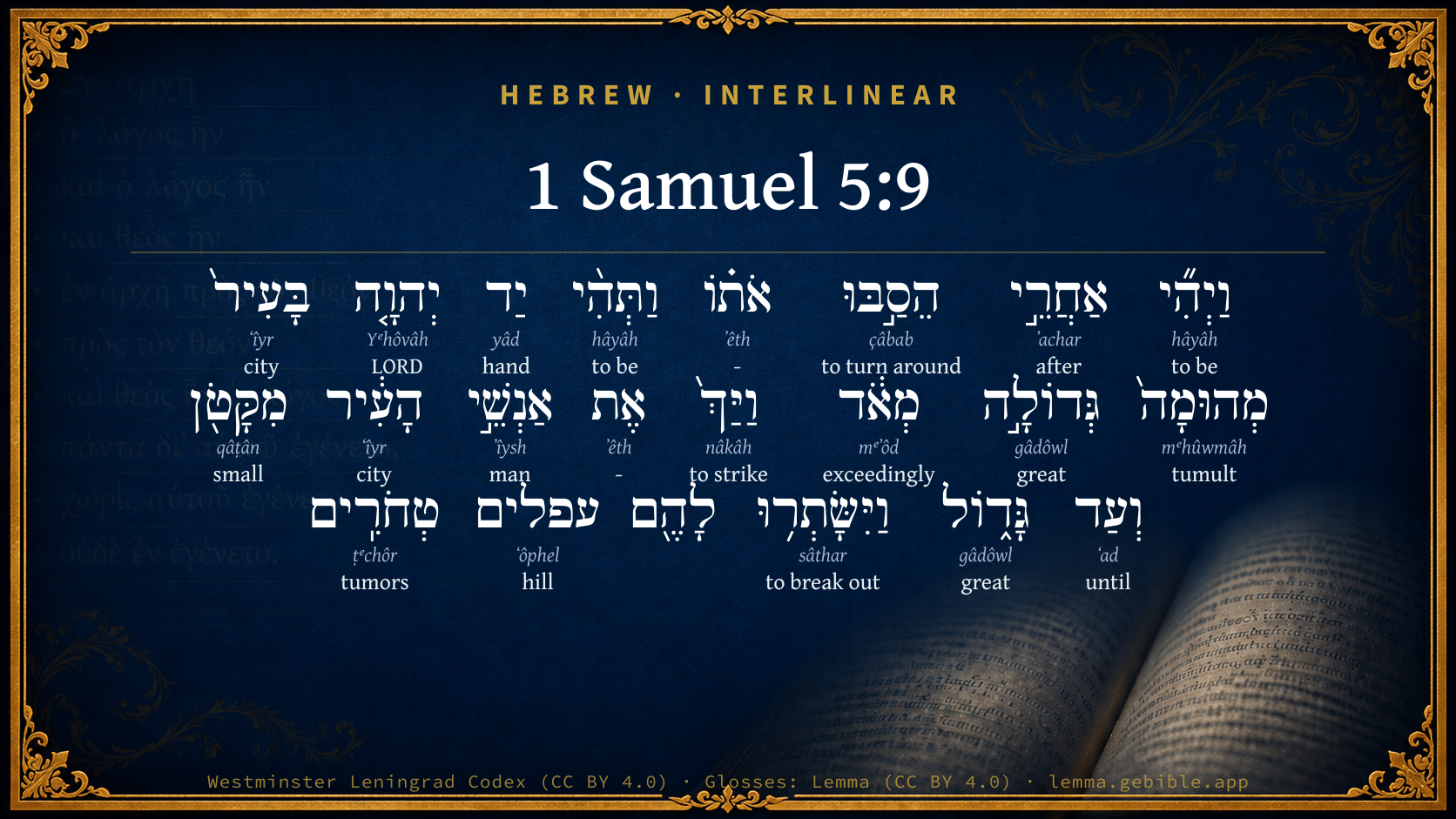
1 Samuel 5:9

Hebrew (Westminster Leningrad Codex) 1 Samuel 5:9 appears in the Hebrew Old Testament. The text above is from the Westminster Leningrad Codex. Each word links to its Strong’s number, a concise gloss, and parsing drawn from the Open Scriptures Hebrew Bible morphology. Click any word for its full Brown-Driver-Briggs (BDB) entry.
Download image
Cite this verse

1 Samuel 5:9 (World English Bible). Public Domain. Lemma interlinear Bible study tool, https://lemma.gebible.app/v/1-samuel/5/9.

Show BibTeX & RIS
BibTeX
RIS
English Translation
It was so, that after they had carried it about, the hand of Yahweh was against the city with a very great confusion: and he struck the men of the city, both small and great; and tumors broke out on them.
World English Bible · Public Domain
Highlights
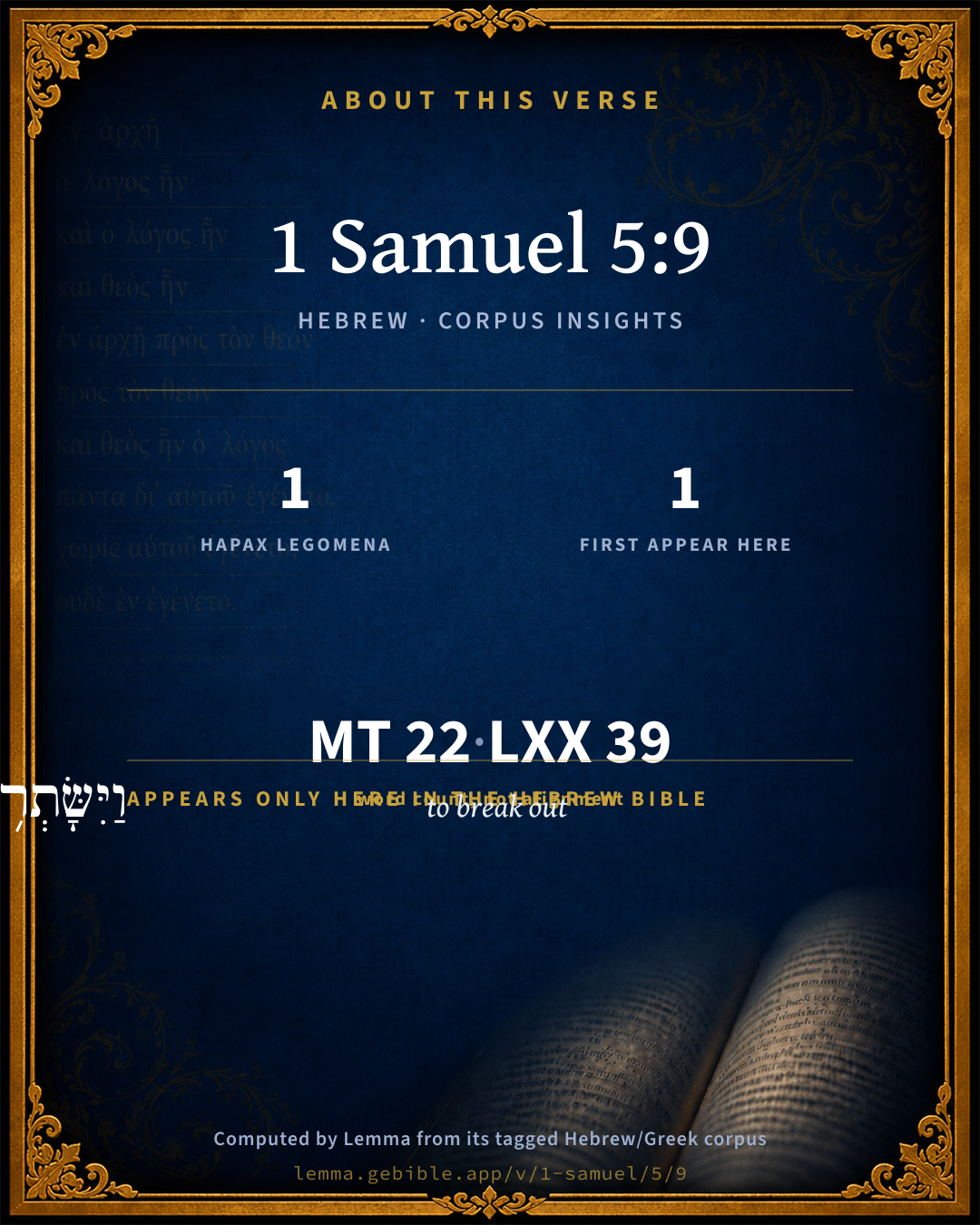
  • 1 hapax legomenon — only here in the Hebrew Bible
  • 1 first appearance in the Hebrew Bible
Full analysis ↓
Download a study sheet

One document with this verse’s original text, its word-by-word gloss line, the meaning frame, cross-references with their text, attributed commentary, and full source and license credits — printable, and it pastes into notes with its structure intact.

This verse Autodidact and up

Study sheet (.html) Plain text (.txt)

A passage Seminary Student

Up to 50 verses in one chapter. A passage sheet keeps up to 6 commentary sources and 12 cross-references per verse, in the order this page ranks them, and says so on the sheet whenever that leaves anything out. Ask for a single verse and you get the Autodidact verse sheet above.

Everything on this page stays free to read, with no account — the sheet is a download of what is already on screen, not access to it.

Want to remove ads? Support Godless Engineer
Compare translations 3

The same verse in 3 English versions, stacked beneath the original-language interlinear above. Click any original word for its lexicon entry.

Each is an independent rendering of the whole verse — the interlinear is not word-aligned to these translations.

Highlighted words mark where these versions differ — a whole-verse word diff, not a word-by-word alignment.

  • World English Bible Public Domain
    It was so, that after they had carried it about, the hand of Yahweh was against the city with a very great confusion: and he struck the men of the city, both small and great; and tumors broke out on them.
  • King James Version Public Domain
    And it was so, that, after they had carried it about, the hand of the LORD was against the city with a very great destruction: and he smote the men of the city, both small and great, and they had emerods in their secret parts.
  • unfoldingWord Literal Text CC BY-SA 4.0
    And it happened after they brought it around that the hand of Yahweh was on the city, a very great tumult. And he struck the men of the city from small and unto great. And tumors broke out on them.

unfoldingWord Literal Text — © unfoldingWord, licensed CC BY-SA 4.0. Word-aligned USFM3 via Door43 (git.door43.org/unfoldingWord/en_ult).

Versions to compare (up to 4)

3 of 4 selected

Show all 18 translations

Every available English version of this verse, each an independent rendering of the whole verse.

  • World English Bible Public Domain
    It was so, that after they had carried it about, the hand of Yahweh was against the city with a very great confusion: and he struck the men of the city, both small and great; and tumors broke out on them.
  • Berean Standard Bible Public Domain
    But after they had moved the ark to Gath, the LORD’s hand was also against that city, throwing it into great confusion and afflicting the men of the city, both young and old, with an outbreak of tumors.
  • Majority Standard Bible Public Domain
    But after they had moved the ark to Gath, the LORD’s hand was also against that city, throwing it into great confusion and afflicting the men of the city, both young and old, with an outbreak of tumors.
  • King James Version Public Domain
    And it was so, that, after they had carried it about, the hand of the LORD was against the city with a very great destruction: and he smote the men of the city, both small and great, and they had emerods in their secret parts.
  • American Standard Version (1901) Public Domain
    And it was so, that, after they had carried it about, the hand of Jehovah was against the city with a very great discomfiture: and he smote the men of the city, both small and great; and tumors brake out upon them.
  • Revised Version (1885) Public Domain
    And it was so, that, after they had carried it about, the hand of the LORD was against the city with a very great discomfiture: and he smote the men of the city, both small and great, and tumours brake out upon them.
  • Geneva Bible (1599) Public Domain
    And when they had caried it about, the hand of the Lord was against the citie with a very great destruction, and he smote the men of the citie both small and great, and they had emerods in their secret partes.
  • Douay-Rheims (1899) Public Domain
    And while they were carrying it about, the band of the Lord came upon every city with an exceeding great slaughter: and he smote the men of every city, both small and great, and they had emerods in their secret parts. And the Gethrites consulted together, and made themselves seats of skins.
  • Young's Literal Translation Public Domain
    and it cometh to pass after they have brought it round, that the hand of Jehovah is against the city -- a very great destruction; and He smiteth the men of the city, from small even unto great; and break forth on them do emerods.
  • Literal Standard Version CC BY-SA 4.0
    and it comes to pass after they have brought it around, that the hand of YHWH is against the city—a very great destruction; and He strikes the men of the city, from small and to great; and lumps break forth on them.
  • Unlocked Literal Bible CC BY-SA 4.0
    But after they brought it around, Yahweh's hand was against the city, causing a very great confusion. He afflicted the men of the city, both small and great; and tumors broke out on them.
  • unfoldingWord Literal Text CC BY-SA 4.0
    And it happened after they brought it around that the hand of Yahweh was on the city, a very great tumult. And he struck the men of the city from small and unto great. And tumors broke out on them.
  • Darby Bible Public Domain
    And it came to pass that, after they had carried it about, the hand of Jehovah was against the city with very great panic; and he smote the men of the city, both small and great, and hemorrhoids broke out upon them.
  • World Messianic Bible Public Domain
    It was so, that after they had carried it there, the LORD’s hand was against the city with a very great confusion; and he struck the men of the city, both small and great, so that tumors broke out on them.
  • Webster's Bible Public Domain
    And it was so, that after they had carried it thither, the hand of the LORD was against the city with a very great destruction: and he smote the men of the city both small and great, and they had emerods in their secret parts.
  • Free Bible Version CC BY-SA 4.0
    But once they'd moved the Ark to Gath, the Lord also took action against that town, throwing it into great confusion and attacking the people of the town, young and old, with a plague of swellings.
  • Bible in Basic English Public Domain
    But after they had taken it away, the hand of the Lord was stretched out against the town for its destruction: and the signs of disease came out on all the men of the town, small and great.
  • JPS Tanakh (1917) Public Domain
    And it was so, that, after they had carried it about, the hand of the LORD was against the city with a very great discomfiture; and He smote the men of the city, both small and great, and emerods broke out upon them.

Literal Standard Version (2020), Covenant Press — licensed CC BY-SA 4.0. Text via the HelloAO Bible API (eBible.org). Unlocked Literal Bible (unfoldingWord) — licensed CC BY-SA 4.0. Text via the HelloAO Bible API (eBible.org). unfoldingWord Literal Text — © unfoldingWord, licensed CC BY-SA 4.0. Word-aligned USFM3 via Door43 (git.door43.org/unfoldingWord/en_ult). Free Bible Version, Dr. Jonathan Gallagher — licensed CC BY-SA 4.0. Text via the HelloAO Bible API (eBible.org).

Word by word

More ways to search: Search by grammar → Find every occurrence → Compare this word →

Practice this passage: Drill this verse → Learn its vocabulary →

וַיִּשָּׂתְר֥וּ
sâthar
H8368
“and · to break out”
Conjunction + Verb, Niphal, Sequential Imperfect, 3rd Person, Masculine, Plural
Part of Speech
Conjunction + Verb
Stem
Niphal
Form
Sequential Imperfect
Person
3rd Person
Gender
Masculine
Number
Plural
Full BDB Definition

Origin: a primitive root

TWOT: 2297

(Niphal) to burst out, break out
  1. וַיְהִ֞י hâyâh H1961 “and · to be” Conjunction + Verb, Qal, Sequential Imperfect, 3rd Person, Masculine, Singular
  2. אַחֲרֵ֣י ʼachar H310 “after” Preposition
  3. הֵסַ֣בּוּ çâbab H5437 “to turn around” Verb, Hiphil, Perfect, 3rd Person, Common, Plural
  4. אֹת֗וֹ ʼêth H853 “- · him” Particle, Direct Object + Suffix, Personal, 3rd Person, Masculine, Singular
  5. וַתְּהִ֨י hâyâh H1961 “and · to be” Conjunction + Verb, Qal, Sequential Imperfect, 3rd Person, Feminine, Singular
  6. יַד yâd H3027 “hand of” Noun, Common, Both, Singular, Construct
  7. יְהוָ֤ה Yᵉhôvâh H3068 “LORD” Noun, Proper
  8. בָּעִיר֙ ʻîyr H5892 “in/at the · city” Preposition, Determined + Noun, Common, Feminine, Singular, Absolute
  9. מְהוּמָה֙ mᵉhûwmâh H4103 “tumult” Noun, Common, Feminine, Singular, Absolute
  10. גְּדוֹלָ֣ה gâdôwl H1419 “great” Adjective, Adjective, Feminine, Singular, Absolute
  11. מְאֹ֔ד mᵉʼôd H3966 “exceedingly” Adverb
  12. וַיַּךְ֙ nâkâh H5221 “and · to strike” Conjunction + Verb, Hiphil, Sequential Imperfect, 3rd Person, Masculine, Singular
  13. אֶת ʼêth H853 “-” Particle, Direct Object
  14. אַנְשֵׁ֣י ʼîysh H376 “men of” Noun, Common, Masculine, Plural, Construct
  15. הָעִ֔יר ʻîyr H5892 “the · city” Particle, Definite Article + Noun, Common, Feminine, Singular, Absolute
  16. מִקָּטֹ֖ן qâṭân H6996 “from · small” Preposition + Adjective, Adjective, Masculine, Singular, Absolute
  17. וְעַד ʻad H5704 “and · until” Conjunction + Preposition
  18. גָּד֑וֹל gâdôwl H1419 “great” Adjective, Adjective, Masculine, Singular, Absolute
  19. עפלים ʻôphel H6076 “tumors” Noun, Common, Masculine, Plural, Absolute
  20. טְחֹרִֽים ṭᵉchôr H2914 “tumors” Noun, Common, Masculine, Plural, Absolute

About this verse

These counts appear in no published source. They are computed here, from the morphology-tagged text and Lemma’s own curated glosses. What Lemma adds →

22
words
17
distinct lemmas
Historical
section

Notable vocabulary

1 hapax legomenon — a word that appears only here in the entire Hebrew Bible:

  • וַיִּשָּׂתְר֥וּ to break out H8368

First appearance in Scripture

This word makes its first canonical appearance in the Hebrew Bible here:

  • וַיִּשָּׂתְר֥וּ to break out H8368

Shared distinctive vocabulary

טְחֹרִֽים tumors H2914 occurs in 8 verses of the Hebrew Bible. Also found in:

Grammatical profile

  • 5 verbs
  • 8 nouns
  • 3 adjectives
  • 3 prepositions
  • 1 adverb
  • 2 particles

Verb forms

  • וַיְהִ֞י Qal · Sequential Imperfect
  • הֵסַ֣בּוּ Hiphil · Perfect
  • וַתְּהִ֨י Qal · Sequential Imperfect
  • וַיַּךְ֙ Hiphil · Sequential Imperfect
  • וַיִּשָּׂתְר֥וּ Niphal · Sequential Imperfect

Repetition

Words recur within this verse — often emphatic in Hebrew:

  • וַיְהִ֞י to be H1961 ×2
  • בָּעִיר֙ city H5892 ×2
  • גְּדוֹלָ֣ה great H1419 ×2

Hebrew & Septuagint length

In English translation the verse runs 41 words from the Hebrew and 52 from the Septuagint (LXX English) — closely comparable.

A rough comparison of the two English renderings, which tokenize alike — not a word-level alignment.

Word counts can differ between the Hebrew and the Greek without any difference in meaning — e.g. the Hebrew direct-object marker אֵת has no separate Greek word, and Greek often adds the article ὁ.

In the original languages it is 22 Hebrew tokens and 39 Greek tokens — but the two are counted differently (Hebrew bundles its prefixes and suffixes into one token; the Greek is in lemma form), so that isn’t a like-for-like length.

Cross-references

10

Topical passages linked to 1 Samuel 5:9 in the Treasury of Scripture Knowledge — connected by theme and wording, ordered by reader-vote popularity; previews shown in the World English Bible.

  • 1 Samuel 5:6 But the hand of Yahweh was heavy on them of Ashdod, and he destroyed them, and struck them with tumors, even Ashdod and the borders of it.
  • Deuteronomy 2:15 Moreover the hand of Yahweh was against them, to destroy them from the midst of the camp, until they were consumed.
  • 1 Samuel 7:13 So the Philistines were subdued, and they came no more within the border of Israel: and the hand of Yahweh was against the Philistines all the days of Samuel.
  • 1 Samuel 12:15 but if you will not listen to the voice of Yahweh, but rebel against the commandment of Yahweh, then will the hand of Yahweh be against you, as it was against your fathers.
  • Psalms 78:66 He struck his adversaries backward. He put them to a perpetual reproach.
  • 1 Samuel 5:11 They sent therefore and gathered together all the lords of the Philistines, and they said, Send away the ark of the God of Israel, and let it go again to its own place, that it not kill us and our people. For there was a deadly confusion throughout all the city; the hand of God was very heavy there.
  • 1 Samuel 6:4–5 Then they said, "What shall be the trespass-offering which we shall return to him?" They said, "Five golden tumors, and five golden mice, [according to] the number of the lords of the Philistines; for one plague was on you all, and on your lords.
  • 1 Samuel 6:11 and they put the ark of Yahweh on the cart, and the coffer with the mice of gold and the images of their tumors.
  • Amos 5:19 As if a man fled from a lion, And a bear met him; Or he went into the house and leaned his hand on the wall, And a snake bit him.
  • Amos 9:1–4 I saw the Lord standing beside the altar, and he said, "Strike the tops of the pillars, that the thresholds may shake; and break them in pieces on the head of all of them; and I will kill the last of them with the sword: there shall not one of them flee away, and there shall not one of them escape.

Cross-references courtesy of OpenBible.info (CC BY 4.0).

Hebrew and Greek witnesses Masoretic Hebrew ↔ Greek Septuagint

The same verse in the two great witnesses to the Old Testament, shown verse-for-verse.

These are two independent witnesses, not word-aligned to each other, and the Septuagint is shown in lemma (dictionary) form.

Hebrew 1 Samuel 5:9 Masoretic · Westminster Leningrad Codex

וַיְהִ֞י אַחֲרֵ֣י הֵסַ֣בּוּ אֹת֗וֹ וַתְּהִ֨י יַד יְהוָ֤ה בָּעִיר֙ מְהוּמָה֙ גְּדוֹלָ֣ה מְאֹ֔ד וַיַּךְ֙ אֶת אַנְשֵׁ֣י הָעִ֔יר מִקָּטֹ֖ן וְעַד גָּד֑וֹל וַיִּשָּׂתְר֥וּ לָהֶ֖ם עפלים טְחֹרִֽים

It was so, that after they had carried it about, the hand of Yahweh was against the city with a very great confusion: and he struck the men of the city, both small and great; and tumors broke out on them.

World English Bible · Public Domain

Greek LXX 1 Samuel 5:9 Septuagint · lemma form

καί γίγνομαι μετά ὁ μεταἔρχομαι αὐτός καί γίγνομαι χείρ κύριος ἐν ὁ πόλις τάραχος μέγας σφόδρα καί πατάσσω ὁ ἀνήρ ὁ πόλις ἀπό μικρός ἕως μέγας καί πατάσσω αὐτός εἰς ὁ ἕδρα αὐτός καί ποιέω ἑαυτοῦ ὁ γεθθαῖος ἕδρα

And it came to pass after it went about to Geth, that the hand of the Lord comes upon the city, a very great confusion; and he struck the men of the city small and great, and struck them in their secret parts: and the Gittites made to themselves images of tumors.

LXX2012 (modern English Septuagint) · Public Domain

On this verse, Adam Clarke's Commentary discusses the Septuagint’s reading. Read the note in Commentary ↓

Hebrew: Westminster Leningrad Codex (CC BY 4.0). Greek: Septuagint (public domain); English from LXX2012 (modern English Septuagint) (Public Domain). How the Septuagint differs from the Hebrew →

Targum (Aramaic paraphrase)

1

The Targum is the ancient Jewish Aramaic paraphrase of the Hebrew Scriptures — an interpretive translation, not the Hebrew text itself. Onkelos (literal) and Pseudo-Jonathan (expansive) render the Torah, and Jonathan the Prophets. Coverage is partial: where no permissively-licensed English translation exists for a verse, only the Aramaic is shown. This is verse-level text, not a word-by-word alignment to the Hebrew.

  1. Targum Jonathan Prophets (Joshua–Malachi)
    וַהֲוָה בָּתַר דְאַסְחָרוּ יָתֵיהּ וַהֲוַת מְחָתָא דַייָ בְּקַרְתָּא שִׁגוּשָׁא רַבָּא לַחֲדָא וּמְחָא יַת אֱנָשֵׁי קַרְתָּא מִזְעֵירָא וְעַד רַבָּא וּלְקוֹ לְהוֹן בִּטְחוֹרִין:

    (no public-domain English translation for this verse)

    Targum Jonathan — Aramaic: “Mikraot Gedolot” (public domain). English: “Sefaria Community Translation” (CC0 1.0 (public-domain dedication)); “London "Chaldee Paraphrase," 1871” (public domain). Text via Sefaria.

Commentary

Notes on 1 Samuel 5:9 from classic Christian and Jewish commentators (each source and its license shown beneath its notes). The classic Christian expositions comment on the surrounding passage and are grouped to its opening verse, so a note may address several verses; the Jewish commentaries on the Tanakh (Rashi and others) are per-verse, so they appear only where the commentator wrote on this verse.

Lemma curates 59 commentaries, every one of them public domain or Creative Commons licensed, each selected and text-cleaned for this edition rather than reprinted as found. About our sources →

Trapp's Complete Commentary

John Trapp

1Sa 5:9 And it was [so], that, after they had carried it about, the hand of the LORD was against the city with a very great destruction: and he smote the men of the city, both small and great, and they had emerods in their secret parts.

Ver. 9. And they had emerods in their secret parts.] Much worse than the inhabitants of Ashdod, as being more inward, and therefore more painful, and hard to come at, or to be cured. {a} Such as was that direful disease whereof died Jehoram, Antiochus, Arrius, Arminius, who died of an incessant pain in his belly.

{a} Secundum genus haemorrhoidis, et multo gravius, ut omnes testantur medici.

John Trapp, A Commentary or Exposition upon All the Books of the Old and New Testament (1647–1656) — public domain. Text from a community e-Sword module.

Joseph Benson's Commentary

1Sa 5:9. They had emerods in their secret (or hidden) parts — That is, internally, in their hinder parts; which is the worst kind of emerods, as all physicians acknowledge, both because their pains are far more sharp than those of the other kind, and because the malady is more out of the reach of remedies.

Joseph Benson's Commentary on the Old and New Testaments (1811–1818) — public domain. Text from a community e-Sword module.

Tyndale Open Study Notes

Tyndale Open Resources

5:9 God often used great panic to incapacitate and overwhelm Israel’s enemies (14:15, 20; Deut 7:23; Ezek 22:5; Amos 3:9).

Tyndale Open Study Notes — © Tyndale Open Resources, licensed CC BY-SA 4.0. Text via the HelloAO Bible API.

Adam Clarke's Commentary

Verse 9. The hand of the Lord was against the city] As it was at Ashdod, so it was at Gath. The Vulgate says, Et computrescebant prominenter extales eorum; which conveys the idea of a bloody flux, dysentery, and ulcerated anus; and it adds, what is not to be found in the Hebrew text, nor many of the versions, except some traces in the Septuagint, Et fecerunt sibi sedes pelliceas, "And they made unto themselves seats of skins;" for the purpose of sitting more easy, on account of the malady already mentioned.

Adam Clarke's Commentary on the Bible (1810–1826) — public domain. Text from a community e-Sword/MySword module.

The Cambridge Bible for Schools and Colleges

gen. ed. J. J. S. Perowne

9. with a very great destruction] Better, with an exceeding great panic, causing utter consternation.

both small and great] i.e. both young and old: all the inhabitants.

and they had emerods in their secret parts] Better, and boils broke out upon them.

The Cambridge Bible for Schools and Colleges (gen. ed. J. J. S. Perowne; Cambridge University Press, 1878–1918) — public domain. Text from a community e-Sword module.

John Gill's Exposition

And it was so, that after they had carried it about,.... And at last placed it in the city of Gath:

the hand of the Lord was against the city with a very great destruction: greater than that at Ashdod, more persons were destroyed; the distemper sent among them was more epidemic and mortal:

and he smote the men of the city, both small and great; high and low, persons of every class, rank, and station, young and old, men, women, and children:

and they had emerods in their secret parts; and so had the men of Ashdod; and the design of this expression is, not to point at the place where they were, which it is well known they are always in those parts, but the different nature of them; the emerods or piles of the men of Ashdod were more outward, these more inward, and so more painful, and not so easy to come at, and more difficult of cure; for the words may be rendered:

and the emerods were hidden unto them (z); were inward, and out of sight; and perhaps this disease as inflicted on them might be more grievous than it commonly is now. Josephus (a) wrongly makes these to be the Ashkalonites, when they were the men of Gath.

(z) "et absconditi erant", Montanus; so Vatablus, Junius & Tremellius. (a) Ut supra. (Antiqu. l. 6. c. 1. sect. 1.)

John Gill's Exposition of the Whole Bible (1746–1763) — public domain (CC PDM 1.0). Text via the HelloAO Bible API.

Haydock's Catholic Bible Commentary

Came upon, to punish, as on other occasions, to protect, Ezechiel i. 3., and xiii. 9. (Menochius) --- Parts. Literally, "Their lower intestines coming out, rotted," as [in] ver. 6. (Haydock) --- Hebrew, "their malady was concealed." (Grotius) --- The emerods attacked them inwardly, with the most excruciating pains, for which they could find no remedy. --- Skins. The ancients knew no greater luxury. (Homer, Odyssey i., and iii.) The Hebrew, &., take no notice of this particular; and there are many other omissions in the Books of Kings, which have been supplied from the Septuagint. (Calmet) --- The skins were used instead of breeches, and to hold up the plaster and other medicines. (Tirinus)

George Leo Haydock (1774–1849), Haydock's Catholic Family Bible and Commentary, 1859 edition — public domain. Excludes Psalms (Douay-Rheims chapter numbering differs from Protestant) and Deuterocanonical books (Catholic canon only).

Matthew Poole's English Annotations

Or,

in their hidden parts, to wit, in the inwards of their hinder parts; which is the worst kind of emerods, as all physicians acknowledge, both because its pains are far more sharp and keen than the other, and because the malady is more out of the reach of remedies.

Matthew Poole's English Annotations on the Holy Bible (1683–1685) — public domain. Text from a community e-Sword/MySword module.

Whedon's Commentary on the Bible

Daniel D. Whedon

9. Hand of the Lord was against the city — In Gath, as in Ashdod, the presence of the ark was the cause of plagues.

A very great destruction — Rather, a very great consternation; that is, by reason of the fearful plagues it spread. מהומה is from הום, to agitate, to throw commotion, Septuagint, ταραχος, tumult, commotion; compare השׁם, to amaze, in 1Sa_5:6.

In their secret parts — These words are adopted from the ancient versions, (Septuagint, Chaldee, Vulgate,) but have nothing to support them in the Hebrew text. Literally the Hebrew, as we render, stands thus: And there broke out on them boils. But what part of the body was thus affected we are not informed. The versions above named, and rabbinical tradition, however, with singular unanimity, represent the disease as affecting the anus. Hence the plausibility of rendering עפלים bleeding piles. This is supposed to receive support from Psa_78:66, where it is said, in reference to this very judgment, He smote his enemies in the hinder parts. But אחור, translated hinder parts, may more properly be rendered back, or backwards, as is done by De Wette, Lengerke, and Alexander, in their works on the Psalms. There is nothing, therefore, in the Hebrew Scriptures to sustain the reference of this disease to any one particular part of the body. For aught that appears to the contrary, these swellings or boils may have broken out all over the body. It may, perhaps, be worth noticing in this connexion that Herodotus (1,105) mentions a plague, which he calls the female disease, (θηλειαν νουσον,) as being inflicted by a goddess of the Philistines upon some Scythians who plundered her ancient temple at Ascalon. According to Hippocrates, this disease came from continual exercise on horseback, and resulted in the loss of virility, whereupon the victims clothed themselves in the attire, and betook themselves to the habits and employments, of women.

Daniel D. Whedon (gen. ed.), Commentary on the Old and New Testaments (1874–1909) — public domain. Text from a community e-Sword module.

The Pulpit Commentary

And they had emerods in their secret parts. The verb used here, sathar, is found in Hebrew only in this place, but is of common occurrence in Syriac and Arabic. Its ordinary meaning in both these languages is to "cover," "conceal," and the A.V, taking it in this sense, supposes that the boils were hidden, and translates as above. But the root has a double meaning, and signifies also "to destroy," though in this sense the Arabic has a slight difference in spelling, namely, shatara instead of satara. The old versions were evidently at a loss in understanding the meaning, though their renderings are suggestive, except the Syriac, which translates quite literally, but leaves thereby the difficulty untouched of the twofold meaning of the word, and the Syro-Arabic lexicons are uncertain which to choose. Some give, "and the emerods hid themselves in them," in the sense of gnawing and burrowing into the flesh, i.e. they became cancerous. Others take the alternative sense, and render, "and the emerods were burst upon them," i.e. became fissured and rent, and turned into open sores. Another translation has been proposed, namely, "the tumours or emerods brake out upon them;" but as the verb, both in the Hebrew and the Syriac, is passive, this rendering can scarcely be defended. Upon the whole, the most probable sense is that the tumours buried themselves deep in the flesh, and becoming thus incurable, ended in causing the death of the sufferers.

The Pulpit Commentary (1880–1919), ed. H.D.M. Spence-Jones & Joseph S. Exell — public domain. Text from a community e-Sword module.

John Wesley's Explanatory Notes

Hidden parts - In the inwards of their hinder parts: which is the worst kind of emerods, as all physicians acknowledge, both because its pains are far more sharp than the other; and because the malady is more out of the reach of remedies.

John Wesley, Explanatory Notes Upon the Whole Bible (1754–1765) — public domain. Text via the GEBible commentary corpus.

Keil & Delitzsch

C. F. Keil & F. Delitzsch

But when the ark was brought to Gath, the hand of Jehovah came upon that city also with very great alarm. גּדולה מהוּמה is subordinated to the main sentence either adverbially or in the accusative. Jehovah smote the people of the city, small and great, so that boils broke out upon their hinder parts.

Keil & Delitzsch — Biblical Commentary on the Old Testament (1861–1891) — public domain (CC PDM 1.0). Text via the HelloAO Bible API. (Old Testament only.)

Rashi

Rabbi Shlomo Yitzchaki (Rashi)

And they were afflicted internally.וַיִשָֹּתְרוּ is identical with וַיִסָּתְרוּ for it is listed in the Masora among those words written with a 'שֹ' and explained as though it were written with a 'ס' meaning "there was a plague in the hidden parts of the body."

Rashi on the Tanakh — English translations: “The Judaica Press complete Tanach with Rashi, translated by A. J. Rosenberg” (CC BY 4.0); “Pentateuch with Rashi's commentary by M. Rosenbaum and A.M. Silbermann, 1929-1934” (public domain); “The Metsudah Tanach series, Lakewood, N.J” (CC BY 4.0); and “The Book of Joshua, Metsudah Publications, 1997” (CC BY 4.0). Text via Sefaria.

Lesson kit

Teaching starters — assembled from the data on this page, not authored interpretation. Every prompt links to the verse data it draws on. Edit before teaching.

1 Samuel, in the Historical, opens this verse with 22 words (17 distinct Hebrew lemmas). Its most distinctive word is sâthar (“to break out”). A historical commentator’s framing appears above. Read the whole chapter for the surrounding context.

Discussion questions

  1. How does “to break out” (sâthar) shape what this verse is saying?
  2. This verse holds 1 word here found nowhere else in the Hebrew Bible. What might the rare word draw attention to?
  3. The word “to break out” first appears here in Scripture. What is being introduced at this debut?
  4. Deuteronomy 28:27 shares the word «tumors» with this verse. How do the two illuminate each other?
  5. “to be” occurs 2× in this one verse. What is the effect of the repetition?
  6. These translations render this verse differently. What is at stake in choosing one wording over another?
  7. The verb «וַיְהִ֞י» is Qal Sequential Imperfect. How does its form color the action?
  8. Reading how Trapp's Complete Commentary and Joseph Benson's Commentary read this verse, where do the two commentators agree and where do they part?

Things to notice

  • 1 word in this verse appears nowhere else in the Hebrew Bible.
  • 1 word makes its first canonical appearance in Scripture here.
  • This verse counts 22 Hebrew ↔ 39 Greek words.
  • These translations choose different wording for 21 words in this verse.
  • “to be” occurs 2× in this single verse.

Reading settings

Reading text

Shown beneath each verse's original-language words.

Old Testament
Old Testament edition

Read the OT as the Masoretic Hebrew (MT) or the Greek Septuagint (LXX).

English shown for the Greek Septuagint (in the Hebrew ↔ Greek comparison).

Comparing translations? Open the Compare panel on any verse page to stack up to four side by side.