
2 Chronicles 23:2

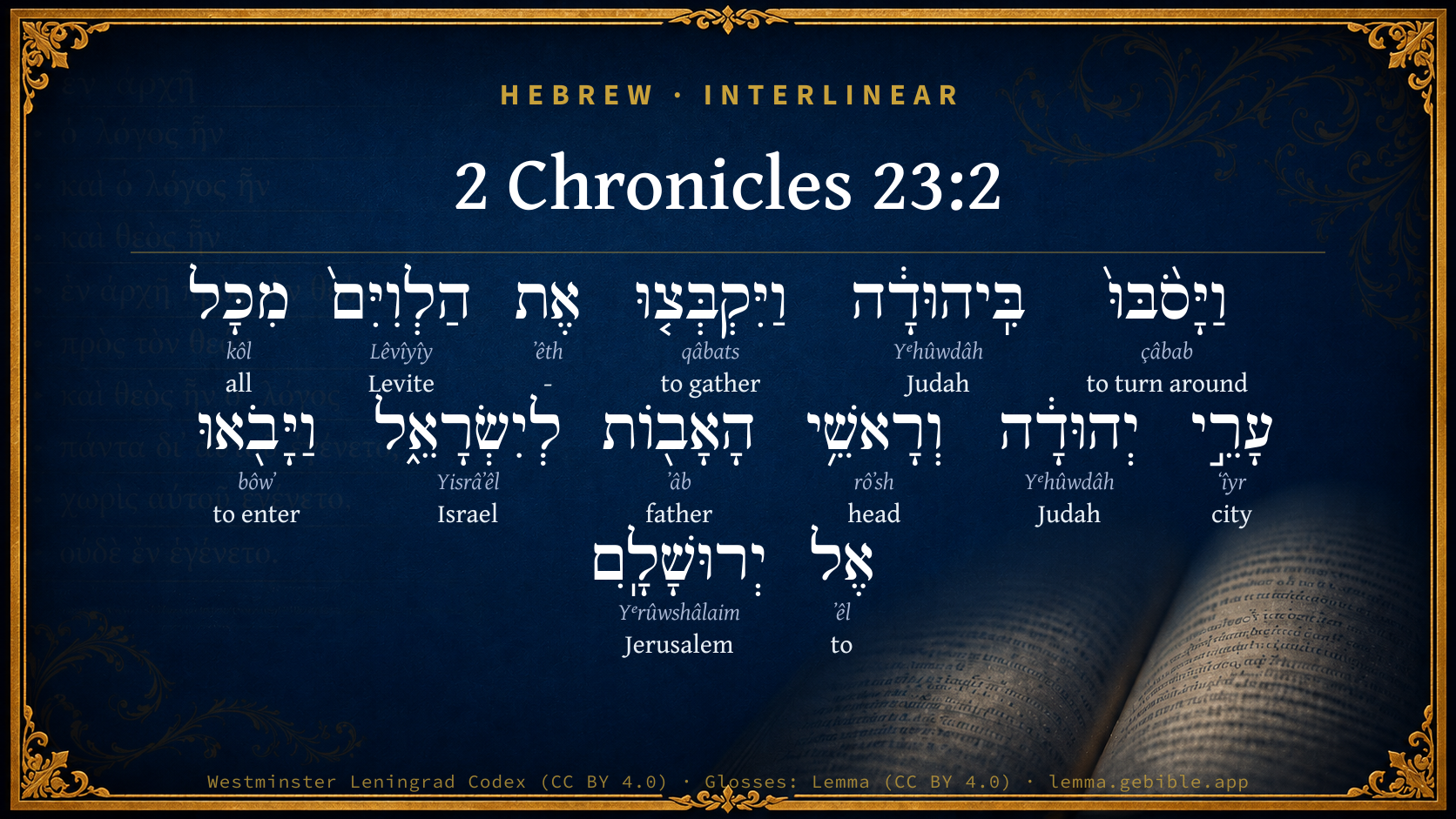
Hebrew (Westminster Leningrad Codex) 2 Chronicles 23:2 appears in the Hebrew Old Testament. The text above is from the Westminster Leningrad Codex. Each word links to its Strong’s number, a concise gloss, and parsing drawn from the Open Scriptures Hebrew Bible morphology. Click any word for its full Brown-Driver-Briggs (BDB) entry.
Download image
Cite this verse

2 Chronicles 23:2 (World English Bible). Public Domain. Lemma interlinear Bible study tool, https://lemma.gebible.app/v/2-chronicles/23/2.

Show BibTeX & RIS
BibTeX
RIS
English Translation
They went about in Judah, and gathered the Levites out of all the cities of Judah, and the heads of fathers' [houses] of Israel, and they came to Jerusalem.
World English Bible · Public Domain
Download a study sheet

One document with this verse’s original text, its word-by-word gloss line, the meaning frame, cross-references with their text, attributed commentary, and full source and license credits — printable, and it pastes into notes with its structure intact.

This verse Autodidact and up

Study sheet (.html) Plain text (.txt)

A passage Seminary Student

Up to 50 verses in one chapter. A passage sheet keeps up to 6 commentary sources and 12 cross-references per verse, in the order this page ranks them, and says so on the sheet whenever that leaves anything out. Ask for a single verse and you get the Autodidact verse sheet above.

Everything on this page stays free to read, with no account — the sheet is a download of what is already on screen, not access to it.

Want to remove ads? Support Godless Engineer
Compare translations 3

The same verse in 3 English versions, stacked beneath the original-language interlinear above. Click any original word for its lexicon entry.

Each is an independent rendering of the whole verse — the interlinear is not word-aligned to these translations.

Highlighted words mark where these versions differ — a whole-verse word diff, not a word-by-word alignment.

  • World English Bible Public Domain
    They went about in Judah, and gathered the Levites out of all the cities of Judah, and the heads of fathers' [houses] of Israel, and they came to Jerusalem.
  • King James Version Public Domain
    And they went about in Judah, and gathered the Levites out of all the cities of Judah, and the chief of the fathers of Israel, and they came to Jerusalem.
  • unfoldingWord Literal Text CC BY-SA 4.0
    And they went around in Judah, and they gathered the Levites from all the cities of Judah and the heads of the fathers of Israel. And they came to Jerusalem.

unfoldingWord Literal Text — © unfoldingWord, licensed CC BY-SA 4.0. Word-aligned USFM3 via Door43 (git.door43.org/unfoldingWord/en_ult).

Versions to compare (up to 4)

3 of 4 selected

Show all 18 translations

Every available English version of this verse, each an independent rendering of the whole verse.

  • World English Bible Public Domain
    They went about in Judah, and gathered the Levites out of all the cities of Judah, and the heads of fathers' [houses] of Israel, and they came to Jerusalem.
  • Berean Standard Bible Public Domain
    So they went throughout Judah and gathered the Levites from all the cities of Judah and the heads of the families of Israel. And when they came to Jerusalem,
  • Majority Standard Bible Public Domain
    So they went throughout Judah and gathered the Levites from all the cities of Judah and the heads of the families of Israel. And when they came to Jerusalem,
  • King James Version Public Domain
    And they went about in Judah, and gathered the Levites out of all the cities of Judah, and the chief of the fathers of Israel, and they came to Jerusalem.
  • American Standard Version (1901) Public Domain
    And they went about in Judah, and gathered the Levites out of all the cities of Judah, and the heads of fathers' `houses' of Israel, and they came to Jerusalem.
  • Revised Version (1885) Public Domain
    And they went about in Judah, and gathered the Levites out of all the cities of Judah, and the heads of fathers’ houses of Israel, and they came to Jerusalem.
  • Geneva Bible (1599) Public Domain
    And they went about in Iudah, and gathered the Leuites out of all the cities of Iudah, and the chiefe fathers of Israel: and they came to Ierusale.
  • Douay-Rheims (1899) Public Domain
    And they went about Juda, and gathered together the Levites out of all the cities of Juda, and the chiefs of the families of Israel, and they came to Jerusalem.
  • Young's Literal Translation Public Domain
    And they go round about in Judah, and gather the Levites out of all the cities of Judah, and heads of the fathers of Israel, and come in unto Jerusalem,
  • Literal Standard Version CC BY-SA 4.0
    And they go around in Judah, and gather the Levites out of all the cities of Judah, and heads of the fathers of Israel, and come to Jerusalem,
  • Unlocked Literal Bible CC BY-SA 4.0
    They went about in Judah and gathered the Levites from all the cities of Judah, as well as the heads of the ancestral houses of Israel, and they came to Jerusalem.
  • unfoldingWord Literal Text CC BY-SA 4.0
    And they went around in Judah, and they gathered the Levites from all the cities of Judah and the heads of the fathers of Israel. And they came to Jerusalem.
  • Darby Bible Public Domain
    And they went about in Judah and gathered together the Levites out of all the cities of Judah, and the chief fathers of Israel; and they came to Jerusalem.
  • World Messianic Bible Public Domain
    They went around in Judah and gathered the Levites out of all the cities of Judah, and the heads of fathers’ households of Israel, and they came to Jerusalem.
  • Webster's Bible Public Domain
    And they went about in Judah, and gathered the Levites out of all the cities of Judah, and the chief of the fathers of Israel, and they came to Jerusalem.
  • Free Bible Version CC BY-SA 4.0
    They traveled all over Judah and brought together the Levites from all the cities of Judah and the family leaders of Israel. When they came to Jerusalem,
  • Bible in Basic English Public Domain
    And they went through Judah, getting together the Levites and the heads of families in Israel from all the towns of Judah, and they came to Jerusalem.
  • JPS Tanakh (1917) Public Domain
    And they went about in Judah, and gathered the Levites out of all the cities of Judah, and the heads of fathers' houses of Israel, and they came to Jerusalem.

Literal Standard Version (2020), Covenant Press — licensed CC BY-SA 4.0. Text via the HelloAO Bible API (eBible.org). Unlocked Literal Bible (unfoldingWord) — licensed CC BY-SA 4.0. Text via the HelloAO Bible API (eBible.org). unfoldingWord Literal Text — © unfoldingWord, licensed CC BY-SA 4.0. Word-aligned USFM3 via Door43 (git.door43.org/unfoldingWord/en_ult). Free Bible Version, Dr. Jonathan Gallagher — licensed CC BY-SA 4.0. Text via the HelloAO Bible API (eBible.org).

Word by word

More ways to search: Search by grammar → Find every occurrence → Compare this word →

Practice this passage: Drill this verse → Learn its vocabulary →

וַיִּקְבְּצ֤וּ
qâbats
H6908
“and · to gather”
Conjunction + Verb, Qal, Sequential Imperfect, 3rd Person, Masculine, Plural
Part of Speech
Conjunction + Verb
Stem
Qal
Form
Sequential Imperfect
Person
3rd Person
Gender
Masculine
Number
Plural
Full BDB Definition

Origin: a primitive root

TWOT: 1983

to gather, assemble - (Qal) to gather, collect, assemble - (Niphal) - to assemble, gather - to be gathered - (Piel) to gather, gather together, take away - (Pual) to be gathered together - (Hithpael) to gather together, be gathered together
  1. וַיָּסֹ֨בּוּ֙ çâbab H5437 “and · to turn around” Conjunction + Verb, Qal, Sequential Imperfect, 3rd Person, Masculine, Plural
  2. בִּֽיהוּדָ֔ה Yᵉhûwdâh H3063 “in/at · Judah” Preposition + Noun, Proper
  3. אֶת ʼêth H853 “-” Particle, Direct Object
  4. הַלְוִיִּם֙ Lêvîyîy H3881 “the · Levites” Particle, Definite Article + Noun, Gentilic, Masculine, Plural, Absolute
  5. מִכָּל kôl H3605 “from · all of” Preposition + Noun, Common, Masculine, Singular, Construct
  6. עָרֵ֣י ʻîyr H5892 “cities of” Noun, Common, Feminine, Plural, Construct
  7. יְהוּדָ֔ה Yᵉhûwdâh H3063 “Judah” Noun, Proper
  8. וְרָאשֵׁ֥י rôʼsh H7218 “and · heads of” Conjunction + Noun, Common, Masculine, Plural, Construct
  9. הָאָב֖וֹת ʼâb H1 “the · fathers” Particle, Definite Article + Noun, Common, Masculine, Plural, Absolute
  10. לְיִשְׂרָאֵ֑ל Yisrâʼêl H3478 “to/for · Israel” Preposition + Noun, Proper
  11. וַיָּבֹ֖אוּ bôwʼ H935 “and · to enter” Conjunction + Verb, Qal, Sequential Imperfect, 3rd Person, Masculine, Plural
  12. אֶל ʼêl H413 “to” Preposition
  13. יְרוּשָׁלִָֽם Yᵉrûwshâlaim H3389 “Jerusalem” Noun, Proper

About this verse

These counts appear in no published source. They are computed here, from the morphology-tagged text and Lemma’s own curated glosses. What Lemma adds →

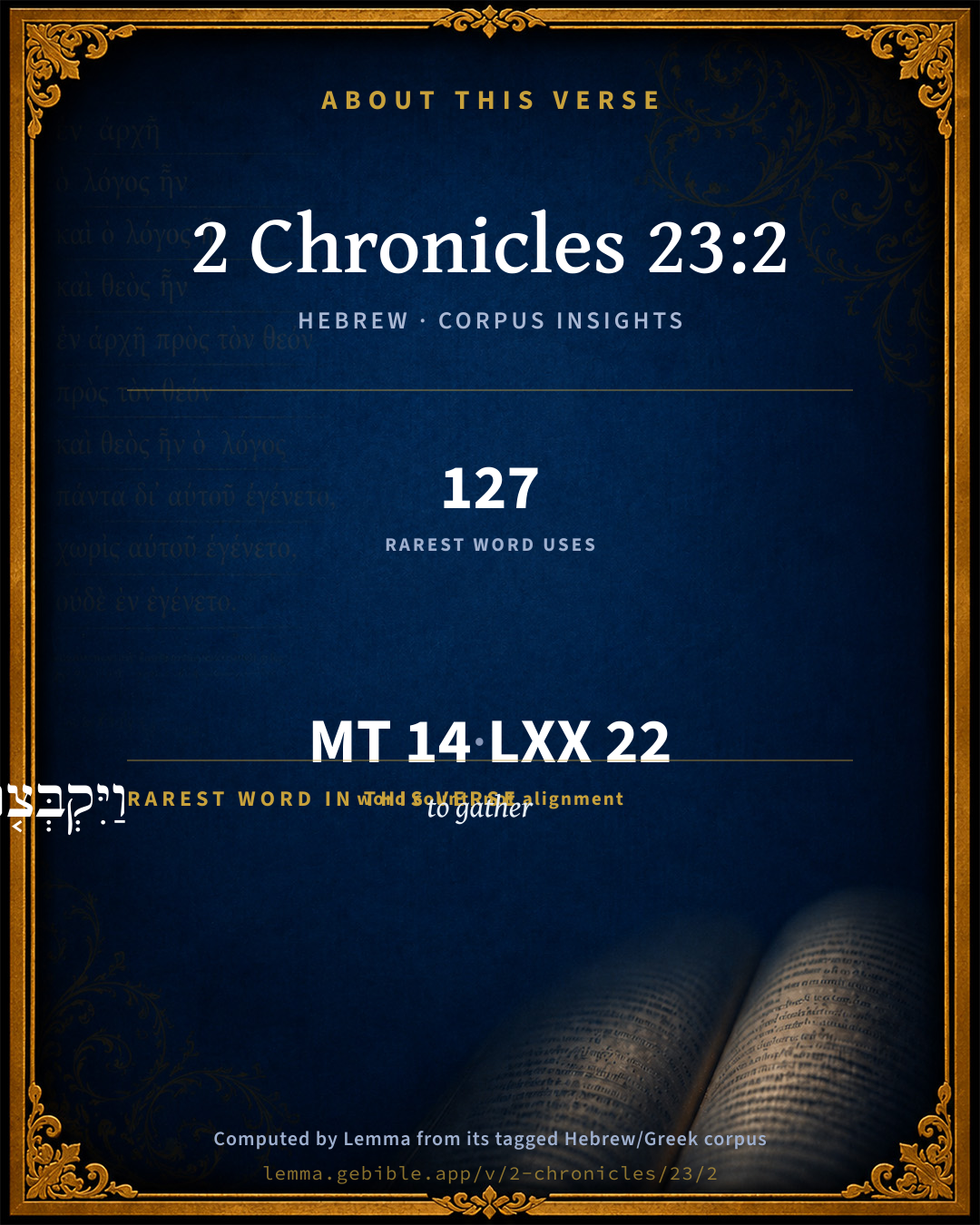
14
words
13
distinct lemmas
Historical
section

Grammatical profile

  • 3 verbs
  • 9 nouns
  • 1 preposition
  • 1 particle

Verb forms

  • וַיָּסֹ֨בּוּ֙ Qal · Sequential Imperfect
  • וַיִּקְבְּצ֤וּ Qal · Sequential Imperfect
  • וַיָּבֹ֖אוּ Qal · Sequential Imperfect

Repetition

A word recurs within this verse — often emphatic in Hebrew:

  • בִּֽיהוּדָ֔ה Judah H3063 ×2

Hebrew & Septuagint length

In English translation the verse runs 29 words from the Hebrew and 29 from the Septuagint (LXX English) — the same length.

A rough comparison of the two English renderings, which tokenize alike — not a word-level alignment.

Word counts can differ between the Hebrew and the Greek without any difference in meaning — e.g. the Hebrew direct-object marker אֵת has no separate Greek word, and Greek often adds the article ὁ.

In the original languages it is 14 Hebrew tokens and 22 Greek tokens — but the two are counted differently (Hebrew bundles its prefixes and suffixes into one token; the Greek is in lemma form), so that isn’t a like-for-like length.

Cross-references

7

Topical passages linked to 2 Chronicles 23:2 in the Treasury of Scripture Knowledge — connected by theme and wording, ordered by reader-vote popularity; previews shown in the World English Bible.

  • 2 Chronicles 11:13–17 The priests and the Levites who were in all Israel resorted to him out of all their border.
  • 1 Chronicles 15:12 and said to them, You are the heads of the fathers' [houses] of the Levites: sanctify yourselves, both you and your brothers, that you may bring up the ark of Yahweh, the God of Israel, to [the place] that I have prepared for it.
  • 1 Chronicles 24:6 Shemaiah the son of Nethanel the scribe, who was of the Levites, wrote them in the presence of the king, and the princes, and Zadok the priest, and Ahimelech the son of Abiathar, and the heads of the fathers' [houses] of the priests and of the Levites; one fathers' house being taken for Eleazar, and one taken for Ithamar.
  • 2 Chronicles 21:2 He had brothers, the sons of Jehoshaphat: Azariah, and Jehiel, and Zechariah, and Azariah, and Michael, and Shephatiah; all these were the sons of Jehoshaphat king of Israel.
  • Psalms 112:5 It is well with the man who deals graciously and lends. He will maintain his cause in judgment.
  • Matthew 10:16 "Behold, I send you out as sheep in the midst of wolves. Therefore be wise as serpents, and harmless as doves.
  • Ephesians 5:15 Therefore watch carefully how you walk, not as unwise, but as wise;

Cross-references courtesy of OpenBible.info (CC BY 4.0).

Hebrew and Greek witnesses Masoretic Hebrew ↔ Greek Septuagint

The same verse in the two great witnesses to the Old Testament, shown verse-for-verse.

These are two independent witnesses, not word-aligned to each other, and the Septuagint is shown in lemma (dictionary) form.

Hebrew 2 Chronicles 23:2 Masoretic · Westminster Leningrad Codex

וַיָּסֹ֨בּוּ֙ בִּֽיהוּדָ֔ה וַיִּקְבְּצ֤וּ אֶת הַלְוִיִּם֙ מִכָּל עָרֵ֣י יְהוּדָ֔ה וְרָאשֵׁ֥י הָאָב֖וֹת לְיִשְׂרָאֵ֑ל וַיָּבֹ֖אוּ אֶל יְרוּשָׁלִָֽם

They went about in Judah, and gathered the Levites out of all the cities of Judah, and the heads of fathers' [houses] of Israel, and they came to Jerusalem.

World English Bible · Public Domain

Greek LXX 2 Chronicles 23:2 Septuagint · lemma form

καί κυκλόω ὁ ἰούδας καί συνἄγω ὁ λευείτης ἐκ πᾶς ὁ πόλις ἰουδά καί ἄρχων πατριά ὁ ἰσραήλ καί ἔρχομαι εἰς ἰερουσαλήμ

And they went round about Juda, and gathered the Levites out of all the cities of Juda, and heads of the families of Israel, and they came to Jerusalem.

LXX2012 (modern English Septuagint) · Public Domain

Hebrew: Westminster Leningrad Codex (CC BY 4.0). Greek: Septuagint (public domain); English from LXX2012 (modern English Septuagint) (Public Domain). How the Septuagint differs from the Hebrew →

Commentary

Notes on 2 Chronicles 23:2 from classic Christian and Jewish commentators (each source and its license shown beneath its notes). The classic Christian expositions comment on the surrounding passage and are grouped to its opening verse, so a note may address several verses; the Jewish commentaries on the Tanakh (Rashi and others) are per-verse, so they appear only where the commentator wrote on this verse.

Lemma curates 59 commentaries, every one of them public domain or Creative Commons licensed, each selected and text-cleaned for this edition rather than reprinted as found. About our sources →

Trapp's Complete Commentary

John Trapp

2Ch 23:2 And they went about in Judah, and gathered the Levites out of all the cities of Judah, and the chief of the fathers of Israel, and they came to Jerusalem.

Ver. 2. And they went about in Judah.] But with so much silence and secrecy, that Athaliah knew nothing of the business See on 2Ki 11:4.

John Trapp, A Commentary or Exposition upon All the Books of the Old and New Testament (1647–1656) — public domain. Text from a community e-Sword module.

Joseph Benson's Commentary

2Ch 23:2. And gathered the Levites out of all the cities of Judah — Because he knew them to be well affected to the cause of God and the king, to which they were bound by the two strongest ties, conscience and interest: and because he could collect them without any suspicion, it being their duty to attend at Jerusalem at the solemn feasts, the time of one which was probably chosen for this purpose. And the chief of the fathers Israel — Judah is here called Israel, as in several other places. They came to Jerusalem — To settle their resolutions with Jehoiada.

Joseph Benson's Commentary on the Old and New Testaments (1811–1818) — public domain. Text from a community e-Sword module.

Geneva Bible (1599)

Geneva Bible translators

Meaning of Judah and Benjamin: read why they are called Israel, 2 Chron. 15:17.

Geneva Bible (1599) marginal notes — public domain. Text via Bolls.life.

Jamieson, Fausset & Brown

Robert Jamieson, A. R. Fausset & David Brown

chief of all the fathers of Israel--This name is frequently used in Chronicles for Judah and Benjamin, now all that remained of Israel. Having cautiously entrusted the secret of the young prince's preservation to all the leading men in the kingdom, he enlisted their interest in the royal cause and got their pledge to support it by a secret oath of fidelity.

they came to Jerusalem--The time chosen for the grand discovery was, probably, one of the annual festivals, when there was a general concourse of the nation at the capital.

Jamieson, Fausset & Brown — Commentary Critical and Explanatory on the Whole Bible (1871) — public domain (CC PDM 1.0). Text via the HelloAO Bible API.

Ellicott's Commentary for English Readers

(2) And they went about in Judah.—2Ch_17:9; 1Sa_7:16.

The chief of the fathers.—The heads of the clans, or chiefs of houses.

This and the next verse are added by the chronicler. In Kings the narrative passes at once to the charge of 2Ch_23:4 : “This is the thing that ye shall do,” which is there addressed to the “captains of the hundreds,” or centurions of the royal guard. In fact, the parallel text is nearly if not altogether silent as to the part played by the Levites in the Restoration; and the chronicler appears to have supplemented that account with materials derived from other authorities, and perhaps from Levitical traditions. That he should have done so, is only consistent with his general practice and the special purpose of his history. At the same time, allowing for certain characteristic additions, interpretations, and substitutions of phrase for phrase, which will be specified in these Notes, the narrative of the chronicler absolutely coincides with that of Kings, treating of the same events, and rigidly observing the same limits, as well as maintaining a general identity of language. We conclude, therefore, that in this case, as elsewhere, the chronicler has used as the groundwork of his relation a historical text which contained sections substantially identical with the present narratives of Kings, but accompanied by numerous details not found in those books.

A Bible Commentary for English Readers, edited by Charles John Ellicott (1878–1897) — public domain. Text from a community e-Sword module.

The Cambridge Bible for Schools and Colleges

gen. ed. J. J. S. Perowne

2. gathered the Levites] This statement is not found in Kings, nor is it there stated as here (2Ch_23:6) that only Levites were allowed inside the Temple to guard the king.

the chief of the fathers] R.V. the heads of fathers’ houses.

Israel] See 2Ch_11:3 (note).

The Cambridge Bible for Schools and Colleges (gen. ed. J. J. S. Perowne; Cambridge University Press, 1878–1918) — public domain. Text from a community e-Sword module.

Albert Barnes' Notes on the Bible

Jehoiada was unwilling to trust the success of the revolution wholly and entirely to the royal body-guard. Accordingly, the captains collected from the cities of Judah a strong body of Levites and the chief of the fathers of Israel (i. e. “Judah,” see 2Ch 20:34 note) who were brought up to Jerusalem.

Albert Barnes' Notes on the Bible (1834–1885) — public domain. Text from a community e-Sword/MySword module.

Haydock's Catholic Bible Commentary

Israel, of which Juda formed a part. M. --- At the time when the author lived, Israel was destroyed, so that there was no danger of a mistake. --- Jerusalem, on a sabbath-day, and most likely on one of the three great festivals: (C.) Salien (the year of the world 3157) thinks at the Passover, to avoid suspicion. M.

George Leo Haydock (1774–1849), Haydock's Catholic Family Bible and Commentary, 1859 edition — public domain. Excludes Psalms (Douay-Rheims chapter numbering differs from Protestant) and Deuterocanonical books (Catholic canon only).

Matthew Poole's English Annotations

Gathered the Levites out of all the cities of Judah; partly because they could do this without any suspicion, upon pretence of some solemn feast; which time, it is probable, was chosen for this purpose; and partly because he knew them to be well affected to the cause of God and the king, to which they were obliged by the two firmest ties, conscience and interest.

The chief of the fathers of Israel, i.e. both of the two tribes, and of the ten tribes, all which are called Israel; and he useth the name of Israel rather than that of Judah, because there were now great numbers of the other tribes incorporated with Judah; and these he esteemed more faithful than many of Judah, having given better proofs of the truth of their religion than they; and therefore he picked out of the chief men of the other tribes as well as of Judah and Benjamin.

Matthew Poole's English Annotations on the Holy Bible (1683–1685) — public domain. Text from a community e-Sword/MySword module.

The Pulpit Commentary

No mention is made in the parallel of the Levites, whom our writer is sure to signalize. The fathers of Israel. The sacredness of the phrase made it dear, above the narrowness of the distinctive appellation Judah, though the worthies all were gathered, as just; implied, out of "Judah."

The Pulpit Commentary (1880–1919), ed. H.D.M. Spence-Jones & Joseph S. Exell — public domain. Text from a community e-Sword module.

Lesson kit

Teaching starters — assembled from the data on this page, not authored interpretation. Every prompt links to the verse data it draws on. Edit before teaching.

2 Chronicles, in the Historical, opens this verse with 14 words (13 distinct Hebrew lemmas). Its most distinctive word is qâbats (“to gather”). A historical commentator’s framing appears above. Read the whole chapter for the surrounding context.

Discussion questions

  1. What does “to gather” (qâbats) contribute to the verse as a whole?
  2. How does 2 Chronicles 11:13–17, which shares this passage’s theme, read alongside this verse?
  3. What does the repetition of “Judah” (2× in this one verse) do in this verse?
  4. These translations render this verse differently. What is at stake in choosing one wording over another?
  5. «וַיָּסֹ֨בּוּ֙» is a Qal Sequential Imperfect verb. How does that grammatical form shape the action described?
  6. Compare how Trapp's Complete Commentary and Joseph Benson's Commentary read this verse. Where do they agree or differ?

Things to notice

Reading settings

Reading text

Shown beneath each verse's original-language words.

Old Testament
Old Testament edition

Read the OT as the Masoretic Hebrew (MT) or the Greek Septuagint (LXX).

English shown for the Greek Septuagint (in the Hebrew ↔ Greek comparison).

Comparing translations? Open the Compare panel on any verse page to stack up to four side by side.