Job 16:13

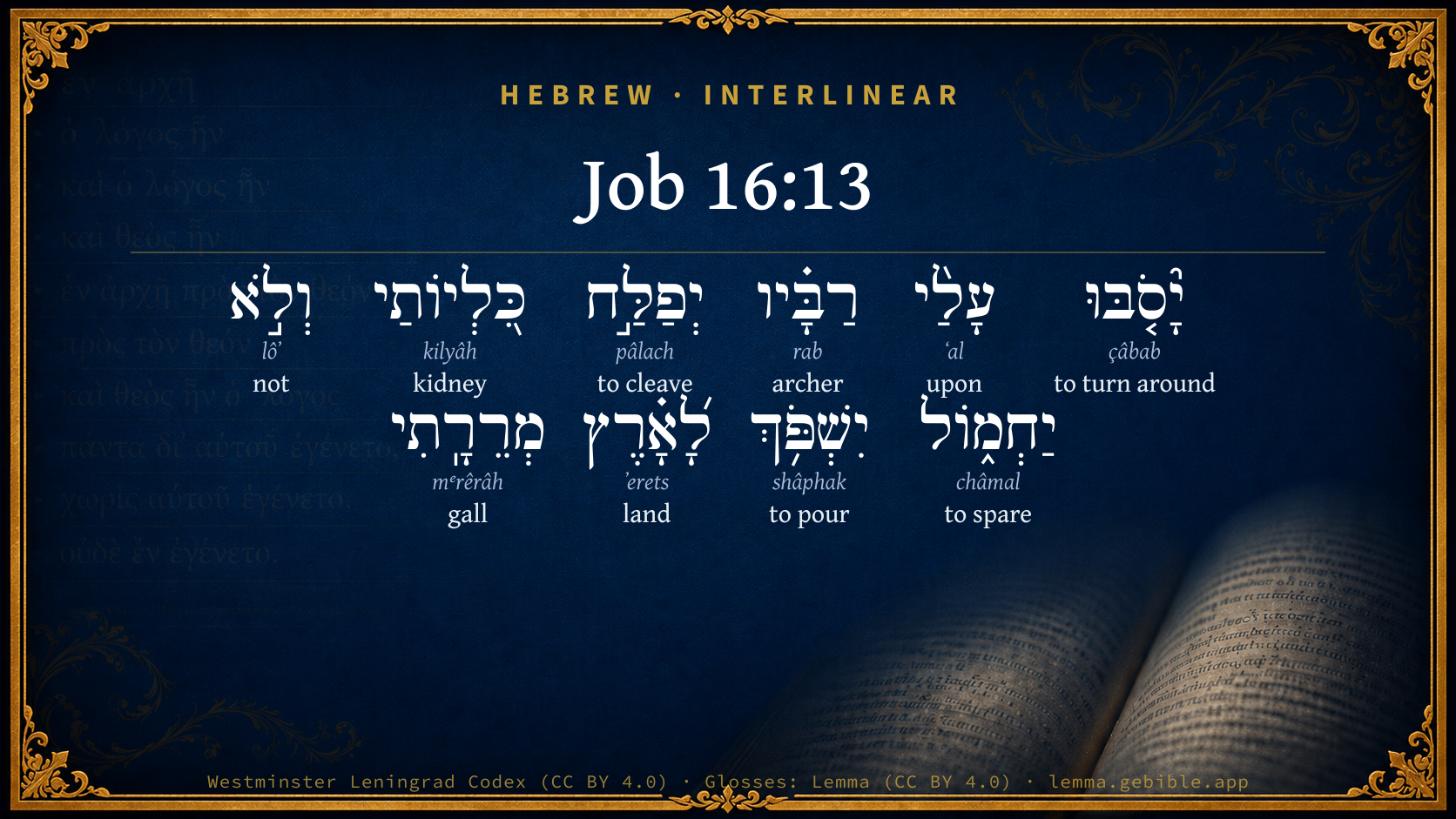
Hebrew (Westminster Leningrad Codex) Job 16:13 appears in the Hebrew Old Testament. The text above is from the Westminster Leningrad Codex. Each word links to its Strong’s number, a concise gloss, and parsing drawn from the Open Scriptures Hebrew Bible morphology. Click any word for its full Brown-Driver-Briggs (BDB) entry.
Download image
Cite this verse

Job 16:13 (World English Bible). Public Domain. Lemma interlinear Bible study tool, https://lemma.gebible.app/v/job/16/13.

Show BibTeX & RIS
BibTeX
RIS
English Translation
His archers surround me. He splits my kidneys apart, and does not spare. He pours out my gall on the ground.
World English Bible · Public Domain
Highlights
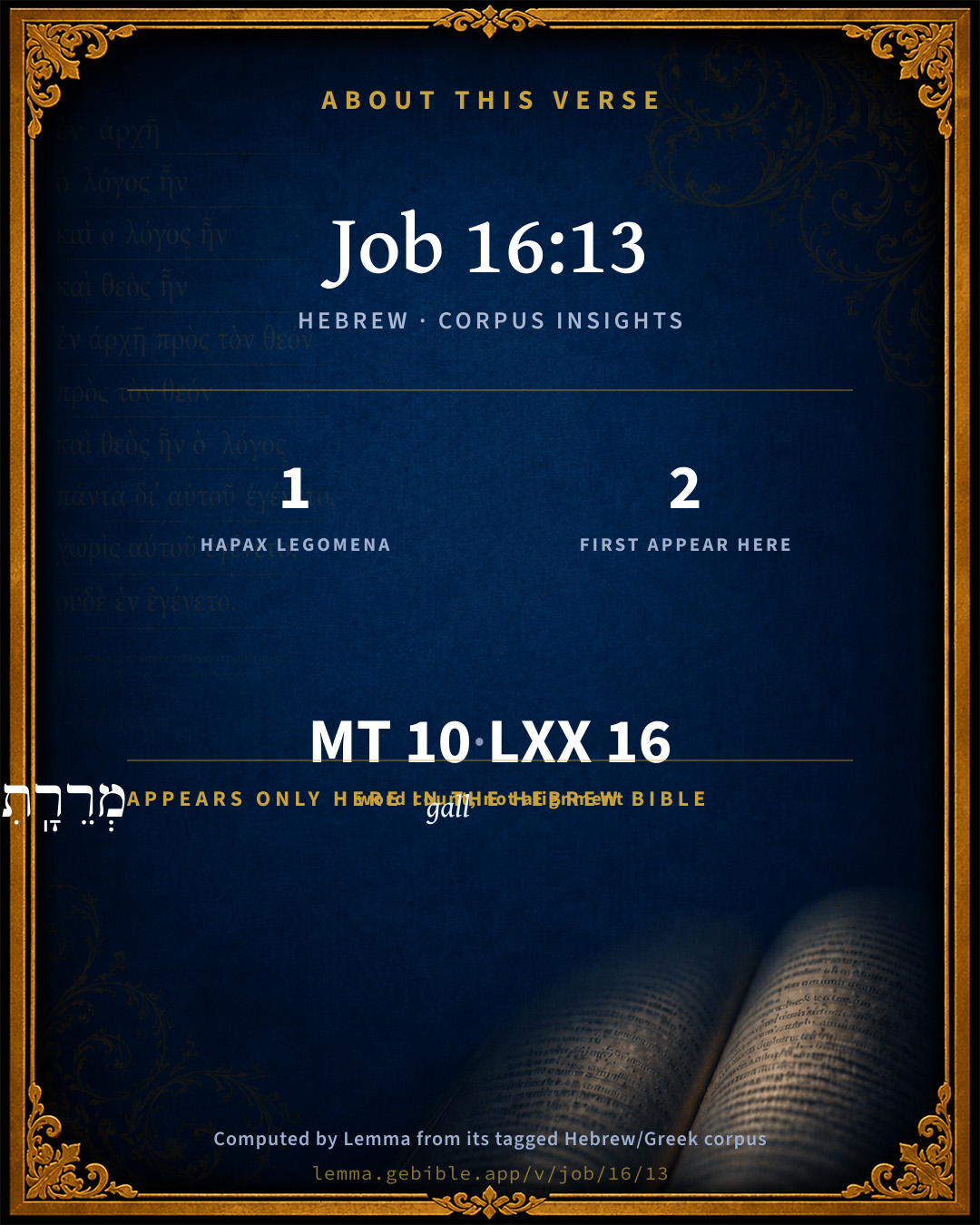
  • 1 hapax legomenon — only here in the Hebrew Bible
  • 2 first appearances in the Hebrew Bible
Full analysis ↓
Download a study sheet

One document with this verse’s original text, its word-by-word gloss line, the meaning frame, cross-references with their text, attributed commentary, and full source and license credits — printable, and it pastes into notes with its structure intact.

This verse Autodidact and up

Study sheet (.html) Plain text (.txt)

A passage Seminary Student

Up to 50 verses in one chapter. A passage sheet keeps up to 6 commentary sources and 12 cross-references per verse, in the order this page ranks them, and says so on the sheet whenever that leaves anything out. Ask for a single verse and you get the Autodidact verse sheet above.

Everything on this page stays free to read, with no account — the sheet is a download of what is already on screen, not access to it.

Want to remove ads? Support Godless Engineer
Compare translations 3

The same verse in 3 English versions, stacked beneath the original-language interlinear above. Click any original word for its lexicon entry.

Each is an independent rendering of the whole verse — the interlinear is not word-aligned to these translations.

Highlighted words mark where these versions differ — a whole-verse word diff, not a word-by-word alignment.

  • World English Bible Public Domain
    His archers surround me. He splits my kidneys apart, and does not spare. He pours out my gall on the ground.
  • King James Version Public Domain
    His archers compass me round about, he cleaveth my reins asunder, and doth not spare; he poureth out my gall upon the ground.
  • unfoldingWord Literal Text CC BY-SA 4.0
    his archers have surrounded me. He pierces my kidneys and he does not spare; he pours my bile on the ground.

unfoldingWord Literal Text — © unfoldingWord, licensed CC BY-SA 4.0. Word-aligned USFM3 via Door43 (git.door43.org/unfoldingWord/en_ult).

Versions to compare (up to 4)

3 of 4 selected

Show all 18 translations

Every available English version of this verse, each an independent rendering of the whole verse.

  • World English Bible Public Domain
    His archers surround me. He splits my kidneys apart, and does not spare. He pours out my gall on the ground.
  • Berean Standard Bible Public Domain
    His archers surround me. He pierces my kidneys without mercy and spills my gall on the ground.
  • Majority Standard Bible Public Domain
    His archers surround me. He pierces my kidneys without mercy and spills my gall on the ground.
  • King James Version Public Domain
    His archers compass me round about, he cleaveth my reins asunder, and doth not spare; he poureth out my gall upon the ground.
  • American Standard Version (1901) Public Domain
    His archers compass me round about; He cleaveth my reins asunder, and doth not spare; He poureth out my gall upon the ground.
  • Revised Version (1885) Public Domain
    His archers compass me round about, he cleaveth my reins asunder, and doth not spare; he poureth out my gall upon the ground.
  • Geneva Bible (1599) Public Domain
    His archers compasse mee rounde about: he cutteth my reines, and doth not spare, and powreth my gall vpon the ground.
  • Douay-Rheims (1899) Public Domain
    I that was formerly so wealthy, am all on a sudden broken to pieces: he hath taken me by my neck, he hath broken me, and hath set me up to be his mark.
  • Young's Literal Translation Public Domain
    Go round against me do his archers. He splitteth my reins, and spareth not, He poureth out to the earth my gall.
  • Literal Standard Version CC BY-SA 4.0
    His archers go around against me. He split my reins, and does not spare, || He pours out my gall to the earth.
  • Unlocked Literal Bible CC BY-SA 4.0
    His archers surround me all around; God pierces my kidneys and does not spare me; he pours out my bile on the ground.
  • unfoldingWord Literal Text CC BY-SA 4.0
    his archers have surrounded me. He pierces my kidneys and he does not spare; he pours my bile on the ground.
  • Darby Bible Public Domain
    His arrows encompass me round about, he cleaveth my reins asunder and doth not spare; he poureth out my gall upon the ground.
  • World Messianic Bible Public Domain
    His archers surround me. He splits my kidneys apart, and does not spare. He pours out my bile on the ground.
  • Webster's Bible Public Domain
    His archers encompass me; he cleaveth my reins asunder, and doth not spare; he poureth out my gall upon the ground.
  • Free Bible Version CC BY-SA 4.0
    His archers surround me. His arrows pierce my kidneys without mercy. He pours out my gall on the ground.
  • Bible in Basic English Public Domain
    His bowmen come round about me; their arrows go through my body without mercy; my life is drained out on the earth.
  • JPS Tanakh (1917) Public Domain
    His archers compass me round about, He cleaveth my reins asunder, and doth not spare; He poureth out my gall upon the ground.

Literal Standard Version (2020), Covenant Press — licensed CC BY-SA 4.0. Text via the HelloAO Bible API (eBible.org). Unlocked Literal Bible (unfoldingWord) — licensed CC BY-SA 4.0. Text via the HelloAO Bible API (eBible.org). unfoldingWord Literal Text — © unfoldingWord, licensed CC BY-SA 4.0. Word-aligned USFM3 via Door43 (git.door43.org/unfoldingWord/en_ult). Free Bible Version, Dr. Jonathan Gallagher — licensed CC BY-SA 4.0. Text via the HelloAO Bible API (eBible.org).

Word by word

More ways to search: Search by grammar → Find every occurrence → Compare this word →

Practice this passage: Drill this verse → Learn its vocabulary →

מְרֵרָֽתִי
mᵉrêrâh
H4845
“gall · my”
Noun, Common, Feminine, Singular, Construct + Suffix, Personal, 1st Person, Common, Singular
Part of Speech
Noun
Type
Common
Gender
Feminine
Number
Singular
State
Construct
Full BDB Definition

Origin: from H4843

TWOT: 1248g

gall
  1. יָ֘סֹ֤בּוּ çâbab H5437 “to turn around” Verb, Qal, Imperfect, 3rd Person, Masculine, Plural
  2. עָלַ֨י ʻal H5921 “upon · me” Preposition + Suffix, Personal, 1st Person, Common, Singular
  3. רַבָּ֗יו rab H7228 “archers · his” Noun, Common, Masculine, Plural, Construct + Suffix, Personal, 3rd Person, Masculine, Singular
  4. יְפַלַּ֣ח pâlach H6398 “to cleave” Verb, Piel, Imperfect, 3rd Person, Masculine, Singular
  5. כִּ֭לְיוֹתַי kilyâh H3629 “kidneys · my” Noun, Common, Feminine, Plural, Construct + Suffix, Personal, 1st Person, Common, Singular
  6. וְלֹ֣א lôʼ H3808 “and · not” Conjunction + Particle, Negative
  7. יַחְמ֑וֹל châmal H2550 “to spare” Verb, Qal, Imperfect, 3rd Person, Masculine, Singular
  8. יִשְׁפֹּ֥ךְ shâphak H8210 “to pour” Verb, Qal, Imperfect, 3rd Person, Masculine, Singular
  9. לָ֝אָ֗רֶץ ʼerets H776 “to/for the · land” Preposition, Determined + Noun, Common, Both, Singular, Absolute

About this verse

These counts appear in no published source. They are computed here, from the morphology-tagged text and Lemma’s own curated glosses. What Lemma adds →

10
words
10
distinct lemmas
Wisdom
section

Notable vocabulary

1 hapax legomenon — a word that appears only here in the entire Hebrew Bible:

  • מְרֵרָֽתִי gall H4845

First appearance in Scripture

These words make their first canonical appearance in the Hebrew Bible here:

  • רַבָּ֗יו archer H7228
  • מְרֵרָֽתִי gall H4845

Shared distinctive vocabulary

רַבָּ֗יו archer H7228 occurs in 2 verses of the Hebrew Bible. Also found in:

Grammatical profile

  • 4 verbs
  • 4 nouns
  • 1 preposition
  • 1 particle

Verb forms

  • יָ֘סֹ֤בּוּ Qal · Imperfect
  • יְפַלַּ֣ח Piel · Imperfect
  • יַחְמ֑וֹל Qal · Imperfect
  • יִשְׁפֹּ֥ךְ Qal · Imperfect

Hebrew & Septuagint length

In English translation the verse runs 21 words from the Hebrew and 28 from the Septuagint (LXX English) — closely comparable.

A rough comparison of the two English renderings, which tokenize alike — not a word-level alignment.

Word counts can differ between the Hebrew and the Greek without any difference in meaning — e.g. the Hebrew direct-object marker אֵת has no separate Greek word, and Greek often adds the article ὁ.

In the original languages it is 10 Hebrew tokens and 16 Greek tokens — but the two are counted differently (Hebrew bundles its prefixes and suffixes into one token; the Greek is in lemma form), so that isn’t a like-for-like length.

Cross-references

12

Topical passages linked to Job 16:13 in the Treasury of Scripture Knowledge — connected by theme and wording, ordered by reader-vote popularity; previews shown in the World English Bible.

  • Job 20:25 He draws it forth, and it comes out of his body. Yes, the glittering point comes out of his liver. Terrors are on him.
  • Job 6:4 For the arrows of the Almighty are within me, My spirit drinks up their poison. The terrors of God set themselves in array against me.
  • Lamentations 2:11 My eyes do fail with tears, my heart is troubled; My liver is poured on the earth, because of the destruction of the daughter of my people, Because the young children and the infants swoon in the streets of the city.
  • Genesis 49:23 The archers have sorely grieved him, Shot at him, and persecute him:
  • Deuteronomy 29:20 Yahweh will not pardon him, but then the anger of Yahweh and his jealousy will smoke against that man, and all the curse that is written in this book shall lie on him, and Yahweh will blot out his name from under the sky.
  • Job 6:10 Be it still my consolation, Yes, let me exult in pain that doesn't spare, That I have not denied the words of the Holy One.
  • Job 19:27 Whom I, even I, shall see on my side. My eyes shall see, and not as a stranger. "My heart is consumed within me.
  • Psalms 7:12–13 If a man doesn't relent, he will sharpen his sword; He has bent and strung his bow.
  • Lamentations 3:13 He has caused the shafts of his quiver to enter into my reins.
  • Ezekiel 5:11 Therefore, as I live, says the Lord Yahweh, surely, because you have defiled my sanctuary with all your detestable things, and with all your abominations, therefore will I also diminish [you]; neither shall my eye spare, and I also will have no pity.
  • Romans 8:32 He who didn't spare his own Son, but delivered him up for us all, how would he not also with him freely give us all things?
  • 2 Peter 2:5 and didn't spare the ancient world, but preserved Noah with seven others, a preacher of righteousness, when he brought a flood on the world of the ungodly;

Cross-references courtesy of OpenBible.info (CC BY 4.0).

Hebrew and Greek witnesses Masoretic Hebrew ↔ Greek Septuagint

The same verse in the two great witnesses to the Old Testament, shown verse-for-verse.

These are two independent witnesses, not word-aligned to each other, and the Septuagint is shown in lemma (dictionary) form.

Hebrew Job 16:13 Masoretic · Westminster Leningrad Codex

יָ֘סֹ֤בּוּ עָלַ֨י רַבָּ֗יו יְפַלַּ֣ח כִּ֭לְיוֹתַי וְלֹ֣א יַחְמ֑וֹל יִשְׁפֹּ֥ךְ לָ֝אָ֗רֶץ מְרֵרָֽתִי

His archers surround me. He splits my kidneys apart, and does not spare. He pours out my gall on the ground.

World English Bible · Public Domain

Greek LXX Job 16:13 Septuagint · lemma form

κυκλόω ἐγώ λόγχη βάλλω εἰς νεφρός ἐγώ οὐ φείδομαι ἐκχέω εἰς ὁ γῆ ὁ χολή ἐγώ

When I was at peace he distracted me: he took me by the hair of the head, and plucked it out: he set me up as a mark.

LXX2012 (modern English Septuagint) · Public Domain

On this verse, Adam Clarke's Commentary discusses the Septuagint’s reading. Read the note in Commentary ↓

Hebrew: Westminster Leningrad Codex (CC BY 4.0). Greek: Septuagint (public domain); English from LXX2012 (modern English Septuagint) (Public Domain). How the Septuagint differs from the Hebrew →

Commentary

Notes on Job 16:13 from classic Christian and Jewish commentators (each source and its license shown beneath its notes). The classic Christian expositions comment on the surrounding passage and are grouped to its opening verse, so a note may address several verses; the Jewish commentaries on the Tanakh (Rashi and others) are per-verse, so they appear only where the commentator wrote on this verse.

Lemma curates 59 commentaries, every one of them public domain or Creative Commons licensed, each selected and text-cleaned for this edition rather than reprinted as found. About our sources →

Trapp's Complete Commentary

John Trapp

Job 16:13 His archers compass me round about, he cleaveth my reins asunder, and doth not spare; he poureth out my gall upon the ground.

Ver. 13. His archers compass me round about] i.e. His instruments of my woe, whether persons or things, but especially my grievous sores putting me through intolerable pain; these are God’s arrows or archers, and do make my poor body not unlike that shield of Sceva, at the siege of Dyrrachium, which had two hundred and twenty darts sticking in it, when Caesar came to his rescue, Densamque ferens in pectore silvam (Luc.).

He cleaveth my reins asunder] As a skilful archer, he hits the white, he cleaves the pin, as they call it, he shooteth exactly (to the very chilling and dissecting of my backbone), and so putteth me to most exquisite pain and torment, Lam 3:13.

He poureth out my gall upon the ground] My bowels, saith the Vulgate. The gall is affixed to the liver, and when that is poured out; the man cannot live, because his wound is mortal and incurable. Job held himself so, but it proved better; the Lord chastened him sore, but he gave him not over to death, Psa 118:18.

John Trapp, A Commentary or Exposition upon All the Books of the Old and New Testament (1647–1656) — public domain. Text from a community e-Sword module.

Joseph Benson's Commentary

Job 16:13-14. His archers compass me round about — His plagues or judgments, elsewhere compared to arrows, and here to archers, surround me on all sides, and assault me from every quarter. Whoever are our enemies, we must look on them as God’s archers, and see him directing the arrow. He cleaveth my reins asunder — He wounds me inwardly, mortally, and incurably; which is also signified by pouring out the gall; such wounds being deadly. “The metaphor,” says Heath, “is here taken from huntsmen. First they surround the beast; then he is shot dead; his entrails are next taken out; and then his body is divided limb from limb.” He breaketh me with breach upon breach — My indignities and miseries have no interruption, but one immediately succeeds another; he runneth upon me like a giant — Who falls upon his enemy with all his might, that he may overthrow and kill him. He assaults me in so violent and powerful a manner, that I can make no more resistance than a dwarf against a giant.

Joseph Benson's Commentary on the Old and New Testaments (1811–1818) — public domain. Text from a community e-Sword module.

Tyndale Open Study Notes

Tyndale Open Resources

16:13 pierce me: Literally pierce my kidneys. • my blood: Literally my gall. The picture is of wounds to vital organs.

Tyndale Open Study Notes — © Tyndale Open Resources, licensed CC BY-SA 4.0. Text via the HelloAO Bible API.

Geneva Bible (1599)

Geneva Bible translators

I am wounded to the heart.

His manifold afflictions.

Geneva Bible (1599) marginal notes — public domain. Text via Bolls.life.

Jamieson, Fausset & Brown

Robert Jamieson, A. R. Fausset & David Brown

his archers--The image of Job 16:12 is continued. God, in making me His "mark," is accompanied by the three friends, whose words wound like sharp arrows.

gall--put for a vital part; so the liver (Lam 2:11).

Jamieson, Fausset & Brown — Commentary Critical and Explanatory on the Whole Bible (1871) — public domain (CC PDM 1.0). Text via the HelloAO Bible API.

Adam Clarke's Commentary

Verse 13. His archers compass me] רביו rabbaiv "his great ones." The Vulgate and Septuagint translate this his spears; the Syriac, Arabic, and Chaldee, his arrows. On this and the following verse Mr. Heath observes: "The metaphor is here taken from huntsmen: first, they surround the beast; then he is shot dead; his entrails are next taken out; and then his body is broken up limb by limb."

Adam Clarke's Commentary on the Bible (1810–1826) — public domain. Text from a community e-Sword/MySword module.

The Cambridge Bible for Schools and Colleges

gen. ed. J. J. S. Perowne

13. The second figure—Job has been set up by God as a mark for His arrows.

his archers] Rather, his arrows, cf. ch. Job_6:4. These arrows fly about him and cleave his vital parts and pour out his life to the ground. The Oriental speaks of the gall and gall-bladder where we might refer to the blood and the heart.

The Cambridge Bible for Schools and Colleges (gen. ed. J. J. S. Perowne; Cambridge University Press, 1878–1918) — public domain. Text from a community e-Sword module.

John Gill's Exposition

He breaketh me with breach upon breach,.... Upon his substance, his family, and the health of his body, which came thick and fast, one after another; referring to the report of those things brought by one messenger upon the back of another, see Eze 7:26;

he runneth upon me like a giant; with great fury and fierceness, with great strength and courage, with great speed and swiftness, causing great terror and distress; he not being able to resist him, any more than a dwarf a giant, and no more, nor so much, a match for him; see Isa 42:13.

John Gill's Exposition of the Whole Bible (1746–1763) — public domain (CC PDM 1.0). Text via the HelloAO Bible API.

Albert Barnes' Notes on the Bible

His archers - He does not come alone to shoot at me; he has employed a company of bowmen, who also direct “their” arrows against me. The word used here רב rab means properly “much, large,” great; and is applied to that which is powerful or mighty. It is nowhere else used in the sense of “archers,” and might be rendered “his many;” that is, his bands, hosts, or armies. But as all the ancient versions render it “arrows,” or “archers,” probably that sense is to be retained. Allusion is here made to those who claimed to be the friends of Job, but who now showed to his apprehension that they were merely sharp-shooters under the control of God, to deepen his woes.

He cleaveth my reins asunder - With his arrows. They penetrate quite through me.

He poureth out my gall - The word “gall” means the “bile” - the yellowish green bitter fluid secreted in the liver. A similar figure occcurs in Lam 2:11, “My liver is poured upon the earth.” Among the pagan poets, also, the “liver” is represented as pierced, and as pouring out gore. Thus, Aesch. Agam. 442: θιγγάνει πρὸς ἧπαρ thinganei pros hēpar. So also 801: Δῆγμα λύπης ἐφ ̓ ἧπαρ προσικνεἴται Dēgma lupēs eph' hēpar prosikneitai. So in the Iliad, xiii. 412, xx. 469, 470. The meaning here is, “I am transfixed with a deadly wound, and must die. God has come upon me as an armed man, and has pierced my vitals.”

Albert Barnes' Notes on the Bible (1834–1885) — public domain. Text from a community e-Sword/MySword module.

Matthew Poole's English Annotations

His archers, i.e. his plagues or judgments, elsewhere compared to arrows, and here to archers.

He cleaveth my reins asunder with his arrows, i.e. he wounds me inwardly, and mortally, and incurably; which also is noted by pouring out the gall; such wounds being deadly.

Matthew Poole's English Annotations on the Holy Bible (1683–1685) — public domain. Text from a community e-Sword/MySword module.

Whedon's Commentary on the Bible

Daniel D. Whedon

13. My reins — The kidneys. “The Scriptures bring the tenderest and the most inward experience of a manifold kind into association with them.” — DELITZSCH, Bib. Psychology, pp. 317-319. Here, in strong figurative language, cutting affliction cleaves the kidneys asunder; language akin to that of our own, “a broken heart.” The psalmist supplicates God to try his reins and his heart, (Job_26:2.) The ancients said the reins give counsel, but the heart carries it into execution.

My gall upon the ground — Used figuratively; the Hebrew doctors understand it literally, and say that Job was sustained in being by a miracle.

Daniel D. Whedon (gen. ed.), Commentary on the Old and New Testaments (1874–1909) — public domain. Text from a community e-Sword module.

The Pulpit Commentary

His archers compass me round about. God is represented, not as himself the shooter of the arrows, but as surrounding Job with a body of archers, who are under his command and carry out his will. So, generally, Scripture represents the judgments of God as carried out by interior agents. (see 2Sa_24:16 1Ch_21:15 2Ki_19:35, etc.) He cleaveth my reins asunder, and doth not spare. The allusion is probably to Job"s physical sufferings, which included severe pains in the lumbar region. He poureth out my gall upon the ground. The rupture of the gallbladder causes the contents to be sprit upon the ground.

The Pulpit Commentary (1880–1919), ed. H.D.M. Spence-Jones & Joseph S. Exell — public domain. Text from a community e-Sword module.

John Wesley's Explanatory Notes

His archers - Whoever are our enemies, we must look on them as God's archers, and see him directing the arrow.

John Wesley, Explanatory Notes Upon the Whole Bible (1754–1765) — public domain. Text via the GEBible commentary corpus.

unfoldingWord translationNotes

Door43 World Missions Community

His archers surround me all around

Job speaks of himself being the focus of God's attacks as if God has set him up as a target and God had archers surrounding him to attack him. AT: "It is as though his archers have me surrounded" (See: Metaphor)

God pierces my kidneys and does not spare me; he pours out my bile on the ground

Job speaks of the pain he is feeling by comparing it to God piercing his body with arrows. Here "God" represents the arrows that he shoots. AT: "It feels like God's arrows have pierced my kidneys and my liver, spilling my bile on the ground. He does not spare me" (See: Metaphor)

He smashes through my wall

Job speaks of the pain that he feels by comparing himself to a wall that God smashes through. AT: "I feel like a wall that God smashes through" or "I feel like a wall that God breaks through" (See: Metaphor)

he runs upon me like a warrior

Job describes God as a soldier that attacks him. AT: "it is like he is a warrior who runs at me to attack me" (See: Metaphor)

translationWords

archer

God

pierce

soldier

unfoldingWord translationNotes — © Distant Shores Media and the Door43 World Missions Community, licensed CC BY-SA 4.0. Source: git.door43.org/Door43/en_tn.

Rashi

Rabbi Shlomo Yitzchaki (Rashi)

His archers רביו, the one who shoots his arrows, as in (Gen. 21:20), “and he became an archer (רבה קשת).”

my gall Heb. מְרֵירָתִי, my gall.

Rashi on the Tanakh — English translations: “The Judaica Press complete Tanach with Rashi, translated by A. J. Rosenberg” (CC BY 4.0); “Pentateuch with Rashi's commentary by M. Rosenbaum and A.M. Silbermann, 1929-1934” (public domain); “The Metsudah Tanach series, Lakewood, N.J” (CC BY 4.0); and “The Book of Joshua, Metsudah Publications, 1997” (CC BY 4.0). Text via Sefaria.

Lesson kit

Teaching starters — assembled from the data on this page, not authored interpretation. Every prompt links to the verse data it draws on. Edit before teaching.

Job, in the Wisdom, opens this verse with 10 words (10 distinct Hebrew lemmas). Its most distinctive word is mᵉrêrâh (“gall”). A historical commentator’s framing appears above. Read the whole chapter for the surrounding context.

Discussion questions

  1. The word mᵉrêrâh carries the sense “gall.” How does it shape the verse?
  2. This verse holds 1 word here found nowhere else in the Hebrew Bible. What might the rare word draw attention to?
  3. 2 words here appear for the first time in Scripture. What is being introduced at this debut?
  4. Jeremiah 50:29 shares the word «archer» with this verse. How do the two illuminate each other?
  5. The translations on this page render this verse differently — a whole-verse word diff, not a word-by-word alignment. What might account for the different wordings?
  6. The verb «יָ֘סֹ֤בּוּ» is Qal Imperfect. How does its form color the action?
  7. Reading how Trapp's Complete Commentary and Joseph Benson's Commentary read this verse, where do the two commentators agree and where do they part?

Things to notice

Reading settings

Reading text

Shown beneath each verse's original-language words.

Old Testament
Old Testament edition

Read the OT as the Masoretic Hebrew (MT) or the Greek Septuagint (LXX).

English shown for the Greek Septuagint (in the Hebrew ↔ Greek comparison).

Comparing translations? Open the Compare panel on any verse page to stack up to four side by side.