Numbers 32:38

Hebrew (Westminster Leningrad Codex) Numbers 32:38 appears in the Hebrew Old Testament. The text above is from the Westminster Leningrad Codex. Each word links to its Strong’s number, a concise gloss, and parsing drawn from the Open Scriptures Hebrew Bible morphology. Click any word for its full Brown-Driver-Briggs (BDB) entry.
Download image
Cite this verse

Numbers 32:38 (World English Bible). Public Domain. Lemma interlinear Bible study tool, https://lemma.gebible.app/v/numbers/32/38.

Show BibTeX & RIS
BibTeX
RIS
English Translation
and Nebo, and Baal Meon, (their names being changed), and Sibmah: and they gave other names to the cities which they built.
World English Bible · Public Domain
Highlights
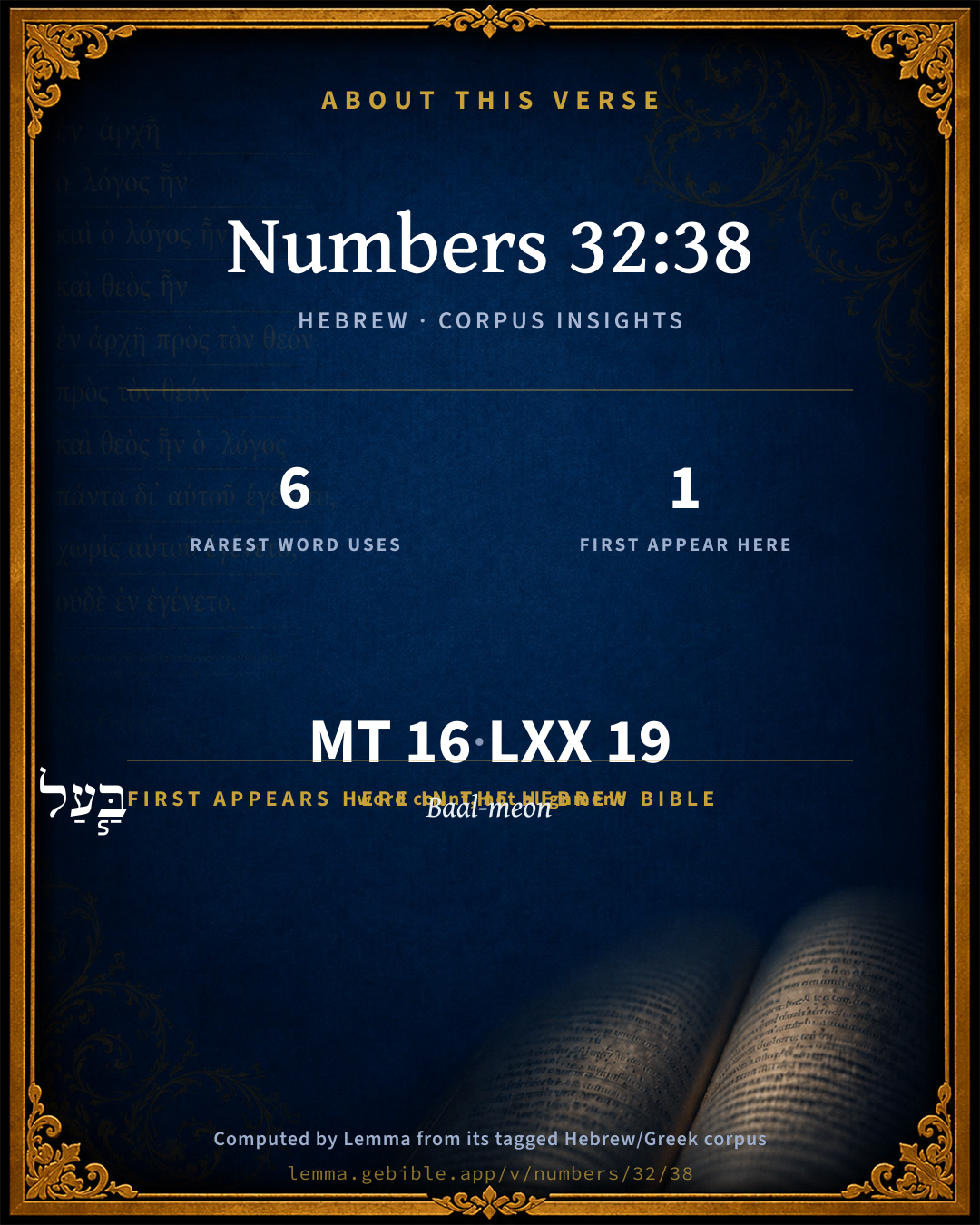
  • 1 first appearance in the Hebrew Bible
Full analysis ↓
Download a study sheet

One document with this verse’s original text, its word-by-word gloss line, the meaning frame, cross-references with their text, attributed commentary, and full source and license credits — printable, and it pastes into notes with its structure intact.

This verse Autodidact and up

Study sheet (.html) Plain text (.txt)

A passage Seminary Student

Up to 50 verses in one chapter. A passage sheet keeps up to 6 commentary sources and 12 cross-references per verse, in the order this page ranks them, and says so on the sheet whenever that leaves anything out. Ask for a single verse and you get the Autodidact verse sheet above.

Everything on this page stays free to read, with no account — the sheet is a download of what is already on screen, not access to it.

Want to remove ads? Support Godless Engineer
Compare translations 3

The same verse in 3 English versions, stacked beneath the original-language interlinear above. Click any original word for its lexicon entry.

Each is an independent rendering of the whole verse — the interlinear is not word-aligned to these translations.

Highlighted words mark where these versions differ — a whole-verse word diff, not a word-by-word alignment.

  • World English Bible Public Domain
    and Nebo, and Baal Meon, (their names being changed), and Sibmah: and they gave other names to the cities which they built.
  • King James Version Public Domain
    And Nebo, and Baalmeon, (their names being changed,) and Shibmah: and gave other names unto the cities which they builded.
  • unfoldingWord Literal Text CC BY-SA 4.0
    and Nebo and Baal Meon (names were changed) and Sibmah. And they called the names of the cities that they built by names.

unfoldingWord Literal Text — © unfoldingWord, licensed CC BY-SA 4.0. Word-aligned USFM3 via Door43 (git.door43.org/unfoldingWord/en_ult).

Versions to compare (up to 4)

3 of 4 selected

Show all 18 translations

Every available English version of this verse, each an independent rendering of the whole verse.

  • World English Bible Public Domain
    and Nebo, and Baal Meon, (their names being changed), and Sibmah: and they gave other names to the cities which they built.
  • Berean Standard Bible Public Domain
    as well as Nebo and Baal-meon (whose names were changed), and Sibmah. And they renamed the cities they rebuilt.
  • Majority Standard Bible Public Domain
    as well as Nebo and Baal-meon (whose names were changed), and Sibmah. And they renamed the cities they rebuilt.
  • King James Version Public Domain
    And Nebo, and Baalmeon, (their names being changed,) and Shibmah: and gave other names unto the cities which they builded.
  • American Standard Version (1901) Public Domain
    and Nebo, and Baal-meon, (their names being changed,) and Sibmah: and they gave other names unto the cities which they builded.
  • Revised Version (1885) Public Domain
    and Nebo, and Baal-meon, (their names being changed,) and Sibmah: and gave other names unto the cities which they builded.
  • Geneva Bible (1599) Public Domain
    And Nebo, and Baal-meon, and turned their names, and Shibmah: and gaue other names vnto the cities which they built.
  • Douay-Rheims (1899) Public Domain
    And Nabo, and Baalmeon (their names being changed) and Sabama: giving names to the cities which they had built.
  • Young's Literal Translation Public Domain
    and Nebo, and Baal-Meon (changed in name), and Shibmah, and they call by `these' names the names of the cities which they have built.
  • Literal Standard Version CC BY-SA 4.0
    and Nebo, and Ba‘al-Meon (changed in name), and Shibmah, and they call the names of the cities which they have built by [these] names.
  • Unlocked Literal Bible CC BY-SA 4.0
    Nebo, Baal Meon—their names were later changed, and Sibmah. They gave other names to the cities that they rebuilt.
  • unfoldingWord Literal Text CC BY-SA 4.0
    and Nebo and Baal Meon (names were changed) and Sibmah. And they called the names of the cities that they built by names.
  • Darby Bible Public Domain
    and Nebo, and Baal-meon (of which the names were changed), and Sibmah; and they gave other names to the cities that they built.
  • World Messianic Bible Public Domain
    Nebo, and Baal Meon, (their names being changed), and Sibmah. They gave other names to the cities which they built.
  • Webster's Bible Public Domain
    And Nebo, and Baal-meon, (their names being changed,) and Shibmah: and gave other names to the cities which they built.
  • Free Bible Version CC BY-SA 4.0
    as well as Nebo and Baal-meon (changing their names), and Sibmah. In fact they renamed those towns they rebuilt.
  • Bible in Basic English Public Domain
    And Nebo and Baal-meon, (their names being changed,) and Sibmah: and they gave other names to the towns they made.
  • JPS Tanakh (1917) Public Domain
    and Nebo, and Baal-meon — their names being changed — and Sibmah; and gave their names unto the cities which they builded.

Literal Standard Version (2020), Covenant Press — licensed CC BY-SA 4.0. Text via the HelloAO Bible API (eBible.org). Unlocked Literal Bible (unfoldingWord) — licensed CC BY-SA 4.0. Text via the HelloAO Bible API (eBible.org). unfoldingWord Literal Text — © unfoldingWord, licensed CC BY-SA 4.0. Word-aligned USFM3 via Door43 (git.door43.org/unfoldingWord/en_ult). Free Bible Version, Dr. Jonathan Gallagher — licensed CC BY-SA 4.0. Text via the HelloAO Bible API (eBible.org).

Word by word

More ways to search: Search by grammar → Find every occurrence → Compare this word →

Practice this passage: Drill this verse → Learn its vocabulary →

בַּ֧עַל
Baʻal Mᵉʻôwn
H1186
“Baal-meon”
Noun, Proper
Part of Speech
Noun
Type
Proper
Full BDB Definition

Origin: from H1168 and H4583

TWOT: None

Baal-meon = "lord of the habitation" - a town in Reuben, mentioned in connection with Nebo, and in the time of Ezekiel, Moabite
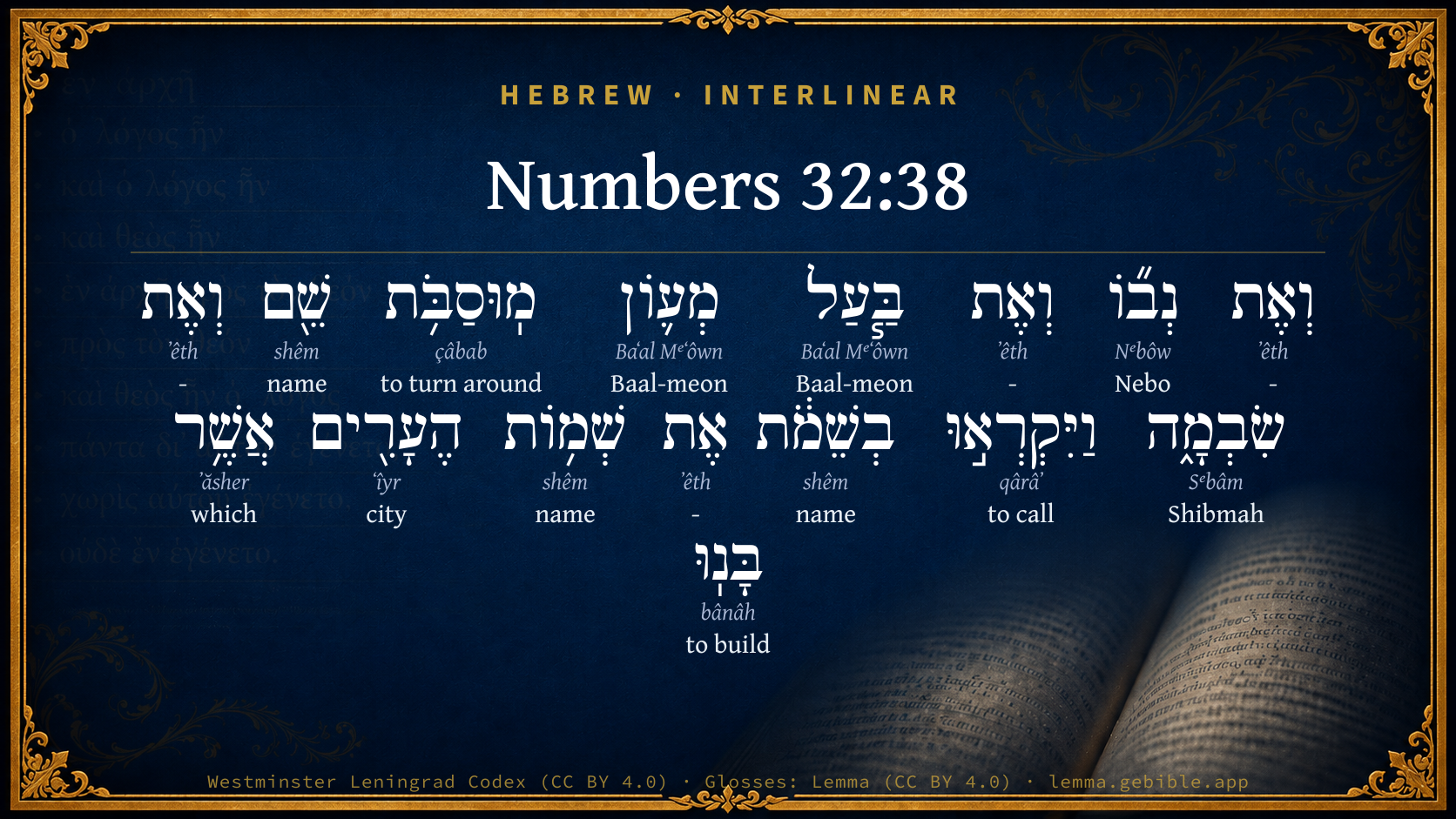
  1. וְאֶת ʼêth H853 “and · -” Conjunction + Particle, Direct Object
  2. נְב֞וֹ Nᵉbôw H5015 “Nebo” Noun, Proper
  3. וְאֶת ʼêth H853 “and · -” Conjunction + Particle, Direct Object
  4. מְע֛וֹן Baʻal Mᵉʻôwn H1186 “Baal-meon” Noun, Proper
  5. מֽוּסַבֹּ֥ת çâbab H5437 “turned around” Verb, Hophal, Participle Passive, Feminine, Plural, Construct
  6. שֵׁ֖ם shêm H8034 “name” Noun, Common, Masculine, Singular, Absolute
  7. וְאֶת ʼêth H853 “and · -” Conjunction + Particle, Direct Object
  8. שִׂבְמָ֑ה Sᵉbâm H7643 “Shibmah” Noun, Proper
  9. וַיִּקְרְא֣וּ qârâʼ H7121 “and · to call” Conjunction + Verb, Qal, Sequential Imperfect, 3rd Person, Masculine, Plural
  10. בְשֵׁמֹ֔ת shêm H8034 “in/at · names” Preposition + Noun, Common, Masculine, Plural, Absolute
  11. אֶת ʼêth H853 “-” Particle, Direct Object
  12. שְׁמ֥וֹת shêm H8034 “names of” Noun, Common, Masculine, Plural, Construct
  13. הֶעָרִ֖ים ʻîyr H5892 “the · cities” Particle, Definite Article + Noun, Common, Feminine, Plural, Absolute
  14. אֲשֶׁ֥ר ʼăsher H834 “which” Particle, Relative
  15. בָּנֽוּ bânâh H1129 “to build” Verb, Qal, Perfect, 3rd Person, Common, Plural

About this verse

These counts appear in no published source. They are computed here, from the morphology-tagged text and Lemma’s own curated glosses. What Lemma adds →

16
words
10
distinct lemmas
Pentateuch
section

Notable vocabulary

The rarest word here is בַּ֧עַל Baal-meon H1186 — appearing just 6 times in the whole Hebrew Bible.

First appearance in Scripture

This word makes its first canonical appearance in the Hebrew Bible here:

  • בַּ֧עַל Baal-meon H1186

Shared distinctive vocabulary

בַּ֧עַל Baal-meon H1186 occurs in 3 verses of the Hebrew Bible. Also found in:

Grammatical profile

  • 3 verbs
  • 8 nouns
  • 5 particles

Verb forms

  • מֽוּסַבֹּ֥ת Hophal · Participle Passive
  • וַיִּקְרְא֣וּ Qal · Sequential Imperfect
  • בָּנֽוּ Qal · Perfect

Repetition

Words recur within this verse — often emphatic in Hebrew:

  • שֵׁ֖ם name H8034 ×3
  • בַּ֧עַל Baal-meon H1186 ×2

Hebrew & Septuagint length

In English translation the verse runs 22 words from the Hebrew and 22 from the Septuagint (LXX English) — the same length.

A rough comparison of the two English renderings, which tokenize alike — not a word-level alignment.

Word counts can differ between the Hebrew and the Greek without any difference in meaning — e.g. the Hebrew direct-object marker אֵת has no separate Greek word, and Greek often adds the article ὁ.

In the original languages it is 16 Hebrew tokens and 19 Greek tokens — but the two are counted differently (Hebrew bundles its prefixes and suffixes into one token; the Greek is in lemma form), so that isn’t a like-for-like length.

Cross-references

7

Topical passages linked to Numbers 32:38 in the Treasury of Scripture Knowledge — connected by theme and wording, ordered by reader-vote popularity; previews shown in the World English Bible.

  • Isaiah 46:1 Bel bows down, Nebo stoops; their idols are on the animals, and on the cattle: the things that you carried about are made a load, a burden to the weary [animal].
  • Numbers 32:3 Ataroth, and Dibon, and Jazer, and Nimrah, and Heshbon, and Elealeh, and Sebam, and Nebo, and Beon,
  • Exodus 23:13 "Be careful to do all things that I have said to you; and don't invoke the name of other gods, neither let them be heard out of your mouth.
  • Joshua 23:7 that you not come among these nations, these that remain among you; neither make mention of the name of their gods, nor cause to swear [by them], neither serve them, nor bow down yourselves to them;
  • Genesis 26:18 Isaac dug again the wells of water, which they had dug in the days of Abraham his father. For the Philistines had stopped them after the death of Abraham. He called their names after the names by which his father had called them.
  • Numbers 22:41 It happened in the morning, that Balak took Balaam, and brought him up into the high places of Baal; and he saw from there the utmost part of the people.
  • Psalms 16:4 Their sorrows shall be multiplied who give gifts to another god. Their drink-offerings of blood I will not offer, Nor take their names on my lips.

Cross-references courtesy of OpenBible.info (CC BY 4.0).

Hebrew and Greek witnesses Masoretic Hebrew ↔ Greek Septuagint

The same verse in the two great witnesses to the Old Testament, shown verse-for-verse.

These are two independent witnesses, not word-aligned to each other, and the Septuagint is shown in lemma (dictionary) form.

Hebrew Numbers 32:38 Masoretic · Westminster Leningrad Codex

וְאֶת נְב֞וֹ וְאֶת בַּ֧עַל מְע֛וֹן מֽוּסַבֹּ֥ת שֵׁ֖ם וְאֶת שִׂבְמָ֑ה וַיִּקְרְא֣וּ בְשֵׁמֹ֔ת אֶת שְׁמ֥וֹת הֶעָרִ֖ים אֲשֶׁ֥ר בָּנֽוּ

and Nebo, and Baal Meon, (their names being changed), and Sibmah: and they gave other names to the cities which they built.

World English Bible · Public Domain

Greek LXX Numbers 32:38 Septuagint · lemma form

καί ὁ βεελμεων περικυκλόω καί ὁ σεβαμα καί ἐπιὀνομάζω κατά ὁ ὄνομα αὐτός ὁ ὄνομα ὁ πόλις ὅς οἰκοδομέω

and Beelmeon, surrounded with walls, and Sebama; and they called the names of the cities which they built, after their own names.

LXX2012 (modern English Septuagint) · Public Domain

On this verse, The Pulpit Commentary discusses the Septuagint’s reading. Read the note in Commentary ↓

Hebrew: Westminster Leningrad Codex (CC BY 4.0). Greek: Septuagint (public domain); English from LXX2012 (modern English Septuagint) (Public Domain). How the Septuagint differs from the Hebrew →

Targum (Aramaic paraphrase)

2

The Targum is the ancient Jewish Aramaic paraphrase of the Hebrew Scriptures — an interpretive translation, not the Hebrew text itself. Onkelos (literal) and Pseudo-Jonathan (expansive) render the Torah, and Jonathan the Prophets. Coverage is partial: where no permissively-licensed English translation exists for a verse, only the Aramaic is shown. This is verse-level text, not a word-by-word alignment to the Hebrew.

  1. Targum Onkelos Torah (Genesis–Deuteronomy)
    וְיָת נְבוֹ וְיָת בַּעַל מְעוֹן מַקְפָן שְׁמָהָן וְיָת שִׂבְמָה וּקְרוֹ בִשְׁמָהָן יָת שְׁמָהַת קִרְוַיָא דִי בְנוֹ

    (no public-domain English translation for this verse)

    Targum Onkelos — Aramaic: “Onkelos Genesis” (public domain); “Onkelos Exodus” (public domain); “Onkelos Leviticus” (public domain); “Onkelos Numbers” (public domain); “Onkelos Deuteronomy” (public domain). English: “Sefaria Community Translation” (CC0 1.0 (public-domain dedication)); “J.W. Etheridge. The Targums of Onkelos and Jonathan Ben Uzziel on the Pentateuch. London: Longmans, Green, 1862” (public domain). Text via Sefaria.

  2. Targum Pseudo-Jonathan Torah (Genesis–Deuteronomy)
    וְיַת בֵּית קְבוּרְתֵּיהּ דְמשֶׁה וְיַת קַרְתָּא דְבָלָק דְפָגְרוּ מִתַּמָן טָעוּת פְּעוֹר בְּמָדוֹר בֵּית בַּמְסַיָא וְיַת קַרְתָּא דְמַקְפָן שׁוּרָהָא גְלִיף שְׁמָהַת גוּבְרַיָא וְיַת שִׁירַן וּבָתַר דְבָנִינוּן קְרוֹ לְהוֹן שְׁמָהָן כְּשׁוּם גוּבְרַיָא דִבְנוּנוּן

    and the place of the sepulchre of Mosheh, and (rebuilt) the city of Balak, destroying out of it the idol of Peor, in the house of his high places, and the city whose walls surrounded it, inscribed with the names of his heroes, and Shiran. And after they had built them they called their names after the names of the men who had built them.

    Targum Pseudo-Jonathan — Aramaic: “Targum Jonathan on Genesis” (public domain); “Targum Jonathan on Exodus” (public domain); “Targum Jonathan on Leviticus” (public domain); “Targum Jonathan on Numbers” (public domain); “Targum Jonathan on Deuteronomy” (public domain). English: “The Targum of Jonathan ben Uzziel, trans. J. W. Etheridge, London, 1862” (public domain). Text via Sefaria.

Commentary

Notes on Numbers 32:38 from classic Christian and Jewish commentators (each source and its license shown beneath its notes). The classic Christian expositions comment on the surrounding passage and are grouped to its opening verse, so a note may address several verses; the Jewish commentaries on the Tanakh (Rashi and others) are per-verse, so they appear only where the commentator wrote on this verse.

Lemma curates 59 commentaries, every one of them public domain or Creative Commons licensed, each selected and text-cleaned for this edition rather than reprinted as found. About our sources →

Trapp's Complete Commentary

John Trapp

Num 32:38 And Nebo, and Baalmeon, (their names being changed,) and Shibmah: and gave other names unto the cities which they builded.

Ver. 38. Their names being changed.] Out of detestation of those idols, Baal, Nebo, &c. {see Exo 23:13 Psa 16:4 Isa 46:1} Absit ut de ore Christiano sonet Iupiter omnipotens, et Mehercule, et Mecastor, et caetera, magis portenta quam nuraina, saith Jerome. Heathenish gods should not be so far honoured as to be heard of out of Christian mouths, nor Popish idols neither. I myself, saith Latimer, {a} have used in mine earnest matters, to say, Yea, by the rood, by the mass, by St Mary, which indeed is naught. Some simple folk say, they may swear by the mass, because there is no such thing; and by our lady, because she is gone out of the country.

{a} Sermon in Third Sunday in Advent.

John Trapp, A Commentary or Exposition upon All the Books of the Old and New Testament (1647–1656) — public domain. Text from a community e-Sword module.

The Biblical Illustrator

Joseph S. Exell

Num_32:38

Their names being changed

Changes of name

Many persons live in names.

This is fatal to the grasp of complete truth and relation. The poet asks, Whats in a name? The name of a friend may be necessary to his identification, but the name is not the man. Character is to be studied, motive is to be understood, purpose is to be appreciated, then whatever changes may take place in the mere name, love and confidence will be undiminished. The change of names, both in the Old Testament and the New, deserves careful study. The name of Abram was changed, so was the name of Jacob, so was the name of Saul of Tarsus. Those changes of name symbolise changes of trust and vocation in life. The name should enlarge with the character, but the character should be always more highly valued than the name. The solemn application of this text is to the matter of great evangelical truths and doctrines. For want of attention to this matter, bigotry has been encouraged, and men have been separated from one another. Some persons do not know the gospel itself, except under a certain set of names, words, and stereotyped phrases. This is not Christianity, it is mere literalism; it is, in fact, idolatry, for there is an idolatry of phrase as well as of images. The truth is not in the letters which print it, the letters but stand to express the inexpressible. All life is symbolic. God has spoken in little else than parables. Revelation addresses the imagination, when imagination is used in its highest senses. It is not the faculty of mere cloud-making, but the faculty of insight into the largest meanings and the innermost relations of things. The letter in which you endeavour to express your love, is a poor substitute for the living voice and the living touch; it is indeed invaluable in the absence of the living personality; but what letter was ever written that quite satisfied the writer when love was the subject and devotedness the intention? There is a change of names that inspires the soul with hope. God is to give His servants a new name in the upper world; their name is to be in their foreheads; but in the changing of the name there is no changing in the burning love and the rapturous adoration. (J. Parker, D. D.)

.

The Biblical Illustrator, edited by Joseph S. Exell (c. 1880s–1900s) — public domain. Text from a community e-Sword module.

Joseph Benson's Commentary

Num 32:38. Their names being changed — Conquerors of places have been wont to change their names. But as the Israelites were forbidden to mention the names of other gods, and as these places, it seems had their names from the false gods worshipped in them, (which was unquestionably the case with Nebo and Baal-meon,) the Israelites might judge it proper to change the names of these places, in order to abolish all footsteps of idolatry.

Joseph Benson's Commentary on the Old and New Testaments (1811–1818) — public domain. Text from a community e-Sword module.

Jamieson, Fausset & Brown

Robert Jamieson, A. R. Fausset & David Brown

(their names being changed)--either because it was the general custom of conquerors to do so; or, rather, because from the prohibition to mention the names of other gods (Exo 23:13), as Nebo and Baal were, it was expedient on the first settlement of the Israelites to obliterate all remembrance of those idols. (See Jos 13:17-20).

Jamieson, Fausset & Brown — Commentary Critical and Explanatory on the Whole Bible (1871) — public domain (CC PDM 1.0). Text via the HelloAO Bible API.

Adam Clarke's Commentary

Verse 38. And Nebo - their names being changed] That is, Those who conquered the cities called them after their own names. Thus the city Kenath, being conquered by Nobah, was called after his name, Nu 32:42.

Adam Clarke's Commentary on the Bible (1810–1826) — public domain. Text from a community e-Sword/MySword module.

The Cambridge Bible for Schools and Colleges

gen. ed. J. J. S. Perowne

38. their names being changed] The parenthesis is strange, for the change of names by the Manassites is related immediately afterwards. Some think that it is a marginal note to the reader that the names are to be changed and read otherwise than they are written in the text. The words refer to Nebo and Baal-meon. Both Nebo and Baal suggested pagan worship, and the latter was frequently altered, e.g. Ish-bosheth, Mephi-bosheth, El-yada, for Ish-baal, Merib-baal, Baal-yada.

The Cambridge Bible for Schools and Colleges (gen. ed. J. J. S. Perowne; Cambridge University Press, 1878–1918) — public domain. Text from a community e-Sword module.

John Gill's Exposition

And the children of Machir the son of Manasseh went to Gilead, and took it,.... That part of it which Moses gave unto the half tribe of Manasseh, which till now was in the hand of the Amorites; for half Mount Gilead, and the cities thereof, were given to the Reubenites and Gadites, which is the land of Gilead they desired, and which was already conquered; for they call it the country which the Lord smote before Israel, Num 32:1,

and dispossessed the Amorite which was in it; for though they were driven out of one part of Gilead, yet not out of the whole.

John Gill's Exposition of the Whole Bible (1746–1763) — public domain (CC PDM 1.0). Text via the HelloAO Bible API.

Haydock's Catholic Bible Commentary

Nabo. Probably the same as Nebo and Nobe. --- Baalmeon. This city had a variety of names, ver. 3, 35. Those who rebuilt these cities gave them their own names, ver. 42. (Hebrew Targum of Jerusalem) Yet they were often known by their former appellations. (Calmet) --- The rebuilders chiefly objected to the names of idols, Baal, &c., which were joined with these cities. (Menochius)

George Leo Haydock (1774–1849), Haydock's Catholic Family Bible and Commentary, 1859 edition — public domain. Excludes Psalms (Douay-Rheims chapter numbering differs from Protestant) and Deuterocanonical books (Catholic canon only).

Matthew Poole's English Annotations

Nebo; of which city see Deu 34:1; Jer 48:1.

Their names being changed; either because conquerors of places use to do so; or because the names of other gods (which Nebo and Baal-meon unquestionably were) were not to be mentioned, Exo 23:13, especially at the first settling of the Israelites there, that the very remembrance of the idols might be blotted out, and so the temptation to idolatry removed, though afterwards, when that danger was over, they were called by their old names again, Jos 13:17,20.

Matthew Poole's English Annotations on the Holy Bible (1683–1685) — public domain. Text from a community e-Sword/MySword module.

Whedon's Commentary on the Bible

Daniel D. Whedon

38. Baal-meon — See Beon, Num_32:3, note.

Names… changed — Num_32:3, note.

Shibmah — See Shebam, Num_32:3, note.

Daniel D. Whedon (gen. ed.), Commentary on the Old and New Testaments (1874–1909) — public domain. Text from a community e-Sword module.

The Pulpit Commentary

Baalomeon. Called Been in verse 3, Beth-meon in Jer_48:23, Beth-Baal-meon in Jos_13:17. Their names being changed. tBosWm, "with change of name," dependent on the verb "built." The Septuagint has perikekuklwmenav (Symmachus, periteteucismenav ), apparently reading rWv for but without authority. It is possible that the Been of verse 3 may be an instance of this attempt to change names, many of which were connected with idolatry. The attempt failed, hut both the attempt itself and its failure were very characteristic of the partial and feeble hold which Israel had on this territory. Gave other names to the cities which they builded. Literally, "they called by names the names of the towns;" a round-about expression correctly paraphrased by the A.V.

The Pulpit Commentary (1880–1919), ed. H.D.M. Spence-Jones & Joseph S. Exell — public domain. Text from a community e-Sword module.

John Wesley's Explanatory Notes

Their names changed - Either because conquerers of places used to do so: or because the names of other Gods (which Nebo and Baal-meon unquestionably were) were not to be mentioned, Exod. xxiii, 13.

John Wesley, Explanatory Notes Upon the Whole Bible (1754–1765) — public domain. Text via the GEBible commentary corpus.

Rashi

Rabbi Shlomo Yitzchaki (Rashi)

ואת נבו ואת בעל מעון מוסבת שם AND NEBO AND AND BAAL-MEON, THEIR NAMES BEING CHANGED — Nebo and Baal-Meon were names of idols, and the Ammonites used to call their cities by the names of their gods. The children of Reuben therefore changed their names into other names. This is the meaning of מוסבת שם: Nebo and Baal-Meon were changed to other names.

ואת שבמה AND SIBMAH — i.e., they built (cf. v. 37) Sibmah also. This is identical with Sebam that is mentioned above (v. 3).

Rashi on the Tanakh — English translations: “The Judaica Press complete Tanach with Rashi, translated by A. J. Rosenberg” (CC BY 4.0); “Pentateuch with Rashi's commentary by M. Rosenbaum and A.M. Silbermann, 1929-1934” (public domain); “The Metsudah Tanach series, Lakewood, N.J” (CC BY 4.0); and “The Book of Joshua, Metsudah Publications, 1997” (CC BY 4.0). Text via Sefaria.

Ramban (Nachmanides)

Rabbi Moshe ben Nachman (Ramban / Nachmanides)

AND NEBO, AND BAAL-MEON — THEIR NAMES BEING CHANGED. “Nebo and Baal-meon were names of idols, and the Amorites used to call their cities by the names of their idols, therefore the children of Reuben changed [the names of these cities and gave them] different names, this being the meaning of the expression their names being changed, which means that Nebo and Baal-meon were changed to other names.” This is Rashi’s language. But the [concluding part of this] verse which says, and they called their names unto the cities which they builded refers to all the cities [mentioned there], and not only to Nebo and Baal-meon [and therefore the phrase their names being changed cannot be understood as Rashi explained it]. Furthermore, what sense would there be in Scripture mentioning the cities [only] by the names of their idols, and saying that the children of Reuben built them and changed their names, without mentioning the good names which they were [now] given! And indeed it is quite usual for Scripture when speaking about [any] captured cities to mention always the new names [given them, as in the following cases]: and they called Leshem, Dan, after the name of Dan their father; and he called them the hamlets of Jair; and he called it Nobach., Verse 42. And likewise wherever the name [of a city] was changed [for any reason] Scripture mentions [the new name as well, as it is said], Now the name of Hebron beforetime was Kiryath-arba; now the name of Debir beforetime was Kiryath-sepher., 15:15.The most likely explanation seems to me to be that these names [Nebo, Baal-meon, etc.] were the names of the cities when they were in the possession of Moab, and Sihon captured all these cities from the former king of Moab, for thus it is written about Heshbon, Dibon and Medeba, as it is said, We have shot at them; Heshbon is perished, even unto Dibon etc., Verse 30. This also appears to me to be the [meaning of the] words of Jephthah, when he said, While Israel dwelt in Heshbon and its towns, and in Aroer and its towns, and in all the cities that are along by the side of the Arnon, this being the same Aroer [mentioned here in Verse 34] which they took from Sihon. Now when Tiglath-pileser the king of Assyria exiled the Reubenites and the Gadites, the Moabites returned and settled in their lands and cities, for we find in the Book of Jeremiah that when Nebuchadnezzar [king of Babylon] destroyed Moab, he conquered from them all these cities. And [the Book of Jeremiah] mentions by name Heshbon and Elealeh, Kiryathaim, Verse 23. Dibon and Nebo, Verse 22. Jazer, Verse 32. Aroer, Verse 19. and Baal-meon which is [there] called Beth-meon, Verse 23. and Beth nimrah which is [there] called Nimrim, and Jahza., Verse 21. Thus you see that all these cities mentioned [in these verses] belonged [originally] to Moab, [and Sihon, king of the Amorites captured them from Moab]. Similarly in [the Book of] Isaiah most of these cities are mentioned when Sennacherib [king of Assyria] overran Moab, for he first exiled the Reubenites and the Gadites, and afterwards he overran Ammon and Moab.Therefore it appears that the meaning of [the phrase] their names being changed is that all these cities had [previously] had their names changed, because the Amorites changed their original names when they captured them [from Moab] and these [names] were their original names which they had when they still belonged to Moab. But the children of Reuben and of Gad still called them by [these Moabite] names when they rebuilt them. [This explanation is borne out by the fact that] the verse does not say, “and they gave names to the cities which they built,” but it says, and they called by names the names of the cities [which they builded], meaning that they called them by name with the same names which they originally had [when they were still under the rule of Moab. This was] because they wanted to refer to them by the names with which they had previously been known, either in order to shame Moab, or, as our Rabbis have mentioned, means that they were changed by the children of Reuben and Gad, because their [Amorite] names were the names of idols. According to Ramban, the phrase refers to the Amorites, who changed the original Moabite names in an attempt to erase the Moabite origin of these cities. Since the Amorites gave them the names of their idols, therefore the children of Reuben and Gad reverted to the original Moabite names in order not to have to mention the names of idols, or, as Ramban suggests, in order to shame the Moabites. because [they did not want to use the Amorite names since] the Amorites used to call their cities by the names of their idols. However, we do not find that Joshua changed the names of the cities which he captured.

AND SIBMAH. The meaning of this is that “they built Sibmah,” but it was not [a city] whose name was changed.

Ramban (Nachmanides) on the Tanakh — English translation: “Commentary on the Torah by Ramban (Nachmanides). Translated and annotated by Charles B. Chavel. New York, Shilo Pub. House, 1971-1976” (CC BY 4.0). Text via Sefaria.

Ibn Ezra

Rabbi Abraham ibn Ezra

Nevo. This could be the Mount of Nevo, where Moshe is buried.

Their names having been changed. These cities had their names changed, and Sivmah as well.

Ibn Ezra on the Tanakh — English translations: “Sefaria Community Translation” (CC0 1.0 (public-domain dedication)); “Yalkut, Sifsei Chachomim Chumash, Metsudah Publications, 2009” (CC BY 4.0); and “Commentary of Ibn Ezra on Isaiah - trans. by M. Friedlander, 1873” (public domain). Text via Sefaria.

Lesson kit

Teaching starters — assembled from the data on this page, not authored interpretation. Every prompt links to the verse data it draws on. Edit before teaching.

Numbers, in the Pentateuch, opens this verse with 16 words (10 distinct Hebrew lemmas). Its most distinctive word is Baʻal Mᵉʻôwn (“Baal-meon”). A historical commentator’s framing appears above. Read the whole chapter for the surrounding context.

Discussion questions

  1. What does “Baal-meon” (Baʻal Mᵉʻôwn) contribute to the verse as a whole?
  2. The word “Baal-meon” first appears here in Scripture. What is being introduced at this debut?
  3. 1 Chronicles 5:8 shares the word «Baal-meon» with this verse. How do the two illuminate each other?
  4. “name” occurs 3× in this one verse. What is the effect of the repetition?
  5. These translations render this verse differently. What is at stake in choosing one wording over another?
  6. The verb «מֽוּסַבֹּ֥ת» is Hophal Participle Passive. How does its form color the action?
  7. Reading how Trapp's Complete Commentary and The Biblical Illustrator read this verse, where do the two commentators agree and where do they part?

Things to notice

Reading settings

Reading text

Shown beneath each verse's original-language words.

Old Testament
Old Testament edition

Read the OT as the Masoretic Hebrew (MT) or the Greek Septuagint (LXX).

English shown for the Greek Septuagint (in the Hebrew ↔ Greek comparison).

Comparing translations? Open the Compare panel on any verse page to stack up to four side by side.