
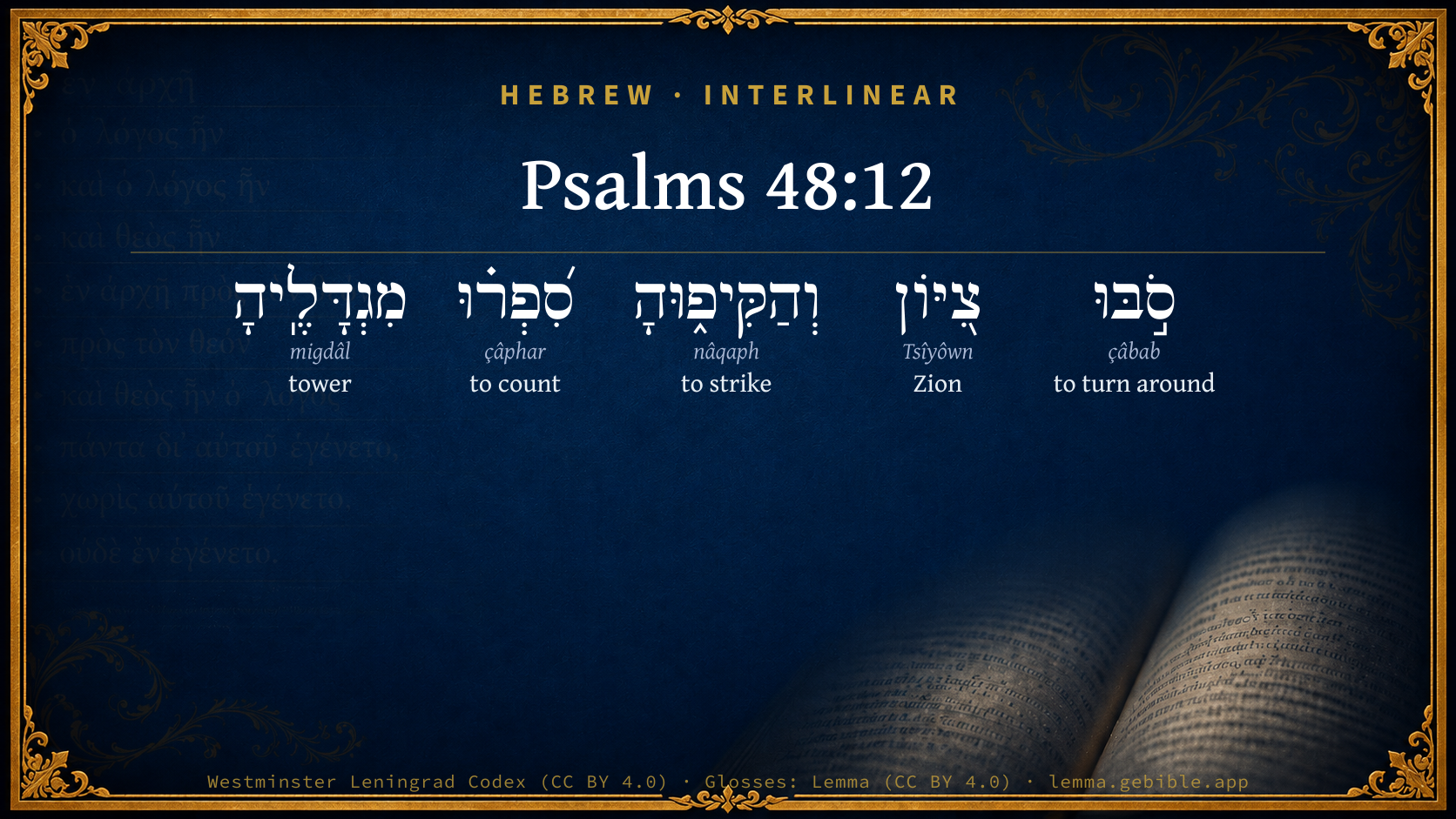
Psalms 48:12

Hebrew (Westminster Leningrad Codex) Psalms 48:12 appears in the Hebrew Old Testament. The text above is from the Westminster Leningrad Codex. Each word links to its Strong’s number, a concise gloss, and parsing drawn from the Open Scriptures Hebrew Bible morphology. Click any word for its full Brown-Driver-Briggs (BDB) entry.
Download image
Cite this verse

Psalms 48:12 (World English Bible). Public Domain. Lemma interlinear Bible study tool, https://lemma.gebible.app/v/psalms/48/12.

Show BibTeX & RIS
BibTeX
RIS
English Translation
Walk about Zion, and go around her. Number its towers;
World English Bible · Public Domain
Download a study sheet

One document with this verse’s original text, its word-by-word gloss line, the meaning frame, cross-references with their text, attributed commentary, and full source and license credits — printable, and it pastes into notes with its structure intact.

This verse Autodidact and up

Study sheet (.html) Plain text (.txt)

A passage Seminary Student

Up to 50 verses in one chapter. A passage sheet keeps up to 6 commentary sources and 12 cross-references per verse, in the order this page ranks them, and says so on the sheet whenever that leaves anything out. Ask for a single verse and you get the Autodidact verse sheet above.

Everything on this page stays free to read, with no account — the sheet is a download of what is already on screen, not access to it.

Want to remove ads? Support Godless Engineer
Compare translations 3

The same verse in 3 English versions, stacked beneath the original-language interlinear above. Click any original word for its lexicon entry.

Each is an independent rendering of the whole verse — the interlinear is not word-aligned to these translations.

Highlighted words mark where these versions differ — a whole-verse word diff, not a word-by-word alignment.

  • World English Bible Public Domain
    Walk about Zion, and go around her. Number its towers;
  • King James Version Public Domain
    Walk about Zion, and go round about her: tell the towers thereof.
  • unfoldingWord Literal Text CC BY-SA 4.0
    Circle Zion and go around her. Count her towers,

unfoldingWord Literal Text — © unfoldingWord, licensed CC BY-SA 4.0. Word-aligned USFM3 via Door43 (git.door43.org/unfoldingWord/en_ult).

Versions to compare (up to 4)

3 of 4 selected

Show all 18 translations

Every available English version of this verse, each an independent rendering of the whole verse.

  • World English Bible Public Domain
    Walk about Zion, and go around her. Number its towers;
  • Berean Standard Bible Public Domain
    March around Zion, encircle her, count her towers,
  • Majority Standard Bible Public Domain
    March around Zion, encircle her, count her towers,
  • King James Version Public Domain
    Walk about Zion, and go round about her: tell the towers thereof.
  • American Standard Version (1901) Public Domain
    Walk about Zion, and go round about her; Number the towers thereof;
  • Revised Version (1885) Public Domain
    Walk about Zion, and go round about her: tell the towers thereof.
  • Geneva Bible (1599) Public Domain
    Compasse about Zion, and goe round about it, and tell the towres thereof.
  • Douay-Rheims (1899) Public Domain
    Let mount Sion rejoice, and the daughters of Juda be glad; because of thy judgments, O Lord.
  • Young's Literal Translation Public Domain
    Compass Zion, and go round her, count her towers,
  • Literal Standard Version CC BY-SA 4.0
    Surround Zion, and go around her, count her towers,
  • Unlocked Literal Bible CC BY-SA 4.0
    Walk around Mount Zion, go round about her; count her towers,
  • unfoldingWord Literal Text CC BY-SA 4.0
    Circle Zion and go around her. Count her towers,
  • Darby Bible Public Domain
    Walk about Zion, and go round about her: count the towers thereof;
  • World Messianic Bible Public Domain
    Walk about Zion, and go around her. Number its towers.
  • Webster's Bible Public Domain
    \\48:11\\Let mount Zion rejoice, let the daughters of Judah be glad, because of thy judgments.
  • Free Bible Version CC BY-SA 4.0
    Go and take a look at Zion. Count the towers as you walk around.
  • Bible in Basic English Public Domain
    Make your way about Zion, and go round it, numbering its towers.
  • JPS Tanakh (1917) Public Domain
    (48-13) Walk about Zion, and go round about her; count the towers thereof.

Literal Standard Version (2020), Covenant Press — licensed CC BY-SA 4.0. Text via the HelloAO Bible API (eBible.org). Unlocked Literal Bible (unfoldingWord) — licensed CC BY-SA 4.0. Text via the HelloAO Bible API (eBible.org). unfoldingWord Literal Text — © unfoldingWord, licensed CC BY-SA 4.0. Word-aligned USFM3 via Door43 (git.door43.org/unfoldingWord/en_ult). Free Bible Version, Dr. Jonathan Gallagher — licensed CC BY-SA 4.0. Text via the HelloAO Bible API (eBible.org).

Word by word

More ways to search: Search by grammar → Find every occurrence → Compare this word →

Practice this passage: Drill this verse → Learn its vocabulary →

וְהַקִּיפ֑וּהָ
nâqaph
H5362
“and · strike · her”
Conjunction + Verb, Hiphil, Imperative, 2nd Person, Masculine, Plural + Suffix, Personal, 3rd Person, Feminine, Singular
Part of Speech
Conjunction + Verb
Stem
Hiphil
Form
Imperative
Person
2nd Person
Gender
Masculine
Number
Plural
Full BDB Definition

Origin: a primitive root

TWOT: 1415 , 1416

to strike, strike off - (Piel) to strike off skin - to go around, compass, round - (Qal) to go around - (Hiphil) - to go around, surround, encompass, enclose - to make the round, complete the circuit - to make round, round off
  1. סֹ֣בּוּ çâbab H5437 “turn around” Verb, Qal, Imperative, 2nd Person, Masculine, Plural
  2. צִ֭יּוֹן Tsîyôwn H6726 “Zion” Noun, Proper
  3. סִ֝פְר֗וּ çâphar H5608 “count” Verb, Qal, Imperative, 2nd Person, Masculine, Plural
  4. מִגְדָּלֶֽיהָ migdâl H4026 “towers · her” Noun, Common, Both, Plural, Construct + Suffix, Personal, 3rd Person, Feminine, Singular

About this verse

These counts appear in no published source. They are computed here, from the morphology-tagged text and Lemma’s own curated glosses. What Lemma adds →

5
words
5
distinct lemmas
Wisdom
section

Notable vocabulary

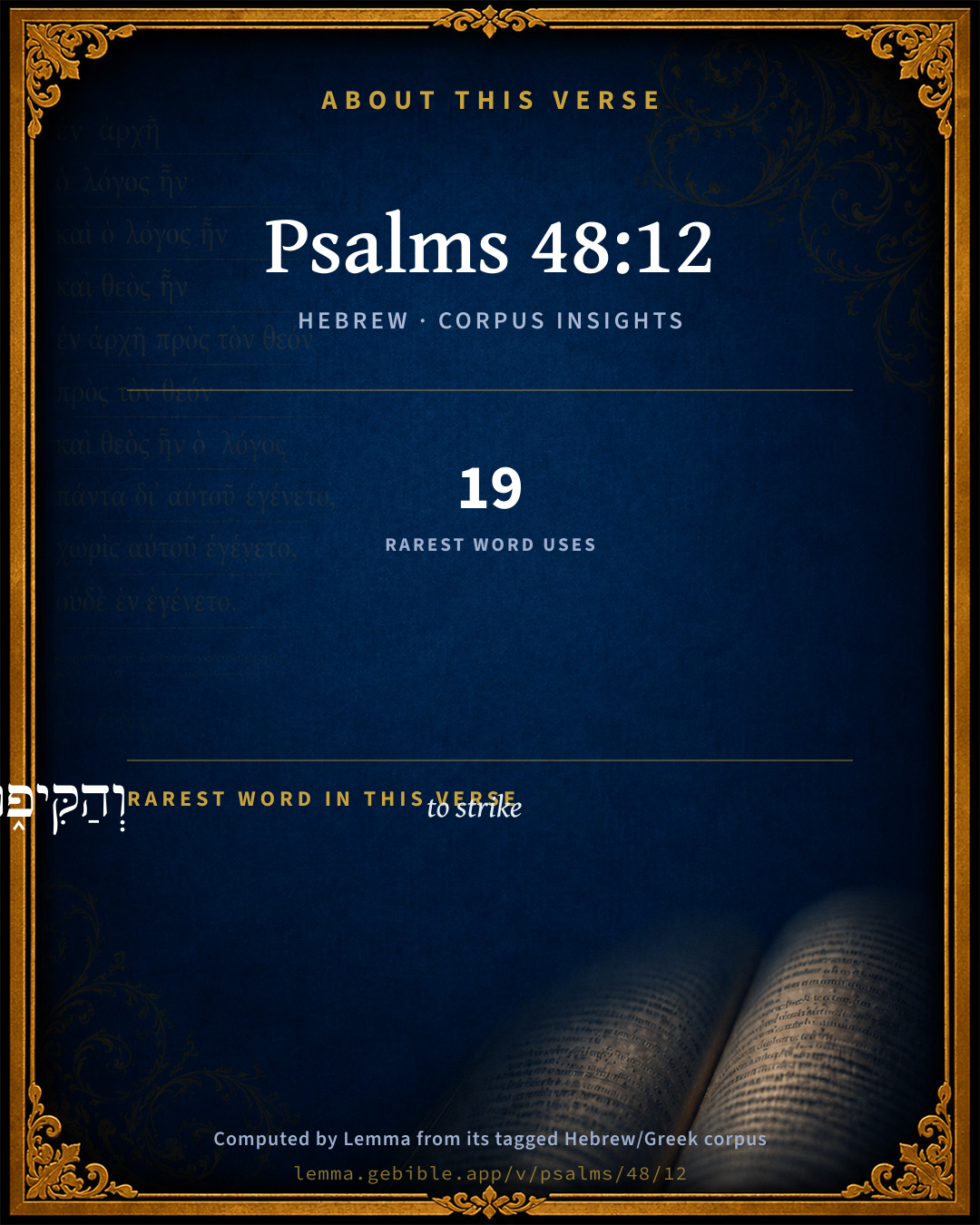
The rarest word here is וְהַקִּיפ֑וּהָ to strike H5362 — appearing just 19 times in the whole Hebrew Bible.

Shared distinctive vocabulary

וְהַקִּיפ֑וּהָ to strike H5362 occurs in 19 verses of the Hebrew Bible. Also found in:

Grammatical profile

  • 3 verbs
  • 2 nouns

Verb forms

  • סֹ֣בּוּ Qal · Imperative
  • וְהַקִּיפ֑וּהָ Hiphil · Imperative
  • סִ֝פְר֗וּ Qal · Imperative

Hebrew & Septuagint length

In English translation the verse runs 10 words from the Hebrew and 11 from the Septuagint (LXX English) — closely comparable.

A rough comparison of the two English renderings, which tokenize alike — not a word-level alignment.

Word counts can differ between the Hebrew and the Greek without any difference in meaning — e.g. the Hebrew direct-object marker אֵת has no separate Greek word, and Greek often adds the article ὁ.

Cross-references

3

Topical passages linked to Psalms 48:12 in the Treasury of Scripture Knowledge — connected by theme and wording, ordered by reader-vote popularity; previews shown in the World English Bible.

  • Isaiah 33:18–20 Your heart shall muse on the terror: Where is he who counted, where is he who weighed [the tribute]? where is he who counted the towers?
  • Matthew 24:1–2 Jesus went out from the temple, and was going on his way. His disciples came to him to show him the buildings of the temple.
  • Nehemiah 12:31–40 Then I brought up the princes of Judah on the wall, and appointed two great companies who gave thanks and went in procession. [One went] on the right hand on the wall toward the dung gate;

Cross-references courtesy of OpenBible.info (CC BY 4.0).

Hebrew and Greek witnesses Masoretic Hebrew ↔ Greek Septuagint

The same verse in the two great witnesses to the Old Testament, shown verse-for-verse.

You’re reading Greek Psalm 47 (Hebrew Psalm 48). The Septuagint counts the superscription, so verse numbers can differ from the Hebrew — chapter-level alignment, not verse-by-verse. Numbering follows Rahlfs.

These are two independent witnesses, not word-aligned to each other, and the Septuagint is shown in lemma (dictionary) form.

Hebrew Psalms 48:12 Masoretic · Westminster Leningrad Codex

סֹ֣בּוּ צִ֭יּוֹן וְהַקִּיפ֑וּהָ סִ֝פְר֗וּ מִגְדָּלֶֽיהָ

Walk about Zion, and go around her. Number its towers;

World English Bible · Public Domain

Greek LXX Greek Psalm 47:12 Septuagint · lemma form

εὐφραίνω ὁ ὄρος σιων ἀγαλλιάομαι ὁ θυγάτηρ ὁ ἰουδαία ἕνεκεν ὁ κρίμα σύ κύριος

Go round about Sion, and encompass her: tell you⌃ her towers.

LXX2012 (modern English Septuagint) · Public Domain

On this verse, Keil & Delitzsch discusses the Septuagint’s reading. Read the note in Commentary ↓

Hebrew: Westminster Leningrad Codex (CC BY 4.0). Greek: Septuagint (public domain); English from LXX2012 (modern English Septuagint) (Public Domain). How the Septuagint differs from the Hebrew →

Commentary

Notes on Psalms 48:12 from classic Christian and Jewish commentators (each source and its license shown beneath its notes). The classic Christian expositions comment on the surrounding passage and are grouped to its opening verse, so a note may address several verses; the Jewish commentaries on the Tanakh (Rashi and others) are per-verse, so they appear only where the commentator wrote on this verse.

Lemma curates 59 commentaries, every one of them public domain or Creative Commons licensed, each selected and text-cleaned for this edition rather than reprinted as found. About our sources →

Trapp's Complete Commentary

John Trapp

Psa 48:12 Walk about Zion, and go round about her: tell the towers thereof.

Ver. 12. Walk about Sion, and tell the towers thereof] q.d. Are they not still the same and as many as they were before the approach of the enemy? is anything diminished or defaced by the late stage or assault? "Therefore thus saith the Lord concerning the king of Assyria, He shall not come into this city, nor shoot an arrow there," &c., Isa 37:33.

John Trapp, A Commentary or Exposition upon All the Books of the Old and New Testament (1647–1656) — public domain. Text from a community e-Sword module.

The Biblical Illustrator

Joseph S. Exell

Psa_48:12-14

Walk about Zion, and go round about her: tell the towers thereof.

The love of Zion

So they revered the city on the hill. Their affections clustered round about its sacred courts. They loved the very tracks which led to it. Blessed is the man in whose heart are the highways to Zion. The beaten roads were trodden deep in their affections. The stones of the building were clothed in rich and mystic meaning. Thy servants take pleasure in her stones. A radiant history made worship eager, grateful and assured. We have heard with our ear, O God; our fathers have told us what work Thou didst in their days, in the times of old. The hoary pile was beautified with the association of the spiritual splendours of other days. They gloried in their heritage. Such was the sentiment of the olden days. The nation found its unity in its common love of Zion. There are now many Zions. The exaltation of one particular mountain has ceased. Spiritual affections no longer find their points of convergence in a lonely and isolated temple. To-day religion has many homes, but because of the many abiding-places the strength of the general fellowship need not be impoverished. The zealous reverence for particular faiths creates the religious atmosphere of a people. Here, then, is our own Zion. What is the significance of this building to the family which gathers within its walls? To an uncounted host the plain old pile is a dear and honoured home. The very stones are revered. They are the shrine of a sacred sentiment. Here our fathers met and prayed. Hero they had such visions of the Master as made them bold to confront the world. But it is not only that these stones are the shrine of a sacred sentiment; they are to many of you the house of a sacred experience. It was here you first saw the face of your Lord. It was here you were born again. I do not wonder that you love the old Zion. Every other place is a strange and unsuggesgive lodging: this house is your birthplace and your home. Tell the towers thereof! What are the towers of our faith? Here is the primary stronghold: Christ is the alone-exalted head of the Christian Church. No one shares His headship or pre-eminence. No one can claim a deputed sovereignty. There is only one throne, and to that throne we may all come boldly, and find grace and mercy in every time of need. Christ is the alone-exalted head of the Christian Church. That is one of the strong towers of our faith. Tell the towers thereof. Here is another of our strongholds: The Christian Church is constituted of Christian believers. The confines of a country do not mark the boundaries of a Church. Geographical measurements cannot delimit the magnitude of a Church. The Christian Church begins where Christian believers begin; it ends where they end. Tell the towers thereof. Here is a third of our strongholds: Every body of Christian believers enjoys the guiding presence of the Holy Ghost. He has called Himself the Spirit of Counsel and of Might, and as such will He stand revealed. Mark ye well her bulwarks! Yes, what are the bulwarks of our faith? What is the character of its walls? What is the nature of its defence? The defences of our faith are the resistance of its own redemptive grace. Spirituality is to be safeguarded by the spiritual. The bulwarks of a saving grace are to be found in the powers of its own salvation. Consider her palaces! Yes, we are not afraid to consider the home-life created and sustained by the forces of our faith. Consider her palaces, her dwellings, the family life which is nourished behind the ramparts of our faith. Can you conceive of any surer and firmer cement for the solidarity of a home than the immediate fellowship of each member with the Christ, in the common bond of the Holy Ghost? The palaces created by our faith, its family and its social life, are the abiding-places of the Eternal God. Walk about Zion, go round about her: tell the towers thereof, mark ye well her bulwarks: consider her palaces, that ye may tell it to the generations following. Is it worth the telling? Or shall we close the book and shelve the story? Can the twentieth century do without our faith? Is there no need for our towers, and our bulwarks, and our palaces? Have we a gospel which will redeem the coming man? Have we a faith which will sanctify the coming home? Have we a hope which will be directive and preservative of the purest elements in the State? Then let us proclaim it, and let us make provision for its proclamation. (J. H. Jowett, M. A.)

The unity of the Church

The walk about Zion is an examination of her position and extent; going round about her implies a complete view of the entire circumference of the holy city. Filling her towers is an examination of her resources; marking the strength of her bulwarks is to admire her stability; considering her palaces is to exalt and glorify the majesty of her internal state. The study of the external and internal condition of the Church fills the heart with rapture and the lips with praise. In figurative martial terms the psalmist celebrates the position, strength, glory and perpetuity of the Church. Based upon the eternal rock, it will stand until the long-groaning creation awakes to hear the Easter hymn that is to be sung in the Jubilee of the final Sabbath. The uppermost questions that now challenge the attention of the chief nations of the world are of and concerning the Church. Much is being said about organic unity, which is another thing than ecclesiastical unity. A forest may be a unit--that is, one forest, all its parts nursed on the same soil and under the same conditions of climate, but it is not an organic unit, for it contains twenty species of trees, all trees, indeed, but not the same in trunk, fibre or branches. They grow together, but they have each their own special development. When, therefore, we talk of organic unity among Protestants, let us remember that the unity of a common life does not imply the necessity of ecclesiastical consolidation. Still, various branches of the Evangelical Catholic Church are every day coming nearer toward one another. And they are coming in virtue of the assimilating force that is deeper than creeds, and deeper far than preferences for mere forms, whether of worship or of government. That force is defined in Holy Scripture as the Unity of the Spirit. And this is the only unity for which we need to pray or labour. To understand this unity, consider the meaning of three words.

I. Christianity. The Rationalist regards it as a system more or less divine which must needs be measured by human reason before it can bind the consciences of men. This low and inadequate view may be Protestant as against the superstitions of the Papacy, but it is not evangelical, inasmuch as it denies the infallibility of Scripture, the vicarious atonement of our Lord and its related doctrines. But Christianity is the complete revelation of the Divine will in the Scriptures. It is Christ revealing Himself to the human consciousness.

II. The church is one in historical transmission; and it is catholic, including all who fear God. Ecclesiastical arrangements are not of its essence, and do not interfere with its real unity, which is that of the Spirit. Rome has been fighting on a thousand battlefields to compel an external unity, but human nature will never submit to it. Such unity is but a dream, an ecclesiastical device.

III. Religion. This is to some--

1. An intellectual conception only. To others--

2. Feeling, rapture. To others--

3. A devout performance on the Lords day. But--

4. To the evangelist it is faith and holiness. (Elbert S. Porter, D. D.)

The beauty and strength of Zion

A diligent search into, and consideration of, the means and causes of the preservation and protection of the Church in the greatest dangers and difficulties, is a duty incumbent on us for our own support against sinful fears, and to enable us to that testimony which is required for future generations, to encourage them to trust in the Lord.

1. What is to be understood by the preservation and protection of the Church, so as we may look neither for less nor more than what we are like to meet with?

2. What is meant by searching into, and considering of, these causes and means of the Churchs preservation? Walk about Zion, tell her towers, set your heart to her bulwarks, consider her palaces, etc.

3. What are those causes and means of the Churchs preservation, those towers and bulwarks which will not fail, whenever Zerah or Sennacherib comes, or whatever attempts are made upon Zion?

4. What reason is there why we should thus search into and consider these causes of the Churchs preservation and protection?

5. What is the testimony which we have to give concerning this matter to the ensuing generation? That ye may declare it to the generation to come. (J. Owen, D. D.)

A view of national felicity, the cause of gratitude to God

I. The natural advantages of our situation.

1. Our soil is fertile, liberally rewarding the husbandman with grass for cattle, and herb for the use of man; with all the necessaries and many of the luxuries of life.

2. No country in the world is more sufficient for itself, or more independent of every other; while from innumerable ports we disperse our superfluities and the fruits of our industry to every nation under heaven.

3. Our climate is mild, temperate and salubrious. We are neither scorched by excess of heat, nor made torpid by intense cold.

4. Our people are hardy and vigorous; patient of toil; docile, generous and open; attached to their country; intrepid in war, industrious at home.

II. The excellence of our government.

1. Ye have personal liberty, which, as it cannot be taken from you without a crime, so neither can ye alienate it of yourselves but for a time, and upon such terms as still keep you under the protection of the laws, to guard you from abuse, and to secure your hire.

2. Ye have political liberty. Every man is allowed to declare his sentiments concerning the measures of government, and to animadvert on them in the most public manner.

3. Ye have religious liberty in a very eminent degree. Every man is allowed to hold his own creed, and to worship God in his own way.

III. The favour of providence. (J. Adamson, D. D.)

The Church of God

I. The church of God is our birthplace. Angels said, This man was born there.

II. The centre of our chief social attractions. Are not our grandest associations connected with the house of God? These are the men that are to stand by us in times of trouble. These are they who are to counsel us when we go astray. These are the men who are to carry us out to our last slumber when we have done with our earthly toil. Oh! I want to be surrounded by church friends, some to counsel me, some to encourage me, some to cheer me and strengthen me. I want to sit with them, and sing with them, and pray with them, and die with them.

III. The home of our children.

IV. A refuge. Seafaring men do not always expect smooth sailing. Neither ought we on the sea of life always expect to have smooth sailing. You have not always had it the way you wanted it in the past. You will not always have it the way you want it in the future. But when trouble came you went into the house of God and found it a refuge. You had your troubles explained to you.

V. Our monument. It seems a very silly thing to expend one or two or three thousand dollars on a tombstone. But that which you do for the Church of God is your eternal monument. It is a living memento.

VI. The gate of heaven. (T. De Witt Talmage.)

The threefold glory of the Chureh

I. Her towers. These naturally represent the great truths that are lifted into prominence. There are some ten great truths curiously related and parts of one system. Five of them are like corner towers--the Being of God is central to all--then the doctrine of the Son, the Spirit, Man, and the Word of God. The intermediate connecting truths are the Mediation of Christ in Atonement, the Mediation of the Spirit in Regeneration, Justification by Faith, the Inspiration of the sacred writers, and the right of private study of Scripture. No one of these truths can be sacrificed without weakening the whole structure.

II. Her bulwarks. These as naturally represent the great barriers or defences of the Church, which act as restraints against wickedness and worldliness, serving both to keep in disciples and keep out evildoers. The Church has certain separating barriers which define her province and life, and restraining barriers which repel and restrain evil. No small part of the service of the Church in the world is found in the resistance to evil. What the dykes are to Holland the Church is to the community: it keeps out the flood of evil.

III. Her palaces. These suggest beauty, honour, delight, privilege, and may stand for all the privileges of the children of God.

1. Worship, with all the ordinances, sacraments, prayer, praise, etc.

2. Fellowship, both with God and saints.

3. Holy living and growing both in knowledge and grace.

4. Service to God and man. (Homiletic Review.)

The great city

Cities are prominent waymarks in human history. With them began the distribution of rights from the few to the many. Cincinnatus at his plough had his patriotism fed by voices from the city. Cities show us the most of man; they exhibit what life can be made; they fortify genius so that its power runs not to waste; and out of the struggles of commerce, the breadth of view concerning human relations to which commerce leads, has sprung the best thought of what is duo from man to man. When Henry the First--called The City Builder, gave to cities peculiar privileges to induce his people to congregate, unwittingly he laid the grand basis of opposition to the Feudal system, and the legal foundation of popular rights. The people united to ward off the attacks of the lords or barons; union gave strength; the limit of locality made them develop their resources; commerce, art and wealth increased within their walls; energy grew and multiplied; the people became wealthy, respectable, educated and refined; better laws and institutions were desired; and thus the principle of human rights, leading to political equality, was gradually developed. Towers and bulwarks, high walls and fortified castles, were the defences of old; to walk about an ancient city was to mark these things; and the great story that was carried down from one generation to another was of hugs walls and mighty gates--stories which we can hardly believe as we see the variety of these defences in the presence of modern arts of destruction. Then cities had to be set upon a hill, that no mountain might give the archers of the enemy a position of assault; or they must be reared, like Babylon and Palmyra, in the midst of a vast plain. But not so now. He who now walks about a great city to note its strength, its defences, its promises of superior greatness, does not mark down upon his map of survey walls, towers, bulwarks, palaces; for he looks into the character of homes, the intelligence and virtue of families, and he counts up schools and institutions of learning, benevolence, religion. Undazzled by all the glitter and show of wealth, unimpressed by the stately palaces, unmoved by the boasts of trade and commerce, and disregarding the growth of material prosperity that makes the grand exhibition of thronged streets and crowded marts--the river dotted with the white sails, amid which the floating vapour from the steam craft rises as incense, sending the thoughts out to sea and to the infinite, unimpressed, in his deepest nature, by all this, his great question is, How true is it that God and the Lamb have their thrones and servants here? How much is God the light of this city? How much of all this glory is as the costume of this oriental bride adorned for her husband, as we think of the city wedded to Christ? No interest of the city can be secured by deserting the Church or profaning the Sabbath. Religion is the patron of all good. She consecrates the child to God, that daily duty towards it may be more and better felt. She invokes a blessing in the school, and sanctifies education as the process of unfolding the mind, as the sun opens the flower, ripens the fruit, gives the seasons of the year. She comes to the workshop and to the lad at his apprenticeship everywhere, telling him labour is a great ordinance of God, and bids him aim to do well his task as a part of religious duty, assuring him that all effort or improvement has its relation to the moral culture and condition and prospects of the soul. Join the elements of duty thus presented, and we may be able to speak in Scripture language, with more than its original meaning, of the crowning City, whose merchants are princes, and whose traffickers are the honourable of the earth. The city will be great. To walk round about her will be to walk about Zion, and to find something worthy of telling to the generations springing up around us. God will be known in her palaces for a refuge. (H. Bacon.)

A walk about Zion

As the Jews were very proud of their temple, and greatly inclined to magnify themselves on account of it, we feel as if we could sympathize with them in their joy and admiration when we picture them walking about Zion literally, and marking the towers thereof; but it may not occur to us, when under this feeling, that we ourselves, as a nation, have a far more magnificent temple than even the Jews had, for we have part and portion in the great Christian temple of which Solomons was after all but the appointed type or symbol. The foundation of our Zion is not concealed. It is all before us in explict revelation, and the great master builder Himself thus brings it fully into view, Behold, I lay in Zion for a foundation, a stone, a precious corner stone, a sure foundation. And, alluding to it still further, in telling believers on whom they rest, it is said of them that they are built upon the foundation of the apostles and prophets, Jesus Christ Himself being the chief corner stone. So close is the spiritual connection between Christ and believers. But we wish to show now that it is for the sake of the Church the world itself exists.

I. The importance to be attached to the towers and bulwarks of Zion, and the duty of all to help in maintaining them. The world is spared for the sake of the Church to be redeemed out of it, and the Church is to aid in gathering together the souls that shall be saved. How much, then, does the world owe to the Church, for it is only for her sake that it is preserved. As the Canaanites were for Israel, who should inherit their land.

II. All people in a Christian land, whatever their position, are under strict obligation to aid in tee building of Zion, Now, this duty is binding, not on private individuals only, but on men in their official capacities as kings, rulers and having authority. It would be strange if those who, by their position, could do most for this work, were free from obligation to do anything. All past history, as given in Scripture, contradicts those who would have no connection between the Church and the State. For kings and governments have helped the Church, have been commanded to do so, and been blessed for that which they have done. Then, my soul, come not thou into their secret. Who would separate what God has joined? (J. Allen.)

Mark well her bulwarks; consider ye her palaces.

Bulwarks and palaces

The psalm speaks of Jerusalem, the pride of the Jewish heart, and the boast of the Jewish glory. It is described from two points: from that of admiring friendship, and from continuous enmity. In this symbolical poem the kings are represented as enemies.

I. Bulwarks symbolize power and strength. I fail to discern any of the marks of decay and weakness with which the Church of God in our day is charged. Her towers are growing stronger, her glory more resplendent, her foes decrease, and her friends become more numerous. Some of the manifest emblems of power are--

1. Christian civilization. The very air men breathe is charged through and through with Christian thought.

2. The Bible, for it is a great source of power. One of the surest proofs of its power is the virulence of its enemies. Men would not attack a book which is a dead letter.

3. The vast accumulation of wealth, and the number of churches. These are signs of power. The value of Church property in our land is unparalleled, and increases greatly every year. There is not a single heathen temple in process of erection in the world. The Church gives hundreds of thousands a year for mission world. Her light flashes away up in frozen Greenland, in Central Africa and in Polynesia. Christ will be universal King.

II. Riches and glory are indicated by the palaces of Zion.

1. There is the palace of assurance--the doctrine of the witness of the Spirit. These need no witness of guilt--of that men are conscious. When pardon comes we have the witness of the Spirit that we are taken into the family of God.

2. The palace of Christian fellowship.

3. That of Divine communion. Zion with her towers, her bulwarks, her palaces, is the joy of the whole earth. Now she is the Church militant, but shall be soon the Church triumphant. (J. H. Bayliss, D. D.)

The Biblical Illustrator, edited by Joseph S. Exell (c. 1880s–1900s) — public domain. Text from a community e-Sword module.

Joseph Benson's Commentary

Psa 48:12-13. Walk about Zion, &c. — He speaks probably to the people of the city and kingdom, who had been eye-witnesses of the glorious work God had wrought for their deliverance. Bishop Patrick thus paraphrases the words: “Make a solemn procession, and go round about the city, blessing and praising God, with thankful hearts, who hath preserved you from being begirt by the enemy. Tell all the towers as you go along, and see if there be so much as one wanting, or the least hurt done to any of them.” Some commentators, however, think that he speaks to the hostile kings and their armies, who had come up against Jerusalem, and had gone round her to reconnoitre her strength, in order to take her, but who were now fled away; and that he calls upon them to return, and go round her again, and see how entire her fortifications were; and bids them tell the next generation, that it would be in vain to attempt any thing against her while she had Jehovah for her protector.

Joseph Benson's Commentary on the Old and New Testaments (1811–1818) — public domain. Text from a community e-Sword module.

Whedon's Commentary on the Bible

Daniel D. Whedon

12, 13. Walk about Zion—The call is not in the spirit of boasting or self confidence, but of gratitude, that they may witness for themselves the unharmed condition of the city, despite the proud threats and malicious plans of the enemy.

Tell the towers… mark… her bulwarks—Count the towers, set your heart to the strongholds. The fortifications of Jerusalem were a marvel to the heathen, as the remains of them are to modern archaeologists. Ruins as old as the days of Solomon and of the first Herod are still traceable. They are seen in the foundations on the south and southwest of the temple, and in the “citadel” on the northwest corner of Zion, just south of the modern Jaffa gate. In this latter place the first forty feet of elevation of the principal tower is allowed to date as far back as Herod the Great, and was, probably, built upon foundations as old as David or Solomon. Rabbi Schwarz, (Pales., p. 273,) supposes this may be the “house of the heroes,” or the “corner of the armory house,” Neh_3:16-17. Tradition has given it the name of “tower, or fort, of David,” but without authority. See note on Psa_45:8. Various are the traces of massive, ancient fortifications in Ophel, Moriah, Zion, and the western and northern city walls, which modern discoveries have brought to light. Extensive excavations will do vastly more. But it is not to these physical strongholds, the terror of Zion’s enemies, to which the prophet would confine attention. These, to his eye, bore a higher significance as types and symbols of the surer defences of the living Church of God, in which sense the language of Psa_48:12-13, finds its true fulfilment. See the notes on Psa_48:14

Daniel D. Whedon (gen. ed.), Commentary on the Old and New Testaments (1874–1909) — public domain. Text from a community e-Sword module.

J. A. Alexander on Psalms

Joseph Addison Alexander

13. (Psa 48:12). Surround Zion and encircle her; count her towers. The verbs in the first clause mean to walk (or go) around. They are twice used together in the history of the taking of Jericho (Jos 6:3; Jos 6:11). The second occurs above in Psa 17:9; Psa 22:17 (16). The object of the walk here proposed is to survey the perfect state of her defences, as untouched by the recent dangers. Compare Isa 33:20. Count her towers, to see if any of them have been demolished.

Joseph Addison Alexander, The Psalms Translated and Explained (1850) — public domain. Text from a community e-Sword module.

Tyndale Open Study Notes

Tyndale Open Resources

48:12-13 towers . . . fortified walls . . . citadels: These structures provide a visual tour of Zion’s strength.

Tyndale Open Study Notes — © Tyndale Open Resources, licensed CC BY-SA 4.0. Text via the HelloAO Bible API.

Geneva Bible (1599)

Geneva Bible translators

For in this outward defense and strength God’s blessings did also appear: but the chief is to be referred to God’s favor and secret defense, who never leaveth his.

Geneva Bible (1599) marginal notes — public domain. Text via Bolls.life.

Jamieson, Fausset & Brown

Robert Jamieson, A. R. Fausset & David Brown

The call to survey Zion, or the Church, as a fortified city, is designed to suggest "how well our God secures His fold." This security is perpetual, and its pledge is His guidance through this life.

Next: Psalms Chapter 49

Jamieson, Fausset & Brown — Commentary Critical and Explanatory on the Whole Bible (1871) — public domain (CC PDM 1.0). Text via the HelloAO Bible API.

Adam Clarke's Commentary

Verse 12. Walk about Zion] Consider the beauty and magnificence of the temple, count the towers by which it is fortified.

Adam Clarke's Commentary on the Bible (1810–1826) — public domain. Text from a community e-Sword/MySword module.

John Calvin's Commentaries

12 and 13 Encompass Zion, etc. Here the prophet again commends the situation and beauty of Jerusalem, intimating that the city was strongly fortified and impregnable; and he does this, because in these external things the blessing of God in some respect shone forth. We must always bear in mind what he stated in a preceding verse, that “God in her palaces is known for a fortress.” In making mention here of her towers and walls, we are not to suppose that he would have the minds of the faithful to rest in these things. He rather sets them before us as a mirror in which the character of God may be seen. He therefore says, Encompass Zion that is, look upon it carefully and attentively on every side; — number her towers, and apply your mind to consider her walls; that is, estimate her palaces as they deserve, and thus it will be manifest beyond all doubt that this is a city chosen of God, seeing it far surpasses all other cities. In insisting upon these points, his whole drift is to make manifest the character with which the Lord had invested Jerusalem in making it a sacred place, in which he himself might take up his abode, and in erecting it as a dwelling-place for his people. It seems, moreover, that the prophet, in stating that the object of his exhortation was, that the beauty and magnificence of the holy city might be reported to the succeeding generation, tacitly gives us to understand, that the time would at length come when that city would be no longer seen. What need would there be for making this report if it could be seen and were always before the eyes of the world? Although, then, he has said a little before that Jerusalem is established for ever, yet he now teaches us, by way of correction, what kind of perpetuity it will be — that it will endure only till the time of the renovation of the Church. We belong to that generation to come, to whom it is said these things will be reported; for we are sharers in all the benefits which God, in the days of old, bestowed upon his ancient people. The outward splendor for which Jerusalem was admired does not, indeed, stand forth conspicuous amongst us at the present day; but since the coming of Christ into our world, the Church has been no less richly and magnificently adorned with spiritual gifts than Jerusalem, under the shadows of the Law, was in old time surrounded and fortified with strong walls and towers. I have translated the word פסגו, pasgu, exalt, referring it to the value which ought to be put upon the towers of the city because of their excellence. To explain it, as is done by some, fortify or strengthen, seems to be less suitable. If any are inclined rather to follow the interpretation of those who render it look upon or behold, I have no great objection to it.

John Calvin's Commentaries (1540-1563) — public domain. Text from the Calvin Translation Society English edition (1840s-50s) via the Christian Classics Ethereal Library (ccel.org). Calvin's coverage is partial (roughly two-thirds of the Bible); uncommented books and verses are honest gaps, never fabricated. The 19th-century editor's footnotes and remarks are omitted so the notes are faithfully Calvin's own voice.

Ellicott's Commentary for English Readers

(12) Walk about Zion.—Notice here the strong patriotic feeling of Hebrew song. The inhabitants of the city are invited to make a tour of inspection of the defences which, under God’s providence, have protected them from their foes. We are reminded of the fine passage in Shakespeare’s Cymbeline, which gratefully recalls “the natural bravery” of our own island home, or of the national songs about our “wooden walls.” Comparison has also been drawn between this passage and a similar burst of patriotic sentiment from the lips of a Grecian orator (Thuc. Ii. 53); but while the Greek thinks only of the men who made Athens strong, the Hebrew traces all back to God.

(12) Tell—i.e., count. So in Milton, “Every shepherd tells his tale,” i.e., counts his sheep.

A Bible Commentary for English Readers, edited by Charles John Ellicott (1878–1897) — public domain. Text from a community e-Sword module.

John Gill's Exposition

For this God is our God for ever and ever,.... Who is spoken of throughout the whole psalm as greatly to be praised, as well as is known in Zion, as the stability, security, and protection of her. This is said as pointing unto him as if visible, as Christ is God manifest in the flesh, now in Gospel times, to which this psalm belongs; as distinguishing him from all others, from the gods of the Gentiles, rejected by the people of God; as claiming an interest in him as their covenant God; as exulting in the view of such relation to him; as suggesting how happy they were on this account; and especially since this relation will always continue, being founded in an everlasting covenant, and arising from the unchangeable love of God;

he will be our guide, even unto death; the Lord orders the steps of the righteous, holds them by the right hand, and guides them with his counsel and in judgment: Christ, the great Shepherd of the flock, feeds them, as the antitype of David, according to the integrity of his heart, and guides them by the skilfulness of his hands; he guides their feet in the ways of peace, life, and salvation, by himself; he leads them into green pastures, beside the still waters, and unto fountains of living waters: the Spirit of the Lord leads them to the fulness of Christ; guides them into all truth, as it is in him; directs them into his and his Father's love, and leads them on to the land of uprightness. And this guide is an everlasting one; "even unto death", or "in death", or "above death" (k); so as not to be hurt of the second death. He guides not only to the brink of Jordan's river, but through the deep waters of it, and never leaves till he has landed them safe on the shores of eternity: and some, as Aben Ezra, render the word as if it was "for ever"; and others, as Abendana observes, render it "secretly"; the Lord sometimes leading his people in ways dark and hidden to them: and others give the sense of it, "as in the days of youth"; that is, God is the guide of his people in old age as in youth; he is always their guide, and ever will be: to which sense incline R. Moses in Aben Ezra, others in Kimchi and Abendana, and as also Jarchi and the Chaldee paraphrase; but Kimchi and Ben Melech render it as we do, "unto death", or "unto our death".

(k) "super mortem", Montanus; "supra mortem", Cocceius, Gussetius, Michaelis; so Syr. vers. "in ipsa morte", Pfeiffer, Dub. Ver. loc. 66.

Next: Psalms Chapter 49

John Gill's Exposition of the Whole Bible (1746–1763) — public domain (CC PDM 1.0). Text via the HelloAO Bible API.

Albert Barnes' Notes on the Bible

Walk about Zion - This is a call on all persons to go round the city; to take a survey of it; to see how beautiful and how strong it was - how it had escaped all danger, and was uninjured by the attempt to destroy it - how capable it was of resisting an attack. The word “walk” here means simply to go around or surround. The other word used has a more direct reference to a solemn procession.

And go round about her - The word used here - from נקף nâqaph - to fasten together, to join together, means to move round in a circle, as if persons joined together (see the notes at Job 1:5), and would refer here properly to a solemn procession moving round the city, and taking a deliberate survey of its entire circuit.

Tell the towers thereof - That is, Take the number of the towers. See how numerous they are; how firm they remain; what a defense and protection they constitute. Cities, surrounded by walls, had always “towers” or elevated portions as posts of observation, or as places from which missiles might be discharged with advantage on those who should attempt to scale the walls. Compare Gen 11:4-5; 2Ch 26:9-10; Isa 2:15.

Albert Barnes' Notes on the Bible (1834–1885) — public domain. Text from a community e-Sword/MySword module.

Matthew Poole's English Annotations

He speaketh, either,

1. To the enemies, as triumphing over them. Or rather,

2. To the people of that city and kingdom, who had been eye-witnesses of this glorious work of God, as appears from the following verses. He bids them mark well her towers, bulwarks, and palaces, here, and Psa 48:13, not with vain ostentation, or carnal confidence, for he had said that God only was their refuge, Psa 48:3; but with thankfulness to God, when they should find upon inquiry, that not one of them was demolished or any way defaced by so potent an enemy.

Matthew Poole's English Annotations on the Holy Bible (1683–1685) — public domain. Text from a community e-Sword/MySword module.

The Treasury of David

Charles H. Spurgeon

Ver. 12. Walk about Zion; often beat her bounds, even as Israel marched around Jericho. With leisurely and careful inspection survey her. And go round about her. Encircle her again and again with loving perambulations. We cannot too frequently or too deeply consider the origin, privileges, history, security, and glory of the church. Some subjects deserve but a passing thought; this is worthy of the most patient consideration. Tell the towers thereof. See if any of them have crumbled, or have been demolished. Is the church of God what she was in doctrine, in strength and in beauty? Her foes counted her towers in envy first, and then in terror, let us count them with sacred exultation. The city of Lucerne, encircled by its ancient walls, adorned with a succession of towers, is a visible illustration of this figure; and as we have gone around it, and paused at each picturesque tower, we have realised the loving lingering inspection which the metaphor implies.

Ver. 12-13. In a spiritual sense the towers and bulwarks of Sion are those doctrines of the true faith, which are the strength and glory of the church, which are to be maintained in their soundness and stability against the assaults of heretical teachers, so that they may be transmitted unimpaired to following generations. Origen and Theodoret, quoted by Wordsworth.

Ver. 12.

1. What is to be understood by the preservation and protection of the church?

2. What is meant by searching into, and considering of, these causes and means of the church's preservation?

3. What are those causes and means of the church's preservation, those towers and bulwarks which will not fail?

4. What reason is there why we should thus search into and consider these causes of the church's preservation and protection?

5. What is the testimony which we have to give concerning this matter to the ensuing generation? John Owen's Sermon.

Psalms 48:13*

Ver. 12-13. See Psalms on "Ps 48:13" for further information.

Charles H. Spurgeon's The Treasury of David (1869–1885) — public domain. Psalms only. Text from a community e-Sword/MySword module.

The Pulpit Commentary

Walk about Zion, and go round about her; tell the towers thereof. Admire, i.e., O Israelites, your glorious city, which God has preserved for you intact. Walk around it, view it on every side; observe its strength and beauty. Nay, count its towers, and see how many they are, that ye may form a true estimate of its defences, which render it well-nigh impregnable. Such a survey would "tend to the glorifying of the God of Israel, and to the strengthening of their faith" (Hengstenberg).

The Pulpit Commentary (1880–1919), ed. H.D.M. Spence-Jones & Joseph S. Exell — public domain. Text from a community e-Sword module.

John Wesley's Explanatory Notes

Tell - He bids them mark well her towers, bulwarks, and palaces, with thankfulness to God, when they should find upon enquiry, that not one of them were demolished.

John Wesley, Explanatory Notes Upon the Whole Bible (1754–1765) — public domain. Text via the GEBible commentary corpus.

Keil & Delitzsch

C. F. Keil & F. Delitzsch

(Heb.: 48:13-15) The call is addressed not to the enemies of Jerusalem - for it would be absurd to invite such to look round about upon Jerusalem with joy and gladness - but to the people of Jerusalem itself. From the time of the going forth of the army to the arrival of the news of victory, they have remained behind the walls of the city in anxious expectation. Now they are to make the circuit of the city (הקּיף, still more definite than סבב, Jos 6:3) outside the walls, and examine them and see that its towers are all standing, its bulwark is intact, its palaces are resplendent as formerly. לחילה, "upon its bulwark," = לחילהּ (Zac 9:4), with softened suffix as in Isa 23:17; Psa 45:6, and frequently; Ew. 247, d. פּסּג (according to another reading, הפסיג) signifies, in B. Baba kamma 81b, to cut through (a vineyard in a part where there is no way leading through it); the signification "to take to pieces and examine, to contemplate piece by piece," has no support in the usage of the language, and the signification "to extol" (erhhen, Luther following Jewish tradition) rests upon a false deduction from the name פּסגּה. Louis de Dieu correctly renders it: Dividite palatia, h. e. obambulate inter palatia ejus, secando omnes palatiorum vias, quo omnia possitis commode intueri. They are to convince themselves by all possible means of the uninjured state of the Holy City, in order that they may be able to tell to posterity, that זה, such an one, such a marvellous helper as is now manifest to them, is Elohim our God. He will also in the future guide us.... Here the Psalm closes; for, although נהג is wont to be construed with עלּ in the signification ἄγειν ἐπὶ (Psa 23:2; Isa 49:10), still "at death" [lit. dying], i.e., when it comes to dying (Hengstenberg), or "even unto (על as in Psa 48:11, Psa 19:7) death" [lit. dying] (Hupfeld), forms no suitable close to this thoroughly national song, having reference to a people of whom the son of Sirach says (Psa 37:25): ζωὴ ἀνδρὸς ἐν ἀριθμῷ ἡμερῶν καὶ αἱ ἡμέραι τοῦ Ἰσραήλ ἀναρίθμητοι. The rendering of Mendelssohn, Stier, and others, "over death" i.e., beyond death (Syriac), would be better; more accurately: beyond dying = destruction (Bunsen, Bibelwerk, Th. i. S. clxi.). but the expression does not admit of this extension, and the thought comes upon one unexpectedly and as a surprise in this Psalm belonging to the time before the Exile. The Jerusalem Talmud, Megilla, ch. ii. (fol. 73, col. b, ed. Venet.), present a choice of the following interpretations: (1) עלמוּת = בּעלימוּת, in youthfulness, adopting which, but somewhat differently applied, the Targum renders, "in the days of youth;" (2) כעילין עלמות, like virgins, with which Luther's rendering coincides: like youth (wie die Jugent); (3) according to the reading עלמות, which the lxx also reproduces: in this and the future world, noting at the same time that Akilas (Aquila) translates the word by ἀθανασία: "in a world where there is no death." But in connection with this last rendering one would rather expect to find אל־מות (Pro 12:28) instead of על־מות. עלמות, however, as equivalent to αἰῶνες is Mishnic, not Biblical; and a Hebrew word עלמוּת (עלימוּת) in the sense of the Aramaic עלּימתּ cannot be justified elsewhere. We see from the wavering of the MSS, some of which give על־מוּת, and others עלמוּת, and from the wavering of expositors, what little success is likely to follow any attempt to gain for על־מות, as a substantial part of the Psalm, any sense that is secure and in accordance both with the genius of the language and with the context. Probably it is a marginal note of the melody, an abbreviation for על־מוּת לבּן, Psa 9:1. And either this note, as in Hab 3:19 למנצּח בּנגינותי, stands in an exceptional manner at the end instead of the beginning (Hitzig, Reggio), or it belongs to the למנצח of the following Psalm, and is to be inserted there (Bttcher, De inferis, 371). If, however, על־מות does not belong to the Psalm itself, then it must be assumed that the proper closing words are lost. The original close was probably more full-toned, and somewhat like Isa 33:22.

Keil & Delitzsch — Biblical Commentary on the Old Testament (1861–1891) — public domain (CC PDM 1.0). Text via the HelloAO Bible API. (Old Testament only.)

unfoldingWord translationNotes

Door43 World Missions Community

Walk around Mount Zion, go round about her

These two phrases are parallel. AT: "Walk all the way around Mount Zion" (See: Parallelism)

notice well

"notice in detail"

translationWords

Zion

watchtower

palace

generation

unfoldingWord translationNotes — © Distant Shores Media and the Door43 World Missions Community, licensed CC BY-SA 4.0. Source: git.door43.org/Door43/en_tn.

Rashi

Rabbi Shlomo Yitzchaki (Rashi)

the daughters of Judah shall exult All the other cities of Judah are as daughters to Zion, as (Num. 32:42): “and he captured Kenath and its daughters.”

for the sake of Your judgments That You perform judgment upon the nations.

Rashi on the Tanakh — English translations: “The Judaica Press complete Tanach with Rashi, translated by A. J. Rosenberg” (CC BY 4.0); “Pentateuch with Rashi's commentary by M. Rosenbaum and A.M. Silbermann, 1929-1934” (public domain); “The Metsudah Tanach series, Lakewood, N.J” (CC BY 4.0); and “The Book of Joshua, Metsudah Publications, 1997” (CC BY 4.0). Text via Sefaria.

Lesson kit

Teaching starters — assembled from the data on this page, not authored interpretation. Every prompt links to the verse data it draws on. Edit before teaching.

Psalms, in the Wisdom, opens this verse with 5 words (5 distinct Hebrew lemmas). Its most distinctive word is nâqaph (“to strike”). A historical commentator’s framing appears above. Read the whole chapter for the surrounding context.

Discussion questions

  1. What does “to strike” (nâqaph) contribute to the verse as a whole?
  2. How does Leviticus 19:27, which shares the word «to strike», read alongside this verse?
  3. The translations on this page render this verse differently — a whole-verse word diff, not a word-by-word alignment. What might account for the different wordings?
  4. «סֹ֣בּוּ» is a Qal Imperative verb. How does that grammatical form shape the action described?
  5. Compare how Trapp's Complete Commentary and The Biblical Illustrator read this verse. Where do they agree or differ?

Things to notice

Reading settings

Reading text

Shown beneath each verse's original-language words.

Old Testament
Old Testament edition

Read the OT as the Masoretic Hebrew (MT) or the Greek Septuagint (LXX).

English shown for the Greek Septuagint (in the Hebrew ↔ Greek comparison).

Comparing translations? Open the Compare panel on any verse page to stack up to four side by side.