2 Samuel 14:24

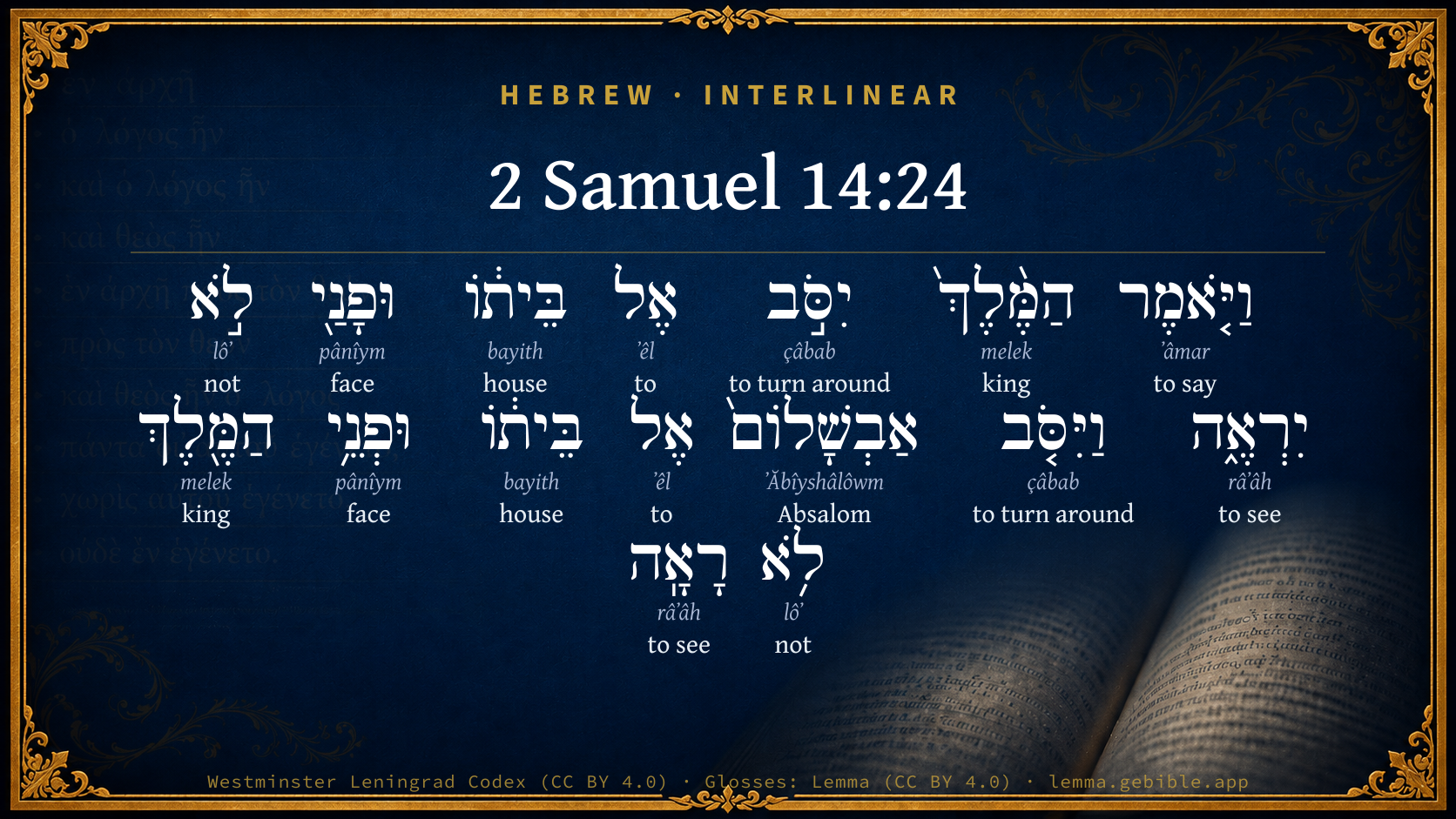
Hebrew (Westminster Leningrad Codex) 2 Samuel 14:24 appears in the Hebrew Old Testament. The text above is from the Westminster Leningrad Codex. Each word links to its Strong’s number, a concise gloss, and parsing drawn from the Open Scriptures Hebrew Bible morphology. Click any word for its full Brown-Driver-Briggs (BDB) entry.
Download image
Cite this verse

2 Samuel 14:24 (World English Bible). Public Domain. Lemma interlinear Bible study tool, https://lemma.gebible.app/v/2-samuel/14/24.

Show BibTeX & RIS
BibTeX
RIS
English Translation
The king said, Let him turn to his own house, but let him not see my face. So Absalom turned to his own house, and didn't see the king's face.
World English Bible · Public Domain
Download a study sheet

One document with this verse’s original text, its word-by-word gloss line, the meaning frame, cross-references with their text, attributed commentary, and full source and license credits — printable, and it pastes into notes with its structure intact.

This verse Autodidact and up

Study sheet (.html) Plain text (.txt)

A passage Seminary Student

Up to 50 verses in one chapter. A passage sheet keeps up to 6 commentary sources and 12 cross-references per verse, in the order this page ranks them, and says so on the sheet whenever that leaves anything out. Ask for a single verse and you get the Autodidact verse sheet above.

Everything on this page stays free to read, with no account — the sheet is a download of what is already on screen, not access to it.

Want to remove ads? Support Godless Engineer
Compare translations 3

The same verse in 3 English versions, stacked beneath the original-language interlinear above. Click any original word for its lexicon entry.

Each is an independent rendering of the whole verse — the interlinear is not word-aligned to these translations.

Highlighted words mark where these versions differ — a whole-verse word diff, not a word-by-word alignment.

  • World English Bible Public Domain
    The king said, Let him turn to his own house, but let him not see my face. So Absalom turned to his own house, and didn't see the king's face.
  • King James Version Public Domain
    And the king said, Let him turn to his own house, and let him not see my face. So Absalom returned to his own house, and saw not the king's face.
  • unfoldingWord Literal Text CC BY-SA 4.0
    Now the king had said, “He may return to his house, but my face he shall not see.” So Absalom returned to his house, but the face of the king he did not see.

unfoldingWord Literal Text — © unfoldingWord, licensed CC BY-SA 4.0. Word-aligned USFM3 via Door43 (git.door43.org/unfoldingWord/en_ult).

Versions to compare (up to 4)

3 of 4 selected

Show all 18 translations

Every available English version of this verse, each an independent rendering of the whole verse.

  • World English Bible Public Domain
    The king said, Let him turn to his own house, but let him not see my face. So Absalom turned to his own house, and didn't see the king's face.
  • Berean Standard Bible Public Domain
    But the king added, “He may return to his house, but he must not see my face.” So Absalom returned to his own house, but he did not see the king.
  • Majority Standard Bible Public Domain
    But the king added, “He may return to his house, but he must not see my face.” So Absalom returned to his own house, but he did not see the face of the king.
  • King James Version Public Domain
    And the king said, Let him turn to his own house, and let him not see my face. So Absalom returned to his own house, and saw not the king's face.
  • American Standard Version (1901) Public Domain
    And the king said, Let him turn to his own house, but let him not see my face. So Absalom turned to his own house, and saw not the king's face.
  • Revised Version (1885) Public Domain
    And the king said, Let him turn to his own house, but let him not see my face. So Absalom turned to his own house, and saw not the king’s face.
  • Geneva Bible (1599) Public Domain
    And the King sayde, Let him turne to his owne house, and not see my face. So Absalom turned to his owne house, and saw not the Kings face.
  • Douay-Rheims (1899) Public Domain
    But the king said: Let him return into his house, and let him not see my face. So Absalom returned into his house, and saw not the king's face.
  • Young's Literal Translation Public Domain
    and the king saith, `Let him turn round unto his house, and my face he doth not see.' And Absalom turneth round unto his house, and the face of the king he hath not seen.
  • Literal Standard Version CC BY-SA 4.0
    and the king says, “Let him turn around to his house, and he does not see my face.” And Absalom turns around to his house, and he has not seen the face of the king.
  • Unlocked Literal Bible CC BY-SA 4.0
    The king said, “He may return to his own house, but he may not see my face.” So Absalom returned to his own house, but did not see the king's face.
  • unfoldingWord Literal Text CC BY-SA 4.0
    Now the king had said, “He may return to his house, but my face he shall not see.” So Absalom returned to his house, but the face of the king he did not see.
  • Darby Bible Public Domain
    And the king said, Let him turn to his own house, and let him not see my face. And Absalom withdrew to his own house, and saw not the king's face.
  • World Messianic Bible Public Domain
    The king said, “Let him return to his own house, but let him not see my face.” So Absalom returned to his own house, and didn’t see the king’s face.
  • Webster's Bible Public Domain
    And the king said, Let him turn to his own house, and let him not see my face. So Absalom returned to his own house, and saw not the king's face.
  • Free Bible Version CC BY-SA 4.0
    But the king gave this order, “He may return to his home, but he's not to come and see me.” So Absalom returned to his own home, but he didn't go and see the king.
  • Bible in Basic English Public Domain
    And the king said, Let him go to his house, but let him not see my face. So Absalom went back to his house and did not see the face of the king.
  • JPS Tanakh (1917) Public Domain
    And the king said: 'Let him turn to his own house, but let him not see my face.' So Absalom turned to his own house, and saw not the king's face.

Literal Standard Version (2020), Covenant Press — licensed CC BY-SA 4.0. Text via the HelloAO Bible API (eBible.org). Unlocked Literal Bible (unfoldingWord) — licensed CC BY-SA 4.0. Text via the HelloAO Bible API (eBible.org). unfoldingWord Literal Text — © unfoldingWord, licensed CC BY-SA 4.0. Word-aligned USFM3 via Door43 (git.door43.org/unfoldingWord/en_ult). Free Bible Version, Dr. Jonathan Gallagher — licensed CC BY-SA 4.0. Text via the HelloAO Bible API (eBible.org).

Word by word

More ways to search: Search by grammar → Find every occurrence → Compare this word →

Practice this passage: Drill this verse → Learn its vocabulary →

אַבְשָׁלוֹם֙
ʼĂbîyshâlôwm
H53
“Absalom”
Noun, Proper
Part of Speech
Noun
Type
Proper
Full BDB Definition

Origin: from H1 and H7965

TWOT: None

Absalom or Abishalom = "my father is peace" - father-in-law of Rehoboam - third son of David, killer of first-born son Amnon, also leader of revolt against his father - David
  1. וַיֹּ֤אמֶר ʼâmar H559 “and · to say” Conjunction + Verb, Qal, Sequential Imperfect, 3rd Person, Masculine, Singular
  2. הַמֶּ֨לֶךְ֙ melek H4428 “the · king” Particle, Definite Article + Noun, Common, Masculine, Singular, Absolute
  3. יִסֹּ֣ב çâbab H5437 “to turn around” Verb, Qal, Imperfect, 3rd Person, Masculine, Singular
  4. אֶל ʼêl H413 “to” Preposition
  5. בֵּית֔וֹ bayith H1004 “house · his” Noun, Common, Masculine, Singular, Construct + Suffix, Personal, 3rd Person, Masculine, Singular
  6. וּפָנַ֖י pânîym H6440 “and · face(s) · my” Conjunction + Noun, Common, Both, Plural, Construct + Suffix, Personal, 1st Person, Common, Singular
  7. לֹ֣א lôʼ H3808 “not” Particle, Negative
  8. יִרְאֶ֑ה râʼâh H7200 “to see” Verb, Qal, Imperfect, 3rd Person, Masculine, Singular
  9. וַיִּסֹּ֤ב çâbab H5437 “and · to turn around” Conjunction + Verb, Qal, Sequential Imperfect, 3rd Person, Masculine, Singular
  10. אֶל ʼêl H413 “to” Preposition
  11. בֵּית֔וֹ bayith H1004 “house · his” Noun, Common, Masculine, Singular, Construct + Suffix, Personal, 3rd Person, Masculine, Singular
  12. וּפְנֵ֥י pânîym H6440 “and · face(s) of” Conjunction + Noun, Common, Both, Plural, Construct
  13. הַמֶּ֖לֶךְ melek H4428 “the · king” Particle, Definite Article + Noun, Common, Masculine, Singular, Absolute
  14. לֹ֥א lôʼ H3808 “not” Particle, Negative
  15. רָאָֽה râʼâh H7200 “to see” Verb, Qal, Perfect, 3rd Person, Masculine, Singular

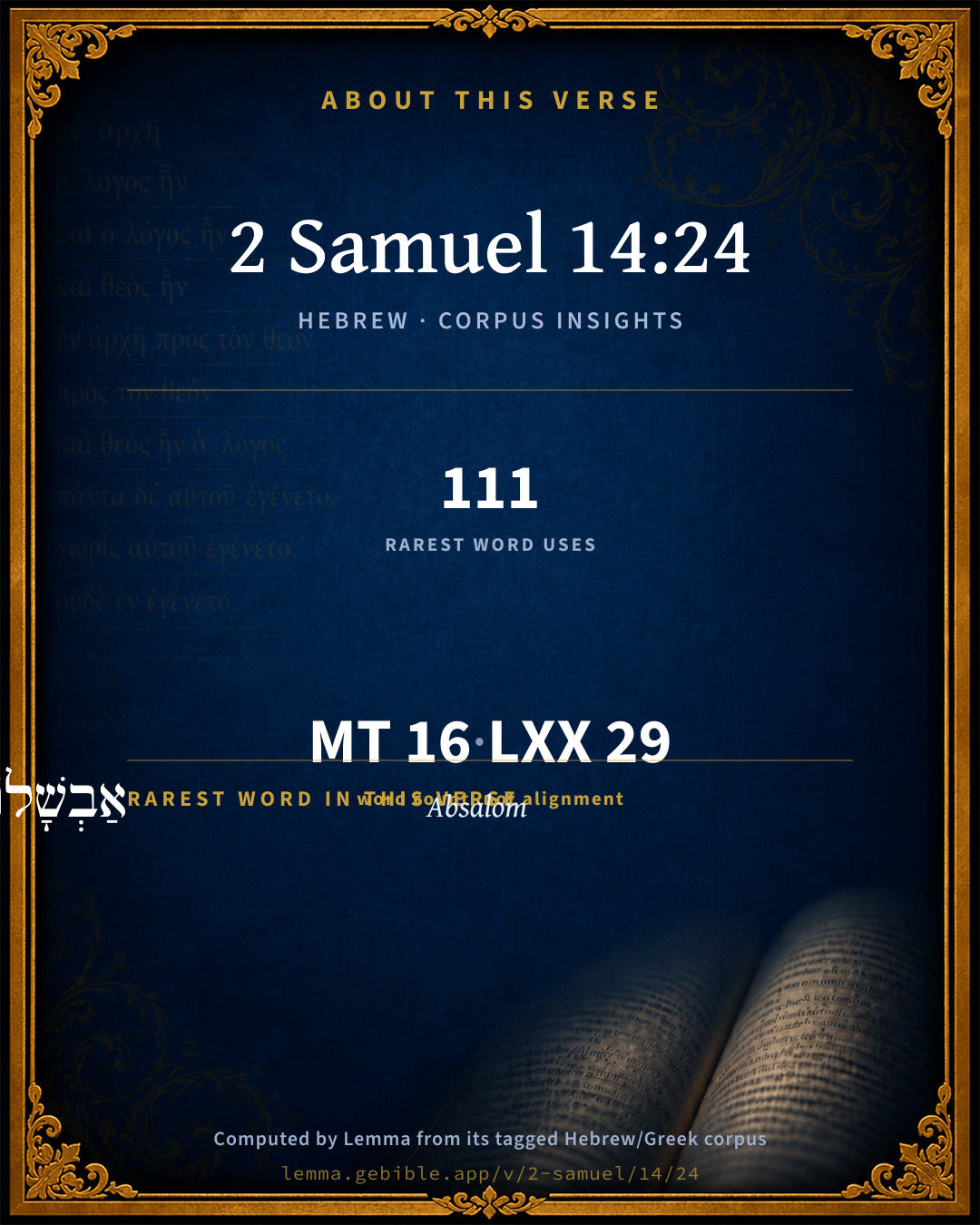
About this verse

These counts appear in no published source. They are computed here, from the morphology-tagged text and Lemma’s own curated glosses. What Lemma adds →

16
words
9
distinct lemmas
Historical
section

Grammatical profile

  • 5 verbs
  • 7 nouns
  • 2 prepositions
  • 2 particles

Verb forms

  • וַיֹּ֤אמֶר Qal · Sequential Imperfect
  • יִסֹּ֣ב Qal · Imperfect
  • יִרְאֶ֑ה Qal · Imperfect
  • וַיִּסֹּ֤ב Qal · Sequential Imperfect
  • רָאָֽה Qal · Perfect

Repetition

Words recur within this verse — often emphatic in Hebrew:

  • הַמֶּ֨לֶךְ֙ king H4428 ×2
  • יִסֹּ֣ב to turn around H5437 ×2
  • בֵּית֔וֹ house H1004 ×2
  • וּפָנַ֖י face H6440 ×2
  • יִרְאֶ֑ה to see H7200 ×2
  • אֶל to H413 ×2
  • לֹ֣א not H3808 ×2

Hebrew & Septuagint length

In English translation the verse runs 30 words from the Hebrew and 27 from the Septuagint (LXX English) — closely comparable.

A rough comparison of the two English renderings, which tokenize alike — not a word-level alignment.

Word counts can differ between the Hebrew and the Greek without any difference in meaning — e.g. the Hebrew direct-object marker אֵת has no separate Greek word, and Greek often adds the article ὁ.

In the original languages it is 16 Hebrew tokens and 29 Greek tokens — but the two are counted differently (Hebrew bundles its prefixes and suffixes into one token; the Greek is in lemma form), so that isn’t a like-for-like length.

Cross-references

5

Topical passages linked to 2 Samuel 14:24 in the Treasury of Scripture Knowledge — connected by theme and wording, ordered by reader-vote popularity; previews shown in the World English Bible.

  • Revelation 22:4 They will see his face, and his name will be on their foreheads.
  • Genesis 43:3 Judah spoke to him, saying, "The man solemnly warned us, saying, 'You shall not see my face, unless your brother is with you.'
  • Exodus 10:28 Pharaoh said to him, "Get away from me! Be careful to see my face no more; for in the day you see my face you shall die!"
  • 2 Samuel 3:13 He said, Well; I will make a league with you; but one thing I require of you: that is, you shall not see my face, except you first bring Michal, Saul's daughter, when you come to see my face.
  • 2 Samuel 14:28 Absalom lived two full years in Jerusalem; and he didn't see the king's face.

Cross-references courtesy of OpenBible.info (CC BY 4.0).

Hebrew and Greek witnesses Masoretic Hebrew ↔ Greek Septuagint

The same verse in the two great witnesses to the Old Testament, shown verse-for-verse.

These are two independent witnesses, not word-aligned to each other, and the Septuagint is shown in lemma (dictionary) form.

Hebrew 2 Samuel 14:24 Masoretic · Westminster Leningrad Codex

וַיֹּ֤אמֶר הַמֶּ֨לֶךְ֙ יִסֹּ֣ב אֶל בֵּית֔וֹ וּפָנַ֖י לֹ֣א יִרְאֶ֑ה וַיִּסֹּ֤ב אַבְשָׁלוֹם֙ אֶל בֵּית֔וֹ וּפְנֵ֥י הַמֶּ֖לֶךְ לֹ֥א רָאָֽה

The king said, Let him turn to his own house, but let him not see my face. So Absalom turned to his own house, and didn't see the king's face.

World English Bible · Public Domain

Greek LXX 2 Samuel 14:24 Septuagint · lemma form

καί εἶπον ὁ βασιλεύς ἀποστρέφω εἰς ὁ οἶκος αὐτός καί ὁ πρόσωπον ἐγώ μή βλέπω καί ἀποστρέφω αβεσσαλωμ εἰς ὁ οἶκος αὐτός καί ὁ πρόσωπον ὁ βασιλεύς οὐ ὁράω

And the king said, Let him return to his house, and not see my face. And Abessalom returned to his house, and saw not the king's face.

LXX2012 (modern English Septuagint) · Public Domain

Hebrew: Westminster Leningrad Codex (CC BY 4.0). Greek: Septuagint (public domain); English from LXX2012 (modern English Septuagint) (Public Domain). How the Septuagint differs from the Hebrew →

Targum (Aramaic paraphrase)

1

The Targum is the ancient Jewish Aramaic paraphrase of the Hebrew Scriptures — an interpretive translation, not the Hebrew text itself. Onkelos (literal) and Pseudo-Jonathan (expansive) render the Torah, and Jonathan the Prophets. Coverage is partial: where no permissively-licensed English translation exists for a verse, only the Aramaic is shown. This is verse-level text, not a word-by-word alignment to the Hebrew.

  1. Targum Jonathan Prophets (Joshua–Malachi)
    וַאֲמַר מַלְכָּא יִסְתְּחַר לְבֵיתֵיהּ וְאַפֵּי לָא יֶחְזֵי וְאִסְתְּחַר אַבְשָׁלוֹם לְבֵיתֵיהּ וְאַפֵּי מַלְכָּא לָא חֲזָא:

    (no public-domain English translation for this verse)

    Targum Jonathan — Aramaic: “Mikraot Gedolot” (public domain). English: “Sefaria Community Translation” (CC0 1.0 (public-domain dedication)); “London "Chaldee Paraphrase," 1871” (public domain). Text via Sefaria.

Commentary

Notes on 2 Samuel 14:24 from classic Christian and Jewish commentators (each source and its license shown beneath its notes). The classic Christian expositions comment on the surrounding passage and are grouped to its opening verse, so a note may address several verses; the Jewish commentaries on the Tanakh (Rashi and others) are per-verse, so they appear only where the commentator wrote on this verse.

Lemma curates 59 commentaries, every one of them public domain or Creative Commons licensed, each selected and text-cleaned for this edition rather than reprinted as found. About our sources →

Trapp's Complete Commentary

John Trapp

2Sa 14:24 And the king said, Let him turn to his own house, and let him not see my face. So Absalom returned to his own house, and saw not the king’s face.

Ver. 24. Let him turn to his own house.] This was a piece of prudent severity: as well for the better humbling of Absalom, whom David knew to be of an insolent nature, as for the preventing of scandal, lest otherwise he might seem too facile to one guilty of so foul a fact, and to make but a light matter of manslaughter.

John Trapp, A Commentary or Exposition upon All the Books of the Old and New Testament (1647–1656) — public domain. Text from a community e-Sword module.

Joseph Benson's Commentary

2Sa 14:24. The king said, Let him turn to his own house — Although the king so far forgave Absalom as to recall him from exile, yet he forbade him to see his face. For his affection to him did not so blind his eyes but he still saw it would not be for his honour to let him come into his presence, lest while he showed some mercy to him, he should seem to approve of his sin. Likewise, he hoped that by this means Absalom might be brought to a more thorough consideration of the heinousness of his crime, and to repentance for it. Indeed, such a discountenance and rebuke as this was necessary, not only to signify the king’s abhorrence of his late cruel revenge upon his brother, but “to mortify his pride and repress his popularity; which it seems now began to blaze out upon the news of his reconciliation to his father. And this may be the reason why the sacred historian subjoins to this account of the king’s discountenance a particular description of Absalom’s beauty, which is a natural and common foundation of popularity; and then adds an account of his having three sons, and one fair daughter, (whom he named after his unhappy sister, Tamar,) which was also another fountain of pride, popularity, and presumption.” — Delaney. He saw not the king’s face — Which was some humiliation to him; for hereby he saw he had not a full pardon, not being entirely restored to the king’s favour. The people also might see by this, in part, how detestable his crime was in the king’s account, and that he would not easily pass by the like in any other person, since he could not endure the sight of a son whose hands were defiled with the blood of his brother.

Joseph Benson's Commentary on the Old and New Testaments (1811–1818) — public domain. Text from a community e-Sword module.

Geneva Bible (1599)

Geneva Bible translators

Covering hereby his affection, and showing some part of justice to please the people.

Geneva Bible (1599) marginal notes — public domain. Text via Bolls.life.

Adam Clarke's Commentary

Verse 24. Let him not see my face.] He would not at once restore him to favour, though he had now remitted his crime; so that he should not die for it. It was highly proper to show this detestation of the crime, and respect for justice.

Adam Clarke's Commentary on the Bible (1810–1826) — public domain. Text from a community e-Sword/MySword module.

Ellicott's Commentary for English Readers

(24) Let him not see my face.—David allowed Absalom’s return, but forbade him his presence. The former had been done in weakness, the latter through a sense of justice. The effect of this half measure was unfortunate; Absalom was irritated, and yet placed in a favourable position to carry out his plots. It is probable that Absalom was confined to his own house.

A Bible Commentary for English Readers, edited by Charles John Ellicott (1878–1897) — public domain. Text from a community e-Sword module.

The Cambridge Bible for Schools and Colleges

gen. ed. J. J. S. Perowne

24. let him not see my face] To recall Absalom without giving him a full pardon was a most dangerous policy. It could not fail to irritate him. It may be inferred from 2Sa_14:29; 2Sa_14:31 that he was confined to his house by David’s order, for otherwise he would not have had to wait until Joab came. David’s reasons for this course of action are discussed in the note on 2Sa_14:1.

The Cambridge Bible for Schools and Colleges (gen. ed. J. J. S. Perowne; Cambridge University Press, 1878–1918) — public domain. Text from a community e-Sword module.

John Gill's Exposition

And the king said,.... Very probably to Joab, when he informed him of Absalom's being come to Jerusalem:

let him turn to his own house; depart from the king's palace, where Joab had brought him, and go to his own house, which was in Jerusalem; for here he had one before he fled to Geshur; see Sa2 13:20,

and let him not see my face; which he ordered, partly to show his detestation of the crime he had been guilty of, and some remaining resentment in his mind at him on account of it; and partly for his credit among some of the people at least, who might think it was a crime so great as not to go unpunished, though others were of a different mind; and also for the greater humiliation of Absalom, who, the king might think, had not been sufficiently humbled for his sin, or had not truly repented of it:

so Absalom returned to his own house, and saw not the king's face; in obedience to his father's orders.

John Gill's Exposition of the Whole Bible (1746–1763) — public domain (CC PDM 1.0). Text via the HelloAO Bible API.

Albert Barnes' Notes on the Bible

Let him not see my face - We are not told why David adopted this half-measure. Possibly Bath-sheba’s influence may have been exerted to keep Absalom in disgrace for the sake of Solomon.

Albert Barnes' Notes on the Bible (1834–1885) — public domain. Text from a community e-Sword/MySword module.

Haydock's Catholic Bible Commentary

Face, though he lived in Jerusalem. (Calmet) --- This was done, in order that he might enter seriously into himself, and avoid similar excesses. (Menochius) --- He felt this privation more than exile. (Haydock)

George Leo Haydock (1774–1849), Haydock's Catholic Family Bible and Commentary, 1859 edition — public domain. Excludes Psalms (Douay-Rheims chapter numbering differs from Protestant) and Deuterocanonical books (Catholic canon only).

Matthew Poole's English Annotations

Let him not see my face; lest whilst he showed some mercy to Absalom, he should seem to approve of his sin, and thereby wound his own conscience, and lose his honour, and encourage him and others to such-like attempts; and that by this means Absalom might be drawn to a more thorough humiliation and true repentance.

Matthew Poole's English Annotations on the Holy Bible (1683–1685) — public domain. Text from a community e-Sword/MySword module.

Whedon's Commentary on the Bible

Daniel D. Whedon

24. Let him not see my face — Though his heart yearn in its love for him, yet his respect for law and justice leads him for the present to show this sternness and severity.

Daniel D. Whedon (gen. ed.), Commentary on the Old and New Testaments (1874–1909) — public domain. Text from a community e-Sword module.

The Pulpit Commentary

Let him turn to his own house, etc. This half forgiveness was unwise, and led to unhappy results. It seems even as if Absalom was a prisoner in his house, as he could not leave it to visit Joab. Still, we must not assume that even kind treatment would have made Absalom a dutiful son, or weaned him from his ambitions purposes. The long plotted revenge, carried out so determinately, gives us a low idea of his character, and probably during these two years of waiting, he had brooded over David"s criminal leniency, and regarded it as a justification for his own foul deed. And now, when allowed to come home, but still treated unkindly, thoughts condemnatory of his father"s conduct were cherished by him. It seems, too, as if a protracted punishment is always dangerous to the moral character of the criminal. And must we not add another reason? Absalom, we may feel sure, saw with indignation the growing influence of Bathsheba over the king. A granddaughter of Ahithophel, she was sure to be an adept in those intrigues in which the women of a harem pass their time; and even if, upon the whole, we form a favourable judgment upon her character, yet undoubtedly she was a very able woman, and could have no affection for Absalom.

The Pulpit Commentary (1880–1919), ed. H.D.M. Spence-Jones & Joseph S. Exell — public domain. Text from a community e-Sword module.

John Wesley's Explanatory Notes

Let him turn - Lest whilst be shewed some mercy to Absalom, he should seem to approve of his sin. Likewise by this means Absalom might be drawn to a more thorough humiliation and repentance.

John Wesley, Explanatory Notes Upon the Whole Bible (1754–1765) — public domain. Text via the GEBible commentary corpus.

Scofield Reference Notes

C. I. Scofield

saw not the king’s face

Not so had God taught David to forgive. Legalists have thought Absalom’s wilfulness to have been due to over-indulgence on the part of David. There is no such intimation in Scripture. Rather it would seem that had David at this time taken Absalom into intimacy, the rebellion might have been averted.

The Scofield Reference Bible (1917 edition), notes by C. I. Scofield — public domain. Text from a community e-Sword module.

Lesson kit

Teaching starters — assembled from the data on this page, not authored interpretation. Every prompt links to the verse data it draws on. Edit before teaching.

2 Samuel, in the Historical, opens this verse with 16 words (9 distinct Hebrew lemmas). Its most distinctive word is ʼĂbîyshâlôwm (“Absalom”). A historical commentator’s framing appears above. Read the whole chapter for the surrounding context.

Discussion questions

  1. How does “Absalom” (ʼĂbîyshâlôwm) shape what this verse is saying?
  2. Revelation 22:4 shares this passage’s theme. How do the two illuminate each other?
  3. “king” occurs 2× in this one verse. What is the effect of the repetition?
  4. These translations render this verse differently. What is at stake in choosing one wording over another?
  5. The verb «וַיֹּ֤אמֶר» is Qal Sequential Imperfect. How does its form color the action?
  6. Reading how Trapp's Complete Commentary and Joseph Benson's Commentary read this verse, where do the two commentators agree and where do they part?

Things to notice

Reading settings

Reading text

Shown beneath each verse's original-language words.

Old Testament
Old Testament edition

Read the OT as the Masoretic Hebrew (MT) or the Greek Septuagint (LXX).

English shown for the Greek Septuagint (in the Hebrew ↔ Greek comparison).

Comparing translations? Open the Compare panel on any verse page to stack up to four side by side.