
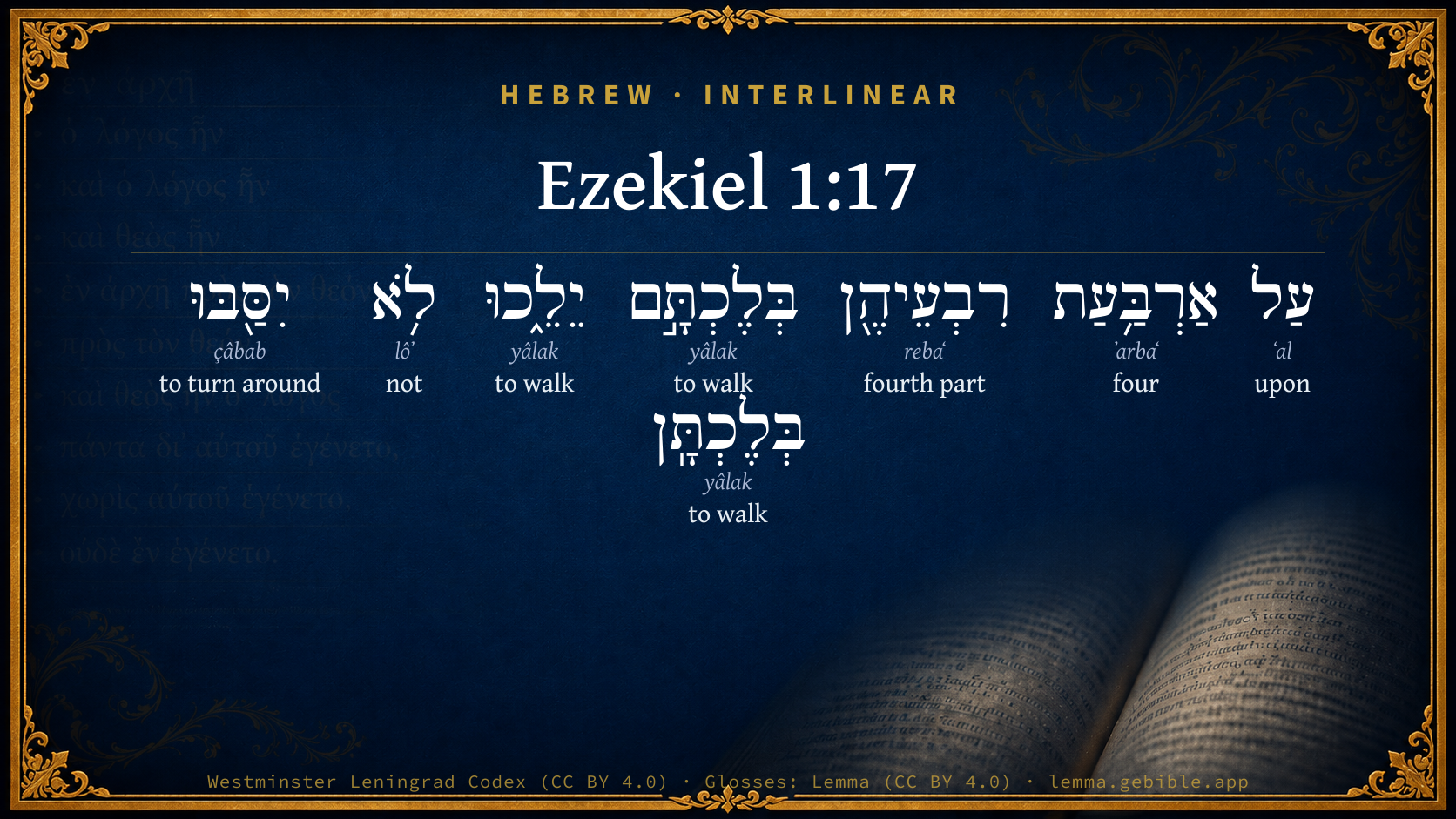
Ezekiel 1:17

Hebrew (Westminster Leningrad Codex) Ezekiel 1:17 appears in the Hebrew Old Testament. The text above is from the Westminster Leningrad Codex. Each word links to its Strong’s number, a concise gloss, and parsing drawn from the Open Scriptures Hebrew Bible morphology. Click any word for its full Brown-Driver-Briggs (BDB) entry.
Download image
Cite this verse

Ezekiel 1:17 (World English Bible). Public Domain. Lemma interlinear Bible study tool, https://lemma.gebible.app/v/ezekiel/1/17.

Show BibTeX & RIS
BibTeX
RIS
English Translation
When they went, they went in their four directions: they didn't turn when they went.
World English Bible · Public Domain
Download a study sheet

One document with this verse’s original text, its word-by-word gloss line, the meaning frame, cross-references with their text, attributed commentary, and full source and license credits — printable, and it pastes into notes with its structure intact.

This verse Autodidact and up

Study sheet (.html) Plain text (.txt)

A passage Seminary Student

Up to 50 verses in one chapter. A passage sheet keeps up to 6 commentary sources and 12 cross-references per verse, in the order this page ranks them, and says so on the sheet whenever that leaves anything out. Ask for a single verse and you get the Autodidact verse sheet above.

Everything on this page stays free to read, with no account — the sheet is a download of what is already on screen, not access to it.

Want to remove ads? Support Godless Engineer
Compare translations 3

The same verse in 3 English versions, stacked beneath the original-language interlinear above. Click any original word for its lexicon entry.

Each is an independent rendering of the whole verse — the interlinear is not word-aligned to these translations.

Highlighted words mark where these versions differ — a whole-verse word diff, not a word-by-word alignment.

  • World English Bible Public Domain
    When they went, they went in their four directions: they didn't turn when they went.
  • King James Version Public Domain
    When they went, they went upon their four sides: and they turned not when they went.
  • unfoldingWord Literal Text CC BY-SA 4.0
    As they moved, they went in any of their four directions, without turning as they went.

unfoldingWord Literal Text — © unfoldingWord, licensed CC BY-SA 4.0. Word-aligned USFM3 via Door43 (git.door43.org/unfoldingWord/en_ult).

Versions to compare (up to 4)

3 of 4 selected

Show all 18 translations

Every available English version of this verse, each an independent rendering of the whole verse.

  • World English Bible Public Domain
    When they went, they went in their four directions: they didn't turn when they went.
  • Berean Standard Bible Public Domain
    As they moved, they went in any of the four directions, without pivoting as they moved.
  • Majority Standard Bible Public Domain
    As they moved, they went in any of the four directions, without pivoting as they moved.
  • King James Version Public Domain
    When they went, they went upon their four sides: and they turned not when they went.
  • American Standard Version (1901) Public Domain
    When they went, they went in their four directions: they turned not when they went.
  • Revised Version (1885) Public Domain
    When they went, they went upon their four sides: they turned not when they went.
  • Geneva Bible (1599) Public Domain
    Whe they went, they went vpon their foure sides, and they returned not when they went.
  • Douay-Rheims (1899) Public Domain
    When they went, they went by their four parts: and they turned not when they went.
  • Young's Literal Translation Public Domain
    On their four sides, in their going they go, they turn not round in their going.
  • Literal Standard Version CC BY-SA 4.0
    On their four sides, in their going they go, they do not turn around in their going.
  • Unlocked Literal Bible CC BY-SA 4.0
    As they moved, they went in any of their four directions, without turning as they went.
  • unfoldingWord Literal Text CC BY-SA 4.0
    As they moved, they went in any of their four directions, without turning as they went.
  • Darby Bible Public Domain
    When they went, they went upon their four sides; they turned not when they went.
  • World Messianic Bible Public Domain
    When they went, they went in their four directions. They didn’t turn when they went.
  • Webster's Bible Public Domain
    When they went, they went upon their four sides: and they returned not when they went.
  • Free Bible Version CC BY-SA 4.0
    They could move in any direction without turning as they did so.
  • Bible in Basic English Public Domain
    The four of them went straight forward without turning to one side.
  • JPS Tanakh (1917) Public Domain
    When they went, they went toward their four sides; they turned not when they went.

Literal Standard Version (2020), Covenant Press — licensed CC BY-SA 4.0. Text via the HelloAO Bible API (eBible.org). Unlocked Literal Bible (unfoldingWord) — licensed CC BY-SA 4.0. Text via the HelloAO Bible API (eBible.org). unfoldingWord Literal Text — © unfoldingWord, licensed CC BY-SA 4.0. Word-aligned USFM3 via Door43 (git.door43.org/unfoldingWord/en_ult). Free Bible Version, Dr. Jonathan Gallagher — licensed CC BY-SA 4.0. Text via the HelloAO Bible API (eBible.org).

Word by word

More ways to search: Search by grammar → Find every occurrence → Compare this word →

Practice this passage: Drill this verse → Learn its vocabulary →

About this verse

These counts appear in no published source. They are computed here, from the morphology-tagged text and Lemma’s own curated glosses. What Lemma adds →

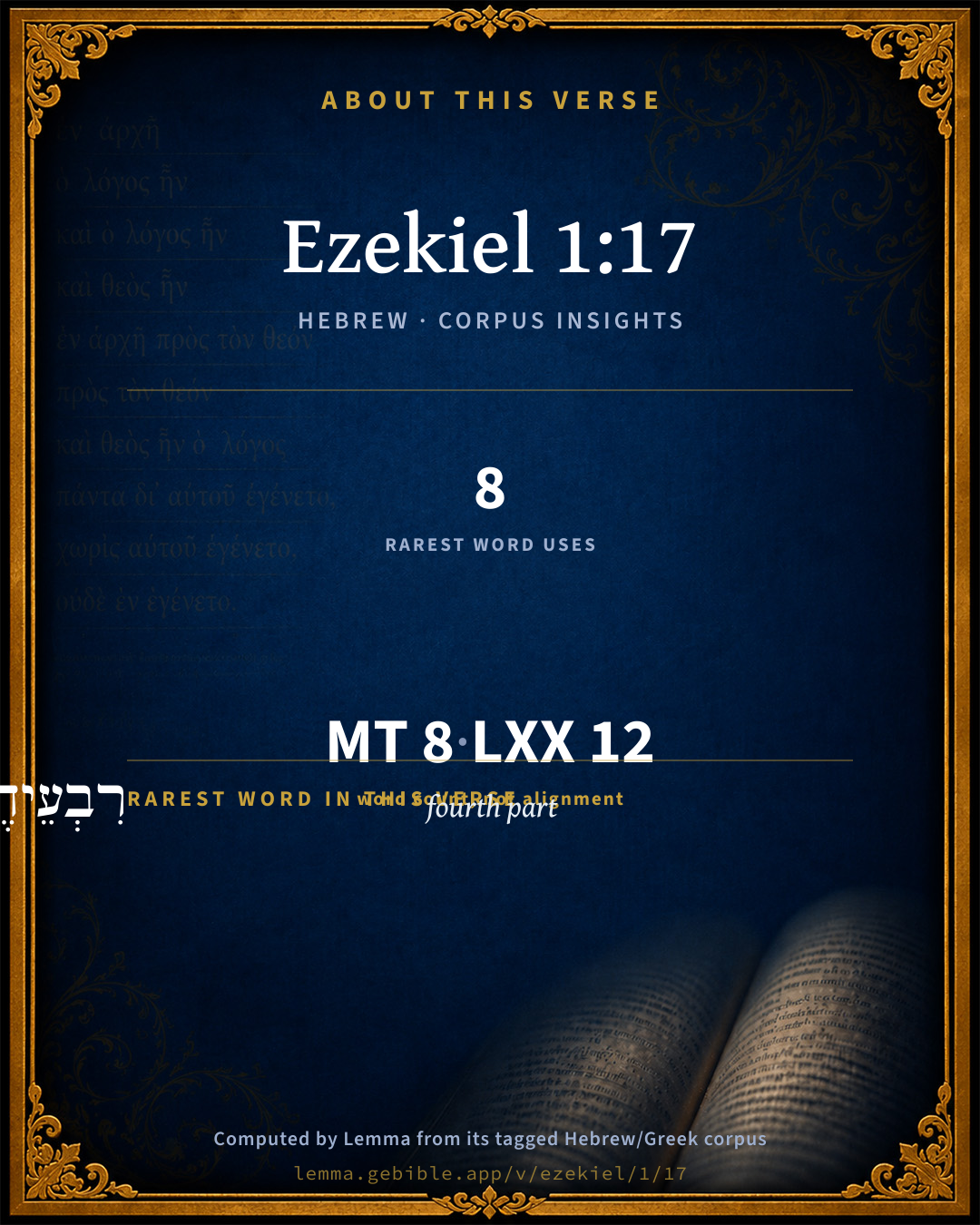
8
words
6
distinct lemmas
Prophets
section

Notable vocabulary

The rarest word here is רִבְעֵיהֶ֖ן fourth part H7253 — appearing just 8 times in the whole Hebrew Bible.

Shared distinctive vocabulary

רִבְעֵיהֶ֖ן fourth part H7253 occurs in 7 verses of the Hebrew Bible. Also found in:

Grammatical profile

  • 4 verbs
  • 1 noun
  • 1 adjective
  • 1 preposition
  • 1 particle

Verb forms

  • בְּלֶכְתָּ֣ם Qal · Infinitive Construct
  • יֵלֵ֑כוּ Qal · Imperfect
  • יִסַּ֖בּוּ Niphal · Imperfect
  • בְּלֶכְתָּֽן Qal · Infinitive Construct

Repetition

A word recurs within this verse — often emphatic in Hebrew:

  • בְּלֶכְתָּ֣ם to walk H3212 ×3

Hebrew & Septuagint length

In English translation the verse runs 15 words from the Hebrew and 12 from the Septuagint (LXX English) — closely comparable.

A rough comparison of the two English renderings, which tokenize alike — not a word-level alignment.

Word counts can differ between the Hebrew and the Greek without any difference in meaning — e.g. the Hebrew direct-object marker אֵת has no separate Greek word, and Greek often adds the article ὁ.

In the original languages it is 8 Hebrew tokens and 12 Greek tokens — but the two are counted differently (Hebrew bundles its prefixes and suffixes into one token; the Greek is in lemma form), so that isn’t a like-for-like length.

Cross-references

4

Topical passages linked to Ezekiel 1:17 in the Treasury of Scripture Knowledge — connected by theme and wording, ordered by reader-vote popularity; previews shown in the World English Bible.

  • Ezekiel 1:9 their wings were joined one to another; they didn't turn when they went; they went everyone straight forward.
  • Ezekiel 1:12 They went everyone straight forward: where the spirit was to go, they went; they didn't turn when they went.
  • Isaiah 55:11 so shall my word be that goes forth out of my mouth: it shall not return to me void, but it shall accomplish that which I please, and it shall prosper in the thing whereto I sent it.
  • Ezekiel 10:1–11 Then I looked, and see, in the expanse that was over the head of the cherubim there appeared above them as it were a sapphire stone, as the appearance of the likeness of a throne.

Cross-references courtesy of OpenBible.info (CC BY 4.0).

Hebrew and Greek witnesses Masoretic Hebrew ↔ Greek Septuagint

The same verse in the two great witnesses to the Old Testament, shown verse-for-verse.

These are two independent witnesses, not word-aligned to each other, and the Septuagint is shown in lemma (dictionary) form.

Hebrew Ezekiel 1:17 Masoretic · Westminster Leningrad Codex

עַל אַרְבַּ֥עַת רִבְעֵיהֶ֖ן בְּלֶכְתָּ֣ם יֵלֵ֑כוּ לֹ֥א יִסַּ֖בּוּ בְּלֶכְתָּֽן

When they went, they went in their four directions: they didn't turn when they went.

World English Bible · Public Domain

Greek LXX Ezekiel 1:17 Septuagint · lemma form

ἐπί ὁ τέσσαρες μέρος αὐτός πορεύομαι οὐ ἐπιστρέφω ἐν ὁ πορεύομαι αὐτός

They went on their four sides: they turned not as they went;

LXX2012 (modern English Septuagint) · Public Domain

Hebrew: Westminster Leningrad Codex (CC BY 4.0). Greek: Septuagint (public domain); English from LXX2012 (modern English Septuagint) (Public Domain). How the Septuagint differs from the Hebrew →

Targum (Aramaic paraphrase)

1

The Targum is the ancient Jewish Aramaic paraphrase of the Hebrew Scriptures — an interpretive translation, not the Hebrew text itself. Onkelos (literal) and Pseudo-Jonathan (expansive) render the Torah, and Jonathan the Prophets. Coverage is partial: where no permissively-licensed English translation exists for a verse, only the Aramaic is shown. This is verse-level text, not a word-by-word alignment to the Hebrew.

  1. Targum Jonathan Prophets (Joshua–Malachi)
    עַל אַרְבְּעָא סִטְרֵיהֶן בְּמִיזַלְהֵן אָזְלִין לָא מִתְחַזְרִין בְּמֵיזַלְהֵן:

    (no public-domain English translation for this verse)

    Targum Jonathan — Aramaic: “Mikraot Gedolot” (public domain). English: “Sefaria Community Translation” (CC0 1.0 (public-domain dedication)); “London "Chaldee Paraphrase," 1871” (public domain). Text via Sefaria.

Commentary

Notes on Ezekiel 1:17 from classic Christian and Jewish commentators (each source and its license shown beneath its notes). The classic Christian expositions comment on the surrounding passage and are grouped to its opening verse, so a note may address several verses; the Jewish commentaries on the Tanakh (Rashi and others) are per-verse, so they appear only where the commentator wrote on this verse.

Lemma curates 59 commentaries, every one of them public domain or Creative Commons licensed, each selected and text-cleaned for this edition rather than reprinted as found. About our sources →

Trapp's Complete Commentary

John Trapp

Eze 1:17 When they went, they went upon their four sides: [and] they turned not when they went.

Ver. 17. When they went, they went upon their four sides.] Or, According to their four sides - i.e., through the four parts of the world, as they were moved by the four living creatures.

And they returned not when they went.] But kept on straight forward, without stopping or stepping back. A figure of the constant and consonant harmony which is in all the works of God’s providence toward the world, but especially toward his Church. {a}

{a} Diod.

John Trapp, A Commentary or Exposition upon All the Books of the Old and New Testament (1647–1656) — public domain. Text from a community e-Sword module.

The Biblical Illustrator

Joseph S. Exell

Eze_1:17

And they turned not when they went.

Concentrated lives

It is a grand thing to see a man thoroughly possessed with one master passion. Such a man is sure to be strong, and if the master principle be excellent, he is sure to be excellent too. The man of one object is a man indeed. Lives with many aims are like water trickling through innumerable streams, none of which is wide enough or deep enough to float the merest cockleshell of a boat; but a life with one object is like a mighty river flowing between its banks, bearing to the ocean a multitude of ships, and spreading fertility on either side. Give me a man not only with a great object in his soul, but thoroughly possessed by it, his powers all concentrated, and himself on fire with vehement zeal for his supreme object, and you have put before me one of the greatest sources of power which the world can produce. Give me a man engrossed with holy love as to his heart, and filled with some masterly celestial thought as to his brain, and such a man will be known wherever his lot may be cast, and I will venture to prophesy that his name will be remembered long after the place of his sepulchre shall be forgotten. (C. H. Spurgeon.)

The Biblical Illustrator, edited by Joseph S. Exell (c. 1880s–1900s) — public domain. Text from a community e-Sword module.

Joseph Benson's Commentary

Eze 1:17-18. When they went — Namely, the wheels; they went upon their four sides — The wheels being supposed spherical as a globe, by an exact framing of two wheels one in the other, the four semicircles, which were in two whole wheels, may well be taken for these four sides on which these wheels moved, and such a wheel will readily be turned to all points of the compass. An expressive emblem this of that divine providence which extends alike easily to every part and thing; and, like a wheel or globe, has no beginning, ending, or separation, but is a circumference including the whole of things, and equally acts more or less in every place and part. And they turned, or returned, not when they went — That is, they never returned, or went backward, till they came to the end of their course; but proceeded on in one straight course and unbent line of direction. So firm and sure are the methods, so unalterable and constant the purposes of God, and so invariable the obedience and observance of holy angels. So subject to the will of God are all second causes, and so surely does the Divine Providence always accomplish its ends. Thus God speaks of his word and decree, Isa 55:11 : It shall not return unto me void, but shall accomplish that which I please. To return by the way that he went, is a proverbial speech, signifying a man’s missing his aim, or not accomplishing his designs: see 1Ki 13:9; 2Ki 19:33. As for their rings, or felloes — Namely, the circumference of the wheels; they were so high that they were dreadful — Their circuit was so vast as to impress a fear on the beholder. This implied the vast compass of providence, which, as we read, Wis 8:1, reacheth from one end to another mightily, or, as St. Paul expresses it, the height and depth both of the wisdom and knowledge of God, how unsearchable his judgments are, and his ways past finding out, Rom 11:33. And their wings were full of eyes round about them four — That is, every one of the four wheels; and so were also the living creatures themselves: see Eze 10:12, to signify the great wisdom and foresight which direct all the dispensations of Divine Providence. How fitly do the wheels, their motion, their height, their eyes, and the form, appearance, motions, wings, and eyes of the living creatures express the height and depth, the unsearchableness, wisdom, and vigilance of the Divine Providence!

Joseph Benson's Commentary on the Old and New Testaments (1811–1818) — public domain. Text from a community e-Sword module.

Jamieson, Fausset & Brown

Robert Jamieson, A. R. Fausset & David Brown

went upon their four sides--Those faces or sides of the four wheels moved which answered to the direction in which the cherubim desired to move; while the transverse circles in each of the four composite wheels remained suspended from the ground, so as not to impede the movements of the others.

Jamieson, Fausset & Brown — Commentary Critical and Explanatory on the Whole Bible (1871) — public domain (CC PDM 1.0). Text via the HelloAO Bible API.

John Calvin's Commentaries

What he had already explained he now repeats for the sake of confirmation, that they went upon their four sides — that is, each living creature proceeded straight forward; the words they turned not refer to their perseverance; not that they exceeded the appointed space, but because they went forward to their object without intermission. I touch but lightly now on what has been already sufficiently explained.

John Calvin's Commentaries (1540-1563) — public domain. Text from the Calvin Translation Society English edition (1840s-50s) via the Christian Classics Ethereal Library (ccel.org). Calvin's coverage is partial (roughly two-thirds of the Bible); uncommented books and verses are honest gaps, never fabricated. The 19th-century editor's footnotes and remarks are omitted so the notes are faithfully Calvin's own voice.

Ellicott's Commentary for English Readers

(17) Upon their four sides—i.e., forwards or backwards upon the one wheel, and to the right or the left upon the other. Four directions are considered throughout the vision as representing all directions, just as elsewhere the four winds represent all winds, and the four corners of the earth the whole earth.

A Bible Commentary for English Readers, edited by Charles John Ellicott (1878–1897) — public domain. Text from a community e-Sword module.

The Cambridge Bible for Schools and Colleges

gen. ed. J. J. S. Perowne

17. they turned not when they went] Of course they ran round on their axle, but each wheel was of such a kind that it had a rim facing all four directions, and could run in any direction. On their four sides should rather be, toward.

The Cambridge Bible for Schools and Colleges (gen. ed. J. J. S. Perowne; Cambridge University Press, 1878–1918) — public domain. Text from a community e-Sword module.

John Gill's Exposition

When they went, they went upon their four sides,.... On either of their crossing rings, as they were directed by the living creatures, at whose side they stood:

and they returned not when they went; they had no need to turn about when they were to go east, west, north, or south, as wheels usually do; but they turned upon the crossing ring, which was towards either of the four points. This denotes the perseverance of the churches, and the true members thereof, in faith and practice; they do not turn back, nor look back, but go right on, walking in the fear of the Lord, and in all his, ways and ordinances.

John Gill's Exposition of the Whole Bible (1746–1763) — public domain (CC PDM 1.0). Text via the HelloAO Bible API.

Albert Barnes' Notes on the Bible

Upon their four sides - i. e. straight in the direction toward which their faces looked. Since the four quarters express all directions, the construction of the living creatures was such that they could move in each direction alike.

Albert Barnes' Notes on the Bible (1834–1885) — public domain. Text from a community e-Sword/MySword module.

Haydock's Catholic Bible Commentary

Parts. When they went, they went by their four parts. That is, indifferently to any of their sides, either forward or backward, to the right or to the left. (Challoner) --- Their motion was connected with the chariot, ver. 20. (Calmet)

George Leo Haydock (1774–1849), Haydock's Catholic Family Bible and Commentary, 1859 edition — public domain. Excludes Psalms (Douay-Rheims chapter numbering differs from Protestant) and Deuterocanonical books (Catholic canon only).

Matthew Poole's English Annotations

When they went; the living creatures; indeed the wheels moved according to the motion of the living creatures, but it will as well agree with the truth, as it better agrees with the grammar of the words, to say this;

they, i.e. the wheels.

They went upon their four sides; the wheels being supposed spherical or round every way as a globe, by an exact and curious framing of two wheels one in the other, the four semicircles which are in two whole wheels may be well taken for these four sides on which these wheels do move, and such a wheel will readily be turned to all points of the compass, as a ball on a billiard table.

They turned not when they went; they needed not go back to turn, as we see other chariots or coaches must do, putting back somewhat to alter their course; or, returned not till they came to their journey’s end; or, nothing could divert them, or put them out of their course. So firm and sure are the methods, so unalterable and constant the purposes, of God, and so invariable the obedience and observance of holy angels; so subject to the just sovereign will of God are all second causes.

Matthew Poole's English Annotations on the Holy Bible (1683–1685) — public domain. Text from a community e-Sword/MySword module.

Whedon's Commentary on the Bible

Daniel D. Whedon

17. They turned not when they went — Of course they revolved, but as each wheel had a double tire, cutting each other transversely, they never needed to turn around when they wished to go at right angles with their present course. Probably these revolving wheels looked like globes of fire, the tires, however, being distinguished by sparkling eyes.

Upon — Rather, toward.

Daniel D. Whedon (gen. ed.), Commentary on the Old and New Testaments (1874–1909) — public domain. Text from a community e-Sword module.

The Pulpit Commentary

When they went, etc. The meaning seems to be that the relative position of the wheels and the living creatures was not altered by motion. On "they turned not," see note on ver. 9. All suggests the idea of orderly and harmonious working.

The Pulpit Commentary (1880–1919), ed. H.D.M. Spence-Jones & Joseph S. Exell — public domain. Text from a community e-Sword module.

John Wesley's Explanatory Notes

They - The wheels. Four sides - The wheels being supposed round every way as a globe, by an exact framing of two wheels one in the other; the four semi-circles which are in two whole wheels, may be well taken for these four sides on which these wheels move, and such a wheel will readily be turned to all points of the compass. Returned not - They returned not 'till they came to their journey's end; nothing could divert them, or put them out of their course. So firm and sure are the methods, so unalterable and constant the purposes of God, and so invariable the obedience and observance of holy angels. So subject to the sovereign will of God are all second causes.

John Wesley, Explanatory Notes Upon the Whole Bible (1754–1765) — public domain. Text via the GEBible commentary corpus.

unfoldingWord translationNotes

Door43 World Missions Community

Connecting Statement:

Ezekiel continues to describe his vision.

they went in any of their four directions

Possible meanings are 1) "their" refers to the creatures. AT: "they would go straight in any one of the four directions that the creatures looked towards" or 2) "their" refers to the wheels.

As for their rims

"This is what the rims of the wheels looked like"

they were high and fearsome

"the rims were very tall and awe-inspiring" or "the rims where tall and frightening"

for the rims were full of eyes round about

"because the rims had very many eyes around all four of the wheels"

unfoldingWord translationNotes — © Distant Shores Media and the Door43 World Missions Community, licensed CC BY-SA 4.0. Source: git.door43.org/Door43/en_tn.

Rashi

Rabbi Shlomo Yitzchaki (Rashi)

toward their four sides, etc. Because of the working of the wheels, he had to repeat them [i.e., the description of the living beings’ movements], to say that the wheels did not stop them because they [the living beings] too were made for that [i.e., moving in four directions].

Rashi on the Tanakh — English translations: “The Judaica Press complete Tanach with Rashi, translated by A. J. Rosenberg” (CC BY 4.0); “Pentateuch with Rashi's commentary by M. Rosenbaum and A.M. Silbermann, 1929-1934” (public domain); “The Metsudah Tanach series, Lakewood, N.J” (CC BY 4.0); and “The Book of Joshua, Metsudah Publications, 1997” (CC BY 4.0). Text via Sefaria.

Lesson kit

Teaching starters — assembled from the data on this page, not authored interpretation. Every prompt links to the verse data it draws on. Edit before teaching.

Ezekiel, in the Prophets, opens this verse with 8 words (6 distinct Hebrew lemmas). Its most distinctive word is rebaʻ (“fourth part”). A historical commentator’s framing appears above. Read the whole chapter for the surrounding context.

Discussion questions

  1. The word rebaʻ carries the sense “fourth part.” How does it shape the verse?
  2. Exodus 29:40 shares the word «fourth part» with this verse. How do the two illuminate each other?
  3. “to walk” occurs 3× in this one verse. What is the effect of the repetition?
  4. These translations render this verse differently. What is at stake in choosing one wording over another?
  5. The verb «בְּלֶכְתָּ֣ם» is Qal Infinitive Construct. How does its form color the action?
  6. Reading how Trapp's Complete Commentary and The Biblical Illustrator read this verse, where do the two commentators agree and where do they part?

Things to notice

Reading settings

Reading text

Shown beneath each verse's original-language words.

Old Testament
Old Testament edition

Read the OT as the Masoretic Hebrew (MT) or the Greek Septuagint (LXX).

English shown for the Greek Septuagint (in the Hebrew ↔ Greek comparison).

Comparing translations? Open the Compare panel on any verse page to stack up to four side by side.