
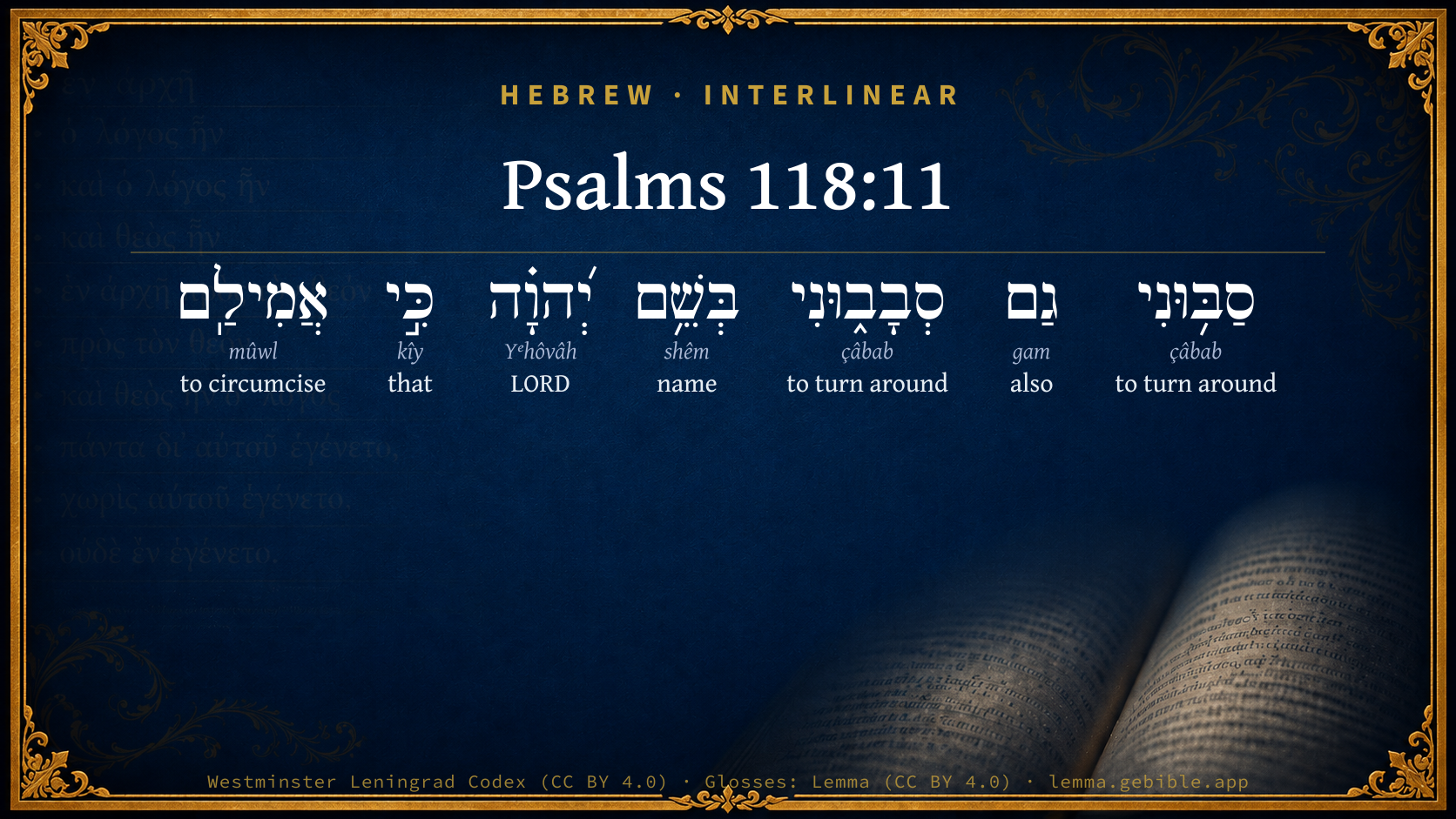
Psalms 118:11

Hebrew (Westminster Leningrad Codex) Psalms 118:11 appears in the Hebrew Old Testament. The text above is from the Westminster Leningrad Codex. Each word links to its Strong’s number, a concise gloss, and parsing drawn from the Open Scriptures Hebrew Bible morphology. Click any word for its full Brown-Driver-Briggs (BDB) entry.
Download image
Cite this verse

Psalms 118:11 (World English Bible). Public Domain. Lemma interlinear Bible study tool, https://lemma.gebible.app/v/psalms/118/11.

Show BibTeX & RIS
BibTeX
RIS
English Translation
They surrounded me, yes, they surrounded me. In the name of Yahweh I indeed cut them off.
World English Bible · Public Domain
Download a study sheet

One document with this verse’s original text, its word-by-word gloss line, the meaning frame, cross-references with their text, attributed commentary, and full source and license credits — printable, and it pastes into notes with its structure intact.

This verse Autodidact and up

Study sheet (.html) Plain text (.txt)

A passage Seminary Student

Up to 50 verses in one chapter. A passage sheet keeps up to 6 commentary sources and 12 cross-references per verse, in the order this page ranks them, and says so on the sheet whenever that leaves anything out. Ask for a single verse and you get the Autodidact verse sheet above.

Everything on this page stays free to read, with no account — the sheet is a download of what is already on screen, not access to it.

Want to remove ads? Support Godless Engineer
Compare translations 3

The same verse in 3 English versions, stacked beneath the original-language interlinear above. Click any original word for its lexicon entry.

Each is an independent rendering of the whole verse — the interlinear is not word-aligned to these translations.

Highlighted words mark where these versions differ — a whole-verse word diff, not a word-by-word alignment.

  • World English Bible Public Domain
    They surrounded me, yes, they surrounded me. In the name of Yahweh I indeed cut them off.
  • King James Version Public Domain
    They compassed me about; yea, they compassed me about: but in the name of the LORD I will destroy them.
  • unfoldingWord Literal Text CC BY-SA 4.0
    They surrounded me; yes, they surrounded me; in the name of Yahweh, indeed I fended them off.

unfoldingWord Literal Text — © unfoldingWord, licensed CC BY-SA 4.0. Word-aligned USFM3 via Door43 (git.door43.org/unfoldingWord/en_ult).

Versions to compare (up to 4)

3 of 4 selected

Show all 18 translations

Every available English version of this verse, each an independent rendering of the whole verse.

  • World English Bible Public Domain
    They surrounded me, yes, they surrounded me. In the name of Yahweh I indeed cut them off.
  • Berean Standard Bible Public Domain
    They surrounded me on every side, but in the name of the LORD I cut them off.
  • Majority Standard Bible Public Domain
    They surrounded me on every side, but in the name of the LORD I cut them off.
  • King James Version Public Domain
    They compassed me about; yea, they compassed me about: but in the name of the LORD I will destroy them.
  • American Standard Version (1901) Public Domain
    They compassed me about; yea, they compassed me about: In the name of Jehovah I will cut them off.
  • Revised Version (1885) Public Domain
    They compassed me about; yea, they compassed me about: in the name of the LORD I will cut them off.
  • Geneva Bible (1599) Public Domain
    They haue compassed mee, yea, they haue compassed mee: but in the Name of the Lord I shall destroy them.
  • Douay-Rheims (1899) Public Domain
    Surrounding me they compassed me about: and in the name of the Lord I have been revenged on them.
  • Young's Literal Translation Public Domain
    They have compassed me about, Yea, they have compassed me about, In the name of Jehovah I surely cut them off.
  • Literal Standard Version CC BY-SA 4.0
    They have surrounded me, || Indeed, they have surrounded me, || In the Name of YHWH I surely cut them off.
  • Unlocked Literal Bible CC BY-SA 4.0
    They surrounded me; yes, they surrounded me; in Yahweh's name I cut them off.
  • unfoldingWord Literal Text CC BY-SA 4.0
    They surrounded me; yes, they surrounded me; in the name of Yahweh, indeed I fended them off.
  • Darby Bible Public Domain
    They encompassed me, yea, encompassed me; but in the name of Jehovah have I destroyed them.
  • World Messianic Bible Public Domain
    They surrounded me, yes, they surrounded me. In the LORD’s name I indeed cut them off.
  • Webster's Bible Public Domain
    They encompassed me; yes, they encompassed me: but in the name of the LORD I will destroy them.
  • Free Bible Version CC BY-SA 4.0
    They completely surrounded me, but even so I defeated them with the help of the Lord.
  • Bible in Basic English Public Domain
    They are round me, yes, they are all about me; but in the name of the Lord I will have them cut down.
  • JPS Tanakh (1917) Public Domain
    They compass me about, yea, they compass me about; verily, in the name of the LORD I will cut them off.

Literal Standard Version (2020), Covenant Press — licensed CC BY-SA 4.0. Text via the HelloAO Bible API (eBible.org). Unlocked Literal Bible (unfoldingWord) — licensed CC BY-SA 4.0. Text via the HelloAO Bible API (eBible.org). unfoldingWord Literal Text — © unfoldingWord, licensed CC BY-SA 4.0. Word-aligned USFM3 via Door43 (git.door43.org/unfoldingWord/en_ult). Free Bible Version, Dr. Jonathan Gallagher — licensed CC BY-SA 4.0. Text via the HelloAO Bible API (eBible.org).

Word by word

More ways to search: Search by grammar → Find every occurrence → Compare this word →

Practice this passage: Drill this verse → Learn its vocabulary →

אֲמִילַֽם
mûwl
H4135
“to circumcise · them”
Verb, Hiphil, Imperfect, 1st Person, Common, Singular + Suffix, Personal, 3rd Person, Masculine, Plural
Part of Speech
Verb
Stem
Hiphil
Form
Imperfect
Person
1st Person
Gender
Common
Number
Singular
Full BDB Definition

Origin: a primitive root

TWOT: 1161

to circumcise, let oneself be circumcised, cut, be cut off - (Qal) to circumcise - (Niphal) to be circumcised, circumcise oneself - (Hiphil) to cause to be circumcised - of destruction (figuratively) - (Hithpolel) to be cut off - (Polel) cut down
  1. סַבּ֥וּנִי çâbab H5437 “to turn around · me” Verb, Qal, Perfect, 3rd Person, Common, Plural + Suffix, Personal, 1st Person, Common, Singular
  2. גַם gam H1571 “also” Adverb
  3. סְבָב֑וּנִי çâbab H5437 “to turn around · me” Verb, Qal, Perfect, 3rd Person, Common, Plural + Suffix, Personal, 1st Person, Common, Singular
  4. בְּשֵׁ֥ם shêm H8034 “in/at · name of” Preposition + Noun, Common, Masculine, Singular, Construct
  5. יְ֝הוָ֗ה Yᵉhôvâh H3068 “LORD” Noun, Proper
  6. כִּ֣י kîy H3588 “that” Conjunction

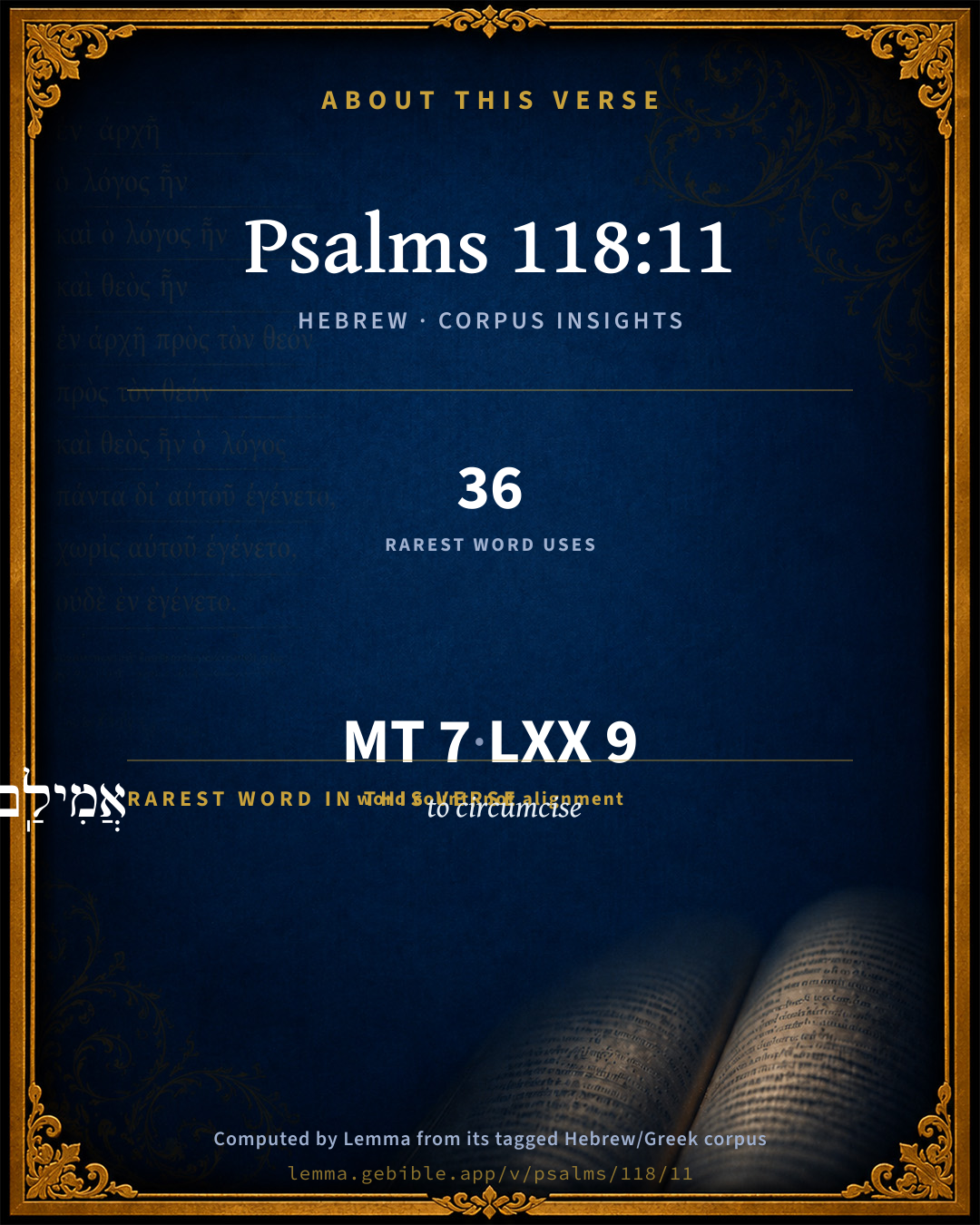
About this verse

These counts appear in no published source. They are computed here, from the morphology-tagged text and Lemma’s own curated glosses. What Lemma adds →

7
words
6
distinct lemmas
Wisdom
section

Shared distinctive vocabulary

אֲמִילַֽם to circumcise H4135 occurs in 32 verses of the Hebrew Bible. Also found in:

Grammatical profile

  • 3 verbs
  • 2 nouns
  • 1 conjunction
  • 1 adverb

Verb forms

  • סַבּ֥וּנִי Qal · Perfect
  • סְבָב֑וּנִי Qal · Perfect
  • אֲמִילַֽם Hiphil · Imperfect

Repetition

A word recurs within this verse — often emphatic in Hebrew:

  • סַבּ֥וּנִי to turn around H5437 ×2

Hebrew & Septuagint length

In English translation the verse runs 17 words from the Hebrew and 15 from the Septuagint (LXX English) — closely comparable.

A rough comparison of the two English renderings, which tokenize alike — not a word-level alignment.

Word counts can differ between the Hebrew and the Greek without any difference in meaning — e.g. the Hebrew direct-object marker אֵת has no separate Greek word, and Greek often adds the article ὁ.

In the original languages it is 7 Hebrew tokens and 9 Greek tokens — but the two are counted differently (Hebrew bundles its prefixes and suffixes into one token; the Greek is in lemma form), so that isn’t a like-for-like length.

Cross-references

4

Topical passages linked to Psalms 118:11 in the Treasury of Scripture Knowledge — connected by theme and wording, ordered by reader-vote popularity; previews shown in the World English Bible.

  • Psalms 88:17 They came around me like water all day long. They completely engulfed me.
  • 1 Samuel 23:26 Saul went on this side of the mountain, and David and his men on that side of the mountain: and David made haste to get away for fear of Saul; for Saul and his men compassed David and his men round about to take them.
  • Psalms 22:12–16 Many bulls have surrounded me. Strong bulls of Bashan have encircled me.
  • 1 Chronicles 19:10 Now when Joab saw that the battle was set against him before and behind, he chose of all the choice men of Israel, and put them in array against the Syrians.

Cross-references courtesy of OpenBible.info (CC BY 4.0).

Hebrew and Greek witnesses Masoretic Hebrew ↔ Greek Septuagint

The same verse in the two great witnesses to the Old Testament, shown verse-for-verse.

You’re reading Greek Psalm 117 (Hebrew Psalm 118). The Septuagint counts the superscription, so verse numbers can differ from the Hebrew — chapter-level alignment, not verse-by-verse. Numbering follows Rahlfs.

These are two independent witnesses, not word-aligned to each other, and the Septuagint is shown in lemma (dictionary) form.

Hebrew Psalms 118:11 Masoretic · Westminster Leningrad Codex

סַבּ֥וּנִי גַם סְבָב֑וּנִי בְּשֵׁ֥ם יְ֝הוָ֗ה כִּ֣י אֲמִילַֽם

They surrounded me, yes, they surrounded me. In the name of Yahweh I indeed cut them off.

World English Bible · Public Domain

Greek LXX Greek Psalm 117:11 Septuagint · lemma form

κυκλόω κυκλόω ἐγώ καί ὁ ὄνομα κύριος ἀμύνω αὐτός

They completely compassed me about: but in the name of the Lord I repulsed them.

LXX2012 (modern English Septuagint) · Public Domain

Hebrew: Westminster Leningrad Codex (CC BY 4.0). Greek: Septuagint (public domain); English from LXX2012 (modern English Septuagint) (Public Domain). How the Septuagint differs from the Hebrew →

Commentary

Notes on Psalms 118:11 from classic Christian and Jewish commentators (each source and its license shown beneath its notes). The classic Christian expositions comment on the surrounding passage and are grouped to its opening verse, so a note may address several verses; the Jewish commentaries on the Tanakh (Rashi and others) are per-verse, so they appear only where the commentator wrote on this verse.

Lemma curates 59 commentaries, every one of them public domain or Creative Commons licensed, each selected and text-cleaned for this edition rather than reprinted as found. About our sources →

Trapp's Complete Commentary

John Trapp

Psa 118:11 They compassed me about; yea, they compassed me about: but in the name of the LORD I will destroy them.

Ver. 11. They compassed me about; yea, &c.] They thought to make sure work of me indeed; as Saul and his men, when they hemmed him in at Maon, 1Sa 23:26; as the Church’s enemies, when they had gotten her as a bird into the snare of the fowler, Psa 124:7; as when the adversaries said, "They shall not know, neither see, till we come in the midst among them, and slay them," Neh 4:11.

But in the name of the Lord I will destroy them] Enervabo, excidam. The word signifieth, Non otioso nec dormienti contingere victorias, sed certanti et praelianti, that he foiled not his foes without pains and peril (Plat. in Syde). Towns were said to come into Timotheus’s toils while he slept; but that was but a fiction of those that envied him.

John Trapp, A Commentary or Exposition upon All the Books of the Old and New Testament (1647–1656) — public domain. Text from a community e-Sword module.

J. A. Alexander on Psalms

Joseph Addison Alexander

11. (Psa 118:11) They surround me, yea they surround me; in the name of Jehovah (I declare) that I will cut them off. The same sentence is repeated with a slight variation, which consists in the omission of the subject and the iteration of the verb, rendered more emphatic by a change of form. The word translated yea means also, likewise, but cannot be so used in the English idiom. The climax indicated may be, that the act described is no longer hypothetical but actual. They surround me; yes, they really, in fact, surround me.

Joseph Addison Alexander, The Psalms Translated and Explained (1850) — public domain. Text from a community e-Sword module.

Ellicott's Commentary for English Readers

(11) But in the name . . .—Or, more emphatically, It is in Jehovah’s name that, &c

A Bible Commentary for English Readers, edited by Charles John Ellicott (1878–1897) — public domain. Text from a community e-Sword module.

John Gill's Exposition

Thou hast thrust sore at me, that I might fall,.... Or "pushing, thou hast pushed me (a), that I might fall": an apostrophe to some particular enemy, as Saul was to David; who thrust sore at him to take away his life, by casting a javelin at him; speaking to his servants to kill him; sending messengers to watch his house and slay him, and by, pursuing him from place to place. And such an one was Judas to Christ, who lifted up his heel against him, and betrayed him into the hands of his enemies; or the devil in him, and by him; and who thrust sore at Christ by others; by Herod in his infancy, who sought to take away his life; and by the Scribes and Pharisees, who attempted it in different ways, and at last got him nailed to the cross; as well as Satan thrust sore at him, by his temptations in the wilderness, and when in his agonies in the garden, and when on the cross: and so the same enemy thrusts sore at the members of Christ, to cause them to fall from him, and the steadfastness of their faith in him to fail; that they may fall into temptation, and by it into sin, and that finally and totally, and into hell itself, could he obtain it;

but the Lord helped me; helped David, so that he perished not by the hand of Saul, he sometimes feared he should; helped Christ, as man and Mediator, in the day of salvation, and raised him from the dead, and gave him glory: and he helps his people against all their enemies; holds them with his right hand; helps them to fight against them; maintains his own work of grace in them, and keeps them from a total and final falling away, by his power unto salvation. The Targum is,

"the Word of the Lord helped me.''

(a) "impellendo impulisti me", Pagninus, Montanus, Musculus, Michaelis; "trudendo trusisti me", Cocceius.

John Gill's Exposition of the Whole Bible (1746–1763) — public domain (CC PDM 1.0). Text via the HelloAO Bible API.

Albert Barnes' Notes on the Bible

They compassed me about; yea, they compassed me about ... - The sentiment and the language of the previous verse are here repeated, as if to give force to what he had said, or to deepen the impression. His own mind dwelt upon it, and the events to which he referred came so vividly to his recollection, and were so important, that he dwells upon them. The subject was worth more than a passing remark. The mind was full, and the language comes from an overflowing heart.

Albert Barnes' Notes on the Bible (1834–1885) — public domain. Text from a community e-Sword/MySword module.

Matthew Poole's English Annotations

They compassed me about; the repetition implies their frequency and fervency in this action, and their confidence of success.

Matthew Poole's English Annotations on the Holy Bible (1683–1685) — public domain. Text from a community e-Sword/MySword module.

The Treasury of David

Charles H. Spurgeon

Ver. 11. They compassed me about; yea, they compassed me about. He had such a vivid recollection of his danger that his enemies seem to live again in his verses. We see their fierce array, and their cruel combination of forces. They made a double ring, they surrounded him in a circle of many ranks, they not only talked of doing so, but they actually shut him up and enclosed him as within a wall. His heart had vividly realized his position of peril at the time, and now he delights to call it again to mind in order that he may the more ardently adore the mercy which made him strong in the hour of conflict, so that he broke through a troop, yea, swept a host to destruction.

But in the name of the LORD will I destroy them. I will subdue them, get them under my feet, and break their power in pieces. He is as certain about the destruction of his enemies as he was assured of their having compassed him about. They made the circle three and four times deep, but for all that he felt confident of victory. It is grand to hear a man speak in this fashion when it is not boasting, but the calm declaration of his heartfelt trust in God.

Ver. 11. Whether Tertullus persecute the church with his tongue, or Elymas with his hand, God hath the command of both. Indeed the wicked are the mediate causes of our troubles: the righteous are as the centre, the other the circumference; which way soever they turn, they find themselves environed; yet still the centre is fixed and immovable, being founded upon Christ. It is good for some men to have adversaries; for often they more fear to sin, lest they should despise them, than dislike it for conscience, lest God should condemn them. They speak evil of us: if true, let us amend it; if false, contemn it; whether false or true, observe it. Thus we shall learn good out of their evil; make them our tutors, and give them our pupillage. In all things let us match them, in nothing fear them: "which is to them an evident token of perdition, but to us of salvation, "Php 1:28. The church is that tower of David; if there be a thousand weapons to wound us, there are a thousand shields to guard us, So 4:4. Thomas Adams.

Psalms 118:12*

Charles H. Spurgeon's The Treasury of David (1869–1885) — public domain. Psalms only. Text from a community e-Sword/MySword module.

The Pulpit Commentary

They compassed me about; yea, they compassed me about. (comp. Psa_88:17) The special compassing about alluded to is probably that in the time of Nebuchadnezzar, when not only the Babylonians but the Syrians, the Moabites, the Ammonites, and the Edomites took part in hostilities against Israel. (2Ki_24:2 Psa_137:7) But in the Name of the Lord I will destroy them. The threefold repetition of this trenchant phrase (vers. 10, 11, 12) lends it vast additional force. It is no casual utterance, no mere wish, or thought begotten of a wish, but a deep and firm conviction.

The Pulpit Commentary (1880–1919), ed. H.D.M. Spence-Jones & Joseph S. Exell — public domain. Text from a community e-Sword module.

John Wesley's Explanatory Notes

Yea - The repetition implies their frequency and fervency in this action.

John Wesley, Explanatory Notes Upon the Whole Bible (1754–1765) — public domain. Text via the GEBible commentary corpus.

Lesson kit

Teaching starters — assembled from the data on this page, not authored interpretation. Every prompt links to the verse data it draws on. Edit before teaching.

Psalms, in the Wisdom, opens this verse with 7 words (6 distinct Hebrew lemmas). Its most distinctive word is mûwl (“to circumcise”). A historical commentator’s framing appears above. Read the whole chapter for the surrounding context.

Discussion questions

  1. The word mûwl carries the sense “to circumcise.” How does it shape the verse?
  2. Genesis 17:10 shares the word «to circumcise» with this verse. How do the two illuminate each other?
  3. “to turn around” occurs 2× in this one verse. What is the effect of the repetition?
  4. These translations render this verse differently; the difference is in the English rendering, not the original. What questions does that raise?
  5. The verb «סַבּ֥וּנִי» is Qal Perfect. How does its form color the action?
  6. Reading how Trapp's Complete Commentary and J. A. Alexander on Psalms read this verse, where do the two commentators agree and where do they part?

Things to notice

Reading settings

Reading text

Shown beneath each verse's original-language words.

Old Testament
Old Testament edition

Read the OT as the Masoretic Hebrew (MT) or the Greek Septuagint (LXX).

English shown for the Greek Septuagint (in the Hebrew ↔ Greek comparison).

Comparing translations? Open the Compare panel on any verse page to stack up to four side by side.