
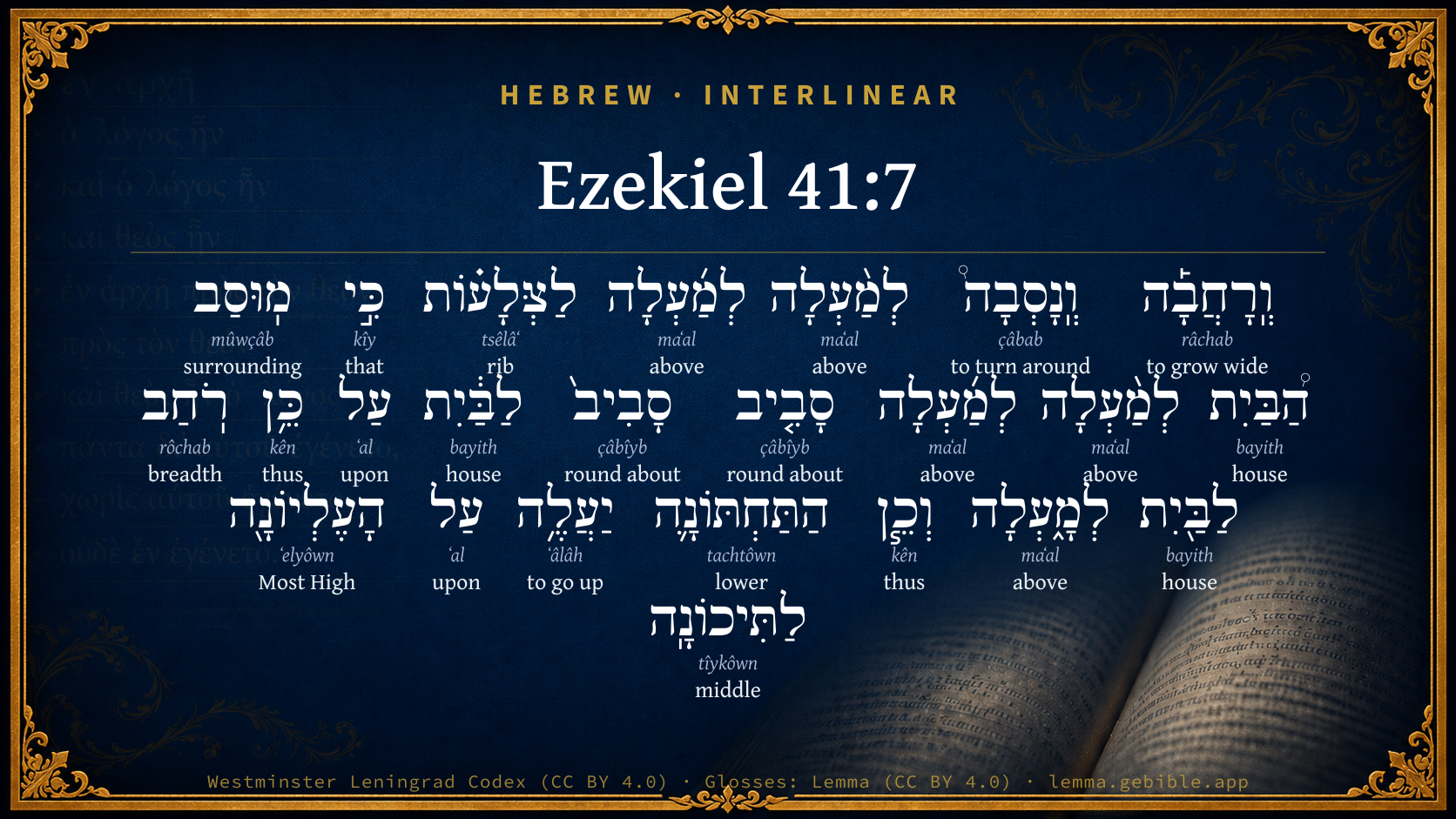
Ezekiel 41:7

Hebrew (Westminster Leningrad Codex) Ezekiel 41:7 appears in the Hebrew Old Testament. The text above is from the Westminster Leningrad Codex. Each word links to its Strong’s number, a concise gloss, and parsing drawn from the Open Scriptures Hebrew Bible morphology. Click any word for its full Brown-Driver-Briggs (BDB) entry.
Download image
Cite this verse

Ezekiel 41:7 (World English Bible). Public Domain. Lemma interlinear Bible study tool, https://lemma.gebible.app/v/ezekiel/41/7.

Show BibTeX & RIS
BibTeX
RIS
English Translation
The side-chambers were broader as they encompassed [the house] higher and higher; for the encompassing of the house went higher and higher round about the house: therefore the breadth of the house [continued] upward; and so one went up [from] the lowest [chamber] to the highest by the middle [chamber].
World English Bible · Public Domain
Highlights
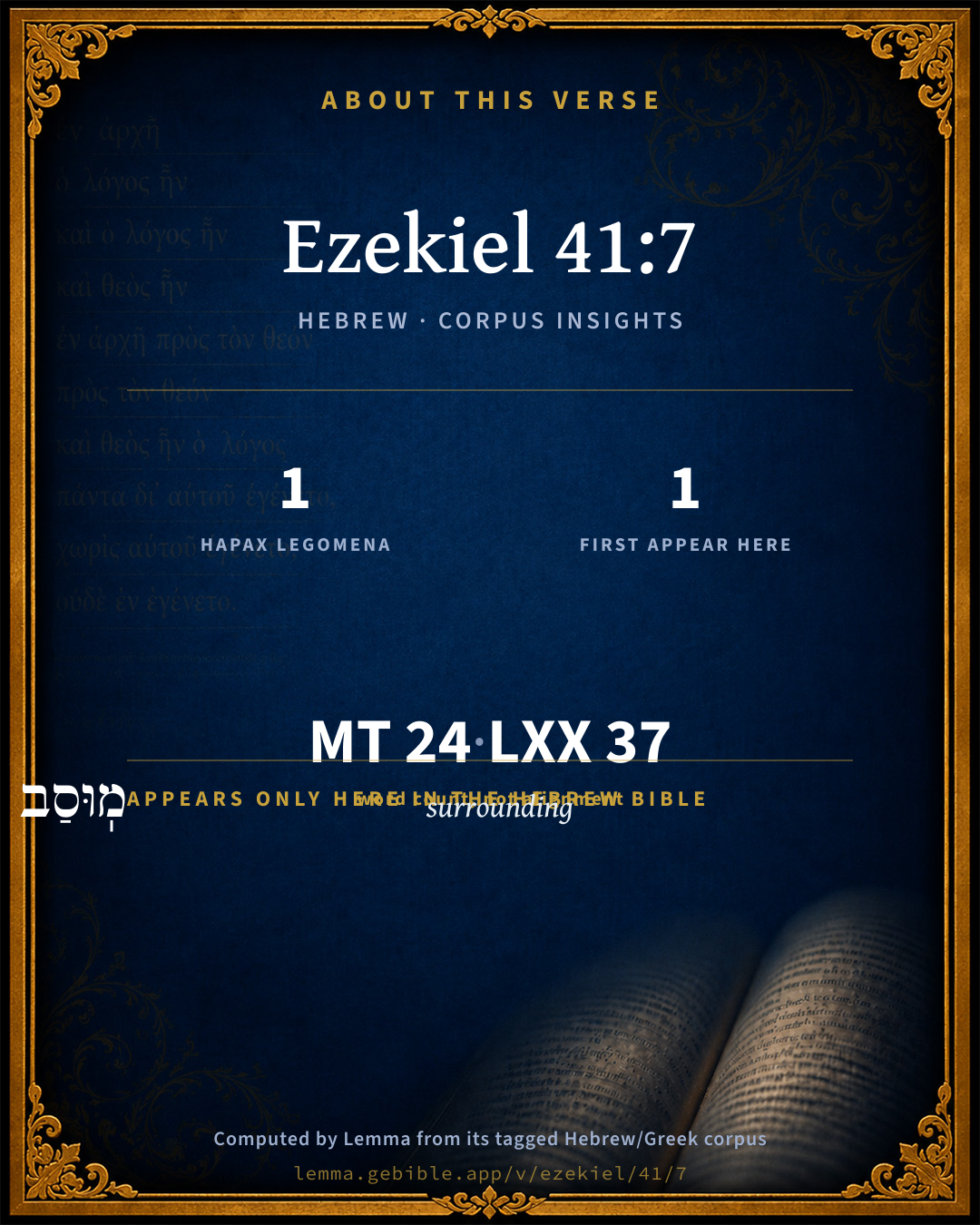
  • 1 hapax legomenon — only here in the Hebrew Bible
  • 1 first appearance in the Hebrew Bible
Full analysis ↓
Download a study sheet

One document with this verse’s original text, its word-by-word gloss line, the meaning frame, cross-references with their text, attributed commentary, and full source and license credits — printable, and it pastes into notes with its structure intact.

This verse Autodidact and up

Study sheet (.html) Plain text (.txt)

A passage Seminary Student

Up to 50 verses in one chapter. A passage sheet keeps up to 6 commentary sources and 12 cross-references per verse, in the order this page ranks them, and says so on the sheet whenever that leaves anything out. Ask for a single verse and you get the Autodidact verse sheet above.

Everything on this page stays free to read, with no account — the sheet is a download of what is already on screen, not access to it.

Want to remove ads? Support Godless Engineer
Compare translations 3

The same verse in 3 English versions, stacked beneath the original-language interlinear above. Click any original word for its lexicon entry.

Each is an independent rendering of the whole verse — the interlinear is not word-aligned to these translations.

Highlighted words mark where these versions differ — a whole-verse word diff, not a word-by-word alignment.

  • World English Bible Public Domain
    The side-chambers were broader as they encompassed [the house] higher and higher; for the encompassing of the house went higher and higher round about the house: therefore the breadth of the house [continued] upward; and so one went up [from] the lowest [chamber] to the highest by the middle [chamber].
  • King James Version Public Domain
    And there was an enlarging, and a winding about still upward to the side chambers: for the winding about of the house went still upward round about the house: therefore the breadth of the house was still upward, and so increased from the lowest chamber to the highest by the midst.
  • unfoldingWord Literal Text CC BY-SA 4.0
    So the side rooms widened and went around going up, for the house went around higher and higher all around; the rooms widened as the house went up, and a stairway went up to the highest level, through the middle level.

unfoldingWord Literal Text — © unfoldingWord, licensed CC BY-SA 4.0. Word-aligned USFM3 via Door43 (git.door43.org/unfoldingWord/en_ult).

Versions to compare (up to 4)

3 of 4 selected

Show all 18 translations

Every available English version of this verse, each an independent rendering of the whole verse.

  • World English Bible Public Domain
    The side-chambers were broader as they encompassed [the house] higher and higher; for the encompassing of the house went higher and higher round about the house: therefore the breadth of the house [continued] upward; and so one went up [from] the lowest [chamber] to the highest by the middle [chamber].
  • Berean Standard Bible Public Domain
    The side rooms surrounding the temple widened at each successive level, because the structure surrounding the temple ascended by stages corresponding to the narrowing of the temple wall as it rose upward. And so a stairway went up from the lowest story to the highest, through the middle one.
  • Majority Standard Bible Public Domain
    The side rooms surrounding the temple widened at each successive level, because the structure surrounding the temple ascended by stages corresponding to the narrowing of the temple wall as it rose upward. And so a stairway went up from the lowest story to the highest, through the middle one.
  • King James Version Public Domain
    And there was an enlarging, and a winding about still upward to the side chambers: for the winding about of the house went still upward round about the house: therefore the breadth of the house was still upward, and so increased from the lowest chamber to the highest by the midst.
  • American Standard Version (1901) Public Domain
    And the side-chambers were broader as they encompassed `the house' higher and higher; for the encompassing of the house went higher and higher round about the house: therefore the breadth of the house `continued' upward; and so one went up `from' the lowest `chamber' to the highest by the middle `chamber'.
  • Revised Version (1885) Public Domain
    And the side-chambers were broader as they encompassed the house higher and higher; for the encompassing of the house went higher and higher round about the house: therefore the breadth of the house continued upward; and so one went up from the lowest chamber to the highest by the middle chamber.
  • Geneva Bible (1599) Public Domain
    And it was large and went rounde mounting vpwarde to the chambers: for the staire of the house was mounting vpwarde, rounde about the house: therefore the house was larger vpward: so they went vp from the lowest chamber to the highest by the middes.
  • Douay-Rheims (1899) Public Domain
    And there was a broad passage round about, going up by winding stairs, and it led into the upper loft of the temple all round: therefore was the temple broader in the higher parts: and so from the lower parts they went to the higher by the midst.
  • Young's Literal Translation Public Domain
    And a broad place and a turning place still upwards `are' to the side-chambers, for the turning round of the house `is' still upwards all round about the house: therefore the breadth of the house `is' upwards, and so the lower one goeth up unto the higher by the midst.
  • Literal Standard Version CC BY-SA 4.0
    And it has become wider when one has turned even higher toward the side-chambers, for the encompassment of the house [is] even higher all around the house: therefore the breadth of the house [goes] upwards, and so the lower [story] goes up to the higher by the middle.
  • Unlocked Literal Bible CC BY-SA 4.0
    So the side rooms widened and went around going up, for the house went around higher and higher all around; the rooms widened as the house went up, and a stairway went up to the highest level, through the middle level.
  • unfoldingWord Literal Text CC BY-SA 4.0
    So the side rooms widened and went around going up, for the house went around higher and higher all around; the rooms widened as the house went up, and a stairway went up to the highest level, through the middle level.
  • Darby Bible Public Domain
    And for the side-chambers there was an enlarging, and it went round about [the house] increasing upward; for the surrounding of the house increased upward round about the house; therefore the house had width upward, and so ascended [from] the lower [story] to the upper, by the middle one.
  • World Messianic Bible Public Domain
    The side rooms were wider on the higher levels, because the walls were narrower at the higher levels. Therefore the width of the house increased upward; and so one went up from the lowest level to the highest through the middle level.
  • Webster's Bible Public Domain
    And there was an enlarging, and a winding about still upward to the side-chambers: for the winding about of the house went still upward around the house; therefore the breadth of the house was still upward, and so increased from the lowest chamber to the highest by the midst.
  • Free Bible Version CC BY-SA 4.0
    The side rooms around the Temple became wider at each higher level, because as the structure around the Temple went up the Temple wall grew narrower A stairway provided access from the bottom story to the top, going through the middle level.
  • Bible in Basic English Public Domain
    The side-rooms became wider as they went higher up the house, by the amount of the space let into the wall up round about the house, because of the inlets in the house; and one went up from the lowest floor by steps to the middle, and from the middle to the upper floor.
  • JPS Tanakh (1917) Public Domain
    And the side-chambers were broader as they wound about higher and higher; for the winding about of the house went higher and higher round about the house; therefore the breadth of the house continued upward; and so one went up from the lowest row to the highest by the middle.

Literal Standard Version (2020), Covenant Press — licensed CC BY-SA 4.0. Text via the HelloAO Bible API (eBible.org). Unlocked Literal Bible (unfoldingWord) — licensed CC BY-SA 4.0. Text via the HelloAO Bible API (eBible.org). unfoldingWord Literal Text — © unfoldingWord, licensed CC BY-SA 4.0. Word-aligned USFM3 via Door43 (git.door43.org/unfoldingWord/en_ult). Free Bible Version, Dr. Jonathan Gallagher — licensed CC BY-SA 4.0. Text via the HelloAO Bible API (eBible.org).

Word by word

More ways to search: Search by grammar → Find every occurrence → Compare this word →

Practice this passage: Drill this verse → Learn its vocabulary →

מֽוּסַב
mûwçâb
H4141
“surrounding of”
Noun, Common, Masculine, Singular, Construct
Part of Speech
Noun
Type
Common
Gender
Masculine
Number
Singular
State
Construct
Full BDB Definition

Origin: from H5437

TWOT: 1456b

encompassing, surrounding, round about
  1. וְֽרָחֲבָ֡ה râchab H7337 “and · to grow wide” Conjunction + Verb, Qal, Perfect, 3rd Person, Feminine, Singular
  2. וְֽנָסְבָה֩ çâbab H5437 “and · to turn around” Conjunction + Verb, Niphal, Perfect, 3rd Person, Feminine, Singular
  3. לְמַ֨עְלָה maʻal H4605 “to/for · above · toward” Preposition + Adverb + Suffix, Demonstrative
  4. לְמַ֜עְלָה maʻal H4605 “to/for · above · toward” Preposition + Adverb + Suffix, Demonstrative
  5. לַצְּלָע֗וֹת tsêlâʻ H6763 “to/for the · ribs” Preposition, Determined + Noun, Common, Both, Plural, Absolute
  6. כִּ֣י kîy H3588 “that” Conjunction
  7. הַ֠בַּיִת bayith H1004 “the · house” Particle, Definite Article + Noun, Common, Masculine, Singular, Absolute
  8. לְמַ֨עְלָה maʻal H4605 “to/for · above · toward” Preposition + Adverb + Suffix, Demonstrative
  9. לְמַ֜עְלָה maʻal H4605 “to/for · above · toward” Preposition + Adverb + Suffix, Demonstrative
  10. סָבִ֤יב çâbîyb H5439 “round about” Noun, Common, Both, Singular, Absolute
  11. סָבִיב֙ çâbîyb H5439 “round about” Noun, Common, Both, Singular, Absolute
  12. לַבַּ֔יִת bayith H1004 “to/for the · house” Preposition, Determined + Noun, Common, Masculine, Singular, Absolute
  13. עַל ʻal H5921 “upon” Preposition
  14. כֵּ֥ן kên H3651 “thus” Particle, Demonstrative
  15. רֹֽחַב rôchab H7341 “breadth” Noun, Common, Masculine, Singular, Absolute
  16. לַבַּ֖יִת bayith H1004 “to/for the · house” Preposition, Determined + Noun, Common, Masculine, Singular, Absolute
  17. לְמָ֑עְלָה maʻal H4605 “to/for · above · toward” Preposition + Adverb + Suffix, Demonstrative
  18. וְכֵ֧ן kên H3651 “and · thus” Conjunction + Particle, Demonstrative
  19. הַתַּחְתּוֹנָ֛ה tachtôwn H8481 “the · lower” Particle, Definite Article + Adjective, Adjective, Feminine, Singular, Absolute
  20. יַעֲלֶ֥ה ʻâlâh H5927 “to go up” Verb, Qal, Imperfect, 3rd Person, Masculine, Singular
  21. עַל ʻal H5921 “upon” Preposition
  22. הָעֶלְיוֹנָ֖ה ʻelyôwn H5945 “the · Most High” Particle, Definite Article + Adjective, Adjective, Feminine, Singular, Absolute
  23. לַתִּיכוֹנָֽה tîykôwn H8484 “to/for the · middle” Preposition, Determined + Adjective, Adjective, Feminine, Singular, Absolute

About this verse

These counts appear in no published source. They are computed here, from the morphology-tagged text and Lemma’s own curated glosses. What Lemma adds →

24
words
15
distinct lemmas
Prophets
section

Notable vocabulary

1 hapax legomenon — a word that appears only here in the entire Hebrew Bible:

  • מֽוּסַב surrounding H4141

First appearance in Scripture

This word makes its first canonical appearance in the Hebrew Bible here:

  • מֽוּסַב surrounding H4141

Shared distinctive vocabulary

לַתִּיכוֹנָֽה middle H8484 occurs in 9 verses of the Hebrew Bible. Also found in:

Grammatical profile

  • 3 verbs
  • 8 nouns
  • 3 adjectives
  • 2 prepositions
  • 1 conjunction
  • 5 adverbs
  • 2 particles

Verb forms

  • וְֽרָחֲבָ֡ה Qal · Perfect
  • וְֽנָסְבָה֩ Niphal · Perfect
  • יַעֲלֶ֥ה Qal · Imperfect

Repetition

Words recur within this verse — often emphatic in Hebrew:

  • לְמַ֨עְלָה above H4605 ×5
  • הַ֠בַּיִת house H1004 ×3
  • סָבִ֤יב round about H5439 ×2
  • עַל upon H5921 ×2
  • כֵּ֥ן thus H3651 ×2

Hebrew & Septuagint length

In English translation the verse runs 50 words from the Hebrew and 52 from the Septuagint (LXX English) — closely comparable.

A rough comparison of the two English renderings, which tokenize alike — not a word-level alignment.

Word counts can differ between the Hebrew and the Greek without any difference in meaning — e.g. the Hebrew direct-object marker אֵת has no separate Greek word, and Greek often adds the article ὁ.

In the original languages it is 24 Hebrew tokens and 37 Greek tokens — but the two are counted differently (Hebrew bundles its prefixes and suffixes into one token; the Greek is in lemma form), so that isn’t a like-for-like length.

Cross-references

3

Topical passages linked to Ezekiel 41:7 in the Treasury of Scripture Knowledge — connected by theme and wording, ordered by reader-vote popularity; previews shown in the World English Bible.

  • 1 Kings 6:8 The door for the middle side-chambers was in the right side of the house: and they went up by winding stairs into the middle [story], and out of the middle into the third.
  • Matthew 13:32 which indeed is smaller than all seeds. But when it is grown, it is greater than the herbs, and becomes a tree, so that the birds of the air come and lodge in its branches."
  • Hebrews 6:1 Therefore leaving the doctrine of the first principles of Christ, let us press on to perfection--not laying again a foundation of repentance from dead works, of faith toward God,

Cross-references courtesy of OpenBible.info (CC BY 4.0).

Hebrew and Greek witnesses Masoretic Hebrew ↔ Greek Septuagint

The same verse in the two great witnesses to the Old Testament, shown verse-for-verse.

These are two independent witnesses, not word-aligned to each other, and the Septuagint is shown in lemma (dictionary) form.

Hebrew Ezekiel 41:7 Masoretic · Westminster Leningrad Codex

וְֽרָחֲבָ֡ה וְֽנָסְבָה֩ לְמַ֨עְלָה לְמַ֜עְלָה לַצְּלָע֗וֹת כִּ֣י מֽוּסַב הַ֠בַּיִת לְמַ֨עְלָה לְמַ֜עְלָה סָבִ֤יב סָבִיב֙ לַבַּ֔יִת עַל כֵּ֥ן רֹֽחַב לַבַּ֖יִת לְמָ֑עְלָה וְכֵ֧ן הַתַּחְתּוֹנָ֛ה יַעֲלֶ֥ה עַל הָעֶלְיוֹנָ֖ה לַתִּיכוֹנָֽה

The side-chambers were broader as they encompassed [the house] higher and higher; for the encompassing of the house went higher and higher round about the house: therefore the breadth of the house [continued] upward; and so one went up [from] the lowest [chamber] to the highest by the middle [chamber].

World English Bible · Public Domain

Greek LXX Ezekiel 41:7 Septuagint · lemma form

καί ὁ εὖρος ὁ ἀνώτερος ὁ πλευρά κατά ὁ πρόσθεμα ἐκ ὁ τοῖχος πρός ὁ ἀνώτερος κύκλος ὁ οἶκος ὅπως διαπλατύνω ἄνωθεν καί ἐκ ὁ κάτωθεν ἀναβαίνω ἐπί ὁ ὑπερῷον καί ἐκ ὁ μέσος ἐπί ὁ τριώροφος

And the breadth of the upper side was made according to the projection out of the wall, against the upper one round about the house, that it might be enlarged above, and that men might go up to the upper chambers from those below, and from the ground-sills to the third story.

LXX2012 (modern English Septuagint) · Public Domain

On this verse, The Cambridge Bible for Schools and Colleges discusses the Septuagint’s reading. Read the note in Commentary ↓

Hebrew: Westminster Leningrad Codex (CC BY 4.0). Greek: Septuagint (public domain); English from LXX2012 (modern English Septuagint) (Public Domain). How the Septuagint differs from the Hebrew →

Targum (Aramaic paraphrase)

1

The Targum is the ancient Jewish Aramaic paraphrase of the Hebrew Scriptures — an interpretive translation, not the Hebrew text itself. Onkelos (literal) and Pseudo-Jonathan (expansive) render the Torah, and Jonathan the Prophets. Coverage is partial: where no permissively-licensed English translation exists for a verse, only the Aramaic is shown. This is verse-level text, not a word-by-word alignment to the Hebrew.

  1. Targum Jonathan Prophets (Joshua–Malachi)
    וּפּוּתְיָא מְסִבָּתָא וְסַלְקָא לְעֵלָא לְעֵלָא מִן מְחִיצַיָא אֲרֵי מַקְפָא בֵיתָא לְסַלָקָא לְעֵלָא לְעֵלָא סְחוֹר סְחוֹר לְגָיו עַל כֵּן פָּתֵי בֵיתָא מִלְעֲלָא וְכֵן בִּמְסִבָּתָא סַלְקִין מִן אַרְעִיתָא לְעִלֵיתָא בְּאוֹרַח מְצִיעֲתָא:

    (no public-domain English translation for this verse)

    Targum Jonathan — Aramaic: “Mikraot Gedolot” (public domain). English: “Sefaria Community Translation” (CC0 1.0 (public-domain dedication)); “London "Chaldee Paraphrase," 1871” (public domain). Text via Sefaria.

Commentary

Notes on Ezekiel 41:7 from classic Christian and Jewish commentators (each source and its license shown beneath its notes). The classic Christian expositions comment on the surrounding passage and are grouped to its opening verse, so a note may address several verses; the Jewish commentaries on the Tanakh (Rashi and others) are per-verse, so they appear only where the commentator wrote on this verse.

Lemma curates 59 commentaries, every one of them public domain or Creative Commons licensed, each selected and text-cleaned for this edition rather than reprinted as found. About our sources →

Trapp's Complete Commentary

John Trapp

Eze 41:7 And [there was] an enlarging, and a winding about still upward to the side chambers: for the winding about of the house went still upward round about the house: therefore the breadth of the house [was still] upward, and so increased [from] the lowest [chamber] to the highest by the midst.

Ver. 7. And there was an enlarging and a winding about still upward.] This might inmind God’s people of heavenly mindedness, whereby their hearts will be enlarged when got once above the world, as birds sing sweetly when got aloft into the air.

Went still upward.] Let there be continual ascensions in our hearts: Sursum corda.

John Trapp, A Commentary or Exposition upon All the Books of the Old and New Testament (1647–1656) — public domain. Text from a community e-Sword module.

The Biblical Illustrator

Joseph S. Exell

Eze_41:7

And there was an enlarging, and a winding about still upward.

Enlargement upwards

As the temple ascended in height, so it still was wider and wider; even from the lowest chambers to the top. And this was to show us that Gods true Gospel temple, which is His Church, should have its enlargedness of heart still upward, or most for spiritual and eternal things (Isa_55:5; Col_3:1). Indeed it is the nature of grace to enlarge itself still upward, and to make the heart widest for the things that are above. The temple, therefore, was narrowest downwards, to show that a little of earth or this world should serve the Church of God. One may say of the fashion of the temple, as some say of a lively picture, it speaks. I say, its form and fashion speaks; it says to all saints, to all the Churches of Christ, Open your hearts for heaven, be ye enlarged upward. I read not in Scripture of any house, but this that was enlarged upwards, nor is there anywhere, save only in the Church of God, that which doth answer this similitude. All others are widest downward, and have the largest heart for earthly things. The Church only has its greatest enlargements towards heaven. (John Bunyan.)

The Biblical Illustrator, edited by Joseph S. Exell (c. 1880s–1900s) — public domain. Text from a community e-Sword module.

Joseph Benson's Commentary

Eze 41:7-8. And there was an enlarging — Namely, of the side-chambers; so much of breadth added to the chambers as was taken from the thickness of the wall: see the preceding note; and a winding about still upward — Winding stairs, which enlarged as the rooms did, went up between each two chambers from the bottom to the top; and there were two doors at the top of each pair of stairs, one door opening into one chamber, and the other into the opposite one. For the winding about, &c. — The stairs, as they rose in height, enlarged themselves too; round about the house — On all sides of the house, where these chambers were. Therefore the breadth was still upward — It became broader by one cubit in every upper chamber. I saw also the height of the house — Of the chambers which rose to three stories high. The foundations, &c., were a full reed of six great cubits — The lowest chamber had properly a foundation laid on the earth, but the floor of the middle and the highest story must be accounted here a foundation; so from the ground to the ceiling of the first room were six great cubits; from the first to the second, six great cubits; and from the third floor to the roof of the chamber, a like number; to which if we add one cubit for the thickness of each of the three floors, you have twenty-one cubits, or ten yards and a half for height.

Joseph Benson's Commentary on the Old and New Testaments (1811–1818) — public domain. Text from a community e-Sword module.

Jamieson, Fausset & Brown

Robert Jamieson, A. R. Fausset & David Brown

the breadth . . . so increased from the lowest . . . to the highest--that is, the breadth of the interior space above was greater than that below.

Jamieson, Fausset & Brown — Commentary Critical and Explanatory on the Whole Bible (1871) — public domain (CC PDM 1.0). Text via the HelloAO Bible API.

Adam Clarke's Commentary

Verse 7. An enlarging, and a winding about] Perhaps a winding staircase that-widened upward as the inner wall decreased in thickness; this wall being six cubits thick; as high as the first story, five from the floor of the second story to that of the third, and four from the floor to the ceiling of the third story: and thus there was a rest of one cubit in breadth to support the stories.-Newcome.

Adam Clarke's Commentary on the Bible (1810–1826) — public domain. Text from a community e-Sword/MySword module.

Ellicott's Commentary for English Readers

(7) And there was an enlarging.—The description in this verse is difficult to understand, and has called out much variety of opinion. The main facts are clear: that there was an increase in the width of each storey of the side chambers by the distance which the wall receded, as is expressly said in 1Ki_6:6; but whether there was a corresponding recession in the thickness of the outer wall of the chambers is not stated. It is also plain that the side chambers surrounded the house; and that the two upper storeys were reached by a winding staircase (w [Eze_40:44-49]). It is impossible to enter into more detail without a careful discussion of the words in the original, the meaning of some of which is disputed.

A Bible Commentary for English Readers, edited by Charles John Ellicott (1878–1897) — public domain. Text from a community e-Sword module.

The Cambridge Bible for Schools and Colleges

gen. ed. J. J. S. Perowne

7. What the verse means to say is that the side-chambers widened in the second and third stories through the retreating of the wall of the house. The present text being assumed it might read: “and there was a widening of the side-chambers and an encompassing (by them) ever upwards; for the encompassing of the house was (the more) ever upwards, round about the house”—the meaning being that the higher the three story building rose the broader it grew and the closer it encompassed the house, i.e. appeared to encroach upon the house owing to the retreat of the wall. Another sense of the present reading would be got if the word rendered “encompass” could be supposed to be something which the house did, viz. “turn,” turn in, retreat. The sense would remain the same. LXX. omits “encompassing” after “widening” and instead of “for the encompassing” &c. it reads: according to the appendage (projection, i.e. the ledge) out of the wall—giving the same general meaning.

the breadth of the house] The words mean: the house became broader upwards—an impossible sense. Either “house” must be omitted with LXX., or the clause read: and it broadened toward the house (or, inwards) ever upward. Subject is the side building.

and so increased] The words state how the various stories communicated with one another, according to the clear statement, 1Ki_6:8. Read: and from the lowest one went up to the highest and to the middle story, or possibly with R.V., by the middle story. LXX. perspicuously: that they might go up from the chambers below to the upper chambers, and from the middle chambers to the third story. Syr. is equally distinct.

The Cambridge Bible for Schools and Colleges (gen. ed. J. J. S. Perowne; Cambridge University Press, 1878–1918) — public domain. Text from a community e-Sword module.

John Gill's Exposition

And there was an enlarging, and a winding about still upward to the side chambers,.... These chambers, as they rose up in stories one above another, were larger and larger; those in the middlemost storey were larger than those in the lower storey by a cubit; so much being taken out of the thickness of the wall, to make the rests or rebatements for the beams of the floor to rest upon, by which so much was gained in breadth for the chambers; and those in the upper storey, for the same reason, were a cubit broader than those in the middle, and two cubits broader than the lowermost; the floor of the first and lower storey was four cubits broad, Eze 41:5 the floor of the second five cubits; and the floor of the third or uppermost six cubits. The wall of the temple at the bottom was six cubits thick, Eze 41:5, at the middlemost storey five cubits; and at the uppermost four: and all this may denote the enlargement of the church of Christ, as it comes nearer the heavenly state; the present state of the church may be signified by the lower storey, where the chambers are narrowest; the state of the church in the latter day glory, or spiritual reign of Christ, by the middlemost, when it will be enlarged; its converts being very numerous, Isa 49:19 and the New Jerusalem church state by the uppermost storey; which city or state will be very large, and next to heaven, or the ultimate glory; see Rev 21:16. The "winding" that went upwards to the side chambers were winding stairs, which went up from one storey to another, higher and higher; see Kg1 6:8. The Misnic doctors say (c), that in the second temple these winding stairs went from one side of the temple to the other, from the north east to the northwest; by which they went up to the roofs of these chambers and to the upper room over the sanctuary. These may signify the various afflictions and tribulations, trials and exercises, in which the Lord leads his people, and by which the churches of Christ pass from one state to another:

for the winding about of the house went still upward round about the house: not on the outside, but within; properly round about the chambers, which are here called the house:

therefore the breadth of the house was still upward; became broader and broader, as it rose up higher and higher:

and so increased from the lowest chamber to the highest by the midst; from being only four cubits broad in the lowest storey, it became five cubits in the middlemost, and from thence six cubits in the highest.

(c) Misn. Middot, c. 4. sect. 5.

John Gill's Exposition of the Whole Bible (1746–1763) — public domain (CC PDM 1.0). Text via the HelloAO Bible API.

Albert Barnes' Notes on the Bible

An enlarging - The “wall for the side-chambers” had for the ground story its full thickness of five cubits Eze 41:9 - then it was diminished one cubit, so as to form a ledge whereon to rest the beams of the floor of the second story, and again was further diminished one cubit for the floor of the third story. Thus there was an “enlarging” of the second story of the chambers by one cubit, and of the third story by two cubits beyond the breadth of the chambers on the ground-floor.

A winding about still upward - Winding stairs led “upward” from one story to another.

The winding about of the house - A collective expression for the various winding staircases to the side-chambers which extended on the north, west, and south sides.

And so increased ... - Rather, “and the lowest story was such that one went by the middle story up to the highest.” The winding stairs were not visible outside, so that one could not go to the upper story without passing through the middle story.

Albert Barnes' Notes on the Bible (1834–1885) — public domain. Text from a community e-Sword/MySword module.

Haydock's Catholic Bible Commentary

Broader, as the wall was not so thick. (Haydock) --- Midst. The two staircases were round in the hollow of the wall, (Menochius) at the eastern end of the chambers. (Josephus) See 3 Kings. (Calmet)

George Leo Haydock (1774–1849), Haydock's Catholic Family Bible and Commentary, 1859 edition — public domain. Excludes Psalms (Douay-Rheims chapter numbering differs from Protestant) and Deuterocanonical books (Catholic canon only).

Matthew Poole's English Annotations

An enlarging, viz. of the side chambers, so much of breadth added to the chamber as was taken from the thickness of the wall; that is, two cubits in the uppermost, and one cubit in the middlemost, more than in the lowest chambers.

A winding about; winding stairs which enlarged as the rooms did, and these run up between each two chambers, from the bottom to the top; so there were two doors at the head of each pair of stairs, one door opening into one chamber, and the other into the opposite chamber: or else you must make the chambers thoroughfares, and suppose passages through all. These stairs, as they rose in height, enlarged themselves too.

Round about, i.e. on all sides of the house where these chambers were, which, as observed, was on three sides of the house.

The breadth of the house; of each chamber.

Increased; grew broader by one cubit in every upper room or chamber; from five in the lowest to six in the middle, and to seven in the highest chamber.

Matthew Poole's English Annotations on the Holy Bible (1683–1685) — public domain. Text from a community e-Sword/MySword module.

The Pulpit Commentary

In the side chambers an enlarging took place as they went up, i.e. the floorage of the second story exceeded that of the first, and the floorage of the third that of the second; though how this was effected can only be conjectured. If the chambers were built against the temple wall, then probably the wall at each story went in, say a cubit or a cubit and a half from the outside, so as to admit the beams; or, if the chambers were built against an outside wall, a similar recession of the wall from the inside may have taken place. In either ease, the (interior) breadth of the house, i.e. of the side chambers, would be upward, and would increase from the lowest chamber to the highest by the midst. Plumptre, after Kliefoth, suggests that the increasing size of the chambers in the three stories may have been due to projecting galleries. Ewald, taking "house" as "the temple," supposes that it gradually became bigger. i.e. broader, as it rose, which could be the case only if the side chambers were built against the temple wall, and the increased width of the stories was scoured By projecting galleries or corridors. Greater obscurity attaches to the second clause, and a winding about still upward to the side chambers, which the Authorized Version and some expositors regard as an indication that Ezekiel"s temple had a spiral staircase like that in Solomon"s temple; (see 1Ki_6:8) and probably some such mode of passing from story to story did exist in Ezekiel"s temple; yet the clause, when properly rendered, does not refer to this. The Revised Version reads, "And the side chambers were broader as they encompassed the house higher and higher; for the encompassing of the house went higher and higher round about the house; therefore the breadth of the house continued upward; and so one went up (most likely by a spiral stair) from the lowest chamber to the highest by the middle chamber."

The Pulpit Commentary (1880–1919), ed. H.D.M. Spence-Jones & Joseph S. Exell — public domain. Text from a community e-Sword module.

John Wesley's Explanatory Notes

An enlarging - Of the side chambers, so much of breadth added to the chamber, as was taken from the thickness of the wall; that is, two cubits in the uppermost, and one cubit in the middle-most, more than in the lowest chambers. A winding about - Winding stairs, which enlarged as the rooms did, and these run up between each two chambers from the bottom to the top; so there were two doors at the head of each pair of stairs, one door opening into one chamber, and the other into the opposite chamber. For the winding about - These stairs, as they rose in height, enlarged themselves too. Round about - On all sides of the house where these chambers were. The breadth - Of each chamber. Increased - Grew broader by one cubit in every upper chamber. From five in the lowest to six in the middle, and to seven in the highest chamber.

John Wesley, Explanatory Notes Upon the Whole Bible (1754–1765) — public domain. Text via the GEBible commentary corpus.

Rashi

Rabbi Shlomo Yitzchaki (Rashi)

And it became wider And the cells constantly widened as they went upward, as I explained: the middle one was a cubit wider than the lowest one, and the uppermost [one] was a cubit [wider] than the middle one.

and it wound higher and higher [Heb. וְנָסְבָה,] and it was surrounded by a spiral staircase, fiz in Old French. This is a stone structure similar to a pillar, with steps winding around it. It seems to the person who is ascending upon it that he is encircling a stone pillar. In German it is called a wendelstein. This is what is [meant when it is] stated regarding Solomon’s Temple (I Kings 6:8): “and upon winding stairs (לוּלִים) they went up into the middle [chamber].” That too is translated [into Aramaic] as וּבִמְסִיבָתָא, like וְנָסְבָה לְמַעְלָה לְמַעְלָה and it wound higher and higher. The spiral staircase continued to wind higher and higher up to the roof of the uppermost cell, as he proceeds to explain, [so] that the spiral staircase ascended from the nethermost cell to the middle one and from the middle one to the uppermost one.

for the encompassing of the House to the cells.

went upward round about the House: therefore, the widest part of the House was above Therefore, we said, “And it became wider and it wound higher and higher.” The widest part of the House within the cells was above. The uppermost [cell] was wider than all of them.

and so, [from] the nethermost Jonathan rendered: “And so, with the spiral staircase they would ascend from the nethermost to the uppermost through the middle one.” And so they would ascend with the spiral staircase from the nethermost one to the uppermost one by way of the middle one.

Rashi on the Tanakh — English translations: “The Judaica Press complete Tanach with Rashi, translated by A. J. Rosenberg” (CC BY 4.0); “Pentateuch with Rashi's commentary by M. Rosenbaum and A.M. Silbermann, 1929-1934” (public domain); “The Metsudah Tanach series, Lakewood, N.J” (CC BY 4.0); and “The Book of Joshua, Metsudah Publications, 1997” (CC BY 4.0). Text via Sefaria.

Lesson kit

Teaching starters — assembled from the data on this page, not authored interpretation. Every prompt links to the verse data it draws on. Edit before teaching.

Ezekiel, in the Prophets, opens this verse with 24 words (15 distinct Hebrew lemmas). Its most distinctive word is mûwçâb (“surrounding”). A historical commentator’s framing appears above. Read the whole chapter for the surrounding context.

Discussion questions

  1. How does “surrounding” (mûwçâb) shape what this verse is saying?
  2. 1 word here appears nowhere else in the Hebrew Bible. Why might the author reach for such rare wording?
  3. This is the first place “surrounding” appears in Scripture (first appears here). What does its debut here establish?
  4. How does Exodus 26:28, which shares the word «middle», read alongside this verse?
  5. What does the repetition of “above” (5× in this one verse) do in this verse?
  6. These translations render this verse differently. What is at stake in choosing one wording over another?
  7. «וְֽרָחֲבָ֡ה» is a Qal Perfect verb. How does that grammatical form shape the action described?
  8. Compare how Trapp's Complete Commentary and The Biblical Illustrator read this verse. Where do they agree or differ?

Things to notice

  • 1 word in this verse appears nowhere else in the Hebrew Bible.
  • 1 word makes its first canonical appearance in Scripture here.
  • This verse counts 24 Hebrew ↔ 37 Greek words.
  • These translations choose different wording for 32 words in this verse.
  • “above” occurs 5× in this single verse.

Reading settings

Reading text

Shown beneath each verse's original-language words.

Old Testament
Old Testament edition

Read the OT as the Masoretic Hebrew (MT) or the Greek Septuagint (LXX).

English shown for the Greek Septuagint (in the Hebrew ↔ Greek comparison).

Comparing translations? Open the Compare panel on any verse page to stack up to four side by side.