
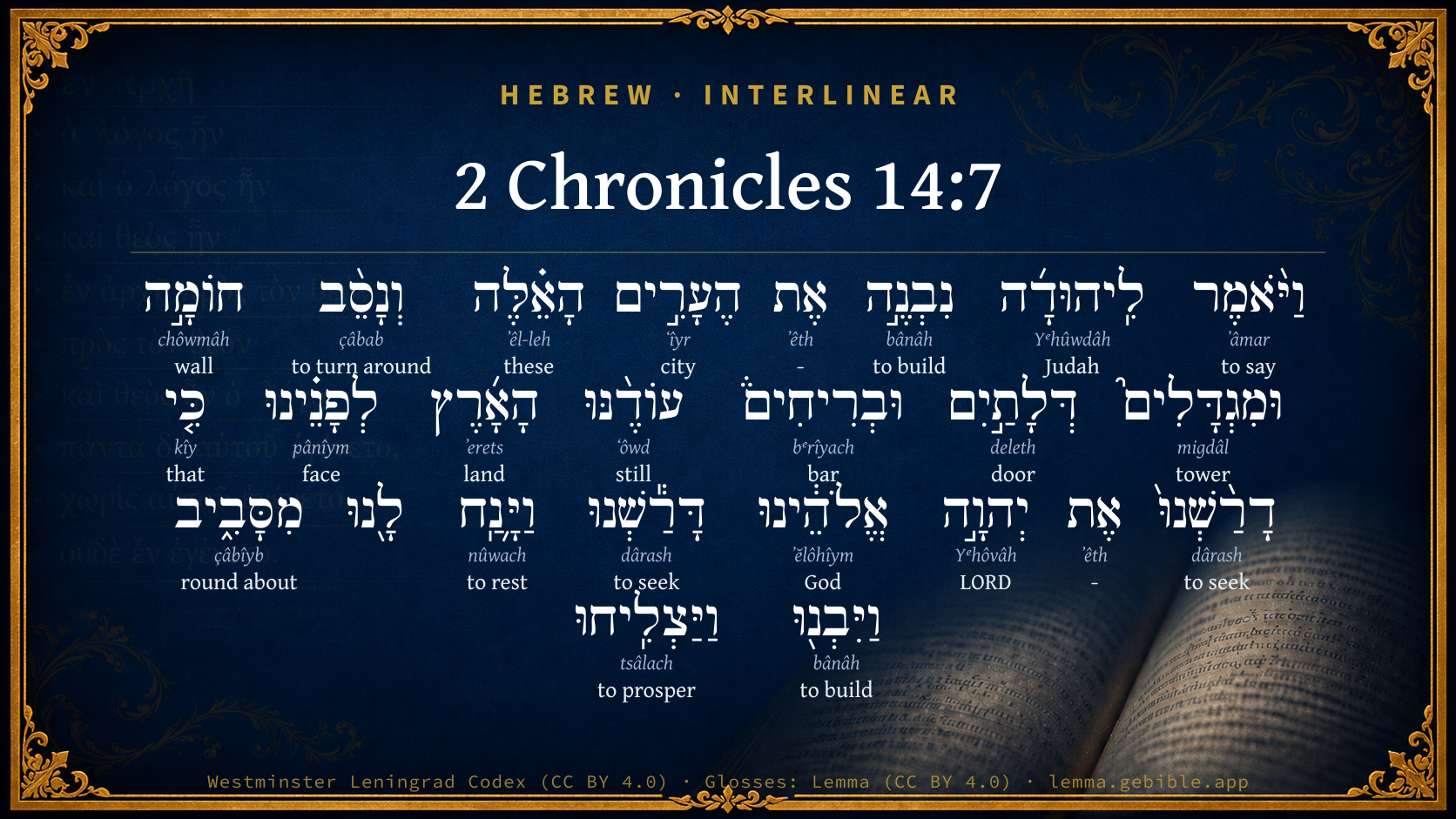
2 Chronicles 14:7

Hebrew (Westminster Leningrad Codex) 2 Chronicles 14:7 appears in the Hebrew Old Testament. The text above is from the Westminster Leningrad Codex. Each word links to its Strong’s number, a concise gloss, and parsing drawn from the Open Scriptures Hebrew Bible morphology. Click any word for its full Brown-Driver-Briggs (BDB) entry.
Download image
Cite this verse

2 Chronicles 14:7 (World English Bible). Public Domain. Lemma interlinear Bible study tool, https://lemma.gebible.app/v/2-chronicles/14/7.

Show BibTeX & RIS
BibTeX
RIS
English Translation
For he said to Judah, Let us build these cities, and make about them walls, and towers, gates, and bars; the land is yet before us, because we have sought Yahweh our God; we have sought him, and he has given us rest on every side. So they built and prospered.
World English Bible · Public Domain
Download a study sheet

One document with this verse’s original text, its word-by-word gloss line, the meaning frame, cross-references with their text, attributed commentary, and full source and license credits — printable, and it pastes into notes with its structure intact.

This verse Autodidact and up

Study sheet (.html) Plain text (.txt)

A passage Seminary Student

Up to 50 verses in one chapter. A passage sheet keeps up to 6 commentary sources and 12 cross-references per verse, in the order this page ranks them, and says so on the sheet whenever that leaves anything out. Ask for a single verse and you get the Autodidact verse sheet above.

Everything on this page stays free to read, with no account — the sheet is a download of what is already on screen, not access to it.

Want to remove ads? Support Godless Engineer
Compare translations 3

The same verse in 3 English versions, stacked beneath the original-language interlinear above. Click any original word for its lexicon entry.

Each is an independent rendering of the whole verse — the interlinear is not word-aligned to these translations.

Highlighted words mark where these versions differ — a whole-verse word diff, not a word-by-word alignment.

  • World English Bible Public Domain
    For he said to Judah, Let us build these cities, and make about them walls, and towers, gates, and bars; the land is yet before us, because we have sought Yahweh our God; we have sought him, and he has given us rest on every side. So they built and prospered.
  • King James Version Public Domain
    Therefore he said unto Judah, Let us build these cities, and make about them walls, and towers, gates, and bars, while the land is yet before us; because we have sought the LORD our God, we have sought him, and he hath given us rest on every side. So they built and prospered.
  • unfoldingWord Literal Text CC BY-SA 4.0
    And he said to Judah, “Let us build these cities and let us surround with a wall, and towers, doors, and bars; still the land is before us because we have sought Yahweh our God. We have sought, and he has given rest to us all around.” And they built, and they succeeded.

unfoldingWord Literal Text — © unfoldingWord, licensed CC BY-SA 4.0. Word-aligned USFM3 via Door43 (git.door43.org/unfoldingWord/en_ult).

Versions to compare (up to 4)

3 of 4 selected

Show all 18 translations

Every available English version of this verse, each an independent rendering of the whole verse.

  • World English Bible Public Domain
    For he said to Judah, Let us build these cities, and make about them walls, and towers, gates, and bars; the land is yet before us, because we have sought Yahweh our God; we have sought him, and he has given us rest on every side. So they built and prospered.
  • Berean Standard Bible Public Domain
    So he said to the people of Judah, “Let us build these cities and surround them with walls and towers, with doors and bars. The land is still ours because we have sought the LORD our God. We have sought Him and He has given us rest on every side.” So they built and prospered.
  • Majority Standard Bible Public Domain
    So he said to the people of Judah, “Let us build these cities and surround them with walls and towers, with doors and bars. The land is still ours because we have sought the LORD our God. We have sought Him, and He has given us rest on every side.” So they built and prospered.
  • King James Version Public Domain
    Therefore he said unto Judah, Let us build these cities, and make about them walls, and towers, gates, and bars, while the land is yet before us; because we have sought the LORD our God, we have sought him, and he hath given us rest on every side. So they built and prospered.
  • American Standard Version (1901) Public Domain
    For he said unto Judah, Let us build these cities, and make about them walls, and towers, gates, and bars; the land is yet before us, because we have sought Jehovah our God; we have sought him, and he hath given us rest on every side. So they built and prospered.
  • Revised Version (1885) Public Domain
    For he said unto Judah, Let us build these cities, and make about them walls, and towers, gates, and bars; the land is yet before us, because we have sought the LORD our God; we have sought him, and he hath given us rest on every side. So they built and prospered.
  • Geneva Bible (1599) Public Domain
    Therefore he saide to Iudah, Let vs builde these cities and make walles about, and towers, gates, and barres, whiles the lande is before vs: because we haue sought the Lord our God, we haue sought him, and he hath giuen vs rest on euery side: so they built and prospered.
  • Douay-Rheims (1899) Public Domain
    And he said to Juda: Let us build these cities, and compass them with walls, and fortify them with towers, and gates, and bars, while all is quiet from wars, because we have sought the Lord the God of our fathers, and he hath given us peace round about. So they built, and there was no hinderance in building.
  • Young's Literal Translation Public Domain
    And he saith to Judah, `Let us build these cities, and compass `them' with wall, and towers, two-leaved doors, and bars, while the land `is' before us, because we have sought Jehovah our God, we have sought, and He giveth rest to us round about;' and they build and prosper.
  • Literal Standard Version CC BY-SA 4.0
    And he says to Judah, “Let us build these cities, and surround [them] with wall, and towers, double gates, and bars, while the land [is] before us, because we have sought our God YHWH, we have sought, and He gives rest to us all around”; and they build and prosper.
  • Unlocked Literal Bible CC BY-SA 4.0
    For Asa said to Judah, “Let us build these cities and make walls around them, and towers, gates, and bars; the land is still ours because we have sought Yahweh our God. We have sought him, and he has given us peace on every side.” So they built and succeeded.
  • unfoldingWord Literal Text CC BY-SA 4.0
    And he said to Judah, “Let us build these cities and let us surround with a wall, and towers, doors, and bars; still the land is before us because we have sought Yahweh our God. We have sought, and he has given rest to us all around.” And they built, and they succeeded.
  • Darby Bible Public Domain
    And he said to Judah, Let us build these cities, and surround them with walls and towers, gates and bars, while the land is yet before us; for we have sought Jehovah our God; we have sought him, and he has given us rest on every side. And they built and prospered.
  • World Messianic Bible Public Domain
    For he said to Judah, “Let’s build these cities and make walls around them, with towers, gates, and bars. The land is yet before us, because we have sought the LORD our God. We have sought him, and he has given us rest on every side.” So they built and prospered.
  • Webster's Bible Public Domain
    Therefore he said to Judah, Let us build these cities, and make about them walls, and towers, gates, and bars, while the land is yet before us; because we have sought the LORD our God, we have sought him, and he hath given us rest on every side. So they built, and prospered.
  • Free Bible Version CC BY-SA 4.0
    Asa told the people of Judah, “Let us build up these towns and surround them with walls and towers and barred gates. The land is still ours, because we continue to worship the Lord our God. We worship him, and he has given us peace from all our enemies.” So they began the building projects, and completed them successfully.
  • Bible in Basic English Public Domain
    He said to Judah, Let us make these towns, building walls round them with towers and doors and locks. The land is still ours, because we have been true to the Lord our God; we have been true to him and he has given us rest on every side. So they went on building and all went well for them.
  • JPS Tanakh (1917) Public Domain
    (14-6) For he said unto Judah: 'Let us build these cities, and make about them walls, and towers, gates, and bars; the land is yet before us, because we have sought the LORD our God; we have sought Him, and He hath given us rest on every side.' So they built and prospered.

Literal Standard Version (2020), Covenant Press — licensed CC BY-SA 4.0. Text via the HelloAO Bible API (eBible.org). Unlocked Literal Bible (unfoldingWord) — licensed CC BY-SA 4.0. Text via the HelloAO Bible API (eBible.org). unfoldingWord Literal Text — © unfoldingWord, licensed CC BY-SA 4.0. Word-aligned USFM3 via Door43 (git.door43.org/unfoldingWord/en_ult). Free Bible Version, Dr. Jonathan Gallagher — licensed CC BY-SA 4.0. Text via the HelloAO Bible API (eBible.org).

Word by word

More ways to search: Search by grammar → Find every occurrence → Compare this word →

Practice this passage: Drill this verse → Learn its vocabulary →

וּבְרִיחִים֒
bᵉrîyach
H1280
“and · bars”
Conjunction + Noun, Common, Masculine, Plural, Absolute
Part of Speech
Conjunction + Noun
Type
Common
Gender
Masculine
Number
Plural
State
Absolute
Full BDB Definition

Origin: from H1272

TWOT: 284b

bar - of wood - of city gates - of tribulation, a fortress, of the earth as a prison (figuratively)
  1. וַיֹּ֨אמֶר ʼâmar H559 “and · to say” Conjunction + Verb, Qal, Sequential Imperfect, 3rd Person, Masculine, Singular
  2. לִֽיהוּדָ֜ה Yᵉhûwdâh H3063 “to/for · Judah” Preposition + Noun, Proper
  3. נִבְנֶ֣ה bânâh H1129 “to build” Verb, Qal, Imperfect, 1st Person, Common, Plural
  4. אֶת ʼêth H853 “-” Particle, Direct Object
  5. הֶעָרִ֣ים ʻîyr H5892 “the · cities” Particle, Definite Article + Noun, Common, Feminine, Plural, Absolute
  6. הָאֵ֗לֶּה ʼêl-leh H428 “the · these” Particle, Definite Article + Pronoun, Demonstrative, Common, Plural
  7. וְנָסֵ֨ב çâbab H5437 “and · to turn around” Conjunction + Verb, Hiphil, Imperfect, 1st Person, Common, Plural
  8. חוֹמָ֣ה chôwmâh H2346 “wall” Noun, Common, Feminine, Singular, Absolute
  9. וּמִגְדָּלִים֮ migdâl H4026 “and · towers” Conjunction + Noun, Common, Both, Plural, Absolute
  10. דְּלָתַ֣יִם deleth H1817 “doors” Noun, Common, Feminine, Dual, Absolute
  11. עוֹדֶ֨נּוּ ʻôwd H5750 “still · his” Adverb + Suffix, Personal, 3rd Person, Masculine, Singular
  12. הָאָ֜רֶץ ʼerets H776 “the · land” Particle, Definite Article + Noun, Common, Both, Singular, Absolute
  13. לְפָנֵ֗ינוּ pânîym H6440 “to/for · face(s) · our” Preposition + Noun, Common, Both, Plural, Construct + Suffix, Personal, 1st Person, Common, Plural
  14. כִּ֤י kîy H3588 “that” Conjunction
  15. דָרַ֨שְׁנוּ֙ dârash H1875 “to seek” Verb, Qal, Perfect, 1st Person, Common, Plural
  16. אֶת ʼêth H853 “-” Particle, Direct Object
  17. יְהוָ֣ה Yᵉhôvâh H3068 “LORD” Noun, Proper
  18. אֱלֹהֵ֔ינוּ ʼĕlôhîym H430 “God(s) · our” Noun, Common, Masculine, Plural, Construct + Suffix, Personal, 1st Person, Common, Plural
  19. דָּרַ֕שְׁנוּ dârash H1875 “to seek” Verb, Qal, Perfect, 1st Person, Common, Plural
  20. וַיָּ֥נַֽח nûwach H5117 “and · to rest” Conjunction + Verb, Hiphil, Sequential Imperfect, 3rd Person, Masculine, Singular
  21. מִסָּבִ֑יב çâbîyb H5439 “from · round about” Preposition + Noun, Common, Both, Singular, Absolute
  22. וַיִּבְנ֖וּ bânâh H1129 “and · to build” Conjunction + Verb, Qal, Sequential Imperfect, 3rd Person, Masculine, Plural
  23. וַיַּצְלִֽיחוּ tsâlach H6743 “and · to prosper” Conjunction + Verb, Hiphil, Sequential Imperfect, 3rd Person, Masculine, Plural

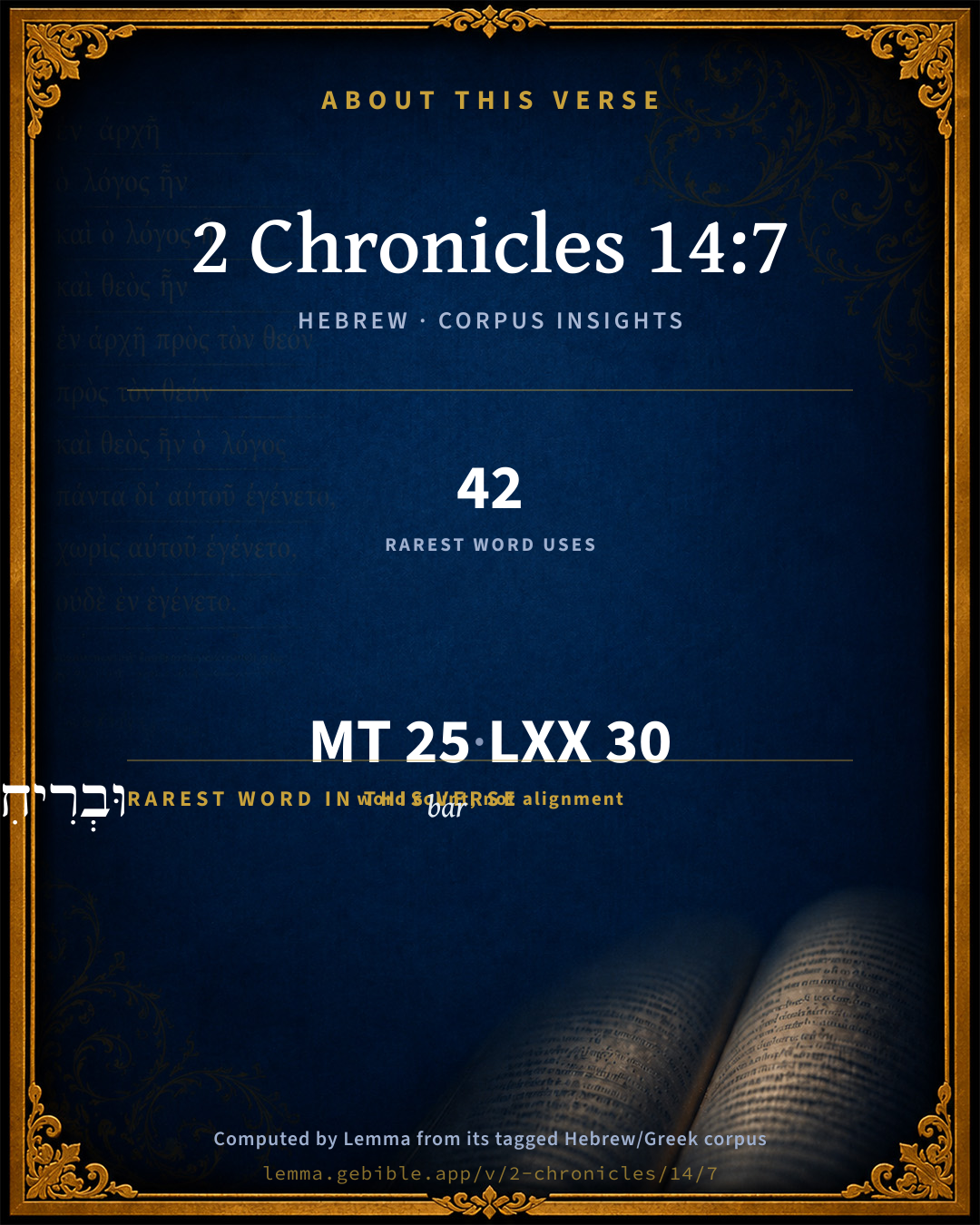
About this verse

These counts appear in no published source. They are computed here, from the morphology-tagged text and Lemma’s own curated glosses. What Lemma adds →

25
words
21
distinct lemmas
Historical
section

Shared distinctive vocabulary

וּבְרִיחִים֒ bar H1280 occurs in 37 verses of the Hebrew Bible. Also found in:

Grammatical profile

  • 8 verbs
  • 11 nouns
  • 1 pronoun
  • 1 preposition
  • 1 conjunction
  • 1 adverb
  • 2 particles

Verb forms

  • וַיֹּ֨אמֶר Qal · Sequential Imperfect
  • נִבְנֶ֣ה Qal · Imperfect
  • וְנָסֵ֨ב Hiphil · Imperfect
  • דָרַ֨שְׁנוּ֙ Qal · Perfect
  • דָּרַ֕שְׁנוּ Qal · Perfect
  • וַיָּ֥נַֽח Hiphil · Sequential Imperfect
  • וַיִּבְנ֖וּ Qal · Sequential Imperfect
  • וַיַּצְלִֽיחוּ Hiphil · Sequential Imperfect

Repetition

Words recur within this verse — often emphatic in Hebrew:

  • נִבְנֶ֣ה to build H1129 ×2
  • דָרַ֨שְׁנוּ֙ to seek H1875 ×2

Hebrew & Septuagint length

In English translation the verse runs 51 words from the Hebrew and 50 from the Septuagint (LXX English) — closely comparable.

A rough comparison of the two English renderings, which tokenize alike — not a word-level alignment.

Word counts can differ between the Hebrew and the Greek without any difference in meaning — e.g. the Hebrew direct-object marker אֵת has no separate Greek word, and Greek often adds the article ὁ.

In the original languages it is 25 Hebrew tokens and 30 Greek tokens — but the two are counted differently (Hebrew bundles its prefixes and suffixes into one token; the Greek is in lemma form), so that isn’t a like-for-like length.

Cross-references

14

Topical passages linked to 2 Chronicles 14:7 in the Treasury of Scripture Knowledge — connected by theme and wording, ordered by reader-vote popularity; previews shown in the World English Bible.

  • 1 Peter 3:12 For the eyes of the Lord are on the righteous, And his ears open to their prayer; But the face of the Lord is against those who do evil."
  • 2 Chronicles 14:6 He built fortified cities in Judah; for the land was quiet, and he had no war in those years, because Yahweh had given him rest.
  • 1 Chronicles 28:9 You, Solomon my son, know the God of your father, and serve him with a perfect heart and with a willing mind; for Yahweh searches all hearts, and understands all the imaginations of the thoughts: if you seek him, he will be found of you; but if you forsake him, he will cast you off forever.
  • Jeremiah 29:12–14 You shall call on me, and you shall go and pray to me, and I will listen to you.
  • John 12:35–36 Jesus therefore said to them, "Yet a little while the light is with you. Walk while you have the light, that darkness doesn't overtake you. He who walks in the darkness doesn't know where he is going.
  • Joshua 23:1 It happened after many days, when Yahweh had given rest to Israel from all their enemies round about, and Joshua was old and well stricken in years;
  • 2 Chronicles 8:5 Also he built Beth Horon the upper, and Beth Horon the lower, fortified cities, with walls, gates, and bars;
  • 2 Chronicles 14:4 and commanded Judah to seek Yahweh, the God of their fathers, and to do the law and the commandment.
  • 2 Chronicles 32:5 He took courage, and built up all the wall that was broken down, and raised [it] up to the towers, and the other wall outside, and strengthened Millo [in] the city of David, and made weapons and shields in abundance.
  • Psalms 105:3–4 Glory in his holy name. Let the heart of those who seek Yahweh rejoice.
  • Matthew 11:28–29 "Come to me, all you who labor and are heavily burdened, and I will give you rest.
  • John 9:4 I must work the works of him who sent me, while it is day. The night is coming, when no one can work.
  • Acts 9:31 So the assemblies throughout all Judea and Galilee and Samaria had peace, and were built up. They were multiplied, walking in the fear of the Lord and in the comfort of the Holy Spirit.
  • Hebrews 3:13–15 but exhort one another day by day, so long as it is called "today;" lest any one of you be hardened by the deceitfulness of sin.

Cross-references courtesy of OpenBible.info (CC BY 4.0).

Hebrew and Greek witnesses Masoretic Hebrew ↔ Greek Septuagint

The same verse in the two great witnesses to the Old Testament, shown verse-for-verse.

These are two independent witnesses, not word-aligned to each other, and the Septuagint is shown in lemma (dictionary) form.

Hebrew 2 Chronicles 14:7 Masoretic · Westminster Leningrad Codex

וַיֹּ֨אמֶר לִֽיהוּדָ֜ה נִבְנֶ֣ה אֶת הֶעָרִ֣ים הָאֵ֗לֶּה וְנָסֵ֨ב חוֹמָ֣ה וּמִגְדָּלִים֮ דְּלָתַ֣יִם וּבְרִיחִים֒ עוֹדֶ֨נּוּ הָאָ֜רֶץ לְפָנֵ֗ינוּ כִּ֤י דָרַ֨שְׁנוּ֙ אֶת יְהוָ֣ה אֱלֹהֵ֔ינוּ דָּרַ֕שְׁנוּ וַיָּ֥נַֽח לָ֖נוּ מִסָּבִ֑יב וַיִּבְנ֖וּ וַיַּצְלִֽיחוּ

For he said to Judah, Let us build these cities, and make about them walls, and towers, gates, and bars; the land is yet before us, because we have sought Yahweh our God; we have sought him, and he has given us rest on every side. So they built and prospered.

World English Bible · Public Domain

Greek LXX 2 Chronicles 14:7 Septuagint · lemma form

καί γίγνομαι ὁ ασα δύναμις ὁπλοφόρος αἴρω θυρεός καί δόρυ ἐν γῆ ἰουδά τριακόσιοι χιλίας καί ἐν γῆ βενιαμίν πελταστής καί τοξότης διακόσιοι καί πεντήκοντα χιλίας πᾶς οὗτος πολεμιστής δύναμις

And he said to Juda, Let us fortify these cities, and make walls, and towers, and gates, and bars: we shall prevail over the land, for as we have sought out the Lord our God, he has sought out us, and has given us rest round about, and prospered us.

LXX2012 (modern English Septuagint) · Public Domain

Hebrew: Westminster Leningrad Codex (CC BY 4.0). Greek: Septuagint (public domain); English from LXX2012 (modern English Septuagint) (Public Domain). How the Septuagint differs from the Hebrew →

Commentary

Notes on 2 Chronicles 14:7 from classic Christian and Jewish commentators (each source and its license shown beneath its notes). The classic Christian expositions comment on the surrounding passage and are grouped to its opening verse, so a note may address several verses; the Jewish commentaries on the Tanakh (Rashi and others) are per-verse, so they appear only where the commentator wrote on this verse.

Lemma curates 59 commentaries, every one of them public domain or Creative Commons licensed, each selected and text-cleaned for this edition rather than reprinted as found. About our sources →

Trapp's Complete Commentary

John Trapp

2Ch 14:7 Therefore he said unto Judah, Let us build these cities, and make about [them] walls, and towers, gates, and bars, [while] the land [is] yet before us; because we have sought the LORD our God, we have sought [him], and he hath given us rest on every side. So they built and prospered.

Ver. 7. Because we have sought the Lord our God, we have sought him.] It did his heart good to think how piously they had purchased their present peace; and therefore he repeateth it. See Zec 8:19. {See Trapp on "Zec 8:19"}

John Trapp, A Commentary or Exposition upon All the Books of the Old and New Testament (1647–1656) — public domain. Text from a community e-Sword module.

The Biblical Illustrator

Joseph S. Exell

2Ch_14:7

Therefore said he unto Judah, Let us build these cities . . . while the land is yet before us

The duty of improving present opportunity

(a Sunday-school sermon):--Consider--

I.

The opportunity for labour with which we are blessed. The land is yet before us.

1. We have liberty to labour.

2. The facilities are great: multiplication of elementary books, circulation of Bibles, etc.

3. The encouragements are numerous. The prejudices of society are in our favour. Gods command, etc.

II. The importance of labouring while we have this opportunity.

1. What is the work to which we are called? That of teaching the young the Word of God (Deu_6:6-7; Psa_78:5; Psa_78:7; Pro_22:6).

2. The duty of improving existing opportunities. Conclusion: Address children. If you had to pass through a long and dark passage where there were many deep pits, how anxious, at the beginning, would you feel for light. Such is the Word of God given to you at your entrance into life (Psa_119:105). (J. G. Breay, B.A.)

The Biblical Illustrator, edited by Joseph S. Exell (c. 1880s–1900s) — public domain. Text from a community e-Sword module.

Tyndale Open Study Notes

Tyndale Open Resources

14:7-14 Solomon had prayed that the Lord would hear his people when they were led into battle (6:34). In the battle against Zerah, God responded to such a prayer. • Ethiopian (literally “Cushite”) might refer to someone from southern Egypt (Nubia) or a Midianite territory northeast of Aqabah (see Num 12:1; Hab 3:7). However, the mention of Libya in 2 Chr 16:8, the size of the battle (comparable to the attack of Shishak against Rehoboam in 12:3), and the location of Mareshah in the west of Judah indicate that Zerah was an Egyptian; he is otherwise unknown. He might have been a Nubian general dispatched by Osorkon I, the Libyan pharaoh who ruled Egypt between the tenth and fourteenth years of Asa (900–897 BC). Another view is that Shishak established a buffer state around Gerar, supported by Nubian mercenaries that invaded Judah. The account, however, only says that Asa and his armies pursued the armies south to Gerar and took a vast amount of plunder, particularly from the herdsmen living in tents around the cities.

Tyndale Open Study Notes — © Tyndale Open Resources, licensed CC BY-SA 4.0. Text via the HelloAO Bible API.

Geneva Bible (1599)

Geneva Bible translators

While we have the full government thereof.

Geneva Bible (1599) marginal notes — public domain. Text via Bolls.life.

Jamieson, Fausset & Brown

Robert Jamieson, A. R. Fausset & David Brown

while the land is yet before us--that is, while we have free and undisputed progress everywhere; no foe is near; but, as this happy time of peace may not last always and the kingdom is but small and weak, let us prepare suitable defenses in case of need. He had also an army of five hundred eighty thousand men. Judah furnished the heavily armed soldiers, and Benjamin the archers. This large number does not mean a body of professional soldiers, but all capable of bearing arms and liable to be called into service.

Jamieson, Fausset & Brown — Commentary Critical and Explanatory on the Whole Bible (1871) — public domain (CC PDM 1.0). Text via the HelloAO Bible API.

Ellicott's Commentary for English Readers

(7) Therefore.—And.

These cities.—The “fenced cities” of last verse. Their names are unknown. Geba and Mizpah were fortified by Asa; but that was after the war with Baasha, which began in the twenty-sixth year of Asa (1Ki_15:33); see 2Ch_16:6. A general system of defence, like that of Rehoboam, who fortified as many as fifteen cities, seems to be indicated.

Walls.—A wall.

Gates (doors) and bars.—1Sa_23:7, and 2Ch_8:5, supra, where “bars” is, as usual, singular, bariach. Here it is plural.

While the land is yet before us.—Is open to us, free from hostile occupation. The phrase is apparently borrowed from Gen_13:9. (Is yet, ‘odennû, masculine pronoun, instead of feminine; probably a clerical error). Omit while, and put a stop at bars. “The land is still before us, for we have sought the Lord,” appears to be the connection of thought.

So they built and prospered—i.e., built prosperously, without let or hindrance.

A Bible Commentary for English Readers, edited by Charles John Ellicott (1878–1897) — public domain. Text from a community e-Sword module.

The Cambridge Bible for Schools and Colleges

gen. ed. J. J. S. Perowne

7. Therefore he said] R.V. For he said.

and bars, while the land is yet before us; because, etc.] R.V. and bars; the land is yet before us, because, etc.

The Cambridge Bible for Schools and Colleges (gen. ed. J. J. S. Perowne; Cambridge University Press, 1878–1918) — public domain. Text from a community e-Sword module.

John Gill's Exposition

And Asa had an army of men that bare targets and spears, out of Judah three hundred thousand,.... These were armed with a large sort of shield, to protect them, and with spears, to push at an enemy when they came near them, and to close quarters with them:

and out of Benjamin, that bare shields and drew bows, two hundred and fourscore thousand; these had also a lesser sort of shields, to defend their bodies, and bows and arrows, to annoy an enemy at a distance:

all these were mighty men of valour; able bodied men, valiant and courageous; perhaps Asa gathered these together, on hearing that the Ethiopians were preparing to attack him, as follows.

John Gill's Exposition of the Whole Bible (1746–1763) — public domain (CC PDM 1.0). Text via the HelloAO Bible API.

Albert Barnes' Notes on the Bible

The land is yet before us - i. e., “unoccupied by an enemy” - “the land is open to us to go where we please.” Compare Gen 13:9. The fortification of the strongholds would be an act of rebellion against Egypt, and it might be expected that the Egyptians would endeavor to put a stop to it.

Albert Barnes' Notes on the Bible (1834–1885) — public domain. Text from a community e-Sword/MySword module.

Matthew Poole's English Annotations

Yet before us, i.e. in our power, as that phrase is oft used. See Poole "Gen 13:9".

Matthew Poole's English Annotations on the Holy Bible (1683–1685) — public domain. Text from a community e-Sword/MySword module.

The Pulpit Commentary

We have sought him, and he hath given us rest. In three successive verses the blessings of peace and quiet, and no war and rest, are recorded (Isa_26:1; Zec_2:5)

The Pulpit Commentary (1880–1919), ed. H.D.M. Spence-Jones & Joseph S. Exell — public domain. Text from a community e-Sword module.

John Wesley's Explanatory Notes

Before us - In our power.

John Wesley, Explanatory Notes Upon the Whole Bible (1754–1765) — public domain. Text via the GEBible commentary corpus.

unfoldingWord translationNotes

Door43 World Missions Community

Asa said to Judah

Here "Judah" refers to the people of Judah. AT: "Asa said to the people of Judah" (See: Metonymy)

peace on every side

"peace all around." This means that Judah was at peace with all of the surrounding nations.

So they built

The ellipsis may be supplied from the context. AT: "So they built the cities" (See: Ellipsis)

300,000 men ... 280,000 men

"three hundred thousand men ... two hundred and eighty thousand men" (See: Numbers)

translationWords

Asa

watchtower

gate

seek

shield

spear

Benjamin

bow and arrow

unfoldingWord translationNotes — © Distant Shores Media and the Door43 World Missions Community, licensed CC BY-SA 4.0. Source: git.door43.org/Door43/en_tn.

Lesson kit

Teaching starters — assembled from the data on this page, not authored interpretation. Every prompt links to the verse data it draws on. Edit before teaching.

2 Chronicles, in the Historical, opens this verse with 25 words (21 distinct Hebrew lemmas). Its most distinctive word is bᵉrîyach (“bar”). A historical commentator’s framing appears above. Read the whole chapter for the surrounding context.

Discussion questions

  1. How does “bar” (bᵉrîyach) shape what this verse is saying?
  2. Exodus 26:26 shares the word «bar» with this verse. How do the two illuminate each other?
  3. “to build” occurs 2× in this one verse. What is the effect of the repetition?
  4. These translations render this verse differently; the difference is in the English rendering, not the original. What questions does that raise?
  5. The verb «וַיֹּ֨אמֶר» is Qal Sequential Imperfect. How does its form color the action?
  6. Reading how Trapp's Complete Commentary and The Biblical Illustrator read this verse, where do the two commentators agree and where do they part?

Things to notice

Reading settings

Reading text

Shown beneath each verse's original-language words.

Old Testament
Old Testament edition

Read the OT as the Masoretic Hebrew (MT) or the Greek Septuagint (LXX).

English shown for the Greek Septuagint (in the Hebrew ↔ Greek comparison).

Comparing translations? Open the Compare panel on any verse page to stack up to four side by side.