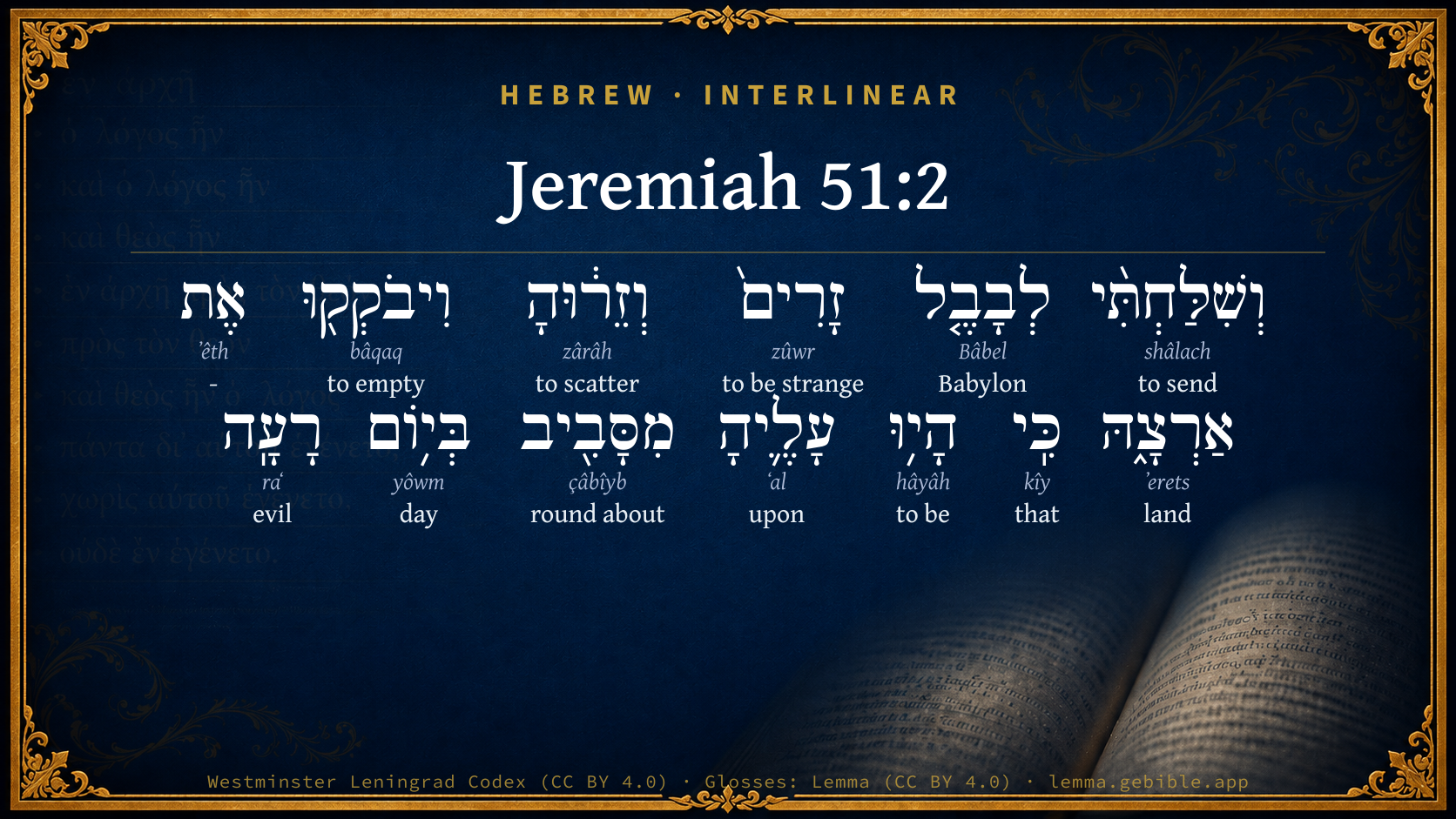
Jeremiah 51:2

Hebrew (Westminster Leningrad Codex) Jeremiah 51:2 appears in the Hebrew Old Testament. The text above is from the Westminster Leningrad Codex. Each word links to its Strong’s number, a concise gloss, and parsing drawn from the Open Scriptures Hebrew Bible morphology. Click any word for its full Brown-Driver-Briggs (BDB) entry.
Download image
Cite this verse

Jeremiah 51:2 (World English Bible). Public Domain. Lemma interlinear Bible study tool, https://lemma.gebible.app/v/jeremiah/51/2.

Show BibTeX & RIS
BibTeX
RIS
English Translation
I will send to Babylon strangers, who shall winnow her; and they shall empty her land: for in the day of trouble they shall be against her round about.
World English Bible · Public Domain
Download a study sheet

One document with this verse’s original text, its word-by-word gloss line, the meaning frame, cross-references with their text, attributed commentary, and full source and license credits — printable, and it pastes into notes with its structure intact.

This verse Autodidact and up

Study sheet (.html) Plain text (.txt)

A passage Seminary Student

Up to 50 verses in one chapter. A passage sheet keeps up to 6 commentary sources and 12 cross-references per verse, in the order this page ranks them, and says so on the sheet whenever that leaves anything out. Ask for a single verse and you get the Autodidact verse sheet above.

Everything on this page stays free to read, with no account — the sheet is a download of what is already on screen, not access to it.

Want to remove ads? Support Godless Engineer
Compare translations 3

The same verse in 3 English versions, stacked beneath the original-language interlinear above. Click any original word for its lexicon entry.

Each is an independent rendering of the whole verse — the interlinear is not word-aligned to these translations.

Highlighted words mark where these versions differ — a whole-verse word diff, not a word-by-word alignment.

  • World English Bible Public Domain
    I will send to Babylon strangers, who shall winnow her; and they shall empty her land: for in the day of trouble they shall be against her round about.
  • King James Version Public Domain
    And will send unto Babylon fanners, that shall fan her, and shall empty her land: for in the day of trouble they shall be against her round about.
  • unfoldingWord Literal Text CC BY-SA 4.0
    I will send foreigners to Babylon. They will scatter her and devastate her land, for they will come against her from all around on the day of disaster.

unfoldingWord Literal Text — © unfoldingWord, licensed CC BY-SA 4.0. Word-aligned USFM3 via Door43 (git.door43.org/unfoldingWord/en_ult).

Versions to compare (up to 4)

3 of 4 selected

Show all 18 translations

Every available English version of this verse, each an independent rendering of the whole verse.

  • World English Bible Public Domain
    I will send to Babylon strangers, who shall winnow her; and they shall empty her land: for in the day of trouble they shall be against her round about.
  • Berean Standard Bible Public Domain
    I will send strangers to Babylon to winnow her and empty her land; for they will come against her from every side in her day of disaster.
  • Majority Standard Bible Public Domain
    I will send strangers to Babylon to winnow her and empty her land; for they will come against her from every side in her day of disaster.
  • King James Version Public Domain
    And will send unto Babylon fanners, that shall fan her, and shall empty her land: for in the day of trouble they shall be against her round about.
  • American Standard Version (1901) Public Domain
    And I will send unto Babylon strangers, that shall winnow her; and they shall empty her land: for in the day of trouble they shall be against her round about.
  • Revised Version (1885) Public Domain
    And I will send unto Babylon strangers, that shall fan her; and they shall empty her land: for in the day of trouble they shall be against her round about.
  • Geneva Bible (1599) Public Domain
    And wil send vnto Babel fanners that shall fanne her, and shall empty her land: for in the day of trouble they shalbe against her on euery side.
  • Douay-Rheims (1899) Public Domain
    And I will send to Babylon fanners, and they shall fan her, and shall destroy her land: for they are come upon her on every side in the day of her affliction.
  • Young's Literal Translation Public Domain
    And I have sent to Babylon fanners, And they have fanned it, and they empty its land, For they have been against it, Round about -- in the day of evil.
  • Literal Standard Version CC BY-SA 4.0
    And I have sent fanners to Babylon, || And they have fanned her, and they empty her land, || For they have been against her, || All around—in the day of evil.
  • Unlocked Literal Bible CC BY-SA 4.0
    I will send foreigners to Babylon. They will scatter her and devastate her land, for they will come against her from all around on the day of disaster.
  • unfoldingWord Literal Text CC BY-SA 4.0
    I will send foreigners to Babylon. They will scatter her and devastate her land, for they will come against her from all around on the day of disaster.
  • Darby Bible Public Domain
    and I will send unto Babylon strangers, who shall fan her, and shall empty her land: for in the day of trouble they shall be against her round about.
  • World Messianic Bible Public Domain
    I will send to Babylon strangers, who will winnow her. They will empty her land; for in the day of trouble they will be against her all around.
  • Webster's Bible Public Domain
    And will send to Babylon fanners, that shall fan her, and shall empty her land: for in the day of trouble they shall be against her on all sides.
  • Free Bible Version CC BY-SA 4.0
    I will send foreign soldiers to attack Babylon to winnow her and turn her country into a wasteland—they will attack her from all directions when her time of trouble comes.
  • Bible in Basic English Public Domain
    And I will send men to Babylon to make her clean and get her land cleared: for in the day of trouble they will put up their tents against her on every side.
  • JPS Tanakh (1917) Public Domain
    And I will send unto Babylon strangers, that shall fan her, and they shall empty her land; for in the day of trouble they shall be against her round about.

Literal Standard Version (2020), Covenant Press — licensed CC BY-SA 4.0. Text via the HelloAO Bible API (eBible.org). Unlocked Literal Bible (unfoldingWord) — licensed CC BY-SA 4.0. Text via the HelloAO Bible API (eBible.org). unfoldingWord Literal Text — © unfoldingWord, licensed CC BY-SA 4.0. Word-aligned USFM3 via Door43 (git.door43.org/unfoldingWord/en_ult). Free Bible Version, Dr. Jonathan Gallagher — licensed CC BY-SA 4.0. Text via the HelloAO Bible API (eBible.org).

Word by word

More ways to search: Search by grammar → Find every occurrence → Compare this word →

Practice this passage: Drill this verse → Learn its vocabulary →

וִיבֹקְק֖וּ
bâqaq
H1238
“and · to empty”
Conjunction + Verb, Poel, Imperfect, 3rd Person, Masculine, Plural
Part of Speech
Conjunction + Verb
Stem
Poel
Form
Imperfect
Person
3rd Person
Gender
Masculine
Number
Plural
Full BDB Definition

Origin: a primitive root

TWOT: 273

to empty - (Qal) - to empty, lay waste - to make void (figuratively) - (Niphal) to be emptied - (Polel) to empty out, devastate
  1. וְשִׁלַּחְתִּ֨י shâlach H7971 “and · to send” Conjunction + Verb, Piel, Sequential Perfect, 1st Person, Common, Singular
  2. לְבָבֶ֤ל Bâbel H894 “to/for · Babylon” Preposition + Noun, Proper
  3. זָרִים֙ zûwr H2114 “strange” Adjective, Adjective, Masculine, Plural, Absolute
  4. וְזֵר֔וּהָ zârâh H2219 “and · to scatter · her” Conjunction + Verb, Piel, Sequential Perfect, 3rd Person, Common, Plural + Suffix, Personal, 3rd Person, Feminine, Singular
  5. אֶת ʼêth H853 “-” Particle, Direct Object
  6. אַרְצָ֑הּ ʼerets H776 “land · her” Noun, Common, Both, Singular, Construct + Suffix, Personal, 3rd Person, Feminine, Singular
  7. כִּֽי kîy H3588 “that” Conjunction
  8. הָי֥וּ hâyâh H1961 “to be” Verb, Qal, Perfect, 3rd Person, Common, Plural
  9. עָלֶ֛יהָ ʻal H5921 “upon · her” Preposition + Suffix, Personal, 3rd Person, Feminine, Singular
  10. מִסָּבִ֖יב çâbîyb H5439 “from · round about” Preposition + Noun, Common, Both, Singular, Absolute
  11. בְּי֥וֹם yôwm H3117 “in/at · day of” Preposition + Noun, Common, Masculine, Singular, Construct
  12. רָעָֽה raʻ H7451 “evil” Noun, Common, Feminine, Singular, Absolute

About this verse

These counts appear in no published source. They are computed here, from the morphology-tagged text and Lemma’s own curated glosses. What Lemma adds →

13
words
13
distinct lemmas
Prophets
section

Notable vocabulary

The rarest word here is וִיבֹקְק֖וּ to empty H1238 — appearing just 9 times in the whole Hebrew Bible.

Shared distinctive vocabulary

וִיבֹקְק֖וּ to empty H1238 occurs in 7 verses of the Hebrew Bible. Also found in:

Grammatical profile

  • 4 verbs
  • 5 nouns
  • 1 adjective
  • 1 preposition
  • 1 conjunction
  • 1 particle

Verb forms

  • וְשִׁלַּחְתִּ֨י Piel · Sequential Perfect
  • וְזֵר֔וּהָ Piel · Sequential Perfect
  • וִיבֹקְק֖וּ Poel · Imperfect
  • הָי֥וּ Qal · Perfect

Cross-references

8

Topical passages linked to Jeremiah 51:2 in the Treasury of Scripture Knowledge — connected by theme and wording, ordered by reader-vote popularity; previews shown in the World English Bible.

  • Jeremiah 15:7 I have winnowed them with a fan in the gates of the land; I have bereaved [them] of children, I have destroyed my people; they didn't return from their ways.
  • Matthew 3:12 His winnowing fork is in his hand, and he will thoroughly cleanse his threshing floor. He will gather his wheat into the barn, but the chaff he will burn up with unquenchable fire."
  • Isaiah 41:16 You shall winnow them, and the wind shall carry them away, and the whirlwind shall scatter them; and you shall rejoice in Yahweh, you shall glory in the Holy One of Israel.
  • Jeremiah 50:14–15 Set yourselves in array against Babylon round about, all you who bend the bow; shoot at her, spare no arrows: for she has sinned against Yahweh.
  • Jeremiah 50:29 Call together the archers against Babylon, all those who bend the bow; encamp against her round about; let none of it escape: recompense her according to her work; according to all that she has done, do to her; for she has been proud against Yahweh, against the Holy One of Israel.
  • Jeremiah 50:32 The proud one shall stumble and fall, and none shall raise him up; and I will kindle a fire in his cities, and it shall devour all who are round about him.
  • Jeremiah 51:27–28 Set up a standard in the land, blow the trumpet among the nations, prepare the nations against her, call together against her the kingdoms of Ararat, Minni, and Ashkenaz: appoint a marshal against her; cause the horses to come up as the rough canker-worm.
  • Ezekiel 5:12 A third part of you shall die with the pestilence, and with famine shall they be consumed in the midst of you; and a third part shall fall by the sword round about you; and a third part I will scatter to all the winds, and will draw out a sword after them.

Cross-references courtesy of OpenBible.info (CC BY 4.0).

Hebrew and Greek witnesses Masoretic Hebrew ↔ Greek Septuagint

The same verse in the two great witnesses to the Old Testament, shown verse-for-verse.

These are two independent witnesses, not word-aligned to each other, and the Septuagint is shown in lemma (dictionary) form.

Hebrew Jeremiah 51:2 Masoretic · Westminster Leningrad Codex

וְשִׁלַּחְתִּ֨י לְבָבֶ֤ל זָרִים֙ וְזֵר֔וּהָ וִיבֹקְק֖וּ אֶת אַרְצָ֑הּ כִּֽי הָי֥וּ עָלֶ֛יהָ מִסָּבִ֖יב בְּי֥וֹם רָעָֽה

I will send to Babylon strangers, who shall winnow her; and they shall empty her land: for in the day of trouble they shall be against her round about.

World English Bible · Public Domain

Greek LXX Structure differs

In the Septuagint, Jeremiah is about an eighth shorter than the Hebrew and arranges its material differently — the Oracles Against the Nations (Hebrew chapters 46–51) appear in the middle of the Greek book, after 25:13. Because the chapter and verse boundaries do not line up, a verse-for-verse comparison with the Hebrew is not shown.

A verse-for-verse comparison isn’t shown here because the chapters and verses don’t line up. Switch to the LXX edition with the MT / LXX toggle above to read the Greek directly.

On this verse, Haydock's Catholic Bible Commentary discusses the Septuagint’s reading. Read the note in Commentary ↓

Hebrew: Westminster Leningrad Codex (CC BY 4.0). Greek: Septuagint (public domain); English from a public-domain English Septuagint. How the Septuagint differs from the Hebrew →

Targum (Aramaic paraphrase)

1

The Targum is the ancient Jewish Aramaic paraphrase of the Hebrew Scriptures — an interpretive translation, not the Hebrew text itself. Onkelos (literal) and Pseudo-Jonathan (expansive) render the Torah, and Jonathan the Prophets. Coverage is partial: where no permissively-licensed English translation exists for a verse, only the Aramaic is shown. This is verse-level text, not a word-by-word alignment to the Hebrew.

  1. Targum Jonathan Prophets (Joshua–Malachi)
    וְאֶשְׁלַח עַל בָּבֶל בָּזוֹזִין וְיִבְזוּנָהּ וִירוֹקְנוּן יַת אַרְעָא אֲרֵי הֲווֹ עֲלָהּ מִסְחוֹר סְחוֹר בְּיוֹם בִּישׁ:

    (no public-domain English translation for this verse)

    Targum Jonathan — Aramaic: “Mikraot Gedolot” (public domain). English: “Sefaria Community Translation” (CC0 1.0 (public-domain dedication)); “London "Chaldee Paraphrase," 1871” (public domain). Text via Sefaria.

Commentary

Notes on Jeremiah 51:2 from classic Christian and Jewish commentators (each source and its license shown beneath its notes). The classic Christian expositions comment on the surrounding passage and are grouped to its opening verse, so a note may address several verses; the Jewish commentaries on the Tanakh (Rashi and others) are per-verse, so they appear only where the commentator wrote on this verse.

Lemma curates 59 commentaries, every one of them public domain or Creative Commons licensed, each selected and text-cleaned for this edition rather than reprinted as found. About our sources →

Trapp's Complete Commentary

John Trapp

Jer 51:2 And will send unto Babylon fanners, that shall fan her, and shall empty her land: for in the day of trouble they shall be against her round about.

Ver. 2. And I will send unto Babylon farmers.] Who shall make as clean work as they once did in Judea, disperse her inhabitants, and dissipate her riches.

John Trapp, A Commentary or Exposition upon All the Books of the Old and New Testament (1647–1656) — public domain. Text from a community e-Sword module.

Jamieson, Fausset & Brown

Robert Jamieson, A. R. Fausset & David Brown

fanners--(See on Jer 15:7). The farmers separate the wheat from the chaff; so God's judgments shall sweep away guilty Babylon as chaff (Psa 1:4).

Jamieson, Fausset & Brown — Commentary Critical and Explanatory on the Whole Bible (1871) — public domain (CC PDM 1.0). Text via the HelloAO Bible API.

Adam Clarke's Commentary

Verse 2. And will send - fanners] When the corn is trodden out with the feet of cattle, or crushed out with a heavy wheel armed with iron, with a shovel they throw it up against the wind, that the chaff and broken straw may be separated from it. This is the image used by the prophet; these people shall be trodden, crushed, and fanned by their enemies.

Adam Clarke's Commentary on the Bible (1810–1826) — public domain. Text from a community e-Sword/MySword module.

John Calvin's Commentaries

Here he explains himself more clearly, without the metaphor he had used. He no longer uses the similitude of wind when he declares that he would send fanners At the same time some take זארים, zarim, in the sense of aliens, who would banish her; but this would be harsh. I then doubt not but that the Prophet alludes to the wind before mentioned. He does not indeed continue that metaphor; but yet what he says corresponds with it. Instead of wind he now mentions fanners, or winnowers; but this cannot be understood except of enemies. A clearer explanation is still found in the word empty, after having said that the Persians and the Medes would fan or winnow Babylon. He compares her, no doubt, to chaff. As then the chaff, when ventilated, falls on the ground, so he says a similar thing would happen to the Babylonians.

But he adds, And shall make empty her land, that is, the land of Babylon. He says that the whole country would be so plundered, that nothing would be left remaining. And he confirms this declaration, because they shall be, he says, around her. By this expression he intimates that there would be no escape for the Chaldeans.

It often happens that men stealthily escape, when pressed by their enemies; for though enemies may watch all passages, yet they often do not find out all hiding-places. But the Prophet says, that their enemies would so surround them, that the Chaldeans would not be able to take with them anything which they might save from their enemies’ hands. He adds, in the day of evil. By this phrase he intimates again, that the Chaldeans were already devoted by God to destruction. It is, then, the same thing as though he had said, that as soon as her enemies came, it would be all over with Babylon and the whole nation, — how so? for it would be the day of her utter ruin. It follows, —

John Calvin's Commentaries (1540-1563) — public domain. Text from the Calvin Translation Society English edition (1840s-50s) via the Christian Classics Ethereal Library (ccel.org). Calvin's coverage is partial (roughly two-thirds of the Bible); uncommented books and verses are honest gaps, never fabricated. The 19th-century editor's footnotes and remarks are omitted so the notes are faithfully Calvin's own voice.

Ellicott's Commentary for English Readers

(2) Fanners, that shall fan her.—The Hebrew word as it stands means “strangers,” but a change of the vowel-points would give etymologically “winnowers” or “fanners,” though the word is not found elsewhere. On the whole it would seem best to accept the meaning of “strangers,” the prophet connecting it with the verb for “fan,” which contains the same consonants, for the sake of a rhythmical assonance. The imagery in either case is that of the familiar picture of the “threshing-floor,” where the “strong wind” scatters the chaff in all directions (Psa_1:4; Psa_35:5; Isa_17:13; Isa_29:5). The word for “empty” is the same as that used with an emphatic significance in Jer_19:7.

A Bible Commentary for English Readers, edited by Charles John Ellicott (1878–1897) — public domain. Text from a community e-Sword module.

The Cambridge Bible for Schools and Colleges

gen. ed. J. J. S. Perowne

2. strangers] mg. (with A.V.) fanners, which (differing only in vocalisation from the other reading) suits the subsequent verb. So Syr. and Targ. The figure is that of men winnowing corn.

The Cambridge Bible for Schools and Colleges (gen. ed. J. J. S. Perowne; Cambridge University Press, 1878–1918) — public domain. Text from a community e-Sword module.

John Gill's Exposition

And I will send unto Babylon farmers, that shall fan her, and shall empty her land,.... Or, "strangers that shall fan her" (c); meaning the Medes and Persians, who should be like a strong wind upon the mountains, where corn, having been threshed, was fanned, and the chaff carried away by the wind; and such would the Chaldeans be in the hand of the Persians, scattered and dispersed among the nations as chaff with the wind, and their cities be emptied of inhabitants, and of their wealth and riches. The Targum is,

"I will send against Babylon spoilers, that shall spoil and exhaust the land:''

for in the day of trouble they shall be against her round about; in the time of the siege they shall surround her on all sides, so that none might escape; as Babylon had been a fanner of the Lord's people, now she should be fanned herself, and stripped of all she had; see Jer 15:7.

(c) "alienos", Cocceius; some in Vatablus; so Kimchi, Ben Melech, Abendana.

John Gill's Exposition of the Whole Bible (1746–1763) — public domain (CC PDM 1.0). Text via the HelloAO Bible API.

Albert Barnes' Notes on the Bible

Fanners - Or, winnowers.

Albert Barnes' Notes on the Bible (1834–1885) — public domain. Text from a community e-Sword/MySword module.

Haydock's Catholic Bible Commentary

Fan her. After the corn was trodden out, it was heaved into the wind. This custom would insinuate the distress and captivity of the Chaldeans. Septuagint, "I will send....scoffers, and they shall treat her with scorn, Greek: kathubriousin. (Haydock) --- They have read (Calmet) zedim for zarim.

George Leo Haydock (1774–1849), Haydock's Catholic Family Bible and Commentary, 1859 edition — public domain. Excludes Psalms (Douay-Rheims chapter numbering differs from Protestant) and Deuterocanonical books (Catholic canon only).

Matthew Poole's English Annotations

Wicked men are compared to chaff, Psa 1:4. Such as execute judgment on them are called fanners, Jer 15:7; so Mat 3:12; because as the fanner keepeth what is in the fan unquiet in a continual motion and agitation, by which (advantaged by the wind) he emptieth it of the chaff; so the executioners of God’s vengeance, by a succession of judgments, keeps a people from quiet, till all their chaff be winnowed out, and the fan be emptied of all but the more solid grain. For (he saith) as the fanner first riddleth what he hath in his fan one way, then another, first throweth it up, then lets it fall into the fan; so the enemies should be round about Babylon, and God would be on every side and every way destroying them.

Matthew Poole's English Annotations on the Holy Bible (1683–1685) — public domain. Text from a community e-Sword/MySword module.

Whedon's Commentary on the Bible

Daniel D. Whedon

2. Fan her — Rather, winnow her.

Daniel D. Whedon (gen. ed.), Commentary on the Old and New Testaments (1874–1909) — public domain. Text from a community e-Sword module.

The Pulpit Commentary

Farmers. This is supported by the Septuagint, Peshito, Targum, Vulgate, according to the Massoretic pointing, however, we should render "enemies." Possibly the prophet intended to suggest both meanings, a and o being so nearly related. Shall empty her land. The original has a much mere striking word, shall pour out, (for the figures, comp. Jer_48:12) which occurs again in similar contexts in Isa_24:1 Nah_2:3.

The Pulpit Commentary (1880–1919), ed. H.D.M. Spence-Jones & Joseph S. Exell — public domain. Text from a community e-Sword module.

Rashi

Rabbi Shlomo Yitzchaki (Rashi)

and they shall scatter her Heb. וְזֵרוּהָ.

and empty her land Heb. וִיבֹקְקוּ.

Rashi on the Tanakh — English translations: “The Judaica Press complete Tanach with Rashi, translated by A. J. Rosenberg” (CC BY 4.0); “Pentateuch with Rashi's commentary by M. Rosenbaum and A.M. Silbermann, 1929-1934” (public domain); “The Metsudah Tanach series, Lakewood, N.J” (CC BY 4.0); and “The Book of Joshua, Metsudah Publications, 1997” (CC BY 4.0). Text via Sefaria.

Lesson kit

Teaching starters — assembled from the data on this page, not authored interpretation. Every prompt links to the verse data it draws on. Edit before teaching.

Jeremiah, in the Prophets, opens this verse with 13 words (13 distinct Hebrew lemmas). Its most distinctive word is bâqaq (“to empty”). A historical commentator’s framing appears above. Read the whole chapter for the surrounding context.

Discussion questions

  1. What does “to empty” (bâqaq) contribute to the verse as a whole?
  2. How does Isaiah 19:3, which shares the word «to empty», read alongside this verse?
  3. These translations render this verse differently; the difference is in the English rendering, not the original. What questions does that raise?
  4. «וְשִׁלַּחְתִּ֨י» is a Piel Sequential Perfect verb. How does that grammatical form shape the action described?
  5. Compare how Trapp's Complete Commentary and Jamieson, Fausset & Brown read this verse. Where do they agree or differ?

Things to notice

Reading settings

Reading text

Shown beneath each verse's original-language words.

Old Testament
Old Testament edition

Read the OT as the Masoretic Hebrew (MT) or the Greek Septuagint (LXX).

English shown for the Greek Septuagint (in the Hebrew ↔ Greek comparison).

Comparing translations? Open the Compare panel on any verse page to stack up to four side by side.