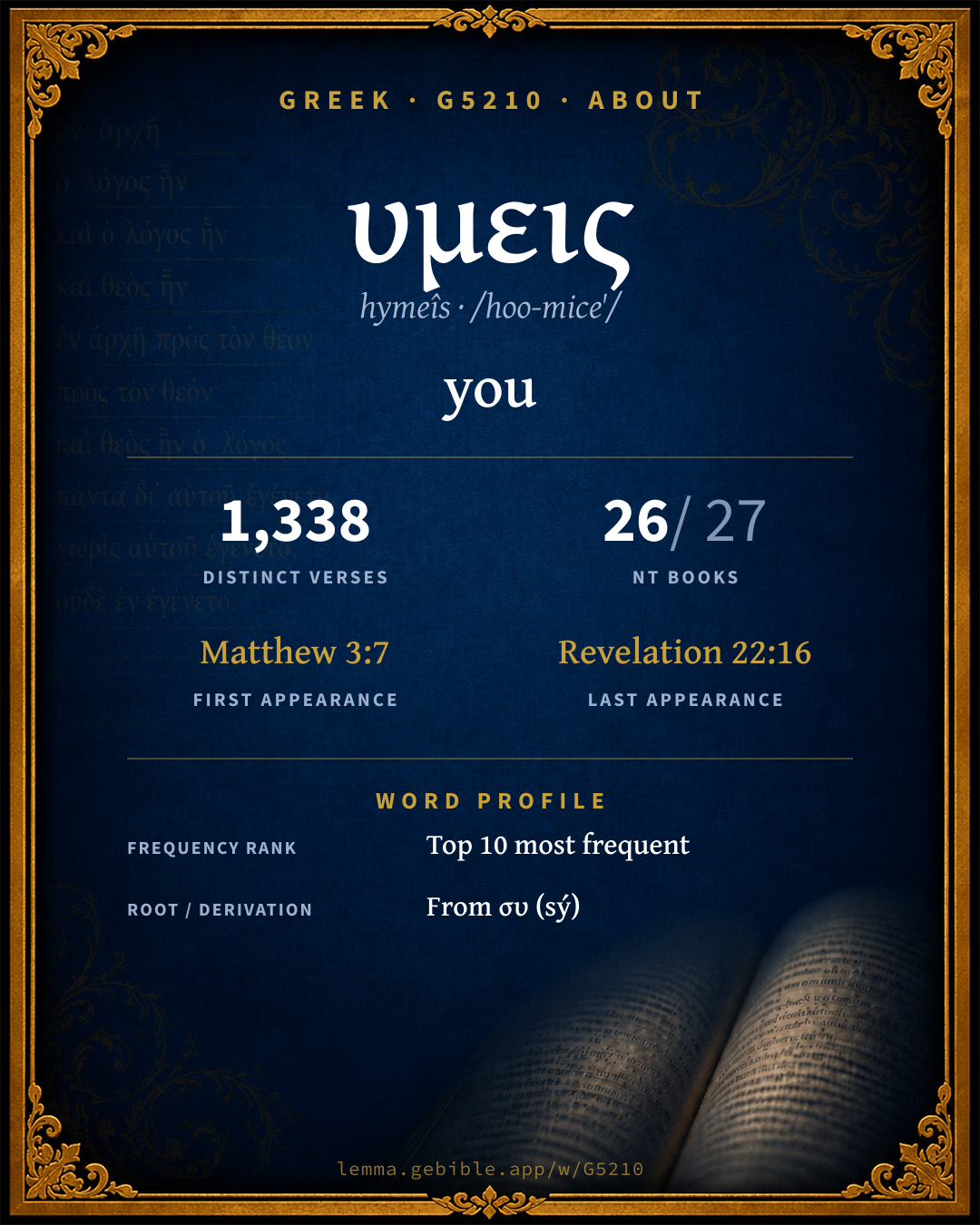
ὑμείς
you
Full lexicon entry — Thayer's Greek Lexicon
From Thayer's Greek Lexicon
Where this word appears
See every Genitive-case word in the Greek New Testament →
Grammar key — what these labels mean
Part of speech
- Personal pronoun
- Stands in for a person already named (“I,” “you,” “he”).
Case
- Dative
- The case of the indirect object, means, or location — “to / for / with / in.”
- Genitive
- The case of source, possession, or “of” — answers “whose / from what.”
- Accusative
- The case of the direct object and of extent.
- Nominative
- The case of the subject (and the predicate nominative).
Person
- 2nd person
- The one addressed (“you”).
Number
- Plural
- More than one.
Every verse where G5210 appears in the Book of Philippians — 40 distinct verses. Click any verse to open its interlinear word-by-word view. Verse text shown in the World English Bible for context — . Each verse’s Greek form is shown with its reference; the English is not keyword-highlighted, since the data carries no word-level English alignment. Use “Compare translations” on any verse to read it across multiple English versions. This concordance covers the Greek New Testament; Septuagint (Greek Old Testament) occurrences of this word are not indexed here.
Philippians
- Philippians 1:2 ὑμῖν pron 2 dat pl Grace to you, and peace from God, our Father, and the Lord Jesus Christ.
- Philippians 1:3 ὑμῶν pron 2 gen pl I thank my God whenever I remember you,
- Philippians 1:4 ὑμῶν pron 2 gen pl always in every request of mine on behalf of you all making my requests with joy,
- Philippians 1:5 ὑμῶν pron 2 gen pl for your partnership in furtherance of the Gospel from the first day until now;
- Philippians 1:6 ὑμῖν pron 2 dat pl being confident of this very thing, that he who began a good work in you will complete it until the day of Jesus Christ.
- Philippians 1:7 ὑμῶν ὑμᾶς ὑμᾶς pron 2 gen pl pron 2 acc pl pron 2 acc pl It is even right for me to think this way on behalf of all of you, because I have you in my heart, because, both in my bonds and in the defense and confirmation of the Gospel, you all are partakers with me of grace.
- Philippians 1:8 ὑμᾶς pron 2 acc pl For God is my witness, how I long after all of you in the tender mercies of Christ Jesus.
- Philippians 1:9 ὑμῶν pron 2 gen pl This I pray, that your love may abound yet more and more in knowledge and all discernment;
- Philippians 1:10 ὑμᾶς pron 2 acc pl so that you may approve the things that are excellent; that you may be sincere and without offense to the day of Christ;
- Philippians 1:12 ὑμᾶς pron 2 acc pl Now I desire to have you know, brothers, that the things which happened to me have turned out rather to the progress of the Gospel;
- Philippians 1:19 ὑμῶν pron 2 gen pl For I know that this will turn out to my salvation, through your supplication and the supply of the Spirit of Jesus Christ,
- Philippians 1:24 ὑμᾶς pron 2 acc pl Yet, to remain in the flesh is more needful for your sake.
- Philippians 1:25 ὑμῖν ὑμῶν pron 2 dat pl pron 2 gen pl Having this confidence, I know that I will remain, yes, and remain with you all, for your progress and joy in the faith,
- Philippians 1:26 ὑμῶν ὑμᾶς pron 2 gen pl pron 2 acc pl that your rejoicing may abound in Christ Jesus in me through my presence with you again.
- Philippians 1:27 ὑμᾶς ὑμῶν pron 2 acc pl pron 2 gen pl Only let your manner of life be worthy of the Gospel of Christ, that, whether I come and see you or am absent, I may hear of your state, that you stand firm in one spirit, with one soul striving for the faith of the Gospel;
- Philippians 1:28 ὑμῶν pron 2 gen pl and in nothing frightened by the adversaries, which is for them a proof of destruction, but to you of salvation, and that from God.
- Philippians 1:29 ὑμῖν pron 2 dat pl Because it has been granted to you on behalf of Christ, not only to believe in him, but also to suffer on his behalf,
- Philippians 2:5 ὑμῖν pron 2 dat pl Have this in your mind, which was also in Christ Jesus,
- Philippians 2:13 ὑμῖν pron 2 dat pl For it is God who works in you both to will and to work, for his good pleasure.
- Philippians 2:17 ὑμῶν ὑμῖν pron 2 gen pl pron 2 dat pl Yes, and if I am poured out on the sacrifice and service of your faith, I rejoice, and rejoice with you all.
- Philippians 2:18 ὑμεῖς pron 2 nom pl In the same way, you also rejoice, and rejoice with me.
- Philippians 2:19 ὑμῖν ὑμῶν pron 2 dat pl pron 2 gen pl But I hope in the Lord Jesus to send Timothy to you soon, that I also may be cheered up when I know how you are doing.
- Philippians 2:20 ὑμῶν pron 2 gen pl For I have no one else like-minded, who will truly care about you.
- Philippians 2:25 ὑμῶν ὑμᾶς pron 2 gen pl pron 2 acc pl But I counted it necessary to send to you Epaphroditus, my brother, fellow worker, fellow soldier, and your apostle and minister to my need;
- Philippians 2:26 ὑμᾶς pron 2 acc pl since he longed for you all, and was very troubled, because you had heard that he was sick.
- Philippians 2:30 ὑμῶν pron 2 gen pl because for the work of Christ he came near to death, risking his life to supply that which was lacking in your service toward me.
- Philippians 3:1 ὑμῖν ὑμῖν pron 2 dat pl pron 2 dat pl Finally, my brothers, rejoice in the Lord. To write the same things to you, to me indeed is not tiresome, but for you it is safe.
- Philippians 3:15 ὑμῖν pron 2 dat pl Let us therefore, as many as are perfect, think this way. If in anything you think otherwise, God will also reveal that to you.
- Philippians 3:18 ὑμῖν pron 2 dat pl For many walk, of whom I told you often, and now tell you even weeping, as the enemies of the cross of Christ,
- Philippians 4:5 ὑμῶν pron 2 gen pl Let your gentleness be known to all men. The Lord is at hand.
- Philippians 4:6 ὑμῶν pron 2 gen pl In nothing be anxious, but in everything, by prayer and petition with thanksgiving, let your requests be made known to God.
- Philippians 4:7 ὑμῶν ὑμῶν pron 2 gen pl pron 2 gen pl And the peace of God, which surpasses all understanding, will guard your hearts and your thoughts in Christ Jesus.
- Philippians 4:9 ὑμῶν pron 2 gen pl The things which you learned, received, heard, and saw in me: do these things, and the God of peace will be with you.
- Philippians 4:15 ὑμεῖς ὑμεῖς pron 2 nom pl pron 2 nom pl You yourselves also know, you Philippians, that in the beginning of the Gospel, when I departed from Macedonia, no assembly shared with me in the matter of giving and receiving but you only.
- Philippians 4:17 ὑμῶν pron 2 gen pl Not that I seek for the gift, but I seek for the fruit that increases to your account.
- Philippians 4:18 ὑμῶν pron 2 gen pl But I have all things, and abound. I am filled, having received from Epaphroditus the things that came from you, a sweet-smelling fragrance, an acceptable and well-pleasing sacrifice to God.
- Philippians 4:19 ὑμῶν pron 2 gen pl My God will supply every need of yours according to his riches in glory in Christ Jesus.
- Philippians 4:21 ὑμᾶς pron 2 acc pl Greet every saint in Christ Jesus. The brothers who are with me greet you.
- Philippians 4:22 ὑμᾶς pron 2 acc pl All the saints greet you, especially those who are of Caesar's household.
- Philippians 4:23 ὑμῶν pron 2 gen pl The grace of the Lord Jesus Christ be with you all. Amen.
About this entry
At a glance — auto-summarized from this page’s data, not written by a person. Every figure links to its source below. This summary describes the numbers; it doesn’t interpret them.
υμεις (hymeîs) is a Greek word most often rendered “you.” It first appears in Matthew 3:7. It turns up in 1,338 verses across 26 books, one of the most common footprint. From the same root come συ, σε and σοι. For the data behind this summary, explore the sense tree and the renderings breakdown below.
Gloss history
Strong's 1890 vs modern scholarship

About this word
Strong's G5210 catalogs a Greek word from the Greek New Testament.
These counts are not copied from any lexicon or concordance. They are computed here, from the morphology-tagged Greek New Testament. What Lemma adds →
- 1,338
- distinct verses
- The word appears in 1,338 distinct verses.
- 26 / 27
- NT books
- The word appears in 26 of 27 New Testament books.
- #8
- by frequency
- Top 10 most frequent Greek words (rank 8 of 5,347 Greek words by occurrence).
View all 1,338 occurrences in the concordance →
By section of the New Testament
By traditional corpus
Conventional, traditional groupings — biblical authorship is debated, so this is a traditional corpus grouping, not an authorship claim. Some books belong to more than one corpus (Luke is in both the Gospels and the Lukan corpus, and so on), so these shares overlap and need not total 100%. Each figure is a share of the word’s 1,338 distinct verses.
- Gospels 566 verses · 42%
- Pauline corpus 525 verses · 39%
- Lukan (Luke–Acts) 256 verses · 19%
- Johannine 194 verses · 14%
- General (Catholic) Epistles 121 verses · 9%
- Hebrews 28 verses · 2%
- Revelation 9 verses · 1%
How translations render this word
Counts come from each version’s own published word-to-Strong’s tagging or interlinear alignment — an approximate guide to how each version renders this word, not a word-level alignment the data otherwise carries. Because each total is that version’s own tagged count, the per-version totals vary from one another and need not match the appearance or distinct-verse counts above. These counts may also differ from a printed concordance because Lemma counts each distinctly tagged rendering and does not collapse phrase taggings into a single head-word total. This is a fixed set of word-tagged versions (KJV, ASV, BSB, ULT) and does not change with the reading translation you choose elsewhere. Each version’s license is shown beside its name below (and on Sources).
- King James Version: Ye 229×, Do ye 3×, Thither ye 2×
- American Standard Version: Ye 220×, Do ye 4×
King James Version Public Domain
Renders G5210 across 242 tagged occurrences — most commonly:
Plus 8 renderings that appear only once — usually multi-word phrases or single function words the recovered tagging swept in, not distinct renderings.
American Standard Version Public Domain
Renders G5210 across 237 tagged occurrences — most commonly:
Plus 13 renderings that appear only once — usually multi-word phrases or single function words the recovered tagging swept in, not distinct renderings.
Senses in Thayer's
The 1 sense Thayer's distinguishes for this word, in lexicon order (not ranked by frequency or importance). The full entry — with sub-senses — is in the Lexicon Entry tab.
- you
Word origin
Derived from συ (sý) (G4771) — you.
Irregular plural of G4771 ; you (as subject of verb): - ye (yourselves) you.
— Strong’s Exhaustive Concordance (1890), public domain.
Forms in the corpus
The 5 distinct written forms G5210 takes in the Greek New Testament, most frequent first — each parse links to that case’s occurrences in the concordance.
| Form | Parsing | Example | Uses |
|---|---|---|---|
| ὑμῖν hymîn | Personal pronoun, 2nd person, Dative, Plural | Matthew 3:7 | 601 |
| ὑμῶν hymō̂n | Personal pronoun, 2nd person, Genitive, Plural | Matthew 5:11 | 560 |
| ὑμᾶς hymâs | Personal pronoun, 2nd person, Accusative, Plural | Matthew 3:11 | 432 |
| ὑμεῖς hymeîs | Personal pronoun, 2nd person, Nominative, Plural | Matthew 5:48 | 230 |
| Ὑμεῖς Hymeîs | Personal pronoun, 2nd person, Nominative, Plural | Matthew 5:13 | 5 |
Same root — word family
Other Thayer's entries built from the same root as G5210, grouped by Strong’s listed origin. These share a root / origin per the lexicon — not necessarily a shared meaning. Each links to that word’s own entry.
Derives from
Shares the same root
Derived from this word
Compare all same-root words → Showing 4 of 10 — not the complete family. They share a root, not necessarily a meaning.
Septuagint usage
The same Greek word υμεις appears 3 times in the Greek Old Testament (Septuagint), across 3 verses in 1 book.
- 3
- LXX occurrences
- Tagged occurrences of this Greek word in the Septuagint.
- 3
- verses
- Distinct Septuagint verses containing this word.
- 1 / 39
- OT books
- The word appears in 1 of the 39 Old Testament books.
Sample Septuagint occurrences
- Jeremiah 41:17 ὑμεῖς
Septuagint occurrences (same lexeme)
Every verse where the same Strong’s number (G5210) appears in the Greek Septuagint. Verse text shown in the World English Bible for context; the Greek form is the matched word — the English is not keyword-highlighted.
- Jeremiah 41:17 ὑμεῖς and they departed, and lived in Geruth Chimham, which is by Bethlehem, to go to enter into Egypt,
- Jeremiah 51:2 ὑμεῖς I will send to Babylon strangers, who shall winnow her; and they shall empty her land: for in the day of trouble they shall be against her round about.
- Jeremiah 51:25 ὑμεῖς Behold, I am against you, destroying mountain, says Yahweh, which destroy all the earth; and I will stretch out my hand on you, and roll you down from the rocks, and will make you a burnt mountain.
These are occurrences of the same Greek lexeme (G5210) in the Septuagint — not a translation of any one Hebrew word. The store carries no word-level Hebrew↔Greek alignment, so no Hebrew original is asserted here. Counts come from the recovered LXX Strong's tagging — high-frequency vocabulary is well covered, while rare or late forms may be untagged — so they reflect tagged occurrences and may slightly undercount.