Matthew 15:7

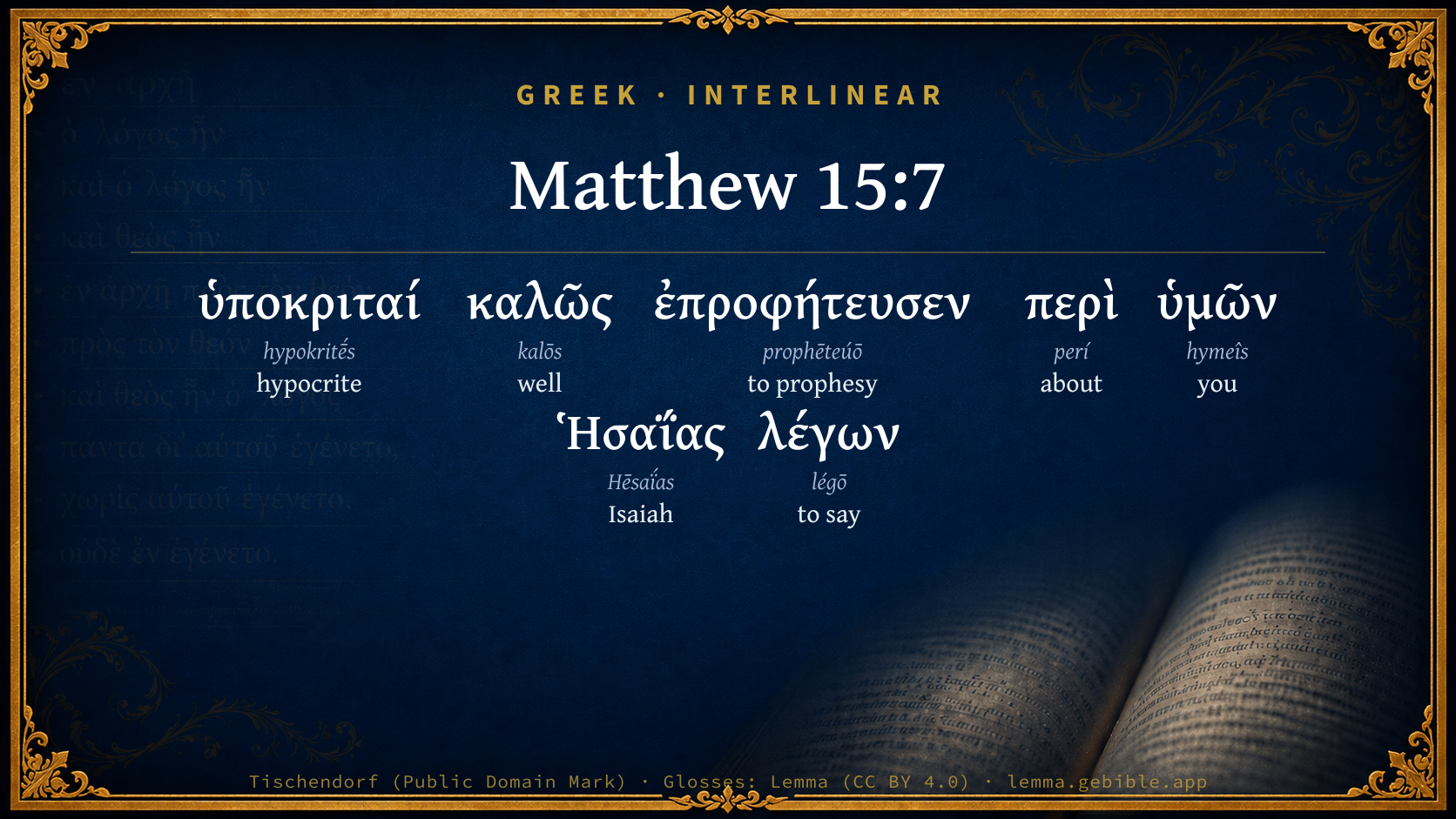
Greek (Tischendorf 8th ed.) Matthew 15:7 appears in the Greek New Testament. The text above is from the Tischendorf 8th edition. Each word links to its Strong’s number and a concise gloss. Click any word for its full Thayer’s Greek Lexicon entry.
Download image
Cite this verse

Matthew 15:7 (World English Bible). Public Domain. Lemma interlinear Bible study tool, https://lemma.gebible.app/v/matthew/15/7.

Show BibTeX & RIS
BibTeX
RIS
English Translation
You hypocrites! Well did Isaiah prophesy of you, saying,
World English Bible · Public Domain
Download a study sheet

One document with this verse’s original text, its word-by-word gloss line, the meaning frame, cross-references with their text, attributed commentary, and full source and license credits — printable, and it pastes into notes with its structure intact.

This verse Autodidact and up

Study sheet (.html) Plain text (.txt)

A passage Seminary Student

Up to 50 verses in one chapter. A passage sheet keeps up to 6 commentary sources and 12 cross-references per verse, in the order this page ranks them, and says so on the sheet whenever that leaves anything out. Ask for a single verse and you get the Autodidact verse sheet above.

Everything on this page stays free to read, with no account — the sheet is a download of what is already on screen, not access to it.

Want to remove ads? Support Godless Engineer
Compare translations 3

The same verse in 3 English versions, stacked beneath the original-language interlinear above. Click any original word for its lexicon entry.

Each is an independent rendering of the whole verse — the interlinear is not word-aligned to these translations.

Highlighted words mark where these versions differ — a whole-verse word diff, not a word-by-word alignment.

  • World English Bible Public Domain
    You hypocrites! Well did Isaiah prophesy of you, saying,
  • King James Version Public Domain
    Ye hypocrites, well did Esaias prophesy of you, saying,
  • unfoldingWord Literal Text CC BY-SA 4.0
    Hypocrites! Isaiah prophesied well about you, saying,

unfoldingWord Literal Text — © unfoldingWord, licensed CC BY-SA 4.0. Word-aligned USFM3 via Door43 (git.door43.org/unfoldingWord/en_ult).

Versions to compare (up to 4)

3 of 4 selected

Show all 19 translations

Every available English version of this verse, each an independent rendering of the whole verse.

  • World English Bible Public Domain
    You hypocrites! Well did Isaiah prophesy of you, saying,
  • Berean Standard Bible Public Domain
    You hypocrites! Isaiah prophesied correctly about you:
  • Majority Standard Bible Public Domain
    You hypocrites! Isaiah prophesied correctly about you:
  • King James Version Public Domain
    Ye hypocrites, well did Esaias prophesy of you, saying,
  • American Standard Version (1901) Public Domain
    Ye hypocrites, well did Isaiah prophesy of you, saying,
  • Revised Version (1885) Public Domain
    Ye hypocrites, well did Isaiah prophesy of you, saying,
  • Geneva Bible (1599) Public Domain
    O hypocrites, Esaias prophecied well of you, saying,
  • Douay-Rheims (1899) Public Domain
    Hypocrites, well hath Isaias prophesied of you, saying:
  • Young's Literal Translation Public Domain
    `Hypocrites, well did Isaiah prophesy of you, saying,
  • Literal Standard Version CC BY-SA 4.0
    Hypocrites, Isaiah prophesied well of you, saying,
  • Unlocked Literal Bible CC BY-SA 4.0
    You hypocrites! Well did Isaiah prophesy about you when he said,
  • unfoldingWord Literal Text CC BY-SA 4.0
    Hypocrites! Isaiah prophesied well about you, saying,
  • Darby Bible Public Domain
    Hypocrites! well has Esaias prophesied about you, saying,
  • World Messianic Bible Public Domain
    You hypocrites! Well did Isaiah prophesy of you, saying,
  • Webster's Bible Public Domain
    Ye hypocrites, well did Isaiah prophesy of you, saying,
  • Free Bible Version CC BY-SA 4.0
    You hypocrites! How well Isaiah described you when he prophesied:
  • Bible in Basic English Public Domain
    You false ones, well did Isaiah say of you,
  • Text-Critical English NT CC BY 4.0
    Hypocrites! Isaiah prophesied rightly about you when he said,
  • Tyndale New Testament (1534) Public Domain
    Ypocrites well prophesyed of you Esay sayinge:

Literal Standard Version (2020), Covenant Press — licensed CC BY-SA 4.0. Text via the HelloAO Bible API (eBible.org). Unlocked Literal Bible (unfoldingWord) — licensed CC BY-SA 4.0. Text via the HelloAO Bible API (eBible.org). unfoldingWord Literal Text — © unfoldingWord, licensed CC BY-SA 4.0. Word-aligned USFM3 via Door43 (git.door43.org/unfoldingWord/en_ult). Free Bible Version, Dr. Jonathan Gallagher — licensed CC BY-SA 4.0. Text via the HelloAO Bible API (eBible.org).

Word by word

More ways to search: Search by grammar → Find every occurrence → Compare this word →

Practice this passage: Drill this verse → Learn its vocabulary →

About this verse

These counts appear in no published source. They are computed here, from the morphology-tagged text and Lemma’s own curated glosses. What Lemma adds →

7
words
7
distinct lemmas
Gospels
section

Notable vocabulary

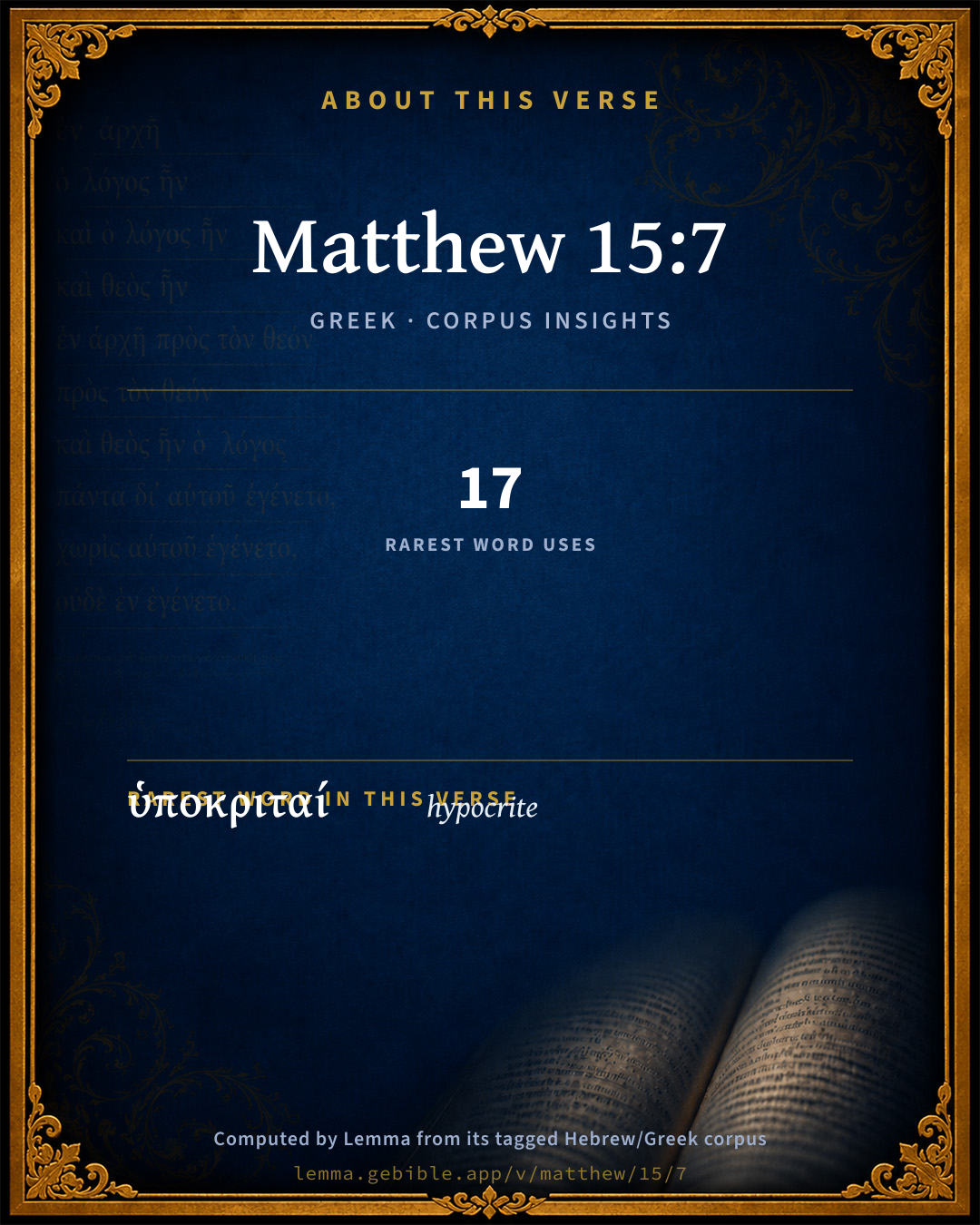
The rarest word here is ὑποκριταί hypocrite G5273 — appearing just 17 times in the whole Greek New Testament.

Shared distinctive vocabulary

ὑποκριταί hypocrite G5273 occurs in 17 verses of the Greek New Testament. Also found in:

Cross-references

4

Topical passages linked to Matthew 15:7 in the Treasury of Scripture Knowledge — connected by theme and wording, ordered by reader-vote popularity; previews shown in the World English Bible.

  • Mark 7:6 He answered them, "Well did Isaiah prophesy of you hypocrites, as it is written, 'This people honors me with their lips, But their heart is far from me.
  • Matthew 23:23–29 "Woe to you, scribes and Pharisees, hypocrites! For you tithe mint, dill, and cumin, and have left undone the weightier matters of the law: justice, mercy, and faith. But you ought to have done these, and not to have left the other undone.
  • Acts 28:25–27 When they didn't agree among themselves, they departed after Paul had spoken one word, "The Holy Spirit spoke rightly through Isaiah, the prophet, to our fathers,
  • Matthew 7:5 You hypocrite! First remove the beam out of your own eye, and then you can see clearly to remove the speck out of your brother's eye.

Cross-references courtesy of OpenBible.info (CC BY 4.0).

Commentary

Notes on Matthew 15:7 from classic Christian and Jewish commentators (each source and its license shown beneath its notes). The classic Christian expositions comment on the surrounding passage and are grouped to its opening verse, so a note may address several verses; the Jewish commentaries on the Tanakh (Rashi and others) are per-verse, so they appear only where the commentator wrote on this verse.

Lemma curates 59 commentaries, every one of them public domain or Creative Commons licensed, each selected and text-cleaned for this edition rather than reprinted as found. About our sources →

The Biblical Illustrator

Joseph S. Exell

Mat_15:7-9

This people draweth near to Me with their mouth.

Lip profession

I. Show who they are who answer to the description in the text. All merely nominal Christians. Formal, self-righteous persons. False professors.

II. Expostulate with them on their folly. Is not conformity to Christs demand of the heart practicable? Is not such consecration to Him necessary? Will not merely a feigned allegiance be disowned by Him? Shall we Hot wish at last that we had been sincere and upright? (Pulpit Studies.)

I. The text describes a great privilege.

II. Points out a serious abuse. (J. Rawlinson.)

Contrasts of sentiments and conduct

Words and works, believing and doing, confession of the mouth and confession of the life, a sense of religion and godliness in the Church, and a sense of religion and godliness in the world, are things that ought never to be separated.

I. Endeavour to convince you, that a various and manifest contrariety actually appears between the sentiments which we express in the Divine service, and particularly at the ordinance of the Sacred Supper, and our conduct in the ordinary course of life.

II. Endeavour to represent to you the absurdity and the danger of such a contradictions and inconsistent behaviour. (Zollikofer.)

True sanctity

I. True sanctity consists not in the knowledge of God and religion, however extensive, however just and perspicuous it may be. Although that knowledge may be necessary to sanctity, it is not, however, competent to it; and though it constitutes the basis of it, yet it is no more sanctity itself than the foundation of an edifice is the edifice itself.

II. Neither does true sanctity consist in A furious zeal for the known truth, or for the honour and glory of that religion which we profess.

III. Neither does true sanctity consist in the diligent or strict attendance on the rites and ceremonies which religion prescribes; nor in the observance, nor in the multiplication of the devotional exercises to which it advises its professors; nor in voluntary penances and mortifications, which they impose upon themselves.

IV. Neither does true sanctity consist in our occasionally omitting something which God has forbidden us, or doing something which he has commanded us; nor in our occasionally performing single good actions, whether of justice or beneficence, or of abstinence. True sanctity is a reigning, constantly active, disposition and bent of the soul, manifesting itself in the several parts of our inward and outward conduct, and making us always willing and ready to do what, and nothing else but what, is agreeable to God, and correspondent to His will. (Zollikofer.)

The heart far from God

I. The state described.

1. Marked by absence of sincerity and honesty.

2. Implies a state of alienation from God.

3. Try the meaning of the text by the common estimates we form of professed friendship. All stress is laid on motive and feeling.

II. The lessons of the state here referred to.

1. The need of repentance.

2. That in the midst of religious ordinances there may be spiritual insensibility.

3. Yet though the heart be far off the Good Shepherd seeks it. (W. D. Harwood.)

The vanity of human institution in religion

Show the equity and importance of this assertion of our Saviour, that they who ground their religious practices, or any part of them, upon human authority, do so far, or in that respect, worship God in vain-that is, they cannot reasonably expect any one good effect from such worship.

I. Rest this matter on our Saviours authority.

II. God is the supreme object of religious worship; and to Him all our devotions ought to be ultimately directed.

III. It is a matter of interest, as well as duty, for us so to do.

IV. The peace and wellbeing of mankind in general, and of every society in particular, are interested in it. (Wm. West.)

Teaching doctrines the commandments of men

Our Lord is here reproving the scribes and Pharisees for imposing on the people some commandments of their own, or traditions of their predecessors, as of equal obligations with the precepts of the law.

I. The objects of this censure or the persons specially affected by it. The objects of the reproof were the scribes and Pharisees, the public authorized teachers of the law. There must be public teachers who shall command and instruct; but this authority is committed to them under restrictions.

II. When are teachers and rulers of the church guilty of the crime here reproved of teaching for doctrines the commandments of men? For the better clearing of which it will be of use to consider-

1. What is meant by commandments of men. They are three sorts:

(1) Where the matter of the human command is the same action that God has enjoined by His law. For human authority ought to command what God has commanded; particularly in such a society as the Christian Church formed upon the laws of the gospel.

(2) A second sort of commandments of men are such whose matter contradicts or interferes with the prescriptions of the Divine law. And such are not only those which expressly forbid what God has commanded, or invert the prescribed order of Gods commands.

(3) A third sort of commandments of men are such whose matter is actions in their nature indifferent, and neither commanded nor forbidden by God; such as the washing hands before meat.

2. Then teaching these commandments of men as doctrines is proposing them as precepts of the Divine law, or of equal authority with them, and obliging the conscience as such.

Rules supposed to be indifferent but convenient and orderly may obtain in a society; but this authority may be abused:

1. When such things are prescribed as binding the conscience by direct obligation.

2. The prescription of indifferent things will be liable to the censure in the text, when it is taught that obedience to them will excuse disobedience to a law of God.

3. This censure will also be incurred when indifferent things are prescribed by men as means of grace, as having power to convey remission of sins, or any other spiritual or supernatural gifts of the Holy Ghost. They may he means of grace, but God only has authority to make them so.

III. What our Lord has here pronounced, that they worship God in vain. (J. Rogers, D. D.)

How may we cure distractions in holy duties

I. The greatness of the sin. Proved by three general considerations:-

1. How tender God is of His worship (Lev_10:3; Ecc_5:2).

2. The more sincere any one is, the more he maketh conscience of his thoughts.

3. Carelessness in duties is the highway to atheism.

Particularly:-

1. It is an affront to God, and a kind of mockery.

2. It grieveth the Spirit of God.

3. It is a spiritual disease.

4. It argueth the loss and non-acceptance of our prayers.

There is a threefold distraction prayer:-

1. An unwilling distraction.

2. A negligent distraction.

3. A voluntary distraction.

II. The causes of this roving and intrusion of vain thoughts.

1. Satan is one cause.

2. The natural levity of our spirits.

3. Practical atheism.

4. Strong and unmortified lusts.

5. Want of love to God anti holy things.

6. Slightness and irreverence, or want of a sense of Gods presence.

7. The curiosity of the senses.

8. Carking and distrustful cares.

III. The remedies.

1. GO to God and wait for the power of His grace.

2. Meditate on the greatness of Him before whom we are.

3. Mortify those lusts that are apt to withdraw our minds.

4. Before the duty there must be an actual preparation or a solemn discharge of all impediments, that we may not bring the world along with us.

5. Be severe to your purpose.

6. Bring with you to every holy service strong spiritual affections.

7. Remember the weight and consequence of the duties of religion.

8. Let every experimental wandering make you more humble and careful.

9. A constant heavenliness and holiness of heart.

10. Frequent and solemn meditation.

11. By use a man gets greater command over himself. (T. Manton, M. D.)

Heart-worship

As the strength of sin lies in the inward frame of the heart, so the strength of worship in the inward complexion and temper of the soul. Shadows are not to be offered instead of substance. God asks for the heart in worship, and commands outward ceremonies, as subservient to inward worship, and goads and spears unto it. What value had the offering of the human nature of Christ been, if he had not had a Divine nature to qualify Him to be the Priest? And what is the oblation of our bodies, without a priestly act of the spirit in the presentation of it? To offer a body with a sapless spirit, is a sacrilege of the same nature with that of the Israelities when they offered dead beasts. One sound sacrifice is better than a thousand rotten ones. (Charnock.)

Mere outward worship offensive to God

You would all judge it to be an affront to the majesty of God if a man should send his clothes stuffed with straw, or a puppet dressed up instead of himself, into the assemblies of Gods people, and think that this would do instead of his personal presence. Yet our clothes stuffed with straw would be less offensive to God than our bodies without our souls. The absence of the spirit is the absence of the more noble part. (T. Manton.)

Sincerity in worship

We may be truly said to worship God, though we want perfection; but we cannot be said to worship Him if we want sincerity: a statue upon a tomb, with eyes and hands lifted up, offers as good and true a service; it wants only a voice, the gestures and postures are the same-nay, the service is better; it is not a mockery, it represents all that it can be framed to. But to worship without our spirits is presenting God with a picture, an echo, voice, and nothing else-a compliment, a mere lie. (Charnock.)

Formalism in worship.

We have sometimes seen a tree which looked with its great spreading arms and massive trunk as strong as other trees. The storm beat upon it and it fell, and then we wondered that it could stand so long when little but the bark and outer fibre supported it, and within was nothing but decay. And do we not often find that where zeal has grown cold and the inner spiritual life has become dead, that habits of formal attention to religious duties are maintained for a long time before the crash comes that reveals the utter ruin and desolation of the spiritual life? (J. G. Pilkington.)

God only to be worshipped and loved

I. The true object of religious worship, which is here called drawing nigh unto God and honouring Him.

II. To direct the right manner of performing religious worship.

1. God is to be worshipped in the way of His own appointment.

2. God is to be worshipped with the whole man, with our bodies and spirits which are His.

3. God is to be worshipped by the assistance of His spirit.

4. God is to be worshipped in the exercise of all suitable graces under the influence of His spirit.

5. God is to be worshipped with an eye to His glory, as our ultimate end.

6. God is to be worshipped in the name of Christ as our only Mediator.

Reflections:

1. How must every one, more or less, stand reproved for defects in worship.

2. How becoming, glorious and delightful must it be to offer up such worship to God, as is agreeable to His will.

3. What glorious provision has God made in the gospel to assist this noble homage. (Dr. Guyse.)

Scriptural worship

All religion must be Scripture religion, all worship Scripture worship, all zeal Scripture zeal; so that let a man have never such sublime knowledge and such burning zeal, yet if it be not according to the law and the testimony, there is no light in them. It is but a vain worship of God, because God doth not require this; so that the sum of all, and that into which all religion must be resolved at last, is the Scriptures-the Word of God; for if you once lay this aside, why should not the Turkish devotion be as good as thine? Why should not the Mahommedan zeal be as acceptable as thine, but only this makes the difference. What may be proved by Scripture is approved of by GOD; so that all these arguments,-Its my conscience; I verily think I am bound to do thus; Its upon my spirit; I find much comfort and much sweetness in religion,-all this is nothing, for all false religions can and do say this; but hast thou the Word of God to warrant thee?doth that justify thee? all things else are but an empty shadow. (A. Burgess.)

The Biblical Illustrator, edited by Joseph S. Exell (c. 1880s–1900s) — public domain. Text from a community e-Sword module.

Joseph Benson's Commentary

Mat 15:7-9. Ye hypocrites — To substitute superstitious observances of man’s invention, in the place of obedience to God’s commands, is downright hypocrisy; it is, however, the prerogative of Him who searches the heart, and knows what is in man, to pronounce who are hypocrites. And as hypocrisy is a sin which only his eye discovers, so it is a sin which above all others he abhors. Well did Esaias prophesy of you — That is, the words which Isaiah addressed to your fathers are exactly applicable to you: his description of them is a prophecy with regard to you. Observe, reader, the reproofs of sin and sinners, which we find in the Scriptures, were designed to be applied to similar persons and practices to the end of the world; for they are not of private interpretation, 2Pe 1:20. Threatenings directed against others belong to us, if we be guilty of the same sins. This people draweth nigh unto me with their mouths, &c. — They make a great profession, and pretend to much devotion and piety; but their heart is far from me — They do not sincerely love and obey me. They do not give me their hearts; and, if the heart be not given to God, all outward worship is no better than a mockery of him. In vain they do worship me — That is, idly, unprofitably, and to no purpose. Their worship does not attain the end for which divine worship was appointed. It neither pleases God nor profits themselves. For if it be not in spirit, it is not in truth, and so it is all nothing. Teaching for doctrines the commandments of men — As equal with, nay, superior to, those of God. What can be a more heinous sin?

Joseph Benson's Commentary on the Old and New Testaments (1811–1818) — public domain. Text from a community e-Sword module.

Tyndale Open Study Notes

Tyndale Open Resources

15:7 You hypocrites! See study note on Matt 23:13.

Tyndale Open Study Notes — © Tyndale Open Resources, licensed CC BY-SA 4.0. Text via the HelloAO Bible API.

Bengel's Gnomon

Johann Albrecht Bengel

Mat 15:7. Προεφήτευσε, prophesied) i.e. foretold.

Bengel's Gnomon of the New Testament — English translation (T&T Clark, Edinburgh, 1860) — public domain. Text from a community e-Sword module.

Meyer's Critical & Exegetical Commentary

Heinrich August Wilhelm Meyer

Mat_15:7 ff. Καλῶς] admirably, appropriately characterizing.

προεφήτ.] has predicted, which de Wette unwarrantably denies to be the meaning of the word in the present instance, understanding προφ. in the sense of the inspired utterance generally. Jesus regards Isa_29:13 (not strictly in accordance with the LXX.) as a typical prediction, which has found its fulfilment in the conduct of the scribes and Pharisees.

μάτην δέ] δέ denotes a continuation of the matter in hand; and μάτην indicates, according to the usual explanation, that their σέβεσθαι is attended with no beneficial result (2Ma_7:18, and classical writers), produces no moral effect upon their heart and life, because they teach as doctrines the commandments of men. But seeing that the μάτην σέβεσθαι consists of mere lip-service in which the heart plays no part, thus according with the idea involved in ὑποκριταί,and inasmuch as διδάσκοντες, etc., is evidence that such is the nature of the service, the interpretation: sine causa, found so early as in the Vulgate, is better suited to the context. Their σέβεσθαι of God is meaningless (temere, comp. Soph. Aj. 634, and Lobecks note, Ast, Lex. Plat. II. p. 285), because they do not teach divine, but human doctrine, the consequence of which is that the σέβεσθαι has no motive principle in the heart, where, on the contrary, human interest takes the place of the fear of God. Comp. the μάταιος θρησκεία of Jam_1:26. For the opposite of such worship, consult Joh_4:24. See Apol. Conf. A., pp. 206, 256.

There is no Hebrew word corresponding to μάτην in the above quotation from Isaiah; probably the text made use of by the LXX. contained a different reading.

ἐντάλμ. ἀνθρ.] promulgating as doctrines, precepts of a merely human origin; comp. Col_2:22.

Meyer — Critical and Exegetical Commentary on the New Testament — English translation by Peter Christie, edited by Frederick Crombie (T&T Clark, 1880) — public domain. Text from a community e-Sword module.

Expositor's Greek Testament

ed. W. Robertson Nicoll

Mat 15:7 . ὑποκριταί : no thought of conciliation; open war at all hazards. “Actors,” in their zeal for God, as illustrated in the case previously cited. God first, parents second, yet God not in all their thoughts. καλῶς , appositely, to the purpose. Isaiah might not be thinking of the Pharisees, but certainly the quotation is very felicitous in reference to them, exactly describing their religious character. Mt. follows Mk. in quoting; neither follows closely the Sept [91] (Isa 29:13 ).

[91] Septuagint.

The Expositor's Greek Testament, edited by W. Robertson Nicoll (1897–1910) — public domain. Text from a community e-Sword module.

Geneva Bible (1599)

Geneva Bible translators

The same men are condemned for hypocrisy and superstition, because they made the kingdom of God to stand in outward things.

Geneva Bible (1599) marginal notes — public domain. Text via Bolls.life.

Jamieson, Fausset & Brown

Robert Jamieson, A. R. Fausset & David Brown

Ye hypocrites, well did Esaias prophesy of you, saying-- (Isa 29:13).

Jamieson, Fausset & Brown — Commentary Critical and Explanatory on the Whole Bible (1871) — public domain (CC PDM 1.0). Text via the HelloAO Bible API.

Adam Clarke's Commentary

Verse 7. Hypocrites, well did Isaiah prophesy of you] In every place where the proper names of the Old Testament occur, in the New, the same mode of orthography should be followed: I therefore write Isaiah with the Hebrew, not Esaias, with the Greek. This prophecy is found Isa 29:13. Our blessed Lord unmasks these hypocrites; and we may observe that, when a hypocrite is found out, he should be exposed to all; this may lead to his salvation: if he be permitted to retain his falsely acquired character, how can he escape perdition!

Adam Clarke's Commentary on the Bible (1810–1826) — public domain. Text from a community e-Sword/MySword module.

Ellicott's Commentary for English Readers

(7) Ye hypocrites.—See Note on Mat_7:5.

A Bible Commentary for English Readers, edited by Charles John Ellicott (1878–1897) — public domain. Text from a community e-Sword module.

The Cambridge Bible for Schools and Colleges

gen. ed. J. J. S. Perowne

7. well did Esaias prophesy] A common Jewish formula for quoting a saying of the prophets.

The Cambridge Bible for Schools and Colleges (gen. ed. J. J. S. Perowne; Cambridge University Press, 1878–1918) — public domain. Text from a community e-Sword module.

John Gill's Exposition

Ye hypocrites,.... After our Lord had given so full a proof of their making void the commandments of God by their traditions, he might very justly, as he does, call them hypocrites; who pretended to so much religion and holiness, and yet scrupled not, upon occasion, to set aside a divine command; who affected so much sanctity, as to be displeased with the disciples, for not complying with an order of their elders, when they themselves made no account of a divine precept; and plainly showed they had more regard to men than God, and to the precepts of men, than to the commands of God, and to approve themselves to men more than to God; and that they sought the praise and applause of men, and not the honour which comes from God; and that their religion lay in mere rituals and externals, and those of men's devising, and not in the spiritual worship and service of God. Nor can it be thought that Christ, in calling them hypocrites, bears too hard upon them; when one of their own doctors, who lived not very distant from this age, says (a) of the men of Jerusalem, that

"if the hypocrites of the world were divided into ten parts, nine of them would belong to Jerusalem, and one to the rest of the world.''

Well did Esaias prophesy of you, saying, in Isa 29:13 which prophecy, though it was directed to, and suited with many in that generation in which the prophet lived, yet had a further view to the Jews in after times: their own writers (b) acknowledge, that the whole prophecy is spoken of that nation; for by Ariel they understand the altar at Jerusalem, the city in which David dwelt,

(a) R. Nathan in Rabba, sect. 1. (b) Abarbinel, Jarchi, Kimchi, & Aben Ezra.

John Gill's Exposition of the Whole Bible (1746–1763) — public domain (CC PDM 1.0). Text via the HelloAO Bible API.

Trapp's Complete Commentary

John Trapp

7 Ye hypocrites, well did Esaias prophesy of you, saying,

Ver. 7. Well did Esaias prophesy of you] Of such as you, and so of you too. The prophets and apostles then spake not of them only with whom they lived, and to whom they wrote (as the Jesuits blaspheme), but their oracles and doctrines do extend still to men of the same stamp and making. "In the volume of thy book it is written of me," saith David, Psa 40:7; he found his own name in God’s book. And where he spake with Jacob at Bethel, there he spake with us, saith Hosea; {Hos 12:4} and, "Whatsoever was written, was written for our learning," saith Paul, Rom 15:4.

John Trapp, A Commentary or Exposition upon All the Books of the Old and New Testament (1647–1656) — public domain. Text from a community e-Sword module.

Matthew Poole's English Annotations

The Greek is, διδασκοντες διδασκαλίας, teaching doctrines, the commandments of men.

Ye hypocrites, who put on an outward vizard or appearance of holiness, but have nothing in your hearts of true and severe piety,

well did Isaiah prophesy of you: Isaiah spake to the Jews that were then in being, but what he then said of your forefathers that lived in his age, is true of you who are their children.

Saying, This people, &c. The evangelist doth not quote the words of the prophet exactly, but his sense, and teacheth us this lesson, That whatsoever outward show and profession of religion be in and upon men, if their hearts be not right with God, and what they outwardly do proceed not from an inward principle of faith, love, and obedience in and to God, they are but hypocrites.

In vain do they worship me, &c.; that is, idly, and unprofitably, and to no purpose: I will not account what they do.

Teaching doctrines, the commandments of men: he means in the worship of God, for other commandments of men are not the preacher’s texts, nor doth he here mean by

commandments of men such as backed the commandments of God, and only served to enforce them, but such as he had been speaking of, human traditions, of which God had said nothing, as washing of hands; or such traditions as enervated the commandments of God; such were the last mentioned.

Matthew Poole's English Annotations on the Holy Bible (1683–1685) — public domain. Text from a community e-Sword/MySword module.

Whedon's Commentary on the Bible

Daniel D. Whedon

7. Ye hypocrites — For fabricating a religion without morality. Prophesy of you — Isaiah, by inspiration, describing such characters as yours beforehand. The class and the race are indeed foreseen by God as recurring, and are so predescribed once for all.

Daniel D. Whedon (gen. ed.), Commentary on the Old and New Testaments (1874–1909) — public domain. Text from a community e-Sword module.

The Pulpit Commentary

Ye hypocrites. He called them by this name because, while they pretended that zeal for God"s glory led them to these explanations and amplifications of the Law, they were really influenced by covetousness and avarice, and virtually despised that which they professed to uphold. A Jewish proverb said that if hypocrites were divided into ten parties, nine of them would be found in Jerusalem, and one in the rest of the world. Well did Esaias prophesy of you. (Isa_29:13) That is, their conduct fulfilled the saying of the prophet, as Mat_13:14. Such "prophecies" were for all time, and were suitable for various circumstances, characters, and events. Christ is wont to fortify his arguments by the authority of Scripture, often rather explaining the mind of the Spirit than quoting the exact words.

The Pulpit Commentary (1880–1919), ed. H.D.M. Spence-Jones & Joseph S. Exell — public domain. Text from a community e-Sword module.

John Wesley's Explanatory Notes

Well did Isaiah prophesy of you, saying - That is, the description which Isaiah gave of your fathers, is exactly applicable to you. The words therefore which were a description of them, are a prophecy with regard to you.

John Wesley, Explanatory Notes Upon the Whole Bible (1754–1765) — public domain. Text via the GEBible commentary corpus.

Kretzmann's Popular Commentary

Paul E. Kretzmann

Christ substantiates His attack:

v. 7. Ye hypocrites, well did Esaias prophesy of you, saying,

v. 8. This people draweth nigh unto Me with their mouth, and honoreth Me with their lips; but their heart is far from Me.

v. 9. But in vain they do worship Me, teaching for doctrines the commandments of men.

He does not mince words; their sham and deceit, their shallow acting at religion, must be branded as such. What the Lord had spoken of the hypocrisy of the Jews in the time of Isa 29:13; Eze 33:31; Isa 1:1-5, applies, in fullest measure, to the scribes and Pharisees. Mere lip-service is an abomination to the Lord. There is no faith, no real love in their hearts. Their supposed orthodoxy is a hallucination, their entire religion is vain. The injunctions which they laid upon men without Scriptural warrant resulted only in their own condemnation, Psa 4:2. "Out of these words of Christ thou mayest draw strong conclusions; first: Everything that is done without the Word of God is idolatry; secondly: Everything that is done according to the Word of God is true worship of God; also thirdly: All that is done without faith is sin; fourthly: All that is done in faith is a good work, for the Word and faith are indissolubly connected, as in holy marriage... We say also that the Pharisees were hypocrites and false pupils of Moses, because they held, if they only fulfilled the ceremonies outwardly, they would, for the sake of the mere work, obtain righteousness before God. This Moses truly did not want, but the ceremonies should be exercises of the pious, who previously were just by faith, and who thus kept the First Commandment before all. Furthermore, the reprobate people should, by external discipline, be held back and separated from the heathen. That is the meaning of Moses, if one understands him correctly."

Paul E. Kretzmann, Popular Commentary of the Bible (1921–1924) — public domain. Text from a community e-Sword module.

Burkitt's Expository Notes on the New Testament

William Burkitt

Our Saviour reproves the hypocritical Pharisees for the same things:

1. That they preferred human traditions before the divine precepts.

2. That by their human traditions they made void the worship of God. It is God’s undoubted prerogative to prescribe all the parts of his own worship; and whoever presumes to add thereunto, they worship him in vain.

Our Saviour farther shews, that all this proceeded from the insincerity of their hearts: This people honoureth me with their lips, but their heart is far from me.

Whence learn, 1. That the removing the heart far from God in worship, is a great sin, and an high degree of hypocrisy.

2. That whatever outward shew and profession of religion men make, if their hearts be not right with God, and what they do proceeds not from an inward principle of love and obedience to God, they are under the reign and power of hypocrisy. Ye hypocrites, in vain do ye worship me.

Learn, 3. That we must not be forward, from Christ’s example, to pronounce men hypocrites; because we have neither that authority nor knowledge of the heart which Christ had, to authorize us so to do.

Christ here called the Pharisees hypocrites,

1. Because they placed holiness and religion in ceremonies of human invention.

2. Because being so superstitiously careful to avoid bodily pollutions, they left their hearts within; full of hypocrisy and iniquity.

William Burkitt's Expository Notes on the New Testament (1700–1703) — public domain. Text from a community e-Sword module.

The People's New Testament

B. W. Johnson

7. Ye hypocrites. The word so rendered might mean one self-deceived as well as a deceiver, but was always a rebuke. Well did Isaiah prophesy of you. See Isaiah 29:13.

B. W. Johnson's The People's New Testament with Notes (1889–1891) — public domain. Electronic text from the Christian Classics Ethereal Library (CCEL) ThML edition.

unfoldingWord translationNotes

Door43 World Missions Community

Connecting Statement:

Jesus concludes his response to the Pharisees and scribes.

General Information:

In verses 8 and 9, Jesus quotes the prophet Isaiah to rebuke the Pharisees and scribes.

Well did Isaiah prophesy about you

"Isaiah told the truth in this prophecy about you"

when he said

It is implied that Isaiah is speaking what God told him. AT: "when he told what God said" (See: Assumed Knowledge and Implicit Information)

This people honors me with their lips

Here "lips" refers to speaking. AT: "These people say all the right things to me" (See: Metonymy)

me

All occurrences of this word refer to God.

but their heart is far from me

Here "heart" refers to a person's thoughts or emotions. This phrase is a way of saying the people are not truly devoted to God. AT: "but they do not really love me" (See: Metonymy and Idiom)

They worship me in vain

"Their worship means nothing to me" or "They only pretend to worship me"

the commandments of people

"the rules that people make up"

translationWords

hypocrite

Isaiah

prophet

honor

heart

worship

vain

doctrine

unfoldingWord translationNotes — © Distant Shores Media and the Door43 World Missions Community, licensed CC BY-SA 4.0. Source: git.door43.org/Door43/en_tn.

Cambridge Greek Testament for Schools and Colleges

7. καλῶς ἐπροφήτευσεν. A common Jewish formula in quoting a saying of the prophets.

Cambridge Greek Testament for Schools and Colleges (Cambridge University Press, 1896; 21 vols, various authors incl. Carr, Maclear, Plummer, Farrar, Lumby, Moule, M. R. James, Simcox) — public domain. Text from a community e-Sword module.

International Critical Commentary

7. Ye hypocrites, well did Isaiah prophesy concerning you, saying.] Mk. has: “And He said to them, Well did Isaiah prophesy concerning you hypocrites, as it stands written that.”

(M)

International Critical Commentary — older volumes (1896–1929), various authors — public domain. Text from a community e-Sword module.

Vincent's Word Studies in the New Testament

Marvin R. Vincent

Well [καλως] . Admirably.

Marvin R. Vincent, Word Studies in the New Testament (1887–1900) — public domain. Text from a community e-Sword/MySword module.

Lesson kit

Teaching starters — assembled from the data on this page, not authored interpretation. Every prompt links to the verse data it draws on. Edit before teaching.

Matthew, in the Gospels, opens this verse with 7 words (7 distinct Greek lemmas). Its most distinctive word is hypokritḗs (“hypocrite”). A historical commentator’s framing appears above. Read the whole chapter for the surrounding context.

Discussion questions

  1. How does “hypocrite” (hypokritḗs) shape what this verse is saying?
  2. How does Matthew 6:2, which shares the word «hypocrite», read alongside this verse?
  3. These translations render this verse differently; the difference is in the English rendering, not the original. What questions does that raise?
  4. Compare how The Biblical Illustrator and Joseph Benson's Commentary read this verse. Where do they agree or differ?

Things to notice

Reading settings

Reading text

Shown beneath each verse's original-language words.

Old Testament
Old Testament edition

Read the OT as the Masoretic Hebrew (MT) or the Greek Septuagint (LXX).

English shown for the Greek Septuagint (in the Hebrew ↔ Greek comparison).

Comparing translations? Open the Compare panel on any verse page to stack up to four side by side.