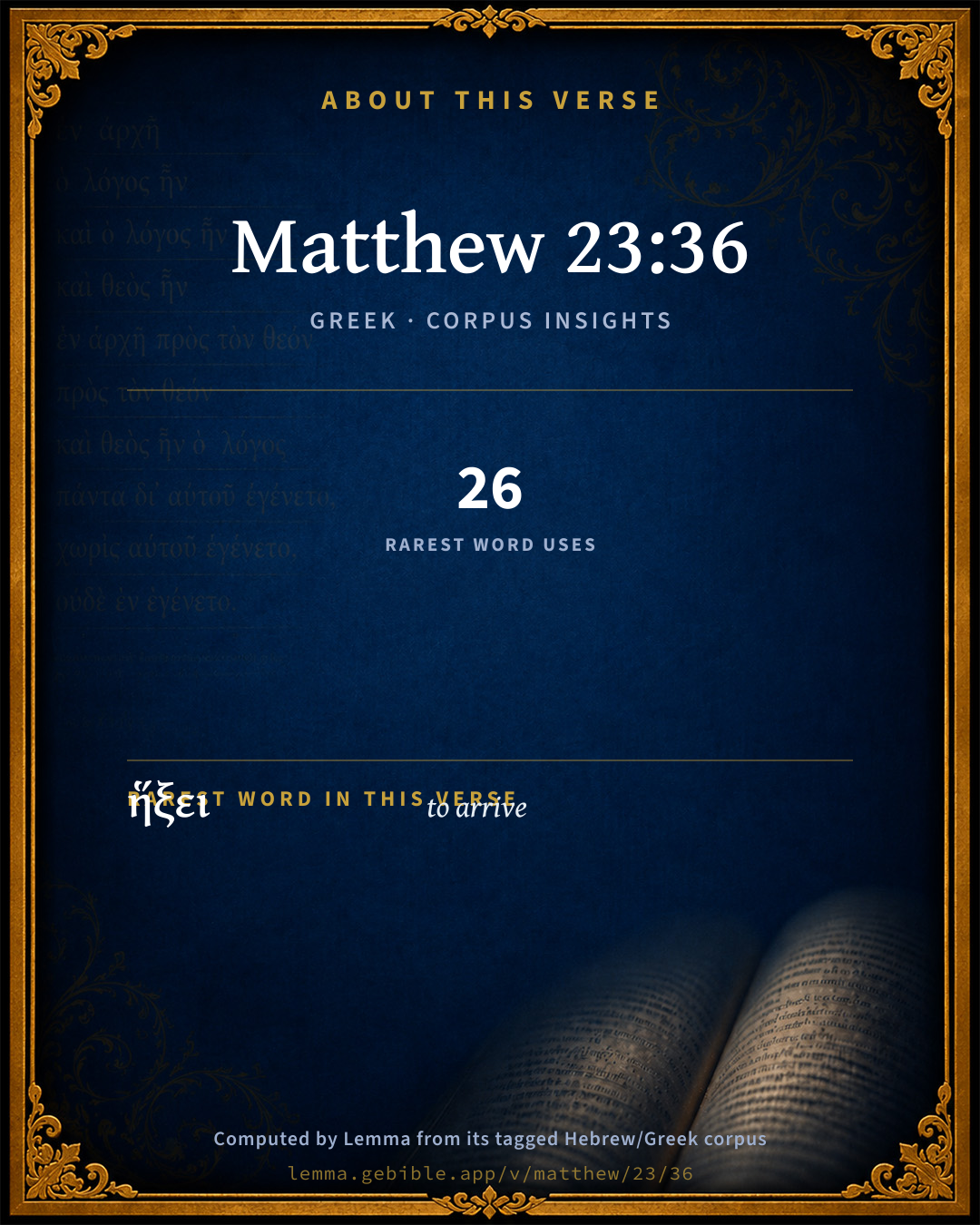
Matthew 23:36

Greek (Tischendorf 8th ed.) Matthew 23:36 appears in the Greek New Testament. The text above is from the Tischendorf 8th edition. Each word links to its Strong’s number and a concise gloss. Click any word for its full Thayer’s Greek Lexicon entry.
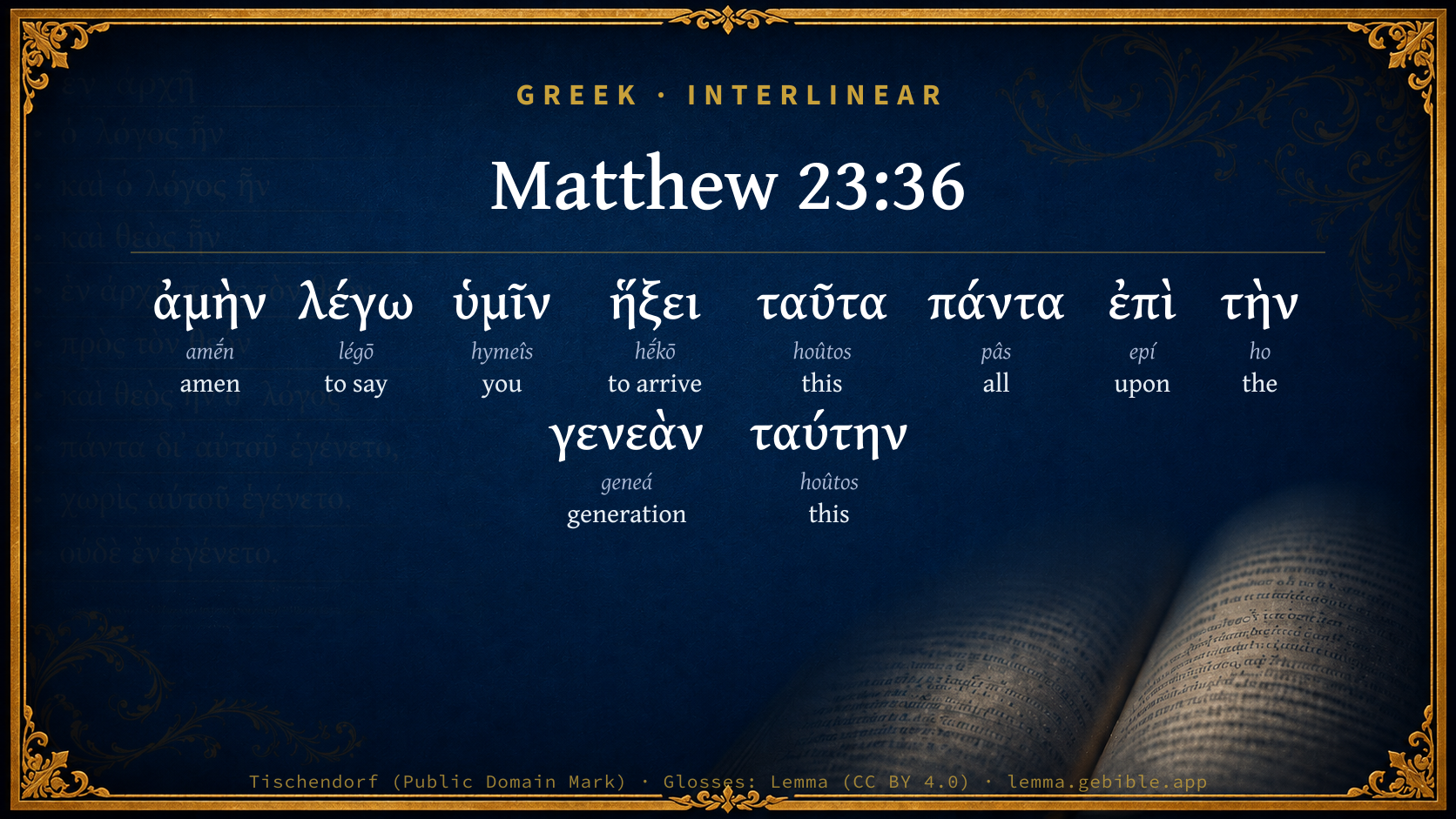
Download image
Cite this verse

Matthew 23:36 (World English Bible). Public Domain. Lemma interlinear Bible study tool, https://lemma.gebible.app/v/matthew/23/36.

Show BibTeX & RIS
BibTeX
RIS
English Translation
Most assuredly I tell you, all these things will come upon this generation.
World English Bible · Public Domain
Download a study sheet

One document with this verse’s original text, its word-by-word gloss line, the meaning frame, cross-references with their text, attributed commentary, and full source and license credits — printable, and it pastes into notes with its structure intact.

This verse Autodidact and up

Study sheet (.html) Plain text (.txt)

A passage Seminary Student

Up to 50 verses in one chapter. A passage sheet keeps up to 6 commentary sources and 12 cross-references per verse, in the order this page ranks them, and says so on the sheet whenever that leaves anything out. Ask for a single verse and you get the Autodidact verse sheet above.

Everything on this page stays free to read, with no account — the sheet is a download of what is already on screen, not access to it.

Want to remove ads? Support Godless Engineer
Compare translations 3

The same verse in 3 English versions, stacked beneath the original-language interlinear above. Click any original word for its lexicon entry.

Each is an independent rendering of the whole verse — the interlinear is not word-aligned to these translations.

Highlighted words mark where these versions differ — a whole-verse word diff, not a word-by-word alignment.

  • World English Bible Public Domain
    Most assuredly I tell you, all these things will come upon this generation.
  • King James Version Public Domain
    Verily I say unto you, All these things shall come upon this generation.
  • unfoldingWord Literal Text CC BY-SA 4.0
    Truly I say to you, all these things will come upon this generation.

unfoldingWord Literal Text — © unfoldingWord, licensed CC BY-SA 4.0. Word-aligned USFM3 via Door43 (git.door43.org/unfoldingWord/en_ult).

Versions to compare (up to 4)

3 of 4 selected

Show all 19 translations

Every available English version of this verse, each an independent rendering of the whole verse.

  • World English Bible Public Domain
    Most assuredly I tell you, all these things will come upon this generation.
  • Berean Standard Bible Public Domain
    Truly I tell you, all these things will come upon this generation.
  • Majority Standard Bible Public Domain
    Truly I tell you, all these things will come upon this generation.
  • King James Version Public Domain
    Verily I say unto you, All these things shall come upon this generation.
  • American Standard Version (1901) Public Domain
    Verily I say unto you, All these things shall come upon this generation.
  • Revised Version (1885) Public Domain
    Verily I say unto you, All these things shall come upon this generation.
  • Geneva Bible (1599) Public Domain
    Verely I say vnto you, all these things shall come vpon this generation.
  • Douay-Rheims (1899) Public Domain
    Amen I say to you, all these things shall come upon this generation.
  • Young's Literal Translation Public Domain
    verily I say to you, all these things shall come upon this generation.
  • Literal Standard Version CC BY-SA 4.0
    truly I say to you, all these things will come on this generation.
  • Unlocked Literal Bible CC BY-SA 4.0
    Truly I say to you, all these things will come upon this generation.
  • unfoldingWord Literal Text CC BY-SA 4.0
    Truly I say to you, all these things will come upon this generation.
  • Darby Bible Public Domain
    Verily I say unto you, All these things shall come upon this generation.
  • World Messianic Bible Public Domain
    Most certainly I tell you, all these things will come upon this generation.
  • Webster's Bible Public Domain
    Verily I say to you, all these things shall come upon this generation.
  • Free Bible Version CC BY-SA 4.0
    I'm telling you, the consequences of all this will fall on this generation.
  • Bible in Basic English Public Domain
    Truly I say to you, All these things will come on this generation.
  • Text-Critical English NT CC BY 4.0
    Truly I say to you, all these things will come upon this generation.
  • Tyndale New Testament (1534) Public Domain
    Verely I say vnto you all these thinges shall light vpon this generacion.

Literal Standard Version (2020), Covenant Press — licensed CC BY-SA 4.0. Text via the HelloAO Bible API (eBible.org). Unlocked Literal Bible (unfoldingWord) — licensed CC BY-SA 4.0. Text via the HelloAO Bible API (eBible.org). unfoldingWord Literal Text — © unfoldingWord, licensed CC BY-SA 4.0. Word-aligned USFM3 via Door43 (git.door43.org/unfoldingWord/en_ult). Free Bible Version, Dr. Jonathan Gallagher — licensed CC BY-SA 4.0. Text via the HelloAO Bible API (eBible.org).

Word by word

More ways to search: Search by grammar → Find every occurrence → Compare this word →

Practice this passage: Drill this verse → Learn its vocabulary →

About this verse

These counts appear in no published source. They are computed here, from the morphology-tagged text and Lemma’s own curated glosses. What Lemma adds →

10
words
9
distinct lemmas
Gospels
section

Shared distinctive vocabulary

ἥξει to arrive G2240 occurs in 25 verses of the Greek New Testament. Also found in:

Repetition

A word recurs within this verse:

  • ταῦτα this G3778 ×2

Cross-references

5

Topical passages linked to Matthew 23:36 in the Treasury of Scripture Knowledge — connected by theme and wording, ordered by reader-vote popularity; previews shown in the World English Bible.

  • Matthew 10:23 But when they persecute you in this city, flee into the next, for most assuredly I tell you, you will not have gone through the cities of Israel, until the Son of Man has come.
  • Matthew 24:34 Most assuredly I tell you, this generation will not pass away, until all these things are accomplished.
  • Mark 13:30–31 Most assuredly I say to you, this generation will not pass away until all these things happen.
  • Luke 21:32–33 Most assuredly I tell you, this generation will not pass away until all things are accomplished.
  • Ezekiel 12:21–28 The word of Yahweh came to me, saying,

Cross-references courtesy of OpenBible.info (CC BY 4.0).

Commentary

Notes on Matthew 23:36 from classic Christian and Jewish commentators (each source and its license shown beneath its notes). The classic Christian expositions comment on the surrounding passage and are grouped to its opening verse, so a note may address several verses; the Jewish commentaries on the Tanakh (Rashi and others) are per-verse, so they appear only where the commentator wrote on this verse.

Lemma curates 59 commentaries, every one of them public domain or Creative Commons licensed, each selected and text-cleaned for this edition rather than reprinted as found. About our sources →

The Biblical Illustrator

Joseph S. Exell

Mat_23:29; Mat_23:33; Mat_23:36

How can ye escape the damnation of hell?

-

The difficulty of escaping the damnation of hell

I. What your situation actually is.

1. You are even now under sentence of condemnation.

2. You need to be awakened, no man will escape a danger he does not perceive.

3. In order to escape final condemnation you must pursue religion with perseverance.

II. The obstacles.

1. The effect of sin is to make men blind to their own sins.

2. The sinner often seeks deliverance in a way in which it cannot be obtained.

3. The unbelieving heart will not submit to God until its opposition be removed.

4. The fascinating power of worldly objects.

5. Then you say the difficulties are so great that you have not courage to make the attempt to escape. (E. Payson, D. D.)

Pretence vain

To pretend holiness when there is none is a vain thing. What were the foolish virgins better for their blazing lamps when they wanted oil? What is the lamp of profession without the oil of saving grace? What comfort will a show of holiness yield at last? Will painted gold enrich? Painted wine refresh him that is thirsty? Will painted holiness be a cordial at the hour of death? A pretence of sanctification is not to be rested in. Many ships have had the name of Hope, the Safeguard, the Triumph, yet have been cast away upon the rocks; so many who have had the name of saintship have been cast into hell. (T. Watson.)

Suspension and infliction of judgments

1. It is not right that God should punish one generation for the sins of another.

2. It is just that God should punish all generations for their own sins.

3. God might if He pleased pass by the sins of all generations; He might punish them hereafter, not here.

4. It is right that God should punish one generation and not another. He has always acted as a Sovereign in sparing or punishing particular generations. God delayed to destroy the Egyptians.

5. When God does spare one generation and punish another He always has some good reason for both sparing and punishing.

6. The sins of one generation may be a good reason why God should punish the sins of another.

7. It is criminal and foolish for one generation to imitate the sins of a former.

8. It is well for the present generation to discountenance open vices prevailing.

9. Sinners always are the troublers of the world. (N. Emmons, D. D.)

The Biblical Illustrator, edited by Joseph S. Exell (c. 1880s–1900s) — public domain. Text from a community e-Sword module.

Bengel's Gnomon

Johann Albrecht Bengel

Mat 23:36. Λέγω, I say) sc. again. Cf. Gen 41:32.—ἥξει, shall come) i.e. as far as the beginnings of vengeance are concerned; for its consummation extends far further; see Mat 23:39.—πάντα, κ.τ.λ., all, etc.) He who commits a sin becomes a partner in crime with all who have committed the same sin.—γενεὰν, generation) see Gnomon on ch. Mat 24:34.

Bengel's Gnomon of the New Testament — English translation (T&T Clark, Edinburgh, 1860) — public domain. Text from a community e-Sword module.

Meyer's Critical & Exegetical Commentary

Heinrich August Wilhelm Meyer

Mat_23:36. Ἥξει] Put first for sake of emphasis: shall come, shall inevitably come upon, etc. Comp. Mat_9:15, Mat_27:49.

πάντα ταῦτα] according to the context: all this shedding of blood, i.e. the punishment for it.

ἐπὶ τ. γενεὰν ταύτ.] See on Mat_11:16; upon this generation, which was destined to be overtaken by the destruction of Jerusalem and the judgments connected with the second coming (Mat_23:38 f.), comp. on Mat_24:34.

Meyer — Critical and Exegetical Commentary on the New Testament — English translation by Peter Christie, edited by Frederick Crombie (T&T Clark, 1880) — public domain. Text from a community e-Sword module.

Expositor's Greek Testament

ed. W. Robertson Nicoll

Mat 23:36 . ἀμὴν : solemn introduction of a statement terrible to think of: sins of countless generations accumulating for ages, and punished in a final representative generation; true, however terrible.

The Expositor's Greek Testament, edited by W. Robertson Nicoll (1897–1910) — public domain. Text from a community e-Sword module.

Jamieson, Fausset & Brown

Robert Jamieson, A. R. Fausset & David Brown

Verily I say unto you, All these things shall come upon this generation--As it was only in the last generation of them that "the iniquity of the Amorites was full" (Gen 15:16), and then the abominations of ages were at once completely and awfully avenged, so the iniquity of Israel was allowed to accumulate from age to age till in that generation it came to the full, and the whole collected vengeance of heaven broke at once over its devoted head. In the first French Revolution the same awful principle was exemplified, and Christendom has not done with it yet.

Lamentation over Jerusalem and Farewell to the Temple (Mat 23:37-39).

Jamieson, Fausset & Brown — Commentary Critical and Explanatory on the Whole Bible (1871) — public domain (CC PDM 1.0). Text via the HelloAO Bible API.

Adam Clarke's Commentary

Verse 36. Shall come upon this generation] επι την γενεαν ταυτην, upon this race of men, viz. the Jews. This phrase often occurs in this sense in the evangelists.

Adam Clarke's Commentary on the Bible (1810–1826) — public domain. Text from a community e-Sword/MySword module.

Ellicott's Commentary for English Readers

(36) All these things shall come upon this generation.—The words carry on the thought of the measure that is gradually being filled up. Men make the guilt of past ages their own, reproduce its atrocities, identify themselves with it; and so, what seems at first an arbitrary decree, visiting on the children the sins of the fathers, becomes in such cases a righteous judgment. If they repent, they cut off the terrible entail of sin and punishment; but if they harden themselves in their evil, they inherit the delayed punishment of their father’s sins as well as of their own.

A Bible Commentary for English Readers, edited by Charles John Ellicott (1878–1897) — public domain. Text from a community e-Sword module.

John Gill's Exposition

O Jerusalem, Jerusalem,.... The metropolis of Judea, the seat of the kings of Judah, yea, the city of the great king; the place of divine worship, once the holy and faithful city, the joy of the whole earth; wherefore it was strange that the following things should be said of it. The word is repeated to show our Lord's affection and concern for that city, as well as to upbraid it with its name, dignity, and privileges; and designs not the building of the city, but the inhabitants of it; and these not all, but the rulers and governors of it, civil and ecclesiastical; especially the great sanhedrim, which were held in it, to whom best belong the descriptive characters of killing the prophets, and stoning them that were sent by God unto them; since it belonged to them to take cognizance of such who called themselves prophets, and to examine, and judge them, and, if false, to condemn them (h); hence that saying of Christ, Luk 13:33 which goes before the same words, as here, "it cannot be that a prophet perish out of Jerusalem": and who are manifestly distinguished from their "children": it being usual to call such as were the heads of the people, either in a civil or ecclesiastic sense, "fathers", and their subjects and disciples, "children": besides, our Lord's discourse throughout the whole context is directed to the Scribes and Pharisees, the ecclesiastic guides of the people, and to whom the civil governors paid a special regard,

Thou that killest the prophets; that is, with the sword, with which the prophets in Elijah's time were slain by the children of Israel,

Kg1 19:10 and which was one of the capital punishments inflicted by the Jewish sanhedrim (i); and also that which follows was another of them,

And stonest them which were sent unto thee; as particularly Zechariah, the son of Jehoiada, before mentioned. The Jews themselves are obliged to own, that this character belongs to them: say (k) they,

"when the word of God shall come, who is his messenger, we will honour him. Says R. Saul, did not the prophets come,

"and we killed them", and shed their blood, and how shall we receive his word? or how shall we believe?

And a celebrated writer of their's, on those words (l), "but now murderers", has this note,

"they have killed Uriah, they have killed Zechariah.

How often would I have gathered thy children together, as a hen gathereth her chickens under her wings, and ye would not! Christ here speaks as a man, and the minister of the circumcision, and expresses an human affection for the inhabitants of Jerusalem, and an human wish, and will for their temporal good; which he very aptly signifies by the hen, which is a very affectionate creature to its young, and which it endeavours to screen from danger, by covering with its wings. So the "Shekinah" with the Jews is called, , "the holy bird" (m); and that phrase, , "to betake one's self, or to come to trust under the wings of the Shekinah", is often used (n) for to become a proselyte to the true religion, and worship of God, as Jethro, and Ruth the Moabitess did. An expression much like to this here is used by an apocryphal writer of 2 Esdras:

"I gathered you together, as a hen gathereth her chickens under her wings: but now, what shall I do unto you? I will cast you out from my face.'' (2 Esdras 1:30).

It seems to be a simile much in use with that people. Our Lord is to be understood not of his divine will, as God, to gather the people of the Jews internally, by his Spirit and grace, to himself; for all those whom Christ would gather, in this sense, were gathered, notwithstanding all the opposition made by the rulers of the people; but of his human affection and will, as a man, and a minister, to gather them to him externally, by, and under the ministry of his word, to hear him preach; so as that they might be brought to a conviction of, and an assent unto him as the Messiah; which, though it might fall short of faith in him, would have been sufficient to have preserved them from temporal ruin, threatened to their city and temple, in the following verse. Instances of the human affection, and will of Christ, may be observed in Mar 10:21 which will of his, though not contrary to the divine will, but subordinate to it, yet not always the same with it, nor always fulfilled: whereas his divine will, or his will as God, is, always fulfilled: "who hath resisted his will?" this cannot be hindered, and made void; he does whatsoever he pleases: and further, that this will of Christ to gather the Jews to himself, is to be understood of his human, and not divine will, is manifest from hence, that this will was in him, and expressed by him at certain several times, by intervals; and therefore he says, "how often would I have gathered", &c. whereas the divine will is one continued, invariable, and unchangeable will, is always the same, and never begins or ceases to be, and to which such an expression is inapplicable; and therefore these words do not contradict the absolute and sovereign will of God, in the distinguishing acts of it, respecting the choice of some persons, and the leaving of others. And it is to be observed, that the persons whom Christ would have gathered, are not represented as being unwilling to be gathered; but their rulers were not willing that they should, and be made proselytes to him, and come under his wings. It is not said, "how often would I have gathered you, and you would not!" nor, "I would have gathered Jerusalem, and she would not"; nor, "I would have gathered thy children, and they would not"; but, "how often would I have gathered thy children, and ye would not!" Which observation alone is sufficient to destroy the argument founded on this passage in favour of free will. Had Christ expressed his desire to have gathered the heads of the people to him, the members of the Jewish sanhedrim, the civil and ecclesiastical rulers of the Jews: or had he signified how much he wished, and earnestly sought after, and attempted to gather Jerusalem, the children, the inhabitants of it in common, and neither of them would not; it would have carried some appearance of the doctrine of free will, and have seemed to have countenanced it, and have imputed the non-gathering of them to their own will: though had it been said, "they would not", instead of, "ye would not", it would only have furnished out a most sad instance of the perverseness of the will of man, which often opposes his temporal, as well as his spiritual good; and would rather show it to be a slave to that which is evil, than free to that which is good; and would be a proof of this, not in a single person only, but in a body of men. The opposition and resistance to the will of Christ were not made by the people, but by their governors. The common people seemed inclined to attend his ministry, as appears from the vast crowds, which, at different times and places, followed him; but the chief priests, and rulers, did all they could to hinder the collection of them to him, and their belief in him as the Messiah; by traducing his character, miracles, and doctrines, and by menacing the people with curses, and excommunications, making a law, that whoever confessed him should be turned out of the synagogue. So that the plain meaning of the text is the same with that of Mat 23:13 and consequently is no proof of men's resisting the operations of the Spirit and grace of God; but only shows what obstructions and discouragements were thrown in the way of attendance on the external ministry of the word. In order to set aside, and overthrow the doctrine of grace, in election, and particular redemption, and effectual calling, it should be proved that Christ, as God, would have gathered, not Jerusalem, and the inhabitants of it only, but all mankind, even such as are not eventually saved, and that in a spiritual, saving way and manner, to himself; of which there is not the least intimation in this text: and in order to establish the resistibility of the grace of God, by the perverse will of man, so as to become of no effect; it should be shown that Christ would have savingly converted persons, and they would not be converted; and that he bestowed the same grace upon them, he does bestow on others, who are converted: whereas the sum of this passage lies in these few words, that Christ, as man, out of a compassionate regard for the people of the Jews, to whom, he was sent as the minister of the circumcision, would have gathered them together under his ministry, and have instructed them in the knowledge of himself, as the Messiah; which if they had only notionally received, would have secured them, as chickens under the hen, from impending judgments, which afterwards fell upon them; but their governors, and not they, would not; that is, would not suffer them to receive him, and embrace him as the Messiah. So that from the whole it appears, that this passage of Scripture, so much talked of by the Arminians, and so often cited by them, has nothing to do with the controversy about the doctrines of election and reprobation, particular redemption, efficacious grace in conversion, and the power of man's free will. This observation alone is sufficient to destroy the argument founded on this passage, in favour of free will,

(h) Misn. Sanhedrin, c. 1. sect. 5. (i) lb. c. 7. sect. 1. (k) R. Isaac Arama in Gen. xlvii. apud Galatin. Arcan. Cath. ver. l. 3. c. 5. (l) Jarchi in Isa. i. 21. (m) Zohar in Numb. fol. 106. 3. & Imre binah in ib. (n) Tzeror Hammor, fol. 77. 4. &. 115. 2. Vid. Targum in Ruth ii. 12. Zohar in Exod. fol. 28. 3. & 29. 2.

John Gill's Exposition of the Whole Bible (1746–1763) — public domain (CC PDM 1.0). Text via the HelloAO Bible API.

Trapp's Complete Commentary

John Trapp

36 Verily I say unto you, All these things shall come upon this generation.

Ver. 36. Shall come upon this generation] In that last desolation of Jerusalem, whereof more in the next Mt. God will not fail to punish persecutors. (See Acts and Mon. of the Church, fol. 1902 to 1950.) Good for them therefore is the counsel that Tertullian gave Scapula, a bloody persecutor, If thou wilt not spare us, yet spare thyself; if not thyself, yet thy city Carthage. Si nobis non parcis, tibi parce; si non tibi, Carthagini.

John Trapp, A Commentary or Exposition upon All the Books of the Old and New Testament (1647–1656) — public domain. Text from a community e-Sword module.

Albert Barnes' Notes on the Bible

Upon this generation - The destruction of Jerusalem took place about forty years after this was spoken. See the next chapter.

Albert Barnes' Notes on the Bible (1834–1885) — public domain. Text from a community e-Sword/MySword module.

Haydock's Catholic Bible Commentary

Amen, I say to you. More severe punishments were inflicted on these Jews, on account of their more grievous and heinous transgressions; for nothing had been able to recall them from their wickedness. They had the example of their ancestors before their eyes, continually irritating the wrath of God; yet all they had suffered for their crimes, could not incite them to leave their sinful ways; but they proceeded further than their ancestors in impiety, and ought therefore to receive a more severe condemnation. Thus though Lamech had not killed a brother, but had neglected to be more prudent after the exemplary punishment of Cain, he still cried out: Seven-fold punishment is taken of Cain, but of Lemech seventy times seven. (Genesis iv.) (St. John Chrysostom, hom. lxxiii.)

George Leo Haydock (1774–1849), Haydock's Catholic Family Bible and Commentary, 1859 edition — public domain. Excludes Psalms (Douay-Rheims chapter numbering differs from Protestant) and Deuterocanonical books (Catholic canon only).

Whedon's Commentary on the Bible

Daniel D. Whedon

36. All… upon this generation — And yet, had they repented, had this generation turned to him, their Saviour, they might every man have been redeemed, whether or not their nation could have been saved from its national ruin. This is shown in the pathetic declaration of the following verse.

Daniel D. Whedon (gen. ed.), Commentary on the Old and New Testaments (1874–1909) — public domain. Text from a community e-Sword module.

The Pulpit Commentary

And these things. All the crimes committed by their forefathers shall be visited upon this generation by the destruction of the Jewish city and polity, which took place within forty years from this time. The blood of the past was required from the Jews of the present time, because they and their evil ancestors were of one family, and were to be dealt with as a whole. In spite of the teaching of history and example, in spite of the warnings of Christ and his apostles, they were bent on repeating the acts of their forefathers, and that in an aggravated form and against increased light and knowledge. The punishment here announced is the temporal award. Christ here says nothing of the final judgment.

The Pulpit Commentary (1880–1919), ed. H.D.M. Spence-Jones & Joseph S. Exell — public domain. Text from a community e-Sword module.

Scofield Reference Notes

C. I. Scofield

come upon

See, Rev 18:21-24. It is the way also of history; judgment falls upon one generation for the sins of centuries. The pediction was fulfilled in the destruction of Jerusalem, A.D. 70.

The Scofield Reference Bible (1917 edition), notes by C. I. Scofield — public domain. Text from a community e-Sword module.

The People's New Testament

B. W. Johnson

36. Verily, I say unto you, All these things shall come upon this generation. As the Amorites were spared until “their iniquity was full” (Gen. 15:16), so the iniquity of Israel was allowed to accumulate from age to age, till in that generation it came to the full, and the collected vengeance of justice broke at once upon it. So it is often in the destruction of a nation. The French Revolution of 1793 is another example.

B. W. Johnson's The People's New Testament with Notes (1889–1891) — public domain. Electronic text from the Christian Classics Ethereal Library (CCEL) ThML edition.

International Critical Commentary

36. Verily I say to you, All these things shall come upon this generation.] Luk 11:51 has: “Yea, I say to you, it shall be required from this generation.”

(L)

International Critical Commentary — older volumes (1896–1929), various authors — public domain. Text from a community e-Sword module.

Lesson kit

Teaching starters — assembled from the data on this page, not authored interpretation. Every prompt links to the verse data it draws on. Edit before teaching.

Matthew, in the Gospels, opens this verse with 10 words (9 distinct Greek lemmas). Its most distinctive word is hḗkō (“to arrive”). A historical commentator’s framing appears above. Read the whole chapter for the surrounding context.

Discussion questions

  1. The word hḗkō carries the sense “to arrive.” How does it shape the verse?
  2. Matthew 8:11 shares the word «to arrive» with this verse. How do the two illuminate each other?
  3. “this” occurs 2× in this one verse. What is the effect of the repetition?
  4. These translations render this verse differently. What is at stake in choosing one wording over another?
  5. Reading how The Biblical Illustrator and Bengel's Gnomon read this verse, where do the two commentators agree and where do they part?

Things to notice

  • These translations choose different wording for 8 words in this verse.
  • “this” occurs 2× in this single verse.
  • 9 distinct Greek lemmas span 10 words in this verse.

Reading settings

Reading text

Shown beneath each verse's original-language words.

Old Testament
Old Testament edition

Read the OT as the Masoretic Hebrew (MT) or the Greek Septuagint (LXX).

English shown for the Greek Septuagint (in the Hebrew ↔ Greek comparison).

Comparing translations? Open the Compare panel on any verse page to stack up to four side by side.