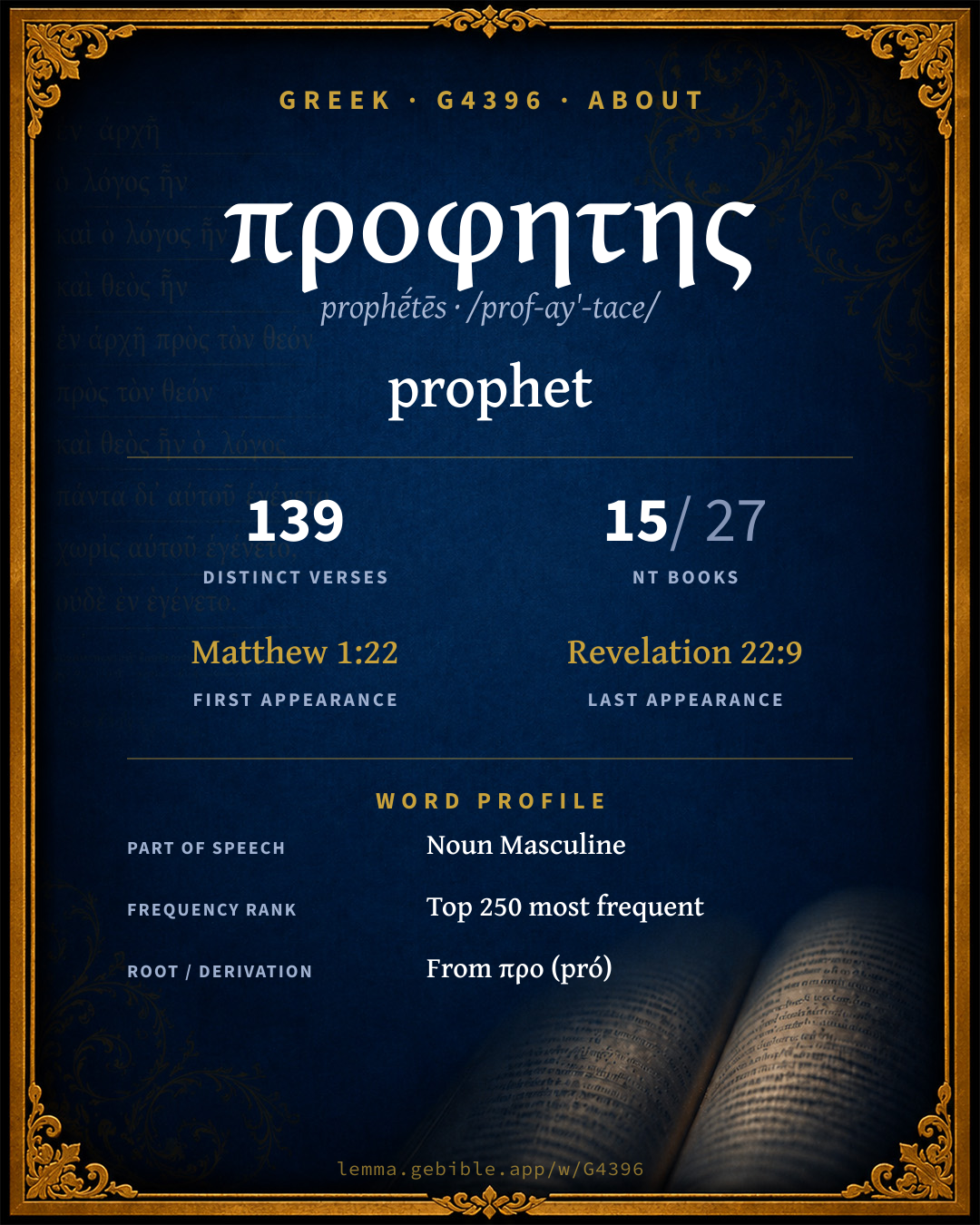
προφήτης
prophet
‘prophet’ is one of 3 main senses fuller range ↓
Full lexicon entry — Thayer's Greek Lexicon
From Thayer's Greek Lexicon
Where this word appears
See every Genitive-case word in the Greek New Testament →
Grammar key — what these labels mean
Part of speech
- Noun
- A naming word — a person, place, thing, or idea.
Case
- Genitive
- The case of source, possession, or “of” — answers “whose / from what.”
- Nominative
- The case of the subject (and the predicate nominative).
- Accusative
- The case of the direct object and of extent.
- Dative
- The case of the indirect object, means, or location — “to / for / with / in.”
Gender
- Masculine
- Grammatically masculine.
Number
- Plural
- More than one.
- Singular
- One.
Grammatical forms
- Noun, Genitive, Plural, Masculine 32 times (22%)
- Noun, Nominative, Singular, Masculine 28 times (19%)
- Noun, Genitive, Singular, Masculine 26 times (18%)
- Noun, Nominative, Plural, Masculine 21 times (14%)
- Noun, Accusative, Plural, Masculine 15 times (10%)
- Noun, Accusative, Singular, Masculine 12 times (8%)
- Noun, Dative, Plural, Masculine 10 times (7%)
- Noun, Dative, Singular, Masculine 1 time (1%)
Parsed forms decoded from the imported morphology (Robinson–Tischendorf, public domain), counted across 145 parsed occurrences — not distinct verses.
Every verse where G4396 appears — 139 distinct verses across 15 books. Click any verse to open its interlinear word-by-word view. Verse text shown in the World English Bible for context — . Each verse’s Greek form is shown with its reference; the English is not keyword-highlighted, since the data carries no word-level English alignment. Use “Compare translations” on any verse to read it across multiple English versions. This concordance covers the Greek New Testament; Septuagint (Greek Old Testament) occurrences of this word are not indexed here.
Matthew 34 verses
- Matthew 1:22 προφήτου n gen sg masc Now all this has happened, that it might be fulfilled which was spoken by the Lord through the prophet, saying,
- Matthew 2:5 προφήτου n gen sg masc They said to him, "In Bethlehem of Judea, for thus it is written through the prophet,
- Matthew 2:15 προφήτου n gen sg masc and was there until the death of Herod; that it might be fulfilled which was spoken by the Lord through the prophet, saying, "Out of Egypt I called my son."
- Matthew 2:17 προφήτου n gen sg masc Then that which was spoken by Jeremiah the prophet was fulfilled, saying,
- Matthew 2:23 προφητῶν n gen pl masc and came and lived in a city called Nazareth; that it might be fulfilled which was spoken through the prophets: "He will be called a Nazarene."
- Matthew 3:3 προφήτου n gen sg masc For this is he who was spoken of by Isaiah the prophet, saying, "The voice of one crying in the wilderness, Make ready the way of the Lord, Make his paths straight."
- Matthew 4:14 προφήτου n gen sg masc that it might be fulfilled which was spoken through Isaiah the prophet, saying,
- Matthew 5:12 προφήτας n acc pl masc Rejoice, and be exceedingly glad, for great is your reward in heaven. For that is how they persecuted the prophets who were before you.
- Matthew 5:17 προφήτας n acc pl masc "Don't think that I came to destroy the law or the prophets. I didn't come to destroy, but to fulfill.
- Matthew 7:12 προφῆται n nom pl masc Therefore whatever you desire for men to do to you, you shall also do to them; for this is the law and the prophets.
- Matthew 8:17 προφήτου n gen sg masc that it might be fulfilled which was spoken through Isaiah the prophet, saying: "He took our infirmities, and bore our diseases."
- Matthew 10:41 προφήτην προφήτου προφήτου n acc sg masc n gen sg masc n gen sg masc He who receives a prophet in the name of a prophet will receive a prophet's reward: and he who receives a righteous man in the name of a righteous man will receive a righteous man's reward.
- Matthew 11:9 προφήτην προφήτου n acc sg masc n gen sg masc But why did you go out? To see a prophet? Yes, I tell you, and much more than a prophet.
- Matthew 11:13 προφῆται n nom pl masc For all the prophets and the law prophesied until John.
- Matthew 12:17 προφήτου n gen sg masc that it might be fulfilled which was spoken through Isaiah the prophet, saying,
- Matthew 12:39 προφήτου n gen sg masc But he answered them, "An evil and adulterous generation seeks after a sign, but no sign will be given it but the sign of Jonah the prophet.
- Matthew 13:17 προφῆται n nom pl masc For most assuredly I tell you that many prophets and righteous men desired to see the things which you see, and didn't see them; and to hear the things which you hear, and didn't hear them.
- Matthew 13:35 προφήτου n gen sg masc that it might be fulfilled which was spoken through the prophet, saying, "I will open my mouth in parables; I will utter things hidden from the foundation of the world."
- Matthew 13:57 προφήτης n nom sg masc They were offended by him. But Jesus said to them, "A prophet is not without honor, except in his own country, and in his own house."
- Matthew 14:5 προφήτην n acc sg masc When he would have put him to death, he feared the multitude, because they counted him as a prophet.
- Matthew 16:14 προφητῶν n gen pl masc They said, "Some say John the Baptizer, some, Elijah, and others, Jeremiah, or one of the prophets."
- Matthew 21:4 προφήτου n gen sg masc All this was done, that it might be fulfilled which was spoken through the prophet, saying,
- Matthew 21:11 προφήτης n nom sg masc The multitudes said, "This is the prophet, Jesus, from Nazareth of Galilee."
- Matthew 21:26 προφήτην n acc sg masc But if we say, 'From men,' we fear the multitude, for all hold John as a prophet."
- Matthew 21:46 προφήτην n acc sg masc When they sought to seize him, they feared the multitudes, because they considered him to be a prophet.
- Matthew 22:40 προφῆται n nom pl masc The whole law and the prophets depend on these two commandments."
- Matthew 23:29 προφητῶν n gen pl masc "Woe to you, scribes and Pharisees, hypocrites! For you build the tombs of the prophets, and decorate the tombs of the righteous,
- Matthew 23:30 προφητῶν n gen pl masc and say, 'If we had lived in the days of our fathers, we wouldn't have been partakers with them in the blood of the prophets.'
- Matthew 23:31 προφήτας n acc pl masc Therefore you testify to yourselves that you are children of those who killed the prophets.
- Matthew 23:34 προφήτας n acc pl masc Therefore, behold, I send to you prophets, wise men, and scribes. Some of them you will kill and crucify; and some of them you will scourge in your synagogues, and persecute from city to city;
- Matthew 23:37 προφήτας n acc pl masc "Jerusalem, Jerusalem, who kills the prophets, and stones those who are sent to her! How often would I have gathered your children together, even as a hen gathers her chickens under her wings, and you would not!
- Matthew 24:15 προφήτου n gen sg masc "When, therefore, you see the abomination of desolation, which was spoken of through Daniel the prophet, standing in the holy place (let the reader understand),
- Matthew 26:56 προφητῶν n gen pl masc But all this has happened, that the Scriptures of the prophets might be fulfilled." Then all the disciples left him, and fled.
- Matthew 27:9 προφήτου n gen sg masc Then that which was spoken through Jeremiah the prophet was fulfilled, saying, "They took the thirty pieces of silver, The price of him upon whom a price had been set, Whom some of the children of Israel priced,
Mark 5 verses
- Mark 1:2 προφήτῃ n dat sg masc As it is written in the prophets, "Behold, I send my messenger before your face, Who will prepare your way before you.
- Mark 6:4 προφήτης n nom sg masc Jesus said to them, "A prophet is not without honor, except in his own country, and among his own relatives, and in his own house."
- Mark 6:15 προφήτης προφητῶν n nom sg masc n gen pl masc But others said, "It is Elijah." Others said, "It is the Prophet, or like one of the prophets."
- Mark 8:28 προφητῶν n gen pl masc They told him, "John the Baptizer, and others say Elijah, but others: one of the prophets."
- Mark 11:32 προφήτης n nom sg masc If we should say, 'From men'"--they feared the people, for all held John to really be a prophet.
Luke 29 verses
- Luke 1:70 προφητῶν n gen pl masc (As he spoke by the mouth of his holy prophets who have been from of old),
- Luke 1:76 προφήτης n nom sg masc And you, child, will be called a prophet of the Most High, For you will go before the face of the Lord to make ready his ways,
- Luke 3:4 προφήτου n gen sg masc As it is written in the book of the words of Isaiah the prophet, "The voice of one crying in the wilderness, 'Make ready the way of the Lord. Make his paths straight.
- Luke 4:17 προφήτου n gen sg masc The book of the prophet Isaiah was handed to him. He opened the book, and found the place where it was written,
- Luke 4:24 προφήτης n nom sg masc He said, "Most assuredly I tell you, no prophet is acceptable in his hometown.
- Luke 4:27 προφήτου n gen sg masc There were many lepers in Israel in the time of Elisha the prophet, yet not one of them was cleansed, except Naaman, the Syrian."
- Luke 6:23 προφήταις n dat pl masc Rejoice in that day, and leap for joy, for behold, your reward is great in heaven, for their fathers did the same thing to the prophets.
- Luke 7:16 προφήτης n nom sg masc Fear took hold of all, and they glorified God, saying, "A great prophet has arisen among us!" and, "God has visited his people!"
- Luke 7:26 προφήτην προφήτου n acc sg masc n gen sg masc But what did you go out to see? A prophet? Yes, I tell you, and much more than a prophet.
- Luke 7:28 προφήτης n nom sg masc "For I tell you, among those who are born of women there is not a greater prophet than John the Baptizer, yet he who is least in the Kingdom of God is greater than he."
- Luke 7:39 προφήτης n nom sg masc Now when the Pharisee who had invited him saw it, he said to himself, "This man, if he were a prophet, would have perceived who and what kind of woman this is who touches him, that she is a sinner."
- Luke 9:8 προφήτης n nom sg masc and by some that Elijah had appeared, and by others that one of the old prophets had risen again.
- Luke 9:19 προφήτης n nom sg masc They answered, "'John the Baptizer,' but others say, 'Elijah,' and others, that one of the old prophets is risen again."
- Luke 10:24 προφῆται n nom pl masc for I tell you that many prophets and kings desired to see the things which you see, and didn't see them, and to hear the things which you hear, and didn't hear them."
- Luke 11:47 προφητῶν n gen pl masc Woe to you! For you build the tombs of the prophets, and your fathers killed them.
- Luke 11:49 προφήτας n acc pl masc Therefore also the wisdom of God said, 'I will send to them prophets and apostles; and some of them they will kill and persecute,
- Luke 11:50 προφητῶν n gen pl masc that the blood of all the prophets, which was shed from the foundation of the world, may be required of this generation;
- Luke 13:28 προφήτας n acc pl masc There will be weeping and gnashing of teeth, when you see Abraham, Isaac, Jacob, and all the prophets, in the Kingdom of God, and yourselves being thrown outside.
- Luke 13:33 προφήτην n acc sg masc Nevertheless I must go on my way today and tomorrow and the next day, for it can't be that a prophet perish outside of Jerusalem.'
- Luke 13:34 προφήτας n acc pl masc "Jerusalem, Jerusalem, that kills the prophets, and stones those who are sent to her! How often I wanted to gather your children together, like a hen gathers her own brood under her wings, and you refused!
- Luke 16:16 προφῆται n nom pl masc The law and the prophets were until John. From that time the Gospel of the Kingdom of God is preached, and everyone is forcing his way into it.
- Luke 16:29 προφήτας n acc pl masc "But Abraham said to him, 'They have Moses and the prophets. Let them listen to them.'
- Luke 16:31 προφητῶν n gen pl masc "He said to him, 'If they don't listen to Moses and the prophets, neither will they be persuaded if one rises from the dead.'"
- Luke 18:31 προφητῶν n gen pl masc He took the twelve aside, and said to them, "Behold, we are going up to Jerusalem, and all the things that are written through the prophets concerning the Son of Man will be completed.
- Luke 20:6 προφήτην n acc sg masc But if we say, 'From men,' all the people will stone us, for they are persuaded that John was a prophet."
- Luke 24:19 προφήτης n nom sg masc He said to them, "What things?" They said to him, "The things concerning Jesus, the Nazarene, who was a prophet mighty in deed and word before God and all the people;
- Luke 24:25 προφῆται n nom pl masc He said to them, "Foolish men, and slow of heart to believe in all that the prophets have spoken!
- Luke 24:27 προφητῶν n gen pl masc Beginning from Moses and from all the prophets, he explained to them in all the Scriptures the things concerning himself.
- Luke 24:44 προφήταις n dat pl masc He said to them, "This is what I told you, while I was still with you, that all things which are written in the law of Moses, the prophets, and the psalms, concerning me must be fulfilled."
John 14 verses
- John 1:21 προφήτης n nom sg masc They asked him, "What then? Are you Elijah?" He said, "I am not." "Are you the Prophet?" He answered, "No."
- John 1:23 προφήτης n nom sg masc He said, "I am the voice of one crying in the wilderness, 'Make straight the way of the Lord,' as Isaiah the prophet said."
- John 1:25 προφήτης n nom sg masc They asked him, "Why then do you baptize, if you are not the Christ, nor Elijah, nor the Prophet?"
- John 1:46 προφῆται n nom pl masc Nathanael said to him, "Can any good thing come out of Nazareth?" Philip said to him, "Come and see."
- John 4:19 προφήτης n nom sg masc The woman said to him, "Sir, I perceive that you are a prophet.
- John 4:44 προφήτης n nom sg masc For Jesus himself testified that a prophet has no honor in his own country.
- John 6:14 προφήτης n nom sg masc When therefore the people saw the sign which Jesus did, they said, "This is truly the prophet who comes into the world."
- John 6:45 προφήταις n dat pl masc It is written in the prophets, 'They will all be taught by God.' Therefore everyone who hears from the Father, and has learned, comes to me.
- John 7:40 προφήτης n nom sg masc Many of the multitude therefore, when they heard these words, said, "This is truly the prophet."
- John 7:52 προφήτης n nom sg masc They answered him, "Are you also from Galilee? Search, and see that no prophet has arisen out of Galilee."
- John 8:52 προφῆται n nom pl masc Then the Jews said to him, "Now we know that you have a demon. Abraham died, and the prophets; and you say, 'If a man keeps my word, he will never taste of death.'
- John 8:53 προφῆται n nom pl masc Are you greater than our father, Abraham, who died? The prophets died. Who do you make yourself out to be?"
- John 9:17 προφήτης n nom sg masc Therefore they asked the blind man again, "What do you say about him, because he opened your eyes?" He said, "He is a prophet."
- John 12:38 προφήτου n gen sg masc that the word of Isaiah the prophet might be fulfilled, which he spoke, "Lord, who has believed our report? To whom has the arm of the Lord been revealed?"
Acts 30 verses
- Acts 2:16 προφήτου n gen sg masc But this is what has been spoken through the prophet Joel:
- Acts 2:30 προφήτης n nom sg masc Therefore, being a prophet, and knowing that God had sworn with an oath to him that of the fruit of his body, according to the flesh, he would raise up the Christ to sit on his throne,
- Acts 3:18 προφητῶν n gen pl masc But the things which God announced by the mouth of all his prophets, that Christ should suffer, he thus fulfilled.
- Acts 3:21 προφητῶν n gen pl masc whom heaven must receive until the times of restoration of all things, which God spoke long ago by the mouth of his holy prophets.
- Acts 3:22 προφήτην n acc sg masc For Moses indeed said to the fathers, 'The Lord God will raise up a prophet for you from among your brothers, like me. You shall listen to him in all things whatever he says to you.
- Acts 3:23 προφήτου n gen sg masc It will be, that every soul that will not listen to that prophet will be utterly destroyed from among the people.'
- Acts 3:24 προφῆται n nom pl masc Yes, and all the prophets from Samuel and those who followed after, as many as have spoken, they also told of these days.
- Acts 3:25 προφητῶν n gen pl masc You are the children of the prophets, and of the covenant which God made with our fathers, saying to Abraham, 'In your seed will all the families of the earth be blessed.'
- Acts 7:37 προφήτην n acc sg masc This is that Moses, who said to the children of Israel, 'The Lord our God will raise up a prophet for you from among your brothers, like me.'
- Acts 7:42 προφητῶν n gen pl masc But God turned, and gave them up to serve the host of the sky, as it is written in the book of the prophets, 'Did you offer to me slain animals and sacrifices Forty years in the wilderness, O house of Israel?
- Acts 7:48 προφήτης n nom sg masc However, the Most High doesn't dwell in temples made with hands, as the prophet says,
- Acts 7:52 προφητῶν n gen pl masc Which of the prophets didn't your fathers persecute? They killed those who foretold the coming of the Righteous One, of whom you have now become betrayers and murderers.
- Acts 8:28 προφήτην n acc sg masc He was returning and sitting in his chariot, and was reading the prophet Isaiah.
- Acts 8:30 προφήτην n acc sg masc Philip ran to him, and heard him reading Isaiah the prophet, and said, "Do you understand what you are reading?"
- Acts 8:34 προφήτης n nom sg masc The eunuch answered Philip, "Who is the prophet talking about? About himself, or about someone else?"
- Acts 10:43 προφῆται n nom pl masc All the prophets testify about him, that through his name everyone who believes in him will receive remission of sins."
- Acts 11:27 προφῆται n nom pl masc Now in these days, prophets came down from Jerusalem to Antioch.
- Acts 13:1 προφῆται n nom pl masc Now in the assembly that was at Antioch there were some prophets and teachers: Barnabas, Simeon who was called Niger, Lucius of Cyrene, Manaen the foster-brother of Herod the tetrarch, and Saul.
- Acts 13:15 προφητῶν n gen pl masc After the reading of the law and the prophets, the rulers of the synagogue sent to them, saying, "Brothers, if you have any word of exhortation for the people, speak."
- Acts 13:20 προφήτου n gen sg masc After these things he gave them judges until Samuel the prophet.
- Acts 13:27 προφητῶν n gen pl masc For those who dwell in Jerusalem, and their rulers, because they didn't know him, nor the voices of the prophets which are read every Sabbath, fulfilled them by condemning him.
- Acts 13:40 προφήταις n dat pl masc Beware therefore, lest that come on you which is spoken in the prophets:
- Acts 15:15 προφητῶν n gen pl masc This agrees with the words of the prophets. As it is written,
- Acts 15:32 προφῆται n nom pl masc Judas and Silas, also being prophets themselves, encouraged the brothers with many words, and strengthened them.
- Acts 21:10 προφήτης n nom sg masc As we stayed there some days, a certain prophet named Agabus came down from Judea.
- Acts 24:14 προφήταις n dat pl masc But this I confess to you, that after the Way, which they call a sect, so I serve the God of our fathers, believing all things which are according to the law, and which are written in the prophets;
- Acts 26:22 προφῆται n nom pl masc Having therefore obtained the help that is from God, I stand to this day testifying both to small and great, saying nothing but what the prophets and Moses said would happen,
- Acts 26:27 προφήταις n dat pl masc King Agrippa, do you believe the prophets? I know that you believe."
- Acts 28:23 προφητῶν n gen pl masc When they had appointed him a day, many people came to him at his lodging. He explained to them, testifying about the Kingdom of God, and persuading them concerning Jesus, both from the law of Moses and from the prophets, from morning until evening.
- Acts 28:25 προφήτου n gen sg masc When they didn't agree among themselves, they departed after Paul had spoken one word, "The Holy Spirit spoke rightly through Isaiah, the prophet, to our fathers,
Romans 3 verses
- Romans 1:2 προφητῶν n gen pl masc which he promised before through his prophets in the holy Scriptures,
- Romans 3:21 προφητῶν n gen pl masc But now apart from the law, a righteousness of God has been revealed, being testified by the law and the prophets;
- Romans 11:3 προφήτας n acc pl masc "Lord, they have killed your prophets, they have broken down your altars; and I am left alone, and they seek my life."
1 Corinthians 5 verses
- 1 Corinthians 12:28 προφήτας n acc pl masc God has set some in the assembly: first apostles, second prophets, third teachers, then miracle workers, then gifts of healings, helps, governments, and various kinds of languages.
- 1 Corinthians 12:29 προφῆται n nom pl masc Are all apostles? Are all prophets? Are all teachers? Are all miracle workers?
- 1 Corinthians 14:29 προφῆται n nom pl masc Let the prophets speak, two or three, and let the others discern.
- 1 Corinthians 14:32 προφητῶν προφήταις n gen pl masc n dat pl masc The spirits of the prophets are subject to the prophets,
- 1 Corinthians 14:37 προφήτης n nom sg masc If any man thinks himself to be a prophet, or spiritual, let him recognize the things which I write to you, that they are the commandment of the Lord.
Ephesians 3 verses
- Ephesians 2:20 προφητῶν n gen pl masc being built on the foundation of the apostles and prophets, Christ Jesus himself being the chief cornerstone;
- Ephesians 3:5 προφήταις n dat pl masc which in other generations was not made known to the children of men, as it has now been revealed to his holy apostles and prophets in the Spirit;
- Ephesians 4:11 προφήτας n acc pl masc He gave some to be apostles; and some, prophets; and some, evangelists; and some, shepherds and teachers;
1 Thessalonians 1 verse
Titus 1 verse
Hebrews 2 verses
- Hebrews 1:1 προφήταις n dat pl masc God, having in the past spoken to the fathers through the prophets at many times and in various ways,
- Hebrews 11:32 προφητῶν n gen pl masc What more shall I say? For the time would fail me if I told of Gideon, Barak, Samson, Jephthah, David, Samuel, and the prophets;
James 1 verse
1 Peter 1 verse
2 Peter 2 verses
- 2 Peter 2:16 προφήτου n gen sg masc but he was rebuked for his own disobedience. A mute donkey spoke with man's voice and stopped the madness of the prophet.
- 2 Peter 3:2 προφητῶν n gen pl masc that you should remember the words which were spoken before by the holy prophets, and the commandments of us, the apostles of the Lord and Savior:
Revelation 8 verses
- Revelation 10:7 προφήτας n acc pl masc but in the days of the voice of the seventh angel, when he is about to sound, then the mystery of God is finished, as he declared to his servants, the prophets.
- Revelation 11:10 προφῆται n nom pl masc Those who dwell on the earth rejoice over them, and they will be glad. They will give gifts to one another, because these two prophets tormented those who dwell on the earth.
- Revelation 11:18 προφήταις n dat pl masc The nations were angry, and your wrath came, as did the time for the dead to be judged, and to give your bondservants the prophets, their reward, as well as to the saints, and those who fear your name, to the small and the great; and to destroy those who destroy the earth."
- Revelation 16:6 προφητῶν n gen pl masc For they poured out the blood of the saints and the prophets, and you have given them blood to drink. They deserve this."
- Revelation 18:20 προφῆται n nom pl masc Rejoice over her, O heaven, you saints, apostles, and prophets; for God has judged your judgment on her."
- Revelation 18:24 προφητῶν n gen pl masc In her was found the blood of prophets and of saints, and of all who have been slain on the earth."
- Revelation 22:6 προφητῶν n gen pl masc He said to me, "These words are faithful and true. The Lord God of the spirits of the prophets sent his angel to show to his bondservants the things which must happen soon."
- Revelation 22:9 προφητῶν n gen pl masc He said to me, "See you don't do it! I am a fellow bondservant with you and with your brothers, the prophets, and with those who keep the words of this book. Worship God."
About this entry
At a glance — auto-summarized from this page’s data, not written by a person. Every figure links to its source below. This summary describes the numbers; it doesn’t interpret them.
The Greek noun προφητης centers on the idea of “prophet.” Debuting at Matthew 1:22, it then recurs through the corpus. Spanning 139 verses in 15 books, it ranks among the common words of the Greek New Testament. Thayer's distinguishes 3 senses for it. Sharing its root, it stands alongside προ, πορρω and πρηνης. For the data behind this summary, explore the sense tree and the renderings breakdown below.
Gloss history
Strong's 1890 vs modern scholarship
About this word
Strong's G4396 catalogs a Greek word from the Greek New Testament.
These counts are not copied from any lexicon or concordance. They are computed here, from the morphology-tagged Greek New Testament. What Lemma adds →
- 139
- distinct verses
- The word appears in 139 distinct verses.
- 15 / 27
- NT books
- The word appears in 15 of 27 New Testament books.
- #112
- by frequency
- Top 250 most frequent Greek words (rank 112 of 5,347 Greek words by occurrence).
View all 139 occurrences in the concordance →
By section of the New Testament
By traditional corpus
Conventional, traditional groupings — biblical authorship is debated, so this is a traditional corpus grouping, not an authorship claim. Some books belong to more than one corpus (Luke is in both the Gospels and the Lukan corpus, and so on), so these shares overlap and need not total 100%. Each figure is a share of the word’s 139 distinct verses.
- Gospels 82 verses · 59%
- Lukan (Luke–Acts) 59 verses · 42%
- Johannine 22 verses · 16%
- Pauline corpus 13 verses · 9%
- Revelation 8 verses · 6%
- General (Catholic) Epistles 4 verses · 3%
- Hebrews 2 verses · 1%
How translations render this word
Counts come from each version’s own published word-to-Strong’s tagging or interlinear alignment — an approximate guide to how each version renders this word, not a word-level alignment the data otherwise carries. Because each total is that version’s own tagged count, the per-version totals vary from one another and need not match the appearance or distinct-verse counts above. These counts may also differ from a printed concordance because Lemma counts each distinctly tagged rendering and does not collapse phrase taggings into a single head-word total. This is a fixed set of word-tagged versions (KJV, ASV, BSB, ULT) and does not change with the reading translation you choose elsewhere. Each version’s license is shown beside its name below (and on Sources).
- King James Version: Prophets 80×, Prophet 65×, Than a prophet 2×
- American Standard Version: Prophets 76×, Prophet 62×, Of 2×
- Berean Standard Bible: Prophets 79×, Prophet 60×, Prophet’s 2×
- unfoldingWord Literal Text: Prophets 81×, Prophet 63×, Of 7×
King James Version Public Domain
Renders G4396 across 149 tagged occurrences — most commonly:
Plus 2 renderings that appear only once — usually multi-word phrases or single function words the recovered tagging swept in, not distinct renderings.
American Standard Version Public Domain
Renders G4396 across 145 tagged occurrences — most commonly:
Plus 3 renderings that appear only once — usually multi-word phrases or single function words the recovered tagging swept in, not distinct renderings.
Berean Standard Bible Public Domain
Renders G4396 across 143 tagged occurrences — most commonly:
Not rendered by a distinct English word in 1 further occurrence.
unfoldingWord Literal Text CC BY-SA 4.0
Renders G4396 across 156 tagged occurrences — most commonly:
Plus 1 rendering that appears only once — usually multi-word phrases or single function words the recovered tagging swept in, not distinct renderings.
Senses in Thayer's
The 3 senses Thayer's distinguishes for this word, in lexicon order (not ranked by frequency or importance). The full entry — with sub-senses — is in the Lexicon Entry tab.
- in Greek writings, an interpreter of oracles or of other hidden things
- one who…
- a poet (because poets were believed to sing under divine inspiration)
Word origin
Derived from προ (pró) (G4253) — before.
Forms in the corpus
The 8 distinct written forms G4396 takes in the Greek New Testament, most frequent first — each parse links to that case’s occurrences in the concordance.
| Form | Parsing | Example | Uses |
|---|---|---|---|
| προφητῶν prophētō̂n | Noun, Genitive, Plural, Masculine | Matthew 2:23 | 32 |
| προφήτης prophḗtēs | Noun, Nominative, Singular, Masculine | Matthew 13:57 | 28 |
| προφήτου prophḗtou | Noun, Genitive, Singular, Masculine | Matthew 1:22 | 26 |
| προφῆται prophē̂tai | Noun, Nominative, Plural, Masculine | Matthew 7:12 | 21 |
| προφήτας prophḗtas | Noun, Accusative, Plural, Masculine | Matthew 5:12 | 15 |
| προφήτην prophḗtēn | Noun, Accusative, Singular, Masculine | Matthew 10:41 | 12 |
| προφήταις prophḗtais | Noun, Dative, Plural, Masculine | Luke 6:23 | 10 |
| προφήτῃ prophḗtē | Noun, Dative, Singular, Masculine | Mark 1:2 | 1 |
Same root — word family
Other Thayer's entries built from the same root as G4396, grouped by Strong’s listed origin. These share a root / origin per the lexicon — not necessarily a shared meaning. Each links to that word’s own entry.
Derives from
Shares the same root
- πορρω pórrhō G4206 far
- πρηνης prēnḗs G4248 headlong
- πριν prín G4250 before
- προαγω proágō G4254 to lead forward
- προαιρεομαι proairéomai G4255 to choose before
- προαιτιαομαι proaitiáomai G4256 to charge previously
- προακουω proakoúō G4257 to hear before
- προαμαρτανω proamartánō G4258 to sin before
- προαυλιον proaúlion G4259 porch
- προβαινω probaínō G4260 to go forward
- προβαλλω probállō G4261 to throw forward
- προβιβαζω probibázō G4264 to drag forward
- προβλεπω problépō G4265 to foresee
- προγινομαι progínomai G4266 to come before
- προγινωσκω proginṓskō G4267 to foreknow
- προγραφω prográphō G4270 to write before
- προδηλος pródēlos G4271 manifest
- προδιδωμι prodídōmi G4272 to give before
- προειδω proeídō G4275 to foresee
- προελπιζω proelpízō G4276 to hope before
- προεπω proépō G4277 to say before
- προεναρχομαι proenárchomai G4278 to begin before
- προεπαγγελλομαι proepangéllomai G4279 to promise before
- προερεω proeréō G4280 to say before
+47 more words share this root (not shown).
Derived from this word
- προφητεια prophēteía G4394 prophecy
- προφητευω prophēteúō G4395 to prophesy
- προφητικος prophētikós G4397 prophetic
- προφητις prophētis G4398 prophetess
Proper names from this root
People and places named from this root — a name, not an additional meaning of the word.
Compare all same-root words → Showing 4 of 78 — not the complete family. 1 of the same-root words is a proper name (a person or place). They share a root, not necessarily a meaning.
Septuagint usage
The same Greek word προφητης appears 280 times in the Greek Old Testament (Septuagint), across 259 verses in 25 books.
- 280
- LXX occurrences
- Tagged occurrences of this Greek word in the Septuagint.
- 259
- verses
- Distinct Septuagint verses containing this word.
- 25 / 39
- OT books
- The word appears in 25 of the 39 Old Testament books.
Sample Septuagint occurrences
- Genesis 20:7 προφήτης
- Exodus 7:1 προφήτης
- Numbers 11:29 προφήτης
- Deuteronomy 13:2 προφήτης
- Judges 6:8 προφήτης
- 1 Samuel 3:20 προφήτης
- 2 Samuel 7:2 προφήτης
- 1 Kings 1:8 προφήτης
- 2 Kings 2:3 προφήτης
- 1 Chronicles 10:13 προφήτης
- 2 Chronicles 9:29 προφήτης
- Ezra 5:1 προφήτης
Septuagint occurrences (same lexeme)
Every verse where the same Strong’s number (G4396) appears in the Greek Septuagint — showing the first 50 of 259. Verse text shown in the World English Bible for context; the Greek form is the matched word — the English is not keyword-highlighted.
- Genesis 20:7 προφήτης Now therefore, restore the man's wife. For he is a prophet, and he will pray for you, and you will live. If you don't restore her, know for sure that you will die, you, and all who are yours."
- Exodus 7:1 προφήτης Yahweh said to Moses, "Behold, I have made you as God to Pharaoh; and Aaron your brother shall be your prophet.
- Numbers 11:29 προφήτης Moses said to him, Are you jealous for my sake? would that all Yahweh's people were prophets, that Yahweh would put his Spirit on them!
- Numbers 12:6 προφήτης He said, Hear now my words: if there be a prophet among you, I Yahweh will make myself known to him in a vision, I will speak with him in a dream.
- Deuteronomy 13:2 προφήτης and the sign or the wonder come to pass, of which he spoke to you, saying, Let us go after other gods, which you have not known, and let us serve them;
- Deuteronomy 13:4 προφήτης You shall walk after Yahweh your God, and fear him, and keep his commandments, and obey his voice, and you shall serve him, and cleave to him.
- Deuteronomy 13:6 προφήτης If your brother, the son of your mother, or your son, or your daughter, or the wife of your bosom, or your friend, who is as your own soul, entice you secretly, saying, Let us go and serve other gods, which you have not known, you, nor your fathers;
- Deuteronomy 18:15 προφήτης Yahweh your God will raise up to you a prophet from the midst of you, of your brothers, like me; to him you shall listen;
- Deuteronomy 18:18 προφήτης I will raise them up a prophet from among their brothers, like you; and I will put my words in his mouth, and he shall speak to them all that I shall command him.
- Deuteronomy 18:19 προφήτης It shall happen, that whoever will not listen to my words which he shall speak in my name, I will require it of him.
- Deuteronomy 18:20 προφήτης But the prophet, who shall speak a word presumptuously in my name, which I have not commanded him to speak, or who shall speak in the name of other gods, that same prophet shall die.
- Deuteronomy 18:22 προφήτης when a prophet speaks in the name of Yahweh, if the thing doesn't follow, nor happen, that is the thing which Yahweh has not spoken: the prophet has spoken it presumptuously, you shall not be afraid of him.
- Deuteronomy 34:10 προφήτης There has not arisen a prophet since in Israel like Moses, whom Yahweh knew face to face,
- Judges 6:8 προφήτης that Yahweh sent a prophet to the children of Israel: and he said to them, Thus says Yahweh, the God of Israel, I brought you up from Egypt, and brought you forth out of the house of bondage;
- 1 Samuel 3:20 προφήτης All Israel from Dan even to Beersheba knew that Samuel was established to be a prophet of Yahweh.
- 1 Samuel 3:21 προφήτης Yahweh appeared again in Shiloh; for Yahweh revealed himself to Samuel in Shiloh by the word of Yahweh.
- 1 Samuel 9:9 προφήτης (In earlier times in Israel, when a man went to inquire of God, thus he said, Come, and let us go to the seer; for he who is now called a Prophet was before called a Seer.)
- 1 Samuel 10:5 προφήτης After that you shall come to the hill of God, where is the garrison of the Philistines: and it shall happen, when you are come there to the city, that you shall meet a band of prophets coming down from the high place with a psaltery, and a tambourine, and a pipe, and a harp, before them; and they will be prophesying:
- 1 Samuel 10:10 προφήτης When they came there to the hill, behold, a band of prophets met him; and the Spirit of God came mightily on him, and he prophesied among them.
- 1 Samuel 10:11 προφήτης It happened, when all who knew him before saw that, behold, he prophesied with the prophets, then the people said one to another, What is this that is come to the son of Kish? Is Saul also among the prophets?
- 1 Samuel 10:12 προφήτης One of the same place answered, Who is their father? Therefore it became a proverb, Is Saul also among the prophets?
- 1 Samuel 19:20 προφήτης Saul sent messengers to take David: and when they saw the company of the prophets prophesying, and Samuel standing as head over them, the Spirit of God came on the messengers of Saul, and they also prophesied.
- 1 Samuel 19:24 προφήτης He also stripped off his clothes, and he also prophesied before Samuel, and lay down naked all that day and all that night. Therefore they say, "Is Saul also among the prophets?"
- 1 Samuel 22:5 προφήτης The prophet Gad said to David, Don't stay in the stronghold; depart, and get you into the land of Judah. Then David departed, and came into the forest of Hereth.
- 1 Samuel 28:6 προφήτης When Saul inquired of Yahweh, Yahweh didn't answer him, neither by dreams, nor by Urim, nor by prophets.
- 1 Samuel 28:15 προφήτης Samuel said to Saul, Why have you disquieted me, to bring me up? Saul answered, I am sore distressed; for the Philistines make war against me, and God is departed from me, and answers me no more, neither by prophets, nor by dreams: therefore I have called you, that you may make known to me what I shall do.
- 2 Samuel 7:2 προφήτης that the king said to Nathan the prophet, See now, I dwell in a house of cedar, but the ark of God dwells within curtains.
- 2 Samuel 12:1 προφήτης Yahweh sent Nathan to David. He came to him, and said to him, "There were two men in one city; the one rich, and the other poor.
- 2 Samuel 12:25 προφήτης and he sent by the hand of Nathan the prophet; and he named him Jedidiah, for Yahweh's sake.
- 2 Samuel 24:11 προφήτης When David rose up in the morning, the word of Yahweh came to the prophet Gad, David's seer, saying,
- 1 Kings 1:8 προφήτης But Zadok the priest, and Benaiah the son of Jehoiada, and Nathan the prophet, and Shimei, and Rei, and the mighty men who belonged to David, were not with Adonijah.
- 1 Kings 1:10 προφήτης but Nathan the prophet, and Benaiah, and the mighty men, and Solomon his brother, he didn't call.
- 1 Kings 1:22 προφήτης Behold, while she yet talked with the king, Nathan the prophet came in.
- 1 Kings 1:23 προφήτης They told the king, saying, Behold, Nathan the prophet. When he was come in before the king, he bowed himself before the king with his face to the ground.
- 1 Kings 1:32 προφήτης King David said, Call to me Zadok the priest, and Nathan the prophet, and Benaiah the son of Jehoiada. They came before the king.
- 1 Kings 1:34 προφήτης and let Zadok the priest and Nathan the prophet anoint him there king over Israel; and blow you the trumpet, and say, [Long] live king Solomon.
- 1 Kings 1:38 προφήτης So Zadok the priest, and Nathan the prophet, and Benaiah the son of Jehoiada, and the Cherethites and the Pelethites, went down, and caused Solomon to ride on king David's mule, and brought him to Gihon.
- 1 Kings 1:44 προφήτης and the king has sent with him Zadok the priest, and Nathan the prophet, and Benaiah the son of Jehoiada, and the Cherethites and the Pelethites; and they have caused him to ride on the king's mule;
- 1 Kings 1:45 προφήτης and Zadok the priest and Nathan the prophet have anointed him king in Gihon; and they are come up from there rejoicing, so that the city rang again. This is the noise that you have heard.
- 1 Kings 11:29 προφήτης It happened at that time, when Jeroboam went out of Jerusalem, that the prophet Ahijah the Shilonite found him in the way; now [Ahijah] had clad himself with a new garment; and they two were alone in the field.
- 1 Kings 13:11 προφήτης Now there lived an old prophet in Bethel; and one of his sons came and told him all the works that the man of God had done that day in Bethel: the words which he had spoken to the king, them also they told to their father.
- 1 Kings 13:18 προφήτης He said to him, I also am a prophet as you are; and an angel spoke to me by the word of Yahweh, saying, Bring him back with you into your house, that he may eat bread and drink water. [But] he lied to him.
- 1 Kings 13:20 προφήτης It happened, as they sat at the table, that the word of Yahweh came to the prophet who brought him back;
- 1 Kings 13:25 προφήτης Behold, men passed by, and saw the body cast in the way, and the lion standing by the body; and they came and told it in the city where the old prophet lived.
- 1 Kings 13:29 προφήτης The prophet took up the body of the man of God, and laid it on the donkey, and brought it back; and he came to the city of the old prophet, to mourn, and to bury him.
- 1 Kings 16:12 προφήτης Thus did Zimri destroy all the house of Baasha, according to the word of Yahweh, which he spoke against Baasha by Jehu the prophet,
- 1 Kings 17:1 προφήτης Elijah the Tishbite, who was of the foreigners of Gilead, said to Ahab, As Yahweh, the God of Israel, lives, before whom I stand, there shall not be dew nor rain these years, but according to my word.
- 1 Kings 18:4 προφήτης for it was so, when Jezebel cut off the prophets of Yahweh, that Obadiah took one hundred prophets, and hid them by fifty in a cave, and fed them with bread and water.)
- 1 Kings 18:13 προφήτης Wasn't it told my lord what I did when Jezebel killed the prophets of Yahweh, how I hid one hundred men of Yahweh's prophets by fifty in a cave, and fed them with bread and water?
- 1 Kings 18:19 προφήτης Now therefore send, and gather to me all Israel to Mount Carmel, and the prophets of Baal four hundred fifty, and the prophets of the Asherah four hundred, who eat at Jezebel's table.
These are occurrences of the same Greek lexeme (G4396) in the Septuagint — not a translation of any one Hebrew word. The store carries no word-level Hebrew↔Greek alignment, so no Hebrew original is asserted here. Counts come from the recovered LXX Strong's tagging — high-frequency vocabulary is well covered, while rare or late forms may be untagged — so they reflect tagged occurrences and may slightly undercount.