Acts 2:16

Greek (Tischendorf 8th ed.) Acts 2:16 appears in the Greek New Testament. The text above is from the Tischendorf 8th edition. Each word links to its Strong’s number and a concise gloss. Click any word for its full Thayer’s Greek Lexicon entry.
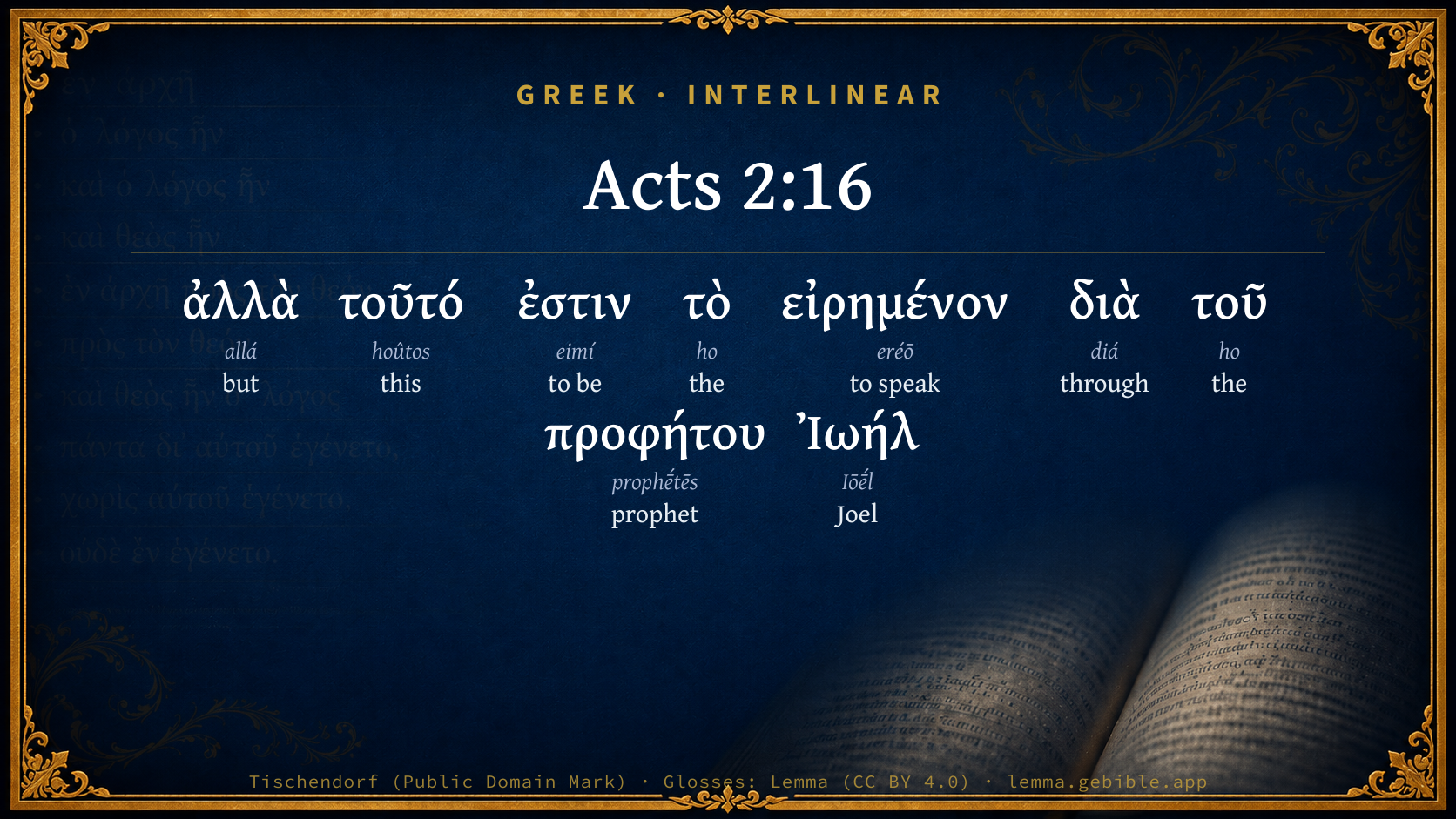
Download image
Cite this verse

Acts 2:16 (World English Bible). Public Domain. Lemma interlinear Bible study tool, https://lemma.gebible.app/v/acts/2/16.

Show BibTeX & RIS
BibTeX
RIS
English Translation
But this is what has been spoken through the prophet Joel:
World English Bible · Public Domain
Highlights
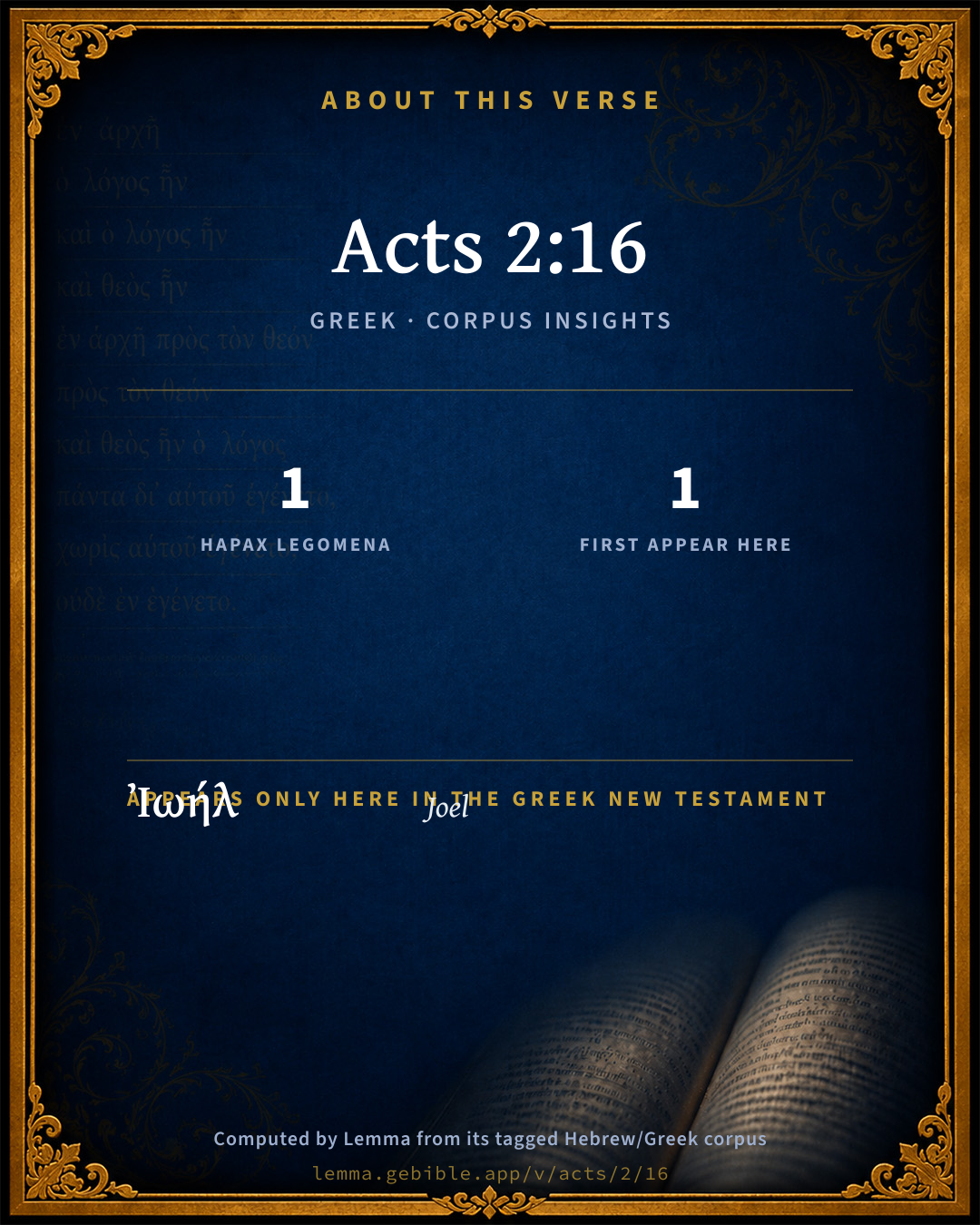
  • 1 hapax legomenon — only here in the Greek New Testament
  • 1 first appearance in the Greek New Testament
Full analysis ↓
Download a study sheet

One document with this verse’s original text, its word-by-word gloss line, the meaning frame, cross-references with their text, attributed commentary, and full source and license credits — printable, and it pastes into notes with its structure intact.

This verse Autodidact and up

Study sheet (.html) Plain text (.txt)

A passage Seminary Student

Up to 50 verses in one chapter. A passage sheet keeps up to 6 commentary sources and 12 cross-references per verse, in the order this page ranks them, and says so on the sheet whenever that leaves anything out. Ask for a single verse and you get the Autodidact verse sheet above.

Everything on this page stays free to read, with no account — the sheet is a download of what is already on screen, not access to it.

Want to remove ads? Support Godless Engineer
Compare translations 3

The same verse in 3 English versions, stacked beneath the original-language interlinear above. Click any original word for its lexicon entry.

Each is an independent rendering of the whole verse — the interlinear is not word-aligned to these translations.

Highlighted words mark where these versions differ — a whole-verse word diff, not a word-by-word alignment.

  • World English Bible Public Domain
    But this is what has been spoken through the prophet Joel:
  • King James Version Public Domain
    But this is that which was spoken by the prophet Joel;
  • unfoldingWord Literal Text CC BY-SA 4.0
    But this is what was spoken through the prophet Joel:

unfoldingWord Literal Text — © unfoldingWord, licensed CC BY-SA 4.0. Word-aligned USFM3 via Door43 (git.door43.org/unfoldingWord/en_ult).

Versions to compare (up to 4)

3 of 4 selected

Show all 19 translations

Every available English version of this verse, each an independent rendering of the whole verse.

  • World English Bible Public Domain
    But this is what has been spoken through the prophet Joel:
  • Berean Standard Bible Public Domain
    No, this is what was spoken by the prophet Joel:
  • Majority Standard Bible Public Domain
    No, this is what was spoken by the prophet Joel:
  • King James Version Public Domain
    But this is that which was spoken by the prophet Joel;
  • American Standard Version (1901) Public Domain
    but this is that which hath been spoken through the prophet Joel:
  • Revised Version (1885) Public Domain
    but this is that which hath been spoken by the prophet Joel;
  • Geneva Bible (1599) Public Domain
    But this is that, which was spoken by the Prophet Ioel,
  • Douay-Rheims (1899) Public Domain
    But this is that which was spoken of by the prophet Joel:
  • Young's Literal Translation Public Domain
    `But this is that which hath been spoken through the prophet Joel:
  • Literal Standard Version CC BY-SA 4.0
    But this is that which has been spoken through the prophet Joel:
  • Unlocked Literal Bible CC BY-SA 4.0
    But this is what was spoken through the prophet Joel:
  • unfoldingWord Literal Text CC BY-SA 4.0
    But this is what was spoken through the prophet Joel:
  • Darby Bible Public Domain
    but this is that which was spoken through the prophet Joel,
  • World Messianic Bible Public Domain
    But this is what has been spoken through the prophet Joel:
  • Webster's Bible Public Domain
    But this is that which was spoken by the prophet Joel,
  • Free Bible Version CC BY-SA 4.0
    What's happening is what was predicted by the prophet Joel:
  • Bible in Basic English Public Domain
    But this is the thing which was said by the prophet Joel;
  • Text-Critical English NT CC BY 4.0
    But this is what was spoken through the prophet Joel:
  • Tyndale New Testament (1534) Public Domain
    But this is that which was spoken by the Prophete Iohel:

Literal Standard Version (2020), Covenant Press — licensed CC BY-SA 4.0. Text via the HelloAO Bible API (eBible.org). Unlocked Literal Bible (unfoldingWord) — licensed CC BY-SA 4.0. Text via the HelloAO Bible API (eBible.org). unfoldingWord Literal Text — © unfoldingWord, licensed CC BY-SA 4.0. Word-aligned USFM3 via Door43 (git.door43.org/unfoldingWord/en_ult). Free Bible Version, Dr. Jonathan Gallagher — licensed CC BY-SA 4.0. Text via the HelloAO Bible API (eBible.org).

Word by word

More ways to search: Search by grammar → Find every occurrence → Compare this word →

Practice this passage: Drill this verse → Learn its vocabulary →

About this verse

These counts appear in no published source. They are computed here, from the morphology-tagged text and Lemma’s own curated glosses. What Lemma adds →

9
words
8
distinct lemmas
Acts
section

Notable vocabulary

1 hapax legomenon — a word that appears only here in the entire Greek New Testament:

First appearance in Scripture

This word makes its first canonical appearance in the Greek New Testament here:

Repetition

A word recurs within this verse:

Cross-references

1

Topical passages linked to Acts 2:16 in the Treasury of Scripture Knowledge — connected by theme and wording, ordered by reader-vote popularity; previews shown in the World English Bible.

  • Joel 2:28–32 "It will happen afterward, that I will pour out my Spirit on all flesh; And your sons and your daughters will prophesy. Your old men will dream dreams. Your young men will see visions.

Cross-references courtesy of OpenBible.info (CC BY 4.0).

Commentary

Notes on Acts 2:16 from classic Christian and Jewish commentators (each source and its license shown beneath its notes). The classic Christian expositions comment on the surrounding passage and are grouped to its opening verse, so a note may address several verses; the Jewish commentaries on the Tanakh (Rashi and others) are per-verse, so they appear only where the commentator wrote on this verse.

Lemma curates 59 commentaries, every one of them public domain or Creative Commons licensed, each selected and text-cleaned for this edition rather than reprinted as found. About our sources →

Joseph Benson's Commentary

Act 2:16-21. But this is that which was spoken by the Prophet Joel — But there is another and better way of accounting for what you see and hear. It is the accomplishment of a remarkable prophecy, in its primary and literal sense intended of these times, and this event. Of this whole paragraph see the notes on Joe 2:28-32, where it is explained at large. It shall come to pass in the last days — So the times of the Messiah are frequently called, the gospel being the last dispensation of divine grace; I will pour out of my Spirit — Not on the day of pentecost only; upon all flesh — On persons of every age, sex, and rank. And your young men shall see visions — In young men the outward senses are most vigorous, and the bodily strength is entire, whereby they are best qualified to sustain the shock which usually attends the visions of God. In old men the internal senses are most vigorous, suited to divine dreams. Not that the old are wholly excluded from the former, or the young from the latter. And upon my servants — On those who are literally in a state of servitude. And I will show prodigies in heaven above, and signs on earth beneath — Great revelations of grace are usually attended with great judgments on those who reject it. In heaven — Treated of, Act 2:20. On earth — Described in this verse. Such signs were those mentioned Act 2:22, before the passion of Christ; which are so mentioned as to include also those at the very time of the passion and resurrection, at the destruction of Jerusalem, and at the end of the world. Terrible, indeed, were those prodigies in particular, which preceded the destruction of Jerusalem: such as the flaming sword hanging over the city, and the fiery comet, pointing down upon it for a year; the light that shone upon the temple and the altar in the night, as if it had been noon-day; the opening of the great and heavy gate of the temple without hands; the voice heard from the most holy place, Let us depart hence; the admonition of Jesus, the son of Ananus, crying, for seven years together, Wo, wo, wo; the vision of contending armies in the air, and of intrenchments thrown up against a city there represented; the terrible thunders and lightnings, and dreadful earthquakes, which every one considered as portending some great evil: all which, through the singular providence of God, are particularly recorded by Josephus. Blood — War and slaughter. Fire — Burning of houses and towns, involving all in clouds of smoke. See the notes on Isa 66:6; Luk 21:11. The moon shall be turned into blood — A bloody colour; before the day of the Lord — Eminently the last day; though not excluding any other day or season, wherein the Lord shall manifest his glory, in taking vengeance on his adversaries. But whosoever shall call on the name of the Lord — This expression implies the whole of religion, and particularly prayer uttered in faith; shall be saved — From all those plagues: from sin and hell. See on Joe 2:32.

Joseph Benson's Commentary on the Old and New Testaments (1811–1818) — public domain. Text from a community e-Sword module.

Bengel's Gnomon

Johann Albrecht Bengel

Act 2:16. Ἀλλὰ, but) These are not drunken, saith he, but filled with the Spirit.—τοῦτο, this) These things are wisely spoken before those things which are mentioned in Act 2:22. The mention of the most glorious advent to judgment renders all things which are stated concerning Jesus Christ the more illustrious and effective.

Bengel's Gnomon of the New Testament — English translation (T&T Clark, Edinburgh, 1860) — public domain. Text from a community e-Sword module.

Meyer's Critical & Exegetical Commentary

Heinrich August Wilhelm Meyer

Act_2:16-17. But this (which has just taken place on the part of those assembled, and has been accounted among you as the effect of drunkenness) is the event, which is spoken of by the prophet Joel.

Joe_3:1-5 (LXX. Act_2:28-31) is freely quoted according to the LXX. The prophet, speaking as the organ of God, describes the σημεῖα which shall directly precede the dawn of the Messianic period, namely first the general effusion of the fulness of the Holy Spirit, and then frightful catastrophes in heaven and on earth. This prophecy, Peter says, has now entered upon its accomplishment.

καὶ ἔσται] and it will be the case: quite according to the Hebrew (and the LXX.) וְהָיָה. The καί in the prophetic passage connects it with what precedes, and is incorporated in the citation.

ἐν ταῖς ἐσχάταις ἡμέραις] The LXX., agreeing with the Hebrew, has only μετὰ ταῦτα. Peter has inserted for it the familiar expression אַחֲרִית הַיָּמִים (Isa_2:2; Mic_4:1, al.) by way of more precise definition (as Kimchi also gives it; see Lightfoot). This denotes the last days of the pre-Messianic periodthe days immediately preceding the erection of the Messianic kingdom (which, according to the N. T. view, could not but take place by means of the speedily expected Parousia of Christ); see 2Ti_3:1; Jam_5:3; and as regards the essential sense, also Heb_1:1. Comp. Weiss, Petrin. Lehrbegr. p. 82 f.

ἐκχεῶ] a later form of the future. Winer, p. 74 [E. T. 91]. The outpouring figuratively denotes the copious communication. Tit_3:6; Act_10:45. Comp. Act_1:5, and see on Rom_5:5.

ἀπὸ τοῦ πνεύματός μου] deviating from the Hebrew אֶת־ריחִי. The partitive expression (Bernhardy, p. 222) denotes that something of the Spirit of God conceived as a wholea special partial emanation for the bestowal of divers gifts according to the will of God (Heb_2:4; 1 Corinthians 12)will pass over to every individual (ἐπὶ πᾶσαν σάρκα[126]).

πᾶσαν σάρκα every flesh, i.e. omnes homines, but with the accessory idea of weakness and imperfection, which the contrast of the highest gift of God, that is to be imparted to the weak mortal race, here presents. Comp. Rom_3:20; Gal_2:16; 1Co_1:29; Mat_24:22; Luk_3:6. In Joel כָּל־בָּשָׂר certainly refers to the people of Israel, conceived, however, as the people of God, the collective body of whom (not merely, as formerly, individual prophets) shall receive the divine inspiration. Comp. Isa_54:13; Joh_6:45. But as the idea of the people of God has its realization, so far as the history of redemption is concerned, in the collective body of believers on Christ without distinction of nations; so also in the Messianic fulfilment of that prophecy meant by Peter, and now begun, what the prophet has promised to all flesh is not to be understood of the Jewish people as such (van Hengel, appealing to Act_2:39), but of all the true people of God, so far as they believe on Christ. The first Messianic effusion of the Spirit at Pentecost was the beginning of this fulfilment, the completion of which is in the course of a progressive development that began at that time with Israel, and as respects its end is yet future, although this end was by Peter already expected as nigh.

καὶ προφητεύσουσιν … ἐνυπνιασθήσονται describes the effects of the promised effusion of the Spirit. ΠΡΟΦΗΤΕΎΣΟΥΣΙΝ, afflatu divino loquentur (Mat_7:22), is by Peter specially recognised as a prediction of that apocalyptically inspired speaking, which had just commenced with the ἙΤΈΡΑΙς ΓΛΏΣΣΑΙς. This we may the more warrantably affirm, since, according to the analogy of Act_19:6, we must assume that that speaking was not mere glossolalia in the strict sense, but, in a portion of the speakers prophecy. Comp. the spiritual speaking in Corinth.

οἱ υἱοὶ ὑμῶν καὶ αἱ θυγατέρες ὑμῶν] the male and female members of the people of God, i.e. all without exception. Peter sees this also fulfilled by the inspired members of the Christian theocracy, among whom, according to Act_1:14, there were at that time also women.

ὉΡΆΣΕΙς … ἘΝΥΠΝΊΟΙς] visions in waking and in sleeping, as forms of the ἀποκάλυψις of God, such as often came to the prophets. This prophetic distinction, Joel predicts, will, after the effusion of the Spirit in its fulness, become common property. The fulfilment of this part of the prophecy had, it is true, not yet taken place among the members of the Christian people of God, but was still before them as a consequence of the communication of the Spirit which had just occurred; Peter, however, quotes the words as already fulfilled (Act_2:16), because their fulfilment was necessarily conditioned by the outpouring of the Spirit, and was consequently already in idea included in it.

ΝΕΑΝΊΣΚΟΙ … ΠΡΕΣΒΎΤΕΡΟΙ belong likewise, as the preceding clause (ΥἹΟῚ … ΘΥΓΑΤΈΡΕς), to the representation of the collective body as illustrated per μερισμόν. The ὁράσεις correspond to the lively feelings of youth; ἘΝΎΠΝΙΑ, to the lesser excitability of more advanced age; yet the two are to be taken, not as mutually exclusive, but after the manner of parallelism.

The verb, with the dative of the cognate noun, is here (ἐνυπνίοις ἐνυπνιασθ., they will dream with dreams; comp. Joe_3:1) a Hebraism, and does not denote, like the similar construction in classic Greek, a more precise definition or strengthening of the notion conveyed by the verb (Lobeck, Paral. p. 524 f.).

[126] The impersonality of the Spirit is not thereby assumed (in opposition to Weiss, bibl. Theol. p. 136), but the distribution of the gifts and powers, which are represented as a partial effusion of the Spirit on individuals. For the personality of the Spirit, comp. especially the saying of Peter, Act_5:3.

Meyer — Critical and Exegetical Commentary on the New Testament — English translation by Peter Christie, edited by Frederick Crombie (T&T Clark, 1880) — public domain. Text from a community e-Sword module.

Geneva Bible (1599)

Geneva Bible translators

There is nothing that can dissolve questions and doubts, but testimonies taken out of the Prophets: for men’s reasons may be overturned, but God’s voice cannot be overturned.

Geneva Bible (1599) marginal notes — public domain. Text via Bolls.life.

Adam Clarke's Commentary

Verse 16. Spoken by the prophet Joel] The prophecy which he delivered so long ago is just now fulfilled; and this is another proof that Jesus whom ye have crucified is the Messiah.

Adam Clarke's Commentary on the Bible (1810–1826) — public domain. Text from a community e-Sword/MySword module.

The Cambridge Bible for Schools and Colleges

gen. ed. J. J. S. Perowne

16. by (or through) the prophet Joel] Joel calls his prophecy “the word of the Lord that came unto Joel.” The passage is from Joe_2:28-32. The order of the clauses differs slightly from the Hebrew order, shewn in the A.V., but agrees generally with the LXX.

The Cambridge Bible for Schools and Colleges (gen. ed. J. J. S. Perowne; Cambridge University Press, 1878–1918) — public domain. Text from a community e-Sword module.

John Gill's Exposition

But this is that which was spoken by the prophet Joel. This affair, which is a matter of wonder and amazement with some, and of speculation with others, and of ridicule and contempt with the most, not the effect of wine, but the fulfilment of a prophecy in Joe 2:28 and is that effusion of the Spirit there foretold; and this prophecy is by the Jews themselves allowed to belong to the world to come, or to the times of the Messiah. Some of their commentators (o) say, that it refers "to time to come"; by which they frequently mean the times of the Messiah; and another says (p) expressly, that they belong , "to the days of the Messiah"; and in one of their Midrashes (q) it is observed, that "the holy blessed God says in this world they prophesy single, (particular persons,) but "in the world to come" all "Israel" shall become prophets, as it is said, Joe 2:28 "and it shall come to pass afterward, that I will pour out my Spirit upon all flesh, and your sons and your daughters shall prophesy, and your old men", &c. So expounds R. Tanchums with R. Aba.

(o) Jarchi in Joel ii. 28. & R. Jeshuah in Aben Ezra in loc. (p) R. David Kimchi in loc. (q) Bemidbar Rabba, sect. 15. fol. 219. 2.

John Gill's Exposition of the Whole Bible (1746–1763) — public domain (CC PDM 1.0). Text via the HelloAO Bible API.

Trapp's Complete Commentary

John Trapp

16 But this is that which was spoken by the prophet Joel;

Ver. 16. But this is that] Thus the Old Testament is fulfilled in the New.

John Trapp, A Commentary or Exposition upon All the Books of the Old and New Testament (1647–1656) — public domain. Text from a community e-Sword module.

Albert Barnes' Notes on the Bible

This is that - This is the fulfillment of that, or this was predicted. This was the second part of Peter’s argument, to show that this was in accordance with the predictions in their own Scriptures.

By the prophet Joel - Joe 2:28-32. This is not quoted literally, either from the Hebrew or the Septuagint. The substance, however, is preserved.

Albert Barnes' Notes on the Bible (1834–1885) — public domain. Text from a community e-Sword/MySword module.

Matthew Poole's English Annotations

God does ordinarily, before that he sends his judgments, and does his strange work, endeavour to reclaim them by mercies: not only Joel, but Isaiah, Jeremiah, and Ezekiel, and others, prophesied before the destruction of that people and country by Nebuchadnezzar; but now, before the final and total ruin, God sent greater and more than these, and endued them with a greater measure of the Spirit, clearer and fuller light to forewarn them of and deliver them from wrath to come.

Matthew Poole's English Annotations on the Holy Bible (1683–1685) — public domain. Text from a community e-Sword/MySword module.

Whedon's Commentary on the Bible

Daniel D. Whedon

16. This is that—This wonderful manifestation is the (or a) fulfilment of the ancient predictions of the prophets, especially of Joe_2:28-32, that the age of the Messiah should be the dispensation of the Spirit. This inaugural effusion is the earnest, nevertheless, of future still more widespread and powerful effusions which are yet to be—the characteristics of the last days.

Daniel D. Whedon (gen. ed.), Commentary on the Old and New Testaments (1874–1909) — public domain. Text from a community e-Sword module.

John Wesley's Explanatory Notes

But this is that which was spoken of by the prophet - But there is another and better way of accounting for this. Joel ii, 28

John Wesley, Explanatory Notes Upon the Whole Bible (1754–1765) — public domain. Text via the GEBible commentary corpus.

McGarvey & Pendleton's Commentaries

J. W. McGarvey

16-18. Peter continues: (16) " But this is that which was spoken through the prophet Joel; (17) And it shall come to pass in the last days, says God, I will pour out from my Spirit upon all flesh; and your sons and your daughters shall prophesy, and your young men shall see visions, and your old men shall dream dreams: (18) And on my men-servants and on my maid-servants, in those days, I will pour out from my Spirit, and they shall prophesy. "

From this passage it is evident that the immediate effects of the outpouring of the Spirit, so far as the recipients are concerning, are mental, and not moral effects. The prophesy contemplates, not a miraculous elevation of the moral nature, but an inspiration of the mind, by which prophesy, and prophetic dreams and visions would be experienced. If the entrance of the Holy Spirit into men, to operate by an abstract exertion of divine power, which is certainly the nature of the operation here contemplated, was designed to take effect immediately upon the heart, it is certainly most unaccountable, that neither by the prophet foretelling the event, not by Luke describing it, is one word said in reference to such an effect. On the contrary, the only effects foretold by the prophet are dreams, visions, and prophesy, and the only one described by the historian is that species of prophesy which consists in speaking in unknown tongues. We desire to note such observations as this, wherever the text suggests them, in order to correct prevailing errors upon this subject. It will be found the uniform testimony of recorded facts, that the power of the Holy Spirit took immediate effect upon the intellectual faculties, leaving the moral nature of inspired men to the effect of the ideas revealed, in precisely the same manner that the hearts of their hearers were affected by the same ideas when uttered by inspired lips.

It is quite common with pedobaptist writers and speakers to make use of the expression, "I will pour out my Spirit," to prove that pouring may be the action of baptism. The substance of the argument, as stated by Dr. Alexander, as follows: "The extraordinary influences of the Holy Spirit are repeatedly described, both in the language and the types of the Old Testament, as poured on the recipient. . . . This effusion is the very thing for which they (the apostles) are here told to wait; and therefore, when they heard it called a baptism, whatever may have been the primary usage of the word, they must have seen its Christian sense to be compatible with such an application." That the apostles must have expected something to occur, in their reception of the Holy Spirit, to which the term baptism would properly apply, is undoubtedly true, for Jesus had promised that they should be baptized in the Holy Spirit. But, in the event itself, there are two facts clearly distinguishable, and capable of separate consideration: 1st. The coming of the Holy Spirit upon them, called an outpouring. 2d. The effect which followed this coming. It is important to inquire to which of these the term baptism is applied. Dr. Alexander, and those who argue with him, assume that it is applied to the former. He says, "This effusion is the very thing," which they had "heard called a baptism." If this assumption is true, then the conclusion follows, that baptism consisted in that movement of the Spirit expressed by the word pour: otherwise there would be no ground for the assumption that the word pour is used as an equivalent for the word baptize. If the act of pouring, then, was the baptism, most undoubtedly the thing poured, was the thing baptized; but it was the Holy Spirit that was poured, and not the apostles; hence, the Holy Spirit, and not the apostles, was baptized.

The absurdity of this conclusion drives us back to search for the baptism in the effect of the outpouring, rather than in the outpouring itself. This, indeed, the language of the Savior unquestionably requires; for he says, "You shall be baptized." These words express an effect of which they were to be the subjects. This effect can not be expressed by the term pour, for the apostles were not and could not be poured. The effect was to depend upon the coming or pouring; for Jesus explains the promise, "You shall be baptized in the Spirit," by saying, "You shall receive power when the Holy Spirit comes upon you." This is still further proof that it is an effect which the outpouring of the Spirit produced, that is called a baptism. But if it be said, that, at any rate, we have here a baptism effected by pouring, we reply that this very fact proves the baptism and the pouring to be two different things; and that an immersion may be effected by pouring.

We further remark, that there was no literal pouring in the case; for the Holy Spirit is not a liquid, that it might be literally poured. The term pour, here, is used metaphorically. In our vague conception of the nature of Spirit, there is such an analogy between it and a subtle fluid, that the action, which, in the plain style of the Savior, is called a coming of the Spirit, may, in the highly figurative style of the prophet Joel, be properly styled an outpouring of the Spirit. The analogy, therefore, which justifies the use of the word pour, is not that between baptism and the act of pouring, but that between a subtle fluid and our inadequate conceptions of spirit.

We now proceed to consider the propriety of styling the effect in question an immersion. When Jesus said, "John baptized in water, but you shall be baptized in the Holy Spirit," his words suggested an analogy between John's baptism and that of the Spirit. But they could not have so far mistaken this analogy as to suppose that their bodies were to be subjects of the Spirit baptism, for this is forbidden by the very nature of the case. But they would naturally expect that their spirits would be the subjects of the baptism in the Spirit, as their bodies had been of the baptism in water. The event corresponded to this expectation; for they were " filled with the Holy Spirit;" he pervaded and possessed all their mental powers, so that, as Jesus had promised, it was not they that spoke, but the Spirit of their Father that spoke in them. Their spirits were as literally and completely immersed in the Holy Spirit, as their bodies had been in the waters of Jordan.

J. W. McGarvey (with Philip Y. Pendleton), Commentaries on the New Testament (The Fourfold Gospel, 1914; Acts; and the epistles) — public domain. Text from a community e-Sword/MySword module.

The People's New Testament

B. W. Johnson

16. This is that which was spoken. He turns to their prophets for an explanation. By the prophet Joel. Who lived about 800 b.c. See Joel 3:1–5.

B. W. Johnson's The People's New Testament with Notes (1889–1891) — public domain. Electronic text from the Christian Classics Ethereal Library (CCEL) ThML edition.

unfoldingWord translationNotes

Door43 World Missions Community

General Information:

Here Peter tells them a passage about which the prophet Joel wrote in the Old Testament that relates to what is happening with the languages in which the believers spoke. This is written in the form of poetry as well as being a quotation.

this is what was spoken through the prophet Joel

This can be stated in active form. AT: "this is what God told the prophet Joel to write" or "this is that which the prophet Joel spoke" (See: Active or Passive)

It will be

"This is what will happen" or "This is what I will do"

I will pour out my Spirit on all people

Here the words "pour out" mean to give generously and abundantly. AT: "I will give my Spirit abundantly to all people" (See: Idiom)

translationWords

prophet

Joel

last day

God

Holy Spirit

vision

dream

unfoldingWord translationNotes — © Distant Shores Media and the Door43 World Missions Community, licensed CC BY-SA 4.0. Source: git.door43.org/Door43/en_tn.

Cambridge Greek Testament for Schools and Colleges

16. διὰ τοῦ προφήτου, through the prophet. διὰ is the preposition generally used in such phrases, and denotes that the prophet was the instrument by whose intervention God spake. Joel himself (Act 1:1) calls his prophecy ‘the word of the Lord that came unto Joel.’ The quotation is from Joe 2:28-32. The order of sentences differs here from the Hebrew (which is represented by the A.V. of Joel), but agrees with the LXX. very nearly, only for ἐν ταῖς ἐσχ. ἡμέραις the LXX. has μετὰ ταῦτα, and omits σημεῖα in Act 2:19.

Cambridge Greek Testament for Schools and Colleges (Cambridge University Press, 1896; 21 vols, various authors incl. Carr, Maclear, Plummer, Farrar, Lumby, Moule, M. R. James, Simcox) — public domain. Text from a community e-Sword module.

Alford’s Greek Testament

Henry Alford

16.] This prophecy is from the LXX, with very slight variations. Where the copies differ, it agrees with the Alexandrine. The variations, &c., are noticed below.

τοῦτό ἐστιν, ‘this is,’ i.e. ‘this is the fact, at which those words pointed.’ See a somewhat similar expression, Luk 24:44.

Henry Alford, The Greek Testament (1849–1861) — public domain. Text from a community e-Sword module.

Lesson kit

Teaching starters — assembled from the data on this page, not authored interpretation. Every prompt links to the verse data it draws on. Edit before teaching.

Acts, in the Acts, opens this verse with 9 words (8 distinct Greek lemmas). Its most distinctive word is Iōḗl (“Joel”). A historical commentator’s framing appears above. Read the whole chapter for the surrounding context.

Discussion questions

  1. What does “Joel” (Iōḗl) contribute to the verse as a whole?
  2. This verse holds 1 word here found nowhere else in the Greek New Testament. What might the rare word draw attention to?
  3. The word “Joel” first appears here in Scripture. What is being introduced at this debut?
  4. Joel 2:28–32 shares this passage’s theme. How do the two illuminate each other?
  5. “the” occurs 2× in this one verse. What is the effect of the repetition?
  6. These translations render this verse differently. What is at stake in choosing one wording over another?
  7. Reading how Joseph Benson's Commentary and Bengel's Gnomon read this verse, where do the two commentators agree and where do they part?

Things to notice

  • 1 word in this verse appears nowhere else in the Greek New Testament.
  • 1 word makes its first canonical appearance in Scripture here.
  • These translations choose different wording for 5 words in this verse.
  • “the” occurs 2× in this single verse.
  • 8 distinct Greek lemmas span 9 words in this verse.

Reading settings

Reading text

Shown beneath each verse's original-language words.

Old Testament
Old Testament edition

Read the OT as the Masoretic Hebrew (MT) or the Greek Septuagint (LXX).

English shown for the Greek Septuagint (in the Hebrew ↔ Greek comparison).

Comparing translations? Open the Compare panel on any verse page to stack up to four side by side.