
1 Samuel 22:5

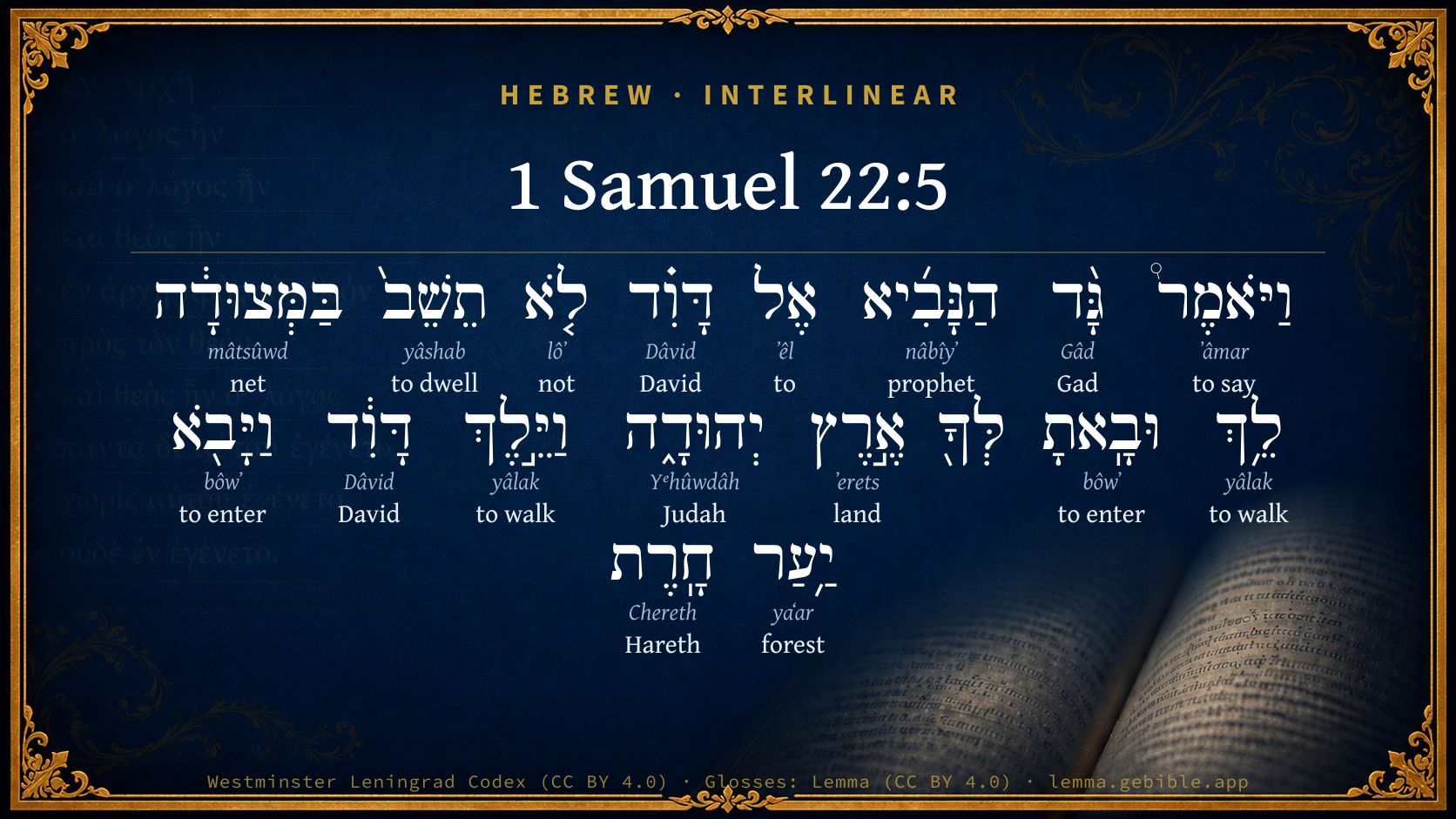
Hebrew (Westminster Leningrad Codex) 1 Samuel 22:5 appears in the Hebrew Old Testament. The text above is from the Westminster Leningrad Codex. Each word links to its Strong’s number, a concise gloss, and parsing drawn from the Open Scriptures Hebrew Bible morphology. Click any word for its full Brown-Driver-Briggs (BDB) entry.
Download image
Cite this verse

1 Samuel 22:5 (World English Bible). Public Domain. Lemma interlinear Bible study tool, https://lemma.gebible.app/v/1-samuel/22/5.

Show BibTeX & RIS
BibTeX
RIS
English Translation
The prophet Gad said to David, Don't stay in the stronghold; depart, and get you into the land of Judah. Then David departed, and came into the forest of Hereth.
World English Bible · Public Domain
Highlights
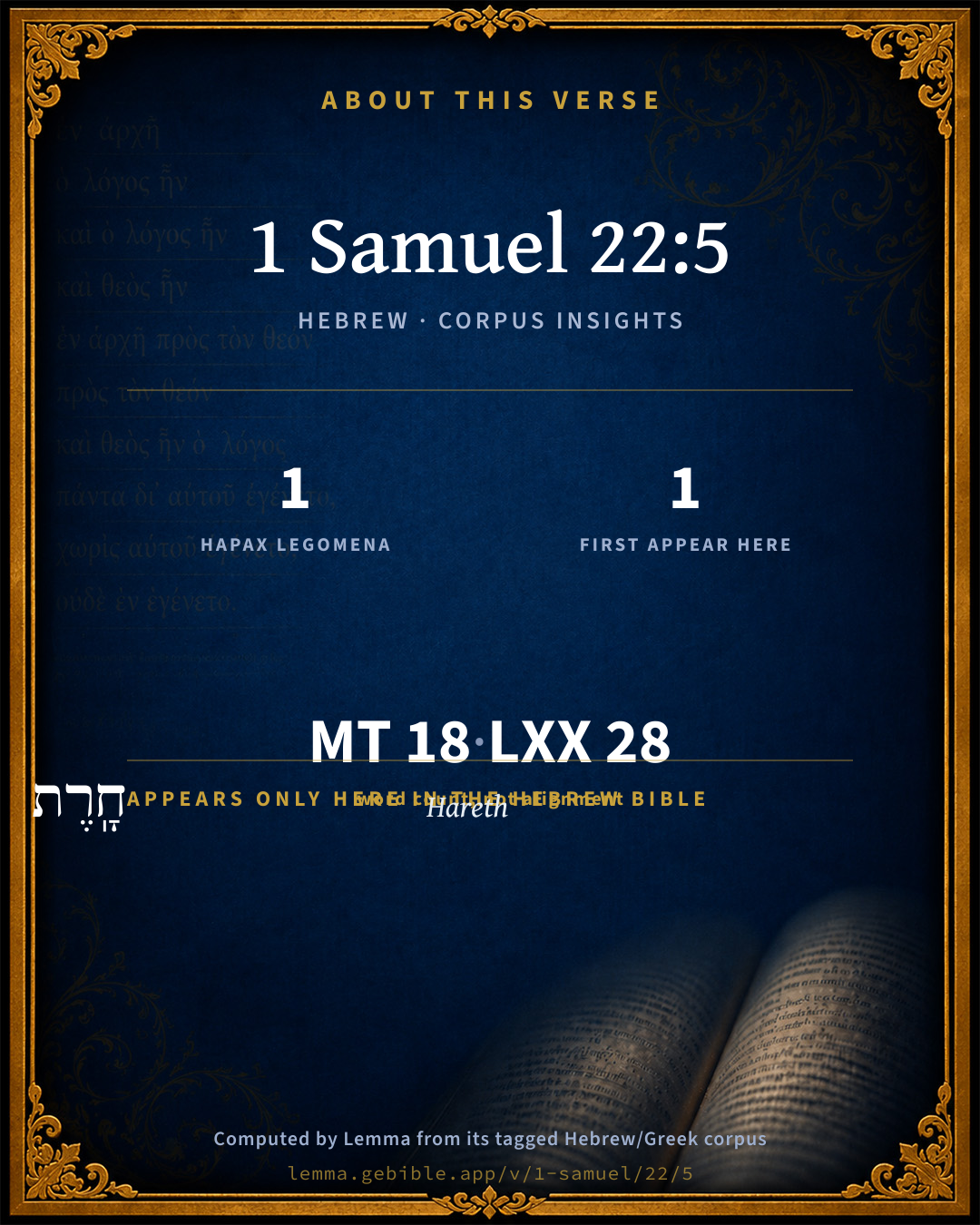
  • 1 hapax legomenon — only here in the Hebrew Bible
  • 1 first appearance in the Hebrew Bible
Full analysis ↓
Download a study sheet

One document with this verse’s original text, its word-by-word gloss line, the meaning frame, cross-references with their text, attributed commentary, and full source and license credits — printable, and it pastes into notes with its structure intact.

This verse Autodidact and up

Study sheet (.html) Plain text (.txt)

A passage Seminary Student

Up to 50 verses in one chapter. A passage sheet keeps up to 6 commentary sources and 12 cross-references per verse, in the order this page ranks them, and says so on the sheet whenever that leaves anything out. Ask for a single verse and you get the Autodidact verse sheet above.

Everything on this page stays free to read, with no account — the sheet is a download of what is already on screen, not access to it.

Want to remove ads? Support Godless Engineer
Compare translations 3

The same verse in 3 English versions, stacked beneath the original-language interlinear above. Click any original word for its lexicon entry.

Each is an independent rendering of the whole verse — the interlinear is not word-aligned to these translations.

Highlighted words mark where these versions differ — a whole-verse word diff, not a word-by-word alignment.

  • World English Bible Public Domain
    The prophet Gad said to David, Don't stay in the stronghold; depart, and get you into the land of Judah. Then David departed, and came into the forest of Hereth.
  • King James Version Public Domain
    And the prophet Gad said unto David, Abide not in the hold; depart, and get thee into the land of Judah. Then David departed, and came into the forest of Hareth.
  • unfoldingWord Literal Text CC BY-SA 4.0
    And the prophet Gad said to David, “Do not stay in the stronghold. Leave and enter for yourself the land of Judah.” And David left and entered the forest of Hereth.

unfoldingWord Literal Text — © unfoldingWord, licensed CC BY-SA 4.0. Word-aligned USFM3 via Door43 (git.door43.org/unfoldingWord/en_ult).

Versions to compare (up to 4)

3 of 4 selected

Show all 18 translations

Every available English version of this verse, each an independent rendering of the whole verse.

  • World English Bible Public Domain
    The prophet Gad said to David, Don't stay in the stronghold; depart, and get you into the land of Judah. Then David departed, and came into the forest of Hereth.
  • Berean Standard Bible Public Domain
    Then the prophet Gad said to David, “Do not stay in the stronghold. Depart and go into the land of Judah.” So David left and went to the forest of Hereth.
  • Majority Standard Bible Public Domain
    Then the prophet Gad said to David, “Do not stay in the stronghold. Depart and go into the land of Judah.” So David left and went to the forest of Hereth.
  • King James Version Public Domain
    And the prophet Gad said unto David, Abide not in the hold; depart, and get thee into the land of Judah. Then David departed, and came into the forest of Hareth.
  • American Standard Version (1901) Public Domain
    And the prophet Gad said unto David, Abide not in the stronghold; depart, and get thee into the land of Judah. Then David departed, and came into the forest of Hereth.
  • Revised Version (1885) Public Domain
    And the prophet Gad said unto David, Abide not in the hold; depart, and get thee into the land of Judah. Then David departed, and came into the forest of Hereth.
  • Geneva Bible (1599) Public Domain
    And the Prophet Gad sayde vnto Dauid, Abide not in the holde, but depart and goe into the land of Iudah. Then Dauid departed and came into the forest of Hareth.
  • Douay-Rheims (1899) Public Domain
    And Gad the prophet said to David: Abide not in the hold, depart, and go into the land of Juda. And David departed, and came into the forest of Haret.
  • Young's Literal Translation Public Domain
    And Gad the prophet saith unto David, `Thou dost not abide in a fortress, go, and thou hast entered for thee the land of Judah;' and David goeth and entereth the forest of Hareth.
  • Literal Standard Version CC BY-SA 4.0
    And the prophet Gad says to David, “You do not abide in a fortress, go, and you have entered the land of Judah for yourself”; and David goes and enters the forest of Hareth.
  • Unlocked Literal Bible CC BY-SA 4.0
    Then the prophet Gad said to David, “Do not stay in your stronghold. Leave and go into the land of Judah.” So David left there and went into the forest of Hereth.
  • unfoldingWord Literal Text CC BY-SA 4.0
    And the prophet Gad said to David, “Do not stay in the stronghold. Leave and enter for yourself the land of Judah.” And David left and entered the forest of Hereth.
  • Darby Bible Public Domain
    And the prophet Gad said to David, Abide not in the stronghold; depart, and go into the land of Judah. Then David departed, and came into the forest of Hareth.
  • World Messianic Bible Public Domain
    The prophet Gad said to David, “Don’t stay in the stronghold. Depart, and go into the land of Judah.” Then David departed, and came into the forest of Hereth.
  • Webster's Bible Public Domain
    And the prophet Gad said to David, Abide not in the hold; depart, and come into the land of Judah. Then David departed, and came into the forest of Hareth.
  • Free Bible Version CC BY-SA 4.0
    But then the prophet Gad told David, “Do not stay in the stronghold. Go back to the land of Judah.” So David left and went to the forest of Hereth.
  • Bible in Basic English Public Domain
    And the prophet Gad said to David, Do not go on living in this place but go into the land of Judah. Then David went away and came to the woodland of Hereth.
  • JPS Tanakh (1917) Public Domain
    And the prophet Gad said unto David: 'Abide not in the stronghold; depart, and get thee into the land of Judah.' Then David departed, and came into the forest of Hereth.

Literal Standard Version (2020), Covenant Press — licensed CC BY-SA 4.0. Text via the HelloAO Bible API (eBible.org). Unlocked Literal Bible (unfoldingWord) — licensed CC BY-SA 4.0. Text via the HelloAO Bible API (eBible.org). unfoldingWord Literal Text — © unfoldingWord, licensed CC BY-SA 4.0. Word-aligned USFM3 via Door43 (git.door43.org/unfoldingWord/en_ult). Free Bible Version, Dr. Jonathan Gallagher — licensed CC BY-SA 4.0. Text via the HelloAO Bible API (eBible.org).

Word by word

More ways to search: Search by grammar → Find every occurrence → Compare this word →

Practice this passage: Drill this verse → Learn its vocabulary →

חָֽרֶת
Chereth
H2802
“Hareth”
Noun, Proper
Part of Speech
Noun
Type
Proper
Full BDB Definition

Origin: from H2801 (but equivalent to H2793 )

TWOT: None

Hareth = "forest" - a forest whose site is now unknown
  1. וַיֹּאמֶר֩ ʼâmar H559 “and · to say” Conjunction + Verb, Qal, Sequential Imperfect, 3rd Person, Masculine, Singular
  2. גָּ֨ד Gâd H1410 “Gad” Noun, Proper
  3. הַנָּבִ֜יא nâbîyʼ H5030 “the · prophet” Particle, Definite Article + Noun, Common, Masculine, Singular, Absolute
  4. אֶל ʼêl H413 “to” Preposition
  5. דָּוִ֗ד Dâvid H1732 “David” Noun, Proper
  6. לֹ֤א lôʼ H3808 “not” Particle, Negative
  7. תֵשֵׁב֙ yâshab H3427 “to dwell” Verb, Qal, Imperfect, 2nd Person, Masculine, Singular
  8. בַּמְּצוּדָ֔ה mâtsûwd H4686 “in/at the · net” Preposition, Determined + Noun, Common, Both, Singular, Absolute
  9. לֵ֥ךְ yâlak H3212 “walk” Verb, Qal, Imperative, 2nd Person, Masculine, Singular
  10. וּבָֽאתָ bôwʼ H935 “and · to enter” Conjunction + Verb, Qal, Sequential Perfect, 2nd Person, Masculine, Singular
  11. אֶ֣רֶץ ʼerets H776 “land of” Noun, Common, Both, Singular, Construct
  12. יְהוּדָ֑ה Yᵉhûwdâh H3063 “Judah” Noun, Proper
  13. וַיֵּ֣לֶךְ yâlak H3212 “and · to walk” Conjunction + Verb, Qal, Sequential Imperfect, 3rd Person, Masculine, Singular
  14. דָּוִ֔ד Dâvid H1732 “David” Noun, Proper
  15. וַיָּבֹ֖א bôwʼ H935 “and · to enter” Conjunction + Verb, Qal, Sequential Imperfect, 3rd Person, Masculine, Singular
  16. יַ֥עַר yaʻar H3293 “forest of” Noun, Common, Masculine, Singular, Construct

About this verse

These counts appear in no published source. They are computed here, from the morphology-tagged text and Lemma’s own curated glosses. What Lemma adds →

18
words
14
distinct lemmas
Historical
section

Notable vocabulary

1 hapax legomenon — a word that appears only here in the entire Hebrew Bible:

  • חָֽרֶת Hareth H2802

First appearance in Scripture

This word makes its first canonical appearance in the Hebrew Bible here:

  • חָֽרֶת Hareth H2802

Shared distinctive vocabulary

בַּמְּצוּדָ֔ה net H4686 occurs in 23 verses of the Hebrew Bible. Also found in:

Grammatical profile

  • 6 verbs
  • 9 nouns
  • 2 prepositions
  • 1 particle

Verb forms

  • וַיֹּאמֶר֩ Qal · Sequential Imperfect
  • תֵשֵׁב֙ Qal · Imperfect
  • לֵ֥ךְ Qal · Imperative
  • וּבָֽאתָ Qal · Sequential Perfect
  • וַיֵּ֣לֶךְ Qal · Sequential Imperfect
  • וַיָּבֹ֖א Qal · Sequential Imperfect

Repetition

Words recur within this verse — often emphatic in Hebrew:

  • דָּוִ֗ד David H1732 ×2
  • לֵ֥ךְ to walk H3212 ×2
  • וּבָֽאתָ to enter H935 ×2

Hebrew & Septuagint length

In English translation the verse runs 30 words from the Hebrew and 33 from the Septuagint (LXX English) — closely comparable.

A rough comparison of the two English renderings, which tokenize alike — not a word-level alignment.

Word counts can differ between the Hebrew and the Greek without any difference in meaning — e.g. the Hebrew direct-object marker אֵת has no separate Greek word, and Greek often adds the article ὁ.

In the original languages it is 18 Hebrew tokens and 28 Greek tokens — but the two are counted differently (Hebrew bundles its prefixes and suffixes into one token; the Greek is in lemma form), so that isn’t a like-for-like length.

Cross-references

4

Topical passages linked to 1 Samuel 22:5 in the Treasury of Scripture Knowledge — connected by theme and wording, ordered by reader-vote popularity; previews shown in the World English Bible.

  • 1 Chronicles 21:9 Yahweh spoke to Gad, David's seer, saying,
  • 1 Chronicles 29:29 Now the acts of David the king, first and last, behold, they are written in the history of Samuel the seer, and in the history of Nathan the prophet, and in the history of Gad the seer,
  • 2 Chronicles 29:25 He set the Levites in the house of Yahweh with cymbals, with psalteries, and with harps, according to the commandment of David, and of Gad the king's seer, and Nathan the prophet; for the commandment was of Yahweh by his prophets.
  • 2 Samuel 24:11 When David rose up in the morning, the word of Yahweh came to the prophet Gad, David's seer, saying,

Cross-references courtesy of OpenBible.info (CC BY 4.0).

Hebrew and Greek witnesses Masoretic Hebrew ↔ Greek Septuagint

The same verse in the two great witnesses to the Old Testament, shown verse-for-verse.

These are two independent witnesses, not word-aligned to each other, and the Septuagint is shown in lemma (dictionary) form.

Hebrew 1 Samuel 22:5 Masoretic · Westminster Leningrad Codex

וַיֹּאמֶר֩ גָּ֨ד הַנָּבִ֜יא אֶל דָּוִ֗ד לֹ֤א תֵשֵׁב֙ בַּמְּצוּדָ֔ה לֵ֥ךְ וּבָֽאתָ לְּךָ֖ אֶ֣רֶץ יְהוּדָ֑ה וַיֵּ֣לֶךְ דָּוִ֔ד וַיָּבֹ֖א יַ֥עַר חָֽרֶת

The prophet Gad said to David, Don't stay in the stronghold; depart, and get you into the land of Judah. Then David departed, and came into the forest of Hereth.

World English Bible · Public Domain

Greek LXX 1 Samuel 22:5 Septuagint · lemma form

καί εἶπον γαδ ὁ προφήτης πρός δαυίδ μή καταἧμαι ἐν ὁ περιοχή πορεύομαι καί ἥκω εἰς γῆ ιουδα καί πορεύομαι δαυίδ καί ἔρχομαι καί καταἵζω ἐν πόλις σαριχ

And Gad the prophet said to David, Dwell not in the hold: go, and you shall enter the land of Juda. So David went, and came and lived in the city of Saric.

LXX2012 (modern English Septuagint) · Public Domain

On this verse, Ellicott's Commentary for English Readers discusses the Septuagint’s reading. Read the note in Commentary ↓

Hebrew: Westminster Leningrad Codex (CC BY 4.0). Greek: Septuagint (public domain); English from LXX2012 (modern English Septuagint) (Public Domain). How the Septuagint differs from the Hebrew →

Targum (Aramaic paraphrase)

1

The Targum is the ancient Jewish Aramaic paraphrase of the Hebrew Scriptures — an interpretive translation, not the Hebrew text itself. Onkelos (literal) and Pseudo-Jonathan (expansive) render the Torah, and Jonathan the Prophets. Coverage is partial: where no permissively-licensed English translation exists for a verse, only the Aramaic is shown. This is verse-level text, not a word-by-word alignment to the Hebrew.

  1. Targum Jonathan Prophets (Joshua–Malachi)
    וַאֲמַר גָד נְבִיָא לְדָוִד לָא תִתֵּב בַּמְצוּדַיָא אִיתָא וֶאֱזֵיל לָךְ לַאֲרַע יְהוּדָה וַאֲזַל דָוִד וַאֲתָא לְחוּרְשָׁא דְחָרֶת:

    (no public-domain English translation for this verse)

    Targum Jonathan — Aramaic: “Mikraot Gedolot” (public domain). English: “Sefaria Community Translation” (CC0 1.0 (public-domain dedication)); “London "Chaldee Paraphrase," 1871” (public domain). Text via Sefaria.

Commentary

Notes on 1 Samuel 22:5 from classic Christian and Jewish commentators (each source and its license shown beneath its notes). The classic Christian expositions comment on the surrounding passage and are grouped to its opening verse, so a note may address several verses; the Jewish commentaries on the Tanakh (Rashi and others) are per-verse, so they appear only where the commentator wrote on this verse.

Lemma curates 59 commentaries, every one of them public domain or Creative Commons licensed, each selected and text-cleaned for this edition rather than reprinted as found. About our sources →

Trapp's Complete Commentary

John Trapp

1Sa 22:5 And the prophet Gad said unto David, Abide not in the hold; depart, and get thee into the land of Judah. Then David departed, and came into the forest of Hareth.

Ver. 5. And the prophet Gad said unto David.] It was no small comfort to distressed David to have about him a prophet, called elsewhere David’s seer, {1Ch 21:9} and afterwards also the high priest with the ephod, by whom he might and did inquire of God upon all occasions. {1Sa 23:2; 1Sa 23:4}

Depart, and get thee into the land of Judah.] Where thou mayest be in action, and do some good to thy country. God is a pure act, and he willeth that all his should be active, "and run with patience the race that is set before them." {Heb 12:2}

John Trapp, A Commentary or Exposition upon All the Books of the Old and New Testament (1647–1656) — public domain. Text from a community e-Sword module.

The Biblical Illustrator

Joseph S. Exell

1Sa_22:5-23

And the prophet Gad said unto David.

A friend and a foe

I. The visit of Gad the seer. David had been brought very low through his own mistakes. God proved him in the hold. Then He sent to him. Wherever you are, wait for a message from God before you move,

II. Sauls appeal to his servants. No one answered it but the alien Doeg. Notice, Herod was an Edomite. The race always conspicuous for hatred to Israel. What circumspection is necessary in Gods children! Always a Doeg looking on! (Exo_23:13; 1Pe_2:12; 1Pe_2:15-16.) False witness, often nearly true. A lie that is half a truth is ever the worst of lies (Mar_14:55-59; Mat_26:61). Built on supposition (Act_21:27-29).

III. God fulfils Himself in many ways. The massacre of Nob, though unjustifiable in Saul, was Gods sentence on Elis house (1Sa_3:12-14; Isa_5:7, etc.)

IV. Security with david (1Sa_22:23). This was beautiful faith. The outcast promising protection because the Lord was with him. He was willing to protect him with his life. So was Jesus. He was not only willing, but He did it (1Jn_3:8; 1Jn_3:16). (R. E. Faulkner.)

The Biblical Illustrator, edited by Joseph S. Exell (c. 1880s–1900s) — public domain. Text from a community e-Sword module.

Joseph Benson's Commentary

1Sa 22:5. The Prophet Gad said unto David — We read nothing of this prophet before; and it is likely God raised him up at this time, on purpose for the support and direction of David. Abide not in the hold — That is, do not shut up thyself here; for he did not merely intend any particular strong place, where David might now be, but in general all those places where he kept himself concealed. Get thee into the land of Judah — As one that confides in God, and in the uprightness of his intentions. Go, show thyself to the people, that thou mayest publicly put in thy claim to the kingdom after Saul’s death; and that thy friends may be invited and encouraged to appear in thy behalf. Hereby also God would exercise David’s faith, wisdom, and courage, and so prepare him for the kingdom.

Joseph Benson's Commentary on the Old and New Testaments (1811–1818) — public domain. Text from a community e-Sword module.

Whedon's Commentary on the Bible

Daniel D. Whedon

DAVID’S RETURN TO THE LAND OF JUDAH, 1Sa_22:5.

5. The prophet Gad — With much plausibility supposed to have been a member of Samuel’s school of prophets. Having made David’s acquaintance at Ramah, (1Sa_19:18,) he now joins his company at Mizpeh of Moab, and advises him to return to his native land. Whether he remained with David during the period of his wanderings we know not; but at a later day we find him attached to the royal household, and spoken of as David’s seer. 1Sa_29:11. He was also the author of a book of the acts of David. 1Ch_29:29.

Abide not in the hold — Dwell no longer in this fortress at Mizpeh.

Get thee into the land of Judah — A long sojourn away from his fatherland might have a tendency to alienate from him the affections of the people of Israel. These words show that when David received the message of Gad he was not in the land of Judah, and therefore the hold in which he was no longer to abide could not have been the cave of Adullam, as many have supposed, nor any other stronghold in the land of Judah. Hence our reason for regarding this hold as some fortified place in the land of Moab.

The forest of Hareth — Some wooded part of the wilderness of Judah, whose exact locality is no longer known. Here it seems Abiathar joined him. 1Sa_22:20.

Daniel D. Whedon (gen. ed.), Commentary on the Old and New Testaments (1874–1909) — public domain. Text from a community e-Sword module.

The Preacher's Complete Homiletical Commentary

Joseph S. Exell (gen. ed.)

CRITICAL AND EXPOSITORY NOTES—

1Sa_22:5. “Gad.” It must remain a matter for conjecture whether Gad had gone with David to Adullam, or whether he now comes to him for the first time with a special Divine message. “Get thee into the land of Judah.” Keil thinks that “David was not to seek for refuge outside the land; not only that he might not be estranged from his fatherland and the people of Israel, which would have been opposed to his calling to be King of Israel, but also that he might learn to trust entirely in the Lord as his only refuge and fortress.” But Erdmann sees the reason for this direction in the fact that “the Philistines were now making plundering incursions into the south of Judah, help and protection against them was needed, and this David and his valiant’ band could give, and thus fulfil part of the theocratic calling in respect of which the distracted, arbitrary rule of Saul was now impotent.” “Forest of Hareth.” An unknown region. Josephus calls it the city of Hareth. It was probably a woody district in the mountains of Judah.

MAIN HOMILETICS OF 1Sa_22:5

THE PROPHET GAD

I. God does not leave His servants in their times of danger and perplexity without help and guidance. “Unto the upright there ariseth light in the darkness” (Psa_112:4), and light often comes to men as it now came to David by means of a man of God. For the very presence of such a man is light in the cloudy and dark day. It will encourage the dejected soul to hold fast its confidence in God, and will exercise a restraining influence when we are exposed to the temptation to turn aside from the path of right which great trial sometimes brings. David had yielded to such a temptation once, but Gad’s companionship would be likely to prevent another such fall. The presence of a prophet of God in the hold was a token of God’s good will, and as such was a light in the darkness. And the counsel of such a man at such a time is a light which not only cheers, but guides. God can guide His servants, as He can feed them, in many different ways. As He has fed them direct from heaven, so He has guided them by a voice direct from the invisible world. He has fed men by the instrumentality of angels, and He has guided them by such an instrumentality. But He more generally helps man by man, and this was the method He employed here.

II. When God’s children have good reason to believe that the light that thus ariseth is a light from heaven, it is wise to follow its guidance implicitly. It is the first duty of a benighted traveller to make sure whether the light upon his path is an ignis-fatuus luring him to destruction, or the lamp of a friend pointing to the highway of safety. When he has made sure that it is the latter, he will only reveal his foolishness if he neglects to walk in the way which it reveals as the right one. Gad was doubtless well known to David; he was in all probability one of that company at Ramah who had grown up around Samuel, and upon whom the prophetic spirit had descended in such a manner as to qualify him to give counsel and guidance to the elect king of Israel, and David, in his unhesitating obedience to his word, acts with true humility and wisdom.

OUTLINES AND SUGGESTIVE COMMENTS

It is to be noted here as an interesting fact, that in the hold of Adullam and in the wilderness of Judah we have, side by side, representatives of the oracular and the prophetical methods of the communication of the will of God to men; and that, in the life of David, as a whole, we have the era of the transition from the one to the other. Up to this time the priest had been the most important personage in the nation, and the only recognised channel through which God indicated his will to the people. True, there had been great outstanding prophets, like Moses and Samuel; but the former was an exception to all rules as being the leader of the Exodus; and the latter, from his training under Eli, was as much a priest as he was a prophet. True, again, in the time of the Judges there was Deborah, the prophetess; but she was raised up in connection with a particular crisis in the history of her people. The general system, however, was, that when the head of the nation, whether judge or king, wished, at any special emergency, to ask counsel of the Lord, the inquiry was made through the priest, and the, answer was given by the Urim and Thummim. But now the prophet, as a standing official personage, comes into prominence, and the mind of God begins to be made known through his human individuality, and not through any such visible media as those which were connected with the priestly breastplate.

In the hold and in the wilderness, David received divine directions through both channels, but gradually, even in his life, the breastplate oracle disappears or falls into desuetude; and from the reign of Solomon downward we have no mention made of its employment in the Jewish annals. In the same gradual manner the prophet waxes into preeminence, Gad and Nathan preparing the way for Elijah and Elisha, and these, in their turn, giving place to Isaiah and Jeremiah, who were succeeded, in the days of the exile, by Ezekiel and Daniel; and in the era of the Restoration by Haggai, Zechariah, and Malachi.

Now, if we think out this subject a little more fully, we shall see that in the life of David a distinct forward step was taken in the education of the people of God, from the first rudiments of external symbolism, on toward that system of spiritual simplicity under which we now live in the Gospel dispensation.… The call for faith was increased when the Urim and Thummin ceased, and the prophets came speaking in God’s name, giving gradually fewer and fewer specific directions as to particular matters, and more and more proclaiming great spiritual principles. And now there is, more than ever, a demand for faith, when, under the New Testament economy, the way into the holiest is made manifest to every believer, and the answers to the soul’s inquiries are given not by any objective oracle, but by the Christian’s study of God’s Word, as that is interpreted by the providences that are without him, and the Spirit of God that is dwelling within him. Hence, when we read the history of David’s sojourn in the cave, or of his wanderings in the wilderness, and see the priest Abiathar on his right hand, and the prophet Gad on his left, we feel that we are standing on one of the great landing-places of that stairway of education, up which God led His people from the childhood of walking by sight, to the glorious liberty, and graceful movement, of that spiritual manhood which walks continually by faith.—Dr. W. M. Taylor.

The Lord will never permit any prince who is heartily disposed to conduct the affairs of his government in his name, to be at any time altogether without some such Gad among his soldiers or officers around him—some man who, because he seeks not his own, unites the most incorruptible fidelity with his allegiance, and by whose mouth the Lord, as often as the foot of the prince is like to slip, will by his warnings and his counsel show to him the right and safe way. Woe to the land on the steps of whose throne there is not found, in the circle of dignified officers surrounding the ruler, at least one man who bears not only in his profession, but at the same time also in his entire consecrated personality, the stamp of a man of God, and who knows at the right time to throw the weight of the divine word and commandment into the balance-scales of the government! Krummacher.

The Preacher's Complete Homiletical Commentary (gen. ed. Joseph S. Exell; Funk & Wagnalls, c. 1892) — public domain (pre-1929). A full-Bible homiletical/sermon-outline anthology covering 65 of 66 books (2 John is absent from the source module). Text from a community e-Sword module.

Tyndale Open Study Notes

Tyndale Open Resources

22:5 The prophet Gad was David’s special adviser (2 Sam 24:11). God was no longer communicating with Saul but was guiding David.

Tyndale Open Study Notes — © Tyndale Open Resources, licensed CC BY-SA 4.0. Text via the HelloAO Bible API.

Jamieson, Fausset & Brown

Robert Jamieson, A. R. Fausset & David Brown

the prophet Gad said unto David, Abide not in the hold--This sound advice, no doubt, came from a higher source than Gad's own sagacity. It was right to appear publicly among the people of his own tribe, as one conscious of innocence and trusting in God; and it was expedient that, on the death of Saul, his friends might be encouraged to support his interest.

forest of Hareth--southwest of Jerusalem.

Jamieson, Fausset & Brown — Commentary Critical and Explanatory on the Whole Bible (1871) — public domain (CC PDM 1.0). Text via the HelloAO Bible API.

Adam Clarke's Commentary

Verse 5. Get thee into the land of Judah] Gad saw that in this place alone he could find safety.

Adam Clarke's Commentary on the Bible (1810–1826) — public domain. Text from a community e-Sword/MySword module.

Ellicott's Commentary for English Readers

(5) The prophet Gad.—From this time onward throughout the life and reign of David, Gad the prophet occupied evidently a marked place. He is mentioned as the king’s seer in 2Sa_24:11; and in 1Ch_29:29 he appears as the compiler of the acts of David, along with Samuel and Nathan. In 2Ch_29:25 he is mentioned with his brother prophet Nathan again, as the man who had drawn up the plan of the great Temple services, which have been the model now for eighteen centuries of the countless Christian Liturgies in all the Churches.

It was Gad also who, far on in the golden days of the exile’s rule, dared to reprove the mighty king for his deed of numbering the people, which act involved a great sin, or the design of a great sin, not recorded for us, and who brought as a message from the Highest the terrible choice of three evils (2Sa_24:11, and following verses). As he appears in the last years of the great king’s life, and apparently survived his master and friend, Gad must have been still young, or at all events in the prime of life, when he joined the fugitive and his outlawed band. He had, therefore, not improbably been a fellow student and friend of David’s in the Naioth of Samuel by Ramah. It seems hardly a baseless conjecture which sees in Gad a direct messenger from the old prophet Samuel to his loved pupil David, “the anointed,” Samuel well knew, “of the Lord.” As has been before observed, among the many who were educated and brought up in the Schools of the Prophets as historians, preachers, musicians, and teachers, but very few seem to have received the Divine influence (the Spirit’s “afflatus”) which was needed to constitute a prophet in the true high sense of the solemn word as we now understand it. Gad, however, appears to have been one of these rarely favoured few, and the presence of such an one in this outlaw camp of David must have been of great advantage to the captain.

Abide not.—The wise advice of the prophet, suggested by a Divine influence, told David not to estrange himself from his own country and people by remaining in a foreign land, but to return with his followers to the wilder districts of Judah. There was work for him and his followers to do in that distracted, harassed land.

The forest of Hareth.—The LXX. and Josephus here read “the city of Hareth.” Lieutenant Conder, whose late investigations have thrown so much light upon the geography of the Promised Land, can find no trace of forest on the edge of the mountain chain of Hebron, where Kharas now stands, and he therefore believes the LXX. text the true one. Dean Payne Smith, however, considers that “the thickets,” which still grow here abundantly, are what the Hebrew word yar, here translated “forest,” signifies.

A Bible Commentary for English Readers, edited by Charles John Ellicott (1878–1897) — public domain. Text from a community e-Sword module.

The Cambridge Bible for Schools and Colleges

gen. ed. J. J. S. Perowne

5. the prophet Gad] Mentioned here for the first time, and not again till David had come to the throne, when he appears as holding the office of “the king’s seer.” He was one of the chroniclers of David’s reign (1Ch_29:29); helped in the arrangement of the musical services in the Temple (2Ch_29:25); and was sent to offer David his choice of punishments for his sin in numbering the people (2Sa_24:11 ff.).

Abide not in the hold] The future king must not remain in a foreign land, but in the face of all risk return to his own country, in order that by such exploits as the relief of Keilah he might gain reputation, and prepare his way to the throne.

the forest of Hareth] Nowhere else mentioned and not identified with any certainty. Perhaps the name survives in Kharâs on the edge of the mountain chain two or three miles east of Keilah.

Psalms 63. is referred by its title to the time when David was in the wilderness of Judah: but internal evidence points rather to his flight from Absalom; 1Sa_22:11 implies that he was already king.

The Cambridge Bible for Schools and Colleges (gen. ed. J. J. S. Perowne; Cambridge University Press, 1878–1918) — public domain. Text from a community e-Sword module.

John Gill's Exposition

And the prophet Gad said unto David,.... Who either accompanied him in his exile, or was sent unto him on this account, being one of the company of the prophets, over whom Samuel was president, Sa1 19:20,

abide not in the hold, depart, and get thee into the land of Judah; this seems to confirm it that the hold David was in was not the cave of Adullam, because that was in the tribe of Judah; but rather some hold in the land of Moab, which he is directed by the prophet to leave, and go into the country of Judah, his own tribe, where Saul would not be so forward to pursue him, and where he would be among his friends, and in the way, upon Saul's death, to be anointed king over Judah; besides, appearing more openly would show the innocence of his cause, and his confidence in the Lord, more than to lurk about in a foreign land:

then David departed; from "Mizpeh" in "Moab"; or, however, from the hold in which he was:

and came into the forest of Hareth; where he would have places and opportunity enough to hide himself as he saw fit. Jerom (a) speaks of a village called Arath, where David abode, to the west of Jerusalem. Kimchi says this was a dry barren place, but for the sake of David it was made by the Lord a well watered and fruitful one.

(a) De loc. Heb. fol. 88. L.

John Gill's Exposition of the Whole Bible (1746–1763) — public domain (CC PDM 1.0). Text via the HelloAO Bible API.

Albert Barnes' Notes on the Bible

The prophet Gad - Mentioned here for the first time. One may conjecture that Samnel had sent him privately from Naioth to tell David not to abide in the hold. Whether he stayed with David or returned to the College of the prophets does not appear. For later notices of him see marginal references.

The forest of Hareth is unknown.

Albert Barnes' Notes on the Bible (1834–1885) — public domain. Text from a community e-Sword/MySword module.

Haydock's Catholic Bible Commentary

Haret, west of Jerusalem. Septuagint read "the town of Haret," (Eusebius) or "Sarec." (Menochius) --- Rama, "the height," in Gabaa. (Calmet) --- God would not suffer David and his followers to continue long among the infidels, for fear of danger. (Menochius) --- The hero shews his ready obedience to the word of the unknown prophet, and is willing again to expose himself in the midst of Saul’s dominions. (Salien)

George Leo Haydock (1774–1849), Haydock's Catholic Family Bible and Commentary, 1859 edition — public domain. Excludes Psalms (Douay-Rheims chapter numbering differs from Protestant) and Deuterocanonical books (Catholic canon only).

Matthew Poole's English Annotations

Abide not in the hold; do not shut up thyself in holes and holds.

Get thee into the land of Judah; go and show thyself in the land of Judah, that thou mayst publicly put in thy claim to the kingdom after Saul’s death, and that thy friends may be invited and encouraged to appear on thy behalf. Hereby also God would exercise David’s faith, and wisdom, and courage; and so prepare him for the kingdom, and uphold and increase his reputation among the people.

In the forest of Hareth there were many caves and lurking-places.

Matthew Poole's English Annotations on the Holy Bible (1683–1685) — public domain. Text from a community e-Sword/MySword module.

The Pulpit Commentary

The prophet Gad. This sudden appearance of the prophet suggests Stahelin"s question, How came he among such people? But, in the first place, David"s followers were not all of the sort described in ver. 2; and, next, this must be regarded as a declaration of the prophetic order in his favour. As we have a summary of David"s proceedings in ver. 4, extending over some time, during which the massacre of the priests at Nob took place, we may well suppose that Saul had alienated from him the minds of all religious people, and that Gad, probably by Samuel"s command, came to be David"s counsellor. The advice he gives is most important Abide not in the hold. Ie. do not remain in the land of Moab. Had David done so he probably would never have become king. By remaining in Judah, and protecting the people from the Philistines, which Saul could no longer do, David grew in reputation and power, and from the list of those who joined him at Ziklag (1Ch_12:1-22) it is evident not only that such was the case, but that there was a strong enthusiasm for him throughout not merely Judah, but all Israel. In the happier times which followed Gad became David"s seer, (2Sa_24:11) was God"s messenger to punish David for numbering the people (ibid. ver. 13), and finally wrote a history of his life. (1Ch_29:29) As he thus survived David, he must have been a young man when he joined him, and possibly had been a companion of David in the prophetic schools at Naioth in Ramah. The forest of Hareth. Or, rather, Hereth. "This lay on the edge of the mountain chain (of Hebron), where Kharas now stands, surrounded by the thickets which properly represent the Hebrew yar, a word wrongly supposed to mean a woodland of timber trees" (Conder, "Tent Work," 2:88). Yar is translated forest here. Hereth was about three miles from Adullam (see on ver. 1).

Ver. 5. (MIZPEH OF MOAB.)

A summons to duty.

The prophet Gad was probably sent at the instance of Samuel to David, who was now "in the hold" in Moab, and with whom he may have become acquainted at Ramah. His message was important in relation to the future course of David (ver. 3). "According to the counsels of God he was not to seek for refuge outside the land; not only that he might not be estranged from his fatherland and the people of Israel, which would have been opposed to his calling to be king of Israel, but also that he might learn to trust entirely in the Lord as his only refuge and fortress" (Keil). There was also a special reason why he should be recalled in the incursions of the Philistines, which Saul failed to repel. (1Sa_23:1) And the message furnished a test of his obedience to the will of God as declared by the prophets. "Immediately he conferred not with flesh and blood," but did as he was directed, and thereby afforded an instructive example to others. Consider the message as

I COMMUNICATED BY THE PROPHETIC WORD. This word is, for us, contained in the Scriptures of truth.

1. It speaks with authority.

2. It speaks plainly, in divers manners," according to our need, and "for our good always.

3. It speaks in the reading of the Scriptures, in the voice of preachers andteachers, parents and friends, in the recollections of the memory, and often comes to the heart and conscience with peculiar force. "Believe his prophets, so shall ye prosper". (2Ch_20:20)

II CALLING TO UNEXPECTED DUTY; unexpected, inasmuch as, not unfrequently

1. It is such as we should not naturally have supposed.

2. It differs from the course which we have chosen for ourselves. "Abidenot in the hold.

3. It requires us to meet unusual difficulties and dangers. "Depart, and get thee into the land of Judah" (into the very presence of a deadly foe).

the Jews of late sought to stone thee; and goest thou thither again?" (Joh_11:8-10; Luk_9:51)

Do thy duty; that is best; Leave unto thy Lord the rest.

III COMPLIED WITH IN A RIGHT MANNER. "And David departed," etc.

1. Without question, like a good soldier at the word of command.

2. Without hesitation or delay.

3. Without fear. How different was it with Saul!. (1Sa_13:11 1Sa_15:11) "Whosoever will save his life," etc.. (Mat_16:25)

IV CONDUCTING TO SAFETY, USEFULNESS, AND HONOUR.

1. Safety; for he was "kept by the power of God.

2. Usefulness; for he "saved the inhabitants of Keilah". (1Sa_23:5)

3. Honour; for he was more fully recognised as the true defender of Israelagainst their enemies, and his heroic band was largely increased. (1Sa_23:13)

Stern Lawgiver! yet thou dos, wear The Godhead"s most benignant grace; Nor know we anything so fair As is the smile upon thy face:

Flowers laugh before thee on their beds, And fragrance in thy footing treads; Thou dost preserve the stars from wrong; And the most ancient heavens through thee are fresh and strong.

Give unto me, made lowly wise, The spirit of self-sacrifice; The confidence of reason give, And in the light of truth thy bondman let me live.

(Wordsworth, "Ode to Duty.") D.

The Pulpit Commentary (1880–1919), ed. H.D.M. Spence-Jones & Joseph S. Exell — public domain. Text from a community e-Sword module.

John Wesley's Explanatory Notes

Abide not - Do not shut up thyself here. Judah - Go and shew thyself in the land of Judah, that thou mayest publicly put in thy claim to the kingdom after Saul's death; and that thy friends may be invited and encouraged to appear on thy behalf. Hereby also God would exercise David's faith, and wisdom, and courage; and so prepare him for the kingdom.

John Wesley, Explanatory Notes Upon the Whole Bible (1754–1765) — public domain. Text via the GEBible commentary corpus.

Lesson kit

Teaching starters — assembled from the data on this page, not authored interpretation. Every prompt links to the verse data it draws on. Edit before teaching.

1 Samuel, in the Historical, opens this verse with 18 words (14 distinct Hebrew lemmas). Its most distinctive word is Chereth (“Hareth”). A historical commentator’s framing appears above. Read the whole chapter for the surrounding context.

Discussion questions

  1. How does “Hareth” (Chereth) shape what this verse is saying?
  2. 1 word here appears nowhere else in the Hebrew Bible. Why might the author reach for such rare wording?
  3. This is the first place “Hareth” appears in Scripture (first appears here). What does its debut here establish?
  4. How does 1 Samuel 22:4, which shares the word «net», read alongside this verse?
  5. What does the repetition of “David” (2× in this one verse) do in this verse?
  6. The translations on this page render this verse differently — a whole-verse word diff, not a word-by-word alignment. What might account for the different wordings?
  7. «וַיֹּאמֶר֩» is a Qal Sequential Imperfect verb. How does that grammatical form shape the action described?
  8. Compare how Trapp's Complete Commentary and The Biblical Illustrator read this verse. Where do they agree or differ?

Things to notice

  • 1 word in this verse appears nowhere else in the Hebrew Bible.
  • 1 word makes its first canonical appearance in Scripture here.
  • This verse counts 18 Hebrew ↔ 28 Greek words.
  • These translations choose different wording for 19 words in this verse.
  • “David” occurs 2× in this single verse.

Reading settings

Reading text

Shown beneath each verse's original-language words.

Old Testament
Old Testament edition

Read the OT as the Masoretic Hebrew (MT) or the Greek Septuagint (LXX).

English shown for the Greek Septuagint (in the Hebrew ↔ Greek comparison).

Comparing translations? Open the Compare panel on any verse page to stack up to four side by side.