1 Samuel 10:12

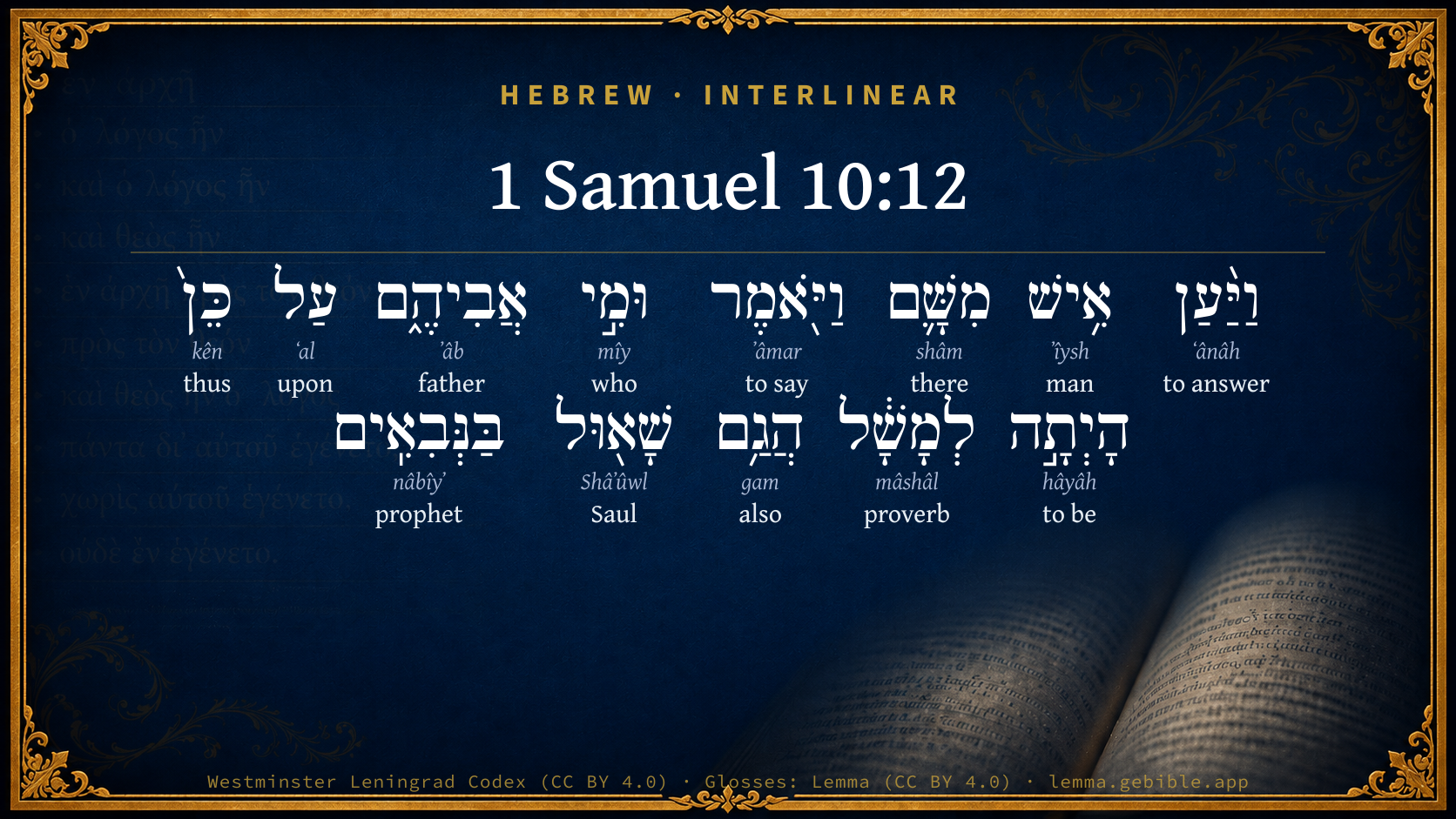
Hebrew (Westminster Leningrad Codex) 1 Samuel 10:12 appears in the Hebrew Old Testament. The text above is from the Westminster Leningrad Codex. Each word links to its Strong’s number, a concise gloss, and parsing drawn from the Open Scriptures Hebrew Bible morphology. Click any word for its full Brown-Driver-Briggs (BDB) entry.
Download image
Cite this verse

1 Samuel 10:12 (World English Bible). Public Domain. Lemma interlinear Bible study tool, https://lemma.gebible.app/v/1-samuel/10/12.

Show BibTeX & RIS
BibTeX
RIS
English Translation
One of the same place answered, Who is their father? Therefore it became a proverb, Is Saul also among the prophets?
World English Bible · Public Domain
Download a study sheet

One document with this verse’s original text, its word-by-word gloss line, the meaning frame, cross-references with their text, attributed commentary, and full source and license credits — printable, and it pastes into notes with its structure intact.

This verse Autodidact and up

Study sheet (.html) Plain text (.txt)

A passage Seminary Student

Up to 50 verses in one chapter. A passage sheet keeps up to 6 commentary sources and 12 cross-references per verse, in the order this page ranks them, and says so on the sheet whenever that leaves anything out. Ask for a single verse and you get the Autodidact verse sheet above.

Everything on this page stays free to read, with no account — the sheet is a download of what is already on screen, not access to it.

Want to remove ads? Support Godless Engineer
Compare translations 3

The same verse in 3 English versions, stacked beneath the original-language interlinear above. Click any original word for its lexicon entry.

Each is an independent rendering of the whole verse — the interlinear is not word-aligned to these translations.

Highlighted words mark where these versions differ — a whole-verse word diff, not a word-by-word alignment.

  • World English Bible Public Domain
    One of the same place answered, Who is their father? Therefore it became a proverb, Is Saul also among the prophets?
  • King James Version Public Domain
    And one of the same place answered and said, But who is their father? Therefore it became a proverb, Is Saul also among the prophets?
  • unfoldingWord Literal Text CC BY-SA 4.0
    And a man from there answered and said, “And who their father?” Therefore it became a proverb, “Is Saul also among the prophets?”

unfoldingWord Literal Text — © unfoldingWord, licensed CC BY-SA 4.0. Word-aligned USFM3 via Door43 (git.door43.org/unfoldingWord/en_ult).

Versions to compare (up to 4)

3 of 4 selected

Show all 18 translations

Every available English version of this verse, each an independent rendering of the whole verse.

  • World English Bible Public Domain
    One of the same place answered, Who is their father? Therefore it became a proverb, Is Saul also among the prophets?
  • Berean Standard Bible Public Domain
    Then a man who lived there replied, “And who is their father?” So the saying became a proverb: “Is Saul also among the prophets?”
  • Majority Standard Bible Public Domain
    Then a man who lived there replied, “And who is their father?” So the saying became a proverb: “Is Saul also among the prophets?”
  • King James Version Public Domain
    And one of the same place answered and said, But who is their father? Therefore it became a proverb, Is Saul also among the prophets?
  • American Standard Version (1901) Public Domain
    And one of the same place answered and said, And who is their father? Therefore it became a proverb, Is Saul also among the prophets?
  • Revised Version (1885) Public Domain
    And one of the same place answered and said, And who is their father? Therefore it became a proverb, Is Saul also among the prophets?
  • Geneva Bible (1599) Public Domain
    And one of the same place answered, and said, But who is their father? Therefore it was a prouerbe, Is Saul also among the Prophets?
  • Douay-Rheims (1899) Public Domain
    And one answered another, saying: And who is their father? therefore it became a proverb: Is Saul also among the prophets?
  • Young's Literal Translation Public Domain
    And a man thence answereth and saith, `And who `is' their father?' therefore it hath been for a simile, `Is Saul also among the prophets?'
  • Literal Standard Version CC BY-SA 4.0
    And a man there answers and says, “And who [is] their father?” Therefore it has been for an allegory, “Is Saul also among the prophets?”
  • Unlocked Literal Bible CC BY-SA 4.0
    A man who was from that same place answered, “Then who is their father?” Because of this, it became a saying, “Is Saul also one of the prophets?”
  • unfoldingWord Literal Text CC BY-SA 4.0
    And a man from there answered and said, “And who their father?” Therefore it became a proverb, “Is Saul also among the prophets?”
  • Darby Bible Public Domain
    And a man of that place answered and said, But who is their father? Therefore it became a proverb, Is Saul also among the prophets?
  • World Messianic Bible Public Domain
    One from the same place answered, “Who is their father?” Therefore it became a proverb, “Is Saul also among the prophets?”
  • Webster's Bible Public Domain
    And one of the same place answered and said, But who is their father? Therefore it became a proverb, Is Saul also among the prophets?
  • Free Bible Version CC BY-SA 4.0
    A man living there responded, “But who is their father?” So it became a saying: “Is Saul one of the prophets too?”
  • Bible in Basic English Public Domain
    And one of the people of that place said in answer, And who is their father? So it became a common saying, Is even Saul among the prophets?
  • JPS Tanakh (1917) Public Domain
    And one of the same place answered and said: 'And who is their father?' Therefore it became a proverb: 'Is Saul also among the prophets?'

Literal Standard Version (2020), Covenant Press — licensed CC BY-SA 4.0. Text via the HelloAO Bible API (eBible.org). Unlocked Literal Bible (unfoldingWord) — licensed CC BY-SA 4.0. Text via the HelloAO Bible API (eBible.org). unfoldingWord Literal Text — © unfoldingWord, licensed CC BY-SA 4.0. Word-aligned USFM3 via Door43 (git.door43.org/unfoldingWord/en_ult). Free Bible Version, Dr. Jonathan Gallagher — licensed CC BY-SA 4.0. Text via the HelloAO Bible API (eBible.org).

Word by word

More ways to search: Search by grammar → Find every occurrence → Compare this word →

Practice this passage: Drill this verse → Learn its vocabulary →

לְמָשָׁ֔ל
mâshâl
H4912
“to/for · proverb”
Preposition + Noun, Common, Masculine, Singular, Absolute
Part of Speech
Preposition + Noun
Type
Common
Gender
Masculine
Number
Singular
State
Absolute
Full BDB Definition

Origin: apparently from H4910 in some original sense of superiority in mental action

TWOT: 1258a

proverb, parable - proverb, proverbial saying, aphorism - byword - similitude, parable - poem - sentences of ethical wisdom, ethical maxims
  1. וַיַּ֨עַן ʻânâh H6030 “and · to answer” Conjunction + Verb, Qal, Sequential Imperfect, 3rd Person, Masculine, Singular
  2. אִ֥ישׁ ʼîysh H376 “man” Noun, Common, Masculine, Singular, Absolute
  3. מִשָּׁ֛ם shâm H8033 “from · there” Preposition + Adverb
  4. וַיֹּ֖אמֶר ʼâmar H559 “and · to say” Conjunction + Verb, Qal, Sequential Imperfect, 3rd Person, Masculine, Singular
  5. וּמִ֣י mîy H4310 “and · who” Conjunction + Particle, Interrogative
  6. אֲבִיהֶ֑ם ʼâb H1 “father · their” Noun, Common, Masculine, Singular, Construct + Suffix, Personal, 3rd Person, Masculine, Plural
  7. עַל ʻal H5921 “upon” Preposition
  8. כֵּן֙ kên H3651 “thus” Particle, Demonstrative
  9. הָיְתָ֣ה hâyâh H1961 “to be” Verb, Qal, Perfect, 3rd Person, Feminine, Singular
  10. הֲגַ֥ם gam H1571 “also” Particle, Interrogative + Adverb
  11. שָׁא֖וּל Shâʼûwl H7586 “Saul” Noun, Proper
  12. בַּנְּבִאִֽים nâbîyʼ H5030 “in/at the · prophets” Preposition, Determined + Noun, Common, Masculine, Plural, Absolute

About this verse

These counts appear in no published source. They are computed here, from the morphology-tagged text and Lemma’s own curated glosses. What Lemma adds →

13
words
13
distinct lemmas
Historical
section

Shared distinctive vocabulary

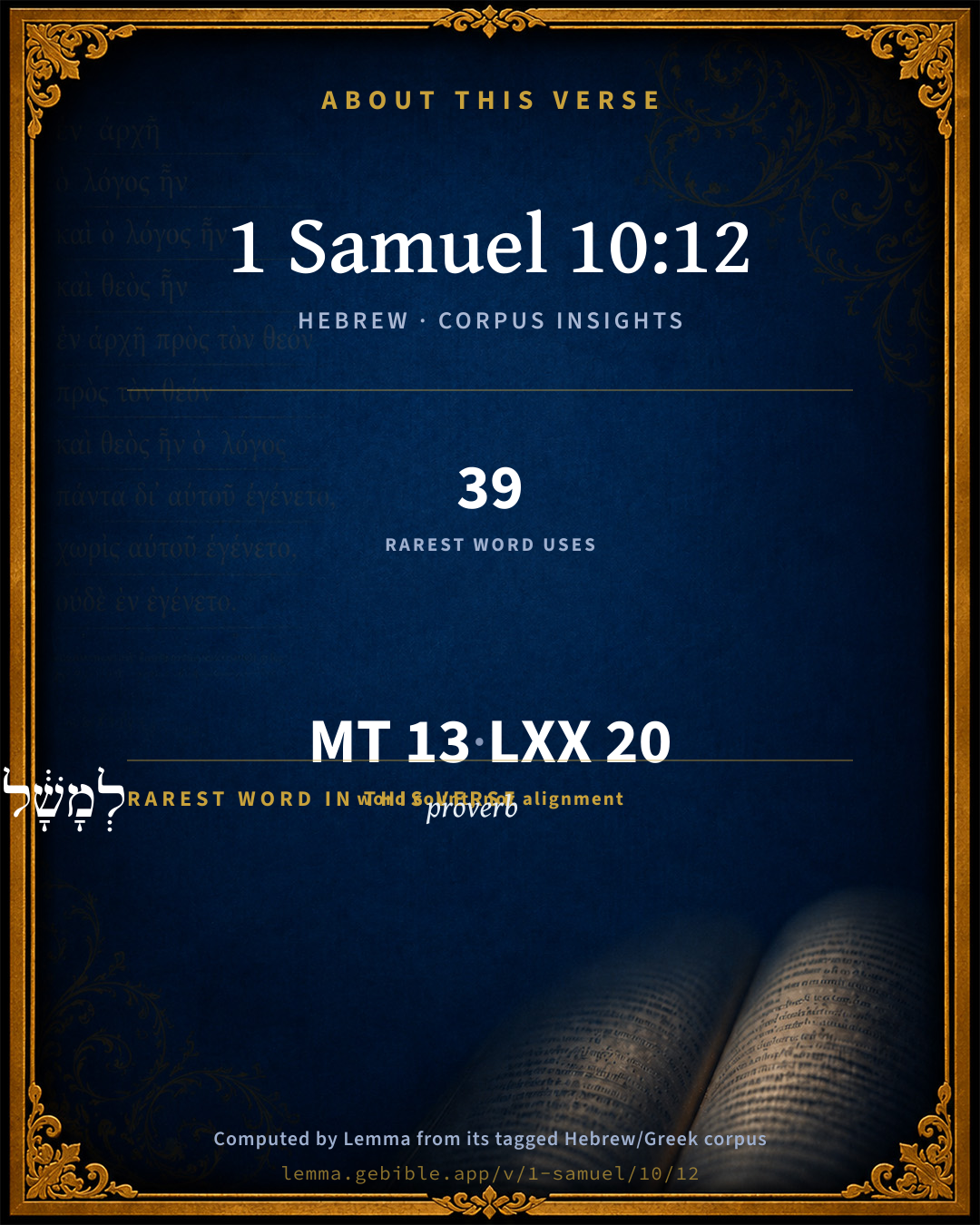
לְמָשָׁ֔ל proverb H4912 occurs in 39 verses of the Hebrew Bible. Also found in:

Grammatical profile

  • 3 verbs
  • 5 nouns
  • 1 preposition
  • 2 adverbs
  • 2 particles

Verb forms

  • וַיַּ֨עַן Qal · Sequential Imperfect
  • וַיֹּ֖אמֶר Qal · Sequential Imperfect
  • הָיְתָ֣ה Qal · Perfect

Hebrew & Septuagint length

In English translation the verse runs 21 words from the Hebrew and 24 from the Septuagint (LXX English) — closely comparable.

A rough comparison of the two English renderings, which tokenize alike — not a word-level alignment.

Word counts can differ between the Hebrew and the Greek without any difference in meaning — e.g. the Hebrew direct-object marker אֵת has no separate Greek word, and Greek often adds the article ὁ.

In the original languages it is 13 Hebrew tokens and 20 Greek tokens — but the two are counted differently (Hebrew bundles its prefixes and suffixes into one token; the Greek is in lemma form), so that isn’t a like-for-like length.

Cross-references

4

Topical passages linked to 1 Samuel 10:12 in the Treasury of Scripture Knowledge — connected by theme and wording, ordered by reader-vote popularity; previews shown in the World English Bible.

  • Isaiah 54:13 All your children shall be taught of Yahweh; and great shall be the peace of your children.
  • John 6:45 It is written in the prophets, 'They will all be taught by God.' Therefore everyone who hears from the Father, and has learned, comes to me.
  • John 7:16 Jesus therefore answered them, "My teaching is not mine, but his who sent me.
  • James 1:17 Every good gift and every perfect gift is from above, coming down from the Father of lights, with whom can be no variation, nor turning shadow.

Cross-references courtesy of OpenBible.info (CC BY 4.0).

Hebrew and Greek witnesses Masoretic Hebrew ↔ Greek Septuagint

The same verse in the two great witnesses to the Old Testament, shown verse-for-verse.

These are two independent witnesses, not word-aligned to each other, and the Septuagint is shown in lemma (dictionary) form.

Hebrew 1 Samuel 10:12 Masoretic · Westminster Leningrad Codex

וַיַּ֨עַן אִ֥ישׁ מִשָּׁ֛ם וַיֹּ֖אמֶר וּמִ֣י אֲבִיהֶ֑ם עַל כֵּן֙ הָיְתָ֣ה לְמָשָׁ֔ל הֲגַ֥ם שָׁא֖וּל בַּנְּבִאִֽים

One of the same place answered, Who is their father? Therefore it became a proverb, Is Saul also among the prophets?

World English Bible · Public Domain

Greek LXX 1 Samuel 10:12 Septuagint · lemma form

καί ἀποκρίνω τις αὐτός καί εἶπον καί τίς πατήρ αὐτός διά οὗτος γίγνομαι εἰς παραβολή εἰμί καί σαούλ ἐν προφήτης

And one of them answered and said, And who is his father? and therefore it became a proverb, Is Saul also among the prophets?

LXX2012 (modern English Septuagint) · Public Domain

On this verse, Jamieson, Fausset & Brown discusses the Septuagint’s reading. Read the note in Commentary ↓

Hebrew: Westminster Leningrad Codex (CC BY 4.0). Greek: Septuagint (public domain); English from LXX2012 (modern English Septuagint) (Public Domain). How the Septuagint differs from the Hebrew →

Targum (Aramaic paraphrase)

1

The Targum is the ancient Jewish Aramaic paraphrase of the Hebrew Scriptures — an interpretive translation, not the Hebrew text itself. Onkelos (literal) and Pseudo-Jonathan (expansive) render the Torah, and Jonathan the Prophets. Coverage is partial: where no permissively-licensed English translation exists for a verse, only the Aramaic is shown. This is verse-level text, not a word-by-word alignment to the Hebrew.

  1. Targum Jonathan Prophets (Joshua–Malachi)
    וַאֲתֵיב גַבְרָא מִתַּמָן וַאֲמַר וּמַן רַבְּהוֹן עַל כֵּן הֲוַת לְמַתְלָא הֲאַף שָׁאוּל בְּסַפְרַיָא:

    (no public-domain English translation for this verse)

    Targum Jonathan — Aramaic: “Mikraot Gedolot” (public domain). English: “Sefaria Community Translation” (CC0 1.0 (public-domain dedication)); “London "Chaldee Paraphrase," 1871” (public domain). Text via Sefaria.

Commentary

Notes on 1 Samuel 10:12 from classic Christian and Jewish commentators (each source and its license shown beneath its notes). The classic Christian expositions comment on the surrounding passage and are grouped to its opening verse, so a note may address several verses; the Jewish commentaries on the Tanakh (Rashi and others) are per-verse, so they appear only where the commentator wrote on this verse.

Lemma curates 59 commentaries, every one of them public domain or Creative Commons licensed, each selected and text-cleaned for this edition rather than reprinted as found. About our sources →

Trapp's Complete Commentary

John Trapp

1Sa 10:12 And one of the same place answered and said, But who [is] their father? Therefore it became a proverb, [Is] Saul also among the prophets?

Ver. 12. And one of the same place.] And, as it may seem, one of the same company of prophets stopped their wondering with these words, as Peter did the people. {Act 2:12; Act 3:10}

But who is their father?] i.e., Their master and instructor? {a} Is it not God? are they not all taught of him? Saul and all? Now, Quando Deus Magister, quam cito discitur quod docetur? {b} God can soon make a prophet of whomsoever he pleaseth.

{a} Chald. Paraph.

{b} August.

John Trapp, A Commentary or Exposition upon All the Books of the Old and New Testament (1647–1656) — public domain. Text from a community e-Sword module.

Joseph Benson's Commentary

1Sa 10:12. And one answered and said, But who is their father? — This wonder was presently satisfied by a prudent person among them asking, Who is the father of all those prophets among whom Saul was now one? Who is it that instructs and inspires them but God? They have not this gift from their parents, nor from their education, but by inspiration from God, who, when he pleases, can bestow it on Saul or any other man, and thereby make him a prophet without the help of any other master; as he did Amos, who was no prophet, nor prophet’s son, but a herdsman, and a gatherer of sycamore fruit. And therefore wonder not at this matter, but give God the glory. Hence it became a proverb — Used when any strange or unexpected thing happened.

Joseph Benson's Commentary on the Old and New Testaments (1811–1818) — public domain. Text from a community e-Sword module.

Tyndale Open Study Notes

Tyndale Open Resources

10:12 “Can anyone become a prophet, no matter who his father is?” Unlike priests and kings, prophets never inherited their office. Possibly the people were asking why Saul, whose well-to-do father was well known, would associate himself with a group of people who had no pedigree.

Tyndale Open Study Notes — © Tyndale Open Resources, licensed CC BY-SA 4.0. Text via the HelloAO Bible API.

Geneva Bible (1599)

Geneva Bible translators

Noting thereby him that from low degree cometh suddenly to honor.

Meaning, that prophecy cometh not by succession, but is given to whom it pleaseth God.

Geneva Bible (1599) marginal notes — public domain. Text via Bolls.life.

Jamieson, Fausset & Brown

Robert Jamieson, A. R. Fausset & David Brown

But who is their father?--The Septuagint reads, "Who is his father?" referring to Saul the son of Kish.

Jamieson, Fausset & Brown — Commentary Critical and Explanatory on the Whole Bible (1871) — public domain (CC PDM 1.0). Text via the HelloAO Bible API.

Adam Clarke's Commentary

Verse 12. But who is their father?] The Septuagint, in its principal editions, adds ου Κεις; is it not Kish? This makes the sense more complete.

Adam Clarke's Commentary on the Bible (1810–1826) — public domain. Text from a community e-Sword/MySword module.

Ellicott's Commentary for English Readers

(12) Who is their father?—As an instance of the extreme surprise with which the association of Saul with the sons of the prophets was witnessed by the inhabitants of Gibeah—an association apparently very foreign to his old habits and to the manner of life of his family—a short dialogue between two of the citizens of Gibeah is here related: a conversation important, owing to the words uttered by the second citizen in reply to the amazed question, “What is this that is come unto the son of Kish?” The reply gives us some insight into the deep conviction entertained by the ordinary Israelite of the days of Samuel that the invisible God was ever present, working in the midst of His chosen people.

The reply of the second citizen has been well explained by Von Bunsen:—“Is the son of Kish, then, a prophet?’ asks the first citizen, surprised, apparently, that one so undistinguished, that one so unlikely to train up a “son of the prophets,” should have a son associated in this peculiar and sudden manner with a chosen band of scholars and teachers. To this question the second citizen replied—no doubt, pointing to the honoured group from the prophet schools of Gibeah—“Do you wonder that the son of so rough and uncultivated a man as Kish should receive the Divine gift which we all love so well and admire so greatly? Who,” pointing to the group singing on the hill-side, “who is their father?” They owe their power of persuasive speech, their gift of holy song, to no accident of birth. Surely Saul, like them, may have received the same power as a gift of the Eternal, not as a patrimony. Owing to this obvious meaning not having occurred to them, the LXX., “Vulgate, and Syriac Versions alter the original into, “Who is his (instead of their) father?” in other words, “Who is Saul? and who is his father, Kish?” But the Hebrew text and the English Version, as explained above, gives an admirable sense, and teaches besides a great spiritual lesson.

A Bible Commentary for English Readers, edited by Charles John Ellicott (1878–1897) — public domain. Text from a community e-Sword module.

The Cambridge Bible for Schools and Colleges

gen. ed. J. J. S. Perowne

12. it became a proverb] Applied probably to the unexpected appearance of any person in a novel character alien to his former occupation and habits. The proverb received a fresh exemplification in the occurrence related in ch. 1Sa_19:24.

The Cambridge Bible for Schools and Colleges (gen. ed. J. J. S. Perowne; Cambridge University Press, 1878–1918) — public domain. Text from a community e-Sword module.

John Gill's Exposition

And one of the same place answered, and said,.... One of the same city, and in the same company, that expressed their admiration at what was come to Saul, and at what he did, and wondering how he came into such company, and to have such a gift, who was of so mean an education:

but who is their father? the father of the prophets; their fathers were not prophets, no more than Saul's was; their Father that taught them is the Lord, and he was able to teach Saul, and bestow on him the gift of prophecy, as well as on them; and so the Targum, who is their master or teacher; for though they might have an undermaster or teacher, as Samuel, or another prophet, yet their chief teacher was God; who could and did give men the gift of prophecy, and even in the highest sense, who had neither prophets for their fathers, nor were indeed trained up in any of the schools of the prophets, which was the case of Amos:

therefore it became a proverb, is Saul also among the prophets? that when a person of a mean parentage, and of a low life and education, was raised up to any degree of dignity in sacred and civil things, they used to apply this proverbial expression to him, or speak of him in this manner, is Saul among the prophets?

John Gill's Exposition of the Whole Bible (1746–1763) — public domain (CC PDM 1.0). Text via the HelloAO Bible API.

Albert Barnes' Notes on the Bible

But who is their father - This is a very obscure phrase. If by “father” be intended the head or leader (compare 1Ch 25:6; 2Ki 2:12) of the prophets, the question means: “What kind of leader can they have to admit such a person as Saul into the company?” Some versions read “Who is his father?” in the sense: “Who would have expected Kish to have a son among the prophets?” (Compare Mat 13:54-55.)

Albert Barnes' Notes on the Bible (1834–1885) — public domain. Text from a community e-Sword/MySword module.

Haydock's Catholic Bible Commentary

Their father. That is, their teacher or superior. As much as to say, Who could bring about such a wonderful change as to make Saul a prophet? (Challoner) but the Lord, whose Spirit breatheth where he will, John iii. 8. (Haydock) --- Septuagint, "Who is his father? is it not Cis?" The Jews seem to have been in a like consternation, when they observed respecting Jesus, who wrought such miracles, Is not this the carpenter’s son? People are unwilling to reflect, that God can select his instruments and ministers from every profession, and make the tongues of infants eloquent. (Haydock) --- The spirit of prophecy is a gift of God, not of parents. (Menochius) --- But a prophet is not without honour, save in his own country, Matthew xiii. 57. (Haydock)

George Leo Haydock (1774–1849), Haydock's Catholic Family Bible and Commentary, 1859 edition — public domain. Excludes Psalms (Douay-Rheims chapter numbering differs from Protestant) and Deuterocanonical books (Catholic canon only).

Matthew Poole's English Annotations

One of the same place, Heb. one from thence, i.e. one of the company there present, or one of the prophets there prophesying.

Who is their father? who is the father of all these prophets of whom you speak, and among whom Saul now is one? who is it that instructs and inspires them with this holy art, but God? They have it not from their natural parents, nor from their civil education, but by inspiration from God, who, when he pleaseth, can inspire Saul, or any other man, with the same skill. And therefore wonder not at this matter, but give God the glory of it. Father is here put for teacher, or instructer, as it is used; as Gen 4:20,21; Mt 23:9; 1Co 4:15. And hence the scholars are called sons of the prophets. It became a proverb, used when any strange, unlikely, or unexpected thing happened.

Matthew Poole's English Annotations on the Holy Bible (1683–1685) — public domain. Text from a community e-Sword/MySword module.

Whedon's Commentary on the Bible

Daniel D. Whedon

12. Who is their father — Not his father, as the Septuagint and other versions presume to amend the Hebrew text, — for this was not a contemptuous question; and otherwise it would have been meaningless in the mouth of a man of Gibeah, who must have known the father of Saul, — but, Who is the father of them? that is, of the prophets: — who makes prophets? Is it not God? and cannot he make a prophet of the son of Kish as easily as of any other man? The gift of prophecy comes not by natural descent, but by inspiration of the Almighty; and this fact was ever suggested by the proverb, afterwards common in Israel, Is Saul also among the prophets?

Daniel D. Whedon (gen. ed.), Commentary on the Old and New Testaments (1874–1909) — public domain. Text from a community e-Sword module.

The Pulpit Commentary

One of the same placei.e. Gibeahanswered and said, But who is their father? The Septuagint, Syriac, and Vulgate read, But who is his father? But this would be a foolish reply to the question, "What has happened to the son of Kish?" The meaning rather must be, You ask about the son of Kish; but what has birth to do with prophecy? None of these young men have inherited these gifts, and if Saul can take part in their prophesyings, why should he not? Kish, his father, is no worse than theirs. Is Saul also among the prophets? Under very different circumstances Saul once again took part in the exercises of these youthful prophets, (1Sa_19:24) and evidently on both occasions with such skill and success as prove the readiness of his genius; and so struck were the people at the strange power which he thus evinced, that their expression of wonder became fixed in the national mind as a proverb. Saul was a man of great natural ability, and yet not the sort of person whom the people expected would be made king. He probably could neither read nor write, and from his extreme height was perhaps awkward and bashful; as he suffered afterwards from fits of insanity, (1Sa_16:14) he may always have been flighty and wilful; and altogether, though possessed of marvellous gifts, was certainly the very opposite of Samuel"s well trained and orderly scholars.

The Pulpit Commentary (1880–1919), ed. H.D.M. Spence-Jones & Joseph S. Exell — public domain. Text from a community e-Sword module.

John Wesley's Explanatory Notes

Who is, &c. - Who is the father of all these prophets, among whom Saul now is one? Who is it that instructs and inspires them but God? They have it not from their parents, nor from their education, but by inspiration from God, who, when he pleaseth, can inspire Saul, or any other man with the same skill. And therefore wonder not at this matter, but give God the glory of it. A proverb - Used when any strange, or unexpected thing happened.

John Wesley, Explanatory Notes Upon the Whole Bible (1754–1765) — public domain. Text via the GEBible commentary corpus.

Rashi

Rabbi Shlomo Yitzchaki (Rashi)

And who is their father? Why do you wonder about the matter as to who is the father of the prophets? Is prophecy hereditary?

Rashi on the Tanakh — English translations: “The Judaica Press complete Tanach with Rashi, translated by A. J. Rosenberg” (CC BY 4.0); “Pentateuch with Rashi's commentary by M. Rosenbaum and A.M. Silbermann, 1929-1934” (public domain); “The Metsudah Tanach series, Lakewood, N.J” (CC BY 4.0); and “The Book of Joshua, Metsudah Publications, 1997” (CC BY 4.0). Text via Sefaria.

Lesson kit

Teaching starters — assembled from the data on this page, not authored interpretation. Every prompt links to the verse data it draws on. Edit before teaching.

1 Samuel, in the Historical, opens this verse with 13 words (13 distinct Hebrew lemmas). Its most distinctive word is mâshâl (“proverb”). A historical commentator’s framing appears above. Read the whole chapter for the surrounding context.

Discussion questions

  1. What does “proverb” (mâshâl) contribute to the verse as a whole?
  2. Numbers 23:7 shares the word «proverb» with this verse. How do the two illuminate each other?
  3. These translations render this verse differently. What is at stake in choosing one wording over another?
  4. The verb «וַיַּ֨עַן» is Qal Sequential Imperfect. How does its form color the action?
  5. Reading how Trapp's Complete Commentary and Joseph Benson's Commentary read this verse, where do the two commentators agree and where do they part?

Things to notice

Reading settings

Reading text

Shown beneath each verse's original-language words.

Old Testament
Old Testament edition

Read the OT as the Masoretic Hebrew (MT) or the Greek Septuagint (LXX).

English shown for the Greek Septuagint (in the Hebrew ↔ Greek comparison).

Comparing translations? Open the Compare panel on any verse page to stack up to four side by side.