1 Samuel 3:20

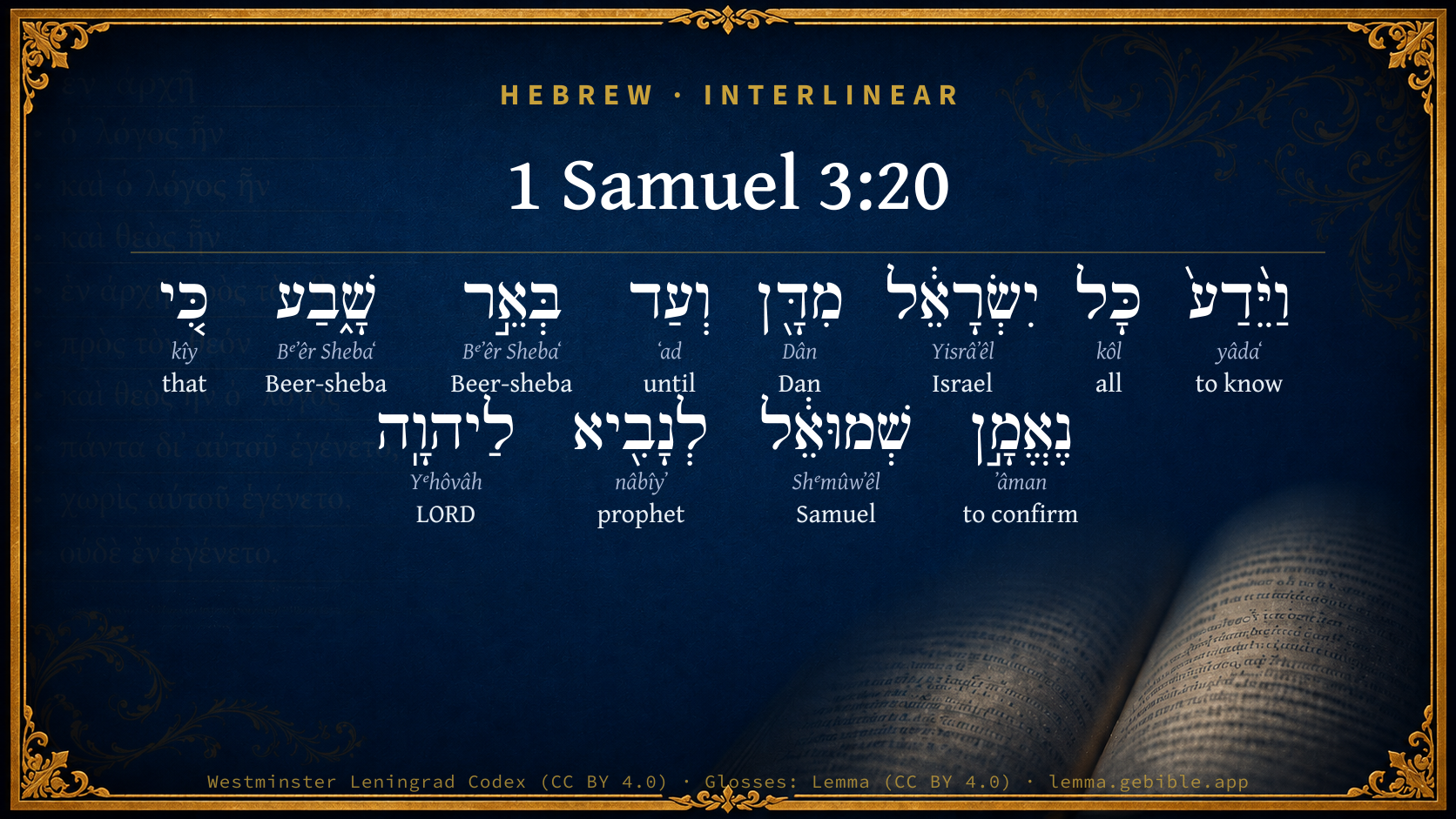
Hebrew (Westminster Leningrad Codex) 1 Samuel 3:20 appears in the Hebrew Old Testament. The text above is from the Westminster Leningrad Codex. Each word links to its Strong’s number, a concise gloss, and parsing drawn from the Open Scriptures Hebrew Bible morphology. Click any word for its full Brown-Driver-Briggs (BDB) entry.
Download image
Cite this verse

1 Samuel 3:20 (World English Bible). Public Domain. Lemma interlinear Bible study tool, https://lemma.gebible.app/v/1-samuel/3/20.

Show BibTeX & RIS
BibTeX
RIS
English Translation
All Israel from Dan even to Beersheba knew that Samuel was established to be a prophet of Yahweh.
World English Bible · Public Domain
Download a study sheet

One document with this verse’s original text, its word-by-word gloss line, the meaning frame, cross-references with their text, attributed commentary, and full source and license credits — printable, and it pastes into notes with its structure intact.

This verse Autodidact and up

Study sheet (.html) Plain text (.txt)

A passage Seminary Student

Up to 50 verses in one chapter. A passage sheet keeps up to 6 commentary sources and 12 cross-references per verse, in the order this page ranks them, and says so on the sheet whenever that leaves anything out. Ask for a single verse and you get the Autodidact verse sheet above.

Everything on this page stays free to read, with no account — the sheet is a download of what is already on screen, not access to it.

Want to remove ads? Support Godless Engineer
Compare translations 3

The same verse in 3 English versions, stacked beneath the original-language interlinear above. Click any original word for its lexicon entry.

Each is an independent rendering of the whole verse — the interlinear is not word-aligned to these translations.

Highlighted words mark where these versions differ — a whole-verse word diff, not a word-by-word alignment.

  • World English Bible Public Domain
    All Israel from Dan even to Beersheba knew that Samuel was established to be a prophet of Yahweh.
  • King James Version Public Domain
    And all Israel from Dan even to Beersheba knew that Samuel was established to be a prophet of the LORD.
  • unfoldingWord Literal Text CC BY-SA 4.0
    So all of Israel, from Dan and unto Beersheba, knew that Samuel was established as a prophet of Yahweh.

unfoldingWord Literal Text — © unfoldingWord, licensed CC BY-SA 4.0. Word-aligned USFM3 via Door43 (git.door43.org/unfoldingWord/en_ult).

Versions to compare (up to 4)

3 of 4 selected

Show all 18 translations

Every available English version of this verse, each an independent rendering of the whole verse.

  • World English Bible Public Domain
    All Israel from Dan even to Beersheba knew that Samuel was established to be a prophet of Yahweh.
  • Berean Standard Bible Public Domain
    So all Israel from Dan to Beersheba knew that Samuel was confirmed as a prophet of the LORD.
  • Majority Standard Bible Public Domain
    So all Israel from Dan to Beersheba knew that Samuel was confirmed as a prophet of the LORD.
  • King James Version Public Domain
    And all Israel from Dan even to Beersheba knew that Samuel was established to be a prophet of the LORD.
  • American Standard Version (1901) Public Domain
    And all Israel from Dan even to Beer-sheba knew that Samuel was established to be a prophet of Jehovah.
  • Revised Version (1885) Public Domain
    And all Israel from Dan even to Beer-sheba knew that Samuel was established to be a prophet of the LORD.
  • Geneva Bible (1599) Public Domain
    And all Israel from Dan to Beer-sheba knew that faithfull Samuel was the Lordes Prophet.
  • Douay-Rheims (1899) Public Domain
    And all Israel from Dan to Bersabee, knew that Samuel was a faithful prophet of the Lord.
  • Young's Literal Translation Public Domain
    and all Israel know, from Dan even unto Beer-Sheba, that Samuel is established for a prophet to Jehovah.
  • Literal Standard Version CC BY-SA 4.0
    and all Israel knows, from Dan even to Beer-Sheba, that Samuel is established for a prophet to YHWH.
  • Unlocked Literal Bible CC BY-SA 4.0
    All Israel from Dan to Beersheba knew that Samuel was appointed to be a prophet of Yahweh.
  • unfoldingWord Literal Text CC BY-SA 4.0
    So all of Israel, from Dan and unto Beersheba, knew that Samuel was established as a prophet of Yahweh.
  • Darby Bible Public Domain
    And all Israel, from Dan even to Beer-sheba, knew that Samuel was established a prophet of Jehovah.
  • World Messianic Bible Public Domain
    All Israel from Dan even to Beersheba knew that Samuel was established to be a prophet of the LORD.
  • Webster's Bible Public Domain
    And all Israel, from Dan even to Beer-sheba, knew that Samuel was established to be a prophet of the LORD.
  • Free Bible Version CC BY-SA 4.0
    Everyone in the whole of Israel from Dan to Beersheba recognized that Samuel was a trustworthy prophet of the Lord.
  • Bible in Basic English Public Domain
    And it was clear to all Israel from Dan to Beer-sheba that Samuel had been made a prophet of the Lord.
  • JPS Tanakh (1917) Public Domain
    And all Israel from Dan even to Beer-sheba knew that Samuel was established to be a prophet of the LORD.

Literal Standard Version (2020), Covenant Press — licensed CC BY-SA 4.0. Text via the HelloAO Bible API (eBible.org). Unlocked Literal Bible (unfoldingWord) — licensed CC BY-SA 4.0. Text via the HelloAO Bible API (eBible.org). unfoldingWord Literal Text — © unfoldingWord, licensed CC BY-SA 4.0. Word-aligned USFM3 via Door43 (git.door43.org/unfoldingWord/en_ult). Free Bible Version, Dr. Jonathan Gallagher — licensed CC BY-SA 4.0. Text via the HelloAO Bible API (eBible.org).

Word by word

More ways to search: Search by grammar → Find every occurrence → Compare this word →

Practice this passage: Drill this verse → Learn its vocabulary →

About this verse

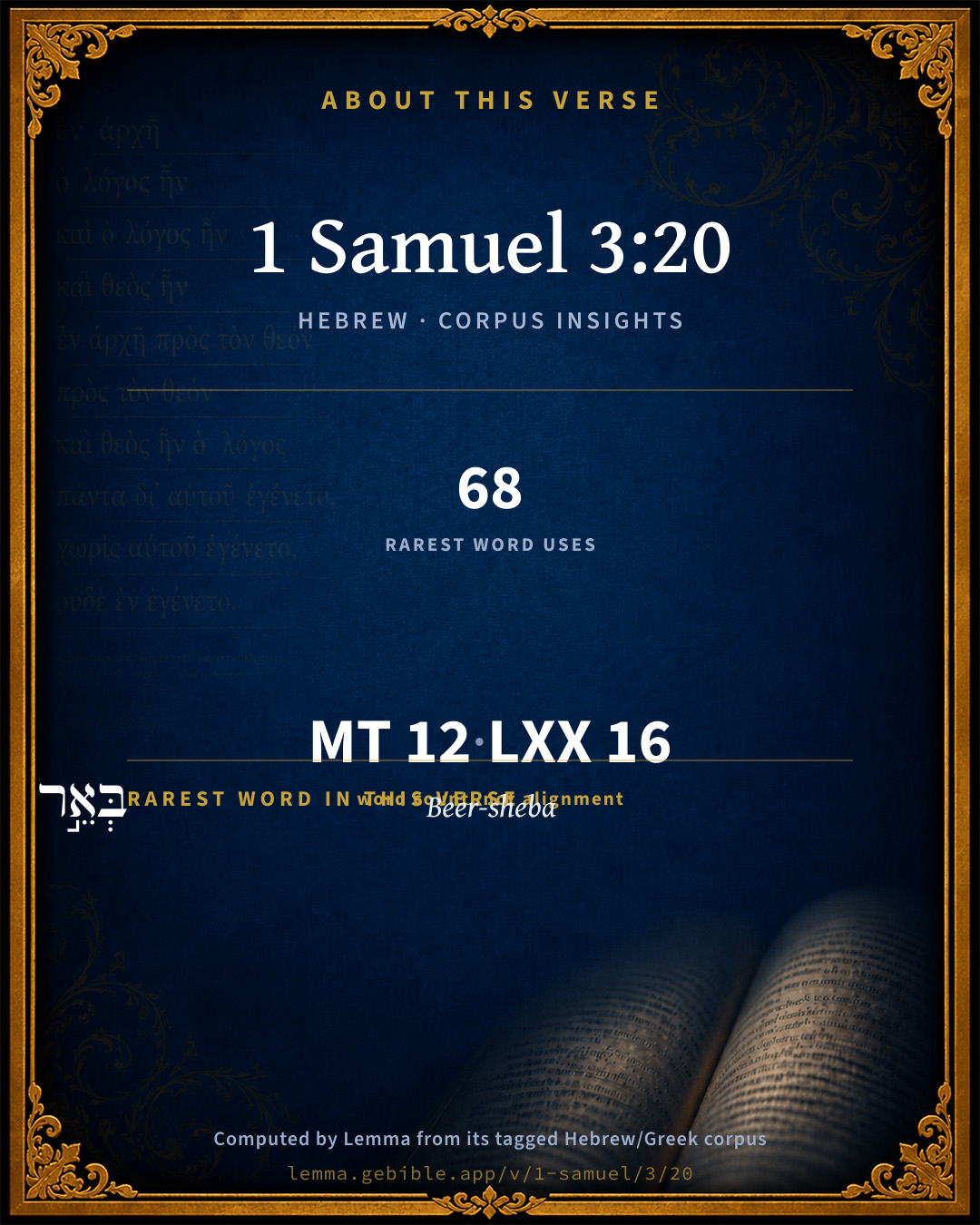
These counts appear in no published source. They are computed here, from the morphology-tagged text and Lemma’s own curated glosses. What Lemma adds →

12
words
11
distinct lemmas
Historical
section

Grammatical profile

  • 2 verbs
  • 8 nouns
  • 1 preposition
  • 1 conjunction

Verb forms

  • וַיֵּ֨דַע֙ Qal · Sequential Imperfect
  • נֶאֱמָ֣ן Niphal · Participle Active

Repetition

A word recurs within this verse — often emphatic in Hebrew:

  • בְּאֵ֣ר Beer-sheba H884 ×2

Hebrew & Septuagint length

In English translation the verse runs 18 words from the Hebrew and 19 from the Septuagint (LXX English) — closely comparable.

A rough comparison of the two English renderings, which tokenize alike — not a word-level alignment.

Word counts can differ between the Hebrew and the Greek without any difference in meaning — e.g. the Hebrew direct-object marker אֵת has no separate Greek word, and Greek often adds the article ὁ.

In the original languages it is 12 Hebrew tokens and 16 Greek tokens — but the two are counted differently (Hebrew bundles its prefixes and suffixes into one token; the Greek is in lemma form), so that isn’t a like-for-like length.

Cross-references

4

Topical passages linked to 1 Samuel 3:20 in the Treasury of Scripture Knowledge — connected by theme and wording, ordered by reader-vote popularity; previews shown in the World English Bible.

  • Judges 20:1 Then all the children of Israel went out, and the congregation was assembled as one man, from Dan even to Beersheba, with the land of Gilead, to Yahweh at Mizpah.
  • 2 Samuel 3:10 to transfer the kingdom from the house of Saul, and to set up the throne of David over Israel and over Judah, from Dan even to Beersheba.
  • 1 Timothy 1:12 And I thank him who enabled me, Christ Jesus our Lord, because he counted me faithful, appointing me to service;
  • 2 Samuel 17:11 But I counsel that all Israel be gathered together to you, from Dan even to Beersheba, as the sand that is by the sea for multitude; and that you go to battle in your own person.

Cross-references courtesy of OpenBible.info (CC BY 4.0).

Hebrew and Greek witnesses Masoretic Hebrew ↔ Greek Septuagint

The same verse in the two great witnesses to the Old Testament, shown verse-for-verse.

These are two independent witnesses, not word-aligned to each other, and the Septuagint is shown in lemma (dictionary) form.

Hebrew 1 Samuel 3:20 Masoretic · Westminster Leningrad Codex

וַיֵּ֨דַע֙ כָּל יִשְׂרָאֵ֔ל מִדָּ֖ן וְעַד בְּאֵ֣ר שָׁ֑בַע כִּ֚י נֶאֱמָ֣ן שְׁמוּאֵ֔ל לְנָבִ֖יא לַיהוָֽה

All Israel from Dan even to Beersheba knew that Samuel was established to be a prophet of Yahweh.

World English Bible · Public Domain

Greek LXX 1 Samuel 3:20 Septuagint · lemma form

καί γιγνώσκω πᾶς ἰσραήλ ἀπό δαν καί ἕως βηρσαβεε ὅτι πιστός σαμουηλ εἰς προφήτης ὁ κύριος

And all Israel knew from Dan even to Bersabee, that Samuel was faithful as a prophet to the Lord.

LXX2012 (modern English Septuagint) · Public Domain

On this verse, Haydock's Catholic Bible Commentary discusses the Septuagint’s reading. Read the note in Commentary ↓

Hebrew: Westminster Leningrad Codex (CC BY 4.0). Greek: Septuagint (public domain); English from LXX2012 (modern English Septuagint) (Public Domain). How the Septuagint differs from the Hebrew →

Targum (Aramaic paraphrase)

1

The Targum is the ancient Jewish Aramaic paraphrase of the Hebrew Scriptures — an interpretive translation, not the Hebrew text itself. Onkelos (literal) and Pseudo-Jonathan (expansive) render the Torah, and Jonathan the Prophets. Coverage is partial: where no permissively-licensed English translation exists for a verse, only the Aramaic is shown. This is verse-level text, not a word-by-word alignment to the Hebrew.

  1. Targum Jonathan Prophets (Joshua–Malachi)
    וִידַע כָּל יִשְׂרָאֵל מִדָן וְעַד בְּאֵר שָׁבַע אֲרֵי מְהֵימָן שְׁמוּאֵל בְּפִּתְגָמֵי נְבוּאֲתָא דַיָי:

    (no public-domain English translation for this verse)

    Targum Jonathan — Aramaic: “Mikraot Gedolot” (public domain). English: “Sefaria Community Translation” (CC0 1.0 (public-domain dedication)); “London "Chaldee Paraphrase," 1871” (public domain). Text via Sefaria.

Commentary

Notes on 1 Samuel 3:20 from classic Christian and Jewish commentators (each source and its license shown beneath its notes). The classic Christian expositions comment on the surrounding passage and are grouped to its opening verse, so a note may address several verses; the Jewish commentaries on the Tanakh (Rashi and others) are per-verse, so they appear only where the commentator wrote on this verse.

Lemma curates 59 commentaries, every one of them public domain or Creative Commons licensed, each selected and text-cleaned for this edition rather than reprinted as found. About our sources →

Trapp's Complete Commentary

John Trapp

1Sa 3:20 And all Israel from Dan even to Beersheba knew that Samuel [was] established [to be] a prophet of the LORD.

Ver. 20. That Samuel was established.] Because his words were fulfilled.

John Trapp, A Commentary or Exposition upon All the Books of the Old and New Testament (1647–1656) — public domain. Text from a community e-Sword module.

The Biblical Illustrator

Joseph S. Exell

1Sa_3:20-21

And all Israel, from Dan even to Beer-sheba, knew that Samuel was established to be a prophet of the Lord.

From Dan to Beer-sheba

That is to say, from Plymouth to Aberdeen--all the people in the towns and villages of Israel knew that there was come a new thing on the earth, that God was now speaking by the mouth of a little child. One of the first lessons which comes from the study of this story is, that bad men and bad things are doomed. Nothing can keep alive that which God has condemned. I look upon Hophni and Phinehas as representatives of that which was bad. All Israel from Dan to Beer-sheba knew that Samuel was established to be a prophet of the Lord, and at the same time, that Hophni and Phinehas were to be removed from the face of the earth. We are surrounded by evil; bad men and bad things are all around us. But I want those of us who believe in God to cheer ourselves with the thought that nothing will live forever but that which is good. No wrong thing can live foreverse Slavery was a giant. It is a giant yet in Africa; but its brother, American slavery, came down never to rise. Tyranny is a doomed thing. Samuel is established to be a prophet of the Lord; and I do not care who Hophni and Phinehas are if you will only do your duty. Be brave, and God will see you through.

2. The second lesson I want to teach today is this: Mothers, get your children ready, that Samuel may be established to be a prophet of the Lord. Oh! what honour came to Hannah through Samuel. We should encourage our children to have right ideas, and encourage them to propagate their ideas. Never was there a time when there was so much room for individual goodness.

3. I should say, further, that early consecration is the pathway to honour and greatness. What a great man Samuel became. (T. Champness.)

The call and prophetic work of Samuel

I. In the first place, we will consider the call of Samuel.

II. But in the second place let us consider the prophetic work or Samuel.

1. First, his work Was to announce the Divine mind by predicting future events.

2. In the second place, another pare of the prophetic work of Samuel was to revive religion and restore the worship of God among the nation. For at the time that Samuel was introduced to the prophetic office, religion was exceedingly low, indescribably low.

3. But, in the next place, another part of his work was to decide all doubtful cases, according to the will and the law of God. The most difficult of all those cases that came before him was the introduction of monarchy into the theocracy.

4. Another part of the work of Samuel was to introduce and to perpetuate a race of prophets, a series of prophets, in the Jewish church.

5. But again: another part of his work was to write a portion of the inspired volume--to communicate a part of the mind of God by inspiration.

1. Let us learn from this, in the first place, that early piety is of great influence in the Christian church.

2. And, in the second place, let us learn how a youth, in very disadvantageous circumstances, may be of great use in reviving religion in his day and generation (T. W. Jenkyn, D. D.)

Communications from God

1. What a dreary, hopeless state it is to live without any communications from God! Man did never in fact live entirely without such communications. God did reveal Himself at sundry times and in divers manners, sometimes dropping His communications for a long tract of time, but always renewing them again. It has indeed been said by doubters and unbelievers that God has given man a conscience and a moral sense, which speak to him in Gods name, and teach him what is right and wrong, and that this is quite sufficient communication from God to make us good and happy, and that we need nothing further. But what is it that our conscience, which is indeed the voice of God within us, teaches us first and before all things else? It is that we have gone astray from the rule of right. No man, without some better help than conscience lent him, ever lived fully up to the requirements of his conscience.

2. But again: God revealed Himself to Samuel by the word of the Lord. We may justly reflect that He has done this more completely to ourselves than He did to Samuel. Now, do we each one of us practically act as if we fully believed that constant revelations from God were necessary to make us holy and happy? Do we make daily devout use of the Holy Scripture, which is our great means of receiving revelations, or, in other words, communications from God? (Dean Goulburn.)

.

The Biblical Illustrator, edited by Joseph S. Exell (c. 1880s–1900s) — public domain. Text from a community e-Sword module.

Joseph Benson's Commentary

1Sa 3:20-21. All Israel, from Dan, &c. — That is, through the whole land, from the northern bound, Dan, to the southern, Beer-sheba: which was the whole length of the land. That Samuel was established, &c. — That is, settled to be a constant prophet. The Lord appeared again, &c. — Having begun to appear to him in Shiloh, he continued this great favour, and revealed himself, not by dreams and visions, but by speaking to him with an audible voice, as he had done at first. And indeed he seems to have been the first eminent prophet that was raised up, after Moses, to be a public instructer and governor of God’s people. Others there had been before him; but not with so high an authority and public approbation. And therefore St. Peter says, Act 3:24, All the prophets from Samuel spake of these days; intimating, that he was the first eminent prophet whom the Lord raised up after Moses.

Joseph Benson's Commentary on the Old and New Testaments (1811–1818) — public domain. Text from a community e-Sword module.

Tyndale Open Study Notes

Tyndale Open Resources

3:20 The whole nation, from Dan in the north to Beersheba in the south, acknowledged that Samuel was God’s prophet. • confirmed as a prophet: The reliability of Samuel’s message (3:19) made it evident that God was speaking through him.

Tyndale Open Study Notes — © Tyndale Open Resources, licensed CC BY-SA 4.0. Text via the HelloAO Bible API.

Geneva Bible (1599)

Geneva Bible translators

Or, that Samuel was the faithful Prophet of the Lord.

Geneva Bible (1599) marginal notes — public domain. Text via Bolls.life.

Adam Clarke's Commentary

Verse 20. All Israel from Dan even to Beer-sheba] Through the whole extent of Palestine; Dan being at the northern, Beer-sheba at the southern extremity.

Was established to be a prophet] The word נאמן neeman, which we translate established, signifies faithful: The faithful Samuel was a prophet of the Lord.

Adam Clarke's Commentary on the Bible (1810–1826) — public domain. Text from a community e-Sword/MySword module.

Ellicott's Commentary for English Readers

(20) A prophet of the Lord.—Then from the northern to the southern cities of the land the fame of the boy-friend of the Eternal was established. The minds of all the people were thus gradually prepared when the right moment came to acknowledge Samuel as a God-sent chieftain. On this rapid and universal acknowledgment of the young prophet it has been observed, “that the people, in spite of their disruption, yet formed religiously an unit.”

A Bible Commentary for English Readers, edited by Charles John Ellicott (1878–1897) — public domain. Text from a community e-Sword module.

The Cambridge Bible for Schools and Colleges

gen. ed. J. J. S. Perowne

20. from Dan even to Beer-sheba] The regular formula to denote the whole extent of the land of Israel. It is first found in Jdg_20:1, and is common in the books of Samuel, but naturally disappears after the Division of the Kingdoms, occurring only once again, and that after the fall of the northern kingdom (2Ch_30:5).

Dan—originally Leshem or Laish, a Sidonian colony—was captured, colonized, and re-named by a band of Danites (Jos_19:47; Judges 18). It was the northernmost town of the Holy Land, and stood upon a hill from the base of which springs one of the main sources of the Jordan, to flow through a rich and fertile plain towards the Lake of Merom. Here Jeroboam set up one of the golden calves (1Ki_12:29-30), but shortly afterwards it was sacked by Benhadad (1Ki_15:20), and we hear no more of it. Its name, however, probably survives to this day. Dan = judge, and the hill is still called Teil-el-Kady = “mound of the judge,” while the stream bears the name el-Leddân, which may possibly be a corruption of Dan. See Robinson’s Biblical Researches in Palestine, III. 390 ff.

Beer-sheba = “well of the oath,” so named from the covenant which Abraham and Abimelech made there (Gen_21:31; cp. Gen_26:31-33): or possibly = “well of seven,” in allusion to the seven ewe lambs with which die covenant was ratified (Gen_21:29-30). It was situated at the southernmost extremity of the land, on the confines of the desert. It was a notable place in the history of the patriarchs.

(1) Here Abraham, Isaac and Jacob often dwelt (Gen_22:19; Gen_28:10; Gen_46:1). (2) Here Samuel’s sons were established as judges (1Sa_8:2). (3) Hither came Elijah when he fled from Jezebel (1Ki_19:3). (4) It was apparently the seat of an idolatrous worship in the days of Amos (Amo_5:5; Amo_8:14). (5) It is mentioned for the last time as one of the towns reoccupied by the Jews on their return from the Captivity (Neh_11:27).

The site of Beer-sheba is beyond question, for the name still survives in the Arabic Bîr es-Sebâ = “well of seven,” or “well of the lion.” There are two principal, and five lesser wells. “The water in both [the principal wells] is pure and sweet and in great abundance: the finest indeed we had found since leaving Sinai. Both wells are surrounded with drinking-troughs of stone for camels and flocks; such as were doubtless used of old for the flocks which then fed on the adjacent hills. The curbstones were deeply worn by the friction of the ropes in drawing up water by hand.” Robinson, Bib. Res. I. 204. But Lieutenant Conder made the disappointing discovery that the masonry is not very ancient. There is a stone in the large well with an Arabic inscription bearing a date in the twelfth century a.d. Tent Work, II. 96.

was established] or, “found faithful,” “approved.” The Heb. word is the same as that which, in ch. 1Sa_2:35, is rendered ‘a faithful priest,’ ‘a sure house;’ and the use of it here seems to indicate that Samuel’s call was the beginning of the fulfilment of that prophecy.

The Cambridge Bible for Schools and Colleges (gen. ed. J. J. S. Perowne; Cambridge University Press, 1878–1918) — public domain. Text from a community e-Sword module.

John Gill's Exposition

And all Israel, from Dan even unto Beersheba,.... That is, from the most northern border of the land of Israel, on which Dan lay, to the utmost border of it southward, where Beersheba was, the fame of Samuel for his piety, prudence, and prophecy, was spread abroad; so that all

knew that Samuel was established to be a prophet of the Lord; or that he was faithful (z) to God and man, to be credited in what he said; and so a fit man to be a prophet of the Lord, being eminently qualified with gifts by him for that office; the Targum is,"that Samuel was faithful in the words of the prophecy of the Lord,''in relating them.

(z) "fidelis", V. L. Pagninus, Montanus, Tigurine version.

John Gill's Exposition of the Whole Bible (1746–1763) — public domain (CC PDM 1.0). Text via the HelloAO Bible API.

Albert Barnes' Notes on the Bible

From Dan ... - See Jdg 20:1 note.

Albert Barnes' Notes on the Bible (1834–1885) — public domain. Text from a community e-Sword/MySword module.

Haydock's Catholic Bible Commentary

Faithful. Hebrew Neeman, may be a title of dignity, or may signify that Samuel was confirmed and continued to be a prophet. (Calmet) --- According to, or by. God revealed his will to him by word, and not by visions. (Sanchez) --- Israel. The whole people suffered along with their leaders. (Haydock) --- They were concerned in the prediction which was denounced against the house of Heli. (Menochius) --- Septuagint, "and Samuel was entrusted to the prophet of the Lord, to all Israel, from the ends of the earth to the ends: And Heli was very old, and his sons going went forward, and their way was wicked before the Lord." Thus they usher in the following catastrophe. (Haydock)

George Leo Haydock (1774–1849), Haydock's Catholic Family Bible and Commentary, 1859 edition — public domain. Excludes Psalms (Douay-Rheims chapter numbering differs from Protestant) and Deuterocanonical books (Catholic canon only).

Matthew Poole's English Annotations

From Dan even to Beer-sheba; through the whole land, from the northern bound,

Dan, to the southern,

Beer-sheba; which was the whole length and largest extent of the land. See Jdg 20:1,2; 2Sa 17:11.

Knew, both by Eli’s testimony, and particular relation of the foregoing history, to the people that came from all parts; and by succeeding revelations made to him, whereof mention is made in the next verse, which though placed after, might be done before.

Matthew Poole's English Annotations on the Holy Bible (1683–1685) — public domain. Text from a community e-Sword/MySword module.

Whedon's Commentary on the Bible

Daniel D. Whedon

20. From Dan even to Beer-sheba — Dan, elsewhere called also Laish, (Jdg_18:29,) was situated about twenty-five miles north of the Sea of Galilee, and Beer-sheba in the south of Palestine, toward the borders of Arabia. These places served to designate the two extremities of the land of Israel. Compare Jdg_20:1; 2Sa_3:10; 2Sa_17:11; 2Sa_24:2; 2Sa_24:15; 1Ki_4:25.

Daniel D. Whedon (gen. ed.), Commentary on the Old and New Testaments (1874–1909) — public domain. Text from a community e-Sword module.

The Pulpit Commentary

From Dan, upon the north, to Beersheba, upon the south, means "throughout the whole country." The phrase is interesting, as showing that, in spite of the virtual independence of the tribes, and the general anarchy which prevailed during the time of the judges, there was nevertheless a feeling that they all formed one people. Was established. The same word used in Num_12:7 of Moses, and there translated was faithful. It is one of those pregnant words common in Hebrew, containing two cognate meaning. It says, first, that Samuel was faithful in his office; and, secondly, that because he was found trustworthy he was confirmed and strengthened in the possession of it.

The Pulpit Commentary (1880–1919), ed. H.D.M. Spence-Jones & Joseph S. Exell — public domain. Text from a community e-Sword module.

John Wesley's Explanatory Notes

From Daniel, &c. - Thro' the whole Land, from the northern bound Daniel, to the southern, Beersheba; which was the whole length of the Land.

John Wesley, Explanatory Notes Upon the Whole Bible (1754–1765) — public domain. Text via the GEBible commentary corpus.

Lesson kit

Teaching starters — assembled from the data on this page, not authored interpretation. Every prompt links to the verse data it draws on. Edit before teaching.

1 Samuel, in the Historical, opens this verse with 12 words (11 distinct Hebrew lemmas). Its most distinctive word is Bᵉʼêr Shebaʻ (“Beer-sheba”). A historical commentator’s framing appears above. Read the whole chapter for the surrounding context.

Discussion questions

  1. What does “Beer-sheba” (Bᵉʼêr Shebaʻ) contribute to the verse as a whole?
  2. How does Judges 20:1, which shares this passage’s theme, read alongside this verse?
  3. What does the repetition of “Beer-sheba” (2× in this one verse) do in this verse?
  4. These translations render this verse differently; the difference is in the English rendering, not the original. What questions does that raise?
  5. «וַיֵּ֨דַע֙» is a Qal Sequential Imperfect verb. How does that grammatical form shape the action described?
  6. Compare how Trapp's Complete Commentary and The Biblical Illustrator read this verse. Where do they agree or differ?

Things to notice

Reading settings

Reading text

Shown beneath each verse's original-language words.

Old Testament
Old Testament edition

Read the OT as the Masoretic Hebrew (MT) or the Greek Septuagint (LXX).

English shown for the Greek Septuagint (in the Hebrew ↔ Greek comparison).

Comparing translations? Open the Compare panel on any verse page to stack up to four side by side.