Titus 1:12

Greek (Tischendorf 8th ed.) Titus 1:12 appears in the Greek New Testament. The text above is from the Tischendorf 8th edition. Each word links to its Strong’s number and a concise gloss. Click any word for its full Thayer’s Greek Lexicon entry.
Download image
Cite this verse

Titus 1:12 (World English Bible). Public Domain. Lemma interlinear Bible study tool, https://lemma.gebible.app/v/titus/1/12.

Show BibTeX & RIS
BibTeX
RIS
English Translation
One of them, a prophet of their own, said, "Cretans are always liars, evil beasts, and idle gluttons."
World English Bible · Public Domain
Download a study sheet

One document with this verse’s original text, its word-by-word gloss line, the meaning frame, cross-references with their text, attributed commentary, and full source and license credits — printable, and it pastes into notes with its structure intact.

This verse Autodidact and up

Study sheet (.html) Plain text (.txt)

A passage Seminary Student

Up to 50 verses in one chapter. A passage sheet keeps up to 6 commentary sources and 12 cross-references per verse, in the order this page ranks them, and says so on the sheet whenever that leaves anything out. Ask for a single verse and you get the Autodidact verse sheet above.

Everything on this page stays free to read, with no account — the sheet is a download of what is already on screen, not access to it.

Want to remove ads? Support Godless Engineer
Compare translations 3

The same verse in 3 English versions, stacked beneath the original-language interlinear above. Click any original word for its lexicon entry.

Each is an independent rendering of the whole verse — the interlinear is not word-aligned to these translations.

Highlighted words mark where these versions differ — a whole-verse word diff, not a word-by-word alignment.

  • World English Bible Public Domain
    One of them, a prophet of their own, said, "Cretans are always liars, evil beasts, and idle gluttons."
  • King James Version Public Domain
    One of themselves, even a prophet of their own, said, The Cretians are alway liars, evil beasts, slow bellies.
  • unfoldingWord Literal Text CC BY-SA 4.0
    One of them, of their own prophets, has said, “Cretans always liars, evil beasts, lazy bellies.”

unfoldingWord Literal Text — © unfoldingWord, licensed CC BY-SA 4.0. Word-aligned USFM3 via Door43 (git.door43.org/unfoldingWord/en_ult).

Versions to compare (up to 4)

3 of 4 selected

Show all 19 translations

Every available English version of this verse, each an independent rendering of the whole verse.

  • World English Bible Public Domain
    One of them, a prophet of their own, said, "Cretans are always liars, evil beasts, and idle gluttons."
  • Berean Standard Bible Public Domain
    As one of their own prophets has said, “Cretans are always liars, evil beasts, lazy gluttons.”
  • Majority Standard Bible Public Domain
    As one of their own prophets has said, “Cretans are always liars, evil beasts, lazy gluttons.”
  • King James Version Public Domain
    One of themselves, even a prophet of their own, said, The Cretians are alway liars, evil beasts, slow bellies.
  • American Standard Version (1901) Public Domain
    One of themselves, a prophet of their own, said, Cretans are always liars, evil beasts, idle gluttons.
  • Revised Version (1885) Public Domain
    One of themselves, a prophet of their own, said, Cretans are alway liars, evil beasts, idle gluttons.
  • Geneva Bible (1599) Public Domain
    One of themselues, euen one of their owne prophets said, The Cretians are alwaies liars, euill beastes, slowe bellies.
  • Douay-Rheims (1899) Public Domain
    One of them a prophet of their own, said, The Cretians are always liars, evil beasts, slothful bellies.
  • Young's Literal Translation Public Domain
    A certain one of them, a prophet of their own, said -- `Cretans! always liars, evil beasts, lazy bellies!'
  • Literal Standard Version CC BY-SA 4.0
    A certain one of them, a prophet of their own, said, “Cretans! Always liars, evil beasts, lazy bellies!”
  • Unlocked Literal Bible CC BY-SA 4.0
    One of their own prophets has said, “Cretans are always liars, evil beasts, lazy gluttons.”
  • unfoldingWord Literal Text CC BY-SA 4.0
    One of them, of their own prophets, has said, “Cretans always liars, evil beasts, lazy bellies.”
  • Darby Bible Public Domain
    One of themselves, a prophet of their own, has said, Cretans are always liars, evil wild beasts, lazy gluttons.
  • World Messianic Bible Public Domain
    One of them, a prophet of their own, said, “Cretans are always liars, evil beasts, and idle gluttons.”
  • Webster's Bible Public Domain
    One of themselves, even a prophet of their own, said, The Cretians are always liars, evil beasts, slow bellies.
  • Free Bible Version CC BY-SA 4.0
    As someone of their own people, a prophet, has stated, “Cretans are always liars, evil beasts who are lazy, greedy people.”
  • Bible in Basic English Public Domain
    One of their prophets has said, The men of Crete are ever false, evil beasts, lovers of food, hating work.
  • Text-Critical English NT CC BY 4.0
    One of their very own prophets said, “Cretans are always liars, evil beasts, and lazy gluttons.”
  • Tyndale New Testament (1534) Public Domain
    One beynge of the selves which was a poyet of their awne sayde: The Cretayns are all wayes lyars evyll beastes and slowe belies.

Literal Standard Version (2020), Covenant Press — licensed CC BY-SA 4.0. Text via the HelloAO Bible API (eBible.org). Unlocked Literal Bible (unfoldingWord) — licensed CC BY-SA 4.0. Text via the HelloAO Bible API (eBible.org). unfoldingWord Literal Text — © unfoldingWord, licensed CC BY-SA 4.0. Word-aligned USFM3 via Door43 (git.door43.org/unfoldingWord/en_ult). Free Bible Version, Dr. Jonathan Gallagher — licensed CC BY-SA 4.0. Text via the HelloAO Bible API (eBible.org).

Word by word

More ways to search: Search by grammar → Find every occurrence → Compare this word →

Practice this passage: Drill this verse → Learn its vocabulary →

Κρῆτες
Krḗs
G2912
“Cretan”
Noun, Nominative, Plural, Masculine
Part of Speech
Noun
Case
Nominative
Number
Plural
Gender
Masculine
Full Thayer's Definition

Origin: from G2914

TDNT: None

1. a Cretan, an inhabitant of the island of Crete
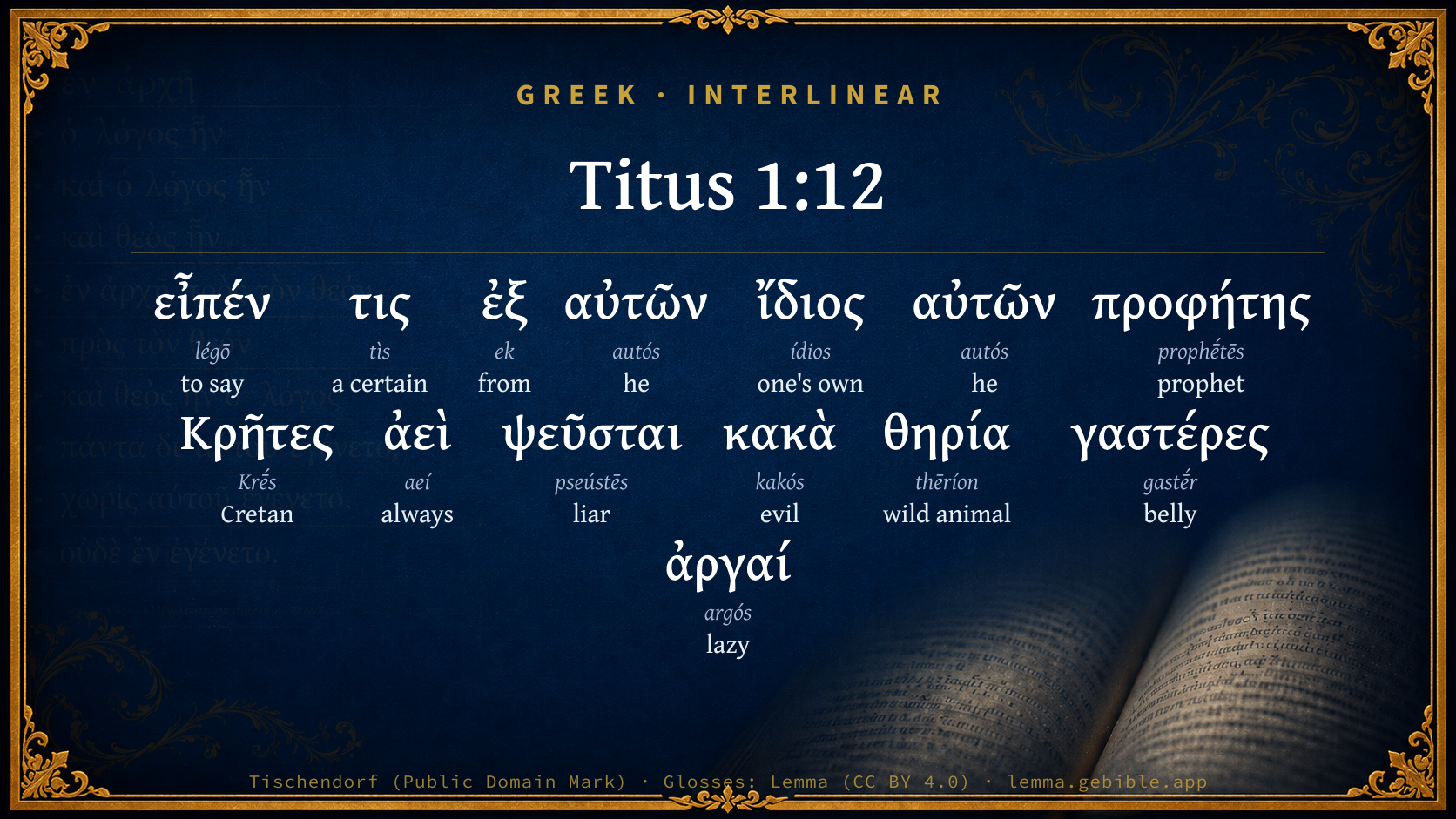
  1. εἶπέν légō G3004 “to say” Verb, Aorist, Active, Indicative, 3rd person, Singular
  2. τις tìs G5100 “a certain” Indefinite pronoun, Nominative, Singular, Masculine
  3. ἐξ ek G1537 “from” Preposition
  4. αὐτῶν autós G846 “he” Personal pronoun, Genitive, Plural, Masculine
  5. ἴδιος ídios G2398 “one's own” Adjective, Nominative, Singular, Masculine
  6. αὐτῶν autós G846 “he” Personal pronoun, Genitive, Plural, Masculine
  7. προφήτης prophḗtēs G4396 “prophet” Noun, Nominative, Singular, Masculine
  8. ἀεὶ aeí G104 “always” Adverb
  9. ψεῦσται pseústēs G5583 “liar” Noun, Nominative, Plural, Masculine
  10. κακὰ kakós G2556 “evil” Adjective, Nominative, Plural, Neuter
  11. θηρία thēríon G2342 “wild animal” Noun, Nominative, Plural, Neuter
  12. γαστέρες gastḗr G1064 “belly” Noun, Nominative, Plural, Feminine
  13. ἀργαί argós G692 “lazy” Adjective, Nominative, Plural, Feminine

About this verse

These counts appear in no published source. They are computed here, from the morphology-tagged text and Lemma’s own curated glosses. What Lemma adds →

14
words
13
distinct lemmas
Pauline Epistles
section

Notable vocabulary

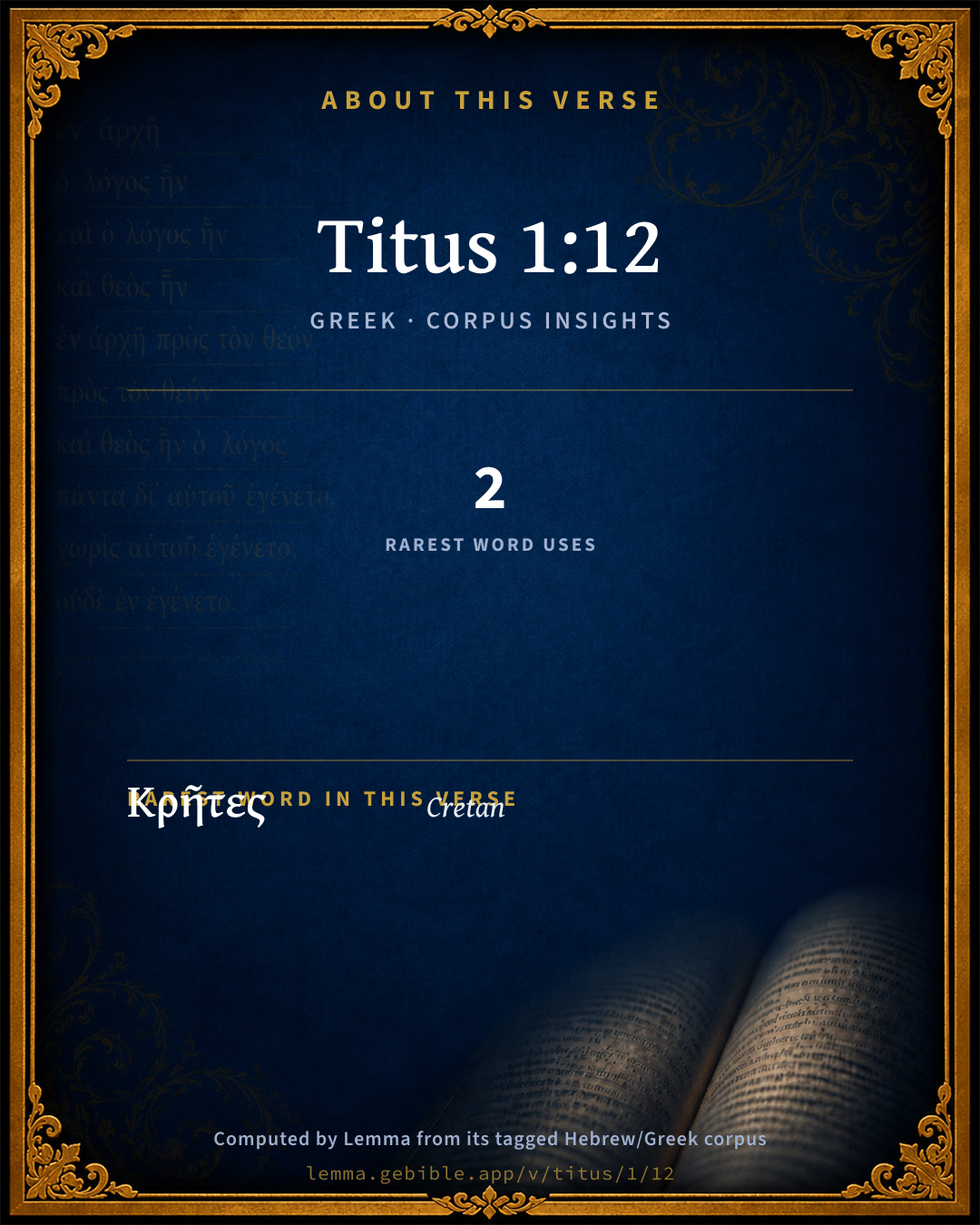
The rarest word here is Κρῆτες Cretan G2912 — appearing just 2 times in the whole Greek New Testament.

Shared distinctive vocabulary

Κρῆτες Cretan G2912 occurs in 2 verses of the Greek New Testament. Also found in:

Repetition

A word recurs within this verse:

  • αὐτῶν he G846 ×2

Cross-references

7

Topical passages linked to Titus 1:12 in the Treasury of Scripture Knowledge — connected by theme and wording, ordered by reader-vote popularity; previews shown in the World English Bible.

  • Romans 16:18 For those who are such don't serve our Lord, Jesus Christ, but their own belly; and by their smooth and flattering speech, they deceive the hearts of the innocent.
  • 1 Timothy 4:2 through the hypocrisy of men who speak lies, branded in their own conscience as with a hot iron;
  • Acts 17:28 'For in him we live, and move, and have our being.' As some of your own poets have said, 'For we are also his offspring.'
  • 2 Peter 2:15 forsaking the right way, they went astray, having followed the way of Balaam the son of Beor, who loved the wages of wrong-doing;
  • Acts 2:11 Cretans and Arabians: we hear them speaking in our languages the mighty works of God!"
  • 2 Peter 2:12 But these, as unreasoning creatures, born natural animals to be taken and destroyed, speaking evil in matters about which they are ignorant, will in their destroying surely be destroyed,
  • Jude 1:8–13 Yet in like manner these also in their dreaming defile the flesh, despise authority, and slander celestial beings.

Cross-references courtesy of OpenBible.info (CC BY 4.0).

Commentary

Notes on Titus 1:12 from classic Christian and Jewish commentators (each source and its license shown beneath its notes). The classic Christian expositions comment on the surrounding passage and are grouped to its opening verse, so a note may address several verses; the Jewish commentaries on the Tanakh (Rashi and others) are per-verse, so they appear only where the commentator wrote on this verse.

Lemma curates 59 commentaries, every one of them public domain or Creative Commons licensed, each selected and text-cleaned for this edition rather than reprinted as found. About our sources →

The Biblical Illustrator

Joseph S. Exell

Tit_1:12-13

The Cretians are always liars

A classical quotation

It is not often that St.

Paul quoted from the treasuries of classic literature, and when he did so he did not draw upon the most celebrated of the Greek poets. The Hymn of Cleanthes gave him a text in his speech on Mars Hill; the treatise of Epimenides concerning oracles furnished him with another. Epimenides was a Cretian poet of religious character and prophetic claims, who visited Athens 599 b.c., and who shortly afterwards died, at the advanced age of a hundred and fifty. He appears to have uttered a terse drastic proverb, a bitter epigrammatic characterisation of his fellow countrymen, a portion of which, The Cretians are always liars, was quoted by Callimachus in his hymn to Zeus. Theodoret attributes the whole quotation to Callimachus. Jerome, Chrysostom, and Epiphanius, agree to refer this severe indictment against the Cretians to Epimenides, the semi-mythical and prophetic minstrel and priest. The severity of the condemnation did not interfere with the tradition preserved by Diogenes Laertius, that the Cretians did sacrificial honour to him as a god. According to Diogenes, stories manifestly fabulous are told of Epimenides, and he is credited with having written numerous treatises and poems. (H. R. Reynolds, D. D.)

The character of the Cretians

The charge of falsehood is repeated undoubtedly by Callimachus, and this characteristic must have been deserved, if we are to trust the host of testimonies to the same effect from other sources. The very word Cretize was invented, meaning, to play the part of a Cretian, and was identical with to deceive, or to utter and circulate a lie. Evil beasts is a phrase expressive of untamed ferocity, truculent selfishness, and greed; while idle bellies, or do nothing gluttons, completes a picture of most revolting national character. (H. R. Reynolds, D. D.)

Falsehood

I. Falsehood and deceit in word and deed is condemned, not only by the light of the Scriptures, but by the light of nature itself. Which appeareth expressly not only by the testimony of this Pagan poet, but by other lights in nature; for the natural conscience of man accuseth and checketh for it; yea, in children themselves, it maketh them blush at the report of a lie. Besides, the most graceless of men account it the highest disgrace to have the lie given them, the infamy of which vice is such as none will take to it, none will confess it. And on the contrary, the heathen so extolled truth, in word, in practice, as of all other virtues it was said to be the only daughter of Jupiter, as whom most nearly it resembled.

II. How should we who would be reputed gods children abhor that practice, which even the sons of men are ashamed of? Shall the sparkles of natural light make the natural conscience of a heathen, and graceless man accuse him of this sin; and shall not the clear light of grace force the conscience of professed Christians to reprove them? Is it justly reputed a disgrace to common men, to be taken with a lie, how disgraceful should it be to Christian men? Shall the heathen profess truth to resemble God so expressly, as that it is His dear and only daughter, and shall Christians who find in the Scriptures the whole image of God, styled by the title, and comprehended under the name of truth, in their practice scarce express it as a part of that image?

1. Every lie is hurtful whether in jest or earnest, for evil or for good, because it is an enemy to truth, and against the ninth commandment.

2. For jesting or sporting lies, the threatening is general (Psa_5:6), untruths may not be spoken although they be not thought. And many of the heathen themselves saw the silliness and folly of this shift; we read of the Lacedemonians, that they would not suffer their laws to be gainsaid in jest, and yet the law of the Lord may be controlled, and gainsaid in jest of Christians. When Thespis, the first stage player, was asked if he were not ashamed to utter so many lies in such a worthy audience, he answered, he did it in sport. But wise Solon replied, If we approve and commend this sport we shall find it in earnest in our contracts and affairs; and even so by Gods just judgment it befalls Christians, who, using to lie in sport, got an habit of lying in earnest, and by his jesting lies, raiseth a suspicion of his words, that he cannot be believed, be he never in such earnest.

3. For officious lies, so called, there can be no such, because in every lie some office or duty is violated. But they hurt no man; yes, if they hurt not another, they hurt a mans self many ways; again, if they hurt not the parties for whom, yet they hurt the parties to whom they are told, who are abused, and urged to believe a lie, and were not this, yet they hurt and prejudice the truth which ought to prevail. But the end of them is good, Yea, but that which is evil in the nature and constitution may never be admitted, let the end be never so good which is pretended. The least evil may not be committed for the greatest good; to help man we may not hurt God. Nay, we may not tell the least lie for Gods greatest glory, and much less for mans good (Job_13:9-10). But they be not against charity. Yes, for charity rejoiceth in truth, and if they were not, yet are they directly against piety, which two loving friends may admit no divorce.

III. And to help ourselves in this duty meditate on these reasons.

1. All falsehood and lies are directly against God Himself, who is truth itself; so as by them a man becometh most unlike unto God, and most like to the devil, who is the father and first founder of them.

2. That therefore the liar casteth himself into the gulf of Gods displeasure, seeing as He hateth all the works of the devil, so hath He testified special hatred against this. A lying tongue is one of the six things which the Lord hateth, and is abomination unto Him (Pro_12:22), and therefore doth with them as we do with the things we abhor; either removeth them out of sight by barring them out of heaven, or destroyeth them (Psa_5:6).

3. That although that be the greatest plague to have the face of God set against them here, and to be cast from out of His face and blessed presence of joy hereafter, yet there are other inferior evils not to be contemned which wait at the heels of this sin.

(1) That it maketh the sinners of this suit justly hateful even unto men, as those who are the main enemies unto human society, which is upheld by truth and faithfulness.

(2) Such deceitful and fraudulent persons are occasions of the multiplication of oaths and perjuries among men, for which the land mourneth.

(3) In themselves it argueth the want of Gods Spirit in their hearts, who, being the Spirit of truth and light, cannot abide to dwell in a heart that is pleased and delighted with nothing more than darkness and falsehood.

(4) They lose justly their own voice and credit, and are worthy not to be believed when they speak truth; and men must deal with them as with their father the devil, whose works they accustom themselves unto, suspect even the truth from them, and not receive any as from them. (T. Taylor, D. D.)

The punishment of liars

When Aristotle, a Grecian philosopher and tutor of Alexander the Great, was asked what a man could gain by uttering falsehoods, he replied, Not to be credited when he shall tell the truth. On the contrary, it is related that when Petrarch, an Italian poet, a man of strict integrity, was summoned as a witness, and offered in the usual manner to take an oath before a court of justice, the judge closed the book, saying, As to you, Petrarch, your word is sufficient. From the story of Petrarch we may learn how great respect is paid to those whose character for truth is established; and from the reply of Aristotle the folly as well as the wickedness of lying. In the country of Siam, a kingdom of Asia, he who tells a lie is punished, according to law, by having his mouth sewed up. This may appear dreadful; but no severity is too great against one who commits so great a sin. We read likewise that God Almighty struck Ananias and Sapphira dead for not speaking the truth.

The gospel offered to the worst

This is indeed a fearful character, which the apostle says is perfectly true. The island must have been in a fearful condition, for the apostle is always in the habit of speaking mildly even of those who are blameworthy. If their guilt had not been enormous, he would never have rebuked them so severely, nor given such stringent commands to Titus to rebuke them sharply, that they might be sound in the faith; And here we should remark how wonderful the love of God is, which reaches down to the lowest of the species, and elevates such brutish natures into the likeness of the Son of God, and lifts them up to the throne of His glory! In the midst of that pandemonian isle is the Church of God planted, like an oasis in the desert waste, like a lighthouse in the raging seas, to give rest and direction to all who will listen to the calls of Divine mercy. Oh, how admirable, how glorious, is that God, who, like the father of the lost son, opens His house and His bosom to a vile, wretched, prodigal world! Art thou a Cretian? art thou a liar, a glutton, and a brute? then the message of the love of God is to you--even to you; and if you receive it you shall shine among the saints in light forever! The world says perhaps of you, as the proverb did of old, The three worst Cs in the world are Cappadocia, Crete, and Cilicia; yet unto these habitations of iniquity and dens of devils the grace of God penetrated, and multitudes were drawn to the Lord. The gospel is for thee, brother, in all thy vileness and guilt; and Jesus, who loved thee, is the same yesterday, today, and forever. Come to Him, and be saved. (W. Graham, D. D.)

Evil beasts

Bestiality in men

1. In becoming without understanding, and in all the things of God by nature as ignorant as the brute beasts (Psa_73:22; Jer_10:14; Pro_20:24).

2. By giving up themselves to be led with sensuality as brute beasts (2Pe_2:12). This naturally arises out of the former; for when men are deprived of understanding, judgment, reason, as every natural man is in the things of God, they must needs be led by other guides, of lusts, appetite, sense, and sight, even as the beasts are.

3. By the practice of many beastly and brutish properties. For what properties have unregenerate men, which are not more beseeming evil and hurtful beasts than men?

(1) If we consider the respect between God and him his heart knoweth no subjection; but as was said once of Israel, he is as an unruly heifer, he knoweth no yoke, acknowledgeth no master, lifteth up his heel against his feeder, and careth not for the owner of his fat pasture.

(2) If we consider natural men in themselves, no beast is so unclean and foul as they whose filthy hearts are fit for nothing, but to be stinking cages and dens for filthy birds and beasts, wholly bespotted as the leopards (Jer_13:23), swinish men, wallowing in the dirt and mire of sinful pleasures, and revolting from every good way as dogs to their vomits; for so the apostle termed such Jews as revolted from Christianity to circumcision, beware of dogs.

(3) Consider them in respect of their neighbour, no evil beast is so cruel and venomous as they; in regard of the former the Scriptures ascribe the property of the devil himself unto them, calling them ramping and roaring lions, such as David and Christ Himself had to do withal (Psa_22:13) such a one was Nero whom Paul had to do withal (2Ti_4:17). And for their savageness and greediness they are called dogs and wolves (Zep_3:3). And for subtlety and craft to hurt they are termed foxes (Luk_13:32). In regard of the latter, namely, their poison and venom, Christ calleth them serpents and generation of vipers; their tongues are like stings, sharpened against good men, and the poison of adders and asps is under their lips (Psa_140:3), hence doth the Lord threaten most cruel and inevitable enemies under such speeches (Jer_8:17). Whereby he would describe and signify the implacable and virulent malice and rage of the Chaldeans. Now man being above all other born a sociable creature, and to live in society with God and men in the family, Church, and commonwealth, hath by his hostility against God, and enmity against man, after a sort put off the nature of man, and by such degenerating of good right hath lost even the name of man also. (T. Taylor, D. D.)

Like a beast

We have a common saying when we see ourselves overseen or overtaken in any temporal and outward thing, Oh, what a beast was I! but well were it if we would seriously thus accuse ourselves when we have failed in our godly course, and to say, Oh, what a beast was I to leave the direction of the Word; and suffer myself to be led by my appetite, or by the lust of my heart, or the sight of mine eyes to this or that sin? Alas, that I to whom God hath given reason, judgment, election, deliberation, yea, His Word and Spirit, should live all this while as one destitute of all these. I understand not what the good and acceptable will of God is, but am yet like the horse and mule without understanding. I have stepped my ears st the Word like the deaf adder, and have refused the things of my peace; I have barked against God and godliness; I have wallowed in my uncleanness like a swine in his own filth; I have been unmerciful and cruel as any lion or wolf; I have spared no prey, and as subtle as any fox to deceive my brethren. I have spit Out my venom both to the face and behind the backs of my neighbours, and especially against the household of faith, the professors of religion. Oh, what a beast was I in all this! But now seeing my understanding is restored unto me again, I will never hereafter carry myself but like a man, not making my lusts my law any longer, but reason shall be my guide; nay, nor that only, but, like a Christian man, I will by Gods grace suffer myself to be guided henceforth by renewed reason, yea, by the Word and Spirit of God. If I must needs in anything resemble the beasts it shall be the ox and ass, in knowing my Lord and Master; the stork, and crane, and swallow, in acknowledging the seasonable time of my repentance, the serpent in Christian wisdom, the lamb and dove in Christian meekness and innocence, and thus resembling them, I neither shall be nor accounted a beast, nor yet be condemned by any of them. But if any, loath to leave his brutish properties, will be a beast still and follow his lust, it is fit he should see the end of his way in one of his predecessors (Pro_7:22). (T. Taylor, D. D.)

This testimony is true

Ministers must not be discouraged from their duty, though they have to deal with a brutish and wretched people

This testimony being true, Titus might have been discouraged, and occasioned hereby to meditate his departure from them as a hopeless people, or to repine that the apostle should place him among such a company of beasts rather than men. But yet Titus muse and does with courage go on in his work among them, and plough up to the Lord even this stiff ground. It is the lot of many gracious ministers to be called and planted among rude, barbarous, and beastly people, such as these Cretians were, yea, among viperous broods who will reward their faithful pains and travail in begetting them to God with extremity of wrong and violence (Jer_26:8). And little comfort find they, unless the Lord give them a breathing time by the means of some Ahikam or other (verse 24) Now what must the minister do in this case? Surely, as he came not of his own head, so now is he not at his own hand to remove himself at his pleasure. And if he should depart upon this ground, he should perhaps meet with less comfort in leaving an uncomfortable people than in staying amongst them. If God bid Jonah arise and go to Nineveh, but he will betake himself to a ministry of more credit and less labour, the Lord will teach him, before he get to Tarshish, that he is not his own man, and that no creature shall shelter him from trouble whilst he flieth it as fast as he can. If Moses be called to speak to Pharaoh, he must not excuse the matter, saying, But they will not believe me. The Lord is said to hold the ministers in His hand, and Christ the seven stars in His right hand (Rev_1:1-20). First, in regard of His disposition of them here and there at His pleasure. Secondly, of His protection of them in their labours. And some He sendeth, and all the heartening they have of Him beforehand is, But they will not receive thee, as Moses and some of the prophets; and that is not all, but they must prepare brows of brass, their shoulders to bear reproaches and wrongs, their backs for stripes, their feet for fetters and stocks, yea, their necks for the very block itself. In like manner Christ, sending out His disciples, forbids them to possess gold and silver, and wisheth them to possess patience, for they should stand more in need of that than the other; and telleth them, that if Himself, the green tree, could not be spared, much less should they the dry branches; and that if the master be called Beelzebub, the servant must not look to escape scot free. And therefore ministers called to such an uncomfortable condition must imitate Paul who, although he knew that bonds and imprisonment did abide him in every city, yet forward he must, and provoketh his own readiness and cheerfulness not only to be bound, but to suffer also the pains of death, for the testimony he beareth: considering well

1. That the disciples themselves, sent from the side of Christ, must make account to be hated of all men for His names sake.

2. That although they see no great comfort or fruit of their works with men, yet their work is with the Lord.

3. That the Lord Jesus, foretelling His death at Jerusalem, yet went forward, and would not pity Himself for all Peters friendly counsel, but pitied His flock, His body, His Church, more than Himself: a worthy example for the practice of all His ministers. (T. Taylor, D. D.)

Rebuke them sharply

Sharply

Here we have another adoption of the phraseology of health or soundness in relation to the faith. Probably it was suggested to the apostle by the previous adoption of phrases indicative of disease, and of severe remedies. A sharp knife, instruments of cautery, firm handling, free incisions, are needed for some poisonous and putrefying sores; and as in former days Titus had to show the Corinthians how to purge out the old leaven, to deliver wicked persons to Satan, to rebuke pretentious sciolism and proclaim no quarter to certain kinds of vice, so once more he had to lift up his voice like a trumpet, and out of sheer kindness was commanded not to spare them. (H. R. Reynolds, D. D.)

Different modes of dealing with different sins

According to the nature of sins and sinners we must set an edge upon our reproofs and sharpen them; for all sins are not of one size, nor all sinners of one strain; but some sins are more enormous than others, and some sinners are more obstinate than others. Some sins are of ignorance, some of malice; some secret, some open; some sinners are as wax to work on; some are stony and stiff-necked; some have here and there their freckles and frailties on them: others are spotted all over like leopards, or, like the Ethiopian, they never change their hue; no washing doeth them good. Now, we must wisely put a difference between both. Compassion must be showed upon some; and others, whom love cannot allure, fear must force. Some must be saved by love, and some be pulled out of the fire. Some sores need but a gentle lenitive, some a sharper drawer; some require but the prick of a needle to open them, others a more painful lancing and cutting; and some a cutting off. (T. Taylor, D. D.)

Christian reproof

I. Christian reproof should always be based on a certain convicting. Mere hearsay insufficient; general rumour unreliable. Inquisitorial curiosity different from faithful watchfulness.

II. Christian reproof should be thorough and effective. A cutting rebuke need not be unkind. Sarcasm, satire, scorn--these are unbecoming a Christian teacher. Soft words break hard hearts; warmth melts, while coldness freezes.

III. Christian reproof should be for the sinners good--That they may be sound in the faith. Wrong motives:

1. To save appearances.

2. To maintain dignity.

3. To gratify revenge.

Right motives:

1. To save the purity of the Church.

2. To prevent the spread of contagion.

3. To restore to spiritual life and privilege. (F. Wagstaff.)

The object of rebukes

The sharpest rebukes in the Church ought to aim at this end, the recovery of diseased Christians to soundness in religion both in judgment and practice; which appeareth in that the greatest ordinary censure in the Church is not mortal but medicinal. For as a surgeon cuts off arms and legs that the body and heart may be saved, so in this body, parts and members are cut off that themselves may be saved as well as their whole body. Paul excommunicateth the incestuous person that his spirit might be saved. Hymineus and Philetus were cast out to Satan that they might learn not to blaspheme. Those whom Jude wisheth to be pulled out of the fire by violence, must be saved thereby. If any object against this that in 1Co_16:21, If any man love not the Lord Jesus, let him be had in execration to the death. And therefore edification and salvation is not the end of this censure. I answer, It is one thing for the Church to excommunicate, another to curse and execrate; the one is an ordinary censure, the other very extraordinary and rare; the one against those who may be friends of the Church, the other only against desperate enemies, and open and obstinate apostates, even such as Julian, whom the Church judgeth to have sinned the sin against the Holy Ghost, and therefore execrateth and accurseth. (T. Taylor, D. D.)

Sharp rebukes sometimes needed

The words is a metaphor taken from surgeons, who cut out dead flesh to the quick, but it is in order to healing. Cutting words have done great cures: many a diseased, festered soul has been made sound, both in faith and manners, by severe reprehension. Learn hence, that although, generally speaking, we ought to temper our reproofs with much gentleness and meekness, yet there is a time when we must reprove sharply, that men may be sound in the faith. We may, we must speak cutting words when kind words will not do. (W. R. Burkitt, M. A.)

A sharp rebuke

A young clergyman came to the house of his sister, and found quite a company round the table--among them a talkative military gentle man, who rather freely flavoured his wit with perverted Bible quotations and anti-Christian innuendos. A bantering remark about God that amounted to no less than a parade of his atheism aroused the hostess at last. You seem to forget that my brother here is a minister of the gospel, she said. Oh! quoth the unabashed officer, my clerical friend and I understand each other; and turning to the young man, with patronising impudence he asked, Is it not so, sir? Your office requires you to tell the old story, which for the ignorant may do very well to believe, but as a man of culture you yourself cannot put faith in these worn-out doctrines. The clergyman eyed his questioner a minute, and then said, Sir, before answering your question, I must ask you three. You are an atheist. Such people have always been in the world. One class of these are thinkers who have speculated and groped till they have fallen into despair, and said, There is no God. Do you belong to that class? No, laughed the officer; thinking is not to my taste. I am no philosopher. Another class are those who speak frivolously of God merely because they learned to do it where such talk was the fashion. Are you one of them? No, sir, said the officer, slightly reddening; I am not a blind follower of others. There is but one more class of atheists, quietly continued the minister--those who have wallowed in sin till they must either expect the horrors of remorse or kill their conscience; and, as the shortest way to get rid of it, they declare that there is no God. This time the clergyman did not utter his question; but the eyes of the whole company, turned on the confused scoffer, made both question and answer needless.

Fidelity in administering reproof

The Rev. Joseph Alleine was very faithful and impartial in administering reproof. Once, when employed in a work of this kind, he said to a Christian friend, I am now going about that which is likely to make a very dear and obliging friend become an enemy. But, however, it cannot be omitted; it is better to lose mans favour than Gods. But, so far from becoming his enemy for his conscientious faithfulness to him, he rather loved him the more after, as long as he lived.

The reproof of a good man

The reproof of a good man resembles fullers earth; it not only removes the spots from our character, but it rubs off when it is dry.

The Biblical Illustrator, edited by Joseph S. Exell (c. 1880s–1900s) — public domain. Text from a community e-Sword module.

Joseph Benson's Commentary

Tit 1:12-14. One of themselves — That is, one of their own countrymen, who could not be unacquainted with their conduct, or disposed to belie them; even a prophet of their own — This was the poet Epimenides, who, among the Romans, was reputed to have foretold future events. Cicero, speaking of him, (De Divinat., lib. 1.,) says he was futura præsciens, et vaticinans per furorem; one who foreknew and foretold things future by ecstasy. Besides, as all poets pretended to a kind of inspiration, the names prophet and poet were used as synonymous, both by the Greeks and Romans. The Cretians are always liars, &c. — Epimenides said this in his book concerning oracles, a passage which Glassius hath quoted entire, p. 2075. According to Bishop Warburton, (Div. Legat., vol. 1. p. 159,) the Cretians were universally hated, and branded as liars, by the other Greeks, because, by showing in their island the tomb of Jupiter, the father of gods and men, they published what the rest of the Greeks concealed in their mysteries, namely, that their gods were dead men. Evil beasts — Or wild beasts, rather, as θηρια signifies, fierce, savage; slow bellies — Lazy gluttons, as averse to action as wild beasts are after gorging themselves with their prey. So that in these words the poet suggests “a remarkable contrast, to show what a mixture there was of fierceness and luxury in the characters of the Cretians. Savage beasts are generally active and nimble, but these men, while they had the fury of lions and tigers, indulged themselves so much in the most sordid idleness and intemperance that they grew, as it were, all belly. As for their proneness to falsehood, it is well known that κρητιζειν, to talk like a Cretian, was a proverb for lying; (as κορινθιαζειν, to live like a Corinthian, was for a luxurious and debauched life;) and it is remarkable that Polybius scarce ever mentions this nation without some severe censure.” This witness is true — Namely, in the general, though some particular persons may be found of a different character. Wherefore rebuke them sharply — Αποτομως, with a cutting severity. From this Blackwall infers, “that it is a vain pretence that only gentle and soft expressions are to be applied to people that renounce good principles, and corrupt the gospel.” But it ought to be observed, that St. Paul speaks of reproving vice, not error. Besides, though Titus was to reprove the Cretians sharply, “the sharpness of his reproofs was not to consist in the bitterness of the language which he used, nor in the passion with which he spake. Reproofs of that sort have little influence to make a person sound, either in faith or practice. It was to consist in the strength of the reasons with which he enforced his reproofs, and in the earnestness and affection with which he delivered them; whereby the consciences of the offenders being awakened, would sting them bitterly.” Not giving heed to Jewish fables — See 1Ti 1:4; and commandments of men — Of Jewish and other teachers; that turn from the truth — Forsake the true doctrine of the gospel. “It appears, from the following verse, that the apostle, in saying this, had in view the precepts of the Judaizers concerning meats, clean and unclean, which, although originally the precepts of God, were now abolished under the gospel. Therefore, if these things were any longer enjoined as obligatory, they were not enjoined by God, but by the precepts of men.” See Doddridge and Macknight.

Joseph Benson's Commentary on the Old and New Testaments (1811–1818) — public domain. Text from a community e-Sword module.

The Expositor's Bible

Chapter 20

CHRISTIANITY AND UNCHRISTIAN LITERATURE. - Tit_1:12-13

THE hexameter verse which St. Paul here cites from the Cretan poet Epimenides is one of three quotations from profane literature which are made by St. Paul. Of the other two, one occurs in 1Co_15:33, "Evil communications corrupt good manners"; and the other in the Apostles speech on the Areopagus at Athens, as recorded in the Acts: {Act_17:28} "For we are also his offspring." They cannot be relied upon as sufficient to prove that St. Paul was well read in classical literature, any more than the quoting of a hackneyed line from Shakespeare, from Byron, and from Tennyson, would prove that an English writer was well acquainted with English literature. It may have been the case that St. Paul knew a great deal of Greek classical literature, but these three quotations, from Epimenides, from some Greek tragedian, and from Cleanthes or Aratus, do not at all prove the point. In all three cases the source of the quotation is not certain. In the one before us the Apostle no doubt tells us that he is quoting a Cretan "prophet," and therefore quotes the line as coming from Epimenides. But a man may know that "Friends, Romans, countrymen, lend me your ears," is Shakespeare, without having read a single play. And we are quite uncertain whether St. Paul had even seen the poem of Epimenides on Oracles in which the line which he here quotes occurs. The iambic which he quotes in the letter to the Corinthians, although originally in some Greek play (perhaps of Euripides or Menander), had passed into a proverb, and proves even less than the line from Epimenides that St. Paul knew the work in which it occurred. The half-line which is given in his speech at Athens, stating the Divine parentage of mankind, may have come from a variety of sources: but it is not improbable that the Apostle had read it in the "Phaenomena" of Aratus, in which it occurs in the form in which it is reproduced in the Acts. This astronomical poem was popular in St. Pauls day, and he was the more likely to have come across it, as Aratus is said to have been a native of Tarsus, or at any rate of Cilicia. But even when we have admitted that the Apostle had read the "Phaenomena" of Aratus or Cleanthes Hymn to Zeus, we have not made much way towards proving that he was well read in Greek literature. Indeed the contrary has been argued from the fact that, according to the reading of the best authorities, the iambic line in the Corinthians is quoted in such a way as to spoil the scanning; which would seem to show that St. Paul was not familiar with the iambic meter. If that was the case he can scarcely have read even a single Greek play.

But the question is not one of great importance, although doubtless of some interest. We do not need this evidence to prove that the Apostle was a person, not only of great energy and ability, but of culture. There are passages m his writings, such as chapters 13 and 15 in 1 Corinthians, which are equal for beauty and eloquence to anything in literature. Even among inspired writers few have known better than St. Paul how to clothe lofty thoughts in noble language. And of his general acquaintance with the moral philosophy of his age, especially of the Stoic school, which was very influential in the neighborhood of Tarsus, there can be no doubt. Just as St. John laid the thoughts and language of Alexandrian philosophy under contribution, and gave them fuller force and meaning to express the dogmatic truths of the Gospel, so St, Paul laid the thoughts and language of Stoicism under contribution, and transfigured them to express the moral teaching of the Gospel. Cleanthes or Aratus, from one or both of whom one of the three quotations comes (and St. Paul seems to know both sources, for he says "as certain even of your own poets have said"), were both of them Stoics: and the speech in which the quotation occurs, short as it is in the Acts, abounds in parallels to the teaching of St. Pauls Stoic contemporary Seneca. If St. Paul tells us that "the God that made the world and all things therein dwelleth not in temples made with hands," Seneca teaches that "temples must not be built to God of stones piled on high: He must be consecrated in the heart of man." While St. Paul reminds us that God "is not far from each one of us," Seneca says "God is near thee: He is with thee; He is within." Again St. Paul warns his hearers that "we ought not to think that the Godhead is like unto gold, or silver, or stone, graven by art and device of man"; and Seneca declares "Thou shalt not form Him of silver and gold: a true likeness of God cannot be molded of this material." But the quotations are of other interest than their bearing upon the question as to the Greek elements in the education and teaching of St. Paul. They have a bearing also on the question of Christian use of profane authors, and on the duty of self-culture in general. The leading teachers of the early Church differed widely in their estimate of the value of heathen literature, and especially of heathen philosophy. On the whole, with some considerable exceptions, the Greek Fathers valued it highly, as containing precious elements of truth, which were partly the result of direct inspiration, partly echoes of the Old Testament. The Latin Fathers, on the other hand, for the most part, treated all pagan teaching with suspicion and contempt. It was in no sense useful. It was utterly false, and simply stood in the way of truth. It was rubbish, which must be swept on one side in order to make room for the Gospel. Tertullian thinks that heathen philosophers are "blockheads when they knock at the doors of truth," and that "they have contributed nothing whatever that a Christian can accept." Arnobius and Lactantius write in a similar strain of contemptuous disapproval. Tertullian thinks it out of the question that a right-minded Christian should teach in pagan schools. But even he shrinks from telling Christian parents that they must allow their children to remain uneducated rather than send them to such schools. The policy of permitting Christian children to attend heathen schools, while forbidding Christian adults from teaching in them, appears singularly unreasonable. Every Christian teacher in a school rendered that school less objectionable for Christian children. But Tertullian urges that one who teaches pagan literature seems to give his sanction to it: one who merely learns it does nothing of the kind. The young must be educated: adults need not become schoolmasters. One can plead necessity in the one case; not in the other ("De Idol.," 10.). But the necessity of sending a child to a pagan school, because otherwise it could not be properly educated, did not settle the question whether it was prudent, or even right, for a Christian in after-life to study pagan literature; and it required the thought and experience of several centuries to arrive at anything like a consensus of opinion and practice on the subject. But during the first four or five centuries the more liberal view, even in the West, on the whole prevailed. From Irenaeus, Tatian, and Hermias, among Greek writers, and from various Latin Fathers, disapproving opinions proceeded. But the influence of Clement of Alexandria and Origen in the East, and of Augustine and Jerome in the West, was too strong for such opinions. Clement puts it on the broad ground that all wisdom is a Divine gift; and maintains that the philosophy of the Greeks, limited and particular as it is, contains the rudiments of that really perfect knowledge, which is beyond this world. Origen, in rebutting the reproach of Celsus, that the gospel repelled the educated and gave a welcome only to the ignorant, quotes the Epistle to Titus, pointing out that "Paul, in describing what kind of man the bishop ought to be, lays down as a qualification that he must be a teacher, saying that he ought to be able to convince the gainsayers, that by the wisdom which is in him he may stop the mouths of foolish talkers and deceivers." The Gospel gives a welcome to the learned and unlearned alike: to the learned, that they may become teachers; to the unlearned, not because it prefers such, but because it wishes to instruct them. And he points out that in enumerating the gifts of the Spirit St. Paul places wisdom and knowledge before faith, gifts of healing, and miracles. {1Co_12:8-10} But Origen does not point out that St. Paul himself makes use of heathen literature; although immediately before dealing with the accusation of Celsus, that Christians hate culture and promote ignorance, he quotes from Callimachus half of the saying of Epimenides, "Cretans are always liars" ("Con. Cels.," III 43.). What Origens own practice was we learn from the "Panegyric" of his enthusiastic pupil, Gregory Thaumaturgus (13.).

With the exception of atheistic philosophy, which is not worth the risk, Origen encouraged his scholars to study everything; and he gave them a regular course of dialectics, physics, and moral philosophy, as a preparation for theology. Augustine, who ascribes his first conversion from a vicious life to the "Hortensius" of Cicero ("Conf.," III 4. 1), was not likely to take an extreme line in condemning classical literature, from which he himself frequently quotes. Of Ciceros "Hortensius" he says, "This book in truth changed my affections, and turned my prayers to Thyself, O Lord, and made me have other hopes and desires." He quotes, among other classical authors, not only Virgil, Livy, Lucan, Sallust, Horace, Pliny, and Quintilian, but Terence, Persius, and Juvenal, and of the last from those Satires which are sometimes omitted by editors on account of their grossness. In his treatise "On Christian Doctrine" (II 40.), he contends that we must not shrink from making use of all that is good and true in heathen writings and institutions. We must "spoil the Egyptians." The writings of his instructor Ambrose show that he also was well acquainted with the best Latin classics. In Jerome we have what may be called an essay on the subject. Ruffinus had suggested to Magnus, a Roman rhetorician, that he should ask Jerome why he filled his writings with so many allusions and quotations taken from Pagan literature, and Jerome in reply, after quoting the opening verses of the book of Proverbs, refers him to the example of St. Paul in the Epistles to Titus and the Corinthians, and in the speech in the Acts. Then he points to Cyprian, Origen, Eusebius, and Apollinaris: "read them, and you will find that in comparison with them we have little skill (in quotation)." Besides these he appeals to the examples, among Greek writers, of Quadratus, Justin Martyr, Dionysius, Clement of Alexandria, Basil, Gregory Nazianzen, etc.; and among Latins, Tertullian, Minucius Felix, Arnobius, Hilary, and Juvencus. And he points out that quotations from profane authors occur in nearly all the works of these writers, and not merely in those which are addressed to heathen. But while Jerome defends the study of classical authors as a necessary part of education, he severely condemns those clergy who amused themselves with such writers as Plautus (of whom he himself had been very fond), Terence, and Catullus, when they ought to have been studying the Scriptures. Later in life his views appear to have become more rigid; and we find him rejoicing that the works of Plato and Aristotle are becoming neglected.

It was the short reign of Julian, commonly called "the Apostate" (A.D. 361-363), which had brought the question very much to the front. His policy and legislation probably influenced Augustine and Jerome in taking a more liberal line in the matter, in spite of Latin dislike of Greek philosophy and their own ascetic tendencies. Julian, jealous of the growing influence of Christian teachers, tried to prevent them from lecturing on classical authors. From this he hoped to gain two advantages.

(1) Secular education would to a large extent be taken out of Christian hands.

(2) The Christian teachers themselves would become less well educated, and less able to contend with heathen controversialists. He sarcastically pointed out the inconvenience of a teacher expounding Homer and denouncing Homers gods: Christians had better confine themselves to "expounding Matthew and Luke in the Churches of the Galileans," and leave the interpretation of the masterpieces of antiquity to others. And he seems not to have contented himself with cynical advice, but to have passed a law that no Christian was to teach in the public schools. This law was at once cancelled by his successor Valentinian; but it provoked a strong feeling of resentment, and stirred up Christians to recognize and hold fast the advantages of a classical education.

But while the influence of the first three of the four great Latin Fathers was in favor of a wise use of the products of pagan genius, the influence of the last of the four was disastrously in the opposite direction.

In the period between Jerome and Gregory the Great two facts had had a calamitous effect upon the cause of liberal education.

(1) The inroads of the barbarians almost destroyed the imperial schools in Gaul and Italy.

(2) The miserable controversies about Origen produced an uneasy suspicion that secular study was prejudicial to orthodoxy. It is perhaps to this latter influence that we may attribute two ecclesiastical canons of unknown date and origin. In the "Apostolical Constitutions" (I 6.) we read, "Abstain from all heathen books. For what hast thou to do with such foreign discourses, or laws, or false prophets, which subvert the faith of the unstable? For what defect dost thou find in the law of God, that thou shouldest have recourse to those heathenish fables?" etc., etc. Again in a collection of canons, which is sometimes assigned to a synod at Carthage (A.D. 398), the 16th canon in the collection runs thus: "Abishop shall read no heathen books, and heretical books only when necessary." The Carthaginian synod of 398 is a fiction, and some of the canons in the collection deal with controversies of a much later date: but we need not doubt that all the canons were enacted in some Church or other in the course of the first six centuries. The spirit of this one is very much in harmony with the known tendencies of the sixth century; and we find Gregory the Great (A.D. 544-604) making precisely the same regulation. He forbade bishops to study heathen literature, and in one of his letters ("Epp.," 9:48) he rebukes Desiderius, Bishop of Vienne, for giving his clergy instruction in grammar, which involved the reading of the heathen poets. "The praises of Christ do not admit of being joined in the same mouth with the praises of Jupiter; and it is a grave and execrable thing for bishops to sing what even for a religious layman is unbecoming." The story that he purposely burnt the Palatine library is not traced earlier than the twelfth century, and is probably untrue; but it indicates the traditional belief respecting his attitude towards classical literature. And it is certainly true that he was twice in Constantinople, and on the second occasion remained there three years (A.D. 579-582), and yet never learnt Greek. In his time, as we learn both from himself and his contemporary, Gregory of Tours, the belief was very prevalent that the end of the world was at hand; and it was argued that mankind had more serious things to attend to than the study of pagan literature - or indeed any literature that was not connected with the Scriptures or the Church. Henceforward, in the words of Gregory of Tours, "the study of literature perished": and, although there were some bright spots at Jarrow and elsewhere, yet on the whole the chief services which Christianity rendered to classical learning during the next few centuries, were the preservation of classical authors in the libraries of monasteries and the preservation of the classical languages in the liturgies of the Church.

The question will perhaps never cease to be argued, although it is hardly probable that so extreme a view as that of Gregory the Great will ever again become prevalent. Let us take a statement of the question from the utterances of one who will not be suspected of want of capacity or experience in the matter, or of want of sympathy with stern and serious views respecting education and life.

"Some one will say to me perhaps," wrote John Henry Newman in 1859, "our youth shall not be corrupted. We will dispense with all general or national literature whatever, if it be so exceptional; we will have a Christian Literature of our own, as pure, as true as the Jewish." You cannot have it. From the nature of the Case, if Literature is to be made a study of human nature, you cannot have a Christian Literature. It is a contradiction in terms to attempt a sinless Literature of sinful man. You may gather together something very great and high, something higher than any literature ever was; and when you have done so, you will find that it is not Literature at all. You will simply have left the delineation of man, as such, and have substituted for it, as far as you have had anything to substitute, that of man, as he is or might be, under certain special advantages. Give up the study of man, as such, if so it must be; but say you do so. Do not say you are studying him, his history, his mind, and his heart, when you are studying something else. Man is a being of genius, passion, intellect, conscience, power. He exercises his great gifts in various ways, in great deeds, in great thoughts, in heroic acts, in hateful crimes. Literature records them all to the life

"We should be shrinking from a plain duty, did we leave out Literature from Education. For why do we educate except to prepare for the world? Why do we cultivate the intellect of the many beyond the first elements of knowledge, except to fit men of the world for the world? We cannot possibly keep them from plunging into the world, with all its ways and principles and maxims, when their time comes; but we can prepare them against what is inevitable; and it is not the way to learn, to swim in troubled waters, never to have gone into them. Proscribe (I do not say particular authors, particular works, particular passages) but secular literature as such: cut out from your class books all broad manifestations of the natural man; and those manifestations are waiting for your pupils benefit, at the very doors of your lecture room in living and breathing substance. They will meet him there in all the charm of novelty, and all the fascination of genius or of amiableness. Today a pupil, tomorrow a member of the great world: today confined to the Lives of the Saints, tomorrow thrown upon Babel; - thrown on Babel, without the honest indulgence of wit and humor and imagination ever permitted to him, without any fastidiousness of taste wrought into him, without any rule given him for discriminating the precious from the vile, beauty from sin, the truth from the sophistry of nature, what is innocent from what is poison."

Many Christians are apt to forget that all truth is of God; and that every one who in an earnest spirit endeavors to ascertain and to teach what is true in any department of human knowledge, is doing Gods work. The Spirit, we are promised by Christ Himself, "shall lead you into all the Truth," and "the Truth shall make you free." Our business is to see that nothing claims the name of truth unlawfully. It is not our business to prohibit anything that can make good its claim to be accounted true.

Those who enjoy large opportunities of study, and especially those who have the responsibility not only of learning, but of teaching, must beware of setting their own narrow limits to the domain of what is useful and true. It has a far wider range than the wants which we feel in ourselves or which we can trace in others. Even the whole experience of mankind would not suffice to give he measure of it. We dishonor rather than reverence the Bible, when we attempt to confine ourselves and others to the study of it. Much of its secret and inexhaustible store of treasure will remain undiscovered by us, until our hearts are warmed, our intellects quickened, and our experiences enlarged, by the masterpieces of human genius. "To the pure all things are pure." In the first century, in which the perils of heathenism to Christianity were tenfold what they are at present, St. Paul in plain terms told his converts that if they liked to accept the invitations of their heathen friends and acquaintances, they need not scruple to do so; {1Co_10:27} and by his own example, he shows them that they may enjoy and use what is beautiful and true in heathen literature. Let us beware of narrowing the liberty wisely allowed by him. Each one of us can readily find out what is dangerous for himself. There is plenty that is not dangerous: let him freely enjoy that. But the limits that are wise for ourselves are not to bind others. Their liberty is not to be circumscribed by our conscience. "The earth is the Lords and the fullness thereof."

William Robertson Nicoll, ed., The Expositor's Bible (London: Hodder & Stoughton, 1887–1910) — public domain. 65 of 66 books (1 Corinthians is not separately keyed, as that volume carries no machine-parseable verse references); section-level commentary keyed to the opening verse. Introductory and overview sections not keyed to a specific passage are excluded.

Tyndale Open Study Notes

Tyndale Open Resources

1:12 one of their own men, a prophet from Crete, has said: This quotation is from Epimenides of Knossos, a philosopher who lived on Crete around the 500s BC. • all liars: This charge was directed specifically at the Cretan claim to have Zeus’s tomb on the island. According to Cretan mythology, the god Zeus was once a mere human who lived and died on Crete (his tomb was said to be there) but who had achieved godhood through his patronage (i.e., gifts and benefits) to humans. Some Greek moralists opposed this legend and characterized it as a lie. A quote from Alexandria in the 200s BC reads: “Cretans are always liars. For a tomb, O Lord, Cretans build for you; but you do not die, for you are forever.” One of Crete’s own prophets (Epimenides) had the same assessment, and Paul cites his voice of conscience approvingly (1:13; see Acts 17:28), for the God who does not lie (Titus 1:2) stands in opposition to the lies of such myths. • liars . . . animals . . . gluttons: It was believed that Cretan immorality resulted from their belief about Zeus; religious lies had given rise to moral corruption. Paul later counters these vices by presenting the contrasting virtues (2:12). He calls the Cretans to reach ethical ideals that are extolled in human society generally but were absent on Crete, as bemoaned by their own prophet. They would reach these ideals only through the gospel of Jesus Christ (2:11-14). • lazy gluttons: Cretans were known to do anything for a little cash. They were famous as mercenaries and as insatiate consumers. They reputedly saw no shame in greed (see Phil 3:19). • Paul applies the quotation more directly to the current false teachers than to Cretan culture generally; the false teachers carried on this Cretan tradition of immorality built on falsehood.

Tyndale Open Study Notes — © Tyndale Open Resources, licensed CC BY-SA 4.0. Text via the HelloAO Bible API.

Bengel's Gnomon

Johann Albrecht Bengel

Tit 1:12. Εἶπέ τις, one said) Those who are too much devoted to the study of profane writers ought not to applaud themselves because Paul quotes from Menander, Aratus, Epimenides; for he does not even mention their names: Act 17:28; 1Co 15:33.—ἐξ αὐτῶν ἴδιος αὐτῶν, of their own) in origin and condition. That circumstance increases the authority of the witness. Testimonies of the wickedness of the Cilicians were also brought forward, but by others [not by one of themselves, as in the case of the Cretans]; therefore Paul, a Cilician, might quote this without reproach.—προφήτης, a prophet) Epimenides, according to the statement of Diogenes Laertius, uttered many predictions; and he acted in the character of a prophet when he spoke these things which Paul quotes.—ἀεὶ, always) Every natural man is at times guilty of lying, but always is a more heinous matter.—ψεῦσται, liars) unlike God, Tit 1:2; liars also in their doctrine concerning God, since they love fables, Tit 1:14. The Cretans had the sepulchre of Jupiter; therefore they were called liars by the poets.—κακὰ θηρία, evil beasts) Crete was considered a χώρα ἄθηρος, a country without wild beasts; whether that be true or false, Al. Morus considers Epimenides (in this line of his) drew the point of his pleasantry from the fact.—γαστέρες ἀργαὶ) Pasor is of opinion that ἀργὸς is here used by Aphæresis for μάργος, voracious; comp. ch. Tit 2:2-6. But the common idea is satisfactory: bellies are slow which are useful to nobody.

Bengel's Gnomon of the New Testament — English translation (T&T Clark, Edinburgh, 1860) — public domain. Text from a community e-Sword module.

Meyer's Critical & Exegetical Commentary

Heinrich August Wilhelm Meyer

Tit_1:12. Paul quotes the saying of a Cretan poet as a testimony regarding the Cretans.

εἶπέ τις ἐξ αὐτῶν ἴδιος αὐτῶν προφήτης] ἐξ αὐτῶν is by most expositors referred to the preceding πολλοί or to οἱ ἐκ περιτομῆς; but such a reference is unsuitable; the apostle is rather thinking of Cretans in general.

The ἴδιος αὐτῶν declares still more strongly that the saying proceeds from a Cretan and not from a stranger, see Winer, p. 139 [E. T. p. 192].

προφήτης] According to Chrysostom, Theophylact, Epiphanius, Jerome, it is Epimenides who is meant. This Epimenides was a contemporary of the seven wise men, and by some was even reckoned as one of them in place of Periander; he was born in the sixth century B.C. The saying quoted by Paul, which forms a complete hexameter, is said to have been in his lost work περὶ χρησμῶν. Theodoret, on the other hand, ascribes the saying to Callimachus, who, however, was a Cyrenian in the third century B.C.; besides, it is only the first words that occur in his Hymn. ad Jov. Tit_1:8. Epiphanius and Jerome think that Callimachus took the words from Epimenides. Paul does not call Epimenides a προφήτης because poets and philosophers were often called prophets in ancient times, but because the saying of Epimenides described beforehand the character of the Cretans as it was in the apostles time. Still it is to be noted that this very Epimenides was famed among the Greeks for his gift of wisdom, so that even Cicero (De Divinat. xviii.) places him among those vaticinantes per furorem. Comp. Diogenes Laertius, Vita Philos. p. 81, ed. Henr. Steph.

Κρῆτες ἀεὶ ψεῦσται] Chrysostom refers these words chiefly to the pretence of the Cretans that Jupiter lay buried among them; to this, at any rate, the verse of Callimachus refers; but the Cretans in ancient times were notorious for falsehood, so that, according to Hesychius, ΚΡΗΤΊΖΕΙΝ is synonymous with ΨΕΎΔΕΣΘΑΙ ΚΑῚ ἈΠΑΤᾷΝ; for proofs of this, see in Wetstein.

ΚΑΚᾺ ΘΗΡΊΑ] denoting their wild, unruly character; some expositors refer this name specially to the greed of the Cretans, as Polybius, book vi., specially mentions their ΑἸΣΧΡΟΚΕΡΔΊΑ ΚΑῚ ΠΛΕΟΝΕΞΊΑ; but it is more than improbable that Epimenides had this meaning in his words.

ΓΑΣΤΈΡΕς ἈΡΓΑΊ] synonymous with Php_3:19 : ὯΝ Ὁ ΘΕῸς Ἡ ΚΟΙΛΊΑ (comp. Rom_16:18; 2Pe_2:13-14); this denotes the Cretans as men given to sensuality. Plato, too (De Legg. i.), reproaches them with lust and immodesty.

The apostles purpose in quoting this saying of Epimenides is indicated in the next verse. The national character of the Cretans was such that they were easily persuaded to listen to the heretics, and hence it was all the more necessary to oppose the latter firmly.

Meyer — Critical and Exegetical Commentary on the New Testament — English translation by Peter Christie, edited by Frederick Crombie (T&T Clark, 1880) — public domain. Text from a community e-Sword module.

Expositor's Greek Testament

ed. W. Robertson Nicoll

Tit 1:12 . προφήτης : It is possible that St. Paul applies this title to the author of the following hexameter line because the Cretan false teachers were self-styled prophets. There was a Cretan prophet once who told plain truths to his countrymen. The whole line occurs, according to Jerome, in the περὶ χρησμῶν of Epimenides, a native of Cnossus in Crete. The first three words are also found in the Hymn to Zeus by Callimachus, who is the prophet meant according to Theodoret; and the rest has a parallel in Hesiod, Theogon . 26, ποιμένες ἄγραυλοι , κάκʼ ἐλέγχεα , γαστέρες οἶον . It is generally agreed that St. Paul was referring to Epimenides. This is the view of Chrys. and Epiph., as well as of Jerome. It was Epimenides at whose suggestion the Athenians are said to have erected the “anonymous altars,” i.e. , Ἀγνώστῳ Θεῷ (Act 17:23 ), in the course of the purification of their city from the pollution caused by Cylon, 596 B.C. He is reckoned a prophet, or predictor of the future, by Cicero, de Divin . i. 18, and Apuleius, Florid . ii. 15, 4. Plato calls him θεῖος ἀνήρ ( Legg . i. p. 642 D).

ψεῦσται : The particular lie which provoked the poet’s ire was the claim made by the Cretans that the tomb of Zeus was on their island. Here, the term has reference to ματαιολόγοι , etc.

γαστέρες ἀργαί : The R.V., idle gluttons , is more intelligible English than the A.V., slow bellies , but does not so adequately represent the poet’s meaning. He has in his mind the belly, as it obtrudes itself on the beholder and is a burden to the possessor, not as a receptacle for food. Alf. quotes aptly Juvenal, Sat . iv. 107, “Montani quoque venter adest, abdomine tardus”.

The Expositor's Greek Testament, edited by W. Robertson Nicoll (1897–1910) — public domain. Text from a community e-Sword module.

Geneva Bible (1599)

Geneva Bible translators

Epimenides, who was counted a Prophet amongst them. Look upon Laertius and Cicero in his first book of Divination.

Geneva Bible (1599) marginal notes — public domain. Text via Bolls.life.

Jamieson, Fausset & Brown

Robert Jamieson, A. R. Fausset & David Brown

One--Epimenides of Phæstus, or Gnossus, in Crete, about 600. He was sent for to purify Athens from its pollution occasioned by Cylon. He was regarded as a diviner and prophet. The words here are taken probably from his treatise "concerning oracles." Paul also quotes from two other heathen writers, ARATUS (Act 17:28) and MENANDER (Co1 15:33), but he does not honor them so far as even to mention their names.

of themselves . . . their own--which enhances his authority as a witness. "To Cretanize" was proverbial for to lie: as "to Corinthianize" was for to be dissolute.

alway liars--not merely at times, as every natural man is. Contrast Tit 1:2, "God that cannot lie." They love "fables" (Tit 1:14); even the heathen poets laughed at their lying assertion that they had in their country the sepulchre of Jupiter.

evil beasts--rude, savage, cunning, greedy. Crete was a country without wild beasts. Epimenides' sarcasm was that its human inhabitants supplied the place of wild beasts.

slow bellies--indolent through pampering their bellies. They themselves are called "bellies," for that is the member for which they live (Rom 16:18; Phi 3:19).

Jamieson, Fausset & Brown — Commentary Critical and Explanatory on the Whole Bible (1871) — public domain (CC PDM 1.0). Text via the HelloAO Bible API.

Adam Clarke's Commentary

Verse 12. One of themselves, even a prophet of their own] This was Epimenides, who was born at Gnossus, in Crete, and was reckoned by many the seventh wise man of Greece, instead of Periander, to whom that honour was by them denied. Many fabulous things are related of this poet, which are not proper to be noticed here. He died about 538 years before the Christian era. When St. Paul calls him a prophet of their own, he only intimates that he was, by the Cretans, reputed a prophet. And, according to Plutarch, (in Solone,) the Cretans paid him divine honours after his death. Diogenes Laertius mentions some of his prophecies: beholding the fort of Munichia, which guarded the port of Athens, he cried out: "O ignorant men! if they but knew what slaughters this fort shall occasion, they would pull it down with their teeth!" This prophecy was fulfilled several years after, when the king, Antipater, put a garrison in this very fort, to keep the Athenians in subjection. See Diog. Laert., lib. i. p. 73.

Plato, De Legibus, lib. ii., says that, on the Athenians expressing great fear of the Persians, Epimenides encouraged them by saying "that they should not come before ten years, and that they should return after having suffered great disasters." This prediction was supposed to have been fulfilled in the defeat of the Persians in the battles of Salamis and Marathon.

He predicted to the Lacedemonians and Cretans the captivity to which they should one day be reduced by the Arcadians. This took place under Euricrates, king of Crete, and Archidamus, king of Lacedemon; vide Diog. Laert., lib. i. p. 74, edit. Meibom.

It was in consequence of these prophecies, whether true or false, that his countrymen esteemed him a prophet; that he was termed ανηρ αθειος, a divine man, by Plato; and that Cicero, De Divin., lib. i., says he was futura praesciens, et vaticinans per furorem: "He knew future events, and prophesied under a divine influence." These things are sufficient to justify the epithet of prophet, given him here by St. Paul. It may also be remarked that vates and poeta, prophet and poet, were synonymous terms among the Romans.

The Cretians are always liars] The words quoted here by the apostle are, according to St. Jerome, Socrates, Nicephorus, and others, taken from a work of Epimenides, now no longer extant, entitled περι χρησμων. Concerning Oracles. The words form a hexameter verse:-

Κρητες αει ψευσται, κακα θηρια, γαστερες αργαι.

The Cretans are always liars; destructive wild beasts; sluggish gluttons.

That the Cretans were reputed to be egregious liars, several of the ancients declare; insomuch that κρητιζειν, to act like a Cretan, signifies to lie; and χρησθαι κρητισμω, to deceive. The other Greeks reputed them liars, because they said that among them was the sepulchre of Jupiter, who was the highest object of the Greek and Roman worship. By telling this truth, which all others would have to pass for a lie, the Cretans showed that the object of their highest admiration was only a dead man.

Evil beasts] Ferocious and destructive in their manners.

Slow bellies.] Addicted to voluptuousness, idleness, and gluttony; sluggish or hoggish men.

Adam Clarke's Commentary on the Bible (1810–1826) — public domain. Text from a community e-Sword/MySword module.

John Calvin's Commentaries

12 One of themselves, a prophet of their own I have no doubt that he who is here spoken of is Epimenides, who was a native of Crete; for, when the Apostle says that this author was “one of themselves,” and was “a prophet of their own,” he undoubtedly means that he belonged to the nation of the Cretans. Why he calls him a Prophet--is doubtful. Some think that the reason is, that the book from which Paul borrowed this passage bears the title Περὶ Χρησμῶν “concerning oracles.” Others are of opinion that Paul speaks ironically, by saying that they have such a Prophet — a Prophet worthy of a nation which refuses to listen to the servants of God. But as poets are sometimes called by the Greeks (προφὢται) “prophets,” and as the Latin authors call them Vates, I consider it to denote simply a teacher. The reason why they were so called appears to have been, that they were always reckoned to be (γένος θεῖον καὶ ἐνθουσιαστικόν) “a divine race and moved by divine inspiration.” Thus also Adimantus, in the Second Book of Plato’s treatise Περὶ Πολιτείας after having called the poets υἵους Θεῶν “sons of the gods,” adds, that they also became their prophets. For this reason I think that Paul accommodates his style to the ordinary practice. Nor is it of any importance to inquire on what occasion Epimenides calls his countrymen liars, namely, because they boast of having the sepulcher of Jupiter; but seeing that the poet takes it from an ancient and well-known report, the Apostle quotes it as a proverbial saying.

From this passage we may infer that those persons are superstitious, who do not venture to borrow anything from heathen authors. All truth is from God; and consequently, if wicked men have said anything that is true and just, we ought not to reject it; for it has come from God. Besides, all things are of God; and, therefore, why should it not be lawful to dedicate to his glory everything that can properly be employed for such a purpose? But on this subject the reader may consult Basil’s discourse πρὸς τοὺς νέους, ὅπως ἂν ἐξ ἑλλ κ.τ.λ

John Calvin's Commentaries (1540-1563) — public domain. Text from the Calvin Translation Society English edition (1840s-50s) via the Christian Classics Ethereal Library (ccel.org). Calvin's coverage is partial (roughly two-thirds of the Bible); uncommented books and verses are honest gaps, never fabricated. The 19th-century editor's footnotes and remarks are omitted so the notes are faithfully Calvin's own voice.

Ellicott's Commentary for English Readers

(12) One of themselves, even a prophet of their own, said.—St. Paul had spoken (Tit_1:10-11) in the severest terms of certain influential members of the Cretan Church; he had even alluded to their disastrous teaching ruining whole families, evidently implying that he had perceived among the Cretans a readiness to welcome a teaching which countenanced a laxer moral tone, the invariable result of perverted doctrine; and now he supports his own condemning words by a reference to a well-known Cretan poet—to one who, according to tradition, was even honoured by them as a god. The verse quoted is an hexameter, written by the famous Epimenides, of Gnossus, in Crete. He flourished some 600 years B.C., and is said to have lived to the strange age of 150 years or more. He appears to have deserved the title of prophet in its fullest sense—Plato speaking of him as a “divine man,” and Cicero coupling him with the Erythæan Sibyl. The first three words were well known, and even used by Callimachus in his hymn to Zeus, “Cretans always liars.” St. Paul’s knowledge of the poem where the verse occurs is one of the several instances which we meet with in his writings indicating his familiarity with profane literature. The quotation, occurring as it does in the midst of an inspired writing, was the occasion of Calvin’s wise, brave words, which style those who decline to avail themselves of the learning and research of profane writers as superstitious. Nothing wise and learned, he says, should be rejected, even though it proceed “ab impiis.”

The Cretians are alway liars.—This terrible estimate of the national Cretan character is amply borne out by the testimony of many profane writers, such as Callimachus, Plato, Polybius, Ovid, &c. The very word “to Cretize” (kretizein), or to play the part of a Cretan, was invented as a word synonymous with “to deceive,” “to utter a lie;” just as corinthiazein. “to play the part of a Corinthian,” signified to commit a still darker moral offence. Some writers suggest that this despicable vice of lying was received as a bequest from the early Phœnician colonists.

Evil beasts.—These words refer to their wild, fierce nature, their ferocity, their love of cruelty.

Slow bellies.—Rather, idle bellies. These terms paint with sharp accuracy another of the evil characteristics of the Cretan peoples—their dull gluttony, their slothful sensuality. The words are used especially of those who, by indulging their bodily appetites, become corpulent and indolent.

A Bible Commentary for English Readers, edited by Charles John Ellicott (1878–1897) — public domain. Text from a community e-Sword module.

The Cambridge Bible for Schools and Colleges

gen. ed. J. J. S. Perowne

12. One of themselves] Rather, one of them, there being nothing to indicate emphasis till the next two words come, a prophet of their own; the force is, ‘there is a Cretan saying—and by a prophet of their own:’ for the adjective see Tit_1:3.

Epimenides was a poet priest and prophet of Gnossus in Crete, who was invited to Athens about 596 b.c. to purify the city after the pollution of Cylon, and is said to have died at Lacedaemon soon after, aged 150 years. This hexameter verse is from his ‘Oracles,’ and the first part was quoted by Callimachus in his ‘Hymn to Zeus’—

‘ “Cretans are always liars”; thy grave has been claimed by the Cretans,

Thine, O King immortal, who livest and reignest for ever.’

Peile quotes Calvin’s Latin hexameter rendering

‘Mendax, venter iners, semper mala bestia Cres est,’ and it would run in English

‘Cretans are always liars, are wild beasts, do-nothing gluttons.’

Their general character was well known from the proverb of ‘The three worst Ks, Kretans, Kappadocians, Kilicians,’ and from the word which meant ‘to play the Cretan’ coming to mean ‘to play the cheat and liar,’ as ‘to play the Corinthian’ was ‘to play the prodigal and libertine.’

For their ferocity and greed and falseness cf. Polyb. vi. 46, 47, ‘The Cretans, on account of their innate avarice live in a perpetual state of private quarrel and public feud and civil strife.… and you will hardly find anywhere characters more tricky and deceitful than those of the Cretans.’

In favour of the Cretans may be said that they sacrificed to their stern mentor Epimenides as a god, and that Titus, who was to adopt and enforce this severe censure of St Paul, has been honoured to this day as the apostle of Crete. See Pashley’s Travels in Crete, vol. 1. p. 175. Cf. Appendix, I.

The Cambridge Bible for Schools and Colleges (gen. ed. J. J. S. Perowne; Cambridge University Press, 1878–1918) — public domain. Text from a community e-Sword module.

John Gill's Exposition

One of themselves, even a prophet of their own,.... This was Epimenides, in whose poems stand the words here cited; the apostle rightly calls him "one of themselves", since he was a Cretian by birth, of the city of Gnossus; it is reported of him, that being sent by his father to his sheep in the field, he by the way, at noon, turned aside into a cave, and slept fifty seven years (m) and he is very properly called a "prophet" of their own; for in Crete Jupiter had his prophets (n), and he might be one of them: the priests among the Heathens were called prophets; so Baal's priests are called the prophets of Baal, and the prophets of the groves, Kg1 18:19. Besides, Epimenides was thought to be inspired by the gods: he is called by Apuleius (o), a famous fortune teller; and is said by Laertius (p) to be very skilful in divination, and to have foretold many things which came to pass; and by the Grecians were supposed to be very dear to the gods; so Balaam, the soothsayer and diviner, is called a prophet, Pe2 2:16. Add to this, that the passage next cited stands in a poem of this writer, entitled, "Concerning Oracles"; and it is easy to observe, that poets in common were usually called "vates", or prophets; so that the apostle speaks here with great propriety. Now concerning the inhabitants of Crete, Epimenides, a native of the place, and a person of great character and repute among them,

said, the Cretians are always liars: living is a sin common to human nature, and appears in men as early, or earlier than any other; and all men are guilty of it, at one time or another; but all are not habitually liars, as it seems these Cretians were: lying was a governing vice among them; they were not only guilty of it in some particular instances, but always; not only for saying that Jupiter's sepulchre was with them, when it was the sepulchre of Minos his son, which they had fraudulently obliterated; and for which (q) Callimachus charges them with lying, and uses these very words of Epimenides; though he assigns a different reason from that now given, which is, that Jupiter died not, but always exists, and therefore his sepulchre could not be with them: but this single instance was not sufficient to fasten such a character upon them; it was a sin they were addicted to: some countries are distinguished by their vices; some for pride; some for levity, vanity, and inconstancy; some for boasting and bragging some for covetousness; some for idleness; some for effeminacy; some for hypocrisy and deceit; and others, as the Cretians, it seems, for lying; this was their national sin (r); and this is said by others, as well as Epimenides. Crete is, by Ovid (s), called "mendax Creta", lying Crete. Hence, with the Grecians, to "cretize", is proverbially used for to lie; this is a sin, than which nothing makes a man more like the devil, or more infamous among men, or more abominable to God. The Ethiopic version, instead of Cretes, or Cretians, reads "hypocrites". Other characters of them, from the same Heathen poet, follow,

evil beasts: slow bellies; by evil beasts are meant beasts of prey, savage and mischievous ones; see Gen 37:20 and are so called, to distinguish them from other beasts, as sheep, and the like, which are not so; and perhaps Crete might abound with such evil beasts; for the Cretians are said (t) to excel in hunting; and to these they themselves are compared, by one of their own prophets, for their cruelty, and savage disposition: so cruel persecutors are compared to beasts, Co1 15:30 and the false teachers, the apostle has respect to in citing this passage, were cruel, if not to the bodies, yet to the souls of men, whom they poisoned and destroyed. And the Cretians are called, by the poet, slow bellies partly for their intemperance, their gluttony and drunkenness: which suited with the false teachers, whose god was their belly, and which they served, and not the Lord Jesus; and partly for their sloth and idleness, eating the bread of others without working.

(m) Laert. l. 1. Vita Epimenidis. (n) Alex. ab Alex. Genial. Dier, l. 4. c. 17. (o) Florida, sect. 15. (p) Ib. (q) Hymn. l. in Jovem, v. 8. (r) Alex. ab Alex. l. 4. c. 13. (s) De Arte Amandi, l. 1. (t) Alex. ab Alex. ib.

John Gill's Exposition of the Whole Bible (1746–1763) — public domain (CC PDM 1.0). Text via the HelloAO Bible API.

Trapp's Complete Commentary

John Trapp

12 One of themselves, even a prophet of their own, said, The Cretians are alway liars, evil beasts, slow bellies.

Ver. 12. Even a prophet of their own] Epimenides, the poet, who by his countrymen the Cretians was counted a prophet, and had divine honours done to him after his death. This uncircumcised poet Paul brings here into the temple, as before he had done Aratus, Act 17:28, and Menander, 1Co 15:33.

The Cretians are always liars] So were the Carthaginians, Tyriique bilingues. {a} The French had so often deceived the English that such as they mean to deceive they call by a common byword, Les Anglois, The English. The Cretians were loud liars, even to a proverb. Of Dolon, Homer saith, that he had an art in lying. But Eudaemon Joannes (that Cretian demoniac) wins the whetstone from all his countrymen, while he blusheth not to tell the world in print that these are the doctrines and practices of the Protestants, to worship no God, to frame our religion to the times, to pretend the public cause to our private lusts, to break our words as we see good for our purpose, to cover deadly hatred under fair flatteries, to confirm tyranny by shedding the blood of innocents. (Eudaemon Joannes contra Casaub.) Evil beasts, cruel as well as crafty. These two are seldom separated; as some write of the asp, that he never wanders alone without his companion; and as the Scripture speaks of those birds of prey and desolation, Isa 34:16; "None of them wanteth his mate."

Slow bellies] That is, given to sloth and idleness, and luxurious gluttons.

{a} Fides Punica. Virgil. Cres semper mendax, mala bellua, et helluo deses. Cretizare cum Cretensib. vide Erasm. Adag. ισκε ψευσεα πολλα λεγειν ετυμοισιν ομοια. Hom.

John Trapp, A Commentary or Exposition upon All the Books of the Old and New Testament (1647–1656) — public domain. Text from a community e-Sword module.

Albert Barnes' Notes on the Bible

One of themselves - That is, one of the Cretans. The quotation here shows that Paul had his eye not only on the Jewish teachers there, but on the native Cretans. The meaning is, that, alike in reference to Jewish teachers and native-born Cretans, there was need of the utmost vigilance in the selection of persons for the ministry. They all had well-known traits of character, which made it proper that no one should be introduced into the ministry without extreme caution. It would seem, also, from the reasoning of Paul here, that the trait of character here referred to pertained not only to the native Cretans, but also to the character of the Jews residing there; for he evidently means that the caution should extend to all who dwelt on the island,

Even a prophet of their own - Or, a poet; for the word “prophet” - προφήτης prophētēs - like the Latin word “vates,” was often applied to poets, because they were supposed to be inspired of the muses, or to write under the influence of inspiration. So Virgil, Ecl. ix. 32: Et me fecere poetam Pierides ...me quoque dicunt vatem pastores. Varro, Ling. Lat. vi. 3: Vates poetae dicti sunt. The term “prophet” was also given by the Greeks to one who was regarded as the interpreter of the gods, or who explained the obscure responses of the oracles. As such an interpreter - as one who thus saw future events, he was called a prophet; and as the poets claimed much of this kind of knowledge, the name was given to them. It was also given to one who was regarded as eminently endowed with wisdom, or who had that kind of sagacity by which the results of present conduct might be foreseen, as if he was under the influence of a kind of inspiration.

The word might have been applied to the person here referred to - Epimenides - in this latter sense, because he was eminently endowed with wisdom. He was one of the seven wise men of Greece. He was a contemporary of Solon, and was born at Phaestus, in the island of Crete, b.c. 659, and is said to have reached the age of 157 years. Many marvelous tales are told of him (see Anthon, Class. Dic) which are commonly supposed to be fabulous, and which are to be traced to the invention of the Cretans. The event in his life which is best known is, that he visited Athens, at the request of the inhabitants, to prepare the way by sacrifices for the introduction of the laws of Solon. He was supposed to have contact with the gods, and it was presumed that a special sacredness would attend the religious services in which he officiated. On this account, also, as well as because he was a poet, the name prophet may have been given him. Feuds and animosities prevailed at Athens, which it was supposed such a man might allay, and thus prepare them for the reception of the laws of Solon. The Athenians wished to reward him with wealth and public honors; but he refused to accept of any remuneration, and only demanded a branch of the sacred olive tree, and a decree of perpetual friendship between Athens and his native city. After his death, divine honors were paid to him by the Cretans. He wrote a poem on the Argonautic expedition, and other poems, which are now entirely lost. The quotation here is supposed to be made from a treatise on oracles and responses, which is also lost.

The Cretians are always liars - This character of the Cretans is abundantly sustained by the examples adduced by Wetstein. To be a Cretan, became synonymous with being a liar, in the same way as to be a Corinthian, became synonymous with living a licentious life; compare Introduction to 1 Corinthians, Section 1. Thus, the scholiast says, παροιμία ἐστι τὸ κρητίζειν ἐπὶ τοῦ ψεύδεσθαι paroimia esti to krētizein epi tou pseudesthai - “to act the Cretan, is a proverb for to lie.” The particular reason why they had this character abroad, rather than other people, is unknown. Bishop Warburton supposes that they acquired it by claiming to have among them the tomb of Jupiter, and by maintaining that all the gods, like Jupiter, were only mortals who had been raised to divine honors. Thus the Greeks maintained that they always proclaimed a falsehood by asserting this opinion. But their reputation for falsehood seems to have arisen from some deeper cause than this, and to have pertained to their general moral character. They were only more eminent in what was common among the ancient pagan, and what is almost universal among the pagan now; compare the notes at Eph 4:25.

Evil beasts - In their character, beasts or brutes of a ferocious or malignant kind. This would imply that there was a great want of civilization, and that their want of refinement was accompanied with what commonly exists in that condition - the unrestrained indulgence of wild and ferocious passions. See examples of the same manner of speaking of barbarous and malicious men in Wetstein.

Slow bellies - Mere gormandizers. Two vices seem here to be attributed to them, which indeed commonly go together - gluttony and sloth. An industrious man will not be likely to be a gormandizer, and a gormandizer will not often be an industrious man. The mind of the poet, in this, seems to have conceived of them first as an indolent, worthless people; and then immediately to have recurred to the cause - that they were a race of gluttons, a people whose only concern was the stomach; compare Phi 3:19. On the connection between gluttony and sloth, see the examples in Wetstein. Seldom have more undesirable, and, in some respects, incongruous qualities, been grouped together in describing any people. They were false to a proverb, which was, indeed, consistent enough with their being ferocious - though ferocious and wild nations are sometimes faithful to their word; but they were at the same time ferocious and lazy, fierce and gluttonous - qualities which are not often found together. In some respects, therefore, they surpassed the common depravity of human nature, and blended in themselves ignoble properties which, among the worst people, are usually found existing alone. To mingle apparently contradictory qualities of wickedness in the same individual or people, is the height of depravity; as to blend in the same mind apparently inconsistent traits of virtuous character, or those which exist commonly, in their highest perfection, only alone, is the highest virtue.

Albert Barnes' Notes on the Bible (1834–1885) — public domain. Text from a community e-Sword/MySword module.

Haydock's Catholic Bible Commentary

One of them, a prophet of their own.[9] He does not mean a true prophet, but as the pretended prophets of Baal were called prophets. St. Paul understands Epimenides, a poet of Crete, who by some pagan authors was thought to know things to come; but Aristotle says, he knew only things past, not to come. The ill character he gave of the Cretians was, that they were always liars, evil beasts, slothful bellies, addicted to idleness and sensual pleasures. (Witham)

===============================

[BIBLIOGRAPHY]

Propheta, Greek: prophetes. Cretenses, semper mendaces, malæ bestiæ, ventres pigri; Greek: Kretes, aei pseustai, kaka theria, gasteres argai. Aristotle, lib. iii. Rhetor. chap. xvii. Epimenides ille de futuris non vaticinabatur: Greek: peri ton esomenon ouk emanteueto, alla peri ton gegonoton. --- Greek: Kretixeiin was proverbially used for uttering falsehood, and it was a received adage, and very illiberal on the inhabitants of Crete, Cappadocia, and Cilicia. Greek: Kretes, Kappodokes, Kilikes, tria Kappa Kakista.

George Leo Haydock (1774–1849), Haydock's Catholic Family Bible and Commentary, 1859 edition — public domain. Excludes Psalms (Douay-Rheims chapter numbering differs from Protestant) and Deuterocanonical books (Catholic canon only).

Matthew Poole's English Annotations

One of themselves, even a prophet of their own; Epimenides, a Greek poet, thus spake of the people of this country, whom he calls a prophet, because he was a poet, and wrote something about such divine oracles as they had.

Said, The Cretians are alway liars: the Cretians were famous for lying and falsehood, so as it became a proverb. He called them

evil beasts, either for their cruelty or treachery.

Slow bellies; a lazy, idle people, that had much more inclination to eat and drink than they had to work in any honest labour. From all this the apostle would infer, that Titus had the more need be watchful in his place, and faithful in the discharge of his office, being amongst such a people.

Matthew Poole's English Annotations on the Holy Bible (1683–1685) — public domain. Text from a community e-Sword/MySword module.

Whedon's Commentary on the Bible

Daniel D. Whedon

12. The fictions of these errorists have a congenial soil in the character of the Cretan population, as attested by a prophet of their own. The poet Callimachus, mentioning that it was said that the tomb of Jupiter was in Crete, responded, “The Cretans are always liars.” But the real prophet who first uttered the words quoted by St. Paul was Epimenides, born in Crete about the year 600 B.C. He was held to be a prophet in the literal sense of the word as predictor of future events. So says a Roman writer, Apuleius, “Cretan Epimenides, a renowned fore-teller and poet.” Cicero speaks of those “who by a certain excitement of the mind, and with a liberated and free movement, predict future events, as Baris the Beotian, and Epimenides the Cretan.” His biographer, Diogenes Laertius, gives instances of his predictions, and says, that “some say that the Cretans sacrifice to him as to a god.” He was invited to Athens to purify the city after its pollution in the case of Cylon. He is said to have lived to an extreme old age, and to have been buried at Lacedemon.

The Cretians— The generally profligate character of the Cretins was proverbial. To Cretanize was to be a liar, as to Corinthianize was to be a debauchee. See our vol. iv, page 9. They had a rival in roguery in the islanders of AEgina, and the proverb was, “A Cretan against an AEginetan.” The three worst K’s were said to be “Krete, Kappadocia, and Kilicia.”

Always liars— Suidas, the lexicographer, says, “Kretanize refers to Cretans, for they were liars and deceivers.”

Evil beasts—Referring to roughness and ferocity. The island once ruled by the just Minos became a piratical nest, and Polybius and Strabo tell us that the Cretans were unrivalled in making incursions by land and sea. Cretan soldiers were often mercenaries in foreign service.

Slow bellies—Whose god was their belly. Php_3:14. Slow implies sluggishness and stupidity, arising from gluttony.

Daniel D. Whedon (gen. ed.), Commentary on the Old and New Testaments (1874–1909) — public domain. Text from a community e-Sword module.

The Pulpit Commentary

A prophet for even a prophet, A.V; Cretan, s for the Cretinous, A.V; idle gluttons for slow bellies, A.V A prophet of their own; viz. Epimenides, a native either of Phaestus or of Cnossus in Crete, the original author of this line, which is also quoted by Callimachus. Epimenides is here called a prophet, not simply as a poet, but from his peculiar character as priest, bard, and seer; called by Plato yeiov anhr , and coupled by Cicero with Bacis the Bceotian prophet, and the sibyl (Bishop Ellicott); described by other ancient writers as a prophet (Alford); "everything we hear of him is of a priestly or religious nature" ("Dict. of Gr. and Romans Biogr. and Mythol."). Cretans are always liars, etc. So truly was this their characteristic, that krhtizein was used to denote" telling lies lie like a Cretan" (Plutarch, etc.). From their general bad character arose the line, Krhtev Kappadokoi, Kilikev tria kappa kakista ; and Livy, Polybius, and Plutarch alike hear witness to their covetousness and dishonesty: Tiv Krhtwn oide dikaiosunhn ; "When was there ever an upright Cretan?" asks Leonides in an "Epigram" (Farrar, "St. Paul," vol. it. p. 534). Evil beasts. Yhrion is "a wild beast;" applied to men as a term of reproach, (1Co_15:32) it implies brutality, stupidity, unreasonableness, and, with the epithet kaka , mischief, like the French mechante bete. The "Epigram" above quoted calls them lhistai kai alifyoroi , "pirates and wreckers." Idle gluttons; literally, idle bellies. The substantive denotes their gluttony and sensuality, (comp. Rom_16:18 Php_3:19, where koilia is equivalent to gasthr) and the adjective their sloth (argai , i.e. aergai); in old Greek it is usually of the common gender.

The Pulpit Commentary (1880–1919), ed. H.D.M. Spence-Jones & Joseph S. Exell — public domain. Text from a community e-Sword module.

John Wesley's Explanatory Notes

A prophet - So all poets were anciently called; but, besides, Diogenes Laertius says that Epimenides, the Cretan poet, foretold many things. Evil wild beasts - Fierce and savage.

John Wesley, Explanatory Notes Upon the Whole Bible (1754–1765) — public domain. Text via the GEBible commentary corpus.

Fairbairn on Ezekiel, Jonah & the Pastoral Epistles

Patrick Fairbairn

Ver. 12. The apostle now passes on to the Cretans generally. They had in a measure been referred to already; for while persons of the Jewish race had been more particularly noticed, it was only as forming the most troublesome and dangerous class of adversaries to the cause of Christ in Crete. But the Cretans at large were noted for characteristics akin to those charged upon the Jews; and he brings in proof an unimpeachable witness: One of them has said—their own prophet—The Cretans are always liars, evil beasts, idle bellies (Κρῆτες ἀεὶ ψεῦσται, κακὰ θηρία, γαστέρες ἀργαί). This passage, which is a regular hexameter line, has been ascribed by some to Callimachus, a Cyrenaean, but improperly; the better informed of the Fathers (Jerome, Chrysostom, Epiphanius) associate the words with Epimenides, who was a native of Phaestus or Cnossus, in Crete, and who had the name and repute of a prophet (Diog. Laertius; Cicero, de Civ. i. 18; Plato also calls him θεῖος ἀνήρ, Legg. i. 642). He lived about 600 years before Christ. It was a dreadful testimony for him to bear against his countrymen, when he charged them with being addicted to falsehood, ferocity (κακὰ θηρία, wild, fierce like beasts), and gluttony (γαστέρες ἀργαί, lit. idle bellies, but used of persons given to luxurious living, and through that growing into a corpulent habit of body). The first characteristic was so notorious, that it was the subject of frequent remark; the very expression here used of it is also found in a hymn to Zeus by Callimachus; and Hesychius in his Lex. explains Κρητίζειν by the synonymous words, ψεύδεσθαι and ἀπατᾷν: to play the Cretan, was just to lie and deceive. (See in Wetstein an immense array of quotations on all the expressions, and on the first with special reference to the Cretans.) The description, of course, is to be understood as applying only in the general to the Cretan population, while admitting, doubtless, of many individual exceptions. But being so general, as to have become a kind of byword and reproach to the island, it was to be expected that the noxious qualities would not be long in making their appearance in the Christian church; on the side especially of these qualities danger was to be looked for to the cause of a pure and healthful Christianity.

Ver. 13. Hence in this verse the apostle calls for sharp reproofs against the prevailing evils: This testimony is true; wherefore reprove them sharply, that they may be sound in the faith. It were wrong to infer from such words, though it is sometimes done, that the members of the church generally in Crete had already given way to the common vices, or had not abandoned them when they assumed the Christian profession; just as in regard to the early church at Corinth, the outbreak of licentious tendencies in one or two individuals by no means argued a general corruption. But happening where licentious practices so fearfully abounded, even a very partial appearance of the evil was sufficient to awaken apprehensions, and called for instant repression. It would naturally be the same in Crete in regard to the corrupt tendencies which had obtained such wide and continued prevalence there; and the purport of the exhortation given to Titus on the subject, was simply that he should maintain a firm protest against practices of such a nature, and in so far as they appeared among the members of the Christian church, subject the doers of them to admonition and rebuke. And when the apostle presents it as the object of such dealing, that the offending parties become sound or healthy in the faith, he as much as says, that faith, when in a state of health, fulness, and vigour, cannot ally itself to such corrupt practices as were prevalent in Crete: such practices betoken either the total absence of faith, or faith in a very feeble and sickly condition.

Patrick Fairbairn — An Exposition of Ezekiel (1851), Jonah (1849), and The Pastoral Epistles (1874) — public domain. Text from a community e-Sword module.

Burkitt's Expository Notes on the New Testament

William Burkitt

The next argument St. Paul makes use of to excite Titus to take great care how he behaved himself at Crete, and what bishops he left there, is drawn from the quality and nature of the people in that island of Crete, where God’s providence and the apostle’s care had placed him: he tells him, that one of their own prophets, or poets, Epimenides, had given this character of them, that the Cretians were a lazy and a lying people, ready enough to be misled by the false teachers, particularly the judaizing doctors, who imposed circumcision and other ceremonial rites upon them, which were now old fables, but tended to pervert men from the truth; therefore he charges Titus to reprove sharply and cuttingly, that they may be sound in faith. The word is a metaphor taken from surgeons, who cut out dead flesh to the quick, but it is in order to healing; cutting words have done great cures: many a diseased, festered soul has been made sound, both in faith and manners, by severe reprehension.

Learn hence, That although, generally speaking, we ought to temper our reproofs with much gentleness and meekness, yet there is a time when we must reprove sharply, that men may be sound in the faith. We may, we must, speak cutting words, when kind words will not do.

William Burkitt's Expository Notes on the New Testament (1700–1703) — public domain. Text from a community e-Sword module.

The People's New Testament

B. W. Johnson

12. One of themselves. Of the Cretans. A prophet. A Cretan sage, seer and teacher, Epimenides by name, who lived about 500 b.c. The Cretans are always liars. The hard testimony of his countrymen is quoted from a poem, now lost.

B. W. Johnson's The People's New Testament with Notes (1889–1891) — public domain. Electronic text from the Christian Classics Ethereal Library (CCEL) ThML edition.

unfoldingWord translationNotes

Door43 World Missions Community

One of their own prophets

"A prophet from Crete itself" or "A Cretan that they themselves consider to be a prophet"

Cretans are always liars

"Cretans lie all the time." This is an exaggeration that means many Cretans lie a lot. (See: Hyperbole and Generalization)

evil beasts

This metaphor compares the Cretans to dangerous wild animals. (See: Metaphor)

Therefore, correct them severely

"You must use strong language that the Cretans will understand when you correct them"

so that they may be sound in the faith

"so they will have a healthy faith" or "so their faith may be true"

Jewish myths

This refers to the false teaching of the Jews.

turn away from the truth

Paul speaks of the truth as if it were an object that one could turn away from or avoid. AT: "reject the truth" (See: Metaphor)

translationWords

Crete

true

faith

Jew

command

unfoldingWord translationNotes — © Distant Shores Media and the Door43 World Missions Community, licensed CC BY-SA 4.0. Source: git.door43.org/Door43/en_tn.

Cambridge Greek Testament for Schools and Colleges

12. εἷπέν τις. So the rec. text with the majority of MSS.; א*G f g and the Bohairic version insert δὲ after εἷπεν.

12. εἶπέν τις ἐξ αὐτῶν ἴδιος αὐτῶν προφήτης, one of themselves, sc. the Cretans, a prophet of their own, said. The philosopher here quoted by St Paul is Epimenides, a Cretan who flourished about 600 B.C.; Plato calls him θεῖος ἀνήρ, and Diogenes Laertius (I. X. 11) reports that the Cretans used to offer sacrifice to him ὡς θεῷ.

For the gen. αὐτῶν after ἴδιος, which might be thought redundant (but the usage is classical), cp. Act 24:23; 2Pe 3:3; 2Pe 3:16.

Κρῆτες ἀεὶ ψεῦσται, κακὰ θηρία, γαστέρες ἀργαί. This hexameter comes from the περὶ χρησμῶν of Epimenides; it is quoted by Callimachus in his Hymn to Zeus, and (as Farrar observes) was a well-known verse in antiquity, because it gave rise to the syllogistic puzzle known as ‘the Liar’ (Farrar, St Paul, p. 661).

The Cretans had a bad reputation and were reckoned among the τρία κάππα κάκιστα of the Greek world, the Cappadocians and Cilicians being associated with them in this unenviable notoriety. Polybius (VI. 47. 5) speaks of their mendacity; indeed, κρητίζειν was a euphemism for ‘to lie,’ as Suidas records.

γαστέρες ἀργαί, idle gluttons. Tyndale’s rendering “slow bellies,” which has been reproduced in many English versions, does not indicate the true sense of ἀργαί, idle, as at 1Ti 5:13 (see note thereon). Cp. “venter tardus” of Juvenal (Sat. iv. 107).

St Paul elsewhere quotes Aratus (Act 17:28) and Menander (1Co 15:33), but it is plain that these references, along with the one before us, are quite insufficient to establish the wide acquaintance with Greek literature which some have claimed for him in consequence. It is by no means improbable that he was a man of liberal education, as well as large experience and profound intellect, but two or three hackneyed quotations will not go far to prove it. The skilful application of the quotations in each case is the interesting point to notice.

Cambridge Greek Testament for Schools and Colleges (Cambridge University Press, 1896; 21 vols, various authors incl. Carr, Maclear, Plummer, Farrar, Lumby, Moule, M. R. James, Simcox) — public domain. Text from a community e-Sword module.

Alford’s Greek Testament

Henry Alford

12.] One of them (not, of the πολλοί spoken of above,—nor, of the οἱ ἐκ περιτομῆς: but of the inhabitants of Crete, to which both belonged), their own prophet (see below) said, “The Cretans are always liars, evil beasts, slow bellies” (Thl. says: ὁ μὲν οὖν εἰρηκώς, Ἐπιμενίδης ἐστίν, ἐν τοῖς μάλιστα τῶν παρʼ Ἕλλησι σοφῶν θειασμοῖς καὶ ἀποτροπιασμοῖς προσέχων, καὶ μαντικὴν δοκῶν κατορθοῦν. And so also Chrys., Epiph., and Jer. But Thdrt. ascribes the verse to Callimachus, in whose Hymn to Zeus, ver. 8, the words Κρῆτες ἀεὶ ψεῦσται are found. To this however Jer. (as also Epiph.) answers, “integer versus de Epimenide poeta ab Apostolo sumptus est, et ejus Callimachus in suo poemate usus est exordio.”

Epimenides was a native of Phæstus in Crete (Ἐπιμ. ὁ Φαίστιος, Plut. Solon 12: or Cnossus, Diog. Laert. i. 109, Κρὴς τὸ γένος, ἀπὸ Κνώσσου. He makes his father’s name to have been Φαίστιος:—πατρὸς μὲν ἦν Φαιστίου, οἱ δέ, Δωσιάδου, οἱ δὲ Ἀγησάρκου), and lived about 600 b.c. He was sent for to Athens to undertake the purification of the city from the pollution occasioned by Cylon (see artt. ‘Epimenides’ and ‘Cylon,’ in the Dict. of Biogr. and Mythol.), and is said to have lived to an extreme old age, and to have been buried at Lacedæmon (Diog. Laert. i. 115). The appellation ‘prophet’ seems to have belonged to him in its literal sense: see Cicero, de Divin. i. 18,—“qui concitatione quadam animi, aut soluto liberoque motu futura præsentiunt, ut Baris Bœotius, ut Epimenides Cres:” so also Apuleius, Florid. ii. 15. 4,—“necnon et Cretensem Epimenidem, inclytum fatiloquum et poetam:” see also id. Apol. 449. Diog. Laert. also gives instances of his prophetic power, and says, λέγουσι δέ τινες ὅτι Κρῆτες αὐτῷ θύουσιν ὡς θεῷ. On the character here given of the Cretans, see Prolegg. to this Epistle, § ii. 9 ff. As to the words,—κακὰ θηρία is abundantly illustrated out of various writers by Wetst., Kypke, and Raphel: γαστέρες ἀργαί is said of those who by indulging their bodily appetites have become corpulent and indolent: so Juv. Sat. iv. 107, “Montani quoque venter adest abdomine tardus”).

Henry Alford, The Greek Testament (1849–1861) — public domain. Text from a community e-Sword module.

International Critical Commentary

12. ἐξ αὐτῶν] sprung from themselves, so with special knowledge.

ἴδιος αὐτῶν προφήτης] whom therefore they ought to believe, and whom I may quote without offence: Epimenides, whom they regarded not merely as a poet but as a prophet, a great religious reformer (θεοφιλὴς καὶ σοφὸς περὶ τὰ θεῖα, Plut. Solon. 12) and predicter, who had predicted the failure of the Persian invasion of Greece ten years before it took place (Plato, Laws, i. 642 D), and whom we may still regard as a prophet, his words in this saying being true still; cf. the treatment of the words of Caiaphas (Joh 11:51), of Balaam’s ass (2 P 2:16). Similarly Irenæus (iv. 33, 3), apparently borrowing the phrase from here: “Accusabit autem eos Homerus proprius ipsorum Propheta” (Wohlenberg).

ψεῦσται] cf. 10 and 16. So Hesychius, κρητίζειν, ψεύδεσθαι καὶ ἀπατᾶν: Ovid, Ars. Am. I. 297:

“Nota cano: non hoc, quæ centum sustinet urbes,

Quamvis sit mendax, Creta negare potest,”

and other interesting illustrations in Wetstein.

κακὰ θηρία] cf. 10 ἀνυπότακτοι . . . ἐπιστομίζειν. Is there an allusion to the Minotaur?

γαστέρες ἀργαί.] cf. 11 αἰσχροῦ κέρδους χάριν, 16 πρὸς πᾶν ἔργον ἀγαθὸν ἀδόκιμοι.

Note. —1. The line was attributed to Epimenides (of Crete, 600-500 b.c.) doubtless in pre-Christian times. It is quoted as from him by Clem. Alex. (Strom. I. xiv, 59), by Jerome (here) as from a poem entitled Χρησμοί, Oracula, and by Isho’dad, a Syrian commentator (c. a.d.. 850), as from the Minos (cf. Rendel Harris, Expositor, 1906, p. 305; 1907, p. 332; 1912, p. 348). But the attribution is very doubtful, as the dialect is Attic and not Cretan (cf. Moulton, N.T. Gr. i. p. 233 n.). It was probably earlier than Callimachus (a.d.. 300-240), who quotes the first half of it in his hymn to Zeus:

Κρῆτες ἀεὶ ψεῦσται· καὶ γὰρ τάφον, ὦ ἄνα, σεῖο

Κρῆτες ἐτεκτήναντο· σὺ δʼ οὒ θάνες· ἐσσὶ γὰρ αἰεί.

And it was probably the legend that the tomb of Zeus was to be found in Crete that gave rise to the charge of lying as characteristic of Crete. It is also possible, as Rendel Harris also suggests, that the last half of the verse is abuse of the animal sacrifices and the feeding on them in the worship of the Cretan Zeus. His further suggestion, that the words in Act 17:28, “For in him we live, and move, and have our being,” are a quotation from the same poem of Epimenides, would give an interesting link between our writer and St. Paul, but can scarcely be maintained; they are too mystical for so early a date (cf. J. U. Powell, Classical Review, Aug.-Sept., 1916).

International Critical Commentary — older volumes (1896–1929), various authors — public domain. Text from a community e-Sword module.

Vincent's Word Studies in the New Testament

Marvin R. Vincent

One of themselves [τις εξ αυτων] . Autwn refers to the gainsayers, vv. 9, 10. Tiv refers to Epimenides, contemporary with Solon, and born in Crete B. C. 659. A legend relates that, going by his father 's order in search of a sheep, he lay down in a cave, where he fell asleep and slept for fifty years. He then appeared with long hair and a flowing beard, and with an astonishing knowledge of medicine and natural history. It was said that he had the power of sending his soul out of his body and recalling it at pleasure, and that he had familiar intercourse with the gods and possessed the power of prophecy. He was sent for to Athens at the request of the inhabitants, in order to pave the way for the legislation of Solon by purifications and propitiatory sacrifices, intended to allay the feuds and party discussions which prevailed in the city. In return for his services he refused the Athenians' offers of wealth and public honors, and asked only a branch of the sacred olive, and a decree of perpetual friendship between Athens and his native city. He is said to have lived to the age of 157 years, and divine honors were paid him by the Cretans after his death. He composed a Theogony, and poems concerning religious mysteries. He wrote also a poem on the Argonautic Expedition, and other works. Jerome mentions his treatise On Oracles and Responses, from which the quotation in this verse is supposed to have been taken. According to Diogenes Laertius (i. 10) Epimenides, in order to remove a pestilence from Athens, turned some sheep loose at the Areopagus, and wherever they lay down sacrificed to the proper God : whence, he says, there are still to be found, in different demes of the Athenians, anonymous altars. Comp. Act 17:22, 23.

The Cretans, etc. The words Krhtev - ajrgai form a hexameter line. Always [αει] . Habitually.

Liars [ψευσται] . In Pastorals here and 1Ti 1:10. Once in Paul, Rom 3:4. Mostly in John. The Cretan habit of lying passed into a verb, krhtizein to speak like a Cretan = to lie : also into a noun, krhtismov Cretan behavior = lying. Similarly, the licentiousness of Corinth appeared in the verb korinqiazesqai to practice whoredom, and in the noun korinqiasthv a whoremonger. Comp. Ov. Artis Amat. 1 296.

"non hoc, centum quae sustinet urbes Quamvis sit mend, Crete Negro potest."

"Crete, which a hundred cities doth maintain, Cannot deny this, though to lying given."

A familiar saying was tria kappa kakista the three worst K's, Krhtev, Kappadokai, Kilikev Cretans, Cappadocians, Cilicians.

Evil beasts [κακα θηρια] . Rude, cruel, and brutal.

Slow - bellies [γαστερες αργαι] . Better, idle - bellies. Rev. gives the correct idea, idle gluttons. They are so given to gluttony that they are mere bellies. Comp. Phi 3:19. Gasthr, elsewhere in N. T. always in connection with childbearing. So mostly in LXX, but in a few instances as here. See Job 20:23; Psa 16:14; Sir. 37 5. In Job 20:14 as the rendering of qereb, bowels. Argov idle, o P. However such words may have befitted the pagan seer, it is not pleasant to regard them as taken up and endorsed by the great Christian apostle, who thus is made to stigmatise as liars, beasts, and gluttons a whole people, among whom he had himself so successfully labored that several churches had been founded in a short time. They are strange words from a venerable Christian minister to a younger minister to whom he had intrusted the care of those very souls; and, in any case, are superfluous, as addressed to one who must have known the characteristics of the Cretans quite as well as the writer himself.

Marvin R. Vincent, Word Studies in the New Testament (1887–1900) — public domain. Text from a community e-Sword/MySword module.

Lesson kit

Teaching starters — assembled from the data on this page, not authored interpretation. Every prompt links to the verse data it draws on. Edit before teaching.

Titus, in the Pauline Epistles, opens this verse with 14 words (13 distinct Greek lemmas). Its most distinctive word is Krḗs (“Cretan”). A historical commentator’s framing appears above. Read the whole chapter for the surrounding context.

Discussion questions

  1. How does “Cretan” (Krḗs) shape what this verse is saying?
  2. How does Acts 2:11, which shares the word «Cretan», read alongside this verse?
  3. What does the repetition of “he” (2× in this one verse) do in this verse?
  4. These translations render this verse differently. What is at stake in choosing one wording over another?
  5. Compare how The Biblical Illustrator and Joseph Benson's Commentary read this verse. Where do they agree or differ?

Things to notice

Reading settings

Reading text

Shown beneath each verse's original-language words.

Old Testament
Old Testament edition

Read the OT as the Masoretic Hebrew (MT) or the Greek Septuagint (LXX).

English shown for the Greek Septuagint (in the Hebrew ↔ Greek comparison).

Comparing translations? Open the Compare panel on any verse page to stack up to four side by side.