
1 Corinthians 12:29

Greek (Tischendorf 8th ed.) 1 Corinthians 12:29 appears in the Greek New Testament. The text above is from the Tischendorf 8th edition. Each word links to its Strong’s number and a concise gloss. Click any word for its full Thayer’s Greek Lexicon entry.
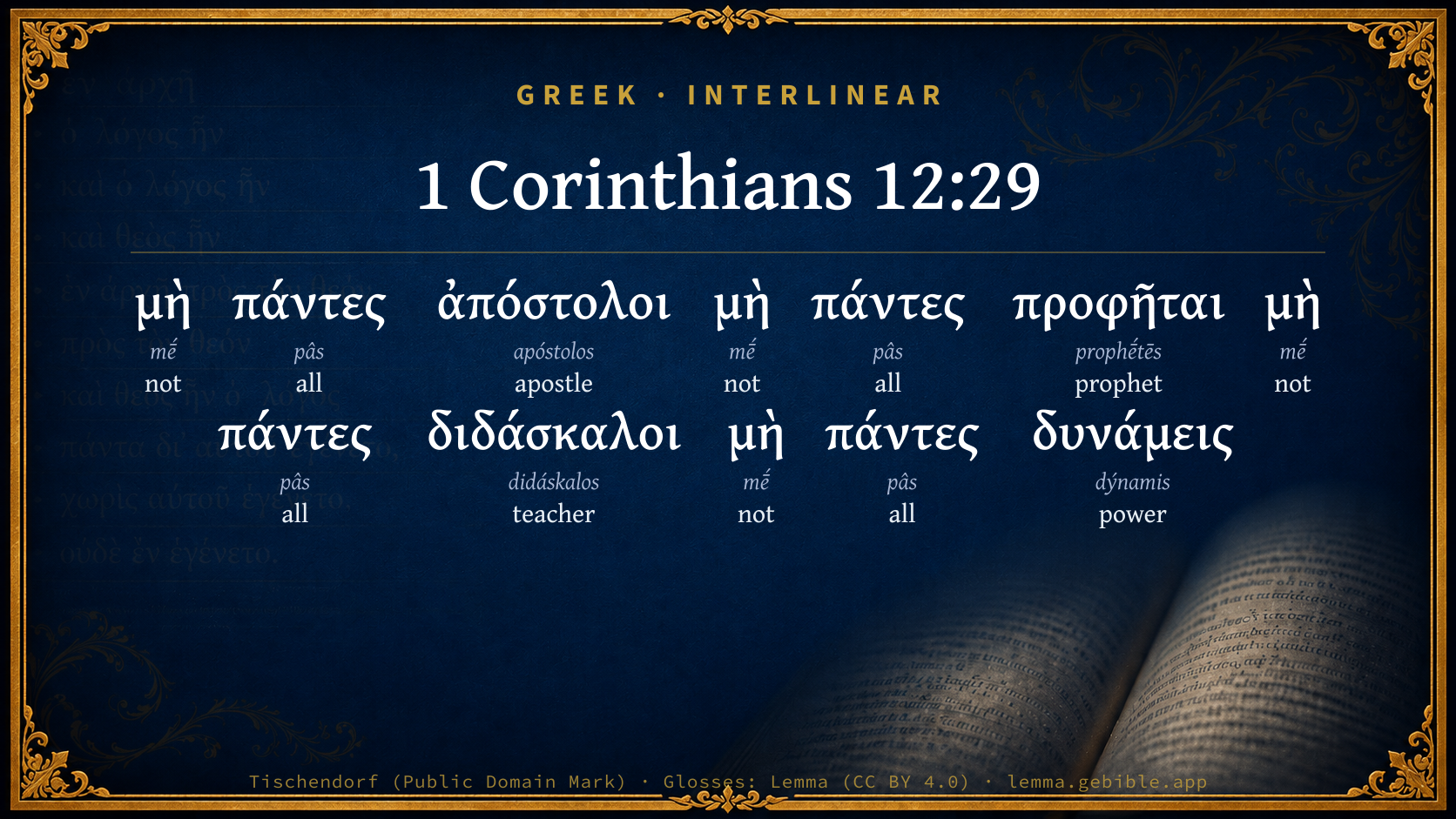
Download image
Cite this verse

1 Corinthians 12:29 (World English Bible). Public Domain. Lemma interlinear Bible study tool, https://lemma.gebible.app/v/1-corinthians/12/29.

Show BibTeX & RIS
BibTeX
RIS
English Translation
Are all apostles? Are all prophets? Are all teachers? Are all miracle workers?
World English Bible · Public Domain
Download a study sheet

One document with this verse’s original text, its word-by-word gloss line, the meaning frame, cross-references with their text, attributed commentary, and full source and license credits — printable, and it pastes into notes with its structure intact.

This verse Autodidact and up

Study sheet (.html) Plain text (.txt)

A passage Seminary Student

Up to 50 verses in one chapter. A passage sheet keeps up to 6 commentary sources and 12 cross-references per verse, in the order this page ranks them, and says so on the sheet whenever that leaves anything out. Ask for a single verse and you get the Autodidact verse sheet above.

Everything on this page stays free to read, with no account — the sheet is a download of what is already on screen, not access to it.

Want to remove ads? Support Godless Engineer
Compare translations 3

The same verse in 3 English versions, stacked beneath the original-language interlinear above. Click any original word for its lexicon entry.

Each is an independent rendering of the whole verse — the interlinear is not word-aligned to these translations.

Highlighted words mark where these versions differ — a whole-verse word diff, not a word-by-word alignment.

  • World English Bible Public Domain
    Are all apostles? Are all prophets? Are all teachers? Are all miracle workers?
  • King James Version Public Domain
    Are all apostles? are all prophets? are all teachers? are all workers of miracles?
  • unfoldingWord Literal Text CC BY-SA 4.0
    Not all apostles, are they? Not all prophets, are they? Not all teachers, are they? Not all miracles, do they?

unfoldingWord Literal Text — © unfoldingWord, licensed CC BY-SA 4.0. Word-aligned USFM3 via Door43 (git.door43.org/unfoldingWord/en_ult).

Versions to compare (up to 4)

3 of 4 selected

Show all 19 translations

Every available English version of this verse, each an independent rendering of the whole verse.

  • World English Bible Public Domain
    Are all apostles? Are all prophets? Are all teachers? Are all miracle workers?
  • Berean Standard Bible Public Domain
    Are all apostles? Are all prophets? Are all teachers? Do all work miracles?
  • Majority Standard Bible Public Domain
    Are all apostles? Are all prophets? Are all teachers? Do all work miracles?
  • King James Version Public Domain
    Are all apostles? are all prophets? are all teachers? are all workers of miracles?
  • American Standard Version (1901) Public Domain
    Are all apostles? are all prophets? are all teachers? are all `workers of' miracles?
  • Revised Version (1885) Public Domain
    Are all apostles? are all prophets? are all teachers? are all workers of miracles?
  • Geneva Bible (1599) Public Domain
    Are all Apostles? are all Prophetes? are all teachers?
  • Douay-Rheims (1899) Public Domain
    Are all apostles? Are all prophets? Are all doctors?
  • Young's Literal Translation Public Domain
    `are' all apostles? `are' all prophets? `are' all teachers? `are' all powers?
  • Literal Standard Version CC BY-SA 4.0
    [Are] all apostles? [Are] all prophets? [Are] all teachers? [Are] all powers?
  • Unlocked Literal Bible CC BY-SA 4.0
    Are all of them apostles? Are all prophets? Are all teachers? Do all do powerful deeds?
  • unfoldingWord Literal Text CC BY-SA 4.0
    Not all apostles, are they? Not all prophets, are they? Not all teachers, are they? Not all miracles, do they?
  • Darby Bible Public Domain
    [Are] all apostles? [are] all prophets? [are] all teachers? [are] all [in possession of] miraculous powers?
  • World Messianic Bible Public Domain
    Are all emissaries? Are all prophets? Are all teachers? Are all miracle workers?
  • Webster's Bible Public Domain
    Are all apostles? are all prophets? are all teachers? are all workers of miracles?
  • Free Bible Version CC BY-SA 4.0
    Not everyone is an apostle, or a prophet, or a teacher, or able to perform miracles.
  • Bible in Basic English Public Domain
    Are all Apostles? are all prophets? are all teachers? have all the power of working wonders?
  • Text-Critical English NT CC BY 4.0
    Are all apostles? Are all prophets? Are all teachers? Do all work miracles?
  • Tyndale New Testament (1534) Public Domain
    Are all Apostles? Are all Prophetes? Are all teachers? Are all doars of miracles?

Literal Standard Version (2020), Covenant Press — licensed CC BY-SA 4.0. Text via the HelloAO Bible API (eBible.org). Unlocked Literal Bible (unfoldingWord) — licensed CC BY-SA 4.0. Text via the HelloAO Bible API (eBible.org). unfoldingWord Literal Text — © unfoldingWord, licensed CC BY-SA 4.0. Word-aligned USFM3 via Door43 (git.door43.org/unfoldingWord/en_ult). Free Bible Version, Dr. Jonathan Gallagher — licensed CC BY-SA 4.0. Text via the HelloAO Bible API (eBible.org).

Word by word

More ways to search: Search by grammar → Find every occurrence → Compare this word →

Practice this passage: Drill this verse → Learn its vocabulary →

διδάσκαλοι
didáskalos
G1320
“teacher”
Noun, Nominative, Plural, Masculine
Part of Speech
Noun
Case
Nominative
Number
Plural
Gender
Masculine
Full Thayer's Definition

Origin: from G1321

TDNT: 04:28,2

1. a teacher 2. in the NT one who teaches concerning the things of God, and the duties of man a. one who is fitted to teach, or thinks himself so b. the teachers of the Jewish religion c. of those who by their great power as teachers draw crowds around them i.e. John the Baptist, Jesus d. by preeminence used of Jesus by himself, as one who showed men the way of salvation e. of the apostles, and of Paul f. of those who in the religious assemblies of the Christians, undertook the work of teaching, with the special assistance of the Holy Spirit g. of false teachers among Christians
  1. μὴ mḗ G3361 “not” Particle, Negative
  2. πάντες pâs G3956 “all” Adjective, Nominative, Plural, Masculine
  3. ἀπόστολοι apóstolos G652 “apostle” Noun, Nominative, Plural, Masculine
  4. μὴ mḗ G3361 “not” Particle, Negative
  5. πάντες pâs G3956 “all” Adjective, Nominative, Plural, Masculine
  6. προφῆται prophḗtēs G4396 “prophet” Noun, Nominative, Plural, Masculine
  7. μὴ mḗ G3361 “not” Particle, Negative
  8. πάντες pâs G3956 “all” Adjective, Nominative, Plural, Masculine
  9. μὴ mḗ G3361 “not” Particle, Negative
  10. πάντες pâs G3956 “all” Adjective, Nominative, Plural, Masculine
  11. δυνάμεις dýnamis G1411 “power” Noun, Nominative, Plural, Feminine

About this verse

These counts appear in no published source. They are computed here, from the morphology-tagged text and Lemma’s own curated glosses. What Lemma adds →

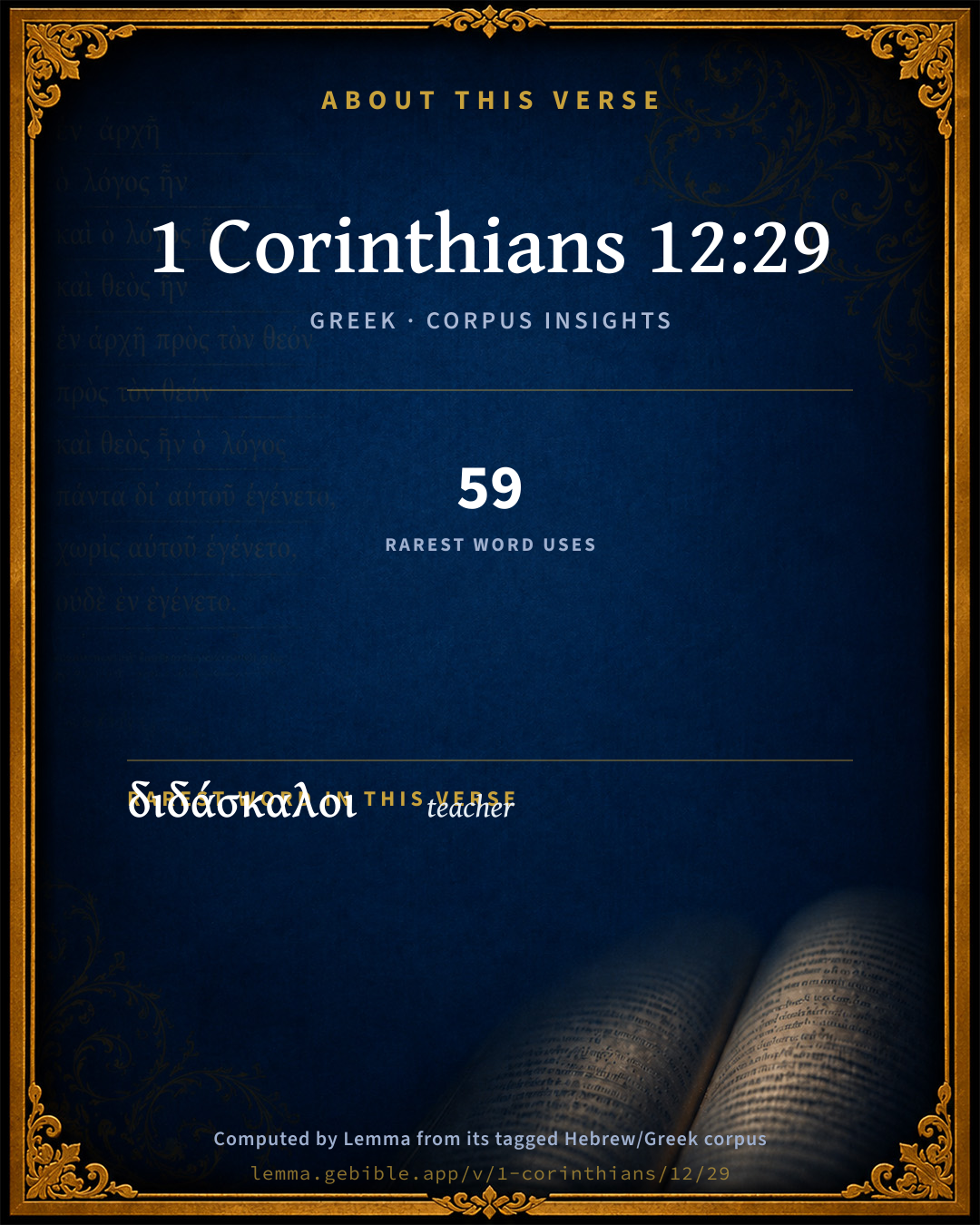
12
words
6
distinct lemmas
Pauline Epistles
section

Shared distinctive vocabulary

διδάσκαλοι teacher G1320 occurs in 58 verses of the Greek New Testament. Also found in:
Repetition

Words recur within this verse:

Cross-references

2

Topical passages linked to 1 Corinthians 12:29 in the Treasury of Scripture Knowledge — connected by theme and wording, ordered by reader-vote popularity; previews shown in the World English Bible.

Cross-references courtesy of OpenBible.info (CC BY 4.0).

Commentary

Notes on 1 Corinthians 12:29 from classic Christian and Jewish commentators (each source and its license shown beneath its notes). The classic Christian expositions comment on the surrounding passage and are grouped to its opening verse, so a note may address several verses; the Jewish commentaries on the Tanakh (Rashi and others) are per-verse, so they appear only where the commentator wrote on this verse.

Lemma curates 59 commentaries, every one of them public domain or Creative Commons licensed, each selected and text-cleaned for this edition rather than reprinted as found. About our sources →

Tyndale Open Study Notes

Tyndale Open Resources

12:29-30 These rhetorical questions all expect the answer, Of course not! Paul gently rebukes those who are jealous of others. Believers are to gratefully accept the gifts God has given them, and not to envy other gifts or elevate any gifts as more important than others (but see 12:31).

Tyndale Open Study Notes — © Tyndale Open Resources, licensed CC BY-SA 4.0. Text via the HelloAO Bible API.

Bengel's Gnomon

Johann Albrecht Bengel

1Co 12:29. Μὴ πάντες, are all? [surely not]) i.e., not very many are.—δυνάμεις, powers) viz., are all? For if Paul referred the have all? of 1Co 12:30, to it, he would have expressed it here.

Bengel's Gnomon of the New Testament — English translation (T&T Clark, Edinburgh, 1860) — public domain. Text from a community e-Sword module.

Meyer's Critical & Exegetical Commentary

Heinrich August Wilhelm Meyer

1Co_12:29-30. None of these functions and gifts is common property of all (all gifted persons). This Paul expresses in the animated queries: But all surely are not apostles? and so on; whereby, after the same thing had been done positively in 1Co_12:28, the ἐκ μέρους of 1Co_12:27 is now clearly elucidated afresh in a negative wayin order to make the readers duly sensible of the non omnia possumus omnes, and of the preposterousness of envy against other gifted persons.

δυνάμεις] Accusative depending on ἔχουσιν, not nominative, as if it denoted wonder-working persons (Bengel, Rückert, de Wette, Osiander, Hofmann, and others); see on 1Co_12:28.

Paul here passes over the ἀντιλήψ. and κυβερν., since it was of no importance to make a complete repetition.

With reference to the whole thought, comp Homer, Il. xiii. 730 f.

Meyer — Critical and Exegetical Commentary on the New Testament — English translation by Peter Christie, edited by Frederick Crombie (T&T Clark, 1880) — public domain. Text from a community e-Sword module.

Expositor's Greek Testament

ed. W. Robertson Nicoll

1Co 12:29-30 . In this string of rhetorical questions P. recapitulates once more the charisms, in the terms of 1Co 12:28 . He adds now to the γλώσσαις λαλεῖν its complementary διερμηνεύειν (see 10, and 1Co 14:13 , etc.: διὰ in this vb [1942] imports translation ); and omits ἀντιλήμψεις and κυβερνήσεις , for these functions had not taken articulate shape at Cor [1943] : the eight are thus reduced to seven . The stress of these interrogations rests on the seven times repeated all ; let prophet, teacher, healer, and the rest, fulfil each contentedly his μέρος in the commonwealth of grace, without trenching upon or envying the prerogative of another; “non omnia possumus omnes”. Thus by fit division of labour the efficiency of the whole body of Christ will be secured and all Church functions duly discharged. δυνάμεις may be nom [1944] (Bg [1945] , Hf [1946] , Hn [1947] , Al [1948] , Bt [1949] , Gd [1950] , El [1951] ), in the vein of the foregoing questions “are all powers?” ( cf. 1Co 15:24 , Rom 8:38 , etc., for the personification applied elsewhere, however, to supernatural Powers); but these “powers” are in 1Co 12:28 ; 1Co 12:8 ff. so decidedly separated from the teaching and associated with the healing gifts, that δυνάμεις appears to look forward, and to be obj [1952] (prospectively) to ἔχουσιν along with χαρίσματα ἰαμάτων : “do all possess powers? all grace-gifts of healings?” (so Bz [1953] , Mr [1954] , Ed [1955] ). For δύναμιν ἔχω , see Rev 3:8 ; also Luk 9:1 , Act 1:8 , Mat 14:2

[1942] verb

[1943] Corinth, Corinthian or Corinthians.

[1944] nominative case.

[1945] Bengel’s Gnomon Novi Testamenti.

[1946] J. C. K. von Hofmann’s Die heilige Schrift N.T. untersucht , ii. 2 (2te Auflage, 1874).

[1947] C. F. G. Heinrici’s Erklärung der Korintherbriefe (1880), or 1 Korinther in Meyer’s krit.-exegetisches Kommentar (1896).

[1948] Alford’s Greek Testament .

[1949] J. A. Beet’s St. Paul’s Epp. to the Corinthians (1882).

[1950] F. Godet’s Commentaire sur la prem. Ép. aux Corinthiens (Eng. Trans.).

[1951] C. J. Ellicott’s St. Paul’s First Epistle to the Corinthians .

[1952] grammatical object.

[1953] Beza’s Nov. Testamentum: Interpretatio et Annotationes (Cantab., 1642).

[1954] Meyer’s Critical and Exegetical Commentary (Eng. Trans.).

[1955] T. C. Edwards’ Commentary on the First Ep. to the Corinthians . 2

The Expositor's Greek Testament, edited by W. Robertson Nicoll (1897–1910) — public domain. Text from a community e-Sword module.

Godet's Commentaries

Frédéric Louis Godet

Vv. 29, 30. “Are all apostles? are all prophets? are all teachers? are all powers? 30. Have all the gifts of healing? do all speak with tongues? do all interpret?” — God has given to believers a certain spiritual endowment (1Co 12:28); but side by side with this endowment He has left a blank in each of them, and so a want which does not allow him to separate himself from the rest. It is obvious that the questions are put so as to lead to the result which was expressed in regard to the members of the body in 1Co 12:14-17. No individual ought to pose as self-sufficient. The body, as a whole, only exists on the condition that each member needs all the rest. The questions, all beginning with μή, all expect a negative answer: “All are not, however, apostles?” None of those, therefore, who are not such, will be able to dispense with the brethren whom God has made apostles. And if this is true regarding apostles and prophets, it is also true in regard to all other gifts and offices.

It is unnecessary to understand ἔχουσιν before δυνάμεις, powers. This substantive may very well be the predicate of the subject. The power of working miracles is identified with its possessor (1Co 12:28).

Helps and governments are omitted in this second list, probably because they did not greatly excite the ambition of believers.

It follows, therefore, from this application to the Church, 1Co 12:27-30: (1) that no one ought to regard himself as being unnecessary to the whole, since he has been placed there with his gift by God Himself (1Co 12:28); (2) and consequently, also, that no one ought to consider himself as possessed of self-sufficiency or as combining in himself all that is necessary for the life of the Church of which he is a member (1Co 12:29-30).

From these general principles the apostle might pass immediately to the practical applications he has in view. But, before entering on this subject, which will be treated in chap. 14, he here inserts a meditation on the fundamental disposition of the Christian life, charity without which all gifts, whatever they may be, become useless, but which, on the other hand, gives them all their true consecration and alone assures their effectual and beneficent exercise (chap. 13). To our 1Co 12:31, which forms the transition to this episode, there obviously corresponds chap. 1Co 14:1, whereby the apostle returns from this digression to his principal subject.

Frédéric Louis Godet — Commentaries on Luke, John, Romans, and 1 Corinthians — English translation (T&T Clark, Edinburgh, 1870s–1890s) — public domain. Text from a community e-Sword module.

Hodge's Commentary on Romans, Ephesians & First Corinthians

Charles Hodge

1Co_12:29, 1Co_12:30

(Are) all apostles? (are) all prophets? (are) all teachers? (are) all workers of miracles? Have all the gifts of healing? do all speak with tongues? do all interpret?

As in the body all is not eye, or all ear, so in the church all have not the same gifts and offices. And as it would be preposterous in all the members of the body to aspire to the same office, so it is no less preposterous in the members of the church that all should covet the same gifts. It is the design of the apostle to suppress, on the one hand, all discontent and envy, and on the other, all pride and arrogance. God distributes his gifts as he pleases; all are necessary, and the recipients of them are mutually dependent.

Charles Hodge — Commentary on Romans (1835), First Corinthians (1857), and Ephesians (1856) — public domain. Text from a community e-Sword module.

Jamieson, Fausset & Brown

Robert Jamieson, A. R. Fausset & David Brown

Are all?--Surely not.

Jamieson, Fausset & Brown — Commentary Critical and Explanatory on the Whole Bible (1871) — public domain (CC PDM 1.0). Text via the HelloAO Bible API.

Adam Clarke's Commentary

Verse 29. Are all apostles, c.] That is: All are not apostles, all are not prophets, c. God has distributed his various gifts among various persons, each of whom is necessary for the complete edification of the body of Christ. On these subjects see the notes on 1Co 12:7-10.

Adam Clarke's Commentary on the Bible (1810–1826) — public domain. Text from a community e-Sword/MySword module.

John Calvin's Commentaries

29. Are all Apostles? It may indeed have happened, that one individual was endowed with many gifts, and sustained two of the offices which he has enumerated; nor was there in this any inconsistency. Paul’s object, however, is to show in the first place, that no one has such a fullness in everything as to have a sufficiency within himself, and not require the aid of others; and secondly, that offices as well as gifts are distributed in such a manner that no one member constitutes the whole body, but each contributing his portion to the common advantage, they then altogether constitute an entire and perfect body. For Paul means here to take away every occasion of proud boasting, base envyings, haughtiness, and contempt of the brethren, malignity, ambition, and everything of that nature.

John Calvin's Commentaries (1540-1563) — public domain. Text from the Calvin Translation Society English edition (1840s-50s) via the Christian Classics Ethereal Library (ccel.org). Calvin's coverage is partial (roughly two-thirds of the Bible); uncommented books and verses are honest gaps, never fabricated. The 19th-century editor's footnotes and remarks are omitted so the notes are faithfully Calvin's own voice.

The Cambridge Bible for Schools and Colleges

gen. ed. J. J. S. Perowne

29. Are all apostles?] The common priesthood of every Christian (1Pe_2:5; 1Pe_2:9) no more precludes the existence of special offices of authority in the Christian Church than the common priesthood of the Jewish people (Exo_19:6) precluded the existence of a special order of men appointed to minister to God in holy things. The Apostle appeals to it as a notorious fact that all were not apostles or prophets, but only those who were called to those offices. Accordingly there is scarcely any sect of Christians which has not set apart a body of men to minister in holy things and to expound the word of God. “Were all teachers,” says Estius, “where were the learners?” The question here, however, is, rather of gifts than of the offices to which those gifts lead.

The Cambridge Bible for Schools and Colleges (gen. ed. J. J. S. Perowne; Cambridge University Press, 1878–1918) — public domain. Text from a community e-Sword module.

John Gill's Exposition

Are all apostles?.... No some are prophets, as distinct from apostles; and some are teachers, as distinct from them both, and some are neither:

are all prophets? no; some are apostles, above them, and some are teachers, inferior to them; and but very few there were who had that peculiar character and gift:

are all teachers? no; the far greater part of the members of churches are hearers, or persons that are taught in the word; are neither in the office of teaching, nor have they the qualifications for it.

Are all workers of miracles? no; in those early times, when the gift of doing miracles was bestowed, it was not given to all, only to some; and now there are none that are possessed of it.

John Gill's Exposition of the Whole Bible (1746–1763) — public domain (CC PDM 1.0). Text via the HelloAO Bible API.

Trapp's Complete Commentary

John Trapp

29 Are all apostles? are all prophets? are all teachers? are all workers of miracles?

Ver. 29. Are all teachers?] Yes, some would have it so, as in Alcibiades’ army all were leaders, no learners.

John Trapp, A Commentary or Exposition upon All the Books of the Old and New Testament (1647–1656) — public domain. Text from a community e-Sword module.

Albert Barnes' Notes on the Bible

Are all apostles? ... - These questions imply, with strong emphasis, that it could not be, and ought not to be, that there should be perfect equality of endowment. It was not a matter of fact that all were equal, or that all were qualified for the offices which others sustained. Whether the arrangement was approved of or not, it was a simple matter of fact that some were qualified to perform offices which others were not; that some were endowed with the abilities requisite to the apostolic office, and others not; that some were endowed with prophetic gifts, and others were not; that some had the gift of healing, or the talent of speaking different languages, or of interpreting and that others had not.

Albert Barnes' Notes on the Bible (1834–1885) — public domain. Text from a community e-Sword/MySword module.

Matthew Poole's English Annotations

That is, all are not, nor can be, any more than all the body can be an ear, or an eye, or a hand, or a foot: you cannot expect, that in a governed body all should be governors; and you see by experience, that all cannot work miracles, prophesy, speak with tongues, or heal those that are sick.

Matthew Poole's English Annotations on the Holy Bible (1683–1685) — public domain. Text from a community e-Sword/MySword module.

The Pulpit Commentary

Are all apostles? etc. It is God"s providence which "has appointed divers orders in his Church," and has "ordained and constituted the services of angels and of men in a wonderful order."

The Pulpit Commentary (1880–1919), ed. H.D.M. Spence-Jones & Joseph S. Exell — public domain. Text from a community e-Sword module.

Burkitt's Expository Notes on the New Testament

William Burkitt

The force of the apostle’s argument lies thus: As the natural body, to which he had before alluded, cannot be all eye, nor all ear, nor all hand, nor all foot; in like manner in the mystical body, the church, all cannot govern, prophesy, teach, work miracles, heal diseases; but one has this gift, and another that; one has this office in the church, and another that; all which are to be employed and improved for the common good of the church, and mutual benefit of each other.

William Burkitt's Expository Notes on the New Testament (1700–1703) — public domain. Text from a community e-Sword module.

Godbey's Commentary on the New Testament

William B. Godbey

DIVERSITIES OF GIFTS

29. “Whether are all apostles?” Of course the answer is in the negative. No age of Christendom has ever needed a very great number of pioneer’s to explore and plant the work in new fields, as it would be fruitless unless those fields are immediately occupied and permanently utilized. If God has not made you a pioneer, it does not follow that He has not called you into the work and has not for you a crown of glory waiting to greet you on the mount of victory. Sanctification kills out all your ambitions so you are as willing to be a most humble worker as the very “chief of the apostles.” If any one thinks that the apostolic office, in its original and literal signification as a pioneer, is not still a happy verity in God’s kingdom, read Eph 4:10-12. “Are all prophets?” i. e., Spirit-filled preachers of the gospel, evangelists and pastors? The answer is in the negative. As in the preceding exegesis, you see there is a symmetry in the body of Christ homogeneous to that in the human body, which would be ruined if it were all eye, or all ear, or all nose, or all foot, or all trunk, and no members. In a similar manner the Omniscient Creator of the body of Christ, which includes all the saints, has beautifully, symmetrically and proportionately supplied it with all the diversified members and infinitesimal constituencies of the infinitely diversified organism. Well has the human body been denominated “a harp with a thousand strings,” on which Jehovah alone can play and He alone keep it in tune. How prominently, even elaborately, in this chapter does the Holy Ghost specify the different members of the body constituting a mysterious unity and beautifully illustrating the mystical unity amid illimitable variety and diversity characterizing the body of Christ. How deplorably do the fallen churches illustrate the sad discomfiture of this Divine arrangement, and their deplorable deficiency of many organs which are indispensable not only to the efficiency, but even the life, of the body. These organs, however, the devil is prompt to supply, which makes the matter infinitely worse than the deficiencies. Of course we are not all “prophets,” i. e., fire-baptized evangelists and pastors. But that is no reason why we should conclude that we have been left out of the catalogue. The Holy Ghost honors and utilizes all the members of the body. He has no deadbeats. The devil supplies them. “Whether are all teachers?” James (Jas 3:1) commands us, “Be not many teacher’s,” E.V., “masters,” in harmony with the old style of calling a schoolteacher a schoolmaster. The Greek is didaskaloi, the very word we have here. Hence we find that “teacher’s” are not many, but few. I have spent years in other capacities of gospel work, but for’ some years have been used as a teacher in the school of Christ. Of this office I feel very unworthy, yet I must be true to the Holy Ghost by the grace of God. The cause of God in all ages, as abundantly and sadly illustrative ever and anon in the present Holiness Movement, has suffered much from incompetent teacher’s, propagating dangerous and damaging errors. Thousands of true saints, who could be eminently useful if they would go out in the office of prophet, i. e., edifying, exhorting and comforting the people (ch. 1Co 14:3), could win platoons for God and weave a crown of glory for their own brows in the coming eternity by reading the Word of God, proclaiming it to the people, exhorting them to receive it and prepare for death and judgment, and everywhere comforting the brokenhearted by reading and repeating the precious promises, at the same time corroborating all by their own happy experiences. Meanwhile, if they undertake to go down into the profundities of exegesis for which they are utterly incompetent, they will actually, though innocently, run into sad mistakes and propagate all sorts of errors which the enemy will use to break our heads, prejudice the people against sanctification and lead them down to Hell. While teaching is so exceedingly important and indispensable, we must admit that education, especially in the Greek and Hebrew, which form the inspired original Scriptures, is of infinite value. The saints of the Lord should move slowly, carefully, prayerfully and judiciously on the line of exegesis, and at the same time be bold as lions, everywhere ringing out the plain Word of God extemporaneously if you have a good memory, but if you do not remember and have the Word at your tongue’s end, praise the Lord! He has given you good eyes and your precious and infallible Bible, which shall judge you and all the people with whom you deal in the interests of their souls, consequently you are left without excuse. You can read God’s Word to the people, exhort them to obey it and comfort them with the precious promises, thus enjoying the honorable office of “prophet” if not that of teacher. The word prophesy means to “overflow.” So you can go around overflowing the Word of God as you read it in your Bible, and exhorting the people to obey it, at the same time reading and repeating the precious promises to the brokenhearted. “He that prophesieth speaketh to the people edification, exhortation and comfort” (ch. 1Co 14:3). Be sure you never lose sight of this definition of prophecy given by the Holy Ghost. It is so simple, easy and practical that by the help of the blessed Spirit you certainly can reach it. “Oh! I am so sorry I can not read the Scriptures in Greek and Hebrew!” Do not please the enemy by talking that way. But shout aloud because you can read your Bible in one language. You are wonderfully fortunate. Five hundred years ago not one person in five hundred could read it. N. B. — You will not be judged by Greek nor Hebrew, but by the plain English Bible, when you stand before the great white throne, so rest easy and press the battle for souls. If you are not prepared to be a teacher, shout the louder because God has given you the more felicitous office of an exhorter and comforter. “Whether are all dynamiters?” i. e., the honored participants of the fifth gift of the Spirit, as they stand in the preceding catalogue, denominated in E.V. “the working of miracles.” Perhaps God does not especially need you in that line. He has for you a fade less diadem in your own calling. Be true, and “ready to stand in your lot at the end of the days.” The church imperatively needs these dynamiters, to go around with their sharp, New Jerusalem steel drills and ponderous mallets, patiently drilling through the devil’s profound flinty strata, putting down the dynamite, igniting it with heavenly electricity, and blowing up the devil’s mountains. But remember, a few dynamite blasts will burst out rock enough to work in a year. Then what a grand open field for a regiment of stone sledgers to come, knock off the asperites, give each piece its requisite shape and dimension, and patiently chisel it out, preparatory to the occupancy of its necessary position in the grand superstructure of God’s temple. In Jerusalem they use neither wood nor brick, but build all the houses out of stone and calcareous cement, which quickly consolidate into a rock. When I was there a number of very magnificent edifices were in process of erection. As I passed along I saw many brown sons of Esau sitting around, each with a rock, hammer and chisel, diligently and patiently preparing his piece for the superstructure. So do not get blue if God has not made you a dynamiter. But shout the louder, because he has honored you with the privilege of dressing the rocks, blown up by his dynamiters, and locating them in the celestial temple to abide forever, the admiration of angels. I have seen much of this beautiful, Divine order manifested; some hard-fisted, clubfooted old dynamiter in a few lightning blasts blow up rock enough to keep a hundred Christian worker’s diligently employed for days and weeks.

William B. Godbey, Commentary on the New Testament (1896–1900) — public domain. Text from a community e-Sword module.

McGarvey & Pendleton's Commentaries

J. W. McGarvey

Are all apostles? are all prophets? are all teachers? are all workers of miracles?

J. W. McGarvey (with Philip Y. Pendleton), Commentaries on the New Testament (The Fourfold Gospel, 1914; Acts; and the epistles) — public domain. Text from a community e-Sword/MySword module.

The People's New Testament

B. W. Johnson

29. Are all apostles? Only a few had this office given them, and so of each of the other gifts.

B. W. Johnson's The People's New Testament with Notes (1889–1891) — public domain. Electronic text from the Christian Classics Ethereal Library (CCEL) ThML edition.

Cambridge Greek Testament for Schools and Colleges

29. μὴ πάντες ἀπόστολοι; The common priesthood of every Christian (1Pe 2:5; 1Pe 2:9) no more precludes the existence of special offices of authority in the Christian Church than the common priesthood of the Jewish people (Exo 19:6) precluded the existence of a special order of men appointed to minister to God in holy things. The Apostle appeals to it as a notorious fact that all were not apostles or prophets, but only those who were called to those offices. Accordingly there is scarcely any sect of Christians which has not set apart a body of men to minister in holy things and to expound the word of God. ‘Were all teachers,’ says Estius, ‘where were the learners?’ The question here, however, is rather of gifts than of the offices to which those gifts lead.

Cambridge Greek Testament for Schools and Colleges (Cambridge University Press, 1896; 21 vols, various authors incl. Carr, Maclear, Plummer, Farrar, Lumby, Moule, M. R. James, Simcox) — public domain. Text from a community e-Sword module.

Alford’s Greek Testament

Henry Alford

29. δυνάμεις] not, as Meyer, al., accusative, governed by ἔχουσιν—which involves a departure from the parallelism, besides the harshness of construction:—but nominative, in apposition with πάντες. The Apostle has above placed the concrete, ἀπόστολοι, προφῆται, διδάσκαλοι, in apposition with δυνάμεις and χαρίσμ. ἰαμ., and now proceeds with the same arrangement till he comes to χαρίσματα ἰαμάτων, which being too palpably unpredicable of persons, gives rise to the change of construction,—μὴ πάντες χαρ. ἔχουσιν ἰαμάτων; In the last two questions, he departs from the order of the last verse, and takes in again one particular from the former catalogue, ver. 10.

Meyer compares Hom. Il. ν. 726-734. See Stanley’s note and excursus.

Henry Alford, The Greek Testament (1849–1861) — public domain. Text from a community e-Sword module.

International Critical Commentary

29. μὴ πάντες ἀπόστολοι; ‘Surely all are not Apostles?’ These rhetorical questions explain μέλη ἐκ μέρους (v. 27) and look back to τὸ σῶμα οὐκ ἕν μέλος ἀλλὰ πολλά (v. 14). God did not give all these spiritual gifts to all. That would have been to make each member a kind of complete body, independent of the other members; and this would have been fatal to the whole. He has made no one member self-sufficient; each needs much from others and supplies something to them. See Godet. Here all the illustrations are concrete, with the possible exception of δυνάμεις. But seeing that δυνάμεις and χαρ. ἰαμάτων form a pair, we may put the two questions together and take ἔχουσιν with both terms; ‘Have all (the power of working) miracles, all gifts of healing?’ The Vulgate may be taken in a similar manner; Numquid omnes virtutes, numquid omnes gratiam habent curationum? but again, why the change from gratias (v. 28) to graham? For the third time the gift of Tongues is placed last.

International Critical Commentary — older volumes (1896–1929), various authors — public domain. Text from a community e-Sword module.

Lesson kit

Teaching starters — assembled from the data on this page, not authored interpretation. Every prompt links to the verse data it draws on. Edit before teaching.

1 Corinthians, in the Pauline Epistles, opens this verse with 12 words (6 distinct Greek lemmas). Its most distinctive word is didáskalos (“teacher”). A historical commentator’s framing appears above. Read the whole chapter for the surrounding context.

Discussion questions

  1. The word didáskalos carries the sense “teacher.” How does it shape the verse?
  2. How does Matthew 8:19, which shares the word «teacher», read alongside this verse?
  3. What does the repetition of “all” (4× in this one verse) do in this verse?
  4. The translations on this page render this verse differently — a whole-verse word diff, not a word-by-word alignment. What might account for the different wordings?
  5. Compare how Tyndale Open Study Notes and Bengel's Gnomon read this verse. Where do they agree or differ?

Things to notice

  • These translations choose different wording for 4 words in this verse.
  • “all” occurs 4× in this single verse.
  • 6 distinct Greek lemmas span 12 words in this verse.

Reading settings

Reading text

Shown beneath each verse's original-language words.

Old Testament
Old Testament edition

Read the OT as the Masoretic Hebrew (MT) or the Greek Septuagint (LXX).

English shown for the Greek Septuagint (in the Hebrew ↔ Greek comparison).

Comparing translations? Open the Compare panel on any verse page to stack up to four side by side.