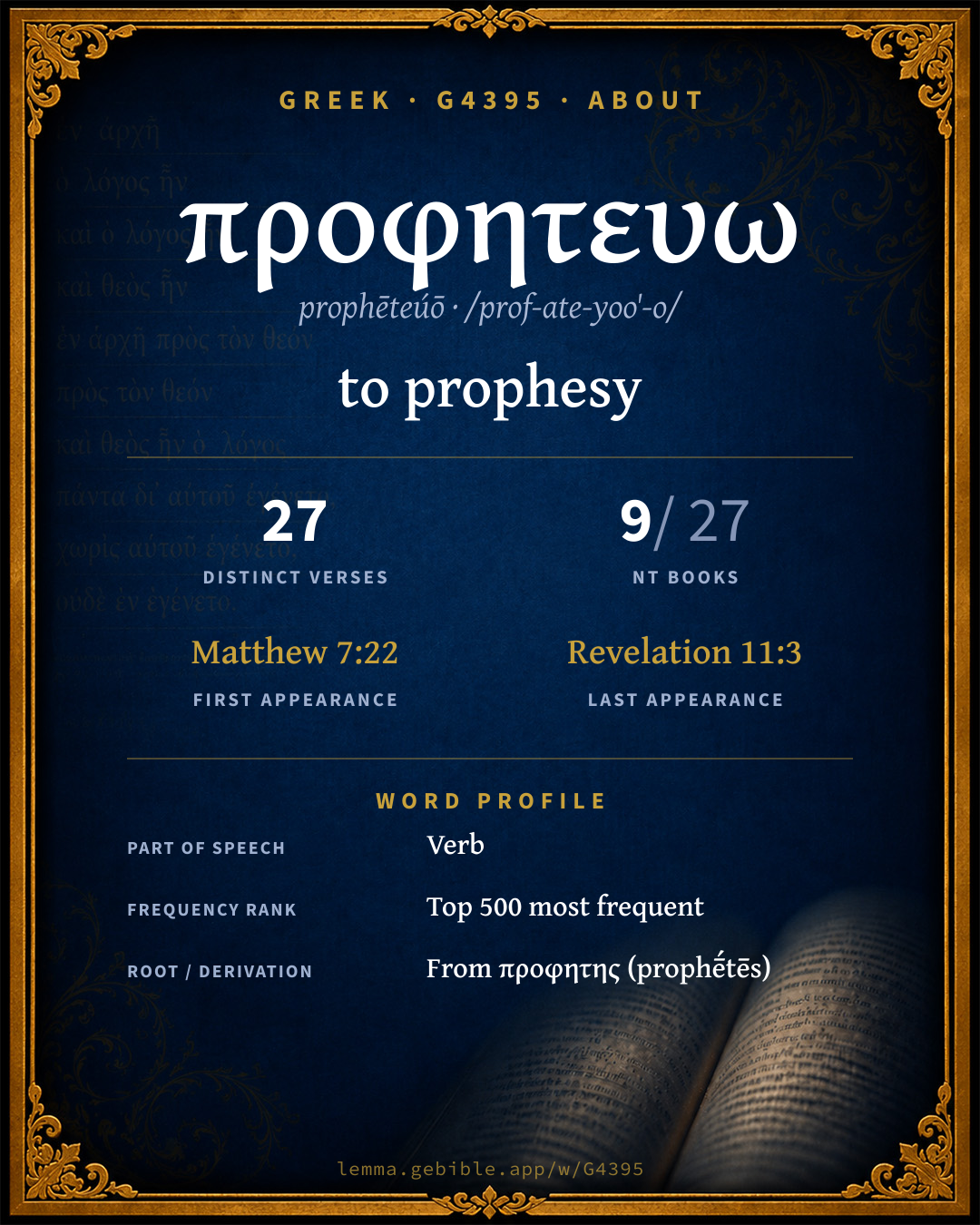
προφητεύω
to prophesy
Full lexicon entry — Thayer's Greek Lexicon
From Thayer's Greek Lexicon
Where this word appears
See every Aorist-tense verb in the Greek New Testament →
Grammar key — what these labels mean
Part of speech
- Verb
- An action or state-of-being word.
Tense
- Aorist
- Action viewed as a simple whole, without regard to duration — often past (perfective aspect).
- Present
- Ongoing or general action in present time (imperfective aspect).
- Future
- Action expected in future time.
- Imperfect
- Continuous or repeated action in past time (“was writing”).
Voice
- Active
- The subject performs the action.
Mood
- Indicative
- States a fact or asks a factual question (the mood of reality).
- Participle
- A verbal adjective (“writing,” “having written”).
- Imperative
- Expresses a command or request.
- Infinitive
- A verbal noun (“to write”), unmarked for person or number.
- Subjunctive
- Expresses probability, purpose, or possibility (the mood of contingency).
Case
- Nominative
- The case of the subject (and the predicate nominative).
Person
- 3rd person
- The one spoken about (“he / she / it / they”).
- 2nd person
- The one addressed (“you”).
- 1st person
- The speaker (“I / we”).
Gender
- Masculine
- Grammatically masculine.
- Feminine
- Grammatically feminine.
Number
- Singular
- One.
- Plural
- More than one.
Grammatical forms 15 distinct
- Verb, Aorist, Active, Indicative, 3rd person, Singular 5 times (18%)
- Verb, Present, Active, Participle, Nominative, Singular, Masculine 4 times (14%)
- Verb, Aorist, Active, Imperative, 2nd person, Singular 3 times (11%)
- Verb, Future, Active, Indicative, 3rd person, Plural 3 times (11%)
- Verb, Present, Active, Infinitive 2 times (7%)
- Verb, Present, Active, Subjunctive, 2nd person, Plural 2 times (7%)
- Verb, Aorist, Active, Indicative, 1st person, Plural 1 time (4%)
- Verb, Aorist, Active, Indicative, 3rd person, Plural 1 time (4%)
+7 more forms (7 occurrences)
Parsed forms decoded from the imported morphology (Robinson–Tischendorf, public domain), counted across 28 parsed occurrences — not distinct verses.
Every verse where G4395 appears — 27 distinct verses across 9 books. Click any verse to open its interlinear word-by-word view. Verse text shown in the World English Bible for context — . Each verse’s Greek form is shown with its reference; the English is not keyword-highlighted, since the data carries no word-level English alignment. Use “Compare translations” on any verse to read it across multiple English versions. This concordance covers the Greek New Testament; Septuagint (Greek Old Testament) occurrences of this word are not indexed here.
Matthew 4 verses
- Matthew 7:22 ἐπροφητεύσαμεν aor act ind 1pl Many will tell me in that day, 'Lord, Lord, didn't we prophesy in your name, in your name cast out demons, and in your name do many mighty works?'
- Matthew 11:13 ἐπροφήτευσαν aor act ind 3pl For all the prophets and the law prophesied until John.
- Matthew 15:7 ἐπροφήτευσεν aor act ind 3sg You hypocrites! Well did Isaiah prophesy of you, saying,
- Matthew 26:68 προφήτευσον aor act impv 2sg saying, "Prophesy to us, you Christ! Who hit you?"
Mark 2 verses
- Mark 7:6 ἐπροφήτευσεν aor act ind 3sg He answered them, "Well did Isaiah prophesy of you hypocrites, as it is written, 'This people honors me with their lips, But their heart is far from me.
- Mark 14:65 προφήτευσον aor act impv 2sg Some began to spit on him, and to cover his face, and to beat him with fists, and to tell him, "Prophesy!" The officers struck him with the palms of their hands.
Luke 2 verses
John 1 verse
Acts 4 verses
- Acts 2:17 προφητεύσουσιν fut act ind 3pl 'It will be in the last days, says God, That I will pour out my Spirit on all flesh. Your sons and your daughters will prophesy. Your young men will see visions. Your old men will dream dreams.
- Acts 2:18 προφητεύσουσιν fut act ind 3pl Yes, and on my servants and on my handmaidens in those days, I will pour out my Spirit, and they will prophesy.
- Acts 19:6 ἐπροφήτευον impf act ind 3pl When Paul had laid his hands on them, the Holy Spirit came on them, and they spoke with other languages and prophesied.
- Acts 21:9 προφητεύουσαι pres act ptcp nom pl fem Now this man had four virgin daughters who prophesied.
1 Corinthians 10 verses
- 1 Corinthians 11:4 προφητεύων pres act ptcp nom sg masc Every man praying or prophesying, having his head covered, dishonors his head.
- 1 Corinthians 11:5 προφητεύουσα pres act ptcp nom sg fem But every woman praying or prophesying with her head unveiled dishonors her head. For it is one and the same thing as if she were shaved.
- 1 Corinthians 13:9 προφητεύομεν pres act ind 1pl For we know in part, and we prophesy in part;
- 1 Corinthians 14:1 προφητεύητε pres act subj 2pl Follow after love, and earnestly desire spiritual gifts, but especially that you may prophesy.
- 1 Corinthians 14:3 προφητεύων pres act ptcp nom sg masc But he who prophesies speaks to men for their edification, exhortation, and consolation.
- 1 Corinthians 14:4 προφητεύων pres act ptcp nom sg masc He who speaks in another language edifies himself, but he who prophesies edifies the assembly.
- 1 Corinthians 14:5 προφητεύητε προφητεύων pres act subj 2pl pres act ptcp nom sg masc Now I desire to have you all speak with other languages, but rather that you would prophesy. For he is greater who prophesies than he who speaks with other languages, unless he interprets, that the assembly may be built up.
- 1 Corinthians 14:24 προφητεύωσιν pres act subj 3pl But if all prophesy, and someone unbelieving or unlearned comes in, he is reproved by all, and he is judged by all.
- 1 Corinthians 14:31 προφητεύειν pres act inf For you all can prophesy one by one, that all may learn, and all may be exhorted.
- 1 Corinthians 14:39 προφητεύειν pres act inf Therefore, brothers, desire earnestly to prophesy, and don't forbid speaking with other languages.
1 Peter 1 verse
Jude 1 verse
Revelation 2 verses
About this entry
At a glance — auto-summarized from this page’s data, not written by a person. Every figure links to its source below. This summary describes the numbers; it doesn’t interpret them.
The Greek verb προφητευω centers on the idea of “to prophesy.” First canonically at Matthew 7:22, it enters the text early. It turns up in 27 verses across 9 books, a moderately common footprint. The word gravitates to 1 Corinthians (37%), then Matthew and Acts. It clusters with προφητης, προφητεια and προφητικος under a shared root. Dig into 27-verse concordance and the renderings breakdown below.
Gloss history
Strong's 1890 vs modern scholarship
About this word
Strong's G4395 catalogs a Greek word from the Greek New Testament.
These counts are not copied from any lexicon or concordance. They are computed here, from the morphology-tagged Greek New Testament. What Lemma adds →
- 27
- distinct verses
- The word appears in 27 distinct verses.
- 9 / 27
- NT books
- The word appears in 9 of 27 New Testament books.
- #485
- by frequency
- Top 500 most frequent Greek words (rank 485 of 5,347 Greek words by occurrence).
View all 27 occurrences in the concordance →
Most concentrated in
- 1 Corinthians 10 verses 37%
- Matthew 4 verses 15%
- Acts 4 verses 15%
By section of the New Testament
By traditional corpus
Conventional, traditional groupings — biblical authorship is debated, so this is a traditional corpus grouping, not an authorship claim. Some books belong to more than one corpus (Luke is in both the Gospels and the Lukan corpus, and so on), so these shares overlap and need not total 100%. Each figure is a share of the word’s 27 distinct verses.
- Pauline corpus 10 verses · 37%
- Gospels 9 verses · 33%
- Lukan (Luke–Acts) 6 verses · 22%
- Johannine 3 verses · 11%
- General (Catholic) Epistles 2 verses · 7%
- Revelation 2 verses · 7%
How translations render this word
Counts come from each version’s own published word-to-Strong’s tagging or interlinear alignment — an approximate guide to how each version renders this word, not a word-level alignment the data otherwise carries. Because each total is that version’s own tagged count, the per-version totals vary from one another and need not match the appearance or distinct-verse counts above. These counts may also differ from a printed concordance because Lemma counts each distinctly tagged rendering and does not collapse phrase taggings into a single head-word total. This is a fixed set of word-tagged versions (KJV, ASV, BSB, ULT) and does not change with the reading translation you choose elsewhere. Each version’s license is shown beside its name below (and on Sources).
- King James Version: Prophesy 8×, Prophesied 7×, He that prophesieth 2×
- American Standard Version: Prophesy 10×, Prophesied 6×, Prophesieth 3×
- Berean Standard Bible: Prophesied 7×, Prophesy 6×, Prophesies 5×
- unfoldingWord Literal Text: Prophesy 7×, Prophesying 7×, Prophesied 4×
King James Version Public Domain
Renders G4395 across 30 tagged occurrences — most commonly:
Plus 11 renderings that appear only once — usually multi-word phrases or single function words the recovered tagging swept in, not distinct renderings.
American Standard Version Public Domain
Renders G4395 across 31 tagged occurrences — most commonly:
Plus 6 renderings that appear only once — usually multi-word phrases or single function words the recovered tagging swept in, not distinct renderings.
Berean Standard Bible Public Domain
Renders G4395 across 28 tagged occurrences — most commonly:
Plus 8 renderings that appear only once — usually multi-word phrases or single function words the recovered tagging swept in, not distinct renderings.
unfoldingWord Literal Text CC BY-SA 4.0
Renders G4395 across 30 tagged occurrences — most commonly:
Plus 8 renderings that appear only once — usually multi-word phrases or single function words the recovered tagging swept in, not distinct renderings.
Senses in Thayer's
The 1 sense Thayer's distinguishes for this word, in lexicon order (not ranked by frequency or importance). The full entry — with sub-senses — is in the Lexicon Entry tab.
- to prophesy, to be a prophet, speak forth by divine inspirations, to predict
Word origin
Derived from προφητης (prophḗtēs) (G4396) — prophet.
From G4396 ; to foretell events divine speak under inspiration exercise the prophetic office : - prophesy.
— Strong’s Exhaustive Concordance (1890), public domain.
Forms in the corpus
The 15 distinct written forms G4395 takes in the Greek New Testament, most frequent first — each parse links to that tense’s occurrences in the concordance.
Same root — word family
Other Thayer's entries built from the same root as G4395, grouped by Strong’s listed origin. These share a root / origin per the lexicon — not necessarily a shared meaning. Each links to that word’s own entry.
Derives from
Shares the same root
- προφητεια prophēteía G4394 prophecy
- προφητικος prophētikós G4397 prophetic
- προφητις prophētis G4398 prophetess
Compare all same-root words → Showing 4 of 5 — not the complete family. They share a root, not necessarily a meaning.
Septuagint usage
The same Greek word προφητευω appears 110 times in the Greek Old Testament (Septuagint), across 96 verses in 10 books.
- 110
- LXX occurrences
- Tagged occurrences of this Greek word in the Septuagint.
- 96
- verses
- Distinct Septuagint verses containing this word.
- 10 / 39
- OT books
- The word appears in 10 of the 39 Old Testament books.
Sample Septuagint occurrences
- Numbers 11:25 προφητεύω
- 1 Samuel 10:5 προφητεύω
- 1 Kings 18:29 προφητεύω
- 2 Chronicles 18:7 προφητεύω
- Ezra 5:1 προφητεύω
- Jeremiah 2:8 προφητεύω
- Ezekiel 4:7 προφητεύω
- Joel 3:1 προφητεύω
- Amos 2:12 προφητεύω
- Zechariah 13:3 προφητεύω
Septuagint occurrences (same lexeme)
Every verse where the same Strong’s number (G4395) appears in the Greek Septuagint — showing the first 50 of 96. Verse text shown in the World English Bible for context; the Greek form is the matched word — the English is not keyword-highlighted.
- Numbers 11:25 προφητεύω Yahweh came down in the cloud, and spoke to him, and took of the Spirit that was on him, and put it on the seventy elders: and it happened that when the Spirit rested on them, they prophesied, but they did so no more.
- Numbers 11:26 προφητεύω But there remained two men in the camp, the name of the one was Eldad, and the name of the other Medad: and the Spirit rested on them; and they were of those who were written, but had not gone out to the Tent; and they prophesied in the camp.
- Numbers 11:27 προφητεύω There ran a young man, and told Moses, and said, Eldad and Medad do prophesy in the camp.
- 1 Samuel 10:5 προφητεύω After that you shall come to the hill of God, where is the garrison of the Philistines: and it shall happen, when you are come there to the city, that you shall meet a band of prophets coming down from the high place with a psaltery, and a tambourine, and a pipe, and a harp, before them; and they will be prophesying:
- 1 Samuel 10:6 προφητεύω and the Spirit of Yahweh will come mightily on you, and you shall prophesy with them, and shall be turned into another man.
- 1 Samuel 10:10 προφητεύω When they came there to the hill, behold, a band of prophets met him; and the Spirit of God came mightily on him, and he prophesied among them.
- 1 Samuel 10:13 προφητεύω When he had made an end of prophesying, he came to the high place.
- 1 Samuel 19:20 προφητεύω Saul sent messengers to take David: and when they saw the company of the prophets prophesying, and Samuel standing as head over them, the Spirit of God came on the messengers of Saul, and they also prophesied.
- 1 Samuel 19:21 προφητεύω When it was told Saul, he sent other messengers, and they also prophesied. Saul sent messengers again the third time, and they also prophesied.
- 1 Samuel 19:23 προφητεύω He went there to Naioth in Ramah: and the Spirit of God came on him also, and he went on, and prophesied, until he came to Naioth in Ramah.
- 1 Samuel 19:24 προφητεύω He also stripped off his clothes, and he also prophesied before Samuel, and lay down naked all that day and all that night. Therefore they say, "Is Saul also among the prophets?"
- 1 Kings 18:29 προφητεύω It was so, when midday was past, that they prophesied until the time of the offering of the [evening] offering; but there was neither voice, nor any to answer, nor any who regarded.
- 1 Kings 22:10 προφητεύω Now the king of Israel and Jehoshaphat the king of Judah were sitting each on his throne, arrayed in their robes, in an open place at the entrance of the gate of Samaria; and all the prophets were prophesying before them.
- 1 Kings 22:12 προφητεύω All the prophets prophesied so, saying, Go up to Ramoth-gilead, and prosper; for Yahweh will deliver it into the hand of the king.
- 1 Kings 22:18 προφητεύω The king of Israel said to Jehoshaphat, Didn't I tell you that he would not prophesy good concerning me, but evil?
- 2 Chronicles 18:7 προφητεύω The king of Israel said to Jehoshaphat, There is yet one man by whom we may inquire of Yahweh: but I hate him; for he never prophesies good concerning me, but always evil: the same is Micaiah the son of Imla. Jehoshaphat said, Don't let the king say so.
- 2 Chronicles 18:9 προφητεύω Now the king of Israel and Jehoshaphat the king of Judah sat each on his throne, arrayed in their robes, and they were sitting in an open place at the entrance of the gate of Samaria; and all the prophets were prophesying before them.
- 2 Chronicles 18:11 προφητεύω All the prophets prophesied so, saying, Go up to Ramoth-gilead, and prosper; for Yahweh will deliver it into the hand of the king.
- 2 Chronicles 18:17 προφητεύω The king of Israel said to Jehoshaphat, Didn't I tell you that he would not prophesy good concerning me, but evil?
- 2 Chronicles 20:37 προφητεύω Then Eliezer the son of Dodavahu of Mareshah prophesied against Jehoshaphat, saying, Because you have joined yourself with Ahaziah, Yahweh has destroyed your works. The ships were broken, so that they were not able to go to Tarshish.
- Ezra 5:1 προφητεύω Now the prophets, Haggai the prophet, and Zechariah the son of Iddo, prophesied to the Jews who were in Judah and Jerusalem; in the name of the God of Israel [prophesied they] to them.
- Jeremiah 2:8 προφητεύω The priests didn't say, Where is Yahweh? and those who handle the law didn't know me: the rulers also transgressed against me, and the prophets prophesied by Baal, and walked after things that do not profit.
- Jeremiah 5:31 προφητεύω the prophets prophesy falsely, and the priests bear rule by their means; and my people love to have it so: and what will you do in the end of it?
- Jeremiah 11:21 προφητεύω Therefore thus says Yahweh concerning the men of Anathoth, who seek your life, saying, You shall not prophesy in the name of Yahweh, that you not die by our hand;
- Jeremiah 14:13 προφητεύω Then said I, Ah, Lord Yahweh! behold, the prophets tell them, You shall not see the sword, neither shall you have famine; but I will give you assured peace in this place.
- Jeremiah 14:14 προφητεύω Then Yahweh said to me, The prophets prophesy lies in my name; I didn't send them, neither have I commanded them, neither spoke I to them: they prophesy to you a lying vision, and divination, and a thing of nothing, and the deceit of their own heart.
- Jeremiah 14:15 προφητεύω Therefore thus says Yahweh concerning the prophets who prophesy in my name, and I didn't send them, yet they say, Sword and famine shall not be in this land: By sword and famine shall those prophets be consumed.
- Jeremiah 14:16 προφητεύω The people to whom they prophesy shall be cast out in the streets of Jerusalem because of the famine and the sword; and they shall have none to bury them-them, their wives, nor their sons, nor their daughters: for I will pour their wickedness on them.
- Jeremiah 19:14 προφητεύω Then came Jeremiah from Topheth, where Yahweh had sent him to prophesy; and he stood in the court of Yahweh's house, and said to all the people:
- Jeremiah 20:1 προφητεύω Now Pashhur, the son of Immer the priest, who was chief officer in the house of Yahweh, heard Jeremiah prophesying these things.
- Jeremiah 20:6 προφητεύω You, Pashhur, and all who dwell in your house shall go into captivity; and you shall come to Babylon, and there you shall die, and there shall you be buried, you, and all your friends, to whom you have prophesied falsely.
- Jeremiah 23:13 προφητεύω I have seen folly in the prophets of Samaria; they prophesied by Baal, and caused my people Israel to err.
- Jeremiah 23:21 προφητεύω I sent not these prophets, yet they ran: I didn't speak to them, yet they prophesied.
- Jeremiah 23:25 προφητεύω I have heard what the prophets have said, who prophesy lies in my name, saying, I have dreamed, I have dreamed.
- Jeremiah 23:26 προφητεύω How long shall this be in the heart of the prophets who prophesy lies, even the prophets of the deceit of their own heart?
- Jeremiah 23:32 προφητεύω Behold, I am against those who prophesy lying dreams, says Yahweh, and do tell them, and cause my people to err by their lies, and by their vain boasting: yet I didn't send them, nor commanded them; neither do they profit this people at all, says Yahweh.
- Jeremiah 25:14 προφητεύω For many nations and great kings shall make bondservants of them, even of them; and I will recompense them according to their deeds, and according to the work of their hands.
- Jeremiah 32:1 προφητεύω The word that came to Jeremiah from Yahweh in the tenth year of Zedekiah king of Judah, which was the eighteenth year of Nebuchadrezzar.
- Jeremiah 32:17 προφητεύω Ah Lord Yahweh! behold, you have made the heavens and the earth by your great power and by your outstretched arm; there is nothing too hard for you,
- Jeremiah 33:9 προφητεύω [This city] shall be to me for a name of joy, for a praise and for a glory, before all the nations of the earth, which shall hear all the good that I do to them, and shall fear and tremble for all the good and for all the peace that I procure to it.
- Jeremiah 33:11 προφητεύω the voice of joy and the voice of gladness, the voice of the bridegroom and the voice of the bride, the voice of those who say, Give thanks to Yahweh of Hosts, for Yahweh is good, for his loving kindness endures forever; [and of them] who bring [sacrifices of] thanksgiving into the house of Yahweh. For I will cause the captivity of the land to return as at the first, says Yahweh.
- Jeremiah 33:12 προφητεύω Thus says Yahweh of Hosts: Yet again shall there be in this place, which is waste, without man and without animal, and in all the cities of it, a habitation of shepherds causing their flocks to lie down.
- Jeremiah 33:20 προφητεύω Thus says Yahweh: If you can break my covenant of the day, and my covenant of the night, so that there shall not be day and night in their season;
- Jeremiah 34:10 προφητεύω All the princes and all the people obeyed, who had entered into the covenant, that everyone should let his man-servant, and everyone his maid-servant, go free, that none should make bondservants of them any more; they obeyed, and let them go:
- Jeremiah 34:14 προφητεύω At the end of seven years you shall let go every man his brother who is a Hebrew, who has been sold to you, and has served you six years, you shall let him go free from you: but your fathers didn't listen to me, neither inclined their ear.
- Jeremiah 34:15 προφητεύω You were now turned, and had done that which is right in my eyes, in proclaiming liberty every man to his neighbor; and you had made a covenant before me in the house which is called by my name:
- Jeremiah 34:16 προφητεύω but you turned and profaned my name, and caused every man his servant, and every man his handmaid, whom you had let go free at their pleasure, to return; and you brought them into subjection, to be to you for servants and for handmaids.
- Jeremiah 35:6 προφητεύω But they said, We will drink no wine; for Jonadab the son of Rechab, our father, commanded us, saying, You shall drink no wine, neither you, nor your sons, forever:
- Jeremiah 35:8 προφητεύω We have obeyed the voice of Jonadab the son of Rechab, our father, in all that he charged us, to drink no wine all our days, we, our wives, our sons, or our daughters;
- Jeremiah 35:9 προφητεύω nor to build houses for us to dwell in; neither have we vineyard, nor field, nor seed:
These are occurrences of the same Greek lexeme (G4395) in the Septuagint — not a translation of any one Hebrew word. The store carries no word-level Hebrew↔Greek alignment, so no Hebrew original is asserted here. Counts come from the recovered LXX Strong's tagging — high-frequency vocabulary is well covered, while rare or late forms may be untagged — so they reflect tagged occurrences and may slightly undercount.