
Luke 16:31

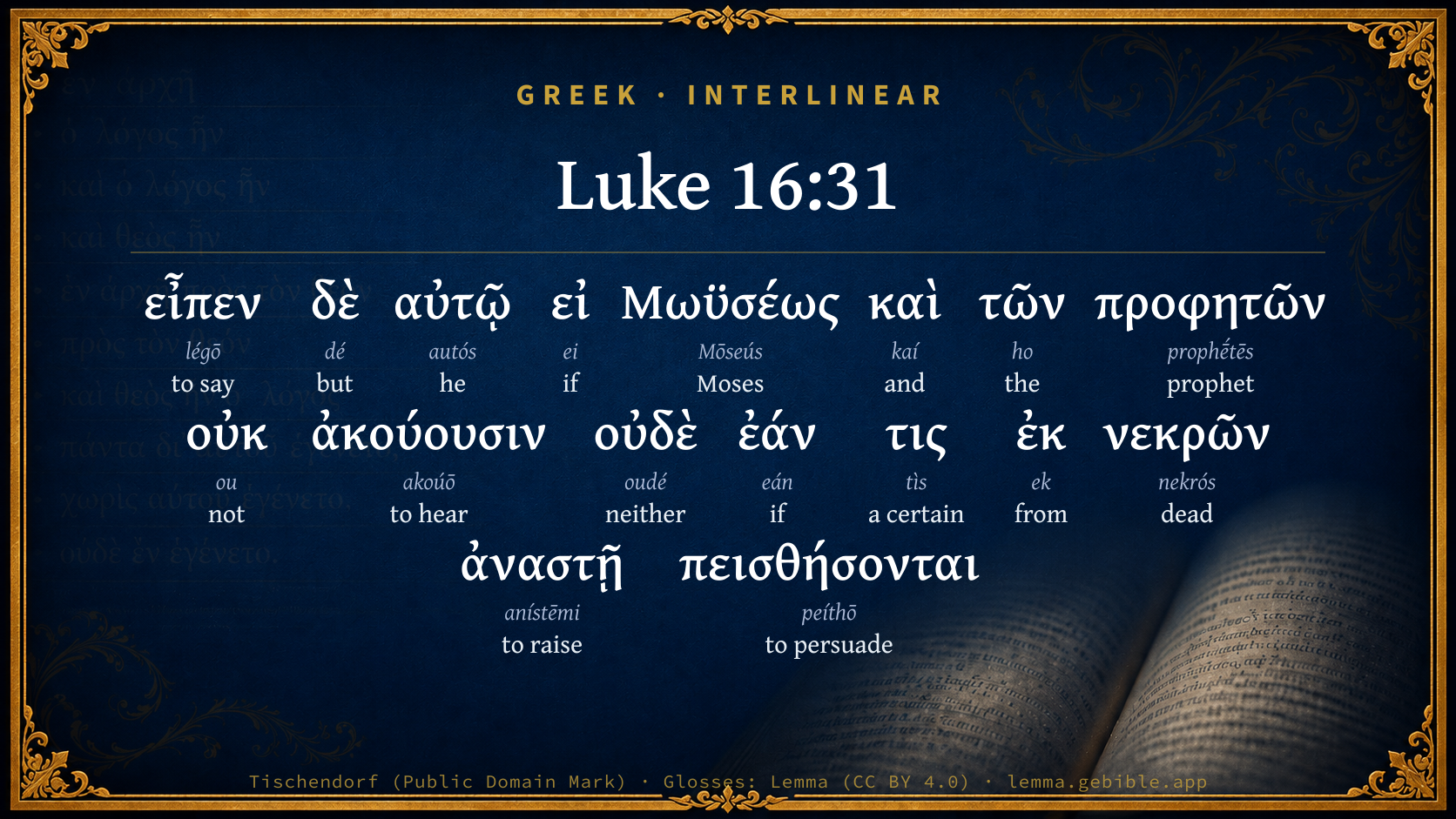
Greek (Tischendorf 8th ed.) Luke 16:31 appears in the Greek New Testament. The text above is from the Tischendorf 8th edition. Each word links to its Strong’s number and a concise gloss. Click any word for its full Thayer’s Greek Lexicon entry.
Download image
Cite this verse

Luke 16:31 (World English Bible). Public Domain. Lemma interlinear Bible study tool, https://lemma.gebible.app/v/luke/16/31.

Show BibTeX & RIS
BibTeX
RIS
English Translation
"He said to him, 'If they don't listen to Moses and the prophets, neither will they be persuaded if one rises from the dead.'"
World English Bible · Public Domain
Download a study sheet

One document with this verse’s original text, its word-by-word gloss line, the meaning frame, cross-references with their text, attributed commentary, and full source and license credits — printable, and it pastes into notes with its structure intact.

This verse Autodidact and up

Study sheet (.html) Plain text (.txt)

A passage Seminary Student

Up to 50 verses in one chapter. A passage sheet keeps up to 6 commentary sources and 12 cross-references per verse, in the order this page ranks them, and says so on the sheet whenever that leaves anything out. Ask for a single verse and you get the Autodidact verse sheet above.

Everything on this page stays free to read, with no account — the sheet is a download of what is already on screen, not access to it.

Want to remove ads? Support Godless Engineer
Compare translations 3

The same verse in 3 English versions, stacked beneath the original-language interlinear above. Click any original word for its lexicon entry.

Each is an independent rendering of the whole verse — the interlinear is not word-aligned to these translations.

Highlighted words mark where these versions differ — a whole-verse word diff, not a word-by-word alignment.

  • World English Bible Public Domain
    "He said to him, 'If they don't listen to Moses and the prophets, neither will they be persuaded if one rises from the dead.'"
  • King James Version Public Domain
    And he said unto him, If they hear not Moses and the prophets, neither will they be persuaded, though one rose from the dead.
  • unfoldingWord Literal Text CC BY-SA 4.0
    But he said to him, ‘If they do not listen to Moses and the prophets, neither will they be persuaded if someone rises from the dead.’”

unfoldingWord Literal Text — © unfoldingWord, licensed CC BY-SA 4.0. Word-aligned USFM3 via Door43 (git.door43.org/unfoldingWord/en_ult).

Versions to compare (up to 4)

3 of 4 selected

Show all 19 translations

Every available English version of this verse, each an independent rendering of the whole verse.

  • World English Bible Public Domain
    "He said to him, 'If they don't listen to Moses and the prophets, neither will they be persuaded if one rises from the dead.'"
  • Berean Standard Bible Public Domain
    Then Abraham said to him, ‘If they do not listen to Moses and the prophets, they will not be persuaded even if someone rises from the dead.’”
  • Majority Standard Bible Public Domain
    Then Abraham said to him, ‘If they do not listen to Moses and the Prophets, they will not be persuaded even if someone rises from the dead.’”
  • King James Version Public Domain
    And he said unto him, If they hear not Moses and the prophets, neither will they be persuaded, though one rose from the dead.
  • American Standard Version (1901) Public Domain
    And he said unto him, If they hear not Moses and the prophets, neither will they be persuaded, if one rise from the dead.
  • Revised Version (1885) Public Domain
    And he said unto him, If they hear not Moses and the prophets, neither will they be persuaded, if one rise from the dead.
  • Geneva Bible (1599) Public Domain
    Then he saide vnto him, If they heare not Moses and the Prophets, neither will they be persuaded, though one rise from the dead againe.
  • Douay-Rheims (1899) Public Domain
    And he said to him: If they hear not Moses and the prophets, neither will they believe, if one rise again from the dead.
  • Young's Literal Translation Public Domain
    And he said to him, If Moses and the prophets they do not hear, neither if one may rise out of the dead will they be persuaded.'
  • Literal Standard Version CC BY-SA 4.0
    And he said to him, If they do not hear Moses and the prophets, neither will they be persuaded if one may rise out of the dead.”
  • Unlocked Literal Bible CC BY-SA 4.0
    But Abraham said to him, 'If they do not listen to Moses and the prophets, neither will they be persuaded if someone rises from the dead.'”
  • unfoldingWord Literal Text CC BY-SA 4.0
    But he said to him, ‘If they do not listen to Moses and the prophets, neither will they be persuaded if someone rises from the dead.’”
  • Darby Bible Public Domain
    And he said to him, If they hear not Moses and the prophets, not even if one rise from among [the] dead will they be persuaded.
  • World Messianic Bible Public Domain
    “He said to him, ‘If they don’t listen to Moses and the Prophets, neither will they be persuaded if one rises from the dead.’”
  • Webster's Bible Public Domain
    And he said to him, If they hear not Moses and the prophets, neither will they be persuaded, though one shall rise from the dead.
  • Free Bible Version CC BY-SA 4.0
    Abraham said to him, ‘If they won't listen to Moses and the prophets, they won't be convinced even if someone returns from the dead.’”
  • Bible in Basic English Public Domain
    And he said to him, If they will not give attention to Moses and the prophets, they will not be moved even if someone comes back from the dead.
  • Text-Critical English NT CC BY 4.0
    But Abraham said to him, ‘If they do not listen to Moses and the Prophets, neither will they be persuaded even if someone rises from the dead.’ ”
  • Tyndale New Testament (1534) Public Domain
    He sayd vnto him: If they heare not Moses and the prophetes nether will they beleve though one roose from deeth agayne.

Literal Standard Version (2020), Covenant Press — licensed CC BY-SA 4.0. Text via the HelloAO Bible API (eBible.org). Unlocked Literal Bible (unfoldingWord) — licensed CC BY-SA 4.0. Text via the HelloAO Bible API (eBible.org). unfoldingWord Literal Text — © unfoldingWord, licensed CC BY-SA 4.0. Word-aligned USFM3 via Door43 (git.door43.org/unfoldingWord/en_ult). Free Bible Version, Dr. Jonathan Gallagher — licensed CC BY-SA 4.0. Text via the HelloAO Bible API (eBible.org).

Word by word

More ways to search: Search by grammar → Find every occurrence → Compare this word →

Practice this passage: Drill this verse → Learn its vocabulary →

πεισθήσονται
peíthō
G3982
“to persuade”
Verb, Future, Passive, Indicative, 3rd person, Plural
Part of Speech
Verb
Tense
Future
Voice
Passive
Mood
Indicative
Person
3rd person
Number
Plural
Full Thayer's Definition

Origin: a primary verb

TDNT: 06:01,8

1. persuade a. to persuade, i.e. to induce one by words to believe b. to make friends of, to win one's favour, gain one's good will, or to seek to win one, strive to please one c. to tranquillise d. to persuade unto i.e. move or induce one to persuasion to do something 2. be persuaded a. to be persuaded, to suffer one's self to be persuaded; to be induced to believe: to have faith: in a thing 1. to believe 2. to be persuaded of a thing concerning a person b. to listen to, obey, yield to, comply with 3. to trust, have confidence, be confident
  1. εἶπεν légō G3004 “to say” Verb, Aorist, Active, Indicative, 3rd person, Singular
  2. δὲ dé G1161 “but” Conjunction
  3. αὐτῷ autós G846 “he” Personal pronoun, Dative, Singular, Masculine
  4. εἰ ei G1487 “if” Conditional
  5. Μωϋσέως Mōseús G3475 “Moses” Noun, Genitive, Singular, Masculine
  6. καὶ kaí G2532 “and” Conjunction
  7. τῶν ho G3588 “the” Article, Genitive, Plural, Masculine
  8. προφητῶν prophḗtēs G4396 “prophet” Noun, Genitive, Plural, Masculine
  9. οὐκ ou G3756 “not” Particle, Negative
  10. ἀκούουσιν akoúō G191 “to hear” Verb, Present, Active, Indicative, 3rd person, Plural
  11. οὐδὲ oudé G3761 “neither” Conjunction, Negative
  12. ἐάν eán G1437 “if” Conditional
  13. τις tìs G5100 “a certain” Indefinite pronoun, Nominative, Singular, Masculine
  14. ἐκ ek G1537 “from” Preposition
  15. νεκρῶν nekrós G3498 “dead” Adjective, Genitive, Plural, Masculine
  16. ἀναστῇ anístēmi G450 “to raise” Verb, Aorist, Active, Subjunctive, 3rd person, Singular

About this verse

These counts appear in no published source. They are computed here, from the morphology-tagged text and Lemma’s own curated glosses. What Lemma adds →

17
words
17
distinct lemmas
Gospels
section

Shared distinctive vocabulary

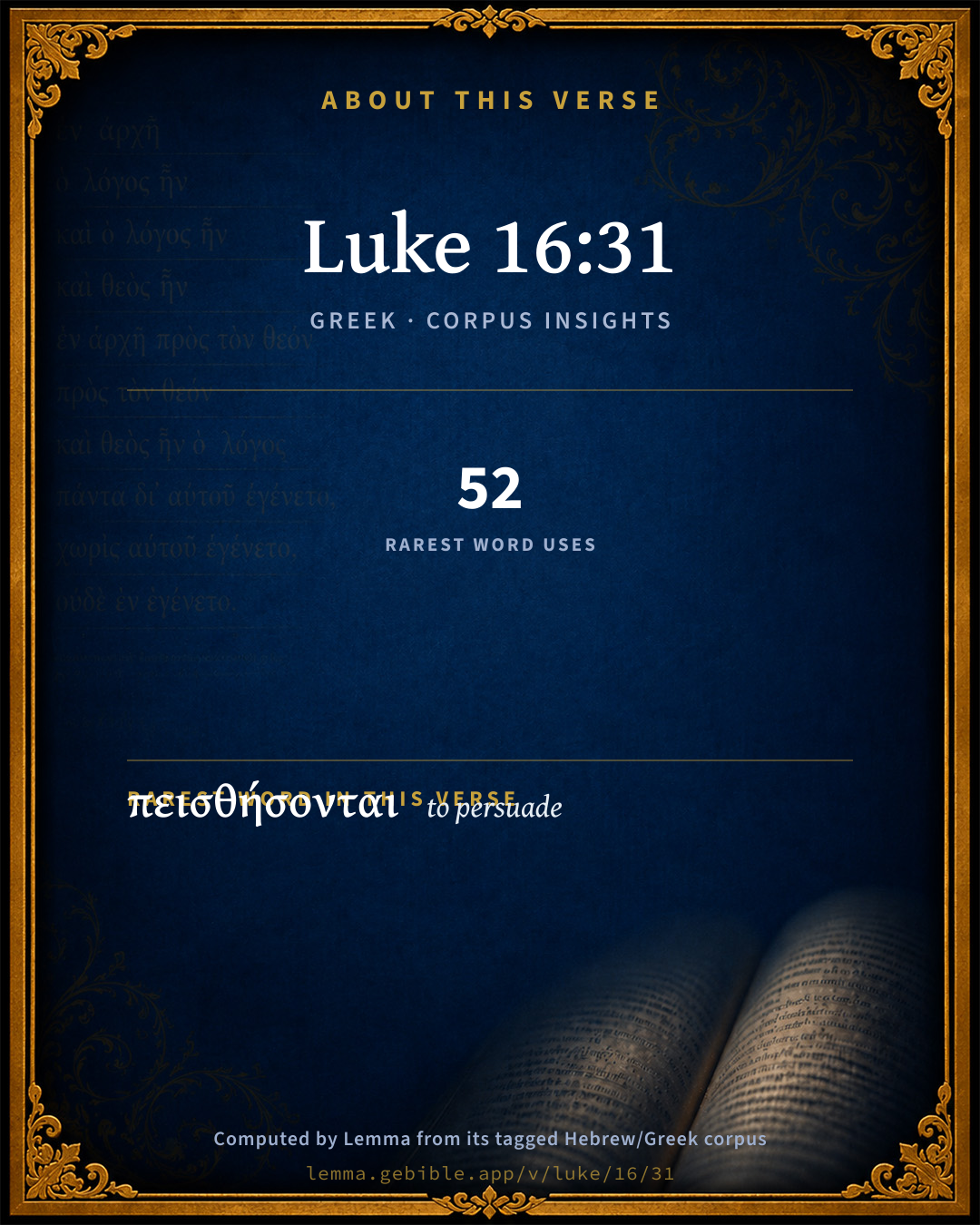
πεισθήσονται to persuade G3982 occurs in 52 verses of the Greek New Testament. Also found in:
Cross-references

7

Topical passages linked to Luke 16:31 in the Treasury of Scripture Knowledge — connected by theme and wording, ordered by reader-vote popularity; previews shown in the World English Bible.

  • 2 Corinthians 4:3 Even if our Gospel is veiled, it is veiled in those who perish;
  • John 11:43–53 When he had said this, he cried with a loud voice, "Lazarus, come out!"
  • Acts 19:8 He entered into the synagogue, and spoke boldly for a period of three months, reasoning and persuading about the things concerning the Kingdom of God.
  • Acts 26:28 Agrippa said to Paul, "With a little persuasion are you trying to make me a Christian?"
  • Acts 28:23 When they had appointed him a day, many people came to him at his lodging. He explained to them, testifying about the Kingdom of God, and persuading them concerning Jesus, both from the law of Moses and from the prophets, from morning until evening.
  • John 12:10–11 But the chief priests conspired to put Lazarus to death also,
  • 2 Corinthians 5:11 Knowing therefore the fear of the Lord, we persuade men, but we are revealed to God; and I hope that we are revealed also in your consciences.

Cross-references courtesy of OpenBible.info (CC BY 4.0).

Commentary

Notes on Luke 16:31 from classic Christian and Jewish commentators (each source and its license shown beneath its notes). The classic Christian expositions comment on the surrounding passage and are grouped to its opening verse, so a note may address several verses; the Jewish commentaries on the Tanakh (Rashi and others) are per-verse, so they appear only where the commentator wrote on this verse.

Lemma curates 59 commentaries, every one of them public domain or Creative Commons licensed, each selected and text-cleaned for this edition rather than reprinted as found. About our sources →

Tyndale Open Study Notes

Tyndale Open Resources

16:31 they won’t be persuaded even if someone rises from the dead: Wicked people refuse to repent even when faced with overwhelming evidence of the truth.

Tyndale Open Study Notes — © Tyndale Open Resources, licensed CC BY-SA 4.0. Text via the HelloAO Bible API.

Bengel's Gnomon

Johann Albrecht Bengel

Luk 16:31. Οὐδὲ ἐὰν—ἀναστῃ, πεισθἠσονται not even if—shall have risen from the dead, will they be persuaded) The rich man had said, ἐὰν—πορευθη μετανοήσουσιν, if one shall have gone to them from the dead, they will repent: now the hypothetical antecedent increases in force [viz. ἀναστῇ taking the place of πορευθῇ]; whereas, however, the consequent decreases in force [πεισθήσονται taking the place of μετανοήσουσιν.] There are many proofs afforded from the unseen world (Mat 27:53); but those proofs are not intended chiefly for his end, in order that mortals may repent. Another and a different Lazarus was raised to life, and yet they did not believe; Joh 11:44; Joh 11:53. Πείθεσθαι, as also ἀπειθεῖν, is at one time to be referred, for the sense in which it is to be taken, to the understanding, at another time to the will: often to both.

Bengel's Gnomon of the New Testament — English translation (T&T Clark, Edinburgh, 1860) — public domain. Text from a community e-Sword module.

Expositor's Greek Testament

ed. W. Robertson Nicoll

Luk 16:31 . εἶπε δὲ : Abraham does not plead impossibility as in reference to the first request; he simply declares his unbelief in the utility of the plan for converting the five. The denizens of Paradise set little value on the unusual as a means of grace. Abraham does not say that a short-lived sensation could not be produced; he does say that they would not be persuaded ( πεισθήσονται ), i.e. , to repent (Hahn). By taking πεισθήσονται as meaning something less than μετανοήσουσιν , and emphasising the difference between ἐκ νεκρῶν ἀναστῇ and ἀπὸ νεκρῶν πορευθῇ (Luk 16:30 ), Trench ( Notes on the Parables ) makes this point: “A far mightier miracle than you demand would be ineffectual for producing a far slighter effect”. It is doubtful if the contrast be legitimate in either case; certainly not as between “repent” and “be persuaded”. In the other case there may be the difference between an apparition and a resurrected man. It may be noted that the resurrection of Christ and of Christians is spoken of as ἐκ νεκρῶν ( vide Luk 20:35 ), while the general resurrection is ἡ ἀνάσ . τῶν νεκρῶν ( e.g. , 1Co 15:42 ).

The Expositor's Greek Testament, edited by W. Robertson Nicoll (1897–1910) — public domain. Text from a community e-Sword module.

Adam Clarke's Commentary

Verse 31. If they hear not Moses, c.] This answer of Abraham contains two remarkable propositions.

1. That the sacred writings contain such proofs of a Divine origin, that though all the dead were to arise, to convince an unbeliever of the truths therein declared, the conviction could not be greater, nor the proof more evident, of the divinity and truth of these sacred records, than that which themselves afford.

2. That to escape eternal perdition, and get at last into eternal glory, a man is to receive the testimonies of God, and to walk according to their dictates.

And these two things show the sufficiency and perfection of the sacred writings. What influence could the personal appearance of a spirit have on an unbelieving and corrupted heart? None, except to terrify it for the moment, and afterwards to leave it ten thousand reasons for uncertainty and doubt. Christ caused this to be exemplified, in the most literal manner, by raising Lazarus from the dead. And did this convince the unbelieving Jews? No. They were so much the more enraged and from that moment conspired both the death of Lazarus and of Christ! Faith is satisfied with such proofs as God is pleased to afford! Infidelity never has enow. See a Sermon on this subject, by the author of this work.

To make the parable of the unjust steward still more profitable, let every man consider: -

1. That God is his master, and the author of all the good he enjoys, whether it be spiritual or temporal.

2. That every man is only a steward, not a proprietor of those things.

3. That all must give an account to God, how they have used or abused the blessings with which they have been entrusted.

4. That the goods which God has entrusted to our care are goods of body and soul: goods of nature and grace: of birth and education: His word, Spirit, and ordinances: goods of life, health, genius, strength, dignity, riches; and even poverty itself is often a blessing from the hand of God.

5. That all these may be improved to God's honour, our good, and our neighbour's edification and comfort.

6. That the time is coming in which we shall be called to an account before God, concerning the use we have made of the good things with which he has entrusted us.

7. That we may, even now, be accused before our Maker, of the awful crime of wasting our Lord's substance.

8. That if this crime can be proved against us, we are in immediate danger of being deprived of all the blessings which we have thus abused, and of being separated from God and the glory of his power for ever.

9. That on hearing of the danger to which we are exposed, though we cannot dig to purchase salvation, yet we must beg, incessantly beg, at the throne of grace for mercy to pardon all that is past.

10. That not a moment is to be lost: the arrest of death may have gone out against us; and this very night-hour-minute, our souls may be required of us. Let us therefore learn wisdom from the prudent despatch which a worldly-minded man would use to retrieve his ruinous circumstances; and watch and pray, and use the little spark of the Divine light which yet remains, but which is ready to die, that we may escape the gulf of perdition, and obtain some humble place in the heaven of glory. Our wants are pressing; God calls loudly; and eternity is at hand!

Adam Clarke's Commentary on the Bible (1810–1826) — public domain. Text from a community e-Sword/MySword module.

Ellicott's Commentary for English Readers

(31) If they hear not Moses and the prophets.—We are accustomed, rightly enough, to look on our Lord’s own Resurrection as leading to the great fulfilment of these words. We should not forget, however, that there was another fulfilment more immediately following on them. In a few weeks, or even days, according to the best harmonists, tidings came that Lazarus of Bethany was sick (Joh_11:1). In yet a few days more that Lazarus did “rise from the dead;” cured, we may believe, of whatever love of this world’s good things had checked his spiritual growth, a witness of the power of Christ to raise, as from the shadow-world of Hades, so also from the darkness of spiritual death to newness of life. And yet that wonder also brought about no repentance, Scribes and Pharisees, and Sadducees and priests simply took counsel together that they might put Lazarus also to death (Joh_12:10). We can hardly believe the coincidence of name and fact in this instance to have been undesigned.

A Bible Commentary for English Readers, edited by Charles John Ellicott (1878–1897) — public domain. Text from a community e-Sword module.

The Cambridge Bible for Schools and Colleges

gen. ed. J. J. S. Perowne

31. neither will they be persuaded, though one rose from the dead ]

“We are saved by faithful hearing, not by apparitions,” Bengel. This was most remarkably exemplified in the results which followed the raising of another Lazarus (Joh_12:10) and the resurrection of our Lord Himself (Mat_28:11-13). Observe that the reply of Abraham (‘be persuaded,’ ‘arose, ‘from among’ [ἐκ not ἀπὸ] the dead) is much stronger than the words used by Dives. “A far mightier miracle ...would be ineffectual for producing a far slighter effect,” Trench.

The Cambridge Bible for Schools and Colleges (gen. ed. J. J. S. Perowne; Cambridge University Press, 1878–1918) — public domain. Text from a community e-Sword module.

Trapp's Complete Commentary

John Trapp

31 And he said unto him, If they hear not Moses and the prophets, neither will they be persuaded, though one rose from the dead.

Ver. 31. Though one rose from the dead] As Lazarus did, and yet they listened as little to him as to Christ, Joh 12:10; but sought to kill him also.

John Trapp, A Commentary or Exposition upon All the Books of the Old and New Testament (1647–1656) — public domain. Text from a community e-Sword module.

Albert Barnes' Notes on the Bible

Be persuaded - Be convinced of the truth; of the danger and folly of their way; of the certainty of their suffering hereafter, and be induced to turn from sin to holiness, and from Satan unto God.

From this impressive and instructive parable we may learn:

That the souls of people do not die with their bodies. That the soul is “conscious” after death; that it does not “sleep,” as some have supposed, until the morning of the resurrection. That the righteous are taken to a place of happiness immediately at death, and the wicked consigned at once to misery. That wealth does not secure from death.

“How vain are riches to secure

Their haughty owners from the grave!”

The rich, the beautiful, the happy, as well as the poor, go down to the grave. All their pomp and apparel, all their honors, their palaces, and their gold cannot save them. Death can as easily find his way into the splendid mansions of the rich as into the cottages of the poor; and the rich shall turn to the same corruption, and soon, like the poor, be undistinguished from common dust and be unknown.

We should not envy the condition of the rich.

“On slippery rocks I see them stand,

And fiery billows rollI below.

“Now let them boast how tall they rise,

I’ll never envy them again;

There they may stand with haughty eyes,

Till they plunge deep in endless pain.

“Their fancied joys how fast they flee!

Like dreams, as fleeting and as vain;

Their songs of softest harmony.

Are but a prelude to their pain.”

We should strive for a better inheritance than can be possessed in this life.

“Now I esteem their mirth and wine.

Too dear to purchase with my blood:

Lord, ’tis enough that thou art mine -

My life, my portion, and my God.”

The sufferings of the wicked in hell will be indescribably great. Think what is represented by “torment;” by burning flame; by insupportable thirst; by that state where a single “drop” of water would afford relief. Remember that “all this” is but a representation of the pains of the damned, and that this will have no intermission day or night, but will continue from year to year, and age to age, without any end, and you have a faint view of the sufferings of those who are in hell. There is a place of sufferings beyond the grave a hell. If there is not, then this parable has no meaning. It is impossible to make “anything” of it unless it be designed to teach that. There will never be any escape from those gloomy regions. There is a gulf fixed - “fixed,” not movable. Nor can any of the damned beat a pathway across this gulf to the world of holiness. We see the amazing folly of those who suppose there may be an “end” to the sufferings of the wicked, and who, on that supposition, seem willing to go down to hell to suffer a long time, rather than go at once to heaven. If man were to suffer but a thousand years, or even “one” year, why should he be so foolish as to choose that suffering rather than go at once to heaven, and be happy at once when he dies? God gives us sufficient warning to prepare for death. He has sent his Word, his servants, his Son; he warns us by his Spirit and his providence; by the entreaties of our friends and by the death of sinners; he offers us heaven, and he threatens hell. If all this will not move sinners, what would do it? There is nothing that would. God will give us nothing farther to warn us. No dead man will come to life to tell us of what he has seen. If he did we would not believe him. Religion appeals to man not by ghosts and frightful apparitions. It appeals to their reason, their conscience, their hopes, their fears. It sets life and death soberly before people, and if they “will not” choose the former, they must die. If you will not hear the Son of God and the warnings of the Scriptures, there is nothing which you will or can hear. You will never be persuaded, and will never escape the place of torment.

Albert Barnes' Notes on the Bible (1834–1885) — public domain. Text from a community e-Sword/MySword module.

Haydock's Catholic Bible Commentary

If they hear not, Moses, &c. We think that if we saw a man raised from the dead, who should tells us what he had seen and suffered in another world, it would make more impression upon us than past miracles, which we hear of, or the promises and threats of the prophets, apostles, and our blessed Saviour, which are contained in Scripture; but it is a false notion, a vain excuse. The wicked, and unbelievers, would even in that case find pretexts and objections for not believing. (St. John Chrysostom, hom. iv.) --- They would say that the dead man was a phantom; that his resurrection was not real; his assertions nugatory. When Christ raised Lazarus from the dead, the miracle was known, evident and public; yet we find none of the Pharisees converted by it. They were even so mad as to enter into a design to kill Lazarus, to get rid of a witness who deposed against their incredulity. How many other miracles did he not perform in their sight, which they attributed to the prince of darkness, or to magic? Christ raised himself from the dead. This fact was attested by many unexceptionable witnesses. And what do the hardened Jews do? They object, that his disciples, stealing away the body, maliciously persuaded the people that he had risen again. Such is the corruption of the human heart, that when once delivered up to any passion, nothing can move it. Every day we see or hear of malefactors publicly executed, yet their example has no effect on the survivors, nor does it prevent the commission of fresh crimes. (Calmet) --- "We have also the more firm prophetical word; whereunto you do well to attend, as to a light that shineth in a dark place, until the day dawn, and the day-star arise in your hearts." (2 Peter i. 19.) --- We may learn many very instructive lessons from this affecting history of Lazarus. --- The rich may learn the dreadful consequences to be apprehended from riches, when made subservient to sensuality, luxury, and ambition. The poor may learn to make their poverty and sufferings, however grievous to nature, instrumental to their future happiness, by bearing them with patience and resignation to the will of heaven. The former are taught that to expose a man to eternal misery, nothing more is required than to enjoy all the good things of this world according to their own will; the latter, that however they may be despised and rejected of men, they may still have courage, knowing that the short day of this fleeting life, with all its apparent evils, will soon be over; and that the day of eternity is fast approaching, when every one shall receive according as he has done good or evil in his body. (Haydock)

George Leo Haydock (1774–1849), Haydock's Catholic Family Bible and Commentary, 1859 edition — public domain. Excludes Psalms (Douay-Rheims chapter numbering differs from Protestant) and Deuterocanonical books (Catholic canon only).

Whedon's Commentary on the Bible

Daniel D. Whedon

31. Neither… persuaded though one rose from the dead—Jesus was expecting soon to be on his way to raise a Lazarus from the dead. Many did believe on him in consequence. Hence, our Lord is not to be understood as saying no one would have been convicted or converted by a message from the dead. But there are Sadducees, both of the sensual and intellectual character, whom no miracle would convince. Indeed, an isolated single miracle or testimony from the dead, perhaps, ought not to convince a man. The miracles of the Bible are a great system of miraculous dealings of God with man. They are to be embraced as a great whole; as the one comprehensive miracle, embracing and consisting of many subordinate miracles.

Upon this parable, note:

1. It was a terrible rebuke to the silver-loving Pharisees of Luk_16:15; men of worldly hearts, and who probably were but the panders to the profligate Sadducee, Herod Antipas and his court.

2. It was a fit completion of the parable of the rich fool. The latter traces the worldly sinner to death, and this pursues and pictures him in the world after death.

3. It is a striking counterpart to the parable of the unjust steward. The latter so made friends of mammon as to secure his eternal life; this rich man so made a master of mammon as to secure eternal death.

Daniel D. Whedon (gen. ed.), Commentary on the Old and New Testaments (1874–1909) — public domain. Text from a community e-Sword module.

John Wesley's Explanatory Notes

Neither will they be persuaded - Truly to repent: for this implies an entire change of heart: but a thousand apparitions cannot, effect this. God only can, applying his word.

John Wesley, Explanatory Notes Upon the Whole Bible (1754–1765) — public domain. Text via the GEBible commentary corpus.

Burkitt's Expository Notes on the New Testament

William Burkitt

A very awakening text this is, which speaks dreadfully to persons sitting all their days under the ministry of the gospel, and yet find not their understandings enlightened, their judgments convinced, their wills subdued, and their lives reformded by it. Were it possible for such persons to see one come from the dead, yea, from the damned, with the flames of hell about his ears, wringing his hands, and gnashing his teeth, bewailing his misery, and beseeching them to take warning by his example, and in time to acquaint themselves with God, and be at peace; all this would have no farther effect upon them, than to move their passions a little for the present, while the dreadful sound is in their ears: the ordinances of God and not his providences, are the instituted and appointed means for men’s conversion and salvation.

Note then, 1. That no visions or apparitions, no new revelations concerning eternal rewards and punishments, are to be expected from the other world, in order to men’s conversion and salvation.

Note, 2. That the word of God dispensed to us, and the ordinary means of grace enjoyed by us, are more conducible and effectual means to persuade men to repentance, than if one should arise from the dead, and preach unto us. A messenger from the dead cannot bring with him either a more necessary doctrine, or a more certain and infallible doctrine, nor bring with him better arguments for our conviction, than what the scriptures do propound for our consideration; nor can we expect a greater co-operation of the Holy Spirit, or a greater concurrence of divine power, to render a message from the dead more effectual, than does ordinarily attend the ministry of the word.

Henceforward then, let us not wonder, if when a drunkard drops down dead upon the spot, the companions say one to another, Drink on; if sinners daily tumble one another into the grave, without considering the operation of God’s hand; this, to those that consider this text, will not seem strange; For if they hear not Moses and the prophets, neither will they be converted, though hundreds of sinners before their eyes drop down dead: nay, if they hear not Moses and the prophets, neither will they be persuaded though one rose from the dead.

William Burkitt's Expository Notes on the New Testament (1700–1703) — public domain. Text from a community e-Sword module.

Cambridge Greek Testament for Schools and Colleges

31. πεισθήσονται. “We are saved by faithful hearing, not by apparitions,” Bengel. This was most remarkably exemplified in the results which followed the raising of another Lazarus (Joh 12:10), and the resurrection of our Lord Himself (Mat 28:11-13). Observe that the reply of Abraham (‘be persuaded,’ ‘arose,’ ‘from among’ [ἐκ not ἀπὸ] the dead) is much stronger than the words used by Dives. “A far mightier miracle … would be ineffectual for producing a far slighter effect,” Trench.

Cambridge Greek Testament for Schools and Colleges (Cambridge University Press, 1896; 21 vols, various authors incl. Carr, Maclear, Plummer, Farrar, Lumby, Moule, M. R. James, Simcox) — public domain. Text from a community e-Sword module.

Alford’s Greek Testament

Henry Alford

31.] οὐχί—not, ‘they will not hear them:’ he could not tell that, and besides, it would have taken away much of the ground of the answer of Abraham:—the word deprecates leaving their salvation in such uncertainty, as the chance of their hearing Moses and the Prophets seems to him to imply.—‘Leave it not so, when it might be at once and for ever done by sending them one from the dead.’

Abraham’s answer, besides opening to us a depth in the human heart, has a plain application to the Pharisees, to whom the parable was spoken. They would not hear Moses and the Prophets:—Christ rose from the dead, but He did not go to them;—this verse is not so worded, ‘they would have rejected Him, had He done so:’—the fact merely is here supposed, and that in the very phrase which so often belongs to His own resurrection. They were not persuaded—did not believe, though One rose from the dead. To deny altogether this allusion, is to rest contented with merely the surface of the parable.

Observe, Abraham does not say, ‘they will not repent’—but, ‘they will not believe, be persuaded:’ which is another and a deeper thing.

Luther does not seem to conclude rightly, that this disproves the possibility of appearances of the dead. It only says, that such appearances will not bring about faith in the human soul: but that they may not serve other ends in God’s dealings with men, it does not assert. There is no gulf between the earth and Hades: and the very form of Abraham’s answer, setting forth no impossibility in this second case, as in the former, would seem to imply its possibility, if requisite.

We can hardly pass over the identity of the name Lazarus with that of him who actually was recalled from the dead, but whose return, far from persuading the Pharisees, was the immediate exciting cause of their crowning act of unbelief.

Henry Alford, The Greek Testament (1849–1861) — public domain. Text from a community e-Sword module.

International Critical Commentary

31. Εἰ … οὐκ ἀκούουσιν. “If, as matters now stand, they are refusing to hear.” We go beyond the tenour of the reply when we make it mean that “a far mightier miracle than you demand would be ineffectual for producing a far slighter effect.” Does ἐκ νεκρῶν ἀναστῆ imply “a far mightier miracle” than ἀπὸ νεκρῶν πορευθῇ? And does πεισθήσονται imply “a far slighter effect” than μετανοήσουσιν? “Persuaded” obviously means “persuaded to repent”; and one who “goes from the dead” to warn the living must “rise from the dead.” By this conclusion Christ once more rebukes the demand for a sign. Those who ask for it have all that they need for the ascertainment of the truth; and the sign if granted would not produce conviction. Saul was not led to repentance when he saw Samuel at Endor, nor were the Pharisees when they saw Lazarus come forth from the tomb. The Pharisees tried to put Lazarus to death and to explain away the resurrection of Jesus. For allegorical interpretations of the parable see Trench, Parables, p. 470, 10th Exo_1

In οὐκ ἀκούουσιν the negative belongs to the verb so as almost to form one word, and is not influenced by the εἰ: “If they disregard.” Comp. 11:8, 12:26, 18:4. The pres. indic. represents the supposition as contemporaneous. Note the change from εἰ with pres. indic. to ἐάν with aor. subjunc. The latter is pure hypothesis.

The Idea of Hades or Sheol in the Old Testament

It is surprising how very little advance there is in O.T., respecting conceptions of the unseen world, upon Greek mythology. It is scarcely an exaggeration to say that, until about b.c. 200, the Jewish Sheol is essentially the same in conception as the Hades of Greek poetry. There are no moral or spiritual distinctions in it. Good and bad alike are there, and are apparently much in the same condition. Moreover, there is no thought of either of them rising again. In some places, possibly, Sheol or Hades is merely a synonym for the grave or death, which receives good and bad alike, and retains them: e.g. Gen 37:35, 42:38; 1Sa 2:6. But in passages in which the unseen world of spirits is plainly meant, the absence of the religious element is remarkable. Nay, in one way the bad are better off than the good; for while the Just have lost the joys which were the reward of their righteousness, the wicked have ceased to be troubled by the consequences of their iniquity. See Davidson on Job 3:16-19. Sheol is a place of rest; but also of silence, gloom, and ignorance. In the only passage in which the word occurs in Ecclesiastes we are told that there is no work, nor device, nor knowledge, nor wisdom, in Sheol, whither thou goest” (9:10). Those who have gone thither return no more, and none escape it (Job 7:9, Job 7:10, Job 7:10:21, 22, Job 7:20:9). It is a land of forgetfulness, in which there is no more remembrance of God or possibility of serving Him (Psa 6:5, 30:9, 88:12; comp. Isa 38:11, Isa 38:18). And it is insatiable (Pro 1:12, Pro 1:27:20, Pro 1:30:16; comp. Isa 5:14). In some Psalms there is some trace of hope for eternal life in God in the other world (49:15), but not of hope for resurrection. In 17:15 “when I awake” probably does not mean awake from death, but from sleep. It is the daily renewal of communion with God that is desired. In Isa 25:8, and still more in Isa 26:19, hope in a resurrection from Sheol is expressed; and in Dan 12:2 we reach idea of resurrection with rewards and punishments. See Hastings, D.B. i. p. 740; D.C.G. ii. p. 514.

Side by side with the hope of a resurrection (2 Mac. 12:43-45, 14:46) comes the belief did Sheol is only an intermediate state, at any rate for the rightous (2 Mac. 7:9, 11, 14, 36, 37; Enoch li.): and along with the idea of a resurrection to rewards and punishments comes the idea that there is retribution in Sheol itself, and consequently a separation of the righteous from the wicked (Enoch xxii.). But the idea of rising again to be punished does not seem to have prevailed. The view rather was that only the righteous were raised, while the wicked remained for ever in Sheol (Enoch lxiii. 8-10, xcix. 11). In this way Hades becomes practically the same as Gehenna (Ps. Sol. 14:6, 15:11, 16:2). In the parable of the Rich Man and Lazarus there is nothing to show whether Hades is intermediate or final: but the doctrine of its being a place of retribution, with a complete separation of the righteous from the wicked, could hardly be more clearly marked. In the Talmud, Sheol is identical with Gehenna, just as in popular English “hell” is always a place of punishment, and generally of final punishment. See DB.2 art. “Hell”; Herzog, Pro_2 art. Hades; Charles, Book of Enoch, p. 168.

L. & T. Edersheim, Life and Times of Jesus the Messiah.

§ Found in Luke alone.

Vulg. Vulgate.

AV. Authorized Version.

RV. Revised Version.

אԠא Cod. Sinaiticus, sæc. iv. Brought by Tischendorf from the Convent of St. Catherine on Mt. Sinai; now at St. Petersburg. Contains the whole Gospel complete.

B B. Cod. Vaticanus, sæc. 4. In the Vatican Library certainly since 15331 (Batiffol, La Vaticane de Paul 3, etc., p. 86).

D D. Cod. Bezae, sæc. vi. Given by Beza to the University Library at Cambridge 1581. Greek and Latin. Contains the whole Gospel.

Beng. Bengel.

Burton. Burton, N.T. Moods and Tenses.

Jos. Josephus.

Hist. of J. N. History of the Jewish Nation.

Syr Syriac.

Sin. Sinaitic.

Win. Winer, Grammar of N.T. Greek (the page refers to Moulton’s edition).

Wic. Wiclif.

Lft. J. B. Lightfoot, * Notes on Epistles of S. Paul.

Aug. Augustine.

A A. Cod. Alexandrinus, sæc. v. Once in the Patriarchal Library at Alexandria; sent by Cyril Lucar as a present to Charles 1. in 1628, and now in the British Museum. Complete.

L L. Cod. Regius Parisiensis, sæc. viii. National Library at Paris. Contains the whole Gospel.

R R. Cod. Nitriensis Rescriptus, sæc. 8. Brought from a convent in the Nitrian desert about 1847, and now in the British Museum. Contains 1:1-13, 1:69-2:4, 16-27, 4:38-5:5, 5:25-6:8, 18-36, 39, 6:49-7:22, 44, 46, 47, 8:5-15, 8:25-9:1, 12-43, 10:3-16, 11:5-27, 12:4-15, 40-52, 13:26-14:1, 14:12-15:1, 15:13-16:16, 17:21-18:10, 18:22-20:20, 20:33-47, 21:12-22:15, 42-56, 22:71-23:11, 38-51. By a second hand 15:19-21.

Boh. Bohairic.

Arm. Armenian.

Aeth. Ethiopic.

F F. Cod. Boreeli, sæc. ix. In the Public Library at Utrecht. Contains considerable portions of the Gospel.

U U. Cod. Nanianus, sæc. x. In the Library of St. Mark’s, Venice. Contains the whole Gospel.

G G. Cod. Harleianus, sæc. ix. In the British Museum. Contains considerable portions.

Δ̠Δ. Cod. Sangallensis, sæc. ix. In the monastery of St. Gall in Switzerland. Greek and Latin. Contains the whole Gospel.

Goth. Gothic.

Wordsw. Wordsworth (Chr.)

Hippol. Hippolytus.

Ξ̠Ξ. Cod. Zacynthius Rescriptus, sæc. viii. In the Library of the Brit. and For. Bible Soc. in London. Contains 1:1-9, 19-23, 27, 28, 30-32, 36-66, 1:77-2:19, 21, 22, 33-39, 3:5-8, 11-20, 4:1, 2, 6-20, 32-43, 5:17-36, 6:21-7:6, 11-37, 39-47, 8:4-21, 25-35, 43-50, 9:1-28, 32, 33, 35, 9:41-10:18, 21-40, 11:1, 2, 3, 4, 24-30, 31, 32, 33.

Cypr. Cyprian.

Wetst. Wetstein.

WH. Westcott and Hort.

Tert. Tertullian.

1 Jésus se serait-il abaissé à de pareilles personalités? asks Godet, with some reason.

2 Ambrose also takes it as history: Narratio magis quam parabola videtur, quando etiam nomen exprimitur (Migne, xv. 1768).

Greg. Gregory, Prolegomena ad Tischendorfii ed. N. T.

Iren. Irenæus.

TR. Textus Receptus.

1 Near the end of the Koran are two passages worth comparing. (Sale’s Koran, chs. 102, 104).

International Critical Commentary — older volumes (1896–1929), various authors — public domain. Text from a community e-Sword module.

Vincent's Word Studies in the New Testament

Marvin R. Vincent

Be persuaded. Dives had said, "they will repent." Abraham replies, "they will not be even persuaded."

Though one rose. Dives had said, "if one went."

From the dead [εκ νεκρων] . Dives had said from the dead, but using a different preposition [απο] . It is wellnigh impossible to give the English reader this nice play of prepositions. The general distinction is ajpo, from the outside; ejk, from within. Thus Luk 2:4, Joseph went up from [απο] Galilee, the province, out of [εκ] the city of Nazareth. Abraham 's preposition (ejk, out of) implies a more complete identification with the dead than Dives' ajpo, from. A rising from among the dead was more than a messenger going from the dead. "We can hardly pass over the identity of the name Lazarus with that of him who actually was recalled from the dead; but whose return, far from persuading the Pharisees, was the immediate exciting cause of their crowning act of unbelief" (Alford).

Marvin R. Vincent, Word Studies in the New Testament (1887–1900) — public domain. Text from a community e-Sword/MySword module.

Lesson kit

Teaching starters — assembled from the data on this page, not authored interpretation. Every prompt links to the verse data it draws on. Edit before teaching.

Luke, in the Gospels, opens this verse with 17 words (17 distinct Greek lemmas). Its most distinctive word is peíthō (“to persuade”). A historical commentator’s framing appears above. Read the whole chapter for the surrounding context.

Discussion questions

  1. What does “to persuade” (peíthō) contribute to the verse as a whole?
  2. Matthew 27:20 shares the word «to persuade» with this verse. How do the two illuminate each other?
  3. These translations render this verse differently; the difference is in the English rendering, not the original. What questions does that raise?
  4. Reading how Tyndale Open Study Notes and Bengel's Gnomon read this verse, where do the two commentators agree and where do they part?

Things to notice

Reading settings

Reading text

Shown beneath each verse's original-language words.

Old Testament
Old Testament edition

Read the OT as the Masoretic Hebrew (MT) or the Greek Septuagint (LXX).

English shown for the Greek Septuagint (in the Hebrew ↔ Greek comparison).

Comparing translations? Open the Compare panel on any verse page to stack up to four side by side.