1 Samuel 28:6

Hebrew (Westminster Leningrad Codex) 1 Samuel 28:6 appears in the Hebrew Old Testament. The text above is from the Westminster Leningrad Codex. Each word links to its Strong’s number, a concise gloss, and parsing drawn from the Open Scriptures Hebrew Bible morphology. Click any word for its full Brown-Driver-Briggs (BDB) entry.
Download image
Cite this verse

1 Samuel 28:6 (World English Bible). Public Domain. Lemma interlinear Bible study tool, https://lemma.gebible.app/v/1-samuel/28/6.

Show BibTeX & RIS
BibTeX
RIS
English Translation
When Saul inquired of Yahweh, Yahweh didn't answer him, neither by dreams, nor by Urim, nor by prophets.
World English Bible · Public Domain
Download a study sheet

One document with this verse’s original text, its word-by-word gloss line, the meaning frame, cross-references with their text, attributed commentary, and full source and license credits — printable, and it pastes into notes with its structure intact.

This verse Autodidact and up

Study sheet (.html) Plain text (.txt)

A passage Seminary Student

Up to 50 verses in one chapter. A passage sheet keeps up to 6 commentary sources and 12 cross-references per verse, in the order this page ranks them, and says so on the sheet whenever that leaves anything out. Ask for a single verse and you get the Autodidact verse sheet above.

Everything on this page stays free to read, with no account — the sheet is a download of what is already on screen, not access to it.

Want to remove ads? Support Godless Engineer
Compare translations 3

The same verse in 3 English versions, stacked beneath the original-language interlinear above. Click any original word for its lexicon entry.

Each is an independent rendering of the whole verse — the interlinear is not word-aligned to these translations.

Highlighted words mark where these versions differ — a whole-verse word diff, not a word-by-word alignment.

  • World English Bible Public Domain
    When Saul inquired of Yahweh, Yahweh didn't answer him, neither by dreams, nor by Urim, nor by prophets.
  • King James Version Public Domain
    And when Saul inquired of the LORD, the LORD answered him not, neither by dreams, nor by Urim, nor by prophets.
  • unfoldingWord Literal Text CC BY-SA 4.0
    And Saul inquired of Yahweh, but Yahweh did not answer him, either by dreams or by the Urim or by prophets.

unfoldingWord Literal Text — © unfoldingWord, licensed CC BY-SA 4.0. Word-aligned USFM3 via Door43 (git.door43.org/unfoldingWord/en_ult).

Versions to compare (up to 4)

3 of 4 selected

Show all 18 translations

Every available English version of this verse, each an independent rendering of the whole verse.

  • World English Bible Public Domain
    When Saul inquired of Yahweh, Yahweh didn't answer him, neither by dreams, nor by Urim, nor by prophets.
  • Berean Standard Bible Public Domain
    He inquired of the LORD, but the LORD did not answer him by dreams or Urim or prophets.
  • Majority Standard Bible Public Domain
    He inquired of the LORD, but the LORD did not answer him by dreams or Urim or prophets.
  • King James Version Public Domain
    And when Saul inquired of the LORD, the LORD answered him not, neither by dreams, nor by Urim, nor by prophets.
  • American Standard Version (1901) Public Domain
    And when Saul inquired of Jehovah, Jehovah answered him not, neither by dreams, nor by Urim, nor by prophets.
  • Revised Version (1885) Public Domain
    And when Saul inquired of the LORD, the LORD answered him not, neither by dreams, nor by Urim, nor by prophets.
  • Geneva Bible (1599) Public Domain
    Therefore Saul asked counsel of the Lord, and the Lord answered him not, neither by dreames, nor by Vrim, nor yet by Prophets.
  • Douay-Rheims (1899) Public Domain
    And he consulted the Lord, and he answered him not, neither by dreams, nor by priests, nor by prophets.
  • Young's Literal Translation Public Domain
    and Saul asketh at Jehovah, and Jehovah hath not answered him, either by dreams, or by Urim, or by prophets.
  • Literal Standard Version CC BY-SA 4.0
    and Saul inquires of YHWH, and YHWH has not answered him, either by the dreams, or by the Lights, or by the prophets.
  • Unlocked Literal Bible CC BY-SA 4.0
    Saul prayed to Yahweh for help, but Yahweh did not answer him—neither by dreams, nor by Urim, nor by prophets.
  • unfoldingWord Literal Text CC BY-SA 4.0
    And Saul inquired of Yahweh, but Yahweh did not answer him, either by dreams or by the Urim or by prophets.
  • Darby Bible Public Domain
    And Saul inquired of Jehovah; but Jehovah did not answer him, either by dreams, or by Urim, or by prophets.
  • World Messianic Bible Public Domain
    When Saul inquired of the LORD, the LORD didn’t answer him by dreams, by Urim, or by prophets.
  • Webster's Bible Public Domain
    And when Saul inquired of the LORD, the LORD answered him not, neither by dreams, nor by Urim, nor by prophets.
  • Free Bible Version CC BY-SA 4.0
    He asked advice from the Lord, but the Lord didn't answer him either by dreams or by Urim or by prophets.
  • Bible in Basic English Public Domain
    And when Saul went for directions to the Lord, the Lord gave him no answer, by a dream or by the Urim or by the prophets.
  • JPS Tanakh (1917) Public Domain
    And when Saul inquired of the LORD, the LORD answered him not, neither by dreams, nor by Urim, nor by prophets.

Literal Standard Version (2020), Covenant Press — licensed CC BY-SA 4.0. Text via the HelloAO Bible API (eBible.org). Unlocked Literal Bible (unfoldingWord) — licensed CC BY-SA 4.0. Text via the HelloAO Bible API (eBible.org). unfoldingWord Literal Text — © unfoldingWord, licensed CC BY-SA 4.0. Word-aligned USFM3 via Door43 (git.door43.org/unfoldingWord/en_ult). Free Bible Version, Dr. Jonathan Gallagher — licensed CC BY-SA 4.0. Text via the HelloAO Bible API (eBible.org).

Word by word

More ways to search: Search by grammar → Find every occurrence → Compare this word →

Practice this passage: Drill this verse → Learn its vocabulary →

בָּאוּרִ֖ים
ʼÛwrîym
H224
“in/at the · Urim”
Preposition, Determined + Noun, Common, Masculine, Plural, Absolute
Part of Speech
Preposition + Noun
Type
Common
Gender
Masculine
Number
Plural
State
Absolute
Full BDB Definition

Origin: plural of H217

TWOT: None

Urim = "lights" - stones kept in a pouch on the high-priest's breastplate, used in determining God's decision in certain questions and issues
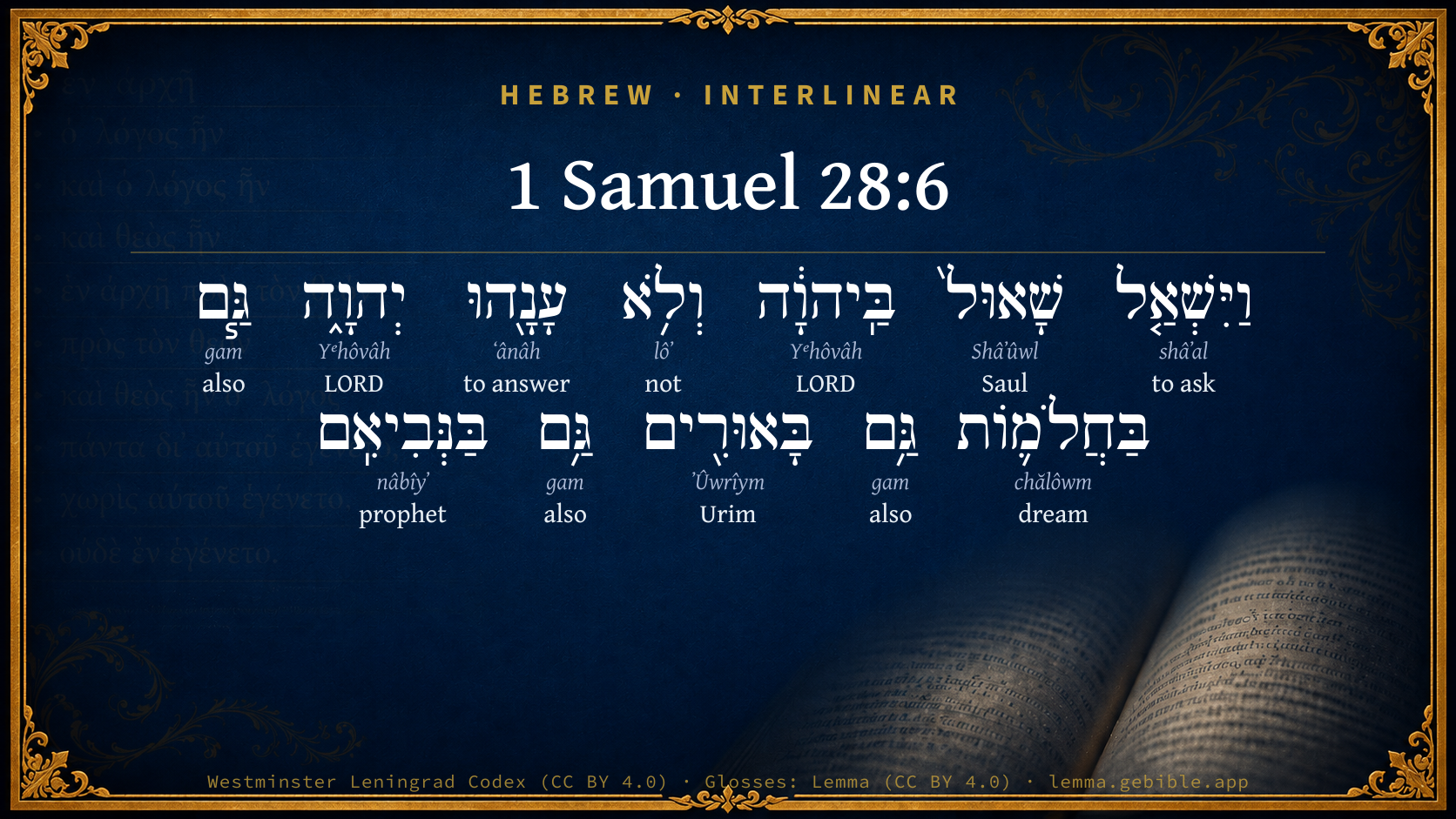
  1. וַיִּשְׁאַ֤ל shâʼal H7592 “and · to ask” Conjunction + Verb, Qal, Sequential Imperfect, 3rd Person, Masculine, Singular
  2. שָׁאוּל֙ Shâʼûwl H7586 “Saul” Noun, Proper
  3. בַּֽיהוָ֔ה Yᵉhôvâh H3068 “in/at · LORD” Preposition + Noun, Proper
  4. וְלֹ֥א lôʼ H3808 “and · not” Conjunction + Particle, Negative
  5. עָנָ֖הוּ ʻânâh H6030 “to answer · him” Verb, Qal, Perfect, 3rd Person, Masculine, Singular + Suffix, Personal, 3rd Person, Masculine, Singular
  6. יְהוָ֑ה Yᵉhôvâh H3068 “LORD” Noun, Proper
  7. גַּ֧ם gam H1571 “also” Particle, Accusative
  8. בַּחֲלֹמ֛וֹת chălôwm H2472 “in/at the · dreams” Preposition, Determined + Noun, Common, Masculine, Plural, Absolute
  9. גַּ֥ם gam H1571 “also” Particle, Accusative
  10. גַּ֥ם gam H1571 “also” Particle, Accusative
  11. בַּנְּבִיאִֽם nâbîyʼ H5030 “in/at the · prophets” Preposition, Determined + Noun, Common, Masculine, Plural, Absolute

About this verse

These counts appear in no published source. They are computed here, from the morphology-tagged text and Lemma’s own curated glosses. What Lemma adds →

12
words
9
distinct lemmas
Historical
section

Notable vocabulary

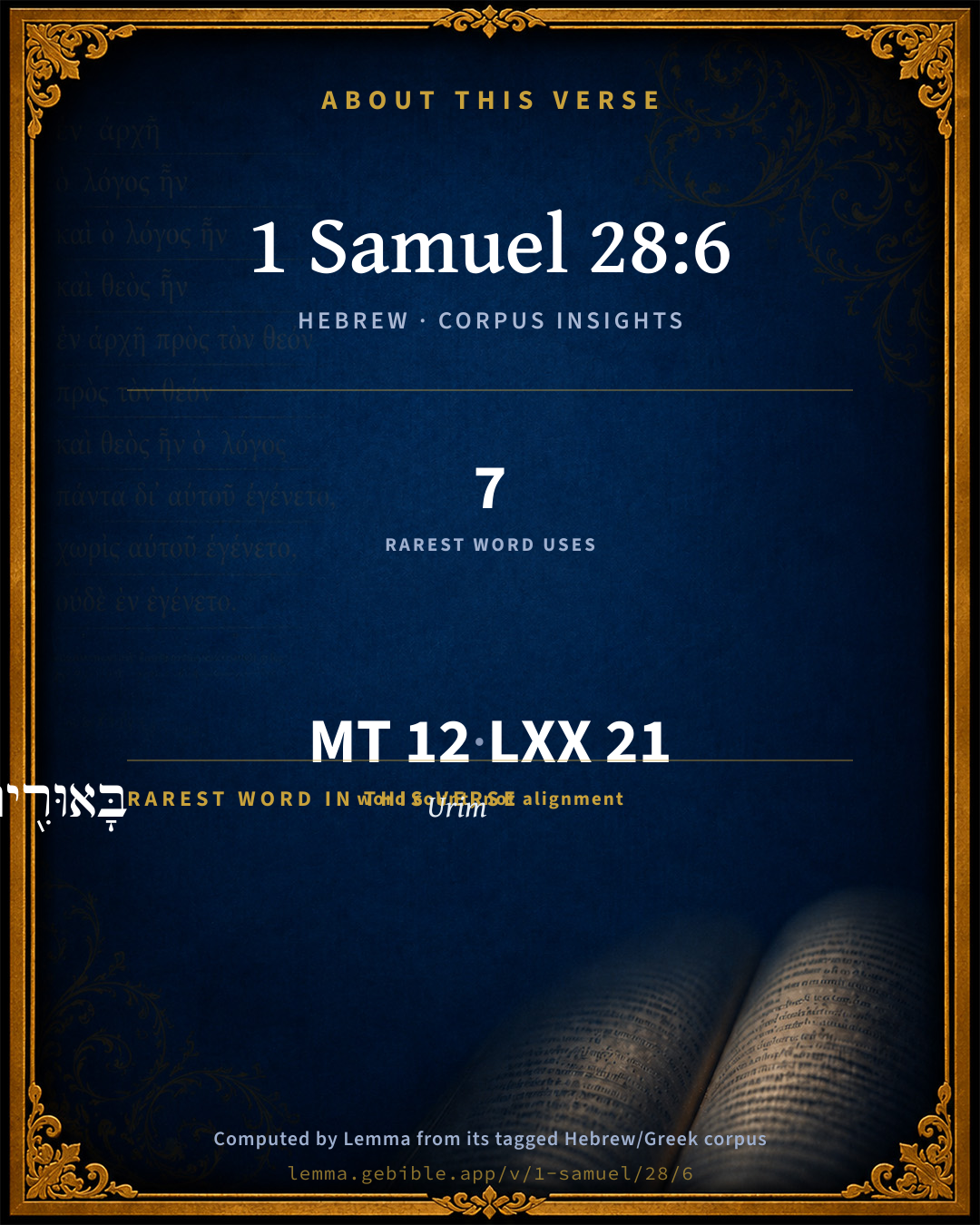
The rarest word here is בָּאוּרִ֖ים Urim H224 — appearing just 7 times in the whole Hebrew Bible.

Shared distinctive vocabulary

בָּאוּרִ֖ים Urim H224 occurs in 7 verses of the Hebrew Bible. Also found in:

Grammatical profile

  • 2 verbs
  • 6 nouns
  • 4 particles

Verb forms

  • וַיִּשְׁאַ֤ל Qal · Sequential Imperfect
  • עָנָ֖הוּ Qal · Perfect

Repetition

Words recur within this verse — often emphatic in Hebrew:

  • גַּ֧ם also H1571 ×3
  • בַּֽיהוָ֔ה LORD H3068 ×2

Hebrew & Septuagint length

In English translation the verse runs 18 words from the Hebrew and 20 from the Septuagint (LXX English) — closely comparable.

A rough comparison of the two English renderings, which tokenize alike — not a word-level alignment.

Word counts can differ between the Hebrew and the Greek without any difference in meaning — e.g. the Hebrew direct-object marker אֵת has no separate Greek word, and Greek often adds the article ὁ.

In the original languages it is 12 Hebrew tokens and 21 Greek tokens — but the two are counted differently (Hebrew bundles its prefixes and suffixes into one token; the Greek is in lemma form), so that isn’t a like-for-like length.

Cross-references

19

Topical passages linked to 1 Samuel 28:6 in the Treasury of Scripture Knowledge — connected by theme and wording, ordered by reader-vote popularity; previews shown in the World English Bible.

  • Numbers 12:6 He said, Hear now my words: if there be a prophet among you, I Yahweh will make myself known to him in a vision, I will speak with him in a dream.
  • 1 Samuel 14:37 Saul asked counsel of God, Shall I go down after the Philistines? will you deliver them into the hand of Israel? But he didn't answer him that day.
  • Lamentations 2:9 Her gates are sunk into the ground; he has destroyed and broken her bars: Her king and her princes are among the nations where the law is not; Yes, her prophets find no vision from Yahweh.
  • Numbers 27:21 He shall stand before Eleazar the priest, who shall inquire for him by the judgment of the Urim before Yahweh: at his word shall they go out, and at his word they shall come in, both he, and all the children of Israel with him, even all the congregation.
  • Ezekiel 20:1–3 It happened in the seventh year, in the fifth [month], the tenth [day] of the month, that certain of the elders of Israel came to inquire of Yahweh, and sat before me.
  • Exodus 28:30 You shall put in the breastplate of judgment the Urim and the Thummim; and they shall be on Aaron's heart, when he goes in before Yahweh: and Aaron shall bear the judgment of the children of Israel on his heart before Yahweh continually.
  • Deuteronomy 33:8 Of Levi he said, Your Thummim and your Urim are with your godly one, Whom you did prove at Massah, With whom you did strive at the waters of Meribah;
  • Jeremiah 23:28 The prophet who has a dream, let him tell a dream; and he who has my word, let him speak my word faithfully. What is the straw to the wheat? says Yahweh.
  • John 9:31 We know that God doesn't listen to sinners, but if anyone is a worshipper of God, and does his will, he listens to him.
  • James 4:3 You ask, and don't receive, because you ask with wrong motives, so that you may spend it for your pleasures.
  • Psalms 74:9 We see no miraculous signs. There is no longer any prophet, Neither is there among us anyone who knows how long.
  • Matthew 1:20 But when he thought about these things, behold, an angel of the Lord appeared to him in a dream, saying, "Joseph, son of David, don't be afraid to take to yourself Mary, your wife, for that which is conceived in her is of the Holy Spirit.
  • Exodus 28:20 and the fourth row a chrysolite, an onyx, and a jasper: they shall be enclosed in gold in their settings.
  • Proverbs 1:1–33 The proverbs of Solomon, the son of David, king of Israel:
  • Genesis 28:12–15 He dreamed. Behold, a stairway set up on the earth, and the top of it reached to heaven. Behold, the angels of God ascending and descending on it.
  • Genesis 46:2–4 God spoke to Israel in the visions of the night, and said, "Jacob, Jacob!" He said, "Here I am."
  • Proverbs 27:1–28:28 Don't boast about tomorrow; For you don't know what a day may bring forth.
  • 1 Chronicles 10:13–14 So Saul died for his trespass which he committed against Yahweh, because of the word of Yahweh, which he didn't keep; and also because he asked counsel of one who had a familiar spirit, to inquire [thereby],
  • Job 33:14–16 For God speaks once, Yes twice, though man pays no attention.

Cross-references courtesy of OpenBible.info (CC BY 4.0).

Hebrew and Greek witnesses Masoretic Hebrew ↔ Greek Septuagint

The same verse in the two great witnesses to the Old Testament, shown verse-for-verse.

These are two independent witnesses, not word-aligned to each other, and the Septuagint is shown in lemma (dictionary) form.

Hebrew 1 Samuel 28:6 Masoretic · Westminster Leningrad Codex

וַיִּשְׁאַ֤ל שָׁאוּל֙ בַּֽיהוָ֔ה וְלֹ֥א עָנָ֖הוּ יְהוָ֑ה גַּ֧ם בַּחֲלֹמ֛וֹת גַּ֥ם בָּאוּרִ֖ים גַּ֥ם בַּנְּבִיאִֽם

When Saul inquired of Yahweh, Yahweh didn't answer him, neither by dreams, nor by Urim, nor by prophets.

World English Bible · Public Domain

Greek LXX 1 Samuel 28:6 Septuagint · lemma form

καί ἐπιἐρωτάω σαούλ διά κύριος καί οὐ ἀποκρίνω αὐτός κύριος ἐν ὁ ἐνύπνιον καί ἐν ὁ δῆλος καί ἐν ὁ προφήτης

And Saul enquired of the Lord; and the Lord answered him not by dreams, nor by manifestations, nor by prophets.

LXX2012 (modern English Septuagint) · Public Domain

Hebrew: Westminster Leningrad Codex (CC BY 4.0). Greek: Septuagint (public domain); English from LXX2012 (modern English Septuagint) (Public Domain). How the Septuagint differs from the Hebrew →

Targum (Aramaic paraphrase)

1

The Targum is the ancient Jewish Aramaic paraphrase of the Hebrew Scriptures — an interpretive translation, not the Hebrew text itself. Onkelos (literal) and Pseudo-Jonathan (expansive) render the Torah, and Jonathan the Prophets. Coverage is partial: where no permissively-licensed English translation exists for a verse, only the Aramaic is shown. This is verse-level text, not a word-by-word alignment to the Hebrew.

  1. Targum Jonathan Prophets (Joshua–Malachi)
    וּשְׁאִיל שָׁאוּל בְּמֵימְרָא דַייָ וְלָא קַבֵּל צְלוֹתֵיהּ יְיָ אַף בְּחֶלְמַיָא אַף בְּאוּרַיָא אַף בְּסַפְרַיָא:

    (no public-domain English translation for this verse)

    Targum Jonathan — Aramaic: “Mikraot Gedolot” (public domain). English: “Sefaria Community Translation” (CC0 1.0 (public-domain dedication)); “London "Chaldee Paraphrase," 1871” (public domain). Text via Sefaria.

Commentary

Notes on 1 Samuel 28:6 from classic Christian and Jewish commentators (each source and its license shown beneath its notes). The classic Christian expositions comment on the surrounding passage and are grouped to its opening verse, so a note may address several verses; the Jewish commentaries on the Tanakh (Rashi and others) are per-verse, so they appear only where the commentator wrote on this verse.

Lemma curates 59 commentaries, every one of them public domain or Creative Commons licensed, each selected and text-cleaned for this edition rather than reprinted as found. About our sources →

Trapp's Complete Commentary

John Trapp

1Sa 28:6 And when Saul enquired of the LORD, the LORD answered him not, neither by dreams, nor by Urim, nor by prophets.

Ver. 6. And when Saul inquired of the Lord.] Which he did not with a true heart, {Heb 10:23} and Ficta pro factis non habentur, saith the Civilian: Nec videtur fieri quod non legitime fit: hence {1Ch 10:13-14} it is said that Saul inquired not of the Lord. He did, and he did not, because not uprightly nor constantly: and Nihil dicitur factum quamdiu aliquid superest faciendum. He should have persisted in seeking God, and not have run to light a candle at the devil, as they say: a sin, whereof his own hands wrought the revenge.

The Lord answered him not.] And no wonder: since it was only extremity of distress that sent Saul to seek God; like as the drowning man catcheth at that bow which he contemned standing safe on the bank.

Nor by Urim.] For Saul had slain those that wore the ephod: and Abiathar who had it was fled to David. {1Sa 23:6} That Saul now sent to Abiathar, is a conceit of the Rabbins.

Nor by prophets.] He cared not for them in his prosperity, and now can have no comfort from them in the day of his distress. Let such look to it as slight God’s faithful ministers.

John Trapp, A Commentary or Exposition upon All the Books of the Old and New Testament (1647–1656) — public domain. Text from a community e-Sword module.

The Biblical Illustrator

Joseph S. Exell

1Sa_28:6

The Lord answered him not.

Gods silence

I. A frequent experience of those who seek God. It is neither an universal nor invariable one, else prayer would become impossible. But it is sufficiently frequent to occasion grave spiritual difficulty.

1. In apparent contradiction of Divine promise. Of Israel, even in Egypt, it was said, I will surely hear their cry (Exo_22:23). (Zec_10:1.) (Psa_86:7.) How strong are the assurances of Christ. (Mat_7:7-11.)

2. Disastrous in its effect upon the life of the soul. If it be true that where there is no vision the people perish, equally so is it that when no Divine voice speaks to the soul it must cease to live. As the plant withers in the gloom of the cellar, the soul that knows not the sunshine of the Fathers smile cannot be healthy or vigorous.

3. A source of uneasiness and sorrow. It is not only right but in the best sense natural that man should seek God; there is no deeper source of dissatisfaction and restlessness than a baffled instinct.

II. An experience to be interpreted. Even the silence of God has a meaning. Rightly interrogated it may prove a precious revelation. In any case the possibilities are too grave for the sign to be neglected.

1. God is sometimes supposed to be silent when He is not. Answers to prayer are not always at once or easily apparent.

2. His silence is not always a token of displeasure. It may be simply

(1) directive; our request unwise, etc. Or it may be

(2) stimulative; as when the Syro-phoenician woman grew importunate when He answered her nothing.

3. Yet it is often expressive of Divine wrath.

It must not be regarded as a light thing.

1. It may be intended to invite to inward examination and repentance. Some unfaithfulness; a falling from grace; it may be direct disobedience. The Holy One is saying, by His silence, Come up higher. I cannot speak to you there!

2. It sometimes occurs, as in the case of Saul, in token of doom. The gracious lips of Christ were silent before a Pilate and a Herod. (A. F. Muir, M. A.)

A silent god

1.Calamity may be borne. We can oppose it to our manhood and our constancy. Menaced by shipwreck, we can breast the storm. To be defeated in battle, to be superseded in power, to see popularity crumbling into indifference--all this and more Saul had to bear, and all this may be borne. If God be on my side, anyone may say to all the world, I care nothing for all the rest. Did not great Martin Luther cry: Oh! my God, punish me rather with pestilence, with all the terrible sicknesses on earth, with war, with anything, rather than Thou be silent to me? And when Saul inquired of the Lord, the Lord answered him not. Ah! that is to be desolate indeed!

2. There are some whom God does not answer because they do not care to inquire of Him at all. The earth suffices them. Life is their feeding trough, and they care nothing for more. They never care to look beyond the narrow horizon of themselves.

3. When Saul inquired of the Lord, we are told that the Lord answered him not, neither by dreams, nor by Urim, nor by prophets. Dreams were the lowest form of revelation: yet we have so many closer modes of communion with God, in His Christ and by His Spirit, that of dreams we need not speak. Have no messages of Scripture ever seemed suddenly to burn their revelation upon your souls? Yes, God does speak to us by Urim still, and He also speaks to us by His prophets. And can you wonder that, if this be so, God, whom you have despised, and whose laws you have deliberately and habitually violated, should not only be silent to you at last? God never turns from the cry of the penitent, however bad he may have been. Distinguish between Gods apparent silences for His children, and the self-created silence of your own to those who utterly refuse Him. Oh, let us beware lest we feel the awful silence which is not Gods, but arises from our own obstinate and determined wickedness, that it may not overwhelm us. (Dean Farrar.)

Communications threatened

During a heavy snowstorm the warning was sent out that in a few hours the wet, heavy snow would break down the telephone and telegraph wires, and cut off communication with the outside world. Instantly there was a great rush to the telephones and the telegraph offices to get messages off before it was too late. What if we knew that very soon God would refuse to hear any more prayers; would there not be a great rush to the throne of grace to send our petitions heavenward before we were cut off foreverse (Christian Endeavour Times.)

The Biblical Illustrator, edited by Joseph S. Exell (c. 1880s–1900s) — public domain. Text from a community e-Sword module.

Joseph Benson's Commentary

1Sa 28:6. When Saul inquired of the Lord — This seems to contradict what is affirmed 1Ch 10:14, that he did not inquire of the Lord, which is assigned as the reason why the Lord slew him. But Rabbi Kimchi, and others, thus reconcile these two places. That since he did not continue to inquire of him, but went to a diviner, it was all one as if he had not inquired at all; for he did it faintly, coldly, and indifferently. A learned Jew, Samuel Laniado, remarks here: “He whose heart is perfect with God, lifts up his eyes unto him, and fixes them on him; hoping in him, though he doth not presently hear him; and perseveres in his expectation and confidence, firmly setting a resolution to wait upon him. But so did not Saul, who was remiss and negligent, saying in his heart, If God will not hear me, I will go and consult a familiar spirit.” The Lord answered him not — Nor is it to be wondered that he should not answer a man of such a disposition. Neither by dreams — By which perhaps he prayed that God would inform him. Nor by Urim — It appears by this, that, Abiathar having fled to David and taken the ephod with him, Saul had set up another high-priest, and made an ephod in imitation of the sacred one, not considering the peculiar sanctity of that which God had appointed, and by which alone he had promised to manifest himself. Nor by prophets — A school of whom, no doubt, was still remaining at Ramah, over which Samuel had presided.

Joseph Benson's Commentary on the Old and New Testaments (1811–1818) — public domain. Text from a community e-Sword module.

Tyndale Open Study Notes

Tyndale Open Resources

28:6 refused to answer: Earlier, Saul had consulted the Lord by sacred lots with mixed results (14:36-42). God’s refusal to speak was a sign of his judgment (14:37; Lam 2:9; Ezek 7:26; Amos 8:11-12; Mic 3:6-7).

Tyndale Open Study Notes — © Tyndale Open Resources, licensed CC BY-SA 4.0. Text via the HelloAO Bible API.

Geneva Bible (1599)

Geneva Bible translators

Meaning, the high Priest, Exod. 28:30.

Geneva Bible (1599) marginal notes — public domain. Text via Bolls.life.

Adam Clarke's Commentary

Verse 6. The Lord answered him not ] He used the three methods by which supernatural intelligence was ordinarily given:-

1. Dreams. - The person prayed for instruction; and begged that God would answer by a significant dream.

2. Urim. - This was a kind of oracular answer given to the high priest when clothed with the ephod, on which were the Urim and Thummim. How these communicated the answer, is not well known.

3. Prophets. - Who were requested by the party concerned to consult the Lord on the subject in question, and to report his answer. The prophets at that time could only be those in the schools of the prophets, which Samuel had established at Naioth and Gibeah. These were the only successors of Samuel that we know of.

Adam Clarke's Commentary on the Bible (1810–1826) — public domain. Text from a community e-Sword/MySword module.

Ellicott's Commentary for English Readers

(6) And when Saul enquired of the Lord.——The question has been asked, How was the enquiry made? for since the massacre at Nob, the high priest, or, at least, the priest in possession of the sacred ephod and the breastplate, with the Urim and Thummim, was, we know, in the camp of David, and we shall soon hear of a solemn use being made of the sacred gems. (See 1Sa_30:7-8.) It has been suggested by eminent Biblical scholars that after the murder of Ahimelech and the flight of Abiathar to David, Saul removed the national Sanctuary from desecrated Nob, and established it at Gibeon, where, during the first year of David’s reign, we find the Tabernacle, with Zadok, son of Ahitub, of the house of Eleazar, acting as high priest—probably placed in that office by Saul. This would account for the frequent reference in the time of David to two high priests, Zadok and Abiathar: Zadok, the high priest appointed by Saul, for a considerable period alone in charge of the Tabernacle; and Abiathar, who fled from Nob with the ephod and the sacred Urim, acknowledged by David as high priest, when the kingdom was restored eventually under one head. These two seemed to have divided the honours and responsibilities of the high priesthood. (See 2Sa_8:17; 2Sa_15:24; 2Sa_15:29; 2Sa_15:35; 1Ch_15:11; 1Ch_18:16.)

This Zadok, we may assume, “enquired” for Saul: some suppose by means of an ephod made in imitation of the ancient breastplate with the Urim in possession of Abiathar; but, as may be readily imagined, no response was received. It is also likely enough that some “prophets”—so called—trained, not improbably, in the school of Samuel, were present with Saul. These, too, of course, received no Divine message, either by voice or in dreams.

A Bible Commentary for English Readers, edited by Charles John Ellicott (1878–1897) — public domain. Text from a community e-Sword module.

The Cambridge Bible for Schools and Colleges

gen. ed. J. J. S. Perowne

6. when Saul inquired of the Lord] In 1Ch_10:13-14 it is said that “Saul died … for asking counsel of one that had a familiar spirit, to inquire of it, and inquired not of the Lord.” The contradiction is only in appearance. Instead of humbling himself in penitence for the sin which he knew must be withholding the Divine answer (1Sa_14:37), and persevering in his inquiry, he resorted to a plan which was tantamount to apostasy from Jehovah.

answered him not] See Pro_1:24-30.

by dreams] A recognised method of divine communications to man (Num_12:6).

by Urim] Since Abiathar had carried off the Ephod with the Urim and Thummim when he fled from Nob, it would appear that Saul had had a new Ephod made, and appointed a high-priest in the room of Ahimelech. This conjecture is supported by the double high-priesthood of Zadok and Abiathar in David’s reign (2Sa_8:17, &c.), which may be accounted for by supposing that David allowed Zadok to retain the office to which Saul had elevated him.

The following points may be noted with respect to the obscure question of the Urim, or Urim and Thummim. For a full discussion see Smith’s Dict. of the Bible.

(a) The name signifies The Light and the Perfection (or the Truth), the words being ‘plurals of excellence.’

(b) It denotes certain material objects, placed inside the breastplate of judgment which formed part of the high-priest’s Ephod (Exo_28:30). There are no directions for making them; it is implied that they were already in existence.

(c) The purpose of this mysterious instrument is clear. It was a means by which the will of Jehovah was ascertained through the high-priest. The present passage is the only mention by name of its use after the entry into Canaan, though it is implied in ch. 1Sa_14:3; 1Sa_14:18, 1Sa_23:2; 1Sa_23:9, 1Sa_30:7-8; 2Sa_21:1. After the Captivity it became a proverbial expression with reference to questions of special difficulty that they must wait for solution “until there stood up a priest with Urim and Thummim” (Ezr_2:63; Neh_7:65).

(d) The origin of the Urim and Thummim was not improbably Egyptian. A plausible conjecture connects them with the symbol of Truth worn by the priest-judges of Egypt, and the symbol of Light worn by members of the priestly caste.

(e) The method of use must remain an enigma. The most probable theories are either (1) that they were consecrated objects by gazing on which the high-priest passed into a state of spiritual ecstasy, and purified from selfish and worldly thoughts became receptive of a supernatural illumination: or (2) that they were a special means of casting lots. Cp. note on 1Sa_14:41.

by prophets] Cp. 1Sa_9:6, 1Sa_22:5, for instances of counsel given through prophets. The same three methods of inquiry are mentioned in Hom. Il. I. 62:

“But seek we first some prophet or some priest,

Or some wise vision-seer, since visions too

From Zeus proceed.”

The Cambridge Bible for Schools and Colleges (gen. ed. J. J. S. Perowne; Cambridge University Press, 1878–1918) — public domain. Text from a community e-Sword module.

John Gill's Exposition

And when Saul inquired of the Lord,.... And this being not done truly and heartily, nor continued in, it was as if he had not inquired, and especially after he had inquired of one that had a familiar spirit, as Kimchi observes; for so it is said, Ch1 10:14,

the Lord answered him not, neither by dreams; which he dreamed himself, from whence he could not conclude anything relating to the will of God; so the Targum,"the Lord did not receive his prayer even by dreams;''or by dreamers, diviners, who pretended to give answers by dreams:

nor by Urim; there being no priest to consult in this way, Abiathar having fled with the ephod, in which were the Urim and Thummim, to David, Sa1 23:9; though some think that he sent to Abiathar, who was with David, to inquire for him; and others that he made another ephod with Urim, and appointed another priest to consult by them; neither of which are probable:

nor by prophets; of which there was a school not far from him, even at Naioth in Ramah, of which Samuel in his lifetime was president; but neither by the one nor the other could Saul get an answer from God, who for his sins had departed from him.

John Gill's Exposition of the Whole Bible (1746–1763) — public domain (CC PDM 1.0). Text via the HelloAO Bible API.

Albert Barnes' Notes on the Bible

When Saul inquired of the Lord ... - It is said 1Ch 10:14 that one reason why the Lord killed Saul, and gave his kingdom to David, was because he inquired not of the Lord. The explanation of this apparent discrepancy is to be found in the fact that inquiring of the familiar spirit was positively antagonistic to inquiring of the Lord. That Saul received no answer - when he “inquired of the Lord” by dreams, which was an immediate revelation to himself; by Urim, which was an answer through the high priest clothed in the ephod; or by prophets, which was an answer conveyed through some seer speaking by the Word of the Lord 1Sa 22:5 - was a reason for self-abasement and self-examination, to find out and, if possible, remove the cause, but was no justification whatever of his sin in asking counsel of familiar spirits.

Albert Barnes' Notes on the Bible (1834–1885) — public domain. Text from a community e-Sword/MySword module.

Haydock's Catholic Bible Commentary

Dreams. During which God often revealed his will. See Deuteronomy xiii. 3. --- Priests. Hebrew, "nor by Urim." It seems Saul had appointed some priests, and had fabricated a fresh ephod, with the Urim, &c., after the departure of Abiathar. (Calmet) --- But Salien calls this in question, and there might neither be priests nor prophets for Saul to consult. (Haydock) --- God despised a man, who had slain so many of his sacred ministers. (Menochius)

George Leo Haydock (1774–1849), Haydock's Catholic Family Bible and Commentary, 1859 edition — public domain. Excludes Psalms (Douay-Rheims chapter numbering differs from Protestant) and Deuterocanonical books (Catholic canon only).

Matthew Poole's English Annotations

Saul inquired of the Lord, in his slight and perfunctory way, as 1Sa 14:19, as appears from hence, that when God did not speedily answer him, he goes to the devil for an answer, 1Sa 28:7; for which reason he is said,

not to have

inquired of the Lord, 1Ch 10:14, i.e. not seriously, and after the right order. Possibly he inquired by some prophet then with him, or by the priest before the ark.

The Lord answered him not, because he sought him not in due order; not by the Urim and Thummim which were in the ephod, which he by his cruelty to the priests had lost, 1Sa 23:6; and because he did not truly repent of nor put away his sins, which provoked God, and kept him from answering, as Saul well knew by his own conscience and experience, 1Sa 14:37-39.

Neither by dreams,

nor by Urim, nor by prophets, i.e. neither by ordinary means, nor extraordinary.

Matthew Poole's English Annotations on the Holy Bible (1683–1685) — public domain. Text from a community e-Sword/MySword module.

Whedon's Commentary on the Bible

Daniel D. Whedon

6. The Lord answered him not — Which showed that the divine anger was against him.

By dreams — This may mean that he had prayed God to give him some significant dream, but no such dream had been granted him; or it may refer to the prophets, who neither by vision nor by dream (Num_12:6) had recently received any communication for Saul.

By urim — On the breastplate of the high priest. See Exo_28:30. But what high priest did Saul resort to after the murder of Ahimelech? Most probably another had been immediately appointed by Saul, and a new ephod had been made for him. It is in no way likely that Saul sent away to David’s camp to inquire by the priest Abiathar.

By prophets — Some of the most distinguished of Samuel’s school, whom Saul had with him in the camp.

Daniel D. Whedon (gen. ed.), Commentary on the Old and New Testaments (1874–1909) — public domain. Text from a community e-Sword module.

The Pulpit Commentary

Vers. 6-14.

Man"s appeal from God to man.

The facts are

1. Saul in his trouble seeks in vain guidance from God.

2. In despair he has recourse to the witch of Endor, promising her that no harm should come to her for assisting him with her incantations.

3. Saul desires of her to bring up Samuel.

4. On Samuel coining forth the woman is in terror, and also discoversSaul"s identity.

5. By the aid of the woman Saul recognises Samuel, and bows himself tothe earth. The strange events here narrated awaken feelings of wonder, and, in minds not acquiescent in God"s methods of developing his purpose in connection with the Hebrew race, some degree of incredulity; but the important spiritual teaching is obvious, and the difficulties of the subject, also, are not without their practical value. We have here an instance of

I A MAN RIGHTEOUSLY LEFT OF GOD IN TIME OF DISTRESS. The triple reference to dreams, prophets, and Urim indicates the intense desire of Saul to obtain some intimation of the Divine will; and this renders the futility of his endeavour the more impressive. Outwardly he conformed to the usages of a ruler in Israel, and, were he judged by men who have regard only or chiefly to the zeal which meets the eye, he would be regarded as, so far, a religious man, and within the range of blessing. To those who are unfamiliar with Scripture it may seem painfully strange that a man presumably in earnest should be so utterly left of God; but, as in other instances, a little more knowledge will afford a solution of the fact and justify the ways of God.

1. It is a fact that men are left to themselves. Divine guidance had been. withheld from Saul from the day of his rebellion. (1Sa_15:20-23) up to the date of this event. The antediluvians and, at one stage of history, Israel were abandoned to their devices (Gen_6:1-3; Pharisees Isa_1:15) were left to the blindness of their hearts notwithstanding their many prayers. When men deliberately darken the light that is in them God does not enable them to see the "Light of the world.

1. There are moral reasons for such abandonment. In Saul"s case there was an absence of that state of mind which alone would render attention to his cry for help honourable to God and blessed to mankind. There was no penitential recognition of his former sin, nor of the years of persistent impenitence, nor of his cruelty to David; his desire for God"s guidance and help sprang entirely from fear of military disaster, of loss of influence, and of the fulfilment of the prediction outstanding against him. (1Sa_15:28, 1Sa_15:29) The response of God to man"s cry is based on law as beautiful in its orderliness as anything in the physical world. The notion that God must help every one in trouble is based on sheer ignorance, and is profoundly unscientific. Even in home and society we recognise the necessity of moral conditions of receiving attention and favour. Divine mercy is free, but is righteous in its flow. It never sets a premium on selfishness and impenitence; it is never exercised in such a way as to do

2. violence to our radical sense of right and moral propriety. This will account for the deaf ear which God is represented as turning to bad men when, in desperation, they cry to him in adversity, and when, at the end of life, they seek him in vain; for they do not care for God, for holiness, for anything but selfish deliverance from uncomfortable circumstances and great danger. Hence

3. The abandonment is in harmony with the current of God"s promises. Again and again we are encouraged to seek the Lord. Nothing is more certain than that God delights to answer our cry for help. The appeal of David later on in life, and the dumb pleading of the Magdalene, were freely answered; but the fifty-first Psalm reveals the contrast of David"s spirit with that of Saul, and the tears of the unholy woman told of a heart altogether turned toward God.

II THE SUPERHUMAN CHARACTER OF GOD"S WAYS. There is in some minds a feeling of surprise that such a narrative as this should find a place in a book supposed to be written or compiled under Divine inspiration for the instruction of the world in spiritual truth; and, assuming that its fitness in such a book can be made out, it is deemed incredible that God should allow his servant to come from the invisible world at the request of such a man as Saul, and through an agency condemned in the Bible. Now on this difficult subject it may suffice for our purpose to observe

1. A revelation of God"s purpose towards mankind in connection with and by means of the history of a race is natural only in so far as it embraces what the chief figures of the history actually did, and especially in their relation to him, be it good or bad. That Saul actually did as here recorded is evident on the face of the whole narrative, for never was there a more perfect air of truthfulness on a record. The very unreasonableness of his conduct in applying to a witch for such a purpose, and after executing the law against witchcraft, is quite reasonable when we reflect on the utter mental and moral confusion involved in his despair. Compare his unreasonable act of seeking a blessing through a sinful act. (1Sa_13:8-14 1Sa_15:21-23) The record, therefore, of such a transaction is reasonable in an inspired book.

1. There are cases in which God allows bad men to have their desire without the advantage they expect from its being granted. Quails were given to men to their grief. A king was desired contrary to God"s will, and one was given, much to the affliction of the nation. There is so far a

2. similarity in this instance, that the granting of the desire to see Samuel was only to seal Saul"s doom, not to give the guidance anticipated, and which had been hitherto refused (ver. 6).

3. There was a manifest fitness in Samuel being permitted to declare the fixity of Saul"s fate and its equity. He had instructed and warned Saul at first in private, (1Sa_9:25, 1Sa_9:26) and subsequently. (1Sa_15:26-31) All through he had looked with sorrowful pity on this poor wayward, sinning man. With Saul"s belief in the existence of the spirits of good men after death, it was the most natural thing to wish, if possible, to see this wise, kind, and faithful friend, and in his utter despair appeal to his pity; and considering that there evidently still lurked in his mind a last hope that the old, long deferred prediction of downfall might yet be averted, with a feeling that it was very hard, and perhaps unjust, for him to be thus left in misery, there seems to be a blending of Divine tenderness and judgment in this kind and faithful friend being permitted once more to be seen and heard, and at the same time to vindicate the justice of God in the doom about to be accomplished. The Divine tenderness and judgment which had borne with and chastised Saul all through his perverse life were now conspicuous in the irrevocable sealing of his doom. He would rather hear his sentence from Samuel than any other being, if it is to be pronounced.

1. There is no evidence that the woman had anything to do with the appearance of Samuel. He came forth before she called, and hence her wild shriek. That she subsequently played her part as a witch was consistent with the character of such persons. That Saul should suppose her to be the cause of the appearance does not touch the question. He was not in a mental condition to discriminate. That God should allow an invisible being to become visible under such conditions is to be settled by history, for

2. There is no moral principle violated in God allowing a being from the invisible world to become visible. There is here no sanction of witchcraft, no admission of its powers. Kindness and judgment only are displayed in relation to Saul. The whole difficulty, therefore, resolves itself in a visible appearance of a dead man. Will any one say that God cannot cause a Samuel to appear as truly as a Moses and Elijah? Does the incredulity lie in the fact that we never see the departed, or that God does not cause them to appear to others? By what law is God bound to make a specific exercise of his power common? Will the case be improved by saying it is such an exercise of power as we should not deem wise and useful? What is that but saying we make our method of government a standard by which God"s reported acts shall be judged? Is it not wiser to submit to the force of historical testimony, and admit that his ways are not our ways? God does strange things in the earth, at which men marvel, but never unholy things. There is nothing incredible in the existence of departed spirits, nor in their employment when God has a fit purpose to accomplish through them.

III THE PERMANENCE OF RELIGIOUS SENTIMENTS. It is noteworthy that although Saul had lived so long in impenitence, and had become even hardened in his sinful course, he still retained an awe and reverence for the supernatural and invisible. His very folly and sin in having recourse to a witch revealed the strength of the feeling which could not rest without some help from the unseen world, If God cannot be found men will seek out a substitute. Idolatry and all forms of religious superstition are evidence of the power of the religious sentiment in man. Thousands of men have done much to crush it out, but it has reasserted itself in seasons of distress. Because man is formed for religion, and carries within him feelings which crave for the unseen and eternal, therefore he often becomes the slave of false systems of belief and worship. The permanence of this sentiment gives hope to the missionary, and adds to the remorse of the finally impenitent.

IV THE POWER OF RELIGIOUS INFLUENCE. The influence of Samuel over Saul appears in this bitter cry for his presence in the hour of misery. The foundation of this influence was laid in Samuel"s character, and in the kind and wise interest he took in Saul when entering on his public duties as king. Holy example, faithful warning, wise instruction, tender forbearance, and pitiful concern had not been altogether lost on this erring, self-willed man, although in the perversity of his heart he had for years gone counter to Samuel"s guidance. In the dark and painful hour of despair the thought of the wise counsellor and sincere friend came over the soul with memories rich in homage to him. How often does the poor prodigal, when sinking in misery, feel the spell of a mother"s piety! How many a man after years of neglected instruction thinks of the faithful pastor, and perchance takes to heart the lessons of his words and life!

General lessons:

1. The climax of trouble is reached when God refuses to hear our prayer, for "What can I do?" then admits of no satisfactory answer.

2. We ought to search our hearts, to see whether we so "regard iniquity"therein as to be in an unfit moral condition to receive a blessing from God. (Psa_66:18)

1. God has methods by which he can vindicate the justice of his judgments,even when we are craving for relief from them.

2. It is important to exercise religious influence over others as early andconstantly as possible, since we know that it will be a power even when we are gone.

The Pulpit Commentary (1880–1919), ed. H.D.M. Spence-Jones & Joseph S. Exell — public domain. Text from a community e-Sword module.

Scofield Reference Notes

C. I. Scofield

Urim

(See Scofield "Exo 28:30").

The Scofield Reference Bible (1917 edition), notes by C. I. Scofield — public domain. Text from a community e-Sword module.

Rashi

Rabbi Shlomo Yitzchaki (Rashi)

Nor through the Urim. Because he had slain [the kohanim of] Nov, the City of Kohanim, he was not answered.

Rashi on the Tanakh — English translations: “The Judaica Press complete Tanach with Rashi, translated by A. J. Rosenberg” (CC BY 4.0); “Pentateuch with Rashi's commentary by M. Rosenbaum and A.M. Silbermann, 1929-1934” (public domain); “The Metsudah Tanach series, Lakewood, N.J” (CC BY 4.0); and “The Book of Joshua, Metsudah Publications, 1997” (CC BY 4.0). Text via Sefaria.

Lesson kit

Teaching starters — assembled from the data on this page, not authored interpretation. Every prompt links to the verse data it draws on. Edit before teaching.

1 Samuel, in the Historical, opens this verse with 12 words (9 distinct Hebrew lemmas). Its most distinctive word is ʼÛwrîym (“Urim”). A historical commentator’s framing appears above. Read the whole chapter for the surrounding context.

Discussion questions

  1. How does “Urim” (ʼÛwrîym) shape what this verse is saying?
  2. Exodus 28:30 shares the word «Urim» with this verse. How do the two illuminate each other?
  3. “also” occurs 3× in this one verse. What is the effect of the repetition?
  4. These translations render this verse differently. What is at stake in choosing one wording over another?
  5. The verb «וַיִּשְׁאַ֤ל» is Qal Sequential Imperfect. How does its form color the action?
  6. Reading how Trapp's Complete Commentary and The Biblical Illustrator read this verse, where do the two commentators agree and where do they part?

Things to notice

Reading settings

Reading text

Shown beneath each verse's original-language words.

Old Testament
Old Testament edition

Read the OT as the Masoretic Hebrew (MT) or the Greek Septuagint (LXX).

English shown for the Greek Septuagint (in the Hebrew ↔ Greek comparison).

Comparing translations? Open the Compare panel on any verse page to stack up to four side by side.