Acts 13:20

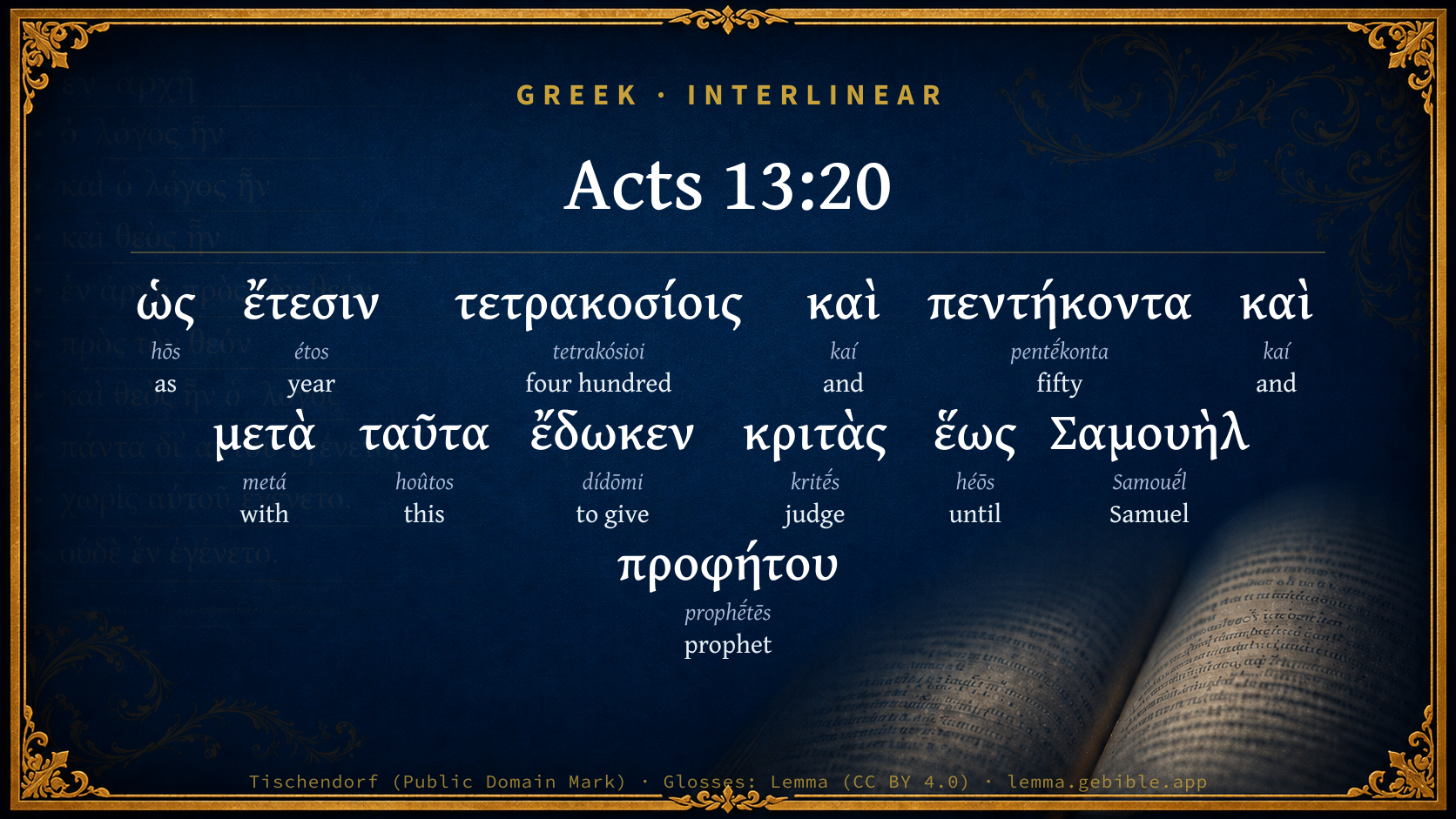
Greek (Tischendorf 8th ed.) Acts 13:20 appears in the Greek New Testament. The text above is from the Tischendorf 8th edition. Each word links to its Strong’s number and a concise gloss. Click any word for its full Thayer’s Greek Lexicon entry.
Download image
Cite this verse

Acts 13:20 (World English Bible). Public Domain. Lemma interlinear Bible study tool, https://lemma.gebible.app/v/acts/13/20.

Show BibTeX & RIS
BibTeX
RIS
English Translation
After these things he gave them judges until Samuel the prophet.
World English Bible · Public Domain
Download a study sheet

One document with this verse’s original text, its word-by-word gloss line, the meaning frame, cross-references with their text, attributed commentary, and full source and license credits — printable, and it pastes into notes with its structure intact.

This verse Autodidact and up

Study sheet (.html) Plain text (.txt)

A passage Seminary Student

Up to 50 verses in one chapter. A passage sheet keeps up to 6 commentary sources and 12 cross-references per verse, in the order this page ranks them, and says so on the sheet whenever that leaves anything out. Ask for a single verse and you get the Autodidact verse sheet above.

Everything on this page stays free to read, with no account — the sheet is a download of what is already on screen, not access to it.

Want to remove ads? Support Godless Engineer
Compare translations 3

The same verse in 3 English versions, stacked beneath the original-language interlinear above. Click any original word for its lexicon entry.

Each is an independent rendering of the whole verse — the interlinear is not word-aligned to these translations.

Highlighted words mark where these versions differ — a whole-verse word diff, not a word-by-word alignment.

  • World English Bible Public Domain
    After these things he gave them judges until Samuel the prophet.
  • King James Version Public Domain
    And after that he gave unto them judges about the space of four hundred and fifty years, until Samuel the prophet.
  • unfoldingWord Literal Text CC BY-SA 4.0
    in about 450 years. And after these things, he gave them judges until Samuel the prophet.

unfoldingWord Literal Text — © unfoldingWord, licensed CC BY-SA 4.0. Word-aligned USFM3 via Door43 (git.door43.org/unfoldingWord/en_ult).

Versions to compare (up to 4)

3 of 4 selected

Show all 19 translations

Every available English version of this verse, each an independent rendering of the whole verse.

  • World English Bible Public Domain
    After these things he gave them judges until Samuel the prophet.
  • Berean Standard Bible Public Domain
    All this took about 450 years. After this, God gave them judges until the time of Samuel the prophet.
  • Majority Standard Bible Public Domain
    All this took about 450 years. After this, God gave them judges until the time of Samuel the prophet.
  • King James Version Public Domain
    And after that he gave unto them judges about the space of four hundred and fifty years, until Samuel the prophet.
  • American Standard Version (1901) Public Domain
    and after these things he gave `them' judges until Samuel the prophet.
  • Revised Version (1885) Public Domain
    and after these things he gave them judges until Samuel the prophet.
  • Geneva Bible (1599) Public Domain
    Then afterward he gaue vnto them Iudges about foure hundreth and fiftie yeeres, vnto the time of Samuel the Prophet.
  • Douay-Rheims (1899) Public Domain
    As it were, after four hundred and fifty years: and after these things, he gave unto them judges, until Samuel the prophet.
  • Young's Literal Translation Public Domain
    `And after these things, about four hundred and fifty years, He gave judges -- till Samuel the prophet;
  • Literal Standard Version CC BY-SA 4.0
    And after these things, about four hundred and fifty years, He gave judges—until Samuel the prophet;
  • Unlocked Literal Bible CC BY-SA 4.0
    All these events took place over four hundred and fifty years. After all these things, God gave them judges until Samuel the prophet.
  • unfoldingWord Literal Text CC BY-SA 4.0
    in about 450 years. And after these things, he gave them judges until Samuel the prophet.
  • Darby Bible Public Domain
    And after these things he gave [them] judges till Samuel the prophet, [to the end of] about four hundred and fifty years.
  • World Messianic Bible Public Domain
    After these things, he gave them judges until Samuel the prophet.
  • Webster's Bible Public Domain
    And after that he gave to them judges, about the space of four hundred and fifty years, until Samuel the prophet.
  • Free Bible Version CC BY-SA 4.0
    Then he provided them with judges as leaders until the time of the prophet Samuel.
  • Bible in Basic English Public Domain
    And after these things he gave them judges, till the time of Samuel the prophet.
  • Text-Critical English NT CC BY 4.0
    After that he gave them judges for about four hundred and fifty years, up to the time of the prophet Samuel.
  • Tyndale New Testament (1534) Public Domain
    And after warde he gave vnto them iudges aboute the space of.iiii.C. and.l. yeres vnto the tyme of Samuel the Prophet.

Literal Standard Version (2020), Covenant Press — licensed CC BY-SA 4.0. Text via the HelloAO Bible API (eBible.org). Unlocked Literal Bible (unfoldingWord) — licensed CC BY-SA 4.0. Text via the HelloAO Bible API (eBible.org). unfoldingWord Literal Text — © unfoldingWord, licensed CC BY-SA 4.0. Word-aligned USFM3 via Door43 (git.door43.org/unfoldingWord/en_ult). Free Bible Version, Dr. Jonathan Gallagher — licensed CC BY-SA 4.0. Text via the HelloAO Bible API (eBible.org).

Word by word

More ways to search: Search by grammar → Find every occurrence → Compare this word →

Practice this passage: Drill this verse → Learn its vocabulary →

About this verse

These counts appear in no published source. They are computed here, from the morphology-tagged text and Lemma’s own curated glosses. What Lemma adds →

13
words
12
distinct lemmas
Acts
section

Notable vocabulary

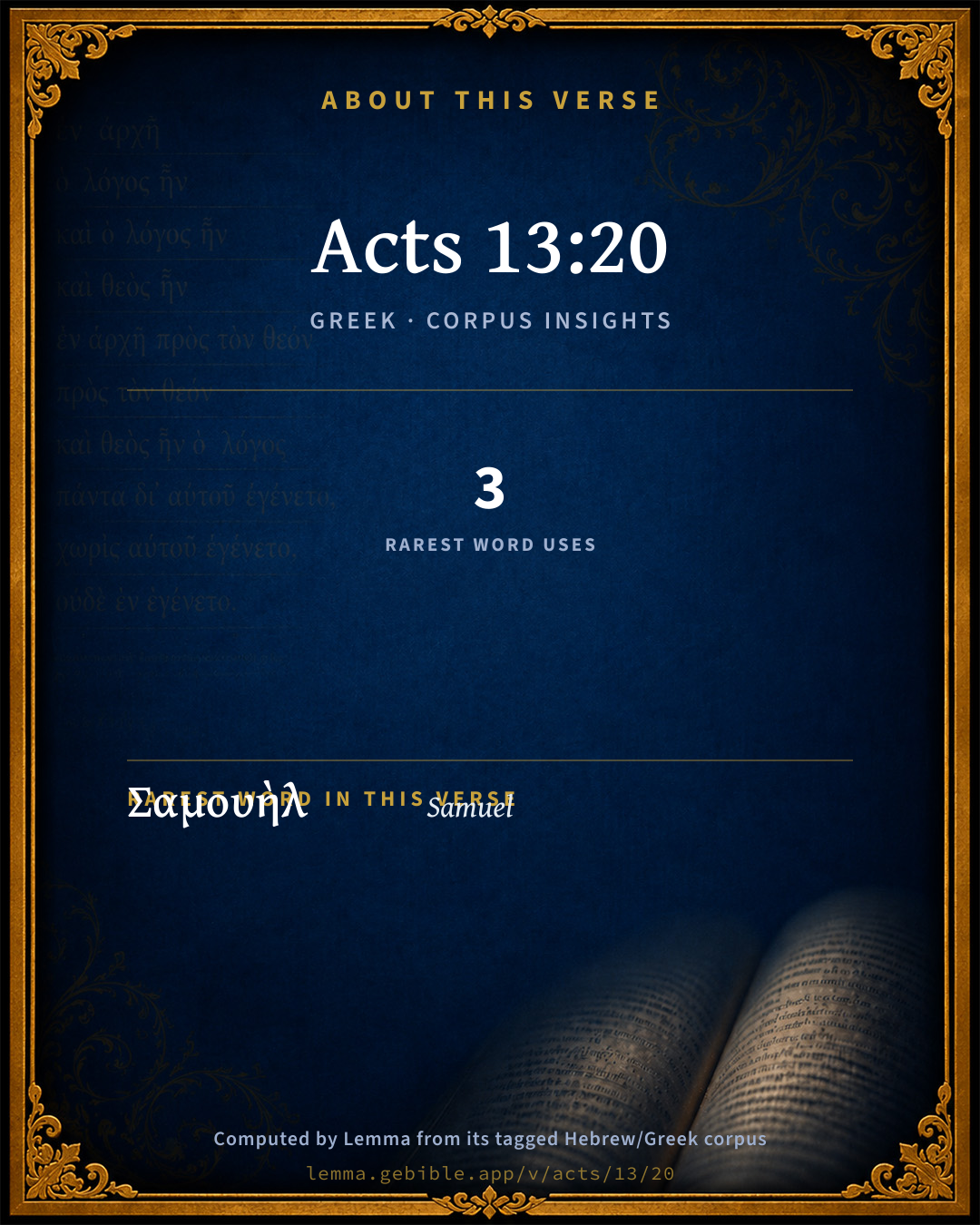
The rarest word here is Σαμουὴλ Samuel G4545 — appearing just 3 times in the whole Greek New Testament.

Shared distinctive vocabulary

Σαμουὴλ Samuel G4545 occurs in 3 verses of the Greek New Testament. Also found in:

Repetition

A word recurs within this verse:

Cross-references

9

Topical passages linked to Acts 13:20 in the Treasury of Scripture Knowledge — connected by theme and wording, ordered by reader-vote popularity; previews shown in the World English Bible.

  • Judges 2:16 Yahweh raised up judges, who saved them out of the hand of those who despoiled them.
  • 1 Samuel 3:20 All Israel from Dan even to Beersheba knew that Samuel was established to be a prophet of Yahweh.
  • Judges 3:10 The Spirit of Yahweh came on him, and he judged Israel; and he went out to war, and Yahweh delivered Cushan Rishathaim king of Mesopotamia into his hand: and his hand prevailed against Cushan Rishathaim.
  • Ruth 1:1 It happened in the days when the judges judged, that there was a famine in the land. A certain man of Bethlehem Judah went to sojourn in the country of Moab, he, and his wife, and his two sons.
  • 1 Samuel 12:11 Yahweh sent Jerubbaal, and Bedan, and Jephthah, and Samuel, and delivered you out of the hand of your enemies on every side; and you lived in safety.
  • 2 Samuel 7:11 and [as] from the day that I commanded judges to be over my people Israel; and I will cause you to rest from all your enemies. Moreover Yahweh tells you that Yahweh will make you a house.
  • 2 Kings 23:22 Surely there was not kept such a Passover from the days of the judges who judged Israel, nor in all the days of the kings of Israel, nor of the kings of Judah;
  • 1 Chronicles 17:6 In all places in which I have walked with all Israel, spoke I a word with any of the judges of Israel, whom I commanded to be shepherd of my people, saying, Why have you not built me a house of cedar?
  • Acts 3:24 Yes, and all the prophets from Samuel and those who followed after, as many as have spoken, they also told of these days.

Cross-references courtesy of OpenBible.info (CC BY 4.0).

Commentary

Notes on Acts 13:20 from classic Christian and Jewish commentators (each source and its license shown beneath its notes). The classic Christian expositions comment on the surrounding passage and are grouped to its opening verse, so a note may address several verses; the Jewish commentaries on the Tanakh (Rashi and others) are per-verse, so they appear only where the commentator wrote on this verse.

Lemma curates 59 commentaries, every one of them public domain or Creative Commons licensed, each selected and text-cleaned for this edition rather than reprinted as found. About our sources →

Bengel's Gnomon

Johann Albrecht Bengel

Act 13:20. Μετὰ ταῦτα, after these things) these things mentioned Act 13:17-19.—ἔδωκε, He gave) It was an act of kindness to them.—κριτὰς, Judges) The times of the Judges were especially glorious (prosperous), nor did their servitudes occupy a great part of those times: therefore Paul draws his mention of the Judges from that Haphtara (Lesson read on that Sabbath): Isa 1:26, “I will restore thy judges as at the first.”—τοῦ προφήτου, the prophet) Before Samuel, prophets were rare; afterwards, very numerous.

Bengel's Gnomon of the New Testament — English translation (T&T Clark, Edinburgh, 1860) — public domain. Text from a community e-Sword module.

Meyer's Critical & Exegetical Commentary

Heinrich August Wilhelm Meyer

Act_13:20. And afterwardsafter this division of the land among the Israelites

He gave them, during about 450 years, judges (שֹׁפְטִים, theocratic dictators, national heroes administering law and justice; see Nägelsbach in Herzogs Encykl. XIII. p. 23 ff.; Bertheau, Komment.), until Samuel. The dative ἔτεσι τετρακ. is dative of the time, during which something happens (comp. Act_8:11). Comp. Joseph. Antt. i. 3. 5 : τὸ ὕδωρ ἡμέραις τεσσαράκοντα ὅλαις κατεφέρετο. Joh_2:20; Rom_14:2-5; Winer, p. 205 [E. T. 274]. As Paul here makes the judges to follow after the division of the land, it is evident that he overleaps the time which Joshua yet lived after the division of the land, or rather includes it in the μετὰ ταῦτα, which in so summary a statement is the less strange, as Joshua was actually occupied until his death with the consolidation of the new arrangement of the land, Jos_24:1-28. But the 450 years are in contradiction with 1Ki_6:1, where the fourth year of Solomons reign, the year of the building of the temple, is placed 480 (LXX.: 440) years after the Exodus from Egypt, which leaves only about 300 years for the period of the judges. But, on the other hand, the chronology of Josephus, who in Antt. viii. 3. 1, comp. x. 8. 5, reckons 592 years from the Exodus out of Egypt to the building of the temple, agrees with Paul in our passage.[11] If, namely, we reckon: (1) 40 years as the period of sojourn in the desert; (2) 25 years as the period of Joshuas rule (Joseph. Antt. v. 1. 29); (3) 450 years as the duration of the judges, to Samuel inclusive (according to our passage); (4) 40 years as the reign of Saul (see on Act_13:21); (5) 40 years as the reign of David (1Ki_2:11); (6) the first four years of Solomons reign,there results from the Exodus out of Egypt to the building of the temple 599 years, with which there remains a difference between Paul and Josephus, which is fully covered by ὡς in the text. Accordingly, it appears as the correct view that Paul here follows the chronology entirely different from 1Ki_6:1, which is also followed by Josephus.[12] This chronology arises from summing up all the numbers mentioned in the Book of Judges (Jdg_3:8; Jdg_3:11; Jdg_3:14; Jdg_3:30, Jdg_4:3, Jdg_5:31, Jdg_6:1, Jdg_8:28, Jdg_9:22, Jdg_10:2-3; Act_10:8, Act_12:7; Act_12:9-10; Act_12:14, Act_13:1, Act_15:20,410 years), and adding 40 years for Eli; by which, however, a total much too high results, as synchronistic statements are included in the reckoning. All attempts at reconciling our passage with 1Ki_6:1 bear the impress of arbitrariness and violencenamely: (1) that of Perizonius (Orig. Aeg. p. 321) and others, that in 1Ki_6:1 the years are not reckoned, in which the Israelites in the time of the judges were oppressed by heathen nations, with which view Wolf agrees; comp. also Keil in the Dörpt. Beitr. II. p. 311. (2) Cornelius a Lapide, Calovius, Mill, and others supply γενόμενα after πεντήκοντα, post haec, quae spatio 450 annorum gesta sunt, so that the terminus a quo is the birth of Isaac, in whom God chose the fathers; from thence to the birth of Jacob are 60 years, from the birth of Jacob to the entrance into Egypt are 130 years, after which the residence in Egypt lasted 210 years, and then from the Exodus to the division of Canaan 47 years elapsed, making in all 447 years,accordingly, about 450 years. With the reading of Lachmann, also, we must count in accordance with this computation. Comp. Beza. (3) Others have had recourse to critical violence. They suppose either (Luther and Beza) that in this passage τριακοσίοις is to be read (τʼ for υʼ), or (Vitringa and Heinrichs) that ὡς ἔτεσι τετρ. κ. πεντήκ. is an addition of a marginal annotator, who (Heinrichs) reckoned thus from the birth of Isaac; or, at least (Voss, Michaelis, Kuinoel), that 1Ki_6:1 is corrupt; in which case, however, Kuinoel grants that Paul follows a Jewish chronology of his time.

ἓως Σαμουήλ] i.e. until the end of the series of judges, which had commenced with Othniel and closed with Samuel, after which Sauls reign began. See Act_13:21.

[11] In Antt. xx. 10, c. Ap. ii. 2, he reckons 612 years for the same period, this 20 years more, which comes still nearer to the statement of time in our passage; see below.

[12] That, nevertheless, the reckoning of 480 years in 1 Kings 6 is not on account of our passage to be wholly rejected; and how far, on the contrary, it is to be considered as correct, may be seen in Bertheau on Judges, Introd. p. xvi. ff.

Meyer — Critical and Exegetical Commentary on the New Testament — English translation by Peter Christie, edited by Frederick Crombie (T&T Clark, 1880) — public domain. Text from a community e-Sword module.

Expositor's Greek Testament

ed. W. Robertson Nicoll

Act 13:20 . If we follow the best attested reading, see critical notes, we may connect the dative of time ἔτεσι , cf. Act 8:11 , closely with the preceding words as signifying the period within which an event is accomplished. The κληρονομία was already assured to the fathers as God’s chosen, Act 7:5 , and the four hundred years of the people’s sojourn in a strange land, Act 7:6 , Gen 15:13 , forty years in the wilderness, and some ten years for the actual conquest of the land made up the four hundred and fifty years (so Weiss, Felten, see Wendt, in loco ). If reading in T.R. is accepted (strongly defended by Farrar, St. Paul , i., p. 370), although it is at variance with 1Ki 6:1 , according to which Solomon began his Temple in the 480th (LXX 440th) year after the Exodus, we have merely to suppose that the Apostle followed the popular chronology adopted by Josephus, Ant. , viii., 3, 1; x., 8, 5, especially when we remember that speaking in round numbers ( ὡς ) that chronology tallies very fairly with that of the Book of Judges. See Meyer-Wendt, Alford, and cf. also the almost similar reckoning in Wetstein, and Bethge, Die Paulinischen Reden , pp. 30, 31. Another explanation is given by Rendall, in loco , where ἔτεσι is taken as marking not duration of time (which would require the accusative), but the limit of time within which, etc.

The Expositor's Greek Testament, edited by W. Robertson Nicoll (1897–1910) — public domain. Text from a community e-Sword module.

Geneva Bible (1599)

Geneva Bible translators

There were from the birth of Isaac unto the destruction of the Canaanites under the governance of Joshua four hundred and seven and forty years, and therefore he addeth in this place, this word, About, for there want three years, but the Apostle useth the whole greater number.

Geneva Bible (1599) marginal notes — public domain. Text via Bolls.life.

Jamieson, Fausset & Brown

Robert Jamieson, A. R. Fausset & David Brown

after that he gave . . . judges . . . about the space of four hundred and fifty years--As this appears to contradict Kg1 6:1, various solutions have been proposed. Taking the words as they stand in the Greek, thus, "after that, by the space of four hundred fifty years, He gave judges," the meaning may be, that about four hundred fifty years elapsed from the time of the covenant with Abraham until the period of the judges; which is historically correct, the word "about" showing that chronological exactness was not aimed at. But taking the sense to be as in our version, that it was the period of the judges itself which lasted about four hundred fifty years, this statement also will appear historically correct, if we include in it the interval of subjection to foreign powers which occurred during the period of the judges, and understand it to describe the whole period from the settlement of the tribes in Canaan to the establishment of royalty. Thus, from the Exodus to the building of the temple were five hundred ninety-two years [JOSEPHUS, Antiquities, 8.3.1]; deduct forty years in the wilderness; twenty-five years of Joshua's rule [JOSEPHUS, Antiquities, 5.1.29]; forty years of Saul's reign (Act 13:2); forty of David's and the first four years of Solomon's reign (Kg1 6:1), and there remain, just four hundred forty-three years; or, in round numbers, "about four hundred fifty years."

Jamieson, Fausset & Brown — Commentary Critical and Explanatory on the Whole Bible (1871) — public domain (CC PDM 1.0). Text via the HelloAO Bible API.

Adam Clarke's Commentary

Verse 20. And after that he gave unto them judges about the space of four hundred and fifty years] This is a most difficult passage, and has been termed by Scaliger, Crux Chronologorum. The apostle seems here to contradict the account in 1Kg 6:1: And it came to pass in the four hundred and eightieth year after the children of Israel were come out of the land of Egypt, in the fourth year of Solomon's reign, he began to build the house of the Lord.

Sir Norton Knatchbull, in his annotations upon difficult texts, has considered the various solutions proposed by learned men of the difficulty before us; and concludes that the words of the apostle should not be understood as meaning how long God gave them judges, but when he gave them; and therefore proposes that the first words of this verse, Και μετα ταυτα, ὡς ετεσι τετρακοσιοις και πεντηκοντα, should be referred to the words going before, Ac 13:17, that is, to the time WHEN the God of the children of Israel chose their fathers.

"Now this time wherein God may properly be said to have chosen their fathers, about 450 years before he gave them judges, is to be computed from the birth of Isaac, in whom God may properly be said to have chosen their fathers; for God, who had chosen Abraham out of all the people of the earth, chose Isaac at this time out of the children of Abraham, in whose family the covenant was to rest. To make this computation evident, let us observe that from the birth of Isaac to the birth of Jacob are 60 years; from thence to their going into Egypt, 130; from thence to the exodus, 210; from thence to their entrance into Canaan, 40; from that to the division of the land (about which time it is probable they began to settle their government by judges) 7 years; which sums make 447: viz. 60 + 130 + 210 + 40 + 7 = 447. And should this be reckoned from the year before the birth of Isaac, when God established his covenant between himself and Abraham, and all his seed after him, Ge 17:19, at which time God properly chose their fathers, then there will be 448 years, which brings it to within two years of the 450, which is sufficiently exact to bring it within the apostle's ως, about, or nearly.

"Some have made the period 452 years; which, though two years more than the apostle's round number, is still sufficiently reconcilable with his qualifying particle ως, about. And it may be added that the most correct writers often express a sum totally, but not exactly: so, with Demosthenes and Plautus, we find that called a talent where some drachms were either wanting or abounding."

The sacred writers often express themselves in the same way: e.g. He made a molten sea, ten cubits from the one brim to the other; and a line of thirty cubits did compass it about. Now we know that the circumference of any circle is only in round numbers to its diameter as three to one; but, correctly, is considerably more, nearly as 22 to 7. But even the Spirit of God does not see it necessary to enter into such niceties, which would only puzzle, and not instruct the common reader.

Calmet has paraphrased these passages nearly to the same sense: the text may be thus connected; Ac 13:19. And having destroyed; seven nations in the land of Canaan, he divided their land to them by lot, about one hundred and fifty years after. And afterwards he gave them judges, to the time of Samuel the prophet. The paraphrase of Calmet is the following: "The God of this people of Israel chose our fathers in the person of Abraham; he promised him the land of Canaan; and four hundred and fifty years after this promise, and the birth of Isaac, who was the son and heir of the promise, he put them in possession of that land which he had promised so long before." As this view of the subject removes all the principal difficulties, I shall not trouble my reader with other modes of interpretation.

Adam Clarke's Commentary on the Bible (1810–1826) — public domain. Text from a community e-Sword/MySword module.

John Calvin's Commentaries

20. He gave them judges. Under this name the Scripture comprehendeth rulers and governors; and here is another testimony of the infinite goodness of God toward the Jews, in that he pardoned so many backslidings in them. For it is likely that Paul handled those things more at large, which Luke gathereth briefly. And we know what was the estate of the people during all that time, seeing that through untamed wantonness they did ever now and then shake off the yoke. They were often punished with most grievous plagues, yet so soon as they were once humbled, God delivered them from the tyranny of their enemies. So that he saved the body thereof alive, amidst many deaths, four whole ages and one-half. And hereby it appeareth how unworthy they were of the favor of God, which they did despise and reject so often, unless the constancy of the election had gotten the victory. For how is it that God is never wearied, but that he keepeth promise with those who are truce-breakers an hundred times, save only because turning his eyes toward his Christ, he hath not suffered his covenant, grounded in him, to decay or perish?

John Calvin's Commentaries (1540-1563) — public domain. Text from the Calvin Translation Society English edition (1840s-50s) via the Christian Classics Ethereal Library (ccel.org). Calvin's coverage is partial (roughly two-thirds of the Bible); uncommented books and verses are honest gaps, never fabricated. The 19th-century editor's footnotes and remarks are omitted so the notes are faithfully Calvin's own voice.

Ellicott's Commentary for English Readers

(20) After that he gave unto them judges . . .—The statement in the text, assigning 450 years to the period of the judges, and apparently reckoning that period from the distribution of the conquered territory, is at variance with that in 1Ki_6:1, which gives 480 years as the period intervening between the Exodus and the building of the temple. The better MSS., however, give a different reading—“He gave their land to them as an inheritance, about 450 years, and after these things he gave unto them judges,” the 450 years in this case being referred to the interval between the choice of “our fathers,” which may be reckoned from the birth of Isaac (B.C. 1897 according to the received chronology) to the distribution of the conquered country in B.C. 1444. So far as any great discrepancy is concerned, this is a sufficient explanation, but what has been said before as to the general tendency in a discourse of this kind to rest in round numbers, has also to be remembered. (See Note on Act_7:6.) Josephus (Ant. viii. 3, § 1) gives 592 years from the Exodus to the building of Solomon’s Temple. Of this period sixty-five years were occupied by the wanderings in the wilderness and the conquest under Joshua, eighty-four by the reigns of Saul and David and the first four years of Solomon, leaving 443 years for the period of the Judges. This agrees, it will be seen, sufficiently with the Received text in this passage, but leaves the discrepancy with 1Ki_6:1 unexplained. There would of course, be nothing strange in St. Paul’s following the same traditional chronology as Josephus, even where it differed from that of the present Hebrew text of the Old Testament.

A Bible Commentary for English Readers, edited by Charles John Ellicott (1878–1897) — public domain. Text from a community e-Sword module.

John Gill's Exposition

And afterward they desired a king,.... Sa1 8:5 which the Jews (w) say, was in the tenth year of Samuel; that is, of his government over Israel, or of his judging them:

and God gave unto them Saul; whose name signifies one that is asked; he was

the son of Cis; so the Septuagint read and pronounce the word "Kish", the name of Saul's father, Sa1 9:1 a man of the tribe of Benjamin; not of Judah, from whence the sceptre was not to depart till Shiloh came; the business of their asking a king being resented by God, he gives them their first king of another tribe:

by the space of forty years. The Jews are very much divided about the years of Saul's reign, some allow him but two years (x), and others three, one year that he reigned with Samuel, and two by himself (y), which they conclude from Sa1 13:1 but others (z) think this too short a time for the things done by him, the wars he fought with many nations, and his persecution of David from place to place; wherefore others (a) allow him, some seventeen, and others twenty years; but our apostle ascribes forty years to him, which must be understood both of him and Samuel; with which Josephus (b) agrees, who says that he reigned eighteen years, during Samuel's life, and twenty two years after his death, which make the space of forty years fixed by the apostle; though the clause, "by the space of forty years", may be read in construction with the latter end of the preceding verse, until Samuel the prophet; who, the Jews (c) own, judged so many years: wherefore the apostle is not to be charged with an error, as he is by a Jewish (d) objector; who observes, that from the beginning of Saul's kingdom, or from the time that he was anointed by Samuel the prophet, until the kingdom was renewed to him by all Israel, was one year, and then Saul chose three thousand men out of Israel after that he reigned two years by the consent of all Israel, until he sinned in the business of the Amalekites, and then he was accounted as a dead man, and the years of his reign were not numbered; at which time David was anointed, who must be about twenty years of age, Sa1 16:18 and yet when he came to the kingdom after the death of Saul, he was but thirty years of age, Sa2 5:4 from whence he thinks it follows that Saul reigned but ten years: in all which he is guilty of several mistakes, and advances things he cannot prove; it was not after Saul had reigned one year, but after he had reigned two years, that he chose three thousand men out of Israel, as is expressly said, Sa1 13:1 and that he had reigned but two years when he sinned in the case of the Amalekites, wants proof; nor is it evident that David was twenty years of age when he was anointed, for it was after his unction that he is said to be a mighty valiant man, and a man of war, Sa1 16:18 nor indeed can it be said in what year of Saul's reign he was anointed; so that nothing can be concluded from the age David was at when he began to reign, concerning the years of the reign of Saul his predecessor; and even according to this man's own reckoning, he must reign thirteen years, one before the consent of all Israel, two after, and before his sin about the Amalekites, and ten from the time of David's unction: but that Saul must reign more years than these, and even as many as the apostle assigns to him, may be concluded, not only from his wars with many nations, and his long persecution of David before observed; but from the number of high priests which were in his time, and who were no less than three, Ahiah, Abimelech, and Abiathar, Sa1 14:3 and from his being a young man when he began to reign, Sa1 9:2 and yet at the end of his reign, or at his death, he had a son, Ishbosheth, that was forty years of age, Sa2 2:10.

(w) T. Bab. Nazir, fol. 5. 1. & Temura, fol. 14. 2. (x) Seder Olam Rabba, c. 13. p. 37. Juchasin, fol. 11. 1. Kabbala, R. Abraham, &c. (y) T. Bab. Temura, fol. 15. 1. (z) R. Levi ben Gersom & R. Isaiah in I Sam. xiii. 1. (a) Shalsheleth Hakabala, fol. 8. 1. (b) Antiqu. l. 6. c. 14. sect. 9. (c) Midrash Tillim apud Broughton's Works, p. 599. Vid. Viccarsium, in Psal xcix. 6. (d) R. Isaac Chizzuk Emuna, par. 2. c. 67. p. 453, 454.

John Gill's Exposition of the Whole Bible (1746–1763) — public domain (CC PDM 1.0). Text via the HelloAO Bible API.

Trapp's Complete Commentary

John Trapp

20 And after that he gave unto them judges about the space of four hundred and fifty years, until Samuel the prophet.

Ver. 20. About the space, &c.] It was not all out so long; therefore he saith, "about the space," ωσει; thereby teaching us in doubtful things to deliver ourselves doubtfully, and not to be overconfident. See Joh 4:6.

John Trapp, A Commentary or Exposition upon All the Books of the Old and New Testament (1647–1656) — public domain. Text from a community e-Sword module.

Albert Barnes' Notes on the Bible

He gave unto them judges - Men who were raised up in an extraordinary manner to administer the affairs of the nation, to defend it from enemies, etc. See Jdg 2:16.

About the space of four hundred and fifty years - This is a most difficult passage, and has exercised all the ingenuity of chronologists. The ancient versions agree with the present Greek text. The difficulty has been to reconcile it with what is said in 1Ki 6:1, “And it came to pass in the four hundred and eightieth year after the children of Israel were come out of the land of Egypt, in the fourth year of Solomon’s reign over Israel ...he began to build the house of the Lord.” Now if to the 40 years that the children of Israel were in the wilderness there be added the 450 said in Acts to have been passed under the administration of the judges, and about 17 years of the time of Joshua, 40 years for Samuel and the reign of Saul together, and 40 years for the reign of David, and three years of Solomon before he began to build the temple, the sum will be 590 years, a period greater by 110 years than that mentioned in 1Ki 6:1. Various ways have been proposed to meet the difficulty. Doddridge renders it, “After these transactions, (which lasted) 450 years, he gave them a series of judges,” etc., reckoning from the birth of Isaac, and supposing that Paul meant to refer to this whole time. But to this there are serious objections:

(1) It is a forced and constrained interpretation, and one manifestly made to meet a difficulty.

(2) There is no propriety in commencing this period at the birth of Isaac. That was in no manner remarkable, so far as Paul’s narrative was concerned; and Paul had not even referred to it. This same solution is offered also by Calovius, Mill, and DeDieu. Luther and Beza think it should be read 300 instead of 400. But this is a mere conjecture, without any authority from mss. Vitringa and some others suppose that the text has been corrupted by some transcriber, who has inserted this without authority. But there is no evidence of this; and the mss. and ancient versions are uniform. None of these explanations are satisfactory. In the solution of the difficulty we may remark:

(1) That nothing is more perplexing than the chronology of ancient facts. The difficulty is found in all writings; in profane as well as sacred. Mistakes are so easily made in transcribing numbers, where letters are used instead of writing the words at length, that we are not to wonder at such errors.

(2) Paul would naturally use the chronology which was in current, common use among the Jews. It was not his business to settle such points; but he would speak of them as they were usually spoken of, and refer to them as others did.

(3) There is reason to believe that what is mentioned here was the common chronology of his time. It accords remarkably with that which is used by Josephus. Thus, (Antiq., book 7, chapter 3, section 1), Josephus says expressly that Solomon “began to build the temple in the fourth year of his reign, 592 years after the exodus out of Egypt,” etc. This would allow 40 years for their being in the wilderness, 17 years for Joshua, 40 for Samuel and Saul, 40 for the reign of David, and 452 years for the time of the judges and the times of anarchy that intervened. This remarkable coincidence shows that this was the chronology which was then used, and which Paul had in view.

(4) This chronology has the authority, also, of many eminent names. See Lightfoot and Boyle’s Lectures, Acts 20. In what way this computation of Josephus and the Jews originated it is not necessary here to inquire. It is a sufficient solution of the difficulty that Paul spake in their usual manner, without departing from his regular object by settling a point of chronology.

Albert Barnes' Notes on the Bible (1834–1885) — public domain. Text from a community e-Sword/MySword module.

Haydock's Catholic Bible Commentary

Chronology only gives about 350 years from the entrance into the land of promise to the end of Samuel’s judicial government, who was the last of the judges. (Bible de Vence)

George Leo Haydock (1774–1849), Haydock's Catholic Family Bible and Commentary, 1859 edition — public domain. Excludes Psalms (Douay-Rheims chapter numbering differs from Protestant) and Deuterocanonical books (Catholic canon only).

Matthew Poole's English Annotations

These judges were persons deputed by God to govern and deliver that people; their commission was attested usually by some extraordinary thing done by them, and their power (as being mediately from God) was absolute. The computation of years here mentioned hath been very much controverted. That which hath the greatest probability with it, is, either, first, to have recourse to Act 13:17, and begin this era there, with God’s choosing of their fathers; and ending it at the time of the decision of the land by lot, as Act 13:19; for from the birth of Isaac, to this distribution of the land, are reckoned four hundred and forty-seven years; which may well be said here,

about four hundred and fifty years: but then the sense is,

after that such things mentioned in Act 13:17-19 were done; which were in the compass of four hundred and fifty years, God then gave them judges. Or, as others do refer these words to what follows, and begin the era or computation from the going of the children of Israel out of Egypt, and ending it at the expulsion of the Jebusites out of Jerusalem, which may make up this account. But then this passage of St. Paul is not intended to show how long the judges ruled, but when it was, or about what time that they ruled; as also to show what a long time it took up to gain that people a quiet possession of that promised inheritance, their sins still keeping good things from them.

Matthew Poole's English Annotations on the Holy Bible (1683–1685) — public domain. Text from a community e-Sword/MySword module.

Whedon's Commentary on the Bible

Daniel D. Whedon

20. After that—The true reading of this passage, as adopted by Bornemann, Lachmann, and Wordsworth, would be: “He assigned their land to them by inheritance for about four hundred and fifty years; after that he gave them judges.” The about four hundred and fifty years would measure the period of covenanting the inheritance, namely, from the birth of Isaac to the commencement of the judges. There is, then, no discrepancy between this passage and 1Ki_6:1. But see Alford, who, after his method, denies that the two passages can be reconciled.

Daniel D. Whedon (gen. ed.), Commentary on the Old and New Testaments (1874–1909) — public domain. Text from a community e-Sword module.

McGarvey & Pendleton's Commentaries

J. W. McGarvey

See notes one verse 17

J. W. McGarvey (with Philip Y. Pendleton), Commentaries on the New Testament (The Fourfold Gospel, 1914; Acts; and the epistles) — public domain. Text from a community e-Sword/MySword module.

The People's New Testament

B. W. Johnson

20. After that he gave unto them judges about the space of four hundred and fifty years. This statement seems to conflict with 1 Kings 6:1, which assigns 480 years to the period between the coming out of Egypt and the fourth year of the reign of Solomon. This would allow only about 300 years to the period of the Judges. David's reign was forty years, Saul's the same, the period in the wilderness the same, Joshua ruled about twenty-five years, add four years for Solomon, and we have 149 years, which, taken from 480 years, leaves 331 for the time of Judges and Samuel. The apparent discrepancy between Paul and the writer of 1 Kings is removed, however, by the Revision, based on the oldest and best Greek text. It changes the place where “and after that” occurs, so that the passage reads, “When he had destroyed the seven nations in the land of Canaan, he gave them their land for an inheritance, for about four hundred and fifty years: and after these things (i. e., after the allotment of the land and all before mentioned) he gave them judges until Samuel the prophet.” The 450 years, in my judgment, includes the period from the departure out of Egypt to the reign of David, the two greatest eras in Jewish history before Christ.

B. W. Johnson's The People's New Testament with Notes (1889–1891) — public domain. Electronic text from the Christian Classics Ethereal Library (CCEL) ThML edition.

Cambridge Greek Testament for Schools and Colleges

20. ὡς ἔτεσιν τετρακοσίοις καὶ πεντήκοντα. καὶ μετὰ ταῦτα with אABC. Supported by Vulg.

Cambridge Greek Testament for Schools and Colleges (Cambridge University Press, 1896; 21 vols, various authors incl. Carr, Maclear, Plummer, Farrar, Lumby, Moule, M. R. James, Simcox) — public domain. Text from a community e-Sword module.

Alford’s Greek Testament

Henry Alford

20.] Treating the reading of (see var. readd.) as an attempt at correcting the difficult chronology of our verse, and taking the words as they stand, no other sense can be given to them, than that the time of the judges lasted 450 years. The dative ἔτεσιν (see ch. 8:11) implies the duration of the period between ταῦτα (the division of the land), and Samuel the prophet, inclusive. And we have exactly the same chronological arrangement in Josephus; who reckons (Antt. viii. 3. 1) 592 years from the Exodus to the building of Solomon’s temple,—arranging the period thus: (1) forty years in the wilderness: (2) twenty-five years under Joshua (στρατηγὸς δὲ μετὰ τὴν Μωυσέως τελευτὴν πέντε κ. εἴκοσι, Antt. v. 1. 29): (3) Judges (below): (4) forty years under Saul, see on ver. 21: (5) forty years under David, 1Ki 2:11: (6) four years of Solomon’s own reign. This gives 592-149 = 443 years (about, ὡς, 450) for the Judges, including Samuel. That this chronology differs widely from 1Ki 6:1, is most evident,—where we read that Solomon began his temple in the four hundred and eightieth (LXX, four hundred and fortieth) year after the Exodus. All attempts to reconcile the two are arbitrary and forced. I subjoin the principal. (1) Perizonius and others assume that the years during which the Israelites were subject to foreign tyrants in the time of the Judges are not reckoned in 1Ki 6:1, and attempt, by adding them, to make out the period—in direct contradiction to the account there, which is, not that the Judges lasted a certain number of years, but that Solomon began to build his temple in the four hundred and eightieth year after the Exodus. (2) Calovius, Mill, &c. supply γενόμενα after πεντήκοντα, and construe, these things ‘which happened in the space of 450 years,’ viz. from the birth of Isaac to the division of the land. But why the birth of Isaac? The words too will not bear this construction. (3) Olshausen conceives the 450 years may include all from the Exodus, as far as the building of the temple. But to this the objection which he himself mentions is fatal, viz. that μετὰ ταῦτα and ἐκεῖθεν must beyond dispute give the termini a quo and ad quem of the period. (4) Others suppose various corruptions, here or at 1Ki 6:1, and by arbitrary conjecture emend so as to produce accordance.

It seems then that Paul followed a chronology current among the Jews, and agreeing with the book of Judges itself (the spaces of time in which, added together = exactly 450), and that adopted by Josephus, but not with that of our present Hebrew text of 1Ki 6:1. The objection to this view, that Josephus is not consistent with himself (Olsh.),—but in Antt. xx. 10. 1, contra Apion. ii. 2 gives another chronology, has arisen from not observing that in the latter places, where he states 612 years to have elapsed from the Exodus to Solomon’s temple, he reckons in the twenty years occupied in building the temple and the king’s house, 1Ki 6:38; 1Ki 7:1. His words are, Antt. xx. 10. 1, ἀφʼ ἧς ἡμέρας οἱ πατέρες ἡμῶν ἐξέλιπον Αἴγυπτον Μωυσέως ἄγοντος, μέχρι τῆς τοῦ ναοῦ κατασκευῆς, ὃν Σολομῶν ὁ βασιλεὺς ἐν Ἱεροσολύμοις ἀνήγειρεν, ἔτη δυοκαίδεκα πρὸς τοῖς ἑξακοσίοις. To reckon in the thirteen years during which he was building his own house may be an inaccuracy, but there is no inconsistency.

Wordsworth, contrary to his usual practice, takes refuge in the amended text of ABC, and then characterizes in the severest language those who have had the moral courage to abide by the more difficult reading, charging them with “arbitrary caprice,” “gratifying a sceptical appetite,” &c. I cite this as an example of that elastic criticism, which by any means within reach, and at any price, smooths away every difficulty from the sacred text.

Σαμουήλ] mentioned as the terminus of the period of the Judges, also as having been so nearly concerned in the setting up over them of Saul and David.

Henry Alford, The Greek Testament (1849–1861) — public domain. Text from a community e-Sword module.

Lesson kit

Teaching starters — assembled from the data on this page, not authored interpretation. Every prompt links to the verse data it draws on. Edit before teaching.

Acts, in the Acts, opens this verse with 13 words (12 distinct Greek lemmas). Its most distinctive word is Samouḗl (“Samuel”). A historical commentator’s framing appears above. Read the whole chapter for the surrounding context.

Discussion questions

  1. How does “Samuel” (Samouḗl) shape what this verse is saying?
  2. How does Acts 3:24, which shares the word «Samuel», read alongside this verse?
  3. What does the repetition of “and” (2× in this one verse) do in this verse?
  4. The translations on this page render this verse differently — a whole-verse word diff, not a word-by-word alignment. What might account for the different wordings?
  5. Compare how Bengel's Gnomon and Meyer's Critical & Exegetical Commentary read this verse. Where do they agree or differ?

Things to notice

Reading settings

Reading text

Shown beneath each verse's original-language words.

Old Testament
Old Testament edition

Read the OT as the Masoretic Hebrew (MT) or the Greek Septuagint (LXX).

English shown for the Greek Septuagint (in the Hebrew ↔ Greek comparison).

Comparing translations? Open the Compare panel on any verse page to stack up to four side by side.