
Luke 24:25

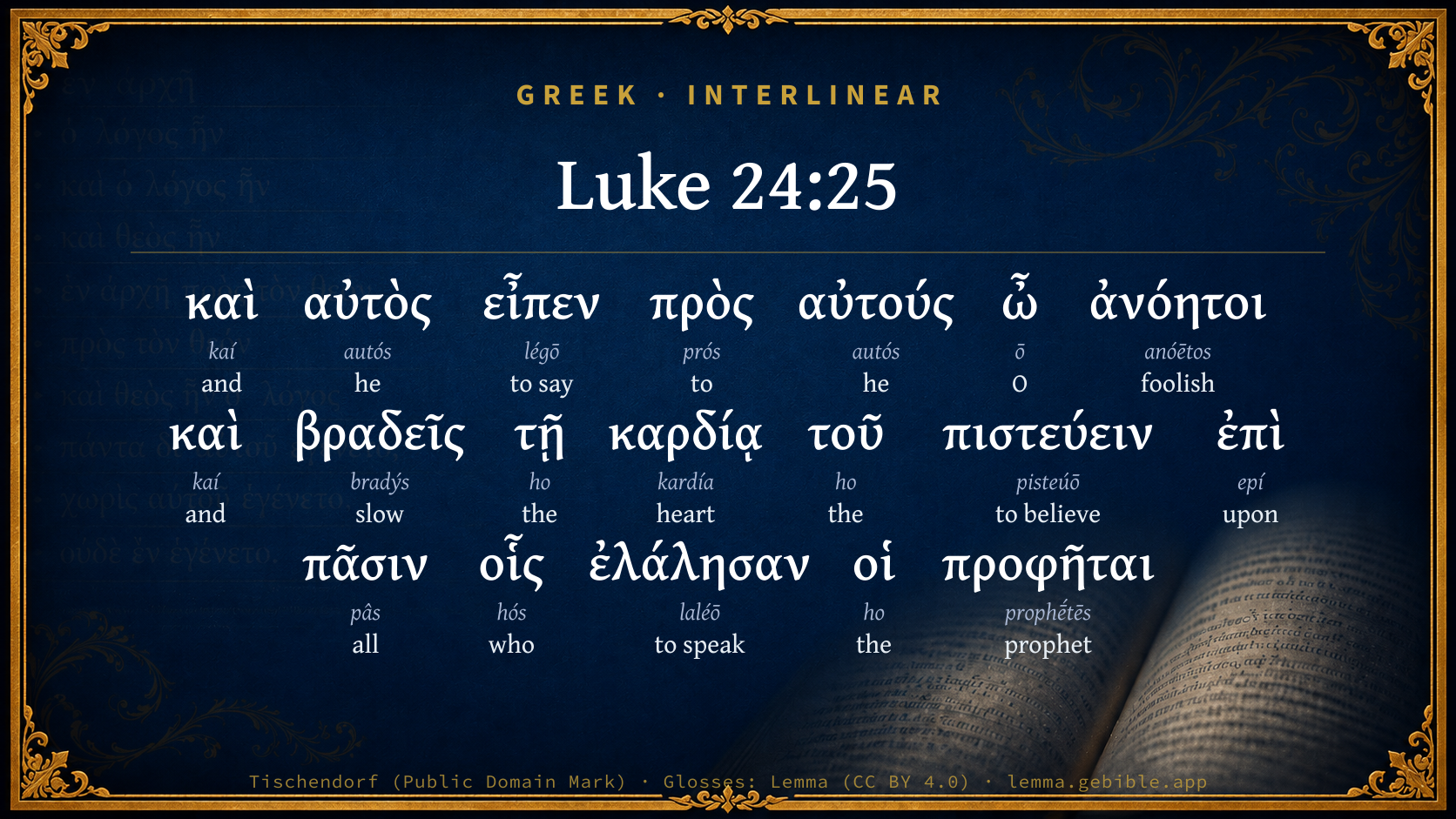
Greek (Tischendorf 8th ed.) Luke 24:25 appears in the Greek New Testament. The text above is from the Tischendorf 8th edition. Each word links to its Strong’s number and a concise gloss. Click any word for its full Thayer’s Greek Lexicon entry.
Download image
Cite this verse

Luke 24:25 (World English Bible). Public Domain. Lemma interlinear Bible study tool, https://lemma.gebible.app/v/luke/24/25.

Show BibTeX & RIS
BibTeX
RIS
English Translation
He said to them, "Foolish men, and slow of heart to believe in all that the prophets have spoken!
World English Bible · Public Domain
Highlights
  • 2 first appearances in the Greek New Testament
Full analysis ↓
Download a study sheet

One document with this verse’s original text, its word-by-word gloss line, the meaning frame, cross-references with their text, attributed commentary, and full source and license credits — printable, and it pastes into notes with its structure intact.

This verse Autodidact and up

Study sheet (.html) Plain text (.txt)

A passage Seminary Student

Up to 50 verses in one chapter. A passage sheet keeps up to 6 commentary sources and 12 cross-references per verse, in the order this page ranks them, and says so on the sheet whenever that leaves anything out. Ask for a single verse and you get the Autodidact verse sheet above.

Everything on this page stays free to read, with no account — the sheet is a download of what is already on screen, not access to it.

Want to remove ads? Support Godless Engineer
Compare translations 3

The same verse in 3 English versions, stacked beneath the original-language interlinear above. Click any original word for its lexicon entry.

Each is an independent rendering of the whole verse — the interlinear is not word-aligned to these translations.

Highlighted words mark where these versions differ — a whole-verse word diff, not a word-by-word alignment.

  • World English Bible Public Domain
    He said to them, "Foolish men, and slow of heart to believe in all that the prophets have spoken!
  • King James Version Public Domain
    Then he said unto them, O fools, and slow of heart to believe all that the prophets have spoken:
  • unfoldingWord Literal Text CC BY-SA 4.0
    And he said to them, “O foolish ones and slow in heart to believe in all that the prophets have spoken!

unfoldingWord Literal Text — © unfoldingWord, licensed CC BY-SA 4.0. Word-aligned USFM3 via Door43 (git.door43.org/unfoldingWord/en_ult).

Versions to compare (up to 4)

3 of 4 selected

Show all 19 translations

Every available English version of this verse, each an independent rendering of the whole verse.

  • World English Bible Public Domain
    He said to them, "Foolish men, and slow of heart to believe in all that the prophets have spoken!
  • Berean Standard Bible Public Domain
    Then Jesus said to them, “O foolish ones, how slow are your hearts to believe all that the prophets have spoken!
  • Majority Standard Bible Public Domain
    Then Jesus said to them, “O foolish ones, and slow of heart to believe all that the prophets have spoken!
  • King James Version Public Domain
    Then he said unto them, O fools, and slow of heart to believe all that the prophets have spoken:
  • American Standard Version (1901) Public Domain
    And he said unto them, O foolish men, and slow of heart to believe in all that the prophets have spoken!
  • Revised Version (1885) Public Domain
    And he said unto them, O foolish men, and slow of heart to believe in all that the prophets have spoken!
  • Geneva Bible (1599) Public Domain
    Then he sayd vnto them, O fooles and slowe of heart to beleeue all that the Prophets haue spoken!
  • Douay-Rheims (1899) Public Domain
    Then he said to them: O foolish, and slow of heart to believe in all things which the prophets have spoken.
  • Young's Literal Translation Public Domain
    And he said unto them, `O inconsiderate and slow in heart, to believe on all that the prophets spake!
  • Literal Standard Version CC BY-SA 4.0
    And He said to them, “O inconsiderate and slow in heart to believe on all that the prophets spoke!
  • Unlocked Literal Bible CC BY-SA 4.0
    Jesus said to them, “O foolish men and slow of heart to believe in all that the prophets have spoken!
  • unfoldingWord Literal Text CC BY-SA 4.0
    And he said to them, “O foolish ones and slow in heart to believe in all that the prophets have spoken!
  • Darby Bible Public Domain
    And *he* said to them, O senseless and slow of heart to believe in all that the prophets have spoken!
  • World Messianic Bible Public Domain
    He said to them, “Foolish people, and slow of heart to believe in all that the prophets have spoken!
  • Webster's Bible Public Domain
    Then he said to them, O fools, and slow of heart to believe all that the prophets have spoken!
  • Free Bible Version CC BY-SA 4.0
    Jesus told them, “You're so dull! How slow you are to trust in all that the prophets said!
  • Bible in Basic English Public Domain
    And he said, O foolish men! how slow you are to give belief to what the prophets have said.
  • Text-Critical English NT CC BY 4.0
    Then Jesus said to them, “O foolish men, how slow of heart you are to believe all that the prophets have spoken!
  • Tyndale New Testament (1534) Public Domain
    And he sayde vnto the: O foles and slowe of herte to beleve all that the prophetes have spoken.

Literal Standard Version (2020), Covenant Press — licensed CC BY-SA 4.0. Text via the HelloAO Bible API (eBible.org). Unlocked Literal Bible (unfoldingWord) — licensed CC BY-SA 4.0. Text via the HelloAO Bible API (eBible.org). unfoldingWord Literal Text — © unfoldingWord, licensed CC BY-SA 4.0. Word-aligned USFM3 via Door43 (git.door43.org/unfoldingWord/en_ult). Free Bible Version, Dr. Jonathan Gallagher — licensed CC BY-SA 4.0. Text via the HelloAO Bible API (eBible.org).

Word by word

More ways to search: Search by grammar → Find every occurrence → Compare this word →

Practice this passage: Drill this verse → Learn its vocabulary →

βραδεῖς
bradýs
G1021
“slow”
Adjective, Nominative, Plural, Masculine
Part of Speech
Adjective
Case
Nominative
Number
Plural
Gender
Masculine
Full Thayer's Definition

Origin: of uncertain affinity

TDNT: None

1. slow 2. metaph. dull, inactive, in mind a. stupid, slow to apprehend or believe
  1. καὶ kaí G2532 “and” Conjunction
  2. αὐτὸς autós G846 “he” Personal pronoun, Nominative, Singular, Masculine
  3. εἶπεν légō G3004 “to say” Verb, Aorist, Active, Indicative, 3rd person, Singular
  4. πρὸς prós G4314 “to” Preposition
  5. αὐτούς autós G846 “he” Personal pronoun, Accusative, Plural, Masculine
  6. ὦ ō G5599 “O” Interjection
  7. ἀνόητοι anóētos G453 “foolish” Adjective, Vocative, Plural, Masculine
  8. καὶ kaí G2532 “and” Conjunction
  9. τῇ ho G3588 “the” Article, Dative, Singular, Feminine
  10. καρδίᾳ kardía G2588 “heart” Noun, Dative, Singular, Feminine
  11. τοῦ ho G3588 “the” Article, Genitive, Singular, Neuter
  12. πιστεύειν pisteúō G4100 “to believe” Verb, Present, Active, Infinitive
  13. ἐπὶ epí G1909 “upon” Preposition
  14. πᾶσιν pâs G3956 “all” Adjective, Dative, Plural, Neuter
  15. οἷς hós G3739 “who” Relative pronoun, Dative, Plural, Neuter
  16. ἐλάλησαν laléō G2980 “to speak” Verb, Aorist, Active, Indicative, 3rd person, Plural
  17. οἱ ho G3588 “the” Article, Nominative, Plural, Masculine
  18. προφῆται prophḗtēs G4396 “prophet” Noun, Nominative, Plural, Masculine

About this verse

These counts appear in no published source. They are computed here, from the morphology-tagged text and Lemma’s own curated glosses. What Lemma adds →

19
words
15
distinct lemmas
Gospels
section

Notable vocabulary

The rarest word here is βραδεῖς slow G1021 — appearing just 3 times in the whole Greek New Testament.

First appearance in Scripture

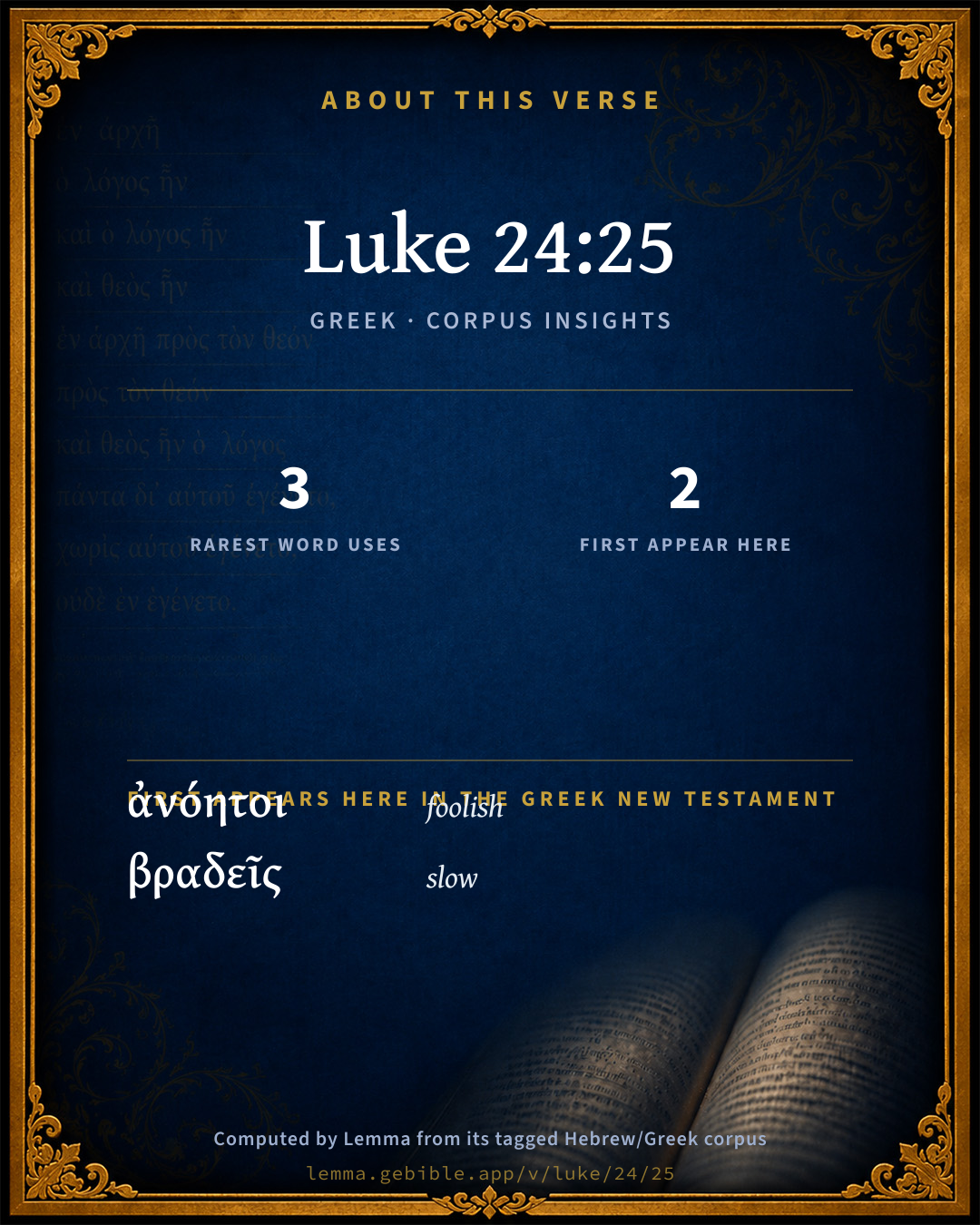
These words make their first canonical appearance in the Greek New Testament here:

  • ἀνόητοι foolish G453
  • βραδεῖς slow G1021

Shared distinctive vocabulary

βραδεῖς slow G1021 occurs in 2 verses of the Greek New Testament. Also found in:
Repetition

Words recur within this verse:

Cross-references

5

Topical passages linked to Luke 24:25 in the Treasury of Scripture Knowledge — connected by theme and wording, ordered by reader-vote popularity; previews shown in the World English Bible.

  • Mark 7:18 He said to them, "Are you thus without understanding also? Don't you perceive that whatever goes into the man from outside can't defile him,
  • Mark 9:19 He answered him, "Unbelieving generation, how long shall I be with you? How long shall I bear with you? Bring him to me."
  • Mark 16:14 Afterward he was revealed to the eleven themselves as they sat at the table, and he rebuked them for their unbelief and hardness of heart, because they didn't believe those who had seen him after he had risen.
  • Hebrews 5:11–12 About him we have many words to say, and hard to interpret, seeing you have become dull of hearing.
  • Mark 8:17–18 Jesus, perceiving it, said to them, "Why do you reason that it's because you have no bread? Don't you perceive yet, neither understand? Is your heart still hardened?

Cross-references courtesy of OpenBible.info (CC BY 4.0).

Commentary

Notes on Luke 24:25 from classic Christian and Jewish commentators (each source and its license shown beneath its notes). The classic Christian expositions comment on the surrounding passage and are grouped to its opening verse, so a note may address several verses; the Jewish commentaries on the Tanakh (Rashi and others) are per-verse, so they appear only where the commentator wrote on this verse.

Lemma curates 59 commentaries, every one of them public domain or Creative Commons licensed, each selected and text-cleaned for this edition rather than reprinted as found. About our sources →

Joseph Benson's Commentary

Luk 24:25-27. Then he said, O fools — Ω ανοητοι, O foolish, or thoughtless persons. The word is not Ω μωροι, properly rendered, O fools, and is a term of great indignation, and sometimes of contempt; but that employed here is only a term of expostulation and reproof; and slow of heart to believe, &c. — From this reproof it would appear, that Cleopas and his companion were of the number of those who gave little credit to the tidings which the women had brought of their Master’s resurrection; his crucifixion and death, as they themselves acknowledge, having almost convinced them that he was not the Messiah. What he reproved them for was their not understanding and believing the prophets, which, he said, declared that, before the Messiah should enter into his glory, he must suffer such things as they said their Master had suffered. And beginning at Moses, &c. — And in order that his reproof might appear to be well founded, that their drooping spirits might be supported, and that they might be prepared for the discovery he was about to make of himself, he explained the whole types and prophecies of the Old Testament, which relate to the Messiah’s sufferings, such as the Mosaical sacrifices, the lifting up of the brazen serpent, the twenty-second Psalm, the fifty-third of Isaiah, &c. Thus did Jesus demonstrate to these desponding disciples, from the Scriptures, that their despair was without cause, and the suspicion without foundation, which they had taken up, of their being deceived in thinking him to be the Messiah, because the priests had put him to death.

Joseph Benson's Commentary on the Old and New Testaments (1811–1818) — public domain. Text from a community e-Sword module.

Tyndale Open Study Notes

Tyndale Open Resources

24:25-26 the prophets wrote . . . that the Messiah would have to suffer: The crucifixion did not negate Jesus’ identity as the Messiah but confirmed it, because the death of the Messiah was predicted in Scripture. Jesus rebuked the two for not recognizing from Scripture that the Messiah had to suffer (see Isa 50:4-9; 52:13–53:12; Pss 2, 16, 22, 118; cp. Luke 18:32; 20:17; 23:37; Acts 2:25-28; 4:25-26).

Tyndale Open Study Notes — © Tyndale Open Resources, licensed CC BY-SA 4.0. Text via the HelloAO Bible API.

Bengel's Gnomon

Johann Albrecht Bengel

Luk 24:25. Ἀνόητοι, fools) [void of mind]. In proportion as faith is the slower or the speedier in being entertained, the worse or the better is the νοῦς (from which comes ἀνόητοι) or mind, Gal 3:1 [O foolish Galatians]; Joh 1:49 [Nathanael’s quick confession, “Thou art the Son of God, Thou art the King of Israel”]. [A salutary reproof.—V. g.]—[βραδεῖς, slow) We ought to be quick in believing, where we have sufficient warrant of any word of GOD.—V. g.]—ἐπὶ, on the authority of [respecting]) The words of the prophets are open to you, and yet ye do not believe. Almost in the same way διὰ is used in Joh 4:41-42 [“Many more believed because of His own word (διὰ τὸν λόγον αὐτοῦ);—not because of (διὰ) thy saving”].

Bengel's Gnomon of the New Testament — English translation (T&T Clark, Edinburgh, 1860) — public domain. Text from a community e-Sword module.

Meyer's Critical & Exegetical Commentary

Heinrich August Wilhelm Meyer

Luk_24:25-26. Αὐτός] He on His part, after the disciples had thus helplessly expressed themselves.

ἀνόητοι (Rom_1:14; Gal_3:2 f.), without intelligence, refers to the understanding, and βραδεῖς τῇ καρδίᾳ to the whole internal living activity, in respect of which (dative) its dulness, i.e. its deficiency in the proper susceptibility and fixedness of purpose, is reproved. σκληροκαρδία, Mar_16:14, is stronger. On βραδύς as tardus in the spiritual sense, comp. Il. x. 226; Plat. Defin. p. 415 E: δυσμαθία βραδυτὴς ἐν μαθήσει. Theophr. Mor. not. 14 ἡ βραδύτης τῆς ψυχῆς. The opposite: ἀγχίνους, Plat. Phaedr. p. 239 A; Diog. Laert. vii. 93; also ὀξύς, Plat. Rep. vii. p. 526 B.

τοῦ πιστεύειν] a genitive of nearer definition dependent on βραδεῖς (see Winer, p. 290 [E. T. 407]); slow to believing confidence in.

On πιστεύειν ἐπί with a dative, comp. Mat_27:42; Rom_9:33; Rom_10:11; 1Ti_1:16; 1Pe_2:6

πᾶσιν] not merely referring to a single thing. There was wanting to them the faith without exception, otherwise they would have recognised even the suffering and death of the Messiah as prophesied, and have rightly discerned them; ἔστι γὰρ πιστεύειν καὶ μερικῶς καὶ καθόλου, Theophylact.

Luk_24:26. Must not the Messiah, etc., namely, according to the prophetically announced divine decree. Comp. Luk_24:44 ff.

ταῦτα] with emphasis: this, which He, to wit, had in fact suffered, and which causes you to be so cast down.

καὶ εἰσελθ. εἰς τ. δόξαν αὐτοῦ] not as though He had already by the resurrection in itself, and before the ascension, attained to His δόξα (for His heavenly condition is not until His glory after death, see Luk_9:26, Luk_21:27; Php_2:9 f.; 1Pe_1:21; 1Ti_3:16; Joh_20:17; Joh_17:5, and elsewhere), but out of the foregoing ἔδει, δεῖ is here to be supplied: and must He not attain unto His glory? Wherefore, on the one hand, those sufferings needed first to precede; and, on the other, He must be again alive. The definite εἰσελθ. εἰς τ. δόξ. is not to be evaporated into the general attain His destination (Schleiermacher). As to supplying the verb in another tense, see Bornemann on Luk_24:27, ad Xen. Apol. § 26; and, generally, Krüger, § 62. 4. 1; also Nagelsbach, Anm. z. Ilias, ed. 3, p. 76.

Meyer — Critical and Exegetical Commentary on the New Testament — English translation by Peter Christie, edited by Frederick Crombie (T&T Clark, 1880) — public domain. Text from a community e-Sword module.

Expositor's Greek Testament

ed. W. Robertson Nicoll

Luk 24:25 f. Jesus speaks . ἀνόητοι , “fools” (A.V [205] ) is too strong, “foolish men” (R.V [206] ) is better. Jesus speaks not so much to reproach as by way of encouragement. As used by Paul in Gal 3:1 the word is harder. “Stupid” might be a good colloquial equivalent for it here. πιστεύειν ἐπὶ π .: ἐπὶ with dative of person after πιστεύειν is common, with dative of the thing only here.

[205] Authorised Version.

[206] Revised Version.

The Expositor's Greek Testament, edited by W. Robertson Nicoll (1897–1910) — public domain. Text from a community e-Sword module.

Jamieson, Fausset & Brown

Robert Jamieson, A. R. Fausset & David Brown

fools--senseless, without understanding.

Jamieson, Fausset & Brown — Commentary Critical and Explanatory on the Whole Bible (1871) — public domain (CC PDM 1.0). Text via the HelloAO Bible API.

Adam Clarke's Commentary

Verse 25. O fools and slow of heart to believe] Inconsiderate men, justly termed such, because they had not properly attended to the description given of the Messiah by the prophets, nor to his teaching and miracles, as proofs that HE alone was the person they described.

Slow of heart - Backward, not easy to be persuaded of the truth, always giving way to doubtfulness and distrust. This very imperfection in them is a strong evidence of the truth of the doctrine which they afterwards believed, and proclaimed to the world. Had they not had the fullest assurance of these things, they never would have credited them; and it is no small honour to the new-covenant Scriptures that such persons were chosen, first, to believe them; secondly, to proclaim them in the world; and, thirdly, to die on the evidence of those truths, the blessed influence of which they felt in their own hearts, and fully exemplified in their lives.

Adam Clarke's Commentary on the Bible (1810–1826) — public domain. Text from a community e-Sword/MySword module.

Ellicott's Commentary for English Readers

(25) O fools, and slow of heart to believe.—The word for “fools” (more literally, silly, senseless) is not that which is used in Mat_5:22; Mat_23:17, but one belonging to a somewhat higher style of language. It is used by St. Paul of the “foolish Galatians” (Gal_3:1), and elsewhere, and by no other New Testament writer. The word of reproof sounds strong, but we must remember that our Lord had already given hints as to the true interpretation of Messianic prophecies (Luk_9:22; Luk_9:44; Mar_14:21), which might have led thoughtful men to see that they pointed to suffering and death, as well as to sovereignty and triumph.

A Bible Commentary for English Readers, edited by Charles John Ellicott (1878–1897) — public domain. Text from a community e-Sword module.

The Cambridge Bible for Schools and Colleges

gen. ed. J. J. S. Perowne

25. O fools] The expression is much too strong. It is not the word aphrones (see Luk_11:40), but anoetoi, ‘foolish,’ ‘unintelligent.’ (Gal_3:1.)

The Cambridge Bible for Schools and Colleges (gen. ed. J. J. S. Perowne; Cambridge University Press, 1878–1918) — public domain. Text from a community e-Sword module.

John Gill's Exposition

And beginning at Moses,.... The writings of Moses, the book of Genesis particularly, Gen 3:15 which is the first prophecy of him, and speaks of the bruising of his heel, or of the sufferings of death by him; and proceeding to open and explain the types concerning his bearing the cross, and the lifting him upon it, in the business of Isaac, and of the brazen serpent; and concerning the shedding of his blood, and the oblation of himself in the sacrifices of the law of Moses:

and all the prophets; as David, Isaiah, Daniel, and others, very likely the passages in Psa 22:1.

he expounded unto them in all the Scriptures in Moses, and the Prophets,

concerning himself; especially concerning these two points, his sufferings, and his glory, which the Spirit of Christ, in the Prophets, testified before hand: besides the above places referred to, concerning the sufferings of Christ, see the following, in reference to his resurrection and glory, Psa 16:10.

John Gill's Exposition of the Whole Bible (1746–1763) — public domain (CC PDM 1.0). Text via the HelloAO Bible API.

Trapp's Complete Commentary

John Trapp

25 Then he said unto them, O fools, and slow of heart to believe all that the prophets have spoken:

Ver. 25. O fools, .& c.] Those in a lethargy must have double the quantity of medicine that others have. Some slow bellies must be sharply rebuked, that they may be sound in the faith Tit 1:12-13.

John Trapp, A Commentary or Exposition upon All the Books of the Old and New Testament (1647–1656) — public domain. Text from a community e-Sword module.

Albert Barnes' Notes on the Bible

O fools - The word “fool” sometimes is a term of reproach denoting “wickedness.” In this sense we are forbidden to employ it in addressing another, Mat 5:22. That, however, is a different word in the Greek from the one which occurs here. The one there used implies contempt, but the one employed in this place denotes “weakness or dulness.” He reproached them for not seeing what he had himself so clearly predicted, and what had been foretold by the prophets. The word used in the original does not imply as much “reproach” as the word “fool” does among us. It was not an expression of “contempt;” it was an expression denoting merely that they were “thoughtless,” and that they did not properly “attend to” the evidence that he must die and rise again.

Slow of heart to believe - Not quick to perceive. Dull of learning. They had suffered their previous opinions and prejudices to prevent their seeing the evidence that he must die and rise from the dead.

All that the prophets have spoken - Respecting the character and sufferings of the Messiah. See the notes at Luk 24:27.

Albert Barnes' Notes on the Bible (1834–1885) — public domain. Text from a community e-Sword/MySword module.

Matthew Poole's English Annotations

By our Saviour’s form of reprehending his disciples, we may both learn:

1. That it is not every saying, Thou fool, but a saying of it from a root of hatred, malice, and anger, which our Saviour makes to be a breach of the sixth commandment, Mat 5:21,22. Our Saviour’s reprehension of them was out of a principle of love, and a root of good will to them.

2. That the best of us are very slow of heart to believe what cometh to us upon the mere credit of a Divine revelation. It is also observable from what we have, Luk 24:27, that Moses and the prophets are not to be rejected by Christians; they also have much concerning Christ; out of them Christ instructs these two disciples in the things concerning himself.

Matthew Poole's English Annotations on the Holy Bible (1683–1685) — public domain. Text from a community e-Sword/MySword module.

Whedon's Commentary on the Bible

Daniel D. Whedon

25. O fools—The Greek word means destitute of discernment in the higher or spiritual faculty; unwise, unintuitive.

Slow of heart—Not hard of heart but slow. Not springing and grasping divine truth. The head is confused because the heart is sluggish.

Daniel D. Whedon (gen. ed.), Commentary on the Old and New Testaments (1874–1909) — public domain. Text from a community e-Sword module.

The Pulpit Commentary

Then he said unto them, O fools, and slow of heart to believe all that the prophets have spoken! better translated, O foolish men, and slow of heart to believe in all that the prophets have spoken! The Stranger now replies to the confused story of sorrow and baffled hopes just lit up with one faint ray of hope, with a calm reference to that holy book so well known to, so deeply treasured by every Jew. "See," he seems to say, "in the pages of our prophets all this, over which you now so bitterly mourn, is plainly predicted: you must be blind and deaf not to have seen and heard this story of agony and patient suffering in those well-known, well-loved pages! When,those great prophets spoke of the coming of Messiah, how came it about that you missed seeing that they pointed to days of suffering and death to be endured by him before his time of sovereignty and triumph could be entered on?"

The Pulpit Commentary (1880–1919), ed. H.D.M. Spence-Jones & Joseph S. Exell — public domain. Text from a community e-Sword module.

John Wesley's Explanatory Notes

O foolish - Not understanding the designs and works of God: And slow of heart - Unready to believe what the prophets have so largely spoken.

John Wesley, Explanatory Notes Upon the Whole Bible (1754–1765) — public domain. Text via the GEBible commentary corpus.

Kretzmann's Popular Commentary

Paul E. Kretzmann

Jesus, the kind Instructor:

v. 25. Then He said unto them, O fools, and slow of heart to believe all that the prophets have spoken!

v. 26. Ought not Christ to have suffered these things, and to enter into His glory?

v. 27. And beginning at Moses and all the prophets, He expounded unto them in all the Scriptures the things concerning Himself.

v. 28. And they drew nigh unto the village whither they went; and He made as though He would have gone further.

v. 29. But they constrained Him, saying, Abide with us; for it is toward evening, and the day is far spent. And He went in to tarry with them.

v. 30. And it came to pass, as He sat at meat with them, He took bread, and blessed it, and brake, and gave to them.

v. 31. And their eyes were opened, and they knew Him; and He vanished out of their sight.

The two, Emmaus pilgrims had opened their hearts to the Lord, for out of the fullness of the heart the mouth speaketh. It was such a full and free confession as they would not have thought of making in ninety-nine cases out of a hundred. But the kind sympathy of this stranger invited, almost compelled, confidences, and so they had opened to Him their whole heart. The first words of the Lord in commenting upon the information He had received were a firm reproof, not unmixed with gentleness. Foolish men He calls them and slow of heart to trust and believe in all things that the prophets had spoken. They had not properly attended to the description of the Messiah as given by the prophets, and they had not looked upon His own teaching and miracles with enlightened eyes. It was a necessity for Christ, for the Master in whose company they had been all these long months; it was an obligation resting upon Him which He could not evade. First the Passion, then the glory; through cross to crown. At all times there is much sin, foolishness, lack of faith mixed with the weakness and grief of the believers. And this must be pointed out without hesitation. For that will open the way to a better understanding, in this case. The Lord deliberately began with the books of Moses and then continued through the books of the prophets; He interpreted to these two disciples the passages concerning His person and work, He compared prophecy and fulfillment; He pointed out the meaning of passages which to them had been hidden treasure-chests; He took His time to explain every word thoroughly, in order that their eyes might finally be opened. It was a long discourse, and from the mouth of the greatest Teacher of all times. Would that we had its exact contents today! But probably it has purposely not been preserved, in order that we may search the Scriptures of the Old Testament all the more diligently. Meanwhile, the two or two and one-half hours needed for a slow journey to Emmaus had brought them to the village, and Jesus purposely assumed the air of one that intended to go farther. He wanted to see whether His explanation of the Scripture and its application had made such an impression upon them that they would want to remain in His company. Happy they that have Christ with them thus! His plan succeeded beautifully, for both of the disciples urged Him with earnest pleading: Abide, remain with us, for it is toward evening, and the day is drawing to a close. Their real reason was, of course, that their hearts had been so touched and overwhelmed with the beauty and power of His explanation that they wanted to hear more of this charming and edifying conversation. Note: This is ever the effect of the doctrine of the Gospel: wherever it is felt, its Author, the ever-blessed Jesus, is earnestly entreated to dwell in the heart. And so Jesus went in to tarry, to remain, with them for the evening meal, at least. But when He reclined at the table with them, He thought the time fitting to reveal Himself to them. Accordingly, He took the bread, gave thanks over it, broke it, and gave it to them. At this act their eyes were opened, and they recognized Him. This stranger was no one else than their Friend and Master, the same who had so often, in His capacity as the Head of the little band, performed this customary work. But in the same moment when their faces lighted up in joyful recognition, Jesus became invisible before them, He vanished out of their sight; He departed from them in that invisible manner. Though He was still their Master and Friend, they could no longer enjoy His intimate company as in the days before His suffering. They should no longer be bound by His visible presence, but learn to place their trust in the word of His Gospel which He has left for all men.

The Obligation Of The Work Of Atonement

There is no fact in Gospel history more consoling or more conducive to the strengthening of the Christian’s faith than that of the readiness and willingness of Jesus in carrying out God’s plan of salvation. If the Redeemer had faltered at any time, if the weakness of His human nature had at any time caused an unwillingness to carry out the work of atonement, the Gospel history would be worthless, and the comfort of a Christian in relying upon the satisfaction of Christ’s vicarious suffering would be vain.

It had been prophesied concerning the Messiah: "Then said I, Lo, I come: in the volume of the Book it is written of Me, I delight to do Thy will, O My God," Psa 40:7-8. This delight in doing the will of God, in carrying out the plan and counsel of God for the salvation of man, is a prominent and necessary feature of Christ’s Ministry. He had a clear and full conception of the extent and of the obligation of the work which He had come to perform, Heb 10:5-10. He knew exactly wherein the will of His heavenly Father consisted. "This is the Father’s will which hath sent Me, that of all which He hath given Me I should lose nothing. And this is the will of Him that sent Me, that everyone which seeth the Son and believeth on Him may have everlasting life. " Joh 6:39-40.

In accordance with this situation and the full understanding of its nature and scope, Jesus at all times kept the work of redemption foremost in His mind, to seek and save that which was lost, Luk 19:10. Even at the age of twelve years He was fully conscious of the obligation resting upon Him, when He told His mother: "Wist ye not that I must be about My Father’s business?" Luk 2:49. To His disciples, who asked about the man that had been born blind, He briefly and succinctly stated His conception of His ministry: "I must work the works of Him that sent Me while it is day; the night cometh when no man can work," Joh 9:4. To the eager Zacchaeus He calls out: "Today I must abide at thy house," Luk 19:5. That was a part of His work, of the ministry of saving souls, which He therefore could not neglect.

When the time came that He should enter into the glory of His Father through the way of suffering and death, He did not falter or waver, but set His face steadfastly to go to Jerusalem, Luk 9:51; Mar 10:32-33. He told His disciples: "The Son of Man must suffer many things," Luk 9:22; Mat 16:22. He was perfectly aware of the fate that was awaiting Him at Jerusalem, and yet He announces: "I must walk today and tomorrow and the day following; for it cannot be that a prophet perish out of Jerusalem. " Luk 13:33.

This being the case, namely, that the chief aim and purpose of Jesus in coming into the world was to work the redemption of mankind by the shedding of His blood as an atonement for the guilt of all, He emphasized this one point to the exclusion of everything else. He tells His disciples on the evening before His death: "This that is written must yet be accomplished in Me, And he was reckoned among the transgressors; for the things concerning Me have an end," Luk 22:37. And in the garden He rebukes the impulsive Peter: "How, then, shall the Scriptures be fulfilled that thus it must be?" Mat 26:54. The same truth is emphasized so strongly in His discourses on the afternoon and evening of the resurrection day, as well as by the angels in their first announcement of the Easter miracle. "Ought not Christ to have suffered these things, and to enter into His glory? All things must be fulfilled which were written in the law of Moses and in the Prophets and in the Psalms concerning Me. Thus it is written, and thus it behooved Christ to suffer," Luk 24:7. and these words were echoed by peter in the interval between Christ’s ascension and the Day of Pentecost: "Men and brethren, this scripture must needs have been fulfilled," Act 1:16.

Upon the basis of these authoritative utterances we condemn all attempts to make the work of Christ seem of a nature concerning this world only. In the face of the blasphemous efforts of the millennial dreamers we hold firmly to the teaching, preaching, and confessing of Christ’s work: "Who has redeemed me, a lost and condemned sinner, purchased and won me from all sins, from death, and from the power of the devil... with His holy, precious blood and with His innocent suffering and death."

Paul E. Kretzmann, Popular Commentary of the Bible (1921–1924) — public domain. Text from a community e-Sword module.

Burkitt's Expository Notes on the New Testament

William Burkitt

Observe, 1. Our Saviour reproves, and then instructs them. He reproves them for being ignorant of the sense of scripture. They thought the death of the Messiah a sufficient ground to question the truth of his office, when it was an argument to confirm and establish it: O fools, ought not Christ to suffer? As if he had said, "Do you not find that the person described by the prophets in the Old Testament to be the Messiah, was to wade to his glory through a sea of blood? Why then do you think yourselves deceived in the person who suffered three days ago, when his death does agree so well with the predictions of the prophets, who foretold, that the Messiah should be cut off, but not for himself, and be smitten for the iniquities of his people?

Here we may observe, the great wisdom and grace of God, who makes sometimes the diffidence of his people an occasion of farther clearing up the choicest truths unto them: never did these disciples hear so excellent an exposition of Moses and the Prophets concerning the Messiah as now, when their sinful distrust had so far prevailed over them.

Observe, 2. The doctrines which Christ instructs his disciples in, namely, in the necessity of his death and passion, and of his glory and exaltation; Ought not Christ to suffer, and to enter into his glory?

Learn,

1. That with respect to God’s decree, and with relation to man’s guilt, the death of Christ was necessary and indispensable.

2. That his resurrection and exaltation was an necessary as his passion.

3. That there was a meritorious connexion between Christ’s sufferings and his glory; his exaltation was merited by his passion; He was to drink of the brook in the way, and then he was to lift up his head.

4. Christ did not only put light into these his apostles’ heads, but heat also into their hearts, which burned all the while he communed with them; Did not our hearts burn within us, while he opened to us the scriptures? Oh what an efficacious power is there in the word of Christ, when set home upon the hearts of men by the Spirit of Christ!

William Burkitt's Expository Notes on the New Testament (1700–1703) — public domain. Text from a community e-Sword module.

The People's New Testament

B. W. Johnson

25. O foolish men. Because “slow of heart to believe all that the prophets have spoken.”

B. W. Johnson's The People's New Testament with Notes (1889–1891) — public domain. Electronic text from the Christian Classics Ethereal Library (CCEL) ThML edition.

unfoldingWord translationNotes

Door43 World Missions Community

Jesus said to them

Jesus is speaking to the two disciples.

slow of heart to believe

Here "heart" is a metonym for a person's mind. AT: "your minds are slow to believe" or "you are slow to believe" (See: Metonymy)

Was it not necessary ... glory?

Jesus uses a question to remind the disciples about what the prophets said. AT: "It was necessary ... glory." (See: Rhetorical Question)

to enter into his glory

This refers to Jesus beginning to rule and to receive honor and glory.

beginning from Moses

Moses wrote the first books of the Bible. AT: "beginning with the writings of Moses" (See: Metonymy)

Jesus interpreted to them

"Jesus explained to them"

translationWords

fool

heart

believe

prophet

Christ

suffer

glory

Moses

word of God

unfoldingWord translationNotes — © Distant Shores Media and the Door43 World Missions Community, licensed CC BY-SA 4.0. Source: git.door43.org/Door43/en_tn.

Cambridge Greek Testament for Schools and Colleges

25. ὦ ἀνόητοι. The expression “fools” in the A. V[419] is much too strong. It is not ἄφρονες (see Luk 11:40), but ἀνόητοι, ‘foolish,’ ‘unintelligent.’ (Gal 3:1)

[419] A. V. Authorised Version.

Cambridge Greek Testament for Schools and Colleges (Cambridge University Press, 1896; 21 vols, various authors incl. Carr, Maclear, Plummer, Farrar, Lumby, Moule, M. R. James, Simcox) — public domain. Text from a community e-Sword module.

Alford’s Greek Testament

Henry Alford

25.] ἀνόητοι, without understanding;—βρ. τ. κ. sluggish—in disposition—to believe: these were both shewn in their not having apprehended, from the fulfilment of the sufferings and death of Christ, the sequel of that death, the resurrection.

Henry Alford, The Greek Testament (1849–1861) — public domain. Text from a community e-Sword module.

International Critical Commentary

25. ἀνόητοι. Four quite different Greek words are translated “fool” in AV.; ἀνόητος (elsewhere “foolish,” Gal 3:1, Gal 3:3; 1Ti 6:9; Tit 3:3), ἄσοφος (Eph 5:15), ἄφρων (11:40, 12:20; 1Co 15:36, etc.), μωρός Mat 5:22, Mat 5:23:17, (19); 1Co 3:18, 1Co 4:10). The latter two are much stronger in meaning than the former two. Here the Latin translations vary between insensati (a c d e) and stulti (f Vulg.), as in 11:40 between insipientes (c) and stulti (f Vulg.): 12:20 and Mat 23:17 all have stultus, ML v. 22 all fatuus.

βραδεῖς…τοῦ πιστεύειν ἐπὶ πᾶσιν οἵς. The gen. is one of limitation depending upon βραδεῖς which occurs here and Jas 1:19 only. Comp. ἐτοιμοι τοῦ ἀνελεῖν (Act 23:15): ἐτοιμοι τοῦ ἐλθεῖν (1 Mac. 5:39). Elsewhere Lk. has the acc. after πιστεύειν ἐπί (Act 9:42, Act 11:17, Act 16:31, Act 22:19), in all which cases the object of the belief is a person. The difference is between faith resting upon, and faith directed towards, an object. Note the characteristic attraction: see small print on 3:19.

ἐπὶ πᾶσιν οἶς ἐλάλησαν οἱ προφῆται. There is special point in the πᾶσιν. Like most Jews. they remembered only the promises of the glories of the Messiah. and ignored the predictions of His sufferings. We cannot well separate ἐπὶ πᾶσιν from πιστεύειν and take ἐπί= “on the top of, after, in spite of”: “slow of heart to believe. in spite of all that the Prophets have spoken” (Hahn). Still more unnatural is Hofmann’s proposal to transfer these words to the next verse: “On the basis of all that the Prophets have spoken ought not Christ,” etc.

International Critical Commentary — older volumes (1896–1929), various authors — public domain. Text from a community e-Sword module.

Vincent's Word Studies in the New Testament

Marvin R. Vincent

Fools and slow of heart [ανοητοι και βραδεις τη καρδια] . This is an unfortunate translation, in the light of the ordinary, popular use of the word fool. Jesus would never have called those sorrowful disciples fools in that sense. The word is compounded of aj, not, and noew, which implies, besides seeing, perception of the mind as consequent upon sight. It is therefore equivalent to dull of perception. They had read what the prophets had spoken, but had failed to perceive its application to Christ. While this rebuke relates to the understanding, the following one, slow of heart, goes deeper, and contemplates the region of feeling and moral susceptibility. Your heart is dull and slow to respond to these testimonies of your own prophets. Compare hardness of heart, Mr 16:14.

All (ejpi pasin). Rev., rightly, in all; relying upon [επι] all the utterances of the prophets.

Marvin R. Vincent, Word Studies in the New Testament (1887–1900) — public domain. Text from a community e-Sword/MySword module.

Lesson kit

Teaching starters — assembled from the data on this page, not authored interpretation. Every prompt links to the verse data it draws on. Edit before teaching.

Luke, in the Gospels, opens this verse with 19 words (15 distinct Greek lemmas). Its most distinctive word is bradýs (“slow”). A historical commentator’s framing appears above. Read the whole chapter for the surrounding context.

Discussion questions

  1. What does “slow” (bradýs) contribute to the verse as a whole?
  2. 2 words here appear for the first time in Scripture. What is being introduced at this debut?
  3. James 1:19 shares the word «slow» with this verse. How do the two illuminate each other?
  4. “the” occurs 3× in this one verse. What is the effect of the repetition?
  5. These translations render this verse differently; the difference is in the English rendering, not the original. What questions does that raise?
  6. Reading how Joseph Benson's Commentary and Tyndale Open Study Notes read this verse, where do the two commentators agree and where do they part?

Things to notice

  • 2 words make their first canonical appearance in Scripture here.
  • These translations choose different wording for 5 words in this verse.
  • “the” occurs 3× in this single verse.
  • 15 distinct Greek lemmas span 19 words in this verse.

Reading settings

Reading text

Shown beneath each verse's original-language words.

Old Testament
Old Testament edition

Read the OT as the Masoretic Hebrew (MT) or the Greek Septuagint (LXX).

English shown for the Greek Septuagint (in the Hebrew ↔ Greek comparison).

Comparing translations? Open the Compare panel on any verse page to stack up to four side by side.