Matthew 2:17

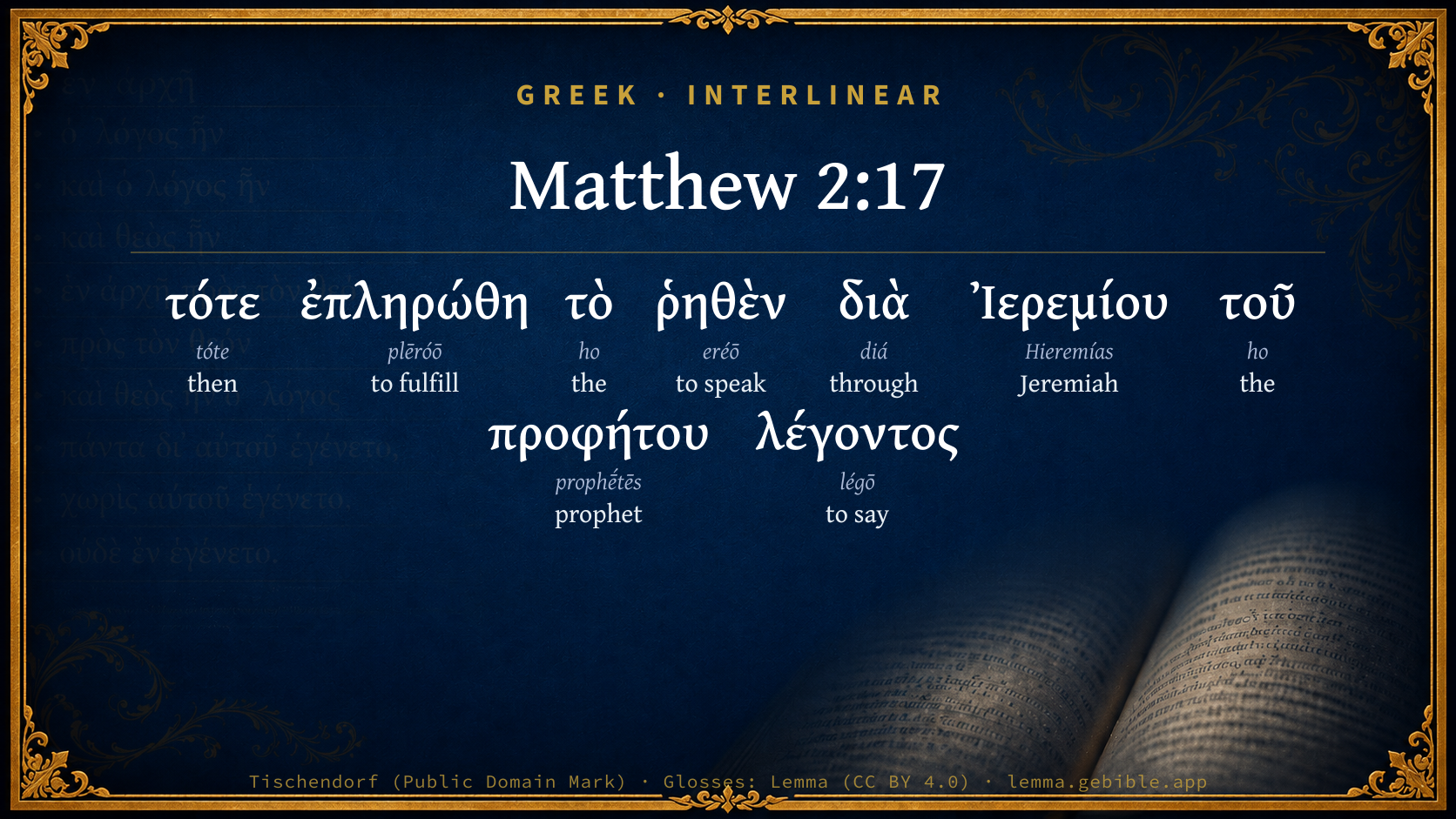
Greek (Tischendorf 8th ed.) Matthew 2:17 appears in the Greek New Testament. The text above is from the Tischendorf 8th edition. Each word links to its Strong’s number and a concise gloss. Click any word for its full Thayer’s Greek Lexicon entry.
Download image
Cite this verse

Matthew 2:17 (World English Bible). Public Domain. Lemma interlinear Bible study tool, https://lemma.gebible.app/v/matthew/2/17.

Show BibTeX & RIS
BibTeX
RIS
English Translation
Then that which was spoken by Jeremiah the prophet was fulfilled, saying,
World English Bible · Public Domain
Highlights
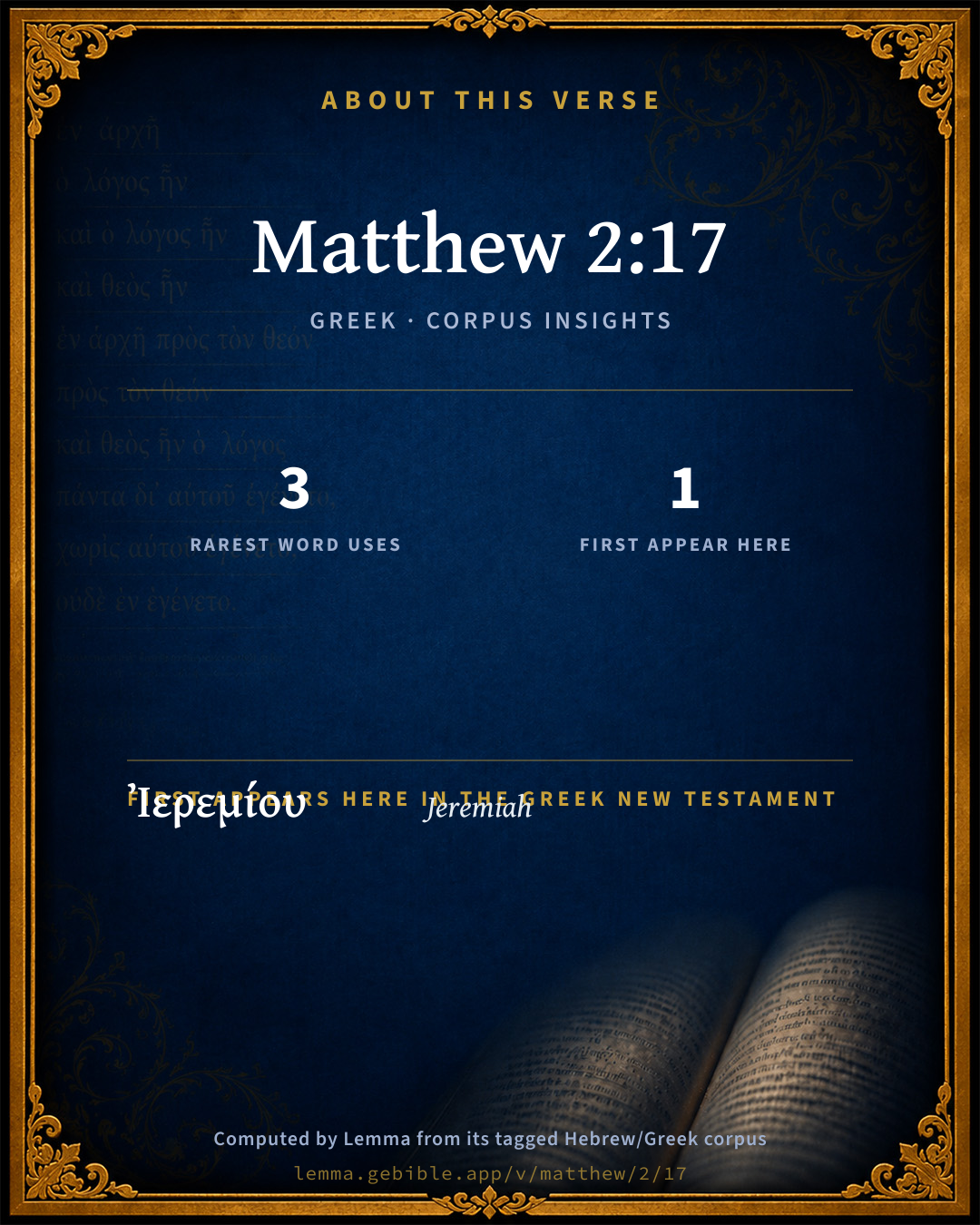
  • 1 first appearance in the Greek New Testament
Full analysis ↓
Download a study sheet

One document with this verse’s original text, its word-by-word gloss line, the meaning frame, cross-references with their text, attributed commentary, and full source and license credits — printable, and it pastes into notes with its structure intact.

This verse Autodidact and up

Study sheet (.html) Plain text (.txt)

A passage Seminary Student

Up to 50 verses in one chapter. A passage sheet keeps up to 6 commentary sources and 12 cross-references per verse, in the order this page ranks them, and says so on the sheet whenever that leaves anything out. Ask for a single verse and you get the Autodidact verse sheet above.

Everything on this page stays free to read, with no account — the sheet is a download of what is already on screen, not access to it.

Want to remove ads? Support Godless Engineer
Compare translations 3

The same verse in 3 English versions, stacked beneath the original-language interlinear above. Click any original word for its lexicon entry.

Each is an independent rendering of the whole verse — the interlinear is not word-aligned to these translations.

Highlighted words mark where these versions differ — a whole-verse word diff, not a word-by-word alignment.

  • World English Bible Public Domain
    Then that which was spoken by Jeremiah the prophet was fulfilled, saying,
  • King James Version Public Domain
    Then was fulfilled that which was spoken by Jeremy the prophet, saying,
  • unfoldingWord Literal Text CC BY-SA 4.0
    Then it was fulfilled was spoken through Jeremiah the prophet, saying,

unfoldingWord Literal Text — © unfoldingWord, licensed CC BY-SA 4.0. Word-aligned USFM3 via Door43 (git.door43.org/unfoldingWord/en_ult).

Versions to compare (up to 4)

3 of 4 selected

Show all 19 translations

Every available English version of this verse, each an independent rendering of the whole verse.

  • World English Bible Public Domain
    Then that which was spoken by Jeremiah the prophet was fulfilled, saying,
  • Berean Standard Bible Public Domain
    Then what was spoken through the prophet Jeremiah was fulfilled:
  • Majority Standard Bible Public Domain
    Then what was spoken through the prophet Jeremiah was fulfilled:
  • King James Version Public Domain
    Then was fulfilled that which was spoken by Jeremy the prophet, saying,
  • American Standard Version (1901) Public Domain
    Then was fulfilled that which was spoken through Jeremiah the prophet, saying,
  • Revised Version (1885) Public Domain
    Then was fulfilled that which was spoken by Jeremiah the prophet, saying,
  • Geneva Bible (1599) Public Domain
    Then was that fulfilled which is spoken by the Prophet Ieremias, saying,
  • Douay-Rheims (1899) Public Domain
    Then was fulfilled that which was spoken by Jeremias the prophet, saying:
  • Young's Literal Translation Public Domain
    Then was fulfilled that which was spoken by Jeremiah the prophet, saying,
  • Literal Standard Version CC BY-SA 4.0
    Then was fulfilled that which was spoken by Jeremiah the prophet, saying,
  • Unlocked Literal Bible CC BY-SA 4.0
    Then was fulfilled what had been spoken through Jeremiah the prophet,
  • unfoldingWord Literal Text CC BY-SA 4.0
    Then it was fulfilled was spoken through Jeremiah the prophet, saying,
  • Darby Bible Public Domain
    Then was fulfilled that which was spoken through Jeremias the prophet, saying,
  • World Messianic Bible Public Domain
    Then that which was spoken by Jeremiah the prophet was fulfilled, saying,
  • Webster's Bible Public Domain
    Then was fulfilled that which was spoken by Jeremiah the prophet, saying,
  • Free Bible Version CC BY-SA 4.0
    In this way Jeremiah's prophecy was fulfilled:
  • Bible in Basic English Public Domain
    Then the word of Jeremiah the prophet came true,
  • Text-Critical English NT CC BY 4.0
    Then what had been spoken by the prophet Jeremiah was fulfilled:
  • Tyndale New Testament (1534) Public Domain
    Then was fulfilled that which was spoken by the Prophet Ieremy sayinge:

Literal Standard Version (2020), Covenant Press — licensed CC BY-SA 4.0. Text via the HelloAO Bible API (eBible.org). Unlocked Literal Bible (unfoldingWord) — licensed CC BY-SA 4.0. Text via the HelloAO Bible API (eBible.org). unfoldingWord Literal Text — © unfoldingWord, licensed CC BY-SA 4.0. Word-aligned USFM3 via Door43 (git.door43.org/unfoldingWord/en_ult). Free Bible Version, Dr. Jonathan Gallagher — licensed CC BY-SA 4.0. Text via the HelloAO Bible API (eBible.org).

Word by word

More ways to search: Search by grammar → Find every occurrence → Compare this word →

Practice this passage: Drill this verse → Learn its vocabulary →

About this verse

These counts appear in no published source. They are computed here, from the morphology-tagged text and Lemma’s own curated glosses. What Lemma adds →

9
words
8
distinct lemmas
Gospels
section

Notable vocabulary

The rarest word here is Ἰερεμίου Jeremiah G2408 — appearing just 3 times in the whole Greek New Testament.

First appearance in Scripture

This word makes its first canonical appearance in the Greek New Testament here:

  • Ἰερεμίου Jeremiah G2408

Shared distinctive vocabulary

Ἰερεμίου Jeremiah G2408 occurs in 3 verses of the Greek New Testament. Also found in:

Repetition

A word recurs within this verse:

Commentary

Notes on Matthew 2:17 from classic Christian and Jewish commentators (each source and its license shown beneath its notes). The classic Christian expositions comment on the surrounding passage and are grouped to its opening verse, so a note may address several verses; the Jewish commentaries on the Tanakh (Rashi and others) are per-verse, so they appear only where the commentator wrote on this verse.

Lemma curates 59 commentaries, every one of them public domain or Creative Commons licensed, each selected and text-cleaned for this edition rather than reprinted as found. About our sources →

Joseph Benson's Commentary

Mat 2:17. Then was fulfilled that which was spoken by Jeremy — The words of Jeremiah here referred to (Jer 31:15, where see the notes) were primarily meant of the Jews carried captive by Nebuchadnezzar, Ramah being the place where they were assembled to be led away to Babylon. But, as this cruel execution here related by the evangelist, extended itself to all the neighbouring places, and in particular to this same Ramah, a town of Benjamin, which lay near to Bethlehem, the prophet’s words are, with great propriety, applied to this melancholy event likewise, and are represented as receiving a second accomplishment in the bloody slaughter of these infants. And when it is considered that the Jews who were carried captive were not slain, but lived many of them to return again, as the Prophet Jeremiah foretold, to their own border, it must be allowed, that the prediction was much more literally fulfilled on this latter than on the former occasion. This application of the prophecy by the evangelist affords a sure proof that a passage of Scripture, whether prophetical, historical, or poetical, may, in the language of the New Testament, be said to be fulfilled, when an event happens to which it may with great propriety be accommodated.

Joseph Benson's Commentary on the Old and New Testaments (1811–1818) — public domain. Text from a community e-Sword module.

Geneva Bible (1599)

Geneva Bible translators

For God speaketh by the mouth of the Prophets.

Geneva Bible (1599) marginal notes — public domain. Text via Bolls.life.

Jamieson, Fausset & Brown

Robert Jamieson, A. R. Fausset & David Brown

Then was fulfilled that which was spoken by Jeremy the prophet, saying-- (Jer 31:15, from which the quotation differs but verbally).

Jamieson, Fausset & Brown — Commentary Critical and Explanatory on the Whole Bible (1871) — public domain (CC PDM 1.0). Text via the HelloAO Bible API.

The Cambridge Bible for Schools and Colleges

gen. ed. J. J. S. Perowne

17. Then was fulfilled] This turn of expression may be regarded as identical with the more usual “that it might be fulfilled.”

by] See note Mat_2:5.

The Cambridge Bible for Schools and Colleges (gen. ed. J. J. S. Perowne; Cambridge University Press, 1878–1918) — public domain. Text from a community e-Sword module.

John Gill's Exposition

Then was fulfilled that which was spoken,.... By the slaughter of the infants at Bethlehem was literally accomplished what had been predicted by

Jeremy the prophet, in Jer 31:15.

in Rama was there a voice heard, &c. That this prophecy belongs not to the Babylonish captivity, but the times of the Messiah, appears from the whole context; which manifestly speaks of the miraculous conception of Christ, of the blessings of his kingdom to be enjoyed by his people, and of the new covenant to be made with them, as I have shown in another place (r). Rama was not in Arabia, as Justin Martyr says (s), but a town in the tribe of Benjamin, Jos 18:25 and very near to Bethlehem in the tribe of Juda: between these two places, and near to both of them, was the grave of Rachel, Gen 35:19 for which reason, and also because Rama belonged to Benjamin, a son of hers, and where, no doubt, many children were destroyed in this massacre, as well as at Bethlehem, Rachel is introduced in the prophecy representing the sorrowful mothers of those parts,

weeping for their children; whose distress and grief are signified by several words, "lamentation, weeping and great mourning", to express the excessiveness thereof, for they

would not be comforted; they refused to hear anything that might be suggested to them for their relief, because their children

were not, i.e. were dead, were not in the land of the living, and no more to be enjoyed by them in this world. I cannot forbear transcribing a remark made by a noted Jew (t) upon that passage in Gen 35:20. "And Jacob set a pillar upon her grave"; to show, says he, that Jacob saw that this thing was of the Lord, and that it would be an help to her children, as it is written, "a voice was heard in Rama", &c. wherefore he set a pillar upon her; and to show that the affair of her grave, that this "belonged to the time to come", he says, "that is the pillar of Rachel's grave unto this day": he means, , "the day of redemption". And Rachel, in the passage of Jeremy, the Jews (u) themselves own, means the congregation of Israel.

(r) Prophecies of the Messiah, &c. p. 126, &c. (s) Dialog. cum Tryph. p. 304. (t) R. Abraham Seba Tzeror Hammor, fol. 47. 1. (u) Zohar in Exod. fol. 13. 1. & in Lev. fol. 8. 4.

John Gill's Exposition of the Whole Bible (1746–1763) — public domain (CC PDM 1.0). Text via the HelloAO Bible API.

Trapp's Complete Commentary

John Trapp

17 Then was fulfilled that which was spoken by Jeremy the prophet, saying,

Ver. 17. Then was fulfilled that which was spoken] Fulfilling of prophecies is a convincing argument of the divinity of the Scriptures. Moses had foretold that God should dwell between Benjamin’s shoulders, Deu 33:12. This was fulfilled 440 years after, when the temple was set up in the tribe of Benjamin: so the prophecies of the coming of Christ and of Antichrist, and others in the Revelation, which we see daily accomplished.

John Trapp, A Commentary or Exposition upon All the Books of the Old and New Testament (1647–1656) — public domain. Text from a community e-Sword module.

Albert Barnes' Notes on the Bible

Then was fulfilled - The word “fulfilled,” here. is used evidently in the sense that the words in Jeremiah aptly express the event which Matthew was recording. Compare the notes at Mat 1:22.

That which was spoken by Jeremy the prophet - Jeremiah. This quotation is taken from Jer 31:15. The original design of the prophecy was to describe the sorrowful departure of the people of Israel into captivity after the conquest of Jerusalem by Nebuzaradan. The captives were assembled at Rama, Jeremiah himself being in chains, and there the fate of those who had escaped in the destruction of the city was decided at the will of the conqueror, Jer 40:1. The nobles had been slain; the sons of the king had been murdered in his presence; the eyes of the king had been put out, and the people were then gathered at Rama in chains, whence they were to start on their mournful journey, slaves to a cruel monarch, leaving behind them all that was dear in life. The sadness of such a scene is well expressed in the language of the prophet, and it no less beautifully and suitably applies to the melancholy event which the evangelist records, and there could be no impropriety in his using it as a quotation.

Albert Barnes' Notes on the Bible (1834–1885) — public domain. Text from a community e-Sword/MySword module.

Matthew Poole's English Annotations

The text quoted is Jer 31:15. This prophecy was literally fulfilled when Judah was carried into captivity; there was then a great mourning in the tribes of Benjamin and Judah, for their children that were slain and carried into captivity. It was now fulfilled, that is, verified, a second time. There is no need that Rama here should be taken appellatively, as it signifieth a high place, from whence a noise is most loudly and dolefully heard. There were several places so named, one near Bethlehem, (formerly called Ephrath, Gen 35:16, 19), Jdg 4:5, a city in the lot of Benjamin, Jos 18:25. The slaughter was in Bethlehem and the coasts thereof; the noise reached to Rama, which was close by. Both Benjamin and Judah made up the one kingdom of Judah.

Rachel was the mother of Benjamin, a woman passionately desirous of children, therefore the fittest person to have her name used to express the sorrow of all those mothers who had lost their children in this slaughter. The slaughter of these children caused a lamentable mourning by tender mothers throughout Benjamin and Judah, such as the former captivity caused to be mentioned, Jer 31:15.

Matthew Poole's English Annotations on the Holy Bible (1683–1685) — public domain. Text from a community e-Sword/MySword module.

The Pulpit Commentary

Vers. 17, 18. Then was fulfilled that which was spoken by (dia) Jeremy the prophet, saying, In Rama was there a voice heard, lamentation, and weeping, and great mourning, Rachel weeping for her children, and would not be comforted, because they are not. (Jer_31:15, from the Hebrew) Notice:

(1) As to details.

(a) The order in the Revised Version. A voice was heard in Ramah is more literal; the stress is on the cry rather than on the place.

(b) Lamentation and must be omitted, with the Revised Version, as a mere addition from the LXX

(c) And would not. The Revised Version, and she would not, seems to be an attempt to express the full term, kai ouk hyelen k.t.l. (cf. Gen_37:35)

(2) As to the quotation generally. St. Matthew applies Jeremiah"s picture of Rachel, the mother of Joseph, i.e. of Ephraim (and also Manasseh), which was the typical part of the northern kingdom, weeping over the destruction of her children by the Assyrians, to the weeping of the mothers in Bethlehem. This application was the more easy because, as Rachel"s tomb was near Bethlehem, (Gen_35:19 Gen_48:7) she might be considered the figurative ancestress of the Bethlehemites as well as the physical ancestress of the Ephraimites. The fulfilment spoken of is thus not to be understood as implying that Jeremiah predicted the massacre at Bethlehem, but that in it his words received a new and deeper significance. It must, however, be added that, although Rachel"s tomb is placed at Bethlehem, both by the direct statement of the present text of Genesis and by tradition, which may be traced at least as far back as A.D. 333, and is accepted by Jews, Christians, and Mohammedans, there are serious doubts whether 1Sa_10:2 does not definitely place it in the north of Benjamin, and whether Jer_31:15 does not accept this latter view(cf. for this question Delitzsch, on Genesis, loc. cit. ). In any case, St. Matthew adopts the statement of Genesis.

The Pulpit Commentary (1880–1919), ed. H.D.M. Spence-Jones & Joseph S. Exell — public domain. Text from a community e-Sword module.

John Wesley's Explanatory Notes

Then was fulfilled - A passage of Scripture, whether prophetic, historical, or poetical, is in the language of the New Testament fulfilled, when an event happens to which it may with great propriety be accommodated.

John Wesley, Explanatory Notes Upon the Whole Bible (1754–1765) — public domain. Text via the GEBible commentary corpus.

Kretzmann's Popular Commentary

Paul E. Kretzmann

Here again there is the fulfillment, not of a literal, but of a typical prophecy:

v. 17. Then was fulfilled that which was spoken by Jeremy the prophet, saying,

v. 18. In Rama was there a voice heard, lamentation, and weeping, and great mourning, Rachel weeping for her children, and would not be comforted, because they are not.

The passage as penned by the prophet, Jer 31:15, is the narration of a vision with reference to the deportation of Israel into captivity, Rachel being the representative mother of the nation, and Ramah having been a fortress of Israel on the frontier where the captives were collected. This prophetic passage Matthew applies to the slaughter of the innocents. Rachel is represented as the mother of Bethlehem and its environs, because it was here that she died, in childbirth, Gen 35:16-20. Her sympathy for her children’s misfortunes would cause her to indulge in such bitter weeping and mourning as the mothers of Bethlehem doubtless gave themselves to at this exhibition of Revolting and senseless cruelty on the part of Herod. Consolation and comfort could avail but little when they were obliged to witness the murder of their children before their very eyes and could only wring their hands in helpless sorrow and agony.

Paul E. Kretzmann, Popular Commentary of the Bible (1921–1924) — public domain. Text from a community e-Sword module.

Burkitt's Expository Notes on the New Testament

William Burkitt

Observe here, The loud and bitter cry which the mothers of Bethlehem make for the death of their innocent children which were barbarously slain by the sword if Herod; here was lamentation, weeping, and great mourning made by Rachel, that is, by the women inhabiting in and about Bethlehem, where Rachel’s sepulchre was: for the land about Bethlehem was called Rachel, from her sepulchre, so famous in those parts. Rachel here is not the name of a person, but of a place.

Observe, 2. The cause and reason of this cry and bitter lamentation: the mothers weep, not because the children are, but because they are not; they did not, with some wicked parents repine because they had lost them: mothers have the sharpest throes both in their children’s births and burials. As children in their births are their mothers’ Benjamins; so in their burial they are their mothers’ Benonis, sons of sorrow.

William Burkitt's Expository Notes on the New Testament (1700–1703) — public domain. Text from a community e-Sword module.

The People's New Testament

B. W. Johnson

17. Then was fulfilled that which was spoken by Jeremy the prophet. The saying is found in Jer. 31:15, and was first spoken with reference to the desolation of Israel by Nebuchadnezzar. The survivors of the Israelites were gathered by their conquerors as captives at Ramah. There the voice of lamentation was heard from the mothers bereft of their offspring. The prophet describes Rachel, the mother of two great tribes, as weeping and refusing to be comforted. It was still more appropriate to the bereaved mothers of Bethlehem. Within half a mile of that city was the tomb of Rachel, and hence the pathetic language of the prophet is again applied to the inconsolable mothers of Bethlehem, as though the Rachel that slept in the tomb were a mourner over her slain offspring. On the site of the tomb Rachel is now a Mahometan mosque. For the burial of Rachel, see Gen. 35:19.

B. W. Johnson's The People's New Testament with Notes (1889–1891) — public domain. Electronic text from the Christian Classics Ethereal Library (CCEL) ThML edition.

unfoldingWord translationNotes

Door43 World Missions Community

General Information:

Matthew quotes the prophet Jeremiah to show that the death of all of the male children in the region of Bethlehem was according to scripture.

Then was fulfilled

This can be stated in active form. AT: "This fulfilled" or "Herod's actions fulfilled" (See: Active or Passive)

what had been spoken through Jeremiah the prophet

This can be stated in active form. AT: "what the Lord spoke long ago through the prophet Jeremiah" (See: Active or Passive)

A voice was heard ... they were no more

Matthew is quoting the prophet Jeremiah.

A voice was heard

This can be stated in active form. AT: "People heard a voice" or "There was a loud sound" (See: Active or Passive)

Rachel weeping for her children

Rachel lived many years before this time. This prophecy shows Rachel, who has died, weeping for her descendants.

she refused to be comforted

This can be stated in active form. AT: "no one could comfort her" (See: Active or Passive)

because they were no more

"because the children were gone and would never return." Here "were no more" is a mild way of saying they are dead. AT: "because they were dead" (See: Euphemism)

translationWords

fulfill

Jeremiah

prophet

voice

Ramah

Rachel

unfoldingWord translationNotes — © Distant Shores Media and the Door43 World Missions Community, licensed CC BY-SA 4.0. Source: git.door43.org/Door43/en_tn.

Cambridge Greek Testament for Schools and Colleges

17. διὰ for ὑπό, the reading of all the more ancient authorities. The prophet is regarded as the instrument, not the agent.

17. τότε ἐπληρώθη. This turn of expression may be regarded as identical with the more usual ‘that it might be fulfilled.’

Cambridge Greek Testament for Schools and Colleges (Cambridge University Press, 1896; 21 vols, various authors incl. Carr, Maclear, Plummer, Farrar, Lumby, Moule, M. R. James, Simcox) — public domain. Text from a community e-Sword module.

Alford’s Greek Testament

Henry Alford

17. τὸ ῥηθ. διὰ Ἱερ.] Apparently, an accommodation of the prophecy in Jer 31:15, which was originally written of the Babylonish captivity. We must not draw any fanciful distinction between τότε ἐπληρώθη and ἵνα πληρωθῇ, but rather seek our explanation in the acknowledged system of prophetic interpretation among the Jews, still extant in their Rabbinical books, and now sanctioned to us by N.T. usage; at the same time remembering, for our caution, how little even now we understand of the full bearing of prophetic and typical words and acts. None of the expressions of this prophecy must be closely and literally pressed. The link of connexion seems to be Rachel’s sepulchre, which (Gen 35:19: see also 1Sa 10:2) was ‘in the way to Bethlehem;’ and from that circumstance, perhaps, the inhabitants of that place are called her children. We must also take into account the close relation between the tribes of Judah and Benjamin, which had long subsisted. Ramah was six miles to the north of Jerusalem, in the tribe of Benjamin (Jer 40:1: “Er-Ram, marked by the village and green patch on its summit, the most conspicuous object from a distance in the approach to Jerusalem from the South, is certainly ‘Ramah of Benjamin.’ ” Stanley, Sinai and Palestine, p. 213); so that neither must this part of the prophecy be strictly taken.

Henry Alford, The Greek Testament (1849–1861) — public domain. Text from a community e-Sword module.

International Critical Commentary

17, 18. Then was fulfilled that which was spoken through Jeremiah the prophet, saying, A voice was heard in Rama, weeping, and much lamentation, Rachel weeping, for her children, and would not be comforted, because they are not.]

τότε ἐπληρώθη] For the formula, see on 1:22. The quotation comes from Jer_31 (LXX. 38) 15. It appears to be a citation from memory of the LXX. text: φωνὴ ἐν Ῥαμὰ ἠκούσθη = LXX. κλαυθμὸς καὶ ὀδυρμὸς πολύς represents the LXX. θρήνου καὶ κλαυθμοῦ καὶ ὀδυρμοῦ. Ῥαχὴλ κλαίουσα paraphrases the LXX. Ῥαχὴλ ἀποκλαιομένη (-ης, א A Q). τὰ τέκνα αὐτῆς inserts from the Heb. a clause which the LXX. omitted, but A Q have ἐπὶ τῶν υἱῶν αὐτῆς—καὶ οὐκ ἤθελεν παρακληθῆναι] So LXX. καὶ (א A Q) οὐκ ἤθελεν παρακληθῆναι (B.a b mg A, but B. παύσασθαι). Here “for her children” of M.T. and LXX. B. is omitted, with LXX. A Q.—ὅτι οὐκ εἰσίν] So LXX.

(P)

International Critical Commentary — older volumes (1896–1929), various authors — public domain. Text from a community e-Sword module.

Lesson kit

Teaching starters — assembled from the data on this page, not authored interpretation. Every prompt links to the verse data it draws on. Edit before teaching.

Matthew, in the Gospels, opens this verse with 9 words (8 distinct Greek lemmas). Its most distinctive word is Hieremías (“Jeremiah”). A historical commentator’s framing appears above. Read the whole chapter for the surrounding context.

Discussion questions

  1. The word Hieremías carries the sense “Jeremiah.” How does it shape the verse?
  2. The word “Jeremiah” first appears here in Scripture. What is being introduced at this debut?
  3. Matthew 16:14 shares the word «Jeremiah» with this verse. How do the two illuminate each other?
  4. “the” occurs 2× in this one verse. What is the effect of the repetition?
  5. These translations render this verse differently. What is at stake in choosing one wording over another?
  6. Reading how Joseph Benson's Commentary and Geneva Bible (1599) read this verse, where do the two commentators agree and where do they part?

Things to notice

  • 1 word makes its first canonical appearance in Scripture here.
  • These translations choose different wording for 4 words in this verse.
  • “the” occurs 2× in this single verse.
  • 8 distinct Greek lemmas span 9 words in this verse.

Reading settings

Reading text

Shown beneath each verse's original-language words.

Old Testament
Old Testament edition

Read the OT as the Masoretic Hebrew (MT) or the Greek Septuagint (LXX).

English shown for the Greek Septuagint (in the Hebrew ↔ Greek comparison).

Comparing translations? Open the Compare panel on any verse page to stack up to four side by side.