Acts 2:30

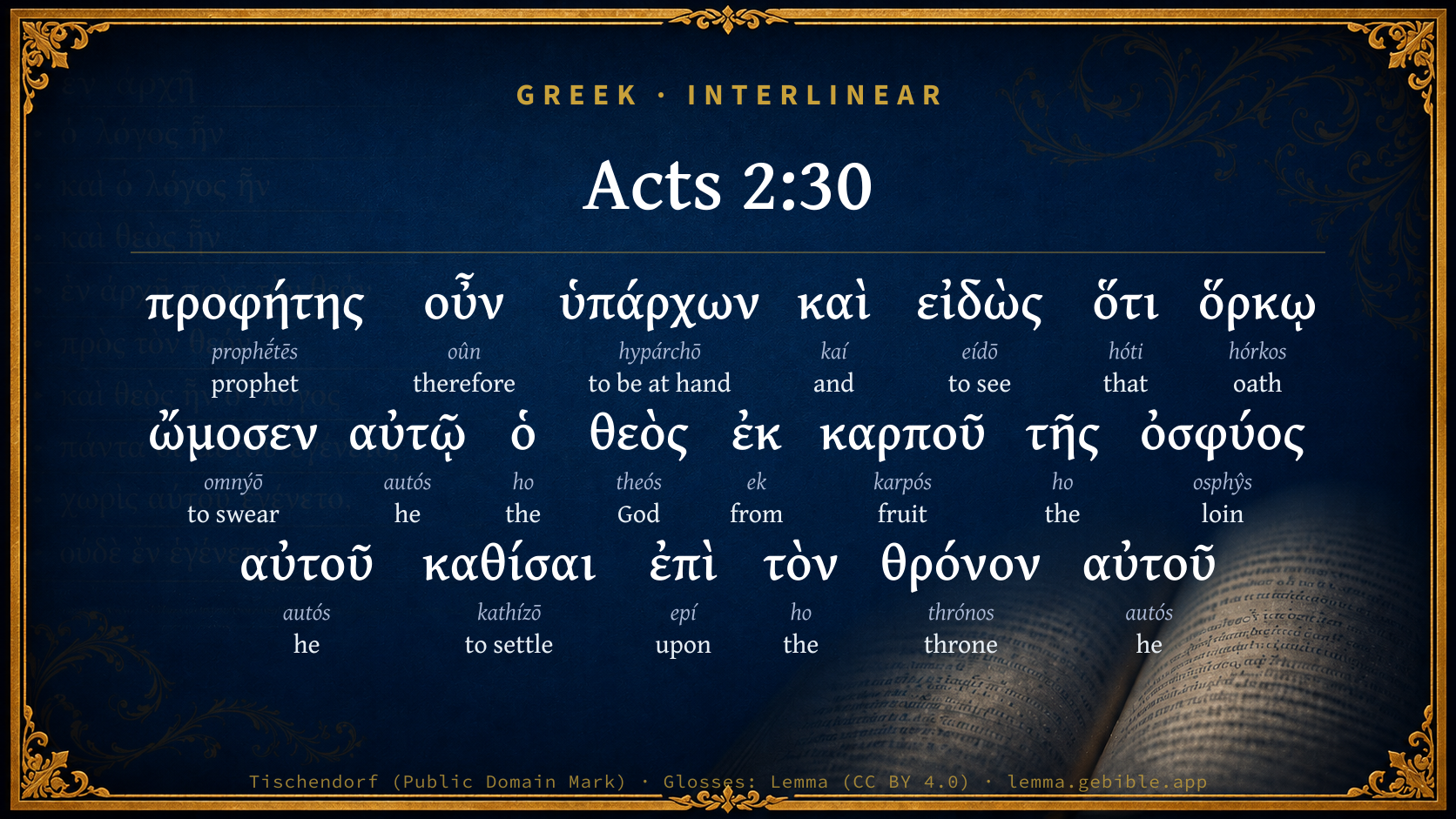
Greek (Tischendorf 8th ed.) Acts 2:30 appears in the Greek New Testament. The text above is from the Tischendorf 8th edition. Each word links to its Strong’s number and a concise gloss. Click any word for its full Thayer’s Greek Lexicon entry.
Download image
Cite this verse

Acts 2:30 (World English Bible). Public Domain. Lemma interlinear Bible study tool, https://lemma.gebible.app/v/acts/2/30.

Show BibTeX & RIS
BibTeX
RIS
English Translation
Therefore, being a prophet, and knowing that God had sworn with an oath to him that of the fruit of his body, according to the flesh, he would raise up the Christ to sit on his throne,
World English Bible · Public Domain
Download a study sheet

One document with this verse’s original text, its word-by-word gloss line, the meaning frame, cross-references with their text, attributed commentary, and full source and license credits — printable, and it pastes into notes with its structure intact.

This verse Autodidact and up

Study sheet (.html) Plain text (.txt)

A passage Seminary Student

Up to 50 verses in one chapter. A passage sheet keeps up to 6 commentary sources and 12 cross-references per verse, in the order this page ranks them, and says so on the sheet whenever that leaves anything out. Ask for a single verse and you get the Autodidact verse sheet above.

Everything on this page stays free to read, with no account — the sheet is a download of what is already on screen, not access to it.

Want to remove ads? Support Godless Engineer
Compare translations 3

The same verse in 3 English versions, stacked beneath the original-language interlinear above. Click any original word for its lexicon entry.

Each is an independent rendering of the whole verse — the interlinear is not word-aligned to these translations.

Highlighted words mark where these versions differ — a whole-verse word diff, not a word-by-word alignment.

  • World English Bible Public Domain
    Therefore, being a prophet, and knowing that God had sworn with an oath to him that of the fruit of his body, according to the flesh, he would raise up the Christ to sit on his throne,
  • King James Version Public Domain
    Therefore being a prophet, and knowing that God had sworn with an oath to him, that of the fruit of his loins, according to the flesh, he would raise up Christ to sit on his throne;
  • unfoldingWord Literal Text CC BY-SA 4.0
    Therefore, being a prophet and having known that God had sworn to him with an oath to set from the fruit of his loins upon his throne,

unfoldingWord Literal Text — © unfoldingWord, licensed CC BY-SA 4.0. Word-aligned USFM3 via Door43 (git.door43.org/unfoldingWord/en_ult).

Versions to compare (up to 4)

3 of 4 selected

Show all 19 translations

Every available English version of this verse, each an independent rendering of the whole verse.

  • World English Bible Public Domain
    Therefore, being a prophet, and knowing that God had sworn with an oath to him that of the fruit of his body, according to the flesh, he would raise up the Christ to sit on his throne,
  • Berean Standard Bible Public Domain
    But he was a prophet and knew that God had promised him on oath that He would place one of his descendants on his throne.
  • Majority Standard Bible Public Domain
    But he was a prophet and knew that God had promised him on oath that from his descendants according to the flesh He would raise up the Christ to seat Him on his throne.
  • King James Version Public Domain
    Therefore being a prophet, and knowing that God had sworn with an oath to him, that of the fruit of his loins, according to the flesh, he would raise up Christ to sit on his throne;
  • American Standard Version (1901) Public Domain
    Being therefore a prophet, and knowing that God had sworn with an oath to him, that of the fruit of his loins he would set `one' upon his throne;
  • Revised Version (1885) Public Domain
    Being therefore a prophet, and knowing that God had sworn with an oath to him, that of the fruit of his loins he would set one upon his throne;
  • Geneva Bible (1599) Public Domain
    Therefore, seeing hee was a Prophet, and knewe that God had sworne with an othe to him, that of the fruite of his loynes hee woulde raise vp Christ concerning the flesh, to set him vpon his throne,
  • Douay-Rheims (1899) Public Domain
    Whereas therefore he was a prophet, and knew that God hath sworn to him with an oath, that of the fruit of his loins one should sit upon his throne.
  • Young's Literal Translation Public Domain
    a prophet, therefore, being, and knowing that with an oath God did swear to him, out of the fruit of his loins, according to the flesh, to raise up the Christ, to sit upon his throne,
  • Literal Standard Version CC BY-SA 4.0
    therefore, being a prophet, and knowing that God swore to him with an oath, out of the fruit of his loins, according to the flesh, to raise up the Christ, to sit on his throne,
  • Unlocked Literal Bible CC BY-SA 4.0
    Therefore, he was a prophet and knew that God had sworn with an oath to him, that he would set one of the fruit of his body upon his throne.
  • unfoldingWord Literal Text CC BY-SA 4.0
    Therefore, being a prophet and having known that God had sworn to him with an oath to set from the fruit of his loins upon his throne,
  • Darby Bible Public Domain
    Being therefore a prophet, and knowing that God had sworn to him with an oath, of the fruit of his loins to set upon his throne;
  • World Messianic Bible Public Domain
    Therefore, being a prophet, and knowing that God had sworn with an oath to him that of the fruit of his body, according to the flesh, he would raise up the Messiah to sit on his throne,
  • Webster's Bible Public Domain
    Therefore being a prophet, and knowing that God had sworn to him with an oath, that from the fruit of his loins, according to the flesh, he would raise up Christ to sit on his throne;
  • Free Bible Version CC BY-SA 4.0
    But he was a prophet, and knew that God had promised on oath to place one of his descendants on his throne.
  • Bible in Basic English Public Domain
    But being a prophet, and having in mind the oath which God had given to him, that of the fruit of his body one would take his place as a king,
  • Text-Critical English NT CC BY 4.0
    So then, because he was a prophet and knew that God had sworn an oath to him that from among his descendants, according to the flesh, he would raise up the Christ to sit on his throne,
  • Tyndale New Testament (1534) Public Domain
    Therfore seinge he was a Prophet and knewe that God had sworne with an othe to him that the frute of his loynes shuld sit on his seat (in that Christ shulde ryse agayne in the flesshe)

Literal Standard Version (2020), Covenant Press — licensed CC BY-SA 4.0. Text via the HelloAO Bible API (eBible.org). Unlocked Literal Bible (unfoldingWord) — licensed CC BY-SA 4.0. Text via the HelloAO Bible API (eBible.org). unfoldingWord Literal Text — © unfoldingWord, licensed CC BY-SA 4.0. Word-aligned USFM3 via Door43 (git.door43.org/unfoldingWord/en_ult). Free Bible Version, Dr. Jonathan Gallagher — licensed CC BY-SA 4.0. Text via the HelloAO Bible API (eBible.org).

Word by word

More ways to search: Search by grammar → Find every occurrence → Compare this word →

Practice this passage: Drill this verse → Learn its vocabulary →

ὀσφύος
osphŷs
G3751
“loin”
Noun, Genitive, Singular, Feminine
Part of Speech
Noun
Case
Genitive
Number
Singular
Gender
Feminine
Full Thayer's Definition

Origin: of uncertain affinity

TDNT: 13:16,7

1. the hip (loin) a. to gird, gird about, the loins 2. a loin, the (two) loins a. the place where the Hebrews thought the generative power (semen) resided
  1. προφήτης prophḗtēs G4396 “prophet” Noun, Nominative, Singular, Masculine
  2. οὖν oûn G3767 “therefore” Conjunction
  3. ὑπάρχων hypárchō G5225 “to be at hand” Verb, Present, Active, Participle, Nominative, Singular, Masculine
  4. καὶ kaí G2532 “and” Conjunction
  5. εἰδὼς eídō G1492 “to see” Verb, Perfect, Active, Participle, Nominative, Singular, Masculine
  6. ὅτι hóti G3754 “that” Conjunction
  7. ὅρκῳ hórkos G3727 “oath” Noun, Dative, Singular, Masculine
  8. ὤμοσεν omnýō G3660 “to swear” Verb, Aorist, Active, Indicative, 3rd person, Singular
  9. αὐτῷ autós G846 “he” Personal pronoun, Dative, Singular, Masculine
  10. ὁ ho G3588 “the” Article, Nominative, Singular, Masculine
  11. θεὸς theós G2316 “God” Noun, Nominative, Singular, Masculine
  12. ἐκ ek G1537 “from” Preposition
  13. καρποῦ karpós G2590 “fruit” Noun, Genitive, Singular, Masculine
  14. τῆς ho G3588 “the” Article, Genitive, Singular, Feminine
  15. αὐτοῦ autós G846 “he” Personal pronoun, Genitive, Singular, Masculine
  16. καθίσαι kathízō G2523 “to settle” Verb, Aorist, Active, Infinitive
  17. ἐπὶ epí G1909 “upon” Preposition
  18. τὸν ho G3588 “the” Article, Accusative, Singular, Masculine
  19. θρόνον thrónos G2362 “throne” Noun, Accusative, Singular, Masculine
  20. αὐτοῦ autós G846 “he” Personal pronoun, Genitive, Singular, Masculine

About this verse

These counts appear in no published source. They are computed here, from the morphology-tagged text and Lemma’s own curated glosses. What Lemma adds →

21
words
17
distinct lemmas
Acts
section

Notable vocabulary

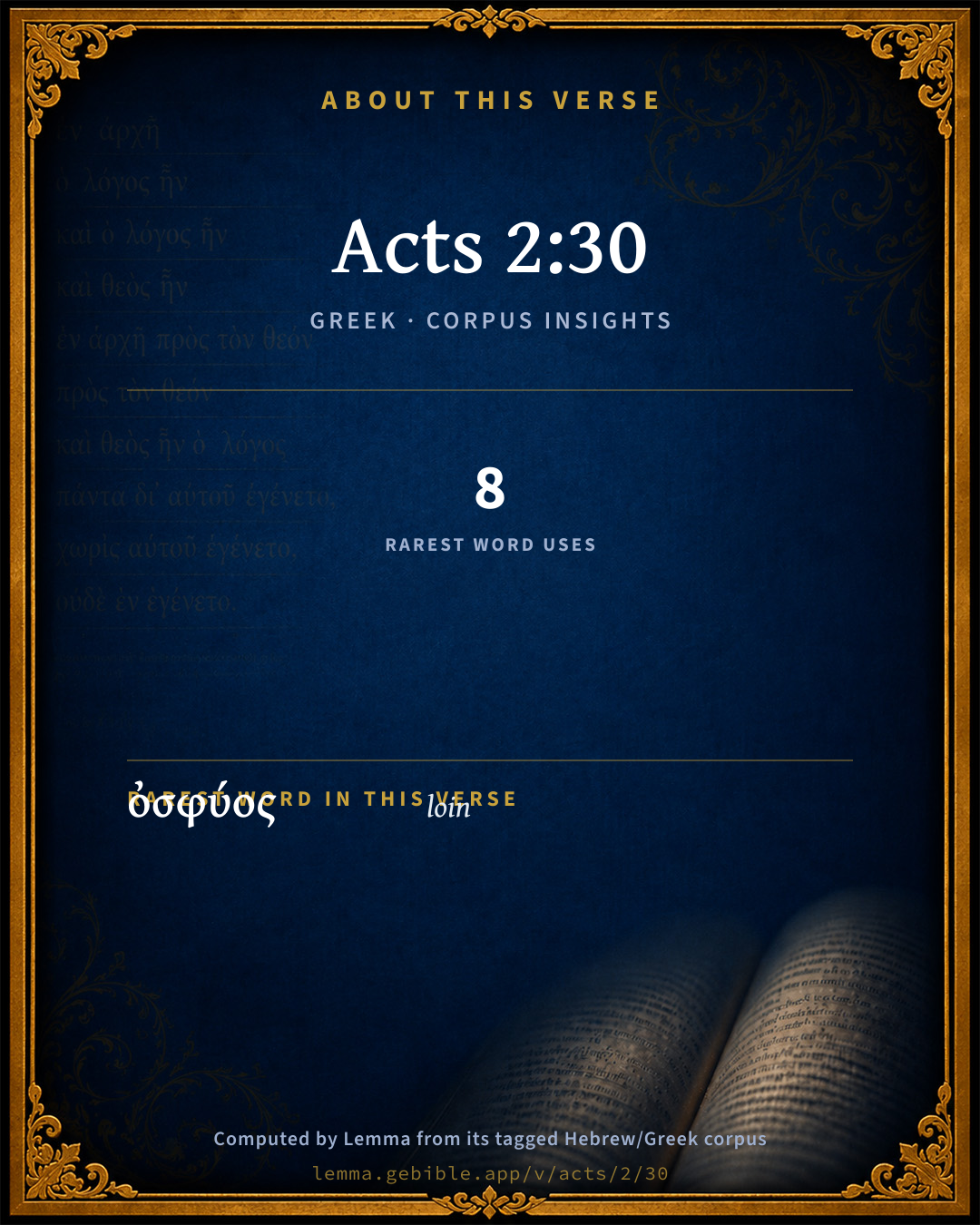
The rarest word here is ὀσφύος loin G3751 — appearing just 8 times in the whole Greek New Testament.

Shared distinctive vocabulary

ὀσφύος loin G3751 occurs in 8 verses of the Greek New Testament. Also found in:

Repetition

Words recur within this verse:

Cross-references

35

Topical passages linked to Acts 2:30 in the Treasury of Scripture Knowledge — connected by theme and wording, ordered by reader-vote popularity; previews shown in the World English Bible.

  • Psalms 132:11–18 Yahweh has sworn to David in truth. He will not turn from it: "I will set the fruit of your body on your throne.
  • Psalms 89:3–4 "I have made a covenant with my chosen one, I have sworn to David, my servant,
  • Jeremiah 33:14–15 Behold, the days come, says Yahweh, that I will perform that good word which I have spoken concerning the house of Israel and concerning the house of Judah.
  • 2 Samuel 7:11–16 and [as] from the day that I commanded judges to be over my people Israel; and I will cause you to rest from all your enemies. Moreover Yahweh tells you that Yahweh will make you a house.
  • 2 Samuel 23:2 The Spirit of Yahweh spoke by me, His word was on my tongue.
  • Isaiah 9:6–7 For to us a child is born, to us a son is given; and the government shall be on his shoulder: and his name shall be called Wonderful, Counselor, Mighty God, Everlasting Father, Prince of Peace.
  • Luke 1:31–33 Behold, you will conceive in your womb, and bring forth a son, and will call his name 'Jesus.'
  • 2 Peter 1:21 For no prophecy ever came by the will of man: but holy men of God spoke, being moved by the Holy Spirit.
  • Romans 1:3 concerning his Son, who was born of the seed of David according to the flesh,
  • 2 Timothy 2:8 Remember Jesus Christ, risen from the dead, of the seed of David, according to my Gospel,
  • Mark 12:36 For David himself said in the Holy Spirit, 'The Lord said to my Lord, Sit at my right hand, Until I make your enemies the footstool of your feet.'
  • Luke 1:69–70 And has raised up a horn of salvation for us in the house of his servant David
  • Luke 24:44 He said to them, "This is what I told you, while I was still with you, that all things which are written in the law of Moses, the prophets, and the psalms, concerning me must be fulfilled."
  • Acts 1:16 "Brothers, it was necessary that this Scripture should be fulfilled, which the Holy Spirit spoke before by the mouth of David concerning Judas, who was guide to those who took Jesus.
  • Romans 15:12 Again, Isaiah says, "There will be the root of Jesse, He who arises to rule over the Gentiles; On him will the Gentiles hope."
  • Hebrews 4:7 he again defines a certain day, today, saying through David so long a time afterward (just as has been said), "Today if you will hear his voice, Don't harden your hearts."
  • 1 Chronicles 17:11–15 It shall happen, when your days are fulfilled that you must go to be with your fathers, that I will set up your seed after you, who shall be of your sons; and I will establish his kingdom.
  • Psalms 2:6–12 "Yet I have set my king on my holy hill of Zion."
  • Psalms 72:1–19 God, give the king your justice; Your righteousness to the royal son.
  • Psalms 89:19–37 Then you spoke in vision to your saints, And said, "I have bestowed strength on the warrior. I have exalted a young man from the people.
  • Psalms 110:1–5 Yahweh says to my Lord, "Sit at my right hand, Until I make your enemies your footstool for your feet."
  • Isaiah 7:14 Therefore the Lord himself will give you a sign. Behold, the virgin will conceive, and bear a son, and shall call his name Immanuel.
  • Jeremiah 23:5–6 Behold, the days come, says Yahweh, that I will raise to David a righteous Branch, and he shall reign as king and deal wisely, and shall execute justice and righteousness in the land.
  • Amos 9:11–12 In that day I will raise up the tent of David who is fallen, and close up its breaches, and I will raise up its ruins, and I will build it as in the days of old;
  • Micah 5:2 But you, Bethlehem Ephrathah, Being small among the clans of Judah, Out of you one will come forth to me that is to be ruler in Israel; Whose goings forth are from of old, from everlasting.
  • Matthew 22:43 He said to them, "How then does David in the Spirit call him Lord, saying,
  • Matthew 27:35 When they had crucified him, they divided his clothing among them, casting lots,
  • Luke 2:10–11 The angel said to them, "Don't be afraid, for behold, I bring you good news of great joy which will be to all the people.
  • John 18:36–37 Jesus answered, "My Kingdom is not of this world. If my Kingdom were of this world, then my servants would fight, that I wouldn't be delivered to the Jews. But now my Kingdom is not from here."
  • Hebrews 6:17 In this way God, being determined to show more abundantly to the heirs of the promise the immutability of his counsel, interposed with an oath;
  • Hebrews 7:1–2 For this Melchizedek, king of Salem, priest of God Most High, who met Abraham returning from the slaughter of the kings and blessed him,
  • Hebrews 7:21 (for they indeed have been made priests without an oath), but he with an oath by him that says of him, "The Lord swore and will not change his mind, 'You are a priest forever, According to the order of Melchizedek'".
  • Revelation 17:14 These will war against the Lamb, and the Lamb will overcome them, for he is Lord of lords, and King of kings. They also will overcome who are with him, called and chosen and faithful."
  • Revelation 19:16 He has on his garment and on his thigh a name written, "KING OF KINGS, AND LORD OF LORDS."
  • Hebrews 3:7 Therefore, even as the Holy Spirit says, "Today if you will hear his voice,

Cross-references courtesy of OpenBible.info (CC BY 4.0).

Where the printed editions differ

1 variant

Places in this verse where the major printed Greek editions disagree on the wording in a way that affects the translation — a comparison of editions, not a manuscript-by-manuscript collation. The editions are the modern critical texts (Nestlé-Aland 28/27, SBL, Westcott-Hort, Tregelles, Tyndale House) and the traditional texts behind the KJV (the Textus Receptus and the Byzantine/Majority text). It is not a claim about which reading is original.

  1. Extra text
    τὸ κατὰ σάρκα ἀναστήσειν τὸν χριστόν

    “<the> according to flesh going to raise up the Christ”

    In TRByz Not in NA28NA27TynSBLWHTreg

    τὸ κατὰ σάρκα ἀναστήσειν τὸν χριστόν (to kata sarka anastēsein ton christon) 'according to flesh going to raise up the Christ' is only in traditional manuscripts (TR+Byz)

Textual data: Translators Amalgamated Greek New Testament (STEPBible TAGNT) · CC BY 4.0.

Commentary

Notes on Acts 2:30 from classic Christian and Jewish commentators (each source and its license shown beneath its notes). The classic Christian expositions comment on the surrounding passage and are grouped to its opening verse, so a note may address several verses; the Jewish commentaries on the Tanakh (Rashi and others) are per-verse, so they appear only where the commentator wrote on this verse.

Lemma curates 59 commentaries, every one of them public domain or Creative Commons licensed, each selected and text-cleaned for this edition rather than reprinted as found. About our sources →

Bengel's Gnomon

Johann Albrecht Bengel

Act 2:30. Προφήτης, a prophet) “Whence it follows that the 16th Psalm is prophetical.—εἰδὼς, knowing) by the prophecy of Nathan (2Sa 7:12-13). Therefore it was after this prophecy that David composed and sang the 16th Psalm.—ὅτι ὃρκῳ ὤμοσεν, with an oath He swore) Psa 132:11, with which comp. Act 2:2.—καρποῦ τῆς ὀσφύος, of the fruit of his loins) Scripture speaks of propagation with wonderful correctness and delicacy. A periphrasis for, of his seed.—καθίσαι) to set, to cause to sit.—αὐτοῦ, his) David’s.

Bengel's Gnomon of the New Testament — English translation (T&T Clark, Edinburgh, 1860) — public domain. Text from a community e-Sword module.

Meyer's Critical & Exegetical Commentary

Heinrich August Wilhelm Meyer

Act_2:30-32. Οὖν] infers from the previous καὶ τὸ μνῆμα αὐτοῦ … ταύτης, whence it is plain that David in the Psalm, l.c., as a prophet and divinely conscious progenitor of the future Messiah, has spoken of the resurrection of Christ as the one who should not be left in Hades, and whose body should not decay.

καὶ εἰδώς] see 2Sa_7:12.

ἐκ καρποῦ τ. ὀσφύος αὐτοῦ] sc. τινά. On the frequent supplying of the indefinite pronoun, see Kühner, II. p. 37 f.; Fritzsche, Conject. I. 36. The well-known Hebrew-like expression καρπὸς τῆς ὀσφύος αὐτοῦ (Psa_132:11) presupposes the idea of the uninterrupted male line of descent from David to Christ. Comp. Heb_7:5; Gen_35:11; 2Ch_6:9; and see remark after Mat_1:18.

καθίσαι ἐπὶ τ. θρόνον αὐτοῦ] to sit on His throne (Xen. Anab. ii. 1. 4), namely, as the Messiah, who was to be the theocratic consummator of the kingdom of David (Mar_11:10; Act_15:16). Comp. Luk_1:32.

προϊδών] prophetically looking into the future. Comp. Gal_3:8.

ὅτι οὐ κατελ.] since He, in fact, was not left, etc. Thus has history proved that David spoke prophetically of the resurrection of the Messiah. The subject of κατελείφθη κ.τ.λ. is not David (Hofm. Schriftbew. II. l, p. 115)which no hearer, after Act_2:29, could supposebut ὁ Χριστός; and what is stated of Him in the words of the Psalm itself is the triumph of their historical fulfilment, a triumph which is continued and concluded in Act_2:32.

τοῦτον τὸν Ἰησοῦν] has solemn emphasis; this Jesus, no other than just Him, to whom, as the Messiah who has historically appeared, Davids prophecy refers.

οὗ] neuter: whereof. See Bernhardy, p. 298.

μάρτυρες] in so far as we, His twelve apostles, have conversed with the risen Christ Himself. Comp. Act_1:22, Act_10:41.

Meyer — Critical and Exegetical Commentary on the New Testament — English translation by Peter Christie, edited by Frederick Crombie (T&T Clark, 1880) — public domain. Text from a community e-Sword module.

Expositor's Greek Testament

ed. W. Robertson Nicoll

Act 2:30 . προφήτης : as David could not have spoken this Psalm of himself, he spoke it of some other, who was none other than the Messiah here the word is used in the double sense of one declaring God’s will, and also of one foretelling how that will would be fulfilled. ὑπάρχων : another favourite word of St. Luke, in his Gospel, and especially in Acts; in the former it is found seven times, and in the latter no less than twenty-four times, and in all parts (excluding τὰ ὑπάρχοντα ), Friedrich, Das Lucasevangelium , p. 7. It is not used by the other Evangelists. In the N.T., as in later Greek, it is often weakened into an equivalent of εἶναι ; Blass, Grammatik des N. G. , p. 239. Here it may indicate that David was a prophet, not only in this one instance, but constantly with reference to the Messiah. ὅρκῳ ὤμοσεν , Hebraistic; cf. Act 2:17 . Viteau, Le Grec du N. T. , p. 141 (1896); for the oath cf. Psa 132:11 , 2Sa 7:16 . ἐκ καρποῦ τῆς ὀσφύος αὐτοῦ , i.e. , of his offspring. It is a common Hebraistic form of expression ὀσφύς read here, but κοιλία in Ps. 131:11 (LXX); cf. Gen 35:11 and 2Ch 6:9 (Heb 7:5 ). With regard to the human element in the Person of Jesus, Peter speaks of him as a descendant of David according to prophecy, as in the Synoptists and Rom 1:3 (Schmid). The exact expression, καρπὸς τῆς ὀσφύος , is not found in the LXX, but καρ . τῆς κοιλίας is found, not only in the Psalm quoted but in Mic 6:7 (Lam 2:20 ), where the same Hebrew words are used as in the Psalm: ὀσφύς in the LXX is several times a translation of another Hebrew word חֲלָצַיִם (dual). This partitive construction (supply τινα ) is also a Hebraistic mode of expression, and frequent in the LXX; cf. Act 2:18 , Act 5:2 . See Viteau, Le Grec du N. T. , p. 151 (1896).

The Expositor's Greek Testament, edited by W. Robertson Nicoll (1897–1910) — public domain. Text from a community e-Sword module.

Geneva Bible (1599)

Geneva Bible translators

Had sworn solemnly.

Geneva Bible (1599) marginal notes — public domain. Text via Bolls.life.

Adam Clarke's Commentary

Verse 30. According to the flesh, he would raise up Christ] This whole clause is wanting in ACD, one of the Syriac, the Coptic, AEthiopic, Armenian, and Vulgate; and is variously entered in others. Griesbach rejects it from the text, and Professor White says of the words, "certissime delenda," they should doubtless be expunged. This is a gloss, says Schoettgen, that has crept into the text, which I prove thus:

1. The Syriac and Vulgate, the most ancient of the versions, have not these words.

2. The passage is consistent enough and intelligible without them.

3. They are superfluous, as the mind of the apostle concerning the resurrection of Christ follows immediately in the succeeding verse.

The passage therefore, according to Bp. Pearce, should be read thus: Therefore being a prophet, and knowing that God had sworn with an oath, of the fruit of his loins, to set on his throne; and foreseeing that he (God) would raise up Christ, he spake of the resurrection of Christ, c. "In this transition, the words which Peter quotes for David's are exactly the same with what we read in the psalm above mentioned and the circumstance of David's foreseeing that Christ was to be raised up, and was the person meant, is not represented as a part of the oath; but is only made to be Peter's assertion, that David, as a prophet, did foresee it, and meant it."

Adam Clarke's Commentary on the Bible (1810–1826) — public domain. Text from a community e-Sword/MySword module.

John Calvin's Commentaries

30. Therefore, seeing he was a prophet He showeth, by two reasons, that it is no marvel if David do speak of things that should come to pass long after his time; the former is, because he was a prophet. And we know that things to come, and such as are removed far from the knowledge of men, are revealed unto the prophets. Therefore, it were wickedness to measure their speeches according to the common manner and order which we use in measuring the speeches of other men, forasmuch as they go beyond the long courses of years, having the Spirit for their director. Whereupon they are also called seers; because being placed, as it were, upon an high tower, they see those things which, by reason of great distance, are hidden from other men. Another reason is, because Christ was promised to him peculiarly. This maxim was so common amongst the Jews, that they had ever now and then the son of David in their mouth, so often as there was any mention made of Christ. They be no such arguments, I confess, as do necessarily prove that this prophecy is to be expounded of Christ; neither was that Peter’s intent and purpose; but first he meant to prevent the contrary objection, whence David had such skill to foretell a thing which was unknown. Therefore he saith, That he knew Christ, both by prophetical revelation, and also by singular promise. Furthermore, this principle was of great (Romans 10:4) force amongst the better-minded sort which Paul setteth down, that Christ is the end of the law. No man, therefore, did doubt of this, but that this was the mark whereat all the prophets did aim, to lead the godly unto Christ as it were by the hand. Therefore, what notable or extraordinary thing soever they did utter, the Jews were commonly persuaded that it did agree with Christ. Furthermore, we must note, that Peter doth reason soundly, when he gathered that David was not ignorant of that which was the chiefest point of all revelations.

He had sworn with an oath God swore not only to the end he might make David believe his promise, but also that the thing promised might be had in greater estimation. And to this end, in my judgment, it is here repeated, that the Jews may think with themselves of what great weight the promise was, which God did make so notable (and so famous.) The same admonition is profitable for us also. For we need not to doubt of this, but that the Lord meant to set forth the excellency of the covenant by putting in a solemn oath. In the mean season, this is also a fit remedy for the infirmity of our faith, that the sacred name of God is set forth unto us, that his words may carry the greater credit. These words, “according to the flesh,” do declare that there was some more noble thing in Christ than the flesh. Therefore Christ did so come of the seed of David as he was man, that he doth nevertheless, retain his divinity; and so the distinction between the two natures is plainly expressed; when as Christ is called the Son of God, according to his eternal essence, in like sort as he is called the seed of David according to the flesh.

John Calvin's Commentaries (1540-1563) — public domain. Text from the Calvin Translation Society English edition (1840s-50s) via the Christian Classics Ethereal Library (ccel.org). Calvin's coverage is partial (roughly two-thirds of the Bible); uncommented books and verses are honest gaps, never fabricated. The 19th-century editor's footnotes and remarks are omitted so the notes are faithfully Calvin's own voice.

Ellicott's Commentary for English Readers

(30) Therefore being a prophet.—The words “according to the flesh, He would raise up Christ,” are wanting in many of the best MSS. Without them the sentence, though somewhat incomplete, would run thus: “That God had sworn with an oath that from his loins one should sit upon his throne.” The words claim for the Psalmist a prophetic foresight of some kind, without defining its measure or clearness. His thoughts went beyond himself to the realisation of his hopes in a near or far-off future. As with most other prophets, the precise time, even the “manner of time,” was hidden from him (1Pe_1:11).

He would raise up Christ.—The Greek, by using the verb from which comes the word “resurrection,” gives to the verb the definite sense of “raising from the dead.”

A Bible Commentary for English Readers, edited by Charles John Ellicott (1878–1897) — public domain. Text from a community e-Sword module.

The Cambridge Bible for Schools and Colleges

gen. ed. J. J. S. Perowne

30. knowing that God had sworn with an oath] See Psa_132:11, “of the fruit of thy body will I set upon thy throne.”

that of the fruit of his loins, according to the flesh, he would raise up Christ to sit on his throne] The words represented by “according … Christ” are omitted in the best MSS. The clause as corrected by them would be “of the fruit of his loins one should sit [or he would set one] on his throne.”

The Cambridge Bible for Schools and Colleges (gen. ed. J. J. S. Perowne; Cambridge University Press, 1878–1918) — public domain. Text from a community e-Sword module.

John Gill's Exposition

Therefore being a prophet,.... Who could foretell things to come, as he did many things concerning the sufferings and death of Christ, and the circumstances attending it, concerning his resurrection, ascension, and session at the right hand of God. So the title of his "Psalms", in the Syriac version, runs thus; the "Book of the Psalms of David, King and Prophet": and in the Arabic version, "the First Book of the Psalms of David the Prophet, King of the Children of Israel". Though the Jews (d) will not allow him, nor Solomon, nor Daniel, to be strictly and properly prophets, they make a difference between prophecy, and the Holy Spirit. They own, that the book of Psalms was written under the influence of the Holy Spirit, but not by prophecy; and therefore they place it among the Hagiographa, or holy writings, but not among the Prophets: though after all, Kimchi allows David to be a prophet, since he is called a man of God; for he says this name is not said of any but , "of a prophet" (e); and Peter is right in calling him so:

and knowing that God had sworn with an oath to him; as he did in Psa 132:11.

that of the fruit of his loins; of one that should be of his seed, that should spring from him, even the Virgin Mary, who was of the house and lineage of David:

according to the flesh, he would raise up Christ; would send him forth, according to the human nature; for this phrase respects not his resurrection from the dead, but his incarnation or exhibition in the flesh, as in Act 3:26. This clause is wanting in the Vulgate Latin, Syriac, and Ethiopic versions, and in the Alexandrian copy, and should be read in a parenthesis; since it is not in the text in Psa 132:11.

to sit on his throne; on the throne of David his father; see Gill on Luk 1:32.

(d) Maimon. More Nevochim, par. 2. c. 45. Vid. Procop. Gazaeum in Reg. l. 2. c. 23. sect. 2. (e) Kimchi Praefat. ad Psalm.

John Gill's Exposition of the Whole Bible (1746–1763) — public domain (CC PDM 1.0). Text via the HelloAO Bible API.

Trapp's Complete Commentary

John Trapp

30 Therefore being a prophet, and knowing that God had sworn with an oath to him, that of the fruit of his loins, according to the flesh, he would raise up Christ to sit on his throne;

Ver. 30. Out of the fruit of his loins] That is, out of the Virgin Mary; the son of whose womb Christ was, being hewn without hands out of that mountain, Dan 2:45.

John Trapp, A Commentary or Exposition upon All the Books of the Old and New Testament (1647–1656) — public domain. Text from a community e-Sword module.

Albert Barnes' Notes on the Bible

Therefore - As David was dead and buried, it was clear that he could not have referred to himself in this remarkable declaration. It followed that he must have had reference to some other one.

Being a prophet - One who foretold future events. That David was inspired is clear, 2Sa 23:2. Many of the prophecies relating to the Messiah are found in the Psalms of David: Psa 22:1, compare Mat 27:46; Luk 24:44 - Psa 22:18, compare Mat 27:35 - Psa 69:21, compare Mat 27:34, Mat 27:48 - Psa 69:25, compare Act 1:20.

And knowing - Knowing by what God had said to him respecting his posterity.

Had sworn with an oath - The places which speak of God as having sworn to David are found in Psa 89:3-4, “I have made a covenant with my chosen, I have sworn unto David my servant, Thy seed will I establish,” etc.; and Psa 132:11, “The Lord hath sworn in truth unto David, he will not turn from it, Of the fruit of thy body will I set upon my throne”; Psa 89:35-36. The promise to which reference is made in all these places is in 2Sa 7:11-16.

Of the fruit of his loins - Of his descendants. See 2Sa 7:12; Gen 35:11; Gen 46:26; 1Ki 8:19, etc.

According to the flesh - That is, so far as the human nature of the Messiah was concerned, he would be descended from David. Expressions like these are very remarkable. If the Messiah was only a man, they would be unmeaning. They are never used in relation to a mere man; and they imply that the speaker or writer supposed that there pertained to the Messiah a nature which was not according to the flesh. See Rom 1:3-4.

He would raise up Christ - That is, the Messiah. To raise up seed, or descendants, is to give them to him. The promises made to David in all these places had immediate reference to Solomon and to his descendants. But it is clear that the New Testament writers understood them as referring also to the Messiah. And it is no less clear that the Jews understood that the Messiah was to be descended from David, Mat 12:23; Mat 21:9; Mat 22:42, Mat 22:45; Mar 11:10; Joh 7:42, etc. In what way these promises that were made to David were understood as applying to the Messiah, it may not be easy to determine. The fact, however, is clear. The following remarks may throw some light on the subject:

The kingdom which was promised to David was to have no end; it was to be established forever. Yet his descendants died, and all other kingdoms changed. The promise likewise stood by itself; it was not made to any other of the Jewish kings; nor were similar declarations made of surrounding kingdoms and nations. It came, therefore, gradually to be applied to that future king and kingdom which was the hope of the nation; and their eyes were anxiously fixed on the long-expected Messiah. At the time that he came it had become the settled doctrine of the Jews that he was to descend from David, and that his kingdom was to be perpetual.

On this belief of the prophecy the apostles argued; and the opinions of the Jews furnished a strong point by which they could convince them that Jesus was the Messiah. Peter affirms that David was aware of this, and that he so understood the promise as referring not only to Solomon, but in a far more important sense to the Messiah. Happily we have a commentary of David himself as expressing his own views of that promise. That commentary is found particularly in Psa 2:1-12; Ps. 22; Ps. 69; and Psa 16:1-11; In these Psalms there can be no doubt that David looked forward to the coming of the Messiah; and there can be as little that he regarded the promise made to him as extending to his coming and his reign.

It may be remarked that there are some important variations in the manuscripts in regard to this verse. The expression “according to the flesh” is omitted in many mss., and is now left out by Griesbach in his New Testament. It is omitted also by the ancient Syriac and Ethiopic versions, and by the Latin Vulgate.

To sit on his throne - To be his successor in his kingdom. Saul was the first of the kings of Israel. The kingdom was taken away from him and his posterity, and conferred on David and his descendants. It was determined that it should be continued in the family of David, and no more go out of his family, as it had from the family of Saul. The unique characteristic of David as king, or what distinguished him from the other kings of the earth, was that he reigned over the people of God. Israel was his chosen people, and the kingdom was over that nation. Hence, he that should reign over the people of God, though in a manner somewhat different from David, would be regarded as occupying his throne, and as being his successor. The form of the administration might be varied, but it would still retain its prime characteristic as being a reign over the people of God. In this sense the Messiah sits on the throne of David. He is his descendant and successor. He has an empire over all the friends of the Most High. And as that kingdom is destined to fill the earth, and to be eternal in the heavens, so it may be said that it is a kingdom which shall have no end. It is spiritual, but not the less real; defended not with carnal weapons, but not the less really defended; advanced not by the sword and the din of arms, but not the less really advanced against principalities, and powers, and spiritual wickedness in high places; not under a visible head and earthly monarch, but not less really under the Captain of salvation and the King of kings.

Albert Barnes' Notes on the Bible (1834–1885) — public domain. Text from a community e-Sword/MySword module.

Matthew Poole's English Annotations

Had sworn with an oath; not barely had sworn, which had been sufficient; but to show the excellency of the matter, and the necessity of our believing of it, as also the solemnity of the words, Psa 132:11.

Of the fruit of his loins; such as should descend from him, as the virgin Mary did.

According to the flesh; as to his human nature, which our Saviour did truly partake of, being in the form of a servant.

He would raise up Christ, by the power of the Holy Ghost in the womb of his virgin mother, as to his incarnation; and by the same power out of the grave, in his resurrection.

To sit on his throne; as Luk 1:32,33; not as a temporal king, for his kingdom is not of this world; but as David ruled over all the people of God, so does Christ, and shall do for ever.

Matthew Poole's English Annotations on the Holy Bible (1683–1685) — public domain. Text from a community e-Sword/MySword module.

Whedon's Commentary on the Bible

Daniel D. Whedon

30. A prophet—In the sense both of speaking by inspiration and of predicting the future.

An oath—In 2Sa_7:5-16, God promises to David a successorship on the throne forever; in <19D211>Psa_132:11, David affirms that God had so sworn; both in consequence of David’s determination to build a house for Jehovah.

Fruit of his loins—Peter speaks as if it was, as it were, through his line of descent that David was able to look prophetically as through a line of light. Thereby he identifies himself with his great descendant the Messiah, and speaks in Psalm xvi as Messiah himself. The best reading, instead of he would raise Christ to sit on his throne, would substitute, that of the fruit of his loins One should sit on his throne. With that future One Peter now (in Act_2:32) identifies Jesus.

Daniel D. Whedon (gen. ed.), Commentary on the Old and New Testaments (1874–1909) — public domain. Text from a community e-Sword module.

The Pulpit Commentary

Being therefore for therefore being, A.V. ; that of the fruit of his loins he would set one upon for that of the fruit of his loins according to the flesh he would raise up Christ to sit on, A.V. and T.R. Had sworn, etc. The first record of God"s promise to David is in 2Sa_7:11-16: "The Lord telleth thee that he will make thee an house. And I will set up thy seed after thee, which shall proceed out of thy bowels, and will establish his kingdom Thy throne shall be established forever;" and in ver. 28, David speaks of it as God"s promise: "Thy words be true, and thou hast promised this goodness unto thy servant." But there is no mention there of an oath. But in Psalm 89, great stress is laid upon God having sworn to David: "I have made a covenant with my chosen, I have sworn unto David my servant, Thy seed will I establish for ever, and build up thy throne to all generations" (vers. 3, 4); and again, ver. 35, "Once have I sworn by my holiness that I will not lie unto David" 1Sa 7 and Psalm 89, should be read through carefully. (comp. also Isa_4:3; Act_13:23 For the phrase, "I have sworn by my holiness," see Amo_4:2)

The Pulpit Commentary (1880–1919), ed. H.D.M. Spence-Jones & Joseph S. Exell — public domain. Text from a community e-Sword module.

John Wesley's Explanatory Notes

Psalm lxxxix, 4, &c.

John Wesley, Explanatory Notes Upon the Whole Bible (1754–1765) — public domain. Text via the GEBible commentary corpus.

Godbey's Commentary on the New Testament

William B. Godbey

30. “Therefore being a prophet and knowing that God swore to him with an oath that one from the fruit of his loins should sit upon his throne.” Peter uses this testimony of David to prove the kingship of Christ. He was born King of the Jews. Paul says (Rom 2:28-29):

“He is not a Jew as one outwardly, neither is circumcision that it is outward in the flesh; but he is a Jew who is one inwardly and circumcision is that of the heart; in the spirit and not in the letter, whose praise is not of men but of God.”

Hence, you see that Jesus was born King of Saints. When Pilate wrote this superscription on His cross above His head in Hebrew, Greek and Latin, the language of religion, learning and law for everybody to read, “This is the King of the Jews,” he wrote an eternal truth. That was the reason why he could not change it afterwards at the request of the Jews. The word Inri, which you so frequently see above crosses at Roman Catholic grave-yards and other places, is a combination of initials and stands for Jesus Nazarenus, Rex Ioudiourum, — “Jesus of Nazareth, King of the Jews.”

David, the brightest type of Christ in the Bible, powerfully symbolizes Him in His regal capacity. As David had two coronations, — first, he was crowned king of his own tribe at Hebron, and seven and a half years afterward he was crowned king of all the tribes of Israel at Jerusalem, — so Christ in His first advent was crowned King of Saints when He ascended up to heaven, when He comes in His glory He will be crowned King of all the nations upon the face of the earth. David never occupied an earthly throne. His kingdom was the divine theocracy centralized in heaven and overlapping on the earth. God said: “I have found David, the son of Jesse, a man after my own heart, who will do all my wills.” The reason why David was a man after God’s own heart was not because he was infallible, for he was not, but because he had one fixed and settled policy and purpose in all his administrations, and that was not to do his own will but the will of God (Act 12:22). Much has been said about the perpetuity of David’s throne; great volumes written in an attempt to substitute other dynasties, even of other nations, in lieu of what is regarded as the forfeited throne of David, and thus fulfill the Scriptures. When we undertake to help out the Bible, we always make a mistake and get into trouble. The Bible, like God, does not need any help. If you will throw away your creeds and part company with the devil, the Bible will do its own talking. Here it is positively specified that Jesus, the lineal descendant of David, was born King of the Jews in David’s royal line. To be sure, He never reigned on earth. Instead of crowning Him King they killed Him, but here Peter proves demonstratively that he was crowned in heaven King of the Jews and successor of David to sit upon his throne. The Bible is clear in this succession of David and perpetuity of his kingdom on the mediatorial throne in heaven. As to David’s earthly throne, instead of all these efforts to find it perpetuated among the Gentiles, which is utterly chimerical, turn with me to the Jerusalem council of apostles, elders and brothers, highest authority this side of heaven, and you find the matter fully explained and the problem solved. Act 15:16 : “After these things [i.e., the preaching of the gospel to all the Gentiles in the present dispensation] I will return and build again the dynasty of David or the throne which hath fallen down, and will rebuild the ruins of the same and set it up again.” Here we see positively that the temporal wing of David’s throne had an interregnum at the time of Christ and the apostles, which is to continue until the King returns in His glory. Then He is going to rebuild the throne of David, restore his kingdom on the earth, destined, as the same Scripture goes on to say, “to encompass all the nations of the globe.” Hence, we see that David’s kingdom in the earth is to have this interregnum, which obtained in the former dispensation and continued to the end of the gospel age.

Therefore it is a great mistake to think we have to find David’s kingdom perpetuated in the earth, as this would preclude the interregnum which the Scriptures positively reveal. Hence the conclusion of the problem is the simple fact that Jesus Christ, the lineal Son, royal Heir and Successor of David, was born King, and, though prohibited and crucified on earth, He was crowned King when He ascended into heaven, and actually there sitteth on the throne of David, thus perpetuating his kingdom forever. Since David really had no earthly throne, but as king of the divine theocracy, his throne was in heaven, the capital of his kingdom, while it overlapped down in the earth and gave Israel a prelibation of the blessedness of the heavenly kingdom, of which Jerusalem, in the glory of David and Solomon, proximately symbolize heaven, and David’s earthly throne was but the temporal counterpart of the heavenly. Hence the temporary dilapidation of David’s earthly throne does not invalidate the eternal perpetuity of his kingdom, realized in the mediatorial administration of Christ in heaven and destined in the coming millennial age, adumbrated in the days of David, to reach down and girdle the globe in the glory of the heavenly kingdom. We find interregnums in many of the time-honored kingdoms of the earth, such as Rome and Britain; but these interregnums do not invalidate the perpetuity of these kingdoms. Neither does the interregnum of David’s throne on earth invalidate the eternal perpetuity of his kingdom, especially in view of the fact that the heavenly nucleus of that kingdom is literally perpetuated in the glorious reign of King Jesus. The very fact that God said to Jesus on His congratulation and coronation, “Sit thou on my right hand till I make thine enemies thy footstool,” involves the unequivocal promise on the part of the Father to shake down every rival potentate in all the earth, whether political or ecclesiastical. The incarnation of the Holy Ghost on the day of Pentecost was a positive confirmation of the coronation of Christ in heaven, as the law must be fully satisfied before the promised restitution can be consummated in the incarnation of the Holy Ghost, actually restoring the human to full spiritual freedom and ushering in the millennial victory. Of course, Luke here gives us but a brief epitome of Peter’s sermon, i. e., the salient points. God in the Abrahamic covenant promised the gift of the Holy Ghost. That covenant must be sealed with the blood of Christ before the Holy Ghost, the Restorer and Comforter, can be given.

William B. Godbey, Commentary on the New Testament (1896–1900) — public domain. Text from a community e-Sword module.

McGarvey & Pendleton's Commentaries

J. W. McGarvey

See notes on verse 29

J. W. McGarvey (with Philip Y. Pendleton), Commentaries on the New Testament (The Fourfold Gospel, 1914; Acts; and the epistles) — public domain. Text from a community e-Sword/MySword module.

The People's New Testament

B. W. Johnson

30. Knowing that God had sworn. God had promised to David that Christ should sit on his throne. See 2 Sam. 7:11–16; Psa. 89:3, 4, 35, 37; 132:11.

B. W. Johnson's The People's New Testament with Notes (1889–1891) — public domain. Electronic text from the Christian Classics Ethereal Library (CCEL) ThML edition.

Cambridge Greek Testament for Schools and Colleges

30. τὸ κατὰ σάρκα ἀναστήσειν τὸν Χριστόν omitted with אABCD. The Vulg. does not represent these words. The omitted words seem like a marginal exposition which in time made its way into the text.

30. ὅρκῳ ὤμοσεν. See Psa 132:11 ‘Of the fruit of thy body will I set upon thy throne.’

ἐκ καρποῦ κ.τ.λ. Render, of the fruit of his loins one should sit [or, he would set one] on his throne; for καθίζειν is used both transitively and intransitively.

Cambridge Greek Testament for Schools and Colleges (Cambridge University Press, 1896; 21 vols, various authors incl. Carr, Maclear, Plummer, Farrar, Lumby, Moule, M. R. James, Simcox) — public domain. Text from a community e-Sword module.

Alford’s Greek Testament

Henry Alford

30.] προφήτης, in the stricter sense, a foreteller of future events by the inspiration of the Holy Spirit.

εἰδώς] See 2Sa 7:12. The words are not cited from the LXX, but rendered from the Hebrew. On the principle of interpretation of this prophecy, see above on ver. 25.

Henry Alford, The Greek Testament (1849–1861) — public domain. Text from a community e-Sword module.

Vincent's Word Studies in the New Testament

Marvin R. Vincent

According to the flesh, he would raise up Christ. The best texts omit. Render as Rev., he would set one upon his throne.

Marvin R. Vincent, Word Studies in the New Testament (1887–1900) — public domain. Text from a community e-Sword/MySword module.

Lesson kit

Teaching starters — assembled from the data on this page, not authored interpretation. Every prompt links to the verse data it draws on. Edit before teaching.

Acts, in the Acts, opens this verse with 21 words (17 distinct Greek lemmas). Its most distinctive word is osphŷs (“loin”). A historical commentator’s framing appears above. Read the whole chapter for the surrounding context.

Discussion questions

  1. How does “loin” (osphŷs) shape what this verse is saying?
  2. Matthew 3:4 shares the word «loin» with this verse. How do the two illuminate each other?
  3. “he” occurs 3× in this one verse. What is the effect of the repetition?
  4. These translations render this verse differently; the difference is in the English rendering, not the original. What questions does that raise?
  5. Reading how Bengel's Gnomon and Meyer's Critical & Exegetical Commentary read this verse, where do the two commentators agree and where do they part?

Things to notice

Reading settings

Reading text

Shown beneath each verse's original-language words.

Old Testament
Old Testament edition

Read the OT as the Masoretic Hebrew (MT) or the Greek Septuagint (LXX).

English shown for the Greek Septuagint (in the Hebrew ↔ Greek comparison).

Comparing translations? Open the Compare panel on any verse page to stack up to four side by side.