John 4:44

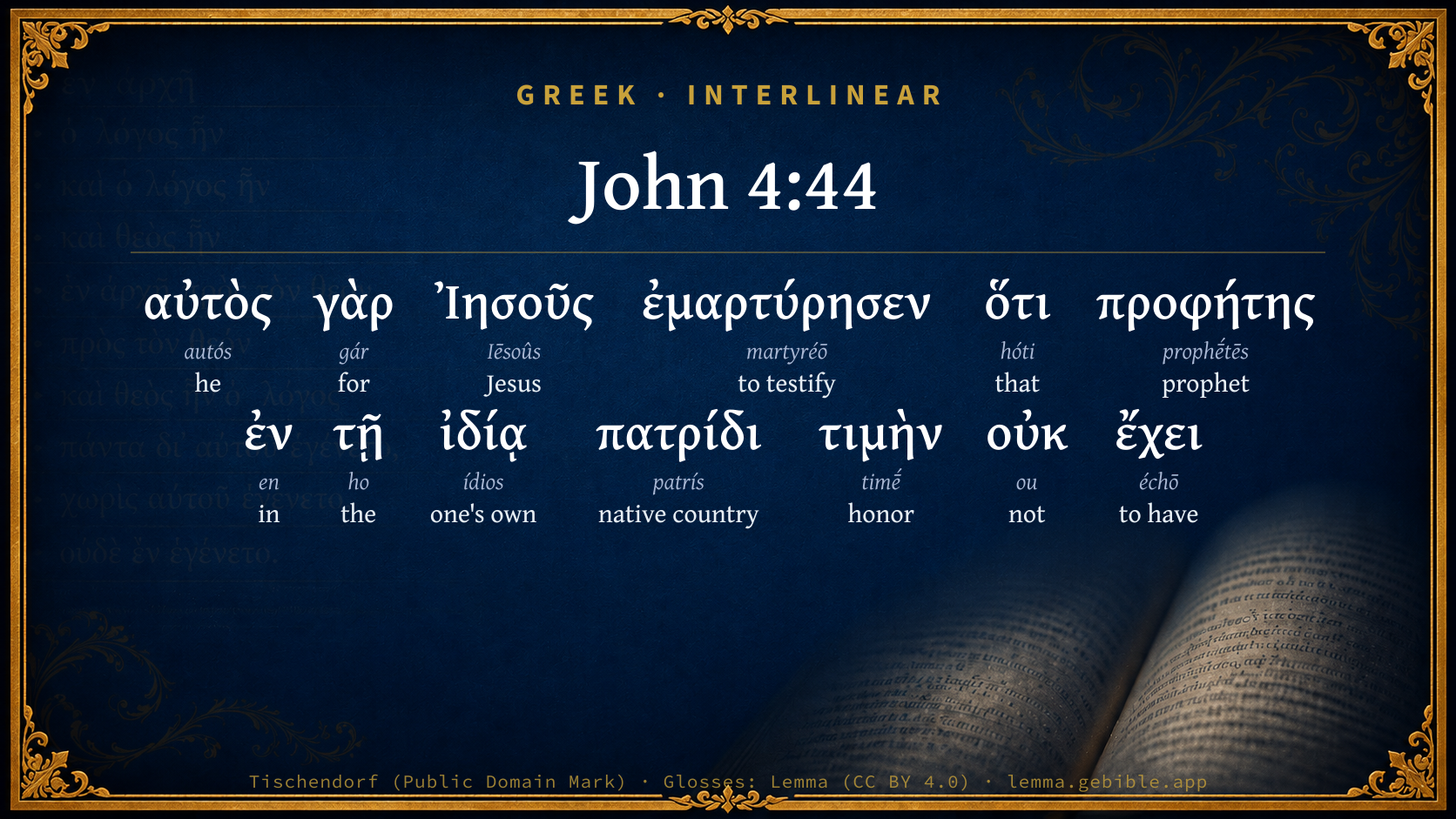
Greek (Tischendorf 8th ed.) John 4:44 appears in the Greek New Testament. The text above is from the Tischendorf 8th edition. Each word links to its Strong’s number and a concise gloss. Click any word for its full Thayer’s Greek Lexicon entry.
Download image
Cite this verse

John 4:44 (World English Bible). Public Domain. Lemma interlinear Bible study tool, https://lemma.gebible.app/v/john/4/44.

Show BibTeX & RIS
BibTeX
RIS
English Translation
For Jesus himself testified that a prophet has no honor in his own country.
World English Bible · Public Domain
Download a study sheet

One document with this verse’s original text, its word-by-word gloss line, the meaning frame, cross-references with their text, attributed commentary, and full source and license credits — printable, and it pastes into notes with its structure intact.

This verse Autodidact and up

Study sheet (.html) Plain text (.txt)

A passage Seminary Student

Up to 50 verses in one chapter. A passage sheet keeps up to 6 commentary sources and 12 cross-references per verse, in the order this page ranks them, and says so on the sheet whenever that leaves anything out. Ask for a single verse and you get the Autodidact verse sheet above.

Everything on this page stays free to read, with no account — the sheet is a download of what is already on screen, not access to it.

Want to remove ads? Support Godless Engineer
Compare translations 3

The same verse in 3 English versions, stacked beneath the original-language interlinear above. Click any original word for its lexicon entry.

Each is an independent rendering of the whole verse — the interlinear is not word-aligned to these translations.

Highlighted words mark where these versions differ — a whole-verse word diff, not a word-by-word alignment.

  • World English Bible Public Domain
    For Jesus himself testified that a prophet has no honor in his own country.
  • King James Version Public Domain
    For Jesus himself testified, that a prophet hath no honour in his own country.
  • unfoldingWord Literal Text CC BY-SA 4.0
    for Jesus himself testified that a prophet has no honor in his own country.

unfoldingWord Literal Text — © unfoldingWord, licensed CC BY-SA 4.0. Word-aligned USFM3 via Door43 (git.door43.org/unfoldingWord/en_ult).

Versions to compare (up to 4)

3 of 4 selected

Show all 19 translations

Every available English version of this verse, each an independent rendering of the whole verse.

  • World English Bible Public Domain
    For Jesus himself testified that a prophet has no honor in his own country.
  • Berean Standard Bible Public Domain
    Now He Himself had testified that a prophet has no honor in his own hometown.
  • Majority Standard Bible Public Domain
    Now He Himself had testified that a prophet has no honor in his own hometown.
  • King James Version Public Domain
    For Jesus himself testified, that a prophet hath no honour in his own country.
  • American Standard Version (1901) Public Domain
    For Jesus himself testified, that a prophet hath no honor in his own country.
  • Revised Version (1885) Public Domain
    For Jesus himself testified, that a prophet hath no honour in his own country.
  • Geneva Bible (1599) Public Domain
    For Iesus himselfe had testified, that a Prophet hath none honour in his owne countrey.
  • Douay-Rheims (1899) Public Domain
    For Jesus himself gave testimony that a prophet hath no honour in his own country.
  • Young's Literal Translation Public Domain
    for Jesus himself testified that a prophet in his own country shall not have honour;
  • Literal Standard Version CC BY-SA 4.0
    for Jesus Himself testified that a prophet will not have honor in his own country;
  • Unlocked Literal Bible CC BY-SA 4.0
    For Jesus himself declared that a prophet has no honor in his own country.
  • unfoldingWord Literal Text CC BY-SA 4.0
    for Jesus himself testified that a prophet has no honor in his own country.
  • Darby Bible Public Domain
    for Jesus himself bore witness that a prophet has no honour in his own country.
  • World Messianic Bible Public Domain
    For Yeshua himself testified that a prophet has no honor in his own country.
  • Webster's Bible Public Domain
    For Jesus himself testified that a prophet hath no honor in his own country.
  • Free Bible Version CC BY-SA 4.0
    Jesus himself had made the comment that a prophet is not respected in his own country.
  • Bible in Basic English Public Domain
    For Jesus himself said that a prophet has no honour in the country of his birth.
  • Text-Critical English NT CC BY 4.0
    (For Jesus himself had testified that a prophet has no honor in his own hometown.)
  • Tyndale New Testament (1534) Public Domain
    And Iesus him selfe testified that a Prophete hath none honoure in his awne countre.

Literal Standard Version (2020), Covenant Press — licensed CC BY-SA 4.0. Text via the HelloAO Bible API (eBible.org). Unlocked Literal Bible (unfoldingWord) — licensed CC BY-SA 4.0. Text via the HelloAO Bible API (eBible.org). unfoldingWord Literal Text — © unfoldingWord, licensed CC BY-SA 4.0. Word-aligned USFM3 via Door43 (git.door43.org/unfoldingWord/en_ult). Free Bible Version, Dr. Jonathan Gallagher — licensed CC BY-SA 4.0. Text via the HelloAO Bible API (eBible.org).

Word by word

More ways to search: Search by grammar → Find every occurrence → Compare this word →

Practice this passage: Drill this verse → Learn its vocabulary →

About this verse

These counts appear in no published source. They are computed here, from the morphology-tagged text and Lemma’s own curated glosses. What Lemma adds →

13
words
13
distinct lemmas
Gospels
section

Notable vocabulary

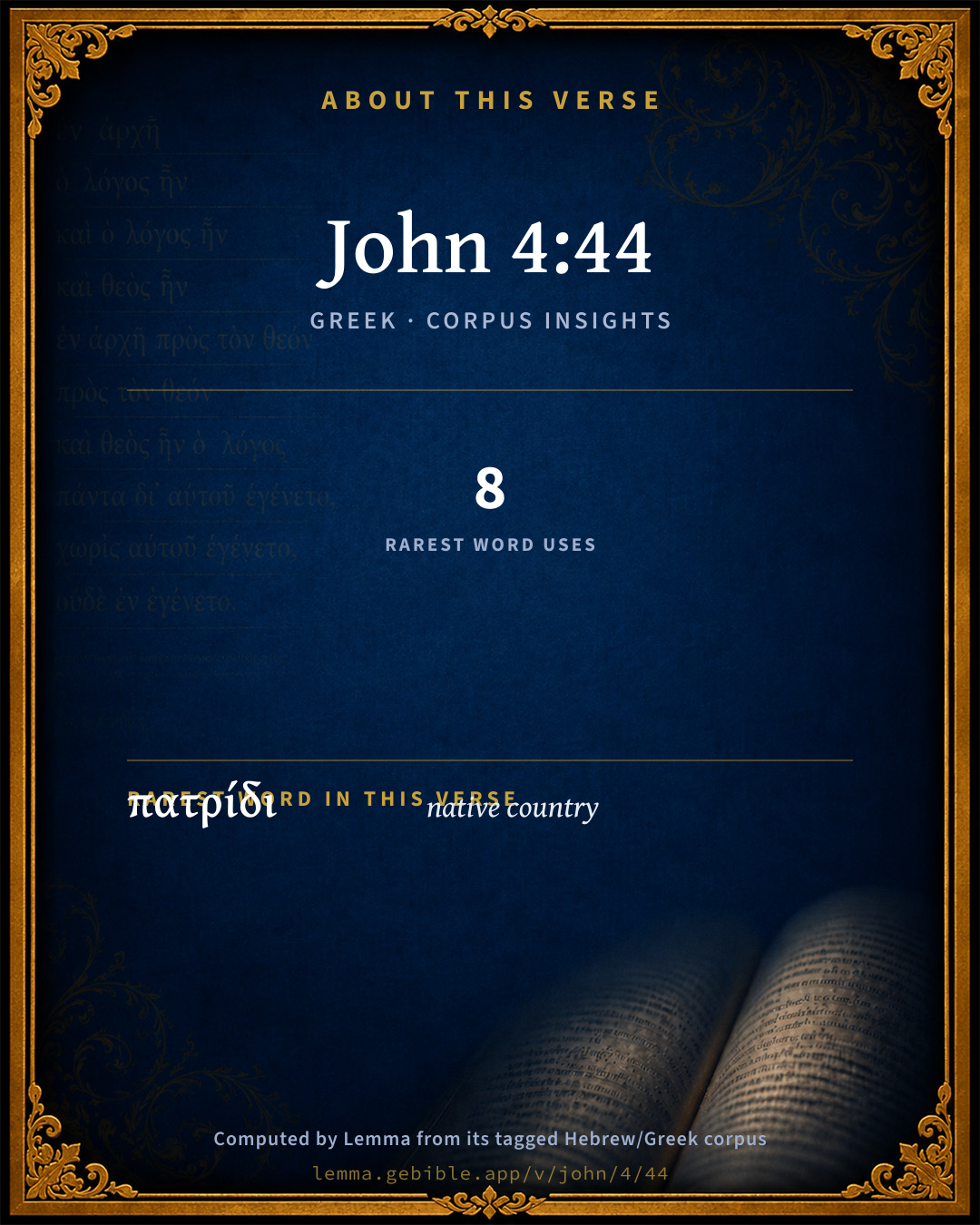
The rarest word here is πατρίδι native country G3968 — appearing just 8 times in the whole Greek New Testament.

Shared distinctive vocabulary

πατρίδι native country G3968 occurs in 8 verses of the Greek New Testament. Also found in:

Cross-references

3

Topical passages linked to John 4:44 in the Treasury of Scripture Knowledge — connected by theme and wording, ordered by reader-vote popularity; previews shown in the World English Bible.

  • Matthew 13:57 They were offended by him. But Jesus said to them, "A prophet is not without honor, except in his own country, and in his own house."
  • Luke 4:24 He said, "Most assuredly I tell you, no prophet is acceptable in his hometown.
  • Mark 6:4 Jesus said to them, "A prophet is not without honor, except in his own country, and among his own relatives, and in his own house."

Cross-references courtesy of OpenBible.info (CC BY 4.0).

Commentary

Notes on John 4:44 from classic Christian and Jewish commentators (each source and its license shown beneath its notes). The classic Christian expositions comment on the surrounding passage and are grouped to its opening verse, so a note may address several verses; the Jewish commentaries on the Tanakh (Rashi and others) are per-verse, so they appear only where the commentator wrote on this verse.

Lemma curates 59 commentaries, every one of them public domain or Creative Commons licensed, each selected and text-cleaned for this edition rather than reprinted as found. About our sources →

Tyndale Open Study Notes

Tyndale Open Resources

4:44-45 Unlike Jesus’ fellow Jews, the Galileans welcomed him, but their welcome was based on awe of Jesus’ miracles (cp. 2:23-25), not true faith.

Tyndale Open Study Notes — © Tyndale Open Resources, licensed CC BY-SA 4.0. Text via the HelloAO Bible API.

Bengel's Gnomon

Johann Albrecht Bengel

Joh 4:44. Πατρίδι, His own country) John presupposes it as a fact known, from ch. Joh 1:46, [Nathanael] “Can anything good come out of Nazareth?” Joh 19:19, [the inscription over the cross, which would be well known] “Jesus of Nazareth,” etc., and from the other evangelists, that Nazareth was the country of Jesus; and hence he infers, from the testimony of Jesus, the reason why He went into Galilee at large, and not to His own country, Nazareth.

Bengel's Gnomon of the New Testament — English translation (T&T Clark, Edinburgh, 1860) — public domain. Text from a community e-Sword module.

Expositor's Greek Testament

ed. W. Robertson Nicoll

Joh 4:44 . The reason for His proceeding to Galilee is given in Joh 4:44 . αὐτὸς γὰρ ὁ Ἰησοῦς ἐμαρτύρησεν , “for Jesus Himself testified”. The evangelist would not have presumed to apply to Jesus the proverbial expression, προφήτης … οὐκ ἔχει , but Jesus Himself used it. The saying embodies a common observation. Montaigne complained that in his own country he had to purchase publishers: while elsewhere publishers purchased him. The difficulty lies in the present application of the saying. If Galilee was His “fatherland,” how can He use this proverb as a reason for His going there? To escape the difficulty Cyril, followed by Calvin, Grotius, and many more, says Nazareth was His πατρίς , and here [ ἀναγκαίαν ποιεῖται τὴν ἀπολογίαν τῆς παραδρομῆς ] he assigns the reason for His passing by Nazareth. πατρίς can be used of a town as in Philo’s Leg. ad Caium , Agrippa says ἔστι δέ μοι Ἱεροσόλυμα πατρίς (Kypke). See also Achilles Tat., 22; Luk 4:23 . But the objection is that Lk. tells us He did go to Nazareth. Origen says Judaea was the πατρίς τῶν προφητῶν ; and Lücke, Westcott, Reith, and others believe that Judaea is here meant; and that Jesus, by citing the proverb, gives the reason for His rejection in Jerusalem. But this is out of place, as He had long since left Jerusalem. Meyer thinks the meaning is that Jesus left Galilee in order to substantiate His Messianic claim in Jerusalem, and this having been accomplished, He returns with His credentials to His own country. This agrees with Joh 4:45 , “having seen the miracles which He had done in Jerusalem”. Weiss interprets the words as meaning that Jesus leaves Samaria, where honour had come unbidden, in order to evoke faith and honour where as yet He had none: thus continuing the hard work of sowing and leaving to the disciples the glad harvesting. This is ingenious; but the obvious interpretation is that which finds in the statement (Joh 4:43-44 ) a resumption of the narrative of Joh 4:1-3 , which had been interrupted by the account of the Lord’s experience in Samaria. That narrative had assigned as the reason for our Lord’s leaving Judaea and making for Galilee, His own over-popularity, which threatened a collision with the Pharisees. To avoid this He goes to Galilee, where, as He Himself said, there was little risk of His being too highly honoured.

The Expositor's Greek Testament, edited by W. Robertson Nicoll (1897–1910) — public domain. Text from a community e-Sword module.

International Critical Commentary

44. προφήτης ἐν τῇ ἰδίᾳ πατρίδι τιμὴν οὐκ ἔχει. The writer does not say that Jesus quoted this familiar Pro_1 when He was passing from Samaria into Galilee. The verse is an editorial comment, illustrative of the context, and only notes that Jesus quoted the saying either then or on some other occasion. The aor. ἐμαρτύρησεν seems to be used like an English pluperfect; cf. the similar aorists ἐποίησεν and ἦλθον in v. 45, “He had done,” “they had come”; cf. also ἐξένευσεν at 5:13. For the verb as applied to explicit sayings of Jesus, cf. 13:21.

The saying is placed in the mouth of Jesus in the Synoptic narratives, at Mar 6:4, Mat 13:57, in the form οὐκ ἔστιν προφήτης ἄτιμος εἰ μὴ ἐν τῇ πατρίδι αὐτοῦ, and in Luk 4:24 as οὐδεὶς προφήτης δεκτός ἐστιν ἐν τῇ πατρίδι αὐτοῦ. In these passages the πατρίς of Jesus is Nazareth, where He was teaching and where His friends and kinsfolk were amazed that “the carpenter, the Son of Mary,” should exhibit such wisdom as His words revealed.

As Jn. applies the proverb, the circumstances were wholly different from those at Nazareth. Jesus had left Judæa, where the Pharisees were beginning to watch Him with suspicion (4:1-3), and was moving via Samaria into Galilee. What does the writer mean here by His having “no honour in His own country”? Alternative explanations have been offered.

(1) If 4:44 refers to the departure of Jesus from Judæa, because His mission was not sufficiently welcomed there, then by His πατρίς Jn. must mean Jerusalem or Judæa. Origen (in Joann. p. 268, and Fragm. in Joann. 4:44) adopts this view. He says that Jerusalem was the πατρίς of all the prophets, and of Jesus as well. Thus 1:11 εἰς τὰ ἴδια ἦλθεν, καὶ οἱ ἴδιοι αὐτὸν οὐ παρέλαβον would provide a parallel for the present verse. But (a) Jesus had made many disciples in Jerusalem already (2:23), and it was His success that had aroused the suspicion of the Pharisees (4:1). And (b) Jn. knew quite well that Jesus was “of Galilee,” which implies that His home or πατρίς was there (see 1:45 and 7:42, 52). It is unlikely that Jn. should allude to Jerusalem as Christ’s πατρίς, more particularly as there are good reasons for holding that he was familiar with Mk.,1 who applies the word to Nazareth.

(2) Some commentators apply 4:44, not to what precedes but to what follows. Jesus had been attracting much notice in Judæa; it was His habit to withdraw Himself, at least in the early stages of His ministry, from a hostile environment (7:1, 10:39), and to seek retirement. He wished, then (so it is urged), to go from Judæa to some place where He might escape unwelcome attention, and He knew from former experience that His old friends in Galilee would not be likely to make too much of Him. According to this view, the citation of the proverb here is a suggestion of the writer that Jesus deliberately chose to go into a territory where He expected that His mission would not arouse public interest. This is highly improbable; and, besides, Jesus was, in fact, cordially received by the people of Galilee (v. 45), and the miracle of the healing of the nobleman’s son is recorded immediately (vv. 46 ff.).

The verse, then, is a gloss the applicability of which to the context is not immediately clear. Perhaps it has been misplaced, but there is no evidence for this. Jn. is prone to insert explanatory reflexions2 or glosses in the body of his narrative, which are not always convincing to modern readers; and this gloss seems to be Johannine. μαρτυρεῖν and ἴδιος are favourite words with Jn.; he is apt to introduce his explanations with γάρ (cf. esp. 5:13 ὁ γὰρ Ἰησοῦς ἐξένευσεν, where, as here, the aor. stands for the pluperfect). τιμή, indeed, is not in Jn.’s vocabulary, and instead of it he always uses δόξα when he would speak of the honour paid by one man to another (see on 1:14); but the proverb as quoted by Mk. has ἄτιμος (although τιμή only occurs in the Synoptists in the sense of “price”; cf. Mat 27:6, Mat 27:9). It is remarkable that the true text of the verse before us gives αὐτὸς γὰρ Ἰησοῦς κτλ. (אABCDWΓΔ Θ) without ὁ, while Jn.’s use is to prefix the def. article to the name Ἰησοῦς (as the rec. text does here); see on 1:29.

We conclude that v. 44 is a gloss, introduced by Jn. or by some later editor from Mar 6:4, suggested by the mention of Galilee, but not apposite in this place.

International Critical Commentary — older volumes (1896–1929), various authors — public domain. Text from a community e-Sword module.

Jamieson, Fausset & Brown

Robert Jamieson, A. R. Fausset & David Brown

For Jesus testified, &c.--This verse had occasioned much discussion. For it seems strange, if "His own country" here means Nazareth, which was in Galilee, that it should be said He came to Galilee because in one of its towns He expected no good reception. But all will be simple and natural if we fill up the statement thus: "He went into the region of Galilee, but not, as might have been expected, to that part of it called 'His own country,' Nazareth (see Mar 6:4; Luk 4:24), for He acted on the maxim which He oft repeated, that 'a prophet,'" &c.

Jamieson, Fausset & Brown — Commentary Critical and Explanatory on the Whole Bible (1871) — public domain (CC PDM 1.0). Text via the HelloAO Bible API.

Adam Clarke's Commentary

Verse 44. Jesus himself testified] He bore testimony to the general truth of the following proverb. See Clarke on Mt 13:57.

Adam Clarke's Commentary on the Bible (1810–1826) — public domain. Text from a community e-Sword/MySword module.

Ellicott's Commentary for English Readers

(44) A prophet hath no honour.—The statement that a prophet hath no honour in his own country is at first thought a strange explanation of the fact that He went into Galilee, and that the Galileans received Him; and the common geographical solutions, as that “His own country” means Judæa, or Nazareth, as distinct from Galilee, or the district of the so-called lower Galilee, are brought to, not from, the text. The narrative of the earlier Gospels places the commencement of the ministry in Galilee. John has in these opening chapters told of an earlier ministry in Judæa and Samaria. He now records the reception in Galilee to which this earlier ministry had been the real introduction. Jesus Himself said so. He knew the principle that a prophet’s own friends are the last to hear his message, and He came to His own country only when that message had been received by many in Judæa and Samaria, and when His own countrymen had seen and known His work at the Passover. Others had received Him at Jerusalem, and they therefore receive Him in Galilee. The honour is brought from without. It does not arise in His own country.

A Bible Commentary for English Readers, edited by Charles John Ellicott (1878–1897) — public domain. Text from a community e-Sword module.

The Cambridge Bible for Schools and Colleges

gen. ed. J. J. S. Perowne

44. For Jesus himself testified] This is a well-known difficulty. As in Joh_20:17, we have a reason assigned which seems to be the very opposite of what we should expect. This witness of Jesus would account for His not going into Galilee: how does it account for His going thither? It seems best to fall back on the old explanation of Origen, that by ‘his own country’ is meant Judaea, ‘the home of the Prophets.’ Moreover, Judaea fits in with the circumstances. He had not only met with little honour in Judaea; He had been forced to retreat from it. No Apostle had been found there. The appeal to Judaea had in the main been a failure.

The Cambridge Bible for Schools and Colleges (gen. ed. J. J. S. Perowne; Cambridge University Press, 1878–1918) — public domain. Text from a community e-Sword module.

John Gill's Exposition

For Jesus himself testified,.... Mat 13:57;

that a prophet hath no honour in his own country: all the Oriental versions read, "in his own city"; that is, Nazareth: for these words must not be understood as a reason why Christ left Judea, and went into Galilee, because he had no honour in Judea, in which was Bethlehem, the place of his nativity; but are a reason why, when he came into Galilee, he did not go to Nazareth, his own city, where he was educated, and had been brought up, and had lived the greatest part of his life, because they treated him with great disrespect and contempt; See Gill on Mat 13:57.

John Gill's Exposition of the Whole Bible (1746–1763) — public domain (CC PDM 1.0). Text via the HelloAO Bible API.

Trapp's Complete Commentary

John Trapp

44 For Jesus himself testified, that a prophet hath no honour in his own country.

Ver. 44. Jesus himself testified] Had testified, when he was cast out at Nazareth; therefore he came no more there. A minister that can do no good once in the place where he lives, is bound to leave, though the fault be not in him, but the people, saith an interpreter here; otherwise (if for self-respects he there abide) it is to be feared that he will lose his gifts, and either fall into errors and heresies, or prove but a dull and dry doctor. Metuendum est ne donum quod acceperis, omittas vel degeneres in errores, vel haereses, vel si retineas puritatem doctrinae, evadas tamen frigidus et aridus doctor. (Rolloc in loc.)

John Trapp, A Commentary or Exposition upon All the Books of the Old and New Testament (1647–1656) — public domain. Text from a community e-Sword module.

Albert Barnes' Notes on the Bible

For Jesus himself testified ... - See the notes at Mat 13:57. The connection of this verse with the preceding may be thus explained: “Jesus went to Galilee, but not to Nazareth, for he testified,” etc. Or, “Jesus went to Galilee, ‘although’ he had said that a prophet had no honor in his own country; yet, because he foreknew that the Galileans would many of them believe on him, he went at this time.”

Albert Barnes' Notes on the Bible (1834–1885) — public domain. Text from a community e-Sword/MySword module.

Haydock's Catholic Bible Commentary

For Jesus himself gave testimony, &c. The connexion and reason given here by the word for, is obscure, when it is said, Jesus went into Galilee and gave testimony that a prophet hath no honour in his own country. One would think this should not be a reason for his going into Galilee, but rather why he should not go thither. St. Cyril,[1] and also St. John Chrysostom distinguish different parts of Galilee; and say that when Jesus went into Galilee, the meaning is, that he would not at that time go to Nazareth, where he was bred, nor to Capharnaum, where he had lived for a time, but went to Cana, and those other parts of Galilee; and that the word for only gives the reason of this, that he would not go to Nazareth or Capharnaum, because no prophet is honoured in his own country. And for the same reason he again said to the ruler: (ver. 48) Unless you see sign and wonders you believe not: whereas the Samaritans, from whom he was now coming readily believed without such miracles. (Witham)

===============================

[BIBLIOGRAPHY]

St. Cyril, in Joan. p. 202. Interjacentem Nazareth præterit, Greek: paratrechei ten Nazareth dia tou mesou keimenen. St. John Chrysostom, hom. xxxiv. in Joan. tom. 8, p. 203. quare addidit, quia, Greek: gar, quod non in Capharnaum, sed in Galileam, et in Cana abiit.

====================

George Leo Haydock (1774–1849), Haydock's Catholic Family Bible and Commentary, 1859 edition — public domain. Excludes Psalms (Douay-Rheims chapter numbering differs from Protestant) and Deuterocanonical books (Catholic canon only).

Matthew Poole's English Annotations

Christ spake those words more than once, Mat 13:57; Mar 6:4; Luk 4:24. But the question is, what force of reason this hath why he went into Galilee, whereas Nazareth, which was in Galilee, was his own country; for though he was born in Bethlehem, yet he was educated at Nazareth; upon which account, Luk 4:23, it is called his own country? The best resolution of this difficulty is, that by Galilee here is to be understood, the country part of Galilee, exclusive to Nazareth; and this is not given as a reason why our Saviour went into Galilee, but why he did not go to Nazareth, but into the country part of Galilee, because Nazareth was his own country, and

a prophet is not without honour, except in his own country.

Matthew Poole's English Annotations on the Holy Bible (1683–1685) — public domain. Text from a community e-Sword/MySword module.

Whedon's Commentary on the Bible

Daniel D. Whedon

44. Prophet… in his own country—From foreign Samaria, where Jesus was honoured, he departs, after a brief sojourn, to his own country, Galilee, where he was, in the comparison, without honour; and he must go to win their honour, and convert, if possible, their hearts from contempt to adoration.

Daniel D. Whedon (gen. ed.), Commentary on the Old and New Testaments (1874–1909) — public domain. Text from a community e-Sword module.

John Wesley's Explanatory Notes

Matt. xiii, 57.

John Wesley, Explanatory Notes Upon the Whole Bible (1754–1765) — public domain. Text via the GEBible commentary corpus.

Cambridge Greek Testament for Schools and Colleges

44. αὐτὸς γὰρ κ.τ.λ. This is a well-known difficulty. As in Joh 20:17, we have a reason assigned which seems to be the very opposite of what we should expect. This witness of Jesus would account for His not going into Galilee: how does it account for His going thither? It seems best to fall back on the old explanation of Origen, that by ‘His own country’ is meant Judaea, ‘the home of the Prophets,’ and, we may add, the land of His birth, for centuries connected with Him by prophecy. Moreover, Judaea fits in with the circumstances. He had not only met with little honour in Judaea; He had been forced to retreat from it. No Apostle had been found there. The appeal to Judaea had in the main been a failure. True that the Synoptists record a similar saying (Mat 13:57; Mar 6:4; Luk 4:24) not in relation to Judaea, but to Nazareth, ‘where He had been brought up.’ But as they record the Galilaean, and S. John the Judaean ministry, it is only natural that a saying capable of various shades of meaning, and perhaps uttered on more than one occasion, should be applied in different ways by them and by S. John. Origen’s explanation accounts quite satisfactorily not only for the γάρ here, but also for the οὖν in Joh 4:45, which means When therefore He came into Galilee, the welcome which He received proved the truth of the saying; ‘Galilee of the Gentiles’ received Him whom οἱ ἴδιοι (Joh 1:11), the Jews of Jerusalem and Judaea, had rejected.

Cambridge Greek Testament for Schools and Colleges (Cambridge University Press, 1896; 21 vols, various authors incl. Carr, Maclear, Plummer, Farrar, Lumby, Moule, M. R. James, Simcox) — public domain. Text from a community e-Sword module.

Alford’s Greek Testament

Henry Alford

44.] Much difficulty has been found in the connexion of this verse, but unnecessarily. Some have supposed that the Evangelist means Judæa by ἡ ἰδία πατρίς (, Lücke (second edn., but see below), Ebrard, &c.),—which cannot be, for there is no allusion to Judæa at all here, as He came from Samaria, and the verse manifestly alludes to His journey into Galilee:—some, that Capernaum is meant, or Nazareth, and ‘He went into Galilee,’ as distinguished from one or other of these places (Chrys., Euthym., Cyril, Olsh.);—but neither can this be, for our Evangelist does not so lightly pass over the reasons of the remarks he makes, and there is no allusion to any city in Galilee, but to His going into Galilee in general.

Some again suppose it to be a reason why He did not go into Galilee before, but remained in Judæa and Samaria (Theophyl., Meyer (1), and somewhat similarly Neander, L. J. 385, and Jacobi); this however would be equally alien from the simplicity of John’s style, and not in accordance with the fact of almost all His teaching and working being in Galilee. Nor is γάρ to be rendered ‘although’ (Kuinoel)—a sense (Lücke, 1. 613) which it never has. One admissible view is (Tholuck, Lücke (third edn.), De Wette), that this verse refers to the next following, and indeed to the whole narrative which it introduces. It stands as a preliminary explanation of the ‘Except ye see signs and wonders, ye will not believe;’ and as indicating the contrast between the Samaritans, who believed on Him for His word,—and His own countrymen, who only received Him because they had seen the miracles which He did at Jerusalem. Such use of γάρ is not unexampled (see Hartung, Partikellehre, i. p. 467; Lücke, 467; Thol.; De Wette; and Matthiæ, Gr. Gr. § 615). In Herod. 1. 124 we have ὦ παῖ Καμβύσεω, σὲ γὰρ θεοὶ ἐπορέωσι· οὐ γὰρ ἄν κοτε ἐς τοσοῦτον τύχης ἀπίκεν· σὺ νῦν Ἀστυάγεα τὸν σεωυτοῦ φονέα τίσαι. Soph. Antig. 393: ἀλλʼ, ἡ γὰρ ἐκτὸς καὶ παρʼ ἐλπίδας χαρὰ | ἔοικεν ἄλλῃ μῆκος οὐδὲν ἡδονῇ, | ἥκω κ.τ.λ. And thus the οὖν in the next verse will be a particle connecting it with this preliminary reason given. But ἐμαρτύρησεν is not to be taken as a pluperfect.

A simpler view still is this: the reason (ver. 1) why He left Judæa for Galilee was, because of the publicity which was gathering round Himself and his ministry. He betakes Himself to Galilee therefore, to avoid fame, testifying that His own country (Galilee) was that where, as a prophet, He was least likely to be honoured.

Henry Alford, The Greek Testament (1849–1861) — public domain. Text from a community e-Sword module.

Vincent's Word Studies in the New Testament

Marvin R. Vincent

For - in His own country [γαρ - εν τη ιδια πατριδι] . For assigns the reason why Jesus went into Galilee. By His own country, Judaea seems to

Marvin R. Vincent, Word Studies in the New Testament (1887–1900) — public domain. Text from a community e-Sword/MySword module.

Godet's Commentaries

Frédéric Louis Godet

Ver. 44. Αὐτός, he, the same who apparently was acting in an opposite way. The solution of the contradiction is given in Joh 4:45. ᾿Εμαρτύρησεν, testified, can here, whatever Meyer, Weiss, etc., may say, have only the sense of the pluperfect, like ἐποίησεν and ἦλθον which follow. It is difficult to believe, indeed, that John quotes here, for the purpose of explaining the conduct of Jesus, a declaration which was uttered at an epoch much farther on, like that of Mar 6:4. Comp. Luk 4:24, which assigns to this saying a much earlier date. The idea of the quoted proverb is that one is less disposed to recognize a superior being in a fellow countryman, very nearly connected with us, than in a stranger who is clothed, to our view, in a veil of mystery. But after that this same man has brought himself to notice elsewhere and on a wider theatre, this glory opens the way for Him to the hearts of His own fellow- citizens. That moment had arrived for Jesus; this is the reason why He now braves the vulgar prejudice which He had Himself pointed out; and of which we have seen an instance in the reply of Nathanael, Joh 1:47. And the success justifies this course. The words πάντα ἑωρακότες, having seen ..., explain the ἐδέξαντο, they received:there is undoubtedly an allusion to Joh 2:23-25. This verse finds its commentary in Luk 4:14-15 : “And Jesus returned to Galilee in the power of the Spirit, and his fame spread abroad through all the region round about; and He taught in their synagogues, being glorified by all.”

Frédéric Louis Godet — Commentaries on Luke, John, Romans, and 1 Corinthians — English translation (T&T Clark, Edinburgh, 1870s–1890s) — public domain. Text from a community e-Sword module.

Lesson kit

Teaching starters — assembled from the data on this page, not authored interpretation. Every prompt links to the verse data it draws on. Edit before teaching.

John, in the Gospels, opens this verse with 13 words (13 distinct Greek lemmas). Its most distinctive word is patrís (“native country”). A historical commentator’s framing appears above. Read the whole chapter for the surrounding context.

Discussion questions

  1. The word patrís carries the sense “native country.” How does it shape the verse?
  2. How does Matthew 13:54, which shares the word «native country», read alongside this verse?
  3. These translations render this verse differently; the difference is in the English rendering, not the original. What questions does that raise?
  4. Compare how Tyndale Open Study Notes and Bengel's Gnomon read this verse. Where do they agree or differ?

Things to notice

Reading settings

Reading text

Shown beneath each verse's original-language words.

Old Testament
Old Testament edition

Read the OT as the Masoretic Hebrew (MT) or the Greek Septuagint (LXX).

English shown for the Greek Septuagint (in the Hebrew ↔ Greek comparison).

Comparing translations? Open the Compare panel on any verse page to stack up to four side by side.