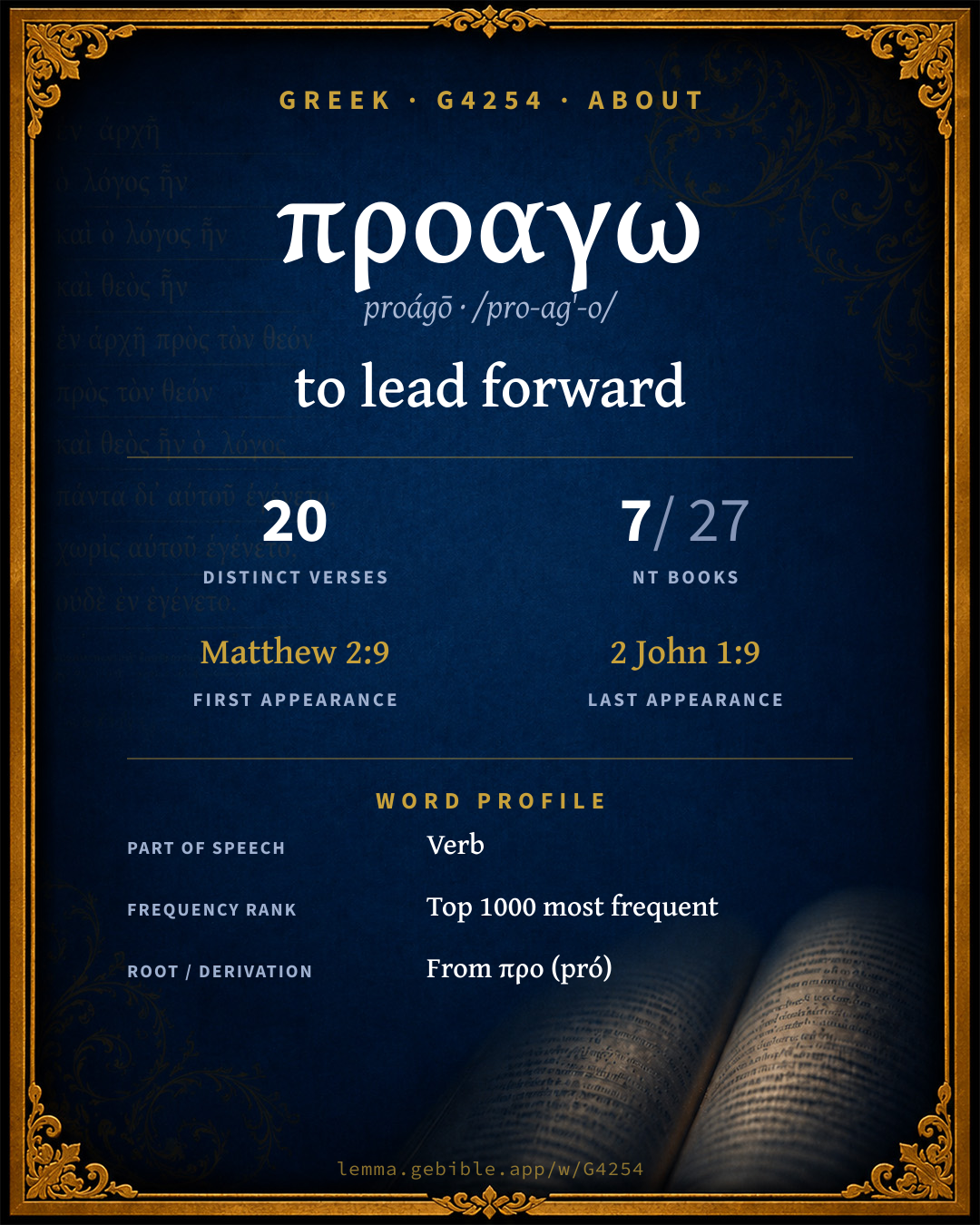
προάγω
to lead forward
‘to lead forward’ is one of 3 main senses fuller range ↓
Full lexicon entry — Thayer's Greek Lexicon
From Thayer's Greek Lexicon
Where this word appears
See every Present-tense verb in the Greek New Testament →
Grammar key — what these labels mean
Part of speech
- Verb
- An action or state-of-being word.
Tense
- Present
- Ongoing or general action in present time (imperfective aspect).
- Aorist
- Action viewed as a simple whole, without regard to duration — often past (perfective aspect).
- Future
- Action expected in future time.
- Imperfect
- Continuous or repeated action in past time (“was writing”).
Voice
- Active
- The subject performs the action.
Mood
- Participle
- A verbal adjective (“writing,” “having written”).
- Infinitive
- A verbal noun (“to write”), unmarked for person or number.
- Indicative
- States a fact or asks a factual question (the mood of reality).
Case
- Nominative
- The case of the subject (and the predicate nominative).
- Accusative
- The case of the direct object and of extent.
- Genitive
- The case of source, possession, or “of” — answers “whose / from what.”
Person
- 1st person
- The speaker (“I / we”).
- 3rd person
- The one spoken about (“he / she / it / they”).
Gender
- Masculine
- Grammatically masculine.
- Feminine
- Grammatically feminine.
Number
- Plural
- More than one.
- Singular
- One.
Grammatical forms 13 distinct
- Verb, Present, Active, Participle, Nominative, Plural, Masculine 3 times (15%)
- Verb, Aorist, Active, Infinitive 2 times (10%)
- Verb, Future, Active, Indicative, 1st person, Singular 2 times (10%)
- Verb, Present, Active, Indicative, 3rd person, Singular 2 times (10%)
- Verb, Present, Active, Infinitive 2 times (10%)
- Verb, Present, Active, Participle, Nominative, Singular, Masculine 2 times (10%)
- Verb, Aorist, Active, Indicative, 1st person, Singular 1 time (5%)
- Verb, Aorist, Active, Participle, Nominative, Singular, Masculine 1 time (5%)
+5 more forms (5 occurrences)
Parsed forms decoded from the imported morphology (Robinson–Tischendorf, public domain), counted across 20 parsed occurrences — not distinct verses.
Every verse where G4254 appears — 20 distinct verses across 7 books. Click any verse to open its interlinear word-by-word view. Verse text shown in the World English Bible for context — . Each verse’s Greek form is shown with its reference; the English is not keyword-highlighted, since the data carries no word-level English alignment. Use “Compare translations” on any verse to read it across multiple English versions. This concordance covers the Greek New Testament; Septuagint (Greek Old Testament) occurrences of this word are not indexed here.
Matthew 6 verses
- Matthew 2:9 προῆγεν impf act ind 3sg They, having heard the king, went their way; and behold, the star, which they saw in the east, went before them, until it came and stood over where the young child was.
- Matthew 14:22 προάγειν pres act inf Immediately Jesus made the disciples get into the boat, and to go ahead of him to the other side, while he sent the multitudes away.
- Matthew 21:9 προάγοντες pres act ptcp nom pl masc The multitudes who went before him, and who followed kept shouting, "Hosanna to the son of David! Blessed is he who comes in the name of the Lord! Hosanna in the highest!"
- Matthew 21:31 προάγουσιν pres act ind 3pl Which of the two did the will of his father?" They said to him, "The first." Jesus said to them, "Most assuredly I tell you that the tax collectors and the prostitutes are entering into the Kingdom of God before you.
- Matthew 26:32 προάξω fut act ind 1sg But after I am raised up, I will go before you into Galilee."
- Matthew 28:7 προάγει pres act ind 3sg Go quickly and tell his disciples, 'He has risen from the dead, and behold, he goes before you into Galilee; there you will see him.' Behold, I have told you."
Mark 5 verses
- Mark 6:45 προάγειν pres act inf Immediately he made his disciples get into the boat, and to go ahead to the other side, to Bethsaida, while he himself sent the multitude away.
- Mark 10:32 προάγων pres act ptcp nom sg masc They were on the way, going up to Jerusalem; and Jesus was going in front of them, and they were amazed; and those who followed were afraid. He again took the twelve, and began to tell them the things that were going to happen to him.
- Mark 11:9 προάγοντες pres act ptcp nom pl masc Those who went in front, and those who followed, cried out, "Hosanna! Blessed is he who comes in the name of the Lord!
- Mark 14:28 προάξω fut act ind 1sg However, after I am raised up, I will go before you into Galilee."
- Mark 16:7 προάγει pres act ind 3sg But go, tell his disciples and Peter, 'He goes before you into Galilee. There you will see him, as he said to you.'"
Luke 1 verse
Acts 4 verses
- Acts 12:6 προαγαγεῖν aor act inf The same night when Herod was about to bring him out, Peter was sleeping between two soldiers, bound with two chains. Guards in front of the door kept the prison.
- Acts 16:30 προαγαγὼν aor act ptcp nom sg masc and brought them out and said, "Sirs, what must I do to be saved?"
- Acts 17:5 προαγαγεῖν aor act inf But the unpersuaded Jews took along some wicked men from the marketplace, and gathering a crowd, set the city in an uproar. Assaulting the house of Jason, they sought to bring them out to the people.
- Acts 25:26 προήγαγον aor act ind 1sg Of whom I have no certain thing to write to my lord. Therefore I have brought him forth before you, and especially before you, King Agrippa, that, after examination, I may have something to write.
1 Timothy 2 verses
- 1 Timothy 1:18 προαγούσας pres act ptcp acc pl fem This charge I commit to you, my child Timothy, according to the prophecies which led the way to you, that by them you may wage the good warfare;
- 1 Timothy 5:24 προάγουσαι pres act ptcp nom pl fem Some men's sins are evident, preceding them to judgment, and some also follow later.
Hebrews 1 verse
2 John 1 verse
About this entry
At a glance — auto-summarized from this page’s data, not written by a person. Every figure links to its source below. This summary describes the numbers; it doesn’t interpret them.
At its core, προαγω (proágō) means “to lead forward.” It first appears in Matthew 2:9. Spanning 20 verses in 7 books, it ranks among the uncommon words of the Greek New Testament. Its uses concentrate in Matthew (30% of all occurrences). Ranging over 3 senses, it is not a single-sense word. Dig into 20-verse concordance and the renderings breakdown below.
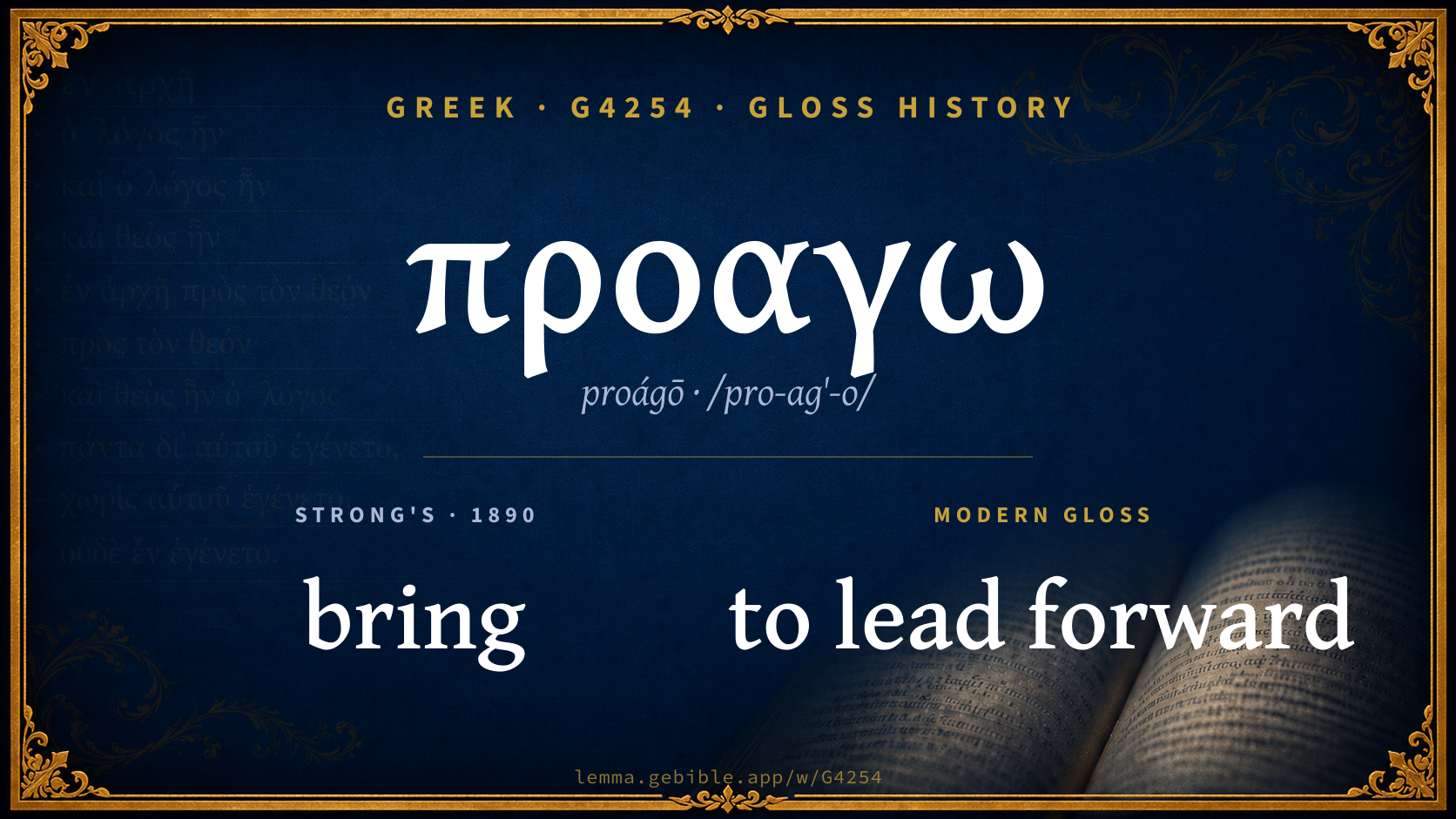
Gloss history
Strong's 1890 vs modern scholarship
About this word
Strong's G4254 catalogs a Greek word from the Greek New Testament.
These counts are not copied from any lexicon or concordance. They are computed here, from the morphology-tagged Greek New Testament. What Lemma adds →
- 20
- distinct verses
- The word appears in 20 distinct verses.
- 7 / 27
- NT books
- The word appears in 7 of 27 New Testament books.
- #622
- by frequency
- Top 1000 most frequent Greek words (rank 622 of 5,347 Greek words by occurrence).
View all 20 occurrences in the concordance →
By section of the New Testament
By traditional corpus
Conventional, traditional groupings — biblical authorship is debated, so this is a traditional corpus grouping, not an authorship claim. Some books belong to more than one corpus (Luke is in both the Gospels and the Lukan corpus, and so on), so these shares overlap and need not total 100%. Each figure is a share of the word’s 20 distinct verses.
- Gospels 12 verses · 60%
- Lukan (Luke–Acts) 5 verses · 25%
- Pauline corpus 2 verses · 10%
- Johannine 1 verse · 5%
- Hebrews 1 verse · 5%
- General (Catholic) Epistles 1 verse · 5%
How translations render this word
Counts come from each version’s own published word-to-Strong’s tagging or interlinear alignment — an approximate guide to how each version renders this word, not a word-level alignment the data otherwise carries. Because each total is that version’s own tagged count, the per-version totals vary from one another and need not match the appearance or distinct-verse counts above. These counts may also differ from a printed concordance because Lemma counts each distinctly tagged rendering and does not collapse phrase taggings into a single head-word total. This is a fixed set of word-tagged versions (KJV, ASV, BSB, ULT) and does not change with the reading translation you choose elsewhere. Each version’s license is shown beside its name below (and on Sources).
- King James Version: Before 3×, Went before 3×, Forth 2×
- American Standard Version: Went before 4×, Forth 2×, Go 2×
- Berean Standard Bible: Go on ahead of 2×, Went ahead 2×, Will go ahead of 2×
- unfoldingWord Literal Text: Going ahead 2×, Going before 2×, He is going before 2×
King James Version Public Domain
Renders G4254 across 22 tagged occurrences — most commonly:
Plus 6 renderings that appear only once — usually multi-word phrases or single function words the recovered tagging swept in, not distinct renderings.
American Standard Version Public Domain
Renders G4254 across 22 tagged occurrences — most commonly:
Plus 10 renderings that appear only once — usually multi-word phrases or single function words the recovered tagging swept in, not distinct renderings.
Berean Standard Bible Public Domain
Renders G4254 across 20 tagged occurrences — most commonly:
Plus 14 renderings that appear only once — usually multi-word phrases or single function words the recovered tagging swept in, not distinct renderings.
unfoldingWord Literal Text CC BY-SA 4.0
Renders G4254 across 23 tagged occurrences — most commonly:
Plus 13 renderings that appear only once — usually multi-word phrases or single function words the recovered tagging swept in, not distinct renderings.
Senses in Thayer's
The 3 senses Thayer's distinguishes for this word, in lexicon order (not ranked by frequency or importance). The full entry — with sub-senses — is in the Lexicon Entry tab.
- to lead forward, lead forth
- preceding, prior in time, previous
- to proceed, go forward
Word origin
Derived from προ (pró) (G4253) — before.
Forms in the corpus
The 13 distinct written forms G4254 takes in the Greek New Testament, most frequent first — each parse links to that tense’s occurrences in the concordance.
Same root — word family
Other Thayer's entries built from the same root as G4254, grouped by Strong’s listed origin. These share a root / origin per the lexicon — not necessarily a shared meaning. Each links to that word’s own entry.
Derives from
Shares the same root
- πορρω pórrhō G4206 far
- πρηνης prēnḗs G4248 headlong
- πριν prín G4250 before
- προαιρεομαι proairéomai G4255 to choose before
- προαιτιαομαι proaitiáomai G4256 to charge previously
- προακουω proakoúō G4257 to hear before
- προαμαρτανω proamartánō G4258 to sin before
- προαυλιον proaúlion G4259 porch
- προβαινω probaínō G4260 to go forward
- προβαλλω probállō G4261 to throw forward
- προβιβαζω probibázō G4264 to drag forward
- προβλεπω problépō G4265 to foresee
- προγινομαι progínomai G4266 to come before
- προγινωσκω proginṓskō G4267 to foreknow
- προγραφω prográphō G4270 to write before
- προδηλος pródēlos G4271 manifest
- προδιδωμι prodídōmi G4272 to give before
- προειδω proeídō G4275 to foresee
- προελπιζω proelpízō G4276 to hope before
- προεπω proépō G4277 to say before
- προεναρχομαι proenárchomai G4278 to begin before
- προεπαγγελλομαι proepangéllomai G4279 to promise before
- προερεω proeréō G4280 to say before
- προερχομαι proérchomai G4281 to go before
+47 more words share this root (not shown).
Proper names from this root
People and places named from this root — a name, not an additional meaning of the word.
Compare all same-root words → Showing 4 of 74 — not the complete family. 1 of the same-root words is a proper name (a person or place). They share a root, not necessarily a meaning.
Septuagint usage
The same Greek word προαγω appears 3 times in the Greek Old Testament (Septuagint), across 3 verses in 2 books.
- 3
- LXX occurrences
- Tagged occurrences of this Greek word in the Septuagint.
- 3
- verses
- Distinct Septuagint verses containing this word.
- 2 / 39
- OT books
- The word appears in 2 of the 39 Old Testament books.
Sample Septuagint occurrences
- Esther 2:21 προἄγω
- Proverbs 4:27 προἄγω
Septuagint occurrences (same lexeme)
Every verse where the same Strong’s number (G4254) appears in the Greek Septuagint. Verse text shown in the World English Bible for context; the Greek form is the matched word — the English is not keyword-highlighted.
- Esther 2:21 προἄγω In those days, while Mordecai was sitting in the king's gate, two of the king's chamberlains, Bigthan and Teresh, of those who kept the threshold, were angry, and sought to lay hands on the king Ahasuerus.
- Proverbs 4:27 προἄγω Don't turn to the right hand nor to the left. Remove your foot from evil.
- Proverbs 6:8 προἄγω Provides her bread in the summer, And gathers her food in the harvest.
These are occurrences of the same Greek lexeme (G4254) in the Septuagint — not a translation of any one Hebrew word. The store carries no word-level Hebrew↔Greek alignment, so no Hebrew original is asserted here. Counts come from the recovered LXX Strong's tagging — high-frequency vocabulary is well covered, while rare or late forms may be untagged — so they reflect tagged occurrences and may slightly undercount.