1 Thessalonians 2:15

Greek (Tischendorf 8th ed.) 1 Thessalonians 2:15 appears in the Greek New Testament. The text above is from the Tischendorf 8th edition. Each word links to its Strong’s number and a concise gloss. Click any word for its full Thayer’s Greek Lexicon entry.
Download image
Cite this verse

1 Thessalonians 2:15 (World English Bible). Public Domain. Lemma interlinear Bible study tool, https://lemma.gebible.app/v/1-thessalonians/2/15.

Show BibTeX & RIS
BibTeX
RIS
English Translation
who killed both the Lord Jesus and their own prophets, and drove us out, and didn't please God, and are contrary to all men;
World English Bible · Public Domain
Download a study sheet

One document with this verse’s original text, its word-by-word gloss line, the meaning frame, cross-references with their text, attributed commentary, and full source and license credits — printable, and it pastes into notes with its structure intact.

This verse Autodidact and up

Study sheet (.html) Plain text (.txt)

A passage Seminary Student

Up to 50 verses in one chapter. A passage sheet keeps up to 6 commentary sources and 12 cross-references per verse, in the order this page ranks them, and says so on the sheet whenever that leaves anything out. Ask for a single verse and you get the Autodidact verse sheet above.

Everything on this page stays free to read, with no account — the sheet is a download of what is already on screen, not access to it.

Want to remove ads? Support Godless Engineer
Compare translations 3

The same verse in 3 English versions, stacked beneath the original-language interlinear above. Click any original word for its lexicon entry.

Each is an independent rendering of the whole verse — the interlinear is not word-aligned to these translations.

Highlighted words mark where these versions differ — a whole-verse word diff, not a word-by-word alignment.

  • World English Bible Public Domain
    who killed both the Lord Jesus and their own prophets, and drove us out, and didn't please God, and are contrary to all men;
  • King James Version Public Domain
    Who both killed the Lord Jesus, and their own prophets, and have persecuted us; and they please not God, and are contrary to all men:
  • unfoldingWord Literal Text CC BY-SA 4.0
    the ones having killed both the Lord Jesus and the prophets and having persecuted us and not being pleasing to God and hostile to all men,

unfoldingWord Literal Text — © unfoldingWord, licensed CC BY-SA 4.0. Word-aligned USFM3 via Door43 (git.door43.org/unfoldingWord/en_ult).

Versions to compare (up to 4)

3 of 4 selected

Show all 19 translations

Every available English version of this verse, each an independent rendering of the whole verse.

  • World English Bible Public Domain
    who killed both the Lord Jesus and their own prophets, and drove us out, and didn't please God, and are contrary to all men;
  • Berean Standard Bible Public Domain
    who killed both the Lord Jesus and their own prophets, and drove us out as well. They are displeasing to God and hostile to all men,
  • Majority Standard Bible Public Domain
    who killed both the Lord Jesus and their own prophets, and drove us out as well. They are displeasing to God and hostile to all men,
  • King James Version Public Domain
    Who both killed the Lord Jesus, and their own prophets, and have persecuted us; and they please not God, and are contrary to all men:
  • American Standard Version (1901) Public Domain
    who both killed the Lord Jesus and the prophets, and drove out us, and pleased not God, and are contrary to all men;
  • Revised Version (1885) Public Domain
    who both killed the Lord Jesus and the prophets, and drave out us, and please not God, and are contrary to all men;
  • Geneva Bible (1599) Public Domain
    Who both killed the Lord Iesus and their owne Prophets, and haue persecuted vs away, and God they please not, and are contrary to all men,
  • Douay-Rheims (1899) Public Domain
    Who both killed the Lord Jesus, and the prophets, and have persecuted us, and please not God, and are adversaries to all men;
  • Young's Literal Translation Public Domain
    who did both put to death the Lord Jesus and their own prophets, and did persecute us, and God they are not pleasing, and to all men `are' contrary,
  • Literal Standard Version CC BY-SA 4.0
    who put to death both the Lord Jesus and their own prophets, and persecuted us, and they are not pleasing God, and [are] contrary to all men,
  • Unlocked Literal Bible CC BY-SA 4.0
    It was the Jews who killed both the Lord Jesus and the prophets. It was the Jews who drove us out. They do not please God. Instead, they are hostile to all people.
  • unfoldingWord Literal Text CC BY-SA 4.0
    the ones having killed both the Lord Jesus and the prophets and having persecuted us and not being pleasing to God and hostile to all men,
  • Darby Bible Public Domain
    who have both slain the Lord Jesus and the prophets, and have driven us out by persecution, and do not please God, and [are] against all men,
  • World Messianic Bible Public Domain
    who killed both the Lord Yeshua and their own prophets, and drove us out, and don’t please God, and are contrary to all men,
  • Webster's Bible Public Domain
    Who both killed the Lord Jesus, and their own prophets, and have persecuted us; and they please not God, and are contrary to all men:
  • Free Bible Version CC BY-SA 4.0
    who killed the Lord Jesus and the prophets, and chased us out. They don't please God and they are hostile to everyone,
  • Bible in Basic English Public Domain
    Who put to death the Lord Jesus and the prophets, violently driving us out; who are unpleasing to God and against all men;
  • Text-Critical English NT CC BY 4.0
    who killed the Lord Jesus and their own prophets, and who also drove us out. They displease God and are hostile to all men
  • Tyndale New Testament (1534) Public Domain
    Which as they kylled the lorde Iesus and their awne prophetes even so have they persecuted vs and God they please not and are contrary to all men

Literal Standard Version (2020), Covenant Press — licensed CC BY-SA 4.0. Text via the HelloAO Bible API (eBible.org). Unlocked Literal Bible (unfoldingWord) — licensed CC BY-SA 4.0. Text via the HelloAO Bible API (eBible.org). unfoldingWord Literal Text — © unfoldingWord, licensed CC BY-SA 4.0. Word-aligned USFM3 via Door43 (git.door43.org/unfoldingWord/en_ult). Free Bible Version, Dr. Jonathan Gallagher — licensed CC BY-SA 4.0. Text via the HelloAO Bible API (eBible.org).

Word by word

More ways to search: Search by grammar → Find every occurrence → Compare this word →

Practice this passage: Drill this verse → Learn its vocabulary →

ἐκδιωξάντων
ekdiṓkō
G1559
“to banish”
Verb, Aorist, Active, Participle, Genitive, Plural, Masculine
Part of Speech
Verb
Tense
Aorist
Voice
Active
Mood
Participle
Case
Genitive
Number
Plural
Gender
Masculine
Full Thayer's Definition

Origin: from G1537 and G1377

TDNT: None

1. to drive out, banish 2. to pursue a. to persecute, oppress with calamities
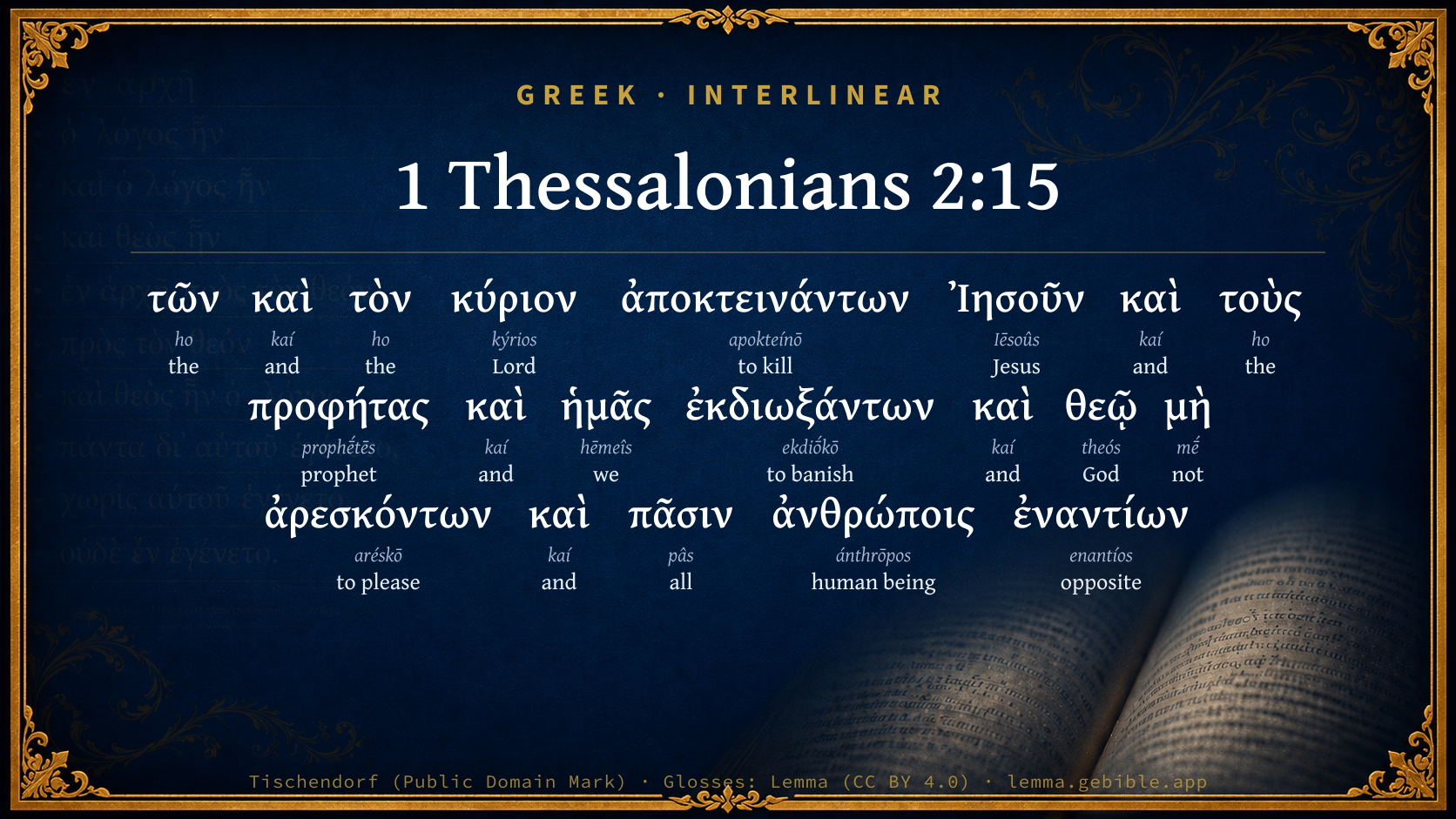
  1. τῶν ho G3588 “the” Article, Genitive, Plural, Masculine
  2. καὶ kaí G2532 “and” Conjunction
  3. τὸν ho G3588 “the” Article, Accusative, Singular, Masculine
  4. κύριον kýrios G2962 “Lord” Noun, Accusative, Singular, Masculine
  5. ἀποκτεινάντων apokteínō G615 “to kill” Verb, Aorist, Active, Participle, Genitive, Plural, Masculine
  6. Ἰησοῦν Iēsoûs G2424 “Jesus” Noun, Accusative, Singular, Masculine
  7. καὶ kaí G2532 “and” Conjunction
  8. τοὺς ho G3588 “the” Article, Accusative, Plural, Masculine
  9. προφήτας prophḗtēs G4396 “prophet” Noun, Accusative, Plural, Masculine
  10. καὶ kaí G2532 “and” Conjunction
  11. ἡμᾶς hēmeîs G2249 “we” Personal pronoun, 1st person, Accusative, Plural
  12. καὶ kaí G2532 “and” Conjunction
  13. θεῷ theós G2316 “God” Noun, Dative, Singular, Masculine
  14. μὴ mḗ G3361 “not” Particle, Negative
  15. ἀρεσκόντων aréskō G700 “to please” Verb, Present, Active, Participle, Genitive, Plural, Masculine
  16. καὶ kaí G2532 “and” Conjunction
  17. πᾶσιν pâs G3956 “all” Adjective, Dative, Plural, Masculine
  18. ἀνθρώποις ánthrōpos G444 “human being” Noun, Dative, Plural, Masculine
  19. ἐναντίων enantíos G1727 “opposite” Adjective, Genitive, Plural, Masculine

About this verse

These counts appear in no published source. They are computed here, from the morphology-tagged text and Lemma’s own curated glosses. What Lemma adds →

20
words
14
distinct lemmas
Pauline Epistles
section

Notable vocabulary

The rarest word here is ἐκδιωξάντων to banish G1559 — appearing just 2 times in the whole Greek New Testament.

Shared distinctive vocabulary

ἐκδιωξάντων to banish G1559 occurs in 2 verses of the Greek New Testament. Also found in:

Repetition

Words recur within this verse:

Cross-references

18

Topical passages linked to 1 Thessalonians 2:15 in the Treasury of Scripture Knowledge — connected by theme and wording, ordered by reader-vote popularity; previews shown in the World English Bible.

  • Matthew 5:12 Rejoice, and be exceedingly glad, for great is your reward in heaven. For that is how they persecuted the prophets who were before you.
  • Luke 11:48–53 So you testify and consent to the works of your fathers. For they killed them, and you build their tombs.
  • Acts 7:52 Which of the prophets didn't your fathers persecute? They killed those who foretold the coming of the Righteous One, of whom you have now become betrayers and murderers.
  • Acts 2:23 him, being delivered up by the determined counsel and foreknowledge of God, you have taken by the hand of lawless men, crucified and killed;
  • Luke 13:33–34 Nevertheless I must go on my way today and tomorrow and the next day, for it can't be that a prophet perish outside of Jerusalem.'
  • Matthew 23:31–35 Therefore you testify to yourselves that you are children of those who killed the prophets.
  • Matthew 23:37 "Jerusalem, Jerusalem, who kills the prophets, and stones those who are sent to her! How often would I have gathered your children together, even as a hen gathers her chickens under her wings, and you would not!
  • Matthew 27:25 All the people answered, "May his blood be on us, and on our children!"
  • Luke 24:20 and how the chief priests and our rulers delivered him up to be condemned to death, and crucified him.
  • Acts 3:15 and killed the Prince of life, whom God raised from the dead, to which we are witnesses.
  • Esther 3:8 Haman said to king Ahasuerus, There is a certain people scattered abroad and dispersed among the peoples in all the provinces of your kingdom; and their laws are diverse from [those of] every people; neither keep they the king's laws: therefore it is not for the king's profit to allow them.
  • Acts 5:30 The God of our fathers raised up Jesus, whom you killed, hanging him on a tree.
  • Acts 12:3 When he saw that it pleased the Jews, he proceeded to seize Peter also. This was during the days of unleavened bread.
  • Acts 22:18–21 and saw him saying to me, 'Hurry and get out of Jerusalem quickly, because they will not receive testimony concerning me from you.'
  • 1 Corinthians 10:5 However with most of them, God was not well pleased, for they were overthrown in the wilderness.
  • Amos 7:12 Amaziah also said to Amos, "You seer, go, flee away into the land of Judah, and there eat bread, and prophesy there:
  • Matthew 21:35–39 The farmers took his servants, beat one, killed another, and stoned another.
  • Acts 4:10 be it known to you all, and to all the people of Israel, that in the name of Jesus Christ of Nazareth, whom you crucified, whom God raised from the dead, in him does this man stand here before you whole.

Cross-references courtesy of OpenBible.info (CC BY 4.0).

Where the printed editions differ

2 variants

Places in this verse where the major printed Greek editions disagree on the wording in a way that affects the translation — a comparison of editions, not a manuscript-by-manuscript collation. The editions are the modern critical texts (Nestlé-Aland 28/27, SBL, Westcott-Hort, Tregelles, Tyndale House) and the traditional texts behind the KJV (the Textus Receptus and the Byzantine/Majority text). It is not a claim about which reading is original.

  1. Extra text
    ἰδίους

    “[their] own”

    In TRByz Not in NA28NA27TynSBLWHTreg

    ἰδίους (idious) '[their] own' is only in traditional manuscripts (TR+Byz)

  2. Different wording
    ἡμᾶς

    “us”

    In NA28NA27TynSBLWHTregByzKJV Not in TR

    ὑμᾶς (humas) 'you' occurs in a few manuscripts (TR) instead of ἡμᾶς (hēmas) 'us' in older manuscripts (NA28+NA27+Tyn+SBL+WH+Treg+Byz+KJV)

Textual data: Translators Amalgamated Greek New Testament (STEPBible TAGNT) · CC BY 4.0.

Commentary

Notes on 1 Thessalonians 2:15 from classic Christian and Jewish commentators (each source and its license shown beneath its notes). The classic Christian expositions comment on the surrounding passage and are grouped to its opening verse, so a note may address several verses; the Jewish commentaries on the Tanakh (Rashi and others) are per-verse, so they appear only where the commentator wrote on this verse.

Lemma curates 59 commentaries, every one of them public domain or Creative Commons licensed, each selected and text-cleaned for this edition rather than reprinted as found. About our sources →

The Biblical Illustrator

Joseph S. Exell

1Th_2:15-16

Who both killed the Lord Jesus and their own prophets

Pauls indictment of the Jews

The apostle goes off upon the word Jews to describe the evil deeds of his countrymen.

I. The explanation of the indictment. Various views have been offered.

1. That as the persecution of believers in Thessalonica, though from the heathen, was yet directly instigated by the Jews, it was natural that Paul should turn aside to speak of them and their wickedness.

2. That the apostle, at the very time of writing, was himself suffering at their hands (Act_18:5-6; Act_18:12). His mind, therefore, we can well conceive, was full of thoughts regarding these Jewish misdeeds, and hence he bursts forth into utterances of sorrowful indignation.

3. That the Thessalonians were converts from Polytheism to a monotheistic religion which was a growth out of Judaism, They could, consequently, hardly fail to stumble by seeing Jews everywhere its most violent opponents. Paul may have striven to meet this state of mind, by showing that the opposition of the Jews was in keeping with their whole character and conduct.

II. Its subject matter.

1. The culminating point in Jewish wickedness is the casting out and murder of their Messiah. In ignorance they did it, it is true. Yet that ignorance was no justification, for the prophets, whose testimony was to Christ, the Jews had also slain. This is the indictment of the Old Testament, and also of Christ (Mat_23:29-39). Pauls words are but an echo of his Masters.

2. Seeing, then, that such was their past conduct, Paul adds, as naturally following, and have persecuted us. What had been meted out to Gods servants in the past it was to be expected would be extended to the apostles and believers. Under new conditions the Jewish character would again assert itself.

3. Hence he declares They please not God and are contrary to all men. The more he came in contact with Gentile life, the more he must have observed the intense dislike with which the Jews were everywhere regarded. Despising other nations, they were themselves only loathed by these nations in return; and now that Pauls feelings had broadened into the love of all mankind, he could not but recognize them as showing what Tacitus called adversus omnes alios hostile odium. The mark of Gods anger had been set upon them, and the Divine judgment had been ratified by men. When God loathes aught, men presently loathe it too.

4. But here it is not the dislike felt by others towards the Jews as the animosity of the Jews towards all others. Forbidding us to speak to the Gentiles, etc. Like their own Pharisees they would neither enter in themselves nor allow others to enter.

5. In thus standing in the way of the Gentiles salvation they were acting so as to fill up their own sins alway with fearful perseverance; alike before Christ had come, when He came, and now that He had gone, they had been filling up the measure of their guilt.

6. And now retribution was approaching. Wrath had already fallen, and was falling upon them; but in a short fourteen years it came upon them to the utmost in the destruction of their city and the dispersion of their race. (J. Hutchison, D. D.)

The fury of the old religion against the new

The transition from the old to a new order of things in the progress of religion is not always accomplished without opposition. Age is naturally and increasingly tenacious: and the old religion looks upon the new with suspicion, jealousy, fear, anger. The Jews had resisted the attempts of their own Divinely commissioned prophets to rouse them to a purer faith and life; but their fury reached its climax in their opposition to Christianity. Observe--

I. The fury of the Jews in their inhuman treatment of the great leaders of religious thought.

1. They plotted against the life of the worlds Redeemer; and, in spite of insufficient evidence to convict, and the endeavours of the Roman Procurator to release, they clamoured for His crucifixion, exclaiming, His blood be on us and on our children--a self-invoked imprecation that fell on them with terrible and desolating vengeance!

2. The sin of murder already darkly stained their race--the best and noblest of their prophets being the unoffending victims. Isaiah, Jeremiah, Amos, and Zechariah met with violent deaths. The charge of Stephen was unanswerable (Act_7:52).

3. The apostles were subjected to similar treatment--Have chased and driven us out. They drove them out of Thessalonica, afterwards out of Berea, and were at that moment engaged in instigating an insurrection to drive the apostle out of Corinth. The spirit of persecution is unchanged. Wherever the attempt is made to raise the Church, it is met with a jealous, angry opposition. And yet what a wretched, short-sighted policy does persecution reveal! It is the idolized weapon of the tyrant and the coward, the sport of the brutal, the sanguinary carnival of devils.

II. The fury of the Jews was displeasing to God. They fondly imagined that they were the favourites of heaven, and that all others were excluded from the Divine complacency. They could quote the words of their law, such as Deu_14:2, with the utmost facility, to support their assumption of superiority and exclusiveness, wilfully shutting their eyes to the difference between the holy intention of Jehovah, and their miserable failure to realize that intention. In all their opposition to Christianity they thought they were doing God service. How fatally blinding is sin--goading the soul to the commission of the most horrible crimes under the guise of virtue.

III. The fury of the Jews was hostile to man.

1. Their hostility was directed against the world of mankind. Are contrary to all men. The Jews of that period were the adversaries and despisers of all. Tacitus brands them as the enemies of all men: and Apion, the Egyptian, calls them Atheists and misanthropes, in fact, the most witless and dullest of barbarians.

2. Their hostility was embittered by a despicable religious jealousy. Forbidding us to speak to the Gentiles, etc. Here the fury of the old religion against the new reached its climax. It is the perfection of bigotry and cruelty to deny to our fellow men the only means of salvation! Into what monsters of barbarity will persecution convert men! Pharaoh persisted to such a degree of unreasonableness as to chastise the Hebrews for not accomplishing impossibilities! Julian the Apostate, carried his vengeful spirit to his deathbed.

IV. The fury of the Jews hurried them into irretrievable ruin.

1. Their wickedness was wilfully persistent. To fill up their sins alway--at all times, now as much as ever. So much so, the time is now come when the cup of their iniquity is filled to the brim, and nothing can prevent the consequent punishment. The desire to sin grows with its commission. St. Gregory says, Sinners would live forever that they might sin forever--a powerful argument for the endlessness of future punishment--the desire to sin is endless!

2. Their punishment was inevitable and complete. For the wrath is come upon them to the uttermost--is even now upon them. The process has begun. Their fury to destroy others will accelerate their own destruction. Punishment descended upon the wicked, unbelieving, and resisting Jews; and utter destruction upon their national status and religious supremacy.

Lessons:--

1. There is a fearful possibility of sinking into a lifeless formality, and a blind, infatuate opposition to the good.

2. The rage of man against the truth defeats its own ends and recoils in vengeance on himself. (G. Barlow.)

Guilty of the death of Christ

Bridaine was one of the most celebrated of the French preachers. Marmontel relates that in his sermons he sometimes had recourse to the interesting method of parables, with a view the more forcibly to impress important truths on the minds of his hearers. Preaching on the passion of Jesus Christ, he expressed himself thus:--A man, accused of a crime of which he was innocent, was condemned to death by the iniquity of his judges. He was led to punishment, but no gibbet was prepared, nor was there any executioner to perform the sentence. The people, moved with compassion, hoped that this sufferer would escape death. But one man raised his voice, and said, I am going to prepare a gibbet, and I will be the executioner. You groan with indignation! Well, my brethren, in each of you I behold this cruel man. Here are no Jews today, to crucify Jesus Christ: but you dare to rise up, and say, I will crucify Him. Marmontel adds, that he heard these words pronounced by the preacher, though very young, with all the dignity of an apostle, and with the most powerful emotion; and that such was the effect, that nothing was heard but the sobs of the auditory. For the wrath is come upon them to the uttermost--

The Jews under the wrath of God

Bishop Patrick quotes the following affecting inquiry addressed by Rabbi Samuel Moraccanus to a friend in the eleventh century:--I would fain learn from thee, out of the testimonies of the law, and the prophets, and other Scriptures, why the Jews are thus smitten in this captivity wherein we are, which may be properly termed the perpetual anger of God, because it hath no end. For it is now above a thousand years since we were carried captive by Titus; and yet our fathers, who worshipped idols, killed the prophets, and cast the law behind their back, were only punished with a seventy years captivity, and then brought home again; but now there is no end of our calamities, nor do the prophets promise any. If, says Bishop Patrick, this argument was hard to be answered then, in his days, it is much harder in ours, who still see them pursued by Gods vengeance, which can be for nothing else but rejecting and crucifying the Messiah, the Saviour of the world.

Severity consistent with benevolence

Take the case of an earthly parent. Suppose him to be endowed with all the tenderest sensibilities of nature, conceive of him as delighting in the health and welfare of his children, and, in the exercise of every benevolent affection, lavishing on them all the riches of a fathers kindness and a fathers care. You say, on looking at his benignant countenance and his smiling family, this is an affectionate father. But a secret canker of ingratitude seizes one or more of his children, they shun his presence, or dislike his society, and at length venture on acts of positive disobedience; he warns them, he expostulates with them, but in vain, they revolt more and more; and at length, in the exercise of deliberate thought, he lifts the rod and chastens them; and he who once was the author of all their happiness has become also their calm but firm reprover. And who that knows the tenderness of a fathers love will not acknowledge that, severe as may be the suffering inflicted, such a man doth not afflict willingly, nor grieve the children of his love? Again, conceive of a man of benevolent feelings invested with the office of magistrate or judge--conceive that Howard, the unwearied friend of his race, who visited the prisons of Europe to alleviate the miseries of the worst and most destitute of men--conceive of such a man sitting in judgment over the life or liberty of another, and can you not suppose, that while every feeling within him inclined him to the side of mercy, and his every sensibility would be gratified, were it possible to make the felon virtuous and happy, he might, notwithstanding, have such a deep moral persuasion of the importance of virtue and order to the well-being of the state, that he could consign the prisoner to a dungeon or the gallows, and that, too, with the perfect conviction that it was right and good to do so; while still, every sentiment of the heart within him, if it could be disclosed, would bear witness, that he afflicted not willingly, and that he had no pleasure in the death of the criminal? Such a father, and such a judge is God; and the sufferings which he inflicts, whether they be viewed as corrective or penal, are compatible with the loftiest benevolence in the Divine mind. (Dr. J. Buchanan.)

The Biblical Illustrator, edited by Joseph S. Exell (c. 1880s–1900s) — public domain. Text from a community e-Sword module.

The Preacher's Complete Homiletical Commentary

Joseph S. Exell (gen. ed.)

CRITICAL AND EXPLANATORY NOTES

1Th_2:15. Who both killed.—The New Testament form of the verb is always compound—as we should say, “killed off.” A tragic contrast to what might have been expected is set forth in our Lord’s parable. “It may be they will reverence My Son.” … They cast Him out and killed Him off (Luk_20:13-15). Have persecuted us.—A.V. margin, “chased us out.” R.V. text, “drave.” How deeply humbling was the thought to St. Paul, that he had at one time taken part in this hounding! The A.V. margin gives us a most vivid picture. They please not God.—This expression is thought by some to be a meiosis, a softening down of the hard reality by the negative form of the language. Is not the best comment found in Joh_16:2, “Whosoever killeth you shall think that he offereth service unto God”? The sophistry that makes “killing no murder” and sanctions an auto da fé is something quite other than pleasing to God. Are contrary to all men.—“The sense of God’s displeasure often shows itself in sourness and ill temper towards one’s fellows. Unbelief and cynicism go together. The rancour of the Jews against other nations at this time was notorious.… The quarrel between Judaism and the world, alas, still continues, as the Judenhasse of Germany and Russia testifies” (Findlay).

1Th_2:16. Forbidding us to speak to the Gentiles.—The very spirit of the dog in the manger! They would not even have left the “uncovenanted mercies” to the Gentiles. To fill up their sins alway.—The phrase signifies ripeness for judgment, and is used in Gen_15:16 of the Amorites in Abraham’s time—an ominous parallel (Ibid.). For the wrath.—R.V, “but the wrath.” As though he said, “But the end comes at last; they have always been sowing this harvest; now it has to be reaped” (Ibid.).

MAIN HOMILETICS OF THE PARAGRAPH.—1Th_2:15-16

The Fury of the Old Religion against the New.

It is the natural order of things that the old must give place to the new. The inexorable operation of the law of progress is seen in a thousand different forms. In the world of vegetation the old life is continually yielding supremacy to the new. The leaves, buds, and blossoms of the tree, as they force their way to the light, fling their shadows on the grave where their predecessors lie decayed and buried—life blooming amid the ghastly emblems of death. And, in the world of religious thought and opinion, while divine truth remains in its essence unchangeably the same, old forms and old definitions are ever giving place to the new. The transition from the old to a new order of things in the progress of religion is not always accomplished without opposition. Age is naturally and increasingly tenacious; and the old religion looks upon the new with suspicion, with jealousy, with fear, with anger. The Jews had resisted the attempts of their own divinely commissioned prophets to rouse the nation to a purer faith and more vigorous religious life; but their fury reached its climax in their blind, unreasonable, and fiendish opposition to Christianity. The text describes the fury of the old religion against the new.

I. The fury of the Jews is seen in their inhuman treatment of the great leaders of religious thought.—“Who both killed the Lord Jesus and their own prophets, and have persecuted us” (1Th_2:15).

1. They plotted against the life of the world’s Redeemer; and in spite of insufficient evidence to convict, and the endeavours of the Roman procurator to release, they clamoured for the immediate crucifixion of their innocent Victim, exclaiming in the wild intoxication of malignant passion, “His blood be on us and on our children”—a self-invoked imprecation that fell on them with terrible and desolating vengeance.

2. The sin of murder already darkly stained their race.—The best and noblest of their prophets were unoffending victims: Isaiah, Jeremiah, Amos, Zechariah, met with violent deaths. The charge of the proto-martyr Stephen was unanswerable (Act_7:52).

3. The apostles were subjected to similar treatment.—“And have persecuted us”—have chased and driven us out. They drove them out of Thessalonica, afterwards out of Berœa, and were at that moment engaged in instigating an insurrection to drive the apostle out of Corinth. The spirit of persecution is unchanged. Wherever the attempt is made to raise the Church from the grave of spiritual death and reanimate her creed and ritual with intenser reality and life, it is met with a jealous, angry opposition. What a wretched, short-sighted policy does persecution reveal! It is the idolised weapon of the tyrant and the coward, the sport of the brutal, the sanguinary carnival of demons!

II. The fury of the Jews was displeasing to God.—“They please not God” (1Th_2:15). They fondly imagined they were the favourites of heaven, and that all others were excluded from the divine complacency. They had the words of the law carefully committed to memory, and could quote them with the utmost facility to serve their own purpose. They would support their proud assumption of superiority and exclusiveness by quoting Deu_14:2, wilfully shutting their eyes to the vital difference between the holy intention of Jehovah and their miserably defective realisation of that intention. In their opposition to Christianity they thought they were doing God service; yet all the time they were displeasing to Him. How fatally blinding is sin, goading the soul to the commission of the most horrible crimes under the sacred guise of virtue!

III. The fury of the Jews was hostile to man.—

1. Their hostility was directed against the world of mankind. “Are contrary to all men” (1Th_2:15). The Jews of that period delighted in hatching all kinds of “sedition, privy conspiracy, and rebellion.” They were the adversaries of all, the despisers of all. Tacitus, the Roman historian, brands them as “the enemies of all men”; and Apion, the Egyptian, according to the admission of Josephus, calls them “atheists and misanthropes—in fact, the most witless and dullest of barbarians.”

2. Their hostility was embittered by a despicable religious jealousy.—“Forbidding us to speak to the Gentiles, that they might be saved” (1Th_2:16). Here the fury of the old religion against the new reached its climax. It is the perfection of bigotry and cruelty to deny to our fellow-men the only means of salvation. Into what monsters of barbarity will persecution turn men! Pharaoh persisted to such a degree of unreasonableness as to chastise the Hebrews for not accomplishing impossibilities! Julian, the apostate from Christianity, carried his vengeful spirit to his deathbed, and died cursing the Nazarene!

IV. The fury of the Jews hurried them into irretrievable ruin.—

1. Their wickedness was wilfully persistent. “To fill up their sins always” (1Th_2:16)—at all times, now as much as ever. So much so, the time is now come when the cup of their iniquity is filled to the brim, and nothing can prevent the consequent punishment. The desire to sin grows with its commission. “Sinners,” says St. Gregory, “would live for ever that they might sin for ever”—a powerful argument for the endlessness of future punishment. The desire to sin is endless.

2. Their punishment was inevitable and complete.—“For the wrath is come upon them to the uttermost” (1Th_2:16)—is even now upon them. The process has begun; their fury to destroy others will accelerate their own destruction. Punishment fell upon the wicked, unbelieving, and resisting Jews, and utter destruction upon their national status and religious supremacy (vide Josephus, Wars, Books v., vi.).

Lessons.—

1. There is a fearful possibility of sinking into a lifeless formality, and blind, infatuate opposition to the good.

2. The rage of man against the truth defeats its own ends, and recoils in vengeance on himself.

GERM NOTES ON THE VERSES

1Th_2:15-16. The Persecuting Jews—

I. Often misled by professed zeal for truth.

II. Tortured and murdered the noblest men of their own race.

III. Opposed the gospel with violent and unreasoning severity.

IV. Have themselves been persecuted by all the nations among whom they sojourned.

V. Furnish an unanswerable argument for the truth of Christianity.

The Preacher's Complete Homiletical Commentary (gen. ed. Joseph S. Exell; Funk & Wagnalls, c. 1892) — public domain (pre-1929). A full-Bible homiletical/sermon-outline anthology covering 65 of 66 books (2 John is absent from the source module). Text from a community e-Sword module.

Tyndale Open Study Notes

Tyndale Open Resources

2:15 Paul was not anti-Jewish; out of love for his own people, he prayed for their salvation (Rom 9:1-5; 10:1). But he was aware of the role some of the Jews had in the deaths of God’s messengers, including Jesus (1 Kgs 19:10; Acts 7:52). Now they had persecuted the apostolic messengers in Thessalonica (Acts 17:10; 2 Cor 11:26).

Tyndale Open Study Notes — © Tyndale Open Resources, licensed CC BY-SA 4.0. Text via the HelloAO Bible API.

Bengel's Gnomon

Johann Albrecht Bengel

1Th 2:15. Ἀποκτεινάντων, who have killed) This is indeed the sin of the whole people, their greatest sin, and one not yet acknowledged.—προφήτας, the prophets) This word is construed with who have killed. That former guilt of theirs [in killing the prophets] woke up in all its strength then especially, when they slew the Lord Himself.—ἡμᾶς, us) the apostles.—ἐκδιωξάντων, who have cast out by persecution) Luk 11:49, note.—μὴ ἀρεσκόντων) not seeking to please.—ἐναντίων, and are adverse [contrary]) The Jews regarded the Gentiles with aversion, and were unwilling at that time that the word should be preached to them.

Bengel's Gnomon of the New Testament — English translation (T&T Clark, Edinburgh, 1860) — public domain. Text from a community e-Sword module.

Meyer's Critical & Exegetical Commentary

Heinrich August Wilhelm Meyer

1Th_2:15-16. As to the occasion of this invective, see on 1Th_2:14.

καί] not signifying even; also not to be connected with the next καί, both … and; but τῶν καί means who also, and proves the propriety of the preceding statement from the analogous conduct in 1Th_2:15. Grotius (comp. Chrysostom, Oecumenius, Theophylact, Pelagius): Quid mirum est, si in nos saeviunt, qui dominum nostrum interfecerunt …?… Non debent discipuli meliorem sortem exspectare quam magistri fuit.

Moreover, τὸν κύριον emphatically precedes, and is separated from Ἰησοῦν in order to enhance the enormity of the deed.

καὶ τοὺς προφήτας] De Wette and Koch unite this with ἐκδιωξάντων; Chrysostom, Oecumenius, Theophylact, Calvin, Musculus, Bengel, Pelt, Schott, Olshausen, Baumgarten-Crusius, Bloomfield, Alford, Hofmann, Auberlen, and most critics, more correctly refer it to ἀποκτεινάντων. In the catalogue of the sins of the Jews which Paul here adduces, he begins directly with that deed which formed the climax of their wickednessthe murder of the Son of God, of Jesus the Messiah. In order to cut off all excuses for this atrocious deed of the Jews, as that they had done it in ignorance, not recognising Jesus as the Son of God, Paul adds, going backwards in time, that they had already done the same to the Old Testament prophets, whom, in like manner, they had murdered against their better knowledge and conscience. Christ Himself accuses the Jews of the murder of the prophets, Mat_23:31; Mat_23:37, Luk_11:47 ff; Luk_13:34; and Stephen does the same, Act_7:52; with which passages comp. 1Ki_19:10; 1Ki_19:14 (see Rom_11:3); Jer_2:30; Neh_9:26.

καὶ ἡμᾶς ἐκδιωξάντων] and have persecuted us. ἡμᾶς refers not to Paul only (Calvin), also not to Paul and Silas only (de Wette, Koch, Alford), or to Paul and the companions who happened to be with him at Thessalonica (Auberlen); but to Paul and the apostles generally (Estius, Aretius, Bengel, Koppe, Flatt, Pelt, Schott). The preposition ἐκ in ἐκδιωξάντων strengthens the verbal idea. In an unjustifiable manner, Koppe and de Wette (the latter appealing to Luk_11:49 and Ps. 118:157, LXX.) make it stand for the simple verb.

καὶ Θεῷ μὴ ἀρεσκόντων] and please not God. Erroneously Wieseler on Gal_1:10, p. 41, note, and Hofmann: live not to please God; similarly Bengel, Koppe, Flatt, and Baumgarten-Crusius: placere non quaerentium; for after the preceding strong expressions that would be flat. Rather the result is inferred from the two preceding statements, namely, the consequences of the obstinacy of the Jews, with which they persecute the messengers of God, is that they please not God, that is, are hateful to Him (Θεοστυγεῖς, Meiosis).

καὶ πᾶσιν ἀνθρώποις ἐναντίων] and are hostile to all men. Grotius, Turretin, Michaelis, Koppe, Olshausen, de Wette, Baumgarten-Crusius, Koch, Bloomfield, Jowett, and others, erroneously find here expressed the narrow exclusiveness, by means of which the Jews strictly separated themselves from all other nations, and about which Tacit. Hist. v. 5 (adversus omnes alios hostile odium); Juvenal, Sat. xiv. 103 ff.; Diod. Sic. xxxiv. p. 524; Philostr. Apollon. v. 33; Joseph, c. Apion. ii. 10, 14, wrote. For (1) that hostile odium and desire of separation among the Jews was nothing else than a shrinking from staining themselves and their monotheistic worship by contact with idolaters. But Paul would certainly not have blamed such a shrinking, which was only a fruit of their strict observance of their ancestral religion. (2) If 1Th_2:16 begins with an independent assertion, κωλυόντων … σωθῶσιν would denote nothing essentially new, but would only repeat what was already expressed in ἡμᾶς ἐκδιωξάντων, 1Th_2:15. (3) It is grammatically inadmissible to understand the words καὶ πᾶσιν ἀνθρώποις ἐναντίων as an independent assertion, and thus to be considered as a general truth. For the participle κωλυόντων (1Th_2:16) must contain a causal statement, as it is neither united with καί, nor by an article (καὶ κωλυόντων κ.τ.λ. or τῶν κωλυόντων κ.τ.λ., or τῶν καὶ κωλυόντων κ.τ.λ.), and thus is closely and directly connected with the preceding, and giving a reason for it, i.e. explaining wherefore or in what relation the Jews are to be considered as πᾶσιν ἀνθρώποις ἐναντίοι. Thus the thought necessarily is: And who actually proved themselves to be hostilely disposed to all men since they hindered us from publishing the gospel to the Gentiles, and thus leading them to salvation. That is to say, the gospel offers salvation to every one, without distinction, who will surrender himself to it. But the Jews, in opposing themselves with all their might to the publication of this free and universal gospel, prove themselves, in point of fact, as enemies to the whole human race, in so far as they will not suffer the gospel, which alone can save men, to reach them. So Chrysostom, Theodoret, Oecumenius, Theophylact, Calovius, Bern. a Piconio, Schott, Alford, Hofmann, and others correctly interpret the words; also Wieseler on Gal_1:10, p. 49, note, and Auberlen, only that he would incorrectly unite καὶ Θεῷ μὴ ἀρεσκόντων with κωλυόντων, which would only be tenable if, instead of the simple connected clause καὶ Θεῷ μὴ ἀρεσκόντων, the more definitely separating form τῶν Θεῷ κ.τ.λ. had been put.[38]

ΚΩΛΥΌΝΤΩΝ ἩΜᾶς] hindering us, namely, by contradictions, calumnies, laying snares for our life, etc. Comp. Act_9:23 ff; Act_13:45; Act_17:5; Act_17:13; Act_22:22. Unnecessarily, Pelt, Schott, de Wette, Koch, seeking to hinder; for the intrigues of the Jews are an actual hindrance to the preaching of the apostle,certainly not an absolute, but a partial hindrance, conditioned by opportunity of place and influence.

ἡμᾶς] as above, us the apostles.

τοῖς ἔθνεσιν] to the Gentiles, with emphasis; for it was the preaching to the Gentiles that enraged the Jews. τοῖς ἔθνεσιν resumes the previous ΠᾶΣΙΝ ἈΝΘΡΏΠΟΙς, as that expression comprehended the non-Jewish humanity, i.e. the Gentile world.

λαλῆσαι] is not to be taken absolutely, so that it would be equivalent to docere (Koppe, Flatt), or would require τὸν λόγον τοῦ Θεοῦ for its completion (Piscator), but is to be conjoined with ἽΝΑ ΣΩΘῶΣΙΝ in one idea, and the whole is then another expression for εὐαγγελίζεσθαι, but in a more impressive form.

ΕἸς ΤῸ ἈΝΑΠΛΗΡῶΣΑΙ Κ.Τ.Λ.] to fill up their sins always. εἰς does not denote the result = ὭΣΤΕ or quo fit ut (Musculus, Estius, Cornelius a Lapide, Grotius, Koppe, Flatt, Pelt, Schott, Baumgarten-Crusius, Koch, Bloomfield), but the object, the design; and that not of κωλυόντων (Hofmann), as this is a dependent clause, but of the whole description. But it expresses not the ultimate design which the Jews themselves, in their so acting, had either consciously (Oecumenius: φησὶ γάρ, ὅτι πάντα ἃ ἐποίησαν οἱ Ἰουδαῖοι, σκοπῷ τοῦ ἁμαρτάνειν ἐποίουν, τουτέστιν ἤδεισαν, ὅτι ἁμαρτάνουσι καὶ ἡμάρτανον) or unconsciously (de Wette: they do it, though unconsciously, to the end, etc.; Auberlen), so that an ironical expression would have to be assumed (Schott). But in entire conformity with the Pauline mode of thought, which delights to dive into the eternal and secret counsels of God, it expresses the design which God has with this sinfulness of the Jews. So, correctly, Piscator. Gods counsel was to make the Jews reach in their hardness even to the extreme point of their sinfulness, and then, instead of the past long-suffering and patience, the severity of anger and punishment was to commence.

ἀναπληρῶσαι τὰς ἁμαρτίας] to fill up their sins, i.e. to fill up the measure destined for them, to bring them to the prescribed point; comp. LXX. Gen_15:16; 2Ma_6:14.

αὐτῶν] refers to the subject of the preceding versesthe Jews.

ΠΆΝΤΟΤΕ] emphatically placed at the end, is not equivalent to ΠΆΝΤΩς or ΠΑΝΤΕΛῦς (Bretschneider, Olshausen), on all sides, in every way (Baumgarten-Crusius), but merely involves the notion of time, always, that is, the Jews before Christ, at the time of Christ, and after Christ, have opposed themselves to the divine truth, and thus have been always engaged in filling up the measure of their iniquities. (Oecumenius: Ταῦτα δὲ καὶ πάλαι ἐπὶ τῶν προφητῶν καὶ νῦν ἐπὶ τοῦ Χριστοῦ καὶ ἐφʼ ἡμῶν ἔπραξαν, ἵνα πάντοτε ἀναπληρωθῶσιν αἱ ἁμαρτίαι αὐτῶν.) When, however, the apostle says that this ἈΝΑΠΛΗΡΟῦΝ ΤᾺς ἉΜΑΡΤΊΑς is practised by the Jews ΠΆΝΤΟΤΕ, at all times, his meaning cannot be that the Jews had at any given moment, thus already repeatedly, filled up the measure of their sins (Musculus), but he intends to say that at every division of time the conduct of the Jews was of such a nature that the general tendency of this continued sinful conduct was the filling up of the measure of their sins. Paul thus conceives that the Jews, at every renewed obstinate rejection of the truth, approached a step nearer to the complete measure of their sinfulness, ἜΦΘΑΣΕ ΔῈ ἘΠʼ ΑὐΤΟῪς Ἡ ὈΡΓῊ ΕἸς ΤΈΛΟς] but the wrath has come upon them even to the end. The Vulgate, Luther, Beza, Wolf, erroneously take δέ in the sense of ΓΆΡ. Rather, ΔΈ forms the contrast to ἈΝΑΠΛΗΡῶΣΑΙ ΠΆΝΤΟΤΕ (not to the whole preceding description), in so far as the increase of the divine wrath is contrasted to the continued wicked conduct of the Jews.

ΦΘΆΝΕΙΝ] contains, in classical usage, the idea of priority in time. Schott thinks that this idea must also be here preserved, whilst he finds indicated therein the ὈΡΓΉ breaking forth upon the Jews citius quam exspectaverint vel omnino praeter opinionem eorum. Incorrectly; for when ΦΘΆΝΕΙΝ is united not with the accusative of the person (comp. 1Th_4:15), but with prepositions (ΦΘΆΝΕΙΝ ΕἼς ΤΙ, Rom_9:31 [see Fritzsche in loco]; Php_3:16; φθάνειν ἄχρι τινός, 2Co_9:14; ΦΘΆΝ. ἘΠΊ ΤΙΝΑ, Mat_12:28; Dan_4:25), then, in the later Greek, the meaning of the verb to anticipate is softened into the general meaning of reaching the intended end. The aorist ἜΦΘΑΣΕ is not here to be taken in the sense of the present (Grotius, Pelt), also not prophetically instead of the future (Koppe: mox eveniet iis; Flatt: it will certainly befall them, and also it will soon befall them; and so also Schott, Bloomfield, Hilgenfeld, Zeitschr. f. wissensch. Theol., Halle 1862, p. 239), but reports in quite a usual manner a fact which already belongs to the past.

ἡ ὀργή] sc. Θεοῦ, does not mean the divine punishment, which certainly in itself it may denote (Erasmus, Musculus, Cornelius a Lapide, Flatt, Schott, de Wette, Ewald), but the divine wrath. The article ἡ denotes either the wrath predicted by the prophets (Theophylact, Schott), or generally the wrath which is merited (Oecumenius).

ΕἸς ΤΈΛΟς] belongs to the whole sentence ἜΦΘΑΣΕ … ὈΡΓΉ, and denotes even to its (the wraths) end, i.e. the wrath of God has reached its extreme limits, so that it must now discharge itself,now, in the place of hitherto long-suffering and patience, punishment must step in. The actual outbreak of the wrath, the punishment itself, has thus not yet occurred at the composition of this Epistle. To interpret the words of the destruction of Jerusalem as already happened, would be contrary to the context. On the other hand, it is to be assumed that Paul, from the by no means dark signs of the times, had by presentiment foreseen the impending catastrophe of the Jewish people, and by means of this foresight had expressed the concluding words of this verse. It is accordingly an unnecessary arbitrariness when Ritschl (Hall. A. Lit. Z. 1847, No. 126) explains the words ἔφθ.… τέλος as a gloss. Incorrectly, Camerarius, Er. Schmid, Homberg, Koch, and Hofmann understand ΕἸς ΤΈΛΟς in the sense of ΤΕΛΈΩς, penitus. Also incorrectly, Heinsius, Michaelis, Bolten, Wahl: postremo, tandem. Others erroneously unite εἰς τέλος with Ἡ ὈΡΓΉ, whilst they supply ΟὖΣΑ, and then either explain it: the wrath which will endure eternally or to the end of the world (Chrysostom, Theophylact, Oecumenius, Theodoret, Fab. Stapulens., Hunnius, Seb. Schmid, and others); or: the wrath which will continue to work until its full manifestation (Olshausen); or lastly: the wrath which shall end with their (the Jews) destruction (Flatt). In all these suppositions the article Ἡ must be repeated before ΕἸς ΤΈΛΟς. Erroneously, moreover, de Wette refers ΕἸς ΤΈΛΟς to the Jews, although he unites it with the verb: so as to make an end of them. So also Bloomfield and Ewald: even to complete eradication. The apostle rather preserves the figure used in ἈΝΑΠΛΗΡῶΣΑΙ; namely, as there is a definite measure for the sins of the Jews, at the filling up of which the divine wrath must discharge itself; so also there exists a definite measure for the long-suffering patience of God, whose fulness provokes divine punishment. Comp. also Rom_2:5.

[38] The article τῶν, wanting before καὶ Θεῷ μὴ ἀρεσκόντων, makes it likewise impossible to make the two last καί in ver. 15 to signify, with Hofmann, both … and.

REMARK.

In 1Th_2:14-16, Baur (see Introd. § 4) finds a particularly noticeable criterion for the spuriousness of the Epistle. The description has a thoroughly un-Pauline stamp, and, besides, betrays a dependence on the Acts. First of all, the comparison of the Thessalonian church with the Palestinian churches is far-fetched, although nothing is more simple, more natural, and more unforced than these very parallels, since the tertium comparationis consists simply in this, that both were persecuted by their own countrymen, and both endured their persecutions with similar heroic courage. The parallels are further inappropriate to Paul, as he does not elsewhere hold up the Jewish-Christians as a pattern to the Gentile-Christians. As if the repeated collections which the apostle undertook for the poor churches of Palestine had not demonstrated by fact that his love extended itself equally to the Jewish as to the Gentile churches! As if the words of the apostle, in 2Co_8:13-15, did not express a high esteem for the Palestinian Jewish-Christians! As if, in Rom_15:27, the Gentile churches are not called debtors to the Jewish-Christians, because the spiritual blessings of Christianity reached the Gentiles only from the mother church of Jerusalem! As if Paul himself, after the fiercest persecutions, and after openly manifested obstinacy, did not always cleave to his people with such unselfish and solicitous love, that he could wish in his own person to be banished and driven from Christ, who was his all in all, in order by such an exchange to make his hardened and always resisting fellow-countrymen partakers of salvation in Christ! But if such were his feelings toward the unconverted among his people, why should he not have been proud of those among them who believed? Why should he not have recognised the heroic faith of the Palestinian brethren, and recognised and praised the stedfastness of a Gentile church as an imitation and emulation of the pattern given by these?

Further, the mention of the persecutions of the Palestinian Christians was inappropriate, because Paul could not speak of them without thinking of himself as the person principally concerned in the only persecution which can have come properly into consideration. But how little importance there is in such an inference is evident from this, that Paul elsewhere does not shun openly to confess his share in the persecutions of the Christians, although with a sorrowful heart (comp. 1Co_15:9; Gal_1:13); and, besides, this very participation in the persecution was for him the occasion that, from being the bitterest enemy of Christianity, he became its most unwearied promoter and the greatest apostle of Christ. If, further, the apostle unites his own sufferings for the sake of the gospel with the misdeeds of the Jews against Jesus and the prophets, this serves strikingly to represent the continuation of Jewish perversity.

Baur may be right when he asserts that we could not expect from the apostle a polemic against the Jews so general and vague, that he knew not how to characterize the enmity of the Jews against the gospel than by the well-known charge brought against them by the Gentiles, the odium generis humani; only it is a pity that this odium generis humani is an abortion of false exegesis.

Baur infers a dependence upon the Acts from the expressions: ἐκδιώκειν, κωλύειν, etc., which correspond accurately with the incidents described in Act_17:5 ff. and elsewhere; likewise from the verb λαλεῖν, which elsewhere is never used by Paul of his own preaching of the gospel, but is quite after the manner of the Acts (Act_14:1, Act_16:6; Act_16:32, Act_18:9). But that the expressions: ἐκδιώκειν, κωλύειν, etc., cannot be borrowed from Act_17:5 ff. is evident enough, as they are not even found there; that, moreover, the circumstances of the persecution itself are narrated in both writings, is only a proof of its actual occurrence; also there is nothing objectionable in λαλεῖν, as it is so used by Paul in 2Co_2:17; 2Co_4:13; Col_4:4; Eph_6:20, and elsewhere.

Lastly, if Baur, in ἔφθασε δὲ ἐπʼ αὐτοὺς ἡ ὀργὴ εἰς τέλος (so also Schrader on 1Th_3:13), finds the destruction of Jerusalem denoted as an event that has already occurred, this is only the result of an interpretation contrary to the context.

Meyer — Critical and Exegetical Commentary on the New Testament — English translation by Peter Christie, edited by Frederick Crombie (T&T Clark, 1880) — public domain. Text from a community e-Sword module.

Expositor's Greek Testament

ed. W. Robertson Nicoll

1Th 2:15 “The Lord, even Jesus” ( cf. Act 2:36 ). προφ . may go either with ἀποκτ . or with ἐκδιωξάντων .

The Expositor's Greek Testament, edited by W. Robertson Nicoll (1897–1910) — public domain. Text from a community e-Sword module.

International Critical Commentary

15-16. The past experiences in Thessalonica and Berœa (Act 17:1-15), the insinuations alluded to in vv. 1-12, and the present troubles in Corinth (3:7; cf. Act 18:5 ff.) explain sufficiently this prophetic denunciation of the Jews (cf. Php 3:1 ff.). The counts are set forth in a series of five participles in close apposition with τῶν Ἰουδαίω. Of these, the first two (ἀποκτεινάντω and ἐκδιωξάντω) are aorist and refer to the past: “who put to death both the Lord Jesus and the prophets, and persecuted us,” that is, Paul, Silvanus, and Timothy (their experiences particularly in Thessalonica and Berœa being looked at collectively). The next two participles (μὴ ἀρεσκόντω, and ὄντω understood after ἐναντίω) are present and describe the constant attitude of the Jews, a description qualified by the fifth participle also present (κωλνόντω, introduced without και): “and who oppose the will of God and the good of humanity in that they hinder us from speaking to the Gentiles with a view to their salvation.” For such obstinacy, judgment is prepared. In accordance with the purpose of God, the Jews are constantly filling up the measure of their sins; and to the prophetic outlook of Paul, the wrath of God has actually come upon them at last.

The denunciation is unqualified; no hope for their future is expressed. The letters of Paul reveal not a machine but a man; his moods vary; now he is repressed (II 3:2 οὐ γὰρ πάντων ἡ πίστι), again he is outspokenly severe (Php 3:1 ff.), and still again he is grieved, but affectionate and hopeful (Rom 9:1 ff. Rom 9:11:25).

καὶ τὸν κύριον καὶ τοὺς προφήτα. “Both the Lord and the prophets.” και … και correlates the substantives. The “prophets” are not Christian but Hebrew (Rom 1:2, Rom 3:21, Rom 11:3). By separating τὸν κύριο from Ἰησοῦ, Paul succeeds in emphasising that the Lord of glory whom the Jews crucified (1Co 2:8) is none other than the historical Jesus, their kinsman according to the flesh (Rom 9:5).

That the first two και are correlative is the view of Ell., Lft., Dob. et al. and is confirmed by 1Co 10:32. Flatt, De W. Lillie, Auberlen, Lün. Schmiedel, et al., interpret the first και to mean “also.” Erasmus and Schmidt translate “not only the Lord and the prophets but also us.”—Some comm. take τοὺς προφήτα with ἐκδιωξάντω Since, however, ἀποκτείνει, a rare word in Paul, is used literally by him only here and Rom 11:3 = 3 Reg. 19:10 (τοὺς προφήτας σου ἀπέκτεινα), the construction with ἀποκτεινάντω suggested by the και correlative is preferable, apart from the consideration that the argument would be weakened were προφήτα attached to ἐκδιωξάντω (cf. Luk 13:34 = Mat 23:37).—For τῶν και with participle, we might have had οἳ και with finite verb (Rom 8:34, Rom 16:7). On ἀποκτείνει of the death of Jesus, cf. Act 3:15; also σταυροῦ (Act 2:36, Act 2:4:10, 1Co 2:8) and ἀναιρεῖ (Act 2:23, etc.). On ὁ κύριος Ἰησοῦς cf. 4:2, II 1:7, 2:8, 1Co 16:23, 2Co 4:14, 2Co 11:31, Eph 1:15, Phm 1:5. According to Tert. (adv. Marc. 5:15), Marcion prefixed ἰδίου to προφήτα (so KL, et al.), thus making the reference to the Hebrew prophets unmistakable.

καὶ ἡμᾶς ἐκδιωξάντω. “And persecuted us.” It is uncertain whether ἐκδιώκει here means “persecute” or “banish”; it is likewise uncertain whether the aorist indicates a single act of ἐκδιώκει or a series of acts taken collectively. The word would recall to the readers the harassing experiences of Paul and his associates (ἡμᾶ) in Thessalonica and perhaps also in Berœa.

Ell. emphasises the semi-local meaning of ἐ, and renders “drive out”; he sees a specific allusion to Act 17:10. But ἐκδιώκει may be equivalent to διώκει, as the use of these words and of καταδιώκει in Lxx suggests (cf. Kennedy, Sources, 37).

καὶ θεῷ μὴ ἀρεσκόντων κτλ. This present participle and the succeeding ἐναντίων (sc. ὄντω) state the constant obstinate attitude of the Jews to God and men, a statement to be understood in the light of the explanatory κωλυόντων κτλ (v. 16), added without και The Jews please not God by resisting his purpose to save the Gentiles; they oppose all men not, as Tacitus (Hist. 5:5) and others have it, in being adversus omnes alios hostile odium, but in being against the best interests of humanity, namely, their salvation. It is not talking to the Gentiles that the Jews are hindering but the talking to them with a view to their salvation (cf. Act 17:6 ff.), the λαλεῖν τὸ εὐαγγέλιον τοῦ θεοῦ (v. 2) εἰς περιποίησιν σωτηρία (5:9).

On Tacitus and the Jews, cf. Th. Reinach, Textes Relatifs au Judaïsme, 1895, 295 ff. ἐναντίο is rarely used of persons in the Gk. Bib. (cf. Num 1:53 (AF) 2:2 and 1 Esd. 8:51 πρὸς τοὺς ἐναντίους ἡμῖ). On ἀρέσκειν, see v. 4; on πάντες ἄνθρωπο, cf. Rom 12:17 f. 1Co 15:19, 2Co 3:2, Php 4:5, etc.; κωλύει, 1Co 14:39; λαλεῖν ἵν, 1Co 14:19; ἵνα σωθῶσι, 1Co 10:33.—σώζει and σωτηρί (5:8-9, II 2:13) are Jewish terms borrowed by the early Christians to designate the blessings of the age to come under the rule of God the Father. To Paul this salvation is future, though near at hand (cf. Rom 13:11); but there are foretastes of the future glory in the present experience of those who possess the Spirit (Rom 8:23), and thus belong to the class “the saved” (1Co 1:18, 2Co 2:15; contrast II 2:10 οἱ ἀπολλύμενο). σώζει need not be negative except when ἀπὸ τῆς ὀργῆ (Rom 5:9) or the like is mentioned (see on 1:10).

εἰς τὸ ἀναπληρῶσαι κτλ. They killed both Jesus and the prophets, they persecuted Paul and his fellow-missionaries, they are hindering the Gentile mission, with the distinct purpose (εἰστο—not on their part but on God’s part) of filling up the measure of their sins (B carelessly omits τὰς ἁμαρτία) always. Grammatically, εἰς το with infin. (see v. 12) may denote either purpose or conceived result; logically it may here denote purpose, for what is in result is to Paul also in purpose. The obstinacy of the Jews is viewed as an element in the divine plan.

The metaphor underlying ἀναπληρῶσα is to be found in the Lxx (cf. Gen 15:16, Dan 8:23, Dan 8:2 Mac. 6:14). A definite measure of sins is being filled up continually by each act of sin, in accordance with the divine decree. The aorist infin. is future in reference to the participles in the preceding context, but the tense of the infin. itself indicates neither action in progress nor action completed; it is indefinite like a substantive. The infinitive rather than the noun (cf. 2 Mac. 6:14 πρὸς ἐκπλήρωσιν ἁμαρτιῶ) is chosen in reference to πάντοτ, the point of the adverb being the continual filling up. This πάντοτε ἀναπληρῶσα, while logically progressive, is regarded by the aorist collectively, a series of ἀναπληρῶσα being taken as one (cf. BMT 39).

ἔφθασεν δὲ ἐπʼ αὐτούς κτλ. “But the wrath has come upon them at last.” ἡ ὀργη (that is, as DG, Vulg explain, ἡ ὀργὴ τοῦ θεου; see 1:10) is not so much the purposed or merited wrath (cf. Sap. 19:4) as the well-known principle of the wrath of God which is revealed (Rom 1:18) in the ends of the ages (1Co 10:11) in which Paul lives, and which is shortly to be expressed in the day of wrath (Rom 2:5). In view of the eschatological bearing of ἡ ὀργη, the reference in ἔφθασε ( = ἦλθε), not withstanding ἡ ὀργή ἡ ἐρχομέν (1:10), cannot be to a series of punishments in the past (cf. the catena of Corderius on Joh 3:36 in Orig. (Berlin ed.) IV, 526: τὰς ἐπελθούσας ἐπʼ αὐτοὺς θεηλάτους τιμωρία); nor to a specific event in the past, whether the loss of Jewish independence, or the famine (Act 11:28), or the banishment from Rome (Act 18:2; cf. Schmidt, 86-90); nor quite to the destruction of Jerusalem, even if Paul shared the view that the day of judgment was to be-simultaneous with the destruction of Jerusalem; but must be simply to the day of judgment which is near at hand. ἔφθασε is accordingly proleptic. Instead of speaking of that day as coming upon the sons of disobedience (Eph 5:6), he speaks of it as at last arrived. Such a proleptic use of the aorist is natural in a prophetic passage and has its analogy in the Lxx (Dob. notes Hos 9:2 f. Hos 9:10:5).

In the N. T. φθάνει occurs, apart from Mat 12:28 = Luk 11:20, only in Paul, and is always equivalent to ἔρχεσθα except in I 4:15 where it is synonymous with προφθάνει (Mat 17:25). In the Lxx it means regularly “to come”; occasionally “to anticipate” (Sap. 6:13, 16:28; cf. 4:7, Sir. 30:25). Elsewhere in Paul, φθάνει is construed with εἰ (Rom 9:31, Php 3:16; cf. Dan. (Th.) 4:17, 19, 6:24, 12:12) and ἀχρι (2Co 10:14). For ἐπι, cf. Mat 12:28 = Luk 11:20; Jdg 20:34. Jdg 20:42, Ecc 8:14 (ἐπι and πρό) Dan. (Th.) 4:21, 25; for ἕω, cf. 2Ch 28:9 Dan. (Th.) 4:8, 7:13, 8:7.—For the use of the English perfect in translating the Greek aorist, cf. BMT 46.

εἰς τέλο. “At last.” That the temporal meaning of εἰς τέλο is here intended and that too not in the sense of “continually,” “forever,” but, as ἔφθασε demands, “at last” is evident from the parallelism of the clauses:

ἀναπληρῶσα αὐτῶ τὰς ἁμαρτία πάντοτ

ἔφθασε ἐπʼ αὐτοὺ ἡ ὀργη εἰς τέλο

For εἰς τέλο = postremo, cf. Stephanus, Thes. col. 9224. In the Lxx εἰς τέλο (apart from εἰς τὸ τέλο of many Psalms and of Jos 3:16 F) is used both intensively “utterly,” “completely,” and temporally “forever” (Psa 48:10; cf. εἰς τὸν αἰῶν as a variant reading (Psa 9:19) or as a parallel (Psa 76:7, Psa 102:9) of εἰς τέλο); but the translation “at last” is in no single case beyond question. In Gen 46:4 = Amo 9:8, εἰς τέλο represents the so-called Hebrew infin. abs. (cf. Thackeray, Gram. O. T. Greek, I, 47, note 1). In Luk 18:5 “forever” = “continually” is equally possible with “finally.” The difficulties in rendering εἰς τέλο may be observed in any attempted translation of 2 Clem. 19:3 Ign. Eph. 14:2 Rom 1:1, Rom 10:1. In our passage, however, πάντοτ demands the temporal sense and that, too, because of ἔφθασε, “at last.”—When εἰς τέλο is taken intensively, ἔγθασε is joined both with ἐπι and εἰ, and ὀρῆ is tacitly supplied after τέλο (cf. Job 23:7, Eze 36:10); or αὐτῶ is supplied after εἰς τέλο “to make an end of them” (De W.); or η is supplied before εἰς τέλο (the article could easily be omitted; cf. 2Co 7:7, 2Co 9:13), “the wrath which is extreme”; or πάντοτ is taken loosely for πάντως, παντελῶ (Dob.). For a conspectus of opinions, see either Lillie or Poole.—The reading of B Vulg f is to be observed: ἐφθ. δὲ ἡ ὀργὴ ἐπʼ αὐτοὺς εἰς τέλο With this order, we may translate either “the wrath has come upon them at last” or “the wrath which was against them has come to its height” (cf. 2 Mac. 6:15 πρὸς τέλος τῶν ἁμαρτιῶ and 6:14 πρὸς ἐκπλήρωσιν τῶν ἁμαρτιῶ; also Sap. 12:27 τὸ τέρμα τῆς καταδίκης ἐπʼ αὐτοὺς ἐπῆλθε; and 2 Mac. 7:38). In the latter translation, φθάνει is construed with εἰ as in Rom 9:31, Php 3:16. The order of B is, however, probably not original; it inverts for emphasis as in 5:9 ἔθετο ὁ θεὸς ἡμᾶ (Zim); furthermore the parallelism with v. 16 f. is broken. The reading ἔφθακε (BD) makes explicit the prophetic sense of ἔφθασε; there is a similar variant in 1 Mac. 10:23, Son 2:12.—If the literal sense of ἔφθασε is insisted upon, and if of the many possible references to the past the destruction of Jerusalem is singled out, then either the entire letter is spurious (Baur, Paulus,2 II, 97) or the clause ἔφθασε … τέλο is an interpolation inserted after 70 a.d. (cf. Schmiedel, ad loc. and Moff. Introd 73). In view of the naturalness of a proleptic aorist in a prophetic passage, the hypothesis of interpolation is unnecessary (cf. Dob. and Clemen, Paulus, I, 114).

Relation of v. 16c to Test. xii, Lev 6:11. That notwithstanding the textual variations there is a literary relation between our clause and Lev 6:11, is generally admitted. But that Lev 6:11, is original to Levi is still debated. Charles in his editions of the Test. xii (1908), following Grabe (Spicileg. 1700,2 I, 138), holds that 6:11 is an integral part of the original text of Levi and that Paul quotes it. The text which Charles prints (ἔφθασεν δὲ αὐτοὺς ἡ ὀργὴ τοῦ θεοῦ εἰς τέλο) is supported by c h (om. αὐτού) i and a e f (except that these three read not τοῦ θεου but κυρίο, and is apparently to be translated: “but the wrath of God has forestalled them completely.” In his English version Charles has: “but the wrath of God came upon them to the uttermost,” a translation that seems to presuppose the text of b d g and the first Slavonic recension (d omits δε and prefixes διὰ τοῦτ; b S1 invert the order to read: ἔφθασεν δὲ ἡ ὀργὴ κυρίου ἐπʼ αὐτοὺς εἰς τέλο)—In favour of the view that Lev 6:11 in some form is original to Levi, it is urged (1) that this passage, unlike 4:4 ad fin. (where both Charles and Burkitt admit a Christian interpolation, although some form of ἀνασκολοπίζει is attested), is not specifically Christian and hence is not likely to be an interpolation; and (2) that 6:11 is prepared for by 6:7 ff. where Levi sees that the ἀπόφασις θεοῦ ἦν εἰς κακα against Shechem and the Shechemites. On this theory Paul quotes Lev 6:11 from memory.—In favour of the view that Lev 6:11 is a Christian interpolation from Paul, it is urged (1) that the striking parallelism of members already observed between our clause and v. 16b points to the originality of v. 16c with Paul; (2) that the textual variations in Levi reflect those in Paul; for example, (a) ἡ ὀργη, which is used absolutely by Paul in a technical sense, does not appear in Test. xii, while ἡ ὀργὴ τοῦ θεου is found both in Lev 6:11 and Reuben 4:4; to be sure in Paul DEGF, Vulg add τοῦ θεου, but not א BAPKL (CH are wanting); (b) in b, S1 of Lev 6:11, the order of words is that of B f Vulg of Paul; (c) six of the nine Gk. Mss. of Levi (c h i a e f) omit the ἐπʼ, a reading similar to that of the catena of Corderius already noted: ἔφθασεν δὲ αὐτοὺς ἡ ὀργὴ εἰς τέλο; and (d) above all, the first Armenian recension omits Lev 6:11 altogether. (That εἰς τέλο is used absolutely in Test. xii elsewhere only in the poorly attested Lev 5:6 is not significant, in the light of the frequent use of εἰς τέλο in the Lxx). According to this theory, Lev 6:11, instead of being the original which Paul quotes, is an interpolation from Paul (the various Greek forms of the interpolation being influenced largely by the variants in Paul), and is thus an early witness to the presence in Paul of v. 16c(Dob.).

The question may be considered as still unsettled. Conybeare (RTP 1908, 375) seems to agree with Charles; Burkitt (JTS 1908, 138) and Plummer (Matthew, 1909, xlvi) dissent; as does also Dob. (48), who, however, prefers (115) to leave it, in the present state of investigation, “ganz unsicher.” Lock (HDB IV, 746a) surmises that the “use of the phrase in the Test. xii Patr. perhaps shows that it was a half-stereotyped rabbinical formula for declaring God’s judgment,” but does not adduce any rabbinical parallels. Rönsch (ZWT 1875, 278 ff.), according to Dob., finds the origin of both Lev 6:11, and our verse in a divergent conception of Gen 35:4 f. (cf. also Jub. 30:26). Burkitt (op. cit.) regards the text of Levi as “a Christian interpolation or at any rate as having been modified in language by the translator or by an editor who was familiar with 1 Thess.”

(4) The Intended Visit (2:17-20)

These verses are to be joined closely to the succeeding sections of the epistolary thanksgiving, viz., the sending of Timothy (3:1-5), his return with a report on the whole favourable, though there were some deficiencies in their faith (3:6-10), and the prayer that the apostles might be able to come back to Thessalonica (3:11-13). The emphasis upon the fact that they wanted to return, that Satan was the only power to hinder them, that Timothy, the trusted companion, is sent to take their place, and that they are praying God and Christ to direct their way to them, intimates rather strongly that 2:17-3:13, with its warm expressions of personal affection, is an apology for Paul’s failure to return (cf. especially Calv.), prompted by the fact that the Jews (vv. 15-16) had insinuated that he did not return because he did not want to return, did not care for his converts, an assertion which had made an impression on the warm-hearted and sensitive Thessalonians, in that it seemed to lend some colour to the criticism of Paul’s conduct during his visit.

Although 2:17-3:10 is a unit, we subdivide for convenience as follows: The Intended Visit (2:17-20); The Sending of Timothy (3:1-5); and Timothy’s Return and Report (3:6-10).

To allay their doubts, the readers are reminded (vv. 17-20) that the apostles from the very moment that they had been bereaved of them were excessively anxious to see them, that Paul especially, the centre of the Jew’s attack, had wished, and that too repeatedly, to see their faces again. Indeed, nothing less than Satan could have deterred them. Far from not caring for them, the missionaries insist, in language broken with emotion, on their eagerness to return, for is it not, they ask, above all, the Thessalonians who are the object of their glory and joy both now and in that day when the converts, having finished their race, will receive the victor’s chaplet.

17Now we, brothers, when we had been bereaved of you for a short time only, out of sight but not out of mind, were excessively anxious to see your faces with great desire, 18for we did wish to come to you—certainly I Paul did, and that too repeatedly—and yet Satan stopped us. 19For who is our hope or joy or chaplet to boast in—or is it not you too—in the presence of our Lord Jesus when he comes? 20In-deed it is really you who are our glory and our joy.

International Critical Commentary — older volumes (1896–1929), various authors — public domain. Text from a community e-Sword module.

Geneva Bible (1599)

Geneva Bible translators

He foretelleth the utter destruction of the Jews, lest any man should be moved by their rebellion.

For the Jews would neither enter into the kingdom of God themselves, nor suffer others to enter in.

He preventeth an offense which might be taken, for that the Jews especially above all others persecuted the Gospel. That is no new thing, sayeth he, seeing they slew Christ himself and his Prophets, and have banished me also.

Geneva Bible (1599) marginal notes — public domain. Text via Bolls.life.

Jamieson, Fausset & Brown

Robert Jamieson, A. R. Fausset & David Brown

the Lord Jesus--rather as Greek, "Jesus THE LORD." This enhances the glaring enormity of their sin, that in killing Jesus they killed the LORD (Compare Act 3:14-15).

their own--omitted in the oldest manuscripts.

prophets-- (Mat 21:33-41; Mat 23:31-37; Luk 13:33).

persecuted us--rather as Greek (see Margin), "By persecution drove us out" (Luk 11:49).

please not God--that is, they do not make it their aim to please God. He implies that with all their boast of being God's peculiar people, they all the while are "no pleasers of God," as certainly as, by the universal voice of the world, which even they themselves cannot contradict, they are declared to be perversely "contrary to all men." JOSEPHUS [Against Apion, 2.14], represents one calling them "Atheists and Misanthropes, the dullest of barbarians"; and TACITUS [Histories, 5.5], "They have a hostile hatred of all other men." However, the contrariety to all men here meant is, in that they "forbid us to speak to the Gentiles that they may be saved" (Th1 2:16).

Jamieson, Fausset & Brown — Commentary Critical and Explanatory on the Whole Bible (1871) — public domain (CC PDM 1.0). Text via the HelloAO Bible API.

Adam Clarke's Commentary

Verse 15. 16. Who hath killed the Lord Jesus, c.] What a finished but just character is this of the Jews!

1. They slew the Lord Jesus, through the most unprincipled and fell malice.

2. They killed their own prophets there was no time in which the seed of the serpent did not hate and oppose spiritual things, they slew even their own prophets who declared to them the will of God.

3. They persecuted the apostles showing the same spirit of enmity to the Gospel which they had shown to the law.

4. They did not please God, nor seek to please him; though they pretended that their opposition to the Gospel was through their zeal for God's glory, they were hypocrites of the worst kind.

5. They were contrary to all men; they hated the whole human race, and judged and wished them to perdition.

6. They forbade the apostles to preach to the Gentiles, lest they should be saved; this was an inveteracy of malice completely superhuman; they persecuted the body to death, and the soul to damnation! They were afraid that the Gentiles should get their souls saved if the Gospel was preached to them!

7. They filled up their sins always; they had no mere purposes or outlines of iniquity, all were filled up; every evil purpose was followed, as far as possible, with a wicked act! Is it any wonder, therefore, that wrath should come upon them to the uttermost? It is to be reckoned among the highest mercies of God that the whole nation was not pursued by the Divine justice to utter and final extinction.

Adam Clarke's Commentary on the Bible (1810–1826) — public domain. Text from a community e-Sword/MySword module.

John Calvin's Commentaries

15 Who killed the Lord Jesus. As that people had been distinguished by so many benefits from God, in consequence of the glory of the ancient fathers, the very name was of great authority among many. Lest this disguise should dazzle the eyes of any one, he strips the Jews of all honor, so as to leave them nothing but odium and the utmost infamy.

“Behold,” says he, “the virtues for which they deserve praise among the good and pious! — they killed their own prophets and at last the Son of God, they have persecuted me his servant, they wage war with God, they are detested by the whole world, they are hostile to the salvation of the Gentiles; in fine, they are destined to everlasting destruction.”

It is asked, why he says that Christ and the prophets were killed by the same persons? I answer, that this refers to the entire body, for Paul means that there is nothing new or unusual in their resisting God, but that, on the contrary, they are, in this manner, filling up the measure of their fathers, as Christ speaks. (Matthew 23:32)

John Calvin's Commentaries (1540-1563) — public domain. Text from the Calvin Translation Society English edition (1840s-50s) via the Christian Classics Ethereal Library (ccel.org). Calvin's coverage is partial (roughly two-thirds of the Bible); uncommented books and verses are honest gaps, never fabricated. The 19th-century editor's footnotes and remarks are omitted so the notes are faithfully Calvin's own voice.

Ellicott's Commentary for English Readers

(15) Who both killed.—A tremendous invective against the Jews, the purpose of which is (1) to show the deep sympathy of St. Paul with the persecuted Thessalonians, and his indignation against the persecutors; (2) to make them see still more deeply the value of their faith by the efforts made to keep it from them. Objection is often made to St. John’s Gospel on the ground that no born Jew could have written of “the Jews” in the bitter way so common in that book, or viewed them so completely as a separate body from himself. This passage, in an indubitable epistle of “a Hebrew of the Hebrews.” seems a satisfactory answer. The memories of St. Stephen’s speech (Act_7:52) seem to be waking in the mind of him who was once a persecuting Jew himself.

Have persecuted.—Take the marginal version, “chased” (not “have chased”) “us violently out of Thessalonica.”

They please not God—(though to serve and please Him was the special purpose for which the nation was set apart, ) “and are at cross purposes with all mankind.” The historian Tacitus gives, as a characteristic of the race, “an attitude of hostility and hatred towards all others.” Juvenal makes the same accusation.

A Bible Commentary for English Readers, edited by Charles John Ellicott (1878–1897) — public domain. Text from a community e-Sword module.

The Cambridge Bible for Schools and Colleges

gen. ed. J. J. S. Perowne

15. who both killed the Lord Jesus, and their own prophets] Revised reading, simply the prophets.

Christ represented His death as the culmination of the murders of the ancient prophets (Luk_11:47-52; Luk_13:31-33; Luk_20:9-16); St Stephen had said the same thing in Paul’s hearing, with poignant force (Act_7:52). Now the Apostle takes up the accusation.

More exactly, killed the Lord, (even) Jesus; or, changing the grammatical form but retaining the order of the Greek words, The Lord they slew, Jesus,—as well as the prophets. This sets the deed in an appalling light. To have killed the Lord—Who bears a title that belongs to God, and “Him whom they were bound to serve” (Jowett); (comp. 1Co_2:8 : They “crucified the Lord of glory”); that Lord being Jesus their Saviour (comp. Act_4:12), and such an one as Jesus was known to be! The double name, emphasized in each part, brings into striking relief at once the Divine authority and the human character of Christ. Comp. Act_2:36 (“Him did God make both Lord and Christ—this Jesus whom you crucified!”); also the parable of Luk_20:9-18, Mar_12:1-11, “The husbandmen said, This is the heir; come, let us kill him!”

and have persecuted us] Better, and drave us out (R. V.), words which echo those of Christ in Luk_11:49 : “I will send them prophets and apostles; and some of them they will kill and persecute.” Already Christ, like the prophets, had been killed; and now His apostles were driven out, “fleeing from city to city” (Mat_23:34) to avoid the like fate. Read the account of Paul’s departure from Jerusalem in Act_9:28-30; and his later experience there, Acts 21-23; also the narrative of James’ death and Peter’s escape from Herod’s prison, in Act_12:1-9. Paul and Silas had now been hunted all the way from Philippi to Corinth by Jewish malignity, and it was only the authority and good sense of the Roman Governor, Gallio, that made it possible for him to remain in the latter city. Comp. 2Co_11:26 : “In perils from mine own countrymen.”

and they please not God] Omit they, and put a comma only before this clause, for it is immediately continuous with the last: more exactly, and are not pleasing to God. This is an instance of what the grammarians call meiosis or litotes, the studiously restrained and smooth expression covering intense feeling; as where the Apostle says, “I praise yon not,” meaning severe blame (1Co_11:17; 1Co_11:22). Their unpleasingness to God was due not to these wicked acts alone, but to their whole conduct. Comp., in the O.T., such sayings as Isa_65:5 : “These are a smoke in My nostrils;” and Jer_32:30. By contrast, the Apostle spoke of himself as “not pleasing men, but God” (1Th_2:4).

and are contrary to all men] At war both with God and men! The sense of God’s displeasure often shews itself in sourness and ill-temper towards one’s fellows. Unbelief and cynicism go together. The rancour of the Jews against other nations at this time was notorious. Tacitus, the Roman historian, writing in the next generation, remarks on their “adversus omnes alios hostile odium” (Histor. 1Th_2:5). This animosity culminated in the war against Rome (a.d. 66–70), and brought a fearful retribution.

The quarrel between Judaism and the world, alas, still continues, as the Judenhasse of Germany and Russia testifies. Jewish hatred has been more than repaid by Christian persecution. The antipathy is powerfully impersonated in Shakespeare’s Shylock. The Jew says of his debtor, “I hate him, for he is a Christian.” And Antonio in turn:

“You may as well use question with the wolf,

Why he hath made the ewe bleat for the lamb;

You may as well do anything most hard,

As seek to soften that (than which what’s harder?)

His Jewish heart.”

But we may hope that better feelings will prevail in the future on both sides. St Paul is thinking, however, not of the Jewish sentiment in general, but of the opposition of his people to the rest of the world on that one point which concerned him so deeply, viz. the salvation of men through Christ.

The Cambridge Bible for Schools and Colleges (gen. ed. J. J. S. Perowne; Cambridge University Press, 1878–1918) — public domain. Text from a community e-Sword module.

John Gill's Exposition

Who both killed the Lord Jesus,.... For though Pilate condemned him to death, and the Roman soldiers executed the sentence, yet it was through the malice and envy of the Jews that he was delivered to him, who brought charges against him, and insisted upon the crucifixion of him; and who are therefore said to have taken him with wicked hands, and crucified and slain him; and to have killed the Prince of life, and to have been the betrayers and murderers of him; and therefore it is no wonder that such persons should persecute the followers of Christ, whether in Judea or elsewhere:

and their own prophets; whom God sent unto them; these they not only mocked and misused, and persecuted, but many of them they put to death, as Isaiah and others; and though this was done by their fathers, yet the present generation were the children of them that killed the prophets; and showed themselves to be of the same principles, and by their practices approved of what they had done: hence our Lord addresses the city of Jerusalem thus, "O Jerusalem, Jerusalem, that killest the prophets", Mat 23:31. The Vulgate Latin and Ethiopic versions leave out the phrase "their own", and so does the Alexandrian copy; but it stands in the Syriac and Arabic versions, and is rightly retained, it having an emphasis in it; these prophets being of their own nation, born among them, and raised up in the midst of them, and sent unto them particularly, and yet were so used; and therefore it need not seem strange that they should treat in an ill manner persons of a lower character, that did not agree with them; the consideration of which serves to support under reproach and persecution; see Mat 5:12.

And have persecuted us; the apostles of Christ; have drove us out of our own country, and pursued us from place to place, and caused us to flee from one city to another:

and they please not God: though they reckoned themselves his chosen people, the favourites of heaven, and whom God delighted in; but neither their persons nor their actions were pleasing to him, their carnal minds being enmity to him, to his law and to his Gospel; and they in the flesh, or in an unregenerate estate, and without faith in Christ, without which it is impossible to please God, and their actions such as before described:

and are contrary to all men; not only Christians, but Heathens; to all the Gentiles, who are called all men, the nations of the world, the world, and the whole world; they were contrary to these, both in their religious and civil principles, and had an aversion to them, of which the following is a full instance.

John Gill's Exposition of the Whole Bible (1746–1763) — public domain (CC PDM 1.0). Text via the HelloAO Bible API.

Trapp's Complete Commentary

John Trapp

15 Who both killed the Lord Jesus, and their own prophets, and have persecuted us; and they please not God, and are contrary to all men:

Ver. 15. Who both killed the Lord] And are therefore banished out of the world, as it were, by a common consent of nations, for their inexpiable guilt. Even in Jerusalem there be hardly to be found a hundred households of them. (Breerwood Inquir.) In Cyprus it is at present death for any Jew to set his foot upon the island. (Dio. Cass.) In Thessalonica and Constantinople there are many thousands of them, but at every Easter they are in danger of death, if they but stir out-of-doors, because at that time they crucified our Saviour. (Biddulph.) The Turks themselves so hate the Jews for crucifying Christ, that they use to say in detestation of a thing, "I would I might die a Jew." Neither will they permit a Jew to turn Turk, unless he be first baptized. The Romans permitted other nations to call themselves Romans after they had conquered them; but so they would not suffer the Jews to do, though they complied never so much, and were their servants (as August. in Psal. lviii. witnesseth), lest there should some blot stick to the glory of the Romans, by that odious and sordid people. O Marcomanni, O Quadi! said one emperor.

And their own prophets] Whose slaughter (though long since done) is in recent remembrance with God, and is reckoned and registered together with the death of Christ himself.

And have persecuted us] They still curse the Christians in their daily prayers, which they close up with a Maledic, Domine, Nazaraeis. Curse, of God, Christians. Lopez at Tyburn affirmed, that he had loved Queen Elizabeth as he loved Jesus Christ. Which from a Jew was heard not without laughter. (Camden’s Elizabeth.)

And they please not God] Yet they challenged the title of God’s Church, as the Papists will needs be the only Catholics. They cried, ad ravim usque, The temple of the Lord, when they nothing regarded the Lord of the temple.

And are contrary to all men] Being herein rather Ishmaelites than Israelites, Gen 16:12. The trout delights to swim against stream. The herb alexander will agree with no other herb but itself. Such antipodes {a} are our Jesuits, so insufferably ambitious and impudent, that neither their doctrine nor their conversation pleaseth those of their own religion.

{a} Diametrically opposite (to anything). ŒD

John Trapp, A Commentary or Exposition upon All the Books of the Old and New Testament (1647–1656) — public domain. Text from a community e-Sword module.

Albert Barnes' Notes on the Bible

Who both killed the Lord Jesus - see the notes on Act 2:23. The meaning here is, that it was characteristic of the Jews to be engaged in the work of persecution, and that they should not regard it as strange that they who had put their own Messiah to death, and slain the prophets, should now be found persecuting the true children of God.

And their own prophets - see the Mat 21:33-40; 23:29-37 notes; Act 7:52 note.

And have persecuted us - As at Iconium Act 14:1, Derbe, and Lystra Act 14:6, and at Philippi, Thessalonica, and Berea. The meaning is, that it was characteristic of them to persecute, and they spared no one. If they had persecuted the apostles themselves, who were their own countrymen, it should not be considered strange that they should persecute those who were Gentiles.

And they please not God - Their conduct is not such as to please God, but such as to expose them to his wrath; 1Th 2:16. The meaning is not that they did not aim to please God - whatever may have been the truth about that - but that they had shown by all their history that their conduct could not meet with the divine approbation. They made extraordinary pretensions to being the special people of God, and it was important for the apostle to show that their conduct demonstrated that they had no such claims. Their opposition to the Thessalonians, therefore, was no proof that God was opposed to them, and they should not allow themselves to be troubled by such opposition. It was rather proof that they were the friends of God - since those who now persecuted them had been engaged in persecuting the most holy people that had lived.

And are contrary to all men - They do not merely differ from other people in customs and opinions - which might be harmless - but they keep up an active opposition to all other people. It was not opposition to one nation only, but to all; it was not to one form of religion only, but to all - even including God’s last revelation to mankind; it was not opposition evinced in their own country, but they carried it with them wherever they went. The truth of this statement is confirmed, not only by authority of the apostle and the uniform record in the New Testament, but by the testimony borne of them in the classic writers. This was universally regarded as their national characteristic, for they had so demeaned themselves as to leave this impression on the minds of those with whom they had contact. Thus Tacitus describes them as “cherishing hatred against all others” - adversus omnes alios hostile odium; Hist. v. 5. So Juvenal (Sat. xiv. 103, 104), describes them.

Non monstrare vias eadem nisi sacra colenti,

Quaesitum a.d. fontem solos deducere verpos.

“They would not even point out the way to any one except of the same religion, nor, being asked, guide any to a fountain except the circumcised.” So they are called by Appollonius “atheists and misanthropes, and the most uncultivated barbarians” - ἀθεοι καὶ μισανθρώποι καὶ ἀφεῦστατοι τῶν βάρβαρῶν atheoi kai misanthrōpoi kai apheustatoi tōn barbarōn; Josephus, Contra Apion ii. 14. So Diodorus Siculus (34:p. 524), describes them as “those alone among all the nations who were unwilling to have any contact (or intermingling - επιμιξιας) epimixias with any other nation, and who regarded all others as enemies” καὶ πολεμίους ὑπολαμβάνειν πάντας kai polemious hupolambanein pantas. Their history had given abundant occasion for these charges.

Albert Barnes' Notes on the Bible (1834–1885) — public domain. Text from a community e-Sword/MySword module.

Matthew Poole's English Annotations

Who both killed the Lord Jesus; no wonder then though they have persecuted you, and the believing Jews their countrymen. They killed the Lord Jesus by the hands of Pilate, crying: Crucify him, crucify him. Though it was by God’s determinate counsel, and the Roman power, yet by the Jews’ malice they killed him; Mat 21:38; This is the heir; let us kill him.

And their own prophets; of their own nation, and directed and sent particularly to them of God; so that it was no new thing in them thus to do. Not that these individual Jews who persecuted Paul killed the prophets, but they were of the same nation, the same blood, and of the same spirit with them, and were the children of them, that killed the prophets, as our Saviour charged them, Mat 23:31. The spirit of persecution was natural to them, it descended from one generation to another; their kings were guilty of it, their priests, their false prophets, and the common people. And though better things might be expected of the Jews than any other people, yet thus they did. And it was not only because of the new doctrine or worship that the apostle preached, for they killed their own prophets before them; but it was their love to their lusts, hatred of reproof, enmity to holiness, &c., that was the cause. And Christ himself chargeth them with the same things, Mat 23:37; O Jerusalem, thou that killest the prophets, & c.; and foretells it as that which they would yet practise, Mat 23:34.

And they please not God; by the figure called meiosis; it is meant they highly displeased God, and were haters of God, and hated, and now rejected, of him. Though they had the advantages and reasons to please God above all other people, having had the law and ordinances of his worship among them, yet they pleased not God, and particularly in their persecutions of the gospel and the apostles, though they might think that therein they did God good service, as Joh 16:2.

And are contrary to all men; contrary in their worship, laws, and customs. Or rather, contrary to all men, in hindering the course of the gospel appointed for men’s salvation. And despising all other nations in comparison of themselves, they were apt to be seditious, and raise tumults every where, and to disdain familiarity and common friendship with the Gentiles.

Matthew Poole's English Annotations on the Holy Bible (1683–1685) — public domain. Text from a community e-Sword/MySword module.

Whedon's Commentary on the Bible

Daniel D. Whedon

15. Who—After having mentioned Jews, Paul’s mind runs up the line of Hebrew history and traces the persecutions which the good and holy have received at Hebrew hands. They killed Jesus, their own prophets, and finally Paul includes us in the line of virtual martyrs. And so even his Thessalonians are also in the sacred line of holy sufferers. Thence his thought runs down the line of Jewish sin.

Please not God—Though hereditary monotheists, worshipping with a divinely appointed ritual in the Holy Land, and resorted to by devout pagans, they nevertheless please not God, because they receive not his Messiah.

Contrary to all men—Almost repeating the words of Tacitus, the Roman historian, adversus omnes alios hostile odium, “a hatred against all others.” The exclusiveness of their monotheism alone would not justify, though it probably occasioned, this charge. But to that the Jews added a fanatical contempt of others instead of a benevolence. It was this fanaticism that not only prevented their accepting Christ, but inspired them to persecute Paul for presenting Christ to either Jews or Gentiles.

Daniel D. Whedon (gen. ed.), Commentary on the Old and New Testaments (1874–1909) — public domain. Text from a community e-Sword module.

The Pulpit Commentary

Who both killed the Lord Jesus; emphatic, to point out the greatness of their wickedness. And their own prophets; or, as some manuscripts read, and the prophets. This crime was often laid to the charge of the Jews: thus, by our Lord, "Ye are witnesses unto yourselves, that ye are the children of them which killed the prophets"; (Mat_23:31) and by the protomartyr Stephen, "Which of the prophets have not your fathers persecuted?" (Act_7:25) And have persecuted us; literally, driven us out, as Paul and Silos were expelled from Thessalonica. And they please not God, but are contrary to all men. The hatred and contempt which the Jews bore to other nations is noticed by Tacitus, Juvenal, and other heathen writers. Thus Tacitus writes of them: "They are faithful to obstinacy, and merciful toward themselves, but toward all others are actuated by the most irreconcilable hatred (odium humani generis)." And Juvenal says, "They will not show the road to one who was not of their religion, nor lead the thirsty person if uncircumcised to the common spring." Perhaps, however, the apostle refers here, not to the enmity of the Jews to the human race in general, though perfectly cognizant of their bigotry and intolerance; as this enmity was a perversion of their peculiar distinction as he people of God; but rather to their opposition to his preaching the gospel to the Gentiles to their extreme reluctance that the Gentiles along with themselves should be admitted into the kingdom of God.

The Pulpit Commentary (1880–1919), ed. H.D.M. Spence-Jones & Joseph S. Exell — public domain. Text from a community e-Sword module.

John Wesley's Explanatory Notes

Us - Apostles and preachers of the gospel. They please not God - Nor are they even careful to please him, notwithstanding their fair professions. And are contrary to all men - Are common enemies of mankind; not only by their continual seditions and insurrections, and by their utter contempt of all other nations; but in particular, by their endeavouring to hinder their hearing or receiving the gospel.

John Wesley, Explanatory Notes Upon the Whole Bible (1754–1765) — public domain. Text via the GEBible commentary corpus.

Burkitt's Expository Notes on the New Testament

William Burkitt

Our apostle’s design being to encourage the Thessalonians to patience and constancy under their persecutions for Christianity, he acquaints them, that they did not walk alone in this thorny path, but that Jesus Christ, the prophets and apostles, went before them, and every step they took in it, was up to the knees in blood; They killed the Lord Jesus, &c.

Where observe, the bitter and bloody persecution which the Jews were guilty of,

they killed the Lord Jesus, and before him their own prophets, called their own, because of their own nation, and sent with a peculiar message to them; and now they persecuted, banished, and drove away St. Paul, and the rest of the apostles;

they pleased not God, that is, they highly displeased him, dreadfully provoked him, they were haters of God, hateful to him, now hated of him, and, lastly,

rejected by him; contrary to all men, that is, to the common interest of all men, by endeavouring to obstruct the preaching of the gospel, which bringeth salvation to all men;

forbidding us to speak to the Gentiles, that is, to preach the gospel to the Gentiles, and consequently obstructing, what in them lay, the salvation almost of all the world;

filling up the measure of their sins, till at last the wrath of God came upon them to the uttermost, in their judicial obduration, and the final destruction of Jerusalem by the Romans; after which the Jews have been no more a people, but scattered abroad through the face of the earth.

From the whole, learn 1. That it is a singular support to suffering saints to consider, that Christ and his apostles suffered before them; and by his sufferings, has sanctified a state of affliction and persecution to them.

Learn, 2. That a spirit of persecution seems oft-times to run in the blood, and passes from parent to child, through many generations. Persecution became, as it were, hereditary, and, in a sort, transient from one generation to another among the Jews; they killed Christ, stoned the prophets, and persecuted the apostles.

Note 3. How St. Paul ranks and reckons them that are enemies to the preaching of the gospel, with the obstinate shedders of Christ’s blood, they are enrolled amongst the capital enemies of mankind; They killed the Lord of life, forbidding us to preach to the Gentiles; such as are enemies to preaching are enemies to the souls of men.

Object. But what need so much preaching amongst us, who are converted from heathenism to Christianity?

Ans. It is one thing to be converted from heathenism to Christianity, and another thing to be converted from sin to God.

Object. But we have the Bible for that end, and can make use of that.

Ans. Observe it, and you will find that such as are no friends to the pulpit, are usually none of the best friends to the Bible; follow them to their families, how doth the Bible lie by as a neglected book amongst them; and it must be a large charity, that can judge it is conscientiously used in the closet, when it is carelessly neglected in the family.

William Burkitt's Expository Notes on the New Testament (1700–1703) — public domain. Text from a community e-Sword module.

McGarvey & Pendleton's Commentaries

J. W. McGarvey

who both killed the Lord Jesus and the prophets, and drove out us, and please not God, and are contrary to all men ;

J. W. McGarvey (with Philip Y. Pendleton), Commentaries on the New Testament (The Fourfold Gospel, 1914; Acts; and the epistles) — public domain. Text from a community e-Sword/MySword module.

The People's New Testament

B. W. Johnson

15. Who both killed. The Jews in Thessalonica had incited the persecution there. Their hostility to righteousness elsewhere is cited. They not only slew the Savior, but had killed their own prophets (Matt. 23:31). Persecuted us. The apostles and evangelists, and especially Paul. Their hatred pursued them everywhere.

B. W. Johnson's The People's New Testament with Notes (1889–1891) — public domain. Electronic text from the Christian Classics Ethereal Library (CCEL) ThML edition.

Cambridge Greek Testament for Schools and Colleges

15. ιδιους (before προφητας): a Syrian insertion.

15. τῶν καὶ τὸν κύριον ἀποκτεινάντων Ἰησοῦν, who both killed the Lord, even Jesus. To have “slain the Lord,” who bears the title of God, “Him whom they were bound to serve” (Jowett)—the most appalling of crimes (cf. 1Co 2:8, τὸν κύριον τῆς δόξης ἐσταύρωσαν); that “Lord,” moreover, Jesus, their Saviour (Mat 1:21; Act 4:12), and such as “Jesus” was known to be. The emphasis thrown by the separation on the double name brings into striking relief the Divine glory and the human character of the Slain; cf. Act 2:36. These words echo those in which Jesus predicted His death in the parable of Luk 20:9-18 and Mar 12:1-11.

καὶ τοὺς προφήτας καὶ ἡμᾶς ἐκδιωξάντων. Jesus had represented His murder as the culmination of that of “the prophets” (Luk 11:47-51; Luk 13:33; Luk 20:9-16), a charge repeated by St Stephen in Saul’s hearing (Act 7:52); cf. also Rom 11:3; 1Ki 19:10; 1Ki 19:14; Jer 2:30; Neh 9:26: these parallels support the usual construction of the clause, who both killed the Lord Jesus and the prophets, and drove us out. But “the prophets” here follow “the Lord Jesus,” making something of an anti-climax if governed by ἀποκτεινάντων. Grammatically this object may just as well be attached to ἐκδιωξάντων and coordinated to ἡμᾶς, with the comma placed after Ἰησοῦν: who both killed the Lord Jesus, and drove out (in persecution) the prophets and ourselves. Our Lord identified His Apostles with the O. T. prophets in persecution (see Mat 5:12); in the Parable of the Wicked Husbandmen (Mat 21:33 ff; cf. Mat 23:34), it was “some” of the servants that “they slew,” as they did “the Son” at last, while all were persecuted (cf. again Act 7:52). “The prophets” and the Apostles were alike bearers of “the word of God” (1Th 2:13), and received the same treatment from His unworthy people. Ἐκ-διώκω, “to persecute out (of a place),” is the verb found in many ancient copies in Luk 11:49, with the same twofold object: “I will send to them prophets and apostles, and some of them they will kill and will persecute”; see also Ps. 118:157, Sir 30:19 (LXX). This is precisely what befell St Paul at Thessalonica and Berœa in turn.

καὶ θεῷ μὴ ἀρεσκόντων. To “please God,” to “walk worthily of the Lord unto all pleasing,” is a favourite Pauline definition of the true religious life (see 1Th 2:4, 1Th 4:1; also Rom 8:8; Rom 12:1; 2Co 5:9, &c., and Heb 11:5 f.),—to which the behaviour of “the Jews” stands in glaring contrast. A tragic meiosis,—to describe as “not pleasing” the conduct of those on whom God’s heaviest “wrath” descends (1Th 2:16). The participle after the article is regularly negatived by μή (see A. Buttmann, N.T. Grammar, p. 351), which tends to oust οὐ with all participles in later Greek; cf. τὰ μὴ εἰδότα, 1Th 4:5. For the sentiment, cf. Isa 65:5; Jer 32:30.

καὶ πᾶσιν ἀνθρώποις ἐναντίων, and (are) to all men contrary. So the terrible indictment of “the Jews” culminates. The two participles and the adjective ἐναντίων, under the regimen of the single article, form a continuous, closely linked statement. Tacitus and Juvenal, who knew the Jews at Rome, speak of their sullen inhumanity as a notorious fact, the former referring to their “adversus omnes alios hostile odium” (Hist. 1Th 2:5), and the latter to their rule, “Non monstrare vias eadem nisi sacra colenti, Quæsitum ad fontem solos deducere verpos” (Sat. xiv. 103 f.). Testimonies to the like effect may be gathered from Philostratus, Vita Apoll. Tyan. v. 33; Diodorus Siculus xxxiv. 1; Josephus, contra Apion. ii. 10, 14. The offer of “the good news” of Christ to the heathen provoked Jewish jealousy and contempt to fury: when the Gentiles flocked to St Paul’s preaching in the synagogue of Pisidian Antioch, the Jews present, ἰδόντες τοὺς ὄχλους, ἐπλήσθησαν ζήλου (Act 13:45); when the Apostle in his speech of defence at Jerusalem appealed to the Lord’s command, “Go, for I will send thee far hence unto the Gentiles,” hearing him ἄχρι τούτου τοῦ λόγου, they burst out, Αἶρε ἀπὸ τῆς γῆς τὸν τοιοῦτον (Act 22:22). These were incidents in a constant experience.

There is a connexion in the nature of things between the two last clauses. The sense of God’s displeasure sours a man’s temper toward his fellows; unbelief breeds cynicism. The Judenhasse of modern times is a lamentable result of the ancient feud of Jew and Gentile, of which the figure of Shylock and his part in Shakespeare’s Merchant of Venice afford a classical illustration.

Cambridge Greek Testament for Schools and Colleges (Cambridge University Press, 1896; 21 vols, various authors incl. Carr, Maclear, Plummer, Farrar, Lumby, Moule, M. R. James, Simcox) — public domain. Text from a community e-Sword module.

Alford’s Greek Testament

Henry Alford

15. τῶν καί] The repeated καί serves for enumeration.

τὸν κύρ. ἀποκτ. Ἰησ. is thus arranged to give prominence to τὸν κύρ., and thus enhance the enormity of the deed: it should be rendered who killed Jesus the Lord, τὸν κύρ. being in a position of emphasis.

κ. τοὺς προφήτας] belongs to ἀποκτεινάντων (see Mat 23:31-37; Act 7:52), not to ἐκδιωξ. as De W. His objection, that all the prophets were not killed, is irrelevant: neither were they all persecuted. The ἰδίους of rec. appears to have been an early insertion: Tert. ascribes it to Marcion.

ἐκδιωξ.] drove out by persecution, viz. from among you, Act 17:5 ff.,—not for the simple verb διωξ. (De W.), nor does the preposition merely strengthen the verb (Lünem.),—but it retains its proper meaning (ὁ δῆμος αὐτῶν ἐξεδίωξε τοὺς δυνατούς, οἱ δὲ ἀπελθόντες … Thuc. i. 24), and the aorist refers it to a definite event, as in the case of ἀποκτεινάντων: when their habit is spoken of, the participles are present, e.g. ἀρεσκόντων and κωλυόντων below.

ἡμᾶς refers to Paul and Silas.

θεῷ μὴ ἀρεσκ.] The μή gives a subjective sense: not exactly that of Bengel, al., ‘Deo placere non quærentium.’ For in strictness, as Ellicott, the shade of subjectivity is only to be found in the aspect in which the subject and the participle is presented to the reader: and therefore can hardly be reproduced in English. Compare on the usage, Winer, edn. 6, § 55. 5, g. β, and Ellicott’s note here. In πᾶσιν ἀνθρώποις ἐναντίων, most Commentators, and recently Jowett (see above), have seen the odium humani generis ascribed to the Jews by Tacitus (Hist. v. 5), and by several other classic authors (Juv. Sat. xiv. 103 ff. Diod. Sic. xxxiv. p. 524, &c.). But it is hardly possible that St. Paul, himself a Jew, should have blamed an exclusiveness which arose from the strict monotheism and legal purity of the Jew: and besides this, the construction having been hitherto carried on by copulæ, but now dropping them, most naturally goes on from ἐναντίων to κωλυόντων, in that they prevent, and thus κωλ. specifies wherein the ἐναντιότης consists, viz. in opposing the salvation of mankind by the Gospel. So that the other seems to be irrelevant (so nearly Lünem.).

Henry Alford, The Greek Testament (1849–1861) — public domain. Text from a community e-Sword module.

Vincent's Word Studies in the New Testament

Marvin R. Vincent

Persecuted [εκδιωξαντων] . Rev. more literally and correctly, drave out. The word only here, though it occurs as an alternative reading, Luk 11:49. Probably with special reference to his own expulsion from Thessalonica. Act 17:5 - 10.

Contrary to all men. Tacitus (Hist. 5 5) describes the Jews as stubborn in their faith, prompt in kindly offices to each other, but bitterly hostile toward everybody else : Juvenal (Sat. 14 102 f.) says that they observe and respect whatever Moses has taught in his mystical volume; not to show the way except to one who practices the same rites, and to show the well only to the circumcised.

Marvin R. Vincent, Word Studies in the New Testament (1887–1900) — public domain. Text from a community e-Sword/MySword module.

Lesson kit

Teaching starters — assembled from the data on this page, not authored interpretation. Every prompt links to the verse data it draws on. Edit before teaching.

1 Thessalonians, in the Pauline Epistles, opens this verse with 20 words (14 distinct Greek lemmas). Its most distinctive word is ekdiṓkō (“to banish”). A historical commentator’s framing appears above. Read the whole chapter for the surrounding context.

Discussion questions

  1. What does “to banish” (ekdiṓkō) contribute to the verse as a whole?
  2. How does Luke 11:49, which shares the word «to banish», read alongside this verse?
  3. What does the repetition of “and” (5× in this one verse) do in this verse?
  4. These translations render this verse differently; the difference is in the English rendering, not the original. What questions does that raise?
  5. Compare how The Biblical Illustrator and The Preacher's Complete Homiletical Commentary read this verse. Where do they agree or differ?

Things to notice

Reading settings

Reading text

Shown beneath each verse's original-language words.

Old Testament
Old Testament edition

Read the OT as the Masoretic Hebrew (MT) or the Greek Septuagint (LXX).

English shown for the Greek Septuagint (in the Hebrew ↔ Greek comparison).

Comparing translations? Open the Compare panel on any verse page to stack up to four side by side.