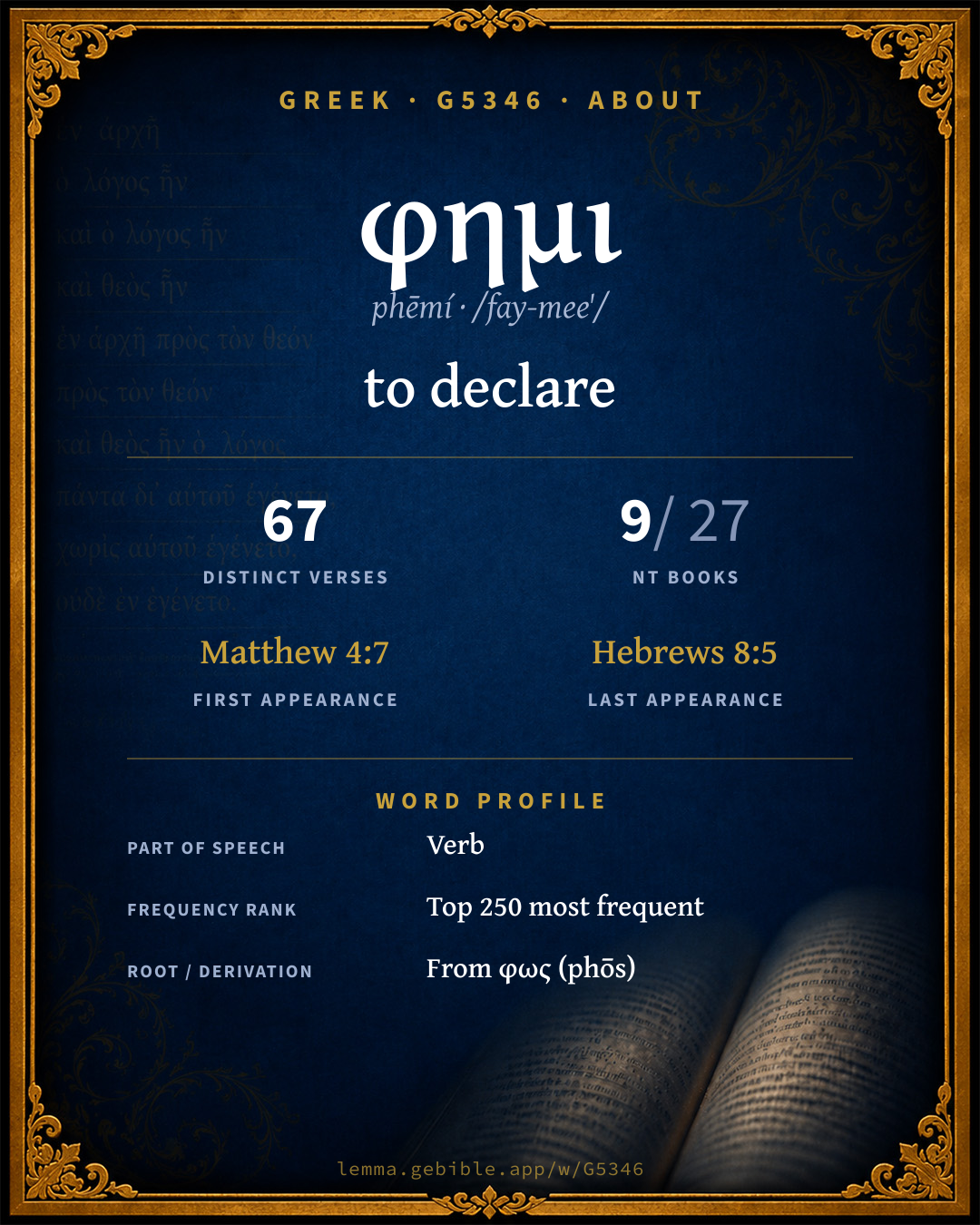
φημί
to declare
‘to declare’ is one of 2 main senses fuller range ↓
Full lexicon entry — Thayer's Greek Lexicon
From Thayer's Greek Lexicon
Where this word appears
See every Imperfect-tense verb in the Greek New Testament →
Grammar key — what these labels mean
Part of speech
- Verb
- An action or state-of-being word.
Tense
- Imperfect
- Continuous or repeated action in past time (“was writing”).
- Present
- Ongoing or general action in present time (imperfective aspect).
- Aorist
- Action viewed as a simple whole, without regard to duration — often past (perfective aspect).
Voice
- Active
- The subject performs the action.
- Passive
- The subject receives the action.
Mood
- Indicative
- States a fact or asks a factual question (the mood of reality).
Person
- 3rd person
- The one spoken about (“he / she / it / they”).
- 1st person
- The speaker (“I / we”).
Number
- Singular
- One.
- Plural
- More than one.
Grammatical forms
- Verb, Imperfect, Active, Indicative, 3rd person, Singular 43 times (63%)
- Verb, Present, Active, Indicative, 3rd person, Singular 19 times (28%)
- Verb, Present, Active, Indicative, 1st person, Singular 4 times (6%)
- Verb, Aorist, Passive, Indicative, 3rd person, Singular 1 time (1%)
- Verb, Present, Active, Indicative, 3rd person, Plural 1 time (1%)
Parsed forms decoded from the imported morphology (Robinson–Tischendorf, public domain), counted across 68 parsed occurrences — not distinct verses.
Every verse where G5346 appears — 67 distinct verses across 9 books. Click any verse to open its interlinear word-by-word view. Verse text shown in the World English Bible for context — . Each verse’s Greek form is shown with its reference; the English is not keyword-highlighted, since the data carries no word-level English alignment. Use “Compare translations” on any verse to read it across multiple English versions. This concordance covers the Greek New Testament; Septuagint (Greek Old Testament) occurrences of this word are not indexed here.
Matthew 18 verses
- Matthew 4:7 ἔφη impf act ind 3sg Jesus said to him, "Again, it is written, 'You shall not test the Lord, your God.'"
- Matthew 8:8 ἔφη impf act ind 3sg The centurion answered, "Lord, I'm not worthy for you to come under my roof. Just say the word, and my servant will be healed.
- Matthew 13:28 ἔφη impf act ind 3sg "He said to them, 'An enemy has done this.' "The servants asked him, 'Do you want us to go and gather them up?'
- Matthew 13:29 φησίν pres act ind 3sg "But he said, 'No, lest perhaps while you gather up the darnel, you root up the wheat with them.
- Matthew 14:8 φησίν pres act ind 3sg She, being prompted by her mother, said, "Give me here on a platter the head of John the Baptizer."
- Matthew 17:26 ἔφη impf act ind 3sg Peter said to him, "From strangers." Jesus said to him, "Therefore the children are exempt.
- Matthew 19:18 φησίν pres act ind 3sg He said to him, "Which ones?" Jesus said, "'You shall not murder.' 'You shall not commit adultery.' 'You shall not steal.' 'You shall not offer false testimony.'
- Matthew 19:21 ἔφη impf act ind 3sg Jesus said to him, "If you want to be perfect, go, sell what you have, and give to the poor, and you will have treasure in heaven; and come, follow me."
- Matthew 21:27 ἔφη impf act ind 3sg They answered Jesus, and said, "We don't know." He also said to them, "Neither will I tell you by what authority I do these things.
- Matthew 22:37 ἔφη impf act ind 3sg Jesus said to him, "'You shall love the Lord your God with all your heart, and with all your soul, and with all your mind.'
- Matthew 25:21 ἔφη impf act ind 3sg "His lord said to him, 'Well done, good and faithful servant. You have been faithful over a few things, I will set you over many things. Enter into the joy of your lord.'
- Matthew 25:23 ἔφη impf act ind 3sg "His lord said to him, 'Well done, good and faithful servant. You have been faithful over a few things, I will set you over many things. Enter into the joy of your lord.'
- Matthew 26:34 ἔφη impf act ind 3sg Jesus said to him, "Most assuredly I tell you that tonight, before the rooster crows, you will deny me three times."
- Matthew 26:61 ἔφη impf act ind 3sg and said, "This man said, 'I am able to destroy the temple of God, and to build it in three days.'"
- Matthew 27:11 ἔφη impf act ind 3sg Now Jesus stood before the governor: and the governor asked him, saying, "Are you the King of the Jews?" Jesus said to him, "So you say."
- Matthew 27:23 ἔφη impf act ind 3sg But the governor said, "Why? What evil has he done?" But they cried out exceedingly, saying, "Let him be crucified!"
- Matthew 27:65 ἔφη impf act ind 3sg Pilate said to them, "You have a guard. Go, make it as secure as you can."
- Matthew 28:15 ἐφημίσθη aor pass ind 3sg So they took the money and did as they were told. This saying was spread abroad among the Jews, and continues until this day.
Mark 6 verses
- Mark 9:12 ἔφη impf act ind 3sg He said to them, "Elijah indeed comes first, and restores all things. How is it written about the Son of Man, that he should suffer many things and be despised?
- Mark 9:38 Ἔφη impf act ind 3sg John said to him, "Teacher, we saw someone who doesn't follow us casting out demons in your name; and we forbade him, because he doesn't follow us."
- Mark 10:20 ἔφη impf act ind 3sg He said to him, "Teacher, I have observed all these things from my youth."
- Mark 10:29 ἔφη impf act ind 3sg Jesus said, "Most assuredly I tell you, there is no one who has left house, or brothers, or sisters, or father, or mother, or wife, or children, or land, for my sake, and for the Gospel's sake,
- Mark 12:24 ἔφη impf act ind 3sg Jesus answered them, "Isn't this because you are mistaken, not knowing the Scriptures, nor the power of God?
- Mark 14:29 ἔφη impf act ind 3sg But Peter said to him, "Although all will be offended, yet I will not."
Luke 7 verses
- Luke 7:40 φησίν pres act ind 3sg Jesus answered him, "Simon, I have something to tell you." He said, "Teacher, say on."
- Luke 7:44 ἔφη impf act ind 3sg Turning to the woman, he said to Simon, "Do you see this woman? I entered into your house, and you gave me no water for my feet, but she has wet my feet with her tears, and wiped them with the hair of her head.
- Luke 15:17 ἔφη impf act ind 3sg But when he came to himself he said, 'How many hired servants of my father's have bread enough to spare, and I'm dying with hunger!
- Luke 22:58 ἔφη ἔφη impf act ind 3sg impf act ind 3sg After a little while someone else saw him, and said, "You also are one of them!" But Peter answered, "Man, I am not!"
- Luke 22:70 ἔφη impf act ind 3sg They all said, "Are you then the Son of God?" He said to them, "You say it, because I AM."
- Luke 23:3 ἔφη impf act ind 3sg Pilate asked him, "Are you the King of the Jews?" He answered him, "So you say."
- Luke 23:40 ἔφη impf act ind 3sg But the other answered, and rebuking him said, "Don't you even fear God, seeing you are under the same condemnation?
John 3 verses
- John 1:23 ἔφη impf act ind 3sg He said, "I am the voice of one crying in the wilderness, 'Make straight the way of the Lord,' as Isaiah the prophet said."
- John 9:38 ἔφη impf act ind 3sg He said, "Lord, I believe!" and he worshiped him.
- John 18:29 φησίν pres act ind 3sg Pilate therefore went out to them, and said, "What accusation do you bring against this man?"
Acts 25 verses
- Acts 2:38 φησίν pres act ind 3sg Peter said to them, "Repent, and be baptized, everyone of you, in the name of Jesus Christ for the forgiveness of sins, and you will receive the gift of the Holy Spirit.
- Acts 7:2 ἔφη impf act ind 3sg He said, "Brothers and fathers, listen. The God of glory appeared to our father Abraham, when he was in Mesopotamia, before he lived in Haran,
- Acts 8:36 φησιν pres act ind 3sg As they went on the way, they came to some water, and the eunuch said, "Behold, here is water. What is keeping me from being baptized?"
- Acts 10:28 ἔφη impf act ind 3sg He said to them, "You yourselves know how it is an unlawful thing for a man who is a Jew to join himself or come to one of another nation, but God has shown me that I shouldn't call any man unholy or unclean.
- Acts 10:30 ἔφη impf act ind 3sg Cornelius said, "Four days ago, I was fasting until this hour, and at the ninth hour, I prayed in my house, and behold, a man stood before me in bright clothing,
- Acts 10:31 φησίν pres act ind 3sg and said, 'Cornelius, your prayer is heard, and your gifts to the needy are remembered in the sight of God.
- Acts 16:30 ἔφη impf act ind 3sg and brought them out and said, "Sirs, what must I do to be saved?"
- Acts 16:37 ἔφη impf act ind 3sg But Paul said to them, "They have beaten us publicly, without a trial, men who are Romans, and have cast us into prison! Do they now release us secretly? No, most assuredly, but let them come themselves and bring us out!"
- Acts 17:22 ἔφη impf act ind 3sg Paul stood in the middle of the Areopagus, and said, "You men of Athens, I perceive that you are very religious in all things.
- Acts 19:35 φησίν pres act ind 3sg When the town clerk had quieted the multitude, he said, "You men of Ephesus, what man is there who doesn't know that the city of the Ephesians is temple-keeper of the great goddess Artemis, and of the image which fell down from Zeus?
- Acts 21:37 ἔφη impf act ind 3sg As Paul was about to be brought into the barracks, he asked the commanding officer, "May I speak to you?" He said, "Do you know Greek?
- Acts 22:2 φησίν pres act ind 3sg When they heard that he spoke to them in the Hebrew language, they were even more quiet. He said,
- Acts 22:27 ἔφη impf act ind 3sg The commanding officer came and asked him, "Tell me, are you a Roman?" He said, "Yes."
- Acts 22:28 ἔφη impf act ind 3sg The commanding officer answered, "I bought my citizenship for a great price." Paul said, "But I was born a Roman."
- Acts 23:5 ἔφη impf act ind 3sg Paul said, "I didn't know, brothers, that he was high priest. For it is written, 'You shall not speak evil of a ruler of your people.'"
- Acts 23:17 ἔφη impf act ind 3sg Paul summoned one of the centurions, and said, "Bring this young man to the commanding officer, for he has something to tell him."
- Acts 23:18 φησίν pres act ind 3sg So he took him, and brought him to the commanding officer, and said, "Paul, the prisoner, summoned me and asked me to bring this young man to you, who has something to tell you."
- Acts 23:35 ἔφη impf act ind 3sg "I will hear you fully when your accusers also arrive." He commanded that he be kept in Herod's palace.
- Acts 25:5 φησίν pres act ind 3sg "Let them therefore," said he, "that are in power among you go down with me, and if there is anything wrong in the man, let them accuse him."
- Acts 25:22 φησίν pres act ind 3sg Agrippa said to Festus, "I also would like to hear the man myself." "Tomorrow," he said, "you shall hear him."
- Acts 25:24 φησιν pres act ind 3sg Festus said, "King Agrippa, and all men who are here present with us, you see this man, about whom all the multitude of the Jews petitioned me, both at Jerusalem and here, crying that he ought not to live any longer.
- Acts 26:1 ἔφη impf act ind 3sg Agrippa said to Paul, "You may speak for yourself." Then Paul stretched out his hand, and made his defense.
- Acts 26:24 φησίν pres act ind 3sg As he thus made his defense, Festus said with a loud voice, "Paul, you are crazy! Your great learning is driving you insane!"
- Acts 26:25 φησίν pres act ind 3sg But he said, "I am not crazy, most excellent Festus, but boldly declare words of truth and reasonableness.
- Acts 26:32 ἔφη impf act ind 3sg Agrippa said to Festus, "This man might have been set free if he had not appealed to Caesar."
Romans 1 verse
1 Corinthians 5 verses
- 1 Corinthians 6:16 φησίν pres act ind 3sg Or don't you know that he who is joined to a prostitute is one body? For, "The two," says he, "will become one flesh."
- 1 Corinthians 7:29 φημι pres act ind 1sg But I say this, brothers: the time is short, that from now on, both those who have wives may be as though they had none;
- 1 Corinthians 10:15 φημι pres act ind 1sg I speak as to wise men. Judge what I say.
- 1 Corinthians 10:19 φημί pres act ind 1sg What am I saying then? That a thing sacrificed to idols is anything, or that an idol is anything?
- 1 Corinthians 15:50 φημι pres act ind 1sg Now I say this, brothers, that flesh and blood can't inherit the Kingdom of God; neither does corruption inherit incorruption.
2 Corinthians 1 verse
Hebrews 1 verse
About this entry
At a glance — auto-summarized from this page’s data, not written by a person. Every figure links to its source below. This summary describes the numbers; it doesn’t interpret them.
At its core, φημι (phēmí) means “to declare.” Scripture first uses it in Matthew 4:7. It appears 67 verses across 9 books of the Greek New Testament, among its moderately common vocabulary. The word gravitates to Acts (37%), then Matthew and Luke. Ranging over 2 senses, it is not a single-sense word. Dig into 67-verse concordance and the renderings breakdown below.
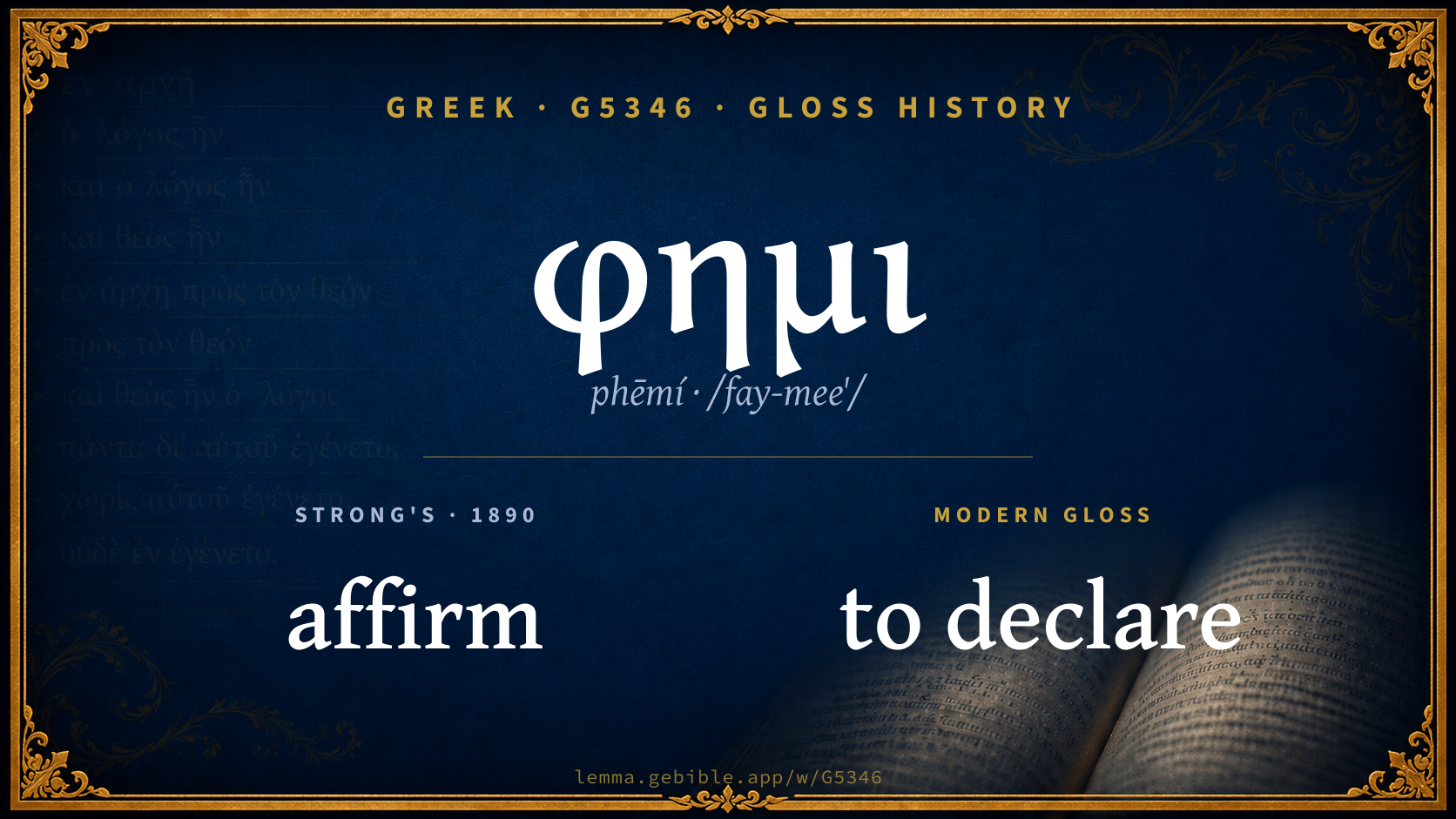
Gloss history
Strong's 1890 vs modern scholarship
About this word
Strong's G5346 catalogs a Greek word from the Greek New Testament.
These counts are not copied from any lexicon or concordance. They are computed here, from the morphology-tagged Greek New Testament. What Lemma adds →
- 67
- distinct verses
- The word appears in 67 distinct verses.
- 9 / 27
- NT books
- The word appears in 9 of 27 New Testament books.
- #243
- by frequency
- Top 250 most frequent Greek words (rank 243 of 5,347 Greek words by occurrence).
View all 67 occurrences in the concordance →
By section of the New Testament
By traditional corpus
Conventional, traditional groupings — biblical authorship is debated, so this is a traditional corpus grouping, not an authorship claim. Some books belong to more than one corpus (Luke is in both the Gospels and the Lukan corpus, and so on), so these shares overlap and need not total 100%. Each figure is a share of the word’s 67 distinct verses.
- Gospels 34 verses · 51%
- Lukan (Luke–Acts) 32 verses · 48%
- Pauline corpus 7 verses · 10%
- Johannine 3 verses · 4%
- Hebrews 1 verse · 1%
How translations render this word
Counts come from each version’s own published word-to-Strong’s tagging or interlinear alignment — an approximate guide to how each version renders this word, not a word-level alignment the data otherwise carries. Because each total is that version’s own tagged count, the per-version totals vary from one another and need not match the appearance or distinct-verse counts above. These counts may also differ from a printed concordance because Lemma counts each distinctly tagged rendering and does not collapse phrase taggings into a single head-word total. This is a fixed set of word-tagged versions (KJV, ASV, BSB, ULT) and does not change with the reading translation you choose elsewhere. Each version’s license is shown beside its name below (and on Sources).
- King James Version: Said 36×, He said 9×, I say 3×
- American Standard Version: Said 25×, He said 8×, Saith 6×
- Berean Standard Bible: Said 17×, Replied 11×, Declared 6×
- unfoldingWord Literal Text: Said 33×, Says 8×, He said 7×
King James Version Public Domain
Renders G5346 across 58 tagged occurrences — most commonly:
Plus 6 renderings that appear only once — usually multi-word phrases or single function words the recovered tagging swept in, not distinct renderings.
American Standard Version Public Domain
Renders G5346 across 56 tagged occurrences — most commonly:
Plus 6 renderings that appear only once — usually multi-word phrases or single function words the recovered tagging swept in, not distinct renderings.
Berean Standard Bible Public Domain
Renders G5346 across 62 tagged occurrences — most commonly:
Plus 13 renderings that appear only once — usually multi-word phrases or single function words the recovered tagging swept in, not distinct renderings. Not rendered by a distinct English word in 4 further occurrences.
unfoldingWord Literal Text CC BY-SA 4.0
Renders G5346 across 66 tagged occurrences — most commonly:
Plus 4 renderings that appear only once — usually multi-word phrases or single function words the recovered tagging swept in, not distinct renderings.
Senses in Thayer's
The 2 senses Thayer's distinguishes for this word, in lexicon order (not ranked by frequency or importance). The full entry — with sub-senses — is in the Lexicon Entry tab.
- to make known one's thoughts, to declare
- to say
Word origin
Derived from φως (phōs) (G5457) — light.
Forms in the corpus
The 8 distinct written forms G5346 takes in the Greek New Testament, most frequent first — each parse links to that tense’s occurrences in the concordance.
| Form | Parsing | Example | Uses |
|---|---|---|---|
| ἔφη éphē | Verb, Imperfect, Active, Indicative, 3rd person, Singular | Matthew 4:7 | 42 |
| φησίν phēsín | Verb, Present, Active, Indicative, 3rd person, Singular | Matthew 13:29 | 17 |
| φημι phēmi | Verb, Present, Active, Indicative, 1st person, Singular | 1 Corinthians 7:29 | 3 |
| φησιν phēsin | Verb, Present, Active, Indicative, 3rd person, Singular | Acts 8:36 | 2 |
| φασίν phasín | Verb, Present, Active, Indicative, 3rd person, Plural | Romans 3:8 | 1 |
| φημί phēmí | Verb, Present, Active, Indicative, 1st person, Singular | 1 Corinthians 10:19 | 1 |
| ἐφημίσθη ephēmísthē | Verb, Aorist, Passive, Indicative, 3rd person, Singular | Matthew 28:15 | 1 |
| Ἔφη Éphē | Verb, Imperfect, Active, Indicative, 3rd person, Singular | Mark 9:38 | 1 |
Same root — word family
Other Thayer's entries built from the same root as G5346, grouped by Strong’s listed origin. These share a root / origin per the lexicon — not necessarily a shared meaning. Each links to that word’s own entry.
Derives from
Shares the same root
- φαινω phaínō G5316 to shine
- φεγγος phéngos G5338 light
- φωστηρ phōstḗr G5458 light-giver
- φωσφορος phōsphóros G5459 morning star
- φωτεινος phōteinós G5460 light
- φωτιζω phōtízō G5461 to enlighten
Derived from this word
Proper names from this root
People and places named from this root — a name, not an additional meaning of the word.
Compare all same-root words → Showing 4 of 12 — not the complete family. 1 of the same-root words is a proper name (a person or place). They share a root, not necessarily a meaning.
Septuagint usage
The same Greek word φημι appears 41 times in the Greek Old Testament (Septuagint), across 37 verses in 11 books.
- 41
- LXX occurrences
- Tagged occurrences of this Greek word in the Septuagint.
- 37
- verses
- Distinct Septuagint verses containing this word.
- 11 / 39
- OT books
- The word appears in 11 of the 39 Old Testament books.
Sample Septuagint occurrences
- Genesis 24:47 φημί
- Exodus 2:6 φημί
- Numbers 24:3 φημί
- 1 Samuel 2:30 φημί
- 2 Kings 9:26 φημί
- 2 Chronicles 34:27 φημί
- Ezra 4:17 φημί
- Job 24:25 φημί
- Psalms 35:2 φημί
- Proverbs 30:20 φημί
- Jeremiah 2:3 φημί
Septuagint occurrences (same lexeme)
Every verse where the same Strong’s number (G5346) appears in the Greek Septuagint. Verse text shown in the World English Bible for context; the Greek form is the matched word — the English is not keyword-highlighted.
- Genesis 24:47 φημί I asked her, and said, 'Whose daughter are you?' She said, 'The daughter of Bethuel, Nahor's son, whom Milcah bare to him.' I put the ring on her nose, and the bracelets on her hands.
- Exodus 2:6 φημί She opened it, and saw the child, and, behold, the baby cried. She had compassion on him, and said, "This is one of the Hebrews' children."
- Numbers 24:3 φημί He took up his parable, and said, Balaam the son of Beor says, The man whose eye was closed says;
- Numbers 24:4 φημί He says, who hears the words of God, Who sees the vision of the Almighty, Falling down, and having his eyes open:
- Numbers 24:15 φημί He took up his parable, and said, Balaam the son of Beor says, The man whose eye was closed says;
- 1 Samuel 2:30 φημί Therefore Yahweh, the God of Israel, says, I said indeed that your house, and the house of your father, should walk before me forever: but now Yahweh says, Be it far from me; for those who honor me I will honor, and those who despise me shall be lightly esteemed.
- 2 Kings 9:26 φημί Surely I have seen yesterday the blood of Naboth, and the blood of his sons, says Yahweh; and I will requite you in this plat, says Yahweh. Now therefore take and cast him into the plat [of ground], according to the word of Yahweh.
- 2 Chronicles 34:27 φημί because your heart was tender, and you did humble yourself before God, when you heard his words against this place, and against the inhabitants of it, and have humbled yourself before me, and have torn your clothes, and wept before me; I also have heard you, says Yahweh.
- Ezra 4:17 φημί [Then] sent the king an answer to Rehum the chancellor, and to Shimshai the scribe, and to the rest of their companions who dwell in Samaria, and in the rest [of the country] beyond the River: Peace, and so forth.
- Job 24:25 φημί If it isn't so now, who will prove me a liar, And make my speech worth nothing?"
- Psalms 35:2 φημί Take hold of shield and buckler, And stand up for my help.
- Proverbs 30:20 φημί So is the way of an adulterous woman: She eats and wipes her mouth, And says, 'I have done nothing wrong.'
- Jeremiah 2:3 φημί Israel [was] holiness to Yahweh, the first fruits of his increase: all who devour him shall be held guilty; evil shall come on them, says Yahweh.
- Jeremiah 23:12 φημί Therefore their way shall be to them as slippery places in the darkness: they shall be driven on, and fall therein; for I will bring evil on them, even the year of their visitation, says Yahweh.
- Jeremiah 25:12 φημί It shall happen, when seventy years are accomplished, that I will punish the king of Babylon, and that nation, says Yahweh, for their iniquity, and the land of the Chaldeans; and I will make it desolate forever.
- Jeremiah 30:18 φημί Thus says Yahweh: Behold, I will turn again the captivity of Jacob's tents, and have compassion on his dwelling-places; and the city shall be built on its own hill, and the palace shall be inhabited after its own manner.
- Jeremiah 30:32 φημί
- Jeremiah 31:12 φημί They shall come and sing in the height of Zion, and shall flow to the goodness of Yahweh, to the grain, and to the new wine, and to the oil, and to the young of the flock and of the herd: and their soul shall be as a watered garden; and they shall not sorrow any more at all.
- Jeremiah 31:35 φημί Thus says Yahweh, who gives the sun for a light by day, and the ordinances of the moon and of the stars for a light by night, who stirs up the sea, so that the waves of it roar; Yahweh of hosts is his name:
- Jeremiah 31:38 φημί Behold, the days come, says Yahweh, that the city shall be built to Yahweh from the tower of Hananel to the gate of the corner.
- Jeremiah 34:15 φημί You were now turned, and had done that which is right in my eyes, in proclaiming liberty every man to his neighbor; and you had made a covenant before me in the house which is called by my name:
- Jeremiah 36:18 φημί Then Baruch answered them, He pronounced all these words to me with his mouth, and I wrote them with ink in the book.
- Jeremiah 37:3 φημί Zedekiah the king sent Jehucal the son of Shelemiah, and Zephaniah the son of Maaseiah, the priest, to the prophet Jeremiah, saying, Pray now to Yahweh our God for us.
- Jeremiah 37:17 φημί Then Zedekiah the king sent, and fetched him: and the king asked him secretly in his house, and said, Is there any word from Yahweh? Jeremiah said, There is. He said also, You shall be delivered into the hand of the king of Babylon.
- Jeremiah 37:21 φημί Then Zedekiah the king commanded, and they committed Jeremiah into the court of the guard; and they gave him daily a loaf of bread out of the bakers' street, until all the bread in the city was spent. Thus Jeremiah remained in the court of the guard.
- Jeremiah 38:20 φημί But Jeremiah said, They shall not deliver you. Obey, I beg you, the voice of Yahweh, in that which I speak to you: so it shall be well with you, and your soul shall live.
- Jeremiah 38:27 φημί Then came all the princes to Jeremiah, and asked him; and he told them according to all these words that the king had commanded. So they left off speaking with him; for the matter was not perceived.
- Jeremiah 38:28 φημί So Jeremiah abode in the court of the guard until the day that Jerusalem was taken.
- Jeremiah 38:31 φημί
- Jeremiah 38:32 φημί
- Jeremiah 38:33 φημί
- Jeremiah 38:35 φημί
- Jeremiah 38:37 φημί
- Jeremiah 38:38 φημί
- Jeremiah 41:22 φημί
- Jeremiah 46:8 φημί Egypt rises up like the Nile, and his waters toss themselves like the rivers: and he says, I will rise up, I will cover the earth; I will destroy cities and the inhabitants of it.
- Jeremiah 49:11 φημί Leave your fatherless children, I will preserve them alive; and let your widows trust in me.
These are occurrences of the same Greek lexeme (G5346) in the Septuagint — not a translation of any one Hebrew word. The store carries no word-level Hebrew↔Greek alignment, so no Hebrew original is asserted here. Counts come from the recovered LXX Strong's tagging — high-frequency vocabulary is well covered, while rare or late forms may be untagged — so they reflect tagged occurrences and may slightly undercount.