
Judges 6:8

Hebrew (Westminster Leningrad Codex) Judges 6:8 appears in the Hebrew Old Testament. The text above is from the Westminster Leningrad Codex. Each word links to its Strong’s number, a concise gloss, and parsing drawn from the Open Scriptures Hebrew Bible morphology. Click any word for its full Brown-Driver-Briggs (BDB) entry.
Download image
Cite this verse

Judges 6:8 (World English Bible). Public Domain. Lemma interlinear Bible study tool, https://lemma.gebible.app/v/judges/6/8.

Show BibTeX & RIS
BibTeX
RIS
English Translation
that Yahweh sent a prophet to the children of Israel: and he said to them, Thus says Yahweh, the God of Israel, I brought you up from Egypt, and brought you forth out of the house of bondage;
World English Bible · Public Domain
Download a study sheet

One document with this verse’s original text, its word-by-word gloss line, the meaning frame, cross-references with their text, attributed commentary, and full source and license credits — printable, and it pastes into notes with its structure intact.

This verse Autodidact and up

Study sheet (.html) Plain text (.txt)

A passage Seminary Student

Up to 50 verses in one chapter. A passage sheet keeps up to 6 commentary sources and 12 cross-references per verse, in the order this page ranks them, and says so on the sheet whenever that leaves anything out. Ask for a single verse and you get the Autodidact verse sheet above.

Everything on this page stays free to read, with no account — the sheet is a download of what is already on screen, not access to it.

Want to remove ads? Support Godless Engineer
Compare translations 3

The same verse in 3 English versions, stacked beneath the original-language interlinear above. Click any original word for its lexicon entry.

Each is an independent rendering of the whole verse — the interlinear is not word-aligned to these translations.

Highlighted words mark where these versions differ — a whole-verse word diff, not a word-by-word alignment.

  • World English Bible Public Domain
    that Yahweh sent a prophet to the children of Israel: and he said to them, Thus says Yahweh, the God of Israel, I brought you up from Egypt, and brought you forth out of the house of bondage;
  • King James Version Public Domain
    That the LORD sent a prophet unto the children of Israel, which said unto them, Thus saith the LORD God of Israel, I brought you up from Egypt, and brought you forth out of the house of bondage;
  • unfoldingWord Literal Text CC BY-SA 4.0
    that Yahweh sent a man, a prophet, to the sons of Israel, and he said to them, “Thus says Yahweh, the God of Israel: ‘I brought you up from Egypt, and I brought you out from the house of slaves.

unfoldingWord Literal Text — © unfoldingWord, licensed CC BY-SA 4.0. Word-aligned USFM3 via Door43 (git.door43.org/unfoldingWord/en_ult).

Versions to compare (up to 4)

3 of 4 selected

Show all 18 translations

Every available English version of this verse, each an independent rendering of the whole verse.

  • World English Bible Public Domain
    that Yahweh sent a prophet to the children of Israel: and he said to them, Thus says Yahweh, the God of Israel, I brought you up from Egypt, and brought you forth out of the house of bondage;
  • Berean Standard Bible Public Domain
    He sent them a prophet, who told them, “This is what the LORD, the God of Israel, says: I brought you up out of Egypt, out of the house of slavery.
  • Majority Standard Bible Public Domain
    He sent them a prophet, who told them, “This is what the LORD, the God of Israel, says: I brought you up out of Egypt, out of the house of slavery.
  • King James Version Public Domain
    That the LORD sent a prophet unto the children of Israel, which said unto them, Thus saith the LORD God of Israel, I brought you up from Egypt, and brought you forth out of the house of bondage;
  • American Standard Version (1901) Public Domain
    that Jehovah sent a prophet unto the children of Israel: and he said unto them, Thus saith Jehovah, the God of Israel, I brought you up from Egypt, and brought you forth out of the house of bondage;
  • Revised Version (1885) Public Domain
    that the LORD sent a prophet unto the children of Israel: and he said unto them, Thus saith the LORD, the God of Israel, I brought you up from Egypt, and brought you forth out of the house of bondage;
  • Geneva Bible (1599) Public Domain
    The Lord sent vnto the children of Israel a Prophet, who sayd vuto them, Thus sayth the Lord God of Israel, I haue brought you vp from Egypt, and haue brought you out of the house of bondage,
  • Douay-Rheims (1899) Public Domain
    And he cried to the Lord desiring help against the Madianites.
  • Young's Literal Translation Public Domain
    that Jehovah sendeth a man, a prophet, unto the sons of Israel, and he saith to them, `Thus said Jehovah, God of Israel, I -- I have brought you up out of Egypt, and I bring you out from a house of servants,
  • Literal Standard Version CC BY-SA 4.0
    that YHWH sends a man, a prophet, to the sons of Israel, and he says to them, “Thus said YHWH, God of Israel: I have brought you up out of Egypt, and I bring you out from a house of servants,
  • Unlocked Literal Bible CC BY-SA 4.0
    Yahweh sent a prophet to the people of Israel. The prophet said to them, “This is what Yahweh, the God of Israel, says: 'I brought you up from Egypt; I brought you out of the house of slavery.
  • unfoldingWord Literal Text CC BY-SA 4.0
    that Yahweh sent a man, a prophet, to the sons of Israel, and he said to them, “Thus says Yahweh, the God of Israel: ‘I brought you up from Egypt, and I brought you out from the house of slaves.
  • Darby Bible Public Domain
    the LORD sent a prophet to the people of Israel; and he said to them, "Thus says the LORD, the God of Israel: I led you up from Egypt, and brought you out of the house of bondage;
  • World Messianic Bible Public Domain
    The LORD sent a prophet to the children of Israel; and he said to them, “The LORD, the God of Israel, says, ‘I brought you up from Egypt, and brought you out of the house of bondage.
  • Webster's Bible Public Domain
    That the LORD sent a prophet to the children of Israel, who said to them, Thus saith the LORD God of Israel, I brought you up from Egypt, and brought you forth from the house of bondage;
  • Free Bible Version CC BY-SA 4.0
    the Lord sent the Israelites a prophet. He told them, “This is what the Lord, the God of Israel, says: ‘I brought you out of Egypt; I led you out from the place where you were slaves.
  • Bible in Basic English Public Domain
    The Lord sent a prophet to the children of Israel, who said to them, The Lord the God of Israel, has said, I took you up from Egypt, out of the prison-house;
  • JPS Tanakh (1917) Public Domain
    that the LORD sent a prophet unto the children of Israel; and he said unto them: 'Thus saith the LORD, the God of Israel: I brought you up from Egypt, and brought you forth out of the house of bondage;

Literal Standard Version (2020), Covenant Press — licensed CC BY-SA 4.0. Text via the HelloAO Bible API (eBible.org). Unlocked Literal Bible (unfoldingWord) — licensed CC BY-SA 4.0. Text via the HelloAO Bible API (eBible.org). unfoldingWord Literal Text — © unfoldingWord, licensed CC BY-SA 4.0. Word-aligned USFM3 via Door43 (git.door43.org/unfoldingWord/en_ult). Free Bible Version, Dr. Jonathan Gallagher — licensed CC BY-SA 4.0. Text via the HelloAO Bible API (eBible.org).

Word by word

More ways to search: Search by grammar → Find every occurrence → Compare this word →

Practice this passage: Drill this verse → Learn its vocabulary →

נָבִ֖יא
nâbîyʼ
H5030
“prophet”
Noun, Common, Masculine, Singular, Absolute
Part of Speech
Noun
Type
Common
Gender
Masculine
Number
Singular
State
Absolute
Full BDB Definition

Origin: from H5012

TWOT: 1277a

spokesman, speaker, prophet - prophet - false prophet - heathen prophet
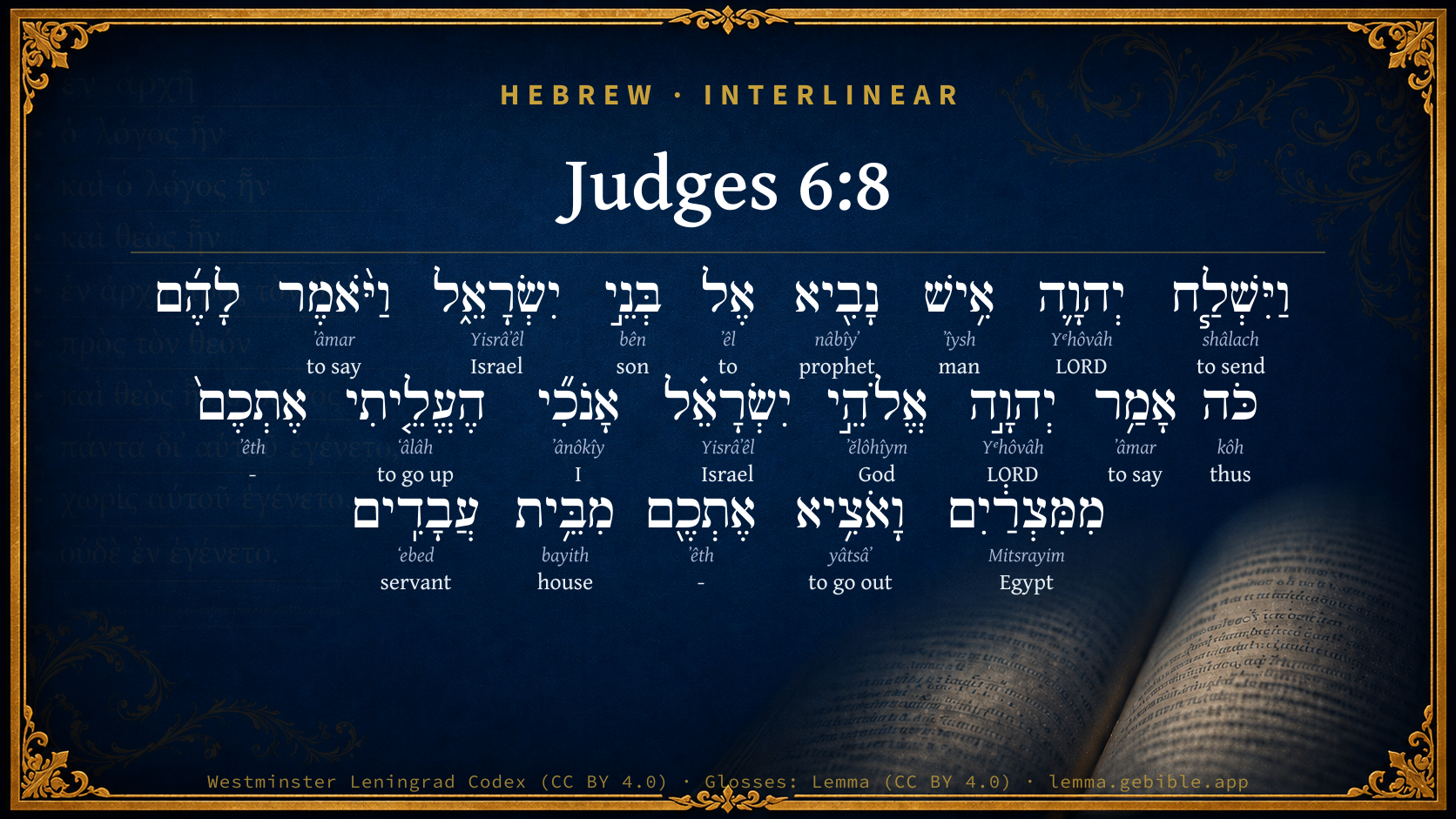
  1. וַיִּשְׁלַ֧ח shâlach H7971 “and · to send” Conjunction + Verb, Qal, Sequential Imperfect, 3rd Person, Masculine, Singular
  2. יְהוָ֛ה Yᵉhôvâh H3068 “LORD” Noun, Proper
  3. אִ֥ישׁ ʼîysh H376 “man” Noun, Common, Masculine, Singular, Absolute
  4. אֶל ʼêl H413 “to” Preposition
  5. בְּנֵ֣י bên H1121 “sons of” Noun, Common, Masculine, Plural, Construct
  6. יִשְׂרָאֵ֑ל Yisrâʼêl H3478 “Israel” Noun, Proper
  7. וַיֹּ֨אמֶר ʼâmar H559 “and · to say” Conjunction + Verb, Qal, Sequential Imperfect, 3rd Person, Masculine, Singular
  8. כֹּה kôh H3541 “thus” Adverb
  9. אָמַ֥ר ʼâmar H559 “to say” Verb, Qal, Perfect, 3rd Person, Masculine, Singular
  10. יְהוָ֣ה Yᵉhôvâh H3068 “LORD” Noun, Proper
  11. אֱלֹהֵ֣י ʼĕlôhîym H430 “God(s) of” Noun, Common, Masculine, Plural, Construct
  12. יִשְׂרָאֵ֗ל Yisrâʼêl H3478 “Israel” Noun, Proper
  13. אָנֹכִ֞י ʼânôkîy H595 “I” Pronoun, Personal, 1st Person, Common, Singular
  14. הֶעֱלֵ֤יתִי ʻâlâh H5927 “to go up” Verb, Hiphil, Perfect, 1st Person, Common, Singular
  15. אֶתְכֶם֙ ʼêth H853 “- · you” Particle, Direct Object + Suffix, Personal, 2nd Person, Masculine, Plural
  16. מִמִּצְרַ֔יִם Mitsrayim H4714 “from · Egypt” Preposition + Noun, Proper
  17. וָאֹצִ֥יא yâtsâʼ H3318 “and · to go out” Conjunction + Verb, Hiphil, Sequential Imperfect, 1st Person, Common, Singular
  18. אֶתְכֶ֖ם ʼêth H853 “- · you” Particle, Direct Object + Suffix, Personal, 2nd Person, Masculine, Plural
  19. מִבֵּ֥ית bayith H1004 “from · house of” Preposition + Noun, Common, Masculine, Singular, Construct
  20. עֲבָדִֽים ʻebed H5650 “servants” Noun, Common, Masculine, Plural, Absolute

About this verse

These counts appear in no published source. They are computed here, from the morphology-tagged text and Lemma’s own curated glosses. What Lemma adds →

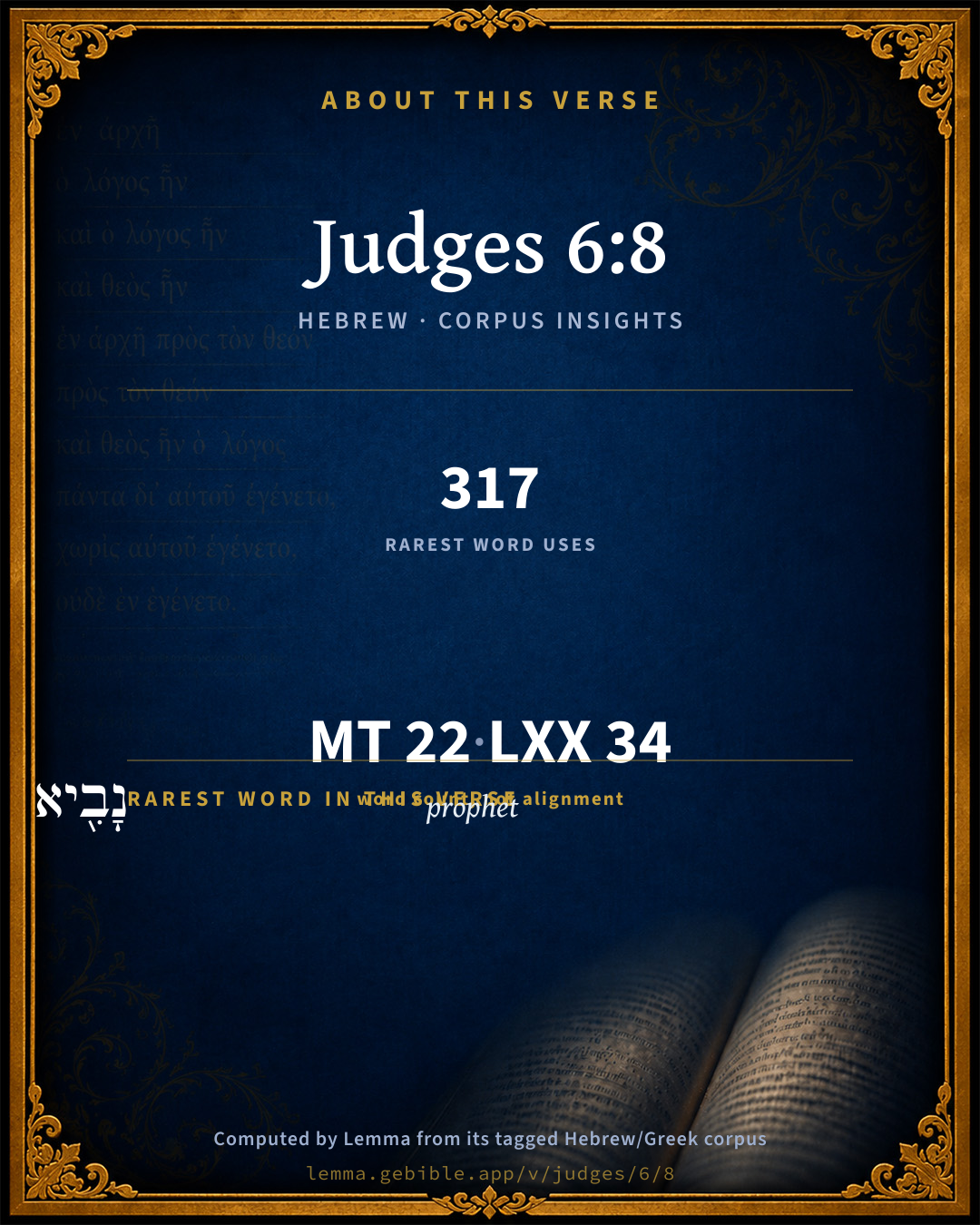
22
words
17
distinct lemmas
Historical
section

Grammatical profile

  • 5 verbs
  • 11 nouns
  • 1 pronoun
  • 2 prepositions
  • 1 adverb
  • 2 particles

Verb forms

  • וַיִּשְׁלַ֧ח Qal · Sequential Imperfect
  • וַיֹּ֨אמֶר Qal · Sequential Imperfect
  • אָמַ֥ר Qal · Perfect
  • הֶעֱלֵ֤יתִי Hiphil · Perfect
  • וָאֹצִ֥יא Hiphil · Sequential Imperfect

Repetition

Words recur within this verse — often emphatic in Hebrew:

  • יְהוָ֛ה LORD H3068 ×2
  • יִשְׂרָאֵ֑ל Israel H3478 ×2
  • וַיֹּ֨אמֶר to say H559 ×2

Hebrew & Septuagint length

In English translation the verse runs 38 words from the Hebrew and 48 from the Septuagint (LXX English) — closely comparable.

A rough comparison of the two English renderings, which tokenize alike — not a word-level alignment.

Word counts can differ between the Hebrew and the Greek without any difference in meaning — e.g. the Hebrew direct-object marker אֵת has no separate Greek word, and Greek often adds the article ὁ.

In the original languages it is 22 Hebrew tokens and 34 Greek tokens — but the two are counted differently (Hebrew bundles its prefixes and suffixes into one token; the Greek is in lemma form), so that isn’t a like-for-like length.

Cross-references

5

Topical passages linked to Judges 6:8 in the Treasury of Scripture Knowledge — connected by theme and wording, ordered by reader-vote popularity; previews shown in the World English Bible.

  • Psalms 136:10–16 To him who struck down the Egyptian firstborn; For his loving kindness endures forever;
  • Ezekiel 20:5–32 and tell them, Thus says the Lord Yahweh: In the day when I chose Israel, and swore to the seed of the house of Jacob, and made myself known to them in the land of Egypt, when I swore to them, saying, I am Yahweh your God;
  • Isaiah 63:9–14 In all their affliction he was afflicted, and the angel of his presence saved them: in his love and in his pity he redeemed them; and he bore them, and carried them all the days of old.
  • Judges 2:1–3 The angel of Yahweh came up from Gilgal to Bochim. He said, I made you to go up out of Egypt, and have brought you to the land which I swore to your fathers; and I said, I will never break my covenant with you:
  • Nehemiah 9:9–12 You saw the affliction of our fathers in Egypt, and heard their cry by the Red Sea,

Cross-references courtesy of OpenBible.info (CC BY 4.0).

Hebrew and Greek witnesses Masoretic Hebrew ↔ Greek Septuagint

The same verse in the two great witnesses to the Old Testament, shown verse-for-verse.

These are two independent witnesses, not word-aligned to each other, and the Septuagint is shown in lemma (dictionary) form.

Hebrew Judges 6:8 Masoretic · Westminster Leningrad Codex

וַיִּשְׁלַ֧ח יְהוָ֛ה אִ֥ישׁ נָבִ֖יא אֶל בְּנֵ֣י יִשְׂרָאֵ֑ל וַיֹּ֨אמֶר לָהֶ֜ם כֹּה אָמַ֥ר יְהוָ֣ה אֱלֹהֵ֣י יִשְׂרָאֵ֗ל אָנֹכִ֞י הֶעֱלֵ֤יתִי אֶתְכֶם֙ מִמִּצְרַ֔יִם וָאֹצִ֥יא אֶתְכֶ֖ם מִבֵּ֥ית עֲבָדִֽים

that Yahweh sent a prophet to the children of Israel: and he said to them, Thus says Yahweh, the God of Israel, I brought you up from Egypt, and brought you forth out of the house of bondage;

World English Bible · Public Domain

Greek LXX Judges 6:8 Septuagint · lemma form

καί ἐκ ἀποστέλλω κύριος ἀνήρ προφήτης πρός ὁ υἱός ἰσραήλ καί εἶπον αὐτός ὅδε λέγω κύριος ὁ θεός ἰσραήλ ἐγώ εἰμί ὅς ἀναἄγω σύ ἐκ γῆ αἴγυπτος καί ἐκἄγω σύ ἐκ οἶκος δουλεία σύ

And the Lord sent a prophet to the children of Israel; and he said to them, Thus says the Lord God of Israel, I am he that brought you up out of the land of Egypt, and I brought you up out of the house of your bondage.

LXX2012 (modern English Septuagint) · Public Domain

Hebrew: Westminster Leningrad Codex (CC BY 4.0). Greek: Septuagint (public domain); English from LXX2012 (modern English Septuagint) (Public Domain). How the Septuagint differs from the Hebrew →

Targum (Aramaic paraphrase)

1

The Targum is the ancient Jewish Aramaic paraphrase of the Hebrew Scriptures — an interpretive translation, not the Hebrew text itself. Onkelos (literal) and Pseudo-Jonathan (expansive) render the Torah, and Jonathan the Prophets. Coverage is partial: where no permissively-licensed English translation exists for a verse, only the Aramaic is shown. This is verse-level text, not a word-by-word alignment to the Hebrew.

  1. Targum Jonathan Prophets (Joshua–Malachi)
    וּשְׁלַח יְיָ גַבְרָא נְבִיָא לְוַת בְּנֵי יִשְׂרָאֵל וַאֲמַר לְהוֹן כִּדְנַן אֲמַר יְיָ אֱלָהָא דְיִשְׂרָאֵל אֲנָא אַסְקֵית יַתְכוֹן מִמִצְרַיִם וְאַפְקֵית יַתְכוֹן מִבֵּית עַבְדוּתָא:

    (no public-domain English translation for this verse)

    Targum Jonathan — Aramaic: “Mikraot Gedolot” (public domain). English: “Sefaria Community Translation” (CC0 1.0 (public-domain dedication)); “London "Chaldee Paraphrase," 1871” (public domain). Text via Sefaria.

Commentary

Notes on Judges 6:8 from classic Christian and Jewish commentators (each source and its license shown beneath its notes). The classic Christian expositions comment on the surrounding passage and are grouped to its opening verse, so a note may address several verses; the Jewish commentaries on the Tanakh (Rashi and others) are per-verse, so they appear only where the commentator wrote on this verse.

Lemma curates 59 commentaries, every one of them public domain or Creative Commons licensed, each selected and text-cleaned for this edition rather than reprinted as found. About our sources →

Trapp's Complete Commentary

John Trapp

Jdg 6:8 That the LORD sent a prophet unto the children of Israel, which said unto them, Thus saith the LORD God of Israel, I brought you up from Egypt, and brought you forth out of the house of bondage;

Ver. 8. That the Lord sent a prophet.] Heb., A man, a prophet; therefore not an angel, as Lyra and Comestor fancied. They had repented in part before, but this prophet is sent to stir them up to do it thoroughly. So Act 2:37, those who were before pricked at heart, are yet further excited to "repent, for the remission of sins," &c. {Act 2:38}

John Trapp, A Commentary or Exposition upon All the Books of the Old and New Testament (1647–1656) — public domain. Text from a community e-Sword module.

Joseph Benson's Commentary

Jdg 6:8. The Lord sent a prophet — We have reason to hope God is designing mercy for us, if we find he is by his grace preparing us for it.

Joseph Benson's Commentary on the Old and New Testaments (1811–1818) — public domain. Text from a community e-Sword module.

Jamieson, Fausset & Brown

Robert Jamieson, A. R. Fausset & David Brown

A PROPHET REBUKES THEM. (Jdg 6:7-10)

the Lord sent a prophet unto the children of Israel--The curse of the national calamity is authoritatively traced to their infidelity as the cause.

Jamieson, Fausset & Brown — Commentary Critical and Explanatory on the Whole Bible (1871) — public domain (CC PDM 1.0). Text via the HelloAO Bible API.

Adam Clarke's Commentary

Verse 8. The Lord sent a prophet] The Jews say that this was Phinehas; but it is more likely that it was some prophet or teacher raised up by the Lord to warn and instruct them. Such were his witnesses, and they were raised up from time to time to declare the counsel of God to his rebellious people.

Adam Clarke's Commentary on the Bible (1810–1826) — public domain. Text from a community e-Sword/MySword module.

Ellicott's Commentary for English Readers

(8) A prophet.—He is here left nameless, but Jewish legend says that he was Phinehas, the son of Eleazar. Their Hagadah (legendary information) generally enables them to name these nameless prophets. Thus they say that the prophet who came to Bethel was Iddo (1 Kings 13), and that the young man who anointed Jehu was Jonah.

Unto the children of Israel.—Perhaps assembled at some solemn feast, like the Passover.

I brought you up.—With the prophet’s message compare Jdg_2:1-3; 2Ki_17:36-38.

Out of the house of bondage.—A clear reference to Exo_20:2. (Comp. Psa_44:1-2.)

A Bible Commentary for English Readers, edited by Charles John Ellicott (1878–1897) — public domain. Text from a community e-Sword module.

John Gill's Exposition

And I delivered you out of the hand of the Egyptians,.... Even after they were brought out of Egypt, when the Egyptians pursued after them, and overtook them at the Red sea; where they were in the utmost distress, and the Lord wrought salvation for them, gave them a passage through it, and destroyed the Egyptians in it:

and out of the hand of all that oppressed you: the Amalekites who made war with them at Rephidim, Sihon, and Og, kings of the Amorites, who came out to fight with them, and oppose their passage through their land into Canaan, and the kings of the Canaanites also, who combined against them:

and drave them out from before you, and gave you their land: not only the land of Sihon and Og, but the whole land of Canaan, out of which more properly the inhabitants of it may be said to be driven.

John Gill's Exposition of the Whole Bible (1746–1763) — public domain (CC PDM 1.0). Text via the HelloAO Bible API.

Albert Barnes' Notes on the Bible

A prophet - His name is not given. (Compare 1 Kings 13.) This message is somewhat similar to that of the Angel, Jdg 2:1-3. The reference to Exo 20:2 is plain, and supposes the people to whom the prophet addresses these words to be familiar with the facts recorded in that text.

Albert Barnes' Notes on the Bible (1834–1885) — public domain. Text from a community e-Sword/MySword module.

Haydock's Catholic Bible Commentary

A prophet. The people no sooner repent, than God shews them mercy. (Haydock) --- The name of this prophet is unknown. The Jews say it was Phinees; others think it was an angel in human shape: but he might be one divinely commissioned on this occasion, to make an exhortation to the people, assembled on some of the great festivals, (see chap. ii. 1.; Calmet) though he might continue to exercise his authority afterwards. (Menochius) --- St. Augustine (q. 31,) thinks that the angel (ver. 11,) is here called a prophet, because he appeared in human form. (Worthington)

George Leo Haydock (1774–1849), Haydock's Catholic Family Bible and Commentary, 1859 edition — public domain. Excludes Psalms (Douay-Rheims chapter numbering differs from Protestant) and Deuterocanonical books (Catholic canon only).

Whedon's Commentary on the Bible

Daniel D. Whedon

8. The Lord sent a prophet — Before providing a deliverer God sends a messenger to reprove them for their sins, and impress them with the thought that all their woes were a punishment for idolatry. This is the only specific mention of a prophet in the history of the Judges. The special age of prophets was yet future.

Daniel D. Whedon (gen. ed.), Commentary on the Old and New Testaments (1874–1909) — public domain. Text from a community e-Sword module.

The Pulpit Commentary

A prophet. Literally, a man, a prophet, just as Deborah was described as a woman, a prophetess. (Jud_1:4:4) It is interesting to observe the flow of the spirit of prophecy in those early days between Moses and Samuel, before the dispensation of the prophets had risen to its height. I brought you up from Egypt. Note the constant reference to the exodus as a fixed point in their national and religious life. (see ver. 13; Jud_1:2:1)

The Pulpit Commentary (1880–1919), ed. H.D.M. Spence-Jones & Joseph S. Exell — public domain. Text from a community e-Sword module.

John Wesley's Explanatory Notes

A prophet - We have reason to hope, God is designing mercy for us, if we find he is by his grace preparing us for it.

John Wesley, Explanatory Notes Upon the Whole Bible (1754–1765) — public domain. Text via the GEBible commentary corpus.

Rashi

Rabbi Shlomo Yitzchaki (Rashi)

A prophet. This prophet was Pinchas. Taken from Seder Olam.

Rashi on the Tanakh — English translations: “The Judaica Press complete Tanach with Rashi, translated by A. J. Rosenberg” (CC BY 4.0); “Pentateuch with Rashi's commentary by M. Rosenbaum and A.M. Silbermann, 1929-1934” (public domain); “The Metsudah Tanach series, Lakewood, N.J” (CC BY 4.0); and “The Book of Joshua, Metsudah Publications, 1997” (CC BY 4.0). Text via Sefaria.

Lesson kit

Teaching starters — assembled from the data on this page, not authored interpretation. Every prompt links to the verse data it draws on. Edit before teaching.

Judges, in the Historical, opens this verse with 22 words (17 distinct Hebrew lemmas). Its most distinctive word is nâbîyʼ (“prophet”). A historical commentator’s framing appears above. Read the whole chapter for the surrounding context.

Discussion questions

  1. What does “prophet” (nâbîyʼ) contribute to the verse as a whole?
  2. Psalms 136:10–16 shares this passage’s theme. How do the two illuminate each other?
  3. “LORD” occurs 2× in this one verse. What is the effect of the repetition?
  4. These translations render this verse differently. What is at stake in choosing one wording over another?
  5. The verb «וַיִּשְׁלַ֧ח» is Qal Sequential Imperfect. How does its form color the action?
  6. Reading how Trapp's Complete Commentary and Joseph Benson's Commentary read this verse, where do the two commentators agree and where do they part?

Things to notice

Reading settings

Reading text

Shown beneath each verse's original-language words.

Old Testament
Old Testament edition

Read the OT as the Masoretic Hebrew (MT) or the Greek Septuagint (LXX).

English shown for the Greek Septuagint (in the Hebrew ↔ Greek comparison).

Comparing translations? Open the Compare panel on any verse page to stack up to four side by side.