Numbers 12:6

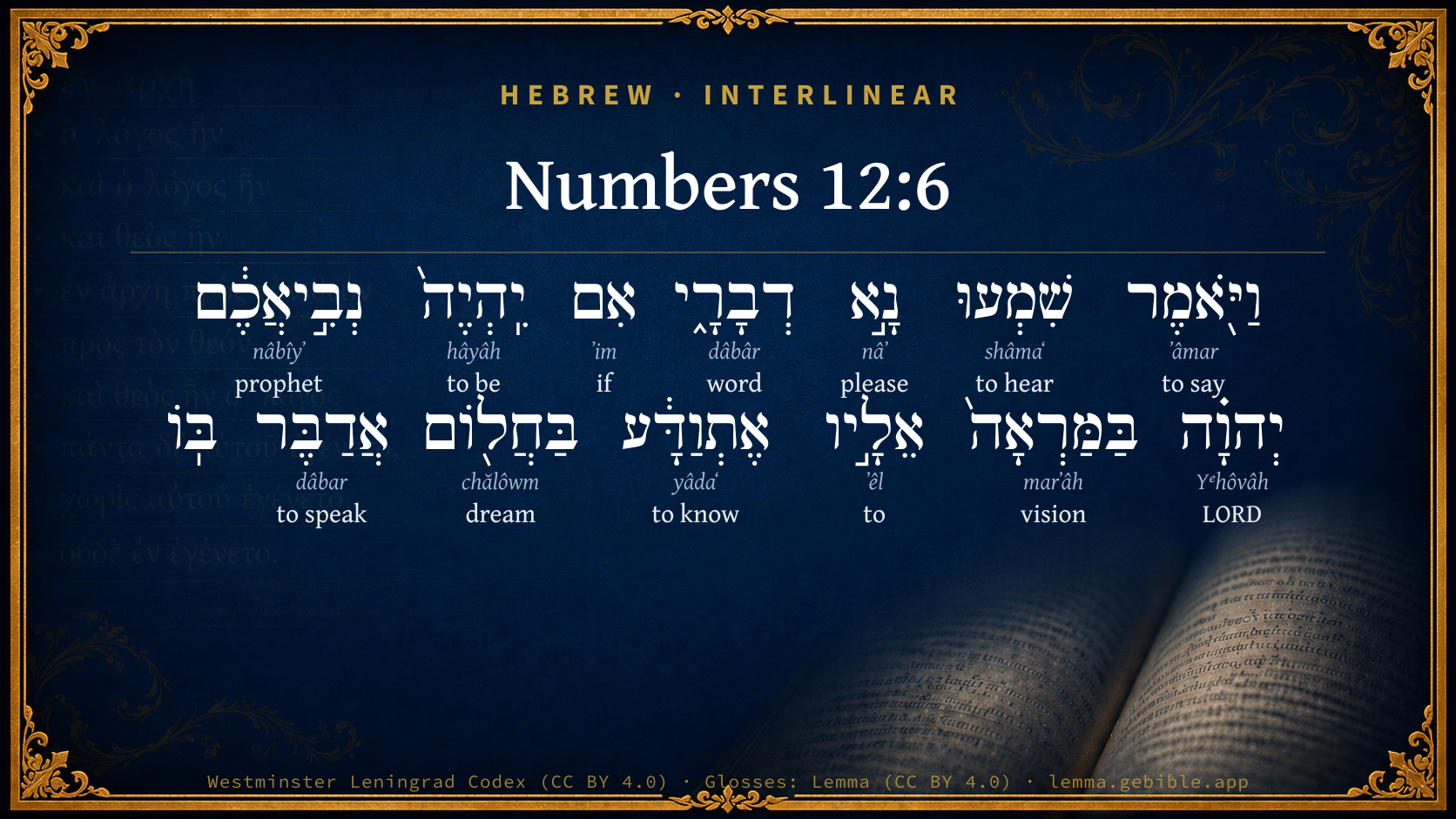
Hebrew (Westminster Leningrad Codex) Numbers 12:6 appears in the Hebrew Old Testament. The text above is from the Westminster Leningrad Codex. Each word links to its Strong’s number, a concise gloss, and parsing drawn from the Open Scriptures Hebrew Bible morphology. Click any word for its full Brown-Driver-Briggs (BDB) entry.
Download image
Cite this verse

Numbers 12:6 (World English Bible). Public Domain. Lemma interlinear Bible study tool, https://lemma.gebible.app/v/numbers/12/6.

Show BibTeX & RIS
BibTeX
RIS
English Translation
He said, Hear now my words: if there be a prophet among you, I Yahweh will make myself known to him in a vision, I will speak with him in a dream.
World English Bible · Public Domain
Download a study sheet

One document with this verse’s original text, its word-by-word gloss line, the meaning frame, cross-references with their text, attributed commentary, and full source and license credits — printable, and it pastes into notes with its structure intact.

This verse Autodidact and up

Study sheet (.html) Plain text (.txt)

A passage Seminary Student

Up to 50 verses in one chapter. A passage sheet keeps up to 6 commentary sources and 12 cross-references per verse, in the order this page ranks them, and says so on the sheet whenever that leaves anything out. Ask for a single verse and you get the Autodidact verse sheet above.

Everything on this page stays free to read, with no account — the sheet is a download of what is already on screen, not access to it.

Want to remove ads? Support Godless Engineer
Compare translations 3

The same verse in 3 English versions, stacked beneath the original-language interlinear above. Click any original word for its lexicon entry.

Each is an independent rendering of the whole verse — the interlinear is not word-aligned to these translations.

Highlighted words mark where these versions differ — a whole-verse word diff, not a word-by-word alignment.

  • World English Bible Public Domain
    He said, Hear now my words: if there be a prophet among you, I Yahweh will make myself known to him in a vision, I will speak with him in a dream.
  • King James Version Public Domain
    And he said, Hear now my words: If there be a prophet among you, I the LORD will make myself known unto him in a vision, and will speak unto him in a dream.
  • unfoldingWord Literal Text CC BY-SA 4.0
    And he said, “Please hear my words! If there is a prophet of yours of Yahweh, in the vision I will make myself known to him. In the dream I will speak with him.

unfoldingWord Literal Text — © unfoldingWord, licensed CC BY-SA 4.0. Word-aligned USFM3 via Door43 (git.door43.org/unfoldingWord/en_ult).

Versions to compare (up to 4)

3 of 4 selected

Show all 18 translations

Every available English version of this verse, each an independent rendering of the whole verse.

  • World English Bible Public Domain
    He said, Hear now my words: if there be a prophet among you, I Yahweh will make myself known to him in a vision, I will speak with him in a dream.
  • Berean Standard Bible Public Domain
    He said, “Hear now My words: If there is a prophet among you, I, the LORD, will reveal Myself to him in a vision; I will speak to him in a dream.
  • Majority Standard Bible Public Domain
    He said, “Hear now My words: If there is a prophet among you, I, the LORD, will reveal Myself to him in a vision; I will speak to him in a dream.
  • King James Version Public Domain
    And he said, Hear now my words: If there be a prophet among you, I the LORD will make myself known unto him in a vision, and will speak unto him in a dream.
  • American Standard Version (1901) Public Domain
    And he said, Hear now my words: if there be a prophet among you, I Jehovah will make myself known unto him in a vision, I will speak with him in a dream.
  • Revised Version (1885) Public Domain
    And he said, Hear now my words: if there be a prophet among you, I the LORD will make myself known unto him in a vision, I will speak with him in a dream.
  • Geneva Bible (1599) Public Domain
    And hee saide, Heare nowe my wordes, If there be a Prophet of the Lord among you, I will be knowen to him by a vision, and will speake vnto him by dreame.
  • Douay-Rheims (1899) Public Domain
    He said to them: Hear my words: if there be among you a prophet of the Lord, I will appear to him in a vision, or I will speak to him in a dream.
  • Young's Literal Translation Public Domain
    And He saith, `Hear, I pray you, My words: If your prophet is of Jehovah -- in an appearance unto him I make Myself known; in a dream I speak with him;
  • Literal Standard Version CC BY-SA 4.0
    And He says, “Now hear My words: If your prophet is of YHWH, || I make Myself known to him in a vision; I speak with him in a dream.
  • Unlocked Literal Bible CC BY-SA 4.0
    Yahweh said, “Now listen to my words. When a prophet of mine is with you, I will reveal myself to him in visions and speak to him in dreams.
  • unfoldingWord Literal Text CC BY-SA 4.0
    And he said, “Please hear my words! If there is a prophet of yours of Yahweh, in the vision I will make myself known to him. In the dream I will speak with him.
  • Darby Bible Public Domain
    And he said, Hear now my words: If there be a prophet among you, I Jehovah will make myself known to him in a vision, I will speak to him in a dream.
  • World Messianic Bible Public Domain
    He said, “Now hear my words. If there is a prophet among you, I, the LORD, will make myself known to him in a vision. I will speak with him in a dream.
  • Webster's Bible Public Domain
    And he said, Hear now my words: If there is a prophet among you, I the LORD will make myself known to him in a vision, and will speak to him in a dream.
  • Free Bible Version CC BY-SA 4.0
    “Now listen to my words, he told them. If you had prophets, I the Lord would reveal myself to them in visions; I would communicate with them in dreams.
  • Bible in Basic English Public Domain
    And he said, Now give ear to my words: if there is a prophet among you I will give him knowledge of myself in a vision and will let my words come to him in a dream.
  • JPS Tanakh (1917) Public Domain
    And He said: 'Hear now My words: if there be a prophet among you, I the LORD do make Myself known unto him in a vision, I do speak with him in a dream.

Literal Standard Version (2020), Covenant Press — licensed CC BY-SA 4.0. Text via the HelloAO Bible API (eBible.org). Unlocked Literal Bible (unfoldingWord) — licensed CC BY-SA 4.0. Text via the HelloAO Bible API (eBible.org). unfoldingWord Literal Text — © unfoldingWord, licensed CC BY-SA 4.0. Word-aligned USFM3 via Door43 (git.door43.org/unfoldingWord/en_ult). Free Bible Version, Dr. Jonathan Gallagher — licensed CC BY-SA 4.0. Text via the HelloAO Bible API (eBible.org).

Word by word

More ways to search: Search by grammar → Find every occurrence → Compare this word →

Practice this passage: Drill this verse → Learn its vocabulary →

בַּמַּרְאָה֙
marʼâh
H4759
“in/at the · vision”
Preposition, Determined + Noun, Common, Feminine, Singular, Absolute
Part of Speech
Preposition + Noun
Type
Common
Gender
Feminine
Number
Singular
State
Absolute
Full BDB Definition

Origin: from H4758

TWOT: 2095g , 2095h

vision - mode of revelation - mirror
  1. וַיֹּ֖אמֶר ʼâmar H559 “and · to say” Conjunction + Verb, Qal, Sequential Imperfect, 3rd Person, Masculine, Singular
  2. שִׁמְעוּ shâmaʻ H8085 “hear” Verb, Qal, Imperative, 2nd Person, Masculine, Plural
  3. נָ֣א nâʼ H4994 “please” Particle, Exhortation
  4. דְבָרָ֑י dâbâr H1697 “words · my” Noun, Common, Masculine, Plural, Construct + Suffix, Personal, 1st Person, Common, Singular
  5. אִם ʼim H518 “if” Conjunction
  6. יִֽהְיֶה֙ hâyâh H1961 “to be” Verb, Qal, Imperfect, 3rd Person, Masculine, Singular
  7. נְבִ֣יאֲכֶ֔ם nâbîyʼ H5030 “prophet · your” Noun, Common, Masculine, Singular, Construct + Suffix, Personal, 2nd Person, Masculine, Plural
  8. יְהוָ֗ה Yᵉhôvâh H3068 “LORD” Noun, Proper
  9. אֵלָ֣יו ʼêl H413 “to · him” Preposition + Suffix, Personal, 3rd Person, Masculine, Singular
  10. אֶתְוַדָּ֔ע yâdaʻ H3045 “to know” Verb, Hithpael, Imperfect, 1st Person, Common, Singular
  11. בַּחֲל֖וֹם chălôwm H2472 “in/at · dream” Preposition + Noun, Common, Masculine, Singular, Absolute
  12. אֲדַבֶּר dâbar H1696 “to speak” Verb, Piel, Imperfect, 1st Person, Common, Singular

About this verse

These counts appear in no published source. They are computed here, from the morphology-tagged text and Lemma’s own curated glosses. What Lemma adds →

14
words
13
distinct lemmas
Pentateuch
section

Notable vocabulary

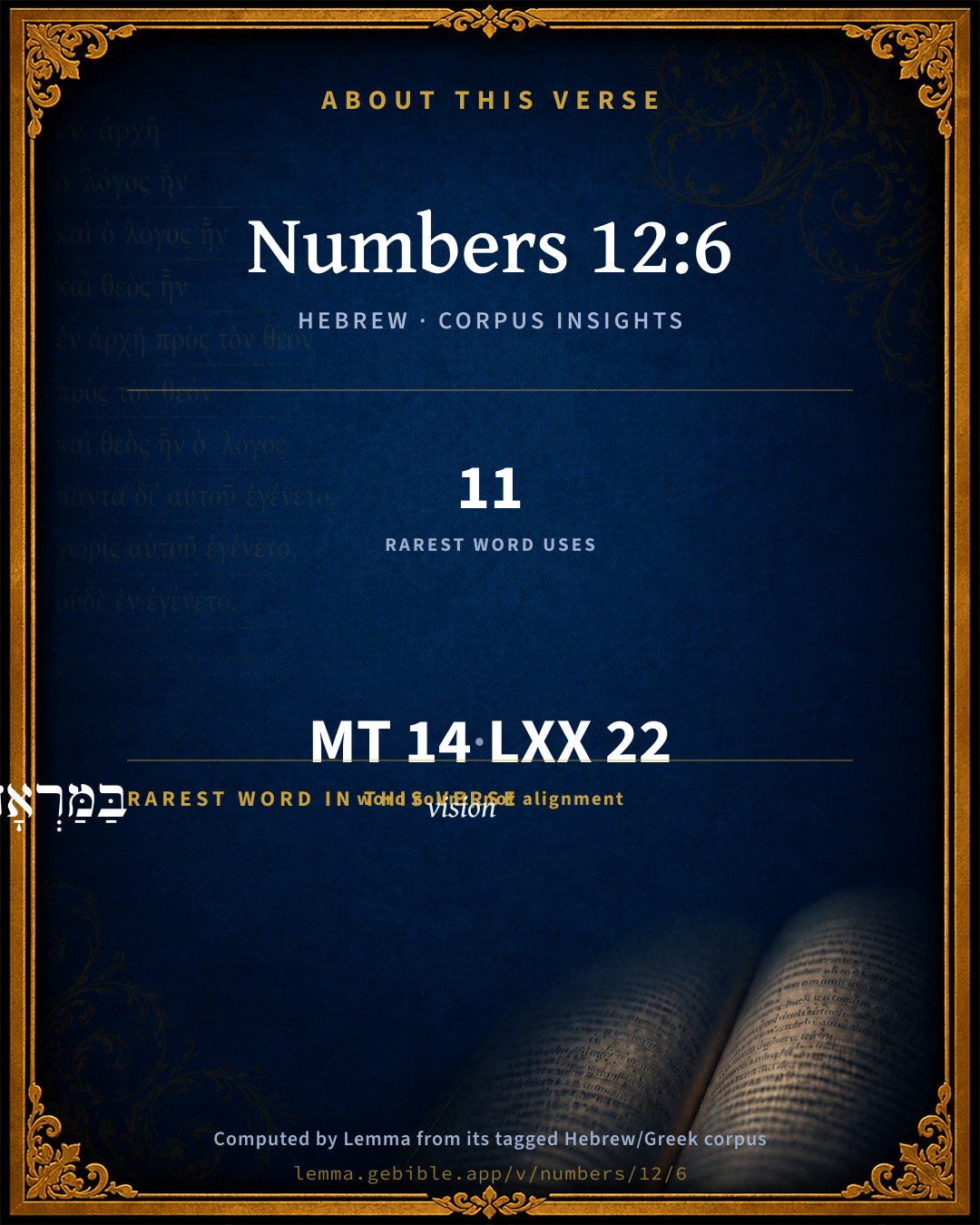
The rarest word here is בַּמַּרְאָה֙ vision H4759 — appearing just 11 times in the whole Hebrew Bible.

Shared distinctive vocabulary

בַּמַּרְאָה֙ vision H4759 occurs in 10 verses of the Hebrew Bible. Also found in:

Grammatical profile

  • 5 verbs
  • 5 nouns
  • 2 prepositions
  • 1 conjunction
  • 1 particle

Verb forms

  • וַיֹּ֖אמֶר Qal · Sequential Imperfect
  • שִׁמְעוּ Qal · Imperative
  • יִֽהְיֶה֙ Qal · Imperfect
  • אֶתְוַדָּ֔ע Hithpael · Imperfect
  • אֲדַבֶּר Piel · Imperfect

Hebrew & Septuagint length

In English translation the verse runs 32 words from the Hebrew and 37 from the Septuagint (LXX English) — closely comparable.

A rough comparison of the two English renderings, which tokenize alike — not a word-level alignment.

Word counts can differ between the Hebrew and the Greek without any difference in meaning — e.g. the Hebrew direct-object marker אֵת has no separate Greek word, and Greek often adds the article ὁ.

In the original languages it is 14 Hebrew tokens and 22 Greek tokens — but the two are counted differently (Hebrew bundles its prefixes and suffixes into one token; the Greek is in lemma form), so that isn’t a like-for-like length.

Cross-references

31

Topical passages linked to Numbers 12:6 in the Treasury of Scripture Knowledge — connected by theme and wording, ordered by reader-vote popularity; previews shown in the World English Bible.

  • 1 Kings 3:5 In Gibeon Yahweh appeared to Solomon in a dream by night; and God said, Ask what I shall give you.
  • Genesis 31:10–11 It happened at the time that the flock conceive, that I lifted up my eyes, and saw in a dream, and behold, the male goats which leaped on the flock were streaked, speckled, and grizzled.
  • Genesis 46:2 God spoke to Israel in the visions of the night, and said, "Jacob, Jacob!" He said, "Here I am."
  • Acts 22:17–18 "It happened that, when I had returned to Jerusalem, and while I prayed in the temple, I fell into a trance,
  • Luke 1:22 When he came out, he could not speak to them, and they perceived that he had seen a vision in the temple. He continued making signs to them, and remained mute.
  • Daniel 10:8 So I was left alone, and saw this great vision, and there remained no strength in me; for my comeliness was turned in me into corruption, and I retained no strength.
  • Luke 1:11 An angel of the Lord appeared to him, standing on the right side of the altar of incense.
  • Ezekiel 1:1 Now it happened in the thirtieth year, in the fourth [month], in the fifth [day] of the month, as I was among the captives by the river Chebar, that the heavens were opened, and I saw visions of God.
  • Genesis 15:1 After these things the word of Yahweh came to Abram in a vision, saying, "Don't be afraid, Abram. I am your shield, your exceedingly great reward."
  • Genesis 20:7 Now therefore, restore the man's wife. For he is a prophet, and he will pray for you, and you will live. If you don't restore her, know for sure that you will die, you, and all who are yours."
  • Exodus 7:1 Yahweh said to Moses, "Behold, I have made you as God to Pharaoh; and Aaron your brother shall be your prophet.
  • Job 4:13 In thoughts from the visions of the night, When deep sleep falls on men,
  • Job 33:15 In a dream, in a vision of the night, When deep sleep falls on men, In slumbering on the bed;
  • Psalms 89:19 Then you spoke in vision to your saints, And said, "I have bestowed strength on the warrior. I have exalted a young man from the people.
  • Psalms 105:15 "Don't touch my anointed ones! Do my prophets no harm!"
  • Jeremiah 23:28 The prophet who has a dream, let him tell a dream; and he who has my word, let him speak my word faithfully. What is the straw to the wheat? says Yahweh.
  • Daniel 8:2 I saw in the vision; now it was so, that when I saw, I was in Shushan the palace, which is in the province of Elam; and I saw in the vision, and I was by the river Ulai.
  • Matthew 1:20 But when he thought about these things, behold, an angel of the Lord appeared to him in a dream, saying, "Joseph, son of David, don't be afraid to take to yourself Mary, your wife, for that which is conceived in her is of the Holy Spirit.
  • Acts 10:11 He saw heaven opened and a certain container descending to him, like a great sheet let down by four corners on the earth,
  • Daniel 7:1 In the first year of Belshazzar king of Babylon Daniel had a dream and visions of his head on his bed: then he wrote the dream and told the sum of the matters.
  • Daniel 10:16–17 Behold, one in the likeness of the sons of men touched my lips: then I opened my mouth, and spoke and said to him who stood before me, my lord, by reason of the vision my sorrows are turned on me, and I retain no strength.
  • Matthew 2:19 But when Herod was dead, behold, an angel of the Lord appeared in a dream to Joseph in Egypt, saying,
  • Acts 10:17 Now while Peter was very perplexed in himself what the vision which he had seen might mean, behold, the men who were sent by Cornelius, having made inquiry for Simon's house, stood before the gate,
  • Matthew 2:12–13 Being warned in a dream that they shouldn't return to Herod, they went back to their own country another way.
  • Matthew 23:31 Therefore you testify to yourselves that you are children of those who killed the prophets.
  • Matthew 23:37 "Jerusalem, Jerusalem, who kills the prophets, and stones those who are sent to her! How often would I have gathered your children together, even as a hen gathers her chickens under her wings, and you would not!
  • Luke 20:6 But if we say, 'From men,' all the people will stone us, for they are persuaded that John was a prophet."
  • Ephesians 4:11 He gave some to be apostles; and some, prophets; and some, evangelists; and some, shepherds and teachers;
  • Revelation 11:3 I will give power to my two witnesses, and they will prophesy one thousand two hundred sixty days, clothed in sackcloth."
  • Revelation 11:10 Those who dwell on the earth rejoice over them, and they will be glad. They will give gifts to one another, because these two prophets tormented those who dwell on the earth.
  • Matthew 23:34 Therefore, behold, I send to you prophets, wise men, and scribes. Some of them you will kill and crucify; and some of them you will scourge in your synagogues, and persecute from city to city;

Cross-references courtesy of OpenBible.info (CC BY 4.0).

Hebrew and Greek witnesses Masoretic Hebrew ↔ Greek Septuagint

The same verse in the two great witnesses to the Old Testament, shown verse-for-verse.

These are two independent witnesses, not word-aligned to each other, and the Septuagint is shown in lemma (dictionary) form.

Hebrew Numbers 12:6 Masoretic · Westminster Leningrad Codex

וַיֹּ֖אמֶר שִׁמְעוּ נָ֣א דְבָרָ֑י אִם יִֽהְיֶה֙ נְבִ֣יאֲכֶ֔ם יְהוָ֗ה בַּמַּרְאָה֙ אֵלָ֣יו אֶתְוַדָּ֔ע בַּחֲל֖וֹם אֲדַבֶּר בּֽוֹ

He said, Hear now my words: if there be a prophet among you, I Yahweh will make myself known to him in a vision, I will speak with him in a dream.

World English Bible · Public Domain

Greek LXX Numbers 12:6 Septuagint · lemma form

καί εἶπον πρός αὐτός ἀκούω ὁ λόγος ἐγώ ἐάν γίγνομαι προφήτης σύ κύριος ἐν ὅραμα αὐτός γιγνώσκω καί ἐν ὕπνος λαλέω αὐτός

And he said to them, Hear my words: If there should be of you a prophet to the Lord, I will be made known to him in a vision, and in sleep will I speak to him.

LXX2012 (modern English Septuagint) · Public Domain

On this verse, Ellicott's Commentary for English Readers discusses the Septuagint’s reading. Read the note in Commentary ↓

Hebrew: Westminster Leningrad Codex (CC BY 4.0). Greek: Septuagint (public domain); English from LXX2012 (modern English Septuagint) (Public Domain). How the Septuagint differs from the Hebrew →

Targum (Aramaic paraphrase)

2

The Targum is the ancient Jewish Aramaic paraphrase of the Hebrew Scriptures — an interpretive translation, not the Hebrew text itself. Onkelos (literal) and Pseudo-Jonathan (expansive) render the Torah, and Jonathan the Prophets. Coverage is partial: where no permissively-licensed English translation exists for a verse, only the Aramaic is shown. This is verse-level text, not a word-by-word alignment to the Hebrew.

  1. Targum Onkelos Torah (Genesis–Deuteronomy)
    וַאֲמַר שְׁמָעוּ כְעַן פִּתְגָמָי אִם יְהוֹן לְכוֹן נְבִיאִין אֲנָא יְיָ בְּחֶזְוָן אֲנָא מִתְגְלֵי לְהוֹן בְּחֶלְמִין אֲנָא מְמַלֵל עִמְהוֹן

    (no public-domain English translation for this verse)

    Targum Onkelos — Aramaic: “Onkelos Genesis” (public domain); “Onkelos Exodus” (public domain); “Onkelos Leviticus” (public domain); “Onkelos Numbers” (public domain); “Onkelos Deuteronomy” (public domain). English: “Sefaria Community Translation” (CC0 1.0 (public-domain dedication)); “J.W. Etheridge. The Targums of Onkelos and Jonathan Ben Uzziel on the Pentateuch. London: Longmans, Green, 1862” (public domain). Text via Sefaria.

  2. Targum Pseudo-Jonathan Torah (Genesis–Deuteronomy)
    וַאֲמַר שִׁמְעוּ בְּבָעוּ פִּתְגָמָי עַד דַאֲמַלֵיל אִין יֶהֱווֹן כָּל נְבִיָא דְקָמוּ מִן יוֹמַת עַלְמָא מִתְמַלֵיל עִמְהוֹן הֵיכְמָא דְמִתְמַלֵיל עִם משֶׁה דְמֵימְרָא דַיְיָ בְּחֵזְיוּ לְוַתְהוֹן מִתְגְלֵי בְּחֶלְמָא מְמַלֵילְנָא עִמְהוֹן

    And He said, Hear now My words, while I speak. Have any of the prophets who have arisen from the days of old been spoken with as Mosheh hath been? To those (prophets) the Word of the Lord hath been revealed in apparition, speaking with them in a dream.

    Targum Pseudo-Jonathan — Aramaic: “Targum Jonathan on Genesis” (public domain); “Targum Jonathan on Exodus” (public domain); “Targum Jonathan on Leviticus” (public domain); “Targum Jonathan on Numbers” (public domain); “Targum Jonathan on Deuteronomy” (public domain). English: “The Targum of Jonathan ben Uzziel, trans. J. W. Etheridge, London, 1862” (public domain). Text via Sefaria.

Commentary

Notes on Numbers 12:6 from classic Christian and Jewish commentators (each source and its license shown beneath its notes). The classic Christian expositions comment on the surrounding passage and are grouped to its opening verse, so a note may address several verses; the Jewish commentaries on the Tanakh (Rashi and others) are per-verse, so they appear only where the commentator wrote on this verse.

Lemma curates 59 commentaries, every one of them public domain or Creative Commons licensed, each selected and text-cleaned for this edition rather than reprinted as found. About our sources →

Trapp's Complete Commentary

John Trapp

Num 12:6 And he said, Hear now my words: If there be a prophet among you, [I] the LORD will make myself known unto him in a vision, [and] will speak unto him in a dream.

Ver. 6. In a vision.] To those awake.

In a dream.] To those asleep: but dreams and visions do soon vanish and fly away. {Job 20:8}

John Trapp, A Commentary or Exposition upon All the Books of the Old and New Testament (1647–1656) — public domain. Text from a community e-Sword module.

Joseph Benson's Commentary

Num 12:6. If there be a prophet among you — If you be prophets, yet know there is a difference among prophets, nor do I put equal honour upon all of them. In a vision — To some the divine will was communicated by strong impressions upon their imaginations when they were awake, but in an ecstasy, as in the case of Abraham, Gen 15:1; Jacob, Gen 46:2; and Dan 8:1-15. Now we never read that Moses was thus entranced in a prophetic vision. He was always awake and quite master of himself when conversing with God, or receiving communications from him. In a dream — To others God revealed his mind by figurative, enigmatical representations, exhibited to them in their sleep; as the ladder which was represented to Jacob in a dream, Gen 28:12.

Joseph Benson's Commentary on the Old and New Testaments (1811–1818) — public domain. Text from a community e-Sword module.

Tyndale Open Study Notes

Tyndale Open Resources

12:6-8 The Lord’s trust in Moses resulted in an intimate relationship. God spoke to prophets in visions and dreams, but he spoke to Moses face to face (literally mouth to mouth; see Exod 33:8-11, 18-23; Deut 34:10).

Tyndale Open Study Notes — © Tyndale Open Resources, licensed CC BY-SA 4.0. Text via the HelloAO Bible API.

Geneva Bible (1599)

Geneva Bible translators

These were the two ordinary means.

Geneva Bible (1599) marginal notes — public domain. Text via Bolls.life.

Jamieson, Fausset & Brown

Robert Jamieson, A. R. Fausset & David Brown

Hear now my words--A difference of degree is here distinctly expressed in the gifts and authority even of divinely commissioned prophets. Moses, having been set over all God's house, (that is, His church and people), was consequently invested with supremacy over Miriam and Aaron also and privileged beyond all others by direct and clear manifestations of the presence and will of God.

Jamieson, Fausset & Brown — Commentary Critical and Explanatory on the Whole Bible (1871) — public domain (CC PDM 1.0). Text via the HelloAO Bible API.

Adam Clarke's Commentary

Verse 6. If there be a prophet] We see here the different ways in which God usually made himself known to the prophets, viz., by visions - emblematic appearances, and by dreams, in which the future was announced by dark speeches, בחידת bechidoth, by enigmas or figurative representations, Nu 12:8. But to Moses God had communicated himself in a different way - he spoke to him face to face, apparently, showing him his glory: not in dark or enigmatical speeches; this could not be admitted in the case in which Moses was engaged, for he was to receive laws by Divine inspiration, the precepts and expressions of which must all be ad captum vulgi, within the reach of the meanest capacity. As Moses, therefore, was chosen of God to be the lawgiver, so was he chosen to see these laws duly enforced for the benefit of the people among whom he presided.

Adam Clarke's Commentary on the Bible (1810–1826) — public domain. Text from a community e-Sword/MySword module.

Ellicott's Commentary for English Readers

(6) If there be a prophet . . . —Better, If there be to (or, among) ycu a prophet of Jehovah, I will make myself known unto him in a vision, and speak unto him. The LXX. and Vulgate connect the word “Jehovah” with the former, not with the latter part of the clause. The mode of communication between God and Moses differed in the respects which are enumerated in Num_12:8 from the mode of communication by visions or dreams, in which God communicated His will to others.

A Bible Commentary for English Readers, edited by Charles John Ellicott (1878–1897) — public domain. Text from a community e-Sword module.

The Cambridge Bible for Schools and Colleges

gen. ed. J. J. S. Perowne

6. if there be a prophet among you, I Jehovah &c.] The Heb. text is corrupt. The true reading is probably ‘a prophet among you’ (נָבִיא בָכֶם for נְבִיְאַכֶם, and ‘Jehovah’ must be omitted. Its position in the Heb. forbids the rendering of the R.V. Possibly it has been accidentally transposed, and the verse should begin ‘And Jehovah said,’ as Syr. and LXX. Luc. [Note: uc. The Lucianic recension of the Septuagint.] have it.

6–8. The words of Jehovah (from ‘If there be a prophet’) are couched in rhythmical form, as was the common practice in the utterance of oracles. As they stand in the Heb. text they fall into ten short lines.

The Cambridge Bible for Schools and Colleges (gen. ed. J. J. S. Perowne; Cambridge University Press, 1878–1918) — public domain. Text from a community e-Sword module.

John Gill's Exposition

And he said, hear now my words,.... The Targum of Jonathan reads, "I beseech you"; and Jarchi says, this particle always so signifies; but it is not so agreeable to the language of the divine Being:

if there be a prophet among you; not as making a doubt of it, but rather allowing that there was, and that there were others besides Moses, as even they themselves, Aaron and Miriam, and the seventy elders, and perhaps others; or at least there had been, and would be again, as there were in later times:

I the Lord will make myself known to him; that is, declare my mind and will concerning things present, or things to come:

in a vision; when awake, either by day or by night, representing objects to the bodily sight; as the almond tree rod, and the boiling pot, to Jeremiah, Jer 1:11; the visions of the chariots, Eze 23:24, and dry bones, Eze 37:1, to Ezekiel, and such as were shown to Amos, Amo 7:1, or to the mind by night, as if really discerned by the senses; as the visions of the man riding on a red horse, Zac 1:8, and of the four horns, Zac 1:18, and four carpenters, Zac 1:20, with several others shown to Zechariah:

and will speak unto him in a dream; as he had done to Jacob, Gen 31:11, and as he did afterwards to Daniel, Dan 7:1, and many others.

John Gill's Exposition of the Whole Bible (1746–1763) — public domain (CC PDM 1.0). Text via the HelloAO Bible API.

Haydock's Catholic Bible Commentary

Vision. Other prophets were inspired in a more mysterious manner: Moses, though he saw not the majesty of God in any corporeal figure, was instructed by him in the most secret things with the utmost perspicuity, (Calmet) as if a man were explaining his sentiments to his most intimate friend, Exodus xxxiii. 19. (Haydock)

George Leo Haydock (1774–1849), Haydock's Catholic Family Bible and Commentary, 1859 edition — public domain. Excludes Psalms (Douay-Rheims chapter numbering differs from Protestant) and Deuterocanonical books (Catholic canon only).

Matthew Poole's English Annotations

If you be prophets, as you pretend, yet know there is a difference among prophets, nor do I put equal authority and honour upon all of them. By a vision God represents things to the mind of a prophet when he is awake, as Gen 15:1; 46:2; Dan 8:18; 10:8. By a dream God manifests his mind to them when asleep, as Gen 20:3; 28:12.

Matthew Poole's English Annotations on the Holy Bible (1683–1685) — public domain. Text from a community e-Sword/MySword module.

Whedon's Commentary on the Bible

Daniel D. Whedon

6. If there be a prophet — The literal rendering of this verse is, If there be a prophet of Jehovah to you, (that is, if ye have one,) I reveal myself to him in a vision, I speak to him in a dream.

Vision… dream — Trances and dreams are here represented as modes of divine communication, but they do not bestow the highest dignity upon the man who is the organ of the revelation.

Daniel D. Whedon (gen. ed.), Commentary on the Old and New Testaments (1874–1909) — public domain. Text from a community e-Sword module.

The Pulpit Commentary

If there boa prophet among you I the Lord will make myself known. More probably "the Lord" belongs to the first clause: "If there be to you a prophet of the Lord, I will make myself known." So the Septuagint, eanhtai profhthv umwn Kuriw ... gnwsyhsomai . In a vision. En oramati . An internal vision, in which the eyes (even if open) saw nothing, but the effects of vision" were produced upon the sensorium by other and supernatural means. (see, e.g., Amo_7:7, 8 Act_10:11) Speak unto him in a dream. Rather, speak "in him wOB. The voice that spake to the prophet was an internal voice, causing no vibration of the outer air, but affecting only the inner and hidden seat of consciousness. It is not necessary to restrict the prophetic dream to the time of sleep; a waking state, resembling what we call day-dream, in which the external senses arc quiescent, and the imagination is freed from its usual restraints, was perhaps the more usual mental condition at the time. Indeed the Divine communications made to Joseph (Mat_1:20 Mat_2:13) and to the Magi (ibid. Num_2:12) are almost the only ones we read of as made during actual sleep, unless we include the ease of Pilate"s wife; (ibid. Num_27:19) and none of these were prophets in the ordinary sense. Compare, however, Act_2:17.

Vers. 6-8. The singular honour of Moses.

The best commentary on these verses is supplied by the comparison instituted between Moses and our blessed Lord in the Epistle to the Hebrews. (Heb_3:1-6) The Hebrews are reminded that of all the servants whom the Lord raised up to minister in the ancient Church, there was not one who approached Moses, in respect either to the greatness and variety of the services performed by him, or the greatness of the honours bestowed upon him. Moses was set over all God"s house, and in this eminent station he was conspicuously faithful. In these respects Moses was the most perfect figure of Christ. Christ"s priesthood was foreshadowed by Melchisedec, his royalty by David and Solomon, his prophetical office by Samuel and the goodly company of prophets who followed him. But in Moses all the three offices were foreshadowed at once. Of these two men, Moses and Christ, and of no other since the world began, could it be affirmed that they were "faithful in all the Lord"s house." No doubt there was disparity as well as a resemblance. Both were servants. But Moses was a servant in a house which belonged to another, in a household of which he was only a member, whereas Christ is such a servant as is also a son, and serves in a household of which he is the Maker and Heir. This is true. Nevertheless it is profitable to forget occasionally the disparity of the two great mediators, and to fix attention on the resemblance between them, the points in which the honour of Christ the Great Prophet was prefigured by the singular honour of Moses. Hence the interest and value of this text in Numbers.

I AS A FOIL TO BRING OUT THE SINGULAR HONOUR OF MOSES, THE LORD PUTS ALONGSIDE OF IT THE HONOUR BESTOWED ON OTHER PROPHETS. a Consider the prophets that have been or yet are among you. How has my will been made known to them?" Two ways are specified.

1. "In a vision. There was a memorable example of this in the case of Abraham. (Ge 15) Visions continued to be the vehicles of revelation during the whole course of the Old Testament history. Isaiah, (Isa 6 Isa 13, &c.); Jeremiah, (Jer 50, &c.); Ezekiel and Daniel (everywhere). Peter"s vision at Joppa is a familiar example of the same kind under the New Testament.

2. "In a dream. This was a lower way of revelation. The stories of Pharaoh and Nebuchadnezzar remind us that the dreams (I do not say the interpretations of them) were not seldom vouchsafed to men who were strangers to God. We shall see immediately that these ways of making himself known to men through the prophets, were inferior to the ways in which the Lord was wont to reveal himself through Moses. But let us not so fix our attention on the points of difference as to lose sight of or forget the bright and glorious feature which they have in common. "I, the Lord, do make myself known in a vision, and do speak in a dream." For reasons we can only guess at, the Lord was pleased to suffer the nations to walk in their own ways. But in Israel he revealed himself. At sundry times and in divers manners he was pleased to speak to the fathers by the prophets. The Scriptures of the Old Testament are oracular. In them we inherit the most precious part of the patrimony of the ancient Church. For this was the chief advantage which the Jews had above the Gentiles, that "unto them were committed the oracles of God." It is our own fault if, in reading the Old Testament, we fail to hear everywhere the voice of God.

II OVER AGAINST THE HONOUR VOUCHSAFED TO ALL THE PROPHETS, THE LORD SETS FORTH THE SINGULAR HONOUR OF MOSES. It is denoted by the loving title by which the Lord here and elsewhere names him: "My servant Moses." "Were ye not afraid to speak against my servant Moses?" (verses 7, 8; cf. Jos_1:2; also Deu_34:5) The word here translated "servant" is a word of honourable import; and in the singular and emphatic way in which it is applied by the Lord to Moses, it is applied by him to no other till we come to Christ himself. (see Isa_52:13 Isa_53:11, &c.); The singular honour of Moses is indicated, moreover, by this, that he was called and enabled to do faithful service "in all God"s house." Aaron served as a priest, Miriam as a prophetess, Joshua as a commander, each being intrusted with one department of service; Moses was employed in all. More particularly, Moses was singularly honoured in regard to the manner of the Divine communications granted to him. With him the Lord spoke "mouth to mouth," even apparently, i.e., visibly, and not in dark speeches, and he beheld the similitude of the Lord.

1. When prophets received communications in dreams and visions they were very much in a passive state, simply beholding and hearing, often unable to make out the meaning of what they saw and heard. Moses, on the contrary, was admitted as it were into the audience chamber, and the Lord spoke to him as a man speaks with his friend. (cf. Num_7:89)

2. A few of the prophets, specially honoured, had visions of the Divine glory. (Isa 6, &c.); But in this respect Moses was honoured above all the rest. (Ex 33 Ex 34) In these respects he prefigured the great Prophet, the only begotten Son, who is in the bosom of the Father, knows the Father even as the Father knows him, and has fully declared him. It has seemed to some learned men a thing unlikely, a thing incredible, that the vast body of doctrine and law and divinely-inspired history contained in the last four books of the Pentateuch should have been delivered to the Church within one age, and chiefly by one man. But the thing will not seem strange to one who believes and duly considers the singular honour of Moses as described in this text, especially if it is read in connection with the similar testimony borne elsewhere to Christ. Moses, and the Prophet like unto Moses, stand by themselves in the history of Divine revelation in this respect, that each served "in all God"s house;" each was commissioned to introduce the Church into a new dispensation, to deliver to the Church a system of doctrine and institutions. In harmony with this is the patent fact that, as at the bringing in of the gospel dispensation the stream of Holy Scripture expands into the four gospels, even so at the bringing in of the ancient dispensation the stream of Holy Scripture originated in the Books of the Law. B.

The Pulpit Commentary (1880–1919), ed. H.D.M. Spence-Jones & Joseph S. Exell — public domain. Text from a community e-Sword module.

John Wesley's Explanatory Notes

Among you - if you be prophets, yet know there is a difference among prophets, nor do I put equal honour upon all of them.

John Wesley, Explanatory Notes Upon the Whole Bible (1754–1765) — public domain. Text via the GEBible commentary corpus.

unfoldingWord translationNotes

Door43 World Missions Community

My servant Moses is not like that

"I do not speak to Moses like that"

He is faithful in all my house

Here "my house" represents the nation of Israel. Being faithful in God's house represents being faithful in leading Israel. AT: "Moses leads my people faithfully" or "Moses is the one whom I trust to lead my people Israel" (See: Metonymy)

So why are you unafraid to speak against my servant, against Moses?

Yahweh asks this question to rebuke Miriam and Aaron. It can be translated as a statement. AT: "You should be afraid to speak against my servant, against Moses." (See: Rhetorical Question)

against my servant, against Moses

The phrase "against Moses" clarifies that he is the "servant" of whom Yahweh speaks. AT: "against my servant, Moses" (See: Parallelism)

translationWords

word

prophet

reveal

vision

dream

servant

faithful

house

unfoldingWord translationNotes — © Distant Shores Media and the Door43 World Missions Community, licensed CC BY-SA 4.0. Source: git.door43.org/Door43/en_tn.

Rashi

Rabbi Shlomo Yitzchaki (Rashi)

שמעו נא דברי HEAR, I PRAY YOU, MY WORDS — The word נא is always an expression of entreaty (Sifrei Bamidbar 103).

אם יהיה נביאכם means, IF THERE WOULD BE PROPHETS TO YOU (i.e. if you had a prophet — if you could show one to me).

ה׳ במראה אליו אתודע This means: the Shechinah (the Divine Glory) of my Name does not reveal Itself unto him in a “transparent glass” (i.e. a direct revelation), but in dreams and visions (cf. Sifrei Bamidbar 103).

Rashi on the Tanakh — English translations: “The Judaica Press complete Tanach with Rashi, translated by A. J. Rosenberg” (CC BY 4.0); “Pentateuch with Rashi's commentary by M. Rosenbaum and A.M. Silbermann, 1929-1934” (public domain); “The Metsudah Tanach series, Lakewood, N.J” (CC BY 4.0); and “The Book of Joshua, Metsudah Publications, 1997” (CC BY 4.0). Text via Sefaria.

Ramban (Nachmanides)

Rabbi Moshe ben Nachman (Ramban / Nachmanides)

IF THERE BE ‘NEVI’ACHEM’ [literally “your prophet”] - if there be a prophet “among you,” as Onkelos rendered it [“if there be prophets among you”]. And Rabbi Abraham ibn Ezra commented that the meaning thereof is: “if there be among you a prophet, a prophet of the Eternal,. Ibn Ezra explains it by adding the word navi (prophet), which is in construct with Hashem — “the prophet of the Eternal.” The reason why Ibn Ezra is forced to do so is because when a noun is in construct it cannot have a pronoun as a suffix, and here it says nevi’achem Hashem, the word nevi’achem having such a pronoun as a suffix. Hence Ibn Ezra adds the word navi (the prophet of), to be in construct with the noun Hashem. The sense of the verse is thus: Im yih’yeh nevi’achem ‘nevi’ Hashem. as in [the expression] and the prophecy of Oded the prophet.”, which indicates the definite article. Here it is stated: v’hanevua Oded. Hence Ibn Ezra explains it by adding the word nevuath (a prophecy of), making the sense of the phrase: “and the prophecy, a prophecy of Oded the prophet.” He has explained it well. Thus the meaning of the verse is that “even if there is a prophet among you who is a [true] prophet of the Eternal, he can only prophesy by My Great Name through a vision or in riddles.” He mentions this [“if he be a true prophet of the Eternal”] because many prophets did not attain even this [stage], but were prophets by virtue of the Holy Spirit, as it is said, The spirit of the Eternal spoke by me, this being the “hand” mentioned in connection with Ezekiel, ] etc. as is explained in the words of Zechariah.

IN A VISION I DO MAKE MYSELF KNOWN TO HIM. Scripture does not say: “I will appear to him in a vision,” but it says ‘I will make Myself known.’ This verse is then similar to the one which states, And I appeared unto Abraham, unto Isaac, and unto Jacob, as G-d Almighty, [the verse here] stating that the Great Name appears in a vision and through it He becomes known to the prophet, but [the prophet does not know Him] by His Great Name, just as He said, but by My Name the Eternal I made Me not known to them. And Scripture stated [further] that the communication is in a vision, but My servant Moses is not so, for in all My house in which the prophets see dreams, he is trusted, knowing of his own accord all the [Divine] attributes, and from mouth to mouth the communication comes to him from Me, and he beholds the similitude, not in a dream. In the words of the Sifre: 103. “And the similitude of the Eternal doth he behold. This refers to the vision of ‘the back.’” Thus Scripture here teaches us the difference between the Divine communication received by Moses and that of the other prophets of his generation, in the same way that it mentioned this [difference between him and] those who preceded him [as it says in the verse], And I appeared unto Abraham, etc., as I have explained; and likewise it mentions at the end of the Torah in relation to those who came after him, And there hath not arisen a prophet since in Israel like unto Moses, whom the Eternal knew face to face, the intention being the same in all these places. Do not be disquieted by the statement of the Rabbis concerning Samuel, that he was equal to Moses, as it is written, Though Moses and Samuel stood before Me, yet My mind could not be toward this people, since it is because G-d mentioned Samuel together with Moses that our Rabbis considered it an indication of his [Samuel’s] greatness, but not that they were comparing the prophecies [of Moses and Samuel] to each other — far it be for them [to say so]! And the intention of this verse [which mentions Moses and Samuel together is as follows]: He mentioned Moses because he stood before Him in the breach, to turn back His wrath, lest He should destroy them, both at the [incident of the] golden calf and that of the spies, when the people were in danger of destruction; and so Scripture also mentioned Samuel, because this verse is in connection with the drought when they needed rain, and He said, Are there any among the vanities of the nations that can cause rain? etc., Verse 22. Thus G-d said that even if Samuel — the prophet who brought rain when it was not due, in the days of the wheat-harvest — were to stand [in prayer] before Him, He would not listen to him to bring it for these people in their time of trouble. Thus Scripture mentioned the great men of the tribe whom G-d chose to minister unto Him, and to bless in His Name, who prayed for Israel. This is also the sense of the verse which says, Moses and Aaron among His priests, and Samuel among them that call upon His Name.

Ramban (Nachmanides) on the Tanakh — English translation: “Commentary on the Torah by Ramban (Nachmanides). Translated and annotated by Charles B. Chavel. New York, Shilo Pub. House, 1971-1976” (CC BY 4.0). Text via Sefaria.

Lesson kit

Teaching starters — assembled from the data on this page, not authored interpretation. Every prompt links to the verse data it draws on. Edit before teaching.

Numbers, in the Pentateuch, opens this verse with 14 words (13 distinct Hebrew lemmas). Its most distinctive word is marʼâh (“vision”). A historical commentator’s framing appears above. Read the whole chapter for the surrounding context.

Discussion questions

  1. The word marʼâh carries the sense “vision.” How does it shape the verse?
  2. How does Genesis 46:2, which shares the word «vision», read alongside this verse?
  3. The translations on this page render this verse differently — a whole-verse word diff, not a word-by-word alignment. What might account for the different wordings?
  4. «וַיֹּ֖אמֶר» is a Qal Sequential Imperfect verb. How does that grammatical form shape the action described?
  5. Compare how Trapp's Complete Commentary and Joseph Benson's Commentary read this verse. Where do they agree or differ?

Things to notice

Reading settings

Reading text

Shown beneath each verse's original-language words.

Old Testament
Old Testament edition

Read the OT as the Masoretic Hebrew (MT) or the Greek Septuagint (LXX).

English shown for the Greek Septuagint (in the Hebrew ↔ Greek comparison).

Comparing translations? Open the Compare panel on any verse page to stack up to four side by side.