1 Kings 1:32

Hebrew (Westminster Leningrad Codex) 1 Kings 1:32 appears in the Hebrew Old Testament. The text above is from the Westminster Leningrad Codex. Each word links to its Strong’s number, a concise gloss, and parsing drawn from the Open Scriptures Hebrew Bible morphology. Click any word for its full Brown-Driver-Briggs (BDB) entry.
Download image
Cite this verse

1 Kings 1:32 (World English Bible). Public Domain. Lemma interlinear Bible study tool, https://lemma.gebible.app/v/1-kings/1/32.

Show BibTeX & RIS
BibTeX
RIS
English Translation
King David said, Call to me Zadok the priest, and Nathan the prophet, and Benaiah the son of Jehoiada. They came before the king.
World English Bible · Public Domain
Download a study sheet

One document with this verse’s original text, its word-by-word gloss line, the meaning frame, cross-references with their text, attributed commentary, and full source and license credits — printable, and it pastes into notes with its structure intact.

This verse Autodidact and up

Study sheet (.html) Plain text (.txt)

A passage Seminary Student

Up to 50 verses in one chapter. A passage sheet keeps up to 6 commentary sources and 12 cross-references per verse, in the order this page ranks them, and says so on the sheet whenever that leaves anything out. Ask for a single verse and you get the Autodidact verse sheet above.

Everything on this page stays free to read, with no account — the sheet is a download of what is already on screen, not access to it.

Want to remove ads? Support Godless Engineer
Compare translations 3

The same verse in 3 English versions, stacked beneath the original-language interlinear above. Click any original word for its lexicon entry.

Each is an independent rendering of the whole verse — the interlinear is not word-aligned to these translations.

Highlighted words mark where these versions differ — a whole-verse word diff, not a word-by-word alignment.

  • World English Bible Public Domain
    King David said, Call to me Zadok the priest, and Nathan the prophet, and Benaiah the son of Jehoiada. They came before the king.
  • King James Version Public Domain
    And king David said, Call me Zadok the priest, and Nathan the prophet, and Benaiah the son of Jehoiada. And they came before the king.
  • unfoldingWord Literal Text CC BY-SA 4.0
    And King David said, “Call to me to Zadok the priest and to Nathan the prophet and to Benaiah, the son of Jehoiada.” And they came to the face of the king.

unfoldingWord Literal Text — © unfoldingWord, licensed CC BY-SA 4.0. Word-aligned USFM3 via Door43 (git.door43.org/unfoldingWord/en_ult).

Versions to compare (up to 4)

3 of 4 selected

Show all 18 translations

Every available English version of this verse, each an independent rendering of the whole verse.

  • World English Bible Public Domain
    King David said, Call to me Zadok the priest, and Nathan the prophet, and Benaiah the son of Jehoiada. They came before the king.
  • Berean Standard Bible Public Domain
    Then King David said, “Call in for me Zadok the priest, Nathan the prophet, and Benaiah son of Jehoiada.” So they came before the king.
  • Majority Standard Bible Public Domain
    Then King David said, “Call in for me Zadok the priest, Nathan the prophet, and Benaiah son of Jehoiada.” So they came before the king.
  • King James Version Public Domain
    And king David said, Call me Zadok the priest, and Nathan the prophet, and Benaiah the son of Jehoiada. And they came before the king.
  • American Standard Version (1901) Public Domain
    And king David said, Call to me Zadok the priest, and Nathan the prophet, and Benaiah the son of Jehoiada. And they came before the king.
  • Revised Version (1885) Public Domain
    And king David said, Call me Zadok the priest, and Nathan the prophet, and Benaiah the son of Jehoiada. And they came before the king.
  • Geneva Bible (1599) Public Domain
    And King Dauid saide, Call mee Zadok the Priest, and Nathan the Prophet, and Benaiah the sonne of Iehoiada. And they came before the King.
  • Douay-Rheims (1899) Public Domain
    King David also said: Call me Sadoc the priest, and Nathan the prophet, and Banaias the son of Joiada. And when they were come in before the king,
  • Young's Literal Translation Public Domain
    And king David saith, `Call for me for Zadok the priest, and for Nathan the prophet, and for Benaiah son of Jehoiada;' and they come in before the king.
  • Literal Standard Version CC BY-SA 4.0
    And King David says, “Call for Zadok the priest, and for Nathan the prophet, and for Benaiah son of Jehoiada for me”; and they come in before the king.
  • Unlocked Literal Bible CC BY-SA 4.0
    King David said, “Call to me Zadok the priest, Nathan the prophet, and Benaiah son of Jehoiada.” So they came before the king.
  • unfoldingWord Literal Text CC BY-SA 4.0
    And King David said, “Call to me to Zadok the priest and to Nathan the prophet and to Benaiah, the son of Jehoiada.” And they came to the face of the king.
  • Darby Bible Public Domain
    And king David said, Call me Zadok the priest, and Nathan the prophet, and Benaiah the son of Jehoiada. And they came before the king.
  • World Messianic Bible Public Domain
    King David said, “Call to me Zadok the priest, Nathan the prophet, and Benaiah the son of Jehoiada.” They came before the king.
  • Webster's Bible Public Domain
    And king David said, Call me Zadok the priest, and Nathan the prophet, and Benaiah the son of Jehoiada. And they came before the king.
  • Free Bible Version CC BY-SA 4.0
    Then King David said, “Call for me Zadok the priest, Nathan the prophet, and Benaiah, son of Jehoiada.” When they arrived,
  • Bible in Basic English Public Domain
    And King David said, Send for Zadok the priest, and Nathan the prophet, and Benaiah, the son of Jehoiada. And they came before the king.
  • JPS Tanakh (1917) Public Domain
    And king David said: 'Call me Zadok the priest, and Nathan the prophet, and Benaiah the son of Jehoiada.' And they came before the king.

Literal Standard Version (2020), Covenant Press — licensed CC BY-SA 4.0. Text via the HelloAO Bible API (eBible.org). Unlocked Literal Bible (unfoldingWord) — licensed CC BY-SA 4.0. Text via the HelloAO Bible API (eBible.org). unfoldingWord Literal Text — © unfoldingWord, licensed CC BY-SA 4.0. Word-aligned USFM3 via Door43 (git.door43.org/unfoldingWord/en_ult). Free Bible Version, Dr. Jonathan Gallagher — licensed CC BY-SA 4.0. Text via the HelloAO Bible API (eBible.org).

Word by word

More ways to search: Search by grammar → Find every occurrence → Compare this word →

Practice this passage: Drill this verse → Learn its vocabulary →

וּלְנָתָ֣ן
Nâthân
H5416
“and · to/for · Nathan”
Conjunction + Preposition + Noun, Proper
Part of Speech
Conjunction + Preposition + Noun
Type
Proper
Full BDB Definition

Origin: from H5414

TWOT: None

Nathan = "giver" - a son of David by Bathsheba - the eminent prophet in the time of David and Solomon - a man of Zobah, father of one of David's mighty warriors - father of Azariah who was over the officers of Solomon - son of Attai and father of Zabad of the tribe of Judah - brother of Joel of the tribe of Judah - one of the head men who returned from Babylon with Ezra - a man with a foreign wife in the time of Ezra - head of a family of Israel who shall mourn when they look on Him whom they pierced
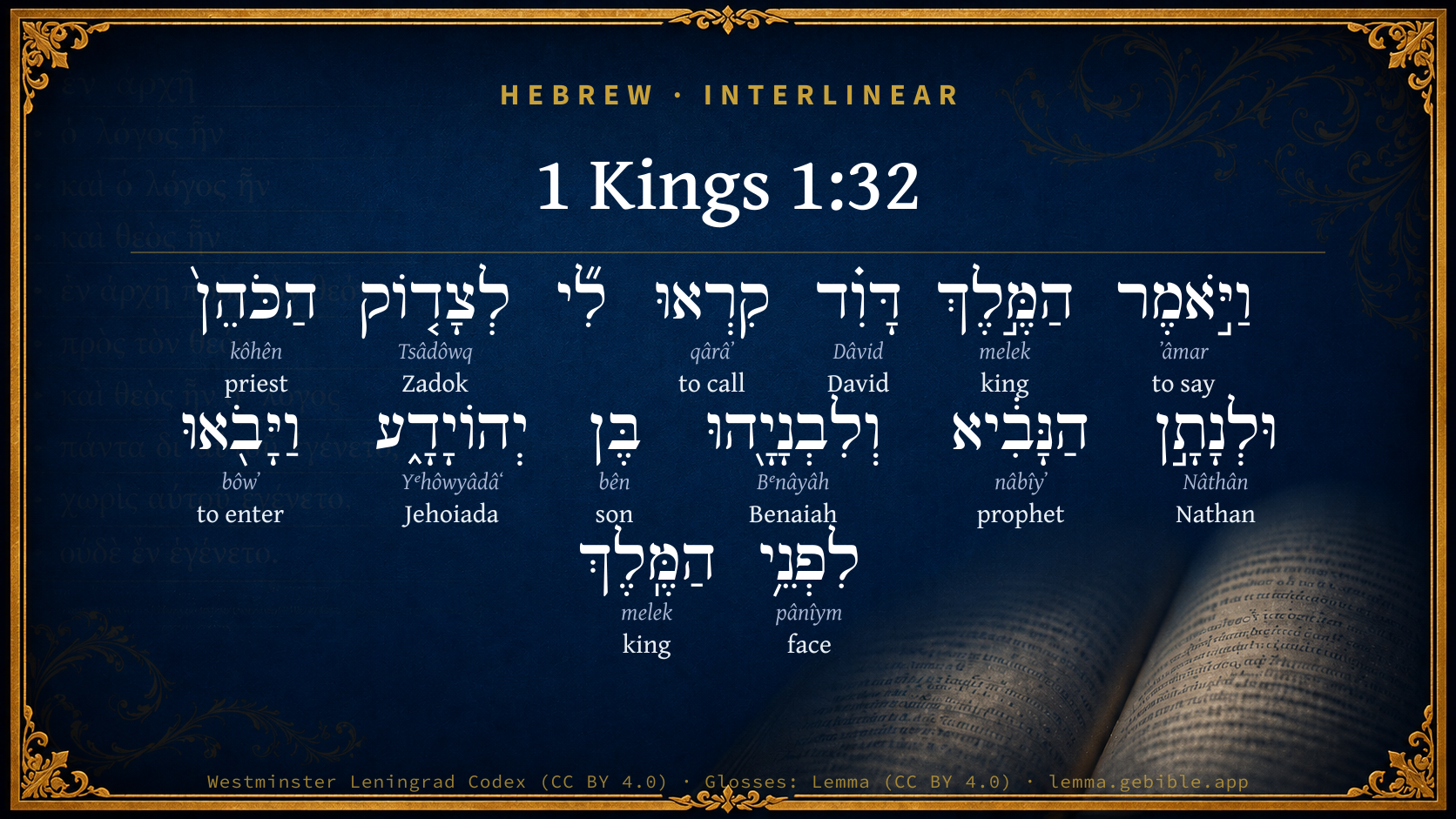
  1. וַיֹּ֣אמֶר ʼâmar H559 “and · to say” Conjunction + Verb, Qal, Sequential Imperfect, 3rd Person, Masculine, Singular
  2. הַמֶּ֣לֶךְ melek H4428 “the · king” Particle, Definite Article + Noun, Common, Masculine, Singular, Absolute
  3. דָּוִ֗ד Dâvid H1732 “David” Noun, Proper
  4. קִרְאוּ qârâʼ H7121 “call” Verb, Qal, Imperative, 2nd Person, Masculine, Plural
  5. לְצָד֤וֹק Tsâdôwq H6659 “to/for · Zadok” Preposition + Noun, Proper
  6. הַכֹּהֵן֙ kôhên H3548 “the · priest” Particle, Definite Article + Noun, Common, Masculine, Singular, Absolute
  7. הַנָּבִ֔יא nâbîyʼ H5030 “the · prophet” Particle, Definite Article + Noun, Common, Masculine, Singular, Absolute
  8. וְלִבְנָיָ֖הוּ Bᵉnâyâh H1141 “and · to/for · Benaiah” Conjunction + Preposition + Noun, Proper
  9. בֶּן bên H1121 “son of” Noun, Common, Masculine, Singular, Construct
  10. יְהוֹיָדָ֑ע Yᵉhôwyâdâʻ H3077 “Jehoiada” Noun, Proper
  11. וַיָּבֹ֖אוּ bôwʼ H935 “and · to enter” Conjunction + Verb, Qal, Sequential Imperfect, 3rd Person, Masculine, Plural
  12. לִפְנֵ֥י pânîym H6440 “to/for · face(s) of” Preposition + Noun, Common, Both, Plural, Construct
  13. הַמֶּֽלֶךְ melek H4428 “the · king” Particle, Definite Article + Noun, Common, Masculine, Singular, Absolute

About this verse

These counts appear in no published source. They are computed here, from the morphology-tagged text and Lemma’s own curated glosses. What Lemma adds →

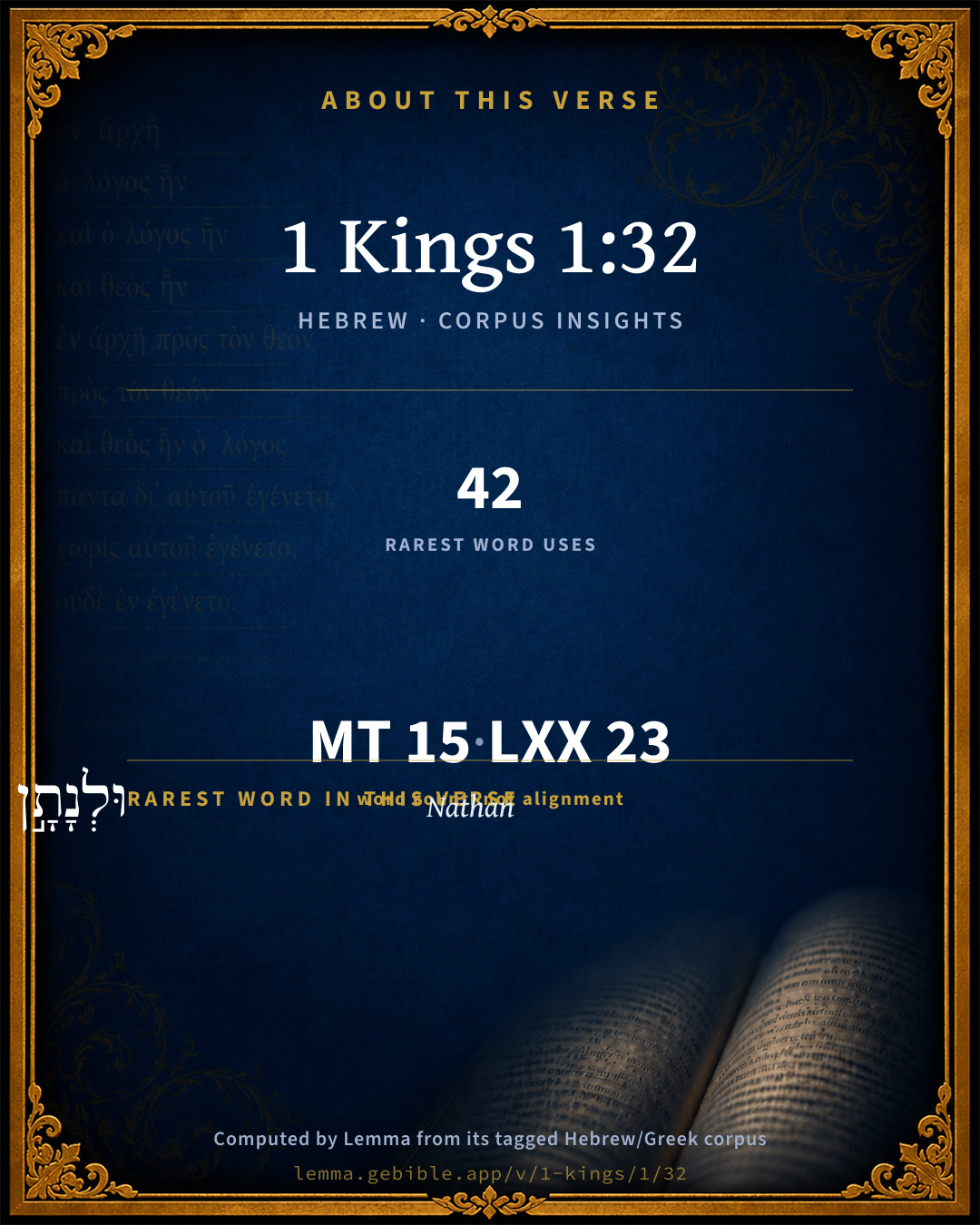
15
words
13
distinct lemmas
Historical
section

Shared distinctive vocabulary

וּלְנָתָ֣ן Nathan H5416 occurs in 39 verses of the Hebrew Bible. Also found in:

Grammatical profile

  • 3 verbs
  • 11 nouns
  • 1 preposition

Verb forms

  • וַיֹּ֣אמֶר Qal · Sequential Imperfect
  • קִרְאוּ Qal · Imperative
  • וַיָּבֹ֖אוּ Qal · Sequential Imperfect

Repetition

A word recurs within this verse — often emphatic in Hebrew:

  • הַמֶּ֣לֶךְ king H4428 ×2

Hebrew & Septuagint length

In English translation the verse runs 24 words from the Hebrew and 26 from the Septuagint (LXX English) — closely comparable.

A rough comparison of the two English renderings, which tokenize alike — not a word-level alignment.

Word counts can differ between the Hebrew and the Greek without any difference in meaning — e.g. the Hebrew direct-object marker אֵת has no separate Greek word, and Greek often adds the article ὁ.

In the original languages it is 15 Hebrew tokens and 23 Greek tokens — but the two are counted differently (Hebrew bundles its prefixes and suffixes into one token; the Greek is in lemma form), so that isn’t a like-for-like length.

Cross-references

3

Topical passages linked to 1 Kings 1:32 in the Treasury of Scripture Knowledge — connected by theme and wording, ordered by reader-vote popularity; previews shown in the World English Bible.

  • 1 Kings 1:8 But Zadok the priest, and Benaiah the son of Jehoiada, and Nathan the prophet, and Shimei, and Rei, and the mighty men who belonged to David, were not with Adonijah.
  • 1 Kings 1:26 But he hasn't called me, even me your servant, and Zadok the priest, and Benaiah the son of Jehoiada, and your servant Solomon.
  • 1 Kings 1:38 So Zadok the priest, and Nathan the prophet, and Benaiah the son of Jehoiada, and the Cherethites and the Pelethites, went down, and caused Solomon to ride on king David's mule, and brought him to Gihon.

Cross-references courtesy of OpenBible.info (CC BY 4.0).

Hebrew and Greek witnesses Masoretic Hebrew ↔ Greek Septuagint

The same verse in the two great witnesses to the Old Testament, shown verse-for-verse.

These are two independent witnesses, not word-aligned to each other, and the Septuagint is shown in lemma (dictionary) form.

Hebrew 1 Kings 1:32 Masoretic · Westminster Leningrad Codex

וַיֹּ֣אמֶר הַמֶּ֣לֶךְ דָּוִ֗ד קִרְאוּ לִ֞י לְצָד֤וֹק הַכֹּהֵן֙ וּלְנָתָ֣ן הַנָּבִ֔יא וְלִבְנָיָ֖הוּ בֶּן יְהוֹיָדָ֑ע וַיָּבֹ֖אוּ לִפְנֵ֥י הַמֶּֽלֶךְ

King David said, Call to me Zadok the priest, and Nathan the prophet, and Benaiah the son of Jehoiada. They came before the king.

World English Bible · Public Domain

Greek LXX 1 Kings 1:32 Septuagint · lemma form

καί εἶπον ὁ βασιλεύς δαυίδ καλέω ἐγώ σαδωκ ὁ ἱερεύς καί ναθαν ὁ προφήτης καί βαναιας υἱός ιωδαε καί εἰςἔρχομαι ἐνώπιον ὁ βασιλεύς

And king David said, Call me Sadoc the priest, and Nathan the prophet, and Banaeas the son of Jodae: and they came in before the king.

LXX2012 (modern English Septuagint) · Public Domain

Hebrew: Westminster Leningrad Codex (CC BY 4.0). Greek: Septuagint (public domain); English from LXX2012 (modern English Septuagint) (Public Domain). How the Septuagint differs from the Hebrew →

Targum (Aramaic paraphrase)

1

The Targum is the ancient Jewish Aramaic paraphrase of the Hebrew Scriptures — an interpretive translation, not the Hebrew text itself. Onkelos (literal) and Pseudo-Jonathan (expansive) render the Torah, and Jonathan the Prophets. Coverage is partial: where no permissively-licensed English translation exists for a verse, only the Aramaic is shown. This is verse-level text, not a word-by-word alignment to the Hebrew.

  1. Targum Jonathan Prophets (Joshua–Malachi)
    וַאֲמַר מַלְכָּא דָוִד קְרוֹ לִי לְצָדוֹק כַּהֲנָא וּלְנָתָן נְבִיָא וְלִבְנָיָהוּ בַּר יְהוֹיָדָע וַאֲתוֹ לָקֳדָם מַלְכָּא:

    (no public-domain English translation for this verse)

    Targum Jonathan — Aramaic: “Mikraot Gedolot” (public domain). English: “Sefaria Community Translation” (CC0 1.0 (public-domain dedication)); “London "Chaldee Paraphrase," 1871” (public domain). Text via Sefaria.

Commentary

Notes on 1 Kings 1:32 from classic Christian and Jewish commentators (each source and its license shown beneath its notes). The classic Christian expositions comment on the surrounding passage and are grouped to its opening verse, so a note may address several verses; the Jewish commentaries on the Tanakh (Rashi and others) are per-verse, so they appear only where the commentator wrote on this verse.

Lemma curates 59 commentaries, every one of them public domain or Creative Commons licensed, each selected and text-cleaned for this edition rather than reprinted as found. About our sources →

Trapp's Complete Commentary

John Trapp

1Ki 1:32 And king David said, Call me Zadok the priest, and Nathan the prophet, and Benaiah the son of Jehoiada. And they came before the king.

Ver. 32. And Nathan the prophet.] So far was David from hatred of truth, that he loved Nathan the better for his plain dealing while he lived, gave him free access to his bedchamber, and now nameth him a commissioner for the declaring of his successor.

John Trapp, A Commentary or Exposition upon All the Books of the Old and New Testament (1647–1656) — public domain. Text from a community e-Sword module.

The Preacher's Complete Homiletical Commentary

Joseph S. Exell (gen. ed.)

CRITICAL AND EXPLANATORY NOTES.—

1Ki_1:33. Take the servants of your lord: viz., the royal body-guard (1Ki_1:38). Ride upon mine own mule—The command that he “ride” was especially significant, for no one, under pain of death, might mount the king’s mule; to ride thereon was an actual declaration that be was king. A she-mule, טִּרְדָּה, because more docile and enduring than the male. Gihon—A pool or fountain on the west side of Jerusalem; favourable as a scene for a vast assemblage, and removed sufficiently from En-rogel to avoid a collision with Adonijah’s adherents.

1Ki_1:34. Anoint him—Done only in the case of a new dynasty or disputed succession.

1Ki_1:35. Sit on my throne—David would resign it to Solomon. Over Israel and over Judah—The kingdoms were not yet separate, but the union of the names was designed to arrest the growing disposition to separation which the envy of Ephiaim was fostering.

1Ki_1:39. An horn of oil out of the tabernacle: the priestly consecrated oil, prepared according to divine directions (Exo_30:22-25); the king was thus emphatically “the anointed of the Lord.”

1Ki_1:40. People came up after him—i.e., to Zion, the citadel.

HOMILETICS OF 1Ki_1:32-40

THE CORONATION OF SOLOMON

1Ki_1:1. Was undertaken with the full approbation and by the express directions of the reigning monarch. 1. The king voluntarily abdicated in favour of his son Solomon. “He shall be king in my stead; and I have appointed him to be ruler over Israel and Judah” (1Ki_1:35). No sooner is David roused to comprehend the gravity of the occasion than he proceeds to make the most complete arrangements for carrying out his own intentions and the Divine will. He surrenders into the hand of the youthful Solomon the kingdom which, for the most part, had been conquered and consolidated by his own military and administrative genius. He had subdued Ephraim, which took the name of Israel, and united it with Judah. Considerable jealousy existed between these two portions of the empire, which ultimately forced on a separation. The old disunion reappeared in the revolt of Absalom, and was again revived by the attempt of Adonijah. It was therefore with a view of strengthening Solomon’s authority over the whole kingdom that David expressly declared that his son should be ruler over Israel and Judah. The abdication of a monarch in favour of a son is not always a wise proceeding. King Henry II. of England lived to regret that he had so acted. Prince Henry, inflated with his new dignity, and instigated to filial disobedience by his mother, rebelled against the king; and in 1183, in the midst of his wicked designs, was seized with a fatal illness, and died. But Solomon had learned better things from his father (Pro_4:4), from his mother (Proverbs 31), and from his tutor, Nathan.

2. The king was explicit in his directions (1Ki_1:32-35). He summoned into his presence Zadok, Nathan, and Benaiah, the chief representatives of the church and the army, and commanded them to take with them the royal body-guard, to set Solomon on his own mule, an honour never conferred but as a mark of the highest distinction; to conduct him in state down to Gihon, there to anoint him with the sacred oil, to sound the trumpet and proclaim him king in the public street; to bring him back to the court in magnificence and triumph, with all the necessary and imposing ceremonies of coronation. The minuteness with which these orders were given indicates the clearness and vigour of David’s mind, and the fervour of his soul in doing what he believed to be the right. Zeal for God should ever be controlled by particularity, method, and purpose.

3. The action of the king met with signal approval (1Ki_1:36-37). Benaiah, on behalf of the rest, applauds the act, and adds his devout Amen. He also utters a prayer that Jehovah may be with Solomon, and exalt his throne above that of his father. The best of men desire their children to be wiser and better than themselves; as they themselves desire to be wiser and better. To be wise and good is to be truly great. Benaiah neither flattered not reflected upon David; but, convinced that the king’s arrangements were in conformity with the Divine will, he wished that the blessing of heaven might rest upon the newly-formed government. God heard the prayer, and confirmed Solomon’s reign, characterized by a lengthened period of civil and religious felicity, representing the triumphant church in heaven, as David’s reign had been a figure of the church militant on earth.

II. Was celebrated with becoming solemnities.

1. There was all the outward display of regal magnificence. Among the Persians it was a capital offence to ride on a king’s horse, to sit on his throne, or to handle his sceptre without the royal permission: on the other hand, to be authorised to mount the royal palfrey was accounted by them the highest dignity. Solomon was placed on the king’s own mule, as a token that he was invested with the regal office; and, attended by the principal officers of the church, the state, and the army, with all the external pomp of a royal procession, was conducted down to Gibon, a small brook on the west side of Jerusalem which emptied itself into the Kedron. The Rabbins assert that all the Hebrew kings were anointed beside a fountain or river as a symbol of the perpetuity of their kingdom. It was a spot where a large assemblage could be gathered, and from which an imposing entrance into the city, which had no open public square, could be made. External display is an important means of impressing the people with the majesty of the throne. That was a striking spectacle in the city of Brussels in 1555, when Charles V. abdicated in favour of his son Philip II. (vide Motley’s Rise of the Dutch Republic, vol. i., chap. 1). What a sight for the universe was that when the triumphant Messiah ascended on high, and was invested with the kingly authority!

2. There was the solemn anointing. An oil flask of horn, containing the anointing oil, which was used only for the anointing of priests and kings, was taken out of the tabernacle, where it was always carefully laid up; and Zadok and Nathan anointed the youthful king, one of them pouring out the oil, and the other anointing his head, drawing a circle round about it with oil, according to the maxim that the Hebrew kings were anointed in the form of a crown, to denote their delegation to the royal dignity. The pouring of the oil upon the head symbolized the communication of the Spirit of Jehovah (1Sa_16:13), and that the king should be endued with all regal virtues, and reign in submission to and for the furtherance of the will of God. The horn of oil was emblematic of power and plenty. The Messiah was anointed to his mediatorial office, not with oil, but with the immeasurable fulness of the Spirit (Psa_45:7).

3. There was the public proclamation. Zadok blew his sacred ram’s-horn, that gave a far-sounding note, and was specially employed for giving signals, and on other solemn occasions; and, as was the custom on the inauguration of kings, the trumpeters of the guard followed with a loud blast, which announced to the assembled crowd the completion of the impressive ceremony. A shout then went up amid the acclamations of the multitude, “God save king Solomon!” Thus, with all the honours befitting the occasion, and in the most public manner, the youthful prince, at the age of fifteen according to some, of twenty according to others, was raised to the throne of his father David. The kingly character of the Messiah was openly proclaimed to the universe (Psa_24:7-10).

III. Was the occasion of great national rejoicing (1Ki_1:40). The people escorted their newly-crowned king to the city, and expressed their exuberant joy, after the manner of the Orientals, with the wild music of flutes, with vehement dancing, and with loud enthusiastic plaudits, so that the earth rang again. The excessive jubilation of the whole people showed that they did not side with Adonijah, but accepted the decision of David as authoritative and binding. They saw in the elevation of Solomon a victory over the daring usurper. The coronation of a monarch is a fitting time for national joy; the more so when the character of the king wins the confidence of the people. There is everything in the kingly character of the Messiah to call forth the joyous acclaim of all angelic powers, of all peoples, of all ages.

LESSONS:—

1. A wise king will make the best arrangement for the future stability and peace of his kingdom.

2. The accession of a good prince should be celebrated with all due honours.

3. All thrones are at the divine disposal. He disconcerts the most cleverly-conceived cabal, and works through the confusion his own peaceful ends.

THE ACCESSION OF SOLOMON TYPICAL OF THE KINGLY CHARACTER OF CHRIST

I. Like Solomon, Christ was appointed to the regal office by His Father. Years before the actual event the voice of prophecy declared: “I have set my king upon my hill of Zion” (Psa_2:6). Gabriel announced to the Virgin: “The Lord God shall give unto him the throne of his father David, and he shall reign over the house of Jacob for ever; and of his kingdom there shall be no end” (Luk_1:32-33). The highest expectations were cherished as to the permanent results of Solomon’s brilliant reign; but it was reserved for the true, the later Son of David to fulfil the prophetic yearnings which had gathered round the birth of the earlier. All the weight and magnificence of the Father’s authority belonged to the Messiah absolutely (Mat_28:18).

II. Like Solomon, Christ was established in His throne, notwithstanding the violent opposition of His enemies. The greatest dignitaries of both the Jewish and heathen worlds plotted against the Messiah, and strove to prevent the establishment of his kingdom. “The kings of the earth set themselves, and the rulers took counsel together against the Lord and against his anointed,” &c. (Psa_2:2-3). There had been a similar confederacy among the Ammonites, Syrians, &c., against David, but it was completely crushed. And terrible was the vengeance that fell on the enemies of God’s anointed One. The Romans were the instruments of the Divine wrath against the Jews, and, in course of time, punishment fell upon the Romans; the imperial city was captured by the Goths, and the conquered people subjected to the most barbarous cruelties. All opposition to Christ, the Father looks upon as opposition to Himself, and it can end only in unutterable disaster and defeat.

III. Like Solomon, Christ was solemnly anointed. His name, Christos, implies it. But the Messiah was not anointed to the regal office with oil. Indeed, the consecrated oil, specially compounded and specially appropriated to the anointing of kings and priests, was lost hundred of years before the birth of Christ, and the custom of anointing in that manner had long ceased. The only anointing of the Messiah of which we read is, the anointing of the Spirit. Peter testifies “how God anointed Jesus of Nazareth with the Holy Ghost and with power” (Act_10:38). And this anointing took place, partly at His conception (Luk_1:35), by which He was prepared for His mission, and more fully at His baptism (Mat_3:16), when He formally entered upon the performance of all the functions belonging to His Messiahship. His baptism in the river Jordan still retained the analogy suggested by the old Jewish custom of anointing kings near a stream, to signify the perpetuity of the kingdom. The unction of the Holy Ghost was poured on Him with an immeasureable fulness (Joh_3:34).

IV. Like Solomon, Christ made His triumphal entry into the Holy City amid the joyous plaudits of the people. Great was the joy and loud were the hosannas of the people when Jesus rode in glorious but homely pomp into his own loved Jerusalem—“Blessed is the King of Israel that cometh in the name of the Lord” (Joh_12:13). But grander and louder was the shout of victory that shook the heavens when the triumphant Messiah ascended to His court on high, and took possession of His mediatorial throne (Psa_47:5-8; Psa_24:7-10).

LESSONS:—

1. Jesus reigns—His people may therefore rejoice.

2. Jesus reigns—His people will therefore triumph over every foe.

3. Jesus reigns—the present and future interests of His people are therefore secure.

The Preacher's Complete Homiletical Commentary (gen. ed. Joseph S. Exell; Funk & Wagnalls, c. 1892) — public domain (pre-1929). A full-Bible homiletical/sermon-outline anthology covering 65 of 66 books (2 John is absent from the source module). Text from a community e-Sword module.

Matthew Henry's Commentary

We have here the effectual care David took both to secure Solomon's right and to preserve the public peace, by crushing Adonijah's project in the bud. Observe,

I. The express orders he gave for the proclaiming of Solomon. The persons he entrusted with this great affair were Zadok, Nathan, and Benaiah, men of power and interest whom David had always reposed a confidence in and found faithful to him, and whom Adonijah had passed by in his invitation, Kg1 1:10. David orders them forthwith, with all possible solemnity, to proclaim Solomon. They must take with them the servants of their lord, the lifeguards, and all the servants of the household. They must set Solomon on the mule the king used to ride, for he kept not such stables of horses as his son afterwards did. He appoints them whither to go (Kg1 1:33 and Kg1 1:34, Kg1 1:35), and what to do. 1. Zadok and Nathan, the two ecclesiastical persons, must, in God's name, anoint him king; for though he was not the first of his family, as Saul and David were, yet he was a younger son, was made king by divine appointment, and his title was contested, which made it necessary that hereby it should be settled. This unction was typical of the designation and qualification of the Messiah, or Christ, the anointed one, on whom the Spirit, that oil of gladness, was poured without measure, Heb 1:9, Psa 89:20. And all Christians, being heirs of the kingdom (Jam 2:5), do from him receive the anointing, Jo1 2:27. 2. The great officers, civil and military, are ordered to give public notice of this, and to express the public joy upon this occasion by sound of trumpet, by which the law of Moses directed the gracing of great solemnities; to this must be added the acclamations of the people: "Let king Solomon live, let him prosper, let his kingdom be established and perpetuated, and let him long continue in the enjoyment of it;" so it had been promised concerning him. Psa 72:15, He shall live. 3. They must then bring him in state to the city of David, and he must sit upon the throne of his father, as his substitute now, or viceroy, to despatch public business during his weakness and be his successor after his death: He shall be king in my stead. It would be a great satisfaction to David himself, and to all parties concerned, to have this done immediately, that upon the demise of the king there might be no dispute, or agitation, in the public affairs. David was far from grudging his successor the honour of appearing such in his life-time, and yet perhaps was so taken up with his devotions on his sick-bed that, if he had not been put in mind of it by others, this great good work, which was so necessary to the public repose, would have been left undone.

II. The great satisfaction which Benaiah, in the name of the rest, professed in these orders. The king said, "Solomon shall reign for me, and reign after me." "Amen" (says Benaiah heartily); "as the king says, so say we; we are entirely satisfied in the nomination, and concur in the choice, we give our vote for Solomon, nemine contradicente - unanimously, and since we can bring nothing to pass, much less establish it, without the concurrence of a propitious providence, The Lord God of my lord the king say so too!" Kg1 1:36. This is the language of his faith in that promise of God on which Solomon's government was founded. If we say as God says in his word, we may hope that he will say as we say by his providence. To this he adds a prayer for Solomon (Kg1 1:37), that God would be with him as he had been with David, and make his throne greater. He knew David was not one of those that envy their children's greatness, and that therefore he would not be disquieted at this prayer, nor take it as an affront, but would heartily say Amen to it. The wisest and best man in the world desires his children may be wiser and better than he, for he himself desires to be wiser and better than he is; and wisdom and goodness are true greatness.

III. The immediate execution of these orders, Kg1 1:38-40. No time was lost, but Solomon was brought in state to the place appointed, and there Zadok (who, though he was not as yet high priest, was, we may suppose, the suffragan, the Jews called him the sagan, or second priest) anointed him by the direction of Nathan the prophet and David the king, Kg1 1:39. In the tabernacle, where the ark was now lodged, was kept among other sacred things, the holy oil for many religious services thence Zadok took a horn of oil, which denotes both power and plenty, and therewith anointed Solomon. We do not find that Abiathar pretended to anoint Adonijah: he was made king by a feast, not by an unction. Whom God calls, he will qualify, which was signified by the anointing; usurpers had it not. Christ signifies anointed, and he is the king whom God hath set upon his holy hill of Sion, according to decree, Psa 2:6, Psa 2:7. Christians also are made to our God (and by him) kings, and they have an unction from the Holy One, Jo1 2:20. The people, hereupon, express their great joy and satisfaction in the elevation of Solomon, surround him with their Hosannas - God save king Solomon, and attend him with their music and shouts of joy, Kg1 1:40. Hereby they declared their concurrence in the choice, and that he was not forced upon them, but cheerfully accepted by them. The power of a prince can be little satisfaction to himself, unless he knows it to be a satisfaction to his people. Every Israelite indeed rejoices in the exaltation of the Son of David.

Matthew Henry's Commentary on the Whole Bible (1708–1710) — public domain (CC PDM 1.0). Text via the HelloAO Bible API.

Ellicott's Commentary for English Readers

(32) Call me Zadok.—This sudden flash of the old energy in David, and the clear, terse directions which he gives for carrying out all the necessary parts of the inauguration of Solomon’s royalty, striking enough in themselves, are still more striking in contrast with the timidity and despondency with which, when far younger, he had received the news of Absalom’s rebellion. For then he felt the coming of God’s threatened chastisement; now he knows that this is passed, and that God is on his side.

A Bible Commentary for English Readers, edited by Charles John Ellicott (1878–1897) — public domain. Text from a community e-Sword module.

The Cambridge Bible for Schools and Colleges

gen. ed. J. J. S. Perowne

32. Zadok the priest] Who must anoint king Solomon, and it is probably with this thought that David names him first.

and Nathan the prophet] Who had gone aside when Bath-sheba was called.

The Cambridge Bible for Schools and Colleges (gen. ed. J. J. S. Perowne; Cambridge University Press, 1878–1918) — public domain. Text from a community e-Sword module.

John Gill's Exposition

And King David said, call me Zadok the priest,.... Not Abiathar the high priest, for he had joined Adonijah; and besides Zadok was David's favourite priest, and for him the high priesthood was designed, as it was in a little time translated to him:

and Nathan the prophet; who very probably went out of the room when Bathsheba was called in: and

Benaiah the son of Jehoiada; the captain of his guards:

and they came before the king; who it is very likely sat up in his bed, and they stood around him.

John Gill's Exposition of the Whole Bible (1746–1763) — public domain (CC PDM 1.0). Text via the HelloAO Bible API.

Albert Barnes' Notes on the Bible

The combination of the high priest, the prophet, and the captain of the bodyguard (the Cherethites and Pelethites, 1Ki 1:38), would show the people that the proceedings had the king’s sanction. The order of the names marks the position of the persons with respect to the matter in hand.

Albert Barnes' Notes on the Bible (1834–1885) — public domain. Text from a community e-Sword/MySword module.

The Pulpit Commentary

And king David said this prompt and vigorous action shows that David"s force of character and mental power were unimpaired, Call me Zadok the priest, and Nathan the prophet, and Benaiah the son of Jehoiada. "the order of the names marks the position of the persons with respect to the matter in hand." (Rawlinson) . And they came before the king.

The Pulpit Commentary (1880–1919), ed. H.D.M. Spence-Jones & Joseph S. Exell — public domain. Text from a community e-Sword module.

unfoldingWord translationNotes

Door43 World Missions Community

General Information:

King David anoints Solomon king.

the servants of your master

David speaks of himself as if he were speaking of someone else so Zadok, Nathan, and Benaiah would remember that David is still king. AT: "my servants" (See: Pronouns)

Gihon

This is the name of a water spring. (See: How to Translate Names)

translationWords

priest

servant

lord

donkey

anoint

trumpet

unfoldingWord translationNotes — © Distant Shores Media and the Door43 World Missions Community, licensed CC BY-SA 4.0. Source: git.door43.org/Door43/en_tn.

Lesson kit

Teaching starters — assembled from the data on this page, not authored interpretation. Every prompt links to the verse data it draws on. Edit before teaching.

1 Kings, in the Historical, opens this verse with 15 words (13 distinct Hebrew lemmas). Its most distinctive word is Nâthân (“Nathan”). A historical commentator’s framing appears above. Read the whole chapter for the surrounding context.

Discussion questions

  1. What does “Nathan” (Nâthân) contribute to the verse as a whole?
  2. How does 2 Samuel 5:14, which shares the word «Nathan», read alongside this verse?
  3. What does the repetition of “king” (2× in this one verse) do in this verse?
  4. These translations render this verse differently. What is at stake in choosing one wording over another?
  5. «וַיֹּ֣אמֶר» is a Qal Sequential Imperfect verb. How does that grammatical form shape the action described?
  6. Compare how Trapp's Complete Commentary and The Preacher's Complete Homiletical Commentary read this verse. Where do they agree or differ?

Things to notice

Reading settings

Reading text

Shown beneath each verse's original-language words.

Old Testament
Old Testament edition

Read the OT as the Masoretic Hebrew (MT) or the Greek Septuagint (LXX).

English shown for the Greek Septuagint (in the Hebrew ↔ Greek comparison).

Comparing translations? Open the Compare panel on any verse page to stack up to four side by side.