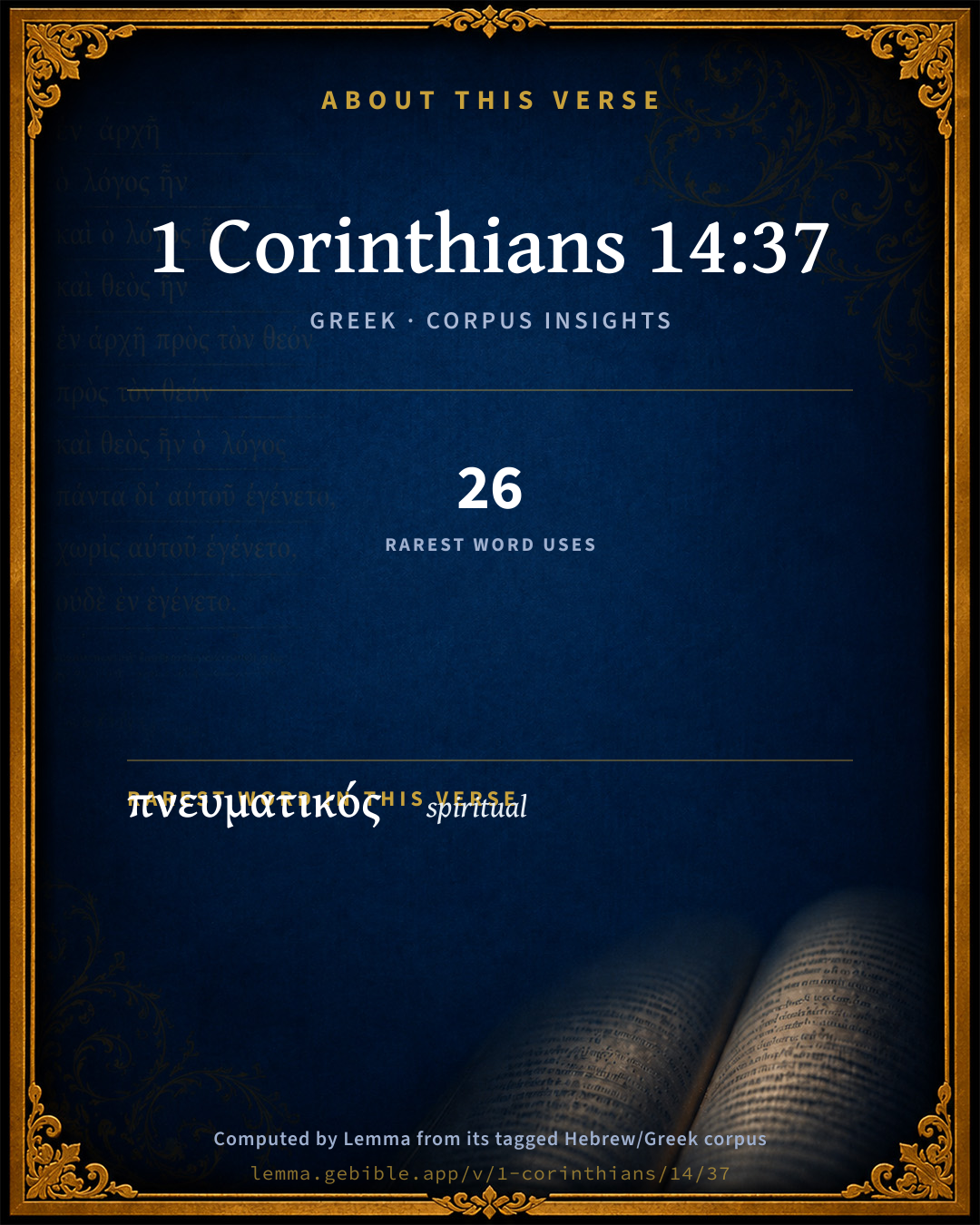
1 Corinthians 14:37

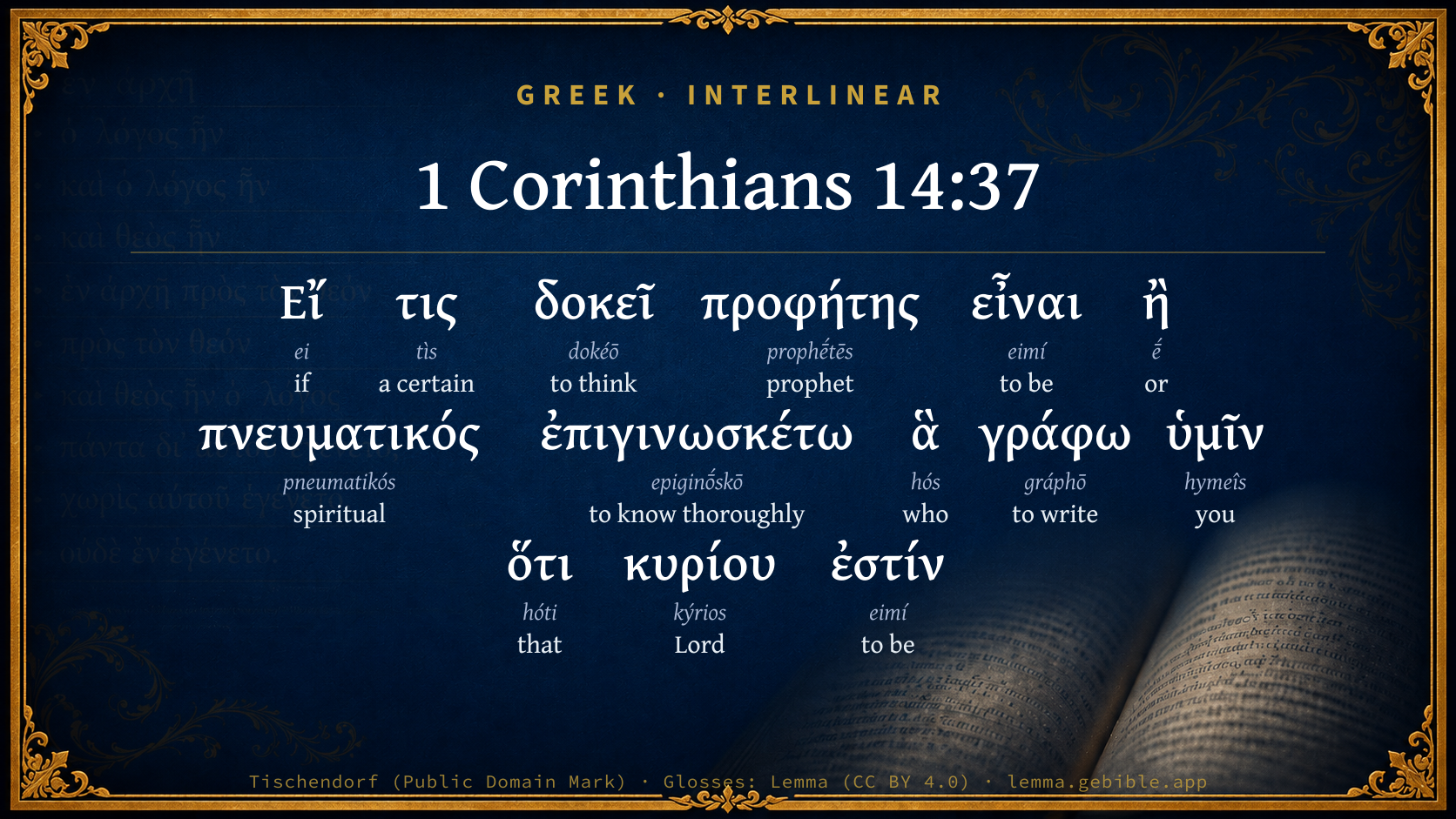
Greek (Tischendorf 8th ed.) 1 Corinthians 14:37 appears in the Greek New Testament. The text above is from the Tischendorf 8th edition. Each word links to its Strong’s number and a concise gloss. Click any word for its full Thayer’s Greek Lexicon entry.
Download image
Cite this verse

1 Corinthians 14:37 (World English Bible). Public Domain. Lemma interlinear Bible study tool, https://lemma.gebible.app/v/1-corinthians/14/37.

Show BibTeX & RIS
BibTeX
RIS
English Translation
If any man thinks himself to be a prophet, or spiritual, let him recognize the things which I write to you, that they are the commandment of the Lord.
World English Bible · Public Domain
Download a study sheet

One document with this verse’s original text, its word-by-word gloss line, the meaning frame, cross-references with their text, attributed commentary, and full source and license credits — printable, and it pastes into notes with its structure intact.

This verse Autodidact and up

Study sheet (.html) Plain text (.txt)

A passage Seminary Student

Up to 50 verses in one chapter. A passage sheet keeps up to 6 commentary sources and 12 cross-references per verse, in the order this page ranks them, and says so on the sheet whenever that leaves anything out. Ask for a single verse and you get the Autodidact verse sheet above.

Everything on this page stays free to read, with no account — the sheet is a download of what is already on screen, not access to it.

Want to remove ads? Support Godless Engineer
Compare translations 3

The same verse in 3 English versions, stacked beneath the original-language interlinear above. Click any original word for its lexicon entry.

Each is an independent rendering of the whole verse — the interlinear is not word-aligned to these translations.

Highlighted words mark where these versions differ — a whole-verse word diff, not a word-by-word alignment.

  • World English Bible Public Domain
    If any man thinks himself to be a prophet, or spiritual, let him recognize the things which I write to you, that they are the commandment of the Lord.
  • King James Version Public Domain
    If any man think himself to be a prophet, or spiritual, let him acknowledge that the things that I write unto you are the commandments of the Lord.
  • unfoldingWord Literal Text CC BY-SA 4.0
    If anyone thinks himself to be a prophet or spiritual, let him acknowledge that what I write to you is a command of the Lord.

unfoldingWord Literal Text — © unfoldingWord, licensed CC BY-SA 4.0. Word-aligned USFM3 via Door43 (git.door43.org/unfoldingWord/en_ult).

Versions to compare (up to 4)

3 of 4 selected

Show all 19 translations

Every available English version of this verse, each an independent rendering of the whole verse.

  • World English Bible Public Domain
    If any man thinks himself to be a prophet, or spiritual, let him recognize the things which I write to you, that they are the commandment of the Lord.
  • Berean Standard Bible Public Domain
    If anyone considers himself a prophet or spiritual person, let him acknowledge that what I am writing you is the Lord’s command.
  • Majority Standard Bible Public Domain
    If anyone considers himself a prophet or spiritual person, let him acknowledge that what I am writing you is the Lord’s command.
  • King James Version Public Domain
    If any man think himself to be a prophet, or spiritual, let him acknowledge that the things that I write unto you are the commandments of the Lord.
  • American Standard Version (1901) Public Domain
    If any man thinketh himself to be a prophet, or spiritual, let him take knowledge of the things which I write unto you, that they are the commandment of the Lord.
  • Revised Version (1885) Public Domain
    If any man thinketh himself to be a prophet, or spiritual, let him take knowledge of the things which I write unto you, that they are the commandment of the Lord.
  • Geneva Bible (1599) Public Domain
    If any man thinke him selfe to be a Prophet, or spirituall, let him acknowledge, that the things, that I write vnto you, are the commandements of the Lord.
  • Douay-Rheims (1899) Public Domain
    If any seem to be a prophet, or spiritual, let him know the things that I write to you, that they are the commandments of the Lord.
  • Young's Literal Translation Public Domain
    if any one doth think to be a prophet, or spiritual, let him acknowledge the things that I write to you -- that of the Lord they are commands;
  • Literal Standard Version CC BY-SA 4.0
    If anyone thinks to be a prophet, or spiritual, let him acknowledge the things that I write to you—that they are commands of the LORD;
  • Unlocked Literal Bible CC BY-SA 4.0
    If anyone thinks himself to be a prophet or spiritual, he should acknowledge that the things I write to you are a command of the Lord.
  • unfoldingWord Literal Text CC BY-SA 4.0
    If anyone thinks himself to be a prophet or spiritual, let him acknowledge that what I write to you is a command of the Lord.
  • Darby Bible Public Domain
    If any one thinks himself to be a prophet or spiritual, let him recognise the things that I write to you, that it is [the] Lord's commandment.
  • World Messianic Bible Public Domain
    If any man thinks himself to be a prophet or spiritual, let him recognize the things which I write to you, that they are the commandment of the Lord.
  • Webster's Bible Public Domain
    If any man thinketh himself to be a prophet, or spiritual, let him acknowledge that the things that I write to you are the commandments of the Lord.
  • Free Bible Version CC BY-SA 4.0
    Anyone who thinks they are a prophet, or that they have some spiritual gift, should be aware that what I'm writing to you is a command of the Lord.
  • Bible in Basic English Public Domain
    If any man seems to himself to be a prophet or to have the Spirit, let him take note of the things which I am writing to you, as being the word of the Lord.
  • Text-Critical English NT CC BY 4.0
    If anyone thinks that he is a prophet or spiritual person, he should acknowledge that the things I am writing to you are commandments of the Lord.
  • Tyndale New Testament (1534) Public Domain
    Yf eny man thinke him sylfe a prophet ether spirituall: let him vnderstonde what thinges I write vnto you. For they are the comaundementes of the Lorde.

Literal Standard Version (2020), Covenant Press — licensed CC BY-SA 4.0. Text via the HelloAO Bible API (eBible.org). Unlocked Literal Bible (unfoldingWord) — licensed CC BY-SA 4.0. Text via the HelloAO Bible API (eBible.org). unfoldingWord Literal Text — © unfoldingWord, licensed CC BY-SA 4.0. Word-aligned USFM3 via Door43 (git.door43.org/unfoldingWord/en_ult). Free Bible Version, Dr. Jonathan Gallagher — licensed CC BY-SA 4.0. Text via the HelloAO Bible API (eBible.org).

Word by word

More ways to search: Search by grammar → Find every occurrence → Compare this word →

Practice this passage: Drill this verse → Learn its vocabulary →

πνευματικός
pneumatikós
G4152
“spiritual”
Adjective, Nominative, Singular, Masculine
Part of Speech
Adjective
Case
Nominative
Number
Singular
Gender
Masculine
Full Thayer's Definition

Origin: from G4151

TDNT: 11:32,9

1. relating to the human spirit, or rational soul, as part of the man which is akin to God and serves as his instrument or organ a. that which possesses the nature of the rational soul 2. belonging to a spirit, or a being higher than man but inferior to God 3. belonging to the Divine Spirit a. of God the Holy Spirit b. one who is filled with and governed by the Spirit of God 4. pertaining to the wind or breath; windy, exposed to the wind, blowing
  1. Εἴ ei G1487 “if” Conditional
  2. τις tìs G5100 “a certain” Indefinite pronoun, Nominative, Singular, Masculine
  3. δοκεῖ dokéō G1380 “to think” Verb, Present, Active, Indicative, 3rd person, Singular
  4. προφήτης prophḗtēs G4396 “prophet” Noun, Nominative, Singular, Masculine
  5. εἶναι eimí G1510 “to be” Verb, Present, Active, Infinitive
  6. ἢ ḗ G2228 “or” Particle
  7. ἐπιγινωσκέτω epiginṓskō G1921 “to know thoroughly” Verb, Present, Active, Imperative, 3rd person, Singular
  8. ἃ hós G3739 “who” Relative pronoun, Accusative, Plural, Neuter
  9. γράφω gráphō G1125 “to write” Verb, Present, Active, Indicative, 1st person, Singular
  10. ὑμῖν hymeîs G5210 “you” Personal pronoun, 2nd person, Dative, Plural
  11. ὅτι hóti G3754 “that” Conjunction
  12. κυρίου kýrios G2962 “Lord” Noun, Genitive, Singular, Masculine
  13. ἐστίν eimí G1510 “to be” Verb, Present, Active, Indicative, 3rd person, Singular

About this verse

These counts appear in no published source. They are computed here, from the morphology-tagged text and Lemma’s own curated glosses. What Lemma adds →

14
words
13
distinct lemmas
Pauline Epistles
section

Shared distinctive vocabulary

πνευματικός spiritual G4152 occurs in 21 verses of the Greek New Testament. Also found in:

Repetition

A word recurs within this verse:

  • εἶναι to be G1510 ×2

Cross-references

17

Topical passages linked to 1 Corinthians 14:37 in the Treasury of Scripture Knowledge — connected by theme and wording, ordered by reader-vote popularity; previews shown in the World English Bible.

  • 1 John 4:6 We are of God. He who knows God listens to us. He who is not of God doesn't listen to us. By this we know the spirit of truth, and the spirit of error.
  • 2 Corinthians 10:7 Do you look at things only as they appear in front of your face? If anyone trusts in himself that he is Christ's, let him consider this again with himself, that, even as he is Christ's, so also we are Christ's.
  • 2 Peter 3:2 that you should remember the words which were spoken before by the holy prophets, and the commandments of us, the apostles of the Lord and Savior:
  • Jude 1:17 But you, beloved, remember the words which have been spoken before by the apostles of our Lord Jesus Christ.
  • 1 Thessalonians 4:1–8 Finally then, brothers, we beg and exhort you in the Lord Jesus, that as you received from us how you ought to walk and to please God, that you abound more and more.
  • Numbers 24:3–4 He took up his parable, and said, Balaam the son of Beor says, The man whose eye was closed says;
  • Luke 10:16 Whoever listens to you listens to me, and whoever rejects you rejects me. Whoever rejects me rejects him who sent me."
  • Romans 12:3 For I say, through the grace that was given me, to every man who is among you, not to think of himself more highly than he ought to think; but to think reasonably, as God has apportioned to each person a measure of faith.
  • 1 Corinthians 7:25 Now concerning virgins, I have no commandment from the Lord, but I give my judgment as one who has obtained mercy from the Lord to be trustworthy.
  • 1 Corinthians 8:2 But if anyone thinks that he knows anything, he doesn't yet know as he ought to know.
  • 1 Corinthians 13:1–3 If I speak with the languages of men and of angels, but don't have love, I have become sounding brass, or a clanging cymbal.
  • 2 Corinthians 10:12 For we are not bold to number or compare ourselves with some of those who commend themselves. But they themselves, measuring themselves by themselves, and comparing themselves with themselves, are without understanding.
  • 2 Corinthians 11:4 For if he who comes preaches another Jesus, whom we did not preach, or if you receive a different spirit, which you did not receive, or a different gospel, which you did not accept, you put up with that well enough.
  • 2 Corinthians 11:12–15 But what I do, that I will do, that I may cut off occasion from them that desire an occasion, that in which they boast, they may be found even as we.
  • Galatians 6:8 For he who sows to his own flesh will from the flesh reap corruption. But he who sows to the Spirit will from the Spirit reap eternal life.
  • Numbers 24:16 He says, who hears the words of God, Knows the knowledge of the Most High, Who sees the vision of the Almighty, Falling down, and having his eyes open:
  • 1 Corinthians 7:40 But she is happier if she stays as she is, in my judgment, and I think that I also have God's Spirit.

Cross-references courtesy of OpenBible.info (CC BY 4.0).

Where the printed editions differ

2 variants

Places in this verse where the major printed Greek editions disagree on the wording in a way that affects the translation — a comparison of editions, not a manuscript-by-manuscript collation. The editions are the modern critical texts (Nestlé-Aland 28/27, SBL, Westcott-Hort, Tregelles, Tyndale House) and the traditional texts behind the KJV (the Textus Receptus and the Byzantine/Majority text). It is not a claim about which reading is original.

  1. Different wording
    ἐστὶν

    “is”

    In NA28NA27TynSBLWHTreg Not in TRByz

    εἰσὶν (eisin) 'are' occurs in traditional manuscripts (TR+Byz) instead of ἐστὶν (estin) 'is' in older manuscripts (NA28+NA27+Tyn+SBL+WH+Treg)

  2. Different wording
    ἐντολή·

    “[the] command;”

    In NA28NA27TynWHTreg Not in SBLTRByz

    ἐντολαί (entolai) '[the] commands' occurs in traditional manuscripts (TR+Byz) instead of ἐντολή· (entolē) '[the] command;' in older manuscripts (NA28+NA27+Tyn+WH+Treg)

Textual data: Translators Amalgamated Greek New Testament (STEPBible TAGNT) · CC BY 4.0.

Commentary

Notes on 1 Corinthians 14:37 from classic Christian and Jewish commentators (each source and its license shown beneath its notes). The classic Christian expositions comment on the surrounding passage and are grouped to its opening verse, so a note may address several verses; the Jewish commentaries on the Tanakh (Rashi and others) are per-verse, so they appear only where the commentator wrote on this verse.

Lemma curates 59 commentaries, every one of them public domain or Creative Commons licensed, each selected and text-cleaned for this edition rather than reprinted as found. About our sources →

Bengel's Gnomon

Johann Albrecht Bengel

1Co 14:37. Προφήτης, a prophet) The species; spiritual, the genus. The former endowed more than the latter with eloquence.—ἐπιγινωσκέτω, let him perceive [acknowledge]) Paul does not allow the question now at last to be raised, whether he be writing correctly.—τοῦ Κυριοῦ) of the Lord) Jesus.

Bengel's Gnomon of the New Testament — English translation (T&T Clark, Edinburgh, 1860) — public domain. Text from a community e-Sword module.

Meyer's Critical & Exegetical Commentary

Heinrich August Wilhelm Meyer

1Co_14:37. He now, after the digression regarding the women, adds the authority of Christ to the section upon the charismata, which has been already previously brought to a conclusion, but to which he looks back once mor.

δοκεῖ] If any one bethinks himself (1Co_3:18, 1Co_8:2, 1Co_10:12) to be a prophet, or spiritually gifted in any way, then let him also prove himself to be such by his recognising, etc. Not to acknowledge this would show him to be not a prophet or not inspire.

πνευματικός] quite general: dotibus Sp. St. instructus; not, as Billroth, David Schulz, Baur, and Wieseler would have it, equivalent to γλ. λαλῶν (comp. on 1Co_12:1, 1Co_14:1). Ἤ is: or generally. Hofmann is wrong in saying that the ἤ is not suited for thus linking on a general statement. Why not? Comp. 1Co_4:3; Luk_12:11; Mat_16:14. There is all the less reason for assuming, with Hofmann, that Paul uses the expression in the vaguer sense of one going even beyond the prophet, because he had found it so used in the letter from Corint.

ἃ γράφω ὑμ.] refers to the whole section regarding the πνευματικοῖς. To refer it, as Billroth and Olshausen do, to the command that the women should keep silence, does not harmonize with the introduction εἴ τις … πνευματικός, and involves the awkwardness of only this intervening matter being thus confirmed with such solemnity, and the principal and far more important section not at al.

κυρίου ἐστίν (see the critical remarks): proceed from the Lord. In his communion of spirit with Christ, Paul was conscious that what he had been writing, from chap. 10 onwards, regarding spiritual gifts and the right use of them, was the result not of his own meditation and desire, but of the working of Christ upon himthat he wrote as an interpres Christi. There is thus no reason for making κυρίου refer to God (Grotius, Billroth, Olshausen), seeing that Christ had in fact given no rules regarding the charismata. Paul is affixing here the seal of apostolic authority, and upon that seal we must read Christ.

Meyer — Critical and Exegetical Commentary on the New Testament — English translation by Peter Christie, edited by Frederick Crombie (T&T Clark, 1880) — public domain. Text from a community e-Sword module.

Expositor's Greek Testament

ed. W. Robertson Nicoll

1Co 14:37-38 . ἃ γράφω ὑμῖν , in the apodosis, includes, beside the last particular (1Co 14:34 ff.), the other instructions of this Ep.; προφήτης and πνευματικὸς in the protasis recall esp. the directions of chh. 12 14: cf. 1Co 11:4 , 1Co 12:1 , 1Co 14:1 . δοκεῖ , as in 1Co 3:18 (see note), is putat, sibi videtur (not videtur alone, Vg [2205] ), denoting self-estimation. The term πνευματικὸς includes every one endowed with a special gift of the Spirit; cf. the pl [2206] πνεύματα , 1Co 14:12 . Hf [2207] and Hn [2208] think however that the disjunctive ἢ narrows the ref [2209] of “spiritual,” by contrast with “prophet,” to the sense of “speaker with tongues”; but this is a needless inference from the part [2210] ; the Ap. means “a prophet, or a man of the Spirit (in any sense)”. The adj [2211] πνευματικός (in masc.: see parls.) refers not to spiritual powers ( τὰ πνευματικά , 1Co 12:1 , etc.), but to spiritual character (= ὁ κατὰ πνεῦμα , ἐν πνεύματι , Rom 8 .), which gives insight in matters of revelation ( cf. Joh 7:17 ; Joh 8:31 f.). While the true “prophet,” having a kindred inspiration ( cf. 1Co 14:29 ), will “know well of the things” the Ap. “writes, that they are a commandment of the Lord” ( Κυρίου ἐστὶν ἐντολή , “are what the Lord commands”; cf. 1Co 2:10-16 , 1Co 7:40 , and notes, 2Co 8:3 ), this ability belongs to “the spiritual” generally, who “judge all things” (1Co 2:15 ); being “of God,” they hear His voice in others ( cf. Joh 8:42 f., etc.; 1Jn 2:20 ; 1Jn 4:6 ). The “Lord” is Christ, the Head of the Church, who “gives commandment to His Apostles” ( cf. 1Co 7:10 ; 1Co 7:25 , 1Co 11:23 , 1Co 12:3 , etc.; Mat 28:20 , etc.). For ἐπι - γινωσκέτω , cf. 1Co 13:12 “judicet atque agnoscat” (Est.); the pr [2212] impv [2213] asks for a continued acknowledgment of Christ’s authority in His Apostle. “But if any one is ignorant (of this), he is ignored ” ( ἀγνοεῖται ) a retribution in kind. The professor of Divine knowledge who does not discern Paul’s inspiration, proves his ignorance; his character as “prophet” or “spiritual” is not recognised, since he does not recognise the Apostle’s character; cf. Mat 10:14 f., Mat 10:41 , Joh 13:20 , for this criterion as laid down by Christ; the Ap. John assumes it in 1Co 4:6 . ἀγοεῖται , is pr [2214] in tense, ignoratur (not ignorabitur , Vg [2215] ), affirming an actual rejection sc. by the Lord , who says to such despisers of His servants, “I know you not” ( cf. 1Co 8:3 ; 2Ti 2:19 ; Joh 5:42 , etc.); but by His Apostle too, who cannot acknowledge for fellow-servants men who repudiate the Lord’s authority in him ( cf. 3Jn 1:9 f.). Christ foretold that He would have to disown “many who had prophesied ” in His name (Mat 7:22 f.). If ἀγνοείτω be read (still preferred by Mr [2216] , Bt [2217] , Ev [2218] , Gd [2219] , with R.V. txt.), the impv [2220] is permissive , as in 8:15: “sibi suæque ignorantiæ relinquendos esse censeo” (Est.) a counsel of lespair; contrast 2Ti 2:24 ff.

[2205] Latin Vulgate Translation.

[2206] plural.

[2207] J. C. K. von Hofmann’s Die heilige Schrift N.T. untersucht , ii. 2 (2te Auflage, 1874).

[2208] C. F. G. Heinrici’s Erklärung der Korintherbriefe (1880), or 1 Korinther in Meyer’s krit.-exegetisches Kommentar (1896).

[2209] reference.

[2210]art. grammatical particle.

[2211] adjective.

[2212] present tense.

[2213] imperative mood.

[2214] present tense.

[2215] Latin Vulgate Translation.

[2216] Meyer’s Critical and Exegetical Commentary (Eng. Trans.).

[2217] J. A. Beet’s St. Paul’s Epp. to the Corinthians (1882).

[2218] T. S. Evans in Speaker’s Commentary .

[2219] F. Godet’s Commentaire sur la prem. Ép. aux Corinthiens (Eng. Trans.).

[2220] imperative mood.

The Expositor's Greek Testament, edited by W. Robertson Nicoll (1897–1910) — public domain. Text from a community e-Sword module.

Hodge's Commentary on Romans, Ephesians & First Corinthians

Charles Hodge

1Co_14:37

If any man think himself to be a prophet, or spiritual, let him acknowledge that the things that I write unto you are the commandments of the Lord.

If any man think, etc. That is, If any man, with or without just reason, assumes to be a prophet, i.e. inspired; or spiritual, i.e. the possessor of any gift of the Spirit, let him prove himself what he claims to be by submitting to my authority. Here, as in 1Jo_4:6, (He that knoweth God, heareth us; he that is not of God, heareth not us,) submission to the infallible authority of the apostles is made the test of a divine mission and even of conversion. This must be so. If the apostles were the infallible organs of the Holy Ghost, to disobey them in any matter of faith or practice is to refuse to obey God. The inference which Romanists draw from this fact is, that as the apostleship is a permanent office in the church, and as the prelates are the bearers of that office, therefore to refuse submission in matters of faith or practice to the bishops is a clear proof that we are not of God. This is the chain with which Rome binds the nations to her car which she drives whithersoever she wills. The inference which Protestants draw from the fact in question is, that as we have the infallible teaching of the prophets and apostles in the Bible, therefore any man who does not conform in faith and practice to the Scriptures cannot be of God. This is the rule by which Protestants try all who claim to have a divine commission. It is nothing to them what their ecclesiastical descent may be. He that heareth not the Scriptures, is not of God. The things which I write. There is not only no reason for confining these words, as some do, to the preceding verse, but every reason against it. It is not merely for the prohibition against women speaking in the church for which the apostle claims divine authority. The specification of prophets and spiritual persons shows that the reference is primarily to the whole contents of this chapter. All the directions which he had given with respect to the exercise of spiritual gifts were of divine authority. What is true, however, of this chapter, is no less true of all apostolical instructions; because they all rest on the same foundation. Are the commandments of the Lord, i.e. of Christ, because he is the person known in the Christian church as Lord. The continued influence of Christ by the Spirit over the minds of his apostles, which is a divine prerogative, is here assumed or asserted.

Charles Hodge — Commentary on Romans (1835), First Corinthians (1857), and Ephesians (1856) — public domain. Text from a community e-Sword module.

Geneva Bible (1599)

Geneva Bible translators

Skillful in knowing and judging spiritual things.

Geneva Bible (1599) marginal notes — public domain. Text via Bolls.life.

Jamieson, Fausset & Brown

Robert Jamieson, A. R. Fausset & David Brown

prophet--the species.

spiritual--the genus: spiritually endowed. The followers of Apollos prided themselves as "spiritual" (Co1 3:1-3; compare Gal 6:1). Here one capable of discerning spirits is specially meant.

things that I write . . . commandments of the Lord--a direct assertion of inspiration. Paul's words as an apostle are Christ's words. Paul appeals not merely to one or two, but to a body of men, for the reality of three facts about which no body of men could possibly be mistaken: (1) that his having converted them was not due to mere eloquence, but to the "demonstration of the Spirit and of power"; (2) that part of this demonstration consisted in the communication of miraculous power, which they were then exercising so generally as to require to be corrected in the irregular employment of it; (3) that among these miraculous gifts was one which enabled the "prophet" or "spiritual person" to decide whether Paul's Epistle was Scripture or not. He could not have written so, unless the facts were notoriously true: for he takes them for granted, as consciously known by the whole body of men whom he addresses [HINDS, On Inspiration].

Jamieson, Fausset & Brown — Commentary Critical and Explanatory on the Whole Bible (1871) — public domain (CC PDM 1.0). Text via the HelloAO Bible API.

Adam Clarke's Commentary

Verse 37. If any man think himself to be a prophet, c.] He who is really a spiritual man, under the influence of the Spirit of God, and capable of teaching the Divine will, he will acknowledge that what I now say is from the same Spirit and that the things which I now write are the commandments of God, and must be obeyed on pain of his displeasure.

Adam Clarke's Commentary on the Bible (1810–1826) — public domain. Text from a community e-Sword/MySword module.

John Calvin's Commentaries

37. If any one thinks himself. Mark here the judgment, which he had previously assigned to the Prophets — that they should receive what they recognised as being from God. He does not, however, desire them to inquire as to his doctrine, as though it were a doubtful matter, but to receive it as the sure word of God, inasmuch as they will recognize it as the word of God, if they judge rightly. Farther, it is in virtue of apostolical authority, that he takes it upon himself to prescribe to them the sentence which they ought to pronounce.

There is still greater confidence in what he immediately adds — He that is ignorant, let him be ignorant. This, it is true, was allowable for Paul, who was fully assured as to the revelation that he had received from God, and he ought also to have been well known to the Corinthians, so that they should have looked upon him in no other light, than as an Apostle of the Lord. It is not, however, for every one to advance such a claim for himself, or if he does, he will, by his boasting, throw himself open to merited derision, for then only is there ground for such confidence, when what is affirmed with the mouth shows itself in reality. It was with truth that Paul affirmed, that his precepts were those of the Lord. Many will be prepared to pretend the same thing on false grounds. His great object is this — that it may be clearly perceived, that he who does not allow himself to be under control, speaks as from the Holy Spirit, not from his own brain. That man, therefore, who is no other than a pure organ of the Holy Spirit, will have the courage to declare fearlessly with Paul, that those who shall reject his doctrine, are not Prophets or spiritual persons; and this he will do in virtue of a right that belongs to him, in accordance with what we had in the beginning of the Epistle — he that is spiritual, judgeth all things. (1 Corinthians 2:15.)

But it may be asked here, how it is that Paul declares those things to be commandments of the Lord, as to which no statement is to be found in the Scriptures? Besides this, there is also another difficulty that presents itself — that if they are the commandments of the Lord, they are necessary to be observed, and they bind the conscience, and yet they are rites connected with polity, as to the observance of which no such necessity exists. Paul, however, merely says, that he enjoins nothing, but what is in accordance with the will of God. Now God endowed him with wisdom, that he might recommend this order in external things at Corinth, and in other places — not that it might be an inviolable law, like those that relate to the spiritual worship of God, but that it might be a useful directory to all the sons of God, and not by any means to be despised.

John Calvin's Commentaries (1540-1563) — public domain. Text from the Calvin Translation Society English edition (1840s-50s) via the Christian Classics Ethereal Library (ccel.org). Calvin's coverage is partial (roughly two-thirds of the Bible); uncommented books and verses are honest gaps, never fabricated. The 19th-century editor's footnotes and remarks are omitted so the notes are faithfully Calvin's own voice.

Ellicott's Commentary for English Readers

(37) If any man think himself . . .—The best evidence of the possession of these gifts would be that their conduct was the very opposite of what they seemed to think the possession of these gifts should make it. The Apostle asserts positively that what he is now writing to them are the commandments of the Lord. There could be no clearer or more emphatic statement of St. Paul’s claim to inspiration.

A Bible Commentary for English Readers, edited by Charles John Ellicott (1878–1897) — public domain. Text from a community e-Sword module.

The Cambridge Bible for Schools and Colleges

gen. ed. J. J. S. Perowne

37. If any man think himself to be a prophet] Since there were many appointed teachers (see ch. 1Co_12:28-29) who were not prophets, the test of the prophetic character was not ordination, but the possession of the prophetic gift. If any man fancied he possessed that gift, he was required to submit himself to the test of his willingness to obey God’s appointed founder and ruler of the Church.

or spiritual] i.e. possessed of any special spiritual gift.

the commandments of the Lord] i.e. Christ. See ch. 1Co_7:10; 1Co_7:12; 1Co_7:40, 1Co_11:2.

The Cambridge Bible for Schools and Colleges (gen. ed. J. J. S. Perowne; Cambridge University Press, 1878–1918) — public domain. Text from a community e-Sword module.

John Gill's Exposition

Wherefore, brethren, covet to prophesy,.... The apostle now draws to a conclusion, and reassumes the exhortation he gave in the beginning of the chapter, pressing the members of this church to desire the gift of prophecy, that being the most eligible and preferable to others, particularly to speaking with tongues, since it was the most useful and edifying, as he abundantly proves:

and forbid not to speak with tongues; such as have that gift, and are desirous of exercising it, provided they observe the rules prescribed, and have an interpreter; this he adds to promote love, and prevent dissension and discord.

John Gill's Exposition of the Whole Bible (1746–1763) — public domain (CC PDM 1.0). Text via the HelloAO Bible API.

Trapp's Complete Commentary

John Trapp

37 If any man think himself to be a prophet, or spiritual, let him acknowledge that the things that I write unto you are the commandments of the Lord.

Ver. 37. The commandment] And therefore to be obeyed by the best of you. Aut faciendum, aut patiendum: Aut poenitendum, aut pereundum. Either do it, or die for it.

John Trapp, A Commentary or Exposition upon All the Books of the Old and New Testament (1647–1656) — public domain. Text from a community e-Sword module.

Albert Barnes' Notes on the Bible

If any man think himself to be a prophet - See the note at 1Co 14:1. If any man claim to be divinely endowed. Macknight renders it, “be really a prophet.” But the more correct meaning here is, doubtless, “If any man “profess” to be a prophet; or is “reputed” to be a prophet.” Bloomfield. The proper meaning of the word δοκέω dokeō is to seem to oneself; to be of opinion, to suppose, believe, etc.; and the reference here is to one who should “regard himself,” or who should believe and profess to be thus endowed.

Or spiritual - Regarding himself as under the extraordinary influence of the Spirit.

Let him acknowledge ... - He will show that he is truly under the influence of the Holy Spirit, by acknowledging my authority, and by yielding obedience to the commands which I utter in the name and by the authority of the Lord. All would probably be disposed to acknowledge the right of Paul to speak to them; all would regard him as an apostle; and all would show that God had influenced their hearts, if they listened to his commands, and obeyed his injunctions. I do not speak by my own authority, or in my own name, says Paul. I speak in the name of the Lord; and to obey the commands of the Lord is a proof of being influenced by his Spirit. True religion everywhere, and the most ardent and enthusiastic zeal that is prompted by true religion, will show their genuineness and purity by a sacred and constant regard for the commands of the Lord. And that zeal which disregards those commands, and which tramples down the authority of the Scriptures and the peace and order of the church, gives demonstration that it is not genuine. It is false zeal, and, however ardent, will not ultimately do good to the cause.

Albert Barnes' Notes on the Bible (1834–1885) — public domain. Text from a community e-Sword/MySword module.

Matthew Poole's English Annotations

If there be any amongst you who hath a conceit that he is inspired by God, and from that inspiration understandeth the mind and will of God, he must acknowledge, that I also am an apostle, and know the mind and will of God as well as he; and being so, that what I tell you

are the commandments of the Lord.

Matthew Poole's English Annotations on the Holy Bible (1683–1685) — public domain. Text from a community e-Sword/MySword module.

Whedon's Commentary on the Bible

Daniel D. Whedon

37. A prophet, or spiritual—Endowed in either case with inspiration.

Let him acknowledge—As he can if his inspiration is true.

That I write—In this whole section of three chapters, in which spiritual gifts according to Church order are discussed.

The commandments of the Lord—Delivered not to you in his own person, but through his commissioned and inspired apostle. This is a very peremptory claim to divine inspiration. This passage confirms our view, that the canon is sustained by the double authority of the inspired apostle and the charismatic Church. See note, 1Co_4:21.

Daniel D. Whedon (gen. ed.), Commentary on the Old and New Testaments (1874–1909) — public domain. Text from a community e-Sword module.

The Pulpit Commentary

If any man think himself to be a prophet. Test your pretensions by the capacity to recognize that I have been speaking to you what Christ approves and requires. (comp. 1Jn_4:6) Or spiritual. He has already said that to most of them he could only speak as carnal. (1Co_3:1)

The Pulpit Commentary (1880–1919), ed. H.D.M. Spence-Jones & Joseph S. Exell — public domain. Text from a community e-Sword module.

John Wesley's Explanatory Notes

Or spiritual - Endowed with any extraordinary gift of the Spirit. Let him - Prove it, by acknowledging that I now write by the Spirit.

John Wesley, Explanatory Notes Upon the Whole Bible (1754–1765) — public domain. Text via the GEBible commentary corpus.

Godbey's Commentary on the New Testament

William B. Godbey

THE BIBLE ONLY AUTHORITY IN CHURCH GOVERNMENT

37. “If any one seems to be a prophet, or spiritual,” i. e., if any man or woman has the gift of prophecy, thus qualifying such an one to speak in public, or endued with any of these spiritual gifts, of which there are nine, “let such an one know well that those things that I write unto you, they are of the Lord.” Lest some think he is prohibiting the women from exercising in public, which is utterly alien to the subject he is discussing, remember that the words in this verse are common gender in Greek, showing that they include the women as well as the men among the prophets and the custodians of all the spiritual gifts. Again, in the eleventh chapter of this same epistle, Paul recognizes the women as praying and prophesying, i. e., speaking in public, just like the men, meanwhile, as some of them were in the habit of preaching bareheaded, thereby incurring unnecessary criticism, he simply advises them to have something on their heads when they speak in public.

William B. Godbey, Commentary on the New Testament (1896–1900) — public domain. Text from a community e-Sword module.

McGarvey & Pendleton's Commentaries

J. W. McGarvey

If any man thinketh himself to be a prophet, or spiritual, let him take knowledge of the things which I write unto you, that they are the commandment of the Lord .

J. W. McGarvey (with Philip Y. Pendleton), Commentaries on the New Testament (The Fourfold Gospel, 1914; Acts; and the epistles) — public domain. Text from a community e-Sword/MySword module.

The People's New Testament

B. W. Johnson

37–40. If any man think himself to be a prophet, or spiritual. If any one thinks he is inspired, or has spiritual gifts, one proof of it is that he recognizes what I write as the Lord's commandment. This is always a test. Whoever insists that he has the spirit, and sets aside the New Testament commands is self-convicted.

B. W. Johnson's The People's New Testament with Notes (1889–1891) — public domain. Electronic text from the Christian Classics Ethereal Library (CCEL) ThML edition.

unfoldingWord translationNotes

Door43 World Missions Community

he should acknowledge

A true prophet or truly spiritual person will accept Paul's writings as coming from the Lord.

let him not be recognized

This can be stated in active form. AT: "you should not recognize him" (See: Active or Passive)

translationWords

prophet

spirit

command

lord

unfoldingWord translationNotes — © Distant Shores Media and the Door43 World Missions Community, licensed CC BY-SA 4.0. Source: git.door43.org/Door43/en_tn.

Cambridge Greek Testament for Schools and Colleges

37. ἐστὶν ἐντολή. So Lachmann and Tregelles, and Westcott and Hort, with אAB. Tischendorf omits ἐντολή with DEFG, most copies of the Vetus Lat. and Origen. Rec. reads εἰσὶν ἐντολαί with Vulg. Peshito.

37. εἴ τις δοκεῖ προφήτης εἶναι. Not, as A.V., ‘if any man,’ but ‘if any one.’ See note on 1Co 11:16. Women (see 1Co 11:5) laid claim to the prophetic gift and even possessed it. There were many appointed teachers (see ch. 1Co 12:28-29) who were not prophets, and therefore the test of the prophetic character was not ordination, but the possession of the prophetic gift. If any one fancied he possessed that gift, he was required to submit himself to the test of his willingness to obey God’s appointed founder and ruler of the Church.

πνευματικός, i.e. possessed of any special spiritual gift. Cf. 1Co 2:15, 1Co 3:1; Gal 6:1.

κυρίου … ἐντολή, i.e. Christ. See ch. 1Co 7:10; 1Co 7:12, 1Co 9:2.

Cambridge Greek Testament for Schools and Colleges (Cambridge University Press, 1896; 21 vols, various authors incl. Carr, Maclear, Plummer, Farrar, Lumby, Moule, M. R. James, Simcox) — public domain. Text from a community e-Sword module.

Alford’s Greek Testament

Henry Alford

37.] πνευματικός, one spiritually endowed: not quite as in ch. 2:15.

ἃ γράφω] the things which I am writing, viz. ‘these regulations which I am now making.’

κυρίου, emphatic: the Lord’s (commandment): carrying His authority. No more direct assertion of inspiration can be uttered than this. “Paul stamps here the seal of apostolic authority: and on that seal is necessarily Christ.” Meyer.

Henry Alford, The Greek Testament (1849–1861) — public domain. Text from a community e-Sword module.

International Critical Commentary

37, 38. He here sums up his own authority in a manner very similar to 11:16: both passages begin with εἴ τις δοκεῖ. Comp. also 3:18, 8:2. The meaning of δοκεῖ must in each case be determined by the context. ‘If any man thinketh himself to be a prophet or endowed with any spiritual gift’; not ‘seemeth to be,’ videtur (Vulg.) but ‘sibi videtur’ (Beza). It is what the man is in his own eyes that is the point here.

ἐπιγινωσκέτω ἂ γράφω ὑμῖν, ὅτι Κυρίον ἐστὶν ἐντολή. ‘Let him continually take knowledge of what I am writing to you, that it is the Lord’s commandment.’ Κυρίον is very emphatic. ‘Let him prove his own inspiration by fully recognizing my absolute authority.’ The sureness of a divinely appointed Apostle is in the verse: non patitur Paulus demum quaeri an recte scribat (Beng.). He is conscious that what he says does not come from himself; he is the mouthpiece of Christ: 2:10-16, 7:40; 2Co 13:3; comp. 1Jn 4:6.* But he is not claiming authority to regulate these details for the whole Church throughout all time: no such vast extension is in his mind. What he is claiming is authority to regulate them for the Corinthian Christians at that time (9:2). And the ἃ γράφω covers all that he has been saying about disorders in public worship (11-14.). His indignation in v. 36 is provoked by all these irregularities, and ἅ γράφω has the same extension. It is a mistake to limit either to the question of women speaking in Church.

εἰ δέ τις ἀγνοεῖ ἀγνοείτω. ‘But if any one is ignorant (that Christ is the Source of my rulings in these matters), let him be ignorant.’ His ignorance does not alter facts, and he must be left in his unedifying condition. Si quis ignorat, ignoret (Calv.). Qui vero ignarus est, ignarus esto (Beza). “Why does he add this?” asks Chrysostom: “To show that he does not use compulsion and is not contentious; which is a mark of those who do not wish to establish their own advantage but seek what is beneficial to others.”

But it is possible that the true reading is ἀγνοεῖται, ‘he is ignored’ by God; he fails to recognize God’s Apostle, and God refuses to recognize him. But St Paul does not say ‘if he refuses to admit my authority,’ but ‘if he is not aware of it’; and being ignored by God seems to be an excessive requital for mere ignorance. ‘I do not care to dispute with him’ is more reasonable. The evidence is rather evenly balanced: ἀγνοεῖται (א* A* D* F G 17, ignorabitur Vulg. : ἀγνοείτω (B E K L and the correctors of א A D, Syrr. Copt. Aeth. Arm., Orig. Chrys. Thdrt.), see 8:3; Gal 4:9. But in one passage Origen has expressly ἀγνοεῖται ὑπὸ τοῦ Θεοῦ (JTS. 10:37, p. 30.

International Critical Commentary — older volumes (1896–1929), various authors — public domain. Text from a community e-Sword module.

Godet's Commentaries

Frédéric Louis Godet

Vv. 37. The term δοκεῖ εἶναι, thinks himself to be, denotes a claim true or false.

We must not give to the word πνευματικός, spiritual, hence inspired, too restricted a sense, according to which it would denote a class different from the prophets, as is done by the commentators who regard this term as designating only the glossolaletes (Baur, Heinrici). It is more natural to understand the ἤ, or, in the sense: or in general, as 1Co 4:3, so that the term spiritual comprehends the prophets also. The best way for these organs of the Spirit to prove the reality of their inspiration will be, the apostle declares, their perceiving his superior wisdom and apostolic authority, not criticising his ordinances, but rendering practical homage to their excellence by conforming to them: the Spirit should acknowledge the Spirit.

The ἃ γράφω, the things that I write, is at once the object of ἐπιγινωσκέτω, let him acknowledge, and the subject of the following proposition: “Let him acknowledge the things that I write as being”...etc.

The three families of MSS. have each their own reading in the following clause. The shortest and most sober is that of the Greco-Lats.: “That the things which I write are the Lord’s.” The Alex. add the idea of commandment: “are a commandment of the Lord.” So also the Byz., but putting the word commandment in the plural. One would naturally be inclined to give the preference to the first reading. But is it not possible that the word commandment, in the singular or plural, was rejected because it was taken in the meaning attached to it in 1Co 7:10, to denote a precept uttered on the earth by the Lord Jesus, and because no such saying was found in the Gospels? If the term ἐντολή, commandment, is authentic, it is hard to know whether to prefer the singular or the plural. The singular may have been substituted for the plural from regard to the Divine precept quoted 1Co 14:34. But the plural may also have been introduced in order better to bring under this term all the many preceding ordinances.

However that may be, the apostle here expresses the intimate consciousness he has of not having directed the Church, while settling these delicate questions, in ways of his own choice, but of having been guided by the light which is assured to him as an apostle charged with founding and governing the Church of the Gentiles; comp. Rom 12:3. It is with this elevated conviction of his apostolic inspiration that he adds the following words, 1Co 14:38.

Frédéric Louis Godet — Commentaries on Luke, John, Romans, and 1 Corinthians — English translation (T&T Clark, Edinburgh, 1870s–1890s) — public domain. Text from a community e-Sword module.

Lesson kit

Teaching starters — assembled from the data on this page, not authored interpretation. Every prompt links to the verse data it draws on. Edit before teaching.

1 Corinthians, in the Pauline Epistles, opens this verse with 14 words (13 distinct Greek lemmas). Its most distinctive word is pneumatikós (“spiritual”). A historical commentator’s framing appears above. Read the whole chapter for the surrounding context.

Discussion questions

  1. What does “spiritual” (pneumatikós) contribute to the verse as a whole?
  2. Romans 1:11 shares the word «spiritual» with this verse. How do the two illuminate each other?
  3. “to be” occurs 2× in this one verse. What is the effect of the repetition?
  4. These translations render this verse differently. What is at stake in choosing one wording over another?
  5. Reading how Bengel's Gnomon and Meyer's Critical & Exegetical Commentary read this verse, where do the two commentators agree and where do they part?

Things to notice

Reading settings

Reading text

Shown beneath each verse's original-language words.

Old Testament
Old Testament edition

Read the OT as the Masoretic Hebrew (MT) or the Greek Septuagint (LXX).

English shown for the Greek Septuagint (in the Hebrew ↔ Greek comparison).

Comparing translations? Open the Compare panel on any verse page to stack up to four side by side.