

2 Peter 2:16
Greek (Tischendorf 8th ed.) 2 Peter 2:16 appears in the Greek New Testament. The text above is from the Tischendorf 8th edition. Each word links to its Strong’s number and a concise gloss. Click any word for its full Thayer’s Greek Lexicon entry.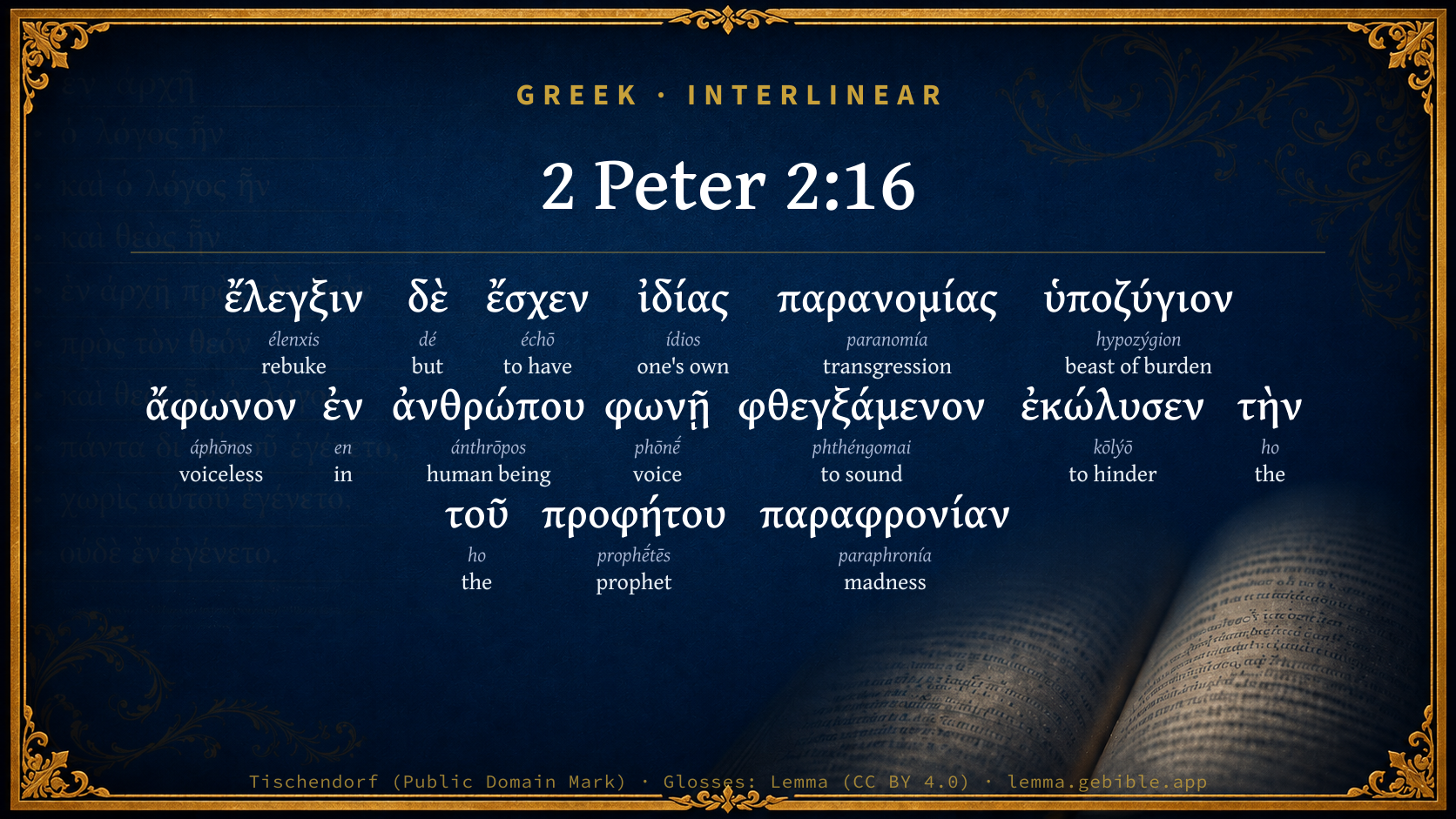
but he was rebuked for his own disobedience. A mute donkey spoke with man's voice and stopped the madness of the prophet.
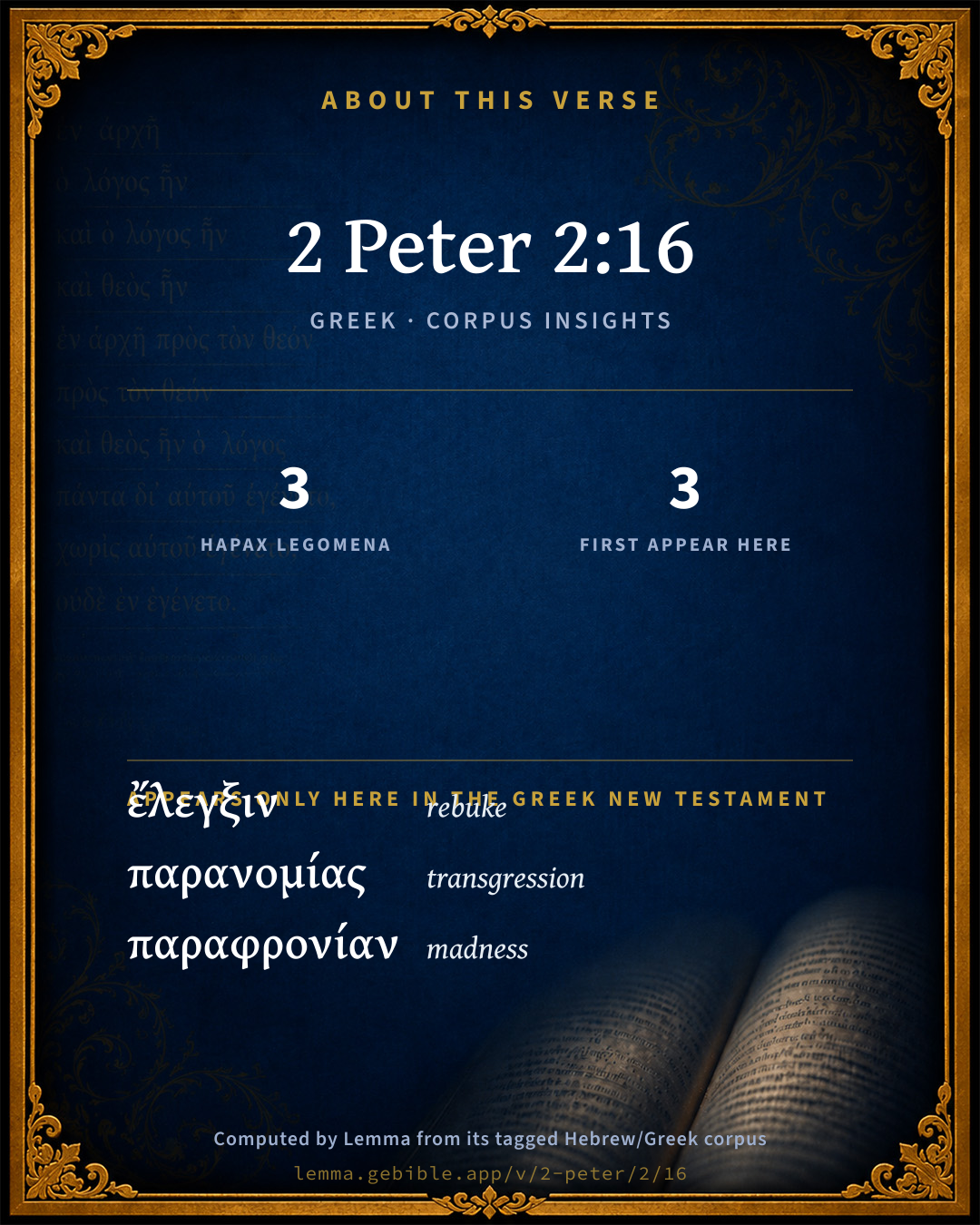
- 3 hapax legomena — only here in the Greek New Testament
- 3 first appearances in the Greek New Testament
Download a study sheet
One document with this verse’s original text, its word-by-word gloss line, the meaning frame, cross-references with their text, attributed commentary, and full source and license credits — printable, and it pastes into notes with its structure intact.
This verse Autodidact and up
A passage Seminary Student
Up to 50 verses in one chapter. A passage sheet keeps up to 6 commentary sources and 12 cross-references per verse, in the order this page ranks them, and says so on the sheet whenever that leaves anything out. Ask for a single verse and you get the Autodidact verse sheet above.
Everything on this page stays free to read, with no account — the sheet is a download of what is already on screen, not access to it.
Compare translations 3
The same verse in 3 English versions, stacked beneath the original-language interlinear above. Click any original word for its lexicon entry.
Each is an independent rendering of the whole verse — the interlinear is not word-aligned to these translations.
Highlighted words mark where these versions differ — a whole-verse word diff, not a word-by-word alignment.
-
World English Bible Public Domain
but he was rebuked for his own disobedience. A mute donkey spoke with man's voice and stopped the madness of the prophet.
-
King James Version Public Domain
But was rebuked for his iniquity: the dumb ass speaking with man's voice forbad the madness of the prophet.
-
unfoldingWord Literal Text CC BY-SA 4.0
But he had a rebuke for his own transgression—a mute donkey, having spoken in a voice of a man, restrained the irrationality of the prophet.
unfoldingWord Literal Text — © unfoldingWord, licensed CC BY-SA 4.0. Word-aligned USFM3 via Door43 (git.door43.org/unfoldingWord/en_ult).
Show all 19 translations
Every available English version of this verse, each an independent rendering of the whole verse.
-
World English Bible Public Domain
but he was rebuked for his own disobedience. A mute donkey spoke with man's voice and stopped the madness of the prophet.
-
Berean Standard Bible Public Domain
But he was rebuked for his transgression by a donkey, otherwise without speech, that spoke with a man’s voice and restrained the prophet’s madness.
-
Majority Standard Bible Public Domain
But he was rebuked for his transgression by a donkey, otherwise without speech, that spoke with a man’s voice and restrained the prophet’s madness.
-
King James Version Public Domain
But was rebuked for his iniquity: the dumb ass speaking with man's voice forbad the madness of the prophet.
-
American Standard Version (1901) Public Domain
but he was rebuked for his own transgression: a dumb ass spake with man's voice and stayed the madness of the prophet.
-
Revised Version (1885) Public Domain
but he was rebuked for his own transgression: a dumb ass spake with man’s voice and stayed the madness of the prophet.
-
Geneva Bible (1599) Public Domain
But he was rebuked for his iniquitie: for the dumme beast speaking with mans voyce, forbade the foolishnesse of the Prophet.
-
Douay-Rheims (1899) Public Domain
But had a check of his madness, the dumb beast used to the yoke, which speaking with man's voice, forbade the folly of the prophet.
-
Young's Literal Translation Public Domain
and had a rebuke of his own iniquity -- a dumb ass, in man's voice having spoken, did forbid the madness of the prophet.
-
Literal Standard Version CC BY-SA 4.0
and had a rebuke of his own iniquity—a mute donkey, having spoken in man’s voice, forbid the madness of the prophet.
-
Unlocked Literal Bible CC BY-SA 4.0
But he obtained a rebuke for his own transgression—a mute donkey speaking in a human voice stopped the prophet's insanity.
-
unfoldingWord Literal Text CC BY-SA 4.0
But he had a rebuke for his own transgression—a mute donkey, having spoken in a voice of a man, restrained the irrationality of the prophet.
-
Darby Bible Public Domain
but had reproof of his own wickedness -- [the] dumb ass speaking with man's voice forbad the folly of the prophet.
-
World Messianic Bible Public Domain
but he was rebuked for his own disobedience. A speechless donkey spoke with a man’s voice and stopped the madness of the prophet.
-
Webster's Bible Public Domain
But was rebuked for his iniquity: the dumb ass speaking with man's voice, forbad the madness of the prophet.
-
Free Bible Version CC BY-SA 4.0
But he was rebuked for his evil actions—a dumb donkey spoke with a human voice and stopped the prophet's foolishness!
-
Bible in Basic English Public Domain
But his wrongdoing was pointed out to him: an ass, talking with a man's voice, put a stop to the error of the prophet.
-
Text-Critical English NT CC BY 4.0
But he received a rebuke for his own transgression; a speechless donkey spoke with a human voice and prevented the prophet's madness.
-
Tyndale New Testament (1534) Public Domain
but was rebuked of his iniquitie. The tame and dome beast speakinge with manes voyce forbade the folisshnes of the Prophete.
Literal Standard Version (2020), Covenant Press — licensed CC BY-SA 4.0. Text via the HelloAO Bible API (eBible.org). Unlocked Literal Bible (unfoldingWord) — licensed CC BY-SA 4.0. Text via the HelloAO Bible API (eBible.org). unfoldingWord Literal Text — © unfoldingWord, licensed CC BY-SA 4.0. Word-aligned USFM3 via Door43 (git.door43.org/unfoldingWord/en_ult). Free Bible Version, Dr. Jonathan Gallagher — licensed CC BY-SA 4.0. Text via the HelloAO Bible API (eBible.org).
Word by word
More ways to search: Search by grammar → Find every occurrence → Compare this word →
Practice this passage: Drill this verse → Learn its vocabulary →
- Appears 1× in the Greek New Testament
- First appears here
- Part of Speech
- Noun
- Case
- Accusative
- Number
- Singular
- Gender
- Feminine
Full Thayer's Definition
- ἔλεγξιν élenxis G1649 “rebuke” Noun, Accusative, Singular, Feminine
- δὲ dé G1161 “but” Conjunction
- ἔσχεν échō G2192 “to have” Verb, Aorist, Active, Indicative, 3rd person, Singular
- ἰδίας ídios G2398 “one's own” Adjective, Genitive, Singular, Feminine
- παρανομίας paranomía G3892 “transgression” Noun, Genitive, Singular, Feminine
- ὑποζύγιον hypozýgion G5268 “beast of burden” Noun, Nominative, Singular, Neuter
- ἄφωνον áphōnos G880 “voiceless” Adjective, Nominative, Singular, Neuter
- ἐν en G1722 “in” Preposition
- ἀνθρώπου ánthrōpos G444 “human being” Noun, Genitive, Singular, Masculine
- φωνῇ phōnḗ G5456 “voice” Noun, Dative, Singular, Feminine
- φθεγξάμενον phthéngomai G5350 “to sound” Verb, Aorist, Middle or Passive deponent, Participle, Nominative, Singular, Neuter
- ἐκώλυσεν kōlýō G2967 “to hinder” Verb, Aorist, Active, Indicative, 3rd person, Singular
- τὴν ho G3588 “the” Article, Accusative, Singular, Feminine
- τοῦ ho G3588 “the” Article, Genitive, Singular, Masculine
- προφήτου prophḗtēs G4396 “prophet” Noun, Genitive, Singular, Masculine
- παραφρονίαν paraphronía G3913 “madness” Noun, Accusative, Singular, Feminine
About this verse
These counts appear in no published source. They are computed here, from the morphology-tagged text and Lemma’s own curated glosses. What Lemma adds →
- 16
- words
- 15
- distinct lemmas
- General Epistles
- section
Notable vocabulary
3 hapax legomena — words that appear only here in the entire Greek New Testament:
First appearance in Scripture
These words make their first canonical appearance in the Greek New Testament here:
Shared distinctive vocabulary
ὑποζύγιον beast of burden G5268 occurs in 2 verses of the Greek New Testament. Also found in:
Repetition
A word recurs within this verse:
- τὴν the G3588 ×2
Cross-references
6Topical passages linked to 2 Peter 2:16 in the Treasury of Scripture Knowledge — connected by theme and wording, ordered by reader-vote popularity; previews shown in the World English Bible.
- Numbers 22:21–33 Balaam rose up in the morning, and saddled his donkey, and went with the princes of Moab.
- Ecclesiastes 7:25 I turned around, and my heart sought to know and to search out, and to seek wisdom and the scheme of things, and to know that wickedness is stupidity, and that foolishness is madness.
- Ecclesiastes 9:3 This is an evil in all that is done under the sun, that there is one event to all: yes also, the heart of the sons of men is full of evil, and madness is in their heart while they live, and after that they go to the dead.
- Hosea 9:7 The days of visitation have come. The days of reckoning have come. Israel will consider the prophet to be a fool, And the man who is inspired to be insane, Because of the abundance of your sins, And because your hostility is great.
- Luke 16:11 If therefore you have not been faithful in the unrighteous mammon, who will commit to your trust the true riches?
- Acts 26:11 Punishing them often in all the synagogues, I tried to make them blaspheme. Being exceedingly enraged against them, I persecuted them even to foreign cities.
Cross-references courtesy of OpenBible.info (CC BY 4.0).
Lesson kit
Teaching starters — assembled from the data on this page, not authored interpretation. Every prompt links to the verse data it draws on. Edit before teaching.
2 Peter, in the General Epistles, opens this verse with 16 words (15 distinct Greek lemmas). Its most distinctive word is élenxis (“rebuke”). A historical commentator’s framing appears above. Read the whole chapter for the surrounding context.
Discussion questions
- What does “rebuke” (élenxis) contribute to the verse as a whole?
- 3 words here appear nowhere else in the Greek New Testament. Why might the author reach for such rare wording?
- 3 words make their first appearance in Scripture here. What does this debut establish?
- How does Matthew 21:5, which shares the word «beast of burden», read alongside this verse?
- What does the repetition of “the” (2× in this one verse) do in this verse?
- These translations render this verse differently. What is at stake in choosing one wording over another?
- Compare how Joseph Benson's Commentary and Bengel's Gnomon read this verse. Where do they agree or differ?
Things to notice
- 3 words in this verse appear nowhere else in the Greek New Testament.
- 3 words make their first canonical appearance in Scripture here.
- These translations choose different wording for 22 words in this verse.
- “the” occurs 2× in this single verse.
- 15 distinct Greek lemmas span 16 words in this verse.
Commentary
Notes on 2 Peter 2:16 from classic Christian and Jewish commentators (each source and its license shown beneath its notes). The classic Christian expositions comment on the surrounding passage and are grouped to its opening verse, so a note may address several verses; the Jewish commentaries on the Tanakh (Rashi and others) are per-verse, so they appear only where the commentator wrote on this verse.
Lemma curates 59 commentaries, every one of them public domain or Creative Commons licensed, each selected and text-cleaned for this edition rather than reprinted as found. About our sources →
Joseph Benson's Commentary
Joseph Benson's Commentary on the Old and New Testaments (1811–1818) — public domain. Text from a community e-Sword module.
Bengel's Gnomon
Johann Albrecht Bengel
Bengel's Gnomon of the New Testament — English translation (T&T Clark, Edinburgh, 1860) — public domain. Text from a community e-Sword module.
Expositor's Greek Testament
ed. W. Robertson Nicoll
The Expositor's Greek Testament, edited by W. Robertson Nicoll (1897–1910) — public domain. Text from a community e-Sword module.
Jamieson, Fausset & Brown
Robert Jamieson, A. R. Fausset & David Brown
Jamieson, Fausset & Brown — Commentary Critical and Explanatory on the Whole Bible (1871) — public domain (CC PDM 1.0). Text via the HelloAO Bible API.
Adam Clarke's Commentary
Adam Clarke's Commentary on the Bible (1810–1826) — public domain. Text from a community e-Sword/MySword module.
John Calvin's Commentaries
John Calvin's Commentaries (1540-1563) — public domain. Text from the Calvin Translation Society English edition (1840s-50s) via the Christian Classics Ethereal Library (ccel.org). Calvin's coverage is partial (roughly two-thirds of the Bible); uncommented books and verses are honest gaps, never fabricated. The 19th-century editor's footnotes and remarks are omitted so the notes are faithfully Calvin's own voice.
Ellicott's Commentary for English Readers
A Bible Commentary for English Readers, edited by Charles John Ellicott (1878–1897) — public domain. Text from a community e-Sword module.
The Cambridge Bible for Schools and Colleges
gen. ed. J. J. S. Perowne
The Cambridge Bible for Schools and Colleges (gen. ed. J. J. S. Perowne; Cambridge University Press, 1878–1918) — public domain. Text from a community e-Sword module.
John Gill's Exposition
John Gill's Exposition of the Whole Bible (1746–1763) — public domain (CC PDM 1.0). Text via the HelloAO Bible API.
Trapp's Complete Commentary
John Trapp
John Trapp, A Commentary or Exposition upon All the Books of the Old and New Testament (1647–1656) — public domain. Text from a community e-Sword module.
Albert Barnes' Notes on the Bible
Albert Barnes' Notes on the Bible (1834–1885) — public domain. Text from a community e-Sword/MySword module.
Matthew Poole's English Annotations
Matthew Poole's English Annotations on the Holy Bible (1683–1685) — public domain. Text from a community e-Sword/MySword module.
The Pulpit Commentary
The Pulpit Commentary (1880–1919), ed. H.D.M. Spence-Jones & Joseph S. Exell — public domain. Text from a community e-Sword module.
John Wesley's Explanatory Notes
John Wesley, Explanatory Notes Upon the Whole Bible (1754–1765) — public domain. Text via the GEBible commentary corpus.
The People's New Testament
B. W. Johnson
B. W. Johnson's The People's New Testament with Notes (1889–1891) — public domain. Electronic text from the Christian Classics Ethereal Library (CCEL) ThML edition.
Cambridge Greek Testament for Schools and Colleges
Cambridge Greek Testament for Schools and Colleges (Cambridge University Press, 1896; 21 vols, various authors incl. Carr, Maclear, Plummer, Farrar, Lumby, Moule, M. R. James, Simcox) — public domain. Text from a community e-Sword module.
Alford’s Greek Testament
Henry Alford
Henry Alford, The Greek Testament (1849–1861) — public domain. Text from a community e-Sword module.
Vincent's Word Studies in the New Testament
Marvin R. Vincent
Marvin R. Vincent, Word Studies in the New Testament (1887–1900) — public domain. Text from a community e-Sword/MySword module.