Acts 8:28

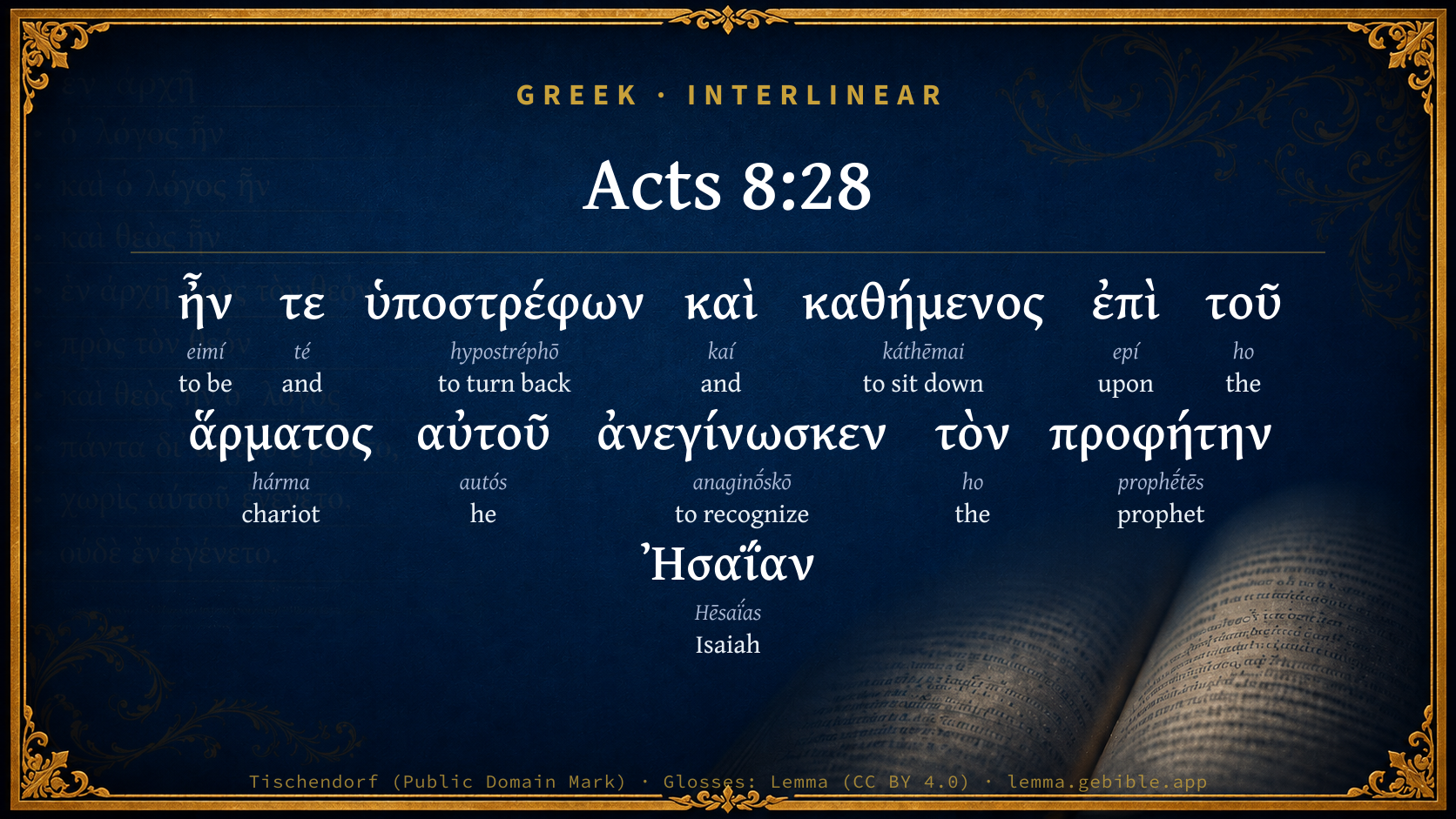
Greek (Tischendorf 8th ed.) Acts 8:28 appears in the Greek New Testament. The text above is from the Tischendorf 8th edition. Each word links to its Strong’s number and a concise gloss. Click any word for its full Thayer’s Greek Lexicon entry.
Download image
Cite this verse

Acts 8:28 (World English Bible). Public Domain. Lemma interlinear Bible study tool, https://lemma.gebible.app/v/acts/8/28.

Show BibTeX & RIS
BibTeX
RIS
English Translation
He was returning and sitting in his chariot, and was reading the prophet Isaiah.
World English Bible · Public Domain
Highlights
  • 1 first appearance in the Greek New Testament
Full analysis ↓
Download a study sheet

One document with this verse’s original text, its word-by-word gloss line, the meaning frame, cross-references with their text, attributed commentary, and full source and license credits — printable, and it pastes into notes with its structure intact.

This verse Autodidact and up

Study sheet (.html) Plain text (.txt)

A passage Seminary Student

Up to 50 verses in one chapter. A passage sheet keeps up to 6 commentary sources and 12 cross-references per verse, in the order this page ranks them, and says so on the sheet whenever that leaves anything out. Ask for a single verse and you get the Autodidact verse sheet above.

Everything on this page stays free to read, with no account — the sheet is a download of what is already on screen, not access to it.

Want to remove ads? Support Godless Engineer
Compare translations 3

The same verse in 3 English versions, stacked beneath the original-language interlinear above. Click any original word for its lexicon entry.

Each is an independent rendering of the whole verse — the interlinear is not word-aligned to these translations.

Highlighted words mark where these versions differ — a whole-verse word diff, not a word-by-word alignment.

  • World English Bible Public Domain
    He was returning and sitting in his chariot, and was reading the prophet Isaiah.
  • King James Version Public Domain
    Was returning, and sitting in his chariot read Esaias the prophet.
  • unfoldingWord Literal Text CC BY-SA 4.0
    and he was returning and sitting in his chariot, and he was reading the prophet Isaiah.

unfoldingWord Literal Text — © unfoldingWord, licensed CC BY-SA 4.0. Word-aligned USFM3 via Door43 (git.door43.org/unfoldingWord/en_ult).

Versions to compare (up to 4)

3 of 4 selected

Show all 19 translations

Every available English version of this verse, each an independent rendering of the whole verse.

  • World English Bible Public Domain
    He was returning and sitting in his chariot, and was reading the prophet Isaiah.
  • Berean Standard Bible Public Domain
    and on his return was sitting in his chariot reading Isaiah the prophet.
  • Majority Standard Bible Public Domain
    and on his return was sitting in his chariot reading Isaiah the prophet.
  • King James Version Public Domain
    Was returning, and sitting in his chariot read Esaias the prophet.
  • American Standard Version (1901) Public Domain
    and he was returning and sitting in his chariot, and was reading the prophet Isaiah.
  • Revised Version (1885) Public Domain
    and he was returning and sitting in his chariot, and was reading the prophet Isaiah.
  • Geneva Bible (1599) Public Domain
    And as he returned sitting in his charet, he read Esaias the Prophet.
  • Douay-Rheims (1899) Public Domain
    And he was returning, sitting in this chariot, and reading Isaias the prophet.
  • Young's Literal Translation Public Domain
    he was also returning, and is sitting on his chariot, and he was reading the prophet Isaiah.
  • Literal Standard Version CC BY-SA 4.0
    he was also returning, and is sitting on his chariot, and he was reading the prophet Isaiah.
  • Unlocked Literal Bible CC BY-SA 4.0
    He was returning and sitting in his chariot, and was reading the prophet Isaiah.
  • unfoldingWord Literal Text CC BY-SA 4.0
    and he was returning and sitting in his chariot, and he was reading the prophet Isaiah.
  • Darby Bible Public Domain
    was returning and sitting in his chariot: and he was reading the prophet Esaias.
  • World Messianic Bible Public Domain
    He was returning and sitting in his chariot, and was reading the prophet Isaiah.
  • Webster's Bible Public Domain
    Was returning; and sitting in his chariot, read Isaiah the prophet.
  • Free Bible Version CC BY-SA 4.0
    was returning from his trip, sitting in his chariot. He was reading out loud from the book of the prophet Isaiah.
  • Bible in Basic English Public Domain
    He was going back, seated in his carriage, and was reading the book of the prophet Isaiah.
  • Text-Critical English NT CC BY 4.0
    and was sitting in his chariot on his way back home, reading the prophet Isaiah.
  • Tyndale New Testament (1534) Public Domain
    And as he returned home agayne sittynge in his charet he rede Esay the prophet.

Literal Standard Version (2020), Covenant Press — licensed CC BY-SA 4.0. Text via the HelloAO Bible API (eBible.org). Unlocked Literal Bible (unfoldingWord) — licensed CC BY-SA 4.0. Text via the HelloAO Bible API (eBible.org). unfoldingWord Literal Text — © unfoldingWord, licensed CC BY-SA 4.0. Word-aligned USFM3 via Door43 (git.door43.org/unfoldingWord/en_ult). Free Bible Version, Dr. Jonathan Gallagher — licensed CC BY-SA 4.0. Text via the HelloAO Bible API (eBible.org).

Word by word

More ways to search: Search by grammar → Find every occurrence → Compare this word →

Practice this passage: Drill this verse → Learn its vocabulary →

ἅρματος
hárma
G716
“chariot”
Noun, Genitive, Singular, Neuter
Part of Speech
Noun
Case
Genitive
Number
Singular
Gender
Neuter
Full Thayer's Definition

Origin: "probably from G1 42">142) [perhaps with 1 (as a particle of union) prefixed]"

TDNT: None

1. a chariot 2. of war chariots (i.e. armed with scythes) 3. chariots (drawn with many horses)
  1. ἦν eimí G1510 “to be” Verb, Imperfect, Active, Indicative, 3rd person, Singular
  2. τε té G5037 “and” Particle
  3. ὑποστρέφων hypostréphō G5290 “to turn back” Verb, Present, Active, Participle, Nominative, Singular, Masculine
  4. καὶ kaí G2532 “and” Conjunction
  5. καθήμενος káthēmai G2521 “to sit down” Verb, Present, Middle or Passive deponent, Participle, Nominative, Singular, Masculine
  6. ἐπὶ epí G1909 “upon” Preposition
  7. τοῦ ho G3588 “the” Article, Genitive, Singular, Neuter
  8. αὐτοῦ autós G846 “he” Personal pronoun, Genitive, Singular, Masculine
  9. ἀνεγίνωσκεν anaginṓskō G314 “to recognize” Verb, Imperfect, Active, Indicative, 3rd person, Singular
  10. τὸν ho G3588 “the” Article, Accusative, Singular, Masculine
  11. προφήτην prophḗtēs G4396 “prophet” Noun, Accusative, Singular, Masculine
  12. Ἠσαΐαν Hēsaḯas G2268 “Isaiah” Noun, Accusative, Singular, Masculine

About this verse

These counts appear in no published source. They are computed here, from the morphology-tagged text and Lemma’s own curated glosses. What Lemma adds →

13
words
12
distinct lemmas
Acts
section

Notable vocabulary

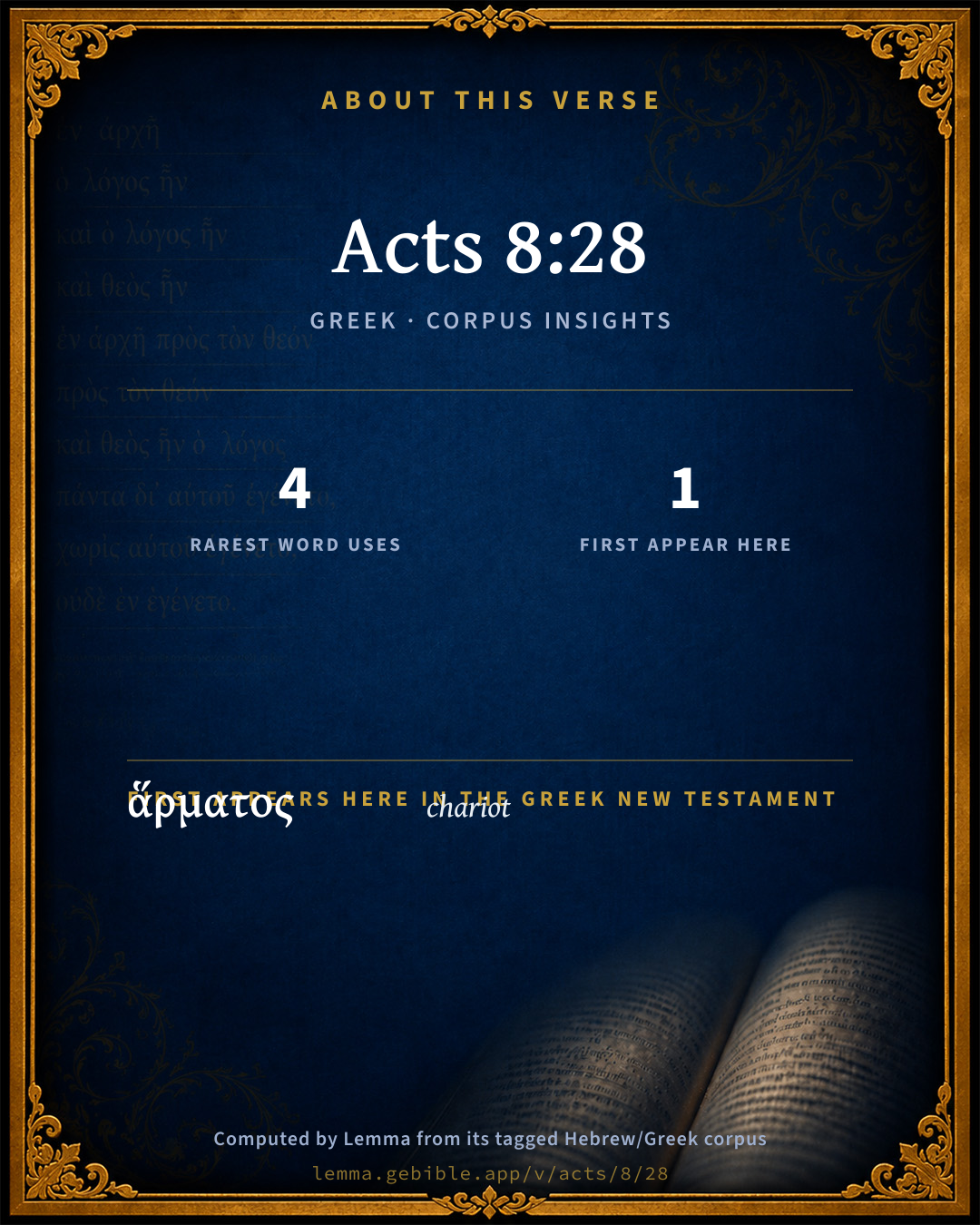
The rarest word here is ἅρματος chariot G716 — appearing just 4 times in the whole Greek New Testament.

First appearance in Scripture

This word makes its first canonical appearance in the Greek New Testament here:

  • ἅρματος chariot G716

Shared distinctive vocabulary

ἅρματος chariot G716 occurs in 4 verses of the Greek New Testament. Also found in:

Repetition

A word recurs within this verse:

Cross-references

17

Topical passages linked to Acts 8:28 in the Treasury of Scripture Knowledge — connected by theme and wording, ordered by reader-vote popularity; previews shown in the World English Bible.

  • Colossians 3:16 Let the word of Christ dwell in you richly; in all wisdom teaching and admonishing one another with psalms, hymns, and spiritual songs, singing with grace in your heart to the Lord.
  • Isaiah 1:1 The vision of Isaiah the son of Amoz, which he saw concerning Judah and Jerusalem, in the days of Uzziah, Jotham, Ahaz, and Hezekiah, kings of Judah.
  • Acts 28:25 When they didn't agree among themselves, they departed after Paul had spoken one word, "The Holy Spirit spoke rightly through Isaiah, the prophet, to our fathers,
  • Deuteronomy 6:6–7 These words, which I command you this day, shall be on your heart;
  • Deuteronomy 11:18–20 Therefore shall you lay up these my words in your heart and in your soul; and you shall bind them for a sign on your hand, and they shall be for symbols between your eyes.
  • Deuteronomy 17:18–19 It shall be, when he sits on the throne of his kingdom, that he shall write him a copy of this law in a book, out of [that which is] before the priests the Levites:
  • Joshua 1:8 This book of the law shall not depart out of your mouth, but you shall meditate thereon day and night, that you may observe to do according to all that is written therein: for then you shall make your way prosperous, and then you shall have good success.
  • Psalms 1:2–3 But his delight is in Yahweh's law; On his law he meditates day and night.
  • Psalms 119:99 I have more understanding than all my teachers, For your testimonies are my meditation.
  • Psalms 119:111 I have taken your testimonies as a heritage forever, For they are the joy of my heart.
  • Proverbs 2:1–6 My son, if you will receive my words, And store up my commandments within you;
  • Proverbs 8:33–34 Hear instruction, and be wise. Don't refuse it.
  • Luke 3:4 As it is written in the book of the words of Isaiah the prophet, "The voice of one crying in the wilderness, 'Make ready the way of the Lord. Make his paths straight.
  • Luke 4:17 The book of the prophet Isaiah was handed to him. He opened the book, and found the place where it was written,
  • John 5:39–40 "You search the Scriptures, because you think that in them you have eternal life; and these are they which testify about me.
  • Acts 17:11–12 Now these were more noble than those in Thessalonica, in that they received the word with all readiness of the mind, examining the Scriptures daily to see whether these things were so.
  • 2 Timothy 3:15–17 From infancy, you have known the sacred writings which are able to make you wise for salvation through faith, which is in Christ Jesus.

Cross-references courtesy of OpenBible.info (CC BY 4.0).

Commentary

Notes on Acts 8:28 from classic Christian and Jewish commentators (each source and its license shown beneath its notes). The classic Christian expositions comment on the surrounding passage and are grouped to its opening verse, so a note may address several verses; the Jewish commentaries on the Tanakh (Rashi and others) are per-verse, so they appear only where the commentator wrote on this verse.

Lemma curates 59 commentaries, every one of them public domain or Creative Commons licensed, each selected and text-cleaned for this edition rather than reprinted as found. About our sources →

The Biblical Illustrator

Joseph S. Exell

Act_8:28

Was returning, and sitting in his chariot read Esaias the prophet.

Oriental reading

If the eunuch followed the general custom of the East, he was not only reading to himself aloud, but so as to be heard easily and distinctly by any one in the immediate neighbourhood. The prayer, or praying, of the Orientals is not usually very noisy, but their reading is a continual sound. They study aloud, read their sacred books aloud, and rehearse their lessons aloud, to an extent that is not seen among the Occidentals, nor enjoyed by an Occidental listener. When there are many together, the babel is astonishing. The idea that it might disturb any one never enters their heads. But the Orientals do many things with noise which we of the west prefer to do with quietness. Our talking seems painfully low and still to them, as theirs seems painfully loud and noisy to us. Yet the Orientals are not very much beyond the ordinary Italians in that respect. (Prof. I. H. Hall.)

The Word of God, the best reading for a journey,

not only on the way from Jerusalem to Gaza, but on the way through time to eternity.

1. We forget thereby the hardships of the way.

2. We look not aside to forbidden paths.

3. We make thereby blessed travelling acquaintances.

4. we go forward on the right path to the blessed goal. (K. Gerok.)

Reading the Scriptures

I. Some remarks on this subject. It is a duty--

1. Incumbent upon all.

2. In accordance with the dictates of reason.

3. To be performed irrespective of rank and condition.

II. Instruction respecting it.

1. Before you read consider whose book it is.

2. Read with a teachable spirit.

3. Practise what you learn.

4. Never read without prayer. (J. Clayton, M. A.)

Reading the Scriptures: its advantage

The Word of God is the water of life; the more you lave it forth, the fresher it runneth: it is the fire of Gods glory; the more ye blow it, the clearer it burneth: it is the corn of the Lords field; the better ye grind it, the more it yieldeth: it is the bread of heaven; the more it is broken and given forth, the more it remaineth: it is the sword of the Spirit; the more it is scoured, the brighter it shineth. (Bp. Jewel.)

Method of Bible reading determined by need and purpose

Ah! the way a man reads the Bible--how much that depends upon his necessity. I have unrolled the chart of the coast many and many a time, particularly in these later days, since there has been so much interest attached to it. I have gone along down with my finger, and followed the shoals and depths in and out of this harbour and that, and imagined a lighthouse here and a lighthouse there that were marked on the chart, and have looked at the inland country lining the shore, and it has been a matter of interest to me, to be sure. But suppose I had been in that equinoctial gale that blew with such violence, and had had the command of a ship off the coast of Cape Hatteras, and the lighthouse had not been in sight, and my spars had been split, and my rigging, had been disarranged, and my sails had been blown away, and I had had all I could do to keep the ship out of a trough of the sea, and I had been trying to make some harbour, how would I have unrolled the chart, and with two men to help me to held it, on account of the reeling and staggering of the vessel, looked at all the signs, and endeavoured to find out where I was! Now, when I sit in my house, where there is no gale, and with no ship, and read my chart out of curiosity, I read it as you sometimes read your Bible. You say, Here is the headland of depravity; and there is a lighthouse--born again; and here is the channel of duty. And yet every one of you has charge of a ship--the human soul. Evil passions are fierce winds that are driving it. This Bible is Gods chart for you to steer by, to keep you from the bottom of the sea, and to show you where the harbour is, and how to reach it without running on rocks or bars. If you have been reading this book to gratify curiosity; if you have been reading it to see if you could mot catch a Universalist; if you have been reading it to find a knife with which to cut up a Unitarian; if you have been reading it for the purpose of setting up or taking down a bishop; if you have been reading it to establish or overthrow any sect; if you have been reading it so, then stop. It is Gods medicine-book. You are sick. You are mortally struck through with disease. There is no human remedy for your trouble. But here is Gods medicine-book. If you read it for life, for health, for growth in righteousness, then blessed is your reading; but if you read it for disputation and dialectical ingenuities, it is no more to you than Bacons Novum Organum would be. It is the book of life--it is the book of everlasting life--so take heed how you read it. In reading it, see that you have the truth, and not the mere semblance of it. You cannot live without it. You die for ever unless you have it to teach you what are your relations to God and eternity. May God guide you away from all cunning appearances of truth set to deceive men, and make you love the real truth! Above all other things, may God make you honest in interpreting it, and applying it to your daily life and disposition! (H. W. Beecher.)

Reading the Scriptures: unprofitable method of

To some the Bible is uninteresting and unprofitable, because they read too fast. Among the insects which subsist on the sweet sap of flowers, there are two very different classes. One is remarkable for its imposing plumage, which shows in the sunbeams like the dust of gems; and as you watch its jaunty gyrations over the fields and its minuet dance from flower to flower, you cannot he!p admiring its graceful activity, for it is plainly getting over a great deal of ground. But in the same field there is another worker, whose brown vest and business-like, straightforward flight may not have arrested your eye. His fluttering neighbour darts down here and there, and sips elegantly wherever he can find a drop of ready nectar; but this dingy plodder makes a point of alighting everywhere, and wherever he alights he either finds honey or makes it. If the flower-cup be deep, he goes down to the bottom; if its dragon-mouth be shut, he thrusts its lips asunder; and if the nectar be peculiar or recondite, he explores all about till he discovers it, and then having ascertained the knack of it, joyful as one who has found great spoil, he sings his may down into its luscious recesses. His rival of the painted velvet wing has no patience for such dull and long-winded details. But what is the end? Why, the one died last October along with the flowers; the other is warm in his hive to-night, amidst the fragrant stores which he gathered beneath the bright beams of summer. To which do you belong?--the butterflies or bees? Do you search the Scriptures, or do you only skim them? (J. Hamilton, D. D.)

Reading the Scriptures: motive for

Other books can nourish our minds, but only Gods Word can feed our souls.

The great prophecy

A few years ago a Brahmin of the highest caste, profound in all the history and language and religion of Brahma, came to England. By chance, or rather by special providence, a copy of the Scriptures fell into his hands. He devoured it with avidity; he did not consult any one to interpret for him a single passage, but the light broke upon him, and what produced the greatest effect upon his mind was that which converted Lord Rochester on his death-bed. He read Isa_53:1-12., and compared it with the account of the crucifixion, and became a profound Christian. That man is now in high favour with the Nizam of Hyderabad, and has founded a church which has several hundred Christian worshippers. (R. Bruce.)

Reading the Scriptures: fruits of

A Roman Catholic priest in Belgium rebuked a young woman and her brother for reading that bad book, pointing to the Bible. Sir, she replied, a little while ago my brother was an idler, a gambler, and a drunkard. Since he began to study the Bible he works with industry, goes no longer to the tavern, no longer touches cards, brings home money to his poor old mother, and our life at home is quiet and delightful. How comes it, sir, that a bad book produces such good fruits?

Reading: kinds of

The first class of readers may be compared to an hour-glass; their reading being as the sand: it runs in and runs out, and leaves not a vestige behind. A second class resembles a sponge, which imbibes everything, and returns it in nearly the same state, only a little dirtier. A third class is like a jelly-bag, which allows all that is pure to pass away, and retains only the refuse and dregs. The fourth class may be compared to the slave of Golconda, who, casting aside all that is worthless, preserves only the pure gems. (S. T. Coleridge.)

Reading: results of good and bad

Do not buy, do not borrow, do not touch bad books. One book may decide thy destiny. The assassin of Lord William Russell said he committed that crime as the result of reading the romance, then popular, entitled Jack Sheppard. George Law was made a millionaire by reading a biography in childhood. Benjamin Franklin became the good man and philosopher that he was by reading in early life Cotton Mathers Essays to do Good. John Angell James, as consecrated a man as ever lived in England, stood in his pulpit and said: Twenty-five years ago a lad loaned me a bad book for a quarter of an hour. I have never recovered from it. The spectres of that book have haunted me to this day. I shall not, to my dying day, get over the reading of that book for fifteen minutes. A clergyman, travelling towards the West, many years ago, had in his trunk Doddridges Rise and Progress. In the hotel he saw a woman copying from a book. He found that she had borrowed Doddridges Rise and Progress from a neighbour, and was copying some portions out of it, so he made her a present of his copy of the Rise and Progress. Thirty-one years after, he was passing along that way and he inquired for that woman. He was pointed to a beautiful home. He went there. He asked her if she remembered him. She said, No. Then, he says, Do you not remember thirty years ago a man gave you a copy of Doddridges Rise and Progress? She said, Yes; I read it, and it was the means of my conversion. I passed it round, and all the neighbours read it, and there came a revival, and we called a minister and we built a church. The church of Wyoming is the result of that one book which you gave me. The reading of Homers Iliad made Alexander a warrior, and the reading of the Life of Alexander made Caesar and Charles XII. men of blood. It is well known that Rochester was, for many years of his life, an avowed infidel, and that a large portion of his time was spent in ridiculing the Bible. One of his biographers has described him as a great wit, a great sinner, and a great penitent. Even this man was converted by the Holy Spirit in the use of His Word. Reading the fifty-third chapter of Isaiah, he was convinced of the truth and inspiration of the Scriptures, the Deity of the Messiah, and the value of His atonement as a rock on which sinners may build their hopes of salvation. On that atonement he rested, and died in the humble expectation of pardoning mercy and heavenly happiness.

The Biblical Illustrator, edited by Joseph S. Exell (c. 1880s–1900s) — public domain. Text from a community e-Sword module.

Bengel's Gnomon

Johann Albrecht Bengel

Act 8:28. Ἀνεγίνωσκε, was reading) aloud: Act 8:30, “Philip heard him read.” We ought to read, hear, search thoroughly, even upon a journey, even though we imperfectly understand. It is to him that hath that it is given. Scripture [above all worldly books, however clear.—V. g.] affects by its sweetness, and retains its hold on the reader, however deficient in intelligence, just in the same way as perfumes transmit their odours even through the coverings in which they are wrapped.

Bengel's Gnomon of the New Testament — English translation (T&T Clark, Edinburgh, 1860) — public domain. Text from a community e-Sword module.

Meyer's Critical & Exegetical Commentary

Heinrich August Wilhelm Meyer

Act_8:28-31. He read aloud (see Act_8:30), and most probably from the LXX. translation widely diffused in Egypt. Perhaps he had been induced by what he had heard in Jerusalem of Jesus and of His fate to occupy himself on the way with Isaiah in particular, the Evangelist among the prophets, and with this very section concerning the Servant of God. Act_8:34 is not opposed to this.

εἶπε δὲ τ. πνεῦμα denotes the address of the Holy Spirit inwardly apprehended. Comp. Act_10:19.

κολλήθητι] attach thyself to, separate not thyself from. Comp. Rth_2:8; Tob_6:17; 1Ma_6:21.

ἆρά γε γινώσκεις ἅ ἀναγινώσκεις;] For instances of a similar paronomasia,[229] see Winer, p. 591 [E. T. 794 f.]. Comp. 2Co_3:2; 2Th_3:11. ἎΡΑ, num (with the strengthening γέ), stands here as ordinarily: ut aliquid sive verae sive fictae dubitationis admisceat, Buttmann, ad Charmid. 14. Comp. Herm. ad Viger. p. 823, and on Luk_18:8; Gal_2:17; Baeuml. Partik. p. 40 f. Philip doubts whether the Aethiopian was aware of the Messianic reference of the words which he read.

πῶς γὰρ ἂν δυναίμην κ.τ.λ.] an evidence of humility and susceptibility, ἂν, with the optative, denotes the subjective possibility conditionally conceived and consequently undecided. See Kühner, § 467. ΓΆΡ is to be taken without a no to be supplied before it: How withal, as the matter stands. See on Mat_27:23.

[229] Compare the well-known saying of Julian:ἀνέγνων, ἔγνων, κατέγνων.

Meyer — Critical and Exegetical Commentary on the New Testament — English translation by Peter Christie, edited by Frederick Crombie (T&T Clark, 1880) — public domain. Text from a community e-Sword module.

Expositor's Greek Testament

ed. W. Robertson Nicoll

Act 8:28 . ἄρματος : the chariot was regarded as a mark of high rank: very frequent word in LXX, but in N.T. only here, and in Rev 9:9 ; cf. Rev 18:13 . “Chariot,” Hastings’ B.D., properly in classics a war-chariot, but here for ἁρμάμαξα , a covered chariot (Blass), Herod., vii., 41. ἀνεγίνωσκεν : evidently aloud, according to Eastern usage; there is no need to suppose that some slave was reading to him (Olshausen, Nösgen, Blass). As the following citation proves, he was reading from the LXX, and the widespread knowledge of this translation in Egypt would make it probable a priori (Wendt), cf. Professor Margoliouth, “Ethiopian Eunuch,” Hastings’ B.D. It may be that the eunuch had bought the roll in Jerusalem “a pearl of great price,” and that he was reading it for the first time; Act 8:34 is not quite consistent with the supposition that he had heard in Jerusalem rumours of the Apostles’ preaching, and of their reference of the prophecies to Jesus of Nazareth: Philip is represented as preaching to him Jesus, and that too as good news. “The eunuch came to worship great was also his studiousness observe again his piety, but though he did not understand he read, and after reading, examines,” Chrys., Hom. , xix., and Jerome, Epist. , liii., 5. See also Corn. à Lapide, in loco , on the diligence and devotion of the eunuch.

The Expositor's Greek Testament, edited by W. Robertson Nicoll (1897–1910) — public domain. Text from a community e-Sword module.

Jamieson, Fausset & Brown

Robert Jamieson, A. R. Fausset & David Brown

Was returning--Having come so far, he not only stayed out the days of the festival, but prolonged his stay till now. It says much for his fidelity and value to his royal mistress that he had such liberty. But the faith in Jehovah and love of His worship and word, with which he was imbued, sufficiently explain this.

and sitting in his chariot, read Esaias--Not contented with the statutory services in which he had joined, he beguiles the tedium of the journey homeward by reading the Scriptures. But this is not all; for as Philip "heard him read the prophet Esaias," he must have been reading aloud and not (as is customary still in the East) so as merely to be audible, but in a louder voice than he would naturally have used if intent on his own benefit only: evidently therefore he was reading to his charioteer.

Jamieson, Fausset & Brown — Commentary Critical and Explanatory on the Whole Bible (1871) — public domain (CC PDM 1.0). Text via the HelloAO Bible API.

Adam Clarke's Commentary

Verse 28. Sitting in his chariot, read Esaias the prophet.] He had gone to Jerusalem to worship: he had profited by his religious exercises: and even in travelling, he is improving his time. God sees his simplicity and earnestness, and provides him an instructer, who should lead him into the great truths of the Gospel, which, without such a one, he could not have understood. Many, after having done their duty, as they call it, in attending a place of worship, forget the errand that brought them thither, and spend their time, on their return, rather in idle conversation than in reading or conversing about the word of God. It is no wonder that such should be always learning, and never able to come to the knowledge of the truth.

Adam Clarke's Commentary on the Bible (1810–1826) — public domain. Text from a community e-Sword/MySword module.

John Calvin's Commentaries

28. He read Esaias. The reading of the prophet showeth that the eunuch did not worship a God unadvisedly, according to the understanding of his own head, whom he had reigned to himself, but whom he knew by the doctrine of the law. And surely this is the right way to worship God, not to snatch at bare and vain rites, but to adjoin the word thereunto, otherwise there shall be nothing but that which cometh by chance and is confused. And certainly the form of worshipping prescribed in the law differeth nothing from the inventions of men, save only because God giveth light there by his word. Therefore, those which are God’s scholars do worship aright only, that is, those who are taught in his school. But he seemeth to lose his labor when he readeth without profit. For he confesseth that he cannot understand the prophet’s meaning, unless he be helped by some other teacher. I answer, as he read the prophet with a desire to learn, so he hoped for some fruit, and he found it indeed. Therefore, why doth he deny that he can understand the place which he had in hand? For because he manifestly confesseth his ignorance in darker places. There be many things in Isaiah which need no long exposition, as when he preacheth of the goodness and power of God, partly that he may invite men unto faith, partly that he may exhort and teach them to lead a godly life. Therefore, no man shall be so rude an idiot which shall not profit somewhat by reading that book, and yet, notwithstanding, he shall, peradventure, scarce understand every tenth verse. Such was the eunuch’s reading. For seeing that, according to his capacity, he gathered those things which served to edification, he had some certain profit by his studies. Nevertheless, though he were ignorant of many things, yet was he not wearied, so that he did cast away the book. Thus must we also read the Scriptures. We must greedily, and with a prompt mind, receive those things which are plain, and wherein God openeth his mind. As for those things which are hid from us, we must pass them over until we see greater light. And if we be not wearied with reading, it shall at length come to pass that the Scripture shall be made more familiar by continual use.

John Calvin's Commentaries (1540-1563) — public domain. Text from the Calvin Translation Society English edition (1840s-50s) via the Christian Classics Ethereal Library (ccel.org). Calvin's coverage is partial (roughly two-thirds of the Bible); uncommented books and verses are honest gaps, never fabricated. The 19th-century editor's footnotes and remarks are omitted so the notes are faithfully Calvin's own voice.

Ellicott's Commentary for English Readers

(28) Sitting in his chariot read Esaias the prophet.—After the manner of most Eastern nations, to whom silent reading is almost unknown, the eunuch was reading aloud. Philip heard him, and so gained an opening for conversation. Was the roll of Isaiah a new-found treasure? Had he bought the MS. in Jerusalem, and was he reading the wonderful utterances for the first time? The whole narrative implies that he was reading the LXX. version.

A Bible Commentary for English Readers, edited by Charles John Ellicott (1878–1897) — public domain. Text from a community e-Sword module.

The Cambridge Bible for Schools and Colleges

gen. ed. J. J. S. Perowne

28. was returning] The original has a conjunction, “and was returning,” i.e. at the termination of the feast.

read Esaias [Isaiah] the prophet] He was evidently reading aloud (see Act_8:30), and this was common among Orientals and was specially the practice of the Jews, who accompanied the reading with a good deal of bodily motion and considered this helpful to study. Thus T. B. Erubin 53 b ad fin. “Beruriah found a student who was reading, but not aloud; she pushed him and said to him, Is it not written ‘Only when it is well ordered then it is kept’? If it is put in order by all thy two hundred and forty-eight limbs [thy study] will abide, but if not it will not abide. We have heard of a pupil of Rabbi Eliezer who studied but not aloud; and after three years he had forgotten his learning.” And a little afterwards we read “Shemuel said to Rab Jehudah, Clever fellow! Open thy mouth when thou readest the Bible, and open thy mouth when thou studiest the Mishna, in order that the reading may abide, and that thy life may be prolonged. For it says (Pro_4:22), For life are they to them that find them” (or as the Rabbis preferred to interpret it, “to them that utter them forth”).

The Cambridge Bible for Schools and Colleges (gen. ed. J. J. S. Perowne; Cambridge University Press, 1878–1918) — public domain. Text from a community e-Sword module.

John Gill's Exposition

Then the Spirit said unto Philip,.... Not the angel, a ministering Spirit, as in Act 8:26 but the Holy Spirit, as the Syriac and Ethiopic versions read, the same with the Spirit of the Lord, Act 8:39 who spoke unto him, either by an articulative voice, such as was the Bath Kol among the Jews; or inwardly, by a secret impulse upon him, he directed him, saying:

go near, and join thyself to this chariot; he bid him make up to the chariot, he saw driving on the road at such a distance, and follow it, and attend it closely; and not leave it, till an opportunity of conversing with the person in it offered.

John Gill's Exposition of the Whole Bible (1746–1763) — public domain (CC PDM 1.0). Text via the HelloAO Bible API.

Trapp's Complete Commentary

John Trapp

28 Was returning, and sitting in his chariot read Esaias the prophet.

Ver. 28. Sitting in his chariot, read] Time is to be redeemed for holy uses. Pliny seeing his nephew walking for his pleasure, called to him, and said, Poteras hasce horas non perdidisse; You might have better bestowed your time than so. Nullus mihi per otium dies exit, A day pased in leasure is nothing to me, saith Seneca. And Jerome exhorted some godly women, to whom he wrote, not to lay the Bible out of their hands, until being overcome with sleep, they bowed down their heads, as it were to salute the leaves below them with a kiss.

John Trapp, A Commentary or Exposition upon All the Books of the Old and New Testament (1647–1656) — public domain. Text from a community e-Sword module.

Albert Barnes' Notes on the Bible

And, sitting in his chariot - His carriage; his vehicle. The form of the carriage is not known. In some instances the carriages of the ancients were placed on wheels; in others were borne on poles, in the form of a “litter” or palanquin, by men, mules, or horses. See Calmet’s “Chariot” article.

Reading Esaias ... - Isaiah. Reading doubtless the translation of Isaiah called the Septuagint. This translation was made in Egypt for the special use of the Jews in Alexandria and throughout Egypt, and was what was commonly used. “Why” he was reading the Scriptures, and especially this prophet, is not certainly known. It is morally certain, however, that he was in Judea at the time of the crucifixion and resurrection of Jesus; that he had heard much of him; that this would be a subject of discussion; and it was natural for him, in returning, to look at the prophecies respecting the Messiah, either to meditate on them as a suitable subject of inquiry and thought, or to examine the claims of Jesus of Nazareth to this office. The prophecy in Isa 53:1-12; was so striking, and coincided so clearly with the character of Jesus, that it was natural for a candid mind to examine whether “he” might not be the person intended by the prophet. On this narrative we may remark:

It is a proper and profitable employment, upon returning from “worship,” to examine the Sacred Scriptures.

(2)It is well to be in the habit of reading the Scriptures when we are on a journey. It may serve to keep the heart from worldly objects, and secure the affections for God.

(3)It is well at all times to read the Bible. It is one of the means of grace. And it is when we are searching his will that we obtain light and comfort. The sinner should examine with a candid mind the sacred volume. It may be the means of conducting him in the true path of salvation.

God often gives us light in regard to the meaning of the Bible in unexpected modes. How little did this eunuch expect to be enlightened in the manner in which he actually was. Yet God, who intended to instruct and save him, sent the living teacher (Philip), and opened to him the Scriptures, and led him to the Saviour.

Albert Barnes' Notes on the Bible (1834–1885) — public domain. Text from a community e-Sword/MySword module.

Matthew Poole's English Annotations

He had some knowledge of the true God, whom he came to worship, and he endeavours after more: and to him that thus hath, shall be given; and they that thus seek, shall find. God will rather work a miracle, than that any that sincerely desire and faithfully endeavour to know him, or his will, should be disappointed.

Matthew Poole's English Annotations on the Holy Bible (1683–1685) — public domain. Text from a community e-Sword/MySword module.

The Pulpit Commentary

And he was for was, A.V.; was reading for read, A.V.; Isaiah for Esaias, A.V., the Hebrew for the Greek form. The diffusion of the Holy Scriptures among the Gentiles by means of the Jewish dispersion and the facility given to Gentiles for reading the Scriptures by their translation into Greek at Alexandria, and by the universal use of the Greek language through the conquests of Alexander the Great, are striking instances of the providence of God working all things after the counsel of his own will.

The Pulpit Commentary (1880–1919), ed. H.D.M. Spence-Jones & Joseph S. Exell — public domain. Text from a community e-Sword module.

John Wesley's Explanatory Notes

Sitting in his chariot, he read the Prophet Isaiah - God meeteth those that remember him in his ways. It is good to read, hear, seek information even in a journey. Why should we not redeem all our time?

John Wesley, Explanatory Notes Upon the Whole Bible (1754–1765) — public domain. Text via the GEBible commentary corpus.

McGarvey & Pendleton's Commentaries

J. W. McGarvey

See notes on verse 27

J. W. McGarvey (with Philip Y. Pendleton), Commentaries on the New Testament (The Fourfold Gospel, 1914; Acts; and the epistles) — public domain. Text from a community e-Sword/MySword module.

The People's New Testament

B. W. Johnson

28. Was returning and … reading. Reading aloud in the Oriental manner. Perhaps he had heard at Jerusalem of Jesus and the Christians. At any rate, he was reading in Isaiah a prophecy of Christ.

B. W. Johnson's The People's New Testament with Notes (1889–1891) — public domain. Electronic text from the Christian Classics Ethereal Library (CCEL) ThML edition.

Cambridge Greek Testament for Schools and Colleges

28. ἦν τε ὑποστρέφων, and was returning, i.e. at the termination of the feast.

ἀνεγίνωσκεν τὸν προφήτην Ἡσαΐαν, read Isaiah the prophet. He was evidently reading aloud (see Act 8:30), and this was common among orientals, and was specially the practice of the Jews, who accompanied the reading with a good deal of bodily motion and considered this helpful to study. Thus T. B. Erubin 53 b ad fin. ‘Beruriah found a student who was reading, but not aloud; she pushed him and said to him, Is it not written “Only when it is well ordered then it is kept”? If it is put in order by all thy two hundred and forty-eight limbs [thy study] will abide, but if not it will not abide. We have heard of a pupil of Rabbi Eliezer who studied but not aloud, and after three years he had forgotten his learning.’ And a little afterwards we read, ‘Shemuel said to Rab Jehudah, Clever fellow! Open thy mouth when thou readest the Bible, and open thy mouth when thou studiest the Mishna, in order that the reading may abide, and that thy life may be prolonged. For it says (Pro 4:22), For life are they to them that find them’ (or as the Rabbis preferred to read it, ‘to them that utter them forth’).

Cambridge Greek Testament for Schools and Colleges (Cambridge University Press, 1896; 21 vols, various authors incl. Carr, Maclear, Plummer, Farrar, Lumby, Moule, M. R. James, Simcox) — public domain. Text from a community e-Sword module.

Alford’s Greek Testament

Henry Alford

28. ἀνεγίνωσκεν] aloud, see ver. 30. Schöttg. quotes from the Rabbis: ‘Qui in itinere constitutus est, neque comitem lmbet, is student in Lege.’

He probably read in the LXX, the use of which was almost universal in Egypt. The word περιοχή below (see on ver. 32) is not decisive (Olsh.) against this (as if there were περιοχαί only in the Hebrew, not in the LXX), as it would naturally be used as well of one as the other by those cognizant of the term. Besides, must there not have been περιοχαί in the copies of the LXX read in the synagogues?

Henry Alford, The Greek Testament (1849–1861) — public domain. Text from a community e-Sword module.

Lesson kit

Teaching starters — assembled from the data on this page, not authored interpretation. Every prompt links to the verse data it draws on. Edit before teaching.

Acts, in the Acts, opens this verse with 13 words (12 distinct Greek lemmas). Its most distinctive word is hárma (“chariot”). A historical commentator’s framing appears above. Read the whole chapter for the surrounding context.

Discussion questions

  1. What does “chariot” (hárma) contribute to the verse as a whole?
  2. This is the first place “chariot” appears in Scripture (first appears here). What does its debut here establish?
  3. How does Acts 8:29, which shares the word «chariot», read alongside this verse?
  4. What does the repetition of “the” (2× in this one verse) do in this verse?
  5. The translations on this page render this verse differently — a whole-verse word diff, not a word-by-word alignment. What might account for the different wordings?
  6. Compare how The Biblical Illustrator and Bengel's Gnomon read this verse. Where do they agree or differ?

Things to notice

  • 1 word makes its first canonical appearance in Scripture here.
  • These translations choose different wording for 4 words in this verse.
  • “the” occurs 2× in this single verse.
  • 12 distinct Greek lemmas span 13 words in this verse.

Reading settings

Reading text

Shown beneath each verse's original-language words.

Old Testament
Old Testament edition

Read the OT as the Masoretic Hebrew (MT) or the Greek Septuagint (LXX).

English shown for the Greek Septuagint (in the Hebrew ↔ Greek comparison).

Comparing translations? Open the Compare panel on any verse page to stack up to four side by side.