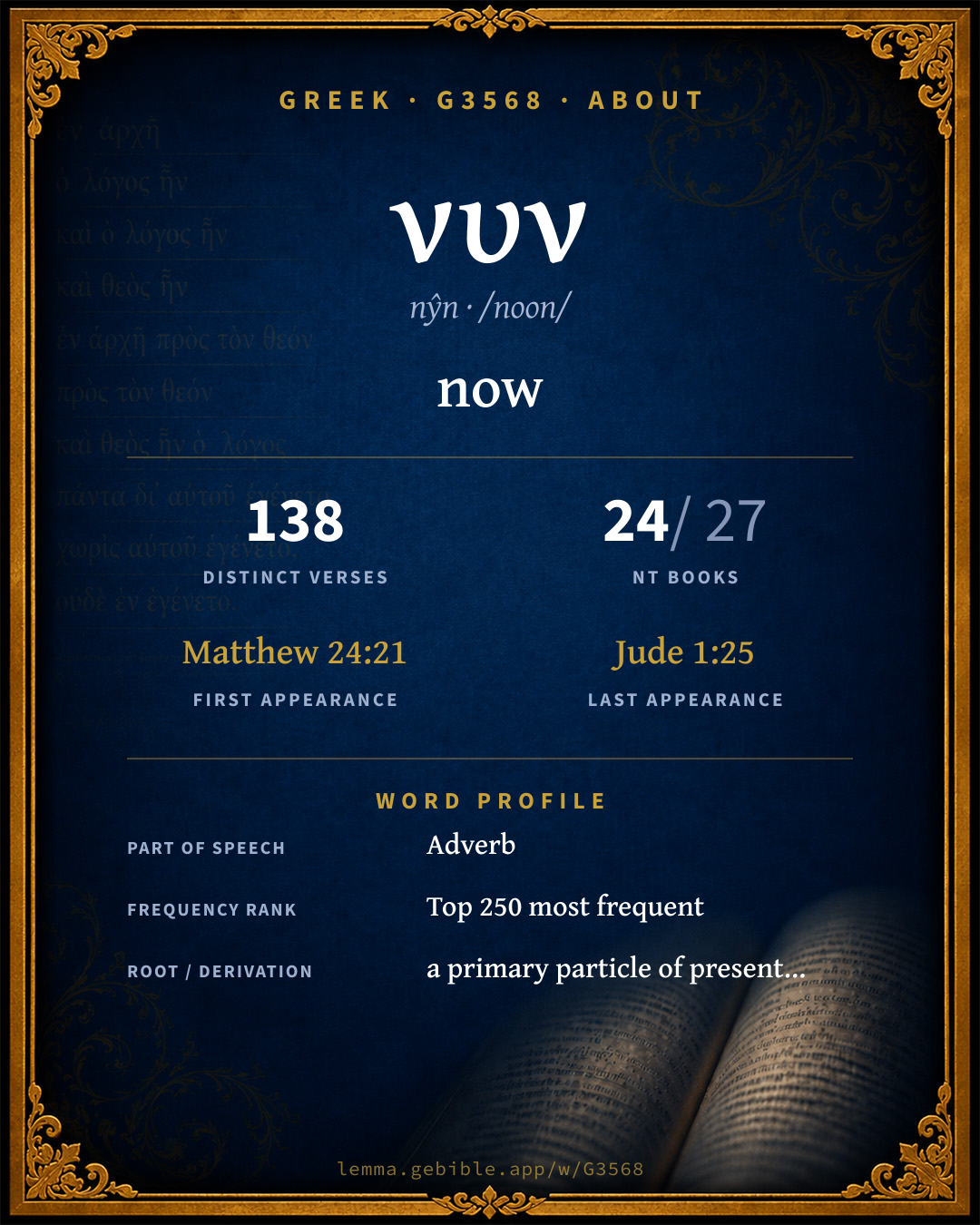
νῦν
now
Full lexicon entry — Thayer's Greek Lexicon
From Thayer's Greek Lexicon
Where this word appears
Grammar key — what these labels mean
Part of speech
- Adverb
- A word that modifies a verb, adjective, or other adverb.
Every verse where G3568 appears — 138 distinct verses across 24 books. Click any verse to open its interlinear word-by-word view. Verse text shown in the World English Bible for context — . Each verse’s Greek form is shown with its reference; the English is not keyword-highlighted, since the data carries no word-level English alignment. Use “Compare translations” on any verse to read it across multiple English versions. This concordance covers the Greek New Testament; Septuagint (Greek Old Testament) occurrences of this word are not indexed here.
Matthew 4 verses
- Matthew 24:21 νῦν adv for then there will be great oppression, such as has not been from the beginning of the world until now, no, nor ever will be.
- Matthew 26:65 νῦν adv Then the high priest tore his clothing, saying, "He has spoken blasphemy! Why do we need any more witnesses? Behold, now you have heard his blasphemy.
- Matthew 27:42 νῦν adv "He saved others, but he can't save himself. If he is the King of Israel, let him come down from the cross now, and we will believe in him.
- Matthew 27:43 νῦν adv He trusts in God. Let God deliver him now, if he wants him; for he said, 'I am the Son of God.'"
Mark 3 verses
- Mark 10:30 νῦν adv but he will receive one hundred times more now in this time, houses, brothers, sisters, mothers, children, and land, with persecutions; and in the age to come eternal life.
- Mark 13:19 νῦν adv For in those days there will be oppression, such as there has not been the like from the beginning of the creation which God created until now, and never will be.
- Mark 15:32 νῦν adv Let the Christ, the King of Israel, now come down from the cross, that we may see and believe him." Those who were crucified with him insulted him.
Luke 12 verses
- Luke 1:48 νῦν adv For he has looked at the humble state of his handmaid. For behold, from now on, all generations will call me blessed.
- Luke 2:29 νῦν adv "Now you are releasing your servant, Master, According to your word, in peace;
- Luke 5:10 νῦν adv and so also were James and John, sons of Zebedee, who were partners with Simon. Jesus said to Simon, "Don't be afraid. From now on you will be catching people alive."
- Luke 6:21 νῦν νῦν adv adv Blessed are you who hunger now, For you will be filled. Blessed are you who weep now, For you will laugh.
- Luke 6:25 νῦν νῦν adv adv Woe to you, you who are full now! For you will be hungry. Woe to you who laugh now! For you will mourn and weep.
- Luke 11:39 νῦν adv The Lord said to him, "Now you Pharisees cleanse the outside of the cup and of the platter, but your inward part is full of extortion and wickedness.
- Luke 12:52 νῦν adv For from now on, there will be five in one house divided, three against two, and two against three.
- Luke 16:25 νῦν adv "But Abraham said, 'Son, remember that you, in your lifetime, received your good things, and Lazarus, in like manner, bad things. But now here he is comforted and you are in anguish.
- Luke 19:42 νῦν adv saying, "If you, even you, had known today the things which belong to your peace! But now, they are hidden from your eyes.
- Luke 22:18 νῦν adv for I tell you, I will not drink at all again from the fruit of the vine, until the Kingdom of God comes."
- Luke 22:36 νῦν adv Then he said to them, "But now, whoever has a purse, let him take it, and likewise a wallet. Whoever has none, let him sell his cloak, and buy a sword.
- Luke 22:69 νῦν adv From now on, the Son of Man will be seated at the right hand of the power of God."
John 27 verses
- John 2:8 νῦν adv He said to them, "Now draw some out, and take it to the ruler of the feast." So they took it.
- John 4:18 νῦν adv for you have had five husbands; and he whom you now have is not your husband. This you have said truly."
- John 4:23 νῦν adv But the hour comes, and now is, when the true worshippers will worship the Father in spirit and truth, for the Father seeks such to be his worshippers.
- John 5:25 νῦν adv Most assuredly, I tell you, the hour comes, and now is, when the dead will hear the Son of God's voice; and those who hear will live.
- John 6:42 νῦν adv They said, "Isn't this Jesus, the son of Joseph, whose father and mother we know? How then does he say, 'I have come down out of heaven?'"
- John 8:40 νῦν adv But now you seek to kill me, a man who has told you the truth, which I heard from God. Abraham didn't do this.
- John 8:52 νῦν adv Then the Jews said to him, "Now we know that you have a demon. Abraham died, and the prophets; and you say, 'If a man keeps my word, he will never taste of death.'
- John 9:21 νῦν adv but how he now sees, we don't know; or who opened his eyes, we don't know. He is of age. Ask him. He will speak for himself."
- John 9:41 νῦν adv Jesus said to them, "If you were blind, you would have no sin; but now you say, 'We see.' Therefore your sin remains.
- John 11:8 νῦν adv The disciples told him, "Rabbi, the Jews were just trying to stone you, and are you going there again?"
- John 11:22 νῦν adv Even now I know that, whatever you ask of God, God will give you."
- John 12:27 νῦν adv "Now my soul is troubled. What shall I say? 'Father, save me from this time?' But for this cause I came to this time.
- John 12:31 νῦν νῦν adv adv Now is the judgment of this world. Now the prince of this world will be cast out.
- John 13:31 νῦν adv When he had gone out, Jesus said, "Now the Son of Man has been glorified, and God has been glorified in him.
- John 13:36 νῦν adv Simon Peter said to him, "Lord, where are you going?" Jesus answered, "Where I am going, you can't follow now, but you will follow afterwards."
- John 14:29 νῦν adv Now I have told you before it happens so that, when it happens, you may believe.
- John 15:22 νῦν adv If I had not come and spoken to them, they would not have had sin; but now they have no excuse for their sin.
- John 15:24 νῦν adv If I hadn't done among them the works which no one else did, they wouldn't have had sin. But now have they seen and also hated both me and my Father.
- John 16:5 νῦν adv But now I am going to him who sent me, and none of you asks me, 'Where are you going?'
- John 16:22 νῦν adv Therefore you now have sorrow, but I will see you again, and your heart will rejoice, and no one will take your joy away from you.
- John 16:29 νῦν adv His disciples said to him, "Behold, now you speak plainly, and speak no figures of speech.
- John 16:30 νῦν adv Now we know that you know all things, and don't need for anyone to question you. By this we believe that you came forth from God."
- John 17:5 νῦν adv Now, Father, glorify me with your own self with the glory which I had with you before the world existed.
- John 17:7 νῦν adv Now they have known that all things whatever you have given me are from you,
- John 17:13 νῦν adv But now I come to you, and I say these things in the world, that they may have my joy made full in themselves.
- John 18:36 νῦν adv Jesus answered, "My Kingdom is not of this world. If my Kingdom were of this world, then my servants would fight, that I wouldn't be delivered to the Jews. But now my Kingdom is not from here."
- John 21:10 νῦν adv Jesus said to them, "Bring some of the fish which you have just caught."
Acts 25 verses
- Acts 3:17 νῦν adv "Now, brothers, I know that you did this in ignorance, as did also your rulers.
- Acts 4:29 νῦν adv Now, Lord, look at their threats, and grant to your servants to speak your word with all boldness,
- Acts 5:38 νῦν adv Now I tell you, withdraw from these men, and leave them alone. For if this counsel or this work is of men, it will be overthrown.
- Acts 7:4 νῦν adv Then he came out of the land of the Chaldaeans, and lived in Haran. From there, when his father was dead, God moved him into this land, where you are now living.
- Acts 7:34 νῦν adv I have surely seen the affliction of my people that is in Egypt, and have heard their groaning. I have come down to deliver them. Now come, I will send you into Egypt.'
- Acts 7:52 νῦν adv Which of the prophets didn't your fathers persecute? They killed those who foretold the coming of the Righteous One, of whom you have now become betrayers and murderers.
- Acts 10:5 νῦν adv Now send men to Joppa, and get Simon, who is surnamed Peter.
- Acts 10:33 νῦν adv Therefore I sent to you at once, and it was good of you to come. Now therefore we are all here present in the sight of God to hear all things that have been commanded you by God."
- Acts 12:11 νῦν adv When Peter had come to himself, he said, "Now I truly know that the Lord has sent out his angel and delivered me out of the hand of Herod, and from everything the Jewish people were expecting."
- Acts 13:11 νῦν adv Now, behold, the hand of the Lord is on you, and you will be blind, not seeing the sun for a season!" Immediately there fell on him a mist and darkness. He went around seeking someone to lead him by the hand.
- Acts 13:31 νῦν adv and he was seen for many days by those who came up with him from Galilee to Jerusalem, who are his witnesses to the people.
- Acts 15:10 νῦν adv Now therefore why do you tempt God, that you should put a yoke on the neck of the disciples which neither our fathers nor we were able to bear?
- Acts 16:36 νῦν adv The jailer reported these words to Paul, saying, "The magistrates have sent to let you go; now therefore come out, and go in peace."
- Acts 16:37 νῦν adv But Paul said to them, "They have beaten us publicly, without a trial, men who are Romans, and have cast us into prison! Do they now release us secretly? No, most assuredly, but let them come themselves and bring us out!"
- Acts 17:30 νῦν adv The times of ignorance therefore God overlooked. But now he commands that all people everywhere should repent,
- Acts 18:6 νῦν adv When they opposed him and blasphemed, he shook out his clothing and said to them, "Your blood be on your own heads! I am clean. From now on, I will go to the Gentiles!"
- Acts 20:22 νῦν adv Now, behold, I go bound by the Spirit to Jerusalem, not knowing what will happen to me there;
- Acts 20:25 νῦν adv Now, behold, I know that you all, among whom I went about preaching the Kingdom of God, will see my face no more.
- Acts 20:32 νῦν adv Now, brothers, I entrust you to God, and to the word of his grace, which is able to build up, and to give you the inheritance among all those who are sanctified.
- Acts 22:16 νῦν adv Now why do you wait? Arise, be baptized, and wash away your sins, calling on the name of the Lord.'
- Acts 23:15 νῦν adv Now therefore, you with the council inform the commanding officer that he should bring him down to you tomorrow, as though you were going to judge his case more exactly. We are ready to kill him before he comes near."
- Acts 23:21 νῦν adv Therefore don't yield to them, for more than forty men lie in wait for him, who have bound themselves under a curse neither to eat nor to drink until they have killed him. Now they are ready, looking for the promise from you."
- Acts 24:25 νῦν adv As he reasoned about righteousness, self-control, and the judgment to come, Felix was terrified, and answered, "Go your way for this time, and when it is convenient for me, I will summon you."
- Acts 26:6 νῦν adv Now I stand here to be judged for the hope of the promise made by God to our fathers,
- Acts 27:22 νῦν adv Now I exhort you to cheer up, for there will be no loss of life among you, but only of the ship.
Romans 13 verses
- Romans 3:26 νῦν adv to demonstrate his righteousness at this present time; that he might himself be just, and the justifier of him who has faith in Jesus.
- Romans 5:9 νῦν adv Much more then, being now justified by his blood, we will be saved from God's wrath through him.
- Romans 5:11 νῦν adv Not only so, but we also rejoice in God through our Lord Jesus Christ, through whom we have now received the reconciliation.
- Romans 6:19 νῦν adv I speak in human terms because of the weakness of your flesh, for as you presented your members as servants to uncleanness and to wickedness upon wickedness, even so now present your members as servants to righteousness for sanctification.
- Romans 6:21 νῦν adv What fruit then did you have at that time in the things of which you are now ashamed? For the end of those things is death.
- Romans 8:1 νῦν adv There is therefore now no condemnation to those who are in Christ Jesus, who don't walk according to the flesh, but according to the Spirit.
- Romans 8:18 νῦν adv For I consider that the sufferings of this present time are not worthy to be compared with the glory which will be revealed toward us.
- Romans 8:22 νῦν adv For we know that the whole creation groans and travails in pain together until now.
- Romans 11:5 νῦν adv Even so then at this present time also there is a remnant according to the election of grace.
- Romans 11:30 νῦν adv For as you in time past were disobedient to God, but now have obtained mercy by their disobedience,
- Romans 11:31 νῦν νῦν adv adv even so these also have now been disobedient, that by the mercy shown to you they may also obtain mercy.
- Romans 13:11 νῦν adv Do this, knowing the time, that it is already time for you to awaken out of sleep, for salvation is now nearer to us than when we first believed.
- Romans 16:26 νῦν adv
1 Corinthians 5 verses
- 1 Corinthians 3:2 νῦν adv I fed you with milk, not with meat; for you weren't yet ready. Indeed, not even now are you ready,
- 1 Corinthians 7:14 νῦν adv For the unbelieving husband is sanctified in the wife, and the unbelieving wife is sanctified in the husband. Otherwise your children would be unclean, but now are they holy.
- 1 Corinthians 12:20 νῦν adv But now they are many members, but one body.
- 1 Corinthians 14:6 νῦν adv But now, brothers, if I come to you speaking with other languages, what would I profit you, unless I speak to you either by way of revelation, or of knowledge, or of prophesying, or of teaching?
- 1 Corinthians 16:12 νῦν adv Now concerning Apollos, the brother, I strongly urged him to come to you with the brothers; and it was not at all his desire to come now; but he will come when he has an opportunity.
2 Corinthians 5 verses
- 2 Corinthians 5:16 νῦν νῦν adv adv Therefore we know no one after the flesh from now on. Even though we have known Christ after the flesh, yet now we know him so no more.
- 2 Corinthians 6:2 νῦν νῦν adv adv for he says, "At an acceptable time I listened to you, In a day of salvation I helped you." Behold, now is the acceptable time. Behold, now is the day of salvation.
- 2 Corinthians 7:9 νῦν adv I now rejoice, not that you were made sorry, but that you were made sorry to repentance. For you were made sorry in a godly way, that you might suffer loss by us in nothing.
- 2 Corinthians 8:13 νῦν adv For this is not that others may be eased and you distressed,
- 2 Corinthians 13:2 νῦν adv I have said beforehand, and I do say beforehand, as when I was present the second time, so now, being absent, I write to those who have sinned before now, and to all the rest, that, if I come again, I will not spare;
Galatians 6 verses
- Galatians 1:23 νῦν adv but they only heard: "He who once persecuted us now preaches the faith that he once tried to destroy."
- Galatians 2:20 νῦν adv I have been crucified with Christ, and it is no longer I that live, but Christ living in me. That life which I now live in the flesh, I live by faith in the Son of God, who loved me, and gave himself up for me.
- Galatians 3:3 νῦν adv Are you so foolish? Having begun in the Spirit, are you now completed in the flesh?
- Galatians 4:9 νῦν adv But now that you have come to know God, or rather to be known by God, why do you turn back again to the weak and miserable elements, to which you desire to be in bondage all over again?
- Galatians 4:25 νῦν adv For this Hagar is Mount Sinai in Arabia, and answers to the Jerusalem that exists now, for she is in bondage with her children.
- Galatians 4:29 νῦν adv But as then, he who was born according to the flesh persecuted him who was born according to the Spirit, so also it is now.
Ephesians 4 verses
- Ephesians 2:2 νῦν adv in which you once walked according to the course of this world, according to the prince of the powers of the air, the spirit who now works in the children of disobedience;
- Ephesians 3:5 νῦν adv which in other generations was not made known to the children of men, as it has now been revealed to his holy apostles and prophets in the Spirit;
- Ephesians 3:10 νῦν adv to the intent that now through the assembly the manifold wisdom of God might be made known to the principalities and the powers in the heavenly places,
- Ephesians 5:8 νῦν adv For you were once darkness, but are now light in the Lord. Walk as children of light,
Philippians 5 verses
- Philippians 1:5 νῦν adv for your partnership in furtherance of the Gospel from the first day until now;
- Philippians 1:20 νῦν adv according to my earnest expectation and hope, that I will in no way be disappointed, but with all boldness, as always, now also Christ will be magnified in my body, whether by life, or by death.
- Philippians 1:30 νῦν adv having the same conflict which you saw in me, and now hear is in me.
- Philippians 2:12 νῦν adv So then, my beloved, even as you have always obeyed, not only in my presence, but now much more in my absence, work out your own salvation with fear and trembling.
- Philippians 3:18 νῦν adv For many walk, of whom I told you often, and now tell you even weeping, as the enemies of the cross of Christ,
Colossians 2 verses
- Colossians 1:24 Νῦν adv Now I rejoice in my sufferings for your sake, and fill up on my part that which is lacking of the afflictions of Christ in my flesh for his body's sake, which is the assembly;
- Colossians 1:26 νῦν adv the mystery which has been hidden for ages and generations. But now it has been revealed to his saints,
1 Thessalonians 1 verse
2 Thessalonians 1 verse
1 Timothy 2 verses
- 1 Timothy 4:8 νῦν adv For bodily exercise has some value, but godliness has value for all things, having the promise of the life which is now, and of that which is to come.
- 1 Timothy 6:17 νῦν adv Charge those who are rich in this present world that they not be haughty, nor have their hope set on the uncertainty of riches, but on the living God, who richly provides us with everything to enjoy;
2 Timothy 2 verses
- 2 Timothy 1:10 νῦν adv but has now been revealed by the appearing of our Savior, Christ Jesus, who abolished death, and brought life and immortality to light through the Gospel.
- 2 Timothy 4:10 νῦν adv for Demas left me, having loved this present world, and went to Thessalonica; Crescens to Galatia, and Titus to Dalmatia.
Titus 1 verse
Hebrews 5 verses
- Hebrews 2:8 νῦν adv You have put all things in subjection under his feet." For in that he subjected all things to him, he left nothing that is not subject to him. But now we don't see all things subjected to him, yet.
- Hebrews 9:5 νῦν adv and above it cherubim of glory overshadowing the mercy seat, of which things we can't now speak in detail.
- Hebrews 9:24 νῦν adv For Christ hasn't entered into holy places made with hands, which are representations of the true, but into heaven itself, now to appear in the presence of God for us;
- Hebrews 11:16 νῦν adv But now they desire a better country, that is, a heavenly one. Therefore God is not ashamed of them, to be called their God, for he has prepared a city for them.
- Hebrews 12:26 νῦν adv whose voice shook the earth, then, but now he has promised, saying, "Yet once more I will shake not only the earth, but also the heavens."
James 3 verses
- James 4:13 νῦν adv Come now, you who say, "Today or tomorrow let's go into this city, and spend a year there, trade, and make a profit."
- James 4:16 νῦν adv But now you glory in your boasting. All such boasting is evil.
- James 5:1 νῦν adv Come now, you rich, weep and howl for your miseries that are coming on you.
1 Peter 4 verses
- 1 Peter 1:12 νῦν adv To them it was revealed, that not to themselves, but to you, did they minister these things, which now have been announced to you through those who preached the Gospel to you by the Holy Spirit sent out from heaven; which things angels desire to look into.
- 1 Peter 2:10 νῦν νῦν adv adv who in time past were no people, but now are God's people, who had not obtained mercy, but now have obtained mercy.
- 1 Peter 2:25 νῦν adv For you were going astray like sheep; but are now returned to the Shepherd and Overseer of your souls.
- 1 Peter 3:21 νῦν adv This is a symbol of baptism, which now saves you-- not the putting away of the filth of the flesh, but the answer of a good conscience toward God, through the resurrection of Jesus Christ,
2 Peter 2 verses
- 2 Peter 3:7 νῦν adv But the heavens that now are, and the earth, by the same word have been stored up for fire, being reserved against the day of judgment and destruction of ungodly men.
- 2 Peter 3:18 νῦν adv But grow in the grace and knowledge of our Lord and Savior Jesus Christ. To him be the glory both now and forever. Amen.
1 John 4 verses
- 1 John 2:18 νῦν adv Little children, these are the end times, and as you heard that the Antichrist is coming, even now many antichrists have arisen. By this we know that it is the end times.
- 1 John 2:28 νῦν adv Now, little children, remain in him, that when he appears, we may have boldness, and not be ashamed before him at his coming.
- 1 John 3:2 νῦν adv Beloved, now we are children of God, and it is not yet revealed what we will be. But we know that, when he is revealed, we will be like him; for we will see him just as he is.
- 1 John 4:3 νῦν adv and every spirit who doesn't confess that Jesus Christ has come in the flesh is not of God, and this is the spirit of the antichrist, of whom you have heard that it comes. Now it is in the world already.
2 John 1 verse
Jude 1 verse
About this entry
At a glance — auto-summarized from this page’s data, not written by a person. Every figure links to its source below. This summary describes the numbers; it doesn’t interpret them.
The Greek verb νυν centers on the idea of “now.” Its earliest occurrence is Matthew 24:21. Spanning 138 verses in 24 books, it ranks among the common words of the Greek New Testament. Related forms include νυνι. Dig into 138-verse concordance and the renderings breakdown below.
Gloss history
Strong's 1890 vs modern scholarship

About this word
Strong's G3568 catalogs a Greek word from the Greek New Testament.
These counts are not copied from any lexicon or concordance. They are computed here, from the morphology-tagged Greek New Testament. What Lemma adds →
- 138
- distinct verses
- The word appears in 138 distinct verses.
- 24 / 27
- NT books
- The word appears in 24 of 27 New Testament books.
- #112
- by frequency
- Top 250 most frequent Greek words (rank 112 of 5,347 Greek words by occurrence).
View all 138 occurrences in the concordance →
By section of the New Testament
By traditional corpus
Conventional, traditional groupings — biblical authorship is debated, so this is a traditional corpus grouping, not an authorship claim. Some books belong to more than one corpus (Luke is in both the Gospels and the Lukan corpus, and so on), so these shares overlap and need not total 100%. Each figure is a share of the word’s 138 distinct verses.
- Pauline corpus 47 verses · 34%
- Gospels 46 verses · 33%
- Lukan (Luke–Acts) 37 verses · 27%
- Johannine 32 verses · 23%
- General (Catholic) Epistles 15 verses · 11%
- Hebrews 5 verses · 4%
How translations render this word
Counts come from each version’s own published word-to-Strong’s tagging or interlinear alignment — an approximate guide to how each version renders this word, not a word-level alignment the data otherwise carries. Because each total is that version’s own tagged count, the per-version totals vary from one another and need not match the appearance or distinct-verse counts above. These counts may also differ from a printed concordance because Lemma counts each distinctly tagged rendering and does not collapse phrase taggings into a single head-word total. This is a fixed set of word-tagged versions (KJV, ASV, BSB, ULT) and does not change with the reading translation you choose elsewhere. Each version’s license is shown beside its name below (and on Sources).
- King James Version: Now 115×, Henceforth 4×, Present 4×
- American Standard Version: Now 111×, Henceforth 6×, Present 5×
- Berean Standard Bible: Now 94×, Present 10×, Now on 7×
- unfoldingWord Literal Text: Now 151×, Present 9×, Now on 6×
King James Version Public Domain
Renders G3568 across 137 tagged occurrences — most commonly:
Plus 4 renderings that appear only once — usually multi-word phrases or single function words the recovered tagging swept in, not distinct renderings. Not rendered by a distinct English word in 1 further occurrence.
American Standard Version Public Domain
Renders G3568 across 136 tagged occurrences — most commonly:
Plus 10 renderings that appear only once — usually multi-word phrases or single function words the recovered tagging swept in, not distinct renderings.
Berean Standard Bible Public Domain
Renders G3568 across 125 tagged occurrences — most commonly:
Plus 12 renderings that appear only once — usually multi-word phrases or single function words the recovered tagging swept in, not distinct renderings. Not rendered by a distinct English word in 9 further occurrences.
unfoldingWord Literal Text CC BY-SA 4.0
Renders G3568 across 169 tagged occurrences — most commonly:
Plus 3 renderings that appear only once — usually multi-word phrases or single function words the recovered tagging swept in, not distinct renderings.
Senses in Thayer's
The 1 sense Thayer's distinguishes for this word, in lexicon order (not ranked by frequency or importance). The full entry — with sub-senses — is in the Lexicon Entry tab.
- at this time, the present, now
Word origin
Origin: a primary particle of present time
Forms in the corpus
The 2 distinct written forms G3568 takes in the Greek New Testament, most frequent first — each parse links to that case’s occurrences in the concordance.
| Form | Parsing | Example | Uses |
|---|---|---|---|
| νῦν nŷn | Adverb | Matthew 24:21 | 144 |
| Νῦν Nŷn | Adverb | Colossians 1:24 | 1 |
Same root — word family
Other Thayer's entries built from the same root as G3568, grouped by Strong’s listed origin. These share a root / origin per the lexicon — not necessarily a shared meaning. Each links to that word’s own entry.
Derived from this word
Compare all same-root words → They share a root, not necessarily a meaning.
Septuagint usage
The same Greek word νυν appears 478 times in the Greek Old Testament (Septuagint), across 461 verses in 31 books.
- 478
- LXX occurrences
- Tagged occurrences of this Greek word in the Septuagint.
- 461
- verses
- Distinct Septuagint verses containing this word.
- 31 / 39
- OT books
- The word appears in 31 of the 39 Old Testament books.
Sample Septuagint occurrences
- Genesis 2:23 νῦν
- Exodus 3:9 νῦν
- Numbers 14:3 νῦν
- Deuteronomy 2:13 νῦν
- Joshua 1:2 νῦν
- Judges 6:13 νῦν
- Ruth 3:2 νῦν
- 1 Samuel 1:16 νῦν
- 2 Samuel 2:6 νῦν
- 1 Kings 1:12 νῦν
- 2 Kings 1:14 νῦν
- 1 Chronicles 17:7 νῦν
Septuagint occurrences (same lexeme)
Every verse where the same Strong’s number (G3568) appears in the Greek Septuagint — showing the first 50 of 461. Verse text shown in the World English Bible for context; the Greek form is the matched word — the English is not keyword-highlighted.
- Genesis 2:23 νῦν The man said, "This is now bone of my bones, and flesh of my flesh. She will be called Woman, because she was taken out of Man."
- Genesis 3:22 νῦν Yahweh God said, "Behold, the man has become like one of us, knowing good and evil. Now, lest he put forth his hand, and also take of the tree of life, and eat, and live forever..."
- Genesis 4:11 νῦν Now you are cursed because of the ground, which has opened its mouth to receive your brother's blood from your hand.
- Genesis 11:6 νῦν Yahweh said, "Behold, they are one people, and they have all one language; and this is what they begin to do. Now nothing will be withheld from them, which they intend to do.
- Genesis 12:19 νῦν Why did you say, 'She is my sister,' so that I took her to be my wife? Now therefore, see your wife, take her, and go your way."
- Genesis 13:14 νῦν Yahweh said to Abram, after Lot was separated from him, "Now, lift up your eyes, and look from the place where you are, northward and southward and eastward and westward,
- Genesis 15:16 νῦν In the fourth generation they will come here again, for the iniquity of the Amorite is not yet full."
- Genesis 18:12 νῦν Sarah laughed within herself, saying, "After I have grown old will I have pleasure, my lord being old also?"
- Genesis 18:27 νῦν Abraham answered, "See now, I have taken it on myself to speak to the Lord, who am but dust and ashes.
- Genesis 19:9 νῦν They said, "Stand back!" They said, "This one fellow came in to live as a foreigner, and he appoints himself a judge. Now will we deal worse with you, than with them!" They pressed hard on the man, even Lot, and drew near to break the door.
- Genesis 20:7 νῦν Now therefore, restore the man's wife. For he is a prophet, and he will pray for you, and you will live. If you don't restore her, know for sure that you will die, you, and all who are yours."
- Genesis 21:23 νῦν Now therefore swear to me here by God that you will not deal falsely with me, nor with my son, nor with my son's son. But according to the kindness that I have done to you, you shall do to me, and to the land in which you have lived as a foreigner."
- Genesis 22:12 νῦν He said, "Don't lay your hand on the boy, neither do anything to him. For now I know that you fear God, seeing you have not withheld your son, your only son, from me."
- Genesis 24:42 νῦν I came this day to the spring, and said, 'Yahweh, the God of my master Abraham, if now you do prosper my way which I go.
- Genesis 26:22 νῦν He left that place, and dug another well. They didn't argue over that one. He called it Rehoboth. He said, "For now Yahweh has made room for us, and we will be fruitful in the land."
- Genesis 26:29 νῦν that you will do us no harm, as we have not touched you, and as we have done to you nothing but good, and have sent you away in peace.' You are now the blessed of Yahweh."
- Genesis 27:3 νῦν Now therefore, please take your weapons, your quiver and your bow, and go out to the field, and take me venison.
- Genesis 27:8 νῦν Now therefore, my son, obey my voice according to that which I command you.
- Genesis 27:36 νῦν He said, "Isn't he rightly named Jacob? For he has supplanted me these two times. He took away my birthright. See, now he has taken away my blessing." He said, "Haven't you reserved a blessing for me?"
- Genesis 27:43 νῦν Now therefore, my son, obey my voice. Arise, flee to Laban, my brother, in Haran.
- Genesis 29:32 νῦν Leah conceived, and bore a son, and she named him Reuben. For she said, "Because Yahweh has looked at my affliction. For now my husband will love me."
- Genesis 29:34 νῦν She conceived again, and bare a son. Said, "Now this time will my husband be joined to me, because I have borne him three sons." Therefore was his name called Levi.
- Genesis 29:35 νῦν She conceived again, and bare a son. She said, "This time will I praise Yahweh." Therefore she named him Judah. Then she stopped bearing.
- Genesis 30:20 νῦν Leah said, "God has endowed me with a good dowry. Now my husband will live with me, because I have borne him six sons." She named him Zebulun.
- Genesis 30:30 νῦν For it was little which you had before I came, and it has increased to a multitude. Yahweh has blessed you wherever I turned. Now when will I provide for my own house also?"
- Genesis 31:13 νῦν I am the God of Bethel, where you anointed a pillar, where you vowed a vow to me. Now arise, get out from this land, and return to the land of your birth."
- Genesis 31:16 νῦν For all the riches which God has taken away from our father, that is ours and our children's. Now then, whatever God has said to you, do."
- Genesis 31:28 νῦν and didn't allow me to kiss my sons and my daughters? Now have you done foolishly.
- Genesis 31:29 νῦν It is in the power of my hand to hurt you, but the God of your father spoke to me last night, saying, 'Take heed to yourself that you don't speak to Jacob either good or bad.'
- Genesis 31:30 νῦν Now, you want to be gone, because you sore longed after your father's house, but why have you stolen my gods?"
- Genesis 31:42 νῦν Unless the God of my father, the God of Abraham, and the fear of Isaac, had been with me, surely now you would have sent me away empty. God has seen my affliction and the labor of my hands, and rebuked you last night."
- Genesis 31:44 νῦν Now come, let us make a covenant, you and I; and let it be for a witness between me and you."
- Genesis 32:5 νῦν I have oxen, donkeys, flocks, men-servants, and maid-servants. I have sent to tell my lord, that I may find favor in your sight.'"
- Genesis 32:11 νῦν Please deliver me from the hand of my brother, from the hand of Esau: for I fear him, lest he come and strike me, and the mothers with the children.
- Genesis 37:20 νῦν Come now therefore, and let's kill him, and cast him into one of the pits, and we will say, 'An evil animal has devoured him.' We will see what will become of his dreams."
- Genesis 41:33 νῦν Now therefore let Pharaoh look for a discreet and wise man, and set him over the land of Egypt.
- Genesis 43:21 νῦν and it happened, when we came to the lodging-place, that we opened our sacks, and, behold, every man's money was in the mouth of his sack, our money in full weight. We have brought it again in our hand.
- Genesis 44:10 νῦν He said, "Now also let it be according to your words: he with whom it is found will be my bondservant; and you will be blameless."
- Genesis 44:28 νῦν and the one went out from me, and I said, "Surely he is torn in pieces;" and I haven't seen him since.
- Genesis 44:30 νῦν Now therefore when I come to your servant my father, and the boy is not with us; seeing that his life is bound up in the boy's life;
- Genesis 44:33 νῦν Now therefore, please let your servant stay instead of the boy, a bondservant to my lord; and let the boy go up with his brothers.
- Genesis 45:5 νῦν Now don't be grieved, nor angry with yourselves, that you sold me here, for God sent me before you to preserve life.
- Genesis 45:8 νῦν So now it wasn't you who sent me here, but God, and he has made me a father to Pharaoh, lord of all his house, and ruler over all the land of Egypt.
- Genesis 46:30 νῦν Israel said to Joseph, "Now let me die, since I have seen your face, that you are still alive."
- Genesis 46:34 νῦν that you shall say, 'Your servants have been keepers of cattle from our youth even until now, both we, and our fathers:' that you may dwell in the land of Goshen; for every shepherd is an abomination to the Egyptians."
- Genesis 47:4 νῦν They said to Pharaoh, "We have come to live as foreigners in the land, for there is no pasture for your servants' flocks. For the famine is severe in the land of Canaan. Now therefore, please let your servants dwell in the land of Goshen."
- Genesis 48:5 νῦν Now your two sons, who were born to you in the land of Egypt before I came to you into Egypt, are mine; Ephraim and Manasseh, even as Reuben and Simeon, will be mine.
- Genesis 50:5 νῦν 'My father made me swear, saying, "Behold, I am dying. Bury me in my grave which I have dug for myself in the land of Canaan." Now therefore, please let me go up and bury my father, and I will come again.'"
- Genesis 50:17 νῦν "So you shall tell Joseph, 'Now please forgive the disobedience of your brothers, and their sin, because they did evil to you.' Now, please forgive the disobedience of the servants of the God of your father." Joseph wept when they spoke to him.
- Exodus 3:9 νῦν Now, behold, the cry of the children of Israel has come to me. Moreover I have seen the oppression with which the Egyptians oppress them.
These are occurrences of the same Greek lexeme (G3568) in the Septuagint — not a translation of any one Hebrew word. The store carries no word-level Hebrew↔Greek alignment, so no Hebrew original is asserted here. Counts come from the recovered LXX Strong's tagging — high-frequency vocabulary is well covered, while rare or late forms may be untagged — so they reflect tagged occurrences and may slightly undercount.