1 Thessalonians 3:8

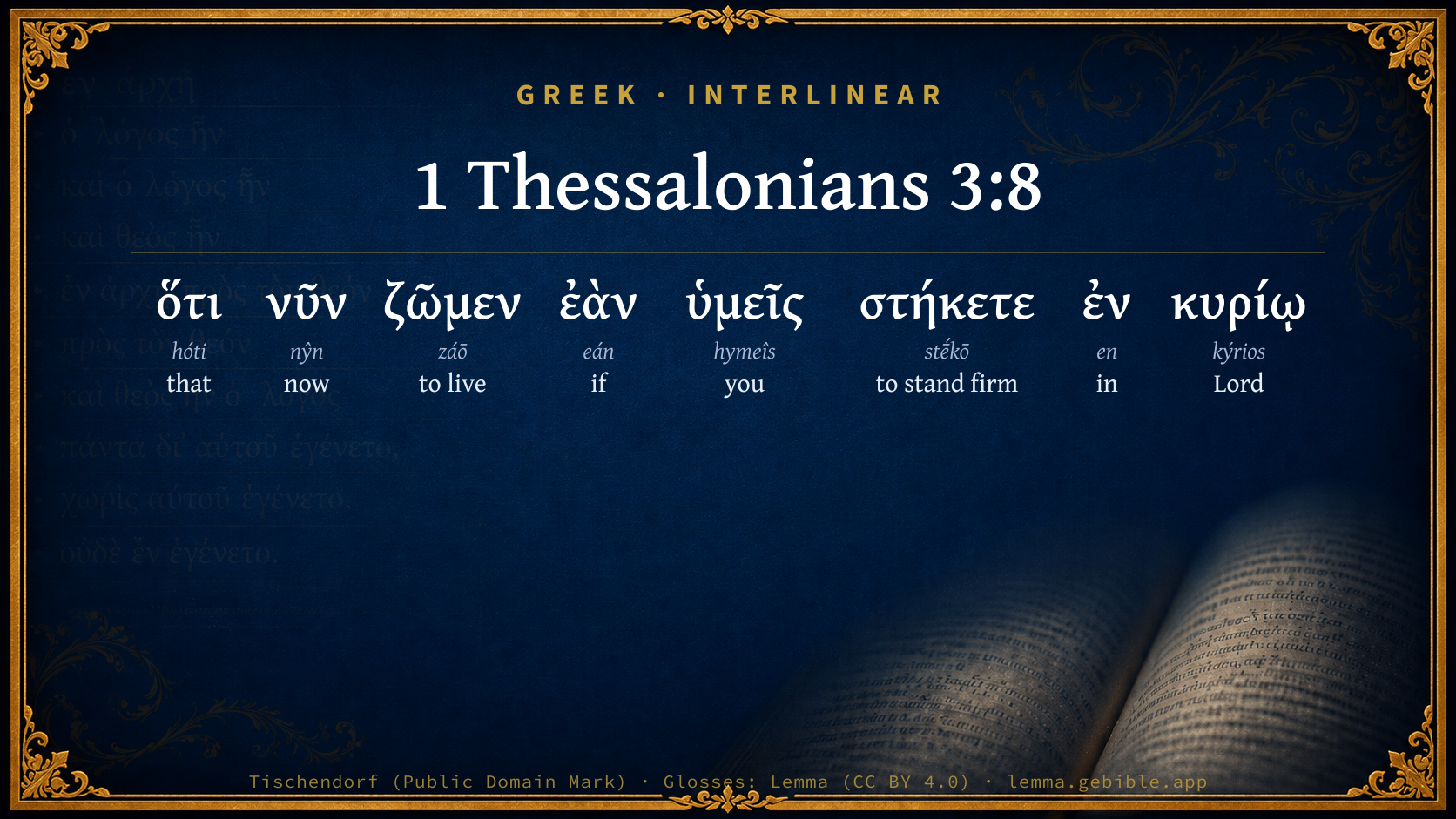
Greek (Tischendorf 8th ed.) 1 Thessalonians 3:8 appears in the Greek New Testament. The text above is from the Tischendorf 8th edition. Each word links to its Strong’s number and a concise gloss. Click any word for its full Thayer’s Greek Lexicon entry.
Download image
Cite this verse

1 Thessalonians 3:8 (World English Bible). Public Domain. Lemma interlinear Bible study tool, https://lemma.gebible.app/v/1-thessalonians/3/8.

Show BibTeX & RIS
BibTeX
RIS
English Translation
For now we live, if you stand fast in the Lord.
World English Bible · Public Domain
Download a study sheet

One document with this verse’s original text, its word-by-word gloss line, the meaning frame, cross-references with their text, attributed commentary, and full source and license credits — printable, and it pastes into notes with its structure intact.

This verse Autodidact and up

Study sheet (.html) Plain text (.txt)

A passage Seminary Student

Up to 50 verses in one chapter. A passage sheet keeps up to 6 commentary sources and 12 cross-references per verse, in the order this page ranks them, and says so on the sheet whenever that leaves anything out. Ask for a single verse and you get the Autodidact verse sheet above.

Everything on this page stays free to read, with no account — the sheet is a download of what is already on screen, not access to it.

Want to remove ads? Support Godless Engineer
Compare translations 3

The same verse in 3 English versions, stacked beneath the original-language interlinear above. Click any original word for its lexicon entry.

Each is an independent rendering of the whole verse — the interlinear is not word-aligned to these translations.

Highlighted words mark where these versions differ — a whole-verse word diff, not a word-by-word alignment.

  • World English Bible Public Domain
    For now we live, if you stand fast in the Lord.
  • King James Version Public Domain
    For now we live, if ye stand fast in the Lord.
  • unfoldingWord Literal Text CC BY-SA 4.0
    For now we live, if you yourselves stand firm in the Lord.

unfoldingWord Literal Text — © unfoldingWord, licensed CC BY-SA 4.0. Word-aligned USFM3 via Door43 (git.door43.org/unfoldingWord/en_ult).

Versions to compare (up to 4)

3 of 4 selected

Show all 19 translations

Every available English version of this verse, each an independent rendering of the whole verse.

  • World English Bible Public Domain
    For now we live, if you stand fast in the Lord.
  • Berean Standard Bible Public Domain
    For now we can go on living, as long as you are standing firm in the Lord.
  • Majority Standard Bible Public Domain
    For now we can go on living, as long as you are standing firm in the Lord.
  • King James Version Public Domain
    For now we live, if ye stand fast in the Lord.
  • American Standard Version (1901) Public Domain
    for now we live, if ye stand fast in the Lord.
  • Revised Version (1885) Public Domain
    for now we live, if ye stand fast in the Lord.
  • Geneva Bible (1599) Public Domain
    For nowe are wee aliue, if ye stand fast in the Lord.
  • Douay-Rheims (1899) Public Domain
    Because now we live, if you stand in the Lord.
  • Young's Literal Translation Public Domain
    because now we live, if ye may stand fast in the Lord;
  • Literal Standard Version CC BY-SA 4.0
    because now we live, if you may stand fast in the LORD.
  • Unlocked Literal Bible CC BY-SA 4.0
    For now we live, if you stand firm in the Lord.
  • unfoldingWord Literal Text CC BY-SA 4.0
    For now we live, if you yourselves stand firm in the Lord.
  • Darby Bible Public Domain
    because now we live if *ye* stand firm in [the] Lord.
  • World Messianic Bible Public Domain
    For now we live, if you stand fast in the Lord.
  • Webster's Bible Public Domain
    For now we live, if ye stand fast in the Lord.
  • Free Bible Version CC BY-SA 4.0
    For us life is worth living now because you're standing firm in the Lord!
  • Bible in Basic English Public Domain
    For it is life to us if you keep your faith in the Lord unchanged.
  • Text-Critical English NT CC BY 4.0
    For now we really live, since you are standing firm in the Lord.
  • Tyndale New Testament (1534) Public Domain
    For now are we alyve yf ye stonde stedfast in the lorde.

Literal Standard Version (2020), Covenant Press — licensed CC BY-SA 4.0. Text via the HelloAO Bible API (eBible.org). Unlocked Literal Bible (unfoldingWord) — licensed CC BY-SA 4.0. Text via the HelloAO Bible API (eBible.org). unfoldingWord Literal Text — © unfoldingWord, licensed CC BY-SA 4.0. Word-aligned USFM3 via Door43 (git.door43.org/unfoldingWord/en_ult). Free Bible Version, Dr. Jonathan Gallagher — licensed CC BY-SA 4.0. Text via the HelloAO Bible API (eBible.org).

Word by word

More ways to search: Search by grammar → Find every occurrence → Compare this word →

Practice this passage: Drill this verse → Learn its vocabulary →

About this verse

These counts appear in no published source. They are computed here, from the morphology-tagged text and Lemma’s own curated glosses. What Lemma adds →

8
words
8
distinct lemmas
Pauline Epistles
section

Notable vocabulary

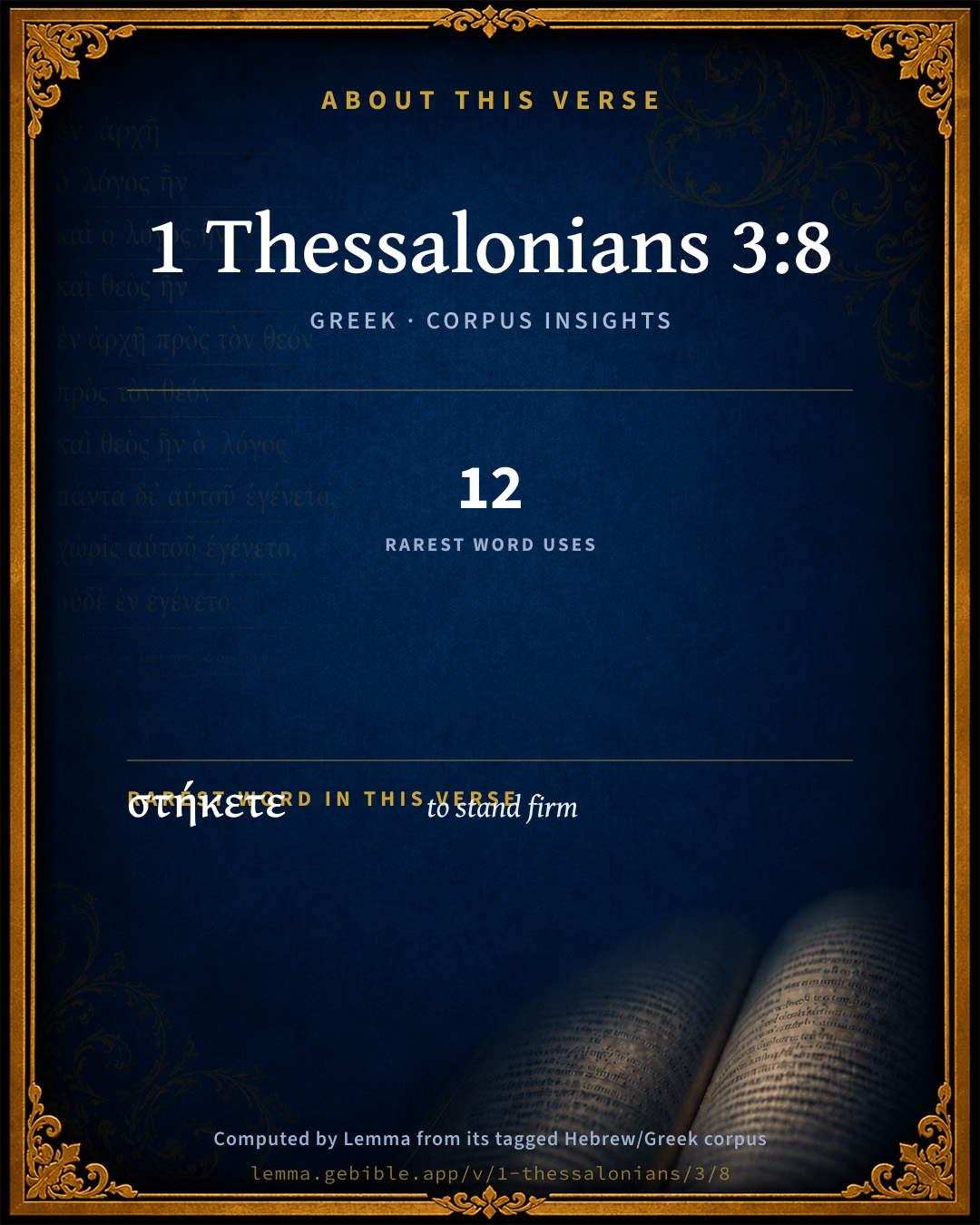
The rarest word here is στήκετε to stand firm G4739 — appearing just 12 times in the whole Greek New Testament.

Shared distinctive vocabulary

στήκετε to stand firm G4739 occurs in 12 verses of the Greek New Testament. Also found in:

Cross-references

23

Topical passages linked to 1 Thessalonians 3:8 in the Treasury of Scripture Knowledge — connected by theme and wording, ordered by reader-vote popularity; previews shown in the World English Bible.

  • 1 Corinthians 16:13 Watch! Stand firm in the faith! Be courageous! Be strong!
  • Colossians 1:23 if it is so that you continue in the faith, grounded and steadfast, and not moved away from the hope of the Gospel which you heard, which is being proclaimed in all creation under heaven; of which I, Paul, was made a servant.
  • Revelation 3:11 I am coming quickly! Hold firmly that which you have, so that no one takes your crown.
  • Philippians 1:21 For to me to live is Christ, and to die is gain.
  • Hebrews 4:14 Having then a great high priest, who has passed through the heavens, Jesus, the Son of God, let us hold tightly to our confession.
  • Hebrews 10:23 let us hold fast the confession of our hope unyieldingly. For he who promised is faithful.
  • Psalms 30:5 For his anger is but for a moment; His favor is for a lifetime. Weeping may stay for the night, But joy comes in the morning.
  • Acts 11:23 who, when he had come, and had seen the grace of God, was glad. He exhorted them all, that with purpose of heart they should remain near to the Lord.
  • Ephesians 3:17 that Christ may dwell in your hearts through faith; to the end that you, being rooted and grounded in love,
  • Hebrews 3:14 For we have become partakers of Christ, if we hold fast the beginning of our confidence firm to the end:
  • Revelation 3:3 Remember therefore how you have received and heard. Keep it, and repent. If therefore you won't watch, I will come as a thief, and you won't know what hour I will come upon you.
  • 1 Samuel 25:6 and thus shall you tell him who lives [in prosperity], Peace be to you, and peace be to your house, and peace be to all that you have.
  • John 15:4 Remain in me, and I in you. As the branch can't bear fruit by itself, unless it remains in the vine, so neither can you, unless you remain in me.
  • John 15:7 If you remain in me, and my words remain in you, you will ask whatever you desire, and it will be done for you.
  • 1 Corinthians 15:58 Therefore, my beloved brothers, be steadfast, immovable, always abounding in the Lord's work, because you know that your labor is not in vain in the Lord.
  • Ephesians 4:15–16 but speaking truth in love, we may grow up in all things into him, who is the head, Christ;
  • Ephesians 6:13–14 Therefore, put on the whole armor of God, that you may be able to withstand in the evil day, and, having done all, to stand.
  • Philippians 1:27 Only let your manner of life be worthy of the Gospel of Christ, that, whether I come and see you or am absent, I may hear of your state, that you stand firm in one spirit, with one soul striving for the faith of the Gospel;
  • Philippians 4:1 Therefore, my brothers, beloved and longed for, my joy and crown, so stand firm in the Lord, my beloved.
  • 1 Peter 5:10 But may the God of all grace, who called you to his eternal glory by Christ Jesus, after you have suffered a little while, perfect, establish, strengthen, and settle you.
  • 2 Peter 3:17 You therefore, beloved, knowing these things beforehand, beware lest, being carried away with the error of the wicked, you fall from your own steadfastness.
  • John 8:31 Jesus therefore said to those Jews who had believed him, "If you remain in my word, then you are truly my disciples.
  • Galatians 5:1 Stand firm therefore in the liberty by which Christ has made us free, and don't be entangled again with a yoke of bondage.

Cross-references courtesy of OpenBible.info (CC BY 4.0).

Commentary

Notes on 1 Thessalonians 3:8 from classic Christian and Jewish commentators (each source and its license shown beneath its notes). The classic Christian expositions comment on the surrounding passage and are grouped to its opening verse, so a note may address several verses; the Jewish commentaries on the Tanakh (Rashi and others) are per-verse, so they appear only where the commentator wrote on this verse.

Lemma curates 59 commentaries, every one of them public domain or Creative Commons licensed, each selected and text-cleaned for this edition rather than reprinted as found. About our sources →

Tyndale Open Study Notes

Tyndale Open Resources

3:8 Paul was distressed by his present circumstances (3:7) and deeply concerned for the church (3:1, 5). He was relieved to learn that the Thessalonians remained strong and were standing firm in the Lord even though they were also suffering (2:14; 3:3-4).

Tyndale Open Study Notes — © Tyndale Open Resources, licensed CC BY-SA 4.0. Text via the HelloAO Bible API.

Bengel's Gnomon

Johann Albrecht Bengel

1Th 3:8. Νῦν ζῶμεν, now we live) now we feel that we are alive. The form of testifying the highest joy; comp. Psa 63:4.

Bengel's Gnomon of the New Testament — English translation (T&T Clark, Edinburgh, 1860) — public domain. Text from a community e-Sword module.

Meyer's Critical & Exegetical Commentary

Heinrich August Wilhelm Meyer

1Th_3:8. Paul considers the ἀνάγκη and θλίψις which lay upon him as a θάνατος, but he does not feel this evil; the θάνατος is converted to him into ζωή, when he learns how the churches which he had founded cleave to the Lord. External matters are, in general, indifferent to the apostle, provided he reaches his life-aim, to lead souls to Christ; every success in reference to this imparts strength and fulness of life to him.

νῦν] is not to be understood in contrast to the pre-Christian life of the apostle, when his thought and aim were entirely different; whereby a thought entirely foreign to the context would be introduced. The force of νῦν as an adverb of time, at present, is not to be too greatly pressed (Marloratus: Sub adverbio nunc repetit, quod prius dixerat, se afflictione et necessitate graviter fuisse oppressum), but has here (on account of ἐάν) a causal reference; now, serving as an introduction to what follows: ἐὰν ὑμεῖς στήκητε ἐν κυρίῳ. Comp. Kühner, II. p. 385; Hartung, Partikell. II. p. 25.

ζῶμεν] not to be referred, with Chrysostom, to the future, eternal life, nor weakened to we are happy (Pelt and others), or satisfied (Grotius, Moldenhauer), but the meaning is: For now we live, i.e. we are in full strength and freshness of life, we do not feel the sorrows and tribulations which the outer world prepares for us.

ἐὰν ὑμεῖς στήκητε ἐν κυρίῳ] when, or so soon as ye stand fast in the Lord, hold fast to His fellowship.

ὑμεῖς] applies specially to the Thessalonians what holds good of Christians generally.

ἐάν] makes the fact of the stedfastness of the readers appear as a well-grounded supposition (see Schmalfeld, Syntax des Griech. Verbums, p. 201). But the hypothetical form of the sentence includes, indirectly, the exhortation to hold fast to the Lord for the future.

Meyer — Critical and Exegetical Commentary on the New Testament — English translation by Peter Christie, edited by Frederick Crombie (T&T Clark, 1880) — public domain. Text from a community e-Sword module.

Expositor's Greek Testament

ed. W. Robertson Nicoll

1Th 3:8 . The news put life and spirit into him. στήκετε , for construction cf. Mar 11:25 and Abbott’s Johan. Gramm. , 2515 (i).

The Expositor's Greek Testament, edited by W. Robertson Nicoll (1897–1910) — public domain. Text from a community e-Sword module.

Geneva Bible (1599)

Geneva Bible translators

For now you cannot otherwise think me safe and in good case, unless you go forward in religion and faith.

Geneva Bible (1599) marginal notes — public domain. Text via Bolls.life.

Jamieson, Fausset & Brown

Robert Jamieson, A. R. Fausset & David Brown

now--as the case is; seeing ye stand fast.

we live--we flourish. It revives us in our affliction to hear of your steadfastness (Psa 22:26).

if--implying that the vivid joy which the missionaries "now" feel, will continue if the Thessalonians continue steadfast. They still needed exhortation, Th1 3:10; therefore he subjoins the conditional clause, "if ye," &c. (Phi 4:1).

Jamieson, Fausset & Brown — Commentary Critical and Explanatory on the Whole Bible (1871) — public domain (CC PDM 1.0). Text via the HelloAO Bible API.

Adam Clarke's Commentary

Verse 8. For now we live] Your steadfastness in the faith gives me new life and comfort; I now feel that I live to some purpose, as my labour in the Lord is not in vain.

Adam Clarke's Commentary on the Bible (1810–1826) — public domain. Text from a community e-Sword/MySword module.

John Calvin's Commentaries

8 For now we live. Here it appears still more clearly that Paul almost forgot himself for the sake of the Thessalonians, or, at least, making regard for himself a mere secondary consideration, devoted his first and chief thoughts to them. At the same time he did not do that so much from affection to men as from a desire for the Lord’s glory. For zeal for God and Christ glowed in his holy breast to such a degree that it in a manner swallowed up all other anxieties. “We live,” says he, that is, “we are in good health, if you persevere in the Lord.” And under the adverb now, he repeats what he had formerly stated, that he had been greatly pressed down by affliction and necessity; yet he declares that whatever evil he endures in his own person does not hinder his joy. “Though in myself I am dead, yet in your welfare I live.” By this all pastors are admonished what sort of connection ought to subsist between them and the Church — that they reckon themselves happy when it goes well with the Church, although they should be in other respects encompassed with many miseries, and, on the other hand, that they pine away with grief and sorrow if they see the building which they have constructed in a state of decay, although matters otherwise should be joyful and prosperous.

John Calvin's Commentaries (1540-1563) — public domain. Text from the Calvin Translation Society English edition (1840s-50s) via the Christian Classics Ethereal Library (ccel.org). Calvin's coverage is partial (roughly two-thirds of the Bible); uncommented books and verses are honest gaps, never fabricated. The 19th-century editor's footnotes and remarks are omitted so the notes are faithfully Calvin's own voice.

Ellicott's Commentary for English Readers

(8) Now we live, if.—“Now” contrasts the new life and vigour which the “gospel of their faith and charity” had infused into the Apostle, with the deadly sinking he had felt at the thought of their possible apostacy. At the same time the “if” has the half-future sense, as though St. Paul meant that the continuance of this “life” was contingent upon their continued steadfastness. Another interpretation has been suggested, according to which both the “we” and “ye” are perfectly general, and therefore interchangeable, and the sense is made to be a vague proposition, “for standing fast in the Lord is a sine qua non of life”—life in the theological sense: and parts of Romans 7, 8 are compared. This interpretation, however, suits the Greek as little as the context.

A Bible Commentary for English Readers, edited by Charles John Ellicott (1878–1897) — public domain. Text from a community e-Sword module.

The Cambridge Bible for Schools and Colleges

gen. ed. J. J. S. Perowne

8. for now we live, if ye stand fast in the Lord] “if ye stand fast:” the pronoun bears the emphasis. St Paul felt as though his life was wrapped up in this Church. A load of apprehension was lifted from his mind, and he resumed his work at Corinth with the sense of renewed health and vigour, saying to himself, “Yes, now one really lives!” For in truth

“The incessant care and labour of his mind

Had wrought the mure, that should confine it in,

So thin, that life looked through and would break out.”

His heaviest burden, weighing down body and mind alike, was “the care of the Churches” (2Co_11:28-29).

This passage, like the Epistle to the Galatians and the Second to Corinth, shews St Paul as a man of high-strung and ardent nature, sensitive in his affections to an extreme degree. His whole soul was bound up with the Churches he had founded (comp. ch. 1Th_2:8, and note). They were his “children,” his “loved and longed for,” his “joy and glory, and crown of boasting.” He lived for nothing else. Read in illustration of this 2Co_7:2-16.

The Cambridge Bible for Schools and Colleges (gen. ed. J. J. S. Perowne; Cambridge University Press, 1878–1918) — public domain. Text from a community e-Sword module.

John Gill's Exposition

For now we live,.... Before they were dead men, lifeless, disconsolate, dispirited, carrying about with them the dying of the Lord Jesus, and death working in them, and they, as it were, under the sentence of that, being killed all the day long for Christ's sake; but now, upon this news, in the midst of all their sore trials and troubles, their spirits revived, and they became alive and cheerful; see Psa 22:26, it was like life from the dead unto them:

if ye stand fast in the Lord: or "our Lord", as the Syriac and Ethiopic versions read; that is, "in the faith of the Lord", as the Arabic version renders it: they were in the Lord secretly by electing grace, and openly by regenerating grace, and they abode in him; and by persevering grace, they were rooted and built up in Christ, and established in the faith of him, of his person, office, and grace; they were steady in the exercise of grace upon him, and stood fast in the liberty wherewith he had made them free, and continued steadfastly in the doctrines and ordinances of the Gospel; for the "if" here is not expressive of doubting, but of reasoning, "seeing ye stand fast in the Lord"; of which they were assured by Timothy: and this gave them fresh spirit and life amidst the deaths in which they often were.

John Gill's Exposition of the Whole Bible (1746–1763) — public domain (CC PDM 1.0). Text via the HelloAO Bible API.

Trapp's Complete Commentary

John Trapp

8 For now we live, if ye stand fast in the Lord.

Ver. 8. For now we live] A joyless life is a lifeless life. An unsuccessful pastor hath little or no joy in his life. "Thus shall ye say to him that liveth," 1Sa 25:6, that is, that liveth at heart’s ease. "All the days of the afflicted are evil," Pro 15:15. As good be out of the world (say they) as have no joy of the world. Now, "I have no greater joy," saith St John, "than to hear that my children walk in the truth," 3Jn 1:4. This revived his good old heart, and made it dance lavoltas {a} in his bosom.

{a} A lively dance for two persons, consisting a good deal in high and active bounds. ŒD

John Trapp, A Commentary or Exposition upon All the Books of the Old and New Testament (1647–1656) — public domain. Text from a community e-Sword module.

Albert Barnes' Notes on the Bible

For now we live, if ye stand fast in the Lord - This is equivalent to saying, “My life and comfort depend on your stability in the faith, and your correct Christian walk;” compare Martial 6:70. Non est vivere, sed valere, vita - “Life consists not merely in living, but in the enjoyment of health.” See also Seneca, Epis. 99, and Manilius, 1Th 4:5, as quoted by Wetstein. The meaning here is, that Paul now enjoyed life; he had that which constituted real life, in the fact that they acted as became Christians, and so as to show that his labor among them had not been in vain. The same thing here affirmed is true of all faithful ministers of the gospel. They feel that they have something that may be called life, and that is worth living for, when those to whom they preach maintain a close walk with God.

Albert Barnes' Notes on the Bible (1834–1885) — public domain. Text from a community e-Sword/MySword module.

Haydock's Catholic Bible Commentary

We live. That is, we live in joy and comfort, if you stand firm in the faith of Christ, as you ought. (Witham) --- The news that you stand steadfast in the Lord, reanimates me under all my sufferings, and as it were raises me to life again from the shadow of death, under which I am placed. O that I could see you, to complete the work of instructing you in the faith, which I have begun.

George Leo Haydock (1774–1849), Haydock's Catholic Family Bible and Commentary, 1859 edition — public domain. Excludes Psalms (Douay-Rheims chapter numbering differs from Protestant) and Deuterocanonical books (Catholic canon only).

Matthew Poole's English Annotations

The comfort of their faith was so great that it would be as life to him, if they stood fast in it; which he calls a standing

fast in the Lord. Life is not only the union of soul and body; comfort is the life of the soul, especially that which springs from Divine causes. And on the contrary, the apostacy and degeneracy of a people doth kill the hearts of their faithful teachers.

Matthew Poole's English Annotations on the Holy Bible (1683–1685) — public domain. Text from a community e-Sword/MySword module.

Whedon's Commentary on the Bible

Daniel D. Whedon

8. We live—We were lifeless, dead, until your life and love revived us.

Daniel D. Whedon (gen. ed.), Commentary on the Old and New Testaments (1874–1909) — public domain. Text from a community e-Sword module.

The Pulpit Commentary

For now we live. Not to be referred to the eternal and future life (Chrysostom); or to be weakened as if it merely signified, "We relish and enjoy life notwithstanding our affliction and distress" (Pelt); but the meaning is the good tidings which Timothy has brought have imparted new life unto us; "we are in the full strength and freshness of life, we do not feel the sorrows and tribulations which the outer world prepares for us" (Lunemann). The apostle considers his condition of affliction and distress as a kind of death: so, elsewhere he says, "I die daily"; (1Co_15:31) and from which death he was now again raised to life. If; provided a hypothetical assumption. Ye stand fast; continue firm in the faith of the gospel. In the Lord; the element of true life.

St. Paul"s devotion to his converts.

I A PICTURE OF CHRISTIAN LOVE. St. Paul is intensely devoted to his converts. Their prosperity is his life, their unfaithfulness his death. Love of the brethren is a conspicuous feature in the early Christian character more conspicuous than, alas! it is in the modern Church. An apostle felt more than a brotherly love for the Churches he had planted. His affection was that of a father for his children.

1. Christianity promotes care for others. It is directly opposed to a self-seeking exclusiveness as much in spiritual as in worldly affairs. As it bids a man not simply care for the enriching of himself with material wealth, so it equally forbids him to seek only for the saving of his own soul. The Church of Christ is always required to have in view the object which Ignatius Loyola propounded as the great end of the society of the Jesuits when he wrote, "The end of this society is not only, with the grace of God, to devote ourselves to the salvation and perfection of our own souls, but also, with the same Divine grace, to labor most earnestly for the salvation and perfection of our neighbor.

2. Christianity binds Christians together in close bonds of affection. This is its aim, and this is what it does when unhindered by culpable selfishness and coldness. The gospel introduces a new experience into the world. Christian love is quite unlike pagan friendship, being

(1) broader;

(2) deeper, founded on spiritual union; and

(3) warmer.

II AN INDUCEMENT TO CHRISTIAN FIDELITY.

1. The inducement is first direct and personal. St. Paul urges the Thessalonians to be steadfast because he feels his own life to be wrapped up in their fidelity. For his sake, if not for their own, he desires them to resist the temptations that are trying them. No doubt so devoted and affectionate a man as St. Paul would be able to bring great weight of persuasion to bear on his converts by this appeal to their consideration for their spiritual father. A similar influence may be helpful now. If we know one who has labored, prayed, and watched for our soul, surely the desire not to grieve him at the last by proving all his toil to have been in vain should be a motive for profiting by it. The scholar should feel thus towards his teacher, the child towards his Christian mother; above all, every one of us towards Christ, that his work may not be in vain that, after all he has suffered for us, he should not be made to suffer by us.

2. Further, the inducement is general and inferential. If the steadfastness of the Thessalonians was a matter of such profound concern to St. Paul, it must have been of great importance in itself. Here is a strong reason for not thinking lightly of Christian fidelity. An apostle feels that he lives in the faithfulness of his converts. How supremely necessary must that faithfulness be for them! how supremely necessary must it ever be for the Church!

III AN EXAMPLE FOR CHRISTIAN WORK. The Church at Thessalonica was faithful. St. Paul was not disappointed in his friends. The secret of this steadfastness may be seen in the spirit of the apostle. He was no perfunctory preacher. Not only was his heart in his work; his heart was with the people to whom he ministered. Their faithfulness and failure were questions of life and death to him. The servant of Christ has here an example of supreme interest. Learning, eloquence, holiness, zeal, all fail without love. The preacher who identifies himself with his people is the most successful in winning them for Christ. W.F.A.

The Pulpit Commentary (1880–1919), ed. H.D.M. Spence-Jones & Joseph S. Exell — public domain. Text from a community e-Sword module.

John Wesley's Explanatory Notes

Now we live - Indeed; we enjoy life: so great is our affection for you.

John Wesley, Explanatory Notes Upon the Whole Bible (1754–1765) — public domain. Text via the GEBible commentary corpus.

Godbey's Commentary on the New Testament

William B. Godbey

8. “Now we live if you stand in the Lord;” et vice versa, we die if you fall; a very delicate hyperbolic expression of the apostle’s exceeding tender love for them.

William B. Godbey, Commentary on the New Testament (1896–1900) — public domain. Text from a community e-Sword module.

McGarvey & Pendleton's Commentaries

J. W. McGarvey

for now we live, if ye stand fast in the Lord . [The good news made Paul relish and enjoy life, just as his afflictions and distress had been to him a kind of death. Comp. 1Co_15:31 ]

J. W. McGarvey (with Philip Y. Pendleton), Commentaries on the New Testament (The Fourfold Gospel, 1914; Acts; and the epistles) — public domain. Text from a community e-Sword/MySword module.

The People's New Testament

B. W. Johnson

8. For now we live, if, etc. How tender his affection for them if he could say that good news from them filled him with new life!

B. W. Johnson's The People's New Testament with Notes (1889–1891) — public domain. Electronic text from the Christian Classics Ethereal Library (CCEL) ThML edition.

unfoldingWord translationNotes

Door43 World Missions Community

we live

This is an idiom that expresses living a satisfied life. AT: "we are very encouraged" (See: Idiom)

if you stand firm in the Lord

To "stand firm" is an idiom meaning to continue being faithful. AT: "if you continue to trust in the Lord" (See: Idiom)

For what thanks can we give to God for you, for all the joy that we have before our God over you?

This rhetorical question can be expressed as a statement. AT: "We cannot thank God enough for what he has done for you! We greatly rejoice over you when we pray to our God!" (See: Rhetorical Question)

before our God

Paul speaks as if he and his companions were physically in God's presence. He is probably referring to the activity of praying. (See: Metaphor)

very hard

"fervently"

see your face

The word "face" refers to their whole person. AT: "visit you" (See: Synecdoche)

translationWords

lord

God

joy

pray

faith

unfoldingWord translationNotes — © Distant Shores Media and the Door43 World Missions Community, licensed CC BY-SA 4.0. Source: git.door43.org/Door43/en_tn.

Cambridge Greek Testament for Schools and Colleges

8. στηκετε, rather than -ητε: all uncials except א*D, and many good minn. See Expository Note.

8. ὅτι νῦν ζῶμεν ἐὰν ὑμεῖς στἡκετε ἐν κυρίῳ. For now we live, if you are standing fast in the Lord. Νῦν is temporal (cf. note on ἄρτι, 1Th 3:6)—under these circumstances. Ζῶμεν, “we live indeed!”—in the full sense of the word; “vivimus, hoc est recte valemus” (Calvin); “vivere mihi videor et salvus esse, si res vestræ salvæ sunt” (Estius): cf. 2Co 6:9, for this rhetorical usage (ἡ ὄντως ζωή in 1Ti 6:19 is quite different); also Psa 71:20; Psa 119:77, &c., Psa 138:7. But St Paul is thinking of something beyond his own revived energy; the persistence of Thessalonian faith reveals the vitality of the Gospel itself, the λόγος ἐνεργούμενος ἐν … τοῖς πιστεύουσιν (1Th 2:13) ministered by Christ’s servants. They “live” to purpose, in so far as their message lives on in others. 2Co 4:7-16 supplies a commentary upon this text: ὁ θάνατος ἐν ἡμῖν ἐνεργεῖται, ἡ δὲ ζωὴ ἐν ὑμῖν … διὸ οὐκ ἐγκακοῦμεν; cf. also Php 1:21-26; Joh 4:31-34. St Paul felt as though the defection of the Thessalonians would have killed him. ʼΥμεῖς is emphatic—“if you are standing fast”—since the cause of the Gospel depends in a peculiar sense upon the Thessalonian Church, the point d’appui of the present mission (1Th 1:8). Ἐὰν στήκετε has grammatical parallels in ἐὰν οἴδαμεν (1Jn 5:15), ὅταν στήκετε (Mar 11:25) &c.; classical sequence in the use of ἐάν (as of εἰ) was not strictly maintained in N.T. Greek; this is true of later Greek generally (Winer-Moulton, p. 369). The indicative (for subjunctive: if -ετε be not an itacistic writing) states the hypothesis more assertively; and ἐὰν στήκετε is a virtual appeal: “You must show that my misgiving was needless; you will go on to justify my confidence.” For ἐν in this connexion, cf. 1Th 1:1, 1Th 4:1, 1Th 5:12; and for στήκω (a late verb based on ἕστηκα), cf. Php 4:1; 1Co 16:13. To “stand fast in the Lord” implies an obediently steadfast faith.

Cambridge Greek Testament for Schools and Colleges (Cambridge University Press, 1896; 21 vols, various authors incl. Carr, Maclear, Plummer, Farrar, Lumby, Moule, M. R. James, Simcox) — public domain. Text from a community e-Sword module.

Alford’s Greek Testament

Henry Alford

8.] for now (not so much an adverb of time, here, as implying the fulfilment of the condition (ἐάν) which follows: so Eur. Iph. in Aul. 644: “συνετὰ λέγουσα μᾶλλον εἰς οἶκτὸν μʼ ἄγεις.” “ἀσύνετα νῦν ἐροῦμεν, εἰ σέ γʼ εὐφοανῶ.” See more examples in Hartung, Partikell. ii. p. 25; Kühner, ii. p. 185) we live (the ἀνάγκη and θλῖψις being conceived as a death: but not to be referred to everlasting life, as Chrys. (ζωὴν λέγων τὴν μέλλουσαν), nor weakened to ‘vivit qui felix est’ (Pelt), but with direct reference to the infringement of the powers of life by ἀνάγκ. and θλ., as Lünem., “we are in full strength and freshness of life, we do not feel the sorrows and tribulations with which the outer world surrounds us”) if ye stand fast in the Lord. The conditional form of this last sentence, with ἐάν, not ἐπεί, carries it forward as an exhortation for the future also; while the solœcistic indicative gives the Apostle’s confident expectation that such would be the case. The reading must not be dismissed, as Ellic., by taking refuge in Scrivener’s assertion that permutations of similar vowels are occasionally found even in the best mss. I have examined the Vatican Codex through the greater part of the N. T., and can safely say that these permutations are found only in such cases as Η, Ι, and ΕΙ, and Ο and Ω in doubtful inflexions, as ἑωρακ. and ἑορακ.; not in cases like the present, nor in any ordinary occurrences of long and short vowels. See remarks on Rom 5:1; and prolegg. to Vol. 1Ch_6. § i. 36, 37. There were (ver. 10) ὑστερήματα in their faith, requiring κατάρτισις.

Henry Alford, The Greek Testament (1849–1861) — public domain. Text from a community e-Sword module.

International Critical Commentary

8. ὅτι νῦν ζῶμεν κτλ. “Through your faith,” I say, “for now we live, if you stand fast in the Lord.” Though at death’s door constantly (Rom 8:36, 1Co 15:31, 2Co 6:9, 2Co 11:23), he feels that he has a new lease of life (recte valemus, Calv.), if their faith stands unwavering in virtue of the indwelling power of Christ (Php 4:1), notwithstanding their persecutions (cf. II 1:4) and the beguilement of the Jews.

On the late Gk. στήκει, built on ἕστηκ, see Bl 17 and Kennedy, Sources, 158; and cf. Jdg 16:26 (B), 3 Reg. 8:11 (B; A has στῆνα), Exo 14:13 (A; B has στῆτ), Rom 14:4, etc. The phrase στήκετε ἐν κυρίῳ recurs in Php 4:1; on ἐ, see 1:1. The reading στήκετ (BAGF) is more original than στήκητ (אD); on ἐά with indic., cf. 1Jn 5:15, Mar 11:25. It is not the form (BMT 242, 247) but the fact of the condition that suggests that Paul here speaks “with some hesitation. Their faith was not complete” (Lft. who notes ὑστερήματ v. 10). If this is so, νῦ is not temporal but logical: “this being the case” (so Ell.).

International Critical Commentary — older volumes (1896–1929), various authors — public domain. Text from a community e-Sword module.

Vincent's Word Studies in the New Testament

Marvin R. Vincent

Stand fast [στηκετε] . The sense of firm standing is derived from the context, and does not inhere in the word. In Mr 3:31; Mr 11:25, it means simply to stand. Comp. Phi 4:1. It does not occur earlier than N. T.

Marvin R. Vincent, Word Studies in the New Testament (1887–1900) — public domain. Text from a community e-Sword/MySword module.

Lesson kit

Teaching starters — assembled from the data on this page, not authored interpretation. Every prompt links to the verse data it draws on. Edit before teaching.

1 Thessalonians, in the Pauline Epistles, opens this verse with 8 words (8 distinct Greek lemmas). Its most distinctive word is stḗkō (“to stand firm”). A historical commentator’s framing appears above. Read the whole chapter for the surrounding context.

Discussion questions

  1. The word stḗkō carries the sense “to stand firm.” How does it shape the verse?
  2. Mark 3:31 shares the word «to stand firm» with this verse. How do the two illuminate each other?
  3. These translations render this verse differently. What is at stake in choosing one wording over another?
  4. Reading how Tyndale Open Study Notes and Bengel's Gnomon read this verse, where do the two commentators agree and where do they part?

Things to notice

Reading settings

Reading text

Shown beneath each verse's original-language words.

Old Testament
Old Testament edition

Read the OT as the Masoretic Hebrew (MT) or the Greek Septuagint (LXX).

English shown for the Greek Septuagint (in the Hebrew ↔ Greek comparison).

Comparing translations? Open the Compare panel on any verse page to stack up to four side by side.