

Luke 6:25
Greek (Tischendorf 8th ed.) Luke 6:25 appears in the Greek New Testament. The text above is from the Tischendorf 8th edition. Each word links to its Strong’s number and a concise gloss. Click any word for its full Thayer’s Greek Lexicon entry.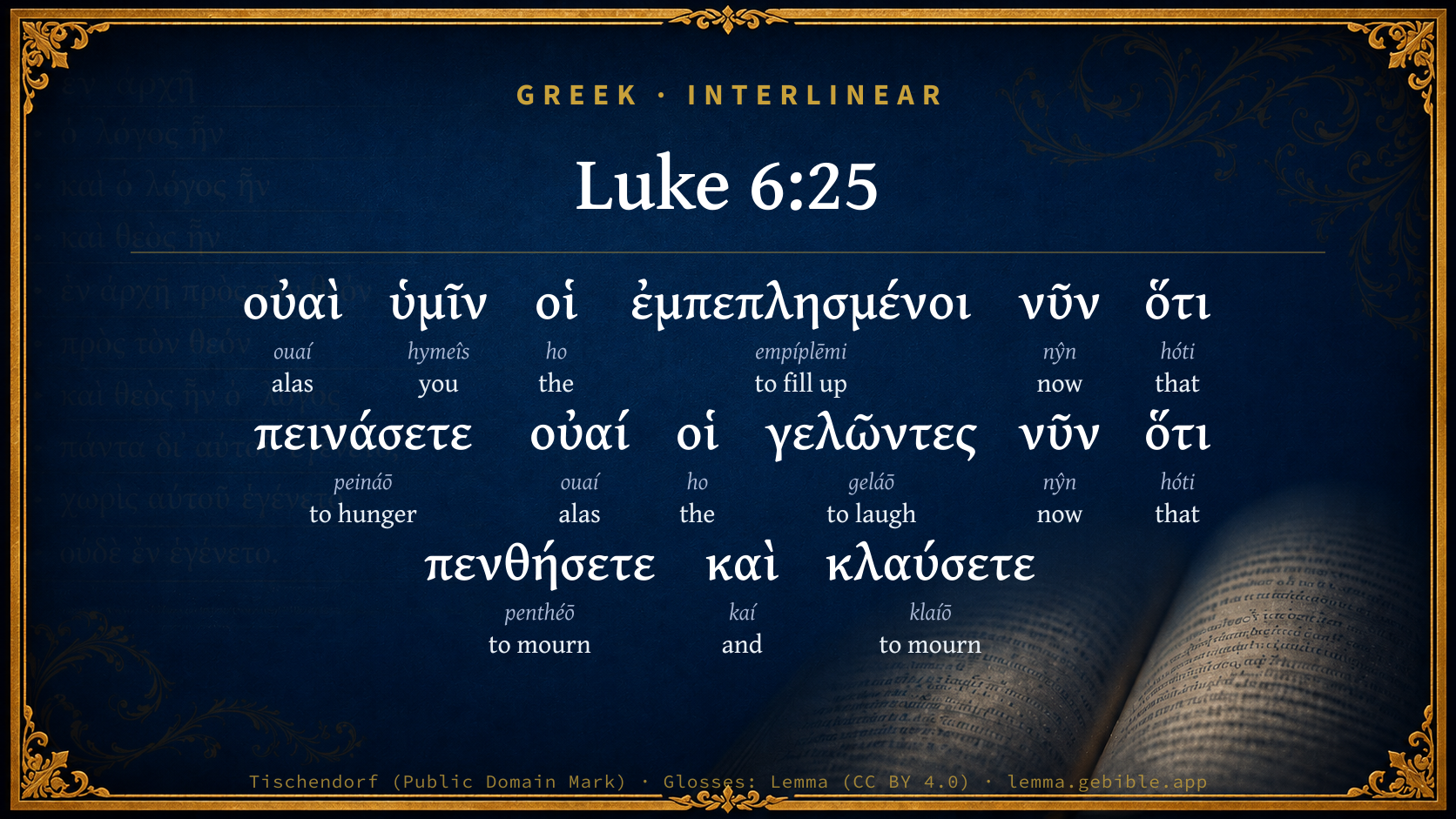
Woe to you, you who are full now! For you will be hungry. Woe to you who laugh now! For you will mourn and weep.
Download a study sheet
One document with this verse’s original text, its word-by-word gloss line, the meaning frame, cross-references with their text, attributed commentary, and full source and license credits — printable, and it pastes into notes with its structure intact.
This verse Autodidact and up
A passage Seminary Student
Up to 50 verses in one chapter. A passage sheet keeps up to 6 commentary sources and 12 cross-references per verse, in the order this page ranks them, and says so on the sheet whenever that leaves anything out. Ask for a single verse and you get the Autodidact verse sheet above.
Everything on this page stays free to read, with no account — the sheet is a download of what is already on screen, not access to it.
Compare translations 3
The same verse in 3 English versions, stacked beneath the original-language interlinear above. Click any original word for its lexicon entry.
Each is an independent rendering of the whole verse — the interlinear is not word-aligned to these translations.
Highlighted words mark where these versions differ — a whole-verse word diff, not a word-by-word alignment.
-
World English Bible Public Domain
Woe to you, you who are full now! For you will be hungry. Woe to you who laugh now! For you will mourn and weep.
-
King James Version Public Domain
Woe unto you that are full! for ye shall hunger. Woe unto you that laugh now! for ye shall mourn and weep.
-
unfoldingWord Literal Text CC BY-SA 4.0
Woe to you, the ones being filled now, for you will be hungry. Woe to the ones laughing now, for you will mourn and weep.
unfoldingWord Literal Text — © unfoldingWord, licensed CC BY-SA 4.0. Word-aligned USFM3 via Door43 (git.door43.org/unfoldingWord/en_ult).
Show all 19 translations
Every available English version of this verse, each an independent rendering of the whole verse.
-
World English Bible Public Domain
Woe to you, you who are full now! For you will be hungry. Woe to you who laugh now! For you will mourn and weep.
-
Berean Standard Bible Public Domain
Woe to you who are well fed now, for you will hunger. Woe to you who laugh now, for you will mourn and weep.
-
Majority Standard Bible Public Domain
Woe to you who are well fed, for you will hunger. Woe to you who laugh now, for you will mourn and weep.
-
King James Version Public Domain
Woe unto you that are full! for ye shall hunger. Woe unto you that laugh now! for ye shall mourn and weep.
-
American Standard Version (1901) Public Domain
Woe unto you, ye that are full now! for ye shall hunger. Woe `unto you', ye that laugh now! for ye shall mourn and weep.
-
Revised Version (1885) Public Domain
Woe unto you, ye that are full now! for ye shall hunger. Woe unto you, ye that laugh now! for ye shall mourn and weep.
-
Geneva Bible (1599) Public Domain
Wo be to you that are full: for ye shall hunger. Wo be to you that now laugh: for ye shall wayle and weepe.
-
Douay-Rheims (1899) Public Domain
Woe to you that are filled: for you shall hunger. Woe to you that now laugh: for you shall mourn and weep.
-
Young's Literal Translation Public Domain
`Wo to you who have been filled -- because ye shall hunger. `Wo to you who are laughing now -- because ye shall mourn and weep.
-
Literal Standard Version CC BY-SA 4.0
Woe to you who have been filled—because you will hunger. Woe to you who are laughing now—because you will mourn and weep.
-
Unlocked Literal Bible CC BY-SA 4.0
Woe to you who are full now, for you will be hungry later. Woe to you who laugh now, for you will mourn and weep later.
-
unfoldingWord Literal Text CC BY-SA 4.0
Woe to you, the ones being filled now, for you will be hungry. Woe to the ones laughing now, for you will mourn and weep.
-
Darby Bible Public Domain
Woe to you that are filled, for ye shall hunger. Woe to you who laugh now, for ye shall mourn and weep.
-
World Messianic Bible Public Domain
Woe to you, you who are full now, for you will be hungry. Woe to you who laugh now, for you will mourn and weep.
-
Webster's Bible Public Domain
Woe to you that are full! for ye shall hunger. Woe to you that laugh now! for ye shall mourn and weep.
-
Free Bible Version CC BY-SA 4.0
How sad are you who are full now, for you will become hungry. How sad are you who laugh now, for you will mourn and cry.
-
Bible in Basic English Public Domain
Unhappy are you who are full of food now: for you will be in need. Unhappy are you who are laughing now: for you will be crying in sorrow.
-
Text-Critical English NT CC BY 4.0
Woe to you who are filled, for you will hunger. Woe to you who laugh now, for you will mourn and weep.
-
Tyndale New Testament (1534) Public Domain
Wo be to you that are full: for ye shall honger. Wo be to you that now laugh: for ye shall wayle and wepe.
Literal Standard Version (2020), Covenant Press — licensed CC BY-SA 4.0. Text via the HelloAO Bible API (eBible.org). Unlocked Literal Bible (unfoldingWord) — licensed CC BY-SA 4.0. Text via the HelloAO Bible API (eBible.org). unfoldingWord Literal Text — © unfoldingWord, licensed CC BY-SA 4.0. Word-aligned USFM3 via Door43 (git.door43.org/unfoldingWord/en_ult). Free Bible Version, Dr. Jonathan Gallagher — licensed CC BY-SA 4.0. Text via the HelloAO Bible API (eBible.org).
Word by word
More ways to search: Search by grammar → Find every occurrence → Compare this word →
Practice this passage: Drill this verse → Learn its vocabulary →
- Appears 2× in the Greek New Testament
- First appears at Luke 6:21
- Part of Speech
- Verb
- Tense
- Present
- Voice
- Active
- Mood
- Participle
- Case
- Nominative
- Number
- Plural
- Gender
- Masculine
Full Thayer's Definition
- οὐαὶ ouaí G3759 “alas” Interjection
- ὑμῖν hymeîs G5210 “you” Personal pronoun, 2nd person, Dative, Plural
- οἱ ho G3588 “the” Article, Nominative, Plural, Masculine
- ἐμπεπλησμένοι empíplēmi G1705 “to fill up” Verb, Perfect, Passive, Participle, Nominative, Plural, Masculine
- νῦν nŷn G3568 “now” Adverb
- ὅτι hóti G3754 “that” Conjunction
- πεινάσετε peináō G3983 “to hunger” Verb, Future, Active, Indicative, 2nd person, Plural
- οὐαί ouaí G3759 “alas” Interjection
- οἱ ho G3588 “the” Article, Nominative, Plural, Masculine
- γελῶντες geláō G1070 “to laugh” Verb, Present, Active, Participle, Nominative, Plural, Masculine
- νῦν nŷn G3568 “now” Adverb
- ὅτι hóti G3754 “that” Conjunction
- πενθήσετε penthéō G3996 “to mourn” Verb, Future, Active, Indicative, 2nd person, Plural
- καὶ kaí G2532 “and” Conjunction
- κλαύσετε klaíō G2799 “to mourn” Verb, Future, Active, Indicative, 2nd person, Plural
About this verse
These counts appear in no published source. They are computed here, from the morphology-tagged text and Lemma’s own curated glosses. What Lemma adds →
- 15
- words
- 11
- distinct lemmas
- Gospels
- section
Cross-references
31Topical passages linked to Luke 6:25 in the Treasury of Scripture Knowledge — connected by theme and wording, ordered by reader-vote popularity; previews shown in the World English Bible.
- Isaiah 65:13 Therefore thus says the Lord Yahweh, Behold, my servants shall eat, but you shall be hungry; behold, my servants shall drink, but you shall be thirsty; behold, my servants shall rejoice, but you shall be disappointed;
- James 4:9 Lament, mourn, and weep. Let your laughter be turned to mourning, and your joy to gloom.
- Proverbs 14:13 Even in laughter the heart may be sorrowful, And mirth may end in heaviness.
- Luke 16:14–15 The Pharisees, who were lovers of money, also heard all these things, and they scoffed at him.
- Job 20:5–7 That the triumphing of the wicked is short, The joy of the godless but for a moment?
- Amos 8:10 I will turn your feasts into mourning, And all your songs into lamentation; And I will make you wear sackcloth on all your bodies, And baldness on every head. I will make it like the mourning for an only son, And the end of it like a bitter day.
- Luke 8:53 They were ridiculing him, knowing that she was dead.
- Revelation 3:17 Because you say, 'I am rich, and have gotten riches, and have need of nothing;' and don't know that you are the wretched one, miserable, poor, blind, and naked;
- Revelation 18:7–11 However much she glorified herself, and grew wanton, so much give her of torment and mourning. For she says in her heart, 'I sit a queen, and am no widow, and will in no way see mourning.'
- 1 Samuel 2:5 Those who were full have hired out themselves for bread; Those who were hungry have ceased [to hunger]: Yes, the barren has borne seven; She who has many children languishes.
- Job 21:11–13 They send forth their little ones like a flock. Their children dance.
- Psalms 22:6–7 But I am a worm, and no man; A reproach of men, and despised by the people.
- Psalms 49:19 He shall go to the generation of his fathers. They shall never see the light.
- Proverbs 30:9 Lest I be full, deny you, and say, 'Who is Yahweh?' Or lest I be poor, and steal, And so dishonor the name of my God.
- Ecclesiastes 2:2 I said of laughter, "It is foolishness;" and of mirth, "What does it accomplish?"
- Ecclesiastes 7:3 Sorrow is better than laughter; for by the sadness of the face the heart is made good.
- Ecclesiastes 7:6 For as the crackling of thorns under a pot, so is the laughter of the fool. This also is vanity.
- Isaiah 8:21 They shall pass through it, sore distressed and hungry; and it shall happen that when they shall be hungry, they shall fret themselves, and curse by their king and by their God, and turn their faces upward:
- Isaiah 9:20 One shall snatch on the right hand, and be hungry; and he shall eat on the left hand, and they shall not be satisfied: they shall eat every man the flesh of his own arm:
- Isaiah 21:3–4 Therefore are my loins filled with anguish; pangs have taken hold on me, as the pangs of a woman in travail: I am pained so that I can't hear; I am dismayed so that I can't see.
- Isaiah 24:7–12 The new wine mourns, the vine languishes, all the merry-hearted do sigh.
- Isaiah 28:7 Even these reel with wine, and stagger with strong drink; the priest and the prophet reel with strong drink, they are swallowed up of wine, they stagger with strong drink; they err in vision, they stumble in judgment.
- Daniel 5:4–6 They drank wine, and praised the gods of gold, and of silver, of brass, of iron, of wood, and of stone.
- Matthew 22:11–13 But when the king came in to see the guests, he saw there a man who didn't have on wedding clothing,
- Luke 12:20 "But God said to him, 'You foolish one, tonight your soul is required of you. The things which you have prepared--whose will they be?'
- Luke 13:28 There will be weeping and gnashing of teeth, when you see Abraham, Isaac, Jacob, and all the prophets, in the Kingdom of God, and yourselves being thrown outside.
- Ephesians 5:4 nor filthiness, nor foolish talking, nor jesting, which are not appropriate; but rather giving of thanks.
- Philippians 4:12–13 I know how to be humbled, and I know also how to abound. In everything and in all things I have learned the secret both to be filled and to be hungry, both to abound and to be in need.
- 1 Thessalonians 5:3 For when they are saying, "Peace and safety," then sudden destruction will come on them, like birth pains on a pregnant woman; and they will in no way escape.
- Deuteronomy 6:11–12 and houses full of all good things, which you didn't fill, and cisterns dug out, which you didn't dig, vineyards and olive trees, which you didn't plant, and you shall eat and be full;
- Nahum 1:10 For entangled like thorns, and drunken as with their drink, they are consumed utterly like dry stubble.
Cross-references courtesy of OpenBible.info (CC BY 4.0).
Lesson kit
Teaching starters — assembled from the data on this page, not authored interpretation. Every prompt links to the verse data it draws on. Edit before teaching.
Luke, in the Gospels, opens this verse with 15 words (11 distinct Greek lemmas). Its most distinctive word is geláō (“to laugh”). A historical commentator’s framing appears above. Read the whole chapter for the surrounding context.
Discussion questions
- The word geláō carries the sense “to laugh.” How does it shape the verse?
- Luke 6:21 shares the word «to laugh» with this verse. How do the two illuminate each other?
- “alas” occurs 2× in this one verse. What is the effect of the repetition?
- These translations render this verse differently; the difference is in the English rendering, not the original. What questions does that raise?
- Reading how Bengel's Gnomon and Expositor's Greek Testament read this verse, where do the two commentators agree and where do they part?
Things to notice
- These translations choose different wording for 11 words in this verse.
- “alas” occurs 2× in this single verse.
- 11 distinct Greek lemmas span 15 words in this verse.
Commentary
Notes on Luke 6:25 from classic Christian and Jewish commentators (each source and its license shown beneath its notes). The classic Christian expositions comment on the surrounding passage and are grouped to its opening verse, so a note may address several verses; the Jewish commentaries on the Tanakh (Rashi and others) are per-verse, so they appear only where the commentator wrote on this verse.
Lemma curates 59 commentaries, every one of them public domain or Creative Commons licensed, each selected and text-cleaned for this edition rather than reprinted as found. About our sources →
Bengel's Gnomon
Johann Albrecht Bengel
Bengel's Gnomon of the New Testament — English translation (T&T Clark, Edinburgh, 1860) — public domain. Text from a community e-Sword module.
Expositor's Greek Testament
ed. W. Robertson Nicoll
The Expositor's Greek Testament, edited by W. Robertson Nicoll (1897–1910) — public domain. Text from a community e-Sword module.
Ellicott's Commentary for English Readers
A Bible Commentary for English Readers, edited by Charles John Ellicott (1878–1897) — public domain. Text from a community e-Sword module.
The Cambridge Bible for Schools and Colleges
gen. ed. J. J. S. Perowne
The Cambridge Bible for Schools and Colleges (gen. ed. J. J. S. Perowne; Cambridge University Press, 1878–1918) — public domain. Text from a community e-Sword module.
John Gill's Exposition
John Gill's Exposition of the Whole Bible (1746–1763) — public domain (CC PDM 1.0). Text via the HelloAO Bible API.
Trapp's Complete Commentary
John Trapp
John Trapp, A Commentary or Exposition upon All the Books of the Old and New Testament (1647–1656) — public domain. Text from a community e-Sword module.
Haydock's Catholic Bible Commentary
George Leo Haydock (1774–1849), Haydock's Catholic Family Bible and Commentary, 1859 edition — public domain. Excludes Psalms (Douay-Rheims chapter numbering differs from Protestant) and Deuterocanonical books (Catholic canon only).
Matthew Poole's English Annotations
Matthew Poole's English Annotations on the Holy Bible (1683–1685) — public domain. Text from a community e-Sword/MySword module.
The Pulpit Commentary
The Pulpit Commentary (1880–1919), ed. H.D.M. Spence-Jones & Joseph S. Exell — public domain. Text from a community e-Sword module.
John Wesley's Explanatory Notes
John Wesley, Explanatory Notes Upon the Whole Bible (1754–1765) — public domain. Text via the GEBible commentary corpus.
Cambridge Greek Testament for Schools and Colleges
Cambridge Greek Testament for Schools and Colleges (Cambridge University Press, 1896; 21 vols, various authors incl. Carr, Maclear, Plummer, Farrar, Lumby, Moule, M. R. James, Simcox) — public domain. Text from a community e-Sword module.
International Critical Commentary
International Critical Commentary — older volumes (1896–1929), various authors — public domain. Text from a community e-Sword module.
Vincent's Word Studies in the New Testament
Marvin R. Vincent
Marvin R. Vincent, Word Studies in the New Testament (1887–1900) — public domain. Text from a community e-Sword/MySword module.