
Titus 2:12

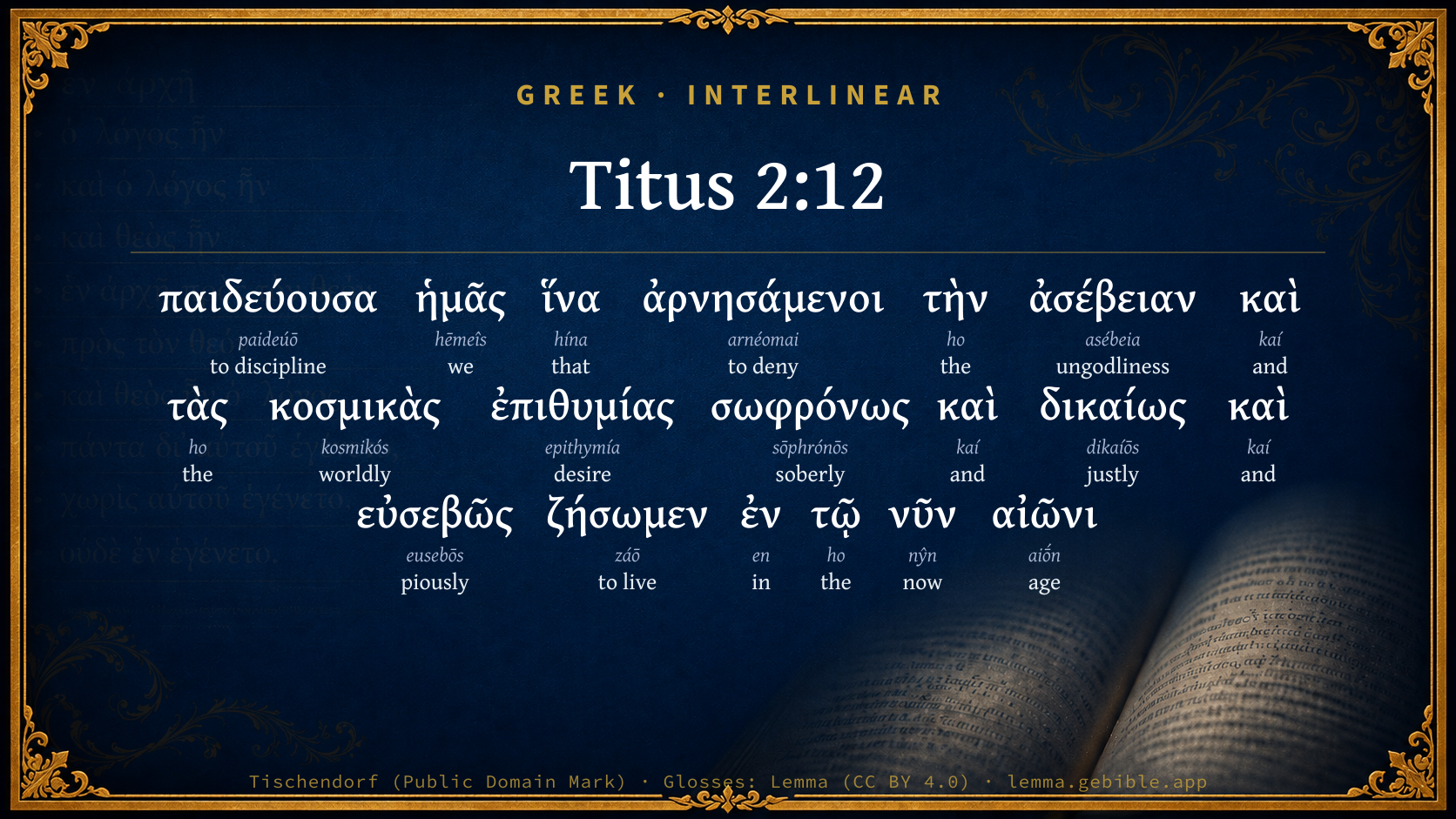
Greek (Tischendorf 8th ed.) Titus 2:12 appears in the Greek New Testament. The text above is from the Tischendorf 8th edition. Each word links to its Strong’s number and a concise gloss. Click any word for its full Thayer’s Greek Lexicon entry.
Download image
Cite this verse

Titus 2:12 (World English Bible). Public Domain. Lemma interlinear Bible study tool, https://lemma.gebible.app/v/titus/2/12.

Show BibTeX & RIS
BibTeX
RIS
English Translation
instructing us to the intent that, denying ungodliness and worldly lusts, we would live soberly, righteously, and godly in this present world;
World English Bible · Public Domain
Highlights
  • 1 hapax legomenon — only here in the Greek New Testament
  • 2 first appearances in the Greek New Testament
Full analysis ↓
Download a study sheet

One document with this verse’s original text, its word-by-word gloss line, the meaning frame, cross-references with their text, attributed commentary, and full source and license credits — printable, and it pastes into notes with its structure intact.

This verse Autodidact and up

Study sheet (.html) Plain text (.txt)

A passage Seminary Student

Up to 50 verses in one chapter. A passage sheet keeps up to 6 commentary sources and 12 cross-references per verse, in the order this page ranks them, and says so on the sheet whenever that leaves anything out. Ask for a single verse and you get the Autodidact verse sheet above.

Everything on this page stays free to read, with no account — the sheet is a download of what is already on screen, not access to it.

Want to remove ads? Support Godless Engineer
Compare translations 3

The same verse in 3 English versions, stacked beneath the original-language interlinear above. Click any original word for its lexicon entry.

Each is an independent rendering of the whole verse — the interlinear is not word-aligned to these translations.

Highlighted words mark where these versions differ — a whole-verse word diff, not a word-by-word alignment.

  • World English Bible Public Domain
    instructing us to the intent that, denying ungodliness and worldly lusts, we would live soberly, righteously, and godly in this present world;
  • King James Version Public Domain
    Teaching us that, denying ungodliness and worldly lusts, we should live soberly, righteously, and godly, in this present world;
  • unfoldingWord Literal Text CC BY-SA 4.0
    training us, so that, rejecting godlessness and worldly passions, we might live in a sensible and righteous and godly way in the present age,

unfoldingWord Literal Text — © unfoldingWord, licensed CC BY-SA 4.0. Word-aligned USFM3 via Door43 (git.door43.org/unfoldingWord/en_ult).

Versions to compare (up to 4)

3 of 4 selected

Show all 19 translations

Every available English version of this verse, each an independent rendering of the whole verse.

  • World English Bible Public Domain
    instructing us to the intent that, denying ungodliness and worldly lusts, we would live soberly, righteously, and godly in this present world;
  • Berean Standard Bible Public Domain
    It instructs us to renounce ungodliness and worldly passions, and to live sensible, upright, and godly lives in the present age,
  • Majority Standard Bible Public Domain
    It instructs us to renounce ungodliness and worldly passions, and to live sensible, upright, and godly lives in the present age,
  • King James Version Public Domain
    Teaching us that, denying ungodliness and worldly lusts, we should live soberly, righteously, and godly, in this present world;
  • American Standard Version (1901) Public Domain
    instructing us, to the intent that, denying ungodliness and worldly lusts, we should live soberly and righteously and godly in this present world;
  • Revised Version (1885) Public Domain
    instructing us, to the intent that, denying ungodliness and worldly lusts, we should live soberly and righteously and godly in this present world;
  • Geneva Bible (1599) Public Domain
    And teacheth vs that we should denie vngodlinesse and worldly lusts, and that we should liue soberly and righteously, and godly in this present world,
  • Douay-Rheims (1899) Public Domain
    Instructing us, that, denying ungodliness and worldly desires, we should live soberly, and justly, and godly in this world,
  • Young's Literal Translation Public Domain
    teaching us, that denying the impiety and the worldly desires, soberly and righteously and piously we may live in the present age,
  • Literal Standard Version CC BY-SA 4.0
    teaching us, that denying the impiety and the worldly desires, we may live soberly, and righteously, and piously in the present age,
  • Unlocked Literal Bible CC BY-SA 4.0
    It trains us to reject godlessness and worldly passions, and to live self-controlled, upright, and godly lives in this age,
  • unfoldingWord Literal Text CC BY-SA 4.0
    training us, so that, rejecting godlessness and worldly passions, we might live in a sensible and righteous and godly way in the present age,
  • Darby Bible Public Domain
    teaching us that, having denied impiety and worldly lusts, we should live soberly, and justly, and piously in the present course of things,
  • World Messianic Bible Public Domain
    instructing us to the intent that, denying ungodliness and worldly lusts, we would live soberly, righteously, and godly in this present age;
  • Webster's Bible Public Domain
    Teaching us, that denying ungodliness, and worldly lusts, we should live soberly, righteously, and piously, in this present world;
  • Free Bible Version CC BY-SA 4.0
    It teaches us to reject a godless way of life with the desires of this world. Instead we should live thoughtful, self-controlled lives that are right before God in the present world
  • Bible in Basic English Public Domain
    Training us so that, turning away from evil and the desires of this world, we may be living wisely and uprightly in the knowledge of God in this present life;
  • Text-Critical English NT CC BY 4.0
    instructing us to deny ungodliness and worldly lusts and to live in a sensible, righteous, and godly manner in the present age,
  • Tyndale New Testament (1534) Public Domain
    and teacheth vs that we shuld denye vngodlynes and worldy lustes and that we shuld live sobre mynded righteously and godly in this present worlde

Literal Standard Version (2020), Covenant Press — licensed CC BY-SA 4.0. Text via the HelloAO Bible API (eBible.org). Unlocked Literal Bible (unfoldingWord) — licensed CC BY-SA 4.0. Text via the HelloAO Bible API (eBible.org). unfoldingWord Literal Text — © unfoldingWord, licensed CC BY-SA 4.0. Word-aligned USFM3 via Door43 (git.door43.org/unfoldingWord/en_ult). Free Bible Version, Dr. Jonathan Gallagher — licensed CC BY-SA 4.0. Text via the HelloAO Bible API (eBible.org).

Word by word

More ways to search: Search by grammar → Find every occurrence → Compare this word →

Practice this passage: Drill this verse → Learn its vocabulary →

σωφρόνως
sōphrónōs
G4996
“soberly”
Adverb
Part of Speech
Adverb
Full Thayer's Definition

Origin: from G4998

TDNT: None

1. with sound mind, soberly, temperately, discreetly
  1. παιδεύουσα paideúō G3811 “to discipline” Verb, Present, Active, Participle, Nominative, Singular, Feminine
  2. ἡμᾶς hēmeîs G2249 “we” Personal pronoun, 1st person, Accusative, Plural
  3. ἵνα hína G2443 “that” Conjunction
  4. ἀρνησάμενοι arnéomai G720 “to deny” Verb, Aorist, Middle deponent, Participle, Nominative, Plural, Masculine
  5. τὴν ho G3588 “the” Article, Accusative, Singular, Feminine
  6. ἀσέβειαν asébeia G763 “ungodliness” Noun, Accusative, Singular, Feminine
  7. καὶ kaí G2532 “and” Conjunction
  8. τὰς ho G3588 “the” Article, Accusative, Plural, Feminine
  9. κοσμικὰς kosmikós G2886 “worldly” Adjective, Accusative, Plural, Feminine
  10. ἐπιθυμίας epithymía G1939 “desire” Noun, Accusative, Plural, Feminine
  11. καὶ kaí G2532 “and” Conjunction
  12. δικαίως dikaíōs G1346 “justly” Adverb
  13. καὶ kaí G2532 “and” Conjunction
  14. εὐσεβῶς eusebōs G2153 “piously” Adverb
  15. ζήσωμεν záō G2198 “to live” Verb, Aorist, Active, Subjunctive, 1st person, Plural
  16. ἐν en G1722 “in” Preposition
  17. τῷ ho G3588 “the” Article, Dative, Singular, Masculine
  18. νῦν nŷn G3568 “now” Adverb
  19. αἰῶνι aiṓn G165 “age” Noun, Dative, Singular, Masculine

About this verse

These counts appear in no published source. They are computed here, from the morphology-tagged text and Lemma’s own curated glosses. What Lemma adds →

20
words
16
distinct lemmas
Pauline Epistles
section

Notable vocabulary

1 hapax legomenon — a word that appears only here in the entire Greek New Testament:

  • σωφρόνως soberly G4996

First appearance in Scripture

These words make their first canonical appearance in the Greek New Testament here:

  • κοσμικὰς worldly G2886
  • σωφρόνως soberly G4996

Shared distinctive vocabulary

κοσμικὰς worldly G2886 occurs in 2 verses of the Greek New Testament. Also found in:
Repetition

Words recur within this verse:

Cross-references

56

Topical passages linked to Titus 2:12 in the Treasury of Scripture Knowledge — connected by theme and wording, ordered by reader-vote popularity; previews shown in the World English Bible.

  • Ezekiel 36:27 I will put my Spirit within you, and cause you to walk in my statutes, and you shall keep my ordinances, and do them.
  • Matthew 16:24 Then Jesus said to his disciples, "If anyone desires to come after me, let him deny himself, and take up his cross, and follow me.
  • Romans 6:19 I speak in human terms because of the weakness of your flesh, for as you presented your members as servants to uncleanness and to wickedness upon wickedness, even so now present your members as servants to righteousness for sanctification.
  • Psalms 4:3 But know that Yahweh has set apart for himself him who is godly: Yahweh will hear when I call to him.
  • Ephesians 4:22–25 that you put away, as concerning your former way of life, the old man, that grows corrupt after the lusts of deceit;
  • 2 Peter 2:9 the Lord knows how to deliver the godly out of temptation and to keep the unrighteous under punishment for the day of judgment;
  • 1 John 2:6 he who says he remains in him ought himself also to walk just like he walked.
  • 2 Peter 1:4–8 by which he has granted to us his precious and exceedingly great promises; that through these you may become partakers of the divine nature, having escaped from the corruption that is in the world by lust.
  • Isaiah 55:6–7 Seek you Yahweh while he may be found; call you on him while he is near:
  • Luke 1:75 In holiness and righteousness before him all the days of our life.
  • 2 Timothy 3:12 Yes, and all who desire to live godly in Christ Jesus will suffer persecution.
  • Revelation 14:12 Here is the patience of the saints, those who keep the commandments of God, and the faith of Jesus."
  • 1 Thessalonians 4:7 For God called us not for uncleanness, but in sanctification.
  • Titus 3:3 For we were also once foolish, disobedient, deceived, serving various lusts and pleasures, living in malice and envy, hateful, and hating one another.
  • James 4:8–10 Draw near to God, and he will draw near to you. Cleanse your hands, you sinners; and purify your hearts, you double-minded.
  • 1 John 2:15–17 Don't love the world, neither the things that are in the world. If anyone loves the world, the Father's love isn't in him.
  • Ephesians 2:2 in which you once walked according to the course of this world, according to the prince of the powers of the air, the spirit who now works in the children of disobedience;
  • Colossians 3:5–9 Put to death therefore your members which are on the earth: sexual immorality, uncleanness, depraved passion, evil desire, and covetousness, which is idolatry;
  • 1 Peter 1:14–18 as children of obedience, not conforming yourselves according to your former lusts as in your ignorance,
  • Matthew 28:20 teaching them to observe all things that I commanded you. Behold, I am with you always, even to the end of the age." Amen.
  • Romans 6:12 Therefore don't let sin reign in your mortal body, that you should obey it in its lusts.
  • 1 Thessalonians 4:9 But concerning brotherly love, you have no need that one write to you. For you yourselves are taught by God to love one another,
  • Ezekiel 18:30–31 Therefore I will judge you, house of Israel, everyone according to his ways, says the Lord Yahweh. Return you, and turn yourselves from all your transgressions; so iniquity shall not be your ruin.
  • Ezekiel 33:14–15 Again, when I say to the wicked, You shall surely die; if he turn from his sin, and do that which is lawful and right;
  • Matthew 3:8–10 Therefore bring forth fruit worthy of repentance!
  • Matthew 5:19–20 Whoever, therefore, shall break one of these least commandments, and teach others to do so, shall be called least in the Kingdom of Heaven; but whoever shall do and teach them shall be called great in the Kingdom of Heaven.
  • John 17:14–15 I have given them your word. The world hated them, because they are not of the world, even as I am not of the world.
  • Acts 24:16 Herein I also practice always having a conscience void of offense toward God and men.
  • Acts 24:25 As he reasoned about righteousness, self-control, and the judgment to come, Felix was terrified, and answered, "Go your way for this time, and when it is convenient for me, I will summon you."
  • Romans 6:4–6 We were buried therefore with him through baptism to death, that just like Christ was raised from the dead through the glory of the Father, so we also might walk in newness of life.
  • Romans 8:13 For if you live after the flesh, you must die; but if by the Spirit you put to death the deeds of the body, you will live.
  • Romans 12:2 Don't be conformed to this world, but be transformed by the renewing of your mind, so that you may prove what is the good, well-pleasing, and perfect will of God.
  • Romans 13:12–13 The night is far gone, and the day is near. Let's therefore throw off the works of darkness, and let's put on the armor of light.
  • 1 Corinthians 6:9–11 Or don't you know that the unrighteous will not inherit the Kingdom of God? Don't be deceived. Neither the sexually immoral, nor idolaters, nor adulterers, nor male prostitutes, nor homosexuals,
  • 2 Corinthians 1:12 For our boasting is this: the testimony of our conscience, that in holiness and sincerity of God, not in fleshly wisdom but in the grace of God we behaved ourselves in the world, and more abundantly toward you.
  • 2 Corinthians 7:1 Having therefore these promises, beloved, let us cleanse ourselves from all defilement of flesh and spirit, perfecting holiness in the fear of God.
  • Galatians 1:4 who gave himself for our sins, that he might deliver us out of this present evil age, according to the will of our God and Father--
  • Galatians 5:24 Those who belong to Christ have crucified the flesh with its passions and lusts.
  • Colossians 1:22 yet now he has reconciled in the body of his flesh through death, to present you holy and without blemish and blameless before him,
  • 1 Timothy 4:12 Let no man despise your youth; but be an example to those who believe, in word, in your way of life, in love, in spirit, in faith, and in purity.
  • 1 Timothy 6:17 Charge those who are rich in this present world that they not be haughty, nor have their hope set on the uncertainty of riches, but on the living God, who richly provides us with everything to enjoy;
  • Hebrews 8:11 They will not teach every man his fellow citizen, Every man his brother, saying, 'Know the Lord,' For all will know me, From the least of them to the greatest of them.
  • 1 Peter 2:11–12 Beloved, I beg you as foreigners and pilgrims, to abstain from fleshly lusts, which war against the soul;
  • 2 Peter 2:20–22 For if, after they have escaped the defilement of the world through the knowledge of the Lord and Savior Jesus Christ, they are again entangled therein and overcome, the last state has become worse with them than the first.
  • 2 Peter 3:11 Therefore since all these things are thus to be destroyed, what manner of persons ought you to be in holy living and godliness,
  • 1 John 2:27 As for you, the anointing which you received from him remains in you, and you don't need for anyone to teach you. But as his anointing teaches you concerning all things, and is true, and is no lie, and even as it taught you, you will remain in him.
  • Psalms 105:45 That they might keep his statutes, And observe his laws. Praise Yah!
  • Luke 1:6 They were both righteous before God, walking blamelessly in all the commandments and ordinances of the Lord.
  • Luke 3:9–13 Even now the axe also lies at the root of the trees. Every tree therefore that doesn't bring forth good fruit is cut down, and thrown into the fire."
  • John 6:25 When they found him on the other side of the sea, they asked him, "Rabbi, when did you come here?"
  • John 14:30 I will no more speak much with you, for the prince of the world comes, and he has nothing in me.
  • Ephesians 1:4 even as he chose us in him before the foundation of the world, that we would be holy and without blemish before him in love;
  • 1 John 5:19 We know that we are of God, and the whole world lies in the power of the evil one.
  • 1 Peter 4:2–5 that you no longer should live the rest of your time in the flesh for the lusts of men, but for the will of God.
  • Jude 1:18 They said to you that "In the last time there will be mockers, walking after their own ungodly lusts."
  • 2 Timothy 4:10 for Demas left me, having loved this present world, and went to Thessalonica; Crescens to Galatia, and Titus to Dalmatia.

Cross-references courtesy of OpenBible.info (CC BY 4.0).

Commentary

Notes on Titus 2:12 from classic Christian and Jewish commentators (each source and its license shown beneath its notes). The classic Christian expositions comment on the surrounding passage and are grouped to its opening verse, so a note may address several verses; the Jewish commentaries on the Tanakh (Rashi and others) are per-verse, so they appear only where the commentator wrote on this verse.

Lemma curates 59 commentaries, every one of them public domain or Creative Commons licensed, each selected and text-cleaned for this edition rather than reprinted as found. About our sources →

MacLaren's Expositions of Holy Scripture

Alexander MacLaren

Titus

THE PURPOSE OF GRACE

Tit 2:12.

To appreciate the full force of these words, we must observe that they are the Apostle’s statement of the ultimate design of the revelation of God in Jesus Christ, and of all the wonderful powers and gifts which Christ brought with Him. In our text, the end for which that grace has appeared and exercises its corrective discipline is defined. It comes in order that, denying ungodliness, and worldly lusts, we should live soberly, righteously, and godly.

Now, remember that Paul thought that the life and the death of Jesus Christ were the most stupendous of miracles, nothing less than the entrance of divinity in a human form into the limitations of our lives, and His participation in the darkness of our deaths.

Remember that he believed that Jesus Christ’s coming had led to a continual gift of an actual divine life to men who trusted Him; then you will see the grandeur and significance of the words of my text. What has this divine miracle of mercy been for? Nothing but this, to help men here to-day to live good lives. If there were no future at all, says Paul, the expenditure of the divine love is amply vindicated. The sun does not disdain to shine in order to ripen the vegetables in the humble cottage garden, and the love of God did not conceive that it had too small an object to warrant all that lavish gift which is in Christ, in helping us to live as becomes us. How dear we must be to God, and how infinitely important in His eyes must conduct and character be if such an abundance and variety of divine influences were set in motion to produce such an effect! Now, the first thing that strikes me about these words is the fair picture that they draw of what every life should be; and next, the hard conditions which they impose upon men who would live so; and then, what God has given us to make such lives possible. So I ask you to look at these three points.

I. The fair picture of what our lives should be.

Paul is saying nothing more than conscience, reason, the instincts of men everywhere endorse. His requirements in the rough division of virtues which he adopts, not for scientific accuracy but for practical force, are really said ‘Amen!’ to by every honest conscience ‘Soberly, righteously, godly’ - that is what everybody, if he will be fair with himself, feels to be the sort of life he ought to live. Let me just touch upon these three things very briefly. They may be said, roughly, though not very accurately, perhaps, to cover the ground of a man’s duties to himself, to his neighbours, and to God.

‘Soberly’ - that is what you owe to your own nature. ‘Righteously’ - that is what you owe to people round you. ‘Godly’ - that is what you owe to Him. I need not explain, I suppose, that the word ‘soberly’ has by no means the narrow signification which the besetting vice of England has given to it now - viz., abstinence from, or a very restrained use of, intoxicating liquors, nor even the wider one of a curbing of the desires of sense. But the meaning may be better represented by self-control than by any other rendering. Now if there were no man in the world but myself, and if I had no thought or knowledge of God, and if there were no other standard to which I ought to conform, I should have, in my own nature, with its crowd of desires, tastes, inclinations, and faculties, plain indication that self-government was essential. For human nature is not constituted on the plan of a democracy or an ochlocracy - a mob rule - but there is a clear hierarchy and order of predominance in it; and, as plainly as a ship is made to need a rudder, so plainly on your make is there stamped the necessity for rigid self-control.

For we all carry with us desires, inclinations, appetites - some of them directly connected with our physical frame, and some of them a little more refined - which are mere blind inclinations to a given specific good, and will be stirred up, apart altogether from the question of whether it is expedient or right to gratify them. To a hungry man the odour of food is equally enticing, whether the food belongs to himself or his neighbour; and if he had to steal for it, it would still tempt him. Because, then, we are to a large extent made up of blind desires which take no account of anything except their appropriate food, the commandment comes from the deepest recesses of each nature, as well as from the great throne in the heavens -’Live soberly.’

The engines will work on all the same, though the bows of the ship be turned to the rocks, and driving straight on the reef. It is the engineer’s business to start them and keep them going; it is their business to turn the screw; it is somebody else’s business to look after the navigation. We have our ‘humours under lock and key’ in order that we may control them. And if we do not, we shall go all to rack and ruin. So, ‘live soberly,’ says Paul.

The next requirement is, ‘righteously.’ Now, I said that that might, perhaps, be roughly explained as referring mainly to our duties to one another. But that is not by any means an exhaustive - and perhaps, a scarcely approximate - description. For the attitude expressed in ‘righteously’ does not so much point to other people as to the existence of a certain standard, external to ourselves, to which it is our business and wisdom to conform. I said that, if there were nothing in the world except a man and his own nature, the duty of sober self-government would necessarily arise. But the supposed isolation does not exist. We stand in certain relations to a whole universe of things and of people, and there does rise before every man, however it may be accounted for, or explained away, or tampered with, or neglected, a standard of right and wrong. And what Paul here, means by ‘live righteously’ is, ‘Do as you know you ought to do,’ and in shaping your character, have reference not merely to its constitution, but to its relations to all this universe of outside facts.

So far as the word may include our duty to others, I may just remind you that ‘righteousness’ in reference to our fellows demands mercy. The common antithesis which is drawn between a just man who will give everybody what they deserve, and not one scrap more nor less if he can help it, and a kindly man is erroneous, because every man has a claim upon every other man for lenient judgment and undeserved help. He may not deserve it, being such a man as he is; but he has a right to it, being a man at all. And no man is righteous who is not merciful We do not fulfil the prophet’s exhortation, ‘do justice,’ unless we fulfil his other, ‘love mercy.’ For mercy is the right of all men.

The last of the phases under which the perfect life is represented here takes us up at once into another region. If there were nobody but myself in the world, it must be my duty to live controlling myself; since I stand in relations manifold to creatures manifold and to the whole order of things, it is my duty to conform to the standard, and to do what is right. And just as plainly as the obligations to sobriety and righteousness press on every man, so plainly is godliness necessary to his perfection. For I am not only Bound by ties which knit me to my fellows, or to this visible order, but the closest of all bonds, the most real of all relations, is that which hinds us each to God.

And if ‘man’s chief end be to glorify God,’ and then and thus, ‘to enjoy Him for ever,’ then that end, in its very nature, must be all pervasive, and diffuse its sweetness into the other two. For you cannot sliver up the unity of life into little sections and say, ‘This deed has to be done soberly, and that one righteously, and this one godly,’ but godliness must cover the whole life, and be the power of self-control and of righteousness. ‘All in all or not at all.’ Godliness must Be uniform and universal. Lacking their supreme beauty are the lives of all who endeavour to keep these other two departments of duty and forget this third. There are many men - I have no doubt there are some of them among us - punctiliously trying to control their natures, and to live righteously; but all their thoughts run along the low levels, and they are absolutely blind and deaf to voices and sights from heaven-They are like some of those truncated pyramids, broad-based upon the solid earth, and springing with firm lines to a certain height, and then coming to a dead stop, and so being but stumps, which leave a sense of incompleteness, because all the firm lines have not gathered themselves up into the sky-piercing point which aspires still higher than it has reached.

‘Soberly,’ that is much; ‘ righteously,’ that is more; ‘godly,’ that is, not most, but all.

II. Secondly, notice what a hard task the man has who will live so.

The Apostle, very remarkably, puts first, in my text, a negative clause. The things that he says we are to deny are the exact opposites of the characteristics that he says we are to aim after. ‘Denying ungodliness’ - that is clearly the opposite of ‘godly’; and ‘worldly lusts,’ though perhaps not so obviously, yet certainly is the antithesis of ‘soberly’ and

‘righteously.’ I need not remind you, I suppose, that the word ‘lusts’ here has not the carnal associations cleaving to it which have gradually accrued to it in the changes of language since our translation was made, but that it implies simply ‘ desires,’ longings, of however refined and incorporeal a sort, which attach themselves to the fleeting things of this life. Pride, ambition, and all the more refined and less sensual desires are as much included as the grossest animalism in which any swine of a man can wallow. Worldly lusts are desires which say to earth, and to what earth can give, in any of its forms, ‘Thou art my god, and having thee I am satisfied.’ Now, says Paul, there is no good to be done in the matter of acquiring these positive graces, without which a life is contemptible and poor, unless, side by side with the continual effort at the acquisition of the one, there be the continual and resolute effort at the excision and casting out of the other. Why? Because they are in possession. A man cannot be godly unless he casts out the ungodliness that cleaves to his nature; nor can he rule himself and seek after righteousness unless he ejects the desires that are in possession of his heart. You have to get rid of the bad tenant if you would bring in the good one. You have to turn the current, which is running in the wrong direction. And so it comes to be a very hard, painful thing for a man to acquire these graces of which my text speaks. People talk as if what was needed was the cultivation of what we have. Aye! that is needed; but there is something else than that needed. ‘You have to turn out a great deal of bad in order to make room for the good. Not that the evil can be expelled without the entrance of the good, as I shall have to say in a moment. But still the two things must go on side by side.

And so it is hard work for a man to grow better. If we had only to advance in practice, or knowledge, or sentiment, or feeling, that would not be so difficult to do; but you have to reverse the action of the machine; and that is hard. Can it be done? Who is to keep the keepers? It is difficult for the same self to be sacrifice and priest. It is a hard matter for a man to crucify himself, and we may well say, if there can be no progress in goodness without this violent and’ thorough mutilation and massacre of the evil that be in us, alas! for us all I am sure, as sure as I stand here, that there are plenty of young men and women among my hearers now who have tried once and again, and have failed once and again, to ‘live soberly, righteously, and godly,’ because the evil that is in them has been too strong for them.

III. I come, lastly, on the strength of that grand first word of my text, ‘in order that,’ to remind you of what God gives us to make such life possible.

‘The grace of God, that bringeth salvation to all men, hath appeared disciplining us,’ for this purpose, that the things which are impossible with men may be possible with God. Christ and His love; Christ and His life; Christ and His death; Christ and His Spirit; in these are new hopes, motives, powers, which avail to do the thing that no man can do. An infant’s finger cannot reverse the motion of some great engine. But the hand that made it can touch some little tap or lever, and the mighty masses of polished iron begin to move the other way. And so God, and God only, can make it possible for us to deny ourselves ungodliness and worldly lusts, and to ‘live soberly, righteously, godly, in this present world.’ That Jesus who comes to us to mould our hearts into hitherto unfelt love, by reason of His own great love, and who gives to us His own Spirit to be the life of our lives, gives us by these gifts new motives, new powers, new tastes, new affections. He puts the reins into our hands, and enables us to control and master our unruly tempers and inclinations. If you want to clear out a tube of any sort, the way to do it is to insert some solid substance, and push, and that drives out the clogging matter. Christ’s love coming into the heart expels the evil, just as the sap rising in the tree pushes off the old leaves that have hung there withered all the winter. As Luther used to say, ‘You cannot clean out the stable with barrows and shovels. Turn the Elbe into it.’ Let that great flood of life pour into our hearts, and it will not be hard to ‘live soberly.’

He comes to help us to live ‘righteously.’ He gives us His own life to dwell in our hearts, in no mere metaphor, but in simple fact. And they who trust in Jesus Christ are righteous by no mere fiction of a righteousness reckoned, but by the blessed reality of a righteousness imparted.

He comes to make it possible for us to live ‘godly.’ For He, and He alone, has the secret of drawing hearts to God; because He, and He alone, has opened the secret of God’s heart to us. As long as we think of that Father in the heavens as demanding and commanding, we shall not love Him, nor serve Him, nor live ‘godly.’ ‘I knew thee that thou wast an austere man…’therefore I was afraid, and hid my talent in the earth.’ But when we learn that ‘God’ and ‘Love’ spell with the same letters, and that He gives us in Christ the power to be what He commands us to become, then our spirits are stirred into thankful obedience.

So, dear friends, you that have been, as I am sure many of you have been, trying over and over again to mend yourselves, and have failed, listen to this gospel. You that have been sitting at the foot of the mountain, and seeing the shining towers of the fair palace-temple on its summit, and have made two or three feeble and foiled efforts to reach it, and then have fallen back again, do not despair or fancy that the heights are inaccessible. Trust yourselves to Christ, and let His life come into your spirits, and He will ‘make your feet as hind’s feet, to tread upon the high places.’ He will be the path, and will show the path, and will give His angels charge concerning thee, to bear thee up in their hands, and to carry thee at last thither, whither He desires to bring thee.

‘Say not in thy heart, Who shall ascend up into the heavens? The word is nigh thee.’ Trust thyself to that Son of Man who came down from heaven, and was in heaven when He came, and He will become the ladder, with its foot on the earth, by which even your feeble steps may rise to God.

Alexander MacLaren, Expositions of Holy Scripture (1904–1910) — public domain. Text from a community e-Sword module.

Tyndale Open Study Notes

Tyndale Open Resources

2:12 we are instructed: The emphasis of this instruction falls on the positive virtues: wisdom, righteousness, and devotion to God. In Greco-Roman writings, these three virtues represent virtuous conduct in general. These virtues counter the Cretan vices listed in 1:12 and are transformed into thoroughly Christian qualities (see 2:13). • Paul exhorts the Cretans to bring these virtues to life, in order to make plain to their compatriots that a virtuous life derives only from God’s grace in Jesus Christ.

Tyndale Open Study Notes — © Tyndale Open Resources, licensed CC BY-SA 4.0. Text via the HelloAO Bible API.

Bengel's Gnomon

Johann Albrecht Bengel

Tit 2:12. Τὴν ἀσέβειαν, ungodliness) In antithesis to εὐσεβῶς, godly.—τὰς κοσμικὰς, worldly) which prevent men from living soberly and righteously.—σωφρόνως καὶ δικαίως καὶ εὐσεβῶς, soberly and righteously and godly) The three cardinal virtues, from which, either single or united, all the others spring.

Bengel's Gnomon of the New Testament — English translation (T&T Clark, Edinburgh, 1860) — public domain. Text from a community e-Sword module.

Meyer's Critical & Exegetical Commentary

Heinrich August Wilhelm Meyer

Tit_2:12. Παιδεύουσα ἡμᾶς, ἵνα κ.τ.λ.] On this the chief emphasis is laid. By παιδεύουσα the apostle makes it clear that the grace of God has a paedagogic purpose (Heydenreich). Here, as also elsewhere in the N. T., παιδεύειν does not simply mean educate, but educate by disciplinary correction. Hence Luther is not incorrect in translating: and chastises us. This reference is to be noted here, as is shown by the next words: ἀρνησάμενοι κ.τ.λ. Ἵνα does not indicate the purpose here, but the object to be supplied, for παιδ. is not subjective, but objective; the sentence beginning with ἵνα might also have been expressed by the infinitive; comp. 1Ti_1:20; not therefore in order that we, but that we. On this use of ἵνα, see Winer, pp. 314 ff.[4] [E. T. pp. 420426].

ἀρνησάμενοι] see Tit_1:16 : denying, i.e. renouncing, abandoning.

τὴν ἀσέβειαν] is not equivalent to ΕἸΔΩΛΟΛΑΤΡΕΊΑΝ ΚΑῚ ΤᾺ ΠΟΝΗΡᾺ ΔΌΓΜΑΤΑ (Theophylact), but is the opposite of ΕὐΣΈΒΕΙΑΝ: the behaviour of man, ungodly, estranged from God, of which idolatry is only one side.

ΚΑῚ ΤᾺς ΚΟΣΜΙΚᾺς ἘΠΙΘΥΜΊΑς] ΚΟΣΜΙΚΌς only here and in Heb_9:1, but there in another connection. The ΚΟΣΜ. ἘΠΙΘΥΜΊΑΙ are not desires or lusts referring to the earthly, transient world (first edition of this commentary; so, too, Wiesinger), but the lusts belonging to the ΚΌΣΜΟς, i.e. to the world estranged from God, which, indeed, is the same thing (so, too, van Oosterzee). Kindred conceptions are found ἐπιθυμία σαρκός, Gal_5:15; Eph_2:3; ἈΝΘΡΏΠΩΝ ἘΠΙΘΥΜΊΑΙ, 1Pe_4:2.

ΣΩΦΡΌΝΩς ΚΑῚ ΔΙΚΑΊΩς ΚΑῚ ΕὐΣΕΒῶς ΖΉΣΩΜΕΝ] see Tit_1:8 (ΣΏΦΡΟΝΑ, ΔΊΚΑΙΟΝ, ὍΣΙΟΝ). This denotes the life of Christian morality in three directions. Immediately after ἘΠΙΘΥΜΊΑΙ we have the opposing conception ΣΩΦΡΌΝΩς, which expresses self-control. ΔΙΚΑΊΩς denotes generally right conduct such as the divine law demands, having special reference here, as in Tit_1:8, to duty towards ones neighbour. ΕὐΣΕΒῶς (opposite of ἈΣΈΒΕΙΑΝ) denotes holiness in thought and act.

Even the older expositors find in the collocation of these three ideas an expression for the whole sum of duties. Wolf: optime illi res instituunt, qui per ΤῸ ΕὐΣΕΒῶς officia adversus Deum, per ΤῸ ΔΙΚΑΊΩς officia adv. proximum, per ΤῸ ΣΩΦΡΌΝΩς vero illa adv. hominem ipsum indicari existimant; still it might be doubtful whether Paul regarded the ideas as so sharply distinct from each other.

ἘΝ Τῷ ΝῦΝ ΑἸῶΝΙ] Paul adds this to remind Titus that for the Christian there is another and future life towards which his glance is directed even in this;still these words cannot be construed with ΠΡΟΣΔΕΧΌΜΕΝΟΙ.

[4] Wiesinger translates: educating us, that we … live holily, but thinks that ἵνα is to be retained in its proper signification as denoting the aim of the παίδευμα. In its proper signification, however, ἵνα does not give the aim, but the purpose. If it be taken in this sense here, we cannot but translate it in order that.

Meyer — Critical and Exegetical Commentary on the New Testament — English translation by Peter Christie, edited by Frederick Crombie (T&T Clark, 1880) — public domain. Text from a community e-Sword module.

Expositor's Greek Testament

ed. W. Robertson Nicoll

Tit 2:12 . παιδεύουσα . erudiens (Vulg.), corripiens ( [319] ). Grace is potentially σωτήριος as regards all men; actually its efficacy is seen in the disciplining of individuals one by one; ἡμᾶς , to begin with. See notes on 1Ti 1:1 ; 1Ti 2:4 ; 1Ti 4:10 . So Chrys. makes ἵνα depend on ἐπεφάνη more directly than on παιδεύονσα : “Christ came that we should deny ungodliness.” The connexion, then, is ἐπεφάνη … ἵνα … ζήσωμεν . “The final cause of the Revelation in Christ is not creed , but character ” (J. H. Bernard). It is of course possible (and this is the view usually held) to join παιδεύουσα ἵνα ; the ἵνα introducing the object ( instructing us, to the intent that, denying , etc., R.V.), not the content ( teaching us that denying , etc., A.V.) of the παιδεία .

[319] The Latin text of Codex Claromontanus (sæc. vi.), a Græco-Latin MS. at Paris, edited by Tischendorf in 1852.

ἀρνησάμενοι … ζήσωμεν … προσδεχόμενοι represent three successive stages in the Christian life. The force of the aorist participle must not be lost sight of, though it may be pedantic to mark it in translation. ἀρνησάμενοι κ . τ . λ ., synchronises with the “death unto sin” which precedes the definite entry on newness of life, while προσδεχόμενοι expresses the constant mental attitude of those who are living that new life.

ἀρνησάμενοι : This indicates the renunciation of the Devil, of the vanity of this world, and of all the sinful lusts of the flesh. ἀρνέομαι means here to repudiate, renounce all connexion with. Cf . ἀποθέμενοι , 1Pe 2:1 . See on 1Ti 5:8 .

τὴν ἀσέβειαν : εὐσέβεια being Christian practice (see below, εὐσεβῶς ζήσωμεν ), ἀσέβεια is heathen practice, the non-moral life.

τὰς κοσμικὰς ἐπιθυμίας : saecularia desideria (Vulg.), “the desires of the flesh and of the mind” (Eph 2:3 ), “the lusts of men” (1Pe 4:2 ); opposed to σωφρ . καὶ δικαίως ; such as have relation to no higher sphere than that of the visible world. They are analysed in 1Jn 2:16 .

σωφρόνως : The reference of the three adverbs is well explained by St. Bernard: “ sobrie erga nos; juste erga proximos; pie erga Deum”.

The Expositor's Greek Testament, edited by W. Robertson Nicoll (1897–1910) — public domain. Text from a community e-Sword module.

Geneva Bible (1599)

Geneva Bible translators

Lusts of the flesh, which belong to the present state of this life and world.

Geneva Bible (1599) marginal notes — public domain. Text via Bolls.life.

Jamieson, Fausset & Brown

Robert Jamieson, A. R. Fausset & David Brown

Teaching--Greek, "disciplining us." Grace exercises discipline, and is imparted in connection with disciplining chastisements (Co1 11:32; Heb 12:6-7). The education which the Christian receives from "the grace" of God is a discipline often trying to flesh and blood: just as children need disciplining. The discipline which it exercises teaches us to deny ungodliness and worldly lusts, and to live soberly, righteously, and godly, in this present world (Greek, "age," or course of things) where such self-discipline is needed, seeing that its spirit is opposed to God (Tit 1:12, Tit 1:16; Co1 1:20; Co1 3:18-19): in the coming world we may gratify every desire without need of self-discipline, because all desires there will be conformable to the will of God.

that--Greek, "in order that"; the end of the "disciplining" is "in order that . . . we may live soberly," &c. This point is lost by the translation, "teaching us."

denying . . . lusts-- (Luk 9:23). The Greek aorist expresses "denying once for all." We deny "worldly lusts" when we withhold our consent from them, when we refuse the delight which they suggest, and the act to which they solicit us, nay, tear them up by the roots out of our soul and mind [ST. BERNARD, Sermon 11].

worldly lusts--The Greek article expresses, "the lusts of the world," "all worldly lusts" [ALFORD], (Gal 5:16; Eph 2:3; Jo1 2:15-17; Jo1 5:19). The world (cosmos) will not come to an end when this present age (aeon) or course of things shall end.

live soberly, righteously, and godly--the positive side of the Christian character; as "denying . . . lusts" was the negative. "Soberly," that is, with self-restraint, in relation to one's self: "righteously" or justly, in relation to our neighbor; "godly" or piously, in relation to God (not merely amiably and justly, but something higher, godly, with love and reverence toward God). These three comprise our "disciplining" in faith and love, from which he passes to hope (Tit 2:13).

Jamieson, Fausset & Brown — Commentary Critical and Explanatory on the Whole Bible (1871) — public domain (CC PDM 1.0). Text via the HelloAO Bible API.

Adam Clarke's Commentary

Verse 12. Teaching us, that, denying, c.] παιδευουσα. Instructing us as children are instructed. Christ is the great teacher and men, in order to learn, must become his disciples-must put themselves under his tuition, and learn of him.

Denying ungodliness] ασεβειαν. All things contrary to God; whatever would lead us to doubt his being, deny any of his essential attributes; his providence or government of the world, and his influence on the souls of men. Every thing, also, which is opposed to his true worship; theoretical and practical atheism, deism, and irreligion in general.

Worldly lusts] Such desires, affections, and appetites, as men are governed by who have their portion in this life, and live without God in the world. Gluttony, drunkenness, lasciviousness, anger, malice, and revenge; together with the immoderate love of riches, power, and fame.

We should live soberly] Having every temper, appetite, and desire, under the government of reason, and reason itself under the government of the Spirit of God.

Righteously] Rendering to every man his due, injuring no person in his body, mind, reputation, or property; doing unto all as we would they should do to us; and filling up the duties of the particular stations in which it has pleased God to fix us, committing no sin, omitting no duty.

And godly] ευσεβως. Just the reverse of what is implied in ungodliness. See above.

In this present world] Not supposing that any thing will be purified in the world to come that is not cleansed in this. The three words above evidently include our duty to God, to our neighbour, and to ourselves. 1. We are to live soberly in respect to ourselves. 2. Righteously in respect to our neighbour. And 3. Godly, or piously, in respect to our Maker.

Adam Clarke's Commentary on the Bible (1810–1826) — public domain. Text from a community e-Sword/MySword module.

John Calvin's Commentaries

12 Teaching us that, denying, ungodliness He now lays down the rule for regulating our life well, and how we ought to begin, namely, with renouncing our former life, of which he enumerates two parts, “ungodliness and worldly desires.” Under ungodliness, I include not only superstitions, in which they had gone astray, but irreligious contempt of God, such as reigns in men, till they have been enlightened in the knowledge of the truth. Although they have some profession of religion, yet they never fear and reverence God sincerely and honestly, but, on the contrary, have consciences that are useless, so that nothing is further from their thoughts than that they ought to serve God.

By worldly desires he means all the affections of the flesh; because we look at nothing but the world, till the Lord has drawn us to himself. Meditation on the heavenly life begins with regeneration. Before we have been regenerated, our desires lean towards the world, and rest on the world.

That we may live temperately, and righteously, and piously As he formerly mentioned those three, when he wished to give a comprehensive summary of Christian life, so he now makes it to consist of those three, “piety, righteousness, and temperance.” “Piety” is religion towards God. “Righteousness” has place among men. He who is endowed with both of these lacks nothing for perfect virtue; and, indeed, in the law of God there is absolute perfection, to which nothing whatever can be added. But as the exercises of godliness may be regarded as appendages to the first table, so “temperance,” which Paul mentions in this passage, aims at nothing else than keeping the law, and, as I said before about patience, is added to the former as a seasoning. Nor does the Apostle contradict himself, when at one time he describes patience, and at another time temperance, as the perfection of a holy life; for they are not distinct virtues, since σωφροσύνη (here translated temperance) includes patience under it.

He adds, in this world, because the Lord has appointed the present life for the trial of our faith. Although the fruit of good actions is not yet visible, yet the hope should be sufficient for stimulating us to doing well; and this is what he immediately adds, —

John Calvin's Commentaries (1540-1563) — public domain. Text from the Calvin Translation Society English edition (1840s-50s) via the Christian Classics Ethereal Library (ccel.org). Calvin's coverage is partial (roughly two-thirds of the Bible); uncommented books and verses are honest gaps, never fabricated. The 19th-century editor's footnotes and remarks are omitted so the notes are faithfully Calvin's own voice.

Ellicott's Commentary for English Readers

(12) Teaching us.—Literally, disciplining us; educating us by life’s sad experiences. God’s grace is in truth a stern discipline of self-denial and training for higher things.

Denying ungodliness and worldly lusts.—More accurately, to the intent that, having denied, &c. The object of the loving discipline of our Father in heaven is that we, having done with those things in life which are offensive or dishonourable to God, having put aside as worthless all inordinate desires for the things of this world—all those things which exclusively belong to this life and have nothing to do with the life to come—having denied all this, that we should live as righteous men the remainder of our lives here.

We should live soberly, righteously, and godly.—In these three terms the blessed life our Lord would have His own to lead on earth is summed up—to ourselves, to our neighbour, and to our God. The first, “soberly,” to ourselves—wisely and temperately, keeping ever a mastery over our passions; the second, “righteously”—justly and honourably, having due regard to our duty towards our neighbour; the third, “godly”—piously, ever remembering to live as in the presence of the Eternal.

In this present world.—Or, in the present course of things. The Apostle adds these words to his summary of the life Christians should lead, to remind them that the present world was but a transitory, passing scene after all, and that there was another and a different “course of things” at hand; and this leads him on to another point. The manifestation of the “grace of God,” in the first coming of the Lord in humiliation (Tit_2:11), teaches us to live our lives in expectation of the second manifestation of His glory in His second coming in power (Tit_2:13). We must—in this great passage contained in Tit_2:11-14—bear in mind that there is a two-fold epiphany spoken of: the one, the manifestation of the “grace of God”—that is past (it was the first coming and the earthly life of Christ); the other, the manifestation of the “glory of God”—that is to come. It will be shown in the second advent when the Lord comes in glory with His holy-angels; and the first epiphany (manifestation) in humiliation is an ever-present reminder to us to live in continued expectation of the second in glory.

A Bible Commentary for English Readers, edited by Charles John Ellicott (1878–1897) — public domain. Text from a community e-Sword module.

The Cambridge Bible for Schools and Colleges

gen. ed. J. J. S. Perowne

12. teaching us that] Rather, ‘training us’; and the present participle implies a continued training, putting us under discipline; this form of the word is explained on 1Ti_1:20. The comma should be before ‘that,’ which has its proper meaning in order that. This ‘training,’ ‘discipline,’ ‘education,’ is through the means of grace. ‘The moral aim of the disciplining in question is expressed first in the negative then in the positive form.’ Fairbairn.

denying ungodliness and worldly lusts] Better, having renounced, though R.V. keeps ‘denying’, and Alford urges that the aorist participle and aorist verb cover the same extent, the whole life. This no doubt is a thoroughly correct use of the participle, but not a necessary use; and the position of the participle at the very beginning and the verb at the end of the clause suggests rather the other equally legitimate use of the participle, to express the priority of the renunciation. So ‘I renounce the devil, the world, the flesh’ is the first act in the first of the ‘means of grace,’ holy baptism.

ungodliness] The opposite of ‘godliness,’ see notes 1Ti_1:9; 1Ti_2:2. Our present word and its connexions occur three times in the Pastoral Epistles, three times in St Peter, three times in St Jude; otherwise only in Ep. to Romans.

worldly lusts] The adjective ‘worldly’ is only used once besides in N.T., in Heb_9:1, of the sanctuary in the wilderness, ‘a sanctuary of the world.’ Here the phrase covers the ground of 1Jn_2:16-17, where see Bp Westcott’s full note. ‘The desire of things earthly as ends in themselves comes from the world and is bounded by the world. It is therefore incompatible with the love of the Father.… In themselves all finite objects, “the things that are in the world,” are “of the Father.” It is the false view of them which makes them idols.… The three false tendencies which S. John marks cover the whole ground of “worldliness,” the desire to set up the creature as an end.’ This word ‘worldly’ occurs in the Apostolical Constitutions, vii. 1, ‘abstain from fleshly and worldly lusts,’ apparently combining this passage and 1Pe_2:11, though its original, The Teaching of the Twelve Apostles, has ‘fleshly and bodily,’ 1.4.

we should live soberly, righteously, and godly] The clause is adopted to describe a true Christian life in the Pr.-Bk. ‘General Confession’ and ‘Baptismal Service for Adults.’ See above and Tit_2:11. Bp Ellicott rightly; ‘Christian duties under three aspects, to ourselves, to others, and to God; but not to be too much narrowed, though the order and the meanings point to this;’ and see notes on 1Ti_2:9; Tit_1:8.

this present world] See note on 1Ti_6:17.

The Cambridge Bible for Schools and Colleges (gen. ed. J. J. S. Perowne; Cambridge University Press, 1878–1918) — public domain. Text from a community e-Sword module.

John Gill's Exposition

Who gave himself for us,.... Not another, or another's, but himself; not merely his own things, but his own self; not the world, and the riches of it, not gold and silver, and such like corruptible things, as the price of redemption; not the cattle on a thousand hills for sacrifice; not men nor angels, but himself; all that belong to him, all that is near and dear, his name, fame, credit, and reputation; his time, strength, and service: all the comforts of life, and life itself; his whole manhood, soul, and body, and that as in union with his divine person; which he gave into the hands of men, and of justice, and to death itself, to be a ransom price of his people, and for a propitiation and sacrifice for their sins, to be paid and offered in their room and stead: not for all mankind, but for many; for us, for all the elect of God, for the church; and who are represented when he gave himself, or died for them, as ungodly, sinners, and enemies: this was a free and voluntary gift, and is an unspeakable one; who can say all that is contained in this word "himself?" it is an instance of the greatest love, of love that passeth knowledge; God, because he could swear by no greater, swore by himself; and Christ, because he could give no greater gift, nor any greater instance of his love, gave himself, for the following ends and purposes:

that he might redeem us from all iniquity: sin brings into bondage and, slavery, redemption is a deliverance from it; sin binds guilt upon the sinner, and lays him under obligation to punishment, and renders him liable to the curse and condemnation of the law; Christ was made sin, and a curse for his people, that he might redeem them from both, and deliver them from the punishment due to sin; which he has done by bearing it in his own, body on the tree, whereby he has redeemed them from all iniquity, that so it shall not be their ruin, or they come into condemnation on account of it; even from original sin, and from all actual transgressions; from all which his blood cleanses, and his righteousness justifies, and which God, for his sake, freely and fully forgives. Christ was called to this work by his Father, to which he agreed; and the plan of redemption being drawn in the everlasting council, and the whole adjusted and fixed in the covenant of peace; promises and prophecies were given out of it, and in the fulness of time Christ was sent, and came to effect it; and he has obtained eternal redemption for us, through the price of his own blood, which could have never been wrought out by any creature; and wherein all the divine perfections are glorified and is a plenteous and complete one; it includes in it, or connects with it, the blessings of justification, peace, pardon, adoption, and eternal life. It follows as another end of Christ's giving himself, or what is a branch of redemption, or consequent upon it,

and purify unto himself a peculiar people, zealous of good works; all mankind are filthy and unclean by nature, in all the powers and faculties of their souls; nor can they cleanse themselves from their impurity of flesh and spirit, by anything that they can do: Christ has a peculiar people among these, a church whom he loves, and for whom he has given himself, that he might sanctify and cleanse them from their sins; which he has done by shedding his blood for them, and washing them in it, which cleanses from all sin, and he has purified them unto himself, for his own use and service, for his pleasure and delight, and to his glory; that they might be a proper habitation for him now; and that they might be made ready for him, to have the marriage between, him and them consummated; and that they might be presented to himself a glorious church, without spot or wrinkle, and be with him, both in the new Jerusalem state, into which nothing that defiles, or is defiled, enters, and in heaven, to all eternity. Now these people, for whom Christ has given himself, and whom he has redeemed and purifies, are a "peculiar people"; for whom Christ has a peculiar love, in whom he takes a peculiar delight, and to whom he grants peculiar nearness to himself, and bestows peculiar blessings on them, and makes peculiar provisions for them, both for time and eternity; these are Christ's own, his possession, his substance, what he has a special right to by his Father's gift, his own purchase, and the conquest of his grace; and they are a distinct and separate people from all others, in election, redemption, effectual calling, and in Christ's intercession, and will be in the resurrection morn, at the day of judgment, and to all eternity; and they are, as the word also signifies, an excellent and valuable people; they are Christ's portion and inheritance; they are his peculiar treasure, his jewels, whom, as such, he values and takes care of. The Syriac version renders it, "a new people". And they who are redeemed and purified by Christ, through the power of his grace upon them, become a people "zealous of good works"; not in order to their justification and salvation, but in obedience to the will of God, and to testify their subjection and gratitude to him, and for his honour and glory, and for the credit of religion, and the good of men, These not only perform them, but perform them from principles of truth and love, and with a zeal for the glory of God, and the honour of his Gospel; and with an holy emulation of one another, striving to go before, and excel each other in the performance of them.

John Gill's Exposition of the Whole Bible (1746–1763) — public domain (CC PDM 1.0). Text via the HelloAO Bible API.

Trapp's Complete Commentary

John Trapp

12 Teaching us that, denying ungodliness and worldly lusts, we should live soberly, righteously, and godly, in this present world;

Ver. 12. Denying ungodliness] Every gospel truth strikes at some sin, and thereby may be discerned.

Soberly, righteously, and godly] This is the Christian man’s motto, his symbol, and the sum of his whole duty.

" Haec tria perpetuo meditare adverbia Pauli:

Haec tria sint vitae regula sancta tuae."

The Egyptians when they praised their deceased friends, were wont to commend them for these three things, their godliness, righteousness, and temperance. (Diod. Sicul.)

John Trapp, A Commentary or Exposition upon All the Books of the Old and New Testament (1647–1656) — public domain. Text from a community e-Sword module.

Albert Barnes' Notes on the Bible

Teaching us - That is, the “grace of God” so teaches us; or that system of religion which is a manifestation of the grace of God, inculcates the great and important duties which Paul proceeds to state.

That denying ungodliness and worldly lusts - “That by denying ourselves of these, or refusing to practice them, we should lead a holy life.” The word ungodliness here means all that would be included under the word impiety; that is, all failure in the performance of our proper duties towards God; see the notes at Rom 1:18. The phrase “worldly lusts” refers to all improper desires pertaining to this life - the desire of wealth, pleasure, honor, sensual indulgence. It refers to such passions as the people of this world are prone to, and would include all those things which cannot be indulged in with a proper reference to the world to come. The gross passions would be of course included, and all those more refined pleasures also which constitute the characteristic and special enjoyments of those who do not live unto God.

We should live soberly - See the word “soberly” (σωφρόνως sōphronōs) explained in the notes at Tit 2:2, Tit 2:4. It means that we should exercise a due restraint on our passions and propensities.

Righteously - Justly - δικαίως dikaiōs. This refers to the proper performance of our duties to our fellow-men; and it means that religion teaches us to perform those duties with fidelity, according to all our relations in life; to all our promises and contracts; to our fellow-citizens and neighbors; to the poor, and needy, and ignorant, and oppressed; and to all those who are providentially placed in our way who need our kind offices. Justice to them would lead us to act as we would wish that they would towards us.

And godly - Piously; that is, in the faithful performance of our duties to God. We have here, then, an epitome of all that religion requires:

(1)Our duty to ourselves - included in the word “soberly” and requiring a suitable control over our evil propensities and passions;

(2)Our duty to our fellow-men in all the relations we sustain in life; and,

(3)Our duty to God - evinced in what will be properly regarded as a pious life.

He that does these things, meets all the responsibilites of his condition and relations; and the Christian system, requiring the faithful performance of these duties, shows how admirably it is adapted to man.

In this present world - That is, as long as we shall continue in it. These are the duties which we owe in the present life.

Albert Barnes' Notes on the Bible (1834–1885) — public domain. Text from a community e-Sword/MySword module.

Haydock's Catholic Bible Commentary

We should live soberly,[4] justly, and piously. St. Jerome puts (as in other places for the same Greek word) chastely, justly, and piously. The words comprehend man’s duty to himself, to his neighbour, and towards God. (Witham)

===============================

[BIBLIOGRAPHY]

Sobrie, juste, et pie. St. Jerome in his commentary, caste juste, et pie. So he generally translates Greek: sophron, sophronos, &c.

George Leo Haydock (1774–1849), Haydock's Catholic Family Bible and Commentary, 1859 edition — public domain. Excludes Psalms (Douay-Rheims chapter numbering differs from Protestant) and Deuterocanonical books (Catholic canon only).

Matthew Poole's English Annotations

Teaching us that, denying ungodliness; all atheism or false religion, living without regard to any Divine Being, or according to our own erroneous and superstitious conceits and opinions of him.

And worldly lusts; and such inclinations, and unlawful desires, and lustings after secular things, as are commonly found in men of the world.

We should live soberly; we should live, with respect to ourselves, in a just government of our affections and passions.

Righteously; and with respect to others, giving to every one their due.

And godly; and with respect to God, piously discharging the duties and paying the homage we owe unto him.

In this present world; so long as we live in this world, where we have temptations to the contrary.

Matthew Poole's English Annotations on the Holy Bible (1683–1685) — public domain. Text from a community e-Sword/MySword module.

Whedon's Commentary on the Bible

Daniel D. Whedon

12. Teaching us—That is, educating us to the holy model which Paul has been describing, (1-10,) and which he sums up in the closing part of this verse.

That—In order that. The next words do not contain the matter that is taught, but the purpose or end for which the teaching is given, namely, our holy living. Soberly, in duty to ourselves; righteously, or justly, toward others; godly, or devoutly, toward God.

This present world— Time-period. The terms worldly and world here are radically different words, the former of the two implying κοσμος, (cosmos,) which designates the physical world or world-frame, and the latter, αιων, (aeon,) which designates the moral system, or time-world. See notes on Mat_25:46; Rom_12:2; 1Co_10:11; Gal_1:4-5; Eph_2:2; Eph_3:21. We must deny worldly lusts, which belong to and spring from the frame of this world, during the present time-world, in view of the future time-world, and of the endless range of future aeons or time-worlds. And the looking of the next verse points to that glorious advent which closes the present, and opens the next time-world.

Daniel D. Whedon (gen. ed.), Commentary on the Old and New Testaments (1874–1909) — public domain. Text from a community e-Sword module.

The Pulpit Commentary

Instructing for teaching, A.V; to the intent that for that, A.V; and righteously for righteously, A.V Instructing us, to the intent that. This is an unnecessary refinement. Huther is right in saying that the sentence beginning with ina might have been expressed by the infinitive mood, as in 1Ti_1:20, and that we ought to render it not "in order that," but simply "that." The phrase in 1Ti_1:20, ina paideuywsi mh blasfhmein , manifestly would justify the phrase, paideuousa hmav zhn dikaiwv , teaching us to live righteously." Alford surely is wrong in saying that the universal New Testament sense of paideuein is "to discipline," i.e. teach by correction. In Act_7:22 1Ti_1:20 2Ti_2:25, the idea of teaching, not of correcting, is predominant. But even if it was so, the pastoral Epistles are so decidedly classical in their use of words, that the classical use of paideuein in such phrases as paideuein tina kiyarizein or swfrona einai (Liddell and Scott) is an abundant justification of a similar rendering of this passage And as regards the use ina , such phrases as Eipe ina oi liyoi outoi artoi genwntai , "Command that these stones become bread"; (Mat_4:3 Mat_20:21 Luk_4:3 Luk_10:40) Diesteilato ... ina mhdeni eipwsin , "He commanded them not to tell"; (Mat_16:20) Sumferei autw ina , "It is profitable for him that"; (Mat_18:6) Proseucesye ina , "Pray that"; (Mat_24:20) Parekalei auto , "He besought him not to send them away"; (Mar_5:10) Parakalousin auto , "They beseech him to touch"; (Mar_8:22, 30 9:9 10:37 13:34 Luk_1:43 Luk_7:36) Edehyhn ... ina , "I asked... to"; (Luk_9:40) Erwtw se ina pemqhv , "I intreat thee to send"; prove (Luk_16:29 Col_4:2, etc.) that the sense "in order that" is not necessarily attached to ina , but that we may properly render the passage before us teaching us... to live soberly," etc.

True self-denial.

Here we see that the cross of Christ has its influence within ourselves as well as on the moral government of God. We are not left passive in a mere receptivity of blessing; we are actively to co-operate with the Spirit of God in working out our salvation.

I HERE IS SELF-DENIAL. But what are we to deny? Our better selves? No; we are to please our conscience, to satisfy our sense of moral order and beauty, to gratify the spiritual being. All depends, in our consideration of self-denial, upon which self we are to deny, the lower self or the higher self. Ungodliness is to be denied; for nothing can minister to the true ends of our being that is not of God. Without "godliness" we are graceless, and all seeming beauty is meretricious and unreal. Worldly lusts are numerous. Lust is love in wrong directions. It is not merely excess or a question of degree; it is a question of kind. Love may be pure, or it may be the lust of the eye, which is sensuality. The pride of life is the lust of pride in mere carnal enjoyment and ambitious aim. We must deny the thorns and the tares of the one to leave room for the harvest of holiness. But

II NEGATIONS ARE NOT ENOUGH. We are not good by what we give up simply, but by what we take up. The cross has its creative as well as its destructive influence. "I am crucified with Christ: nevertheless I live;" and how? "Soberly;" giving room for reason to take the place of passion, and for conscience to conquer the excitements of intoxicated desire. "Righteously;" so that it may be seen that wickedness is wrong our life "wrung," that is, twisted from the "straight." "Godly;" that is, not governed by laws of custom, or expediency, or self-pleasing, but by God"s will, and the Spirit of God in the heart. For as nature is beautiful because therein we see the ideal of God no art being really beautiful that is not true to nature so no life is pure and holy that has not God"s thought and purpose in it. And we are to do all this amid temptation and hesitation, in "this present world. W.M.S.

The Pulpit Commentary (1880–1919), ed. H.D.M. Spence-Jones & Joseph S. Exell — public domain. Text from a community e-Sword module.

John Wesley's Explanatory Notes

Instructing us - All who do not reject it. That, having renounced ungodliness - Whatever is contrary to the fear and love of God. And worldly desires - Which are opposite to sobriety and righteousness. We should live soberly - In all purity and holiness. Sobriety, in the scripture sense, is rather the whole temper of a man, than a single virtue in him. It comprehends all that is opposite to the drowsiness of sin, the folly of ignorance, the unholiness of disorderly passions. Sobriety is no less than all the powers of the soul being consistently and constantly awake, duly governed by heavenly prudence, and entirely conformable to holy affections. And righteously - Doing to all as we would they should do to us. And godly - As those who are consecrated to God both in heart and life.

John Wesley, Explanatory Notes Upon the Whole Bible (1754–1765) — public domain. Text via the GEBible commentary corpus.

Fairbairn on Ezekiel, Jonah & the Pastoral Epistles

Patrick Fairbairn

Ver. 12. In this verse we have the main point presented to us of the apostle’s testimony respecting God’s grace—the particular aspect under which he here presses it on our regard; and this, it must be remembered, takes quite naturally its hue from the preceding context, in which the Christian life, in its habitual resistance to sin and diligent practising of all moral excellencies, was the great theme. Hence, the saving grace of God comes into consideration as the paedagogic or moulding power, by means of which our naturally wayward and corrupt souls are formed to that higher scheme of life: disciplining us to the end that, denying ungodliness and worldly lusts, we might live soberly, justly, and godlily in this present world. We have no word that exactly corresponds to the παιδεύουσα of the apostle. With classical writers it bore the sense simply of instructing or educating; in which sense, as elsewhere noted (1Ti 1:20), the word occurs, once at least, in the New Testament (Act 7:22). But a deeper meaning came to be infused into the verb and the cognate noun (παιδεία) by the more profound and earnest spirit of the gospel; for, as Trench well remarks, the sacred writers “felt and understood that all effectual instruction for the sinful children of men includes and implies chastening, or, as we are accustomed to say, out of a sense of the same truth, correction.” The expression here, therefore, bears respect to the native tendency of the human heart, as requiring to be chastened and subdued, that it may be delivered from its inherent superfluity of naughtiness, and formed to the pure, upright, and benignant character which becomes the gospel of Christ. And this corrective influence, or internal discipline, is what the grace of God in Christ Jesus comes to effect; but does so, of course, according to its proper nature, less by imposing any conscious restraint, than by infusing and nourishing the desires which breathe after conformity to the will of God. Herein lies the difference between the law and the gospel; yet their common end, the moral aim of the disciplining in question, is expressed first in the negative, then in the positive form: in the former respect it shows itself in a denial of ungodliness and worldly (κοσμικὰς, only occurring once again in New Testament Scripture, Heb 9:1) lusts; that is, in a disrelishing and avoiding of those things which tend to dishonour God, and pamper desires and appetites which are of a merely terrene nature. It is impossible, of course, in such things to draw on every side a sharp boundary line between what is allowable and forbidden, for the one will often seem, in actual life, to approach very near to the other; while still, in every real child of grace, and the more always that grace is living and active in his experience, there will never fail to be such a shrinking from the corruptions, and such a reserve even in regard to the common pleasures of the world, as to render his course easily distinguishable from that of those whose “portion is in this life.” We have the same thought as to the renunciation of worldly lusts expressed, and somewhat more strongly, in 1Jn 2:15-17.

A positive, however, must go along with this negative; for an active following after the good is the necessary counterpart and complement to a renunciation of the evil; and this the apostle describes as a life marked by three prominent characteristics: that we might live soberly, justly, and godlily, in this present world. We may not say, perhaps, that in these words the apostle intended to mark a threefold distinction of moral duty; but commentators have not unnaturally observed, that they do in fact admit of special application to oneself, one’s neighbour, and God. Soberly expresses the self-command and restraint which the Christian should always exercise over his thoughts and actions; justly, the integrity that should regulate all his dealings towards his fellow-men; while godlily or piously indicates the state of mind and conduct he should maintain in his relation toward God. And all these are given as distinctive features of the life he should lead, he should be ever living (for the aorist ζήσωμεν sums it up into one ideal whole), in this present world, notwithstanding that there is so much in it to tempt to a contrary course. Through grace the believer must triumph over all; as the apostle says of himself elsewhere, “I can do all things through Christ strengthening me” (Php 4:13).

Patrick Fairbairn — An Exposition of Ezekiel (1851), Jonah (1849), and The Pastoral Epistles (1874) — public domain. Text from a community e-Sword module.

The People's New Testament

B. W. Johnson

12. Teaching us. We are taught in this system of grace that we must deny ourselves all sinful lusts, and live godly lives.

B. W. Johnson's The People's New Testament with Notes (1889–1891) — public domain. Electronic text from the Christian Classics Ethereal Library (CCEL) ThML edition.

Cambridge Greek Testament for Schools and Colleges

12. παιδεύουσα ἡμᾶς, ἴνα κ.τ.λ., schooling us, in order that &c. This is the point of stress in the whole paragraph. The ground of the foregoing exhortations to fulfil our several duties lies here, that “the grace of God appeared … schooling (or disciplining) us” for right living. The final cause of the Revelation in Christ is not creed, but character.

ἴνα ἀρνησάμενοι τὴν ἀσέβειαν καὶ τὰς κοσμικἀς ἐπιθυμίας, in order that having denied ungodliness and worldly lusts &c. The aorist participle seems to point to a definite act of renunciation, such as is made at Baptism, which is everywhere in the N.T. contemplated as the beginning of the Christian life. It is grammatically possible to take ἀρνησάμενοι as coextensive in time with ζήσωμεν which follows, and to translate denying (as A.V. and R.V.), the continual denials of the Christian course being thus described. But a reference to the baptismal vow (see on 1Ti 6:12 and cp. 1Pe 3:21) seems to be intended. ἀσέβεια (2Ti 2:16) is, of course, the opposite of εὐσέβεια; see on 1Ti 2:2. The worldly desires which we are called on to ‘deny’ include the lusts of the flesh, but are not confined to these; ἡ ἐπιθυμία τῆς σαρκὸς καὶ ἡ ἐπιθυμία τῶν ὀφθαλμῶν καὶ ἡ ἁλαζονία τοῦ βίου are all ἐκ τοῦ κόσμου (1Jn 2:16).

σωφρόνως καὶ δικαίως καὶ εὐσεβῶς ζήσωμεν, we should live soberly and righteously and godly. The three adverbs, taken together, express the Christian ideal of life (cp. the language of the General Confession), and they are so used in the Form for Adult Baptism and also in that for the Consecration of Bishops (see above on Tit 2:7). In a rough way they may be considered as pointing respectively to our duties, to ourselves, to our neighbours, and to God, but anything like a sharp division is not to be pressed (see on ch. Tit 1:8). For σωφροσύνη see on 1Ti 2:9 and for εὐσέβεια on 1Ti 2:2.

ἐν τῷ νῦν αἰῶνι, in the present world. For this phrase see on 1Ti 6:17.

Cambridge Greek Testament for Schools and Colleges (Cambridge University Press, 1896; 21 vols, various authors incl. Carr, Maclear, Plummer, Farrar, Lumby, Moule, M. R. James, Simcox) — public domain. Text from a community e-Sword module.

International Critical Commentary

12. παιδεύουσα] training, schooling, cf. 2Ti 2:25, 2Ti 3:16 (not, as more often, “chastising”). The educative power of God’s grace is dwelt upon, as the context is concerned with sound teaching. The thought is akin to the Greek conception of redemption from ignorance; but this is not un-Pauline, and the primary thought is redemption from moral evil.

ἀρνησάμενοι] perhaps with reference to a particular time, the time of baptism.

ἀσεβείαν] τὴν εἰδωλολατρείαν, καὶ τὰ πονηρὰ δόγματα (Theoph.), but this is too narrow; it is the contrast to εὐσεβῶς. Impiety, all wrong thoughts about God, and the actions that follow from it, which marked the heathen (τήν) life, cf. Jud 1:15-18; “impietatem et sæcularia desieria” (Vulg.).

κοσμικάς] here only in N.T. in this sense; cf. 1Jn 2:16 πᾶν τὸ ἐν τῷ κόσμῳ, ἡ ἐπιθυμία τῆς σαρκὸς καὶ ἡ ἐπιθυμία τῶν ὀφθαλμῶν, καὶ ἡ ἀλαζονεία τοῦ βίου, for the meaning.

σωφρόνως] placed first, as the contrast to ἐπιθυμίαι and as the characteristic word of the whole chapter: with self-control, with respect for the rights of others, with true piety towards God.

τῷ νῦν αἰῶνι] 1Ti 6:17, 2Ti 4:10 only in N.T.

International Critical Commentary — older volumes (1896–1929), various authors — public domain. Text from a community e-Sword module.

Vincent's Word Studies in the New Testament

Marvin R. Vincent

Teaching [παιδευουσα] . Better, instructing or training. The saving economy of God is educative. Comp. Heb 12:4 - 11, and see on 1Ti 1:20.

Ungodliness [ασεβειαν] . In Pastorals only here and 2Ti 2:16. The contrary of eujsebeia, for which see on 1Ti 2:2. Worldly lusts [κοσμικας επιθυμιας] . The phrase N. T. o. Kosmikov worldly, only here and Heb 9:1. On the ethical sense in kosmov the world, see on Act 17:24, and Joh 1:9

Marvin R. Vincent, Word Studies in the New Testament (1887–1900) — public domain. Text from a community e-Sword/MySword module.

Lesson kit

Teaching starters — assembled from the data on this page, not authored interpretation. Every prompt links to the verse data it draws on. Edit before teaching.

Titus, in the Pauline Epistles, opens this verse with 20 words (16 distinct Greek lemmas). Its most distinctive word is sōphrónōs (“soberly”). A historical commentator’s framing appears above. Read the whole chapter for the surrounding context.

Discussion questions

  1. What does “soberly” (sōphrónōs) contribute to the verse as a whole?
  2. This verse holds 1 word here found nowhere else in the Greek New Testament. What might the rare word draw attention to?
  3. 2 words here appear for the first time in Scripture. What is being introduced at this debut?
  4. Hebrews 9:1 shares the word «worldly» with this verse. How do the two illuminate each other?
  5. “the” occurs 3× in this one verse. What is the effect of the repetition?
  6. These translations render this verse differently; the difference is in the English rendering, not the original. What questions does that raise?
  7. Reading how MacLaren's Expositions of Holy Scripture and Tyndale Open Study Notes read this verse, where do the two commentators agree and where do they part?

Things to notice

  • 1 word in this verse appears nowhere else in the Greek New Testament.
  • 2 words make their first canonical appearance in Scripture here.
  • These translations choose different wording for 20 words in this verse.
  • “the” occurs 3× in this single verse.
  • 16 distinct Greek lemmas span 20 words in this verse.

Reading settings

Reading text

Shown beneath each verse's original-language words.

Old Testament
Old Testament edition

Read the OT as the Masoretic Hebrew (MT) or the Greek Septuagint (LXX).

English shown for the Greek Septuagint (in the Hebrew ↔ Greek comparison).

Comparing translations? Open the Compare panel on any verse page to stack up to four side by side.