1 Kings 1:12

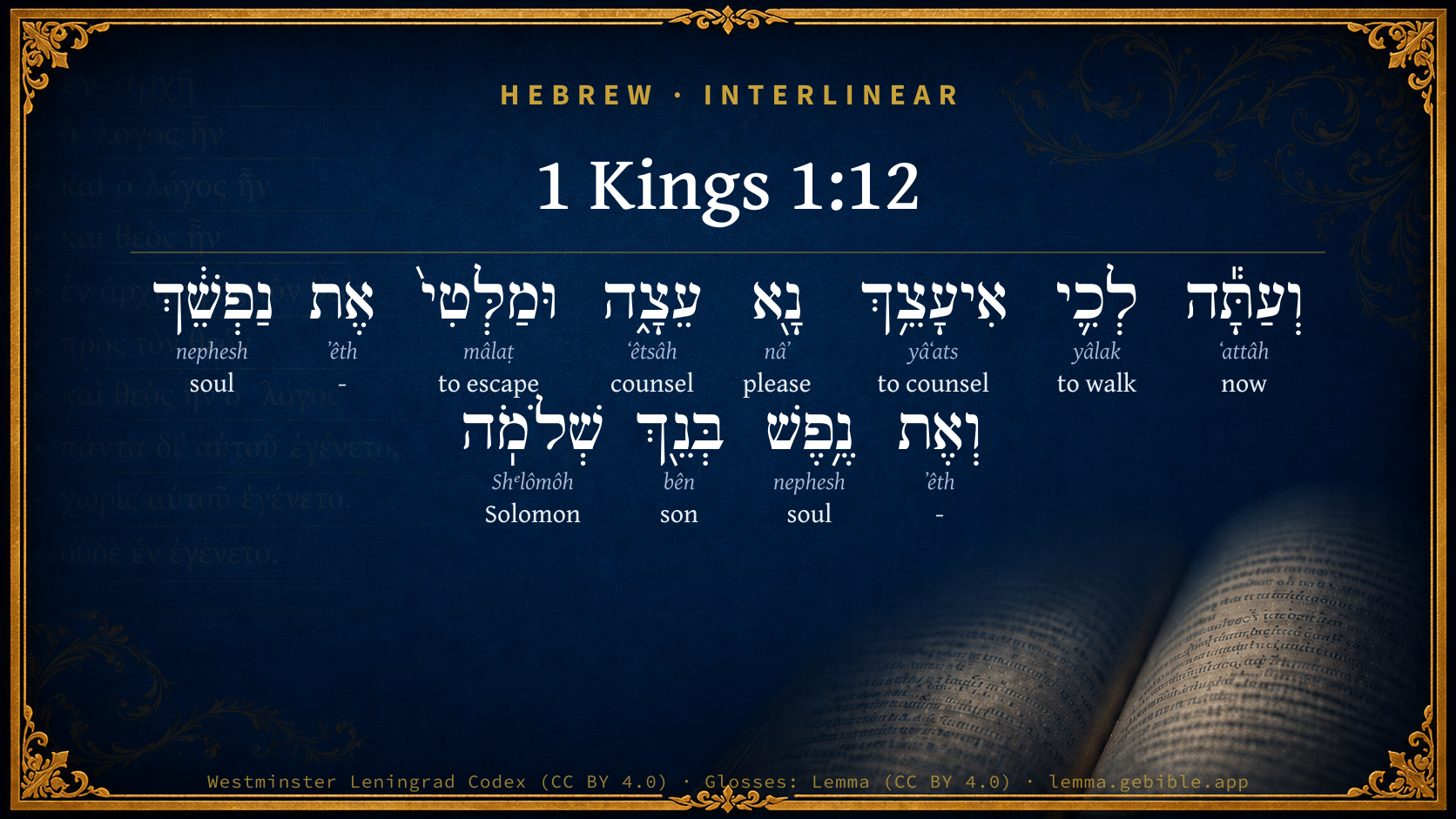
Hebrew (Westminster Leningrad Codex) 1 Kings 1:12 appears in the Hebrew Old Testament. The text above is from the Westminster Leningrad Codex. Each word links to its Strong’s number, a concise gloss, and parsing drawn from the Open Scriptures Hebrew Bible morphology. Click any word for its full Brown-Driver-Briggs (BDB) entry.
Download image
Cite this verse

1 Kings 1:12 (World English Bible). Public Domain. Lemma interlinear Bible study tool, https://lemma.gebible.app/v/1-kings/1/12.

Show BibTeX & RIS
BibTeX
RIS
English Translation
Now therefore come, please let me give you counsel, that you may save your own life, and the life of your son Solomon.
World English Bible · Public Domain
Download a study sheet

One document with this verse’s original text, its word-by-word gloss line, the meaning frame, cross-references with their text, attributed commentary, and full source and license credits — printable, and it pastes into notes with its structure intact.

This verse Autodidact and up

Study sheet (.html) Plain text (.txt)

A passage Seminary Student

Up to 50 verses in one chapter. A passage sheet keeps up to 6 commentary sources and 12 cross-references per verse, in the order this page ranks them, and says so on the sheet whenever that leaves anything out. Ask for a single verse and you get the Autodidact verse sheet above.

Everything on this page stays free to read, with no account — the sheet is a download of what is already on screen, not access to it.

Want to remove ads? Support Godless Engineer
Compare translations 3

The same verse in 3 English versions, stacked beneath the original-language interlinear above. Click any original word for its lexicon entry.

Each is an independent rendering of the whole verse — the interlinear is not word-aligned to these translations.

Highlighted words mark where these versions differ — a whole-verse word diff, not a word-by-word alignment.

  • World English Bible Public Domain
    Now therefore come, please let me give you counsel, that you may save your own life, and the life of your son Solomon.
  • King James Version Public Domain
    Now therefore come, let me, I pray thee, give thee counsel, that thou mayest save thine own life, and the life of thy son Solomon.
  • unfoldingWord Literal Text CC BY-SA 4.0
    And now, come, please let me counsel you counsel, and escape with your life and with the life of your son Solomon.

unfoldingWord Literal Text — © unfoldingWord, licensed CC BY-SA 4.0. Word-aligned USFM3 via Door43 (git.door43.org/unfoldingWord/en_ult).

Versions to compare (up to 4)

3 of 4 selected

Show all 18 translations

Every available English version of this verse, each an independent rendering of the whole verse.

  • World English Bible Public Domain
    Now therefore come, please let me give you counsel, that you may save your own life, and the life of your son Solomon.
  • Berean Standard Bible Public Domain
    Now please, come and let me advise you. Save your own life and the life of your son Solomon.
  • Majority Standard Bible Public Domain
    Now please, come and let me advise you. Save your own life and the life of your son Solomon.
  • King James Version Public Domain
    Now therefore come, let me, I pray thee, give thee counsel, that thou mayest save thine own life, and the life of thy son Solomon.
  • American Standard Version (1901) Public Domain
    Now therefore come, let me, I pray thee, give thee counsel, that thou mayest save thine own life, and the life of thy son Solomon.
  • Revised Version (1885) Public Domain
    Now therefore come, let me, I pray thee, give thee counsel, that thou mayest save thine own life, and the life of thy son Solomon.
  • Geneva Bible (1599) Public Domain
    Now therefore come, and I will now giue thee counsell, howe to saue thine owne life, and the life of thy sonne Salomon.
  • Douay-Rheims (1899) Public Domain
    Now then come, take my counsel and save thy life, and the life of thy son Solomon.
  • Young's Literal Translation Public Domain
    and now, come, let me counsel thee, I pray thee, and deliver thy life, and the life of thy son Solomon;
  • Literal Standard Version CC BY-SA 4.0
    And now, come, please let me counsel you, and deliver your life and the life of your son Solomon;
  • Unlocked Literal Bible CC BY-SA 4.0
    Now therefore let me give you advice, so that you may save your own life and the life of your son Solomon.
  • unfoldingWord Literal Text CC BY-SA 4.0
    And now, come, please let me counsel you counsel, and escape with your life and with the life of your son Solomon.
  • Darby Bible Public Domain
    And now, come, let me, I pray thee, give thee counsel, that thou mayest save thine own life, and the life of thy son Solomon.
  • World Messianic Bible Public Domain
    Now therefore come, please let me give you counsel, that you may save your own life and your son Solomon’s life.
  • Webster's Bible Public Domain
    Now therefore come, let me, I pray thee, give thee counsel, that thou mayest save thy own life, and the life of thy son Solomon.
  • Free Bible Version CC BY-SA 4.0
    Let me give you some advice so you can save your life, and that of your son Solomon.
  • Bible in Basic English Public Domain
    So now, let me make a suggestion, so that you may keep your life safe and the life of your son Solomon.
  • JPS Tanakh (1917) Public Domain
    Now therefore come, let me, I pray thee, give thee counsel, that thou mayest save thine own life, and the life of thy son Solomon.

Literal Standard Version (2020), Covenant Press — licensed CC BY-SA 4.0. Text via the HelloAO Bible API (eBible.org). Unlocked Literal Bible (unfoldingWord) — licensed CC BY-SA 4.0. Text via the HelloAO Bible API (eBible.org). unfoldingWord Literal Text — © unfoldingWord, licensed CC BY-SA 4.0. Word-aligned USFM3 via Door43 (git.door43.org/unfoldingWord/en_ult). Free Bible Version, Dr. Jonathan Gallagher — licensed CC BY-SA 4.0. Text via the HelloAO Bible API (eBible.org).

Word by word

More ways to search: Search by grammar → Find every occurrence → Compare this word →

Practice this passage: Drill this verse → Learn its vocabulary →

אִיעָצֵ֥ךְ
yâʻats
H3289
“to counsel · you”
Verb, Qal, Cohortative, 1st Person, Common, Singular + Suffix, Personal, 2nd Person, Feminine, Singular
Part of Speech
Verb
Stem
Qal
Form
Cohortative
Person
1st Person
Gender
Common
Number
Singular
Full BDB Definition

Origin: a primitive root

TWOT: 887

to advise, consult, give counsel, counsel, purpose, devise, plan - (Qal) - to advise, counsel, give counsel, consult - counsellor (participle) - (Niphal) to consult together, exchange counsel, deliberate, counsel together - (Hithpael) to conspire
  1. וְעַתָּ֕ה ʻattâh H6258 “and · now” Conjunction + Adverb
  2. לְכִ֛י yâlak H3212 “walk” Verb, Qal, Imperative, 2nd Person, Feminine, Singular
  3. נָ֖א nâʼ H4994 “please” Particle, Exhortation
  4. עֵצָ֑ה ʻêtsâh H6098 “counsel” Noun, Common, Feminine, Singular, Absolute
  5. וּמַלְּטִי֙ mâlaṭ H4422 “and · escape” Conjunction + Verb, Piel, Imperative, 2nd Person, Feminine, Singular
  6. אֶת ʼêth H853 “-” Particle, Direct Object
  7. נַפְשֵׁ֔ךְ nephesh H5315 “soul · your” Noun, Common, Both, Singular, Construct + Suffix, Personal, 2nd Person, Feminine, Singular
  8. וְאֶת ʼêth H853 “and · -” Conjunction + Particle, Direct Object
  9. נֶ֥פֶשׁ nephesh H5315 “soul of” Noun, Common, Both, Singular, Construct
  10. בְּנֵ֖ךְ bên H1121 “son · your” Noun, Common, Masculine, Singular, Construct + Suffix, Personal, 2nd Person, Feminine, Singular
  11. שְׁלֹמֹֽה Shᵉlômôh H8010 “Solomon” Noun, Proper

About this verse

These counts appear in no published source. They are computed here, from the morphology-tagged text and Lemma’s own curated glosses. What Lemma adds →

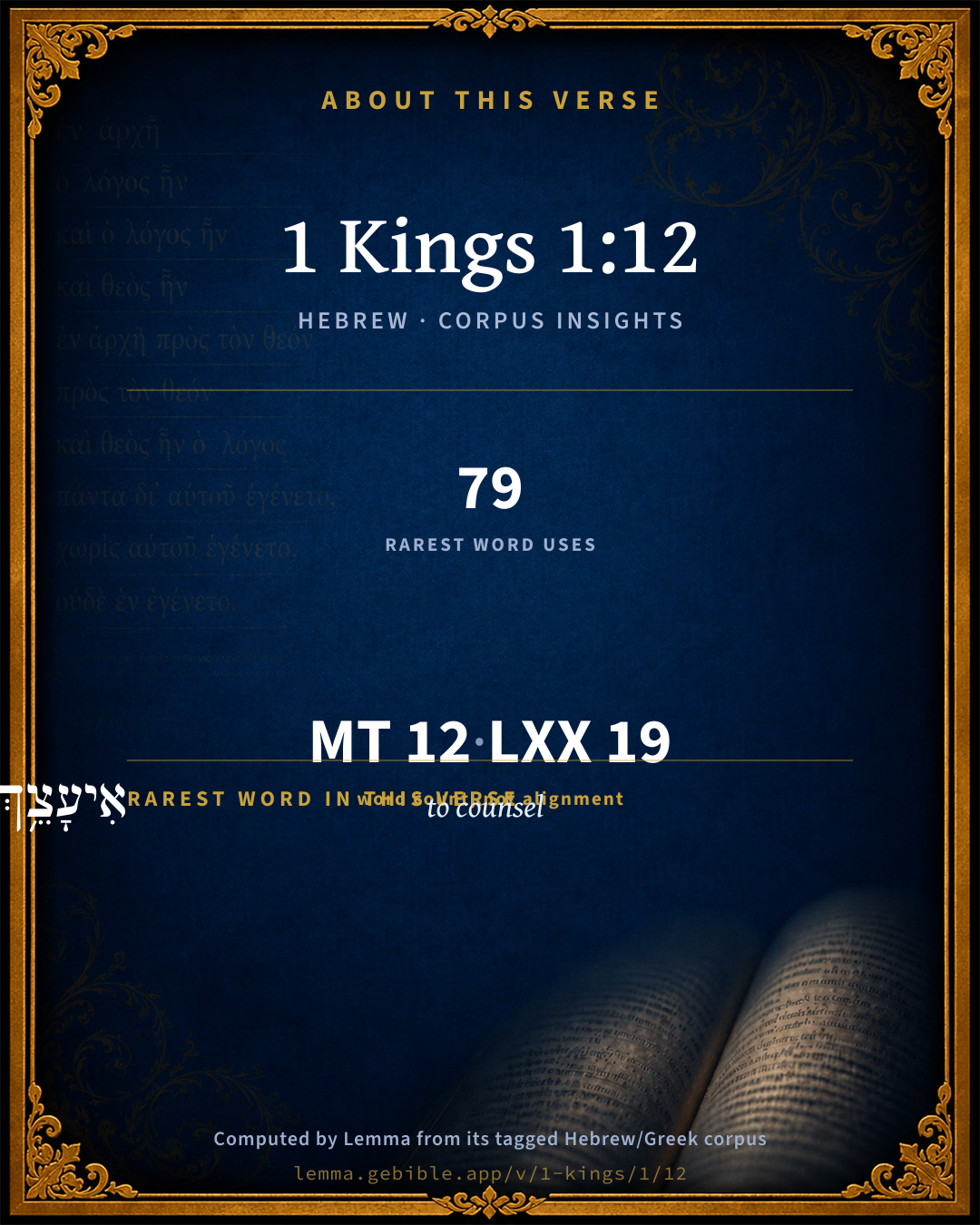
12
words
10
distinct lemmas
Historical
section

Grammatical profile

  • 3 verbs
  • 5 nouns
  • 1 adverb
  • 3 particles

Verb forms

  • לְכִ֛י Qal · Imperative
  • אִיעָצֵ֥ךְ Qal · Cohortative
  • וּמַלְּטִי֙ Piel · Imperative

Repetition

A word recurs within this verse — often emphatic in Hebrew:

  • נַפְשֵׁ֔ךְ soul H5315 ×2

Hebrew & Septuagint length

In English translation the verse runs 23 words from the Hebrew and 23 from the Septuagint (LXX English) — the same length.

A rough comparison of the two English renderings, which tokenize alike — not a word-level alignment.

Word counts can differ between the Hebrew and the Greek without any difference in meaning — e.g. the Hebrew direct-object marker אֵת has no separate Greek word, and Greek often adds the article ὁ.

In the original languages it is 12 Hebrew tokens and 19 Greek tokens — but the two are counted differently (Hebrew bundles its prefixes and suffixes into one token; the Greek is in lemma form), so that isn’t a like-for-like length.

Cross-references

13

Topical passages linked to 1 Kings 1:12 in the Treasury of Scripture Knowledge — connected by theme and wording, ordered by reader-vote popularity; previews shown in the World English Bible.

  • Genesis 19:17 It came to pass, when they had taken them out, that he said, "Escape for your life! Don't look behind you, neither stay anywhere in the plain. Escape to the mountain, lest you be consumed!"
  • Judges 9:5 He went to his father's house at Ophrah, and killed his brothers the sons of Jerubbaal, being seventy persons, on one stone: but Jotham the youngest son of Jerubbaal was left; for he hid himself.
  • 1 Kings 1:21 Otherwise it will happen, when my lord the king shall sleep with his fathers, that I and my son Solomon shall be counted offenders.
  • 2 Kings 11:1 Now when Athaliah the mother of Ahaziah saw that her son was dead, she arose and destroyed all the seed royal.
  • 2 Chronicles 21:4 Now when Jehoram was risen up over the kingdom of his father, and had strengthened himself, he killed all his brothers with the sword, and various also of the princes of Israel.
  • 2 Chronicles 22:10 Now when Athaliah the mother of Ahaziah saw that her son was dead, she arose and destroyed all the seed royal of the house of Judah.
  • Proverbs 11:14 Where there is no wise guidance, the nation falls, But in the multitude of counselors there is victory.
  • Proverbs 15:22 Where there is no counsel, plans fail; But in a multitude of counselors they are established.
  • Proverbs 20:18 Plans are established by advice; By wise guidance you wage war!
  • Proverbs 27:9 Perfume and incense bring joy to the heart; So does earnest counsel from a man's friend.
  • Jeremiah 38:15 Then Jeremiah said to Zedekiah, If I declare it to you, will you not surely put me to death? and if I give you counsel, you will not listen to me.
  • Matthew 21:38 But the farmers, when they saw the son, said among themselves, 'This is the heir. Come, let's kill him, and seize his inheritance.'
  • Acts 27:31 Paul said to the centurion and to the soldiers, "Unless these stay in the ship, you can't be saved."

Cross-references courtesy of OpenBible.info (CC BY 4.0).

Hebrew and Greek witnesses Masoretic Hebrew ↔ Greek Septuagint

The same verse in the two great witnesses to the Old Testament, shown verse-for-verse.

These are two independent witnesses, not word-aligned to each other, and the Septuagint is shown in lemma (dictionary) form.

Hebrew 1 Kings 1:12 Masoretic · Westminster Leningrad Codex

וְעַתָּ֕ה לְכִ֛י אִיעָצֵ֥ךְ נָ֖א עֵצָ֑ה וּמַלְּטִי֙ אֶת נַפְשֵׁ֔ךְ וְאֶת נֶ֥פֶשׁ בְּנֵ֖ךְ שְׁלֹמֹֽה

Now therefore come, please let me give you counsel, that you may save your own life, and the life of your son Solomon.

World English Bible · Public Domain

Greek LXX 1 Kings 1:12 Septuagint · lemma form

καί νῦν δεῦρο συνβουλεύω σύ δή συμβουλία καί ἐκαἱρέω ὁ ψυχή σύ καί ὁ ψυχή ὁ υἱός σύ σαλωμών

And now come, let me, I pray, give you counsel, and you shall rescue your life, and the life of your son Solomon.

LXX2012 (modern English Septuagint) · Public Domain

Hebrew: Westminster Leningrad Codex (CC BY 4.0). Greek: Septuagint (public domain); English from LXX2012 (modern English Septuagint) (Public Domain). How the Septuagint differs from the Hebrew →

Targum (Aramaic paraphrase)

1

The Targum is the ancient Jewish Aramaic paraphrase of the Hebrew Scriptures — an interpretive translation, not the Hebrew text itself. Onkelos (literal) and Pseudo-Jonathan (expansive) render the Torah, and Jonathan the Prophets. Coverage is partial: where no permissively-licensed English translation exists for a verse, only the Aramaic is shown. This is verse-level text, not a word-by-word alignment to the Hebrew.

  1. Targum Jonathan Prophets (Joshua–Malachi)
    וּכְעַן אֲתָא אֶמְלְכִינָךְ כְעַן מַלְכָּא וְשֵׁיזְבֵי יַת נַפְשִׁיךְ וְיַת נְפַשׁ בְּרִיךְ שְׁלֹמֹה:

    (no public-domain English translation for this verse)

    Targum Jonathan — Aramaic: “Mikraot Gedolot” (public domain). English: “Sefaria Community Translation” (CC0 1.0 (public-domain dedication)); “London "Chaldee Paraphrase," 1871” (public domain). Text via Sefaria.

Commentary

Notes on 1 Kings 1:12 from classic Christian and Jewish commentators (each source and its license shown beneath its notes). The classic Christian expositions comment on the surrounding passage and are grouped to its opening verse, so a note may address several verses; the Jewish commentaries on the Tanakh (Rashi and others) are per-verse, so they appear only where the commentator wrote on this verse.

Lemma curates 59 commentaries, every one of them public domain or Creative Commons licensed, each selected and text-cleaned for this edition rather than reprinted as found. About our sources →

Trapp's Complete Commentary

John Trapp

1Ki 1:12 Now therefore come, let me, I pray thee, give thee counsel, that thou mayest save thine own life, and the life of thy son Solomon.

Ver. 12. That thou mayest save thine own life, and the life of thy son Solomon.] Which the usurper will surely take away if he carry the crown; not suffering any such rub to lie in the way, that may hinder the true running of his bowl.

John Trapp, A Commentary or Exposition upon All the Books of the Old and New Testament (1647–1656) — public domain. Text from a community e-Sword module.

Geneva Bible (1599)

Geneva Bible translators

For Adonijah will destroy thee and thy son, if he reigns.

Geneva Bible (1599) marginal notes — public domain. Text via Bolls.life.

Adam Clarke's Commentary

Verse 12. Save thine own life, and the life of thy son] Nathan took for granted that Adonijah would put both Bath-sheba and Solomon to death as state criminals, if he got established on the throne. O cursed lust of rule! a father will destroy his son, a son depose his father, and a brother murder a brother, in order to obtain a crown! At this time the monarchy of Israel was unsettled; no man knew who was to succeed to the crown, and the minds of the people were as unsettled as the succession. I have examined both systems, and find that, with all its alleged disadvantages, hereditary monarchy has a high balance of evidence in its favour beyond that which is elective, and is every way more safe for the state and more secure for the subject.

Adam Clarke's Commentary on the Bible (1810–1826) — public domain. Text from a community e-Sword/MySword module.

Ellicott's Commentary for English Readers

(12) The life of . . . Solomon.—The usurpation of Adonijah would, as a matter of course, be sealed by the blood of his rival Solomon. (Comp. 2Ch_21:4.) Bath-sheba herself need hardly have been sacrificed; but her position of favour with David would excite jealousy, and Solomon, being still young, might well be thought only an instrument in her hands.

A Bible Commentary for English Readers, edited by Charles John Ellicott (1878–1897) — public domain. Text from a community e-Sword module.

The Cambridge Bible for Schools and Colleges

gen. ed. J. J. S. Perowne

12. save thine own life, and the life of thy son Solomon] Because it has ever been the policy of an Oriental usurper, as soon as ever he had power enough, to put out of the way those who were likely to oppose him, and so make his throne more secure.

The Cambridge Bible for Schools and Colleges (gen. ed. J. J. S. Perowne; Cambridge University Press, 1878–1918) — public domain. Text from a community e-Sword module.

John Gill's Exposition

Now therefore come, let me, I pray thee, give thee counsel,.... How to conduct in this affair, which she being a woman, and no doubt surprised and confounded at this relation, might be at a loss what to do; wherefore Nathan, being a wise man, and a faithful friend, offers to give the best advice he could, and desires her attention to it: says he,

that thou mayest save thine own life, and the life of thy son Solomon; which would be the usurper's first care to take away, that he might have no rival, and none to disturb him in his government; which step has been often taken by usurpers to secure themselves, see Jdg 9:5.

John Gill's Exposition of the Whole Bible (1746–1763) — public domain (CC PDM 1.0). Text via the HelloAO Bible API.

Albert Barnes' Notes on the Bible

It would have been in accordance with general Eastern custom for Solomon to suffer death, if Adonijah had succeeded in his attempt. But to have executed his mother also would have been an unusual severity. Still, such cases sometimes occurred: Cassander put to death Roxana, the widow of Alexander the Great, at the same time with her son, the young Alexander.

Albert Barnes' Notes on the Bible (1834–1885) — public domain. Text from a community e-Sword/MySword module.

Haydock's Catholic Bible Commentary

Life. Both would have been in imminent danger, if the ambitious projects of Adonias succeeded, as he knew that the throne had been promised to Solomon by his father, and he would consider him as a dangerous rival. (Calmet) --- The Turkish emperors usually destroy or confine their brethren, when they commence their reign. (Haydock)

George Leo Haydock (1774–1849), Haydock's Catholic Family Bible and Commentary, 1859 edition — public domain. Excludes Psalms (Douay-Rheims chapter numbering differs from Protestant) and Deuterocanonical books (Catholic canon only).

Matthew Poole's English Annotations

For he will never reckon himself safe till his competitor and his friends be taken out of the way.

Matthew Poole's English Annotations on the Holy Bible (1683–1685) — public domain. Text from a community e-Sword/MySword module.

Whedon's Commentary on the Bible

Daniel D. Whedon

12. Save thine own life — If Adonijah became king, he would doubtless, according to the barbarous custom of Oriental monarchs, destroy all persons suspected of claiming a title to the kingdom, and therefore the lives of Solomon and his mother would be in peril.

Daniel D. Whedon (gen. ed.), Commentary on the Old and New Testaments (1874–1909) — public domain. Text from a community e-Sword module.

The Pulpit Commentary

Now therefore come, let me give Hebrews counsel thee counsel, that thou mayest save Hebrews and save, i.e., by acting upon it thine own life, and the life of thy son Solomon. The custom of Eastern kings to secure their thrones by a massacre of their rivals has received many illustrations, notably among the Ottomans, and is receiving one in Burmah at the present moment (May, 1879). We have Scripture instances in Jud_1:9:5; 1Ki_15:29; 2Ki_10:7, 14 11:1. 1Sa_24:21. To put a royal mother to death, along with her offspring, though perhaps unusual, was not unknown. Rawlinson cites the instances of Cleopatra, widow of Philip of Macedon, who was murdered with her infant son Caranus by Olympias; and Roxana, widow of Alexander the Great, who, with her son, was put to death by Cassander. Nathan does not say this will be, but may be, Bathsheba"s fate. Behold, I have done according to thy words i.e. , granted thy prayer, as the next words show: lo Heb. behold I have given thee a wise and an understanding heart, so that there was none like thee before thee, neither after thee shall any arise like unto thee. Cf. 1Ch_29:25; 2Ch_9:22. But there is no need to restrict the reference to kings and princes.

The Pulpit Commentary (1880–1919), ed. H.D.M. Spence-Jones & Joseph S. Exell — public domain. Text from a community e-Sword module.

Rashi

Rabbi Shlomo Yitzchaki (Rashi)

And you will save your life. From the rivalry which will follow the death of the king, for your son will wish to reign, as the Holy One Blessed Is He, had promised him.

Rashi on the Tanakh — English translations: “The Judaica Press complete Tanach with Rashi, translated by A. J. Rosenberg” (CC BY 4.0); “Pentateuch with Rashi's commentary by M. Rosenbaum and A.M. Silbermann, 1929-1934” (public domain); “The Metsudah Tanach series, Lakewood, N.J” (CC BY 4.0); and “The Book of Joshua, Metsudah Publications, 1997” (CC BY 4.0). Text via Sefaria.

Lesson kit

Teaching starters — assembled from the data on this page, not authored interpretation. Every prompt links to the verse data it draws on. Edit before teaching.

1 Kings, in the Historical, opens this verse with 12 words (10 distinct Hebrew lemmas). Its most distinctive word is yâʻats (“to counsel”). A historical commentator’s framing appears above. Read the whole chapter for the surrounding context.

Discussion questions

  1. How does “to counsel” (yâʻats) shape what this verse is saying?
  2. How does Genesis 19:17, which shares this passage’s theme, read alongside this verse?
  3. What does the repetition of “soul” (2× in this one verse) do in this verse?
  4. These translations render this verse differently. What is at stake in choosing one wording over another?
  5. «לְכִ֛י» is a Qal Imperative verb. How does that grammatical form shape the action described?
  6. Compare how Trapp's Complete Commentary and Geneva Bible (1599) read this verse. Where do they agree or differ?

Things to notice

Reading settings

Reading text

Shown beneath each verse's original-language words.

Old Testament
Old Testament edition

Read the OT as the Masoretic Hebrew (MT) or the Greek Septuagint (LXX).

English shown for the Greek Septuagint (in the Hebrew ↔ Greek comparison).

Comparing translations? Open the Compare panel on any verse page to stack up to four side by side.