John 14:29

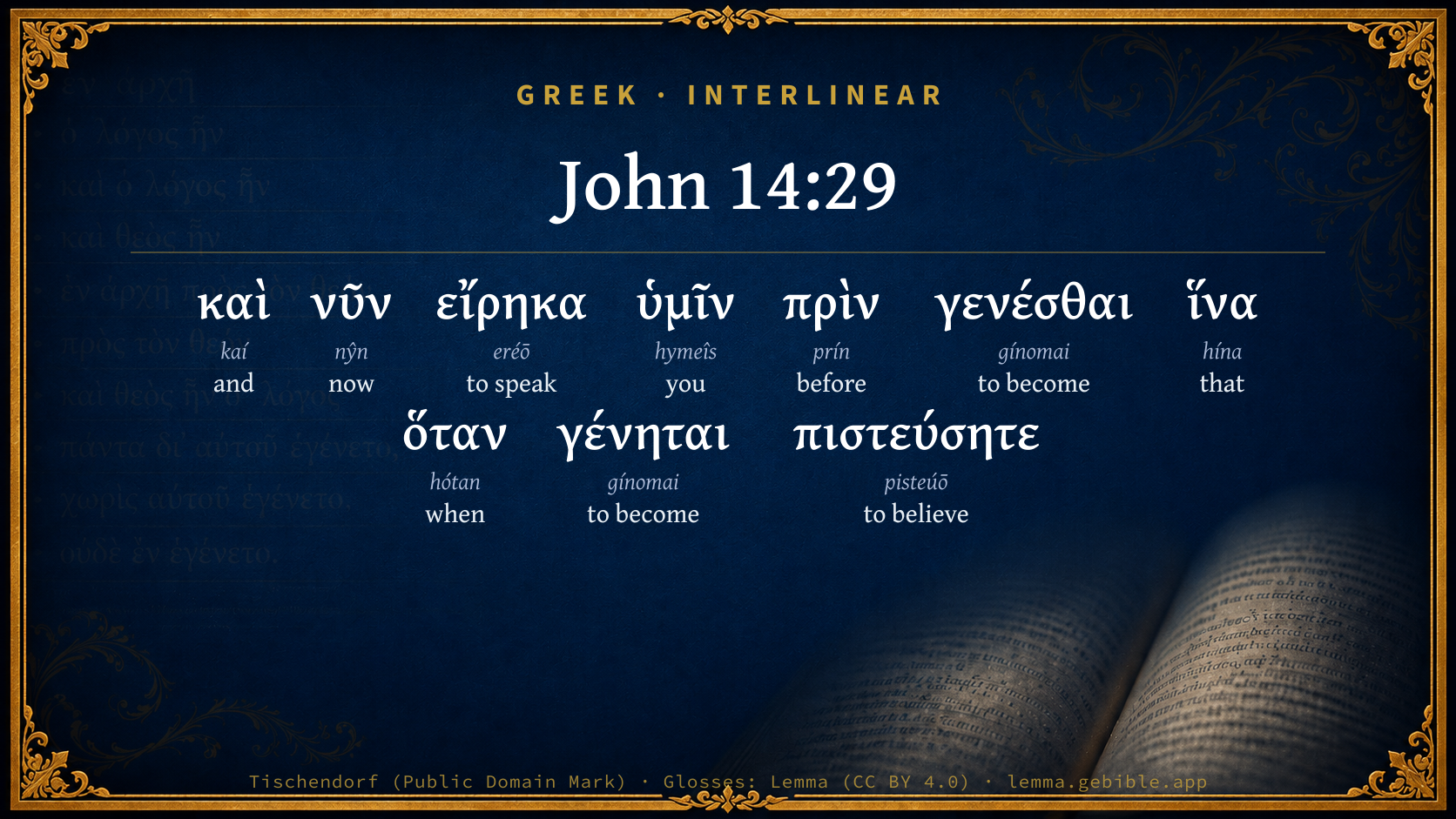
Greek (Tischendorf 8th ed.) John 14:29 appears in the Greek New Testament. The text above is from the Tischendorf 8th edition. Each word links to its Strong’s number and a concise gloss. Click any word for its full Thayer’s Greek Lexicon entry.
Download image
Cite this verse

John 14:29 (World English Bible). Public Domain. Lemma interlinear Bible study tool, https://lemma.gebible.app/v/john/14/29.

Show BibTeX & RIS
BibTeX
RIS
English Translation
Now I have told you before it happens so that, when it happens, you may believe.
World English Bible · Public Domain
Download a study sheet

One document with this verse’s original text, its word-by-word gloss line, the meaning frame, cross-references with their text, attributed commentary, and full source and license credits — printable, and it pastes into notes with its structure intact.

This verse Autodidact and up

Study sheet (.html) Plain text (.txt)

A passage Seminary Student

Up to 50 verses in one chapter. A passage sheet keeps up to 6 commentary sources and 12 cross-references per verse, in the order this page ranks them, and says so on the sheet whenever that leaves anything out. Ask for a single verse and you get the Autodidact verse sheet above.

Everything on this page stays free to read, with no account — the sheet is a download of what is already on screen, not access to it.

Want to remove ads? Support Godless Engineer
Compare translations 3

The same verse in 3 English versions, stacked beneath the original-language interlinear above. Click any original word for its lexicon entry.

Each is an independent rendering of the whole verse — the interlinear is not word-aligned to these translations.

Highlighted words mark where these versions differ — a whole-verse word diff, not a word-by-word alignment.

  • World English Bible Public Domain
    Now I have told you before it happens so that, when it happens, you may believe.
  • King James Version Public Domain
    And now I have told you before it come to pass, that, when it is come to pass, ye might believe.
  • unfoldingWord Literal Text CC BY-SA 4.0
    And now I have told you before it happens so that, when it may happen, you will believe.

unfoldingWord Literal Text — © unfoldingWord, licensed CC BY-SA 4.0. Word-aligned USFM3 via Door43 (git.door43.org/unfoldingWord/en_ult).

Versions to compare (up to 4)

3 of 4 selected

Show all 19 translations

Every available English version of this verse, each an independent rendering of the whole verse.

  • World English Bible Public Domain
    Now I have told you before it happens so that, when it happens, you may believe.
  • Berean Standard Bible Public Domain
    And now I have told you before it happens, so that when it does happen, you will believe.
  • Majority Standard Bible Public Domain
    And now I have told you before it happens, so that when it does happen, you will believe.
  • King James Version Public Domain
    And now I have told you before it come to pass, that, when it is come to pass, ye might believe.
  • American Standard Version (1901) Public Domain
    And now I have told you before it come to pass, that, when it is come to pass, ye may believe.
  • Revised Version (1885) Public Domain
    And now I have told you before it come to pass, that, when it is come to pass, ye may believe.
  • Geneva Bible (1599) Public Domain
    And nowe haue I spoken vnto you, before it come, that when it is come to passe, ye might beleeue.
  • Douay-Rheims (1899) Public Domain
    And now I have told you before it comes to pass: that when it shall come to pass, you may believe.
  • Young's Literal Translation Public Domain
    `And now I have said `it' to you before it come to pass, that when it may come to pass, ye may believe;
  • Literal Standard Version CC BY-SA 4.0
    And now I have said [it] to you before it comes to pass, that when it may come to pass, you may believe.
  • Unlocked Literal Bible CC BY-SA 4.0
    Now I have told you before it happens so that, when it happens, you will believe.
  • unfoldingWord Literal Text CC BY-SA 4.0
    And now I have told you before it happens so that, when it may happen, you will believe.
  • Darby Bible Public Domain
    And now I have told you before it comes to pass, that when it shall have come to pass ye may believe.
  • World Messianic Bible Public Domain
    Now I have told you before it happens so that when it happens, you may believe.
  • Webster's Bible Public Domain
    And now I have told you before it cometh to pass, that when it hath come to pass, ye may believe.
  • Free Bible Version CC BY-SA 4.0
    I've explained this to you now before it happens so that when it does happen you will be convinced.
  • Bible in Basic English Public Domain
    And now I have given you word of it before it comes, so that, when it comes, you may have faith.
  • Text-Critical English NT CC BY 4.0
    I have told you now before it happens, so that when it does happen, you may believe.
  • Tyndale New Testament (1534) Public Domain
    For the father is greater then I. And now have I shewed you before it come that when it is come to passe ye might beleve.

Literal Standard Version (2020), Covenant Press — licensed CC BY-SA 4.0. Text via the HelloAO Bible API (eBible.org). Unlocked Literal Bible (unfoldingWord) — licensed CC BY-SA 4.0. Text via the HelloAO Bible API (eBible.org). unfoldingWord Literal Text — © unfoldingWord, licensed CC BY-SA 4.0. Word-aligned USFM3 via Door43 (git.door43.org/unfoldingWord/en_ult). Free Bible Version, Dr. Jonathan Gallagher — licensed CC BY-SA 4.0. Text via the HelloAO Bible API (eBible.org).

Word by word

More ways to search: Search by grammar → Find every occurrence → Compare this word →

Practice this passage: Drill this verse → Learn its vocabulary →

About this verse

These counts appear in no published source. They are computed here, from the morphology-tagged text and Lemma’s own curated glosses. What Lemma adds →

10
words
9
distinct lemmas
Gospels
section

Notable vocabulary

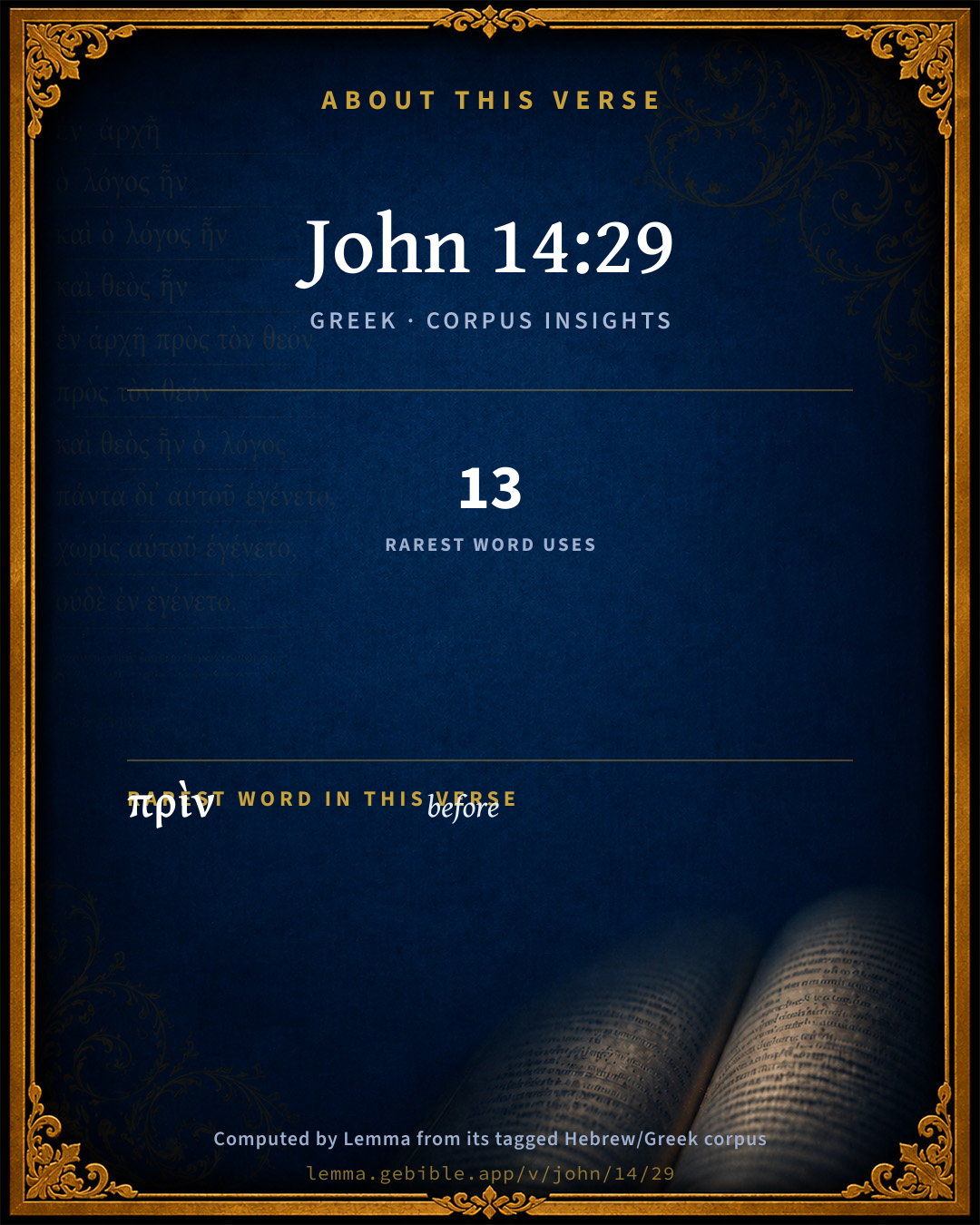
The rarest word here is πρὶν before G4250 — appearing just 13 times in the whole Greek New Testament.

Shared distinctive vocabulary

πρὶν before G4250 occurs in 13 verses of the Greek New Testament. Also found in:

Repetition

A word recurs within this verse:

  • γενέσθαι to become G1096 ×2

Cross-references

3

Topical passages linked to John 14:29 in the Treasury of Scripture Knowledge — connected by theme and wording, ordered by reader-vote popularity; previews shown in the World English Bible.

  • John 13:19 From now on, I tell you before it happens, that when it happens, you may believe that I AM.
  • John 16:4–31 But I have told you these things, so that when the time comes, you may remember that I told you about them. I didn't tell you these things from the beginning, because I was with you.
  • Matthew 24:24–25 For there will arise false christs, and false prophets, and they will show great signs and wonders, so as to lead astray, if possible, even the chosen ones.

Cross-references courtesy of OpenBible.info (CC BY 4.0).

Commentary

Notes on John 14:29 from classic Christian and Jewish commentators (each source and its license shown beneath its notes). The classic Christian expositions comment on the surrounding passage and are grouped to its opening verse, so a note may address several verses; the Jewish commentaries on the Tanakh (Rashi and others) are per-verse, so they appear only where the commentator wrote on this verse.

Lemma curates 59 commentaries, every one of them public domain or Creative Commons licensed, each selected and text-cleaned for this edition rather than reprinted as found. About our sources →

Bengel's Gnomon

Johann Albrecht Bengel

Joh 14:29. Εἴρηκα, I have told you) as to My departure and return. The word is the seed: faith [with peace and joy.—V. g.] is the fruit.—ἵνα, that) The scope of this discourse. So ch. Joh 15:11; Joh 15:17, Joh 16:1; Joh 16:4; Joh 16:33.

Bengel's Gnomon of the New Testament — English translation (T&T Clark, Edinburgh, 1860) — public domain. Text from a community e-Sword module.

Meyer's Critical & Exegetical Commentary

Heinrich August Wilhelm Meyer

Joh_14:29. And now, even now, when my departure is approaching, I have said it to you, namely, ὅτι πορεύομαι πρὸς τ. π., Joh_14:28, not what was said in Joh_14:26, as Lücke thinks.

ὅταν γένηται] cum factum fuerit, namely, through my death; comp. Joh_13:19.

πιστεύσητε] Not absolutely, so that it would express of itself what is more precisely denned in Joh_13:19 by ὅτι ἐγώ εἰμι; but: that you may believe it, namely, that I have gone to the Father. Comp. πιστεύετέ μοι, Joh_14:11. The point for the departing Lord was, that when His approaching death should take place, the disciples should have the true believing apprehension of it, namely, as His departure to the Father.

Meyer — Critical and Exegetical Commentary on the New Testament — English translation by Peter Christie, edited by Frederick Crombie (T&T Clark, 1880) — public domain. Text from a community e-Sword module.

Expositor's Greek Testament

ed. W. Robertson Nicoll

Joh 14:29 . καὶ νῦν … πιστεύσητε . “I have told you now before it came to pass,” i.e. , He has told them of His departure, that they might not be terrified or depressed by its occurrence, but might recognise it as foretold by Him as the consummation of His work and so might have their faith increased. Cf. Joh 13:19 .

The Expositor's Greek Testament, edited by W. Robertson Nicoll (1897–1910) — public domain. Text from a community e-Sword module.

Adam Clarke's Commentary

Verse 29. I have told you before it come to pass] Lest my death should be a stumbling-block to you, I have spoken of it beforehand, and showed you the necessity of it, that when it happens ye may believe, that as I could predict it so clearly, and so circumstantially, so all the good which I have promised shall be the result may be confidently expected by you; and that your sorrow, if not entirely removed, may at least be much mitigated.

Adam Clarke's Commentary on the Bible (1810–1826) — public domain. Text from a community e-Sword/MySword module.

John Calvin's Commentaries

29. And I have told you now. It was proper that the disciples should be frequently admonished on this point; for it was a secret far exceeding all human capacity. He testifies that he foretells what shall happen, that, when it has happened, they may believe; for it was a useful confirmation of their faith when they brought to recollection the predictions of Christ, and saw accomplished before their eyes what they had formerly heard from his mouth. Yet it appears to be a sort of concession, as if Christ had said, “Because you are not yet capable of comprehending so deep a mystery, I bear with you till the event has happened, which will serve as an interpreter to explain this doctrine.” Although for a time he seemed to speak to the deaf, yet it afterwards appeared that his words were not scattered in vain, or, as we may say, in the air, but that it was a seed thrown into the earth. Now, as Christ speaks here about his word and the accomplishment of events, so his death, and resurrection, and ascension to heaven, are combined with doctrine, that they may produce faith in us.

John Calvin's Commentaries (1540-1563) — public domain. Text from the Calvin Translation Society English edition (1840s-50s) via the Christian Classics Ethereal Library (ccel.org). Calvin's coverage is partial (roughly two-thirds of the Bible); uncommented books and verses are honest gaps, never fabricated. The 19th-century editor's footnotes and remarks are omitted so the notes are faithfully Calvin's own voice.

Ellicott's Commentary for English Readers

(29) And now I have told you before it come to pass.—Comp. Joh_13:19. Here, again, He tells them the event before the accomplishment, that it may serve to strengthen their faith. Two interpretations of this verse are possible. (1) That He told them of the coming of the Advocate to teach all truth, and bring all things to their remembrance, in order that in the fulfilment of this they may, with increase of faith, believe in Him. (2) That He told them of His going to the Father, in order that when the hour of departure came they may believe that He had gone to the Father. Upon the whole, and especially considering the close parallel with Joh_13:19, the first seems the more probable meaning.

A Bible Commentary for English Readers, edited by Charles John Ellicott (1878–1897) — public domain. Text from a community e-Sword module.

The Cambridge Bible for Schools and Colleges

gen. ed. J. J. S. Perowne

29. ye might believe] Better, ye may believe. The brevity of the expression makes it ambiguous. It may mean either, ‘ye may believe that I am He’ (as in Joh_13:19), in which case ‘I have told you’ probably refers to the sending of the Paraclete; or, ‘ye may believe Me’ (as in Joh_14:11), in which case ‘I have told you’ probably refers to Christ’s going to the Father. The former seems better.

The Cambridge Bible for Schools and Colleges (gen. ed. J. J. S. Perowne; Cambridge University Press, 1878–1918) — public domain. Text from a community e-Sword module.

John Gill's Exposition

And now I have told you before it came to pass,.... This is a strong proof of his true and proper deity, for none but the omniscient God can tell of things before they come to pass; this is peculiar to him, and distinguishes him from the gods of the Gentiles; see Isa 41:22;

that when it is come to pass, ye might believe: that is, that when he was removed from them, and gone to his Father, they might then believe that he was truly God, the Son of God, the promised Messiah; and that he was then in glory, and at the right hand of God.

John Gill's Exposition of the Whole Bible (1746–1763) — public domain (CC PDM 1.0). Text via the HelloAO Bible API.

Trapp's Complete Commentary

John Trapp

29 And now I have told you before it come to pass, that, when it is come to pass, ye might believe.

Ver. 29. And now I have told you before] Which none beside God himself could do, but by divine revelation. The knowledge of future contingents is of God only, and of such as to whom he is pleased to communicate it; as he did to the prophets, who when they foretold things only as in their causes, they might happen or not, as Isa 38:1; Jon 3:4; 1Ki 21:20; but when they foretold things ut futura in seipsis, then they occured infallibly. The devil also may come acquainted with such things, and be able to foretell them, if God reveal them to him, as he did Ahab’s death; and as Trithemius the abbot and Cusanus the cardinal foretold a change of religion to happen in the year 1517, which was the year wherein Luther began to stickle for Christ against the pope. {a}

{a} Cusanus obiit, A. D. 1464. Trithem. scripsit an. 1508. Genius vero qui Trithemio haec dictavit, albus an ater fuerit, ego non facile dixerim. Bucholcer.

John Trapp, A Commentary or Exposition upon All the Books of the Old and New Testament (1647–1656) — public domain. Text from a community e-Sword module.

Albert Barnes' Notes on the Bible

Before it come to pass - Before my death, resurrection, and ascension.

Ye might believe - You might be confirmed or strengthened in faith by the evidence which I gave that I came from God - the power of foretelling future events.

Albert Barnes' Notes on the Bible (1834–1885) — public domain. Text from a community e-Sword/MySword module.

Matthew Poole's English Annotations

Evils that surprise us are always the most heavy, and load our spirits. Saith our Saviour, Before these things come to pass, I have given you notice of them, that, when you see them come to pass, you might not be overwhelmed with sorrow and trouble, to the hinderance of your faith in me; but understanding that I have told you the truth before the thing come to pass, you may be assured that I am not mere man, but truly God; and receive and embrace me, and rest upon me as your Saviour.

Matthew Poole's English Annotations on the Holy Bible (1683–1685) — public domain. Text from a community e-Sword/MySword module.

Whedon's Commentary on the Bible

Daniel D. Whedon

29. Ye might believe—Jesus here, as in Joh_13:19, utters words which should hereafter ripen into fruit. In the future, as they should contemplate the past as a whole, they would see those correspondences between his prophecies and the fact as should establish the divinity of his teaching.

Daniel D. Whedon (gen. ed.), Commentary on the Old and New Testaments (1874–1909) — public domain. Text from a community e-Sword module.

The Pulpit Commentary

And now I have said it to you before it come to pass I have told you of my departure and what is involved in itthat when it is come to pass, ye may believe. Christ often appeals to the effect which the fulfillment of his own predictions will produce in the minds of his disciples. (Joh_1:51 Joh_13:19) They will, when the series of events will unroll themselves, believe that he has gone to the Father, to do all he said he would do, to be all he said he was. This means undoubtedly more than a spiritual consolation whereby they may endure his separation by death from their society. It is the announcement beforehand of the Resurrection and Ascension, by which their faith in his exaltation would be fanned into burning flame and made a revelation of Divine love to the universe.

Vers. 29-31. The crisis at hand.

Jesus is about to end his discourse in the chamber.

I HIS PREDICTION OF EVENTS IS DESIGNED TO STRENGTHEN THE DISCIPLES" FAITH. "And now I have told you before it come to pass, that, when it is come to pass, ye may believe.

1. The events foretold are his departure and all involved in it, as well as the mission of the Comforter.

2. What a wise provision he made to support the faith and patience of his followers! For his separation from them would be the greatest of trials.

II THE IMMINENCE OF THE CRISIS. "The prince of this world cometh, and hath nothing in me.

1. Satan was approaching in the persons of Judas and the chief priests, whose counsels he inspired. They were all instruments of the great enemy. There was likewise in our Lord"s mind a presentiment of his approaching agony in Gethsemane.

2. Yet Satan had nothing in Jesus that fell under his power. It is sin that gives Satan the power over man. Our Lord"s words imply

a. Christ"s perfect sinlessness,

b. and the absolute voluntariness of his death.

III THE PURPOSE OF HIS DEATH. "But that the world may know that I love the Father; and as the Father gave me commandment, even so I do.

1. His obedience to death was an evidence of his love to the Father.

2. It was likewise an act of obedience to the Divine commandment. "Lo, I come to do thy will, O God.

Vers. 29-31. Anticipation.

Before giving the signal for removing, Jesus in spirit glances forward. What does he see in the immediate future?

I THE FUTURE SHALL VERIFY HIS WORDS, AND SO STRENGTHEN HIS DISCIPLES" FAITH. He had explicitly foretold his death, his resurrection and ascension, and the outpouring of the Holy Spirit. They did not disbelieve him, but they were slow to grasp the purport of his words. Fulfillment should render his predictions plain, and should confirm the feeble faith of those who through strong faith were to do their work as his witnesses to the world.

II THE FUTURE SHALL BRING ON THE CONFLICT BETWEEN JESUS AND THE POWER OF EVIL A CONFLICT WHICH MUST ISSUE IN VICTORY FOR CHRIST AND HIS PEOPLE. The prince of this world had before now assailed the Prince of Light, but had departed for a season. But the hour of the power of darkness was at hand. An absorbing conflict was about to take place, in which the adversary of God and men should find nothing in him on which to lay hold, and in which Christ should certainly overcome.

III THE FUTURE SHALL UNFOLD TO THE WORLD CHRIST"S RELATION TO THE FATHER. It should be seen that what Jesus did and suffered was one long act of affectionate obedience to God. This deep significance of the facts which occurred at the close of the Redeemer"s ministry was hidden from the world; but the eyes of men should be opened to discern it. And for the benefit of all time it should be seen that love and obedience are mightier than sin, than Satan, than death. T.

The Pulpit Commentary (1880–1919), ed. H.D.M. Spence-Jones & Joseph S. Exell — public domain. Text from a community e-Sword module.

John Wesley's Explanatory Notes

I have told you - Of my going and return.

John Wesley, Explanatory Notes Upon the Whole Bible (1754–1765) — public domain. Text via the GEBible commentary corpus.

Burkitt's Expository Notes on the New Testament

William Burkitt

The time of our Saviour’s death now nearer and nearer approaching, he prepares the expectation of his disciples for it, because evils that surprize us suddenly, do sink our spirits sadly: whereas what we fear, for that we prepare.

Accordingly our Lord arms his disciples against all disquietude, and overwhelming sorrow for his departure from them: I have told you before, that when it comes to pass, ye might believe; that is, be assured that I am not mere man, but truly and really God, and depend upon me for life and salvation.

Observe, 2. How our Saviour points out the cause of his suffering; namely, Satan and his instruments; The prince of this world cometh; that is, by Judas, the soldiers, and the high priests: But he hath nothing in me: that is, "He will find no sin or corruption in men to side with his temptation, or no guilt upon me to give him any advantage against me, for I shall die as a perfectly innocent person." Christ, in suffering for our sins, did not only conflict with the wrath of God, but with the rage of men and devils; yet all the power and policy, all the malice and cruelty, of Satan, cannot prevail against Christ, any farther than he voluntarily yields and submits himself unto it. The prince of this world cometh, but hath nothing in me.

Observe, 3. That it was Christ’s love and obedience to his Father that carried him forth so cheerfully to the work of sufferings, supported him under it, and carried him through it: That the world may know that I love the Father, and as the Father gave me commandment, even so I do. True love to God will draw all men to obedience in the hardest service and sufferings: the grand motive of commands, and a regard to his glory.

Lord, let thy love and obedience to thy Father, in all thy sufferings, be the subject of our admiration, and the matter of our imitation also. As the Father gives us commandment, so let us always do.

William Burkitt's Expository Notes on the New Testament (1700–1703) — public domain. Text from a community e-Sword module.

Cambridge Greek Testament for Schools and Colleges

29. πιστεύσητε. Comp. Joh 13:19 and see on Joh 1:7. By foretelling the trouble Jesus turns a stumblingblock into an aid to faith.

Cambridge Greek Testament for Schools and Colleges (Cambridge University Press, 1896; 21 vols, various authors incl. Carr, Maclear, Plummer, Farrar, Lumby, Moule, M. R. James, Simcox) — public domain. Text from a community e-Sword module.

Alford’s Greek Testament

Henry Alford

29.] εἴρηκα—viz. ‘the prophecies of My Resurrection and Ascension,’ &c.

πιστεύσητε] See ch. 13:19, where ὅτι ἐγώ εἰμι is supplied. That ye may believe, in the fullest sense of the word. “Neque enim Eum Dei Filium non et ante credebant: sed cum in Illo factum esset quod ante prædixit, fides illa quæ tunc quando illis loquebatur fuit parva, et cum moreretur pæne jam nulla, et revixit et crevit.” Aug. in Joann. Tract. lxxix. 1.

Henry Alford, The Greek Testament (1849–1861) — public domain. Text from a community e-Sword module.

International Critical Commentary

29. καὶ νῦν, “And now,” sc. “to make an end” (cf. 17:5, 1Jn 2:28, for καὶ νῦν used thus; and see on 11:22), “I have told you before it come to pass, that when it is come to pass ye may believe.” See note on 13:19.

πιστεύειν may be used here absolutely (see 1:7); or the meaning may be governed by 13:19, where the words are ἵνα πιστεύσητε … ὅτι ἐγώ εἰμι, “that I (am) He.”

In vv. 26 ff., Jesus had told the disciples of His approaching departure, which as yet they had hardly brought themselves to believe, and of the coming of the Holy Spirit which would ensue. The experience of this heavenly illumination would convince them of His superhuman foreknowledge. Cf. 2:22.

International Critical Commentary — older volumes (1896–1929), various authors — public domain. Text from a community e-Sword module.

Godet's Commentaries

Frédéric Louis Godet

Ver. 29. This disappearance of Jesus, so contrary to their thoughts, might in itself shake their faith; but Jesus applies to this trial what He had said of the treachery of Judas: through the fact that He has foretold it to them, it will, on the contrary, turn to the strengthening of their faith. And now, finally, the summons to depart:

Frédéric Louis Godet — Commentaries on Luke, John, Romans, and 1 Corinthians — English translation (T&T Clark, Edinburgh, 1870s–1890s) — public domain. Text from a community e-Sword module.

Lesson kit

Teaching starters — assembled from the data on this page, not authored interpretation. Every prompt links to the verse data it draws on. Edit before teaching.

John, in the Gospels, opens this verse with 10 words (9 distinct Greek lemmas). Its most distinctive word is prín (“before”). A historical commentator’s framing appears above. Read the whole chapter for the surrounding context.

Discussion questions

  1. What does “before” (prín) contribute to the verse as a whole?
  2. How does Matthew 1:18, which shares the word «before», read alongside this verse?
  3. What does the repetition of “to become” (2× in this one verse) do in this verse?
  4. These translations render this verse differently. What is at stake in choosing one wording over another?
  5. Compare how Bengel's Gnomon and Meyer's Critical & Exegetical Commentary read this verse. Where do they agree or differ?

Things to notice

  • These translations choose different wording for 7 words in this verse.
  • “to become” occurs 2× in this single verse.
  • 9 distinct Greek lemmas span 10 words in this verse.

Reading settings

Reading text

Shown beneath each verse's original-language words.

Old Testament
Old Testament edition

Read the OT as the Masoretic Hebrew (MT) or the Greek Septuagint (LXX).

English shown for the Greek Septuagint (in the Hebrew ↔ Greek comparison).

Comparing translations? Open the Compare panel on any verse page to stack up to four side by side.