
1 Peter 3:21

Greek (Tischendorf 8th ed.) 1 Peter 3:21 appears in the Greek New Testament. The text above is from the Tischendorf 8th edition. Each word links to its Strong’s number and a concise gloss. Click any word for its full Thayer’s Greek Lexicon entry.
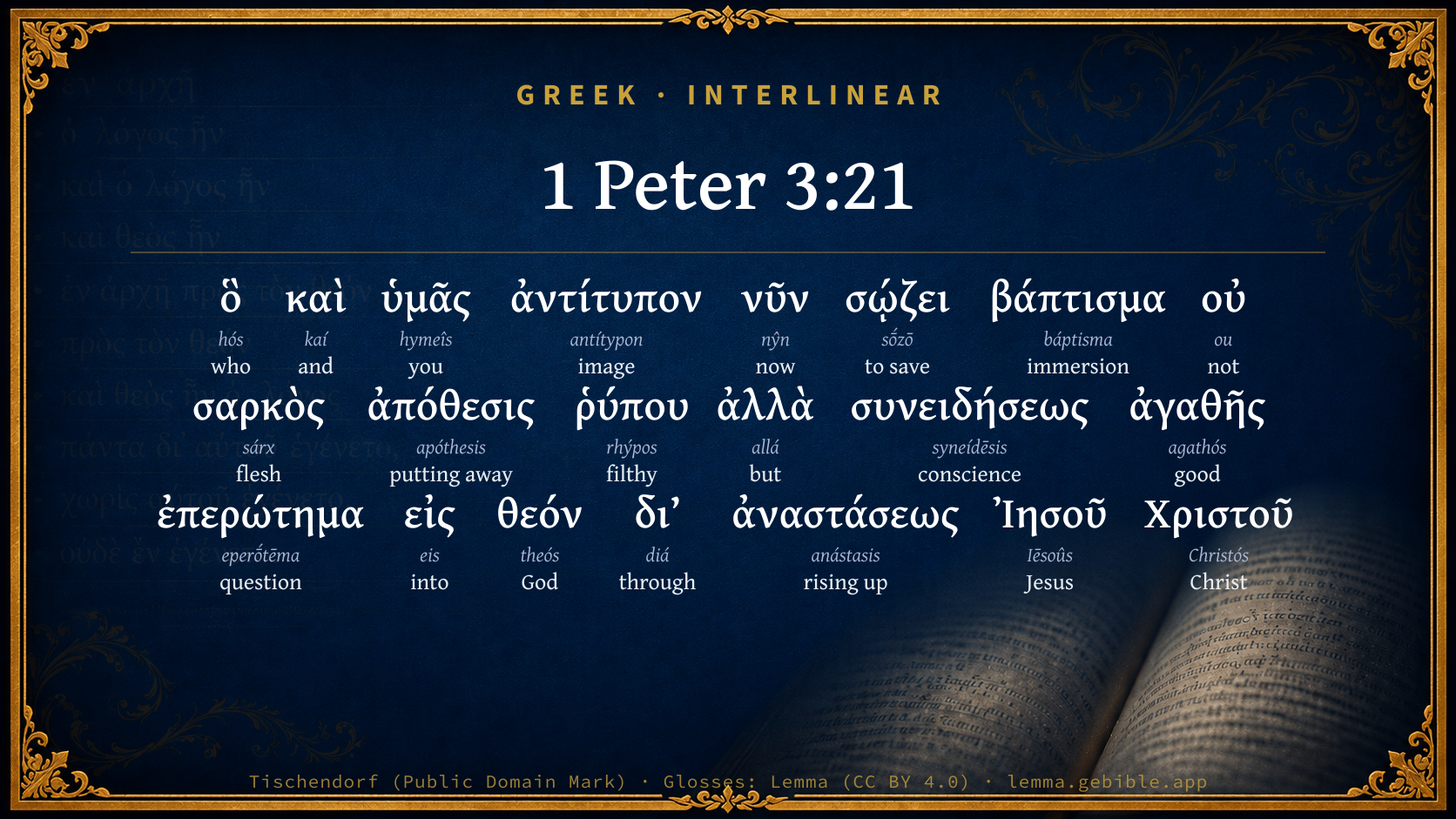
Download image
Cite this verse

1 Peter 3:21 (World English Bible). Public Domain. Lemma interlinear Bible study tool, https://lemma.gebible.app/v/1-peter/3/21.

Show BibTeX & RIS
BibTeX
RIS
English Translation
This is a symbol of baptism, which now saves you-- not the putting away of the filth of the flesh, but the answer of a good conscience toward God, through the resurrection of Jesus Christ,
World English Bible · Public Domain
Highlights
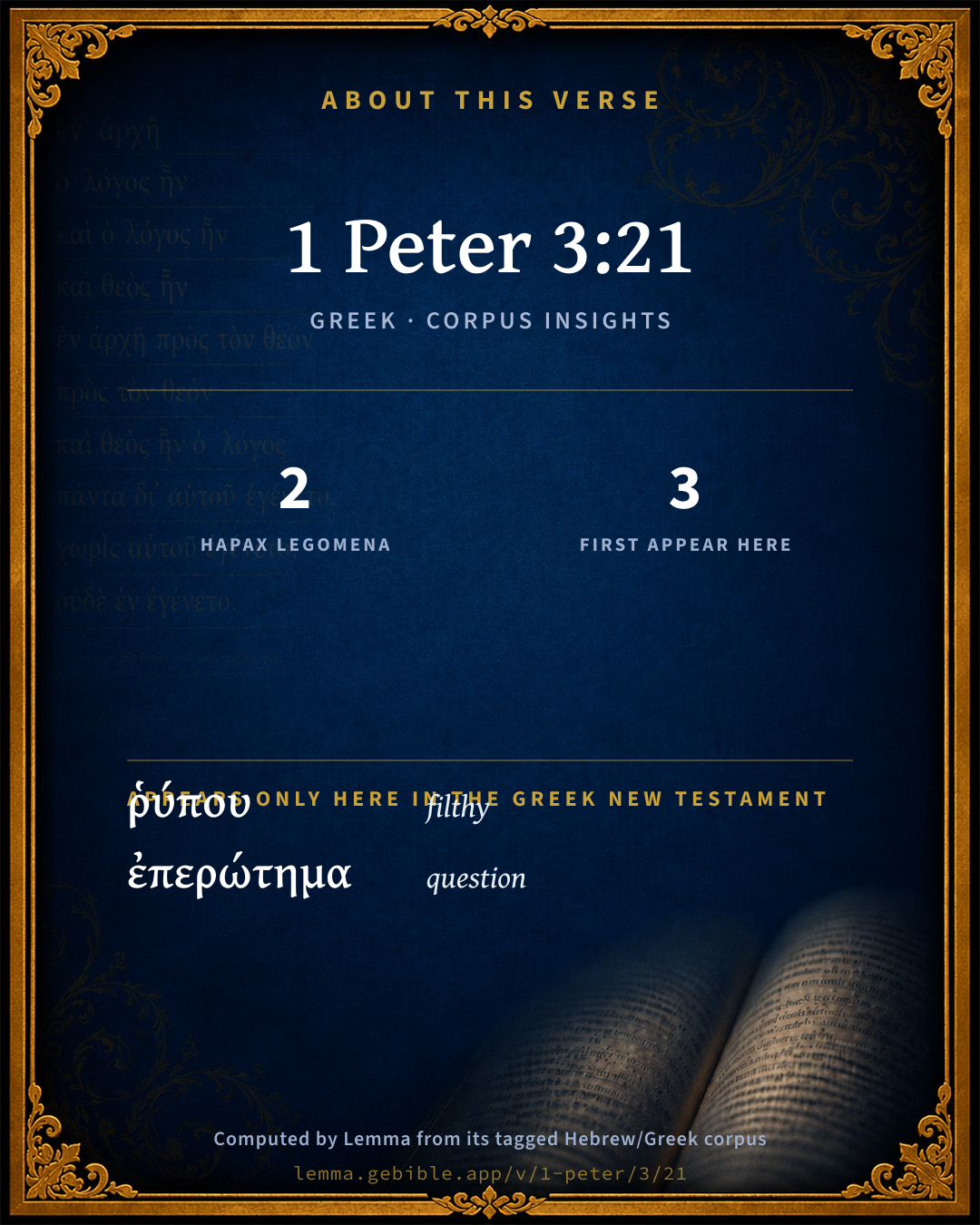
  • 2 hapax legomena — only here in the Greek New Testament
  • 3 first appearances in the Greek New Testament
Full analysis ↓
Download a study sheet

One document with this verse’s original text, its word-by-word gloss line, the meaning frame, cross-references with their text, attributed commentary, and full source and license credits — printable, and it pastes into notes with its structure intact.

This verse Autodidact and up

Study sheet (.html) Plain text (.txt)

A passage Seminary Student

Up to 50 verses in one chapter. A passage sheet keeps up to 6 commentary sources and 12 cross-references per verse, in the order this page ranks them, and says so on the sheet whenever that leaves anything out. Ask for a single verse and you get the Autodidact verse sheet above.

Everything on this page stays free to read, with no account — the sheet is a download of what is already on screen, not access to it.

Want to remove ads? Support Godless Engineer
Compare translations 3

The same verse in 3 English versions, stacked beneath the original-language interlinear above. Click any original word for its lexicon entry.

Each is an independent rendering of the whole verse — the interlinear is not word-aligned to these translations.

Highlighted words mark where these versions differ — a whole-verse word diff, not a word-by-word alignment.

  • World English Bible Public Domain
    This is a symbol of baptism, which now saves you-- not the putting away of the filth of the flesh, but the answer of a good conscience toward God, through the resurrection of Jesus Christ,
  • King James Version Public Domain
    The like figure whereunto even baptism doth also now save us (not the putting away of the filth of the flesh, but the answer of a good conscience toward God,) by the resurrection of Jesus Christ:
  • unfoldingWord Literal Text CC BY-SA 4.0
    which, an antitype, now saves you also, baptism—not a removal of dirt from the flesh, but an appeal of a good conscience to God—through the resurrection of Jesus Christ,

unfoldingWord Literal Text — © unfoldingWord, licensed CC BY-SA 4.0. Word-aligned USFM3 via Door43 (git.door43.org/unfoldingWord/en_ult).

Versions to compare (up to 4)

3 of 4 selected

Show all 19 translations

Every available English version of this verse, each an independent rendering of the whole verse.

  • World English Bible Public Domain
    This is a symbol of baptism, which now saves you-- not the putting away of the filth of the flesh, but the answer of a good conscience toward God, through the resurrection of Jesus Christ,
  • Berean Standard Bible Public Domain
    And this water symbolizes the baptism that now saves you also—not the removal of dirt from the body, but the pledge of a clear conscience toward God—through the resurrection of Jesus Christ,
  • Majority Standard Bible Public Domain
    And this water symbolizes the baptism that now saves us also—not the removal of dirt from the body, but the pledge of a clear conscience toward God—through the resurrection of Jesus Christ,
  • King James Version Public Domain
    The like figure whereunto even baptism doth also now save us (not the putting away of the filth of the flesh, but the answer of a good conscience toward God,) by the resurrection of Jesus Christ:
  • American Standard Version (1901) Public Domain
    which also after a true likeness doth now save you, `even' baptism, not the putting away of the filth of the flesh, but the interrogation of a good conscience toward God, through the resurrection of Jesus Christ;
  • Revised Version (1885) Public Domain
    which also after a true likeness doth now save you, even baptism, not the putting away of the filth of the flesh, but the interrogation of a good conscience toward God, through the resurrection of Jesus Christ;
  • Geneva Bible (1599) Public Domain
    Whereof the baptisme that nowe is, answering that figure, (which is not a putting away of the filth of the flesh, but a confident demaunding which a good conscience maketh to God) saueth vs also by the resurrection of Iesus Christ,
  • Douay-Rheims (1899) Public Domain
    Whereunto baptism being of the like form, now saveth you also: not the putting away of the filth of the flesh, but the examination of a good conscience towards God by the resurrection of Jesus Christ.
  • Young's Literal Translation Public Domain
    also to which an antitype doth now save us -- baptism, (not a putting away of the filth of flesh, but the question of a good conscience in regard to God,) through the rising again of Jesus Christ,
  • Literal Standard Version CC BY-SA 4.0
    also an antitype to immersion which now saves you—not a putting away of the filth of flesh, but the question of a good conscience in regard to God, through the resurrection of Jesus Christ,
  • Unlocked Literal Bible CC BY-SA 4.0
    This is a symbol of the baptism that saves you now—not as a washing away of dirt from the body, but as the appeal of a good conscience to God—through the resurrection of Jesus Christ.
  • unfoldingWord Literal Text CC BY-SA 4.0
    which, an antitype, now saves you also, baptism—not a removal of dirt from the flesh, but an appeal of a good conscience to God—through the resurrection of Jesus Christ,
  • Darby Bible Public Domain
    which figure also now saves you, [even] baptism, not a putting away of [the] filth of flesh, but [the] demand as before God of a good conscience, by [the] resurrection of Jesus Christ,
  • World Messianic Bible Public Domain
    This is a symbol of immersion, which now saves you—not the putting away of the filth of the flesh, but the answer of a good conscience toward God—through the resurrection of Yeshua the Messiah,
  • Webster's Bible Public Domain
    The like figure to which, even baptism, doth also now save us (not the putting away of the filth of the flesh, but the answer of a good conscience towards God,) by the resurrection of Jesus Christ:
  • Free Bible Version CC BY-SA 4.0
    This water symbolizes baptism that now saves you, not by washing off dirt from your body, but as a positive response to God that comes from a clear conscience. It is the resurrection of Jesus Christ that makes your salvation possible.
  • Bible in Basic English Public Domain
    And baptism, of which this is an image, now gives you salvation, not by washing clean the flesh, but by making you free from the sense of sin before God, through the coming again of Jesus Christ from the dead;
  • Text-Critical English NT CC BY 4.0
    Baptism, which corresponds to this, now saves us—not by removing dirt from the body, but as an appeal to God for a clear conscience—through the resurrection of Jesus Christ,
  • Tyndale New Testament (1534) Public Domain
    which signifieth baptism that now saveth vs not the puttinge awaye of the filth of the flesshe but in that a good conscience consenteth to God by the resurreccion of Iesus Christ

Literal Standard Version (2020), Covenant Press — licensed CC BY-SA 4.0. Text via the HelloAO Bible API (eBible.org). Unlocked Literal Bible (unfoldingWord) — licensed CC BY-SA 4.0. Text via the HelloAO Bible API (eBible.org). unfoldingWord Literal Text — © unfoldingWord, licensed CC BY-SA 4.0. Word-aligned USFM3 via Door43 (git.door43.org/unfoldingWord/en_ult). Free Bible Version, Dr. Jonathan Gallagher — licensed CC BY-SA 4.0. Text via the HelloAO Bible API (eBible.org).

Word by word

More ways to search: Search by grammar → Find every occurrence → Compare this word →

Practice this passage: Drill this verse → Learn its vocabulary →

ῥύπου
rhýpos
G4509
“filthy”
Noun, Genitive, Singular, Masculine
Part of Speech
Noun
Case
Genitive
Number
Singular
Gender
Masculine
Full Thayer's Definition

Origin: of uncertain affinity

TDNT: None

1. filthy, dirty
  1. ὃ hós G3739 “who” Relative pronoun, Nominative, Singular, Neuter
  2. καὶ kaí G2532 “and” Conjunction
  3. ὑμᾶς hymeîs G5210 “you” Personal pronoun, 2nd person, Accusative, Plural
  4. ἀντίτυπον antítypon G499 “image” Adjective, Nominative, Singular, Neuter
  5. νῦν nŷn G3568 “now” Adverb
  6. σῴζει sṓzō G4982 “to save” Verb, Present, Active, Indicative, 3rd person, Singular
  7. βάπτισμα báptisma G908 “immersion” Noun, Nominative, Singular, Neuter
  8. οὐ ou G3756 “not” Particle, Negative
  9. σαρκὸς sárx G4561 “flesh” Noun, Genitive, Singular, Feminine
  10. ἀπόθεσις apóthesis G595 “putting away” Noun, Nominative, Singular, Feminine
  11. ἀλλὰ allá G235 “but” Conjunction
  12. συνειδήσεως syneídēsis G4893 “conscience” Noun, Genitive, Singular, Feminine
  13. ἀγαθῆς agathós G18 “good” Adjective, Genitive, Singular, Feminine
  14. ἐπερώτημα eperṓtēma G1906 “question” Noun, Nominative, Singular, Neuter
  15. εἰς eis G1519 “into” Preposition
  16. θεόν theós G2316 “God” Noun, Accusative, Singular, Masculine
  17. δι’ diá G1223 “through” Preposition
  18. ἀναστάσεως anástasis G386 “rising up” Noun, Genitive, Singular, Feminine
  19. Ἰησοῦ Iēsoûs G2424 “Jesus” Noun, Genitive, Singular, Masculine
  20. Χριστοῦ Christós G5547 “Christ” Noun, Genitive, Singular, Masculine

About this verse

These counts appear in no published source. They are computed here, from the morphology-tagged text and Lemma’s own curated glosses. What Lemma adds →

21
words
21
distinct lemmas
General Epistles
section

Notable vocabulary

2 hapax legomena — words that appear only here in the entire Greek New Testament:

  • ῥύπου filthy G4509
  • ἐπερώτημα question G1906

First appearance in Scripture

These words make their first canonical appearance in the Greek New Testament here:

  • ἀπόθεσις putting away G595
  • ῥύπου filthy G4509
  • ἐπερώτημα question G1906

Shared distinctive vocabulary

ἀντίτυπον image G499 occurs in 2 verses of the Greek New Testament. Also found in:
Cross-references

21

Topical passages linked to 1 Peter 3:21 in the Treasury of Scripture Knowledge — connected by theme and wording, ordered by reader-vote popularity; previews shown in the World English Bible.

  • Mark 16:16 He who believes and is baptized will be saved; but he who disbelieves will be condemned.
  • Ezekiel 36:25–26 I will sprinkle clean water on you, and you shall be clean: from all your filthiness, and from all your idols, will I cleanse you.
  • Acts 2:38 Peter said to them, "Repent, and be baptized, everyone of you, in the name of Jesus Christ for the forgiveness of sins, and you will receive the gift of the Holy Spirit.
  • Acts 22:16 Now why do you wait? Arise, be baptized, and wash away your sins, calling on the name of the Lord.'
  • Galatians 3:27 For as many of you as were baptized into Christ have put on Christ.
  • Ephesians 5:26 that he might sanctify it, having cleansed it by the washing of water with the word,
  • Romans 10:9–10 that if you will confess with your mouth the Lord Jesus, and believe in your heart that God raised him from the dead, you will be saved.
  • 1 Peter 1:3 Blessed be the God and Father of our Lord Jesus Christ, who according to his great mercy became our father again to a living hope through the resurrection of Jesus Christ from the dead,
  • 1 Corinthians 12:13 For in one Spirit we were all baptized into one body, whether Jews or Greeks, whether bond or free; and were all given to drink into one Spirit.
  • Matthew 28:19 Therefore go, and make disciples of all nations, baptizing them in the name of the Father and of the Son and of the Holy Spirit,
  • Colossians 2:12 having been buried with him in baptism, in which you were also raised with him through faith in the working of God, who raised him from the dead.
  • Romans 6:3–6 Or don't you know that all we who were baptized into Christ Jesus were baptized into his death?
  • Acts 8:36 As they went on the way, they came to some water, and the eunuch said, "Behold, here is water. What is keeping me from being baptized?"
  • 1 Timothy 6:12 Fight the good fight of faith. Lay hold of the eternal life to which you were called, and you confessed the good confession in the sight of many witnesses.
  • Titus 3:5–7 not by works of righteousness, which we did ourselves, but according to his mercy, he saved us, through the washing of regeneration and renewing by the Holy Spirit,
  • Hebrews 9:24 For Christ hasn't entered into holy places made with hands, which are representations of the true, but into heaven itself, now to appear in the presence of God for us;
  • Zechariah 13:1 "In that day there will be a spring opened to the house of David and to the inhabitants of Jerusalem, for sin and for uncleanness.
  • Acts 16:33 He took them the same hour of the night, and washed their stripes, and was immediately baptized, he and all his household.
  • 1 Corinthians 4:6 Now these things, brothers, I have in a figure transferred to myself and Apollos for your sakes, that in us you might learn not to think beyond the things which are written, that none of you be puffed up against one another.
  • 2 Corinthians 7:1 Having therefore these promises, beloved, let us cleanse ourselves from all defilement of flesh and spirit, perfecting holiness in the fear of God.
  • Romans 5:14 Nevertheless death reigned from Adam until Moses, even over those whose sins weren't like Adam's disobedience, who is a foreshadowing of him who was to come.

Cross-references courtesy of OpenBible.info (CC BY 4.0).

Where the printed editions differ

1 variant

Places in this verse where the major printed Greek editions disagree on the wording in a way that affects the translation — a comparison of editions, not a manuscript-by-manuscript collation. The editions are the modern critical texts (Nestlé-Aland 28/27, SBL, Westcott-Hort, Tregelles, Tyndale House) and the traditional texts behind the KJV (the Textus Receptus and the Byzantine/Majority text). It is not a claim about which reading is original.

  1. Different wording
    ὑμᾶς

    “you”

    In NA28NA27TynSBLWHTreg Not in TRByz

    ἡμᾶς (hēmas) 'us' occurs in traditional manuscripts (TR+Byz) instead of ὑμᾶς (humas) 'you' in older manuscripts (NA28+NA27+Tyn+SBL+WH+Treg)

Textual data: Translators Amalgamated Greek New Testament (STEPBible TAGNT) · CC BY 4.0.

Commentary

Notes on 1 Peter 3:21 from classic Christian and Jewish commentators (each source and its license shown beneath its notes). The classic Christian expositions comment on the surrounding passage and are grouped to its opening verse, so a note may address several verses; the Jewish commentaries on the Tanakh (Rashi and others) are per-verse, so they appear only where the commentator wrote on this verse.

Lemma curates 59 commentaries, every one of them public domain or Creative Commons licensed, each selected and text-cleaned for this edition rather than reprinted as found. About our sources →

Joseph Benson's Commentary

1Pe 3:21-22. The like figure whereunto — Αντιτυπον, the antitype whereof, that is, the thing which corresponds, not with the water, but with the ark; even baptism doth now save us — Or is the instrument of our safety and preservation, from the guilt, power, and consequences of sin, which overwhelms the world as a flood. Not the putting away the filth of the flesh — As if he had said, By baptism I do not mean merely or chiefly the sprinkling or washing the body with water from its filthiness, which is only the outward or visible sign of baptism, but the inward renewing grace of God, producing the answer of a good conscience, or a divine consciousness that both our persons and our actions are accepted; by the resurrection of Christ — That is, the baptism which consists in the answer of a good conscience toward God, and which is the antitype or thing which was signified by Noah’s preservation in the ark, now saves us as effectually as the ark preserved Noah from destruction by the flood. It is well known the Jews laid a great stress upon their lustrations or washings. The apostle, therefore, very properly cautions his readers against such foolish dependancies. A readiness to perform their whole duty, and even to suffer persecution for the sake of truth, was absolutely necessary in the first Christians, in order to their maintaining that good conscience, to which, in their baptism, they professed a great regard, and to the exercise of which they solemnly engaged themselves. The word επερωτημα, here rendered answer, signifies rather interrogation, and is said by Archbishop Leighton to be a judicial word, and to signify interrogations used in the law for a trial, or executing a process, and has been thought by some commentators to refer to certain interrogations, said by Cyprian and other ancient writers to be put to persons who offered themselves to baptism, concerning their faith in Christ, and their renunciation of Satan with all his works, and the vanities of the world. But it does not appear, Macknight thinks, that these questions and answers were used in the apostle’s days; and if they were not, the apostle could not refer to them. “Allowing, however,” he says, “that the word question is here put for the word answer, this answer of a good conscience, being made to God, is an inward answer, and means the baptized person’s sincere persuasion of the things which, by submitting to baptism, he professed to believe; namely, that Jesus, in whose name baptism is administered, arose from the dead, and that at the last day he will raise all from the dead to eternal life, who sincerely obey him. This signification of baptism the Apostle Paul hath taught, Rom 6:4-5; and therefore he calls it, our begun confidence, Heb 3:14; and exhorts the Hebrews to hold it steadfast to the end.” Who is gone into heaven — As our forerunner; and is on the right hand of God — Having all power in heaven and on earth; angels, authorities, and powers — That is, all orders, both of angels and men; being made subject to him — Insubserviency of his great design, of saving all his true followers. The apostle, in speaking here of the resurrection and glory of Christ, means not only to represent him as the object of our confidence, but to intimate, that if we imitate him in his courageous fidelity, we may hope to partake with him in his glory.

Joseph Benson's Commentary on the Old and New Testaments (1811–1818) — public domain. Text from a community e-Sword module.

The Pulpit Commentary

The like figure whereunto even baptism doth also now save us. The reading of the Textus Receptus w+, represented by "whereunto," is without authority; all the uncial manuscripts have o "which," in the nominative case. The oldest manuscripts also read "you" instead of "us." The antecedent of the relative must be the word immediately preceding, udatov, water; the word "baptism" is added in apposition, to define more clearly the apostle"s meaning; the water which saves is the water of baptism. Thus the literal translation will be, "Which (as) antitype is saving you also, (namely) baptism;" that is, the water which is saving you is the antitype of the water of the Flood. That water was made the means of saving a few; it bore up the ark in which they were. It saved them, perhaps, from the malice of the ungodly; it saved them from that corruption which was almost universal; it was the means of saving the race of men as by a new birth through death into a new life, a new beginning; it washed away the evil, those who suffered for evil-doing, and so saved those who had doubtless been suffering for well-doing. Thus it is the figure (tupov) of the antitype (ajntitupon) baptism; the two (the water of the Flood and the water of baptism) correspond as type and antitype. The ajntitupon is the counterpart of the tupov; and as tupov sometimes means the original, sometimes the figure, there is a correspondent variation in the meaning of ajntitupon. Delitzsch says, onpov Heb_9:24, "We have found tu at 1Pe_5:5 used in the sense of an original figure a model from which a copy is made; such copy from an original (or architype) is that designated as ajntitupa here. Tupov again (as at Rom_5:14) is used in the sense of a prophetic foretype, of which the accomplishment is reserved for the future (tupov twn mellontwn); and that accomplishment is again called ajntitupon (antitype); e.g. baptism, at 1Pe_3:21, is in this sense an ajntitupon of the Deluge. The earthly reflection of the heavenly archetype, and the actual fulfillment of the prophetic tupov, are each called ajntitupon." Here the water of the Flood is the prophetic foretype; baptism is the accomplishment. "Baptism," St. Peter says, "is saving you," the few Christians, separating you from the vast number of Gentries, whom in some sense it condemns through their rejection of God"s offered mercy, (Heb_11:7) saving you from the corruption of their evil example, bringing you into the ark of Christ"s Church, bearing up that ark through the grace of the new birth. The apostle says, "Baptism is saving you;" he does not say, "hits saved;" he is using the present tense in its proper sense of an incomplete action; it brings us into a state of salvation, into covenant with God. But it is only the beginning, the birth; the growth must follow; the death unto sin, the new birth unto righteousness, must be realized in actual life; otherwise, alas! we shall have received the grace of God in vain. (comp. Tit_3:5) (Not the putting away of the filth of the flesh, but the answer of a good conscience toward God.) St. Peter hastens to explain his statement. Baptism doth save us, but not the mere outward ceremony; you may "make clean the outside" with the most scrupulous care; you may be very careful in putting away the filth of the flesh (or, if the genitive is to be regarded as subjective, with Bengel, the flesh may put away its filth); but more is needed than the old Jewish washings, the frequent purifications. Comp. Justin Martyr, "Dial. cum Trypho," p. 331 (quoted by Huther), Ti ganou tou baptismatov (the Jewish washing) o thrka kainon tonei baptisqhte thn. Observe that St. Peter uses the word here rendered "putting away" (ajpoqesiv) again in the Second Epistle (1. 14) of putting off the earthly tabernacle (comp. alsomenoi). 1Pe_2:1, where he uses the corresponding participle, ajpoqe. The next clause presents great difficulty. Is the genitive subjective or objective? What is the meaning of ejperwthma? The word ejperwthma occurs only in one other place in the Greek Scriptures (Dan_4:14) in the Authorized Version, 4:17D, where it is translated "demand;" the corresponding verb is of frequent occurrence; as in Rom_10:20, "them that asked not after me;" and 2Ki_11:7, (2Sa_11:7, (in the Authorized Version) where it is joined with the preposition eijv, as in this verse. Thus ejperwthma seems to mean an "inquiry," and the genitive is probably subjective. The inner meaning of baptism is not that the flesh puts away its filth, but that a good conscience inquires after God. The outward and visible sign doth not save if separated from the inward and spiritual grace. The first is necessary, for it is an outward sign appointed by Christ; but it will not save without the second; those who draw near to God must have their bodies washed with pure water, but also their hearts sprinkled from an evil conscience. (Heb_10:22) The inner cleansing of the soul results in a good conscience, a consciousness of sincerity, of good intentions and desires, which will instinctively seek after God. And that good conscience is the effect of baptism, when baptism has its perfect work, when those who have once been grafted into the true Vine abide in Christ, when those who have once been baptized in one Spirit into one body keep the unity of the Spirit, Christ dwelling in them, and they in Christ. Archbishop Leighton explains the word ejperwthma as "the whole correspondence of the conscience with God, and with itself as towards God, or in the sight of God." If the genitive is regarded as objective, the meaning will be, "an inquiry addressed to God for a good conscience;" the soul, once awakened, seeks continually fuller purification, hungers and thirsts after righteousness. This gives a good sense, but seems less suitable in this context. It is possible also to join the preposition eijv with suneidhsiv in the sense of a good conscience in relation to God; but it seems much more natural to connect it with ejperwthma. Some commentators follow Aecumenius in paraphrasing ejerwthma by ajrjrJabwn ejnecuron ajpodeixiv; they take the ground that, in legal language, the word was used in the sense of a contract, and they see in St. Peter"s words a reference to the covenant made with God in baptism, and to the questions and answers in which, from the earliest times, that covenant was expressed; ejperwthma being used in a general sense so as to cover answers as well as questions. This is a possible alternative, but the word seems to have acquired this meaning in later times. By the resurrection of Jesus Christ. These words refer back to "baptism doth also now save us." Baptism derives its saving effect from the resurrection of our Lord; without that resurrection it would be an empty form. (see note on 1Pe_1:3)

The Pulpit Commentary (1880–1919), ed. H.D.M. Spence-Jones & Joseph S. Exell — public domain. Text from a community e-Sword module.

Tyndale Open Study Notes

Tyndale Open Resources

3:21 a picture of baptism: Peter might mean that, as the water floated the boat in which Noah and his family were saved, so baptism saves believers. Or he might mean that, as Noah and his family passed through water to safety, so Christians pass through the waters of baptism to salvation. Finally, he might mean that, as the water judged sin in Noah’s day, so the water of baptism washes away the sins of Christians. • Peter does not mean that water baptism saves a person regardless of that person’s heart. He adds that baptism saves only as a response to God from (or as an appeal to God for) a clean conscience, thus making clear that only people exercising faith toward God will benefit from baptism.

Tyndale Open Study Notes — © Tyndale Open Resources, licensed CC BY-SA 4.0. Text via the HelloAO Bible API.

Bengel's Gnomon

Johann Albrecht Bengel

1Pe 3:21. Ὃ καὶ ἡμᾶς ἀντίτυπον) The relative ὅ, which, stands in the place of ὕδωρ, water; and has ἀντίτυπον added to it as an epithet; but the substantives, baptism and asking [“answer”], are put in apposition to it.—νῦν, now) at this time, which is in other respects an evil time.—σώζει, saves) brings us forth from the destruction of the whole world, and of the Jewish people. There is a reference to were saved, 1Pe 3:20. Peter shows that, as in former times there were some who perished through unbelief, and others who were saved through faith, so altogether in the New Testament there are some who are saved (as in this passage), others, on the contrary, who perish: ch. 1Pe 4:4-6: that they both experience, although in different ways, the efficacy (power) of Christ: which very thing has special force to bring forth the godly from the wicked, and to confirm them in patience.—οὐσαρκὸς, not of the flesh) He declares why and how far baptism has so salutary an effect. There were baptisms also among the Jews; but they were such only as purified the flesh, and to this their efficacy was limited: even now the flesh is washed in baptism, but the washing of the flesh is not that in which baptism really consists, nor does it (baptism) save, so far as it is [i.e. in respect of its being] done by the hand: comp. Eph 2:11: but so far as it is the asking [“answer”] of a good conscience. The word σαρκὸς, of the flesh, is emphatically put first, and the putting away of impurity is ascribed to the flesh [i.e. “the flesh’s putting away of impurity”] (accordingly it is not said, the putting away of the filth of the flesh [as Engl. Vers.]); and the conscience is opposed to the flesh.—συνειδήσεως ἀγαθῆς ἐπερώτημα,[33] the asking of a good conscience) Dan 4:14, שאלתא (parallel to which is פחגמא, a judicial decree, Heb. דבר), in the Septuagint, ἘΠΕΡΏΤΗΜΑ, in this one passage. But שאל and דרש are oftened rendered by the same by the word ἘΠΕΡΩΤΆΩ. The Greek Scholia have this: ἘΠΕΡΏΤΗΜΑ, ΤΟΥΤΈΣΤΙΝ, ἈῤῬΑΒῺΝ, ἘΝΈΧΥΡΟΝ, ἈΠΌΔΕΙΞΙς, an earnest, a pledge, a proof. There is no doubt but that the apostle had reference to the Hebrew שאלה. It is the part of the godly to ask, to consult, to address God with confidence; but it is the part of the ungodly not to ask Him, or to ask idols: Jdg 20:18; Jdg 20:23; Jdg 20:27; 1Sa 10:22; 1Sa 23:2; 1Sa 23:4; Isa 30:2; Hos 4:12; in all which places the Septuagint has ἘΠΕΡΩΤᾷΝ. Therefore it is the asking of a good conscience which saves us; that is, the asking, in which we address God with a good conscience, our sins being forgiven and laid aside. Comp. 1Pe 3:16; Heb 10:22. This asking is given in baptism; and it is exercised in all acts of faith, of prayers, and of Christian life; and God always regards it as worthy of an answer. Comp. Deu 26:17-18, את יהוה האמרת, τὸν Θεὸν εἳλου, thou hast chosen God: ויהוה האמירך, ΚΑῚ ΚΎΡΙΟς ΕἽΛΕΤΌ ΣΕ, and the Lord hath chosen thee: Isa 19:21.—διʼ ἀναστάσεως, by the resurrection) Constructed with saves. Comp. ch. 1Pe 1:3; 1Pe 1:21.

[33] ἐπερώτημα. The word seems to denote the promises made in baptism. St Luk 2:46, uses the word ἐπερωτᾷν for questioning, where he speaks of the child Jesus as being found in the temple, sitting in the midst of the doctors, both hearing them and asking them questions. The word appears to comprehend, as referred to baptism, the mutual questions and answers which make up the process of teaching on one side, and the stipulation on the other.—T. See Quarterly Review, vol. 71, p. 332.

Bengel's Gnomon of the New Testament — English translation (T&T Clark, Edinburgh, 1860) — public domain. Text from a community e-Sword module.

Meyer's Critical & Exegetical Commentary

Heinrich August Wilhelm Meyer

1Pe_3:21. ὃ καὶ ὑμᾶς [ἡμᾶς] ἀντίτυπον νῦν σώζει βάπτισμα] ὅ does not apply to the thought expressed in the previous verse, as Gerhard, who adopts the reading ᾧ, explains: isti conservationi tanquam typo spiritualis conservationis baptismus velut ἀντίτυπον respondet (in like manner Beza, Hornejus, Morus, Hottinger, Hensler, etc.), but it refers back to ὕδατος, and, withal, so that by it water generally is to be understood, and not that particular water through the medium of which the Noahites were saved; water saved them, and it is water by which you too are saved. The general term receives a more precise definition in the adjectival ἀντίτυπον, by means of which the water which now saves is contrasted as antitype[219] with the water which saved Noah and those with him. What this antitypical water is, is stated by the subjoined βάπτισμα, which as an apposition must be explained in the sense: as baptism (comp. Winer, p. 491 [E. T. 663]). Differently Hofmann; he would take the apposition in the sense of: a baptism namely; he says: in the explanatory apposition the apostle substitutes the term baptism for water, without, by the anarthrous βάπτισμα, directly indicating Christian baptism. What kind of baptism he means is stated by the apposition subjoined to βάπτισμα. On this it must be remarked that βάπτισμα would certainly convey to the readers only the idea of a definite Christian baptism, and that the apposition following is not fitted to mark the term baptism, indefinite in itself, as the specifically Christian baptism, but only to point out in what way baptism possesses in itself the saving power attributed to it.

Without any cogent reason, Steiger interprets βάπτισμα as equivalent to baptismal water. The direct conjunction which takes place here ceases to occasion surprise, if it be considered that the typical character of the deluge, as regards baptism, consists not only in the sameness of the elements, but in the similarity of the relation of the water to those saved. If διʼ ὕδατος be rendered through the water, an incongruity will arise, disturbing to the parallelism, and which attempts have been made to overcome by supplying intermediate ideas. According to de Wette, the antitypical character of baptism consists in this: that in it the flesh must perish and, as it were, be judged; whilst, at the same time, through faith in the resurrection of Christ, pure spiritual life is attained, and the believer saved. By these and such like supplements, which the apostle himself in no way suggests, elements are introduced foreign to his conception.[220]

The present σώζει is put here neither instead of the preterite nor the future; it denotes rather the effect which, from the moment of its accomplishment, baptism produces on the persons who submit to it. The latter resemble the Noahites whilst by means of water they were being preserved in the ark from destruction (ἀπώλεια).

The antithesis which exists between ὑμᾶς and the preceding ὀλίγοι, indicates that the proportion saved by baptism to the unbelieving is but small. ὀλίγοι has accordingly a typical significance. It is more doubtful whether the same is the case with the ark; Oecumenius already saw in it the church, whilst others regard it as a symbol of Jesus Christ. Thus Hemming: quemadmodum aqua per se non salvavit Noe, sed mediante area, ita aqua baptismi per se non salvat, sed mediante area, h. e. Christo Jesu.

οὐ σαρκὸς ἀπόθεσις ῥύπου, ἀλλά] Apposition to βάπτισμα, which, however, does not state the nature of baptism generally, but only in what sense it effects σώζειν. This is stated first negatively, in order thereby to mark more distinctly the standpoint. Almost all commentators take σαρκός as a genitive depending on ῥύπου, and preceding it only for the sake of emphasis. Bengel, on the other hand, joins itas genit. subj.directly with ἀπόθεσις: carni adscribitur depositio sordium; ideo non dicitur: depositio sordium carnis. The sense would then be: baptism does not consist in this, that the flesh lays aside its uncleanness. This explanation, corresponding as it does to the position of the words, is well suited to the idea ἀπόθεσις, which does not necessarily presuppose the activity of the subject, but can be used when the subject is, strictly speaking, passive; comp. 2Pe_1:14, the only other passage in which the word occurs in the N. T. Hofmann is accordingly mistaken in asserting that the laying aside of uncleanness cannot be regarded as an act of the flesh.

An antithetical allusion to the Jewish washings can hardly be here assumed (cf. Justin M. dial. c. Tryph. p. 331: τί γὰρ ὄφελος ἐκείνου τοῦ βαπτίσματος (the Jewish washing), ὃ τὴν σάρκα καὶ μόνον τὸ σῶμα φαιδρύνει; βαπτίσθητε τὴν ψυχήν).[221]

ἀλλὰ συνειδήσεως ἀγαθῆς ἐπερώτημα εἰς Θεόν] The positive, as contrasted with the negative character of baptism, συνειδήσεως ἀγαθῆς can be either the subjective or the objective gen.[222] ἐπερώτημα, a ἅπ. λεγ. in the N. T. (in the O. T. only once, LXX. Dan_4:14, as a translation of שְׁאֵלְתָּא), is used in classical Greek only in the sense of question. Holding by this meaning, commentators have explained it as(1) the question concerning a good conscience addressed to God (thus Wiesinger, who, however, prefers the translation inquiry to question), or (2) the question of a good conscience directed to God (Gerhard, Steiger, Besser). The first of these renderings is not in harmony with the nature of baptism, inasmuch as the person to be baptized already knows how the good conscience is to be obtained. From the second there results only an incomplete idea, necessitating arbitrary supplements.[223] Now, as ἐπερωτᾷν, which doubtless means only to ask a question, is used also of such questions as would obtain something from the person asked (Mat_16:1; Psa_137:3, LXX.), the meaning has been assigned to ἐπερώτημα: the inquiring desire, the inquiring request. Some commentators here take συν. ἀγ. as a subj. gen., and interpret: the request of a good conscience addressed to God (thus Bengel, with whom Schmid, Bibl. Theol. des N.T. p. 199, agrees: salvat nos rogatio bonae conscientiae, i. e. rogatio, qua nos Deum compellamus cum bona conscientia, peccatis remissis et depositis[224]); but this also gives rise to an incomplete idea, inasmuch as the contents of the request are not stated. On this rendering of ἘΠΕΡΏΤΗΜΑ it is better to regard the gen. as an object. gen., thus: the request addressed to God for a good conscience; Lutz, Lechler, Weiss, Weizsäcker (Reuters Repert. 1858, H. 3), Hofmann, Schott; Wiesinger, too, is inclined to agree.[225] But to this also objections which cannot be overlooked arise: (1) Although the reception of baptism be founded on the desire for a reconciled conscience, yet it does not follow that baptism itself can be described as the expression of this desire; (2) Taken thus, the proper meaning of ἘΠΕΡΏΤΗΜΑ is entirely lost sight of; the word is used in a sense in which it occurs nowhere else,a proceeding which is all the more open to question that the apostle had certainly other words at his command wherewith to give the idea of request; (3) The object which the recipient of baptism requests, namely, the reconciled conscience, is inadequately expressed by ΣΥΝΕΊΔΗΣΙς ἈΓΑΘΉ, for here no stress is laid on the essential elementthe forgiveness of sin; lastly, (4) In this interpretation ΕἸς ΘΕΌΝ is only of secondary importance, whilst the passages, chap. 1Pe_1:21 and 1Pe_3:18, show that the chief emphasis lies on ΕἸς ΘΕΌΝ.[226]

Even from early times interpreters have attempted to explain ἐπερώτημα in this passage, not according to common, but according to juristic usage, taking it as equal to ΣΎΜΦΩΝΟΝ, stipulatio mutua, contract (Luther: covenant), referring at the same time to the act of question and answer, which took place at baptism: ἈΠΟΤΆΣΣῌ Τῷ ΣΑΤΑΝᾶ; ἈΠΟΤΆΣΣΟΜΑΙ· ΣΥΝΤΆΣΣῌ Τῷ ΧΡΙΣΤῷ; ΣΥΝΤΆΣΣΟΜΑΙ· abrenuntias? abrenuntio; credis? credo (Tertull. lib. de resurr. cam.: anima non lavatione, sed responsione sancitur). Aretius interprets: Deus in baptismo nobis promittit, quod velit nos filiorum loco habere propter Christum; contra nos promittimus, nos serio victuros pie; haec est mutua stipulatio; this interpretation, however, is erroneous, as even in legal phraseology ἘΠΕΡΏΤΗΜΑ does not mean a reciprocal contract. De Wettes is likewise wrong: by metonymy, because questions were addressed to the individual who took the vow, ἐπερωτᾶσθαι acquired the meaning promittere, spondere, and ἘΠΕΡΏΤΗΜΑ that of sponsio; for ἘΠΕΡΏΤΗΜΑ is not derived from ἘΠΕΡΩΤᾶΣΘΑΙ, but from ἘΠΕΡΩΤᾷΝ, and therefore never had or could have had the signification: solemn pledge. Further, it has been not unjustly remarked, in opposition to this view, according to which συν. ἀγ. is considered as an object. gen, that it would have been better to have spoken of ἀναστροφὴ ἀγαθή as that which has to be vowed.[227] Brückner has substantially corrected de Wette by pointing out that in the language of the Byzantine lawyers ἘΠΕΡΩΤᾷΝ is used in the sense: to conclude a treaty, a contract, stipulari, taking ΣΥΝ. ἈΓ. as a subject, gen. But his exposition suffers from an uncertain wavering, for he too declares ἐπερώτημα to be synonymous with treaty, indeed with vow, which is certainly not the case. The facts are these: a contract was concluded in the form of question and answer: spondesne? spondeo (comp. Puchta, Curs. der Instit. v. 3, p. 97); by the question, on the one side, the agreement was proposed; by the reply, on the other, it was concluded. ἐπερώτημα is then this question by which the conclusion of a contract began, not then the contract itself, and still less the pledge which was taken rather by him who replied. The questioner bound himself by his question to accept that which he who gave the reply promised. If, then, the designation of baptism as ΣΥΝΕΙΔΉΣΕΩς ἈΓ. ἘΠΕΡΏΤΗΜΑ ΕἸς ΘΕΌΝ is to be explained from legal procedure, it can only be spoken of as such, inasmuch as the person baptized, by the reception of baptism, enters into a relationas it were of contractwith God, in which he submits in faith to Gods promise of salvation. Nor can it be denied that this is really in harmony with the nature of baptism, more especially if it be considered that in the legal proceedings, connected with the conclusion of a contract, the respondent pronounced his spondeo in the expectation that the interrogator would fulfil the conditions previously stipulated, to which he had pledged himself. This explains the expression ΣΥΝΕΙΔΉΣΕΩς ἈΓΑΘῆς, which points to the circumstance that the recipient of baptism, in submitting to it, has the honest purpose faithfully to fulfil the conditions under which the divine assent is given. This interpretation is distinguished from those above mentioned by its concrete precision. No doubt ἘΠΕΡΏΤΗΜΑ in this juristic sense is to be found only in writings of a later date; but since this form of concluding a contract belonged to an earlier time, it may be assumed that the word had previously been in use thus in legal phraseology.[228] The adjunct: διʼ ἀναστάσεως Ἰησοῦ Χριστοῦ, by referring back to ζωοποιηθεὶς δὲ πνεύματι, brings the apostle again to his former train of thought. The words are not appended in a loose way to ἐπερώτημα for the purpose of stating how this is effected, as Grotius, Pott, Hensler, Zezschwitz, Hofmann, Schott, and others assume;[229] they are rather conjoined with the verb of the clause ΣΏΖΕΙ, inasmuch as they state that through which the ΒΆΠΤΙΣΜΑ exercises its saving effect (de Wette, Wiesinger, Weiss). The former construction is the less justifiable, that it is more natural to unite the concluding adjunct with the leading idea than with the secondary thought which specifies the nature of baptism. It is still less appropriate to connect the words directly with ΣΥΝΕΙΔΉΣΕΩς ἈΓ. (as against Fronmüller).

[219] Raphelius: τύπος res aliud quid praefigurans, ἀντίτυπος res ilia praefigurata. ἀντίτυπος has another meaning in Heb_9:24, where the τύπος is the ἀληθινόν.

[220] Schott, indeed, justly remarks that the antitypical nature of baptism, and therefore the typical nature of that to which baptism corresponds as antitype, consists precisely in what is asserted of both, namely, in their saving power and effect. He thinks, however, that the antitypical nature of the water applies to what was essentially peculiar to the great flood. What this is he explains by saying that the flood was a judgment which destroyed mankind from the earth, so that from out of it only a small number, belonging to the church of believers, were saved; that is, it was a judgment of extirpation in such a way that it was the means of effecting a salvation.

[221] Augustins opinion (contr. Faust. c. 12 et 13), with which Beda and others agree, is quite inappropriate. It is, that the apostle here alludes to the baptism of the heretics. Calvins assertion, too, that this negative apposition emphasizes the fact that baptism, as an outward form, is of no use, introduces a foreign idea into the words of the apostle.

[222] This is denied, indeed, by several commentators, specially by Hofmann and Schott, because a good conscience does not precede, but is the fruit of baptism. But this assertion presupposes the identification of the good conscience with that conscience which by Christ is reconciled with God, and is released from the feeling of guilt. For this, however, the N. T. phraseology gives no warrant. According to it, συνείδησις ἀγαθή rather means: the consciousness of pure intentions, or the consciousness of sincerely willing that which is good

[223] Gerhard: quomodo deus erga baptizatum affectus sit, etc.; Steiger: for the salvation of which he who receives baptism would be assured; Besser: Art thou not my father? am I not thy child? The interpretation given in the Erlanger Zeitschrift, 1856, p. 293 ff., is evidently altogether erroneous: the proof of the good conscience attained in baptism is the ἐπερώτημα εἰς Θ., i.e. the question: Am I not saved by my baptism from the judgment on an unbelieving world? Apart from all else, the matter here treated of is not a question which is only put after baptism, since baptism itself is designated as the ἐπερώτημα.

[224] To this interpretation of Bengel, Hofmann rightly objects: that ἐπερώτημα cannot well mean something which presupposes the reception of baptism; but if the peccatis remissis et depositis be not looked upon as belonging to the idea of a good conscience, Hofmanns objection loses its validity.

[225] The same view is to be found already in Seb. Schmidius, only that he regards ἐπερ. as meaning the petitio addressed to God by him who baptizes, and συν. ἀγ. as the gift which he implores for the person baptized; evidently this is entirely arbitrary.

[226] Hofmann, in support of the interpretation here called in question, appeals to the circumstance, that the petition for the cleansing of the conscience from past sins forms the only suitable antithesis to the putting away of filth contracted outwardly. But it must be remarked in opposition, that however suitable this antithesis may appear in itself, it does not follow that the apostle had it in his mind in the way here stated. It is rather improbable that he had, since in this positive nearer definition of baptism its application to cleansing is in no way alluded to.The explanation given in Weissagung und Erfüllung, II. p. 234: the happiness of a good conscience asked of God, he passes over in silence in his Schriftbeweis, II. 2.The interpretation given by Winer in the 5th ed. of his Gr.: The inquiry of a good conscience after God, i.e. the turning to God, the seeking Him, does not occur in the subsequent editions, nor is there any justification for it.

[227] Estius, Beza, Grotius, Semler, Pott, Hensler, etc., interpret similarly to de Wette,

[228] After the explanation here given, it is evidently incorrect when Hofmann says that ἐπερώτημα could only be the question addressed by him who closes an agreement, to the person who is to consent to it. The very opposite is the case. The question is not addressed from the former to the latter, but from the latter to the former; that is, then, not from God to the person baptized, but from the person baptized to God.

[229] 1Ki_22:7 : ἔτι εἷς ἔστιν ἀνὴρ εἰς τὸ ἐπερωτῆσαι διʼ αὐτοῦ τὸν κύριον, has been appealed to in favour of this construction. Erroneously, since διʼ αὐτοῦ applies to a person. Between it, therefore, and διʼ ἀναστάσεως no parallel can be drawn.According to Hofmann, διά states that which the person baptized appeals to in support of his desire for the remission of sin. The passages, however, which he quotes (1Co_1:10 and Rom_12:1) by no means prove that the prep. διά has this signification.

(Heb_13:18 : καλὴν συνείδησιν ἔχομεν, ἐν πᾶσι καλῶς θέλοντες ἀναστρέφεθαι; cf. also 1Pe_3:16; Act_23:1; 1Ti_1:5; 1Ti_1:19; 1Ti_3:9). If baptism is really to bring a blessing to the person baptized, he must surely desire it with a good conscience.

Meyer — Critical and Exegetical Commentary on the New Testament — English translation by Peter Christie, edited by Frederick Crombie (T&T Clark, 1880) — public domain. Text from a community e-Sword module.

Expositor's Greek Testament

ed. W. Robertson Nicoll

1Pe 3:21 . Baptism is generally the antitype of the deliverance of Noah. Christians pass through water (in both senses) to salvation; in each microcosm are the sins which must be washed away and the remnant which is to be saved. Therefore the antitypical water saves us ( ὅ = τὸ ὕδωρ > διʼ ὕδατος ) being οὐ σαρκὸς , κ . τ . λ .; cf. Tit 3:5 . βάπτισμα if not an interpolation explains ὁ ἀντ . which corresponding to the (pre-existent) type ( cf. Heb 9:24 the earthly temple is ἀντίτυπα τῶν ἀληθινῶν ). The following definition by exclusion contrasts Christian baptism with Jewish and pagan lustrations and also with the Deluge which was a removal of sin-fouled flesh from the sinners of old (1Pe 4:6 ); the former affected the flesh and not the conscience (Heb 9:13 f.), the latter removed the flesh but not the spiritual defilement proceeding from past sin. σαρκός and συνειδήσεως stand before their belongings for emphasis and not merely in accordance with prevalent custom. For ἀπόθεσις ῥύπου compare Isa 4:4 (sequel of the description of the daughters of Zion which is used above 1Pe 3:3 ), Jehovah shall wash away their filth ( τὸν ῥύπον : LXX chivalrously prefixes of the sons and ). ἐπερώτημα is explained by Oecumenius as meaning earnest, pledge as in Byzantine Greek law. Its use for the questions put to the candidate in the baptismal service (dost thou renou nee.…?) is probably due to St. Peter here. In ordinary Greek (Herodotus and Thucydides) it = question ἐπ . having no force, as if implying a second additional question arising out of the first). Here the noun corresponds to the verb as used in Isa 65:1 , quoted by St. Paul in Rom 10:20 , ἐμφανὴς ἐγενόμην τοῖς ἐμὲ μὴ ἐπερωτῶσι = (1) a seeking, quest after God or (2) request addressed to God (supported by εἰς cf. the formula ἔντευξις εἰς τὸ βασίλεως ὄνομα , a petition addressed to the king’s majesty). In the latter case Peter will still be thinking as above and below of the disobedient spirits who presented a petition ( ἐρώτη σις ) to God inspired by an evil conscience (see Enoch summarised above). At any rate συνειδ . is probably subjective or possessive rather than objective genitive. The believer who comes to baptism has believed in Christ and repented of his past sins, renounces them and the spirits which prompted them and appeals to God for strength to carry out this renunciation in his daily life. διʼ ἀναστ . with σώζει ; compare 1Co 15:13-17 .

The Expositor's Greek Testament, edited by W. Robertson Nicoll (1897–1910) — public domain. Text from a community e-Sword module.

Geneva Bible (1599)

Geneva Bible translators

A proportional applying of the former example to the times which followed the coming of Christ: for that preservation of Noah in the waters was a figure of our Baptism, not as though that material water of Baptism saveth us, as those waters which bare up the Ark saved Noah, but because Christ with his inward virtue, which the outward Baptism shadoweth, preserveth us being washed, so that we may call upon God with a good conscience.

The conscience being sanctified may freely call upon God.

That selfsame virtue, whereby Christ rose again, and now being carried into heaven, hath received all power, doth at this day defend and preserve us.

Geneva Bible (1599) marginal notes — public domain. Text via Bolls.life.

Matthew Henry's Commentary

Noah's salvation in the ark upon the water prefigured the salvation of all good Christians in the church by baptism; that temporal salvation by the ark was a type, the antitype whereunto is the eternal salvation of believers by baptism, to prevent mistakes about which the apostle,

I. Declares what he means by saving baptism; not the outward ceremony of washing with water, which, in itself, does no more than put away the filth of the flesh, but it is that baptism wherein there is a faithful answer or restipulation of a resolved good conscience, engaging to believe in, and be entirely devoted to, God, the Father, Son, and Holy Ghost, renouncing at the same time the flesh, the world, and the devil. The baptismal covenant, made and kept, will certainly save us. Washing is the visible sign; this is the thing signified.

II. The apostle shows that the efficacy of baptism to salvation depends not upon the work done, but upon the resurrection of Christ, which supposes his death, and is the foundation of our faith and hope, to which we are rendered conformable by dying to sin, and rising again to holiness and newness of life. Learn, 1. the sacrament of baptism, rightly received, is a means and a pledge of salvation. Baptism now saveth us. God is pleased to convey his blessings to us in and by his ordinances, Act 2:38; Act 22:16. 2. The external participation of baptism will save no man without an answerable good conscience and conversation. There must be the answer of a good conscience towards God. - Obj. Infants cannot make such an answer, and therefore ought not to be baptized. - Answer, the true circumcision was that of the heart and of the spirit (Rom 2:29), which children were no more capable of then than our infants are capable of making this answer now; yet they were allowed circumcision at eight days old. The infants of the Christian church therefore may be admitted to the ordinance with as much reason as the infants of the Jewish, unless they are barred from it by some express prohibition of Christ.

III. The apostle, having mentioned the death and resurrection of Christ, proceeds to speak of his ascension, and sitting at the right hand of the Father, as a subject fit to be considered by these believers for their comfort in their suffering condition, Pe1 3:22. If the advancement of Christ was so glorious after his deep humiliation, let not his followers despair, but expect that after these short distresses they shall be advanced to transcendent joy and glory. Learn, 1. Jesus Christ, after he had finished his labours and his sufferings upon earth, ascended triumphantly into heaven, of which see Act 1:9-11; Mar 16:19. He went to heaven to receive his own acquired crown and glory (Joh 17:5), to finish that part of his mediatorial work which could not be done on earth, and make intercession for his people, to demonstrate the fulness of his satisfaction, to take possession of heaven for his people, to prepare mansions for them, and to send down the Comforter, which was to be the first-fruits of his intercession, Joh 16:7. 2. Upon his ascension into heaven, Christ is enthroned at the right hand of the Father. His being said to sit there imports absolute rest and cessation from all further troubles and sufferings, and an advancement to the highest personal dignity and sovereign power. 3. Angels, authorities, and powers, are all made subject to Christ Jesus: all power in heaven and earth, to command, to give law, issue orders, and pronounce a final sentence, is committed to Jesus, God - man, which his enemies will find to their everlasting sorrow and confusion, but his servants to their eternal joy and satisfaction.

Matthew Henry's Commentary on the Whole Bible (1708–1710) — public domain (CC PDM 1.0). Text via the HelloAO Bible API.

Jamieson, Fausset & Brown

Robert Jamieson, A. R. Fausset & David Brown

whereunto--The oldest manuscripts read, "which": literally, "which (namely, water, in general; being) the antitype (of the water of the flood) is now saving (the salvation being not yet fully realized by us, compare Co1 10:1-2, Co1 10:5; Jde 1:5; puts into a state of salvation) us also (two oldest manuscripts read 'you' for 'us': You also, as well as Noah and his party), to wit, baptism." Water saved Noah not of itself, but by sustaining the ark built in faith, resting on God's word: it was to him the sign and mean of a kind of regeneration, of the earth. The flood was for Noah a baptism, as the passage through the Red Sea was for the Israelites; by baptism in the flood he and his family were transferred from the old world to the new: from immediate destruction to lengthened probation; from the companionship of the wicked to communion with God; from the severing of all bonds between the creature and the Creator to the privileges of the covenant: so we by spiritual baptism. As there was a Ham who forfeited the privileges of the covenant, so many now. The antitypical water, namely, baptism, saves you also not of itself, nor the mere material water, but the spiritual thing conjoined with it, repentance and faith, of which it is the sign and seal, as Peter proceeds to explain. Compare the union of the sign and thing signified, Joh 3:5; Eph 5:26; Tit 3:5; Heb 10:22; compare Jo1 5:6.

not the, &c.--"flesh" bears the emphasis. "Not the putting away of the filth of the flesh" (as is done by a mere water baptism, unaccompanied with the Spirit's baptism, compare Eph 2:11), but of the soul. It is the ark (Christ and His Spirit-filled Church), not the water, which is the instrument of salvation: the water only flowed round the ark; so not the mere water baptism, but the water when accompanied with the Spirit.

answer--Greek, "interrogation"; referring to the questions asked of candidates for baptism; eliciting a confession of faith "toward God" and a renunciation of Satan ([AUGUSTINE, The Creed, 4.1]; [CYPRIAN, Epistles, 7, To Rogatianus]), which, when flowing from "a good conscience," assure one of being "saved." Literally, "a good conscience's interrogation (including the satisfactory answer) toward God." I prefer this to the translation of WAHL, ALFORD and others, "inquiry of a good conscience after God": not one of the parallels alleged, not even Sa2 11:7, in the Septuagint, is strictly in point. Recent Byzantine Greek idiom (whereby the term meant: (1) the question; (2) the stipulation; (3) the engagement), easily flowing from the usage of the word as Peter has it, confirms the former translation.

by the resurrection of Jesus--joined with "saves you": In so far as baptism applies to us the power of Christ's resurrection. As Christ's death unto sin is the source of the believer's death unto, and so deliverance from, sin's penalty and power; so His resurrection life is the source of the believer's new spiritual life.

Jamieson, Fausset & Brown — Commentary Critical and Explanatory on the Whole Bible (1871) — public domain (CC PDM 1.0). Text via the HelloAO Bible API.

Adam Clarke's Commentary

Verse 21. The like figure whereunto, c.] Dr. Macknight has translated this verse so as to make the meaning more clear: By which (water) the antitype baptism (not the putting away of the filth of the flesh, but the answer of a good conscience towards God) now saveth us also, through the resurrection of Jesus Christ.

He remarks that the relative ω being in the neuter gender, its antecedent cannot be κιβωτος, the ark, which is feminine, but υδωρ, water, which is neuter.

There are many difficulties in this verse but the simple meaning of the place may be easily apprehended. Noah believed in God; walked uprightly before him, and found grace in his sight; he obeyed him in building the ark, and God made it the means of his salvation from the waters of the deluge. Baptism implies a consecration and dedication of the soul and body to God, the Father, Son, and Holy Spirit. He who is faithful to his baptismal covenant, taking God through Christ, by the eternal Spirit, for his portion, is saved here from his sins; and through the resurrection of Christ from the dead, has the well-grounded hope of eternal glory. This is all plain; but was it the deluge, itself, or the ark, or the being saved by that ark from the deluge, that was the antitype of which St. Peter speaks? Noah and his family were saved by water; i.e. it was the instrument of their being saved through the good providence of God. So the water of baptism, typifying the regenerating influence of the Holy Spirit, is the means of salvation to all those who receive this Holy Spirit in its quickening, cleansing efficacy. Now as the waters of the flood could not have saved Noah and his family, had they not made use of the ark; so the water of baptism saves no man, but as it is the means of his getting his heart purified by the Holy Spirit, and typifying to him that purification. The ark was not immersed in the water; had it been so they must all have perished; but it was borne up on the water, and sprinkled with the rain that fell from heaven. This text, as far as I can see, says nothing in behalf of immersion in baptism; but is rather, from the circumstance mentioned above, in favour of sprinkling. In either case, it is not the sprinkling, washing, or cleansing the body, that can be of any avail to the salvation of the soul, but the answer of a good conscience towards God-the internal evidence and external proof that the soul is purified in the laver of regeneration, and the person enabled to walk in newness of life. We are therefore strongly cautioned here, not to rest in the letter, but to look for the substance.

Adam Clarke's Commentary on the Bible (1810–1826) — public domain. Text from a community e-Sword/MySword module.

John Calvin's Commentaries

21 The like figure whereunto I fully think that the relative ought to be read in the dative case, and that it has happened, through a mistake, that ὃ is put, and not ᾧ. The meaning, however, is not ambiguous, that Noah, saved by water, had a sort of baptism. And this the Apostle mentions, that the likeness between him and us might appear more evident. It has already been said that the design of this clause is to shew that we ought not to be led away by wicked examples from the fear of God, and the right way of salvation, and to mix with the world. This is made evident in baptism, in which we are buried together with Christ, so that, being dead to the world, and to the flesh, we may live to God. On this account, he says that our baptism is an antitype (ἀντίτυπον) to the baptism of Noah, not that Noah’s baptism was the first pattern, and ours an inferior figure, as the word is taken in the Epistle to the Hebrews, where the ceremonies of the law are said to be antitypes of heavenly things, (Hebrews 9:9,10.) Greek writers apply the same word to sacraments, so that, when they speak of the mystical bread of the holy Supper, they call it the antitype. But here there is no comparison made between the greater and the less; the Apostle only means that there is a likeness, and as they commonly say, a correspondence. Perhaps it might more properly be said to be correspondency, (ἀντίστροφον,) as Aristotle makes Dialectics to be the antistrophè of Rhetoric. But we need not labor about words, when there is an agreement about the thing itself. As Noah, then, obtained life through death, when in the ark, he was enclosed not otherwise than as it were in the grave, and when the whole world perished, he was preserved together with his small family; so at this day, the death which is set forth in baptism, is to us an entrance into life, nor can salvation be hoped for, except we be separated from the world.

Not the putting away of the filth of the flesh This was added, because it might be that the greatest part of men would profess the name of Christ; and so it is with us, almost all are introduced into the church by baptism. Thus, what he had said before would not be appropriate, that few at this day are saved by baptism, as God saved only eight by the ark. This objection Peter anticipates, when he testifies that he speaks not of the naked sign, but that the effect must also be connected with it, as though he had said, that what happened in the age of Noah would always be the case, that mankind would rush on to their own destruction, but that the Lord would in a wonderful way deliver His very small flock.

We now see what this connection means; for some one might object and say, “Our baptism is widely different from that of Noah, for it happens that most are at this day baptized.” To this he replies, that the external symbol is not sufficient, except baptism be received really and effectually: and the reality of it will be found only in a few. It hence follows that we ought carefully to see how men commonly act when we rely on examples, and that we ought not to fear though we may be few in number.

But the fanatics, such as Schuencfeldius, absurdly pervert this testimony, while they seek to take away from sacraments all their power and effect. For Peter did not mean here to teach that Christ’s institution is vain and inefficacious, but only to exclude hypocrites from the hope of salvation, who, as far as they can, deprave and corrupt baptism. Moreover, when we speak of sacraments, two things are to be considered, the sign and the thing itself. In baptism the sign is water, but the thing is the washing of the soul by the blood of Christ and the mortifying of the flesh. The institution of Christ includes these two things. Now that the sign appears often inefficacious and fruitless, this happens through the abuse of men, which does not take away the nature of the sacrament. Let us then learn not to tear away the thing signified from the sign. We must at the same time beware of another evil, such as prevails among the Papists; for as they distinguish not as they ought between the thing and the sign, they stop at the outward element, and on that fix their hope of salvation. Therefore the sight of the water takes away their thoughts from the blood of Christ and the power of the Spirit. They do not regard Christ as the only author of all the blessings therein offered to us; they transfer the glory of his death to the water, they tie the secret power of the Spirit to the visible sign.

What then ought we to do? Not to separate what has been joined together by the Lord. We ought to acknowledge in baptism a spiritual washing, we ought to embrace therein the testimony of the remission of sin and the pledge of our renovation, and yet so as to leave to Christ his own honor, and also to the Holy Spirit; so that no part of our salvation should be transferred to the sign. Doubtless when Peter, having mentioned baptism, immediately made this exception, that it is not the putting off of the filth of the flesh, he sufficiently shewed that baptism to some is only the outward act, and that the outward sign of itself avails nothing.

But the answer of a good conscience The word question, or questioning, is to be taken here for “answer,” or testimony. Now Peter briefly defines the efficacy and use of baptism, when he calls attention to conscience, and expressly requires that confidence which can sustain the sight of God and can stand before his tribunal. For in these words he teaches us that baptism in its main part is spiritual, and then that it includes the remission of sins and renovation of the old man; for how can there be a good and pure conscience until our old man is reformed, and we be renewed in the righteousness of God? and how can we answer before God, unless we rely on and are sustained by a gratuitous pardon of our sins? In short, Peter intended to set forth the effect of baptism, that no one might glory in a naked and dead sign, as hypocrites are wont to do.

But we must notice what follows, by the resurrection of Jesus Christ By these words he teaches us that we are not to cleave to the element of water, and that what is thereby typified flows from Christ alone, and is to be sought from him. Moreover, by referring to the resurrection, he has regard to the doctrine which he had taught before, that Christ was vivified by the Spirit; for the resurrection was victory over death and the completion of our salvation. We hence learn that the death of Christ is not excluded, but is included in his resurrection. We then cannot otherwise derive benefit from baptism, than by having all our thoughts fixed on the death and the resurrection of Christ.

John Calvin's Commentaries (1540-1563) — public domain. Text from the Calvin Translation Society English edition (1840s-50s) via the Christian Classics Ethereal Library (ccel.org). Calvin's coverage is partial (roughly two-thirds of the Bible); uncommented books and verses are honest gaps, never fabricated. The 19th-century editor's footnotes and remarks are omitted so the notes are faithfully Calvin's own voice.

Ellicott's Commentary for English Readers

(21) The like figure whereunto even baptism doth also now save us.—There are two undoubted false readings in this sentence which must be cleared away before we can consider the meaning. First, the word “whereunto” is a mistake for the more difficult which; and second, it should be you, not “us.” We may then translate, either, Which baptism also, in antitype, doth now save you, or else, Which (water) also, in antitype, now saveth you—baptism. The first is less likely, both from the order of the words in Greek, and also because of the difficulty of calling the Flood point-blank a baptism. According to the second translation, the water through which Noah was saved is said in the present day (“now,” as opposed to “in the days of Noe”) to save us (the “you” is emphatic). It does so, in the same sense as we might say, for instance, that the sprinkling of the paschal blood saves us: that is to say, it foreshadowed something which does as a fact save us. This St. Peter expresses by the adjective which may be rendered “in antitype.” The thing it represented is Christian baptism. Where, then, lies the likeness between the two? Not merely in the identity of the element water, which serves but to arrest the fancy, and make one think of the deeper resemblance. One obvious point is that the number of persons accepting the proffered salvation at the present crisis is, as in the days of Noe, very small compared with those who reject it. The main thought, however, is not of the Christians, as a body or family (like Noe’s), being saved while others are lost. For each individual by himself there is a meaning in his baptism which is prefigured by the Flood; and the explanation of baptism which follows, and the opening of the next chapter, show that the Apostle was thinking chiefly of this individual application. As the passage of Israel through the Red Sea is described as a baptism (1Co_10:2) because it marked their transition from the state of bondage to a new national life, and left their enemies destroyed in the water, so Noe’s safe passage through the Flood is a type of baptism, because it was a regeneration of humanity, it was a destruction of the carnal, sensual element (Gen_6:3. “he also is flesh”), it washed the human race from its pollutions, and man rose to a new and more spiritual existence for the time being, with the bow for a sign of a perpetual covenant made. So baptism is a destruction and death to the flesh, but a new life to the spirit. It must be observed how carefully St. Peter expresses the permanent effect of baptism by the present tense “saveth:” not “saved you,” nor “hath saved you;” it is a living and ever present fact, the “everlasting benediction of His heavenly washing;” it washes the neophyte not from past sins only, but from those which he afterwards commits, if only he still repents and believes.

Not the putting away of the filth of the flesh.—The Apostle is not cautioning his readers against the thought that baptism acted ex opere operato, as a charm, but he is telling them, on the contrary, that it is no external rite. He was writing to Jews, who were very familiar with ceremonial washings, or “baptisings,” which, though they symbolised a cleansing from sin, really effected nothing but to make the skin less dirty.

But the answer of a good conscience toward God.—An expression which has caused almost as much difficulty as any in the New Testament. The difficulty lay especially in two points: first, that the context was so involved as to give little indication what to expect; secondly, that the Greek word (eperôtêma) which is here rendered “answer” is so seldom found. and might easily take such various shades of meaning. (1) Touching the word itself, we may at once reject the translation “answer,” for it could only mean an “answer” in that sense in which “question” and “answer” are identical, both of them being “the thing asked,” the subject matter of both being the same; but so cumbersome a sense is not in keeping here. (2) Next we may consider the attractive theory that it means a “contract.” The form in which a contract was made was as follows: N says to M, “Dost thou promise?” and M answers, “I promise.” Now in Byzantine Law-Greek such a contract is known as an eperôtêma, or “questionment,” from the question with which proceedings began. And, as a matter of fact, the baptismal covenant has undoubtedly been entered upon from the earliest times with just such questions and answers. Tertullian speaks of this (De Corona, chap. iii.) as an ancient custom in the end of the second century. There are, however, three serious objections: first, that “the contract of a good conscience” is a somewhat vague and imperfect phrase, and far more difficult in Greek than in English; secondly, that there is no trace of the legal term eperôtêma until centuries after the date of St. Peter, or of Tertullian either; thirdly, that had eperôtêma been a recognised term for a “contract” in St. Peter’s time, we should have been certain to find this explanation in some of the Greek Fathers. (3) The usual meaning of the verb would lead us towards a less unsatisfactory conclusion. Eperôtân is “to put a question” for further information’s sake. And we may remark that the order of the Greek would strongly suggest that the words “toward God” should be attached (in spite of the analogy of Act_24:16) not to “good conscience,” but to the word eperôtêma. Now, there is a constant use of the verb eperôtân in the Old Testament in connection with the name of God. In Jos_9:14, Jdg_1:1; Jdg_18:5, and many other places, it means “to consult God,” “to inquire of the Lord,” to seek to Him for direction. Or, with a slightly different turn, it is used, as in Isa_19:3; Isa_65:1, for “to inquire after God,” in which sense it finds its way into the New Testament in Rom_10:20. Thus baptism would be said to be, “not the flesh’s putting away of dirt (for so it might be turned, though it is somewhat forced), but a good conscience’s inquiry at the hands of God,” or “a good conscience’s inquiry after God.” Observe that if the “good conscience” is the agent in this transaction, as here expressed, St. Peter would recognise (as in Luk_8:15) the man’s happy state of soul before baptism, and baptism would be the mode of his further approach to God. That this is good doctrine cannot be denied. (4) There is, however, another version for which a still better case can be made out: viz., “demand.” It is true that the verb eperôtân more frequently means “to ask” a question than “to ask” a boon, expecting a verbal response rather than a practical one; but it is once used in the New Testament in the latter sense (Mat_16:1), and in the Old Testament also (as Psa_137:3). And the only other instance of the word eperôtêma in inspired literature makes for this view. This occurs in Dan_4:17, where the English has “demand,” and the Latin petitio. There is, indeed, almost as much difficulty in ascertaining the exact sense there as here; but, on the whole, it seems to mean the “demand” for Nebuchadnezzar’s degradation. This was evidently the meaning assigned to our present passage by the anonymous Father in the Catena, for, wrongly joining the words “through the resurrection” with eperôtêma, he says: “It teacheth also how we beseech of Him; and how? by confessing the resurrection of the Lord.” Taking, then, the rendering “demand,” a further question arises: Does St. Peter mean that baptism is the demand (made by God or the Church upon the man) for a good conscience towards God? or the demand made by a good conscience upon God, without specifying the demand? or finally, the demand upon God (made by the man) for a good conscience? Of these the second seems the weakest, because it leaves the nature of the demand so open, and because the notion of a good conscience previous to baptism is less suited to the context. The first would indeed give a vigorous sense. St. Peter would then be saying, “Have a good conscience (1Pe_3:16), for, besides all else, it is your baptismal obligation, and in defiling conscience you forfeit your baptismal salvation;” but it labours under the defect of connecting “toward God” with “conscience” instead of with “demand,” and it is imperfect, moreover, in not demanding a good conscience toward men as well as toward God. The last seems both the clearest in itself, the best antithesis to the balancing clause, and the most in keeping with the context. It will then be: “Noah’s flood, in antitype, to this day saves you—that is to say, baptism, which is no cleansing of the skin from dirt, but an application to God for a clear conscience.” A “good conscience,” in this case, will not mean an honest frame of mind, but a consciousness of having nothing against you, such as would come to even the chief of sinners from the baptismal remission of sins. “Conscience” is used in this retrospective sense four times in Hebrews (Heb_9:9; Heb_9:14, and Heb_10:2; Heb_10:22); and, indeed, in 1Pe_3:16 it meant “having nothing on your mind because of the past,” rather than “being sure that you mean well.” And how well this suits the context! The Apostle, from 1Pe_3:13 to 1Pe_4:6, is uttering the praises of a clear conscience, and warning from everything that could defile it. “With this,” he says, “you cannot be harmed; with this, you will be always ready to defend the faith when called to account. It was because He had this that Christ was able to atone for you and bring you to God, and to conduct His mission to the dead, and to give by His resurrection an efficacy to your baptism; and that baptism itself only saves you by the fact that in it you ask and receive the cleansing of the conscience.”

By the resurrection.—Rightly joined in our version with “doth save.” Baptism derives all its sacramental efficacy from the fact that Christ has, by the Resurrection, introduced into the world a new kind of life, which in baptism is imparted to the believer. The doctrine here approaches still nearer to that of Romans 6 than to that of 1Pe_1:3. In the first chapter, the Resurrection of Christ was said to be the means and the moment of our regeneration, but baptism (though of course implied) was not mentioned, nor the death to sin. But here, as in Romans, these two take a prominent place. As humanity died to the flesh in the bad Antediluvians, and rose again, washed clean, in Noe, so to the believer there was in baptism a death to the flesh, and he rose again, with a conscience washed clean through the union thereby effected with the crucified and risen Christ. Note, again, that when the Apostle speaks of glories he uses the name of Jesus: when of sufferings, it is the title of Christ.

A Bible Commentary for English Readers, edited by Charles John Ellicott (1878–1897) — public domain. Text from a community e-Sword module.

The Cambridge Bible for Schools and Colleges

gen. ed. J. J. S. Perowne

21. The like figure whereunto even baptism doth also now save us] The MSS. present two readings; one that of the Textus Receptus, answering to the English Version as giving the relative pronoun in the dative, the other, supported by the better MSS., giving the pronoun in the nominative, “which also” (sc. the element of water) “the antitype [of the deluge,] doth even now save us,” and then he adds, as explaining what was the antitype, the word “baptism” in apposition with the subject of the sentence. At first it seems hard to see the parallelism between the flood which destroyed and the baptism which saves, but reflection will shew that the Apostle may well have thought of the deluge as burying the old evils of the world and giving the human race, as it were, a fresh start, under new and better conditions, a world, in some sense, regenerated or brought into a new covenant with God, and therefore new relations to Him. Does not the teaching of the previous verse suggest the inference that he thought of the flood as having been even for those who perished in it, not merely an instrument of destruction, but as placing even the souls of the disobedient in a region in which they were not shut out from the pitying love of the Father who there also did not “will that any should perish”?

not the putting away of the filth of the flesh] The Greek word for “putting away” may be noted as one of those common to the two Epistles (see note on 2Pe_1:14). The implied protest against the notion that this was all that was meant by Christian baptism, though it might be necessary both for Jewish and heathen converts, gains immensely in its significance if we think of the Epistle as addressed mainly to the former class. They were in danger of looking upon baptism, not as the sacrament of a new birth, but as standing on the same level as the “washing” or “baptism” (the same word is used) of the older ritual. So, even during the ministry of the Baptist, there was a dispute between some of his disciples and the Jews “about purification” (Joh_3:25), obviously rising out of that confusion of thought. So it formed part of the elementary instruction of Christian catechumens that they should learn the “doctrine of baptisms” (Heb_6:2), i.e. the distinction between the Jewish and the Christian rites that went almost or altogether[18] by the same name. St Peter warns men against the perilous thought that they washed away their sins by the mere outward act. So far as he may have contemplated heathen converts at all we may remember that they too thought of guilt as washed away by a purely ceremonial institution. So Ovid, Fast. ii. 45,

[18] The tendency to desynonymize led to the term baptisma in the neuter being used of the Christian rite, while the masculine baptismos was used in a more generic sense.

“Full easy souls who dream the crystal flood

Can wash away the deep-dyed stain of blood.”

[Ah, nimium faciles qui tristia crimina caedis

Fluminea tolli posse putetis aqua.]

Comp. also Juven. Sat. vi. 522, Persius, Sat. ii. 15, Horace, Sat. ii. 3.290. History records but too many instances of the revival of a like superstition. The tendency to postpone baptism in order to cancel the sins that were in the meantime accumulating, and avoid the danger of postbaptismal sin, of which we see conspicuous instances in the lives of Constantine and Augustine, the mediæval dogma still lingering in popular belief, that unbaptized infants are excluded from salvation; these are examples of ways of looking at baptism more or less analogous to that which St Peter condemns. With him the saving power of baptism varies with the activity and purity of the moral consciousness of the baptized.

but the answer of a good conscience toward God] The words admit of very different interpretations. (1) The Greek word translated “answer” means primarily “question,” “enquiry.” If this sense be admitted here, there would then rise the question whether the words “of a good conscience” were in the genitive of the subject or the object. If the former, the condition on which St Peter lays stress would be equivalent to (a) the enquiry of a good conscience, the seeking of the soul after God; if the latter, that condition would be (b) the prayer addressed to God for a good conscience. Neither of these interpretations, however, is satisfactory. It is against (a) that it is the idea of baptism that men are no longer seeking God but have found Him. It is against (b) that it is also the idea of baptism that it is more than the asking for a gift. A true solution is found partly in the forensic use of the Greek word for question, as including, like our word “examination,” both question and answer, and so applied to the whole process of a covenant, the conditions of which were determined by mutual interrogatories and affirmative or negative replies, and partly in the fact that at a date so early that it is reasonable to infer an Apostolic origin, the liturgical administration of baptism involved interrogatories and answers, in substance identical with those that have been in use in the Church at large and are in use still. “Dost thou renounce Satan?” “I do renounce him.” “Dost thou believe in Christ?” “I do believe in Him,” the second question sometimes taking the form “Dost thou take thy stand with Christ?” and the answer, “I do take my stand.” In this practice of interrogation then we find that which explains St Peter’s meaning. That which is of the essence of the saving power of baptism is the confession and the profession which precedes it. If that comes from a conscience (see notes on chaps. 1Pe_2:19, 1Pe_3:16) that really renounces sin and believes on Christ, then baptism, as the channel through which the grace of the new birth is conveyed and the convert admitted into the Church of Christ, “saves us,” but not otherwise. The practice of Infant Baptism, though the scales of argument both as regards Scripture and antiquity turn in its favour, presents, it must be admitted, an apparent inversion of the right order, though the idea is still retained in the questions put to the sponsors who answer in the infant’s name, as his representatives. If the question is asked, What then is the effect of Infant Baptism? the answer must be found, that it is, in the language of Scripture, as a new birth, the admission into new conditions of life, into, as it were, the citizenship of a new country. It gives the promise and potency of life, but its power to save the man that grows out of the infant varies with the fulfilment of the conditions when consciousness is developed. Now, as when St Peter wrote, it is not the “putting away the filth of the flesh” that saves, but “the answer of a good conscience towards God.”

by the resurrection of Jesus Christ] So far the words have brought before us the human side of baptism. But the rite has also a divine side and this the last words of the verse bring before us. Baptism derives its power to save from the Resurrection of Christ. It brings us into union with the life of Him who “was dead and is alive for evermore” (Rev_1:18). We are buried with Him in baptism, planted together with Him in the likeness of His death, that we may be also in the likeness of His resurrection (Rom_6:4-5).

The Cambridge Bible for Schools and Colleges (gen. ed. J. J. S. Perowne; Cambridge University Press, 1878–1918) — public domain. Text from a community e-Sword module.

Trapp's Complete Commentary

John Trapp

21 The like figure whereunto even baptism doth also now save us (not the putting away of the filth of the flesh, but the answer of a good conscience toward God,) by the resurrection of Jesus Christ:

Ver. 21. Baptism doth also now save] It is of permanent use, and effectual to seal up salvation whensoever a man believes and repents. Hence we are once baptized for all. See Eph 5:26; Tit 3:5. The pope’s decree says, that confirmation is of more value than baptism, and gives the Holy Ghost more plentifully and effectually. How fitly might the gloss have set upon this decree Palea, or Hoc non credo, as they use to do, when anything in the decrees pleaseth them not!

Not the putting away] That none bear himself bold upon his Christendom. Unregenerate Israel is to God as Ethiopia, Amo 9:7. A man may go to hell with baptismal water on his face.

But the answer] επερωτημα, the stipulation, or confident interrogation, such as is that of the apostle, Rom 8:33-35, and of Jeremiah pleading with God, Jer 12:1, and reasoning the case with him. David from his circumcision promised himself victory over that uncircumcised Philistine; so may we from our baptism, against all spiritual wickednesses; bring but this confident answer of a good conscience, and the devil will never be able to abide by it. Luther maketh mention of a certain holy virgin, who usually quenched the devil’s fiery darts with the water of baptism. For whensoever he tempted her to evil, she confidently answered Christiana sum, I am a Christian, I have been baptized, and therein promised to renounce the devil and all his works. {a} For to that custom of asking the party to be baptized, and taking his answer ( Credis? credo; abrenuncias? abrenuncio), the apostle seemeth here to allude; or, as others are of the opinion, to the manner of John’s baptism, wherein people confessed (renounced) their sins, and asked him what they should do, Luk 3:10.

{a} Intellexit hostis statim virtutem baptismi, &c., et fugit ab ea. Luther.

John Trapp, A Commentary or Exposition upon All the Books of the Old and New Testament (1647–1656) — public domain. Text from a community e-Sword module.

Albert Barnes' Notes on the Bible

The like figure whereunto, even baptism, doth also now save us - There are some various readings here in the Greek text, but the sense is not essentially varied. Some have proposed to read (ῷ hō) to which instead of (ὅ ho) which, so as to make the sense “the antitype to which baptism now also saves us.” The antecedent to the relative, whichever word is used, is clearly not the ark, but water; and the idea is, that as Noah was saved by water, so there is a sense in which water is made instrumental in our salvation. The mention of water in the case of Noah, in connection with his being saved, by an obvious association suggested to the mind of the apostle the use of water in our salvation, and hence led him to make the remark about the connection of baptism with our salvation. The Greek word here rendered “figure” - ἀντίτυπον antitupon - “antitype” means properly, “resisting a blow or impression,” (from ἀντί anti and τύπος tupos;) that is, hard, solid. In the New Testament, however, it is used in a different sense; and (ἀντί anti) in composition, implies resemblance, correspondence and hence, the word means, “formed after a type or model; like; corresponding; that which corresponds to a type” - Robinson, Lexicon. The word occurs only in this place and Heb 9:24, rendered “figures.” The meaning here is, that baptism corresponded to, or had a resemblance to, the water by which Noah was saved; or that there was a use of water in the one case which corresponded in some respects to the water that was used in the other; to wit, in effecting salvation. The apostle does not say that it corresponded in all respects; in respect, e. g., to quantity, or to the manner of the application, or to the efficacy; but there is a sense in which water performs an important part in our salvation, as it did in his.

Baptism - Not the mere application of water, for that idea the apostle expressly disclaims, when he says that it involves not “putting away the filth of the flesh, but the answer of a good conscience toward God.” The sense is, that baptism, including all that is properly meant by baptism as a religious rite - that is, baptism administered in connection with true repentance, and true faith in the Lord Jesus, and when it is properly a symbol of the putting away of sin, and of the renewing influences of the Holy Spirit, and an act of unreserved dedication to God - now saves us. On the meaning of the word “baptism,” see the notes at Mat 3:6, Mat 3:16.

Doth also now save us - The water saved Noah and his family from perishing in the flood; to wit, by bearing up the ark. Baptism, in the proper sense of the term, as above explained, where the water used is a symbol, in like manner now saves us; that is, the water is an emblem of that purifying by which we are saved. It may be said to save us, not as the meritorious cause, but as the indispensable condition of salvation. No man can be saved without that regenerated and purified heart of which baptism is the appropriate symbol, and when it would be proper to administer that ordinance. The apostle cannot have meant that water saves us in the same way in which it saved Noah, because that cannot be true. It is neither the same in quantity, nor is it applied in the same way, nor is it efficacious in the same manner. It is indeed connected with our salvation in its own proper way, as an emblem of that purifying of the heart by which we are saved. Thus, it corresponds with the salvation of Noah by water, and is the (ἀντίτυπον antitupon) “antitype” of that. Nor does it mean that the salvation of Noah by water was designed to be a type of Christian baptism. There is not the least evidence of that; and it should not be affirmed without proof. The apostle saw a resemblance in some respects between the one and the other; such a resemblance that the one naturally suggested the other to his mind, and the resemblance was so important as to make it the proper ground of remark.

(But if Noah’s preservation in the ark, be the type of that salvation of which baptism is the emblem, who shall say it was not so designed of God? Must we indeed regard the resemblance between Noah’s deliverance and ours, as a happy coincidence merely? But the author is accustomed to deny typical design in very clear cases; and in avoiding one extreme seems to have gone into another. Some will have types everywhere; and, therefore, others will allow them nowhere. See the supplementary note at Heb 7:1; M. Knight’s Essay, viii. Sect. v., on the laws of typical interpretation, with his commentary in loco)

The points of resemblance in the two cases seem to have been these:

There was salvation in both; Noah was saved from death, and we are saved from hell.

(2)Water is employed in both cases - in the case of Noah to uphold the ark; in ours to be a symbol of our purification.

(3)The water in both cases is connected with salvation: in the case of Noah by sustaining the ark; in ours by being a symbol of salvation, of purity, of cleansing, of that by which we may be brought to God.

The meaning of this part of the verse, therefore, may be thus expressed: “Noah and his family were saved by water, the antitype to which (to wit, that which in important respects corresponds to that) baptism (not the putting away of the filth of the flesh, or the mere application of material water, but that purifying of the heart of which it is the appropriate emblem) now saves us.”

Not the putting away of the filth of the flesh - Not a mere external washing, however solemnly done. No outward ablution or purifying saves us, but that which pertains to the conscience. This important clause is thrown in to guard the statement from the abuse to which it would otherwise be liable, the supposition that baptism has of itself a purifying and saving power. To guard against this, the apostle expressly declares that he means much more than a mere outward application of water.

But the answer of a good conscience toward God - The word here rendered “answer” (ἐπερώτημα eperōtēma) means properly a question, an inquiry. It is “spoken of a question put to a convert at baptism, or rather of the whole process of question and answer; that is, by implication, examination, profession” - Robinson, Lexicon. It is designed to mark the spiritual character of the baptismal rite in contrast with a mere external purification, and evidently refers to something that occurred at baptism; some question, inquiry, or examination, that took place then; and it would seem to imply:

(1)That when baptism was performed, there was some question or inquiry in regard to the belief of the candidate;

(2)That an answer was expected, implying that there was a good conscience; that is, that the candidate had an enlightened conscience, and was sincere in his profession; and,

(3)That the real efficacy of baptism, or its power in saving, was not in the mere external rite, but in the state of the heart, indicated by the question and answer, of which that was the emblem.

On the meaning of the phrase “a good conscience,” see the notes at 1Pe 3:16 of this chapter. Compare on this verse Neander, Geschich der Pfianz. u. Leit. der chr, Kirche, i. p. 203ff, in Bibl. Reposi. iv. 272ff. It is in the highest degree probable that questions would be proposed to candidates for baptism respecting their belief, an we have an instance of this fact undoubtedly in the case before us. How extensive such examinations would be, what points would be embraced, how much reference there was to personal experience, we have, of course, no certain means of ascertaining. We may suppose, however, that the examination pertained to what constituted the essential features of the Christian religion, as distinguished from other systems, and to the cordial belief of that system by the candidate.

By the resurrection of Jesus Christ - That is, we are saved in this manner through the resurrection of Jesus Christ. The whole efficiency in the case is derived from that. If he had not been raised from the dead, baptism would have been vain, and there would have been no power to save us. See this illustrated at length in the notes at Rom 6:4-5. The points, therefore, which are established in regard to baptism by this important passage are these:

(1) That Christian baptism is not a mere external rite; a mere outward ablution; a mere application of water to the body. It is not contemplated that it shall be an empty form, and its essence does not consist in a mere “putting away of the filth of the flesh.” There is a work to be done in respect to the conscience which cannot be reached by the application of water.

(2) That there was an examination among the early Christians when a candidate was about to be baptized, and of course such an examination is proper now. Whatever was the ground of the examination, it related to that which existed before the baptism was administered. It was not expected that it should be accomplished by the baptism. There is, therefore, implied evidence here that there was no reliance placed on that ordinance to produce that which constituted the “answer of a good conscience;” in other words, that it was not supposed to have an efficacy to produce that of itself, and was not a converting or regenerating ordinance.

(3) The “answer” which was returned in the inquiry, was to be such as indicated a good conscience; that is, as Bloomfield expresses it, (New Testament in loc.,) “that which enables us to return such an answer as springs from a good conscience toward God, which can be no other than the inward change and renovation wrought by the Spirit.” It was supposed, therefore, that there would be an internal work of grace; that there would be much more than an outward rite in the whole transaction. The application of water is, in fact, but an emblem or symbol of that grace in the heart, and is to be administered as denoting that. It does not convey grace to the soul by any physical efficacy of the water. It is a symbol of the purifying influences of religion, and is made a means of grace in the same way as obedience to any other of the commands of God.

(4) There is no efficacy in the mere application of water in any form, or with any ceremonies of religion, to put away sin. It is the “good conscience,” the renovated heart, the purified soul, of which baptism is the emblem, that furnishes evidence of the divine acceptance and favor. Compare Heb 9:9-10. There must be a deep internal work on the soul of man, in order that he may be acceptable to God; and when that is missing, no external rite is of any avail.

(5) Yet, it does not follow from this that baptism is of no importance. The argument of the apostle here is, that it is of great importance. Noah was saved by water; and so baptism has an important connection with our salvation. As water bore up the ark, and was the means of saving Noah, so baptism by water is the emblem of our salvation; and when administered in connection with a “good conscience,” that is, with a renovated heart, it is as certainly connected with our salvation as the sustaining waters of the flood were with the salvation of Noah. No man can prove from the Bible that baptism has no important connection with salvation; and no man can prove that by neglecting it he will be as likely to obtain the divine favor as he would by observing it. It is a means of exhibiting great and important truths in an impressive manner to the soul; it is a means of leading the soul to an entire dedication to a God of purity; it is a means through which God manifests himself to the soul, and through which he imparts grace, as he does in all other acts of obedience to his commandments.

Albert Barnes' Notes on the Bible (1834–1885) — public domain. Text from a community e-Sword/MySword module.

Haydock's Catholic Bible Commentary

Baptism, &c. That is, the ark was a figure of baptism, which saveth you from the death of the soul; and as no one was saved from the waters of the deluge but those few eight persons who were in the ark, so no one can enter into heaven if he hath not been baptized, or hath had a desire of it when come to the use of reason. And such persons as are capable of knowing what they receive, must come with the dispositions of faith and a true repentance, which is here called the examination (literally, the interrogation [3]) of a good conscience, who therefore are examined whether they believe in one God and three Persons, &c. (Witham) --- Baptism is said to be the like form with the water by which Noe [Noah] was saved, because the one was a figure of the other. --- Not the putting away, &c. As much as to say, that baptism has not its efficacy, in order to salvation, from its washing away any bodily filth or dirt; but from its purging the conscience from sin: when accompanied with suitable dispositions in the party, to answer the interrogations made at that time, with relation to faith, the renouncing of Satan with all his works, and the obedience to God’s commands. (Challoner)

===============================

[BIBLIOGRAPHY]

Conscientiæ bonæ interrogatio, Greek: eperotema. See Estius.

George Leo Haydock (1774–1849), Haydock's Catholic Family Bible and Commentary, 1859 edition — public domain. Excludes Psalms (Douay-Rheims chapter numbering differs from Protestant) and Deuterocanonical books (Catholic canon only).

Matthew Poole's English Annotations

The like figure; Greek, the antitype. Twice this word occurs in Scripture; once Heb 9:24, where it signifies simply a type, or exemplar, or representation; and here, where it implies either the likeness or correspondence of one type with another in signifying the same thing: so that here may be two types, the deliverance of Noah and his household in the flood, and baptism, whereof the former was a type of the latter, yet so as both represent the salvation of the church; in that as the waters of the flood lifting up the ark, and saving Noah’s family shut up in it, signified the salvation of the church; so likewise baptism signifies the salvation of those that are in the church (as in an ark) from that common destruction which involves the rest of the world: or, it signifies the truth itself, as answering the type or figure; and thus the temporal salvation of Noah, &c. from the flood, in the ark, was the type, and the eternal salvation of believers by baptism is the antitype, or truth figured by it. Our translation seems to favour the former.

Whereunto; i.e. the saving eight persons by water; q.d. The salvation of believers now by baptism, answers to the deliverance of Noah then; and so this relative, whereunto, answers to the foregoing sentence, as its antecedent.

Even baptism doth also now save us; viz. with an eternal salvation, in answer to the temporal deliverance of Noah by water; and that not only as it is a sign, but a seal whereby the Spirit of God confirms in the hearts of believers the faith of their justification purchased by Christ’s death, and witnessed by his resurrection, Rom 4:25.

Not the putting away of the filth of the flesh; not merely the washing of the body with water, or the external part of baptism, which can of itself have no further effect than other bodily washings have, viz. to cleanse the flesh. And so he answers an objection which might be made: How baptism can be said to save us, when so many perish who are baptized, by declaring, as follows, what it is in baptism which is so effectual.

But the answer of a good conscience: the Greek word here used is several ways rendered, and so this place differently interpreted: the best translation seems to be, either:

1. The petition of a good conscience, and then it notes the effect of baptism, viz. that holy confidence and security wherewith a conscience, sprinkled with the blood of Christ, addresses itself to God in prayer, as a Father. Thus the word is taken, Mat 15:23; 16:2; Rom 10:20. Or rather:

2. The stipulation, which by a metonymy is taken for the answer, promise, or restipulation required; and this agrees with our translation.

In baptism there is a solemn covenant, or mutual agreement, between God and the party baptized, wherein God offers, applies, and seals his grace, stipulating or requiring the party’s acceptance of that grace, and devoting himself to his service; and when he out of a good conscience doth engage and promise this, which is to come up to the terms of covenant, that may properly be called the answer of a good conscience. It seems to be an allusion to the manner of baptizing, where the minister asked the party to be baptized concerning his faith in Christ, and he accordingly answered him; Dost thou believe? I believe. Dost thou renounce the devil, &c.? I renounce. See Act 8:37.

A good conscience; a conscience purified by faith from internal and spiritual defilements, (in opposition to putting away the filth of the flesh), which only sincerely answers to what God requires in baptism.

Toward God; i.e. in the presence of God, with whom conscience hath to do in baptism, and who alone is the Judge of conscience, and knows whether it be good and sincere, or not: or, toward God, is to God; and then it relates to answer, and implies the answer or engagement of conscience to be made to God.

By the resurrection of Jesus Christ: either these words are to be joined to the verb save, and the rest of the verse to be read in a parenthesis, according to our translation; and then the sense is, that baptism saves us by the faith of Christ’s resurrection, or by virtue derived from Christ’s resurrection, under which is comprehended his death and sufferings: or they are to be joined to answer, supplying which is; and then, without a parenthesis, the text runs thus, the answer of a good conscience, which is by the resurrection of Christ; and the meaning is, that the answer of a good conscience toward God is by the resurrection of Christ, as the foundation of our believing the promise of forgiveness and free grace, inasmuch as it testifies God to be fully satisfied for sin, and Christ to have fully overcome sin, the devil, &c. For where this faith is not, there can be no good conscience, nor any sincere answering what God requires of us in baptism: if men do not believe the satisfaction of Divine justice by Christ’s death, which is evidenced by his resurrection, they will not close with the offers of his grace, nor engage themselves to be the Lord’s. See 1Pe 1:3; 1Co 15:17.

Matthew Poole's English Annotations on the Holy Bible (1683–1685) — public domain. Text from a community e-Sword/MySword module.

Whedon's Commentary on the Bible

Daniel D. Whedon

21. The like figure whereunto—Better, Which, in its antitype. The water of the flood is the type, the thing prefiguring; the water which becomes baptism is the antitype, the thing prefigured. Noah, believing and obeying, (Heb_11:7,) was saved by the type; us, believing and obeying, baptism, the antitype, is now saving. But the apostle is careful to assure us that baptism saves, not by a mere external application of water in cleansing the body, not the putting away of the filth of the flesh, but symbolically, representing the cleansing of the soul. “Baptismal regeneration,” therefore, can be only a symbolical regeneration.

The answer—The response of the soul consecrating itself to God, and earnestly seeking toward him for salvation. The word means both inquiry and answer, and is used for the examination of candidates for baptism. The following is a very early formula: “Dost thou separate thyself from Satan?” “I separate myself.” “Dost thou devote thyself to Christ?” “I devote myself.” The answer then would be (see Bloomfield) the promise to live righteously and holily, so as to have a conscience void of offence toward God. This is the literal “regeneration.”

By the resurrection—The risen Christ, with the Holy Spirit, baptizes and saves spiritually and really, and gives efficiency to baptism with water to save symbolically.

Daniel D. Whedon (gen. ed.), Commentary on the Old and New Testaments (1874–1909) — public domain. Text from a community e-Sword module.

John Wesley's Explanatory Notes

The antitype whereof - The thing typified by the ark, even baptism, now saveth us - That is, through the water of baptism we are saved from the sin which overwhelms the world as a flood: not, indeed, the bare outward sign, but the inward grace; a divine consciousness that both our persons and our actions are accepted through him who died and rose again for us.

John Wesley, Explanatory Notes Upon the Whole Bible (1754–1765) — public domain. Text via the GEBible commentary corpus.

Burkitt's Expository Notes on the New Testament

William Burkitt

Observe here, 1. The type and the anti-type, the ark and baptism; their salvation from the deluge, by the ark, prefigureth our salvation from God’s wrath by baptism. As all that were without the ark perished, and all within the ark were saved; so all that are ingrafted into Christ by faith, whereof baptism is a seal, are saved, whilst the unbelieving and unbaptized part of the world perish. Baptism is such a mean of spiritual salvation now, as the ark was of Noah’s and his family’s temporal salvation then: the like figure whereunto, baptism now saveth us.

Observe, 2. How our apostle expresses himself, and plainly declares what he means by that baptism which is saving; negatively, it is not the outward ceremony of sprinkling the face, or washing the body with water, that is saving, or any ways pleasing unto God, save only as it is an act and exercise of our obedience to his command and will; but positively, it is the answer of a good conscience towards God, that is, the faithful answer of a resolved soul in the covenant of baptism, who gives up himself to the obedience of Father, Son, and Holy Spirit, and renounces the world, the flesh, and the devil; this covenanting is the condition of salvation, and baptism but the sign.

Learn hence, The outward baptism alone saves none, but the inward only; and the sign and singular effect of inward baptism, is the answer of a good conscience towards God, Yet we must not conclude, with the Anabaptists, from this text that baptism can be of no saving advantage to infants, because, they cannot at present make this answer of a good conscience: for in the same manner speaks St. Paul of circumcision, that the true circumcision before God is the inward circumcision of the heart and spirit, and not the outward circumcision of the flesh.

But who dare argue from thence, that the Jewiah infants, for want of the inward circumcision, must not be admitted to the outward?

The argument is the very same: will you say that the answer of a good conscience is absolutely necessary, and expressly required, that baptism may be beneficial; therefore they only are to be baptized that can make this answer? The same may we say, that the inward circumcision of the heart was required as the only acceptable circumcision in the sight of God: therefore they only are to be circumcised, who have this inward circumcision of the heart. But as the one was the will of God, so is the other.

True indeed, The Jews did not admit proselytes to circumcision then, no more will we admit adult persons to baptism now, without the answer of a good conscience, or a solemn stipulation to be the Lord’s for ever: but they admitted infants to circumcision without it; in like manner, the Christian church now admits the children of Christian parents to baptism, without any such answer made by them, but for them only.

William Burkitt's Expository Notes on the New Testament (1700–1703) — public domain. Text from a community e-Sword module.

Godbey's Commentary on the New Testament

William B. Godbey

ARGUMENT 17

THE ANTITYPE BAPTISM SAVES

21. “Which antitype baptism even now saves us, not putting away the filth of the flesh, but the answer of a good conscience toward God through the resurrection of Jesus Christ.” This passage has suffered terribly in the hands of Satan’s preachers, Papistical and Protestant, who have done their utmost to drag it into conservatism to the soul-destroying heresy of baptismal regeneration, whereas it positively certifies the very opposite. Throughout the Bible water symbolizes the Holy Ghost, while the water of the deluge destroyed the wicked antediluvians, it carried up the ark from the doom of the dying world, thus saving Noah and his family. The Greek erroneously translated “like figure,” is antitype, and should be transferred as in the Revised Version. As water is a type of the Holy Spirit, it follows as an irresistible sequence that the Spirit Himself is the Antitype. Hence the plain teaching of this passage is that the baptism of the Holy Ghost under the Gospel dispensation saves us. “Not the putting away of the filth of the flesh,” i.e., not water baptism, as it is a plain allusion to the removal of ceremonial defilement under the Levitical law, by sprinkling the water of purification (Heb 9:10), which was water baptism. “But the answer of a good. conscience.” While Peter certifies that this antitype baptism is not water baptism, he simultaneously tells us it is the “answer of a good conscience,” i.e., when God baptizes us with the Holy Ghost, He thereby gives His answer to our conscience, assuring us that it is good.

22. Christ having perfected the plan of salvation, ascending up to heaven, is lovingly received by the Father and crowned Mediatorial King, amid the ovations of the celestial universe.

William B. Godbey, Commentary on the New Testament (1896–1900) — public domain. Text from a community e-Sword module.

The People's New Testament

B. W. Johnson

21. The like figure whereunto. Literally, “the antitype now saves us, Baptism.” Says Alford, “Water saved them, bearing up the ark; it saves us, becoming to us baptism.” As they entered the Ark, we are “baptized into Christ,” the Savior. See Gal. 3:27. Not the putting away of the filth of the flesh. Not as a Jewish ceremonial washing, which was only a purification of the flesh, but it is the answer of a good conscience. The Revision says, “the interrogation of a good conscience.” “Inquiry” would be still better. The soul seeking the forgiveness of sins “inquires” What shall I do to remove the sense of unforgiven sins and make my conscience void of offense? The answer is “Repent and be baptized,” etc. See Acts 2:38. He who obeys the word of the Lord has the “inquiry” answered in baptism. Through the resurrection. Baptism would be meaningless and vain were it not for the resurrection of Christ. It points directly to the burial and resurrection of the Lord. See Rom. 6:1–6

B. W. Johnson's The People's New Testament with Notes (1889–1891) — public domain. Electronic text from the Christian Classics Ethereal Library (CCEL) ThML edition.

unfoldingWord translationNotes

Door43 World Missions Community

This is a symbol of the baptism that saves you now

Peter says that baptism corresponds to the way in which God saved Noah and his family in the ark from the flood.

the baptism that saves you now

Baptism is the means by which God saves people. AT: "the baptism by which God saves you now" (See: Assumed Knowledge and Implicit Information)

the appeal of a good conscience to God

Possible meanings are 1) "the appeal of a person to God to give him a good conscience" or 2) "the pledge of a person to God made with a good conscience, that is, sincerely."

through the resurrection of Jesus Christ

"because of the resurrection of Jesus Christ." This phrase completes the thought, "This is a symbol of the baptism that saves you now."

Christ is at the right hand of God

To be at the "right hand of God" is a symbol that God has given Jesus greatest honor and authority over all others. AT: "Christ is beside God in the place of honor and authority" (See: Symbolic Action)

submit to him

"submit to Jesus Christ"

translationWords

baptize

save

conscience

resurrection

Jesus

right hand

heaven

angel

authority

power

submit

unfoldingWord translationNotes — © Distant Shores Media and the Door43 World Missions Community, licensed CC BY-SA 4.0. Source: git.door43.org/Door43/en_tn.

Cambridge Greek Testament for Schools and Colleges

21. ὃ is omitted by א* 73 aeth. but is read by all the best authorities. The T.R. reads ᾦ which is found in several cursives, and Hort regards ὅ as a primitive error for ᾧ on the ground that it is impossible to take ἀντίτυπον as an epithet agreeing with βάπτισμα and scarcely less difficult to take it with ὅ as the R.V. which (water) after a true likeness (or antitypically). But ἀντίτυπον may be taken as a neuter substantive and not as an adjective, which antitype namely Baptism. In this case Baptism would not be the ἀντίτυπον of which the Flood was the τύπος, but both the Flood and Baptism are regarded as the ἀντίτυπον or earthly copy of the same spiritual reality, namely death unto sin as the prelude to new birth unto righteousness.

ἀντίτυπον. Cf. Heb 9:24 where the copies of the things in the heavens ὑποδείγματα τῶν ἐν τοῖς οὐράνοις, i.e. the earthly tabernacle and its accessories, are described as ἀντίτυπα τῶν ἀληθινῶν because they corresponded to “the pattern (τύπος) in the mount” which was shewn to Moses.

In 2 Clement 14 the visible Church in its external bodily form (σάρξ) is the earthly copy (τὸ ἀντίτυπον) of the spiritual Church (τὸ αὐθεντικόν), and Lightfoot, p. 247, explains that τὸ αὐθεντικὸν means the autograph letter, the original document in God’s own handwriting, as it were, of which the ἀντίτυπον is the blurred transcript. So in Irenaeus i. 5, 6 the Church is described by the Valentinians as ἀντίτυπον τῆς ἄνω ἐκκλησίας. Again, in the Apostolic Constitutions 1Pe 3:14, vi. 30, vii. 25, and other Fathers, the Bread and Wine in the Eucharist are described as ἀντίτυπα of the Body and Blood of Christ. Cyril of Jerusalem speaks of Baptism as the ἀντίτυπον of Christ’s sufferings, while Caesarius describes Baptism as the ἀντίτυπον of Circumcision. Other writers speak of the brazen serpent as the ἀντίτυπον of Christ.

In all these passages therefore (except Caesarius) the ἀντίτυπον is the copy as opposed to the reality, and naturally inferior to it. In this passage, however, we can hardly imagine that St Peter regards the Flood as the pattern (τύπος), of which Baptism is merely the copy, ἀντίτυπον. Therefore, as suggested above, it seems better to take ἀντίτυπον as a substantive. The same earthly copy, namely, saving by means of water, which was presented in the Flood, is again presented in Baptism. Now, as then, it represents the same heavenly original, life issuing out of death. This rendering enables us to retain the usual meaning of ἀντίτυπον. Lightfoot (Clement ii. 247) however regards ἀντίτυπον here as the finished work of which the Flood was only the rough model, τύπος. In support of this view it may be argued that τύπος does sometimes mean the copy and not the pattern, e.g. Act 7:43, the images (τύποι) of your gods; 1Co 10:6; 1Co 10:11, the experiences of Israel in the wilderness happened, τυπικῶς, i.e. as earthly copies of spiritual originals. Rom 5:14, Adam is the τύπος of Christ. So here, it is said, the Flood, in which by the selfsame water the guilty world was destroyed while the inmates of the ark were borne in safety by it, was an earthly picture (τύπος) of death unto sin and new birth unto righteousness, of which Baptism is the true expression, ἀντίτυπον. The objections to this view, however, are (a) that it is contrary to the general use of ἀντίτυπον; (b) that Baptism is not in itself “the original,” but only “the outward and visible sign,” and the “means whereby we receive” the inward and spiritual grace of death unto sin and new birth unto righteousness.

σαρκὸς ἀπόθεσις ῥύπου. σαρκός might be governed by ῥύπου, putting away of the filth of the flesh, as A.V. and R.V., or it might be putting away of filth on the part of the flesh (subjective genitive).

ἀπόθεσις, the substantive occurs again only in 2Pe 1:14, of “putting off the tabernacle of the body,” i.e. death. So here it might be equivalent to θανατωθεὶς σαρκί, the death of the old self in Baptism as contrasted with the new birth, διʼ ἀναστάσεως Ἰησοῦ Χριστοῦ. But the addition of ῥύπου makes this improbable; of. Jas 1:21. The meaning probably is that the saving efficacy of Baptism cannot be obtained by the mere cleansing of the body (such as was effected by Jewish ceremonial washings and circumcision), but a right attitude of the conscience toward God is demanded. If any contrast between Baptism and Circumcision is suggested here, as in Col 2:11, we may compare St Peter’s speech at the Apostolic Conference, Act 15:9, where, in arguing against the necessity of imposing circumcision upon Gentile converts, he reminds his hearers of the case of Cornelius, where “God made no distinction between us and them, having cleansed their hearts by faith” (though their bodies were still unclean from the Jewish point of view).

συνειδήσεως ἀγαθῆς. Cf. 1Pe 3:16; Act 23:1; 1Ti 1:5; 1Ti 1:19. In Heb 9:14 the cleansing of the conscience from dead works by the blood of Christ is contrasted with the cleansing of the flesh by Jewish ordinances.

ἐπερώτημα εἰς θεόν. εἰς θεόν must almost certainly be taken either with ἐπερώτημα or with συνειδήσεως ἀγαθῆς and not with σώζει (as Bigg in antithesis to διεσώθησαν εἰς τὴν κιβωτόν).

The following renderings have been suggested:

(a) Prayer to God proceeding from a good conscience.

(b) Prayer to God for a good conscience.

(c) The inquiry (or appeal) of a good conscience toward God, R.V. margin.

(d) The answer of a good conscience toward God, A.V.

(e) The interrogation of a good conscience toward God, R.V.

The substantive ἐπερώτημα occurs nowhere else in the N.T. and only once in Theodotion’s version of Dan 6:17. The demand (or matter), viz. the judgment upon Nebuchadnezzar, is by the word of the holy ones, i.e. the angels.

The verb ἐπερωτᾷν is frequently used in the N.T., but always in the sense of asking a question except in Mat 16:1, of demanding a sign. In the LXX. ἐπερωτᾷν is used in Psa 137:3 of demanding a song, but as addressed to God it means to “enquire of” or “consult.” So in Isa 65:1, quoted in Rom 10:20, ἐμφανὴς ἐγενόμην τοῖς ἐμὲ μὴ ἐπερωτῶσιν. This is the only passage in the N.T. where the verb is used with reference to God.

The only passage in the LXX. where ἐπερωτᾷν εἰς is used is in 2Sa 11:7 of David enquiring after the welfare (εἰς εἰρήνην) of Joab and the army.

There is therefore not much support for the rendering, inquiry, appeal, or prayer of a good conscience addressed to God, and none apparently for the A.V. rendering “answer,” taking ἐπερώτημα as the thing asked for, i.e. the answer. In late Byzantine writers on law ἐπερώτημα is used for a “stipulation” or “agreement,” and this would give a good sense here, but there is no evidence for this use of the word at the time when this Epistle must have been written. Very possibly it refers to the questions and answers in Baptism—the “interrogation” whether the candidates have repentance and faith, which virtually constitute “a good conscience toward God.” Robinson (Eph 5:26) suggests that ἐν ῥήματι in that passage refers to some form of Baptismal confession.

The confession of faith demanded from the eunuch, Act 8:37, although only a Western insertion, is at least early evidence that such interrogations were usual, and the original use of creeds was as a Baptismal profession. The usual formula was ἀποτάσσῃ τῷ Σατανᾷ; Dost thou renounce Satan? to which the answer was ἀποτάσσομαι. συντάσσῃ τῷ Χριστῷ; Dost thou join the ranks of Christ? to which the answer was συντάσσομαι, and then a creed was recited in answer to an enquiry as to the candidate’s faith. Some such interrogation or examination to test whether the conscience was in right relationship toward God (ἀγαθῆς συνειδήσεως εἰς θεόν) St Peter regards as the necessary condition to obtain “saving” grace in Baptism, as contrasted with a mere ceremonial cleansing of the body such as was practised by both Jews and heathen. Compare St Peter’s words to Simon Magus just after he had received the outward rite of Baptism, “thy heart is not right before God.” So now, even in Infant Baptism, the sponsors, as representing the child, are required publicly to acknowledge that repentance, faith and obedience are the necessary conditions for continuing in the state of salvation to which we are admitted by Baptism.

διʼ ἀναστάσεως. The “new birth unto righteousness” involved in this right relationship to God is only ours in virtue of Christ’s resurrection, and this is symbolized in Baptism. When the person baptized sinks under the water the death and burial of his old self is represented. When he emerges from the water he is regarded as rising to a new life. This idea is expanded in detail by St Paul in Rom 6:3 ff. Cf. also Col 2:12. Possibly the same idea may be intended in the difficult words, “What shall they do that are baptized for the dead?” 1Co 15:29, which some critics interpret to mean that in Baptism men act on behalf of their own dead selves; they represent their death and resurrection, and this becomes an acted farce if any resurrection of the dead is an impossibility.

St Peter shews so many apparent traces of the Epistle to the Romans that St Paul’s language in Romans 6 almost certainly influenced him in this section. But we have no right to assume that this idea of Baptism, as representing death and resurrection with Christ, was originated by St Paul. He appeals to it as a thought which must surely be familiar (ἢ ἀγνοεῖτε ὅτι, Rom 6:3) to his readers in Rome, although he had never yet preached there himself. Therefore it may have been a favourite theme of other Christian teachers, although the elaboration of it was probably due to St Paul.

Cambridge Greek Testament for Schools and Colleges (Cambridge University Press, 1896; 21 vols, various authors incl. Carr, Maclear, Plummer, Farrar, Lumby, Moule, M. R. James, Simcox) — public domain. Text from a community e-Sword module.

Alford’s Greek Testament

Henry Alford

21.] Which (viz. ὕδωρ: not βάπτισμα, which does not come in till the end of the clause: nor, the whole fact announced in ver. 20. The construction is somewhat involved by the close connexion of the thing signifying and the thing signified. The ὕδωρ to which ὅ refers is not, as Huther, al., the water of Noah’s flood, but water, generally, the common term between the type and antitype) the antitype (of that) (ἀντίτυπον, adj. antitypal: the corresponding particular in both cases: the word does not contain in itself any solution of the question which of the two, the τύπος or that which is ἀντίτυπον to it, is the original: in ref., from the context, the τύπος is the primitive, the ἀντίτυπον the representative: here, from the context, it is vice versa: this need not however be expressed, but left to be understood) is now saving (pres., the rescue not being as yet fully accomplished. We are as yet διασωζόμενοι διʼ ὕδατος) you also (as well as them. Then this assertion having been made, follows the parenthetical explanation, that the method of saving in the ἀντίτυπον is not material, as in the type), even baptism (not, the water of baptism: the parenthesis following is a kind of protest against such a rendering:—but, water, in the form of baptism, become to us baptism. Water is the common term: water saves in both cases. It saved them, becoming to them a means of floating their ark and bearing them harmless: it saves us, becoming to us baptism: and that baptism not material, but spiritual); not putting away of the filth of the flesh (σαρκός, placed first for emphasis, see Winer, § 30. 3, Remark 4. b; removing the baptism spoken of altogether out of the realm of carnal washings: q. d. “not fleshly putting away of filth.” σαρκός cannot be the gen. subj. as Bengel, ‘carni adscribitur depositio sordium:” it is the gen. possessive governed by ῥύπου. It is possible that the Apostle may have special reference to the unavailing nature of the Jewish washings, as Justin Martyr, Tryph. § 14, p. 114, τί γὰρ ὄφελος ἐκείνου τοῦ βαπτίσματος ὃ τὴν σάρκα καὶ μόνον τὸ σῶμα φαιδρύνει; βαπτίσθητε τὴν ψυχήν), but enquiry of a good conscience after God (i. e. the seeking after God in a good and pure conscience, which is the aim and end of the Christian baptismal life. This is the sense of ἐπερωτᾶν εἰς, in the only place where it occurs in Scripture, viz. 2Ki 11:7 LXX, καὶ ἐπηρώτησεν Δαυὶδ εἰς εἰρήνην Ἰωάβ, καὶ εἰς εἰρήνην τοῦ λαοῦ, καὶ εἰς εἰρήνην τοῦ πολέμον. On this view, συνειδ. ἀγ. is gen. subj.,—the enquiry which a good conscience makes. Very various have been the interpretations. Œc. goes wrong, in saying συνειδήσεως ἀγαθῆς τῆς εἰς θεόν, ἤτοι κατὰ θεόν: for εἰς θεόν must by the requirement of the sentence be joined to ἐπερώτημα. His explanation of ἐπερώτημα is ἀῤῥαβών, ἐνέχυρον, ἀπόδειξις. This is taking the juristic sense of ἐπερώτημα, which prevailed in Byzantine Greek, of a stipulation or contract. And so in the main, Aretius, al., and recently De Wette and Huther understand the word of the questions asked in baptism, ἀποτάσσῃ τῷ Σατανᾷ; ἀποτάσσομαι· συντάσσῃ τῷ χριστῷ; συντάσσομαι: and make συνειδ. ἀγ. a gen. object., pledge of a good conscience, i. e. to maintain a good conscience. But there does not appear to be any justification in Scripture, or in the usage of the time, of this sense of the word ἐπερώτημα: and εἰς θεόν would hardly occur in this sense: we have in the similar case of διαθήκη, oftenest a dative following (2Ki 5:3), then πρός (2Ki 3:13), μετά (2Ki 3:12), ἀνὰ μέσον (3 Kings 5:12); but never εἰς. Again, many understand, the request of a good conscience: so Bengel. “Salvat ergo nos rogatio bonæ conscientiæ, i. e. rogatio qua nos Deum compellamus cum bona conscientia, peccatis remissis et depositis, cf. ver. 16, et Heb 10:22. Hæc rogatio in baptismo datur et in omnibus fidei, precum, vitæque christianæ actibus exercetur.” This same meaning of ἐπερώτημα is taken in the main by Wiesinger, making however συνειδ. a gen. object., “prayer (or, desire) to God for a good conscience:” so also Seb. Schmidt, Hofmann, Weiss. The objection to all these is, that they do not justify the expression as applied to the saving force of baptism: as indeed neither entirely does the meaning which I have given above: but where all explanations were unsatisfactory, I thought it best to adopt one which strictly keeps to the Scripture usage of the words, being at the same time full as good as any of the others in its contextual application),—by means of the resurrection of Jesus Christ (with what are these words to be joined? Grot., with others, connects them with the immediately preceding: “hæc bonæ conscientiæ sponsio venit ex fide de resurrectione Christi.” So also Hofmann, Schriftb. ii. 2, p. 167, saying, “By means of the resurrection of Christ, as the removal of sin once for all for all mankind, it is, that in baptism the prayer for a good conscience is directed to God.” But as Wies. objects, it is surely allotting too insignificant a part to these words, to make them merely assign the method in which the prayer is heard. Most Commentators have joined them with σώζει, regarding the intervening sentence as parenthetical. Thus taken, the words refer back to ζωοποιηθεὶς πνεύματι in ver. 18, conducting on the course of thought with regard to Christ and to ourselves: His resurrection, and entrance into His kingdom, giving us, by Him, a living part in Him, and entrance also into His kingdom by means of His appointed sacrament of Holy Baptism, spiritually received. Steiger endeavours to combine both connexions, but this evidently cannot be):

Henry Alford, The Greek Testament (1849–1861) — public domain. Text from a community e-Sword module.

Vincent's Word Studies in the New Testament

Marvin R. Vincent

The like figure whereunto. Following a rejected reading, w, to which; so that the literal rendering would be the antitype to which. Read o ajntitupon, which, the antitype or as an antitype; i e., which water, being the antitype of that water of the flood, doth now save you, even baptism. Rev., which, after a true likeness doth now, etc. 'Antitupon, figure, or antitype, is from ajnti, over against, and tupov, a blow. Hence, originally, repelling a blow : a blow against a blow; a counterblow. So of an echo or of the reflection of light; then a correspondence, as of a stamp to the die, as here. The word occurs only once elsewhere, Heb 9:24 : "the figures of the true."

Putting away [αποθεσις] . Peculiar to Peter. Here and 2Pe 1:14. Filth [ρυπου] . Only here in New Testament. In classical Greek signifying especially dry dirt, as on the person.

Answer [επερωτημα] . Only here in New Testament. In classical Greek the word means a question and nothing else. The meaning here is much disputed, and can hardly be settled satisfactorily. The rendering answer has no warrant. The meaning seems to be (as Alford), "the seeking after God of a good and pure conscience, which is the aim and end of the Christian baptismal life." So Lange : "The thing asked may be conceived as follows : 'How shall I rid myself of an evil conscience? Wilt thou, most holy God, again accept me, a sinner ? Wilt thou, Lord Jesus, grant me the communion of thy death and life ? Wilt thou, O Holy Spirit, assure me of grace and adoption, and dwell in my heart ?' To these questions the triune Jehovah answers in baptism, 'Yea!' Now is laid the solid foundation for a good conscience. The conscience is not only purified from its guilt, but it receives new vital power by means of the resurrection of Jesus Christ." This is the sense of ejperwtan eijv, in the only place where it occurs in scripture, 2Sa 11:7 (Sept.) : "David asked of him how Joab did [επερωτησεν εις ειρηνην ιωαβ] ." Lit., with reference to the peace of Joab. Rev. renders, the interrogation, and puts inquiry, appeal, in margin.

Marvin R. Vincent, Word Studies in the New Testament (1887–1900) — public domain. Text from a community e-Sword/MySword module.

Lesson kit

Teaching starters — assembled from the data on this page, not authored interpretation. Every prompt links to the verse data it draws on. Edit before teaching.

1 Peter, in the General Epistles, opens this verse with 21 words (21 distinct Greek lemmas). Its most distinctive word is rhýpos (“filthy”). A historical commentator’s framing appears above. Read the whole chapter for the surrounding context.

Discussion questions

  1. The word rhýpos carries the sense “filthy.” How does it shape the verse?
  2. 2 words here appear nowhere else in the Greek New Testament. Why might the author reach for such rare wording?
  3. 3 words make their first appearance in Scripture here. What does this debut establish?
  4. How does Hebrews 9:24, which shares the word «image», read alongside this verse?
  5. The translations on this page render this verse differently — a whole-verse word diff, not a word-by-word alignment. What might account for the different wordings?
  6. Compare how Joseph Benson's Commentary and The Pulpit Commentary read this verse. Where do they agree or differ?

Things to notice

  • 2 words in this verse appear nowhere else in the Greek New Testament.
  • 3 words make their first canonical appearance in Scripture here.
  • These translations choose different wording for 25 words in this verse.
  • 21 distinct Greek lemmas span 21 words in this verse.

Reading settings

Reading text

Shown beneath each verse's original-language words.

Old Testament
Old Testament edition

Read the OT as the Masoretic Hebrew (MT) or the Greek Septuagint (LXX).

English shown for the Greek Septuagint (in the Hebrew ↔ Greek comparison).

Comparing translations? Open the Compare panel on any verse page to stack up to four side by side.