
2 Corinthians 8:13

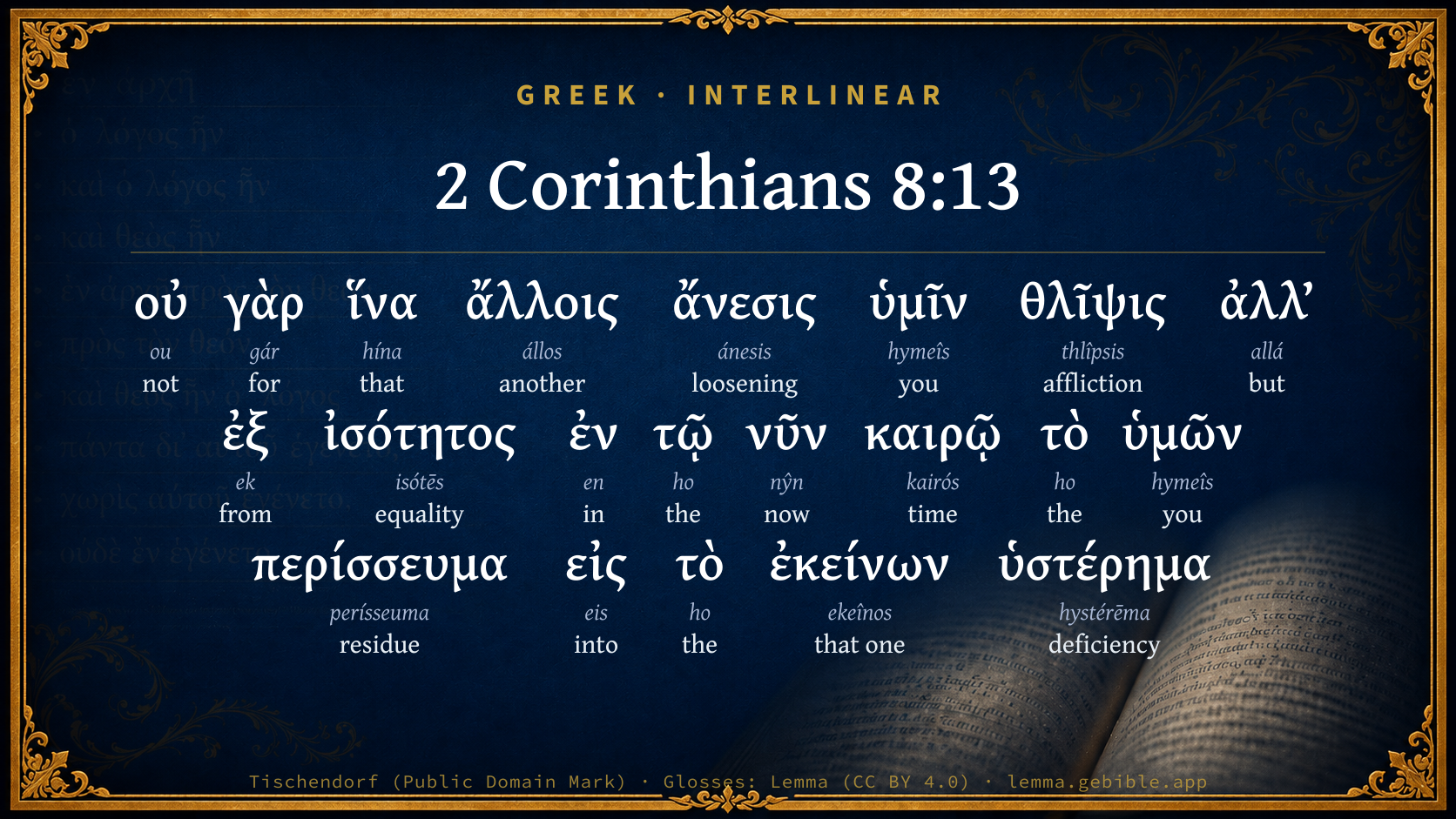
Greek (Tischendorf 8th ed.) 2 Corinthians 8:13 appears in the Greek New Testament. The text above is from the Tischendorf 8th edition. Each word links to its Strong’s number and a concise gloss. Click any word for its full Thayer’s Greek Lexicon entry.
Download image
Cite this verse

2 Corinthians 8:13 (World English Bible). Public Domain. Lemma interlinear Bible study tool, https://lemma.gebible.app/v/2-corinthians/8/13.

Show BibTeX & RIS
BibTeX
RIS
English Translation
For this is not that others may be eased and you distressed,
World English Bible · Public Domain
Highlights
  • 1 first appearance in the Greek New Testament
Full analysis ↓
Download a study sheet

One document with this verse’s original text, its word-by-word gloss line, the meaning frame, cross-references with their text, attributed commentary, and full source and license credits — printable, and it pastes into notes with its structure intact.

This verse Autodidact and up

Study sheet (.html) Plain text (.txt)

A passage Seminary Student

Up to 50 verses in one chapter. A passage sheet keeps up to 6 commentary sources and 12 cross-references per verse, in the order this page ranks them, and says so on the sheet whenever that leaves anything out. Ask for a single verse and you get the Autodidact verse sheet above.

Everything on this page stays free to read, with no account — the sheet is a download of what is already on screen, not access to it.

Want to remove ads? Support Godless Engineer
Compare translations 3

The same verse in 3 English versions, stacked beneath the original-language interlinear above. Click any original word for its lexicon entry.

Each is an independent rendering of the whole verse — the interlinear is not word-aligned to these translations.

Highlighted words mark where these versions differ — a whole-verse word diff, not a word-by-word alignment.

  • World English Bible Public Domain
    For this is not that others may be eased and you distressed,
  • King James Version Public Domain
    For I mean not that other men be eased, and ye burdened:
  • unfoldingWord Literal Text CC BY-SA 4.0
    For not so that relief for others tribulation for you, but out of equality.

unfoldingWord Literal Text — © unfoldingWord, licensed CC BY-SA 4.0. Word-aligned USFM3 via Door43 (git.door43.org/unfoldingWord/en_ult).

Versions to compare (up to 4)

3 of 4 selected

Show all 19 translations

Every available English version of this verse, each an independent rendering of the whole verse.

  • World English Bible Public Domain
    For this is not that others may be eased and you distressed,
  • Berean Standard Bible Public Domain
    It is not our intention that others may be relieved while you are burdened, but that there may be equality.
  • Majority Standard Bible Public Domain
    It is not our intention that others may be relieved while you are burdened, but that there may be equality.
  • King James Version Public Domain
    For I mean not that other men be eased, and ye burdened:
  • American Standard Version (1901) Public Domain
    For `I say' not `this' that others may be eased `and' ye distressed;
  • Revised Version (1885) Public Domain
    For I say not this, that others may be eased, and ye distressed:
  • Geneva Bible (1599) Public Domain
    Neither is it that other men should be eased and you grieued: But vpon like condition, at this time your abundance supplieth their lacke:
  • Douay-Rheims (1899) Public Domain
    For I mean not that others should be eased, and you burthened, but by an equality.
  • Young's Literal Translation Public Domain
    for not that for others release, and ye pressured, `do I speak,'
  • Literal Standard Version CC BY-SA 4.0
    for I do not speak that for others [to be] released, and you pressured,
  • Unlocked Literal Bible CC BY-SA 4.0
    For this task is not in order that others may be relieved and you may be burdened. Instead, there should be fairness.
  • unfoldingWord Literal Text CC BY-SA 4.0
    For not so that relief for others tribulation for you, but out of equality.
  • Darby Bible Public Domain
    For [it is] not in order that there may be ease for others, and for you distress,
  • World Messianic Bible Public Domain
    For this is not that others may be eased and you distressed,
  • Webster's Bible Public Domain
    For I mean not that other men should be eased, and you burdened:
  • Free Bible Version CC BY-SA 4.0
    This is not to make things easier for others and harder for you, but simply to be fair.
  • Bible in Basic English Public Domain
    And I am not saying this so that others may get off free, while the weight comes on you:
  • Text-Critical English NT CC BY 4.0
    I do not mean there should be relief for others and hardship for you, but it is a matter of equality. At the present time your abundance should provide for their need,
  • Tyndale New Testament (1534) Public Domain
    It is not my mynde that other be set at ease and ye brought into combraunce:

Literal Standard Version (2020), Covenant Press — licensed CC BY-SA 4.0. Text via the HelloAO Bible API (eBible.org). Unlocked Literal Bible (unfoldingWord) — licensed CC BY-SA 4.0. Text via the HelloAO Bible API (eBible.org). unfoldingWord Literal Text — © unfoldingWord, licensed CC BY-SA 4.0. Word-aligned USFM3 via Door43 (git.door43.org/unfoldingWord/en_ult). Free Bible Version, Dr. Jonathan Gallagher — licensed CC BY-SA 4.0. Text via the HelloAO Bible API (eBible.org).

Word by word

More ways to search: Search by grammar → Find every occurrence → Compare this word →

Practice this passage: Drill this verse → Learn its vocabulary →

ἰσότητος
isótēs
G2471
“equality”
Noun, Genitive, Singular, Feminine
Part of Speech
Noun
Case
Genitive
Number
Singular
Gender
Feminine
Full Thayer's Definition

Origin: likeness (in condition or proportion)

TDNT: 08:43,4

1. equality 2. equity, fairness, what is equitable
  1. οὐ ou G3756 “not” Particle, Negative
  2. γὰρ gár G1063 “for” Conjunction
  3. ἵνα hína G2443 “that” Conjunction
  4. ἄλλοις állos G243 “another” Adjective, Dative, Plural, Masculine
  5. ἄνεσις ánesis G425 “loosening” Noun, Nominative, Singular, Feminine
  6. ὑμῖν hymeîs G5210 “you” Personal pronoun, 2nd person, Dative, Plural
  7. θλῖψις thlîpsis G2347 “affliction” Noun, Nominative, Singular, Feminine
  8. ἀλλ’ allá G235 “but” Conjunction
  9. ἐξ ek G1537 “from” Preposition
  10. ἐν en G1722 “in” Preposition
  11. τῷ ho G3588 “the” Article, Dative, Singular, Masculine
  12. νῦν nŷn G3568 “now” Adverb
  13. καιρῷ kairós G2540 “time” Noun, Dative, Singular, Masculine
  14. τὸ ho G3588 “the” Article, Nominative, Singular, Neuter
  15. ὑμῶν hymeîs G5210 “you” Personal pronoun, 2nd person, Genitive, Plural
  16. περίσσευμα perísseuma G4051 “residue” Noun, Nominative, Singular, Neuter
  17. εἰς eis G1519 “into” Preposition
  18. τὸ ho G3588 “the” Article, Accusative, Singular, Neuter
  19. ἐκείνων ekeînos G1565 “that one” Demonstrative pronoun, Genitive, Plural, Masculine
  20. ὑστέρημα hystérēma G5303 “deficiency” Noun, Accusative, Singular, Neuter

About this verse

These counts appear in no published source. They are computed here, from the morphology-tagged text and Lemma’s own curated glosses. What Lemma adds →

21
words
18
distinct lemmas
Pauline Epistles
section

Notable vocabulary

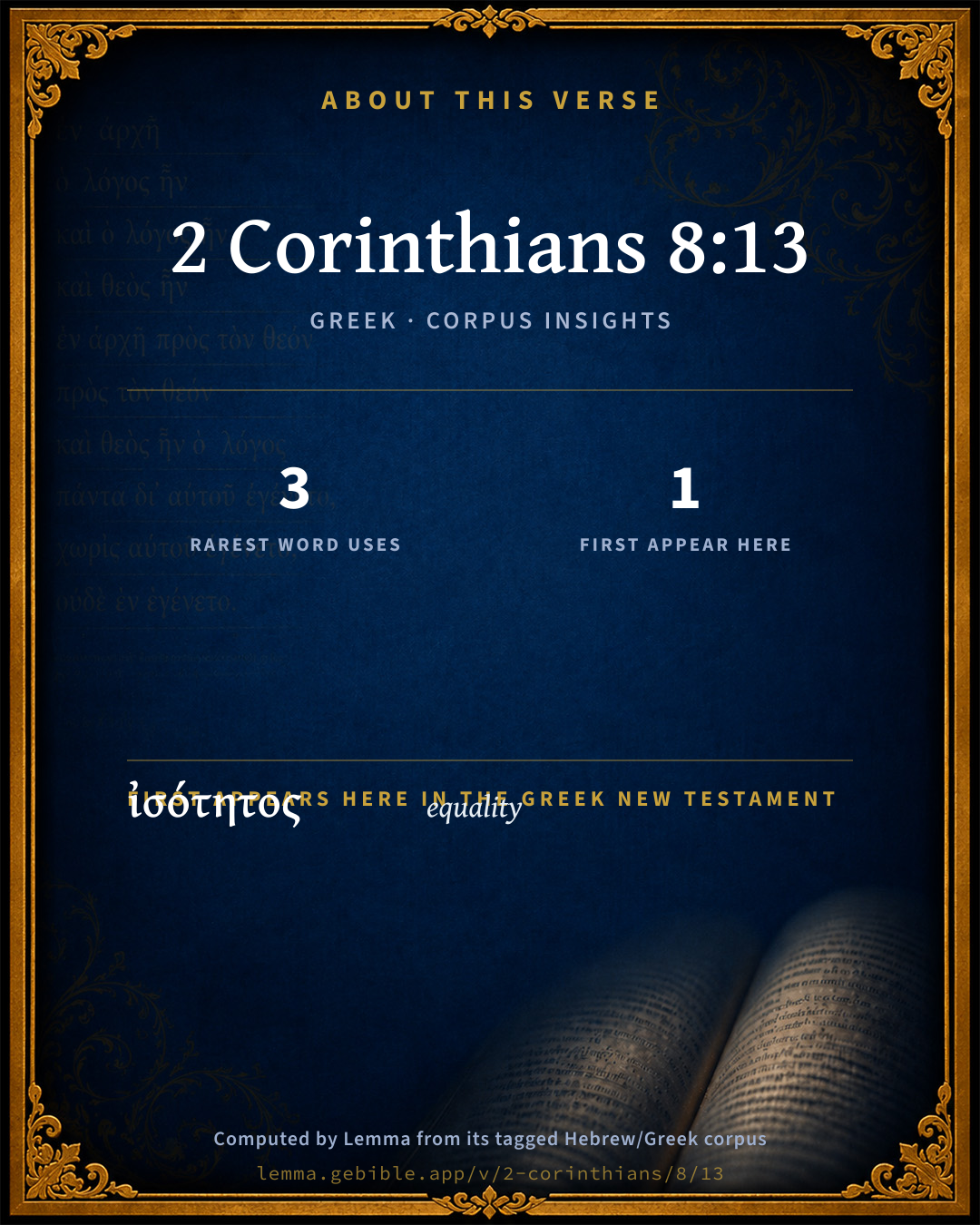
The rarest word here is ἰσότητος equality G2471 — appearing just 3 times in the whole Greek New Testament.

First appearance in Scripture

This word makes its first canonical appearance in the Greek New Testament here:

  • ἰσότητος equality G2471

Shared distinctive vocabulary

ἰσότητος equality G2471 occurs in 3 verses of the Greek New Testament. Also found in:
Repetition

Words recur within this verse:

Cross-references

2

Topical passages linked to 2 Corinthians 8:13 in the Treasury of Scripture Knowledge — connected by theme and wording, ordered by reader-vote popularity; previews shown in the World English Bible.

  • Acts 4:34 For neither was there among them any who lacked, for as many as were owners of lands or houses sold them, and brought the proceeds of the things that were sold,
  • Romans 15:26–27 For it has been the good pleasure of Macedonia and Achaia to make a certain contribution for the poor among the saints who are at Jerusalem.

Cross-references courtesy of OpenBible.info (CC BY 4.0).

Commentary

Notes on 2 Corinthians 8:13 from classic Christian and Jewish commentators (each source and its license shown beneath its notes). The classic Christian expositions comment on the surrounding passage and are grouped to its opening verse, so a note may address several verses; the Jewish commentaries on the Tanakh (Rashi and others) are per-verse, so they appear only where the commentator wrote on this verse.

Lemma curates 59 commentaries, every one of them public domain or Creative Commons licensed, each selected and text-cleaned for this edition rather than reprinted as found. About our sources →

The Biblical Illustrator

Joseph S. Exell

2Co_8:13-15

For I mean not that other men should be eased and ye burdened.

Christian liberality

I. The spirit in which Paul urged it. The apostle spoke strongly: not in the way of coercion, but of counsel and persuasion (2Co_8:8; 2Co_8:10). Note the difference between the dictatorial authority of the priest and the gentle helpfulness of the minister (2Co_1:24). There is not a minister or priest who is not exposed to the temptation which allures men to try to be a confessor and director to his people, to guide their conscience, to rule their wills, and to direct their charities. But observe how entirely alien this was from St. Pauls spirit. According to the apostle, a Christian was one who, perceiving principles, in the free spirit of Jesus Christ, applied these principles for himself. As examples of this, remember the spirit in which he excommunicated (1Co_5:12-13) and absolved (2Co_2:10), and remark, in both these cases--where the priestly power would have been put forward, if anywhere--the entire absence of all aim at personal influence or authority. St. Paul would not even command Philemon to receive his slave (Phm_1:8-9; Phm_1:13-14). And in the case before us he would not order the Corinthians to give even to a charity which he reckoned an important one. He wanted them to be men, and not dumb, driven cattle.

II. The motives he brought to bear.

1. The example of Christ (verse 9). To a Christian mind Christ is all; the measure of all things: the standard and the reference.

2. The desire of reciprocity (verses 13-15). This is the watchword of Socialists, who cry out for equality in circumstances. But think, Pauls principle is that the abundance of the rich is intended for the supply of the poor; and the illustration of the principle is drawn from the manna (verse 15). If any one through greediness gathered more than enough, it bred worms, and became offensive; and if through weakness, or deep sorrow, or pain, any were prevented from collecting enough, still what they had collected was sufficient. In this miracle St. Paul perceives a great universal principle of human life. God has given to every man a certain capacity and a certain power of enjoyment. Beyond that he cannot find delight. Whatsoever he heaps or hoards beyond that is not enjoyment but disquiet. E.g., if a man monopolises to himself rest which should be shared by others, the result is unrest--the weariness of one on whom time hangs heavily. Again, if a man piles up wealth, all beyond a certain point becomes disquiet. How well life teaches us that whatever is beyond enough breeds worms, and becomes offensive! We can now understand why the apostle desired equality, and what that equality was which he desired. Equality with him meant reciprocation--the feeling of a true and loving brotherhood; which makes each man feel, My superabundance is not mine: it is anothers: not to be taken by force, or wrung from me by law, but to be given freely by the law of love. Observe, then, how Christianity would soon solve the problems of the rights of the poor and the duties of the rich. After how much does possession become superabundance? When has a man gathered too much? You cannot answer these questions by any science. Socialism cannot do it. Revolutions will try to do it, but they will only take from the rich and give to the poor; so that the poor become rich, and the rich poor, and we have inequality back again. But give us the spirit of Christ. Let us love as Christ loved. Give us the spirit of sacrifice which the early Church had, when no man said that aught of the things he possessed was his own; then each mans own heart will decide what is meant by gathering too much, and what is meant by Christian equality. (F. W. Robertson, M. A.)

But by an equality.--

New Testament equality

The word ἰσότης means here neither reciprocity nor equity, but equality, as the illustration in verse 15 shows. The ἐκ, as in verse 11, expresses the rule or standard in giving. The rule is equality; we must give so as to produce, or that there may be, equality. This is not agrarianism, nor community of goods. The New Testament teaches on this subject--

I. That all giving is voluntary. A mans property is his own. It is in his own power to retain or to give away; and if he gives, it is his prerogative to decide whether it shall be much or little (Act_5:4). Giving is the fruit of love. It is of course obligatory as a moral duty, and the indisposition to give is proof of the absence of the love of God (1Jn_3:17). Still it is one of those duties the performance of which others cannot enforce as a right belonging to them. It must remain at our own discretion.

II. That the end to be accomplished by giving is relieving the necessities of the poor. The equality therefore aimed at is not an equality as to the amount of property, but equal relief from the burden of want.

III. That whilst all men are brethren, and the poor as poor, whether Christians or not, are the proper objects of charity, yet there is a special obligation resting on the members of Christ to relieve the wants of their fellow-believers (Gal_6:10). All the directions in this and the following chapter have reference to the duty of Christians to their fellow-believers. There are two reasons for this.

1. The common relation of believers to Christ as members of His body, so that what is done to them is done to Him, and their consequent intimate relation to each other as being one body in Christ Jesus.

2. The assurance that the good done to them is pure good. There is no apprehension that the alms bestowed will encourage idleness or vice.

IV. The poor have no right to depend on the benefactions of the rich because they are brethren (2Th_3:10). Thus do the Scriptures avoid, on the one hand, the injustice and destructive evils of agrarian communism, by recognising the right of property and making all almsgiving optional; and on the other, the heartless disregard of the poor by inculcating the universal brotherhood of believers, and the consequent duty of each to contribute of his abundance to relieve the necessities of the poor. At the same time they inculcate on the poor the duty of self-support to the extent of their ability. They are commanded with quietness to work, and to eat their own bread. Could these principles be carried out, there would be among Christians neither idleness nor want. (C. Hodge, D. D.)

The Biblical Illustrator, edited by Joseph S. Exell (c. 1880s–1900s) — public domain. Text from a community e-Sword module.

Joseph Benson's Commentary

2Co 8:13-15. I mean not that other men — Those who are now in want; should be eased — Plentifully supplied; and ye be burdened — Straitened to relieve them; that is, that ease should be to the brethren in Judea, through distress to you. But by (εξ, on account of) an equality — That a distribution should be made according to their necessity and your ability; that at the present time your abundance may be a supply for the wants of the brethren in Judea, and that at another time, if God, in the course of his providence, should hereafter change your conditions, and you should stand in need of it; their abundance may be a supply for your wants, so as that there may be an equality — That there may be no want on the one side, nor superfluity on the other. The words may likewise have a further meaning: that as the temporal bounty of the Corinthians supplied the temporal wants of their poor brethren in Judea, so the prayers of these might be a means of bringing down many spiritual blessings on their benefactors. So that all the spiritual wants of the one might be amply supplied; all the temporal of the other. As it is written — As it was in the gathering of the manna; He that gathered much had nothing over, &c. — Had only his proportion. For what any person gathered more than a homer, was put into a common stock, to make up that quantity to the aged and infirm, who gathered little.

Joseph Benson's Commentary on the Old and New Testaments (1811–1818) — public domain. Text from a community e-Sword module.

Whedon's Commentary on the Bible

Daniel D. Whedon

c. By assurance of fair proportionment, 2Co_8:13-15.

13. Eased… burdened—There was to be a reciprocity, an exchange of liberalities, when needed. Proud Corinth might again be laid in ashes, and poor Jerusalem, who now begs her aid, might be her benefactor.

Daniel D. Whedon (gen. ed.), Commentary on the Old and New Testaments (1874–1909) — public domain. Text from a community e-Sword module.

Bengel's Gnomon

Johann Albrecht Bengel

2Co 8:13. Οὐ γὰρ) for not, viz. the object aimed at is not. The rule of exercising liberality.—ἄνεσις· θλίψις) The same antithesis is found, 2Th 1:6-7.—ἐξ ἰσότητος, by an equality) in carnal things. [Love thy neighbour, as thyself (not more).—V. g.]—ἐν τῷ νῦν καιρῷ, at the present [juncture] time) This limitation does not occur again in the following verse.—τὸ—περίσσευμα, abundance) in external resources [means]. The imperative γενέσθω is courteously omitted, for he does not command, 2Co 8:8.

Bengel's Gnomon of the New Testament — English translation (T&T Clark, Edinburgh, 1860) — public domain. Text from a community e-Sword module.

Meyer's Critical & Exegetical Commentary

Heinrich August Wilhelm Meyer

2Co_8:13. Confirmation of the previous οὐ καθὸ οὐκ ἔχει from the aim of the present collection.

The words usually supplied after οὐ γάρ (Beza, Flatt, and others: hoc dico; Erasmus and Grotius: sic dandum est; Rosenmüller and Fritzsche, ad Rom. p 48: volo; comp. Osiander; Rückert has γίνεται τοῦτο, comp. Ewald, and previously Luther) are superfluous, and therefore to be rejected. There is nothing to be supplied but ᾖ after θλίψις and γίνεται (see 2Co_8:14) at the end of the verse: for not in order that there may be to others refreshing, to you distress, but on a footing of equality at the present time your superfluity reaches to the lack of those, is applied to remedy their lack. The punctuation is to be corrected accordingly. Since the sentence in this way flows logically and grammatically without any obstacle, there is not to be placed after θλίψις (Beza, Elzevir, Flatt, and many others), or yet even after ἰσότητος (Griesbach, Lachmann, Tischendorf, Rückert, de Wette, Osiander, and others), any colon, by which, moreover, ἐν τῷ νῦν καιρῷ would receive an emphasis not justified by any contrast, and would come in very abruptly, having no connecting particl.

ἄλλοις] means the Christians in Jerusalem. The same are afterwards meant by ἐκείνων. Probably opponents in Corinth had said: he wishes to fleece us and bring us to want, that others may have good times or the like.

On the contrast of ἄνεσις and θλίψις, comp. 2Th_1:6 f. The asyndeton: ἄλλοις ἄνεσις, ὑμῖν (δέ is not genuine) θλίψις presents the contrast more vividly. Paul, however, uses ἄλλοις, not ἑτέροις (as in 2Co_8:8), because he has been thinking of others generally, other persons than the readers.

ἐξ ἰσότητος] ἐκ, as in 2Co_8:11, used of the standard. The establishment of equality (between you and others) is the norm, according to which, et.

ἐν τῷ νῦν καιρᾷ] awakens the thought of a future, where the state of the case might be reversed. See 2Co_8:14. Hofmann thinks that Paul had here in view the definite inversion of the situation in such wise, that after Israels conversion (2Co_3:16) there would be in the Holy Land a Christian church under more prosperous fortunes than the body of Gentile Christians then sorely tried. But this is not to be made good by 2Th_2:3, and it has against it Rom_11:25, according to which, before the conversion of Israel will ensue, the whole Gentile world must first be converted, and accordingly Paul could hardly have thought of casual collections from Judaea as then either necessary or effectual for the Gentiles (apart altogether from the expected nearness of the Parousia).

On γίνεσθαι εἰς, to come unto, reach towards, be apportioned to (Plato, Tim. p. 57 A; Luc. Caucas, 19, al.), comp. on Gal_3:14.

Meyer — Critical and Exegetical Commentary on the New Testament — English translation by Peter Christie, edited by Frederick Crombie (T&T Clark, 1880) — public domain. Text from a community e-Sword module.

Expositor's Greek Testament

ed. W. Robertson Nicoll

2Co 8:13-14 . οὐ γὰρ ἵνα κ . τ . λ .: for the collection is not made in order that there may be relief to others, i.e. , to the Judæan Christians, and pressure to you, but by equality, your abundance at the present season being a supply for their want, that their abundance also may prove to be a supply for your want, sc. , at some future time, that there may be equality, i.e. , reciprocity. There is no thought here of Jerusalem giving spiritual benefits in return for the material benefits given by Corinth ( cf. chap. 2Co 9:14 and Rom 15:27 ); what is meant is that if it ever came to the turn of Corinth to be poor, then it would be for Jerusalem to contribute for her support: Such an idea as that of the transference of the merits of the saints is, of course, quite foreign to the context.

The Expositor's Greek Testament, edited by W. Robertson Nicoll (1897–1910) — public domain. Text from a community e-Sword module.

Geneva Bible (1599)

Geneva Bible translators

That like as now in your abundance you help others, which are poor, with some part of your goods, so should others in like sort bestow some of theirs upon you.

Christian liberality is mutual, that proportion may be ob-served.

Geneva Bible (1599) marginal notes — public domain. Text via Bolls.life.

Jamieson, Fausset & Brown

Robert Jamieson, A. R. Fausset & David Brown

For--Supply from Co2 8:8, "I speak." My aim is not that others (namely, the saints at Jerusalem) may be relieved at the cost of your being "distressed" (so the Greek for "burdened"). The golden rule is, "Love thy neighbour as thyself," not more than thyself.

Jamieson, Fausset & Brown — Commentary Critical and Explanatory on the Whole Bible (1871) — public domain (CC PDM 1.0). Text via the HelloAO Bible API.

Adam Clarke's Commentary

Verse 13. That other men be eased] I do not design that you should impoverish yourselves in order that others may live affluently.

Adam Clarke's Commentary on the Bible (1810–1826) — public domain. Text from a community e-Sword/MySword module.

John Calvin's Commentaries

13. Not that others. This is a confirmation of the preceding statement — that a readiness of will is well-pleasing to God alike in poverty and in wealth, inasmuch as God does not mean that we should be reduced to straits, in order that others may be at ease through our liberality. True, indeed, it is certain, that we owe to God, not merely a part, but all that we are, and all that we have, but in His kindness He spares us thus far, that He is satisfied with that participation of which the Apostle here speaks, What he teaches here you must understand to mean an abatement from the rigor of law. In the mean time, it is our part to stir ourselves up from time to time to liberality, because we must not be so much afraid of going to excess in this department. The danger is on the side of excessive niggardliness.

This doctrine, however, is needful in opposition to fanatics, who think that you have done nothing, unless you have stripped yourself of every thing, so as to make every thing common; and, certainly, they gain this much by their frenzy, that no one can give alms with a quiet conscience. Hence we must carefully observe Paul’s (ἐπιείκεια) mildness, and moderation, in stating that our alms are well-pleasing to God, when we relieve the necessity of our brethren from our abundance — not in such a way that they are at ease, and we are in want, but so that we may, from what belongs to us, distribute, so far as our resources allow, and that with a cheerful mind.

By an equality Equality may be taken in two senses, either as meaning a mutual compensation, when like is given for like, or, as meaning a proper adjustment. I understand ἰσότητα simply as meaning — an equality of proportional right, as Aristotle terms it. In this signification it is made use of, also, in Colossians 4:1, where he exhorts “masters to give to their servants what is equal.” He certainly does not mean, that they should be equal in condition and station, but by this term he expresses that humanity and clemency, and kind treatment, which masters, in their turn, owe to their servants. Thus the Lord recommends to us a proportion of this nature, that we may, in so far as every one’s resources admit, afford help to the indigent, that there may not be some in affluence, and others in indigence. Hence he adds — at the present time. At that time, indeed, necessity pressed upon them. Hence we are admonished that, in exercising beneficence, we must provide for the present necessity, if we would observe the true rule of equity.

John Calvin's Commentaries (1540-1563) — public domain. Text from the Calvin Translation Society English edition (1840s-50s) via the Christian Classics Ethereal Library (ccel.org). Calvin's coverage is partial (roughly two-thirds of the Bible); uncommented books and verses are honest gaps, never fabricated. The 19th-century editor's footnotes and remarks are omitted so the notes are faithfully Calvin's own voice.

Ellicott's Commentary for English Readers

(13) For I mean not that other men be eased.—The disclaimer is obviously an answer to something that had been said. The “charity begins at home” argument, with which the workers in the cause of missions and other distant works of charity are but too familiar, would seem not to have been unknown in the Church of Corinth.

A Bible Commentary for English Readers, edited by Charles John Ellicott (1878–1897) — public domain. Text from a community e-Sword module.

The Cambridge Bible for Schools and Colleges

gen. ed. J. J. S. Perowne

13. that other men be eased, and you burdened] This translation is partly due to the Geneva Version and partly to Tyndale. Literally it runs, that other men should have relief (see note on ch. 2Co_7:5) and ye tribulation. (That it be remissioun to other men and to you tribulation. Wiclif. Similarly the Rhemish Version.) “Again, in St Paul’s spirit of entreaty we remark the spirit of reciprocity. It might have been supposed that because St Paul was a Jew he was therefore anxious for his Jewish brethren; and that in urging the Corinthians to give liberally, even out of their poverty, he forgot the unfairness of the request, and was satisfied so long as only the Jews were relieved—it mattered not at whose expense.” Robertson.

The Cambridge Bible for Schools and Colleges (gen. ed. J. J. S. Perowne; Cambridge University Press, 1878–1918) — public domain. Text from a community e-Sword module.

John Gill's Exposition

For I mean not that other men be eased and you burdened. Referring either to the givers; and that either to the richer and meaner sort in this church; the apostle's sense being, not to put the whole burden of the collection upon some only, whilst others were excused doing little or nothing; but that everyone should give according to his ability; or to other churches in poorer circumstances; and the apostle's meaning was, not that these churches by reason of their meanness should be entirely free from this service, as it was plain they were not, by the instance of the Macedonians; and that the whole be devolved upon the Corinthian church, and others that were rich; but that all should contribute according to their circumstances: or this may refer to the persons given to, and for whom this beneficence was asked; for the words may be rendered, "for not that there may be ease", or relaxation "to others, and to you affliction" or straitness; that is, his meaning was, not that there should be such a contribution raised for these poor saints at Jerusalem, that they should live in ease and great abundance; whilst their benefactors, through an over abundant generosity to them, were straitened, and their families reduced to great difficulties; this was what was far from his intentions.

For I mean not that other men be eased and you burdened. Referring either to the givers; and that either to the richer and meaner sort in this church; the apostle's sense being, not to put the whole burden of the collection upon some only, whilst others were excused doing little or nothing; but that everyone should give according to his ability; or to other churches in poorer circumstances; and the apostle's meaning was, not that these churches by reason of their meanness should be entirely free from this service, as it was plain they were not, by the instance of the Macedonians; and that the whole be devolved upon the Corinthian church, and others that were rich; but that all should contribute according to their circumstances: or this may refer to the persons given to, and for whom this beneficence was asked; for the words may be rendered, "for not that there may be ease", or relaxation "to others, and to you affliction" or straitness; that is, his meaning was, not that there should be such a contribution raised for these poor saints at Jerusalem, that they should live in ease and great abundance; whilst their benefactors, through an over abundant generosity to them, were straitened, and their families reduced to great difficulties; this was what was far from his intentions.

2 Corinthians 8:14

co2 8:14

co2 8:14

co2 8:14But by an equality,.... All that he meant was, that there might be an equality both in givers and receivers, proportioned to their several circumstances and stations of life:

that now at this time; which was a very necessitous time at Jerusalem, there being a famine there, and their common stock exhausted:

your abundance may be a supply for their want, that their abundance also may be a supply for your want; which respects either the different abilities of givers at different times; and that whereas now the church at Corinth was rich, and wealthy, and had great abundance of the things of this world, they in this general collection were able to make up the deficiencies of other churches; and so should it ever be their case, as it might be, that they should be reduced, and these other churches increased, and enjoy a large abundance, they might hereafter in their turn supply what would be wanting in them: or else the persons given to; and the sense is, that should they ever change circumstances, as it was not impossible that they that were now rich should become poor, and they that were poor become rich; then as their abundance had been a supply to the wants of others, the abundance of others in their turn would be a supply to their wants; so that the argument is taken from the hope of retribution, in case of such vicissitudes; see Luk 6:38 his view was,

that there may be equality; either that in time to come an equal return may be made, should it be necessary; or that at present some sort of equality might be observed between the rich and poor; that the rich should so distribute as not to leave themselves without a proper support, according to their station of life; and yet so freely communicate, that the poor may not be without food and raiment, suitable to their lower sphere of life.

John Gill's Exposition of the Whole Bible (1746–1763) — public domain (CC PDM 1.0). Text via the HelloAO Bible API.

Trapp's Complete Commentary

John Trapp

13 For I mean not that other men be eased, and ye burdened:

Ver. 13. And you burdened] Gr. θλιψις, pinched or pressed, viz. with poverty.

John Trapp, A Commentary or Exposition upon All the Books of the Old and New Testament (1647–1656) — public domain. Text from a community e-Sword module.

Albert Barnes' Notes on the Bible

For I mean not that other men be eased ... - I do not intend that others should be eased in order to relieve you. Literally, “Not that there should be rest (ἄνεσις anesis, a letting loose; remission, relaxation) to others, but affliction (θλίψις thlipsis) to you.” Probably the Corinthians were able to contribute more than many other churches, certainly more than the churches of Macedonia 2Co 8:2, and Paul therefore presses upon them the duty of giving according to their means, yet he by no means intended that the entire burden should come on them.

Albert Barnes' Notes on the Bible (1834–1885) — public domain. Text from a community e-Sword/MySword module.

Matthew Poole's English Annotations

I do not press you to such proportions in giving as should make your afflicted brethren rich, and you poor.

Matthew Poole's English Annotations on the Holy Bible (1683–1685) — public domain. Text from a community e-Sword/MySword module.

The Pulpit Commentary

And ye be burdened; literally, for not that there may be relief to others, but to you affliction. In other words, I have no wish that you should distress yourselves to set others at ease. You must not suspect me of Jewish proclivities which would lead me to impoverish you to provide luxuries for the Christians at Jerusalem. Others refer it to the Macedonians: "I do not wish to burden you, but the Macedonians, who are poor, have contributed, and if you join them in this good work now they may help you hereafter." But there is no hint of this anywhere.

The Pulpit Commentary (1880–1919), ed. H.D.M. Spence-Jones & Joseph S. Exell — public domain. Text from a community e-Sword module.

Burkitt's Expository Notes on the New Testament

William Burkitt

Observe here, The humble modesty and holy prudence of the apostle, in what he demanded of the Corinthians by way of charity for the poor saints in Judea. He tells them freely, he did not design to lay a load upon them to ease others, or to make others rich by making themselves poor; but that there might be an equality in supplying the wants of one another, that now you abound, you may supply them; and when they abound, they may supply you; yet mark, We must not, by the equality mentioned here, understand it so, as if the wisdom of the divine providence had ordained levelling, or making all men equal in their portion of the good things of this life: But so far Christianity seems to require this equality, that we should not suffer others to lack the necessary comforts of this life, whilst we abound with them, and can spare them, and suffer them to sink in their sorrows, whilst we sin in fulness.

Learn hence, There is a debt of mercy and pity, of charity and compassion, of relief and succour, due to human nature, and payable from one man to another; and such as deny to pay it the distressed in the time of their abundance, may justly expect it will be denied themselves in the time of want.

To confirm this, the apostle draws an allusion from the gathers of manna in the wilderness; some gathered, more, and others less; but they that had more, were to give them that had less: In like manner would Almighty God have it, that they which have great riches, should impart of their abundance, to them that are in want; otherwise, Almighty God will shrink their heap into some equality with them whom they refused to relieve. With what measure we mete, in acts of charity, as well as in acts of justice, it shall be measured to us again.

William Burkitt's Expository Notes on the New Testament (1700–1703) — public domain. Text from a community e-Sword module.

McGarvey & Pendleton's Commentaries

J. W. McGarvey

For I say not this that others may be eased and ye distressed ;

J. W. McGarvey (with Philip Y. Pendleton), Commentaries on the New Testament (The Fourfold Gospel, 1914; Acts; and the epistles) — public domain. Text from a community e-Sword/MySword module.

The People's New Testament

B. W. Johnson

13. I mean not that other men be eased. I wish all to give according to what they have, other churches as well as you. Nor do I mean to burden you that the saints at Jerusalem may be at ease.

B. W. Johnson's The People's New Testament with Notes (1889–1891) — public domain. Electronic text from the Christian Classics Ethereal Library (CCEL) ThML edition.

unfoldingWord translationNotes

Door43 World Missions Community

For this task

This refers to collecting money for the believers in Jerusalem. AT: "For this task of collecting money" (See: Assumed Knowledge and Implicit Information)

that others may be relieved and you may be burdened

This can be stated in active form. AT: "that you may relieve others and burden yourselves" (See: Active or Passive)

there should be fairness

"there should be equality"

This is also so that their abundance may supply your need

Since the Corinthians are acting in the present time, it is implied that the believers in Jerusalem will also help them at some time in the future. AT: "This is also so that in the future their abundance may supply your need"

as it is written

Here Paul quotes from Exodus. This can be stated in active form. AT: "as Moses wrote" (See: Active or Passive)

did not have any lack

This can be stated positively. AT: "had all he needed" (See: Double Negatives)

translationWords

burden

written

unfoldingWord translationNotes — © Distant Shores Media and the Door43 World Missions Community, licensed CC BY-SA 4.0. Source: git.door43.org/Door43/en_tn.

Cambridge Greek Testament for Schools and Colleges

13, 14. The construction of the first ἵνα and of ἐξ ἰσότητος is uncertain. Probably ἵνα depends upon something to be understood, as ‘You must complete the ποιῆσαιʼ (2Co 8:11), or ‘I mean’ (A.V.), or ‘I say this’ (R.V.), or, as ἵνα itself suggests, ‘The object is’ (Waite). And ἀλλʼ ἐξ ἰσότητος looks both ways, but is more closely connected with what follows. For the object is not, that others may have relief, you distress (see critical note); but according to equality, at the present season your abundance to meet their want, that their abundance also may meet your want, that there may be equality. With ἐξ ἰσότητος comp. ἐκ τοῦ ἔχειν (2Co 8:11). It is not necessary to supply a verb for τὸ ὑμῶν περίσσευμα εἰς τὸ ἐκείνων ὑστέρημα. These words explain ἐξ ἰσότητος: on a principle of equality—your abundance to meet their want. With γένηται εἰς = ‘may be extended to’ comp. Gal 3:14. The Apostle reminds the Corinthians that a day may come when they may need help and the Palestinian Christians may be able to supply it, ὅπως γένηται ἱσότης, that there may be brought about equality. The help from Palestine to Corinth is a contingency in the future, and can hardly refer to the spiritual benefits which the heathen had received and were receiving from the Jews. For ὑμῶν see last note on 2Co 12:19.

13. The δέ after ὑμῖν (א3DFGKLP, Vulg. Arm.) is probably an insertion for smoothness: אBC, 17, 33, d e Aeth. omit.

Cambridge Greek Testament for Schools and Colleges (Cambridge University Press, 1896; 21 vols, various authors incl. Carr, Maclear, Plummer, Farrar, Lumby, Moule, M. R. James, Simcox) — public domain. Text from a community e-Sword module.

Alford’s Greek Testament

Henry Alford

13-15.] Further explanation that the present collection is not intended to press the Corinthians καθὸ οὐκ ἔχουσι. For (it is) not (the collection is not made) that there may be to others (the saints at Jerusalem) relief, and to you distress (of poverty):

Henry Alford, The Greek Testament (1849–1861) — public domain. Text from a community e-Sword module.

International Critical Commentary

13, 14. οὐ γὰρ ἵνα ἄλλιος ἄενσις. Something is often understood before ἵνα: ‘I mean’ (AV), or ‘I say this’ (RV), or ‘the object is’ (Waite and others), etc. But the ellipse is just as intelligible in English as in Greek, and in English no conjunction is needed; ‘Not that there is to be relief for others, pressure for you: but according to equality, etc.’ For ἄνεσις see on 2:13; also Index IV.

ἀλλʼ ἐξ ἰσότητος. These words may be taken either with what precedes or with what follows. Although ὅπως γένηται ἰσότης occurs at the end of the next sentence, it is perhaps best to take ἀλλʼ ἐξ ἰσότητος at the beginning of it. Place a colon at ‘pressure for you’ and continue; ‘but according to equality—at the present season your abundance to meet their want, that their abundance also may meet your want, so that the result may be equality.’* There is to be reciprocity, mutual give and take, so that in the end each side has rendered the same kind of service to the other. We need not bring in here the thought in Rom 15:27 of Gentiles giving material help in return for spiritual help. Here the help on both sides is material. The Apostle contemplates the possibility of Corinthian Christians being in distress, and of Jerusalem Christians sending money to relieve it, Vulg. supplies words which are not in the Greek; and something must be supplied; vestra abundantia illorum inopiam suppleat; ut et illorum abundantia vestrae inopiae sit supplementum. Beza has suppleat in both clauses. Ἐν τῷ νῦν καιρῷ as in Rom 3:26, Rom 11:5.

τὸ ὑμῶν περίσσευμα … τὸ ὑμῶν ὑστέρημα. This use of ὑμῶν between the art. and the noun is freq. in Paul; see on 1:6 and cf. 1Co 7:35, 1Co 9:12.

The δέ after ὑμῖν (א3 D E G K L P, Vulg. Goth. Arm.) is probably an insertion for the sake of smoothness; א* B C 17, d e, Aeth. omit. Note D E and d e.

International Critical Commentary — older volumes (1896–1929), various authors — public domain. Text from a community e-Sword module.

Lesson kit

Teaching starters — assembled from the data on this page, not authored interpretation. Every prompt links to the verse data it draws on. Edit before teaching.

2 Corinthians, in the Pauline Epistles, opens this verse with 21 words (18 distinct Greek lemmas). Its most distinctive word is isótēs (“equality”). A historical commentator’s framing appears above. Read the whole chapter for the surrounding context.

Discussion questions

  1. How does “equality” (isótēs) shape what this verse is saying?
  2. The word “equality” first appears here in Scripture. What is being introduced at this debut?
  3. 2 Corinthians 8:14 shares the word «equality» with this verse. How do the two illuminate each other?
  4. “the” occurs 3× in this one verse. What is the effect of the repetition?
  5. These translations render this verse differently; the difference is in the English rendering, not the original. What questions does that raise?
  6. Reading how The Biblical Illustrator and Joseph Benson's Commentary read this verse, where do the two commentators agree and where do they part?

Things to notice

  • 1 word makes its first canonical appearance in Scripture here.
  • These translations choose different wording for 14 words in this verse.
  • “the” occurs 3× in this single verse.
  • 18 distinct Greek lemmas span 21 words in this verse.

Reading settings

Reading text

Shown beneath each verse's original-language words.

Old Testament
Old Testament edition

Read the OT as the Masoretic Hebrew (MT) or the Greek Septuagint (LXX).

English shown for the Greek Septuagint (in the Hebrew ↔ Greek comparison).

Comparing translations? Open the Compare panel on any verse page to stack up to four side by side.