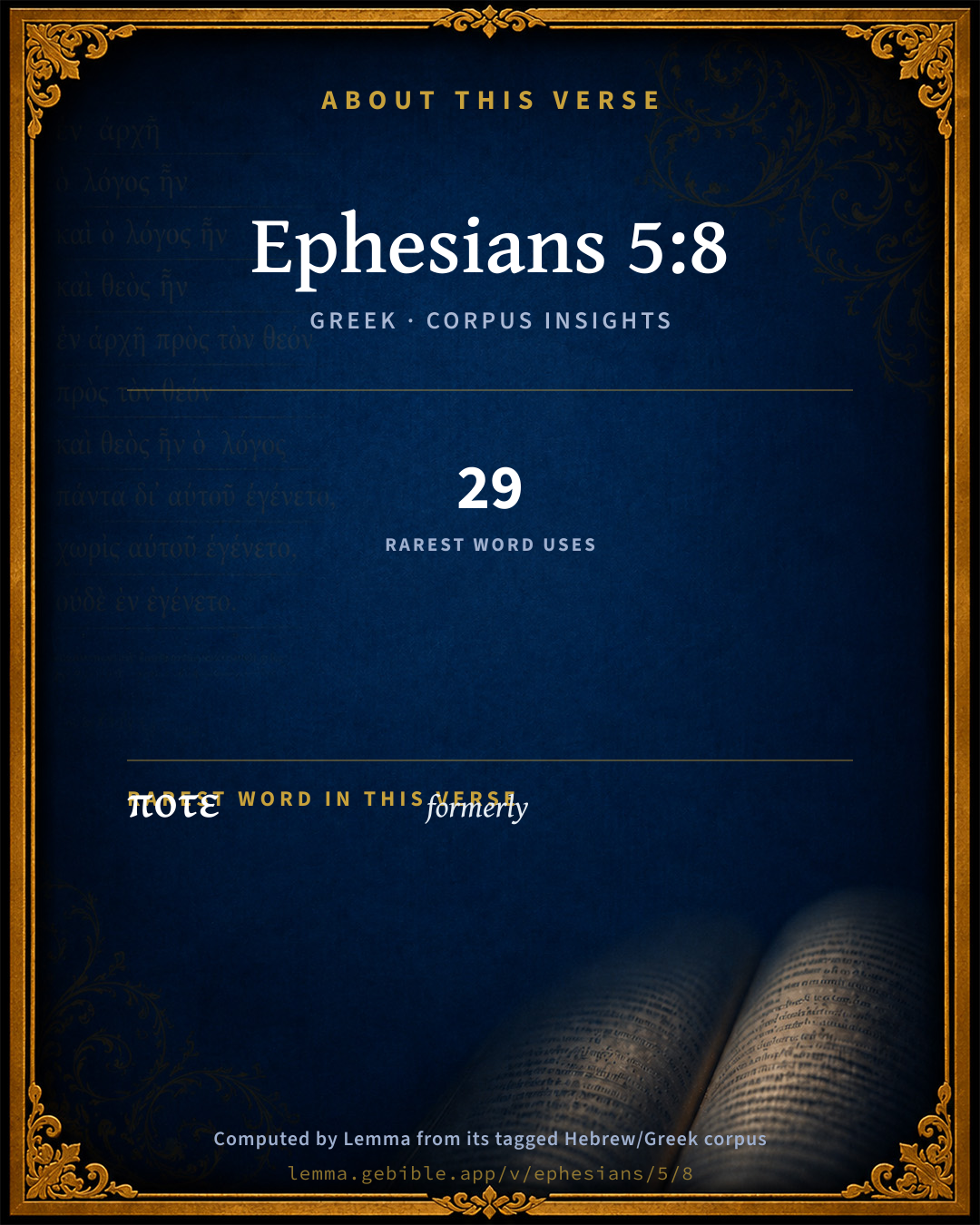
Ephesians 5:8

Greek (Tischendorf 8th ed.) Ephesians 5:8 appears in the Greek New Testament. The text above is from the Tischendorf 8th edition. Each word links to its Strong’s number and a concise gloss. Click any word for its full Thayer’s Greek Lexicon entry.
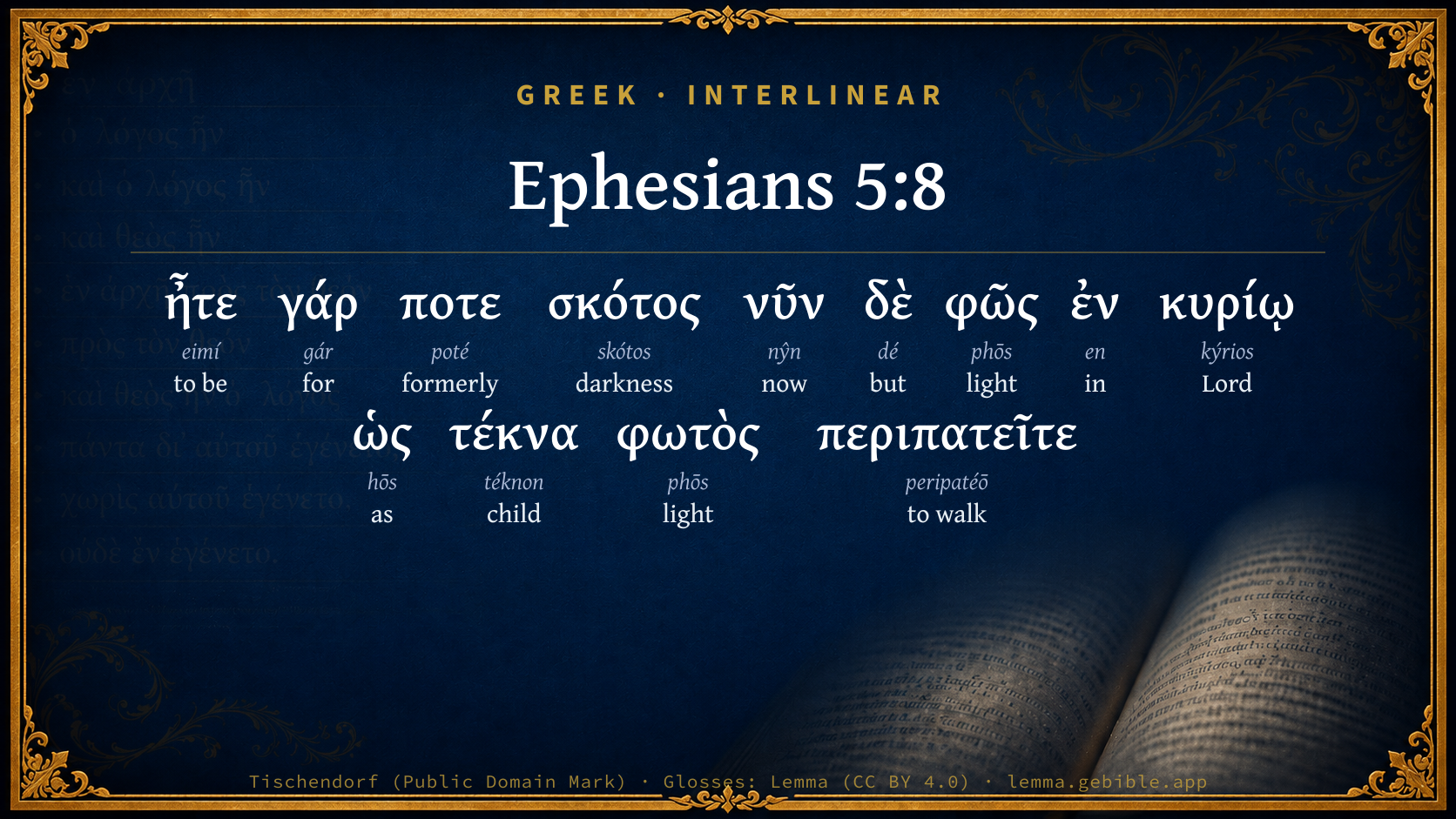
Download image
Cite this verse

Ephesians 5:8 (World English Bible). Public Domain. Lemma interlinear Bible study tool, https://lemma.gebible.app/v/ephesians/5/8.

Show BibTeX & RIS
BibTeX
RIS
English Translation
For you were once darkness, but are now light in the Lord. Walk as children of light,
World English Bible · Public Domain
Download a study sheet

One document with this verse’s original text, its word-by-word gloss line, the meaning frame, cross-references with their text, attributed commentary, and full source and license credits — printable, and it pastes into notes with its structure intact.

This verse Autodidact and up

Study sheet (.html) Plain text (.txt)

A passage Seminary Student

Up to 50 verses in one chapter. A passage sheet keeps up to 6 commentary sources and 12 cross-references per verse, in the order this page ranks them, and says so on the sheet whenever that leaves anything out. Ask for a single verse and you get the Autodidact verse sheet above.

Everything on this page stays free to read, with no account — the sheet is a download of what is already on screen, not access to it.

Want to remove ads? Support Godless Engineer
Compare translations 3

The same verse in 3 English versions, stacked beneath the original-language interlinear above. Click any original word for its lexicon entry.

Each is an independent rendering of the whole verse — the interlinear is not word-aligned to these translations.

Highlighted words mark where these versions differ — a whole-verse word diff, not a word-by-word alignment.

  • World English Bible Public Domain
    For you were once darkness, but are now light in the Lord. Walk as children of light,
  • King James Version Public Domain
    For ye were sometimes darkness, but now are ye light in the Lord: walk as children of light:
  • unfoldingWord Literal Text CC BY-SA 4.0
    because formerly you were darkness, but now light in the Lord. Walk as children of light

unfoldingWord Literal Text — © unfoldingWord, licensed CC BY-SA 4.0. Word-aligned USFM3 via Door43 (git.door43.org/unfoldingWord/en_ult).

Versions to compare (up to 4)

3 of 4 selected

Show all 19 translations

Every available English version of this verse, each an independent rendering of the whole verse.

  • World English Bible Public Domain
    For you were once darkness, but are now light in the Lord. Walk as children of light,
  • Berean Standard Bible Public Domain
    For you were once darkness, but now you are light in the Lord. Walk as children of light,
  • Majority Standard Bible Public Domain
    For you were once darkness, but now you are light in the Lord. Walk as children of light,
  • King James Version Public Domain
    For ye were sometimes darkness, but now are ye light in the Lord: walk as children of light:
  • American Standard Version (1901) Public Domain
    For ye were once darkness, but are now light in the Lord: walk as children of light
  • Revised Version (1885) Public Domain
    For ye were once darkness, but are now light in the Lord: walk as children of light
  • Geneva Bible (1599) Public Domain
    For ye were once darkenesse, but are nowe light in the Lord: walke as children of light,
  • Douay-Rheims (1899) Public Domain
    For you were heretofore darkness, but now light in the Lord. Walk then as children of the light.
  • Young's Literal Translation Public Domain
    for ye were once darkness, and now light in the Lord; as children of light walk ye,
  • Literal Standard Version CC BY-SA 4.0
    for you were once darkness, and now light in the LORD; walk as children of light,
  • Unlocked Literal Bible CC BY-SA 4.0
    For you were once darkness, but now you are light in the Lord. Walk as children of light
  • unfoldingWord Literal Text CC BY-SA 4.0
    because formerly you were darkness, but now light in the Lord. Walk as children of light
  • Darby Bible Public Domain
    for ye were once darkness, but now light in [the] Lord; walk as children of light,
  • World Messianic Bible Public Domain
    For you were once darkness, but are now light in the Lord. Walk as children of light,
  • Webster's Bible Public Domain
    For ye were sometime darkness, but now are ye light in the Lord: walk as children of light;
  • Free Bible Version CC BY-SA 4.0
    At one time you were darkness, but now you are light in the Lord. You are to live as children of light
  • Bible in Basic English Public Domain
    For you at one time were dark, but now are light in the Lord: let your behaviour be that of children of light
  • Text-Critical English NT CC BY 4.0
    For you were once darkness, but now you are light in the Lord. Walk as children of light
  • Tyndale New Testament (1534) Public Domain
    Ye were once dercknes but are now light in the Lorde. Walke as chyldren of light.

Literal Standard Version (2020), Covenant Press — licensed CC BY-SA 4.0. Text via the HelloAO Bible API (eBible.org). Unlocked Literal Bible (unfoldingWord) — licensed CC BY-SA 4.0. Text via the HelloAO Bible API (eBible.org). unfoldingWord Literal Text — © unfoldingWord, licensed CC BY-SA 4.0. Word-aligned USFM3 via Door43 (git.door43.org/unfoldingWord/en_ult). Free Bible Version, Dr. Jonathan Gallagher — licensed CC BY-SA 4.0. Text via the HelloAO Bible API (eBible.org).

Word by word

More ways to search: Search by grammar → Find every occurrence → Compare this word →

Practice this passage: Drill this verse → Learn its vocabulary →

About this verse

These counts appear in no published source. They are computed here, from the morphology-tagged text and Lemma’s own curated glosses. What Lemma adds →

13
words
12
distinct lemmas
Pauline Epistles
section

Shared distinctive vocabulary

ποτε formerly G4218 occurs in 28 verses of the Greek New Testament. Also found in:

Repetition

A word recurs within this verse:

  • φῶς light G5457 ×2

Cross-references

38

Topical passages linked to Ephesians 5:8 in the Treasury of Scripture Knowledge — connected by theme and wording, ordered by reader-vote popularity; previews shown in the World English Bible.

  • John 8:12 Again, therefore, Jesus spoke to them, saying, "I am the light of the world. He who follows me will not walk in the darkness, but will have the light of life."
  • 1 John 1:7 But if we walk in the light, as he is in the light, we have fellowship with one another, and the blood of Jesus Christ, his Son, cleanses us from all sin.
  • John 12:46 I have come as a light into the world, that whoever believes in me may not remain in the darkness.
  • Acts 26:18 to open their eyes, that they may turn from darkness to light and from the power of Satan to God, that they may receive remission of sins and an inheritance among those who are sanctified by faith in me.'
  • Colossians 1:13 who delivered us out of the power of darkness, and translated us into the Kingdom of the Son of his love;
  • 1 Peter 2:9–11 But you are a chosen race, a royal priesthood, a holy nation, a people for God's own possession, that you may show forth the excellencies of him who called you out of darkness into his marvelous light:
  • Isaiah 42:6–7 I, Yahweh, have called you in righteousness, and will hold your hand, and will keep you, and give you for a covenant of the people, for a light of the Gentiles;
  • Ephesians 4:18 being darkened in their understanding, alienated from the life of God, because of the ignorance that is in them, because of the hardening of their hearts;
  • John 12:36 While you have the light, believe in the light, that you may become children of light." Jesus said these things, and he departed and hid himself from them.
  • Isaiah 9:2 The people who walked in darkness have seen a great light: those who lived in the land of the shadow of death, on them has the light shined.
  • Ephesians 2:2 in which you once walked according to the course of this world, according to the prince of the powers of the air, the spirit who now works in the children of disobedience;
  • Isaiah 2:5 House of Jacob, come, and let us walk in the light of Yahweh.
  • Isaiah 60:1–3 Arise, shine; for your light is come, and the glory of Yahweh is risen on you.
  • Jeremiah 13:16 Give glory to Yahweh your God, before he cause darkness, and before your feet stumble on the dark mountains, and, while you look for light, he turn it into the shadow of death, and make it gross darkness.
  • 2 Corinthians 4:6 seeing it is God who said, "Light will shine out of darkness," who has shone in our hearts, to give the light of the knowledge of the glory of God in the face of Jesus Christ.
  • Luke 16:8 "His lord commended the dishonest manager because he had done wisely, for the children of this world are, in their own generation, wiser than the children of the light.
  • Isaiah 60:19–20 The sun shall be no more your light by day; neither for brightness shall the moon give light to you: but Yahweh will be to you an everlasting light, and your God your glory.
  • Luke 1:79 To shine on those who sit in darkness and the shadow of death; To guide our feet into the way of peace."
  • 2 Corinthians 3:18 But we all, with unveiled face beholding as in a mirror the glory of the Lord, are transformed into the same image from glory to glory, even as from the Lord, the Spirit.
  • Ephesians 6:12 For our wrestling is not against flesh and blood, but against the principalities, against the powers, against the world's rulers of the darkness of this age, and against the spiritual hosts of wickedness in the heavenly places.
  • 1 Thessalonians 5:4–8 But you, brothers, aren't in darkness, that the day should overtake you like a thief.
  • Titus 3:3 For we were also once foolish, disobedient, deceived, serving various lusts and pleasures, living in malice and envy, hateful, and hating one another.
  • Isaiah 49:9 saying to those who are bound, Go forth; to those who are in darkness, Show yourselves. They shall feed in the ways, and on all bare heights shall be their pasture.
  • Matthew 4:16 The people who sat in darkness saw a great light, To those who sat in the region and shadow of death, To them light has dawned."
  • John 1:4–5 In him was life, and the life was the light of men.
  • John 1:9 The true light that enlightens everyone was coming into the world.
  • Romans 2:19 and are confident that you yourself are a guide of the blind, a light to those who are in darkness,
  • 1 Corinthians 1:30 But of him, you are in Christ Jesus, who was made to us wisdom from God, and righteousness and sanctification, and redemption:
  • 2 Corinthians 6:14 Don't be unequally yoked with unbelievers, for what fellowship have righteousness and iniquity? Or what communion has light with darkness?
  • 1 John 2:8–11 Again, I write a new commandment to you, which is true in him and in you; because the darkness is passing away, and the true light already shines.
  • Isaiah 42:16 I will bring the blind by a way that they don't know; in paths that they don't know will I lead them; I will make darkness light before them, and crooked places straight. These things will I do, and I will not forsake them.
  • Isaiah 49:6 yes, he says, It is too light a thing that you should be my servant to raise up the tribes of Jacob, and to restore the preserved of Israel: I will also give you for a light to the Gentiles, that you may be my salvation to the end of the earth.
  • Romans 1:21 Because, knowing God, they didn't glorify him as God, neither gave thanks, but became vain in their reasoning, and their senseless heart was darkened.
  • Galatians 5:25 If we live by the Spirit, let's also walk by the Spirit.
  • Psalms 74:20 Honor your covenant, For haunts of violence fill the dark places of the earth.
  • Acts 17:30 The times of ignorance therefore God overlooked. But now he commands that all people everywhere should repent,
  • Ephesians 2:11–12 Therefore remember that once you, the Gentiles in the flesh, who are called "uncircumcision" by that which is called "circumcision," (in the flesh, made by hands);
  • Ephesians 5:2 Walk in love, even as Christ also loved you, and gave himself up for us, an offering and a sacrifice to God for a sweet-smelling fragrance.

Cross-references courtesy of OpenBible.info (CC BY 4.0).

Commentary

Notes on Ephesians 5:8 from classic Christian and Jewish commentators (each source and its license shown beneath its notes). The classic Christian expositions comment on the surrounding passage and are grouped to its opening verse, so a note may address several verses; the Jewish commentaries on the Tanakh (Rashi and others) are per-verse, so they appear only where the commentator wrote on this verse.

Lemma curates 59 commentaries, every one of them public domain or Creative Commons licensed, each selected and text-cleaned for this edition rather than reprinted as found. About our sources →

The Biblical Illustrator

Joseph S. Exell

Eph_5:8

For ye were sometimes darkness, but now are ye light in the Lord: walk as children of light.

The children of light and their obligations

I. The degradation from which believers have been raised. A state of wretchedness resulting: from ignorance to God and disobedience to His will.

II. The nobility to which believers have been advanced. The light of truth has shone into their hearts, and exposed to view all the abominations, all the depravity, that lay concealed in the dark chambers of imagery within. They have learned to know not only themselves, but also God and Jesus Christ, whom to know is life eternal. They are now united to the Lord, and are of one spirit. Christ dwells in them, and they in Him.

III. The duties devolving on those who are light in the Lord.

1. They are required to walk as children of light; to prove their descent, to show what family they belong to; to act according to the light bestowed, the knowledge attained; to keep themselves unspotted from the world, undefiled by the surrounding contagion.

2. They are bound to prove what is acceptable unto the Lord--to test what is well pleasing unto Him. This can only be known by the revelation of His will, oral or written.

3. They are forbidden all fellowship with the fruitless works of darkness. (J. DArcy Sirr, D. D.)

The past and the present: an incentive to acceptable walking

I. Their former state. Darkness--the darkness of heathendom. Such was the state of all men by nature. The state of nature is a state of darkness; and I may say of every unregenerate man, thou art darkness. And if this is true of our view of nature in its best form, what shall we say of the life of sin? Utter darkness! everything darkness! Our Lord says, he that walketh in darkness, knoweth not whither he goeth; and the apostle describes them as wandering stars; going from bad to worse, and from worse to worse, from one sin to another, from one error to another. But there is another description of this state of darkness, besides this: we say, that a state of unbelief is a state of darkness.

II. Their present condition. Light. A very strong expression. It is not said, ye have some light; it is not said, there is some light in you; but it is positively declared, ye are light. Of course, this can only be taken in a modified sense; because how little is the light that any of the saints of God have! We see only through the unveiled face. We see as in a glass darkly; we know in part. Alas! how little do we know of the glory of the Saviour in His person! how little do we know of the perfection of the Saviour! how little do we enter into the glory of the atoning blood! how little do our souls enter into the sweet savour of that sacrifice! and how little we realize the perfection of that Perfect righteousness, which is unto all and upon all them that believe! How little do our spirits enter into the deep and unutterable fulness that there is in Jesus! And yet, though our light be so feeble, still it is light. He never despises that light that comes from the work of the Holy Ghost in the soul of man; however feeble, however faint, He never despises it. Oh! for a word of tender caution; do you never despise it either.

III. The exhortation. Walk as children of light. If you ask for a simple view of their walking as children of light--I would say first of all it is to walk in the brightness of that light: to walk in the light of Gods precious gospel, to walk in the light of Gods perfections, to walk in the realizing view of His pardoning mercy, to walk in the light of His adoption, to walk as righteous ones, righteous in the righteousness of the Lord Jesus Christ. Surely the light is sweet, and a pleasant thing it is to behold the sun.

2. He walks as a child of light, beloved, as he walks in the purity of that light. Observe, this is an essential part of the subject--it is the very subject for which the apostle introduced it; ye were sometimes darkness, but now are ye light in the Lord: walk as children of light (for the fruit of the Spirit is in all goodness and righteousness and truth): proving what is acceptable unto the Lord. My dear hearers, we are to walk as children of light--only be you thankful and grateful for being thus brought into the light. To be brought into the light, to one that once was blind, would be one of the first things that would fill his heart with joy. What were ye once? I am persuaded too, beloved, that if we are children of light, we shall rejoice that others be made to walk in the light of that same gospel; we shall rejoice to diffuse, as far as in us lies, that gospel around us. (J. H. Evans, M. A.)

Unconverted sinners are darkness

But what is it to be in darkness? What is this unconverted state that the Holy Ghost so often calls darkness? Take it in these four particulars. To be in darkness is

(1) to be in sin, the work of darkness;

(2) to be under Satan, the prince of darkness;

(3) under wrath, the fruit of darkness;

(4) near to hell, the place of darkness.

The Scripture by darkness ordinarily expresses some or all of these. When an unconverted state is called darkness, we are to understand by it a most sinful and miserable state. The misery of an unconverted state is so great, as even this darkness will discover it. Let us follow the metaphor a little, the better to discern it.

1. Darkness is uncomfortable. So is the state of an unconverted sinner. Who would not be weary of his life upon earth, if the sentence of continual darkness should pass upon it? Alas! more miserable is thy condition if unconverted, because the want of spiritual light is a greater misery than the want of sensible light.

2. Darkness is dangerous. He whose way lies near snares and pits, who is to pass over precipices, rocks, the brink of dangerous gulfs, and has no light to direct him, every step is the hazard of his life. No less dangerous is the way of man ever since sin entered into the world. So many snares has Satan laid, so many pits has he digged, so near we walk to the brink of the bottomless pit, as without light we cannot make one step in safety.

3. Darkness is fearful. We read of the horrors of darkness (Gen_15:12). What more apt to engender fears than darkness, when dangers are on every side, and nothing visible that may afford confidence! So the state of nature. The condition of a sinner unconverted is a fearful condition. He is encompassed with terrors on every side; such as, if he were sensible of them, would dash all his mirth and carnal jollity. Those whom the Lord has enlightened to see the dreadfulness of that state, they wonder that such can sleep quietly, or take comfort in any enjoyment, while they are not converted.

But who are those that are in darkness? How shall we know whether we be in this unconverted state?

1. Who walk in the ways of darkness? The children of light do not walk in the paths of darkness. You may know your state by your way; ways of wickedness are ways of darkness: so Solomon: The way of the wicked is darkness (Pro_4:19). He that walks in any way of known wickedness, be it drunkenness, etc., neglect of ordinances, etc., he is in darkness. By their fruits ye may know them.

2. Those that want spiritual discerning. He that has eyes and sees not, it is plain he is in darkness; what else should hinder his sight? So they that have the same understanding, the same faculty of inward sight with others, and yet perceive not that in spiritual things, that those discern who are savingly enlightened, it is evident that spiritual darkness overshadows their souls.

3. Those that act not for God. The things of God are at a distance from every unconverted man; he sees not, he knows not how to go about it.

4. Exhortation, to those that are converted, brought out of the woeful state of darkness; let this stir you up to joy and thankfulness for your deliverance. (D. Clarkson, B. D.)

Light in the Lord

For God who commanded … not of us. We hear much in these days about the electric light. It is much more brilliant than the old-fashioned lamps. I was looking at one the other day, and noticing particularly that the candles, as they are called, are only black, ugly pieces of charcoal. Nothing more. As I looked at them I could not but wonder that things which by their nature were so black, could, when connected with the mysterious power which causes the flame to glow, give out such wonderful light. Truly the light is not in them. It is the unseen but mighty power working in them and through them that enables them to be useful. A tiny flaw may break the connection and stop the light--disconnected for one instant from the source the light dies instantly, and utterly.

Change of state demands change of life

In the words we have--

1. An antecedent.

2. A consequent, or an argument and an inference.

First: The antecedent, or argument, is taken from their present compared with their past estate, what they are with what they were.

1. The grace received--Ye are light; that is, filled with the light of wisdom and holiness. But can it be used of any mere man liable to such imperfections?

(1) It noteth not their perfection so much as the perfection of the dispensation they are under. Not their perfection, as if there were no darkness in them at all, but the clearness of the gospel which then shined brightly to them. There is a difference between the gospel and believers; the gospel is a perfect light, but we do but imperfectly receive it.

(2) It noteth some good measure and degree of participation, but not complete fruition. Participation it noteth, for otherwise it could not be said that we are not only enlightened, but light itself; not complete fruition, for those that are said to he light in the Lord are presently called children of the light; which doth somewhat abate of the expression.

(3) It noteth that we have received grace, not only for ourselves, but for the good of others.

2. The author of this grace--In the Lord; that is, Christ; for there is but one Lord, as well as one God and Father of all (Eph_4:5-6); and whatever good we have, we have it from Christ and in Christ.

I. Let me speak of the two opposite states, darkness and light, and there show you that the carnal estate is an estate of darkness, and the renewed state is a state of light.

1. The carnal estate is an estate of darkness. So the apostle telleth the Ephesians, Ye were not only darksome, but darkness itself, for the greater vehemency of the expression.

(1) The darkness of the understanding is ignorance; they are incapable of discerning between good and evil, know nothing of the nature and will of the true God.

(2) There is downright and apparent wandering from God.

(3) Eternal misery is the issue and close of it (Mat_25:30; 2Pe_2:17).

2. The renewed estate is an estate of light. Light is a quality pure and unmixed, and implieth both knowledge, holiness, and happiness. Knowledge, as it discovereth all things; holiness, as it is pure, and can shine on the filthiest dunghill without any stain; felicity, as it is the smile of heaven upon the earth.

II. That there is a mighty change wrought in them who are called out of one estate into the other.

1. They have a different principle. All things work according to their nature; as fire ascendeth and water descendeth; fishes go to the water, and beasts keep on dry land; it is according to their nature, and that principle of life which they have. The saints have a Divine nature: Whereby ye are made partakers of the Divine nature (2Pe_1:4).

2. As the internal principle of our operation is unlike, so the external rule of our conversations are quite different, viz., the will of God revealed in the word, which they study to know and obey: Proving what is acceptable unto the Lord (Eph_5:10); Be not unwise, but understanding what the will of the Lord is (verse 17); That ye may prove what is that good and acceptable and perfect will of God (Rom_12:2).

III. That it is good often to compare those two estates, and to consider what we are by nature and what we are by grace. First: That we ought frequently to reflect on our former woeful estate. Reasons there are for this.

1. To magnify the riches of Gods mercy in our deliverance from that woeful estate. We wonder at it more when we compare both together (1Pe_2:9).

2. That we may admire His power in the change (1Co_6:11).

3. To keep us humble (1Co_15:9; 2Co_12:7.

4. It makes us more compassionate to others, we having once had as blind a mind and hard a heart as they (Tit_3:2-3).

5. It makes us more watchful. A man who has escaped a dangerous disease or surfeit is very careful not to lapse into it again.

6. It quickens us to greater fruitfulness for time to come. Was I so zealous for sin, and shall I not do so much for God (Rom_6:19)? Since we set out so late, let us mend our pace.

7. It maketh our conversion more evident and sensible, and so quickeneth us to thankfulness and praise.

8. It increases our confidence and hopes of eternal life. He that could take us with all our faults, and love us, and pardon us, and heal our natures, and reconcile us to Himself, will He not give us eternal life after we begin to obey, love, and serve Him in our measure? (Rom_5:9-10).

9. It puts an argument in our hands against sin (Rom_6:20-21). Secondly: We ought to remember what we were by nature, so as not to deny what we are by grace (Rom_6:17).

IV. This change must be manifested by a suitable conversation: Walk, etc. Children of the light may refer to the dispensation we are under, or the grace we have received by it.

1. The dispensation we are under, as those that live in the clearness of gospel light are children of the day. Ye are not of the night; walk as children of light, that have the light of the gospel, or becoming that most holy religion which Christ hath taught us.

(1) In the light all blemishes are soon discovered, and so our sins are without excuse; whereas people that have not the gospel, or not so fully preached, are more excusable. Men might plead this, that they knew no better; but now they have no cloak for their sin (Joh_15:22).

(2) As they are without sin, so without shame, when they sin in the open light: Every morning doth He bring His judgment to light; He faileth not, but the unjust knoweth no shame (Zep_3:5).

(3) Sins are more dangerous and deadly: And this is the condemnation, that light is come into the world, and men loved darkness rather than light, because their deeds are evil (Joh_3:19).

2. The grace received by it. (T. Manton, D. D.)

Darkness and light

I. This verse is typical of the Christian religion. It is the appeal which the preacher to Christian hearers has to make in very varied forms and at various times all through his ministry. Advent and Lent, the special times appointed by the Church for doing it, in order to ensure its being done. But it is a work for every time; and every mission or other time of revival is a form of doing it.

II. The words are used as symbols.

1. Light a good thing; needful for our bodily health; needful for our sustenance by the fruits of the earth; without light we could not live.

2. Without light we could not work. We may put forth strength, but cannot direct it.

3. Darkness a bad thing--hurtful if continued, and destructive to animal and vegetable life. In the night crimes of violence are committed; it is their congenial home.

III. Light therefore means goodness and darkness sin.

1. Light to the soul is when all its powers are directed consciously to right ends, i.e., to holy living, to the worship and the glory of God. Darkness, when either it knows not that right end, or, knowing it, deliberately chooses something else as its purpose.

2. Contrast in these respects between the Christian and the pagan world.

IV. Earnest and practical. The personal question, the great question for us all.

1. Are you in the darkness or in the light?

2. With all your Christian privileges you should be in the light. Do you prove that you are so by love to God, watchfulness over yourself, tenderness of conscience? No mere words will be acceptable as a proof. If ye love Me, keep My commandments. On the other hand--

3. Whatever your profession of religion, and whatever your privileges, if you are contented with sin--willingly enduring it, not anxious to overcome it in your own soul and in the souls of others--then you are still in the darkness.

4. Be not satisfied to remain so. Make an effort to break your chain by the help of Jesus. (S. J. Eales, M. A.)

Learning to walk

I suppose that all you boys and girls think that you know how to walk. You would laugh at the idea of being taught how you are to use your legs now, as you were when you were babies. Well, we will see. You all know how to walk along the country lanes and turnpike roads, but if you were to go to London for the first time, you would find that you did not know how to walk. I have sometimes seen a countryman in one of the crowded streets of the City of London, trying to make his way along, and every minute he would run against some passenger, and get in the way of another, till the busy city folks were quite angry with him. There is a particular way of walking in crowded streets, and, like everything else, it has to be learned. But there is another kind of walking which has to be learned. We hear a great deal about that in the Bible. St. Paul has much to say about how we ought to walk, and he was not writing to little tiny children, but to grown up men and women. Now there are only two roads on which we can walk. One is the broad road which leads to destruction, the devils road. It seems easy to travel on it at first, but it grows harder and rougher as we go on, for the way of transgressors is hard. You know what the other road is? The Kings highway, the narrow path which leads to life eternal, Gods way, of which He says, Walk ye in it. Here are some plain rules for you, my children, which will show you how you ought to walk through life as Gods children, as children of light.

1. Then, keep to the right. You will often see these words printed up in the crowded streets of great cities. Your own conscience will tell you what is right, and whenever there are two ways for you to go in, the right or the wrong, be sure to keep to the right.

2. The next rule I give you is, keep your eyes open. If you were to walk along a road with your eyes shut, you would soon stumble or fall, or wander out of the right path; but if you keep your eyes open, you see the rough places over which you might stumble, and the muddy places where you might splash your clothes with dirt, and you can see the finger post showing you the right way. Well, in walking along the path of life you will need to keep your eyes open. There are dangerous places, over which you will stumble and fall, unless you watch for them carefully; there are temptations, like muddy pools, which will stain your white robe, and make it foul, unless you avoid them. If you keep your eyes open, you will see Gods hand directing you, and you will find that He has placed many finger posts to show you the right way. The Church is one finger post, the Bible is another, your teachers are all pointing out to you the right road.

3. My next piece of advice to you is, push your way. There are sure to be difficulties in your path. You can do one of two things, you can wait for the difficulty to be removed, or you can push your way through it. In large towns, where there are great public buildings, such as banks and offices, you often see a heavy door leading into the building, and on it is written the one word, push. Now, suppose you wished to enter that building; you might pull at that door for hours and not open it; you might ring the bell, or call to someone to open, but everybody would be too busy to listen. There would be only one thing for you to do, you must push, then the door would open. So it is with all difficulties: where theres a will theres a way; if you push against the door which is blocking your way, it will open.

4. Take another word of advice, when you meet with your enemy, fight. I dont mean an earthly enemy, and I dont mean fighting with your fists. As you walk along the roads of life, your enemy, the devil, will often stand in the path to injure you, to turn you out of the way, Whom resist, steadfast in the faith. The ancient Greeks, who were the most famous soldiers of old times, carried a shield in battle. To lose this shield and leave it behind, was the greatest disgrace which could happen to them. When a soldier was killed, or badly wounded, his companions laid him on his shield, and carried him out of the fight. I have read of a Greek mother, who said to her son as he was going to the battle, Either return with your shield or upon it. That meant, Either conquer or die. My children, it would be very sad for us to have to say, after we have met with temptations to sin--I have returned again, but I have left my shield behind.

5. Last of all, take this rule if you would walk rightly, mind the crossings. In London streets it is very difficult and dangerous to cross the road sometimes. If you are not very careful, and quite accustomed to it, you may be knocked down, and run over: or you may take the wrong turning, and lose yourself. So it is with life, we have to cross over a difficult crossing very often, and there is a great crowd of temptations and sins all around us, and if we are not very watchful, we shall be knocked down and run over by some of those temptations. (H. J. Wilmot-Buxton, M. A.)

Walk as children of light

I. Attend to the character applied to the heirs of grace. Children of light, as opposed to the children of darkness.

1. On account of their celestial extraction.

2. It denotes their spiritual illumination.

3. It signifies the purity of their hearts.

4. It refers (o the sanctity of their conduct.

5. It means that they have an inheritance of this description in heaven.

II. The apostles exhortation--Walk as children of light.

1. Shine in your conduct towards your minister. Hold him in high reputation. Submit to him, Pray for him. Receive his advice. Provide for him.

2. Shine one towards another. Cultivate unanimity. A spirit of forbearance. Help each other. Preserve a high esteem one for another, and seek to have your affection increased. Conduct yourselves towards each other with the strictest fidelity.

3. Shine in your conduct towards all around you in the world.

III. Improvement.

1. Be circumspect.

2. Be humble.

3. Take care of an implacable spirit.

4. Be steady in your profession.

5. Take the Word of God for your guide.

6. Pray that your minister may be faithful. (The Pulpit.)

Light in the Lord

Light denotes several things in Scripture.

1. Spiritual knowledge. Light and knowledge are terms of the same import (2Co_4:6). Light to discover God in Christ savingly, and to discern the things of God spiritually.

2. Purity and holiness. Sin and corruption is expressed by darkness, holiness and purity by light. In this sense the most holy God is called Light (1Jn_1:5), spotless and perfect holiness, in whom there is not the least impurity. And in reference to us (verse 7), such a light as this is life, spiritual life, which consists in the principles of holiness and purity.

3. The favour of God, and the consequent of it, joy and comfort. The favour of God, the manifesting of His loving kindness, is frequently expressed by the light of His countenance (Psa_4:6), the issue of which is joy and gladness (verse 7). Light and joy explain one another (Psa_97:11). That which is light in the first clause is joy in the latter.

4. Glory and happiness. Heaven, the seat of it, is described by light (1Ti_6:16). It is called the inheritance (Col_1:12).

Use 1. If those that are converted be light, etc., then those that are not converted are not light in the Lord. This necessarily follows by the rule of contraries. They may be light in appearance, or in respect of natural endowments, or moral accomplishments, or in the account of others, or in their own conceit and apprehensions, but they are not light in the Lord; and this shows the misery of an unconverted state, and it is useful to take notice of it more particularly. If they are not light in the Lord--

(1) they are not in the Lord. The phrase implies union; but such are without union to, without communion with, without participation of, without special relation to Him; without His special protection, without His special favour, without His gracious covenant. It may be propounded to them that they have no actual interest in, or right to, the blessings, the mercies of the covenant.

(2) They want the saving knowledge of God in Christ, they are not light in this respect. The darkness of ignorance and misapprehensions is upon the face of their souls; the prince of darkness, the god of this world, has blinded their minds (2Co_4:3-4). Though they may be knowing men in other respects, yet as to spiritual, saving, experimental, effectual knowledge of Christ, and the things of Christ, they are in darkness.

(3) They want the favour of God. They are not under the beams of Divine love, the light of Gods countenance does not shine on them, and so they are not light in the Lord. Those that are unconverted, want that which is the life and joy to the converted soul; that which sweetens all his afflictions and makes all his enjoyments comfortable.

(4) They want the lustre of holiness. This is one thing which concurs to make converts light in the Lord. This light shines nowhere on earth but in the hearts and lives of such; those that are unconverted show themselves either strangers or enemies to it. They are carnal, sold under sin, know not what belongs to an holy frame of heart; think heaven may be attained without strictness, holiness, as the Scripture requires, and the lives of the saints there recorded hold forth; jeer, deride, abuse it, under odious names; place all their holiness in some outward performances or observances; holy discourse and employments are wearisomeness to them.

(5) They want discoveries of future glory, they are not light in the Lord; they have not so much light as will discover it at a distance; there are no dawnings, no approaches, no appearances of that blessed light. It is midnight with a sinner while unconverted. But how shall we know, who are in this state, whether or no we be light in the Lord? To direct you herein, let us come to--

Use 2. by way of examination. Hereby ye may know whether ye be converted. Every convert is light in the Lord; those, therefore, that are not light in the Lord are not converted; these are so conjoined, as he that knows the one may conclude the other. Examine, then, whether ye be light in the Lord, if ye would know whether ye be converted. In order hereto observe these particulars:

(1) Light is delightful.

(2) While there is light there is heat.

Heat, as philosophers tell us, is an inseparable property of celestial light. We see a concurrence of these in fire; indeed, there may be an appearance of light where there is no heat, as in glow worms, but where there is any real light, there is some degree of heat more or less. Answerably, they that are light in the Lord are zealous for the Lord, eager in following Him, ardent in love to Him and desires after Him, fervent in spirit in serving Him.

(3) Light is progressive. The light from its birth grows and increases, till it domes to its full strength, when the sun is in the meridian. Thus it is with those that ale light in the Lord, as Solomon expresses it (Pro_4:18). This light is but a spark at first, and often accompanied with much smoke, but by degrees it breaks forth into a flame. Such grow in grace and in the knowledge of Christ; they go from strength to strength, and from one degree of holiness and spiritual knowledge to another; this light daily prevailing against the darkness of ignorance and corruption, till at last it be brought forth to victory. There is a growth of knowledge in the extent of it; it discovers one truth after another, unlocks one mystery after another, and daily scatters the clouds of misapprehensions. In the clearness of it, sees gospel truths with more and more evidence, as that blind mans sight was restored by degrees (Mat_8:23-24). In the firmness of it: established in the truth to a full assurance. There is a growth in the spiritualness, the efficacy, the experimentalness, the practicalness of his knowledge. This light has daily a more spiritual and powerful influence upon his heart, to spiritualize it in his motions, intentions, inclinations; upon his conscience, to make it tender; upon his affections, to kindle them to God, and dead them to the world; upon his conversation, to reform and beautify it with more holy and exemplary actings. There is a growth in grace, too, in everyone that is light in the Lord. This light of holiness shines more and more, prevails against inward distempers and outward miscarriages, Dears down the interest of darkness, i.e. of the flesh and of the world.

Use 3. Consolation to those that are converted. If thou art a convert thou art light in the Lord, and this light discovers thy condition to be safe, comfortable, glorious, durable.

(1) Safe. If thou canst conclude by Scripture evidence, I was sometimes darkness, etc. The Lord has brought thee into a safe condition; thou art freed from those fears and dangers that thy former darkness exposed thee to.

(2) Comfortable. Light and joy in Scripture are put one for the other; and Solomon tells us: The light of the righteous rejoiceth (Pro_13:9). What cause they have to rejoice who are light in the Lord; who are in Him, united to Him, in covenant with Him, under the beams of His love, under the sweet influences of His loving, kindness!

(3) Durable. Not safe, comfortable, happy for a moment, but forever; for it is light in the Lord. If thy light were in thyself, death or other calamities might extinguish it; if thy light were in the world and outward enjoyments, it might go out of itself, for the light hereof is but as the crackling of thorns; if thy light were in wickedness it would certainly be put out (Job_18:5-6). But what can put out that light that is in the Lord? Light in other things is like them, vain and fading; but light in the Lord is as He is, everlasting. Everlasting knowledge, joy, holiness, happiness is the portion of converted souls; because they have all these in the Lord.

(4) Glorious. Nothing visible on earth more glorious than light; and these are put one for the other in Scripture (1Co_15:41). What is their glory but their light? Those who are converted have hereby a double glory, one as they are light, the other as they are light in the Lord, light in the Lord of glory, He is a glory to them, even as a robe of light would be to our body; such, and much more, is the Lord to a converted soul (Isa_60:19). (D. Clarkson, B. D.)

Walk as children of light

I. What is it to be children of light? It denotes several things.

1. Descent. They are called children of light who are of the Father of lights. Christ, the light of the world, is formed in them.

2. Propriety.

3. Destination. 1Sa_20:31, one who is near to, worthy of, destined to, death; so children of light, because ordained to it.

4. Residence. They abide in the light.

5. Constitution. Their minds, hearts, affections, are of a lightsome, i.e., a spiritual and heavenly temper; spiritual light in their minds, holiness in their wills, joy, delight, hopes of glory in their hearts.

6. Obligation. Those that are converted are in this sense children of light, because they are obliged to walk as those that are enlightened from above; to walk holily, to be followers of God as dear children. There are strong engagements laid upon them, they are bound by covenant thus to walk.

II. What is it to walk as children of light?

1. To walk at a distance from darkness (verse 11); from sin, which is the work, which is the cause of all those woeful things which the Holy Ghost expresses by darkness. What communion has fight with darkness? (2Co_6:14). He speaks of it as a most absurd, incongruous thing, that those that are light should mingle with darkness. Every degree of darkness is contrary to fight; so every sin, small or great, open or secret, is opposite, contrary, altogether unbeseeming the blessed relation of a child of fight.

2. To walk boldly; to be herein followers of God as dear children. How followers of God? The apostle tells us (1Pe_1:15-16), the light of holiness should shine in the fives of those that are Christs; holiness both exercised and diffused. Walking denotes motion and activeness.

3. Exemplarily. Children of fight must walk so as to be fight unto others, and this in divers particulars.

(1) Unblameably. So as to give no cause of offence to the weak, nor no cause of reproach to the wicked.

(2) Their walking should be convictive. It should discover and manifest the sinfulness of those who walk in the ways of darkness.

(3) Their walking should be imitable, i.e., worthy of imitation; so order their ways as they may be a pattern unto others; so shine, as others may follow the light, not in affectation of preeminence, or singularity, in unwarranted opinions or practices; but in close following of Christ, and walking exactly according to the rule of holiness.

(4) Their walking should be an ornament to their profession.

4. Cheerfully. Being children of light, they are children of joy. That is their portion, they are all Barnabases, sons of consolation, and should walk accordingly.

If it be inquired how we may walk as children of light?

1. Walk not according to opinion. This can have no better ground than vain opinion, which Moses followed not, when he chose rather to suffer, etc., and accounted the reproach of Christ, etc. (Heb_11:25-26). He had not respect to common opinion, but to something else; nor did the apostle regard it, but something of another nature (2Co_4:16-18).

2. Follow the light of the Word fully. Make use of it to discover the whole will of God concerning the duty of His children, that you may comply with it, and order heart and life by it. Decline no part of it, whatever it be.

3. Walk above the world and earthly things. Children of light are clothed with the sun; the moon, the world is under their feet (Rev_12:1). It has no high place in their minds or hearts; riches, pleasures, honours, and respect are thrown down in their thoughts, and cast out of their affections, they are not the design of their lives; the world is their footstool everywhere, and serves, does not command them.

4. Walk in the sight of heaven. Children of the fight are the children of the kingdom, heirs of heaven and glory, begotten again to an inheritance, etc. And that is one reason why they are called children of light, because they are heirs of the inheritance of the saints in light. (D. Clarkson, B. D.)

Light in daffiness

I was in a darkened room, that I might observe the effect produced by the use of what is appropriately called luminous paint. A neat card, on which the words Trust in the Lord were printed, rested upon the bookcase, and shone out clearly in the darkness. The effect fairly startled me. It was the first time that I had seen this simple but interesting effect. How remarkable that, if from any cause the light of sun or day failed to rest upon the card, its luminousness gradually declined, but returned when the suns action infused fresh light! Truly, we also, if hidden from the face of our Lord, cease to shine. Ye are light in the Lord: walk as children of the light. (Henry Varley.)

Children of light

That deep-lunged, red-blooded preacher, Sydney Smith, used to throw open the shutters to the morning sun, saying, Let us glorify the room! Both conscience and temperament led him, also, to insist on flooding the dark places of the moral world with cheerfulness, which is the sunshine of the spirit. Thus he constantly advocated the wisdom of what he called short views of life. It was obvious, he thought, that the larger part of our worries and perplexities came from the anticipation of evils. He insisted that if we were happy now, or at least not miserable, or even not overborne by the trouble of the hour, we might logically infer--nay, we should even make it a duty to suppose--that tomorrow, or next week, or next year, would also bring its balance of compensation and resistance. Every substantial grief or danger, he used to say, was accompanied by twenty shadows, and most of these are of our own making.

The Biblical Illustrator, edited by Joseph S. Exell (c. 1880s–1900s) — public domain. Text from a community e-Sword module.

Joseph Benson's Commentary

Eph 5:8-10. For ye were sometimes — That is, once; darkness — In a state of total blindness and ignorance, without any light of instruction without, or divine grace within, and therefore had some excuse for living such unrighteous and profane lives: but now ye are light in the Lord — Enlightened by the divine word and Spirit, and brought to the saving knowledge of God and Christ, and of divine things in general; and consequently such vicious practices as you formerly pursued would be utterly inexcusable in you now. You are now under an indispensable obligation to walk as children of light — That is, in a manner suitable to your present knowledge. For, &c. — As if he had said, Such walking is the proper, natural result of your illumination and spiritual condition; the fruit of the Spirit is in — Consists in; all goodness, righteousness, and truth — That is, the Spirit works these graces in those persons in whom he dwells, graces quite opposite to the sins spoken of Eph 4:25, &c. By goodness we are to understand an inclination and endeavour to perform all good offices to our fellow-creatures, especially to the children of God: by righteousness, justice, and fair dealing toward all men: and by truth, freedom from hypocrisy, dissimulation, guile, and deceit. Some MSS., together with the Syriac and Vulgate versions, read here, But the fruit of the light, &c., which Estius, Grotius, Mill, and Bengelius, think the true reading, because there is no mention made of the Spirit, either in what goes before, or in what follows. The common reading they suppose hath been taken from Gal 5:22. Proving — Δοκιμαζοντες, making trial of, proving by experience, or approving; what is acceptable — Ευαρεστον, well-pleasing; to the Lord — And how happy they are who in all things are governed by his will.

Joseph Benson's Commentary on the Old and New Testaments (1811–1818) — public domain. Text from a community e-Sword module.

Whedon's Commentary on the Bible

Daniel D. Whedon

b. Against their secret and nightly shame be children of light and day, Eph_5:8-17.

As the darkness of night is the element in which license and guilt find their covert, so by association of thought license and darkness are conceptually identified; while, on the contrary, truth and purity, as well as knowledge, are conceptually identified with light. These associations of thought are universal in the human mind and in human language. Zoroastrianism makes light and darkness the emblem of the two great kingdoms of good and evil in the world. St. Paul here intensifies the thought, by making light and darkness include not only the principles of good and evil, but the human embodiments of good and evil, the Church and the anti-Church.

8. Ye were—While Gentiles.

Now are ye light—Not as illuminated, but as luminous and illuminating. So our Saviour: “Ye are the light of the world.”

Children of light—In the whole paragraph there is a blending of the double thought of moral and physical light. So our Lord: “Let your light so shine, that men may see your good works.” The children of light are those who are not only the true sons of moral illumination, but are so congenial with the actual light of day that the sun may freely shine upon all they do, and illuminate even the secrets locked within their breasts. And so, also, in the uses of both the terms light and darkness there is a blended double reference to the moral principles and the classes of men who embody the principles. Christians are light, and they are children of light; and, Eph_5:13, the darkness of the licentious, by having the light shine through them, becomes light.

Daniel D. Whedon (gen. ed.), Commentary on the Old and New Testaments (1874–1909) — public domain. Text from a community e-Sword module.

MacLaren's Expositions of Holy Scripture

Alexander MacLaren

EPHESIANS

WHAT CHILDREN OF LIGHT SHOULD BE

Eph 5:8

It was our Lord who coined this great name for His disciples. Paul’s use of it is probably a reminiscence of the Master’s, and so is a hint of the existence of the same teachings as we now find in the existing Gospels, long before their day. Jesus Christ said, ‘Believe in the light, that ye may be the children of light’; and Paul gives substantially the same account of the way by which a man becomes a Son of the Light when he says, in the words preceding my text, ‘Ye were sometimes darkness, but now are ye light in the Lord.’

Union with Him makes light, just as the bit of carbon will glow as long as it is in contact with the electric force, and subsides again into darkness when that is switched off. To be in Christ is to be a child of light, and to believe in Christ is to be in Him.

But the intense moral earnestness of our Apostle is indicated by the fact that on both occasions in which he uses this designation he does so, not for the purpose of heightening the sense of the honour and prerogative attached to it, but for the sake of deducing from it plain and stringent moral duties, and heightening the sense of obligation to holy living.

‘Walk as children of light.’ Be true to your truest, deepest self. Manifest what you are. Let the sweet, sacred secrets of inward communion come out in the trivialities of ordinary conduct; make of your every thought a deed, and see to it that every deed be vitalised and purified by its contact with the great truths and thoughts that lie in this name. These are various ways of putting this one all-sufficient directory of conduct.

Now, in the context, the Apostle expands this concentrated exhortation in three or four different directions, and perhaps we may best set forth its meaning if we shape our remarks by these, I venture to cast them, for the sake of emphasis, into a hortatory form.

I. Aim at an all-round productiveness of the natural fruits of the light.

The true reading is, ‘Walk as children of light, for the fruit of the light’ {not spirit, as the Authorised Version reads it} ‘is in all goodness and righteousness and truth.’ Now, it is obvious that the alteration of ‘light’ instead of ‘spirit’ brings the words into connection with the preceding and the following. The reference to the ‘fruits of the spirit’ would be entirely irrelevant in this place; a reference to the ‘fruit of the light,’ as being every form of goodness and righteousness and truth, is altogether in place.

There is, then, a natural tendency in the light to blossom out into all forms and types of goodness. ‘Fruit’ suggests the idea of natural, silent, spontaneous, effortless growth. And, although that is by no means a sufficient account of the process by which bad men become good men, it is an inseparable element, in all true moral renovation, that it be the natural outcome and manifestation of an inward principle; otherwise it is mere hypocritical adornment, or superficial appearance. If we are to do good we must first of all be good. If from us there are to come righteousness and truth, and all other graces of character, there must, first of all, be the radical change which is involved in passing from separateness in the darkness to union with Jesus Christ in the light. The Apostle’s theory of moral renovation is that you must begin with the implantation in the spirit of the source of all moral goodness-viz. Jesus Christ-brought into the heart by the uniting power of humble faith. And then there will be lodged in our being a vital power, of which the natural outcome will be all manner of fair and pure things. Effort is needed, as I shall have to say; but prior to effort there must be union with Jesus Christ.

This wide, general commandment of our text is sufficiently definite, thinks Paul; for if the light be in you it will naturally effloresce into all forms of beauty. Light is the condition of fruitfulness. Everywhere the vital germ is only acted upon by the light. No sunshine, no flowers; darkness produces thin, etiolated, whitened, and feeble shoots at the best. Let the light blaze in, and the blanched feebleness becomes vigorous and unfolds itself. How much more will light be the condition of fruitfulness when the very light itself is the seed from which all fruit is developed.

But, still further, mark how there must be an all-round completeness in order that we shall fairly set forth the glory and power of the light of which our faith makes us children and partakers. The fruit ‘is in all goodness and righteousness and truth.’ These three aspects-the good, the right, the true-may not be a scientific, ethical classification, but they give a sufficiently plain and practical distinction. Goodness, in which the prevailing idea is beneficence and the kindlier virtues; righteousness, which refers to the sterner graces of justice; truth, in which the prevalent idea is conformity in action with facts and the conditions of man’s life and entire sincerity-these three do cover, with sufficient completeness, the whole ground of possible human excellence. But the Apostle widens them still further by that little word all.

We all tend to cultivate those virtues which are in accordance with our natural dispositions, or are made most easy to us by our circumstances. And there is nothing in which we more need to seek comprehensiveness than in the effort to educate ourselves into, and to educe from ourselves, kinds of goodness and forms of excellence which are not naturally in accordance with our dispositions, or facilitated by our circumstances. The tree planted in the shrubbery will grow all lopsided; the bushes on the edge of the cliff will be shorn away on the windward side by the teeth of the south-western gale, and will lean over northwards, on the side of least resistance. And so we all are apt to content ourselves with doing the good things that are easiest for us, or that fit into our temperament and character. Jesus Christ would have us to be all-round men, and would that we should seek to aim after and possess the kinds of excellence that are least cognate to our characters. Are you strong, and do you pride yourself upon your firmness? Cultivate gentleness. Are you amiable, and pride yourself, perhaps, upon your sympathetic tenderness? Try to get a little iron and quinine into your constitution. Seek to be the man that you are least likely to be, and aim at a comprehensive development of ‘all righteousness and goodness and truth.’

Further, remember that this all-round completeness is not attained as the result of an effortless growth. True, these things are the fruits of the light, but also true, they are the prizes of struggle and the trophies of warfare. No man will ever attain to the comprehensive moral excellence which it is in his own power to win; no Christian will ever be as all-round a good man as he has the opportunities of being, unless he makes it his business, day by day, to aim after the conscious increase of gifts that he possesses, and the conscious appropriation and possession of those of which he is still lacking. ‘Nothing of itself will come,’ or very little. True, the light will shine out in variously tinted ray if it be in a man, as surely as from the seed come the blade and the ear and the full corn in the ear, but you will not have nor keep the light which thus will unfold itself unless you put forth appropriate effort. Christ comes into our hearts, but we have to bring Him there. Christ dwells in our hearts, but we have to work into our nature, and work out in action, the gifts that He bestows. They will advance but little in the divine life who trust to the natural unfolding of the supernatural life within them, and do not help its unfolding by their own resolute activity. ‘Walk as children of the light.’ There is your duty, for ‘the fruit of the light is all righteousness.’ One might have supposed that the commandments would be, ‘Be passive as children of the light, for the light will grow.’ But the Apostle binds together, as always, the two things, the divine working and the human effort at reception, retention, and application of that divine work, just as he does in the great classical passage, ‘Work out your own salvation, for it is God that worketh in you.’

II. Secondly, the general exhortation of my text widens out itself into this-test all things by Christ’s approval of them.

‘Proving what is well pleasing unto the Lord.’ That, according to the natural construction of the Greek, is the main way by which the Apostle conceives that his general commandment of ‘walking as children of the light’ is to be carried out. You do it if, step by step, and moment by moment, and to every action of life, you apply this standard-Does Christ like it? Does it please Him? When that test is rigidly applied, then, and only then, will you walk as becomes the children of the light.

So, then, there is a standard-not what men approve, not what my conscience, partially illuminated, may say is permissible, not what is recognised as allowable by the common maxims of the world round about us, but Christ’s approval. How different the hard, stern, and often unwelcome prescriptions of law and rigidity of some standards of right become when they are changed into that which pleases the Divine Lord and Lover! Surely it is something blessed that the hard, cold, and to such a large extent powerless conceptions of duty or obligation shall be changed into pleasing Jesus Christ; and that so our hearts shall be enlisted in the service of our consciences, and love shall be glad to do the Beloved’s will. There are many ways by which the burden of life’s obligations is lightened to the Christian. I do not know that any of them is more precious than the fact that law is changed into His will, and that we seek to do what is right because it pleases the Master. There is the standard.

It will be easy for us to come to the right appreciation of individual actions when we are living in the light. Union with Jesus Christ will make us quick to discern His will. We have a conscience;-well, that needs educating and enlightening, and very often correcting. We have the Word of God;-well, that needs explanation, and needs to be brought close to our hearts. If we have Christ dwelling in us, in the measure in which we are in sympathy with Him, we shall be gifted with clear eyes, not indeed to discern the expedient-that belongs to another region altogether-but we shall be gifted with very clear eyes to discern right from wrong, and there will be an instinctive recoil from the evil, and an instinctive attachment of ourselves to the good. If we are in the Lord we shall easily be able to prove what is acceptable and well-pleasing to Him.

We shall never walk as the children of the light, unless we have the habit of referring everything, trifles and great things, to His arbitrament, and seeking in them all to do what is pleasing in His sight. The smallest deed may be brought under the operation of the largest principles. Gravitation influences the microscopic grain of sand as well as planets and sun. There is nothing so small but you can bring it into this category-it either pleases or displeases Jesus Christ. And the faults into which Christian men fall and in which they continue are very largely owing to their carelessness in applying this standard to the small things of their daily lives. The sleepy Custom House officers let the contraband article in because it seems to be of small bulk. There are old stories about how strong castles were taken by armed men hidden in an innocent-looking cart of forage. Do you keep up a rigid inspection at the frontier, and see to it that everything vindicates its right to enter because it is pleasing to Jesus Christ.

III. Thirdly, we have here another expansion of the general command, and that is-keep well separate from the darkness.

Have no fellowship with the unfruitful works of darkness, but rather reprove them.’ Now, your time will not allow me to dwell, as I had hoped to do, upon the considerations to be suggested here. The very briefest possible mention of them is all that I can afford.

‘The unfruitful works of darkness’;-well, then, the darkness has its works, but though they be works they are not worth calling fruit. That is to say, nothing except the conduct which flows from union with Jesus Christ so corresponds to the man’s nature and relations, or has any such permanence about it as to entitle it to be called fruit. Other acts may be ‘works’ but Paul will not dishonour the great word ‘fruit’ by applying it to such rubbish as these, and so he brands them as ‘unfruitful works of darkness.’

Keep well clear of them, says the Apostle. He is not talking here about the relations between Christians and others, but about the relations between Christian men and the works of darkness. Only, of course, in order to avoid fellowship with the works you will sometimes have to keep yourselves well separate from their doers. Much association with such men is forced upon us by circumstances, and much is the imperative duty of Christian beneficence and charity. But I venture to express the strong and growing conviction that there are few exhortations that the secularised Church of this generation needs more than this commandment of my text: ‘Have no fellowship with the unfruitful works of darkness’ ‘What communion hath light with darkness?’ Ah! we see plenty of it, unnatural as it is, in the so-called Church of to-day. ‘What concord hath Christ with Belial? What part hath he that believeth with an infidel? Come ye out from among them, and be ye separate.’

And, brethren, remember, a part of the separation is that your light shall be a constant condemnation of the darkness. ‘But rather reprove them,’ says my text; that is a work that devolves upon all Christians. It is to be done, no doubt, by the silent condemnation of evil which ever comes from the quiet doing of good. As an old preacher has it, ‘The presence of a saint hinders the devil of elbow-room for doing his tricks.’ The old legend told us that the fire-darting Apollo shot his radiant arrows against the pythons and ‘dragons of the slime.’ The sons of light have the same office-by their light of life to make the darkness aware of itself, and ashamed of itself; and to change it into light.

But silent reproving is not all our duty. The Christian Church has wofully fallen beneath its duty, not only in regard to its complicity with the social crimes of each generation, but in regard to its cowardly silence towards them; especially when they flaunt and boast themselves in high places. What has the Church said worthy of itself in regard to war? What has the Church said worthy of itself in regard to impurity? What has the Church said worthy of itself in regard to drunkenness? What has the Church said worthy of itself in regard to the social vices that are honeycombing society and this city to-day? If you are the sons of light, walk as the sons of light, and have ‘no fellowship with the unfruitful works of darkness’; but set the trumpet to your lips, and ‘declare unto My people their transgressions, and to the house of Israel their sin.’

Alexander MacLaren, Expositions of Holy Scripture (1904–1910) — public domain. Text from a community e-Sword module.

Tyndale Open Study Notes

Tyndale Open Resources

5:8 Darkness is ignorance of God and his ways and being dominated by sin (see 4:18). • Light from the Lord is Christ’s good news (see John 8:12). As people of light, believers live in fellowship with God, in whom there is no darkness (see 1 Jn 1:5-7; 5:9; cp. Matt 5:14-16; John 8:12; 12:35-36, 46; Rom 13:12; 2 Cor 6:14; 1 Thes 5:4-8; 1 Pet 2:9).

Tyndale Open Study Notes — © Tyndale Open Resources, licensed CC BY-SA 4.0. Text via the HelloAO Bible API.

Bengel's Gnomon

Johann Albrecht Bengel

Eph 5:8. Σκοτός—φῶς, darkness—light) The abstract for the concrete, exceedingly emphatic; for, children of light, follows.

Bengel's Gnomon of the New Testament — English translation (T&T Clark, Edinburgh, 1860) — public domain. Text from a community e-Sword module.

Meyer's Critical & Exegetical Commentary

Heinrich August Wilhelm Meyer

Eph_5:8. Reason assigned for the exhortation just given: For your former state of darkness (with which those vices were in keeping) is past; now, on the other hand, ye are Christianly enlightened; as befits such, let your walk be.

ἦτε] prefixed with significant stress, has the force of a ground assigned as praeterite, just as at Rom_6:17. Rückert incorrectly holds that Paul has omitted μέν, which is at variance with good composition. The non-use of μέν has its logical ground, and that in the fact, that the clause is not conceived in relation to that which thereupon confronts it by δέ Just so in classical writers, where μέν seems to be wanting. See Krüger, Anab. iii. 4. 41; Bornemann, ad Cyrop. iii. 2. 12, Goth.; Klotz, ad Devar. p. 356 f.; Ellendt, Lex. Soph. I. p. 388.

σκότος] Abstractum pro concreto, to make the designation the stronger (Kühner, II. p. 25 f.): dark, by which the opposite of the possession of divine truth is denoted.

νῦν δὲ κ.τ.λ.] now on the other hand, since your conversion, how entirely different is it with you, how entirely different must your walk be! Light in the Lord are ye, i.e. furnished with divine truth in your fellowship with Christ, in whom, as the source and giver of light (Eph_5:14), ye live and move. Comp. Eph_1:18.

ὡς τέκνα φωτός] as children of light, i.e. as enlightened ones. Comp. 1Th_5:5; Luk_16:8; Joh_12:36. As such they are now to show themselves in their walk. Without οὖν the exhortation comes in with the greater energy. Comp. Stallbaum, ad Plat. Gorg. p. 510 C; Dissen, ad Pind. Exc. II. p. 276.

Meyer — Critical and Exegetical Commentary on the New Testament — English translation by Peter Christie, edited by Frederick Crombie (T&T Clark, 1880) — public domain. Text from a community e-Sword module.

Expositor's Greek Testament

ed. W. Robertson Nicoll

Eph 5:8 . ἦτε γάρ ποτε σκότος : for ye were once darkness . A consideration in support of the previous exhortation, viz. , the consideration that with them the condition in which such sins could be indulged was wholly past and gone. The ἦτε is put emphatically first to throw stress on the fact that all that is now behind them, and surely not a condition to which they could revert. No μέν requires to be supplied here. Its omission in this clause, while the next has δέ , is nothing strange or irregular, the μέν being inserted only “when the first clause is intended to stand in connection with and prepare the reader for the opposition to the second” (Ell.). See Ell. on Gal 2:15 ; Jelf, Greek Gram. , p 765; Donaldson, Greek Gram. , pp. 575 578. It has to be remembered also that the correlation of those two particles has by no means the position in NT Greek which it has in classical Greek. In point of fact it has little or no place in the Catholic Epistles except 1 Pet. (to some extent), or in 2 Thess., 1 Tim., Tit., Philem., and the Apoc., and is comparatively rare even in the Gospels; cf. Blass, Gram. of N. T. Greek , pp. 266, 267. The abstract σκότος , instead of ἐσκοτισμένοι or similar concrete form, adds greatly to the force of the representation. They were darkness itself, persons “in whom darkness becomes visible and holds sway” (Thay.-Grimm), so utterly sunk in ignorance of Divine things, so wholly lost in the evils accompanying such ignorance. νῦν δὲ φῶς Κυρίῳ : but now ye are light in the Lord . Instead of what they once were they had become enlightened by the Gospel, discerners of Divine truth and subjects of the new life which it opens to men. The completeness of the change is indicated again by the use of the abstract term so possessed and penetrated were they by that truth that they could be described not simply as enlightened but as themselves now light . And this “in the Lord,” for it was in virtue of their fellowship with Christ that this new apprehension of things came to them, transforming their lives. ὡς τέκνα φωτός περιπατεῖτε : walk as children of light . The strong abstracts σκότος , φῶς , come in fitly before the exhortation and make it more pointed. The omission of οὖν or any similar particle adds further to the force of the exhortation. If these Ephesians were now “light in the Lord,” it was not for themselves only but for others. They were called to live a life beseeming those to whom Christian enlightenment and purity had become their proper nature; cf. Luk 16:8 ; Joh 12:36 ; 1Th 5:5 . Nothing is to be made of the absence of the article here in contrast with τοῦ φωτὸς of Eph 5:2 , the general practice being to insert or omit the article in the case of the governed noun according as the governing noun has it or wants it (Rose’s Middleton, On the Greek Article , iii., 3, 7, p. 49).

The Expositor's Greek Testament, edited by W. Robertson Nicoll (1897–1910) — public domain. Text from a community e-Sword module.

Hodge's Commentary on Romans, Ephesians & First Corinthians

Charles Hodge

Eph_5:8

This is enforced by a reference to their conversion from a previous state of sin and misery to one of holiness and blessedness. For ye were sometime darkness. As light stands for knowledge, and as knowledge, in the scriptural sense of the word, produces holiness, and holiness happiness; so darkness stands for ignorance, such ignorance as inevitably produces sin, and sin misery. Therefore, the expression, ye were darkness, means ye were ignorant, polluted, and wretched. But now ye are light in the Lord, i.e. in virtue of union with the Lord, ye are enlightened, sanctified, and blessed. Walk as children of the light, i.e. as the children of holiness and truth. Children of light, means enlightened; as children of famine, means the famished; see Eph_2:2. The exhortation is that they should walk in a way consistent with their character as men illuminated and sanctified by their union with the Lord Jesus.

Charles Hodge — Commentary on Romans (1835), First Corinthians (1857), and Ephesians (1856) — public domain. Text from a community e-Sword module.

Geneva Bible (1599)

Geneva Bible translators

The faithful are called light, both because they have the true light in them which lighteneth them, and also because they give light to others, insomuch, that their honest conversation reproveth the life of wicked men.

Geneva Bible (1599) marginal notes — public domain. Text via Bolls.life.

Jamieson, Fausset & Brown

Robert Jamieson, A. R. Fausset & David Brown

sometimes--"once." The emphasis is on "were." Ye ought to have no fellowship with sin, which is darkness, for your state as darkness is now PAST. Stronger than "in darkness" (Rom 2:19).

light--not merely "enlightened"; but light enlightening others (Eph 5:13).

in--in union with the Lord, who is THE LIGHT.

children of light--not merely "of the light"; just as "children of disobedience" is used on the opposite side; those whose distinguishing characteristic is light. PLINY, a heathen writing to Trajan, bears unwilling testimony to the extraordinary purity of Christians' lives, contrasted with the people around them.

Jamieson, Fausset & Brown — Commentary Critical and Explanatory on the Whole Bible (1871) — public domain (CC PDM 1.0). Text via the HelloAO Bible API.

Adam Clarke's Commentary

Verse 8. For ye were sometimes (ποτε, formerly) darkness] While ye lived in darkness, ye lived in these crimes.

But now are ye light in the Lord] When ye were in heathenish darkness ye served divers lusts and pleasures, but now ye have the light-the wisdom and teaching which come from God; therefore walk as children of the light-let the world see that ye are not slaves to the flesh, but free, willing, rational servants of the Most High; not brutish followers of devil gods.

Adam Clarke's Commentary on the Bible (1810–1826) — public domain. Text from a community e-Sword/MySword module.

John Calvin's Commentaries

8. For ye were once darkness. The precepts which immediately follow derive greater weight from the motives with which they are mingled. Having spoken of unbelievers, and warned the Ephesians not to become partakers of their crimes and their destruction, he argues still further, that they ought to differ widely from the life and conduct of those men. At the same time, in order to guard them against ingratitude to God, he refreshes their remembrance of their own past life. “You ought,” he says, “to be very different persons from what you formerly were; for out of darkness God hath made you light.” Darkness is the name here given to the whole nature of man before regeneration; for, where the brightness of God does not shine, there is nothing but fearful darkness. Light, again, is the name given to those who are enlightened by the Spirit of God; for immediately afterwards in the same sense, he calls them children of light, and draws the inference, that they ought to walk in light, because by the mercy of God they had been rescued from darkness. Observe here, we are said to be light in the Lord, because, while we are out of Christ, all is under the dominion of Satan, whom we know to be the Prince of darkness.

John Calvin's Commentaries (1540-1563) — public domain. Text from the Calvin Translation Society English edition (1840s-50s) via the Christian Classics Ethereal Library (ccel.org). Calvin's coverage is partial (roughly two-thirds of the Bible); uncommented books and verses are honest gaps, never fabricated. The 19th-century editor's footnotes and remarks are omitted so the notes are faithfully Calvin's own voice.

Ellicott's Commentary for English Readers

(8) Ye were sometimes darkness, but now are ye light in the Lord.—This expression is unique, and far more emphatic than the more common phrases of “being,” or “walking,” “in darkness” and “in light.” (See Rom_2:9; Col_1:2; 1Th_5:4; 1Jn_1:6-7; 1Jn_2:9-10.) For here the outward element of light or darkness is said to pervade the inner nature of the soul. (1) Christ is the “true Light,” the “Sun of Righteousness” (Joh_1:4-9; Joh_3:19; Joh_8:12; Joh_9:5; Joh_12:46). His servants are sometimes mere secondary lights (or “candles”) (Luk_11:33-34; Luk_11:36; Joh_5:35; 2Pe_1:19), kindled from His rays; sometimes, like the moon or planets, they are said, as reflecting His light, or as having His light in them (Joh_12:35), to be actually “the light of the world” (Mat_5:14), which, however, shines as a mere reflected light, so that “men glorify” not it, but “the Father which is in heaven” (Mat_5:16). They thus become light, but only “in the Lord:” that is, as being made one with Him. (2) So, on the other hand, they who walk in darkness are said to be themselves darkness—new sources, so to speak, of the darkness which hates and quenches light, both to themselves and to others. “The light” which is in them “becomes darkness;” “and how great is that darkness!” (Mat_6:23.) As there is a natural delight in giving light, so the reprobate state is distinguished by a horrible pleasure in spreading the cloud of delusion, sin, or unbelief, by which to hide God from man.

Walk as children of light.—So our Lord teaches, “While ye have the light, believe in the light, that ye may become children of light” (Joh_12:36; comp. 1Th_5:5). “Children of light” are they who not only love the light, but also manifest the likeness of the one true Light, “the Father of Lights” (Jas_1:17), being His children in Jesus Christ.

A Bible Commentary for English Readers, edited by Charles John Ellicott (1878–1897) — public domain. Text from a community e-Sword module.

The Cambridge Bible for Schools and Colleges

gen. ed. J. J. S. Perowne

8. sometimes] Better, in modern English, once, formerly. See on Eph_2:13 above.—He refers to the whole period of their unconverted life.

darkness] Not merely “in the dark”. So had the night of spiritual ignorance and sin penetrated them that they were, as it were, night itself, night embodied. On the metaphor of darkness see on Eph_4:18.

light] Again, not merely “in the light.” The Divine Light of truth, holiness, and resulting joy, had now so penetrated them that they were, in a sense, light embodied; not seeing light only, but being light, and emitting it (see below, on Eph_5:13). Cp. Mat_5:14.

in the Lord] By your union with and knowledge of Him Who is the Light.

walk] See above on Eph_2:2, &c., for the metaphor.

children of light] See above on Eph_2:2, for the phrase “children, or sons, of.”

The Cambridge Bible for Schools and Colleges (gen. ed. J. J. S. Perowne; Cambridge University Press, 1878–1918) — public domain. Text from a community e-Sword module.

John Gill's Exposition

For the fruit of the Spirit,.... Either of the spirit of man, as renewed, or rather of the Spirit of God; the allusion is to fruits of trees: the believer is a tree of righteousness; Christ is his root; the Spirit is the sap, which supports and nourishes; and good works, under the influence of his grace, are the fruit: the Alexandrian copy, and some others, and the Vulgate Latin, Syriac, and Ethiopic versions, read "the fruit of light"; which agrees with the preceding words: and the genuine fruit of internal grace, or light,

is in all goodness, and righteousness, and truth; the fruit of "goodness", lies in sympathizing with persons in distress; in assisting such according to the abilities men have in a readiness to forgive offences and injuries; and in using meekness and candour in admonishing others: "righteousness" lies in living in obedience to the law of God; in attending the worship and service of him; and in discharging our duty to our fellow creatures; and this as goodness, is very imperfect, and not to be boasted of, or trusted to, nor is salvation to be expected from it: "truth" is opposed to lying, to hypocrisy, to error and falsehood; and where the Spirit of God, and the work of grace are, there will be more or less an appearance of these fruits.

John Gill's Exposition of the Whole Bible (1746–1763) — public domain (CC PDM 1.0). Text via the HelloAO Bible API.

Trapp's Complete Commentary

John Trapp

8 For ye were sometimes darkness, but now are ye light in the Lord: walk as children of light:

Ver. 8. For ye were sometimes darkness] Which hath in it (as Mr Dugard well noteth): 1. Error. 2. Terror. 3. Inconsistency with light. 4. Impossibility of reducing itself to light.

But now are ye light] Semper in sole sita est Rhodos, saith Sylvius. The saints are always in the sunshine.

Walk as children of light] A godly man should be like a crystal glass with a light in the midst, which appeareth through every part thereof. He is in the light, and shall be more.

John Trapp, A Commentary or Exposition upon All the Books of the Old and New Testament (1647–1656) — public domain. Text from a community e-Sword module.

Albert Barnes' Notes on the Bible

For ye were sometimes darkness - see the Eph 2:11-12 notes; 1Co 6:11 note. The meaning here is, that they were themselves formerly sunk in the same ignorance, and practiced the same abominations.

But now are ye light in the Lord - Light is the emblem of happiness, knowledge, holiness. The meaning is, that they had been enlightened by the Lord to see the evil of these practices, and that they ought, therefore, to forsake them.

Walk as children of light - see the notes on Mat 1:1, on the use of the word “son,” or “children.” The meaning here is, that they should live as became those who had been enlightened to see the evil of sin, and the beauty of virtue and religion; compare Joh 12:36, where the same phrase occurs.

Albert Barnes' Notes on the Bible (1834–1885) — public domain. Text from a community e-Sword/MySword module.

Haydock's Catholic Bible Commentary

By darkness is here meant the state of infidelity into which they had been plunged so far as to adore stones as God, and committed without remorse the above-mentioned grievous sins. But delivered by Christ from this darkness, they have become light in the Lord, shining in faith and justice. (Estius)

George Leo Haydock (1774–1849), Haydock's Catholic Family Bible and Commentary, 1859 edition — public domain. Excludes Psalms (Douay-Rheims chapter numbering differs from Protestant) and Deuterocanonical books (Catholic canon only).

Matthew Poole's English Annotations

For ye were sometimes darkness; the same as in darkness, Rom 2:19; 1Th 5:4; viz. the darkness of sin, ignorance, unbelief. The abstract being put for the concrete, shows the greatness of that darkness in which they were.

But now are ye light in the Lord; either now, being in Christ, ye are light, or rather, ye are enlightened or made light by Christ, being furnished with spiritual knowledge, faith, purity, and holiness.

Walk as children of light; a Hebraism; children of light, for those that are in the light, 1Th 5:5; q.d. Let your conversation be suitable to your condition and privileges: see 1Jo 1:7.

Matthew Poole's English Annotations on the Holy Bible (1683–1685) — public domain. Text from a community e-Sword/MySword module.

The Pulpit Commentary

For ye were once darkness, but are now light in the Lord. Another expressive "but." To make the contrast more emphatic, it is not said, "ye were in darkness, but are now in light;" but, "ye were darkness itself, and are now light itself," and this last is explained by the usual formula, "in the Lord." There was a celebrated Ephesian philosopher, Alexander, who was called "The Light;" but not from that source had the light come. The idea of light-giving is also involved in their being light. "Arise, shine, for thy light is come." Walk as children of light. Another expressive image, denoting close connection with light, as if they were actually born of it; hence their lives should be full of it. The figure connecting darkness with sin and light with purity, common to all languages, underlies the exhortation.

The darkness turned into light.

As a reason for their not lapsing into vices from which they had escaped, the apostle reminds them of the darkness of their pagan condition.

I THEY WERE ONCE DARKNESS ITSELF. "Ye were sometimes darkness." The phrase is very impressive, for it indicates a moral as well as an intellectual darkness. A hard heart is always linked with a blinded understanding. The two act and react upon each other, becoming alternately cause and effect. Men do not care to retain the knowledge of God in their thoughts, and God, in judgment, gives them over to a reprobate mind. The most enlightened natures of the ancient world were thus "darkness" itself. Athens, the eye of Greece, inscribed upon an altar the confession of its ignorance. The phrase, "darkness," suggests three thoughts.

1. There is fear in darkness the fear of enemies, the fear of death, the fear of undefined agencies. Heathenism was full of fears. Death was a dark and terrible specter.

2. There is discomfort in darkness. Light, its opposite, is the symbol of joy.

3. There is danger in darkness. Enemies use the nights for their deeds of violence. We stumble on a dark night; we fall down precipices; we take a wrong road. How expressive is the term as applied to the heathen!

II THEY ARE SOW "LIGHT IN THE LORD." Conversion has wrought a radical change in the understanding as well as the heart. Believers are now light "in fellowship with the Lord". (1Jn_1:3) There is more implied than the flashing into a human mind the knowledge of the truth; there is the renewing of that mind into the love of the truth which it knows. Otherwise the light would torment and not comfort. But believers, thus doubly furnished may well be called "light in the Lord." The light of the sun does not stream down directly upon the world; at least, it comes to the service of men reflected from a thousand objects which receive it upon their surfaces; similarly the world sees the glory of the Sun of righteousness reflected in the millions of saints who are "lights in the Lord.

III THE DUTY OF BELIEVERS IN THESE CIRCUMSTANCES AS CHILDREN OF LIGHT." That is, as those in nearest connection with it.

1. As light signifies joy, believers walk in the joy of an assured hope and a perpetual cleansing. If we walk in the light, as he is in the light, ... the blood of Jesus Christ his Son cleanseth us from all sin". (1Jn_1:7)

2. We walk in the day and therefore should not stumble. "The darkness is past, and the true light now shineth". (1Jn_2:8) We ought to keep an eye fixed on the straight path of duty, and avoid the by-paths that lead to darkness and ruin.

3. If we walk in the light, we ought clearly to recognize the fellowship of all travelers to Zion. "If we walk in the light ... we have fellowship one with another." We are going the same way, inspired by the same hopes, meeting the same difficulties, arriving at last at the same home. T.C.

Vers. 8-10.

Christian life.

ye were sometimes darkness, but now are ye light in the Lord: walk as children of light: (for the fruit of the Spirit is in all goodness and righteousness and truth;) proving what is acceptable unto the Lord." These verses present to us the Christian life in its transformation, obligation, and demonstration.

I TRANSFORMATION. A true Christian is one who has been changed from darkness into light. The figurative language implies:

1. A change from immorality to holiness. "Darkness" is the emblem of depravity. "They that be drunken are drunken in the night." The ghastly legions of hell win their most terrible victories in the gloom and silence of night. The "light" is a symbol of purity.

2. A change from ignorance to knowledge. Darkness clouds our vision, and hides from us the world in which we live. Man in an unregenerated state is in the moral world as a man in midnight. Light " is a symbol of intelligence.

3. A change from sadness to joy. Darkness is depressing. Even the irrational creatures feel its dejecting power. Sin is sadness; true religion is joy. We are told that there is "no night in heaven." It means that there is no immorality, no ignorance, no sorrow there. How great the change that has taken place in a true Christian man!

II OBLIGATION. Two duties are here indicated.

1. Walking in light. "Walk as children of light." Don"t go back into darkness. Nay, don"t remain in the twilight of Christian experience, but step farther and farther into the day. Leave the valleys, scale the hills, and come more directly under the broad beams of day. To walk in the light is to walk intelligently, safely, and joyously.

2. Pleasing God. The ninth verse being parenthetical, the last clause of the eighth verse should be read with the tenth, "Walk as children of light, proving what is acceptable well-pleasing unto the Lord." "Be not conformed to this world: but be ye transformed by the renewing of your mind, that ye may prove what is that good, and acceptable, and perfect will of God". (Rom_12:2) The expression "well-pleasing" to God throws a light upwards on God and downwards on man.

(1) It reveals God. It indicates

(a) his moral susceptibility. He is not indifferent to the moral conduct of his creatures. It indicates

(b) his forgiving mercy. Man, though a sinner, can, through his infinite mercy, render himself acceptable to him.

(2) It reveals man.

(a) It indicates the highest end of his being. What higher object can a creature have than to please the Creator?

(b) It indicates the highest blessedness of his being. The smile of the Creator is the heaven of the creature.

III DEMONSTRATION. The Christian man develops in his life certain glorious things. The fruit of the Spirit "light" is in all goodness and righteousness and truth." He demonstrates in his life:

1. Divine beneficence. "In all goodness." He is full of social love, tender, compassionate, self-sacrificing.

2. Divine righteousness. He is a man of inflexible honesty, unswerving rectitude. In him the "righteousness of the Law is fulfilled.

3. Divine reality. His thoughts, sympathies, actions, are in harmony with the eternal realities of being. He is neither a visionary nor a hypocrite. His thoughts are true, his life is sincere.

CONCLUSION. What an infinite boon is the gospel to mankind! How glorious the transformation it effects! how righteous the obligation it imposes! how great the power it confers! a power to demonstrate in our life the good, the right, and the true. D.T.

The Pulpit Commentary (1880–1919), ed. H.D.M. Spence-Jones & Joseph S. Exell — public domain. Text from a community e-Sword module.

John Wesley's Explanatory Notes

Ye were once darkness - Total blindness and ignorance. Walk as children of light - Suitably to your present knowledge.

John Wesley, Explanatory Notes Upon the Whole Bible (1754–1765) — public domain. Text via the GEBible commentary corpus.

Burkitt's Expository Notes on the New Testament

William Burkitt

Here the Ephesians are put in mind of the darkness and blindness of their heathen state, before the light of the gospel came among them; they were not only dark, very much in the dark, but darkness itself: he next acquaints them with their happy condition, by entertaining of the gospel of Christ; they therefore became light in the Lord, they were savingly enlightened by the word and Spirit of God; and accordingly he urges them to walk answerably to their Christian profession, Walk as children of the light.

Note here, 1. That the state which every soul is in by nature, and before conversion, is a state of spiritual darkness; like men in the dark, they go they know not whither, they do they know not what, they stumble and fall they know not how and when.

Note, 2. That all those whom God calls effectually out of the darkness and ignorance of their natural and unregenerate state, he doth enlighten them by his word and Holy Spirit.

Note, 3. That such as are so called and enlightened, ought to walk suitably to their privilege, and answerably to their high and honourable profession. Walk as children of light; that is, holy, humbly, cheerfully, thankfully, before God; exemplarily and unblamably before the world.

William Burkitt's Expository Notes on the New Testament (1700–1703) — public domain. Text from a community e-Sword module.

The People's New Testament

B. W. Johnson

8–10. Ye were once darkness. Not only lived in darkness, but gave off no light and darkened others. Now are ye light. Shining with the light that comes from Christ.

B. W. Johnson's The People's New Testament with Notes (1889–1891) — public domain. Electronic text from the Christian Classics Ethereal Library (CCEL) ThML edition.

unfoldingWord translationNotes

Door43 World Missions Community

For you were once darkness

Just as one cannot see in the dark, so people who love to sin lack spiritual understanding. (See: Metaphor)

but now you are light in the Lord

Just as one can see in the light, so people whom God has saved understand how to please God. (See: Metaphor)

Walk as children of light

Walking on a path is a metaphor for how a person lives his life. AT: "Live as people who understand what the Lord wants them to do" (See: Metaphor)

the fruit of the light consists in all goodness, righteousness, and truth

"Fruit" here is a metaphor for "result" or "outcome." AT: "the result of living in the light is good work, right living, and truthful behavior" (See: Metaphor)

Do not associate with the unfruitful works of darkness

Paul speaks of the useless, sinful things that unbelievers do as if they are evil deeds people do in the dark so no one will see them. AT: "Do not do useless, sinful things with unbelievers" (See: Metaphor)

unfruitful works

actions that do nothing good, useful, or profitable. Paul is comparing evil actions to an unhealthy tree that produces nothing good. (See: Metaphor)

expose them

Speaking against the works of darkness is spoken of as bringing them out into the light so that people can see them. AT: "bring them out into the light" or "uncover them" or "show and tell people how wrong these actions are" (See: Metaphor)

translationWords

darkness

light

good

righteous

true

unfoldingWord translationNotes — © Distant Shores Media and the Door43 World Missions Community, licensed CC BY-SA 4.0. Source: git.door43.org/Door43/en_tn.

Cambridge Greek Testament for Schools and Colleges

8. ἦτε γάρ ποτε σκότος. St Paul has come back now to the broad contrast between the New and the Old with which he started in Eph 4:17. Just as he contrasted their present with their former position in point of spiritual privilege (Eph 2:12), so here he points the contrast from the side of moral responsibility. The figure that he employs is that of light and darkness. It is a figure of frequent occurrence in Isaiah, especially in the later chapters, where the world both Jewish and Gentile is described as lying in darkness, and Jehovah (Isa 60:19) and the Servant (Isa 42:6, Isa 49:6) and Zion (Isa 60:2) are in various ways sources of light. The figure had passed into general currency, the Pharisees regarding themselves as in a special sense called to be the light of those in darkness (Rom 2:19). Hence the bitter irony of our Lord’s description of them as ‘blind guides’ and His warning Mat 6:23; Luk 11:35. At the same time He claims the figure of light for Himself (Joh 8:12; Joh 9:5; Joh 12:46), and for His disciples (Mat 5:14), and describes the condition of men apart from Him as darkness (Joh 12:35; Joh 12:46) and the force opposed to Him as ‘the power of the darkness’ (Luk 22:53). In the same way the figures are applied in direct dependence on Isaiah in Luk 1:79; Luk 2:32; Mat 4:16. The figure is first found in connexion with St Paul at the critical moment in the evangelization of Antioch in Pisidia, Act 13:47, where Isa 49:6 is boldly claimed as supplying decisive guidance to Paul and Barnabas in turning to the Gentiles. How fundamental the thought was in St Paul’s conception of his office is clear from Act 26:18. From this point of view he speaks of the world apart from Christ as ‘this darkness’ (Eph 6:12, cf. 2Co 6:14). The men belonging to it are ‘darkened in mind’ (Eph 4:18), blinded by the god of this world (2Co 4:4), and do the works of darkness (Rom 13:12; Eph 5:11). For this darkness is a dominion (Col 1:13; cf. Act 26:18) and spiritual powers of evil exercise authority within it (Eph 6:12). The deliverance effected by the Gospel is a transference of men to a new allegiance in the kingdom of the Son of His Love, which is another name for the inheritance of the Saints in light. It is the work of God Himself (Col 1:13) and is strictly parallel to the original creation of light out of (physical) darkness (2Co 4:6). It is effected as God Himself shines in our hearts to enable us to see His Glory in the face of Christ. The result is a moral transformation. Christians become sons of light (1Th 5:5; cf. Joh 12:36). They put on the armour of light (Rom 13:12). They become themselves luminaries, spreading light and life in the world (Php 2:15; cf. Mat 5:14). Bearing these passages in mind the sequence of thought here can be followed without difficulty.

νῦν δὲ φῶς ἐν κυρίῳ. In union with and in loving obedience to their Lord they had become luminous. Cf. Mat 5:14; Joh 8:12; Rev 21:11.

ὡς τέκνα φωτὸς περιπατεῖτε. Cf. Luk 16:8; Joh 12:36; 1Th 5:5 and note on Eph 2:3. They were moulded and transformed by the light that shines from Him into its own likeness, and the consequence must be seen in their daily life.

περιπατεῖτε. This picks up Eph 4:17, Eph 5:2 and is picked up in Eph 5:15. Joh 12:35 supplies an interesting parallel emphasizing as Joh 9:4, Joh 11:9 the fact that the possession of the light is a call to work.

Cambridge Greek Testament for Schools and Colleges (Cambridge University Press, 1896; 21 vols, various authors incl. Carr, Maclear, Plummer, Farrar, Lumby, Moule, M. R. James, Simcox) — public domain. Text from a community e-Sword module.

Alford’s Greek Testament

Henry Alford

8.] For (your state (present, see above) is a totally different one from theirs—excluding any such participation) ye were (emphatic, see ref.) once (no μέν. “The rule is simple: if the first clause is intended to stand in connexion with and prepare the reader for the opposition to the second, μέν is inserted: if not, not: see the excellent remarks of Klotz, Devar. ii. p. 356 sq.: Fritz., Rom 10:19, vol. ii. p. 423.” Ellic.) darkness (stronger than ἐν σκότει, Rom 2:19; 1Th 5:4: they were darkness itself—see on φῶς below), but now (the ἐστέ is not expressed—perhaps, as Stier suggests, not only for emphasis, but to carry a slight tinge of the coming exhortation, by shewing them what they ought to be, as well as were by profession) light (not πεφωτισμένοι—light has an active, illuminating power, which is brought out in ver. 13) in (‘in union with’—conditioning element—not ‘by’—διὰ τῆς θεοῦ χάριτος, Chr.) the Lord (Jesus): walk (the omission of οὖν makes the inference rhetorically more forcible) as children of light (not τοῦ φωτός, as in Luk 16:8, where τὸ φῶς is contrasted with ὁ αἰὼν οὗτος, and in next verse, where τοῦ φωτός is the figurative φῶς—q. d. ‘the light of which I speak:’ here it is light, as light, which is spoken of. The omission of the article may be merely from the rules of correlation, as Ellic.: but I much prefer here to treat it as significant); for (gives the reason of the introduction of the comparison in the context, connecting this with the moral details which have preceded) the fruit of the light (τοῦ, see above) is in (is borne within the sphere of, as its condition and element) all goodness and righteousness and truth (in all that is good (Gal 5:22), right, and true. As Harl. observes, the opposites are κακία, ἀδικία, ψεῦδος): proving (to be joined with περιπατεῖτε as its modal predicate, ver. 9 having been parenthetical. The Christian’s whole course is a continual proving, testing, of the will of God in practice: investigating not what pleases himself, but what pleases Him) what is well-pleasing to the Lord;

Henry Alford, The Greek Testament (1849–1861) — public domain. Text from a community e-Sword module.

International Critical Commentary

8. ἦτε γάρ ποτε σκότος. μέν is quite properly absent. To quote Fritzsche: “Recte ibi non ponitur, ubi aut non sequitur membrum oppsitum, aut scriptores oppositionem addere nondum constituerant, aut loquentes alterius membri oppositionem quacunque de causâ lectoribus non indixerunt” (Rom 10:19, vol. ii. p. 423).

ἦτε. The emphasis is on the time past; cf. “Troja fuit, fuimus Troes.” σκότος. Stronger than “were in darkness.” They were not only in darkness; darkness was also in them. So νῦν δὲ φῶς ἐν Κυρίῳ. The whole nature of light was to belong to them as formerly the whole nature of darkness; they were not only in the light, but penetrated by it, so that they themselves became “the light of the world,” Mat 5:14.

ἐν Κυρίῳ, “in fellowship with the Lord.”

ὡς τέκνα φωτὸς περιπατεῖτε. With τέκνα φωτός cf. υἱοὶ ἀπειθείας, ver. 6 and 2:3. Alford argues from the absence of the article before φωτός (in contrast with τοῦ φωτός, ver. 9 and Luk 16:8), that “it is light as light that is spoken of.” But the absence of the article is in accordance with the settled rule stated by Apollonius, that (subject to certain qualifications) nouns in regimen must have the article prefixed to both or to neither (see Middleton, On the Greek Article, iii. 1, 7; 3, 6).

International Critical Commentary — older volumes (1896–1929), various authors — public domain. Text from a community e-Sword module.

Vincent's Word Studies in the New Testament

Marvin R. Vincent

Ye were. Emphatic, and according with become of ver. 7. Ye were darkness, but now are ye light. Do not become darkness again.

Darkness [σκοτος] . See on Joh 1:5.

Light [φως] Light itself; not a lamp.

Children of light. See Mt 5:16.

Marvin R. Vincent, Word Studies in the New Testament (1887–1900) — public domain. Text from a community e-Sword/MySword module.

Lesson kit

Teaching starters — assembled from the data on this page, not authored interpretation. Every prompt links to the verse data it draws on. Edit before teaching.

Ephesians, in the Pauline Epistles, opens this verse with 13 words (12 distinct Greek lemmas). Its most distinctive word is poté (“formerly”). A historical commentator’s framing appears above. Read the whole chapter for the surrounding context.

Discussion questions

  1. How does “formerly” (poté) shape what this verse is saying?
  2. How does Luke 22:32, which shares the word «formerly», read alongside this verse?
  3. What does the repetition of “light” (2× in this one verse) do in this verse?
  4. These translations render this verse differently. What is at stake in choosing one wording over another?
  5. Compare how The Biblical Illustrator and Joseph Benson's Commentary read this verse. Where do they agree or differ?

Things to notice

  • These translations choose different wording for 5 words in this verse.
  • “light” occurs 2× in this single verse.
  • 12 distinct Greek lemmas span 13 words in this verse.

Reading settings

Reading text

Shown beneath each verse's original-language words.

Old Testament
Old Testament edition

Read the OT as the Masoretic Hebrew (MT) or the Greek Septuagint (LXX).

English shown for the Greek Septuagint (in the Hebrew ↔ Greek comparison).

Comparing translations? Open the Compare panel on any verse page to stack up to four side by side.