2 John 1:5

Greek (Tischendorf 8th ed.) 2 John 1:5 appears in the Greek New Testament. The text above is from the Tischendorf 8th edition. Each word links to its Strong’s number and a concise gloss. Click any word for its full Thayer’s Greek Lexicon entry.
Download image
Cite this verse

2 John 1:5 (World English Bible). Public Domain. Lemma interlinear Bible study tool, https://lemma.gebible.app/v/2-john/1/5.

Show BibTeX & RIS
BibTeX
RIS
English Translation
Now I beg you, dear lady, not as though I wrote to you a new commandment, but that which we had from the beginning, that we love one another.
World English Bible · Public Domain
Download a study sheet

One document with this verse’s original text, its word-by-word gloss line, the meaning frame, cross-references with their text, attributed commentary, and full source and license credits — printable, and it pastes into notes with its structure intact.

This verse Autodidact and up

Study sheet (.html) Plain text (.txt)

A passage Seminary Student

Up to 50 verses in one chapter. A passage sheet keeps up to 6 commentary sources and 12 cross-references per verse, in the order this page ranks them, and says so on the sheet whenever that leaves anything out. Ask for a single verse and you get the Autodidact verse sheet above.

Everything on this page stays free to read, with no account — the sheet is a download of what is already on screen, not access to it.

Want to remove ads? Support Godless Engineer
Compare translations 3

The same verse in 3 English versions, stacked beneath the original-language interlinear above. Click any original word for its lexicon entry.

Each is an independent rendering of the whole verse — the interlinear is not word-aligned to these translations.

Highlighted words mark where these versions differ — a whole-verse word diff, not a word-by-word alignment.

  • World English Bible Public Domain
    Now I beg you, dear lady, not as though I wrote to you a new commandment, but that which we had from the beginning, that we love one another.
  • King James Version Public Domain
    And now I beseech thee, lady, not as though I wrote a new commandment unto thee, but that which we had from the beginning, that we love one another.
  • unfoldingWord Literal Text CC BY-SA 4.0
    And now I ask you, lady—not as writing a new commandment to you, but what we have had from the beginning—that we should love one another.

unfoldingWord Literal Text — © unfoldingWord, licensed CC BY-SA 4.0. Word-aligned USFM3 via Door43 (git.door43.org/unfoldingWord/en_ult).

Versions to compare (up to 4)

3 of 4 selected

Show all 19 translations

Every available English version of this verse, each an independent rendering of the whole verse.

  • World English Bible Public Domain
    Now I beg you, dear lady, not as though I wrote to you a new commandment, but that which we had from the beginning, that we love one another.
  • Berean Standard Bible Public Domain
    And now I urge you, dear lady—not as a new commandment to you, but one we have had from the beginning—that we love one another.
  • Majority Standard Bible Public Domain
    And now I urge you, dear lady—not as a new commandment to you, but one we have had from the beginning—that we love one another.
  • King James Version Public Domain
    And now I beseech thee, lady, not as though I wrote a new commandment unto thee, but that which we had from the beginning, that we love one another.
  • American Standard Version (1901) Public Domain
    And now I beseech thee, lady, not as though I wrote to thee a new commandment, but that which we had from the beginning, that we love one another.
  • Revised Version (1885) Public Domain
    And now I beseech thee, lady, not as though I wrote to thee a new commandment, but that which we had from the beginning, that we love one another.
  • Geneva Bible (1599) Public Domain
    And nowe beseeche I thee, Lady, (not as writing a newe commandement vnto thee, but that same which we had from the beginning) that we loue one another.
  • Douay-Rheims (1899) Public Domain
    And now I beseech thee, lady, not as writing a new commandment to thee, but that which we have had from the beginning, that we love one another.
  • Young's Literal Translation Public Domain
    and now I beseech thee, Kyria, not as writing to thee a new command, but which we had from the beginning, that we may love one another,
  • Literal Standard Version CC BY-SA 4.0
    and now I implore you, lady, not as writing to you a new command, but which we had from the beginning, that we may love one another,
  • Unlocked Literal Bible CC BY-SA 4.0
    Now I plead with you, lady—not as though I were writing to you a new commandment, but one that we have had from the beginning—that we should love one another.
  • unfoldingWord Literal Text CC BY-SA 4.0
    And now I ask you, lady—not as writing a new commandment to you, but what we have had from the beginning—that we should love one another.
  • Darby Bible Public Domain
    And now I beseech thee, lady, not as writing to thee a new commandment, but that which we have had from [the] beginning, that we should love one another.
  • World Messianic Bible Public Domain
    Now I beg you, dear lady, not as though I wrote to you a new commandment, but that which we had from the beginning, that we love one another.
  • Webster's Bible Public Domain
    And now I beseech thee, lady, not as though I wrote a new commandment to thee, but that which we had from the beginning, that we love one another.
  • Free Bible Version CC BY-SA 4.0
    Now I'm telling you, dear lady, not as a new instruction, but following what we've understood from the beginning, that we should love one another.
  • Bible in Basic English Public Domain
    And now, my sister, I make a request to you, not sending you a new law, but the law which we had from the first, that we have love for one another.
  • Text-Critical English NT CC BY 4.0
    And now I ask yoʋ, dear lady—not as writing yoʋ a new commandment, but one we have had from the beginning—that we love one another.
  • Tyndale New Testament (1534) Public Domain
    And nowe beseche I the lady not as though I wrote a newe commaundement vnto the but that same which we had from the begynninge that we shuld love one another.

Literal Standard Version (2020), Covenant Press — licensed CC BY-SA 4.0. Text via the HelloAO Bible API (eBible.org). Unlocked Literal Bible (unfoldingWord) — licensed CC BY-SA 4.0. Text via the HelloAO Bible API (eBible.org). unfoldingWord Literal Text — © unfoldingWord, licensed CC BY-SA 4.0. Word-aligned USFM3 via Door43 (git.door43.org/unfoldingWord/en_ult). Free Bible Version, Dr. Jonathan Gallagher — licensed CC BY-SA 4.0. Text via the HelloAO Bible API (eBible.org).

Word by word

More ways to search: Search by grammar → Find every occurrence → Compare this word →

Practice this passage: Drill this verse → Learn its vocabulary →

Κυρία
Kyría
G2959
“Kyria”
Noun, Vocative, Singular, Feminine
Part of Speech
Noun
Case
Vocative
Number
Singular
Gender
Feminine
Full Thayer's Definition

Origin: from G2962

TDNT: 21:15,5

1. a Christian woman to whom the second Epistle of John is addressed
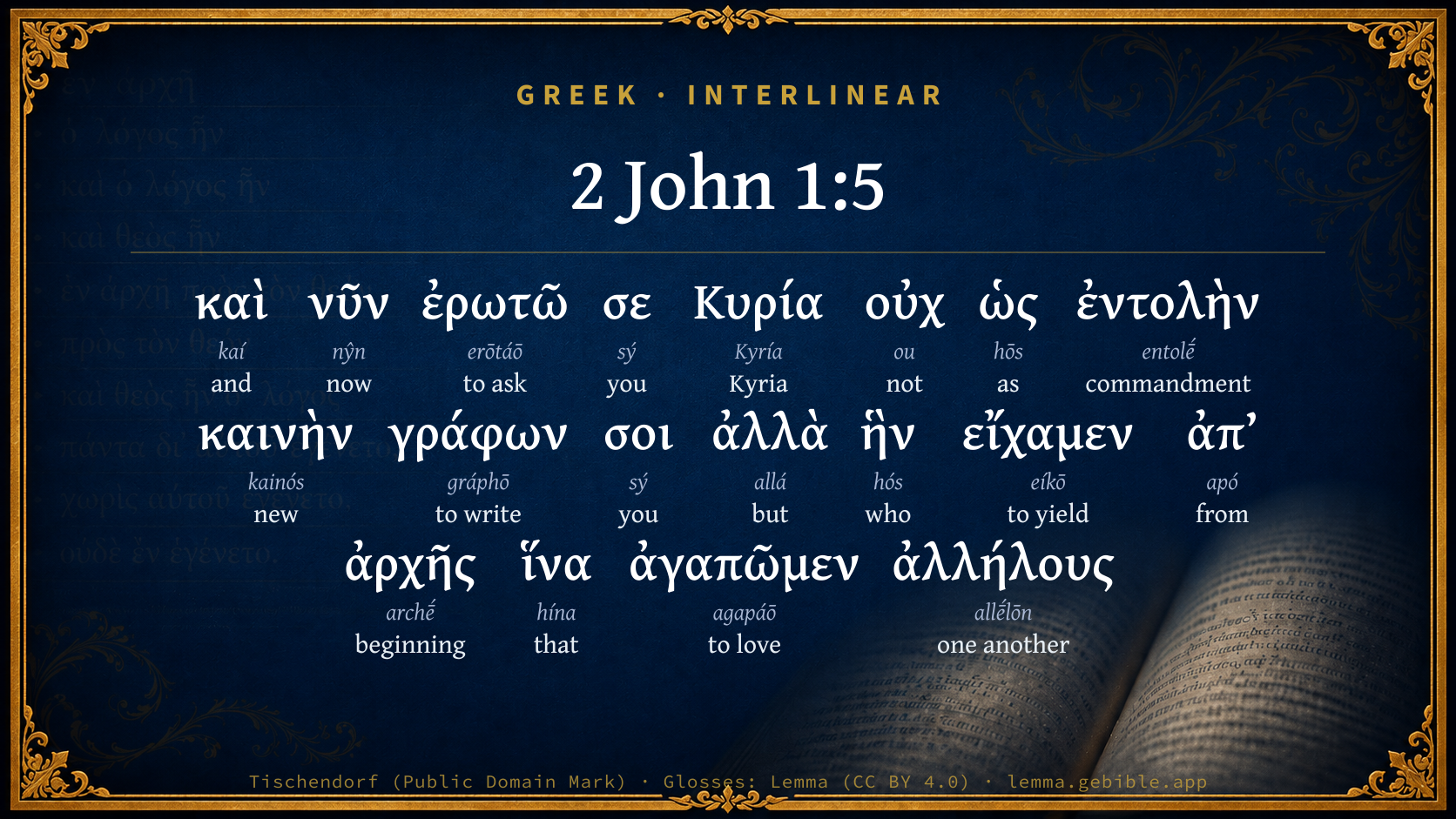
  1. καὶ kaí G2532 “and” Conjunction
  2. νῦν nŷn G3568 “now” Adverb
  3. ἐρωτῶ erōtáō G2065 “to ask” Verb, Present, Active, Indicative, 1st person, Singular
  4. σε sý G4771 “you” Personal pronoun, 2nd person, Accusative, Singular
  5. οὐχ ou G3756 “not” Particle, Negative
  6. ὡς hōs G5613 “as” Adverb
  7. ἐντολὴν entolḗ G1785 “commandment” Noun, Accusative, Singular, Feminine
  8. καινὴν kainós G2537 “new” Adjective, Accusative, Singular, Feminine
  9. γράφων gráphō G1125 “to write” Verb, Present, Active, Participle, Nominative, Singular, Masculine
  10. σοι sý G4771 “you” Personal pronoun, 2nd person, Dative, Singular
  11. ἀλλὰ allá G235 “but” Conjunction
  12. ἣν hós G3739 “who” Relative pronoun, Accusative, Singular, Feminine
  13. εἴχαμεν eíkō G1502 “to yield” Verb, Aorist, Active, Indicative, 1st person, Plural
  14. ἀπ’ apó G575 “from” Preposition
  15. ἀρχῆς archḗ G746 “beginning” Noun, Genitive, Singular, Feminine
  16. ἵνα hína G2443 “that” Conjunction
  17. ἀγαπῶμεν agapáō G25 “to love” Verb, Present, Active, Subjunctive, 1st person, Plural
  18. ἀλλήλους allḗlōn G240 “one another” Reciprocal pronoun, Accusative, Plural, Masculine

About this verse

These counts appear in no published source. They are computed here, from the morphology-tagged text and Lemma’s own curated glosses. What Lemma adds →

19
words
18
distinct lemmas
General Epistles
section

Notable vocabulary

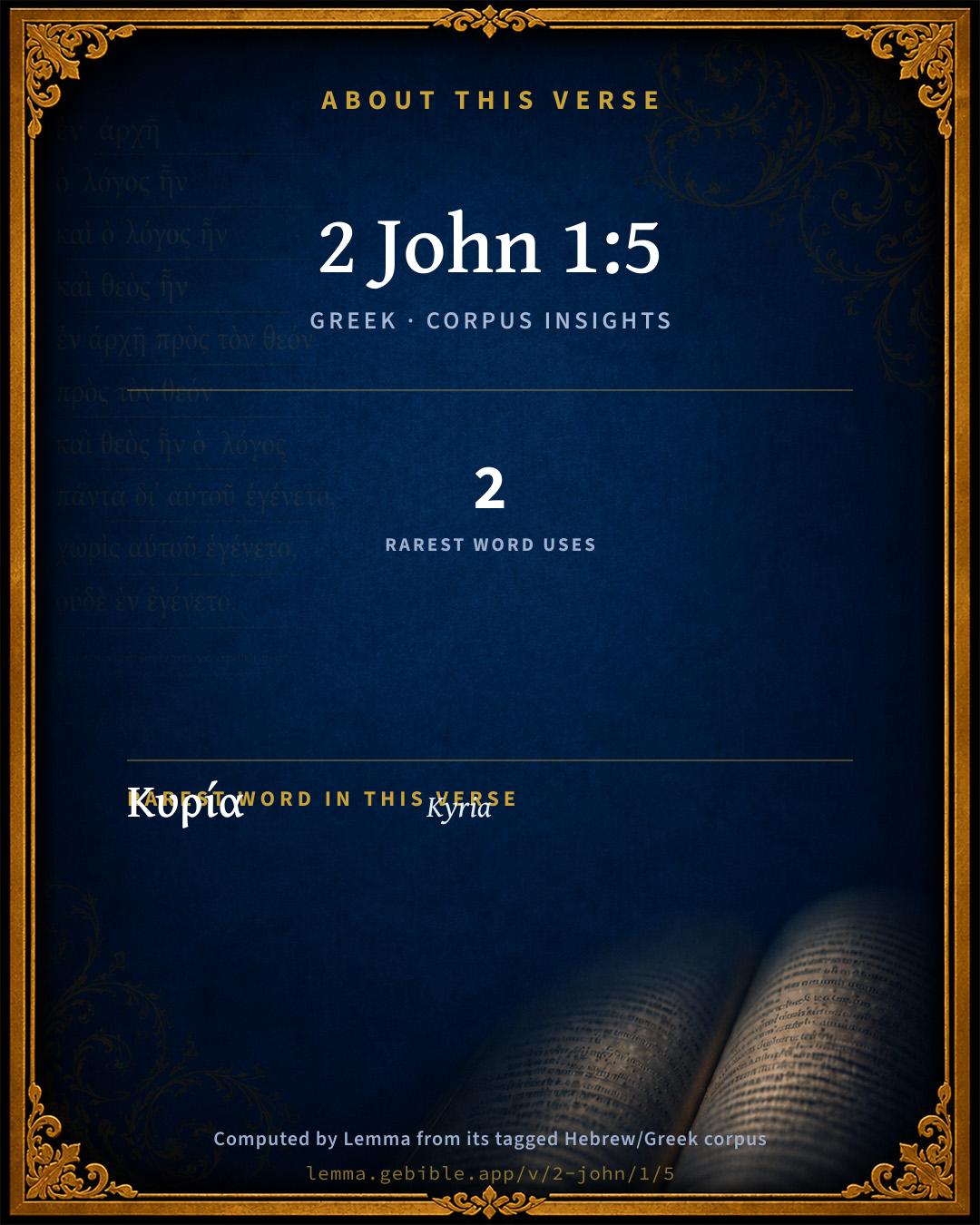
The rarest word here is Κυρία Kyria G2959 — appearing just 2 times in the whole Greek New Testament.

Shared distinctive vocabulary

Κυρία Kyria G2959 occurs in 2 verses of the Greek New Testament. Also found in:

Repetition

A word recurs within this verse:

Cross-references

15

Topical passages linked to 2 John 1:5 in the Treasury of Scripture Knowledge — connected by theme and wording, ordered by reader-vote popularity; previews shown in the World English Bible.

  • John 13:34–35 A new commandment I give to you, that you love one another, just like I have loved you; that you also love one another.
  • John 15:12 "This is my commandment, that you love one another, even as I have loved you.
  • 1 John 3:11 For this is the message which you heard from the beginning, that we should love one another;
  • 1 Thessalonians 4:9 But concerning brotherly love, you have no need that one write to you. For you yourselves are taught by God to love one another,
  • 1 John 3:23 This is his commandment, that we should believe in the name of his Son, Jesus Christ, and love one another, even as he commanded.
  • 1 John 4:20 If a man says, "I love God," and hates his brother, he is a liar; for he who doesn't love his brother whom he has seen, how can he love God whom he has not seen?
  • 1 Peter 4:8 And above all things be earnest in your love among yourselves, for love covers a multitude of sins.
  • 1 John 3:14–18 We know that we have passed out of death into life, because we love the brothers. He who doesn't love his brother remains in death.
  • Ephesians 5:2 Walk in love, even as Christ also loved you, and gave himself up for us, an offering and a sacrifice to God for a sweet-smelling fragrance.
  • Hebrews 13:1 Let brotherly love continue.
  • 1 Peter 1:22–23 Seeing you have purified your souls in your obedience to the truth through the Spirit in sincere brotherly affection, love one another from the heart fervently:
  • 2 Peter 1:7 and in godliness brotherly affection; and in brotherly affection, love.
  • 1 John 2:7–8 Brothers, I write no new commandment to you, but an old commandment which you had from the beginning. The old commandment is the word which you heard from the beginning.
  • 1 John 4:7–12 Beloved, let us love one another, for love is of God; and everyone who loves is born of God, and knows God.
  • Galatians 5:22 But the fruit of the Spirit is love, joy, peace, patience, kindness, goodness, faithfulness,

Cross-references courtesy of OpenBible.info (CC BY 4.0).

Commentary

Notes on 2 John 1:5 from classic Christian and Jewish commentators (each source and its license shown beneath its notes). The classic Christian expositions comment on the surrounding passage and are grouped to its opening verse, so a note may address several verses; the Jewish commentaries on the Tanakh (Rashi and others) are per-verse, so they appear only where the commentator wrote on this verse.

Lemma curates 59 commentaries, every one of them public domain or Creative Commons licensed, each selected and text-cleaned for this edition rather than reprinted as found. About our sources →

Matthew Henry's Commentary

We come now more into the design and substance of the epistle; and here we have,

I. The apostle's request: Now, I beseech thee, lady. Considering what it is that he entreats, the way of address is very remarkable; it is not any particular boon or bounty to himself, but common duty and observance of divine command. Here he might command or charge; but harsher measures are worse than needless where milder will prevail; and the apostolical spirit is, of all other, the most tender and endearing. Whether out of deference to her ladyship, or apostolical meekness, or both, he condescends to beseech: And now I beseech thee, lady. He may be supposed speaking as another apostle does to a certain master to whom he writes: Wherefore, though I might be very bold in Christ (and according to the power with which Christ hath entrusted me) to enjoin thee that which is convenient, yet, for love's sake I rather beseech thee, being such a one as the aged, the elder. Love will avail where authority will not; and we may often see that the more authority is urged the more it is slighted. The apostolical minister will love and beseech his friends into their duty.

II. The thing requested of the lady and her children - Christian sacred love: That we love one another, Jo2 1:5. Those that are eminent in any Christian virtue have yet room to grow therein. But, as touching brotherly love, you need not that I write unto you; for you yourselves are taught of God to love one another. But we beseech you, brethren (and sisters), that you increase more and more, Th1 4:9, Th1 4:10.

1. This love is recommended, (1.) From the obligation thereto - the commandment. Divine command should sway our mind and heart. (2.) From the antiquity of the obligation: Not as though I wrote a new commandment unto thee, but that which we had from the beginning, Jo2 1:5. This commandment of mutual Christian love may be said to be a new one in respect of its new enaction and sanction by the Lord Christ; but yet, as to the matter of it (mutual holy love), it is as old as natural, Jewish, or Christian religion. This commandment must every where attend Christianity, that the disciples of it must love one another.

2. Then this love is illustrated from the fruitful nature of it: And this is love, that we walk after his commandments, Jo2 1:5. This is the test of our love to God, our obedience to him. This is love to ourselves, to our own souls, that we walk in obedience to divine commands. In keeping them there is great reward. This is love to one another, to engage one another to walk in holiness; and this is the evidence of our sincere, mutual, Christian love - that we (in other things) walk after God's commands. There may be mutual love that is not religious and Christian; but we know ours to be so, by our attendance to all other commands besides that of mutual love. Universal obedience is the proof of the goodness and sincerity of Christian virtues; and those that aim at all Christian obedience will be sure to attend to Christian love. This is a fundamental duty in the gospel-charter: This is the commandment, that, as you have heard from the beginning, you should walk in it (Jo2 1:6), that is, walk in this love. The foresight of the decay of this love, as well as of other apostasy, might engage the apostle to inculcate this duty, and this primordial command, the more frequently, the more earnestly.

Matthew Henry's Commentary on the Whole Bible (1708–1710) — public domain (CC PDM 1.0). Text via the HelloAO Bible API.

The Biblical Illustrator

Joseph S. Exell

2Jn_1:5

Not as though I wrote a new commandment.

The feminine danger

No one was more likely than a woman to think that the precept of loving was something altogether different in kind from the precepts of the old law; no one was more likely to say, Love has nothing to do with precepts; it springs up unbidden in the heart. And no one was more likely than a woman to suffer from these very natural opinions; to turn love into a mere taste and sentiment; to suppose it had its origin in herself, and that its continuance might be trusted to her strong feelings; to separate it from obedience; to make it unpractical; so to divorce it from self-denial and endurance. Nothing would be so fatal to all that is noblest in the female character, to the sacrificing and persevering affection for which women have been so eminent, as this temper of mind. Nothing, therefore, appears more entirely appropriate than the apostles double admonition, which is enforced in the following verse: This is love, etc. (F. D. Maurice, M. A.)

The Biblical Illustrator, edited by Joseph S. Exell (c. 1880s–1900s) — public domain. Text from a community e-Sword module.

Joseph Benson's Commentary

2Jn 1:5. Now, I beseech thee, Kuria — This sort of address suits a particular person much better than a whole church, consisting of many individuals, to which, in the opinion of some, this letter was directed; not as though I wrote a new commandment — A commandment which thou didst never hear before; but that which we had from the beginning — Of our Lord’s ministry. Indeed it was in some sense from the beginning of the world; that we love one another — More abundantly. The apostle does not here speak of a new commandment in the sense in which our Lord used that phrase Joh 13:34; (see on 1Jn 2:7-8;) but his meaning is, either that the commandment to love one another, which he gave to this family, was not a commandment which had never been delivered to the church before, or that it was not a commandment peculiar to the gospel. The first of these seems to be the apostle’s meaning; as he tells this matron that the disciples of Christ had had this commandment delivered to them from the beginning. In inculcating mutual love among the disciples of Christ so frequently and so earnestly in all his writings, John showed himself to be, not only a faithful apostle of Christ, but a person of a most amiable and benevolent disposition; his own heart being full of love to all mankind, and particularly to the followers of Jesus, he wished to promote that holy and happy temper in all true Christians.

Joseph Benson's Commentary on the Old and New Testaments (1811–1818) — public domain. Text from a community e-Sword module.

Tyndale Open Study Notes

Tyndale Open Resources

1:5 I am writing to remind you, dear friends: Literally I urge you, lady. See study note on 1:1.

Tyndale Open Study Notes — © Tyndale Open Resources, licensed CC BY-SA 4.0. Text via the HelloAO Bible API.

Bengel's Gnomon

Johann Albrecht Bengel

2Jn 1:5. Οὐχ ὡς—καινὴν, not as—new) Love performs both pages:[4] truth produces nothing else.

[4] The Old as well as the New Testament love to God, and love to our neighbour—E.

Bengel's Gnomon of the New Testament — English translation (T&T Clark, Edinburgh, 1860) — public domain. Text from a community e-Sword module.

Meyer's Critical & Exegetical Commentary

Heinrich August Wilhelm Meyer

2Jn_1:5-6. καὶ νῦν ἐρωτῶ σε] νῦν is used here, not temporally, but logically. Düsterdieck refers it to the immediately preceding subordinate clause: καθὼς κ.τ.λ.; Ebrard, on the other hand, to the idea εὕρηκα κ.τ.λ.; but it is more correctly referred to ἐχάρην κ.τ.λ.; the joy which the apostle felt is the cause of his present request (so also Brückner and Braune). John says ἐρωτῶ instead of the usual παρακαλῶ, as the request is suitable to the Church, as a κυρία.

οὐχ ὡς ἐντολὴν γράφων σοι καινὴν κ.τ.λ.] Comp. 1Jn_2:7.

ἵνα ἀγαπῶμεν ἀλλήλους] dependent on ἐρωτῶ, comp. Joh_17:15, not on ἐντολὴν ἔχομεν (Baumgarten-Crusius), for this is used in a subordinate clause merely, and ἐρωτῶ would be without connection and without object (Brückner). ἵνα states here also not merely the purpose, but the substance of the request (contrary to Braune).2Jn_1:6. καὶ αὕτη … ἵνα] The same construction, 1Jn_5:3. The apostle is not distinguishing the commandment of love from the other commandments (de Wette), but is describing the walking according to the commandments of God as the substance and essence of love; with justice, for, in the first place, only that love is moralor more particularly, Christianin its character which is founded on obedience toward God, and therefore consists in the fulfilment of the commandments of God that regulate our relationship to our neighbour (Ebrard); and, in the second place, the aim of all the divine commandments is nothing else than love. Brückner, Braune, and others here interpret ἡ ἀγάπη incorrectly of Christian love simply, including also the love of God and Christ; the close connection of this sentence with the preceding one (ἡ ἀγάπη clearly refers back to ἵνα ἀγαπῶμεν ἀλλήλους) compels us to understand ἡ ἀγαπή of Christian brotherly love. The thought last expressed is specially emphasized by the following words. According to the reading: αὕτη ἡ ἐντολή ἐστι, we must translate: This commandment is (consists in this), as ye have heard from the beginning (no other than this), that ye should walk ἐν αὐτῇ.

ἡ ἐντολή resumes the preceding τὰς ἐντολὰς αὐτοῦ. the transition from the plural to the singular is not difficult; comp. 1Jn_3:22-23.

ἵνα states the substance of the commandment, and ἐν αὐτῇ refers to ἀγάπῃ (de Wette-Brückner, Lücke, Düsterdieck, Ebrard, Braune), and not to ἐντολή (Sander); for this would not only give an inadmissible tautology, but would also be contrary to Johns mode of expression, in which the phrase: περιπατεῖν ἐν τῇ ἐντολῇ, does not appear.

By the intervening clause καθὼς ἠκούσατε, a subordinate definition of the ἐντολή (Lücke, de Wette) is not given, but it is observed that the readers have heard from the beginning what is the substance of the divine commandment; the apostle thereby refers back to what was said in 2Jn_1:5 (so also Düsterdieck, Ebrard, Brückner, Braune). The circle that results from this interpretation only serves to bring clearly out the identity of brotherly love and obedience toward God.[9]

[9] Köstlin incorrectly interprets (p. 218): the old commandment, that we should love one another, means nothing else than that we should abide in what He has commanded us to believe. That ἐντολή here denotes the command to believe (1Jn_3:23), finds no confirmation in the context.Ebrard unjustifiably asserts that the obscurity of the expression in this verse is to be explained by the fact that the apostle intentionally alludes to some passages of the First Epistle, with which he assumes the Kyria to be familiar.

Meyer — Critical and Exegetical Commentary on the New Testament — English translation by Peter Christie, edited by Frederick Crombie (T&T Clark, 1880) — public domain. Text from a community e-Sword module.

Expositor's Greek Testament

ed. W. Robertson Nicoll

2Jn 1:5-6 . The Comprehensive Commandment. “And now I ask thee, Kyria, not as writing a new commandment to thee but the one which we had from the beginning, that we love one another. And this is love that we walk according to His commandments; this is the commandment, even as ye heard from the beginning that we should walk in love,”

These counsels are just a summary of the doctrines expounded at large in the first Epistle. There is here a sort of reasoning in a circle: The commandment is Love; Love is walking according to His commandments; His commandments are summed up in one Love.

2Jn 1:5 . ἀπʼ ἀρχῆς , “from the beginning of our Christian life”. See note on 1Jn 2:7 .

The Expositor's Greek Testament, edited by W. Robertson Nicoll (1897–1910) — public domain. Text from a community e-Sword module.

Jamieson, Fausset & Brown

Robert Jamieson, A. R. Fausset & David Brown

I beseech--rather (compare Note, see on Jo1 5:16), "I request thee," implying some degree of authority.

not . . . new commandment--It was old in that Christians heard it from the first in the Gospel preaching; new, in that the Gospel rested love on the new principle of filial imitation of God who first loved us, and gave Jesus to die for us; and also, in that love is now set forth with greater clearness than in the Old Testament dispensation. Love performs both tables of the law, and is the end of the law and the Gospel alike (compare Notes, see on Jo1 2:7-8).

that we--implying that he already had love, and urging her to join him in the same Christian grace. This verse seems to me to decide that a Church, not an individual lady, is meant. For a man to urge a woman ("THEE"; not thee and thy children) that he and she should love one another, is hardly like an apostolic precept, however pure may be the love enjoined; but all is clear if "the lady" represent a Church.

Jamieson, Fausset & Brown — Commentary Critical and Explanatory on the Whole Bible (1871) — public domain (CC PDM 1.0). Text via the HelloAO Bible API.

Adam Clarke's Commentary

Verse 5. That which we had from the beginning] The commandment to love one another was what they had heard from the first publication of Christianity, and what he wishes this excellent woman to inculcate on all those under her care. The mode of address here shows that it was a person, not a Church, to which the apostle wrote.

Adam Clarke's Commentary on the Bible (1810–1826) — public domain. Text from a community e-Sword/MySword module.

The Cambridge Bible for Schools and Colleges

gen. ed. J. J. S. Perowne

5, 6. Exhortation to Love and Obedience

5. And now] As in 1Jn_2:28 (see note there), this introduces a practical exhortation depending on what precedes. ‘It is my joy at the Christian life of some of thy children, and my anxiety about the others, that move me to exhort thee’.

I beseech thee] S. John uses the same verb (ἐρωτᾷν) as that used of making request about ‘sin unto death’ (1Jn_5:16). It perhaps indicates that he begs as an equal or superior rather than as an inferior. In both passages the Vulgate rightly has rogo, not peto. In classical Greek the verb = interrogo, ‘I ask a question’, a meaning which it frequently has in N. T. S. Paul uses it very seldom, and always in the sense of ‘I request’: his usual word is παρακαλῶ, which S. John never employs.

a new commandment] See on 1Jn_2:7.

from the beginning] See on 1Jn_2:7.

that we love one another] ‘That’ (ἵνα) introduces the purport of the command; but perhaps the notion of purpose is not wholly absent (see on 1Jn_1:8 and comp. 1Jn_3:23). It is doubtful whether ‘that we love’ depends upon ‘commandment’ or upon ‘I beseech thee’.

5–11. We now enter upon the main portion of the Epistle, which has three divisions: Exhortation to Love and Obedience (5, 6); Warnings against False Doctrine (7–9); Warnings against False Charity (10, 11). As usual, the transitions from one subject to another are made gently and without any marked break.

The Cambridge Bible for Schools and Colleges (gen. ed. J. J. S. Perowne; Cambridge University Press, 1878–1918) — public domain. Text from a community e-Sword module.

John Gill's Exposition

And now I beseech thee, lady,.... Or "Kyria", which word the Syriac and Arabic versions retain, as if it was a proper name: the apostle having finished the inscription, salutation, and congratulation in the preceding verses, passes to an exhortation and entreaty to observe the commandment of love to one another, which is not a new commandment, but what was from the beginning:

not as though I wrote a new commandment, &c. See Gill on Jo1 2:7 and See Gill on Jo1 2:8.

John Gill's Exposition of the Whole Bible (1746–1763) — public domain (CC PDM 1.0). Text via the HelloAO Bible API.

Trapp's Complete Commentary

John Trapp

5 And now I beseech thee, lady, not as though I wrote a new commandment unto thee, but that which we had from the beginning, that we love one another.

Ver. 5. Not as though I wrote a new commandment] A new commandment our Saviour calleth it, Joh 13:34. Quia exuto veteri induit nos novum hominem, as Austin gives the reason; because the old man being put off, it puts on us the new man. Or, as others, because when the scribes and Pharisees by false glosses and corrupt interpretations had put it out of date, Christ restored it by a true interpretation, Mat 5:43-45, &c., and revived and illustrated it by his own practice and example, as Paul also observeth, Eph 5:2; Php 1:9.

That we love, &c.] God lays no other commands upon us than what we may perform by love, that lighteneth and sweeteneth all. His subjects and soldiers are all volunteers, Psa 110:3.

John Trapp, A Commentary or Exposition upon All the Books of the Old and New Testament (1647–1656) — public domain. Text from a community e-Sword module.

Albert Barnes' Notes on the Bible

And now I beseech thee, lady - Dr, “And now I entreat thee, Kyria,” (κυρία kuria.) See the introduction, Section 2. If this was her proper name, there is no impropriety in supposing that he would address her in this familiar style. John was probably then a very old man; the female to whom the Epistle was addressed was doubtless much younger.

Not as though I wrote a new commandment unto thee - John presumed that the command to love one another was understood as far as the gospel was known; and he might well presume it, for true Christianity never prevails anywhere without prompting to the observance of this law. See the notes at 1Th 4:9.

But that which we had from the beginning - From the time when the gospel was first made known to us. See the notes at 1Jo 2:7; 1Jo 3:11.

That we love one another - That is, that there be among the disciples of Christ mutual love; or that in all circumstances and relations they should love one another, Joh 15:12, Joh 15:17. This general command, addressed to all the disciples of the Saviour, John doubtless means to say was as applicable to him and to the pious female to whom he wrote as to any others, and ought to be exercised by them toward all true Christians; and he exhorts her, as he did all Christians, to exercise it. It was a command upon which, in his old age, he loved to dwell; and he had little more to say to her than this, to exhort her to obey this injunction of the Saviour.

Albert Barnes' Notes on the Bible (1834–1885) — public domain. Text from a community e-Sword/MySword module.

Matthew Poole's English Annotations

He inculcates that great precept, of which see 1Jo 2:7,8.

Matthew Poole's English Annotations on the Holy Bible (1683–1685) — public domain. Text from a community e-Sword/MySword module.

Whedon's Commentary on the Bible

Daniel D. Whedon

5. And now—In view of this evidence of adherence to Christian truth, I beseech that the Christian love be added.

A new commandment—See notes on 1Jn_2:7-8.

From the beginning—From our first listening to the gospel of love.

Daniel D. Whedon (gen. ed.), Commentary on the Old and New Testaments (1874–1909) — public domain. Text from a community e-Sword module.

The Pulpit Commentary

Vers. 5-11. MAIN DIVISION. Exhortation. Having thus stated what has led to his writing, the apostle passes on to the central portion of the letter (verses 5-11), which consists of three exhortations: to love and obedience (verses 5, 6); against false doctrine (verses 7-9); against false charity (verses 10, 11). The transition to this practical part of the Epistle is indicated by the opening particles, "And now.

I beseech thee, lady. The verb has, perhaps, a tinge of peremptoriness about it ejrwtw: "This is a request which I have a right to make." Respecting the "new commandment" and "from the beginning," see notes on 1Jn_2:7. We may reasonably suppose that St. John is here reminding her of the contents of his First Epistle. The parallels between this Epistle and the First are so numerous and so close, that we can scarcely doubt that some of them are consciously made. There are at least eight such in these thirteen verses, as may be seen from the margin of a good reference Bible.

Vers. 5, 6.

Mutual love.

now I beseech thee, lady, not as though I wrote a new commandment unto thee," etc. Having expressed his joy that certain of the children of the elect lady were "walking in truth," the apostle exhorts to the exercise of mutual love. Truth and love must be combined in Christian character and conduct. Where truth dwells without love, the character is likely to be or to become cold, rigid, and harsh. Where love dwells without truth, the character becomes effeminate, self-indulgent, and unreliable. Neither is truth in itself complete without love, nor love without truth. The combination of both is needful to the completeness of either in Christian character. Notice

I THE OBLIGATION OF MUTUAL LOVE. It is commanded by God. "A commandment that we love one another This is the commandment, even as ye heard from the beginning, that ye should walk in it," i.e., in love.

1. The mature of this love. In the original of the New Testament there are two words both of which are translated "love" in our Authorized Version. "The distinction seems to be that ajgapan is more used of that reverential love, grounded on high graces of character, which is borne towards God and man by the child of God; whereas filein expresses more the personal love of human affection" (Alford). The apostle here uses the word with the higher meaning. The affection of which he writes differs from matrimonial, parental, filial, and friendly love. It cannot be exercised towards the wicked. It has reference chiefly to the character of the person loved. Its exercise involves respect and esteem.

2. The obligatoriness of this love. It is a sacred "commandment that we love one another". (cf. Joh_13:34 Joh_15:12; 1Jn_3:10-18) It is a moral duty to reverence goodness, to admire beauty of character, to love in this high sense those who are spiritually excellent. It is ill with a man when he fails to esteem uprightness and honour in man, to venerate consistent piety, and to love genuine godliness. Such a man is on the road to perdition. Mark the fact that this obligation was not new. "Not as though I wrote to thee a new commandment, but that which we had from the beginning," etc. Some understand " from the beginning," to mean from the creation of humanity. "As to the matter of it (mutual holy love) it is as old as natural, Jewish, or Christian religion." "It is as old as Moses, yea, as old as Adam, being a part of the law of nature written in Adam"s heart." Others interpret, "from the beginning of their faith in Jesus Christ," or "from the time of their conversion to Christianity." In a sense the former view is true, but the latter seems to us to be the meaning of St. John in this place. From the commencement of their Christian life they were under the most sacred obligations to obey this command. And yet it is a new commandment, "inasmuch as it ever assumes new freshness as the Christian life unfolds, as the old darkness is more and more cleared away, and the true light shineth." It is new also because it should "be always fresh in the memories, and found in the practice, of Christ"s disciples to the end of the world.

3. The earnestness with which the apostle requests this love. "I beseech thee, lady," etc. Such an entreaty from the sainted apostle would carry more force than an earnest exhortation or an authoritative command. It is said that, in his extreme age, when he was unable to walk to the place where the Christians met together, St. John caused himself to be borne thither, that he might address the assembly; and his address was only this children, love one another." And when he was asked why bealways spoke the same thing and nothing else, he replied, "That it was the command of the Lord, and that if this only were done, enough was done." The story is perfectly in keeping with our text, "I beseech thee, lady that we love one another" And St. Paul wrote, "Love is the fulfilling of the Law.

II THE MANIFESTATION OF THIS LOVE. "And this is love, that we should walk after his commandments. This is the commandment, even as ye heard from the beginning, that ye should walk in it." The love for the exercise of which St. John prays, may be described as walking according to God"s commandments; and the one commandment in which all others is summed up is this ye should walk in it," i.e., in love. Love is to be manifested by obedience to the Divine will.

1. Obedience is the product of love. The obedience which springs from servile fear or from considerations of self-interest is not true. It is mechanical, not hearty. It is utterly lacking of loyalty, and cannot be acceptable to God. To be true, obedience must be free and cordial; it is the product of love. Love makes obedience easy, and duty delightful.

2. Obedience is the evidence of love. The genuine evidence of affection is not profession, but obedience; not words, but deeds. "If ye love me," said our Lord, "ye will keep my commandments." The mutual love which St. John entreats" is not an effeminate, self-seeking, self-complacent love to our neighbour, but a love which manifests itself in the steady discharge of every obligation." "By this we know that we love the children of God, when we love God and do his commandments. For this. is the love of God, that we keep his commandments: and his commandments are not grievous". (1Jn_5:2:3) "He that hath my commandments, and keepeth them, he it is that loveth me," etc.. (Joh_14:21)

CONCLUSION.

1. Let us endeavour to become worthy of this exalted Christian love. By the help of Divine grace let us seek to develop characters worthy of the esteem and affection of the good.

2. Let us live in the exercise of this love. Said our Lord, "A new commandment I give unto you, that ye love another; even as I have loved you, that ye also love another. By this shall all men know that ye are my disciples, if ye have love one to another. W.J.

The Pulpit Commentary (1880–1919), ed. H.D.M. Spence-Jones & Joseph S. Exell — public domain. Text from a community e-Sword module.

John Wesley's Explanatory Notes

That which we had from the beginning - Of our Lord's ministry. Indeed it was, in some sense, from the beginning of the world. That we may love one another - More abundantly.

John Wesley, Explanatory Notes Upon the Whole Bible (1754–1765) — public domain. Text via the GEBible commentary corpus.

Scofield Reference Notes

C. I. Scofield

that we love one another

Law (of Christ), Summary: The new "law of Christ" is the divine love, as wrought into the renewed heart by the Holy Spirit Rom 5:5; Heb 10:16 and outflowing in the energy of the Spirit, unforced and spontaneous, toward the objects of the divine love; 2Co 5:14-20; 1Th 2:7; 1Th 2:8. It is, therefore, " the law of liberty"; Jas 1:25; Jas 2:12 in contrast with the external law of Moses. Moses’ law demands love,; Lev 19:18; Deu 6:5; Luk 10:27 Christ’s law is love; Rom 5:5; 1Jn 4:7; 1Jn 4:19; 1Jn 4:20 and so takes the place of the external law by fulfilling it; Rom 13:10; Gal 5:14. It is the "law written in the heart" under the New Covenant.

(See Scofield "Heb 8:8").

The Scofield Reference Bible (1917 edition), notes by C. I. Scofield — public domain. Text from a community e-Sword module.

Burkitt's Expository Notes on the New Testament

William Burkitt

Observe here, The duty required, together with the profession of the gospel; namely, to love in unity and peace, in amity and concord, one with another. This he calls a commandment, in the singular number, to intimate that in this one commandment all the rest are contained, and in keeping this we keep all: and he tells them, it is no new commandment, but an old one from the beginning; it is as old as Moses, yea, as old as Adam, being a part of the law of nature written in Adam’s heart; yet, in some respects, love may be called a new commandment, because urged from new motives, and enforced by a new example; and because it is never to wax old, but to be always fresh in the memories, and found in the practice of Christ’s disciples, to the end of the world: I write no new commandment, but what we had from the beginning, that we love one another.

William Burkitt's Expository Notes on the New Testament (1700–1703) — public domain. Text from a community e-Sword module.

The People's New Testament

B. W. Johnson

5. And now I beseech thee, lady. Kyria in Greek. If lady at all it would mean “your ladyship.” Not as though I wrote a new commandment. Love embraces all. Compare 1 John 2:7. See notes there.

B. W. Johnson's The People's New Testament with Notes (1889–1891) — public domain. Electronic text from the Christian Classics Ethereal Library (CCEL) ThML edition.

Cambridge Greek Testament for Schools and Colleges

5–11. We now enter upon the main portion of the Epistle, which has three divisions: Exhortation to Love and Obedience (5, 6); Warnings against False Doctrine (7–9); Warnings against False Charity (10, 11). As usual, the transitions from one subject to another are made gently and without any marked break.

5, 6. EXHORTATION TO LOVE AND OBEDIENCE

5. For γράφω read γράφων ([874][875][876][877][878]), and with [879][880], Vulgate, and Memphitic place καινήν before γράφων σοι: but the other order ([881], Thebaic) is very possibly correct. In the case of γράφω, as in many others, “Erasmus (1516) led the common editions wrong, where the Complutensian (1514) is correct” (Scrivener, p. 76).

[874] 4th century. Discovered by Tischendorf in 1859 at the monastery of S. Catherine on Mount Sinai, and now at Petersburg. All three Epistles.

[875] 5th century. Brought by Cyril Lucar, Patriarch of Constantinople, from Alexandria, and afterwards presented by him to Charles I. in 1628. In the British Museum. All three Epistles.

[876] 4th century. Brought to Rome about 1460. It is entered in the earliest catalogue of the Vatican Library, 1475. All three Epistles.

[877] 9th century. All three Epistles.

[878] 9th century. All three Epistles.

[879] 4th century. Discovered by Tischendorf in 1859 at the monastery of S. Catherine on Mount Sinai, and now at Petersburg. All three Epistles.

[880] 5th century. Brought by Cyril Lucar, Patriarch of Constantinople, from Alexandria, and afterwards presented by him to Charles I. in 1628. In the British Museum. All three Epistles.

[881] 4th century. Brought to Rome about 1460. It is entered in the earliest catalogue of the Vatican Library, 1475. All three Epistles.

5. καὶ νῦν. As in 1Jn 2:28 (see note there), this introduces a practical exhortation depending on what precedes. ‘It is my joy at the Christian life of some of thy children, and my anxiety about the others, that move me to exhort thee’.

ἐρωτῶ σε. S. John uses the same verb as that used of making request about ‘sin unto death’ (1Jn 5:16). It perhaps indicates that he begs as an equal or superior rather than as an inferior. In both passages the Vulgate rightly has rogo not peto. In classical Greek ἐρωτῶ = interrogo, ‘I ask a question’, a meaning which it frequently has in N.T. S. Paul uses it very seldom, and always in the sense of ‘I request’: his usual word is παρακαλῶ, which S. John never employs. Only at the opening and close does the Apostle use the strictly personal σε (1Jn 5:16): in 2Jn 1:6; 2Jn 1:8; 2Jn 1:10; 2Jn 1:12 he uses the second person plural. What meaning has this change, if the letter is addressed to a Church? It is natural, if it is addressed to a lady and her family. For ἐντολὴν καινήν see on 1Jn 2:7.

εἴχαμεν. Comp. ἐξῆλθαν in 2Jn 1:7; 1Jn 2:19 (see note); 3Jn 1:7. For ἀπʼ ἀρχῆς see on 1Jn 2:7.

ἵνα ἀγαπῶμεν. It is doubtful whether this depends upon ἐρωτῶ or ἐντολήν: in either case ἵνα introduces the purport of the request or command, with perhaps a lingering notion of the purpose of it (see on 1Jn 1:8 and comp. 1Jn 3:23).

Cambridge Greek Testament for Schools and Colleges (Cambridge University Press, 1896; 21 vols, various authors incl. Carr, Maclear, Plummer, Farrar, Lumby, Moule, M. R. James, Simcox) — public domain. Text from a community e-Sword module.

Alford’s Greek Testament

Henry Alford

5.] And now (so καὶ νῦν, coupling to what has gone before, 1Jn 2:28. It has also a force of breaking off, and passing to that which is the main subject, or most in the Writer’s thoughts, which here is, that this walking in truth is a walking after God’s commandments in love) I entreat thee (see on ἐρωτάω and αἰτέω, 1Jn 5:15, 1Jn 5:16. Here ἐρωτῶ carries, as Schlichting, “blandior quædam admonendi ratio:” with the assumed fact of a right thus to entreat) lady, not as writing to thee a new commandment, but (as writing to thee …: the construction is not strictly logical) that which we had from the beginning (see on this, 1Jn 2:7), that (ἵνα here is not epexegetic of ἐντολή, as so often in St. John, but is to be taken in its proper sense, as the aim of ἐρωτῶ, and dependent on it) we love one another (the expression of the commandment in the first person is a mark of gentleness and delicacy: a sign that he who wrote it kept the commandment himself.)

Henry Alford, The Greek Testament (1849–1861) — public domain. Text from a community e-Sword module.

International Critical Commentary

5. νῦν] The adverb is temporal. Cf. ver. 4, ἐχάρην.

ἐρωτῶ σε Κυρία] If ἐρωτᾶν has the special force of suggesting some sort of equality of position between the two parties concerned (“in the exercise of the full privilege of Christian fellowship,” Wsct.), the emphasis is laid on the words οὐχ ὡς ἐντολήν. The Elder who has the right to command merely grounds a personal request, as between equals, on the old command laid on both alike by the Master. If, however, the special meaning of ἐρωτᾶν is to be found in the emphasis which it lays on the person addressed, as opposed to the thing asked (αἰτεῖν), then Κυρία is the emphatic word. He can ask in full confidence of the “Elect Lady” that which is no new command, pleading for the fulfilment of the old commandment laid on her and on all by the Lord. But ἐρωτᾶν was the natural word to use. Cf. Oxyrh. Pap. 2:292, ἠρώτησα δὲ καὶ Ἑρμίαν τὸν ἀδελφὸν διὰ γραπτοῦ ἀνηγεῖσθαί σοι περὶ τούτου.

εἴχαμεν] The writer includes himself and all Christians among the recipients of the command. There is no need to limit his application of the first person plural to those who originally heard the command given.

ἵνα ἀγαπῶμεν ἀλληλούς] These words should probably be taken, not as dependent on ἐρωτῶ, but as defining the ἐντολή. The instances of the purely definitive ἵνα have been collected before.

ερωτω] ερωτωμενIa 101. 7f, 65 (40) boh-cod. | γραφων σοι καινην B K L P al. pler. cat. sah. Thphyl. Oec.] καινην γραφων σοι א A 5. 13. 31. 68 dscr vg. cop. Lcif. | γραφων] γραφω 64. 65. 66. 106 dscr * al. uix. mu. arm. aeth. | καινην] inc. sahb | αλλα] + εντολην א : + εντολην παλαιαν syrp | ειχαμεν א A] ειχομεν B K L P al. pler.: εχομεν 31. 38. 68 ascr al. fere. 20 | ινα] pr. αλλIa δ254 (?).

International Critical Commentary — older volumes (1896–1929), various authors — public domain. Text from a community e-Sword module.

Vincent's Word Studies in the New Testament

Marvin R. Vincent

New [καινην] . See on Mt 26:29.

We had [ειχαμεν] . The apostle identifies himself with his readers.

Marvin R. Vincent, Word Studies in the New Testament (1887–1900) — public domain. Text from a community e-Sword/MySword module.

Westcott on Hebrews & the Epistles of John

Brooke Foss Westcott

5. καὶ νῦν] and now, looking back upon that former feeling (Ὁ. 4) of Joy... The words may mark simply a logical connexion: 1 John ii. 28.

ἐρωτῶ) 7 pray thee, in the exercise of the full privilege of Christian fellowship. Comp. 1 John v. 16, note.

The request is directly personal and not a general exhortation (παρακαλῶ). It is remarkable that the words παρακαλεῖν, παράκλησις, do not occur in the writings of St John. The singular address (c¢) occurs again in Ὁ. 13. In the intermediate verses the plural is used.

οὐχ ὡς evr....] not as writing a new commandment... The order is significant (ἐντ. γράφων o.x.). The prayer is first distinguished from a command generally: ‘I pray thee, not as writing ἃ command to thee’; and then the command is more exactly described, which is indeed the substance of the prayer. Comp. 1 Jobn ii. 7.

εἴχαμεν) we had. Contrast 1 John ii. 7 ye had. Throughout the apostle identifies himself with those to whom he is writing, Christian with Christians.

ἵνα ἀγαπῶμεν...) that we love... The words seem to depend upon J pray thee (John xvii. 15), the intervening clause being parenthetical. The apostle includes himself in the object of his prayer (that we, not that ye) It is possible that the form in which the request is thus shaped is occasioned by the reference to ‘the command which we had,’

ἐρωτῶσε.. ἵνα... Ipraythee...that... The infinitive and a final particle are both used by St John after ἐρωτᾷν : (1) tajfin. John iv. 40 || Luke v. 3; viii. 37; Acts iil. 3; x. 48; xvi. 39; xviii. John iv. 47; xix. 31, 38 || Mk. vii. 26; 27 (Acts xxiii. 20 ὅπως).

ἀγαπώμεν ἀλλήλους.

ἐξῆλθαν] went out. The tense (1 John ii. 19) appears to mark a particular crisis. They went out from the bosom of the Christian society to fulfil their work.

πολλοί...οἱ μὴ opor.] The participial clause does not only assert a

we wrought, but may receive a full reward. %Every one that goeth forward and abideth not in the teaching of Christ hath not God: he that abideth in the teaching, the same hath both the Father and the Son. Tf any one cometh unto you, and beareth not this teaching, receive him not into your house, and give him no greeting; “for he that giveth him greeting hath fellowship with hits evil works.

Brooke Foss Westcott (1825–1901), The Epistle to the Hebrews (1889) and The Epistles of St John (1883) — public domain (pre-1929). Text recovered from Internet Archive / Google Books OCR scans. Westcott’s Gospel of John commentary is not included (its OCR lost the chapter running-heads required for reliable verse-keying). Some Greek quoted in the Hebrews volume is imperfectly rendered by the OCR.

Lesson kit

Teaching starters — assembled from the data on this page, not authored interpretation. Every prompt links to the verse data it draws on. Edit before teaching.

2 John, in the General Epistles, opens this verse with 19 words (18 distinct Greek lemmas). Its most distinctive word is Kyría (“Kyria”). A historical commentator’s framing appears above. Read the whole chapter for the surrounding context.

Discussion questions

  1. The word Kyría carries the sense “Kyria.” How does it shape the verse?
  2. How does 2 John 1:1, which shares the word «Kyria», read alongside this verse?
  3. What does the repetition of “you” (2× in this one verse) do in this verse?
  4. These translations render this verse differently; the difference is in the English rendering, not the original. What questions does that raise?
  5. Compare how Matthew Henry's Commentary and The Biblical Illustrator read this verse. Where do they agree or differ?

Things to notice

Reading settings

Reading text

Shown beneath each verse's original-language words.

Old Testament
Old Testament edition

Read the OT as the Masoretic Hebrew (MT) or the Greek Septuagint (LXX).

English shown for the Greek Septuagint (in the Hebrew ↔ Greek comparison).

Comparing translations? Open the Compare panel on any verse page to stack up to four side by side.