

Acts 23:15
Greek (Tischendorf 8th ed.) Acts 23:15 appears in the Greek New Testament. The text above is from the Tischendorf 8th edition. Each word links to its Strong’s number and a concise gloss. Click any word for its full Thayer’s Greek Lexicon entry.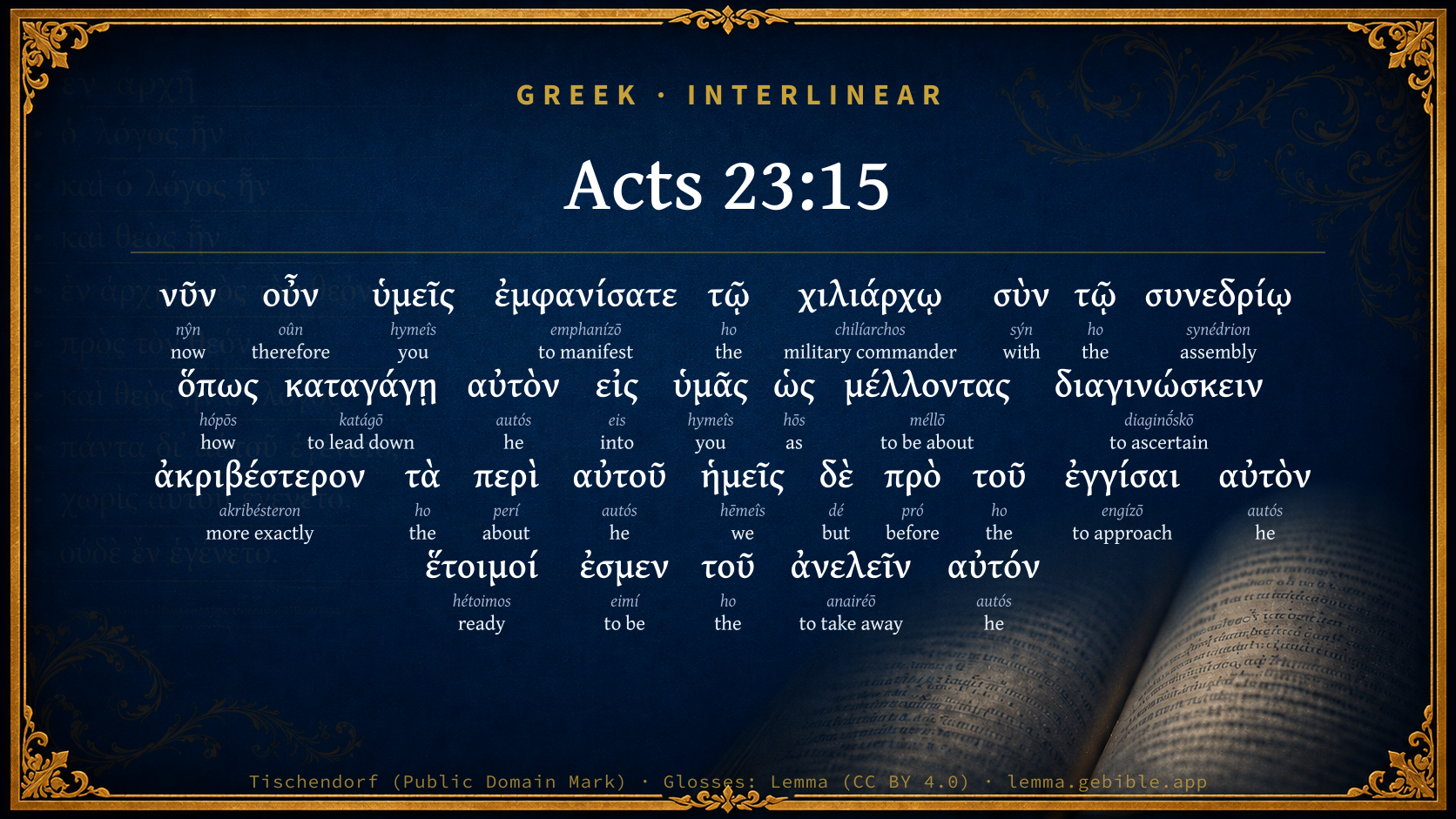
Now therefore, you with the council inform the commanding officer that he should bring him down to you tomorrow, as though you were going to judge his case more exactly. We are ready to kill him before he comes near."
Download a study sheet
One document with this verse’s original text, its word-by-word gloss line, the meaning frame, cross-references with their text, attributed commentary, and full source and license credits — printable, and it pastes into notes with its structure intact.
This verse Autodidact and up
A passage Seminary Student
Up to 50 verses in one chapter. A passage sheet keeps up to 6 commentary sources and 12 cross-references per verse, in the order this page ranks them, and says so on the sheet whenever that leaves anything out. Ask for a single verse and you get the Autodidact verse sheet above.
Everything on this page stays free to read, with no account — the sheet is a download of what is already on screen, not access to it.
Compare translations 3
The same verse in 3 English versions, stacked beneath the original-language interlinear above. Click any original word for its lexicon entry.
Each is an independent rendering of the whole verse — the interlinear is not word-aligned to these translations.
Highlighted words mark where these versions differ — a whole-verse word diff, not a word-by-word alignment.
-
World English Bible Public Domain
Now therefore, you with the council inform the commanding officer that he should bring him down to you tomorrow, as though you were going to judge his case more exactly. We are ready to kill him before he comes near."
-
King James Version Public Domain
Now therefore ye with the council signify to the chief captain that he bring him down unto you to morrow, as though ye would enquire something more perfectly concerning him: and we, or ever he come near, are ready to kill him.
-
unfoldingWord Literal Text CC BY-SA 4.0
Now, therefore, you, with the Sanhedrin, appear to the chiliarch as if you are going to examine more thoroughly the things concerning him, so that he may bring him down to you. But we are ready to kill him before he arrives.”
unfoldingWord Literal Text — © unfoldingWord, licensed CC BY-SA 4.0. Word-aligned USFM3 via Door43 (git.door43.org/unfoldingWord/en_ult).
Show all 19 translations
Every available English version of this verse, each an independent rendering of the whole verse.
-
World English Bible Public Domain
Now therefore, you with the council inform the commanding officer that he should bring him down to you tomorrow, as though you were going to judge his case more exactly. We are ready to kill him before he comes near."
-
Berean Standard Bible Public Domain
Now then, you and the Sanhedrin petition the commander to bring him down to you on the pretext of examining his case more carefully. We are ready to kill him on the way.”
-
Majority Standard Bible Public Domain
Now then, you and the Sanhedrin petition the commander to bring him down to you tomorrow on the pretext of examining his case more carefully. We are ready to kill him on the way.”
-
King James Version Public Domain
Now therefore ye with the council signify to the chief captain that he bring him down unto you to morrow, as though ye would enquire something more perfectly concerning him: and we, or ever he come near, are ready to kill him.
-
American Standard Version (1901) Public Domain
Now therefore do ye with the council signify to the chief captain that he bring him down unto you, as though ye would judge of his case more exactly: and we, before he comes near, are ready to slay him.
-
Revised Version (1885) Public Domain
Now therefore do ye with the council signify to the chief captain that he bring him down unto you, as though ye would judge of his case more exactly: and we, or ever he come near, are ready to slay him.
-
Geneva Bible (1599) Public Domain
Nowe therefore, ye and the Council signifie to the chiefe captaine, that hee bring him foorth vnto you to morow: as though you would know some thing more perfectly of him, and we, or euer he come neere, will be readie to kill him.
-
Douay-Rheims (1899) Public Domain
Now therefore do you with the council signify to the tribune, that he bring him forth to you, as if you meant to know something more certain touching him. And we, before he come near, are ready to kill him.
-
Young's Literal Translation Public Domain
now, therefore, ye, signify ye to the chief captain, with the sanhedrim, that to-morrow he may bring him down unto you, as being about to know more exactly the things concerning him; and we, before his coming nigh, are ready to put him to death.'
-
Literal Standard Version CC BY-SA 4.0
now, therefore, you, signify to the chief captain, with the Sanhedrin, that tomorrow he may bring him down to you, as being about to know more exactly the things concerning him; and we, before his coming near, are ready to put him to death.”
-
Unlocked Literal Bible CC BY-SA 4.0
Now, therefore, let the council tell the chief captain to bring him down to you, as if you would decide his case more precisely. As for us, we are ready to kill him before he comes here.”
-
unfoldingWord Literal Text CC BY-SA 4.0
Now, therefore, you, with the Sanhedrin, appear to the chiliarch as if you are going to examine more thoroughly the things concerning him, so that he may bring him down to you. But we are ready to kill him before he arrives.”
-
Darby Bible Public Domain
Now therefore do ye with the council make a representation to the chiliarch so that he may bring him down to you, as about to determine more precisely what concerns him, and we, before he draws near, are ready to kill him.
-
World Messianic Bible Public Domain
Now therefore, you with the council inform the commanding officer that he should bring him down to you tomorrow, as though you were going to judge his case more exactly. We are ready to kill him before he comes near.”
-
Webster's Bible Public Domain
Now therefore ye with the council signify to the chief captain, that he bring him down to you to-morrow, as though ye would inquire something more perfectly concerning him: and we, before he shall come near, are ready to kill him.
-
Free Bible Version CC BY-SA 4.0
So you and the council should send word to the commander that he should bring Paul down to meet with you, as if you wanted to examine his case in more detail. We're ready to kill him along the way.”
-
Bible in Basic English Public Domain
So now, will you and the Sanhedrin make a request to the military authorities to have him sent down to you, as if you were desiring to go into the business in greater detail; and we, before ever he gets to you, will be waiting to put him to death.
-
Text-Critical English NT CC BY 4.0
Now then, you and the council must make an official request to the commander to bring him down to you tomorrow, as though you would be investigating the facts about his case in greater detail. And we will be ready to kill him before he draws near to this place.”
-
Tyndale New Testament (1534) Public Domain
Now therfore geve the knowlege to the vpper captayne and to the counsell that he bringe him forth vnto vs to morow as though we wolde knowe some thinge more perfectly of him. But we (or ever he come neare) are redy in the meane season to kill him.
Literal Standard Version (2020), Covenant Press — licensed CC BY-SA 4.0. Text via the HelloAO Bible API (eBible.org). Unlocked Literal Bible (unfoldingWord) — licensed CC BY-SA 4.0. Text via the HelloAO Bible API (eBible.org). unfoldingWord Literal Text — © unfoldingWord, licensed CC BY-SA 4.0. Word-aligned USFM3 via Door43 (git.door43.org/unfoldingWord/en_ult). Free Bible Version, Dr. Jonathan Gallagher — licensed CC BY-SA 4.0. Text via the HelloAO Bible API (eBible.org).
Word by word
More ways to search: Search by grammar → Find every occurrence → Compare this word →
Practice this passage: Drill this verse → Learn its vocabulary →
- Appears 2× in the Greek New Testament
- First appears here
- Part of Speech
- Verb
- Tense
- Present
- Voice
- Active
- Mood
- Infinitive
Full Thayer's Definition
- νῦν nŷn G3568 “now” Adverb
- οὖν oûn G3767 “therefore” Conjunction
- ὑμεῖς hymeîs G5210 “you” Personal pronoun, 2nd person, Nominative, Plural
- ἐμφανίσατε emphanízō G1718 “to manifest” Verb, Aorist, Active, Imperative, 2nd person, Plural
- τῷ ho G3588 “the” Article, Dative, Singular, Masculine
- χιλιάρχῳ chilíarchos G5506 “military commander” Noun, Dative, Singular, Masculine
- σὺν sýn G4862 “with” Preposition
- τῷ ho G3588 “the” Article, Dative, Singular, Neuter
- συνεδρίῳ synédrion G4892 “assembly” Noun, Dative, Singular, Neuter
- ὅπως hópōs G3704 “how” Adverb
- καταγάγῃ katágō G2609 “to lead down” Verb, Aorist, Active, Subjunctive, 3rd person, Singular
- αὐτὸν autós G846 “he” Personal pronoun, Accusative, Singular, Masculine
- εἰς eis G1519 “into” Preposition
- ὑμᾶς hymeîs G5210 “you” Personal pronoun, 2nd person, Accusative, Plural
- ὡς hōs G5613 “as” Adverb
- μέλλοντας méllō G3195 “to be about” Verb, Present, Active, Participle, Accusative, Plural, Masculine
- διαγινώσκειν diaginṓskō G1231 “to ascertain” Verb, Present, Active, Infinitive
- ἀκριβέστερον akribésteron G197 “more exactly” Adverb, Comparative
- τὰ ho G3588 “the” Article, Accusative, Plural, Neuter
- περὶ perí G4012 “about” Preposition
- αὐτοῦ autós G846 “he” Personal pronoun, Genitive, Singular, Masculine
- ἡμεῖς hēmeîs G2249 “we” Personal pronoun, 1st person, Nominative, Plural
- δὲ dé G1161 “but” Conjunction
- πρὸ pró G4253 “before” Preposition
- τοῦ ho G3588 “the” Article, Genitive, Singular, Neuter
- ἐγγίσαι engízō G1448 “to approach” Verb, Aorist, Active, Infinitive
- αὐτὸν autós G846 “he” Personal pronoun, Accusative, Singular, Masculine
- ἕτοιμοί hétoimos G2092 “ready” Adjective, Nominative, Plural, Masculine
- ἐσμεν eimí G1510 “to be” Verb, Present, Active, Indicative, 1st person, Plural
- τοῦ ho G3588 “the” Article, Genitive, Singular, Neuter
- ἀνελεῖν anairéō G337 “to take away” Verb, Aorist, Active, Infinitive
- αὐτόν autós G846 “he” Personal pronoun, Accusative, Singular, Masculine
About this verse
These counts appear in no published source. They are computed here, from the morphology-tagged text and Lemma’s own curated glosses. What Lemma adds →
- 32
- words
- 24
- distinct lemmas
- Acts
- section
Notable vocabulary
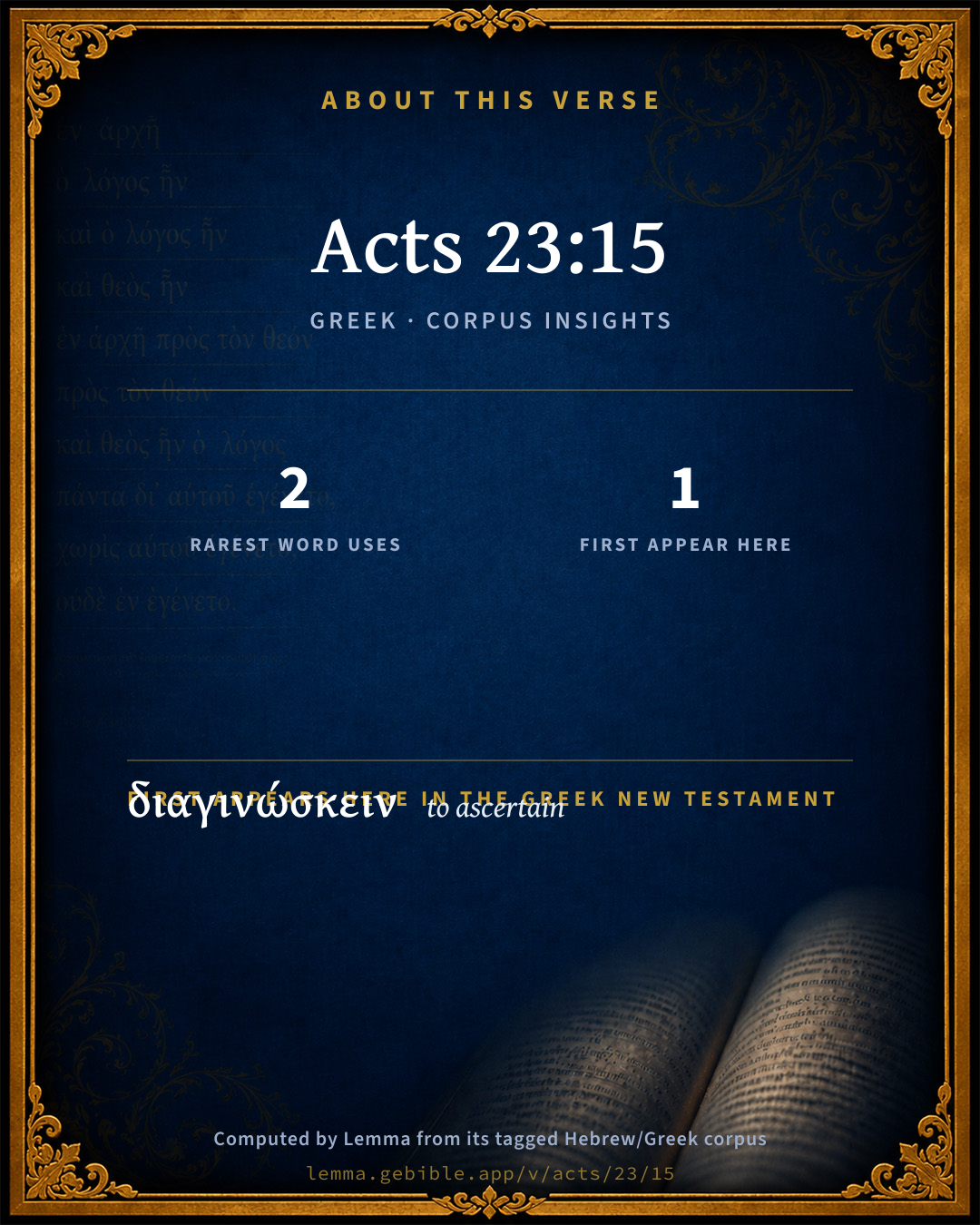
The rarest word here is διαγινώσκειν to ascertain G1231 — appearing just 2 times in the whole Greek New Testament.
First appearance in Scripture
This word makes its first canonical appearance in the Greek New Testament here:
- διαγινώσκειν to ascertain G1231
Shared distinctive vocabulary
διαγινώσκειν to ascertain G1231 occurs in 2 verses of the Greek New Testament. Also found in:
Cross-references
9Topical passages linked to Acts 23:15 in the Treasury of Scripture Knowledge — connected by theme and wording, ordered by reader-vote popularity; previews shown in the World English Bible.
- Psalms 37:32–33 The wicked watches the righteous, And seeks to kill him.
- Isaiah 59:7 Their feet run to evil, and they make haste to shed innocent blood: their thoughts are thoughts of iniquity; desolation and destruction are in their paths.
- Proverbs 1:11–12 If they say, "Come with us, Let's lay in wait for blood; Let's lurk secretly for the innocent without cause;
- Proverbs 1:16 For their feet run to evil. They hurry to shed blood.
- Psalms 21:11 For they intended evil against you. They plotted evil against you which cannot succeed.
- Proverbs 4:16 For they don't sleep, unless they do evil. Their sleep is taken away, unless they make someone fall.
- Acts 22:30–23:1 But on the next day, desiring to know the truth about why he was accused by the Jews, he freed him from the bonds, and commanded the chief priests and all the council to come together, and brought Paul down and set him before them.
- Romans 3:14–16 "Whose mouth is full of cursing and bitterness."
- Acts 25:3 asking a favor against him, that he would summon him to Jerusalem; plotting to kill him on the way.
Cross-references courtesy of OpenBible.info (CC BY 4.0).
Where the printed editions differ
1 variantPlaces in this verse where the major printed Greek editions disagree on the wording in a way that affects the translation — a comparison of editions, not a manuscript-by-manuscript collation. The editions are the modern critical texts (Nestlé-Aland 28/27, SBL, Westcott-Hort, Tregelles, Tyndale House) and the traditional texts behind the KJV (the Textus Receptus and the Byzantine/Majority text). It is not a claim about which reading is original.
-
Extra text
αὔριον
“tomorrow”
In TRByz Not in NA28NA27TynSBLWHTregαὔριον (aurion) 'tomorrow' is only in traditional manuscripts (TR+Byz)
Textual data: Translators Amalgamated Greek New Testament (STEPBible TAGNT) · CC BY 4.0.
Lesson kit
Teaching starters — assembled from the data on this page, not authored interpretation. Every prompt links to the verse data it draws on. Edit before teaching.
Acts, in the Acts, opens this verse with 32 words (24 distinct Greek lemmas). Its most distinctive word is diaginṓskō (“to ascertain”). A historical commentator’s framing appears above. Read the whole chapter for the surrounding context.
Discussion questions
- The word diaginṓskō carries the sense “to ascertain.” How does it shape the verse?
- The word “to ascertain” first appears here in Scripture. What is being introduced at this debut?
- Acts 24:22 shares the word «to ascertain» with this verse. How do the two illuminate each other?
- “the” occurs 5× in this one verse. What is the effect of the repetition?
- These translations render this verse differently. What is at stake in choosing one wording over another?
- Reading how Bengel's Gnomon and Meyer's Critical & Exegetical Commentary read this verse, where do the two commentators agree and where do they part?
Things to notice
- 1 word makes its first canonical appearance in Scripture here.
- These translations choose different wording for 33 words in this verse.
- “the” occurs 5× in this single verse.
- 24 distinct Greek lemmas span 32 words in this verse.
Commentary
Notes on Acts 23:15 from classic Christian and Jewish commentators (each source and its license shown beneath its notes). The classic Christian expositions comment on the surrounding passage and are grouped to its opening verse, so a note may address several verses; the Jewish commentaries on the Tanakh (Rashi and others) are per-verse, so they appear only where the commentator wrote on this verse.
Lemma curates 59 commentaries, every one of them public domain or Creative Commons licensed, each selected and text-cleaned for this edition rather than reprinted as found. About our sources →
Bengel's Gnomon
Johann Albrecht Bengel
Bengel's Gnomon of the New Testament — English translation (T&T Clark, Edinburgh, 1860) — public domain. Text from a community e-Sword module.
Meyer's Critical & Exegetical Commentary
Heinrich August Wilhelm Meyer
Meyer — Critical and Exegetical Commentary on the New Testament — English translation by Peter Christie, edited by Frederick Crombie (T&T Clark, 1880) — public domain. Text from a community e-Sword module.
Expositor's Greek Testament
ed. W. Robertson Nicoll
The Expositor's Greek Testament, edited by W. Robertson Nicoll (1897–1910) — public domain. Text from a community e-Sword module.
Geneva Bible (1599)
Geneva Bible translators
Geneva Bible (1599) marginal notes — public domain. Text via Bolls.life.
Jamieson, Fausset & Brown
Robert Jamieson, A. R. Fausset & David Brown
Jamieson, Fausset & Brown — Commentary Critical and Explanatory on the Whole Bible (1871) — public domain (CC PDM 1.0). Text via the HelloAO Bible API.
Adam Clarke's Commentary
Adam Clarke's Commentary on the Bible (1810–1826) — public domain. Text from a community e-Sword/MySword module.
Ellicott's Commentary for English Readers
A Bible Commentary for English Readers, edited by Charles John Ellicott (1878–1897) — public domain. Text from a community e-Sword module.
The Cambridge Bible for Schools and Colleges
gen. ed. J. J. S. Perowne
The Cambridge Bible for Schools and Colleges (gen. ed. J. J. S. Perowne; Cambridge University Press, 1878–1918) — public domain. Text from a community e-Sword module.
John Gill's Exposition
John Gill's Exposition of the Whole Bible (1746–1763) — public domain (CC PDM 1.0). Text via the HelloAO Bible API.
Trapp's Complete Commentary
John Trapp
John Trapp, A Commentary or Exposition upon All the Books of the Old and New Testament (1647–1656) — public domain. Text from a community e-Sword module.
Albert Barnes' Notes on the Bible
Albert Barnes' Notes on the Bible (1834–1885) — public domain. Text from a community e-Sword/MySword module.
Matthew Poole's English Annotations
Matthew Poole's English Annotations on the Holy Bible (1683–1685) — public domain. Text from a community e-Sword/MySword module.
Whedon's Commentary on the Bible
Daniel D. Whedon
Daniel D. Whedon (gen. ed.), Commentary on the Old and New Testaments (1874–1909) — public domain. Text from a community e-Sword module.
The Pulpit Commentary
The Pulpit Commentary (1880–1919), ed. H.D.M. Spence-Jones & Joseph S. Exell — public domain. Text from a community e-Sword module.
John Wesley's Explanatory Notes
John Wesley, Explanatory Notes Upon the Whole Bible (1754–1765) — public domain. Text via the GEBible commentary corpus.
McGarvey & Pendleton's Commentaries
J. W. McGarvey
J. W. McGarvey (with Philip Y. Pendleton), Commentaries on the New Testament (The Fourfold Gospel, 1914; Acts; and the epistles) — public domain. Text from a community e-Sword/MySword module.
Cambridge Greek Testament for Schools and Colleges
Cambridge Greek Testament for Schools and Colleges (Cambridge University Press, 1896; 21 vols, various authors incl. Carr, Maclear, Plummer, Farrar, Lumby, Moule, M. R. James, Simcox) — public domain. Text from a community e-Sword module.
Alford’s Greek Testament
Henry Alford
Henry Alford, The Greek Testament (1849–1861) — public domain. Text from a community e-Sword module.
Vincent's Word Studies in the New Testament
Marvin R. Vincent
Marvin R. Vincent, Word Studies in the New Testament (1887–1900) — public domain. Text from a community e-Sword/MySword module.