

1 Timothy 4:8
Greek (Tischendorf 8th ed.) 1 Timothy 4:8 appears in the Greek New Testament. The text above is from the Tischendorf 8th edition. Each word links to its Strong’s number and a concise gloss. Click any word for its full Thayer’s Greek Lexicon entry.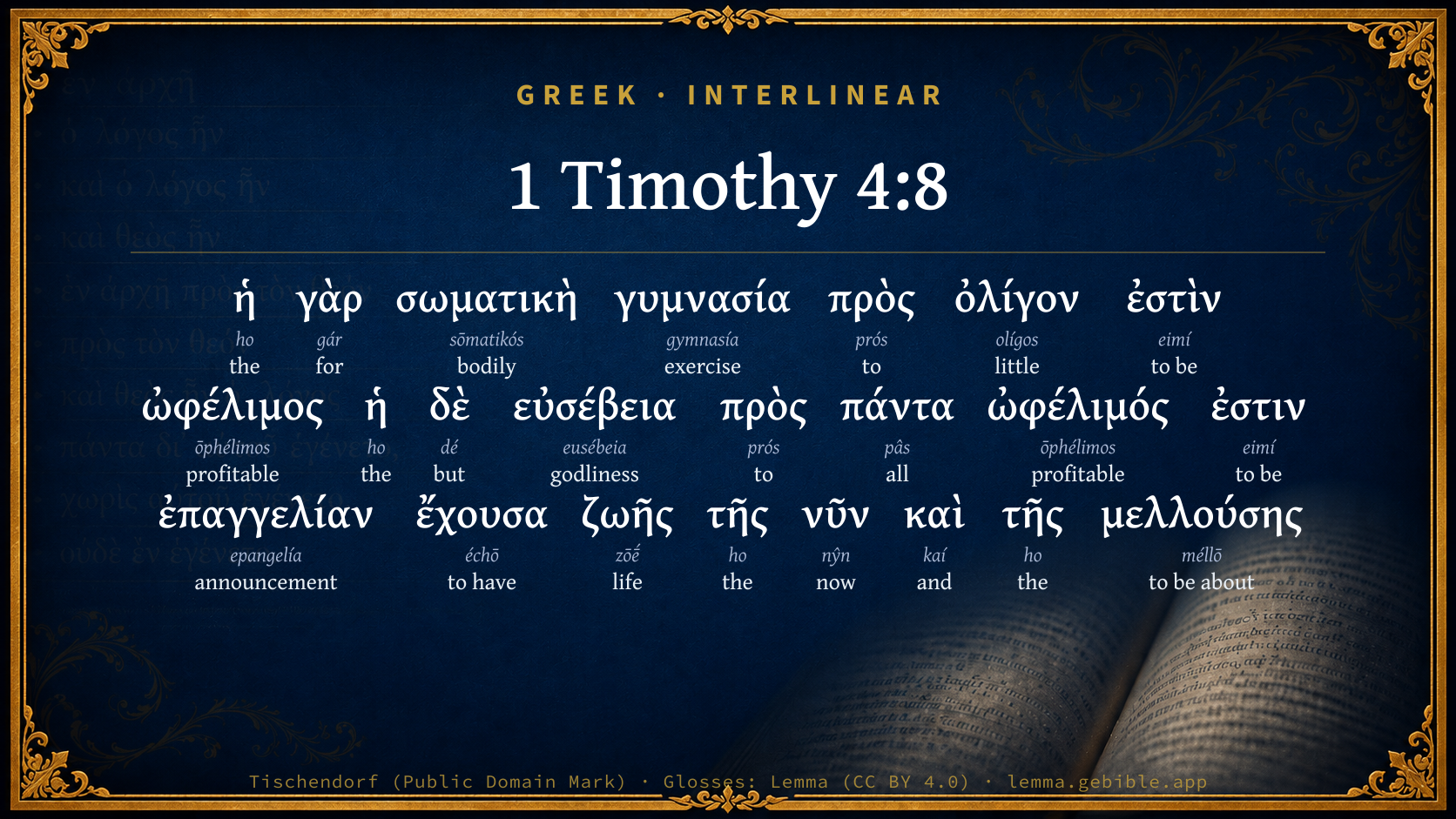
For bodily exercise has some value, but godliness has value for all things, having the promise of the life which is now, and of that which is to come.
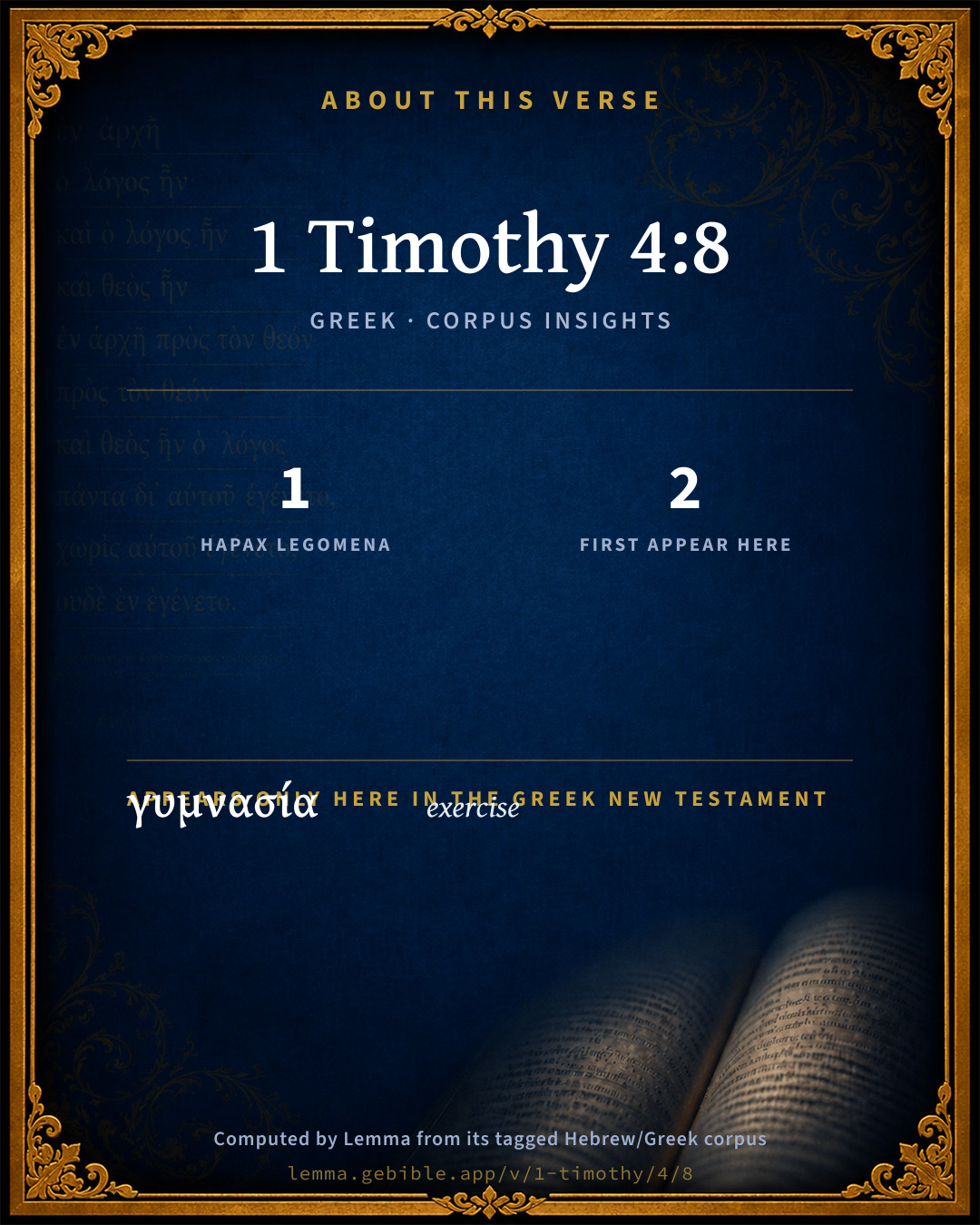
- 1 hapax legomenon — only here in the Greek New Testament
- 2 first appearances in the Greek New Testament
Download a study sheet
One document with this verse’s original text, its word-by-word gloss line, the meaning frame, cross-references with their text, attributed commentary, and full source and license credits — printable, and it pastes into notes with its structure intact.
This verse Autodidact and up
A passage Seminary Student
Up to 50 verses in one chapter. A passage sheet keeps up to 6 commentary sources and 12 cross-references per verse, in the order this page ranks them, and says so on the sheet whenever that leaves anything out. Ask for a single verse and you get the Autodidact verse sheet above.
Everything on this page stays free to read, with no account — the sheet is a download of what is already on screen, not access to it.
Compare translations 3
The same verse in 3 English versions, stacked beneath the original-language interlinear above. Click any original word for its lexicon entry.
Each is an independent rendering of the whole verse — the interlinear is not word-aligned to these translations.
Highlighted words mark where these versions differ — a whole-verse word diff, not a word-by-word alignment.
-
World English Bible Public Domain
For bodily exercise has some value, but godliness has value for all things, having the promise of the life which is now, and of that which is to come.
-
King James Version Public Domain
For bodily exercise profiteth little: but godliness is profitable unto all things, having promise of the life that now is, and of that which is to come.
-
unfoldingWord Literal Text CC BY-SA 4.0
for bodily training is useful for little, but godliness is useful for all, having promise of life, now and coming.
unfoldingWord Literal Text — © unfoldingWord, licensed CC BY-SA 4.0. Word-aligned USFM3 via Door43 (git.door43.org/unfoldingWord/en_ult).
Show all 19 translations
Every available English version of this verse, each an independent rendering of the whole verse.
-
World English Bible Public Domain
For bodily exercise has some value, but godliness has value for all things, having the promise of the life which is now, and of that which is to come.
-
Berean Standard Bible Public Domain
For physical exercise is of limited value, but godliness is valuable in every way, holding promise for the present life and for the one to come.
-
Majority Standard Bible Public Domain
For physical exercise is of limited value, but godliness is valuable in every way, holding promise for the present life and for the one to come.
-
King James Version Public Domain
For bodily exercise profiteth little: but godliness is profitable unto all things, having promise of the life that now is, and of that which is to come.
-
American Standard Version (1901) Public Domain
for bodily exercise is profitable for a little; but godliness is profitable for all things, having promise of the life which now is, and of that which is to come.
-
Revised Version (1885) Public Domain
for bodily exercise is profitable for a little; but godliness is profitable for all things, having promise of the life which now is, and of that which is to come.
-
Geneva Bible (1599) Public Domain
For bodily exercise profiteth litle: but godlinesse is profitable vnto all things, which hath the promise of the life present, and of that that is to come.
-
Douay-Rheims (1899) Public Domain
For bodily exercise is profitable to little: but godliness is profitable to all things, having promise of the life that now is, and of that which is to come.
-
Young's Literal Translation Public Domain
for the bodily exercise is unto little profit, and the piety is to all things profitable, a promise having of the life that now is, and of that which is coming;
-
Literal Standard Version CC BY-SA 4.0
for bodily exercise is to little profit, but piety is profitable to all things, having promise of the life that now is, and of that which is coming;
-
Unlocked Literal Bible CC BY-SA 4.0
For bodily training is a little useful, but godliness is useful for all things. It holds promise for this life now and the life to come.
-
unfoldingWord Literal Text CC BY-SA 4.0
for bodily training is useful for little, but godliness is useful for all, having promise of life, now and coming.
-
Darby Bible Public Domain
for bodily exercise is profitable for a little, but piety is profitable for everything, having promise of life, of the present one, and of that to come.
-
World Messianic Bible Public Domain
For bodily exercise has some value, but godliness has value in all things, having the promise of the life which is now and of that which is to come.
-
Webster's Bible Public Domain
For bodily exercise profiteth little: but godliness is profitable to all things, having promise of the life that now is, and of that which is to come.
-
Free Bible Version CC BY-SA 4.0
for while physical exercise is useful to some extent, spiritual exercise is much more useful. For “it has promise for the present life, and for the life to come.”
-
Bible in Basic English Public Domain
For the training of the body is of profit for a little, but religion is of profit in every way, giving hope for the life which now is, and for that which is to come.
-
Text-Critical English NT CC BY 4.0
For bodily training is beneficial to a certain extent, but godliness is beneficial in every way, since it holds promise for both the present life and the life to come.
-
Tyndale New Testament (1534) Public Domain
For bodely exercise proffiteth lyttll: But godlines is good vnto all thynges as a thynge which hath promyses of the lyfe that is now and of the lyfe to come.
Literal Standard Version (2020), Covenant Press — licensed CC BY-SA 4.0. Text via the HelloAO Bible API (eBible.org). Unlocked Literal Bible (unfoldingWord) — licensed CC BY-SA 4.0. Text via the HelloAO Bible API (eBible.org). unfoldingWord Literal Text — © unfoldingWord, licensed CC BY-SA 4.0. Word-aligned USFM3 via Door43 (git.door43.org/unfoldingWord/en_ult). Free Bible Version, Dr. Jonathan Gallagher — licensed CC BY-SA 4.0. Text via the HelloAO Bible API (eBible.org).
Word by word
More ways to search: Search by grammar → Find every occurrence → Compare this word →
Practice this passage: Drill this verse → Learn its vocabulary →
- Appears 1× in the Greek New Testament
- First appears here
- Part of Speech
- Noun
- Case
- Nominative
- Number
- Singular
- Gender
- Feminine
Full Thayer's Definition
- ἡ ho G3588 “the” Article, Nominative, Singular, Feminine
- γὰρ gár G1063 “for” Conjunction
- σωματικὴ sōmatikós G4984 “bodily” Adjective, Nominative, Singular, Feminine
- γυμνασία gymnasía G1129 “exercise” Noun, Nominative, Singular, Feminine
- πρὸς prós G4314 “to” Preposition
- ὀλίγον olígos G3641 “little” Adjective, Accusative, Singular, Masculine
- ἐστὶν eimí G1510 “to be” Verb, Present, Active, Indicative, 3rd person, Singular
- ὠφέλιμος ōphélimos G5624 “profitable” Adjective, Nominative, Singular, Masculine
- ἡ ho G3588 “the” Article, Nominative, Singular, Feminine
- δὲ dé G1161 “but” Conjunction
- εὐσέβεια eusébeia G2150 “godliness” Noun, Nominative, Singular, Feminine
- πρὸς prós G4314 “to” Preposition
- πάντα pâs G3956 “all” Adjective, Accusative, Plural, Neuter
- ὠφέλιμός ōphélimos G5624 “profitable” Adjective, Nominative, Singular, Masculine
- ἐστιν eimí G1510 “to be” Verb, Present, Active, Indicative, 3rd person, Singular
- ἐπαγγελίαν epangelía G1860 “announcement” Noun, Accusative, Singular, Feminine
- ἔχουσα échō G2192 “to have” Verb, Present, Active, Participle, Nominative, Singular, Feminine
- ζωῆς zōḗ G2222 “life” Noun, Genitive, Singular, Feminine
- τῆς ho G3588 “the” Article, Genitive, Singular, Feminine
- νῦν nŷn G3568 “now” Adverb
- καὶ kaí G2532 “and” Conjunction
- τῆς ho G3588 “the” Article, Genitive, Singular, Feminine
- μελλούσης méllō G3195 “to be about” Verb, Present, Active, Participle, Genitive, Singular, Feminine
About this verse
These counts appear in no published source. They are computed here, from the morphology-tagged text and Lemma’s own curated glosses. What Lemma adds →
- 23
- words
- 17
- distinct lemmas
- Pauline Epistles
- section
Notable vocabulary
1 hapax legomenon — a word that appears only here in the entire Greek New Testament:
- γυμνασία exercise G1129
First appearance in Scripture
These words make their first canonical appearance in the Greek New Testament here:
Shared distinctive vocabulary
σωματικὴ bodily G4984 occurs in 2 verses of the Greek New Testament. Also found in:
Cross-references
45Topical passages linked to 1 Timothy 4:8 in the Treasury of Scripture Knowledge — connected by theme and wording, ordered by reader-vote popularity; previews shown in the World English Bible.
- Matthew 6:33 But seek first God's Kingdom, and his righteousness; and all these things will be given to you as well.
- 1 Timothy 6:6 But godliness with contentment is great gain.
- Psalms 37:3–4 Trust in Yahweh, and do good. Dwell in the land, and enjoy safe pasture.
- Proverbs 19:23 The fear of Yahweh leads to life, then contentment; He rests and will not be touched by trouble.
- Proverbs 22:4 The result of humility and the fear of Yahweh Is wealth, honor, and life.
- Colossians 2:21–23 "Don't handle, nor taste, nor touch"
- Psalms 37:11 But the humble shall inherit the land, And shall delight themselves in the abundance of peace.
- Mark 10:30 but he will receive one hundred times more now in this time, houses, brothers, sisters, mothers, children, and land, with persecutions; and in the age to come eternal life.
- 1 John 2:25 This is the promise which he promised us, the eternal life.
- Job 5:19–26 He will deliver you in six troubles; Yes, in seven there shall no evil touch you.
- Psalms 145:19 He will fulfill the desire of those who fear him. He also will hear their cry, and will save them.
- Psalms 37:29 The righteous shall inherit the land, And live in it forever.
- Psalms 112:1–3 Praise Yah! Blessed is the man who fears Yahweh, Who delights greatly in his commandments.
- Matthew 5:3–12 "Blessed are the poor in spirit, For theirs is the Kingdom of Heaven.
- Psalms 128:1–6 Blessed is everyone who fears Yahweh, Who walks in his ways.
- Proverbs 3:16–18 Length of days is in her right hand. In her left hand are riches and honor.
- Job 22:2 "Can a man be profitable to God? Surely he who is wise is profitable to himself.
- Psalms 84:11 For Yahweh God is a sun and a shield. Yahweh will give grace and glory. He withholds no good thing from those who walk blamelessly.
- Ecclesiastes 8:12 Though a sinner commits crimes a hundred times, and lives long, yet surely I know that it will be better with those who fear God, who are reverent before him.
- Hebrews 13:9 Don't be carried away by various and strange teachings, for it is good that the heart be established by grace, not by food, through which those who were so occupied were not benefited.
- 1 Samuel 15:22 Samuel said, Has Yahweh as great delight in burnt offerings and sacrifices, as in obeying the voice of Yahweh? Behold, to obey is better than sacrifice, and to listen than the fat of rams.
- Psalms 50:7–15 "Hear, my people, and I will speak; Israel, and I will testify against you. I am God, your God.
- Isaiah 3:10 Tell the righteous "Good!" For they shall eat the fruit of their deeds.
- Titus 3:8 This saying is faithful, and concerning these things I desire that you affirm confidently, so that those who have believed God may be careful to maintain good works. These things are good and profitable to men;
- Deuteronomy 28:1–14 It shall happen, if you shall listen diligently to the voice of Yahweh your God, to observe to do all his commandments which I command you this day, who Yahweh your God will set you on high above all the nations of the earth:
- Psalms 91:10–16 No evil shall happen to you, Neither shall any plague come near your dwelling.
- Isaiah 1:11–16 "What are the multitude of your sacrifices to me?," says Yahweh. "I have had enough of the burnt offerings of rams, And the fat of fed animals. I don't delight in the blood of bulls, Or of lambs, Or of male goats.
- Isaiah 32:17–18 The work of righteousness shall be peace; and the effect of righteousness, quietness and confidence forever.
- Isaiah 33:16 He shall dwell on high; his place of defense shall be the munitions of rocks; his bread shall be given [him]; his waters shall be sure.
- Jeremiah 6:20 To what purpose comes there to me frankincense from Sheba, and the sweet cane from a far country? your burnt offerings are not acceptable, nor your sacrifices pleasing to me.
- Revelation 3:21 He who overcomes, I will give to him to sit down with me on my throne, as I also overcame, and sat down with my Father on his throne.
- 1 Corinthians 8:8 But food will not commend us to God. For neither, if we don't eat, are we the worse; nor, if we eat, are we the better.
- 2 Peter 1:3–4 seeing that his divine power has granted to us all things that pertain to life and godliness, through the knowledge of him who called us by his own glory and virtue;
- Psalms 37:9 For evildoers shall be cut off, But those who wait for Yahweh shall inherit the land.
- Psalms 37:16–19 Better is a little that the righteous has, Than the abundance of many wicked.
- Isaiah 65:13–14 Therefore thus says the Lord Yahweh, Behold, my servants shall eat, but you shall be hungry; behold, my servants shall drink, but you shall be thirsty; behold, my servants shall rejoice, but you shall be disappointed;
- Amos 5:21–24 I hate, I despise your feasts, And I can't stand your solemn assemblies.
- Mark 10:19–20 You know the commandments: 'Do not murder,' 'Do not commit adultery,' 'Do not steal,' 'Do not give false testimony,' 'Do not defraud,' 'Honor your father and mother.'"
- Isaiah 58:3–5 Why have we fasted, [say they], and you don't see? [why] have we afflicted our soul, and you take no knowledge? Behold, in the day of your fast you find [your own] pleasure, and exact all your labors.
- Matthew 19:29 Everyone who has left houses, or brothers, or sisters, or father, or mother, or wife, or children, or lands, for my name's sake, will receive one hundred times, and will inherit eternal life.
- Luke 12:31–32 But seek God's Kingdom, and all these things will be added to you.
- Romans 8:28 We know that all things work together for good for those who love God, to those who are called according to his purpose.
- Hebrews 9:9–10 which is a symbol of the present age, where gifts and sacrifices are offered that are incapable, concerning the conscience, of making the worshipper perfect;
- Revelation 3:12 He who overcomes, I will make him a pillar in the temple of my God, and he will go out from there no more. I will write on him the name of my God, and the name of the city of my God, the new Jerusalem, which comes down out of heaven from my God, and my own new name.
- 1 Corinthians 3:22 whether Paul, or Apollos, or Cephas, or the world, or life, or death, or things present, or things to come. All are yours,
Cross-references courtesy of OpenBible.info (CC BY 4.0).
Lesson kit
Teaching starters — assembled from the data on this page, not authored interpretation. Every prompt links to the verse data it draws on. Edit before teaching.
1 Timothy, in the Pauline Epistles, opens this verse with 23 words (17 distinct Greek lemmas). Its most distinctive word is gymnasía (“exercise”). A historical commentator’s framing appears above. Read the whole chapter for the surrounding context.
Discussion questions
- How does “exercise” (gymnasía) shape what this verse is saying?
- 1 word here appears nowhere else in the Greek New Testament. Why might the author reach for such rare wording?
- 2 words make their first appearance in Scripture here. What does this debut establish?
- How does Luke 3:22, which shares the word «bodily», read alongside this verse?
- What does the repetition of “to be” (2× in this one verse) do in this verse?
- These translations render this verse differently. What is at stake in choosing one wording over another?
- Compare how The Biblical Illustrator and Joseph Benson's Commentary read this verse. Where do they agree or differ?
Things to notice
- 1 word in this verse appears nowhere else in the Greek New Testament.
- 2 words make their first canonical appearance in Scripture here.
- These translations choose different wording for 13 words in this verse.
- “to be” occurs 2× in this single verse.
- 17 distinct Greek lemmas span 23 words in this verse.
Commentary
Notes on 1 Timothy 4:8 from classic Christian and Jewish commentators (each source and its license shown beneath its notes). The classic Christian expositions comment on the surrounding passage and are grouped to its opening verse, so a note may address several verses; the Jewish commentaries on the Tanakh (Rashi and others) are per-verse, so they appear only where the commentator wrote on this verse.
Lemma curates 59 commentaries, every one of them public domain or Creative Commons licensed, each selected and text-cleaned for this edition rather than reprinted as found. About our sources →
The Biblical Illustrator
Joseph S. Exell
The Biblical Illustrator, edited by Joseph S. Exell (c. 1880s–1900s) — public domain. Text from a community e-Sword module.
Joseph Benson's Commentary
Joseph Benson's Commentary on the Old and New Testaments (1811–1818) — public domain. Text from a community e-Sword module.
The Preacher's Complete Homiletical Commentary
Joseph S. Exell (gen. ed.)
The Preacher's Complete Homiletical Commentary (gen. ed. Joseph S. Exell; Funk & Wagnalls, c. 1892) — public domain (pre-1929). A full-Bible homiletical/sermon-outline anthology covering 65 of 66 books (2 John is absent from the source module). Text from a community e-Sword module.
Tyndale Open Study Notes
Tyndale Open Resources
Tyndale Open Study Notes — © Tyndale Open Resources, licensed CC BY-SA 4.0. Text via the HelloAO Bible API.
Bengel's Gnomon
Johann Albrecht Bengel
Bengel's Gnomon of the New Testament — English translation (T&T Clark, Edinburgh, 1860) — public domain. Text from a community e-Sword module.
Meyer's Critical & Exegetical Commentary
Heinrich August Wilhelm Meyer
Meyer — Critical and Exegetical Commentary on the New Testament — English translation by Peter Christie, edited by Frederick Crombie (T&T Clark, 1880) — public domain. Text from a community e-Sword module.
Expositor's Greek Testament
ed. W. Robertson Nicoll
The Expositor's Greek Testament, edited by W. Robertson Nicoll (1897–1910) — public domain. Text from a community e-Sword module.
Geneva Bible (1599)
Geneva Bible translators
Geneva Bible (1599) marginal notes — public domain. Text via Bolls.life.
Jamieson, Fausset & Brown
Robert Jamieson, A. R. Fausset & David Brown
Jamieson, Fausset & Brown — Commentary Critical and Explanatory on the Whole Bible (1871) — public domain (CC PDM 1.0). Text via the HelloAO Bible API.
Adam Clarke's Commentary
Adam Clarke's Commentary on the Bible (1810–1826) — public domain. Text from a community e-Sword/MySword module.
John Calvin's Commentaries
John Calvin's Commentaries (1540-1563) — public domain. Text from the Calvin Translation Society English edition (1840s-50s) via the Christian Classics Ethereal Library (ccel.org). Calvin's coverage is partial (roughly two-thirds of the Bible); uncommented books and verses are honest gaps, never fabricated. The 19th-century editor's footnotes and remarks are omitted so the notes are faithfully Calvin's own voice.
Ellicott's Commentary for English Readers
A Bible Commentary for English Readers, edited by Charles John Ellicott (1878–1897) — public domain. Text from a community e-Sword module.
The Cambridge Bible for Schools and Colleges
gen. ed. J. J. S. Perowne
The Cambridge Bible for Schools and Colleges (gen. ed. J. J. S. Perowne; Cambridge University Press, 1878–1918) — public domain. Text from a community e-Sword module.
John Gill's Exposition
John Gill's Exposition of the Whole Bible (1746–1763) — public domain (CC PDM 1.0). Text via the HelloAO Bible API.
Trapp's Complete Commentary
John Trapp
John Trapp, A Commentary or Exposition upon All the Books of the Old and New Testament (1647–1656) — public domain. Text from a community e-Sword module.
Albert Barnes' Notes on the Bible
Albert Barnes' Notes on the Bible (1834–1885) — public domain. Text from a community e-Sword/MySword module.
Haydock's Catholic Bible Commentary
George Leo Haydock (1774–1849), Haydock's Catholic Family Bible and Commentary, 1859 edition — public domain. Excludes Psalms (Douay-Rheims chapter numbering differs from Protestant) and Deuterocanonical books (Catholic canon only).
Matthew Poole's English Annotations
Matthew Poole's English Annotations on the Holy Bible (1683–1685) — public domain. Text from a community e-Sword/MySword module.
Whedon's Commentary on the Bible
Daniel D. Whedon
Daniel D. Whedon (gen. ed.), Commentary on the Old and New Testaments (1874–1909) — public domain. Text from a community e-Sword module.
The Pulpit Commentary
The Pulpit Commentary (1880–1919), ed. H.D.M. Spence-Jones & Joseph S. Exell — public domain. Text from a community e-Sword module.
John Wesley's Explanatory Notes
John Wesley, Explanatory Notes Upon the Whole Bible (1754–1765) — public domain. Text via the GEBible commentary corpus.
Fairbairn on Ezekiel, Jonah & the Pastoral Epistles
Patrick Fairbairn
Patrick Fairbairn — An Exposition of Ezekiel (1851), Jonah (1849), and The Pastoral Epistles (1874) — public domain. Text from a community e-Sword module.
Burkitt's Expository Notes on the New Testament
William Burkitt
William Burkitt's Expository Notes on the New Testament (1700–1703) — public domain. Text from a community e-Sword module.
The People's New Testament
B. W. Johnson
B. W. Johnson's The People's New Testament with Notes (1889–1891) — public domain. Electronic text from the Christian Classics Ethereal Library (CCEL) ThML edition.
Cambridge Greek Testament for Schools and Colleges
Cambridge Greek Testament for Schools and Colleges (Cambridge University Press, 1896; 21 vols, various authors incl. Carr, Maclear, Plummer, Farrar, Lumby, Moule, M. R. James, Simcox) — public domain. Text from a community e-Sword module.
Alford’s Greek Testament
Henry Alford
Henry Alford, The Greek Testament (1849–1861) — public domain. Text from a community e-Sword module.
International Critical Commentary
International Critical Commentary — older volumes (1896–1929), various authors — public domain. Text from a community e-Sword module.
Vincent's Word Studies in the New Testament
Marvin R. Vincent
Marvin R. Vincent, Word Studies in the New Testament (1887–1900) — public domain. Text from a community e-Sword/MySword module.